"The Crystal Hunters" (continued 7)
Reading edition
“Why, Melk, you’ve made me look like an Italian brigand,” cried Saxe pitifully, as he stood up and looked down at his cross-gartered legs. “Oh! I can hardly stand. But now we are wasting time: let’s find Mr Dale.”
“Yes,” said Melchior, drawing a long deep breath: “let’s try and find Mr Dale.”
“Which way shall we go?” said Saxe, painfully picking up his axe and looking hopelessly around over the white waste where the snow lay, now compressed into waves of ice, and looking like portions of a glacier.
There was no answer to his question, and he looked at the guide, who stood leaning upon his ice-axe.
“Well!” cried Saxe; and Melchior started and faced him. “I was trying to think, herr,” he said. “We were all separated at the first slip of the snow. I held on to you for a few moments, but you were snatched from me, and I saw no more, till I found myself far below yonder. I had been buried twice; but the snow as it rolled over thrust me forth again, and I was able to struggle out.”
“Then you have no idea where Mr Dale can be?” Melchior shook his head sadly.
“It was a mistake, sir,” he said. “I ought to have known better than to cross such a treacherous slope. I did know better, but I suffered myself to be overruled, and now in the face of all this terrible misfortune I feel helpless. What can one man do when great Nature fights against him as she does here?”
Saxe looked wildly round again, to see that before long it would be dusk, for the snow was fast turning grey, and the peaks alone were ruddy with the sinking sun.
The boy shivered from cold and nervous shock, as he gazed at the weird-looking rocks and the folded snow, and then, grasping at Melchior’s arm, he said pitifully: “Don’t tell me you think he is buried.”
“No, herr,” cried the guide, rousing himself: “I will not say that, for there is still hope. He may have been carried right away below us by the loose upper snow, which went on, while the lower part soon stopped by getting pressed together into ice. But it is impossible to say. We must do something; it will soon be dark, and you have no strength left now.”
“I have!” cried the boy excitedly; “and I can help you now. Shout: perhaps he may be within hearing.”
The guide shrugged his shoulders and shook his head; but he gave forth a long, loud mountaineer’s call, which was repeated plainly from far away above him.
Then again, and again, and again; but there were only the echoes to respond.
“Let’s look about,” cried Saxe, in a voice which told of his despair; but even as he spoke the guide had started off after a few minutes’ consideration, and the boy followed up and up, painfully, slowly, slipping, climbing and drawing himself forward from time to time by driving the pick of his axe into the ice.
For there was very little snow to traverse here: by the slip it had been almost entirely turned into ice, and the difficulties of the climb so increased that from time to time Saxe had to stop utterly exhausted.
“Why are we going up here?” he said on one of these occasions.
“To get as near as I can guess to where we were when the snow-slide began, herr. Shall I go on alone?”
“No—no! don’t leave me!” cried Saxe excitedly.
“The herr might depend upon my return,” said Melchior.
“Yes: I was not thinking of that, but of my being able to help. How much farther is it?”
“About five minutes, herr—not more. You can see for yourself that we must be quite close to the position now. Rested?”
Saxe nodded, and wishing fervently for the guide’s strength, he toiled on again behind him, till at last they stood upon the bare rock swept clear of the snow, and any doubt of its being where the mishap befel them was quite removed by their coming suddenly upon quite a wall of snow standing many feet above their heads, and running far enough to right and left in a jagged line, as if a flash of lightning had darted across and made the division.
Saxe’s lips parted to speak, but the guide held up his hand.
“Not a word, herr,” he whispered. “We might have another fall.”
Saxe looked up and shuddered, for the snow far above them seemed as if it might come down at any moment; and after looking sharply from left to right, he gladly followed Melchior as he went cautiously toward the upper rocks for a couple of dozen yards.
“Here is where we must have been,” he said; “and from this spot we ought to start back if we are to find the herr.”
Saxe nodded, for he could not trust himself to speak. It was all too terrible; and the thought of Dale being imprisoned somewhere near, held fast as he had been, seemed far worse than anything he had himself gone through.
Melchior started back directly, as if from instinct; and, unable to do more, Saxe followed him till he halted.
“It is blind work, herr,” he whispered. “There is no clue to guide one. He was suddenly swept away from us; and who can say whether we may not be going from him all this time, instead of following him up?”
“Oh, Melchior!” cried Saxe piteously.
“Not so loud, herr—not so loud. It sounds cruel to say so—hard to you; but I am obliged to be honest with you, and say that I see no hope of our finding him alive.”
A sob escaped from Saxe’s breast, but his face looked cold and hard.
“You might have said the same about me,” he whispered back; “but I am here.”
“Yes, herr; but then you were able to make some sign of being alive. We have shouted and looked about for a long time now, but have heard nothing of poor Mr Dale, and my heart is growing cold about him.”
“Oh, don’t say that!” cried Saxe. “It is too horrible. We must—we will find him. Perhaps he is quite buried under the snow.”
Saxe’s last words made the guide turn and look at him curiously; but he said no word, only kept on walking down slowly toward the foot of the slope, sweeping his eyes over the way they traversed from side to side, his keen glance taking in the slightest thing, and making him hurry away to carefully examine places where the snow and ice lay high or more ragged; but they kept on with their difficult descent, and saw nothing that afforded them a clue to Dale’s whereabouts.
“Oh, we must have help to search the place well!” cried Saxe in agony. “It will soon be too dark to see anything, and we are so useless alone.”
“Yes, herr,” said the guide sadly; “but it will take six hours to get people here at the very least, and I don’t like to go away while there is the least chance of our finding him.”
“You are right,” sighed Saxe; “while we were gone for help he might be perishing, and we could have saved him. We must stop and search till we drop.”
That seemed as if it would not be long first, as far as the boy was concerned. He had apparently forgotten the numbness of his limbs and the peril through which he had passed, and in spite of the roughness of the ice and snow he continued to get over it in his extemporised sandals, which had the advantage of not slipping. But the day’s toil had been excessive before the accident; and though his spirits had kept him up so far, the time was fast approaching when exhaustion would conquer.
Melchior knew it, and after glancing at Saxe as he tottered once and nearly fell, he went on for a few minutes before speaking and hurting the boy’s feelings by telling him that it was because of his weariness, then suddenly drew up, took off and threw down his rope.
“One can’t go on for ever without getting strength, herr,” he said. “I’m nearly wearied out. Let’s sit down on the rope for a few minutes.”
“No, no: let’s keep on. He may be anxiously waiting for our help.”
“If we go on as we are, herr, we shall be too weak to help him if we find him,” said Melchior, seating himself; and Saxe sank beside him, and involuntarily leaned up against the sturdy fellow, who began to search his wallet, and brought out the remains of some bread and cheese, the greater part of which he offered to his companion.
“No, no, Melk: I can’t eat,” he said.
“You must, herr—for his sake. Try.”
“A fair half, then,” said Saxe; and the guide smiled, and made a fresh division, which was slowly discussed every mouthful seeming to the boy as if it would choke him.
And as they ate the last faint light died away, and bright points of light began to twinkle overhead.
“It will be a bright night, thank Heaven!” said Melchior: “the storm threats have passed away. Hah! it begins to grow cold.”
“And I have made you worse,” said Saxe faintly, as he glanced at the sleeves of his companion’s shirt.
“Oh, that’s nothing, herr,” said the guide, stretching out his hands to feel Saxe’s feet; and after bidding him sit fast, lifting the boy’s feet across his own. “Keep them there,” he said: “they will be warmer while we rest; they were getting wet, and we must not have your feet frozen.”
“Does it freeze?” said Saxe drowsily.
“Yes, herr, sharply up here, as soon as the sun goes down. Now, you must not think me heartless if I light my pipe. Then we will start on again.”
“Oh no: light it, Melk, and let us start again,” said Saxe in a whisper.
The guide rapidly filled and lit his pipe, for his long experience told him that Saxe must not sit long in the condition he was; and rising and resuming his hold of his trusty axe, he said sharply—
“Now, herr, forward!”
Saxe looked up at him in a dazed way, but did not stir.
“I was afraid so,” muttered the guide, as he picked up the boy’s ice-axe and stuck it through his belt. Then drawing the rope from beneath him, he threw it over his shoulder and went down on his knees just in front of his companion.
“Now, herr,” he said imperatively: “put your arms round my neck.”
“What for? what are you going to do?” faltered Saxe helplessly.
“Only give you a lift, my boy, till you are a bit rested.”
“But—” began Saxe, protesting feebly.
“Your hands! Quick!” cried Melchior; and seizing one he drew Saxe forward, the other hand followed, and the guide staggered to his feet, shifted and shuffled his load into an easier position, and then getting his hands beneath his legs, as Saxe involuntarily clasped his arms about the man’s stout neck, he began his perilous descent—perilous, for now he had to trust entirely to his feet and balance himself cautiously as he started off in the gathering darkness downward toward the nearest vale.
“Are you comfortable?” he asked; but Saxe did not reply.
“It was quite time, poor lad,” muttered Melchior. “The warmth from my body will keep him alive, and, Heaven helping me, I may get safely down below the snow. If I can do that, I must find a place where I can make a fire. Now, lad, you call yourself a guide: make for the nearest bit of forest, and save this poor boy’s life. But it’s a hard task—a hard task, and you need all your strength and knowledge now.”
It was indeed a hard task, and again and again he nearly fell headlong; but by the exercise of his wonderful activity and strength, he always recovered himself, took a fresh breath, and descended steadily over the frozen snow, which grew more rugged and difficult at every turn.
“But I must do it—must do it,” the man kept on muttering; and he toiled on down till the bottom of the slope was reached, and here the piled-up new ice proved more difficult than ever; and it was not till an hour had passed from his reaching the bottom of the slip, that he thoroughly left behind the last trace of the avalanche.
What had been simple mountaineering work in the bright sunshine, when free and able to pick the way, became terrible now in the mountain, where the path was always rugged, but often such that a moment’s hesitation or a slip might mean death for both. But Melchior’s feet seemed by long habit to have grown accustomed to danger, and to have been educated into joining in the protection of him they bore, so that, in spite of the darkness and danger, Melchior got down lower and lower, and by degrees worked himself into the track he had followed in the morning in guiding his companions up the peak.
Here he was more at home, and able to think out how he could best pass round that ledge and creep by this angle before he reached it. Saxe did not speak, but hung upon his back perfectly inert—a terrible load at such a time; but the guide made no mental complaint,—simply toiled on slowly enough for a couple of hours; then, thinking of a certain nook in the mountain just below the snow-line where there was a good-sized clump of dwarfed and distorted pines, he decided to stop there for the night, sheltered from the icy wind with a good elastic heap of pine boughs for their bed and coverlet, and a roaring fire to add to their warmth.
“The task will be easy enough to-morrow,” he said; and then, thinking sorrowfully of Dale, he kept on with his slow, careful tramp down the mountain side.
It was as if that clump of pines would never be reached, and there were moments when he was ready to think that he must have missed them; but a glance to left or right at the rocks towering up into the sky sufficed to convince him that he was still on the right track, for he knew them by heart, and, giving his load a fresh shift, he toiled on again, hot, exhausted, but full of determination.
Now and then he spoke to Saxe, but there was no reply; and more than once he felt disposed to let his burden glide down on to the rock and have a short rest, but he always shook his head and went on downward, thanking Providence that he was below all the parts which necessitated clinging; and at last, when so utterly wearied out that his pace was a mere crawl, he reached the pines, threaded his way in, and lowered Saxe down. Then, setting rapidly to work, he soon brought together a quantity of dead wood, and started a fire with a few handfuls of pine needles piled on the small boughs to shed its warmth upon the boy’s half-frozen feet.
This done, he cut and broke down bough after bough, making of them a soft, elastic bed near the fire, and dragging Saxe into a better position before cutting other pieces with his axe and laying them together like the ridge of a roof over his companion’s head.
“He’ll soon be warm there,” muttered Melchior: “no fear of freezing now.”
The wood was rapidly piled on the fire, for there was abundance beneath the pines; and at last, after bending down and satisfying himself as to Saxe’s condition, Melchior prepared to creep in and lie down by his side, but, on second thoughts, seated himself by the fire to enjoy its warm glow. But he was too uneasy to stay there long; and, creeping back to Saxe, he laid his hand upon the boy’s breast.
“Asleep, herr?” he said gently.
“Asleep?” said the boy confusedly: “I—I suppose I have been; but I’m giddy, and my head— Melchior—Melchior! why are we here? Have you found Mr Dale?”
The guide was silent for a few moments. Then, in a low, hoarse voice, he said sadly—
“No, herr; and it seems impossible to search farther.”
“Oh, Melchior!”
“It is true, herr. Your life was in danger, and it was all I could do to bring you down in safety.”
“Bring me down?” faltered Saxe. “I do not understand.”
“No, herr; we do not understand when we are insensible. You do not remember my carrying you down the mountain on my back?”
“I? No: of course not! You could not have done so.”
The guide laughed softly, and drew the tough pine boughs more over Saxe.
“Are you warm?” he asked.
“Yes, I think so; but we must get up and go in search of Mr Dale.”
“We cannot go to-night, without lanthorns and help. Do you think I should stay here without trying, if it were possible to save Mr Dale’s life?”
“What’s that!” moaned Saxe just at that moment; for a shrill cry came from a distance, followed by a jodel, which Melchior answered as he stood aside from the fire so as to try and pierce the darkness of the slope below them.
The jodel was given again, and answered.
“There is help coming, young herr,” cried the guide excitedly, as he shaded his eyes from the fire: “men with lanthorns. Who can they be?” he muttered to himself. “Smugglers? No, for the jodel was Pierre’s, and the cry was like that of Andregg. Why are they coming here?”
He was not long kept in doubt, for the party, whoever they were, came on rapidly now, at the sight of the fire, the dim lanthorns dancing and swinging about in the darkness below, and coming nearer and nearer, as their bearers ascended the mountain side towards the patch of wood, till all at once one of them came forward at a run into the light shed by the fire.
“Melchior!” he panted: “you here! Where is young Saxe?”
“Mr Dale!” cried the guide wonderingly; and at his cry Saxe came creeping out from the shelter of boughs, and struggled to his feet to utter a cry of astonishment as he saw the figure of his mountaineering friend standing full in the fire’s light.
Chapter Thirty Eight.
Saxe has an Antipathy.
Dale’s first act, as soon as he caught sight of Saxe, was to clasp him to his breast in a brotherly hug, while, unable to control his feelings, Saxe responded.
“Oh, my dear boy—my dear lad!” cried Dale; “I was heartbroken about you.”
Saxe tried to reply, but no words would come.
“Thank Heaven you are safe!” cried Dale. “Eh? Ah, Melchior, my man, I had forgotten you!”
He held out both his hands to the guide, who took a step forward and folded Dale to his breast.
“I wish to goodness they would not do that,” said the Englishman to himself: “it seems so unmanly.” But he smiled the next moment, as he recalled that he had set the example by hugging Saxe; and then he drew back, for fear that the old peasant Andregg and his man Pierre should follow suit.
“Why, Saxe, my lad, I thought you and Melchior were buried beneath the snow.”
“That’s what we thought about you, herr,” cried Melchior. “We have been searching for you.”
“I searched for you both for over an hour,” said Dale, “and then in despair I went off for help.”
“But how was it we did not see you?” cried Saxe, who now, in his great joy, began to recover voice and strength.
“The snowfield is great,” said Melchior gravely. “Several people might be on it at once, hidden from each other by the rough piles of ice and snow; and the young herr forgets that he was buried long beneath, and that it was, I dare say, nearly an hour before I struggled out and found him. How did you, sir, get on?”
“Ah! that I can hardly tell you,” said Dale. “It was all one roar and rush and confusion; but I was kept at the top all the way, and never quite covered by the snow.”
“All the way, herr?”
“Yes. I cannot tell how far it was; but I seemed to glissade right down into the valley, where I was fixed for a few minutes right up to my armpits. Then I got free, and began to struggle back up the snow in search of you, till, quite in despair at not finding you, I went for help.”
“It was no wonder that the herr did not find us,” said Melchior. “He was borne to the bottom, and we were shut in not so very far from the top. But, there, our lives are all preserved; and we thank you, neighbours, for coming to our help.”
“Glad to help thee, Melchior, my brave man,” said old Andregg, in his rough patois; “and I shall be glad to see thee give up this wild mountain life and become a quiet peasant like myself.”
“Well,” cried Dale, “what is to be done? Can you walk back to Andregg’s?”
This after the boy had briefly given him an account of his adventures.
“Yes, I think so,” said Saxe. “I seem to be rested now.”
“No!” cried Melchior emphatically. “The young herr cannot walk another step to-night. We must stay here.”
“You are right,” said Dale. “We have brought up food and blankets. Now you talk like this, I begin to feel how exhausted I am.”
“Then we will make camp here, herr,” said Melchior. And the fire being replenished by Pierre, the little party were soon seated around, partaking of the simple fare provided; and Saxe, in his utter freedom from care, ate with an appetite which astounded himself, as he thought of the despair and misery of a short time before.
Then as they talked, Melchior smiled as he listened to the boy’s remarks; for they were confused, and he was quite in ignorance of how far he was from the site of the snow slip. To him the perils of that day had occurred close by, and he did not realise the fact that the guide had carried him for hours upon his back.
“It does not matter,” Melchior said to himself. “Why should I tell him? Some day he may find out. If I tell him now, he will think I am seeking for a reward.”
The meal, though, was not altogether pleasant to Saxe, who found that every time he raised his eyes Pierre was staring at him in the peculiar apathetic way which had irritated him so before. No matter how he changed his position, no matter what he did, the feeling was strong upon him that old Andregg’s servant was watching him; and the stronger this idea grew upon him the more he felt compelled to turn and look back, just as if the eyes of the sour-looking fellow had some peculiar fascination which he could not resist.
But even this came to an end; for, refreshed by the food, and after submitting to an examination by Melchior, who wished to make sure that his feet were not frozen in the least, a peculiar sensation of drowsy warmth came over the boy so strongly, that one minute he was trying to paint his sufferings on the snow when he felt that he had lost Dale, the next he was lying back wrapped in a blanket, breathing hard and sleeping as soundly in that dwarf pine-wood on the ledge of the huge mountain as if he had been back in London, with policemen regularly parading the street outside.
It was a heavy, dreamless sleep, that lasted till long after sunrise, when he opened his eyes to find that he was the last to wake up, that the fire was burning merrily, the sun shining, and nature looking more beautiful than ever. They were evidently waiting for him to wake and join them, for the rough meal was spread and the party talking quietly—all but Pierre, who lay on the ground upon his chest, resting his chin in his hands, and staring hard in one direction with his heavy, glowering eyes.
That direction was at Saxe, who turned away angrily as once more he found himself the object of the man’s unpleasant stare.
“I can’t make a fuss about it and complain,” he said to himself: “it would seem to be so stupid.” For what could he say, save that the man stared at him in a dull, heavy way? Dale would reply that there was no harm in that, and he would look weak. But all the same the man’s stare worried him and spoiled his breakfast, making him feel irritable and morose all the way back, till they reached Andregg’s home in the valley, where Dale announced that they would have a few days’ rest.
Chapter Thirty Nine.
Saxe sees a Kobold.
“I don’t approve of our hunt for crystals to turn out such a failure,” said Saxe one day, after they had had their rest and spent another fortnight in the valley, making short excursions in various directions.
“It is disappointing,” replied Dale; “but we did succeed, though we have lost the fruit of our success.”
“Well, that’s the part of it that I don’t like,” said Saxe. “It seems so precious hard. But you will not give up yet!”
“No: I propose staying another month, or till the weather breaks up. If we begin to have rain and snow, we shall soon want to get down to the lower grounds.”
“That is what always puzzles me,” said Saxe; “for with the mountains rising up all round us, we seemed to be on the low grounds here—down in this valley.”
“You forget that we are between five and six thousand feet above sea-level here.”
“Between five and six thousand!” said Saxe thoughtfully. “Six thousand; and the cross of Saint Paul’s is only four hundred and four. Why, this valley here is nearly fifteen times as high, and it does not seem high a bit!”
“But it is my lad, all the same.”
There was a few minutes’ silence, and then Saxe began again:
“You win not give up the crystal hunting?” he said.
“Yes, I think I shall—at all events, for this year. You see it is such a matter of accident. You found that partly—well, by accident.”
“No,” said Saxe sharply, “not by accident: I was looking for it.”
“Yes; but it was by mere accident that we were in the right spot. There—never mind the crystals. We have had a delightful trip, made an excellent collection of Alpine plants, and you have had a good early apprenticeship to mountaineering. Better still, we have escaped unhurt, in spite of the one or two rather serious accidents.”
“Yes,” said Saxe thoughtfully, “that’s true. How soon are we going up another mountain?”
“What! have you not had enough climbing?”
“No: I should like to go up a dozen more.”
“Then you will be disappointed for this season, Saxe. Melchior will tell you that it will soon be risky to attempt the high Alps. But as you want an expedition, what do you say to one up the great glacier again—this time as far as we can get?”
“This glacier?”
“No, no: the one in the high valley. We might camp again in the narrow niche.”
“And go up the Black Ravine, and examine that lower grotto?”
“Well—yes, if you like. I do not feel very anxious, for the memory of that place is too much associated with my disappointment.”
“When shall we go?”
“Make your hay while the sun shines, my boy. The weather is so settled that we cannot do better than go to-morrow.”
“I was going with Melk to the Silbern See to-morrow, for trout; but I’d rather visit the great glacier.”
“Then go and tell Melchior that we will be off in the morning. I want to make some notes about the movement of the glacier, and perhaps we may descend one or two of the crevasses where the ice is not so thick.”
Saxe started off to where Melchior was busy fitting an iron spike to a stout ashen alpenstock.
“Now, Melk!” he cried: “off to-morrow again!”
“Where to, herr? over into Italy?”
“No: into the cold country again. Mr Dale wants to visit the great glacier once more.”
“To search for the crystals?”
“Oh no. Don’t talk about them to him. It only makes him angry. But we are going to stay up there two or three days; so take a good load of provisions and blankets, so as to make it warmer in the tent.”
Melchior looked pleased, and rose to speak to Pierre about the mule, and ordered him to chop up some pine-wood small, to act as kindling to start a fire when that collected might be wet. Then Andregg and his wife were summoned, and received their orders about bread, butter, poultry and cheese; after which Saxe had a happy thought.
“Look here, Melchior!” he said; “I like milk in my coffee.”
“Yes, herr, it is pleasant. I will take a bottleful.”
“Oh, but I want it every day!”
“We could not take a cow up there.”
“No; but we might take a goat.”
The guide laughed.
“Yes, we might take a goat,” he said; “but it would be rather troublesome.”
“Oh no, I’ll look after her. I’ve watched Pierre milk time’s enough, and I’m sure I can do it.”
“Very well, herr: if you don’t mind goat’s milk, I’ll get one that will run beside the mule.”
This fresh idea was received with a good deal of laughter by the old peasant and his wife; but a goat was selected as suitable for the purpose, and the preparations were completed by Pierre, of the heavy, stolid face, bringing in the mule, and haltering it in the stable beneath the chalet.
Saxe was the first to wake next morning at dawn and rouse Dale and the guide, the little party starting off soon afterward, before the sun was up, with the mule heavily laden, and the goat trotting, along by its side contentedly enough. Once or twice it made a bound or two up the steep rocks by the track, and Saxe was about to start in pursuit.
“There goes my breakfast milk!” he shouted; but the guide restrained him.
“She has only gone to crop a few mouthfuls,” he said; and so it proved, for the active little animal returned to the track again farther on.
The way to the great glacier—or gros gletscher, as Melchior called it—was now familiar, so that the various points of view had ceased to extort ejaculations of wonderment from Saxe, who trudged on, with geological hammer in hand, “tasting,” as he called it, the different stones they passed.
“For who knows?” he said: “I might hit upon gold or silver!”
“You would have to hit that kind of stone much harder to make it produce gold,” said Dale, laughing.
Saxe went on in silence for a time, and then broke out with—
“Never mind: I did find the crystals, and perhaps I shall hit upon another grotto yet.”
“Pray do,” said Dale merrily. “But at any rate we will have a few of the best from the lower grotto in the Black Ravine.”
“Yes; and I would have a good search down there,” said Saxe: “we may find a fresh place.”
“Well, we shall see, my lad; we shall see.”
The journey to the niche was made leisurely enough, with no further excitement than a false alarm or two raised by Saxe, who felt sure that they were being followed; but, as he was only laughed at for his pains, he turned sulky, and went on without looking back. He played with the goat, which took to him in the most affectionate way, snowing its appreciation by butting at him when he did not expect the kindly attention; and he became the best of friends with Gros, who climbed on, uttering low sighs of satisfaction as soon as Saxe had hit upon the idea of scratching here and there with the point of the geological hammer, and whinnying impatiently for a continuance of the titillation as soon as the boy ceased.
Then the niche was reached, looking quite familiar with the traces of their old fireplace; the tent was set up and secured with blocks of granite instead of tethering pegs, and Saxe gave a grunt of pleasure as he saw the preparations for the evening meal.
“How about the goat, Melk?” he said: “will she want tethering?”
“Oh no, herr: she will not leave us and Gros. Those animals are too fond of company to go far. They get tiresome now and then from being too familiar.”
The night passed quietly enough. It was cold; and, at the height they had reached, the stars shone out frostily; but the sleep was deliriously refreshing, and Saxe rose the next morning ready for a journey to the Black Ravine. The mule was taken to carry back any specimens that they might decide to bring away, and the goat insisted upon following, having apparently no intention of being left alone, and setting Gros an excellent example in climbing.
In the Black Ravine the two grottoes were well searched, and the lower one found to be fairly extensive; but no specimens were found worthy of notice, and they returned to camp.
The next day was spent in another expedition higher up the glacier valley, which was followed till the snow became so deep as to be laborious to pass over, and, after exploring two similar ravines to the last, they returned once more to camp, where Melchior drew Saxe aside to ask him if he noticed anything.
“Eh? No,” said the boy.
“Perhaps I am wrong, then,” said the guide. “I thought the tent had been interfered with, as if some one had touched it.”
No more was said; but these words set Saxe thinking till it was bedtime, when Melchior startled him by saying quietly—
“Don’t laugh at me, herr. I do try to be firm, and to set aside all the old stories of demons, dragons and goblins in the mountains. I wish the herr would have a watch kept again, for I am afraid that this gletscher valley is bewitched.”
Saxe looked at him for a moment wonderingly, and then laughed.
“Don’t let Mr Dale hear you talk like that,” he said. “It will make him cross. He says there is no need to keep watch; and that it is so tiring.”
Saxe had forgotten the incident in the conversation which ensued; and after the discussion of the plans for the ensuing day, he went to his sleeping-place to think about the blue-ice grotto at the bottom of the glacier where the milky stream issued, and lie wondering how far up they would be able to explore it, and whether it would be possible to get up as far as the crevasse out of which they had rescued the guide.
“Wouldn’t be worth the trouble,” he said to himself, in the middle of a yawn. “Plenty of crystals, but the wrong sort—ice crystals—won’t keep.”
It only seemed to be the next minute that he was sitting up in the darkness listening and realising that he had been asleep. He had been dreaming, he was sure, but had not the least idea what about; and all he knew now was that he was hot and thirsty.
He rose and quietly unfastened the little canvas fold which served as a door, and went out to find the kettle and have a good draught of water; but it was so mawkishly warm, that he turned from it in disgust, and began to ascend higher to where the little fall came, down, with its pure, icily cold stream.
The night was glorious, and as he looked up he felt that he had never seen so many or such large stars before. So grandly was the arch of heaven bespangled, that he stopped to gaze upward for a few minutes, till, the sensation of thirst growing more acute, he went on, with the towering wall of rock to right and left, and the moist odour of the falling water saluting his nostrils, as he went close up to where one tiny thread of water fell bubbling into a rocky basin, edged with moss—the spot where water was obtained for regular use, its crystal purity tempting the thirsty to drink.
Saxe placed a hand on the rock on either side, bent down till his lips touched the surface, and then drank with avidity, every draught being delicious.
“Make any fellow sleep,” he said to himself, as he raised his head; and he was in the act of passing his hand across his wet lips, when he became suddenly petrified, and stood there motionless, gazing straight before him at a hideous object, apparently not a yard away. It looked misty and dim in the semi-darkness, but plain enough for the boy to see apparently a huge head resting in a pair of hands, which held the chin and pressed up the long loose cheeks on either side, curving up the monstrous mouth into a ghastly grin. The forehead was low, and the eyebrows were shaggy, while from beneath them glared into his a great pair of glowing eyes, that flashed at times and sparkled in the starlight, which rained down on and through a bush of dark, tangled hair, a portion of which hung below the head on either side, and stood out wildly around.
There was no movement but in the eyes, and these literally held the boy, so that for a time he could do nothing but stare at the horrible-looking object, which seemed to come nearer to him—so near that it almost touched him; then receded, till it was almost invisible, and once more stood quite still.
But it was not moving, and Saxe still had sufficient command over self to know that this effect was produced by the mist from the fall being wafted between them by the soft night wind.
How long he stood bent forward there gazing at that horrible head Saxe did not know, but by degrees he began to shrink back slowly, getting farther and farther away, till he dared to turn and run with all his might to the tent door, and creep in, fully expecting that the monster was about to spring upon him till he was inside, when he fastened the canvas door with trembling fingers, and crept to his bed again, where he lay down quickly, with his breath sobbing and the perspiration standing in great drops upon his face. The sensation was upon him that the terrible being he had seen would begin breaking in through the canvas directly, and he lay there with one arm stretched out ready to wake up Dale for help at the first sound outside the tent.
As he now lay trembling there, he recalled Melchior’s words about the valley being bewitched, the falling stones, the disappearance of the crystals; and he was fast growing into a belief that the old legends must be true, and that there really existed a race of horrible little beings beneath the earth, whose duty it was to protect the treasures of the subterranean lands, and that this was one of them on the watch to take the crystals from their hands. But in the midst of the intense silence of the night better sense began to prevail.
“It’s all nonsense—all impossible,” he muttered. “There are no such things, and it was all fancy. I must have seen a block of stone through the falling water, and I was half asleep and nearly dreaming at the time. Why, if I were to wake Mr Dale and tell him, he would laugh at me. It was all a dream.”
But, all the same, he lay shivering there, the aspect of the face having startled him in a way that at times enforced belief; and it was getting rapidly on toward morning when he once more fell asleep, to dream of that hideous head and see the terrible eyes gazing right into his own.
Chapter Forty.
In the Ice-Cave.
The sun was shining brightly on as lovely a morning as had fallen to their lot since they had been in the Alps; and upon Saxe springing up, his first act was to go up to the spring for his morning wash, and also to look at the stone which had so strongly resembled a head.
There was the clear basin from which he had drunk, and there were the places where he had rested his hands; but there was no stone that could by any possibility have looked like a head even in the darkness, and he returned at last to the tent feeling strangely uncomfortable, and in no good condition for his breakfast.
“Come, Saxe,” cried Dale, as he sat eating his bread and fried bacon. “Didn’t you sleep well? Not unwell, are you?”
“I? No—oh no! Why?”
“Because you are making a very poor meal, and it will be many hours before we eat again.”
Saxe went on with his breakfast; but somehow he did not enjoy it, and his thoughts were either occupied with the terrible face which stood out clear before him as he had seen it the previous night, or he was asking himself whether he should not take Melchior into his confidence, and ask him his opinion about what he had seen.
“I shall not want to stop here to-night,” he said to himself. “It is too horrible to feel that a hideous creature like that is always close at hand.”
“Now, then,” cried Dale, breaking in upon his meditations; “pack up, and let’s start for the bottom of the glacier. How long will it take us?”
“Nearly two hours, herr.”
“We’ll have some provisions for lunch, and take the big hammer and chisel: I shall want the rock marked, so that I can examine it when I come next year, or the year after.”
The orders were obeyed, the tent closed up, water and fuel placed ready for their return, and Melchior led off with the mule to cut across a corner before descending to the edge of the ice.
Before they had gone a dozen yards there was a loud b–a–ah! from overhead, and the goat came bounding down from rock to rock in the most breakneck fashion; but it ended by leaping into their track, and ran up and butted its head against Saxe.
“How friendly that animal has become!” said Saxe, as they walked on, with the goat munching away and trotting beside them; till Dale said suddenly, “Here—we do not want it with us: send it back.”
Saxe drove the goat away, but it took his movements as meaning play, and danced and skipped, and dodged him and then dashed by, and on ahead, the same gambols taking place at every attempt to send the animal back.
“There—let it be,” cried Dale at last: “you’ll tire yourself out before we fairly start. Why, it follows us like a dog! Perhaps it will get tired soon, and go back.”
But the goat seemed to have no such intention, and it would have been a difficult task to tire out the active creature, which was now tickling the mule’s ribs with one of its horns, now scrambling up some steep piece of rock, now making tremendous leaps, and trotting on again as calmly as if it were thoroughly one of the party.
In due time the foot of the great glacier was reached, after a difficult scramble down the steep, smoothly polished rocks which shut it in on either side.
Here the mule was unloaded by a shabby amount of pasture, ice-axes and hammers seized, and the trio started over the level bed of the glacier streams, the main rivulet dividing into several tiny veins, which spread over the soft clayey earth brought down by the water. But this soon gave place to rock as they neared the piled-up ice, which looked to Saxe like huge masses of dull white chalk, veined in every direction with blue.
As they advanced the rock became more and more smooth, looking as if the ice had only lately shrunk from its surface, but, on Melchior being referred to, he shook his head.
“Not in my time, herr. The ice is creeping farther down the valley every year.”
“Well,” said Dale; “we’ll try and find out the rate of its progress by scoring the rock.”
This was done in several places as they advanced toward the low arch of ice from which the stream poured forth; and Saxe rather shrank from this task, as it seemed to promise a long wade in chilling water.
But as they came close up, it was to find ample room beneath the glacier to pick their way in over the rock, with the stream on their right, where it had worn itself a channel in the course of ages.
Dale became immediately deeply interested in the structure of the ice and the state of the rock beneath the arch, at whose entrance he paused, while the guide under his instruction chipped marks at the edge of the stream by which he could test the rate of progress of the glacier.
This was very interesting from a scientific point of view; but it soon grew tedious to Saxe, who began to penetrate a little farther into the lovely blue grotto, whose roof was a succession of the most delicate azure tints.
“Don’t go in too far alone,” said Dale, looking up.
“No: I shall not go too far,” replied Saxe; “and, besides, I am not alone.”
He nodded laughingly toward the goat, which had followed him in without hesitation, sniffing at the running water, and then throwing up its horned head to gaze onward into the blue haze from which came the gurglings and strange whisperings of the water.
“Well, I may as well go on a little bit,” thought Saxe; and cautiously advancing, so as not to step down some horrible rock split, he went forward rapt in wonder at the beauty of the scene, as at the end of a few yards the passage curved round so that the opening became invisible, and he was gazing at the glorious rays of light which shot right by him, all tinted with celestial blue.
“It is glorious,” he thought; and then he gave quite a start, for the goat beside him suddenly set up a loud bleat and began to advance farther beneath the glacier, its pattering hoofs on the stone sounding loudly above the water.
“Here, you: stop! Come back,” cried Saxe: “you’ll be tumbling down some hole. Do you hear?”
If the goat did hear, it paid no heed, but went on; and as the way seemed to be safe in the dim blue light, Saxe followed, till from twilight it began to grow purply-black before he had nearly overtaken the goat, which uttered a mournful baa, and stopped short, as a good-sized lump of ice flew by its head, and smashed upon the rock; and as the goat still advanced, another and another came flying.
Saxe retreated horrified and startled, to reach the spot where the others were, breathless and pale.
“Hullo! What’s the matter?”
“The ice is falling in. Come out.”
“Nonsense!” cried Dale.
“It is; or else lumps are flying out from inside; and the goat and I were nearly hit.”
Dale looked at the guide, who shook his head.
“Some ice might fall farther in,” he said; “but pieces could not come flying out.”
“Of course not,” said Dale, returning to his observations. “Go in and see.”
It was on Saxe’s lips to say, “Never again!” for his thoughts flew back to his last night’s experience; but just then the goat bleated, looked inquiringly along the blue winding cavern, with its amethystine roof, and began to advance.
“There you are, Saxe,” cried Dale: “go after that goat and turn her back, or she’ll lose herself, and there’ll be no milk for tea.”
Saxe felt obliged to go now; and, calling himself a coward to be afraid to enter that long cellar-like place, he walked boldly in after the goat, turned the corner where the arch of light was left behind, with the two fingers busy chipping and measuring, and went on.
The goat looked very indistinct now, then it disappeared in the purple gloom; and it was only by listening to the pat-pat of its hoofs on the stone that Saxe could satisfy himself that it was going forward, and that there was no dangerous fall awaiting him.
Then the goat bleated again, and crick, crack, crash, came the sound of pieces of ice striking the walls and floor. The goat came bounding back, followed by another piece of ice, which broke close to Saxe’s feet, as he turned and took flight once more.
“Hullo!—back! Why, you look scared, boy!”
“There is ice falling or flying out.”
Dale laughed; and this put the boy upon his mettle, as he now argued with himself that help was very near.
“I want the lanthorn,” he said aloud.
“What for?”
“To go and see what it is.”
“That’s right. Give him the lanthorn, Melchior. We’ll follow him directly.”
The guide swung the lanthorn round from where it hung at his belt, detached it, lit it; and, with the confidence afforded by the light, Saxe grasped his ice-axe firmly, and walked right in, preceded once more by the goat.
The mingling of the light with the amethystine gloom had a very beautiful effect, as the former flashed from the surface of the walls and made the ice glitter; but Saxe had no eyes then for natural beauties. He could think of nothing but the flying lumps of ice, and, oddly enough, the remembrance of the horrible head which he had seen in the night now came strongly back.
But he went on, and, if not boldly, at any rate with a fixed determination to see the adventure to the end.
Saxe was able to penetrate farther this time, with the goat pattering on before him; and to show that there was no fancy in the matter, the light flashed from some broken fragments of ice lying close beside the rushing stream. But though he held the lanthorn high above his head, he could see nothing, only the dim arch, the line of shining water, and the pale stony floor.
Just ahead, though, the stream took a sudden bend round to the left, and the dry portion of the stone taking the same direction, Saxe went on, involuntarily raising his axe as if there might be danger round beyond that bend where the ice projected like a buttress.
He was close upon it now, and, holding the light well up with his left hand, he was in the act of turning the corner, when something moved out of the darkness on the other side, and Saxe stood once more petrified with horror as the light fell upon the huge face he had seen in the night, but hideously distorted, and with the glowing bloodshot eyes within six inches of his own.
Chapter Forty One.
Melchior wakes up.
The boy’s lips parted, but no words came; his arm was raised with its weapon, but he could not strike—only stand shivering; until, by a tremendous effort, he flung himself round and dashed back.
“Why, hallo, lad! what is it? Have you seen a ghost?”
Saxe tried to speak, but no words would come for a few moments.
“Yes—no,” he panted at last. “Something dreadful—in there.”
Dale caught up the ice-axe which he had laid down while he was measuring, and turned to the guide.
“What is it likely to be, Melchior—a bear?”
“I cannot say, herr,” said the guide, whose countenance changed a little as he, too, caught up his ice-axe. “But I should think not—in there.”
“No—not a bear,” panted Saxe. “I saw it—last night. Horrible—horrible.”
“Don’t rave like a hysterical girl, my lad,” cried Dale, grasping Saxe’s arm. “Now, then: speak out—like a man. Is it the body of some poor creature dead?”
“No—no,” said Saxe, struggling to master himself, and now speaking calmly: “I went to the fall to drink in the middle of the night, and I saw it there. It cast lumps of ice at me, and I saw it close to the lanthorn.”
“A wild beast?”
“No,” said Saxe, with a shudder.
“Come; you must not be scared like that, my lad. What was it?”
“I don’t know; unless it is true that there are gnomes and kobolds, and this is one.”
“Well, then, boy—it is not true, and this is not one.”
“No—no: of course not,” said Saxe, who was now strung up. “It must be a man.”
“Of course. What do you say, Melchior?”
“That it must be a man trying to frighten him, herr. We will go and see.”
“Yes,” said Dale calmly, taking the lanthorn: “we must go and see. We shall be back directly, Saxe.”
“I am coming with you,” said the boy firmly. “I am ashamed to have been so frightened, but it was very horrible.”
Dale gripped his arm firmly.
“Well done, brother mountaineer,” he whispered. “Come along.”
He strode into the ice-cave, closely followed by Saxe, and Melchior went in after him.
“These English: they are very brave,” he muttered. “I must go, too.”
Dale went on, holding the lanthorn on high, and his ice-axe so that it could be used as a cudgel in case of attack; and as soon as the first bend was passed there were clear evidences of pieces of ice having been thrown, while a minute later a good-sized piece grazed the lanthorn, and another struck Saxe on the arm.
“Hurt?” said Dale.
“Not much.”
“Come on, then, and turn your axe. Don’t be afraid to strike with the handle. It is a trick being played upon us.”
“Take care, herr—take care!” said Melchior, in an excited whisper, as a couple more pieces were thrown, to shiver against the stones.
“Yes, I’ll take care,” said Dale angrily, as he pressed on. “Hold your axe handle in front of your face, Saxe.”
At that moment there was a rushing sound, and the goat darted by them, startling all for the moment; but Dale went on, and now reached the second angle.
He was in the act of passing round, when the same great hideous face came into view, with the eyes rolling and the great mouth opened, showing crooked blackened teeth. It was so hideous that Dale stopped short, with his blood seeming to curdle; and when he recovered himself and looked again, the face was gone.
“You saw!” whispered Saxe.
“Yes, I saw. What is it?—a gorilla?”
At that moment a hideous, bellowing roar came echoing down the ice grotto, sounding so low and inhuman that it needed all Saxe’s determination to stand fast.
“What are you going to do?” whispered the boy.
“Act like a man, sir,” said Dale firmly. “Here, Melchior, can you explain this—a hideous face, like that of some deformity—a dwarf?”
“Ah!” exclaimed Melchior: “you saw that? I thought so, from that cry.”
“Well, what is it? Do you know?”
“Yes, I know!” cried the guide angrily: “who could be so weak? Come on, herr. Give Herr Saxe the light, and be ready to help me. He is as strong as a lion if he attacks us, but he will not dare. Throw at travellers, will he? Come on.”
Melchior was already striding forward, with his axe handle ready; and, angry at getting no farther explanation, Dale followed, with Saxe close up, now taking and holding the lanthorn on high so that it nearly touched the icy roof.
They were not kept long in suspense, for there was another hideous cry, which seemed to send all the blood back to the boy’s heart, and then there was a rush made from the dark part of the grotto; a loud, excited ejaculation or two; the sound of a heavy blow delivered with a staff; and in the dim light cast by the lanthorn Saxe saw that both Dale and Melchior were engaged in a desperate struggle.
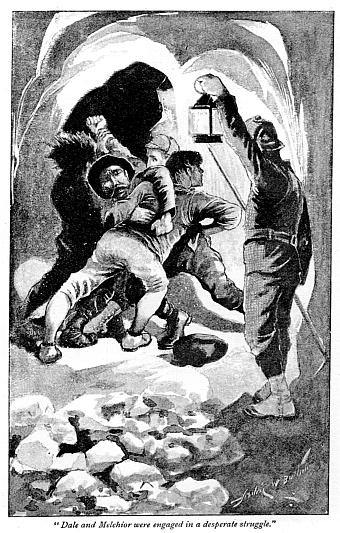
The boy’s position was exciting in the extreme, and thought after thought flashed through his brain as to what he should do, the result being that he did nothing, only held the lanthorn, so that those who struggled and wrestled, before him could see.
In spite of the hoarse, inhuman howling he could hear close to him, all superstitious notions were now gone. Dale and Melchior were too evidently engaged with human beings like themselves; and the next instant there was a heavy blow, a cry and a fall.
“Rightly served,” cried Melchior, “whoever you are. Now, herr, you hold him, and I’ll use my rope.”
“Quick, then!” panted Dale hoarsely: “he’s too strong for me. Hah!”
Dale was heavily thrown, and Saxe could dimly see a short, squat figure upon his breast. Then he saw Melchior appear out of the gloom, and quick as lightning twist a loop of the rope tightly round the arms of the figure, binding them to its side.
“Now, herr, up with you,” cried Melchior, “and help me. Show the light, Herr Saxe. Ah! that’s right: down on his face. Good. Your foot on the back of his neck. Now I have him. Good English rope: he will not break that.”
As the guide spoke he wound his rope round the figure’s hands, which he had dragged behind its back, and tied them fast, serving the legs in the same way, in spite of the fierce howlings and horrible yellings made.
“That will do,” cried the guide at last, and he stooped down over his prisoner. “Not hurt, are you, herr?”
“Well—yes, I am. It was like wrestling with a bull, and he has bitten my arm.”
“Not through your clothes, herr?” cried the guide excitedly.
“No: I suppose it is only like a pinch; but it was as if it were nipped in a vice.”
“Show the light here, young herr,” continued Melchior, as he turned the captive over. “He is beautiful, is he not?”
“Horrible!” ejaculated Dale, with a shudder. “Good heavens! who and what is he?”
“The most hideous cretin in Switzerland, herr. Poor wretch! he had no brains, but his strength is terrible. He is from the valley next to Andregg’s. I don’t know what he can be doing here.”
“I know,” cried Saxe excitedly: “watching us.”
“No,” said Melchior: “he has not the sense, unless— Here, I must have hit some one else in the dark. There were two. Give me the light!”
He snatched the lanthorn and stepped farther in, to bend down over another prostrate figure.
“It is!” he cried. “Pierre! I don’t quite understand as yet. It must be—yes, I see. The wretch!—it is his doing. He must have been watching us, and set this creature—this animal—to do his work—do what he wanted. But no: Herr Dale, Herr Saxe, I am puzzled.”
“Hooray!” shouted Saxe. “I have it!”
“What!” cried Dale, who was stanching the blood which flowed from his nose.
“The crystals!” cried Saxe. “They must have hidden them here.”
Melchior took a dozen steps farther into the ice-cave, having to stoop now, and then he uttered a triumphant jodel.
“Come here, herrs!” he cried, holding down the lanthorn. “Look! All are here.”
Saxe darted forward, to be followed more cautiously by Dale, and the party stood gazing down at the glittering heap of magnificent crystals hidden there as the least likely place to be searched.
For, as Pierre afterwards confessed, he had heard the plans made as he stood, on their first coming, in the stable, and then and there determined to possess himself of the valuable specimens the English party and their guide might find. In spite of his vacant look, he was possessed of plenty of low cunning, and he at once secured the dog-like services of the cretin, who had been his companion in the mountains for years, and obeyed him with the dumb fidelity of a slave.
The task was comparatively easy, for their knowledge of the mountains in that wild neighbourhood was far greater than Melchior’s. The cretin’s strength and activity were prodigious, and he readily learned his lesson from his master, with the result that has been seen.
Chapter Forty Two.
Clear as Crystal.
Pierre had received so severe a blow from Melchior’s axe handle that he was stunned, and when he came to he was so cowed and beaten that he went down on his knees, owned to everything, and begged for mercy, with the result that the miserable inhuman deformity grasped the position, and, uttering piteous whines and howls, seemed to be imploring mercy, too.
“Look here, Pierre,” said Melchior: “I have but to send down to the village to get a messenger to take a letter to the town, and the police will fetch you to prison.”
“No, no,” pleaded the culprit, and he implored for mercy again in the most abject terms.
“A year in prison would do him good, herr,” said Melchior. “He is no Switzer, but a disgrace to his country. We Swiss are honest, honourable men, and he is a thief.”
Pierre fell on his knees, and began to ask for pity again. “Get up, dog!” cried Melchior; and turning from him he began to untie the hideous deformity whose wild eyes were watching them in a frightened way.
“What are you going to do?” cried Dale. “You forget how strong he is.”
“No, herr, I remember; and I am going to make use of it; he is tamed now. Look here, Pierre, you and Mad Fritz will carry those crystals all down to Andregg’s.”
“Yes, Herr Melchior—yes,” cried Pierre abjectly.
“Stop! You can have the mule to help you, and for the next journey you can bring the donkey too.”
“Yes, Herr Melchior; but you will not let the English nobleman send me to prison,” he cried.
“We shall see. Get to work, both of you, and bring out the best. The herr will choose which.”
“Yes,” cried the man eagerly; and Melchior turned to Dale. “You will have a fair mule-load taken down to the chalet at once, herr, will you not?”
“Yes, of course.”
“Good; and we can leave the others here, and send these two to fetch them.”
“But you can’t trust them,” whispered Saxe. “Oh yes, I can, herr, now,” said Melchior proudly. “The law is very strong here in this canton; and being so strong, it is seldom put in force. People are honest here, in spite of what this man has done. My life on it now, herr, Pierre will bring every crystal down to the chalet.”
“But the cretin?”
“Will do exactly as he is told. Here, Pierre, take Gros and go to our camp. Bring the tent and everything back here while we get out the crystals. Take Fritz with you.”
“Yes, Herr Melchior,” said the man humbly; and then, turning to the cretin, he said something in a curious harsh guttural way, and the poor creature sprang after him and out into the day.
“Then you feel that you can trust them?” said Dale.
“Yes, herr, you may be sure of that. Everything will be taken down to Andregg’s—never fear. Ah! how plain everything seems now! The stones thrown at us—eh?”
“Never mind about them,” cried Saxe excitedly. “You’ve sent those two off with the mule, and they’ll take away our lunch, and I’m getting hungry now.”
“Sure, I had forgotten,” cried the guide, and he ran out. They heard him jodel and check Pierre and his hideous companion, so that the food was left behind.
This seen to, Melchior resumed what he was about to say in the ice-cave.
“You will communicate with the authorities, herr, about your great find?”
“Of course,” said Dale.
“That will frighten Pierre, when they come to take charge of the crystals. You cannot punish that poor Heaven-smitten creature Fritz.”
“No, certainly not.”
“Then I would ask you, herr, if the man Pierre is patient and obedient, not to punish him more. He is a poor half-witted creature, and the temptation was too much for him.”
“I shall not punish him.”
“Thank you, herr.”
“But,” said Saxe, “you said that the authorities would take possession of the crystals!”
“Yes, herr, in the name of the canton. But they will not be ungenerous. They will like good specimens for our museums; but they will let Herr Dale choose and take what he wishes to his own country. It is for science, and we Swiss are as proud to welcome all scientific men to explore our country as we are to serve those who merely come to admire and return again and again, to see the mountains, glaciers and lakes of our dear fatherland.”
All fell out as Melchior had foretold. Pierre and his follower soon returned with the tent, and humbly accepted some food before loading the mule, and then themselves, with some of the choicest crystals, which were deposited safely in Andregg’s chalet. The next day they made a journey with the two animals alone, and brought back more; and again on the following day they set off and brought the rest, Andregg gazing with astonishment at the magnificent collection.
In due time people from the principal city of the canton arrived, and the whole of the crystals were taken on mules to the Rathhaus, where soon after Dale was invited to attend with his companion and their guide.
They went, and were warmly complimented by the chief magistrate and the fathers of the city upon their great discovery, following which they were invited to choose what specimens they liked.
They chose so very modestly that the selection was more than doubled, and in due time reached Old England’s shores, to add lustre to several collections and museums.
Dale kept his word about Pierre, and quietly incited Saxe to make him a present when they went away.
“Because he doesn’t deserve it,” said Saxe, who also made a point of giving the unfortunate cretin an object which set his eyes rolling with delight every time it was taken out. This was a large knife with a collection of odds and ends stored in the handle: toothpick, lancet blade, tweezers, screwdriver, horse-hoof picker, and corkscrew, the latter being, as Saxe said, so likely to prove useful.
A month later, after a warm parting from old Andregg and his wife, who made her apron quite wet with tears, and insisted upon presenting Saxe with a very nasty-smelling cheese of her own make, the little party journeyed back through the various valleys, and on to the lovely lake of deep waters, where the mountains rose up like walls on either side, and then on and on to Waldberg, whence they were to start next day for home.
And then came the parting from the guide—the brave, faithful companion of many months.
“And now, Melchior!” said Dale, “I want you to accept this, not as payment, but as a gift from one friend to another—a present to the man whose hand was always ready to save us in perilous times.”
“That, herr!” said Melchior. “No, no: you have paid me nobly, and it has not been work, but a pleasure journey with two friends.”
“Nonsense, man: take it.”
“But, herr!” cried Melchior. “That watch for a poor Swiss guide!—it is gold!”
“Well, man, yours is a golden heart! Take it, and some day you may tell your son that it came from an English boy and man who looked upon you as friends. The watch was mine; the chain is from Saxe here: they are yours.”
The tears stood in Melchior’s eyes as the watch was handed to Saxe, who thrust it into the guide’s pocket. Then he grasped their hands.
“Good-bye,” he said, in perfect English—“Leben Sie wohl. Ah!” he cried excitedly: “I know French but badly; but there is a farewell they have, herrs, which fits so well. The mountains are here, and everlasting. It is nearly winter now, but the summer will come again, when the snows are melting, and the valleys will be green and beautiful once more; and when those bright days are here I shall see that the peaks are waiting to be climbed and that there are perils to be bravely met by those who love our land; and then I shall pray. Herr Dale, that you will come again, and that you, Herr Saxe, will come, and, taking me by the hand, say, as you have so often said, ‘where to to-day?’ Make me happy, gentlemen—me, the man you called more than guide, your friend—tell me you will come again.”
“We will, please God—we will!” cried Saxe.
“The words I would have said,” said Dale.
“Then, now for those words of French, dear herr: Au revoir!”
The End.
| Chapter 1 | | Chapter 2 | | Chapter 3 | | Chapter 4 | | Chapter 5 | | Chapter 6 | | Chapter 7 | | Chapter 8 | | Chapter 9 | | Chapter 10 | | Chapter 11 | | Chapter 12 | | Chapter 13 | | Chapter 14 | | Chapter 15 | | Chapter 16 | | Chapter 17 | | Chapter 18 | | Chapter 19 | | Chapter 20 | | Chapter 21 | | Chapter 22 | | Chapter 23 | | Chapter 24 | | Chapter 25 | | Chapter 26 | | Chapter 27 | | Chapter 28 | | Chapter 29 | | Chapter 30 | | Chapter 31 | | Chapter 32 | | Chapter 33 | | Chapter 34 | | Chapter 35 | | Chapter 36 | | Chapter 37 | | Chapter 38 | | Chapter 39 | | Chapter 40 | | Chapter 41 | | Chapter 42 |