"The Crystal Hunters" (continued 6)
Reading edition
“Yes; let’s see it,” said Dale eagerly, while Saxe felt a curious sensation of shrinking as he saw the guide secure one end of his rope to the nearest block of stone that stood up clear.
“Is that strong enough?” said Dale.
“Oh yes, herr; it is not a loose stone, but a solid piece of the rock, and would bear a dozen of us. I will go down first.”
He took hold of the rope, slipped over the edge of the shelf upon which they stood, and lowered himself down from buttress to ledge and projecting block, and stood the next minute inside the narrow crack.
“Will you go next, Saxe?”
The boy did not reply, but, imitating Melchior’s actions as nearly as he could, he lowered himself down, only hesitating once, when he was hanging over the dark hollow up from which came the noise of falling water.
“Come along, herr,” said Melchior encouragingly, as he leaned out of the hole and looked up. “Down another foot, and you can find a place to rest upon. The remainder is as easy as can be.”
Saxe found it so, for it only wanted confidence, and the next minute he was standing beside the guide and looking up from the opening as Dale now began to descend.
Saxe had to back into the black rift to make room for Dale to come, and he held on tightly by a projection from the rocky side of the cavern to stand listening to the trickling of water, evidently a great way below; and as the weird whispering sound came up, he could not repress a shudder.
But there was no time left him for reflections about the danger, for the next minute Dale was blocking out the light of the entrance.
“Ah!” he exclaimed, “this looks a likely place. Here, let’s have a match before we move. There may be all kinds of horrible pitfalls close at hand.” He let go of the rope, which swung to and fro in front of the opening, and took out a box of wax matches.
“I quite thought you had been down here, herr,” said Melchior. Then, as a match was struck and held up, he continued: “Yes, we must have the lanthorn here, herr, for it is dangerous. See how the floor is split up into great holes.”
Feeble as the light of the match proved, it was bright enough to show that; and, when nearly burned out, Dale threw it from him, and it fell, still burning, down and down till it was a tiny spark and it was impossible to say at last whether it went out or disappeared still burning in the great depth below.
“Why, Saxe, we have hit at last upon a veritable crystal mine,” said Dale, as he held up a fresh match above his head, whose light was reflected from the facets of hundreds upon hundreds of crystals depending from the roof and sides, and, as far as they could see for the tiny glow, encircling the whole place; while Saxe now found that the projection by which he held was a hexagonal piece as clear as glass.
“Yes, herr,” said the guide triumphantly: “this is what you wished for.”
“No,” said Dale, throwing away the end of the match again. “Very interesting, Melchior; but not what I meant.”
“Then I have not understood the herr,” said the guide, in a disappointed tone.
“Oh yes; and brought us to the part of the mountains where these wonders of Nature are to be found. These are beautiful, but, as far as I can see, all very small.”
“But there may be big ones, herr,” cried Melchior.
“May be; but it is doubtful here. There, it does not matter, for in the other cave—that to which you climbed—there are splendid specimens.”
“Is the herr quite sure?”
“Yes, for we brought one away, and Saxe hid it somewhere, and has forgotten the place.”
“Mr Dale!” cried Saxe indignantly.
“Well, then, I did,” said Dale, laughing. “There, both of you, I am quite content. I should not have murmured about these, but we have at our command some that are incomparably better; and to-morrow we will come properly prepared with lights, chisels and hammer, and see what we can do.”
“I am very glad, herr; and I have one peak I can take you up—the Blitzenhorn—where I am nearly sure we can find the finest yet.”
“Good: we will try it. Now let’s get back and dine.”
“Yes, that will be wise,” said the guide, as Saxe pricked up his ears at the suggestion. “I journeyed nearly all last night, herr, so as to get back soon; and I hurried on as soon as I found your letter with the pine skewer through it.”
“Under the stone, Melchior.”
“No, herr: stuck down into the crack between two pieces of rock.”
Dale said no more; and Saxe thought it strange, for he remembered the incident of securing the message perfectly.
“But Melk was tired and sleepy: he fancied it was secured like that,” Saxe said to himself.
He had no time to think more, for Dale spoke to him. “Now, my lad,” he said, “up with you; or shall one of us go first?”
“Oh, I’ll go,” said Saxe, turning to the gloomy opening, and reaching out his hand for the dull grey rope, which showed clearly against the black face of rock on the opposite side, not twenty feet away.
“Get a good hold, herr; next turn face inward, and swing yourself a little sidewise; then you will be on good climbing rock, and can easily get up.”
Saxe nodded, took hold of the rope, turned round, reached up as high as he could, and then was about to throw his whole weight upon it, when it gave way, and came down upon him. This, with the surprise, threw him off his balance, and he would have gone down backward, headlong to the bottom of the narrow cleft, but for the action of the guide, who darted out one hand and caught him.
Chapter Thirty One.
Misunderstandings.
Saxe dropped, but no farther than the sill of the entrance, where Melchior was able to hold him, while Dale reached over and gripped the boy by the belt and hauled him in.
“Oh, Melchior!” cried Dale indignantly; “I thought I could have trusted you to secure a rope.”
“But I did—I did, herr!” cried the man passionately. “I could have staked my life upon that rope being secure.”
“I spoke to you at the time about it not seeming safe.”
“The herr said the rock did not look secure, not the rope. The rock has not come down.”
“It is enough for me that the rope came down. Another instant, and that poor lad would have lost his life.”
“Yes, herr; but we saved him. I cannot understand it.”
“Has the rope broken?” said Dale, as it was hauled in.
“No, herr,” said Melchior, as he examined the rope in the darkness; “and, see, the loop is here and the knots still fast!”
“It is very strange,” said Dale.
“Yes, herr. Ever since I have grown up I have laughed at all the old stories about the dragons in the mountains, and the strange elves, gnomes, and kobolds said to live down in the deep mines; but what can one say to this? Is there an evil spirit to this crystal mine who is angry because we have come, and who seeks to punish us for intruding?”
“No, there is not!” cried Dale, with genuine English unbelief in such legends: “nothing of the kind. The loop slipped off the stone; so now climb up and fasten it safely, if you can.”
There was such a sneer in this that Melchior looked at him reproachfully before reaching round the side of the grotto and then stepping out of sight.
“Rather an upset for you, my lad,” said Dale kindly, as he took Saxe’s hand, while they could hear the rustling and scratching made by Melchior as he climbed up, dragging the rope after him; for he had not stopped to coil it up, but merely threw the loop over his head and put one arm through it.
“Yes, I thought I was gone,” replied the boy.
“It has made your hand feel wet, and set it trembling.”
“Has it?”
“Yes, and I’m sorry; for I want you to get plenty of nerve out here.”
“I’m sorry too, for I hate to feel afraid.”
“That was enough to make any man feel afraid. I’m trembling too, my lad; and my heart felt quite in my throat for a few moments.”
Just then the rope was shaken vigorously, and became still once more.
“It is quite safe now, herr!” cried the guide; “and I am holding it down too.”
“Right!” shouted back Dale. “I’ll go first this time, Saxe.”
“No, sir! please let me go: I would rather.”
“Do you feel cool enough?”
“That will make me cooler.”
“Then go on. Stop! you had better have the rope midway fastened to your waist, and I can hold the other end; then you cannot fall.”
“No, no!” cried Saxe, rather hoarsely. “Let me climb without.”
Dale gave way rather unwillingly, and the boy seized the rope, gave it a tremendous tug, and then swung himself out sidewise and began to climb; while Dale leaned out and watched him, uttering a low sigh of satisfaction as he saw him reach the top, and then following without making use of the rope.
“Now,” he said, as he reached the others, “how was it that rope slipped?”
“I cannot say, herr,” cried Melchior. “Look, here: the loop is big enough for it to come off easily if some one took hold of it with both hands and drew it up quite two feet, but it could not slip off by itself.”
“But it did.”
Melchior shook his head.
“Oh, man, man, how can you be so absurd!” cried Dale impatiently. “You don’t mean to say you believe any mischievous imp could have thrown it off?”
“What am I to believe, when the rope falls on us like that? There is no one here in this desolate, awful place—not even a wild beast.”
“Stop!” cried Saxe: “are you sure? Would a bear do that?”
“Surely not, herr.”
“I’ll believe in the bear before I believe in the gnome or kobold!” cried Dale. “Oh, Melchior! now I have so far had so much respect for you as a frank, manly Switzer, don’t spoil it by trying to cloak an error with a paltry excuse. You did not properly secure the rope; it came off; and it was an accident. You know it was an accident, so let it rest.”
“I have tried hard to win the herr’s confidence, and to deserve it,” said the man coldly. “I secured that rope as I believe any guide upon the mountains would have fastened it. The rope gave way not by breaking or coming untied, and I cannot tell how. I told the herr the beliefs of my people, and that I had ceased to think that they were true; but we are seeking to penetrate the mysteries of the mines, and this accident has befallen us. I can say no more.”
“Better not to say more,” said Dale coldly. “Will you lead on?”
Saxe glanced in the guide’s face, and gave him a look of sympathy as he saw how it was wrinkled and drawn with trouble; but nothing more was said, and he went on coiling up the rope as they passed along the dark chasm, only stopping to untie the knot as they reached the main rift and began the descent toward the glacier.
It was no place for conversation, even if Saxe had been so disposed; for every one’s energies were taken up by the task of mastering the way between or over the rugged blocks which filled the bottom of the place. But at last, at a sudden turn, a gleam of the white ice was seen, and soon after Dale was busily obliterating the mark he had made that morning for Melchior’s guidance.
Then began the slow descent, sometimes beside, sometimes over the glacier—wherever Melchior could indicate a short cut; the crevasses were passed, each bringing up its recollections of their adventures, and at last a more even part of their journey fell to their lot along the polished rock.
But Dale went on in silence, answering Saxe so shortly several times that he dropped back from walking abreast, and went on down for some distance half-way between his companions.
“I can’t help it,” he said to himself at last: “he must be offended if he likes. I don’t believe poor old Melk could help the accident. I shall walk with him.”
He waited for the guide to come up, and he was soon abreast, looking inquiringly at him, as if asking what he meant to say. The man’s face was dark and heavy of aspect, and he was evidently deeply hurt by Dale’s anger; and, in consequence, he looked up with a bright smile as Saxe asked him if he was tired.
“Oh no, herr,” he said; “my legs are a little heavy, but not so heavy as my heart.”
“Don’t take any notice of that,” said Saxe, in a low voice; “he did not mean anything much. He was angry because I was so nearly killed.”
“Yes; and it was just,” said the guide: “for I am answerable for your lives. It would have been most horrible if you had gone down there.”
“Yes, of course it would,” said Saxe lightly.
“And I have been thinking it over and over, herr, till I can think no more; for the thoughts always come to the same point. I cannot understand it.”
“Why, the rope got worked up, Melk; that’s all.”
“No, herr—impossible: that loop could not have worked up unless hands touched it.”
“Gnomes or kobolds?” said Saxe, smiling as he had not been able to smile in the gloomy ravine.
“Ah, herr! you laugh at the old fancy; but there the matter lies; and I am beginning to think that a great deal of our misfortune is due to the same cause.”
“What! the stone-throwing from the mountain?”
“Yes, herr.”
“Well, don’t let us talk any more about it, or you’ll be making me fancy all sorts of things after it is dark. How much farther have we to go?”
“A good piece yet, herr; but we know the way. There is no doubt about it. In a little while I shall hurry on before, and get the fire lit, so as to have the tea ready for Herr Dale. I am sorry I have angered him so.”
“Don’t say any more about it, and he will soon forget it all.”
“Yes, herr—I hope so,” replied Melchior; “but I cannot.”
Half an hour after he stepped out, and went silently by Dale, touching his hat as he passed, and went on so quickly that he was soon out of sight; and then Dale slackened his pace a little, to allow Saxe to come up.
“Tired and hungry, my lad?” he said.
“Yes, both,” replied the boy. “I hope Melchior has brought a chicken to broil for tea.”
Dale laughed.
“Well, now you speak of it, I hope so too, for I suppose I am hungry; but all that business put eating out of my head. By the way, Saxe, I am sorry I spoke so sharply to Melchior. The man is very sensitive, and of course he cannot help having a lingering belief in the old superstitions of the people among whom he was raised.”
“I suppose not,” said Saxe thoughtfully.
“Why, in one of their old books the author has given copperplate engravings of the terrible fiery and other dragons which dwelt in the mountains. Superstitions die hard. But there—I dare say he will forget it by to-morrow.”
“But don’t you think that some one must have lifted off the rope?”
“No: I believe it was his careless tying.”
“But I don’t think he could be careless,” said Saxe quickly. “Then, about that crystal being found. Somebody must have been down to that grotto, and dropped it as he came away. I think we are being tracked by people who wish us to fail.”
“Then whoever it is must wish, for we are not going to fail, my boy. We must and will succeed, in spite of everybody. By the way, did you break off that crystal by which you held when you were in the grotto?”
“No, I tried,” said Saxe; “but it was too firm, and I had not room to use my ice-axe, we were so close together.”
“Never mind; to-morrow will do. We must get a grand collection of choice specimens, Saxe; and I hope that, as the Swiss Government will be the gainers by my discoveries, they will not raise any objections to my taking a goodly assortment away.”
They relapsed into silence again, and it was growing so dusk when they began to climb up out of the glacier valley, that the reflection of a fire could be seen upon the side of the rocky niche in which they had formed their camp; and later on, as they came in sight of the little fall at the end of the rift in the mountain, the foaming waters were lit up so brilliantly that they looked like gold.
But the beauties of the place were forgotten by Saxe in the sight of a kettle on the fire, and something which looked wonderfully like cut-up chicken waiting to be frizzled over the glowing embers, beside which Melchior’s sturdy figure stood up plainly, with his dark shadow cast upon the side of the white tent.
“Tea nearly ready?” cried Saxe, as they approached.
“Very nearly, herr,” was the reply. Then to Dale, as a piece of sharpened pine was held out: “This is the wood used to pin down your letter, herr.”
“That?”
“Yes, herr; and it was stuck in that crevice between those pieces of rock.”
Dale took the piece with a curiously intent look in his countenance. Then, half aloud: “I could have taken an oath that I laid the paper on that—”
He looked hastily round, for nothing was visible.
“I was going to say on that stone, Saxe,” he said, in a low voice.
“I know,” replied the boy; “but the stone isn’t there, nor the one you laid upon it.”
“There!” cried Dale; “I was sure of it, and you are too. It is very strange.”
“Yes,” said Saxe: “somebody’s having a game with us, unless Melchior’s right, and there are—”
“Boys who ought to be kicked for being so ridiculously superstitious. There, let’s have a wash in the spring, and then get to our meal. Back directly, Melchior,” he said aloud, quite in his usual voice, as he passed close by the guide, who was now busy cooking.
Melchior bowed slowly, and went on with his work, patiently preparing the tea-dinner, and drawing back after the return of the others as if to leave them to partake of their meal alone.
It was a picturesque sight, and wonderfully attractive to a hungry boy,—the steaming kettle, the glowing fire lighting up the whole niche; and, to make the sight more enjoyable, there was the savoury smell, one which seemed to have had a peculiar effect upon Gros, the mule, for he had left the patch where he was picking up a good succulent meal, to draw near and stand blinking his eyes, flapping his long ears, and staring, till Saxe drove him off as he came to take his place.
“I say,” he whispered, “poor old Melk is so upset by what you said that he is not going to have tea with us.”
“Yes, he is,” said Dale quietly; and then aloud: “Melchior, I am afraid I said hastily some words which have wounded your feelings: I beg you will let me apologise?”
“I accept your apology, herr,” said the guide quietly.
“Then we will say no more about it; so come and sit down and join us.”
“The herr wishes it?”
“Yes, of course.”
Melchior sat down quietly and gravely, and the meal went on without further reference to the unpleasant incident; but Dale grew eager about their work on the next day, chatting about the size of the crystals he had felt, and the difficulties of enlarging the hole so that they could creep in.
“That can soon be done, herr, if we have fine weather, but there is lightning over the Blitzenhorn, and that may mean a storm.”
“Let’s hope not, for though this place is lovely now, it would be very dreary and cold if it were wet. Now then, let’s clear away and get to sleep, for we have a long day’s work before us to-morrow.”
The clearance was made, and the fire raked together and made up so that it might possibly last till morning, and then came the preparation for sleep.
“We shall divide the night into three watches to-night, Melchior,” said Dale suddenly.
“The herr will keep watch?”
“Yes; for whoever it is that is watching and trifling with us—”
“Then the herr thinks—”
“That we have an enemy hanging about our camp and following us.”
“Ah!”
“And that it was he who threw off the rope.”
“Then the herr thinks that?”
“Yes, I feel sure now, for I have been thinking it over, and I know that Melchior Staffeln, the tried old guide, could not possibly have fastened that rope so that an accident would result.”
“The herr gives me hope and life again,” said the guide warmly.
“Yes, Melchior, I was all wrong. There—shake hands, man, like we English do.”
“Yes: it is good,” said the guide, eagerly doing as he was told.
“Now lie down both of you, and sleep. In three hours I shall call you, Melchior, and in three more you will come up, Saxe. We may see nothing, but henceforth we will be on guard.”
Ten minutes later the fire was subsiding into a glow. Saxe and the guide slept, and Dale was keenly awake watching for the kobold who disturbed their peace.
Chapter Thirty Two.
The Treasure.
No kobold, gnome, or any other goblin of the mine disturbed the watchers through that night. Dale roused Melchior at the end of his spell, and somewhere about daybreak the guide roused Saxe, in obedience to his orders, and asked him whether he felt fit to take his turn.
“Eh?—Fit?” said Saxe, sitting up: “of course. Why shouldn’t I be?”
“I thought you seemed a little upset by the shock yesterday.”
“Nonsense: I’m only sleepy. I’m getting used to that sort of thing. There; lie down, and finish your rest. I’m as fresh as a daisy! I say, though: have you seen anything in the night?”
“The stars slowly going down behind the mountains, and the peaks beginning to glow.”
“Didn’t Mr Dale see anything?”
“No.”
“Well, I’m disappointed. I hoped one of you would catch the gentleman who comes after us. I’m sure there is something.”
“So am I, herr. The fire is burning. Keep it up, and call me when it is breakfast time.”
He lay down directly, and Saxe ran to the spring for a good sluice, to come back glowing and scrubbing his scarlet face with a towel.
“I say, Melk!”
There was no answer.
“Melky!”
Still silent.
Saxe bent over the Swiss, and then turned away.
“Well, he can sleep,” he muttered: “seems only to have to shut his eyes, and he is off.”
It did not occur to him that he was as great an adept at sleeping as the guide, and he turned away, half ill-humouredly, to finish his rough toilet, and then he busied himself in making preparations for breakfast, which entailed a severe fight with self, for a sensation of hunger soon developed itself. But he won by a vigorous effort, and, after all was ready, forced himself away from the fire and the kettle, walking right out of the niche, to stand watching the glorious changes on the mountain peaks, and the lines of light slowly creeping, downward and driving out the shadows where it was still night while high up amongst the glittering ice fields it was glorious day.
“Oh, how different it all looks in the sunshine!” thought Saxe. “Which did he say was the Blitzenhorn? I forget.”
Then he began to think about the day’s work before them—the tramp up beside the glacier, the climb along the black ravine, right in among the mountains, and the exploration of the caves.
“Well, we shall have found some crystals to take back,” he thought. “Wish it was breakfast time, though. What am I to do to amuse myself till Mr Dale wakes?”
At that moment a peculiar whinnying noise fell upon his ears, and he started off down the mountain side in the direction from which the sound had come.
“Better company than none,” he said, laughing. “Here: where are you, old chap?”
There was of course no answer, and he was some little time before he could make out the mule, whose colour assimilated wonderfully with the browny-grey rocks. But at last he saw it, end on, standing gazing up a narrow valley, and climbed down to find that it was in the midst of a fair spread of short whortleberry growth, whose shoots had evidently been his fare.
As Saxe drew nearer he could see that, in spite of the animal’s warmth, the longer hairs about the mule were covered with hoar-frost, and at every breath a couple of jets of white vapour were sent forth from the mule’s nostrils.
The mule took no heed of his approach, but gave vent to another long, loud, complaining whinny, and kept its head stretched out and its ears pointed in the direction of the top of the valley high above them.
“Hullo, Gros!” cried Saxe, as he approached; and the mule turned a little more away as the boy approached.
“Do you hear?” cried Saxe, stepping aside so as to get up to the mule’s head; but that head was averted a little in the other direction, and the animal’s hind quarters were presented.
“Now, stupid—I mean Dumkoff—I was going to pat your head. I can’t shake hands with your tail!”
He darted sharply a few paces to the other side, but the mule carefully turned, to balance the movement, and still presented his tail.
“Ah, you obstinate old ruffian!” cried Saxe: “how can you expect people to be friendly with you! Well, I’m not going to be beaten by an old mule, anyhow!”
It was a rash declaration, for as Saxe made a rush right by the animal it spun round, and the positions were once more the same.
This evolution was repeated again and again, till Saxe stopped short, panting.
“Here!” he exclaimed. “I thought it was cold this morning, and I’m getting hot. For two pins I’d throw a chump of rock at you, you obstinate old four-legged hit of ill-temper.”
He stooped and picked up a stone as big as his fists, and suddenly became aware of the fact that, though the mule’s head was turned away from him, the cunning animal turned its eyes back and was watching him carefully. For as he raised the stone Gros shook his head so that his long ears rattled, squealed, and a peculiar quivering motion, like the beginning of a dance, was visible in his hind quarters.
“Ah! would you kick!” cried Saxe. “You ruffian, you’d better not. There are plenty of stones, and I’ll give you one for every hoist of those nice little heels.”
He made an “offer,” as boys call it, with the stone, and there was a loud squeal. Gros’s head went down between his fore legs till he had nearly touched the ground, and he was turning himself into a tripod so as to set his hind legs at liberty.
Certainly they seemed at liberty, for he threw them out so vigorously that, as Saxe gazed at the hoofs playing about in the air, they seemed to be sparring and fencing at him, while the tail between whipped and whisked about, and ended by tucking itself in tightly, till Saxe sat down on a rock roaring with laughter, when the mule suddenly ceased its efforts, stood still, and turned its head round to watch him.
“Now it’s coming!” cried Saxe, leaping up and raising the stone again.
The mule squealed defiance, and out flew its heels once more, and this was repeated till, half choked with laughing, Saxe threw down the stone.
“There!” he said: “I wouldn’t throw at you. Poor old chap, then!”
He approached the animal now on the side to which its head was thrust to watch him, and, to his great surprise, Gros did not stir, but moved his head a little, and let him approach, pat his neck, and pull his ears.
“Only your fun, was it, old chap—eh! There! It was only my fun too. It’s all right. Go on, old fellow. But, I say, how long have we been carrying on this game? Suppose my fire’s out!”
He gave the mule a final pat, and then hurried back to the tent, where the fire was burning steadily, but wanted replenishing. This done, he looked at the sleepers, who were both like the Irishman in the old story, paying attention to it; then Saxe told himself that he would continue his watch.
This idea seemed so droll that he could not refrain from smiling.
“Rather a queer way of keeping watch,” he said, “going off like that. Never mind: there’s nothing much to steal, and no one to steal it. But I suppose I ought to stop; only the worst of it is, if I stop here I begin feeling hungry.”
The temptation came over him to examine the stores which Melchior had brought on the previous day, but he resisted it; and by dint of walking about using Dale’s glass to examine the different peaks and snowfields in the distance, the time passed till Dale woke with a start and sprang up.
“Ah, Saxe, my lad, have I overslept myself?—No? Well, it’s time I was up. All right? That’s well. Now, this ought to be an important day for us,” he continued, as he rapidly prepared himself for the journey. “We must creep into that grotto somehow, and with plenty of light. I expect we shall find it quite a treasure-house. But,” he said at last, “I think you may wake up Melchior now.”
“I am awake, herr,” said the guide, rising. “It is just the time I had settled to sleep.”
In a few minutes they were ready for breakfast, and as they began Melchior drew from the pannier a portion of the provision he had brought, smiling as he placed it upon the slab of rock which served them as a table.
“What are you laughing at?” said Saxe.
“Oh, only about being a boy like you once, herr, and thinking that when I was your age I too could eat one breakfast and feel ready for another in an hour.”
“I felt ready for one an hour ago, but I didn’t have one,” said Saxe. “No, it was two hours ago.”
“But the herr did have a breakfast one or two hours ago.”
“I?” said Saxe sharply. “No, I didn’t have anything.”
The guide looked at him wonderingly, then at the provisions he was setting down, and ended by shrugging his shoulders.
“I beg the young herr’s pardon. I thought he did,” said Melchior quietly; and for the time the incident was forgotten.
Half an hour later Gros was brought up, provisions packed, the geological hammer and a cold chisel put inside with the food, and they started after leaving wood and water ready for a fire when they returned.
The ravine was duly reached, Gros having proved himself an admirable climber on the ice, and he made no objection to ascending the black ravine for some distance; but at last it grew too bad for him, and he was tethered to a block of stone and left to meditate and lick the moisture which trickled down, for there was no pasture—not so much as a patch of moss.
Then the climb went on, Dale asking the guide if he thought the mule could get back with a load of crystals in the pannier.
“That depends on the weight, herr. If it is too much for him, we must help, or we must all go twice.”
In due time they reached the rock beyond which was the way down to the lower grotto; but though it would have been tempting to have explored this with lights, it was decided to leave it for the present, and to go on and break into the cave discovered by Saxe.
“Well,” said Dale, as they stood beneath it and gazed upon the black crevice, “do you think you can get at it so as to use a hammer and the chisel?”
“Oh yes, herr,” said Melchior quietly; and thrusting the hammer handle and the chisel through his belt, he went up and along the ledge with wonderful agility, sprang across on to the projecting block, and then Saxe watched him eagerly as he saw him drive in the point of the geological hammer as high up as he could reach, and use it to hold by while he climbed higher and got his feet on the lower edge of the opening, where he stood with his hand inside to steady himself while he wriggled out the hammer. Then, holding this in his breast, they saw him take a steel spike from his pocket, and after a little examination thrust the point in a crevice which looked like an upward continuation of the opening into the grotto. This done, a sharp stroke or two from the hammer enabled him to fix the spike sufficiently firmly to enable him to hold on by it with his left hand while he drove it in firmly with the hammer before passing the double rope over it, and making a sling in which he could sit opposite the opening and work.
“There, Saxe, neither you nor I could have done that,” said Dale, as the guide settled himself in the loop swinging before the mouth of the grotto.
“It makes my hands feel wet,” whispered Saxe. “Look!”
For Melchior was already hard at work with hammer and chisel, cutting off great angles that obstructed the way in and sending the fragments showering down.
They watched him intently, seeing that he used the hammer as he used his ice-axe, so as not to deliver an unnecessary blow.
“Think you will make a way in?” cried Dale, as the guide paused for a few moments to wipe his brow.
“Oh yes, herr; I should have done by now, only my blows fall weakly sitting swinging here.”
“Is the spike safe? Take care.”
“I shall not fall, herr,” he replied. “If the spike gave way I should have time to save myself.”
He began hammering again, this time without the chisel, and using the hammer with so much effect that they could hear the pieces of rock he chipped off rattling down inside, till at the end of about half an hour he ceased striking, and began raking out the bits he had broken off.
“I can get through here now, herr,” he said. “I’ll come down, and you shall go first.”
“No: that is your right, Saxe, as the discoverer; only be careful not to penetrate far. There may be danger.”
As they were speaking Melchior stood once more upon the edge of the entrance, sending a shovelful or two of the broken stone clattering down as he untied the knots in the loop, and, taking one end of the rope, threw it over the spike, made a slip-knot, drew it tight, and then glided down to where Dale and Saxe were standing.
“There, herr,” he said; “you can hold the rope, creep along the ledge, swing yourself across, and mount easily now.”
“Shall I go first?” said the boy, looking at Dale.
“Yes, of course; but we shall be close behind you.”
Saxe seized the rope, and, profiting by old experience, went up, swung himself over on to the projection, and then easily climbed in at the opening; saw that there was ample room for him to pass, and then he crept forward cautiously on hands and knees, finding that the floor sloped downward rapidly toward where all was black darkness.
He stopped short, not caring to go farther, and waited till the agitation of the rope, which he had let go, told him that Dale was nearly up. The next minute the figure of the latter darkened the opening, and he too crept in.
“Well, Saxe: what has Aladdin’s cave to show us?”
“Darkness,” replied the boy.
“Ah, well; we shall soon dissipitate that,” said Dale, as he loosed his hold of the rope and began to prepare the lanthorn he had brought up. “Seen any gnomes?”
“Can’t see anything,” replied Saxe shortly; for it seemed to him that Dale was smiling at him.
“No kobolds or goblins? Well, let’s strike a match and light up: then perhaps we may. That’s one good thing about these hollows,—there is no explosive gas, like there is in a coal mine. There, take this and hold it out before you,” he continued, as he closed and passed the lanthorn. “Lift it up! Now what can you see?”
“Something glittering—yes, crystals!—beauties!—what a size!”
“Hah! Yes. These are worth all the trouble we have taken!” cried Dale, as he dimly saw pendant from the roof, projecting from the rock at all angles, and even lying upon the floor of the grotto, dozens upon dozens of magnificent crystals, which seemed to be clear as glass, of a dull brown, like smoky quartz, and some even of a hue that was almost a purply-black.
At that moment Melchior’s head appeared.
“Is there room for me to come in, herr?” he said; and before an answer could be given, “Ah! those are large.”
“Large, my good fellow! they are the finest I have ever seen. Come in. Well, Saxe, how far does the grotto go in? Can you stand up? Mind your head!”
“Just stand up here,” he replied; “but it is higher farther in.”
“Let me go on first, herr,” said Melchior: “it may be dangerous. There is no telling where these cracks in the rocks extend.”
He took the lanthorn and crept forward cautiously, while Dale and Saxe watched the play of the light on the wonderful prisms and hexagons which hung in all directions. But there was no penetrating above thirty feet; for the grotto, after rising six or seven feet in height, dropped down again, and closed together till there was a mere slit.
“There may be more of it beyond here, sir,” said the guide, “if we could break through.”
“There is more than enough here, Melchior,” cried Dale. “I am satisfied if we can get these away.”
“Yes, herr,” said the guide, holding up the lanthorn, and making its light play in all directions, its rays flashing off the various facets in a way that displayed in some the beauty of their forms, and in others the limpid transparency of the stone,—“yes, herr: there are many mules’ burdens here. What will you do first?”
“Try to get off that one,” cried Saxe, pointing. “It is the best here.”
“They all seem best, Saxe,” said Dale. “Yes, we will have that one, if it can be broken off without injury.”
“There is a fine one here, herr,” said the guide. “It must have fallen from the roof.”
As he spoke he turned over a huge piece, after setting down the lanthorn, the light from which shot beneath it, and showed a rich purply-black stain, as the guide set the great hexagon up on end.
“Why, that is the finest I have seen,” said Dale, growing quite excited over his discovery. “This and two or three more will be a load for the mule.”
“Yes, herr, as many as we can get over the rocks with; but we can make many journeys backwards and forwards now we have found the place. But the herr will not take all away without sending word to Lucerne or Geneva?”
“You may trust me,” said Dale. “I shall behave quite honourably to the Government, who will, I have no doubt, consent to my keeping some of them. Now, then: we shall have a long, slow journey back, with such a load. Try and strike off that small white piece.”
The “small white piece” proved to be ten inches long and very heavy, when it had been dexterously struck off, without damaging any of its clearly-cut angles.
Two more very beautifully clear pieces were then selected, and then Dale looked questioningly at Melchior.
“If the mule carries the two largest pieces, herr,” he said, smiling, “and we take one each, I think it will be all we can do. When we get lower down, on to the better way, the mule can carry all.”
“Yes, we must not be too grasping,” said Dale, with a sigh. “I wish, Saxe, I had all these over in England safe.”
“I should like to have the whole grotto over there safe,” replied Saxe.
“Better say the mountain while you are about it,” cried Dale, with a laugh. “There, Melchior, try if you can get down that heavy piece.”
“Yes, herr, easily done,” said the guide; and, drawing up the rope, he made it fast to the largest crystal and carefully lowered it down.
“You must go down now and unfasten,” said Dale. “I can lower the rest. But what about the rope when we have done?”
For answer Melchior climbed up and loosened the rope, leaving only a loop over the spike. Then sliding down, he soon set the crystal free, and the others were lowered down. Dale and Saxe followed, and the rope was jerked off the spike and coiled up.
“The only way of locking up the door,” said Saxe, laughing. “But, I say, these will be very heavy to carry back. What’s the matter?” he continued, as he saw Dale looking at the fragments of broken rock sent down by Melchior.
“I was thinking that those pieces will tell tales,” he said. “If any one comes up here, they will see we have been at work.”
“Yes, herr, if any one comes by; but nobody is likely to come here.”
“I suppose not,” said Dale thoughtfully, after a look round.
“The herr forgets that we are now in the wildest part of this the most desolate of our cantons.”
“Yes, I had forgotten,” said Dale lightly. “No one is likely to come, unless it be one of your kobolds, Melchior.”
“They will not come, herr, or they would have been here to protect their treasures,” replied the guide, laughing, as he stooped and lifted the big crystal on to his shoulder; then took it off, and asked Saxe to place the coil of rope under it. “The stone is heavy,” he said cheerfully. “Yes, that’s it: now it will ride easily. I think, herr, if you take my ice-axe and give me another under this arm to balance it, I can get on well.”
“But you are too heavily laden now, Melchior.”
“Oh no, herr: I am a strong man. Give me the other.”
It was handed to him.
“Now, can you carry the other three?”
“Oh yes—easily,” cried Saxe, who took one of the largest. “’Tis heavy, though,” he added to himself, as he felt the weight of the solid stone.
“Then these two are my load,” said Dale, placing one under each arm as soon as he had thrust the ice-axe handles through his belt. “Ready?”
“Yes.”
“Then off!”
They started, and but for the knowledge of the value of the load Saxe would gladly have freed himself of the burden by letting it fall on the stones. But these were the crystals of which Dale was in search, and as he saw that his companion was patiently plodding on and making his way over the sharp, rough masses of stone with which the ravine was floored, he bent to his task patiently, though it seemed as though they would never reach the spot where the mule was tethered.
There he was though, at last, ready to whinny in welcome of their coming; but this glad greeting closed when Melchior’s load was carefully balanced across his back, and the journey downward was very slowly and solemnly performed.
With the heaviest crystals safe on the mule’s back, a redistribution took place, Melchior relieving Dale of his heaviest piece, and Dale exchanging his lighter one for Saxe’s; and in this order the side of the glacier was descended, and they reached the camp hot, tired and hungry.
“Why, Saxe, we shall not want many loads like this,” said Dale.
“No, herr,” said Melchior, as the boy stood shaking his head. “You cannot take many away, unless we have a train of mules. Where will you have these placed?”
“Oh, just inside the tent for to-night. In the morning we must contrive some hiding-place for them, to which we can bring the rest; and when I have all I want we must bring mules here and remove them.”
A good long look was taken at the various magnificent specimens before they were laid together. Then Melchior busied himself helping to prepare the meal; and very shortly after this was ended, watching being deemed unnecessary, the whole party were sleeping soundly, not one of them, after the heavy toil of the day, being startled by the loud squealing whinny given by the mule toward the middle of the night.
Saxe’s sleep was almost dreamless till toward morning, when he became a little restless consequent upon imagining that he was engaged in a desperate encounter with a small round goblin, who was about the size of a baby, but seemed to have the strength of an elephant. He walked in at the tent door, and informed Saxe that he had come to fetch the crystals stolen from his storehouse that day; and upon Saxe refusing to give them up, a desperate encounter took place—a fight which had no beginning and no end, finishing off, as it were, in a mist, out of which he started to hear the sound of wood crackling, and to find that it was day.
Chapter Thirty Three.
In Desperation.
The faint grey dawn lit up the canvas of the tent and faintly showed the figure of Dale fast asleep, with his head close to the place where the crystals had been laid and covered over with a rug.
Melchior had crept out of the tent without making sound loud enough to awaken them; and it was apparent now that he was busy preparing the morning meal.
Saxe did not want to get up for a few minutes, and he lay thinking about the beautiful crystals, and of how he would break off a few of the smaller ones to bring away in his pockets to keep as curiosities for home. Then he recalled the weight of the one he had carried overnight, and thought how strong Melchior must be, or else how patient and enduring. Finally, he determined to get up and go and talk to the guide about their work for the coming day—a task which had lost its zest now that some of the crystals had been found.
But his moving roused Dale, who started up.
“Throw open the tent door, my boy, and let’s have some fresh air. I want to have a look, too,” he cried, “at our treasures.”
Saxe obeyed; and he was in the act of looping back the canvas, when Dale uttered an angry cry.
“Gone!—stolen!” he cried. “That man must have gone off with them on the mule.”
“Did the herr call?” said Melchior, hurrying up.
“You here, Melchior?” stammered Dale in his surprise. “But yes. Look! The crystals! We laid them there. Do you know where they are gone?”
“No, herr. But are you sure?”
“Sure, man! Yes, and—ah! Look at that!” he continued, pointing at the tent wall. “A slit has been cut in it with a knife.”
Melchior rushed outside and examined the slit.
“Yes,” he said, shaking his head; “cut with a sharp knife. It must have been whilst we slept.”
“And by some one who must have been watching our movements.”
“There!” cried Saxe excitedly. “I knew it. I felt sure that we were being watched.”
“Whoever it is cannot have gone far,” said Dale sternly. “It is the same party that stole the crystal before. Now, Melchior, which way are they likely to have gone?—of course back toward the valley!”
Melchior shook his head.
“But they must. There is no other road, you say.”
“Oh yes, herr: there are ways for good climbers.”
“But a good climber cannot get up and down dangerous places with half a hundredweight of stones on his back, man.”
“No, herr. They would not carry the stones very far: they would hide them.”
“And go back without them!”
“No, herr. If the object of watching us is to get the crystals, they will still be hiding to see if we find more.”
“Yes, you may be right,” said Dale, after a few moments’ thought. “Here, let’s have a good look round in different directions.”
Melchior looked at him half pityingly.
“Which!” he said at last. “Has the herr thought how impossible it would be to hunt good climbers down in these wilds! Look!” he continued, waving his hand round; “the great wilderness is everywhere, and there are thousands of places where men could hide.”
“Yes, I know all that,” cried Dale impatiently; “but I am not going to sit down quietly and be robbed like this of the specimens I have worked so hard to get. What do you say, Saxe!”
“Get ’em back at any cost. I think they are Italian brigands from the other side who have done it.”
“No, herr,” said Melchior. “It is the work of some of our people, who are greedy and jealous. There are some who would sooner work hard for a month to find an opportunity to steal a few francs than work honestly for a week to earn double. Fortunately they are very few.”
“Then you would give up and not search for them!” said Dale angrily.
“I would search for them, herr; but it would end in failure. This must be done by men who know these high mountains as well as I do. Why, if I wished to hide here, there are places I could get to where I should never be found.”
“But the hiding people want food!”
“Yes, herr,” said the guide drily; “and they have got it. A great deal of what I brought up with Gros has gone. I thought the young herr here had taken some of it; but I see now.”
“Then, what would you do?”
“I would not waste time in hunting for what we shall never discover, herr. It may be hidden in the mountains, or down some crevasse in the great glacier. Those crystals were very fine, but we left others behind in the grotto as beautiful. Why not go and get these, and take what we find at once to a place of safety?”
“At once? You forget how long a journey it is back.”
“No, herr. It is far; but once we have them we must watch, and not be robbed again like this.”
Dale stood thinking for a minute or two, Saxe watching him eagerly.
“Very good advice,” he said; “and I will follow it, but not to-day. Saxe, you must be guardian over the camp. No: we shall want your help, my lad. Put some food in your wallet, Melchior; and we will try and trace these people, for there must be more than one.”
“Yes, herr; there must be more than one,” said Melchior; and hastily making the provision required, he said that he was ready.
“Now, then,” cried Dale; “which way first?”
“One way is as good as another, herr,” replied the guide. “It is all chance. We may go upon their track; we may go right away. Shall I lead?”
“Yes,” said Dale, frowning; and the search began and lasted till darkness forced them to give up and seek their couches, tired out. For, taking the camp as a centre, they went off from it and returned, from every possible direction: not that there were many, for the vast precipices and hollows around compelled them to be select in their routes.
But it was all in vain, and from starting there was nothing that guided them in the slightest degree: for they were in a wilderness where footprints only showed upon the snow; and wherever they approached an ice field it was to find the pure white mantle unstained, and not even showing the track of a bird.
“Will the herr continue the search to-morrow, or go to the grotto?” said Melchior, as they lay down to sleep.
“Continue the search,” said Dale sternly; and the next day and the next they toiled on, going farther and farther into the mountains, but there was no other result than weariness.
“It’s enough to make one believe in Melchior’s goblins,” said Dale petulantly, “all those beautiful crystals to have been spirited away like that. But never mind: we shall find them to-morrow, I feel sure.”
But when to-morrow came Dale did not feel so sure; and, altering his mind, to Saxe’s great delight, they took the mule and started for the grotto once again.
Dale went first, and the mule followed, Saxe walking behind with Melchior, until they reached the black ravine.
“I am glad,” the boy said, as they trudged along over the rock and ice. “It was all waste of time trying to catch those fellows.”
“Yes, herr—quite.”
“Have you no idea as to whom it could be, Melk?”
“No, herr, not the least. Mr Dale must have talked about his journey to some one as you came, and clever people have been let to watch you.”
“Well, it’s no use crying over spilt milk, even if it is Swiss milk,” said Saxe, laughing.
The guide looked at him wonderingly. He was very proficient in English, but proverbs puzzled him, and he shook his head.
“Well, then,” said Saxe, laughing, “it’s of no use to throw away time when we can use it to advantage. Do you understand that!”
“Quite,” said Melchior. “We must get a very great load of the crystals to-day, and make sure of them. It will be a splendid find, if we pick the best—grander than has ever been made here before.”
“And I discovered them,” said Saxe proudly. “Yes, herr; you discovered them,” said the guide, smiling. Saxe coloured.
“He’s laughing at me,” he said to himself, as he hurried on to overtake Dale. “I do wish I was not so conceited.”
They had a brief halt at the mouth of the black ravine, toiled up it till they reached Gros’s tethering place, and then went on.
“I have been thinking,” said Dale, as Saxe climbed on beside him, “that we ought to have swept away all those chips of stone after we opened the place.”
“You both thought no one likely to climb up here,” replied Saxe.
“Yes: we thought so, Saxe,” said Dale rather shortly; and then the toil of the climbing among and over the sharp crags put an end to their conversation, and they kept on till they were beneath the narrow crevice with the fragments of stone chipped out by Melchior lying just as they had been left.
“Now, Melchior,” cried Dale; “I will not be avaricious. We’ll have one good select load of the crystals, and then make them safe. Up with you!”
Melchior climbed up, fastened the rope to the spike, and then crept inside the grotto with the lanthorn attached to his waist.
“Looks just like a bear going into his den,” said Saxe, laughing, as the hind quarters of the guide disappeared.
“Yes. Up with you, and play bear too, or monkey,” said Dale, laughing; and with the help of the rope the boy soon reached the opening and crawled in.
Dale followed, and blocked out the light just as Melchior had crept farther in, and was busy opening the lanthorn and striking a match.
“One moment, Melchior,” said Dale: “here’s a piece of blue light,—let’s burn that.”
But just as he spoke the match flashed into light, and Melchior dropped it; they heard him scratching at his box, and directly after he struck about half a dozen together, and separated them, so that they burned brightly, holding them high up above his head before taking one to light the wick of the lanthorn.
At the first flash out of the matches Saxe sprang back in horror, and Dale uttered a groan of disappointment. Then there was a dead silence, during which the matches blazed down close to the guide’s fingers, and were allowed to fall, while the lanthorn burned more brightly, showing the guide’s wrinkled countenance, full of disappointment and despair.
“It’s horrible!” cried Saxe wildly. “Oh, if I only knew!”
“Yes, boy: if you only knew,” said Dale.
“We must find them.”
“No, young herr: it would be waste of time to try. Trust to me; perhaps I can take you to a better grotto yet, and if we do find one, we will live in it till bit by bit the crystals are removed and placed in safety.”
“We shall not find such another spot,” said Dale sadly.
“The mountains are wonderful and vast, herr. There is the Blitzenhorn yet to try.”
“Yes, to try,” said Dale sadly. “Oh, but it is maddening just as success had attended us!” and he relapsed into gloomy silence, as Melchior went about the grotto holding the lanthorn to its glittering ceiling, the light flashing from hundreds of crystals; but every one worth taking as a specimen had been removed, and a great rusty hammer with which they had been broken off lay before them, forgotten in their hurry by those who had been there.
Chapter Thirty Four.
Growing Resigned.
A month had glided by, during which Dale and Saxe had explored valleys, traced glaciers to their sources, and made plenty of mountain ascents; but though they penetrated into the wildest regions of the higher alps, and encountered storm and wind sufficient to tear them from the giddy crags to which they climbed, no more crystals rewarded their efforts, no curiously half-hidden rift fringed with sparkling points invited them to break a way in.
“Why not try the Blitzenhorn, herr?” Melchior would say: “the young herr is getting to be a clever, sure-footed mountaineer now, and I have hopes of our being successful there.”
Dale would gaze up at the mighty peak whose icy crown stood up before them, beyond the mountains which surrounded Andregg’s hut, and shake his head.
“No,” he said: “the climb is too difficult for Saxe.”
“Oh no!” cried the boy; “I feel sure I could do it.”
“And I feel sure you could not,” replied Dale. “Look at it. The snow slopes you could manage; but those black, forbidding, almost perpendicular crags would be too much for you, and that is the part we should have to explore.”
“Yes,” said Melchior; “certainly that is the part we should have to explore.”
“Well, why not let me try!” cried Saxe.
“Wait, my lad—wait.”
So their days passed on, amidst fine weather and foul; partly-passed at Andregg’s chalet, partly in the mountains with their tent. They had been again and again to the black ravine, and examined other grottoes, bringing away a good assortment of crystals, but, as Dale said, there was nothing particular among them; and though they divided their time between trying to make fresh discoveries and tracing the old treasures, the crystals had disappeared as completely as if the legendary spirits of the grots and mines had snatched them back, and hidden them where they would be safe from mortal eyes.
But it was a glorious time, in spite of the disappointment, and Saxe revelled in the wondrous scenery, growing more sure-footed and firm of nerve day by day when in the mountains, and happy and full of fun when back in Andregg’s valley, leaving the donkey or his companion Gros, and accompanying heavy, surly, stupid, strong Pierre up the green alps to fetch home the goats and cows, becoming a perfect adept with a great wooden Alpine horn, whose notes evoked wonderful echoes among the mountains which shut them in.
The natural history collection increased—butterflies, pressed plants and minerals were stored up; the falls were used for shower-baths; trout caught in the streams and lakes; and time was passing, when one evening, as the glorious sky foretold a bright day on the morrow, Dale, who was seated outside Andregg’s chalet with Melchior, returned that day from far below with a fresh load of provisions, called Saxe to bring him his field-glass.
This was brought, and the lad watched him, and saw that he was scanning the Blitzenhorn carefully.
“He means to try it, after all,” thought the boy, whose heart began to beat heavily.
“Fine day to-morrow, Melchior,” said Dale at last, as he closed the glass.
“Yes, herr, I think so; though one never knows what changes may come.”
“But it is pretty sure to be a good day!”
“Yes, herr.”
“Then we’ll start at three to ascend the Blitzenhorn, and I hope your prophecies will prove right.”
“I hope so, herr. Everything shall be ready. We’ll take the mule and tent?”
“No: we’ll go in light marching order, and chance it. Let’s get to bed at once, and start at two.”
“Good, herr. Coffee shall be ready at half-past one.”
“One moment. What about the moon!”
“We shall have it with us at starting, herr.”
“And which way do you propose?”
The guide raised the ice-axe, which never seemed to leave his side, and pointed out the route he meant to take, with the difficulties likely to be encountered among the great snowfields which clothed the giant’s sides.
An hour later the preparations had been made, and they were all sleeping, when, just as he had apparently closed his eyes, Melchior stood over Saxe and roused him up once more.
“One o’clock, herr; and the coffee is nearly ready.”
It had now become such a matter of course to rise at these nocturnal hours for long expeditions, that Saxe turned out at once, with nothing more than a growl or two and a vicious snatch at his clothes. The cold water and the coffee, however, soon set him right, and at two punctually the trio were on their way along the valley, with the last quarter of the moon to light them as they struck up close by the end of the lower glacier, and then went on and on at a steady rate toward the great giant whose pyramidal peak could be faintly discerned in the distance, looking to Saxe terribly far off, and as if it would be impossible to reach the top that day. But their guide had cunning ways for shortening the distance, leading them round this outer buttress, up that ravine, and in and out and along shelves, so that, by the time the sun rose, they had well mastered the outworks, and were ready to attack the peak itself.
For the next two hours it was now steady climb over rock and snow. Then the difficulties began, but were surmounted one by one,—a great snowfield or two were skirted, an arète mounted, which led them to the foot of a slope of hard ice, where they halted for a rest.
“Must we take that, Melchior?”
“Yes, herr: there is no other way, and with the rope it is not so difficult.”
“But you will have to cut steps all the way!”
“Yes, herr.”
“And the precipice?”
“You will not mind that, herr; and I am sure he will not shrink from it now.”
Saxe declared that he was ready, and for the next hour they were crossing the ice, where a slip might have sent all flying down two or three thousand feet. But it was passed at last, and the great black crags were now within easy reach.
“Do you mean to go right to the top, herr?” said the guide; “because, if so, it would be better to do it now, before the snow grows softer, and descend to the black crags afterwards. Then, if we do not find crystals, I can take you round by the cornice, and over or round one of the snowfields home.”
“What do you say, Saxe? Shall we venture?”
“Yes, we must be able to say we have climbed the Blitzenhorn.”
“Go on, then, Melchior, and we’ll do it. Is there anything very bad?”
“No, herr, I think not. A few crevasses, perhaps, that one can get over, are the worst. Nothing more difficult than we have often done.”
They climbed on, but the difficulties increased, and there proved to be an awkward ice ledge to pass along, with a terrific gulf beneath; and a gap or two, with snow bridges, which were apparently waiting a touch to go down at once. These were all safely overcome. And at last a long slope of loose snow was all that remained to toil up before they reached the top, where Saxe threw himself down to enjoy the wondrous prospect of glittering ice peaks, and, a few minutes after, the food Melchior brought from his wallet.
“It doesn’t seem so difficult as you thought,” said Saxe, with his mouth full.
“Don’t holloa till you are out of the wood,” replied Dale. “Shall we go back the same way?” he said to the guide.
“No, herr; I shall take you back right to the black rock, where it is too steep for the snow to lie.”
“And for us to get down?”
“I shall skirt the edge of those steep bits, herr. You will see.”
In half an hour they were once more afoot, with the sun beginning to blaze down upon them and the snow dazzling their eyes; but the descent to the first bare rocks was steadily made, and the exploration began, with the result during the next two hours of four crevices being discovered, each lined with crystals that, at the first sight, looked like ice, but a close investigation satisfied Dale that they were not worthy of his notice, and that the minor grotto in the black ravine was far superior.
“No good, herr,” said the guide sadly. “Sehr schlecht. I hoped we should have done better.”
“Never mind. We have done the best we could, and this has been a magnificent ascent.”
“The herr is satisfied with that?”
“Yes.”
“Splendid!” added Saxe.
Then a difficult descent began, among the jagged masses of rock, whose hollows were full of snow. After some stiff work a great couloir was reached, one which led well down in the direction the guide was now taking, and along this gully they managed to glide in safety, though twice over great stones came bounding down from the black crags overhead.
Then a ledge of ice had to be cautiously approached and passed, one angle where there was barely foothold calling for all Saxe’s fortitude; but he passed it bravely and fought very hard not to show that he had felt a slight attack of nerves. There had been a curious catching sensation in his throat, and his breath had come as he glanced once down into the blue haze in an ice gulf; but he breathed more freely as firm snow and then solid rock was reached; and the descent continued, no allusion being made to the perilous bit, though on glancing at the guide once he received a nod which evidently meant:
“Bravo! well done! You could not have faced that when you first came among the Alps.”
Chapter Thirty Five.
A Catastrophe.
“When are you going to give us a glissade, Melk?” cried Saxe, as they reached a piece of smooth snow descending at a moderate angle.
“The first time there is a suitable place, herr,” replied the guide quietly.
“Why not here?”
“I will show you when we get to the bottom.”
Saxe looked disappointed, and grew more so as the descent was made slowly and toilsomely, with every precaution taken and warning words uttered from time to time respecting keeping the rope taut.
“But there were no crevasses here?” said Saxe, as they reached to where the slope seemed to curve over suddenly and then descend more sharply, for the continuation was out of sight.
“No, there are no crevasses,” replied Melchior; “but a slip here would have been bad.”
“This is a cornice, then, Melchior?” said Dale.
“Yes, herr, and if you two will hold me, I will step out a little way and break a hole for you to see.”
In obedience to his instructions, Saxe and Dale stepped back to the full extent of the cord, and then eased it out as the guide stepped forward, till he suddenly held up his hand.
“Now,” he said, “let me bear out against the rope;” and, raising the ice-axe in both hands, he began to use it vigorously, cutting hard at the frozen snow, till there was a sharp crack, and he threw himself back while a huge piece of the cornice broke away and dropped down out of sight. Then all waited breathlessly till a faint hissing sound told that it had touched rock or ground somewhere below, but how far down Saxe did not realise, till Melchior made way for him to creep to the extreme edge and look.
“We have the rope tightly,” said Dale, “so you need not hesitate.”
But the boy did hesitate, and, after peering over, he shrank back appalled.
Melchior smiled.
“Well, herr,” he said, “what do you think of the glissade, if you had taken one?”
“It’s horrible,” said Saxe, in a subdued tone; and he turned and looked down again where the guide had broken away the cornice, which curved out over a tremendous precipice, and saw that had he followed his inclination and slid down the snow slope, he would have gone over the cornice, and then plunged headlong, to fall nearly sheer down what seemed to be three or four thousand feet, to where a glacier wound along past the foot of the precipice.
Just then Dale joined him.
“Ah!” he said; “this is grand. Look at the course of that river till it disappears in the haze. You can count several villages, too, on the mountain slope and plain.”
But Saxe had no eye for river or villages. The object that took his attention was the river of ice below, upon which whoever dropped from where he stood must fall; and as Dale spoke to him again, he turned away with quite a start and a shudder.
“Hallo!” cried Dale; “that will not do. Too imaginative, Saxe. There’s plenty all round to encounter, without your calling up the imaginary. Well, Melchior, which way next?”
“Up above that snow slope, herr, and round the shoulder of the mountain that you can see yonder.”
“Yes; but that’s going up again.”
“Yes, herr; I do not like to be so near this place without letting you see the Silber Grat and the wonderful view. Very few people come to see this place, but it is very grand.”
“Yes, grand in the extreme,” said Dale. “Here, Saxe,” he continued, giving the rope a jerk, “come away now.”
The boy started again, and then frowned, as he felt as if he were being treated like a mule or a donkey, held by a halter.
“Ready, herrs?” said the guide. “We must get on, please.”
“Which way?” said Dale.
“Straight up, herr, along by these rocks, till we are above that snow slope; then along the top across the shoulder, where we shall find an easy slope on the other side, and perhaps be able to have a glissade without going down a precipice at the bottom.”
“Oh, come!” cried Saxe; “that’s meant for me. How was I to know that the mountain ended suddenly like a wall?”
“Never mind that,” said Dale impatiently; “it’s growing late, and we want to get back to camp. Why, Melchior, we are going to have a storm!”
“Yes, herr; I’m afraid so.”
“Then why go up there and along the top? Surely we can go diagonally up the snowfield from here to the corner below the shoulder, and we shall save half a mile, at least!”
“Yes, herr; nearer a mile,” said the guide, gazing up thoughtfully at the smooth snowfield; “but there is a great slope there.”
“Yes, but away from this horrible precipice. I suppose that goes down into an inner valley?”
“Yes, herr; and extends right to the bottom—all snow.”
“Then a slip and a roll would not matter?”
“No, herr.”
“Then why do you hesitate, man?” cried Dale peevishly, as the guide stood with his brow shaded, gazing up at the dazzling slope which rose from them at a little distance and then curved over and disappeared.
“I was looking, herr, because I mistrusted that snow. It does not look healthy.”
“What, likely to give way? Absurd! There are no crevasses there.”
“Oh no, herr. It is all rock below.”
“Of course: it must be. Well, we will take the cut right across that snow to the opposite corner.”
“The herr desires it?” said Melchior gravely.
“Yes, certainly. It is folly to go so far round.”
“The snow is not always good, herr; and the longest way round is sometimes the nearest.”
“Yes, but with a storm coming on, perhaps!” said Dale sharply.
“It may be hours yet, herr.”
“The better for us. Let’s get back down into shelter.”
Melchior said no more, but unfastened the rope, and after coiling it up, led them along for some distance, till the great cornice was left behind, and they descended into a little valley over snow, ice and rock, till they reached the stream hurrying down the hollow, crossed it, made a similar ascent, and just as Saxe had it in his mind to say, “I thought we were going over that snowfield,” they climbed up through a little wilderness of blocks, and they were upon the edge of the unsullied slope, which ran up to left and down to their right apparently for a mile.
“Ah!” cried Dale, springing upon the snow, which allowed his feet to sink in a little; “capital condition! Now, Melchior, forward!”
“Yes, herr,” said the guide, testing the snow with his foot; “there will be no steps to cut here.”
He then started off to cross the great snowfield diagonally, so as to reach the rocks at the far top corner, his feet sinking more deeply into the soft crystals than was conducive to good progress, and Saxe first, and then Dale, keeping pretty well to his footprints.
“Disappointing, this,” said Dale, when they were about a third of the way across. “I thought we were to have nothing but downward progress now.”
“It is puffing work, too!” cried Saxe.
“Herr! herr!” said the guide, stopping short in his tracks, and speaking in a reproachful whisper.
“What’s the matter?” said Saxe.
“There is a great deal of loose snow high up on our left, and if you set any of it in motion it would be bad.”
“I forgot,” said Saxe apologetically. “I will be more careful.”
“That’s right,” said Dale. “Not much danger, though, here. No fear of being bombarded by stones—eh, Melchior?”
“No, herr,” said the guide, looking about him anxiously. “Shall we get on?”
Dale nodded, and they tramped on through the soft snow for some distance farther; when, just as Saxe was asking himself whether he was growing tired or the snow much more soft, Melchior paused once more and looked upward.
“Yes—what is it?” said Dale quickly.
“A minute’s rest for the young herr, sir. As soon as he has his breath well go on. The snow is loose, but better than I expected. I was a little afraid at starting.”
“Afraid? Of what?”
“The snow is often a little treacherous in a place like this, herr; and as it is so loose we shall have to be careful about glissading when we get beyond the rocks yonder.”
“But surely there is nothing treacherous here?” said Dale: “a little soft, perhaps, but that is all. Go on: we ought to be up there in another quarter of an hour.”
“Yes, herr,” said the guide, after another glance up at the wreaths and folds of pure white snow which draped the mountain high above their heads; and then, after giving Saxe an encouraging smile, he went on again, with his boots crunching down the snow, forming a series of impressions which were deepened by those who followed.
Half the distance—two-thirds—was passed; and as he struggled on, feeling hot now and as if the exertion were telling upon him, Saxe glanced back, wondering at the length of the track they had made, and how the snowfield had seemed to extend as they trudged along.
“Yes,” said Dale, from close behind him, as he divined the boy’s thoughts, “it is a long way; but we shall soon reach the rocks now, and then the worst part of our journey is done.”
Crack!
A long dull report, as of something breaking; and Melchior stopped short and uttered a groan.
“What is it?” cried Dale excitedly.
“The snow, herr—the snow!” cried Melchior. “See!”
He spoke calmly and solemnly, but made no effort to dash on; though, as he realised their danger, Dale’s first impulse was to call upon Saxe to try and reach the rocks.
Melchior knew that it would be impossible, and he stood firm, ready to meet his fate.
For far above them a dark jagged line had opened across the snowfield, with the dull report they had heard. That crack had begun to widen rapidly, with a curious hissing noise, and the next moment Saxe saw that the vast snow slope was in motion, and that they were being carried by it downward toward the valley, a couple of thousand yards below.
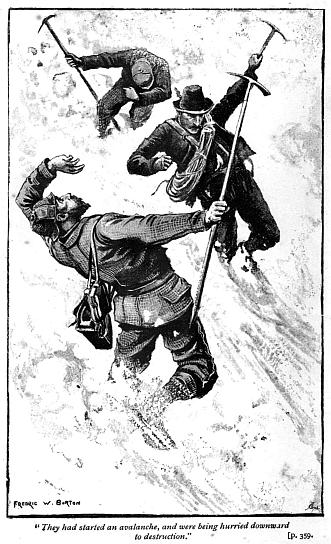
Everything happened so quickly that the boy had no time to feel alarm. One quick thought darted through his brain,—that they would be carried so far down that they would have to make a long détour. Then his arm was seized by Melchior, and a sound above him made him gaze upward, to see that the snow was forming in long folds, like waves, upon the slope, and threatening to curve over and bury them. Then their speed increased, the rolling sound rose into a terrific roar, and the boy fully grasped the fact that they had started an avalanche, and were being hurried downward to destruction.
“Can’t we—we—”
Saxe said no more, for at that moment a rush of snow swept by them as if borne upon the wings of some terrible tempest, and in the midst of the suffocating sensation he felt himself sinking lower and lower. The snow was at his waist; then, as he was borne swiftly down, at his breast; and the next instant at his lips; and all the while he was gliding downward at railway speed.
“Melk! Help!” he cried hoarsely, as he was twisted violently round and borne down backward; and then the snow seemed to leap right over him, and all was dark.
What followed was blind confusion, in which Saxe struggled to fight back the snow, so that he could breathe, for the sense of suffocation was terrible. Then all at once the rapid gliding motion ceased, and in the darkness he felt as if he were being held tightly in some terrible embrace, which closed round him slowly and surely, till only his arms were at liberty, and with these he fought.
And now he found that he still held the ice-axe that had been his companion all day. It was stretched right out above him as far as he could reach, and, as he moved it, to his intense joy he could see a pale ray of light, one which increased as he moved the axe again, telling him that, though he was buried, the head of the axe was above the level of the snow.
His first efforts were to enlarge the hole that ran right up, very little larger than the handle of the axe, though the beating with his hand had formed quite a little hollow about his head.
“The snow has stopped, and I am only buried so deep,” he thought to himself, as the horrible feeling of panic began to subside. “If I can make that hole bigger, so as to be able to breathe, I ought soon to be able to creep out.”
He worked away, enlarging the hole a little; but he had to observe the greatest caution, for fear of filling the little perpendicular tunnel with the loose snow. It was but little, still it enabled him to breathe more freely; and as soon as he reached this pitch he began to strive to raise himself, first one leg and then the other, to force himself out to the surface.
And now the feeling of horror, which had passed away for the moment, returned, as he grasped the fact that the loose snow, in which he had been swept down, had been pressed together by the weight above it, till to his waist he felt as if he were enclosed in solid ice.
In spite of his position the perspiration broke out upon his forehead, and the wild horror which seized him nearly robbed him of his senses till the reaction came.
“Melchior and Mr Dale will seek for me and dig me out,” he thought. “I must listen till I hear them, and then shout.”
He grew calmer now, and listened; but all was perfectly still, and a chill struck through him as he asked himself a terrible question—
“Where were his companions!”
He had been plodding on, he remembered, with Mr Dale behind him; but he had not seen a sign of his companion since, though he had seen Melchior, who had caught him by the wrist, and then—
“Yes: what then?”
He could remember no more, only that horrible confusion as they were carried down, till he was fighting for breath, buried at the bottom of the drift.
Saxe listened again, straining his ears for the faintest sound, but hearing nothing.
“They must have been carried farther,” he tried to think; “and as soon as they can climb up they will begin to seek for me;” and he repeated this cheering thought to fight back another, which was vague, strange and terrible—a thought which suggested the impossibility of two people discovering the tiny hole made by the head of an ice-axe in the midst of the snow of that tremendous avalanche.
“I don’t care; I will not give up hoping,” he said to himself, as he moved the ice-axe gently, and saw a ray or two more light. Then he began to wonder whether the heat of his body would melt enough of the snow-ice about him to enable him to work his way out; and in this hope he waited and rested for a few minutes, for the exertion even of moving the axe seemed to set his heart beating fast.
Then once more the feeling of horror grew more terrible than he could bear; and he was fast succumbing to it and losing his senses, when he fancied that he heard a cry.
It ceased directly; and then, as he listened with every nerve on the strain, there it was again—faint, apparently very distant, but plainly enough—the jodel of some Swiss, if it were not that of the guide.
Throwing his head back as far as he could, and keeping the axe handle tight against the side of the narrow hole, Saxe sent up a despairing cry for help.
As he ceased he made a desperate struggle to free himself, but it was useless; and he listened again and to his great joy the jodel came again, and he answered it.
Then there was a terrible period of suspense; and, as no sound was heard, he yelled with all his might, and this time there was undoubtedly an answering call.
Once more he shouted, and a hail came from nearer; and then, to his despair, it was repeated from farther away, making the unfortunate prisoner utter a despairing cry of rage, which had the effect of bringing the sound once more nearer and nearer still, and at last so close that he knew it was Melchior’s voice which cried—
“Now, once more shout. Where are you?”
Saxe’s lips parted, and he drew in his breath in the excitement and relief of feeling that help was so close at hand; but no sound would come save a low, hoarse gasp, and then a giddy sensation came over him, and once more all was darkness.
Chapter Thirty Six.
From the Snow Grave.
Saxe seemed to have awakened from sleep with a terrible throbbing headache, to listen to a curious digging sound which was going on over his head. He could hear a loud rumbling too, and, as he was still wandering and confused at being suddenly awakened, as it appeared to him, the truth came with a leap, just as the axe handle, which he still held, was sharply agitated to keep the hole open, and Melchior’s voice came down to him.
“Try—try and speak, young herr!” But for a few moments no word would come from his lips. He wanted to speak; he strove hard, wondering the while at his silence; but not a sound came, till there was a deep groan from above him, and then with a sudden rush the words came from his pent up breast—
“Melk! Help—help!”
“Hah! That’s right. Yes, boy!” was shouted down to him loudly. “That’s right. Keep a good heart, and I’ll soon have you out. Can you breathe well?”
The axe handle was agitated while these words were spoken; and as Saxe replied, the efforts of the guide were renewed, and he cut and chopped away at the compressed snow, sending the sparkling crystals flying, and toiling hard; while a word or two were exchanged from time to time, the guide’s being so full of encouragement and promise that the boy grew more and more hopeful.
At last the fragments of snow began to crumble down more rapidly; and, in spite of Melchior’s efforts to keep the way clear, the snow rose about Saxe’s face, so that very little more of it would have meant suffocation. The boy fought hard with his left hand to keep the snow clear, but there was no space sufficient for him to sweep it right away; and the moments grew more and more anxious as Melchior’s axe cut and chipped, and he tore out great pieces from the hole he was making and hurled them down the slope.
And all the while the prisoner gazed up through his pinched-together eyes, for the fragments and ice dust fell fast, till at last the point of Melchior’s axe appeared suddenly, and was as quickly withdrawn.
“How far was that from your face, boy?” whispered Melchior.
“Nearly a foot.”
“Hah! that’s well,” cried the man; and the blows of the axe fell merrily now, till a great piece of the impending snow was suddenly lifted out, and the prisoner breathed freely as he gazed wildly up past the guide’s body at the glowing evening sky.
This piece removed, the guide’s next effort was to clear the loose enow crystals and chips of ice away from the prisoner’s face, and to chip off other pieces of the snow which had roofed him in. Then, getting himself into a better position, he bent down and grasped the boy’s hands.
“I just saw the head of your axe,” he said. “There, keep heart of gold in you, lad: you will soon be out now. I think if I place your axe across for you to drag at, and I try too, we shall be able to draw you right out. A minute’s rest first, though. Now you can breathe. I am breathless too.”
“Where is Mr Dale?” panted Saxe; but there was no reply, and Saxe read the worst in the barely seen face bent over him in the rough well-like hole that had been cut so energetically.
A few minutes only were allowed to elapse, and then the guide took the ice-axe to which Saxe still clung from the boy’s hand to lay it aside.
“Now,” he said, “close your eyes while I cut a couple of holes.”
The boy obeyed, and tried hard not to wince as the hard chips flew and struck him again and again in the face; while making the implement flash as he struck with it energetically, Melchior cut deeply into the sides of the hole, and just at a suitable distance for the object he had in view.
This of course was to place Saxe’s ice-axe across, with head and butt resting in the two holes, and he had judged so accurately that the head went in with not half an inch to spare after he had thrust in the butt spike at the opposite side.
“Now,” cried the guide, “take well hold of that, while I stoop down and get my hands under your arms and locked across your breast. Then, as I give the word, we must heave together.”
He got himself into position as he spoke, but had to use the spike at the end of his axe handle to form a place for his feet on either side. Then, throwing down the axe, he planted his feet firmly, bent down nearly double, clasped his hands round the boy, and after seeing that he had a good grip of the ashen handle above his head, called upon him to heave.
Then began a slow, patient struggle, with Saxe tugging at the cross-bar formed by his ice-axe, till it bent more and more into a bow, while Melchior brought his powerful muscles to bear in a steady strain, till Saxe gasped forth—
“No, no! Stop!”
“Did I hurt you?” said Melchior.
“Only seemed as if you were pulling me right in two,” groaned the boy. “It’s of no use; you can’t get me out.”
“I can, and I will,” said the guide firmly.
“I would go on cutting you out, only it would take so many hours, and I am afraid—”
“Of what?” said Saxe faintly, and speaking more for the sake of gaining time than anything else, so terrible had the strain been for him.
“I am afraid of loosening the snow and starting it again by my blows,” replied Melchior. “It takes so little sometimes to begin an avalanche, and we know how the snow hangs lightly on this side of the mountain.”
“Yes,” said Saxe, with his eyes half-closed.
“And he would be dead long before I could get him out,” said Melchior to himself. “Poor boy! He could not last for hours frozen in like that.”
Saxe opened his eyes again, and looked up at the guide wildly.
“Never mind me now,” he said: “go and find Mr Dale.”
Melchior shook his head.
“No: my duty is here, herr, and I must get you out. As soon as you can bear it I must try again.”
“But I can’t bear it. You can never get me out.”
“We shall see,” cried the guide cheerily. “Come: you are upset. Where is your what you English call pluck?”
This was said in a tone in which there seemed to be so much contempt, that Saxe gazed at the man resentfully, and seizing the cross-bar again he cried—
“Try again!”
The guide smiled as soon as he was not noticed, and then bending down once more the strain began again, and was carried on till Melchior himself gave in.
“We must rest once more, herr,” he said, as he removed his arms; and then, as Saxe made no sign, he looked down excitedly in the boy’s face, to see that his eyes were closed and that he was quite inanimate.
“Poor boy!” he said tenderly: “that sneer at his courage made him fight till he could do no more.”
The guide stood upright now, breathing hard as if to inhale fresh strength; and then gathering himself together, he bent down again.
“Better now, while he is insensible,” he muttered.
This time he got himself down lower, and his arms so far round Saxe that he was able to hook his hands about his elbows. Then, slowly bringing his great strength to bear, he began to heave, the veins standing out like network about his temples, and his face turning purple as he strove to draw the prisoner out of the icy fetters in which he was fast. But for some moments every effort seemed to be vain, and a horrible feeling of despair came over the guide as he relaxed his efforts once more.
But only while one might have counted twenty before he tightened his clasp once more, and heaved with so good an effect that he drew Saxe right out of the icy mould, which had pretty well shaped itself to the lower part of his figure, and then carried him out of the excavation and laid him down barefooted upon the snow.
Chapter Thirty Seven.
A Great Surprise.
“Hah!” ejaculated Melchior, as he wiped the great drops off his brow and stood panting and waiting for the boy to recover his senses.
At last Saxe uttered a catching sigh and moved his head uneasily. Then, with his eyes tightly closed, he said feebly—
“Don’t—don’t, Melk: you hurt me. It’s of no use. Go and try to help Mr Dale. Eh?”
He started as he opened his eyes widely and looked about. “Why, Melk—you don’t mean—”
“Yes, herr,” said the guide quietly. “I dragged you out.”
“Why!—oh, how it hurts! You’ve left my legs in the hole! No,” he added, as he struggled into a sitting position and looked down,—“only my boots.”
“I’ll bind some cloth round them directly, herr. We can get other boots.”
“But—I feel—just as if I had no legs at all,” said Saxe excitedly. “Not broken, are they?”
“No, herr: only a little numbed with the cold and pressure. There, I am better now. I’ll chafe them before I bind up your feet.”
“You couldn’t get out my boots?”
“No, herr—not for many hours: we must not wait for that;” and he knelt down now, and after rapidly chafing the half-dead limbs to bring back the circulation, he took string from his pocket, cut off both sleeves of his jacket, and then cleverly tied the wrists, and drew them on to the boy’s legs, where he bound them with the string, forming a pair of boots and stockings in one.