Gay Scene in Cherbourg Harbour—The O’Wiggins again—Aquatic Visiting—A Disciple of St. Impudentia—How to Banquet Uninvited—The Ball—Visit of the President to the Fleet—A Few Remarks on Affairs in General. (continued 2)
Reading edition
As we brought the bright light of Cape La Hogue a little before the larboard beam, the wind increased considerably, and we began to feel the short, broken sea of the Race. Every moment it increased; rapidly the water rose and fell in white-topped pyramids, leaping high above our bulwarks, and threatening to tumble on board and overwhelm us with its weight. The hatches were battened down and every thing well secured on deck; and well it was so, for sea after sea came leaping over the side, now on the quarter, then over the bows, and now again amidships. It was impossible to say where it would strike the vessel, for not the best steering could avoid it; yet on we flew with the fast rising breeze, rolling and pitching and tumbling, the water foaming and roaring, and literally drenching us with spray even when we avoided the heavier seas. The moon, too, which shone forth on the wild tumult of waters, rather increased the awfulness of the scene, by exhibiting to us the dangers which surrounded us on every side; yet so clear were the lights, both of La Hogue on the left and the Casquets on the right, that we had no difficulty in steering our course. The dark outline of the small island of Sark at last appeared in sight on the starboard beam, and in order to avoid the wild shoal of the Dirouilles Rocks, towards which the early flood sets, we hauled up more to the westward.
Still urged onward by the terrific force of the tide, we continued plunging through the mad waters, till daybreak showed us the Island of Jersey right ahead, and Guernsey on our weather beam. So strong was the current, however, that we had drifted considerably to the east, and in the grey light of the morning, not a cable’s length from us, appeared the dark heads of the Dirouilles, while on the starboard hand the sea, in masses of foam, was breaking over the equally terrific rocks of the Paternosters. The wind had now got so far to the westward, and the tide set so strong against us, that finding we were drifting bodily to leeward, we ran close in-shore, and dropped our anchor in a romantic little cove called Bouley Bay, on the north-east coast of Jersey. There was a narrow sandy beach, on which a few boats were drawn up, and a narrow ravine leading down to it, while on either side lofty cliffs towered high above our heads. On the side of the ravine was situated a small hotel, the master of which came off to us as soon as he saw us standing into the bay.
To the first question I put to him, as to whether he had seen any vessel off the coast that morning, he told us that at break of day he had been to the top of the cliffs, and had observed a cutter standing between the Paternosters and the land, and that he thought it probable she would be able to double Cape Grosnez before the tide made against her, in which case she would have little difficulty in getting round to St. Helier’s, if she happened to be bound there.
“If she is, we shall catch her to a certainty,” exclaimed O’Malley; and he forthwith volunteered to go across the island to try what he could do; and I proposed accompanying him, as I thought I might be of assistance in getting hold of Sandgate. Of course Harcourt gladly assented to our offer, although he determined himself to remain in the vessel.
I have not described Harcourt’s feelings all this time;—his hopes and fears, his eager excitement, as he thought the “Rover” was within his reach—his dread lest his Emily should have suffered injury or alarm—they were too intense for utterance.
As soon as the “Amethyst” had made sail, O’Malley and I started away across the little island as fast as our legs could carry us. We should have hired horses or a carriage, but none were to be procured at the quiet little spot where we landed, so we resolved to trust to our own feet, of which we had by no means lost the use, as the way we made them move over the ground gave full evidence. As soon as we reached St. Helier’s, we hurried down to the pier, when, to our infinite satisfaction, we beheld the “Rover” at anchor in the outer roads. We immediately hurried off to the authorities to give information, and to procure assistance to rescue Miss Manners. On our way we suddenly came upon the villain of whom we were in search,—Sandgate himself. Something made him turn round, and he caught sight of us. Without a moment’s hesitation he darted off towards the quay, where a boat was in waiting, and jumping into her, pulled towards the cutter. He had every reason to fear, we learned; for on his appearance in the morning he had been narrowly watched by the revenue officers, who suspected that some smuggling business had attracted him to the island. Such in fact was the case, as he had gone there to settle with his agents, and to procure certain stores before he commenced the long voyage he contemplated, little thinking that we should so soon have been able to track him thither. Before we had been able to engage a boat he had got on board, and the “Rover” was under way for the westward. I have an idea that some of the boatmen were in league with him. At all events, they seemed to think that it was their business to impede us as much as possible, and to do their best to help the hunted fox to escape. Such a feeling is very general among that class. The more eagerness and impatience we exhibited, the more difficulties they threw in our way; and it was not till the “Rover” was well clear of the harbour, and pursuit hopeless, that we could obtain a boat. We got one at last, and jumping into it, asked the men to pull away out of the harbour. Much to their vexation and to our satisfaction, we in a short time caught sight of our friend’s cutter. She had just got off Elizabeth Castle, which stands on a rocky point, isolated at high water from the mainland. She hove-to, and in a few minutes we jumped on board, and gave Harcourt the information we had obtained on shore, and pointed out in the distance a sail which we had little doubt was the “Rover.”
Harcourt then told us that after we had started overland, he had remained two hours at anchor, and then shipping an old pilot, in a Welsh wig, who only spoke Jersey French—the oddest patois he ever heard—he got under way for St. Helier’s. The “Amethyst” beat along that rocky and lofty coast, inside the Paternosters, till she rounded Cape Grosnez—which, as she had had a fresh breeze, she had done without much difficulty. She was then kept away, passing the rugged and threatening rocks of the Corbière, rounding which with a flowing sheet, she was headed in among an archipelago of hidden dangers towards the town of St. Helier’s. As they were passing the Corbière, Harcourt observed a cutter standing away to the westward, as if she had come out of St. Aubin’s Bay. He pointed her out to Griffiths, but she was too far off to distinguish what she was, and he was unwilling to make chase till we had ascertained whether Sandgate had been there. He accordingly stood on, eager to receive our report.
Our first act was to tumble the pilot into the shore-boat, and make chase after the cutter Harcourt had before observed. She had a very long start, but we trusted to the chances the winds and tides might afford us to come up with her—yet we could not but see that she had many more in her favour to aid her escape. There were, however, still some hours of daylight, and as long as we could keep her in sight, we need not despair. From the course she was steering, as much to the westward as she could lay up with the wind as it then stood, we felt certain that our worst suspicions would be realised, and that Sandgate fully intended to run across to America, or to some other distant land.
Never had the “Amethyst” before carried such a press of sail as she now staggered under; but little would it have availed us had the wind, which came in uncertain currents, not shifted round to the northward, while the “Rover” still had the breeze as before. It continued, however, increasing till we could no longer bear our gaff-topsail, and so much had we overhauled the chase, that, at sundown, we were within two miles of her. Now came the most critical time; as before the moon rose it would scarcely be possible to keep her in sight, and Sandgate would not fail to profit by the darkness if he could, to effect his escape—he, also, having the wind exactly as we had it, now sailed as fast as we did. So exciting had become the chase, even to those least interested in it, that every man kept the deck, and with so many well-practised eyes, Argus-like, fixed on her, any movement she made would scarcely escape us. The sky was clear, and the stars shone bright, but the wind whistled shrilly, and the foam flew over us, as the little craft, heeling over on her gunwale, plunged and tore through the foaming and tumbling waves. Thus passed hour after hour. If the “Rover” hauled up, so did we; if she kept away, the movement was instantly seen and followed by us, though all the time, as O’Malley observed, he could not, for the life of him, make out any thing but a dark shadow with a scarcely defined form stalking like an uneasy ghost before us; as to know what she was about, it passed his comprehension how we discovered it. That she was, however, increasing her distance we became at length aware, by the difficulty we experienced in seeing her, and at last the shadowy form faded into air.
Every one on board uttered an exclamation of disappointment, and some swore deeply, if not loudly.
“Can no one make her out?” Harcourt asked.
The seamen peered through the darkness.
“There she is on the weather-bow,” sung out one.
“I think I see her right ahead still,” said another.
“No: I’m blowed if that ain’t her on the lee-bow there,” was the exclamation of a third.
One thing only was certain, she was not to be seen. We determined, however, to keep the same course we had been before steering, and as the moon would rise shortly, we trusted again to sight her. The intervening hour was one of great anxiety; and when, at last, the crescent moon, rising from her watery bed, shed her light upon the ocean, we looked eagerly for the chase. Right ahead there appeared a sail, but what she was it was impossible to say; she might be the “Rover,” or she might be a perfect stranger. On still we steered due west, for, although we felt that our chance of overtaking Sandgate was slight indeed, yet our only hope remained in keeping a steady course. Thus we continued all night; and the moment the first streaks of light appeared in the sky, Harcourt was at the masthead eagerly looking out for the chase. Far as the eye could reach, not a sail was to be seen; there was no sign of land, nothing was visible but the grey sky and the lead-coloured water. Still Harcourt remained at his post, for he dared not acknowledge to himself that Emily was lost to him for ever. In vain he strained his eyes, till the sun rose and cast his beams along the ocean. A white object glistened for a moment ahead; it might have been the wing of a sea-fowl, but as he watched, there it remained, and he felt certain that it was the head of a cutter’s mainsail. Taking the bearings of the sail, he descended on deck, and, as a last hope, steered towards it, sending a hand on the cross-trees to watch her movements. The wind fortunately, as it proved to us, was variable, and thus we again neared the chase. As we rose her hull, Griffiths pronounced her to be of the size of the “Rover,” if not the “Rover” herself.
“Well, we’ll do our best to overhaul her,” I exclaimed; “set the gaff-topsail. The craft must bear it.”
And, pressed to her utmost, the little “Amethyst” tore through the foaming waves. Thus we went on the whole day, till towards the evening the chase again ran us completely out of sight. The wind, also, was falling away, and at sundown there was almost a complete calm. Still the vessel had steerage-way, so we kept the same course as before. At length I threw myself on a sofa in the cabin. I know not how long I had slept, when I was awoke by feeling the yacht once more springing livelily through the water. I jumped on deck without awaking O’Malley, who was on the opposite sofa. The morning was just breaking, and, by the faint light of the early dawn, I perceived a large dark object floating at some distance ahead of us.
“What is that?” I exclaimed to Griffiths, who had charge of the deck.
“A dismasted ship, sir,” was the answer. “I have seen her for some time, and as she lay almost in our course, I steered for her, as I thought as how you’d like to overhaul her, sir.”
“You did well,” I answered. “Rouse all hands, and see a boat clear for boarding her. But what is that away there just beyond the wreck? By heavens, it’s the ‘Rover,’ and becalmed too. Grant the wind may not reach her!”
Awoke by hearing the people called, Harcourt and O’Malley were by my side. I pointed out the wreck and the cutter to them.
“Well,” exclaimed O’Malley, “the big ship there may still float, but the breeze which has been sending us along, may at last reach the sails of the ‘Rover;’ so I propose we make sure of her first.”
To our joy, however, we found that the wind, instead of reaching her, was gradually falling away, and by the time we were up with the wreck, the sea was as calm as a sheet of glass. We were in hopes also that keeping, as we had done, the wreck between us and the “Rover,” we might have escaped observation, and in the grey light of morning we might come upon her unawares. There were several people on board the ship, who cheered as they saw assistance at hand; and reason they had to be glad, for from the clear streams of water which gushed from her sides, they had evidently great labour to keep her afloat. No time was to be lost, the gig was soon in the water, and Harcourt, O’Malley, and I, with eight men fully armed, pulled towards the “Rover,” while old Griffiths, the master, boarded the ship in the other boat. My friend’s heart beat quick as we neared the cutter. She was the “Rover,” there was no doubt, but whether Sandgate would attempt to defend his vessel was the question. A moment more would solve it. We dashed alongside; the men, stowed away in the bottom of the boat, sprang up, and before the crew of the “Rover” had time to defend themselves, we were on board. Except the man at the helm and the look-out forward, the watch on deck were all asleep, and those two, as it afterwards appeared, were glad to see us approach. The noise awoke Sandgate, who, springing on deck, found himself confronted by O’Malley and me, while half his crew were in the power of my people, and the fore-hatch was battened over the rest. A pistol he had seized in his hurry was in his hand; he pointed it at my breast, but it missed fire; on finding which, he dashed it down on the deck, and before we could seize him, retreated forward, where some of his crew rallied round him. With fear and hope alternately racking his bosom, Harcourt hurried below. He pronounced his own name; the old nurse opened the door of the main cabin—a fair girl was on her knees at prayer. She sprang up, and seeing him, forgetful of all else, fell weeping in his arms. I shall pass over all she told him, except that Sandgate had behaved most respectfully to her, informing her, however, that he should take her to the United States, where she must consent to marry him, and that, on their return to England, he would put her in possession of a large fortune, to which by some means he had discovered she was heiress, and which had induced him to run off with her. It was, I afterwards learned, his last stake, as the reduction of duties no longer enabled him to make a profit by smuggling; and as he had no other means of supporting his extravagant habits, he was a ruined man.
Sandgate’s people seemed resolved to stand by him, but not to proceed to extremities, or to offer any opposition to our carrying off Miss Manners and her attendant. He evidently was doing all he could to induce them to support him; and I believe, had he possessed the power, he would, without the slightest compunction, have hove us all over board, and carried off his prize in spite of us. As it was, he could do nothing but gnash his teeth and scowl at us with unutterable hatred. Handing the young lady and the old nurse into the boat, we pulled away from the “Rover.” Of course, we should have wished to have secured Sandgate; but as we had come away without any legal authority to attempt so doing, we saw that it would be wiser to allow him to escape. We should probably have overpowered him and his lawless crew, but then the females might have been hurt in the scuffle, and we were too glad to recover them uninjured to think at the moment of the calls of justice.
What was our surprise, as Harcourt handed her on to the deck of the yacht, to see her rush forward into the arms of an old gentleman who stood by the companion-hatch.
“My own Emily!” he exclaimed, as he held her to his heart.
It was Colonel Manners.
“My father!” burst from her lips.
A young lady was reclining on the hatch near him; she rose as she saw Emily, and they threw themselves on each other’s neck.
“My sister!” they both exclaimed, and tears of joy started to their eyes.
There were several other strangers on board, who, by Griffiths’ exertions, had been removed from the wreck. Our boats were busily employed in removing the others, for there was no time to lose, as the ship was settling fast in the water. All the people being placed in safety, we proceeded to remove the articles of greatest value and smallest bulk on board the two vessels, which became then very much loaded, when, a breeze springing up, another sail hove in sight: she bore down towards us, and, in a short time, the little fat figure of Mr Warwick Ribbons graced the deck of the “Amethyst.” His delight at seeing Emily in safety was excessive, but, though he looked sentimental, he said nothing; and, when he heard that the colonel was alive, and that there was another sister in the case, his face elongated considerably. From motives of charity, I hurried him, with several of the passengers and part of the cargo, on board the “Dido,” and the three vessels made sail together for Falmouth. Just as we were leaving the ship, a deep groan issued from her hold, and, her head inclining towards the water, she slowly glided down into the depths of the ocean. Landing all our passengers at Falmouth, except the colonel and his daughters, we had a quick run to Cowes. Colonel Manners established his claim to his property. O’Malley had made such good use of his time during the voyage, that he won the heart and hand of Julia Manners; while, as may be suspected, Emily owned, that if Harcourt loved her, their affection was reciprocal; and the same day saw them joined respectively together in holy matrimony.
Such was the result of my friend Harcourt’s summer cruise, and I think you will all agree that the narrative is not altogether unworthy of the name of a romance. The last time I saw little Ribbons he was on board the “Dido,” which lay high and dry on the mud off Ryde, and I afterwards heard that he married a Miss Bosley, who, I conclude, was a daughter of old Bosley’s.
“And what became of the rascal Sandgate?” exclaimed Hearty; “by Neptune! I should like to come up with the fellow, and to lay my craft alongside his till I had blown her out of the water. Fancy a scoundrel in the nineteenth century venturing to run off with a young lady!” We laughed at his vehemence. Hearty always spoke under a generous impulse.
“Oh, it’s not the first case of the sort I have heard of,” said Carstairs; “more than one has occurred within the last few years in Ireland; but I agree with Hearty, that I should like to catch Mr Sandgate, for the sake of giving him a good thrashing. Though I hadn’t the pleasure of knowing Miss Manners, every man of honour should take a satisfaction in punishing such a scoundrel.” Bubble and Porpoise responded heartily to the sentiment, and so strong a hold did the account take of the minds of all the party, that we talked ourselves into the idea that it would be our lot to fall in with Sandgate, and to inflict the punishment he had before escaped. “Will Bubble had taken an active part in fitting out the yacht, and in selecting most of the crew; he consequently was on rather more intimate terms with them than the rest of us; not that it was the intimacy which breeds contempt, but he took a kindly interest in their welfare, and used to talk to them about their families, and the past incidents of their lives. Indeed, under a superficial coating of frivolity and egotism, I discovered that Bubble possessed a warm and generous heart,—fully alive to the calls of humanity. I do not mean to say that the coating was not objectionable; he would have been by far a superior character without it. Indeed, perhaps all I ought to say is, that he was capable of better things than those in which he too generally employed his time. He returned aft one day from a visit forward, and told us he had discovered that several of the men were first-rate yarn-spinners. The master,” said he, “seems a capital hand; but old Sleet beats all the others hollow. If it would not be subversive of all discipline, I wish you would come forward and hear them in the forecastle as one caps the other’s tale with something more wonderful still.”
“I don’t think that would quite do,” said Hearty; “if we could catch them on deck spinning their yarns, it would be very well. But, at all events, I will invite Snow, into the cabin and consult him.”
According to Hearty’s proposal, he invited Snow down. “Mr Snow,” said Hearty, “we hear that some of the people forward are not bad hands at spinning yarns, and, if you could manage it, we should be glad to hear them, but it would never do to send for them aft for the purpose.”
“You are right, sir, they would become tongue-tied to a certainty,” answered Snow; “just let me alone, and I will manage to catch some of them in the humour. Several of them have been engaged, one time or another, in the free-trade, and have some curious things to tell about it.”
“But I thought smuggling had been knocked on the head long ago,” observed Hearty.
“Oh, no, sir! of late years a very considerable blow has been struck against it; but even now some people find inducements to follow it,” answered the master. “I found it out to be a bad trade many years ago, and very few of those I know who still carry it on do more than live, and live very badly too; some of them spending many a month out of the year in prison, and that is not where an honest man would wish to be.”
However, I have undertaken to chronicle the adventures of the “Frolic,” and of those who dwelt on board her, so that I must not devote too much of our time to the yarns, funs, witticisms, and anecdotes and good sayings with which we banished any thing like tedium during our voyage. No blue devils could stand for an instant such powerful exorcisms.
It was not, however, till some time after this that we benefited by Snow’s inquiries among the crew.
Chapter Twelve.
The “Frolic” in a Gale, in which the Frolickers see no Fun—A Sail in Sight—Her Fate—An Unexpected Increase to the Crew—Bubble Shows that he can Think and Feel—Intelligence Obtained.
“What sort of weather are we going to have, Snow?” asked Hearty, as we came on deck after dinner one afternoon, when the cutter was somewhere about the middle of the Bay of Biscay.
“Dirty, sir, dirty!” was the unenlivening answer, as the old master looked with one eye to windward, which just then was the south-west. In that direction thick clouds were gathering rapidly together, and hurrying headlong towards us, like, as Carstairs observed, “a band of fierce barbarians, rushing like a torrent down upon the plain.” The sea grew darker and darker in hue, and then flakes of foam, white as the driven snow, blew off from the hitherto smooth surface of the ocean. The sea rose higher and higher, and the cutter, close-hauled, began to pitch into, them with an uneasy motion, subversive of the entire internal economy of landsmen.
“The sooner we get the canvas off her the better, now, sir,” said Snow to Porpoise, who had come on deck after calculating our exact position on the charts.
“As soon as you like,” was the answer. “We shall have to heave-to, I suspect; but that little matters, as we have plenty of sea-room out here, and she may dance away for a fortnight with the helm a-lee, and come to no harm.”
The topmast was struck; the jib was taken in, and a storm-jib set; the foresail was handed, and the mainsail meantime was closely reefed. Relieved for a time, she breasted the seas more easily; but the wind had not yet reached its strength. Before nightfall down came the gale upon us with all its fury; the cutter heeled over to it as she dashed wildly through the waves.
“The sooner we get the mainsail altogether off her the better, sir,” said Snow. This was accordingly done, and the trysail was set instead, and the helm lashed a-lee.
“There; we are as snug and comfortable as possible,” exclaimed Porpoise, as the operation was completed. “Now all hands may turn in and go to sleep till the gale is over.”
The landsmen looked rather blue.
“Very funny notion this of comfort!” exclaimed Carstairs, who had the worst sea-going inside of any of the party. “Oh, oh, oh! is it far from the shore?”
“Couldn’t get there, sir, if any one was to offer ten thousand guineas,” said Snow. “We are better as we are, sir, out here—by very far.”
The cutter, which in Cowes Harbour people spoke of as a fine large craft, now looked and felt very like a mere cockle-shell, as she pitched and tumbled about amid the mighty waves of the Atlantic.
“Don’t you feel very small, Carstairs?” exclaimed Hearty, as he sat convulsively grasping the sides of the sofa in the cabin.
“Yes, faith, I do,” answered the gentle giant, who lay stretched out opposite to him. “Never felt so very little since I was a baby in long-clothes. I say, Porpoise, I thought you told me that the Bay of Biscay was always smooth at this time of the year.”
“So it should be,” replied our fat captain. “No rule without an exception though; but never mind, it will soon roll itself quiet; and then the cutter will do her best to make up for lost time.”
The person evidently most at his ease was Will Bubble. Blow high or blow low, it seemed all the same to him; he sang and whistled away as happily as ever.
“Oh, oh, oh! you jolly dog, don’t mock us in our misery!” exclaimed Carstairs with a groan.
“On no account,” answered Will, with a demure look. “I’ll betake myself to the dock, and smoke my weed in quiet.”
On deck he went, and seated himself on the companion-hatch, where he held on by a becket secured for the purpose; but as to smoking a cigar, that was next to an impossibility, for the wind almost blew the leaves into a flame. I was glad to go on deck, also; for the skylights being battened down made the cabin somewhat close. The cutter rode like a wild fowl over the heavy seas, which, like dark walls crested with foam, came rolling up as if they would ingulf her. Just as one with threatening aspect approached her, she would lift her bows with a spring, and anon it would be found that she had sidled up to the top of it.
It was a wild scene—to a landsman it must have appeared particularly so. The dark, heavy clouds close overhead; the leaden seas, not jumping and leaping as in shallow waters, but rising and falling, with majestic deliberation, in mountain masses, forming deep valleys and lofty ridges, from the summits of which, high above our heads, the foam was blown off in sheets of snowy whiteness with a hissing sound, interrupted by the loud flop of the seas as they dashed together.
We were not the only floating thing within the compass of vision. Far away I could see to windward, as the cutter rose to the top of a sea, the canvas of a craft as we were hove-to. She was a small schooner, and though we undoubtedly were as unsteady as she was, it seemed impossible, from the way she was tumbling about, that any thing could hold together on board her.
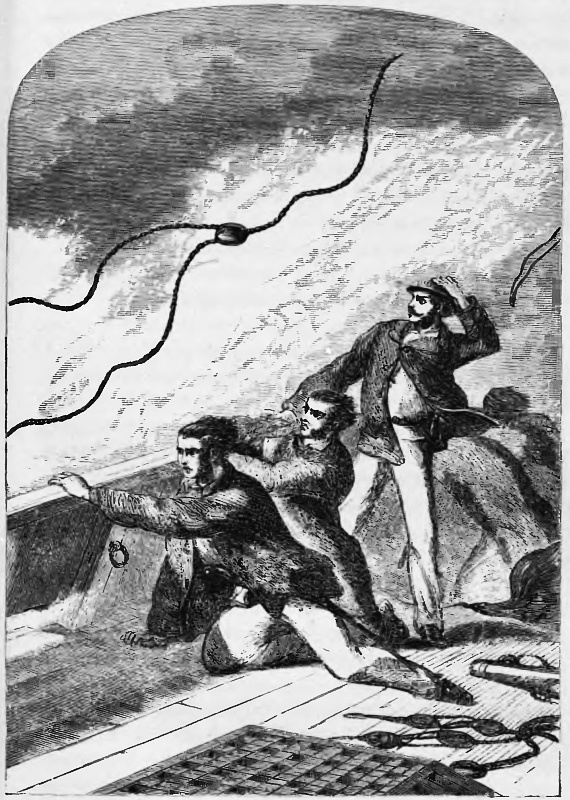
I had rejoined the party in the cabin, when an exclamation from Bubble called us all on deck.
“The schooner has bore up, and is running down directly for us!” he exclaimed.
So it was; and in hot haste she seemed indeed.
“Something is the matter on board that craft,” said Porpoise, who had been looking at her through his glass. “Yes, she has a signal of distress flying.”
“The Lord have mercy on the hapless people on board, then!” said I. “Small is the help we or any one else can afford them.”
“If we don’t look out, she’ll be aboard us, sir,” sung out Snow. “To my mind, she’s sprung a leak, and the people aboard are afraid she’ll go down.”
“Stand by to make sail on the cutter; and put the helm up,” cried Porpoise. “We must not let her play us that trick, at all events.”
On came the little schooner, directly down for us, staggering away under a close-reefed fore-topsail, the seas rolling up astern, and threatening every instant to wash completely over her. How could her crew expect that we could aid them? still it was evidently their only hope of being saved—remote as was the prospect. They might expect to be able to heave-to again under our lee, and to send a boat aboard us. The danger was that in their terror they might run us down, when the destruction of both of us was certain. We stood all ready to keep the cutter away, dangerous as was the operation—still it was the least perilous of two alternatives. We were, as may be supposed, attentively watching every movement of the schooner; so close had she come that we could see the hapless people on board stretching out their arms, as if imploring that aid which we had no power to afford them. On a sudden they threw up their hands; a huge sea came roaring up astern of them; they looked round at it—we could fancy that we almost saw their terror-stricken countenances, and heard their cry of despair. Down it came, thundering on her deck; the schooner made one plunge into the yawning gulf before her. Will she rise to the next sea?
“Where is she?” escaped us all. With a groan of horror we replied to our own question—“She’s gone!”
Down, down she went before our very eyes—her signal of distress fluttering amid the seething foam, the last of her we saw. Perhaps her sudden destruction was the means of our preservation. Some dark objects were still left floating amid the foam; they were human beings struggling for life; the sea tossed them madly about—now they were together, now they were separated wide asunder. Two were washed close to us; we could see the despairing countenance of one poor fellow; his staring eye-balls; his arms outstretched as he strove to reach us. In vain; his strength was unequal to the struggle; the sea again washed him away, and he sunk before our sight. His companion still strove on; a sea dashed towards us; down it came on our deck. “Hold on, hold on, my lads!” sung out Porpoise.
It was well that all followed the warning, or had we not, most certainly we should have been washed overboard. The lively cutter, however, soon rose again to the top of the sea, shaking herself like a duck after a dive beneath the surface. As I looked around to ascertain that all hands were safe, I saw a stranger clinging to the shrouds. I with others rushed to haul him in, and it was with no little satisfaction that we found that we had been the means of rescuing one of the crew of the foundered schooner from a watery grave. The poor fellow was so exhausted that he could neither speak nor stand, so we carried him below, and stripping off his wet clothes, put him between a couple of warm blankets. By rubbing his body gently, and pouring down a few drops of hot brandy and water, he was soon recovered. He seemed very grateful for what had been done for him, and his sorrow was intensely severe when he heard that no one else of the schooner’s crew had been saved.
“Ay, it’s more than such a fellow as I deserve!” he remarked.
I was much struck by his frank and intelligent manners, when having got on a suit of dry clothes, he was asked by Hearty into the cabin, to give an account of the catastrophe which had just occurred.
“You see, gentlemen,” said he, “the schooner was a Levant trader. Her homeward-bound cargoes were chiefly figs, currants, raisins, and such-like fruit. A better sea-boat never swam. I shipped aboard her at Smyrna last year, and had made two voyages in her before this here event occurred. We were again homeward-bound, and had made fine weather of it till we were somewhere abreast of Cape Finisterre, when we fell in with some baddish weather, in which our boats and caboose were washed away; and besides this, we received other damage to hull and rigging. We were too much knocked about to hope to cross the Bay in safety, so we put into Corunna to refit. The schooner leaked a little, though we thought nothing of it, and as we could not get at the leak, as soon as we had got the craft somewhat to rights, we again put to sea. We had been out three days when this gale sprang up, and the master thought it better to heave the vessel to, that she might ride it out. The working of the craft very soon made the leak increase; all hands went to the pumps, but the water gained on us, and as a last chance the master determined to run down to you, in the hopes that before the schooner went down, some of us might be able to get aboard you. You saw what happened. Oh, gentlemen! may you never witness the scene on board that vessel, as we all looked into each other’s faces, and felt that every hope was gone! It was sad to see the poor master, as he stood there on the deck of the sinking craft, thinking of his wife and seven or eight little ones at home whom he was never to see again, and whom he knew would have to struggle in poverty with the hard world! He was a good, kind man; and to think of me being saved,—a wild, careless chap, without any one to care for him, who cares for nobody, and who has done many a wild, lawless deed in his life, and who, maybe, will do many another! I can’t make it out; it passes my notion of things.”
Will Bubble had been listening attentively to the latter part of the young seaman’s account of himself. He walked up to him with an expression of feeling I did not expect to see, seemingly forgetful that any one else was present, and took his hand: “God in his mercy preserved you for better things, that you might repent of your follies and vices, and serve him in future. Oh, on your knees offer up your heartfelt thanks to him for all he has done for you!”
Hearty and Carstairs opened their eyes with astonishment as they heard Will speaking.
“Why, Bubble, what have?” began Hearty.
“I have been thinking,” was the answer; “I had time while you fellows lay sick; and I bethought me how very easily this little cockle-shell might go down and take up its abode among the deposits of this Adamite age,”—Will was somewhat of a geologist,—“and how very little we all were prepared to enter a pure state of existence.”
“That’s true, sir,” said the seaman, not quite understanding, however, Bubble’s remarks; “that’s just what I thought before the schooner sank. I am grateful to God, sir; but, howsomdever, I feel that I am a very bad, good-for-nothing chap.”
“Try to be better, my friend; you’ll have help from above if you ask for it,” said Bubble, resuming his seat.
“Why, where did you get all that from?” asked Carstairs, languidly; “I didn’t expect to hear you preach, old fellow.”
“I got it from my Bible,” answered Bubble. “I’m very sure that’s the only book of sailing directions likely to put a fellow on a right course, and to keep him there, so I hope in future to steer mine by it; but I don’t wish to be preaching. It’s not my vocation, and a harum-scarum, careless fellow as I am is not fitted for it; only all I ask of those present is to think—to think of their past lives; how they have employed their time—whether in the way for which they were sent into the world to employ it, in doing all the good to their fellow-creatures they can; or in selfish gratification; and to think of the future, that future without an end—to think if they are fitted for it—for its pure joys—its never-ending study of God’s works; to think whether they have any claim to enter into realms of glory—of happiness.”
Will sprang on deck as he ceased speaking. He had evidently worked himself up to utter these sentiments, so different to any we should have conceived him to have possessed. I never saw a party of gentlemen more astonished, if not disconcerted. Had not Tom Martin, the young seaman just saved, been present, I do not know what might have been said. Still the truth, the justice, the importance of what Bubble had said, struck us all, though perhaps we thought him just a little touched in the upper story, to venture on thus giving expression to his feelings. While Tom Martin had been giving an account of himself, I had been watching his countenance, and it struck me that I had seen him somewhere before.
“You’ve been a yachtsman, I think,” I observed; “I have known your face, I am sure.”
“Yes, sir,” said he, frankly; “and, if I mistake not, I know yours. I used to meet you at Cowes last year; but the craft I belonged to I can’t say was a yacht, though its owner called her one. I’m sure you gentlemen won’t take advantage of any thing I say against me, and so I’ll tell you all about the matter. The craft I speak of was the ‘Rover’ cutter, belonging to Mr Miles Sandgate. I first shipped aboard her about three years ago; he gave high pay, and let us carry on aboard pretty much as we liked, when not engaged in his business. An old chum of mine, a man called Ned Holden, who was, I may say, born and bred a smuggler, first got me to join; there wasn’t a dodge to do the revenue which Ned wasn’t up to, and he thought no more harm of smuggling than of eating his dinner. I didn’t inquire how the ‘Rover’ was employed; she belonged to a gentleman who paid well, and that’s all I asked, though I might have suspected something. She had just come from foreign parts, and the people who had then been in her talked of all sorts of curious things they had done. Smuggling was just nothing to what she’d been about. Mr Sandgate seemed to have tried his hand at every thing. He had been out in the China seas, running opium among the long pigged-tailed gentlemen of that country. More than once he had some hot fighting with the Government revenue-vessels, and several times he was engaged with the pirates, who swarm, they say, in those seas. I did not hear whether he made money out there, but after a time he got tired of the work, and shaped a course for England. On his way, after leaving the Cape of Good Hope, he fell in with a craft, which he attacked and took. She was laden with goods of all sorts fitted for the markets in Africa, and intended to be exchanged for slaves. Besides them she had the irons, and all the other fittings for a slaver. Such vessels sail without a protection from any government. After he had taken every thing he wanted, he hove the rest overboard, and then told the crew that he gave them their liberty, and that they might make the best of their way back to the parts from whence they came. With the goods he had thus obtained he stood for the slave-coast; he had acquaintance there, as everywhere else; indeed it would be difficult to say in what part of the world he would not find himself at home. He was not long in fitting the ‘Rover’ inside into a regular slave-vessel, but outside she looked as honest and harmless as any yacht. He ran up the Gaboon, or one of those rivers on the slave-coast—I forget which exactly—where lived a certain Don Lopez Mendoza, the greatest slave-dealer in those parts; besides which, as I heard say, it would be difficult to find anywhere a bigger villain. Well, he and Mr Sandgate were hand-in-glove, and one would have done any thing for each other. They were fairly matched, you may depend on it; however that might be, the Don took all the goods Mr Sandgate brought him, and asked no questions, and filled his vessel in return with a lot of prime slaves and water, and farina enough to carry them across to Havana. As soon as he got them on board he was out of the river again, and, loosening his jib, away he went with some two hundred human souls stowed under hatches, in a craft fit to carry only thirty or forty in comfort. She had a quick run across, and escaped all the ships-of-war looking after slavers. Mr Sandgate there sold the blacks for a good round sum, and thought he had done a very clever thing. However, he does not seem to be a man to keep money, though he is ready enough to do many an odd thing to get it. He gave his crew a handsome share of the profits; he and they went ashore at the Havana, and spent it as fast as they had made it, just in the old buccaneering style I’ve heard tell of, in all sorts of wild games and devilry, till I rather fancy the Dons were glad to be rid of them. When their money was nearly all gone, they went aboard again and made sail. I don’t mean to say but what I suppose Mr Sandgate had some left. He had also armed the cutter, and stored and provisioned her completely for a voyage round the world.
“Once more he stood across for the African coast. He had heard, it appears, that one of those store-ships I was speaking of, which supply slavers with goods and provisions, and irons and stores, was to be met with in a certain latitude. He fell in with her, and, without asking her leave or saying a word, he ran her alongside, and, before her people had time to stand to their arms, he had mastered every one of them. He never ill-treated any one, but he just clapped them in irons till he had rifled the vessel, and then, leaving them a somewhat scant supply of provisions and water, he, as before, told them that they were at liberty to make the best of their way home again.
“Some men would, perhaps, have gone back to the coast, taken in a cargo of slaves, and returned to the Havana or the Brazils, but our gentleman was rather too cautious to run any such risk. He knew that he had made enemies, who would try to prove him a pirate, with or without law; so he just goes off the Gaboon, and sends in a note to his friend Don Lopez, to say that he had got a rich cargo for him, which he should have for so many dollars, two thousand or more below its value. The Don, in return, despatched two or three small craft with the sum agreed on aboard, and all being found right and fair, the exchange was quickly made, and Mr Sandgate once more shaped a course for England. As you may suppose, every one was sworn to secrecy aboard; but, bless you, the sort of chaps he had got for a crew didn’t much care for an oath; and besides, as it was that they mightn’t say any thing out of the ship, they didn’t mind talking about it to me and others who afterwards joined her. He brought home a good round sum of money; but he took it into his head to go up to London, and what with gambling and such-like ways, he soon managed to get rid of most of it. He had got tired, it seems, of having his neck constantly in a noose, so he took to the quieter occupation of smuggling. He didn’t do it in the common way like the people along the coast, but in a first-rate style, like a gentleman. He had some relatives or other, rich silk merchants in London, and he undertook to supply them with goods to any amount, free of duty. There was nothing new in the plan, for it was an old dodge of this house, by which they had made most of their money. You would be surprised, gentlemen, to hear of the number of people employed in the business, and who well knew it was against the laws. First, there were the agents in France to buy the goods, and to have them packed in small bales fit for running; then they had to ship them; next there were the cutters and other craft to bring them over, and the people to assist at their landing; and the carters with their light carts to bring them up to London; and the clerks in the warehouse in London, many of whom knew full well that not a penny of duty had ever been paid on the goods; and the shop people too, who knew full well the same thing, as they could not otherwise have got their articles so cheap. It’s a true saying, that one rascal makes many; and so it was in this case.”
Much to the same effect Tom told us about Sandgate; but as with several of the points the readers are already acquainted, I need not repeat them. Tom frankly acknowledged that he was on board the “Rover” when Sandgate attempted to carry off Miss Manners; but he seemed to be little aware of the enormity of the offence. He said that he fancied the young lady had come of her own free will, as Sandgate had made the crew believe a tale to that effect.
“But what became of him after that?” I asked, eagerly. “Did he return to the coast of Africa, and turn pirate again?”
“No, sir,” answered Martin. “He had several plans of the sort though, I believe; but at last we stood for the Rock of Gibraltar, and ran through the Straits into the Mediterranean. We could not make out what Mr Sandgate was about. We touched at two or three places on the African coast, and he had some communication with the Moors. To my mind, he scarcely knew himself what he would be at. He spoke and acted very often like a person out of his wits. Sometimes we would be steering for a place, and our course would be suddenly altered, and we would go back to the port from whence we came. However, by degrees we got higher and higher up the Mediterranean. We did not touch at Malta, but stood on till we got among the Greek islands: there he seemed quite at home, and was constantly having people aboard whom he treated as old friends. Still we did nothing to make the vessel pay her way, and that was very unlike Mr Sandgate’s custom. After a time we ran on to Smyrna: we thought that we were going to take in a cargo of figs and raisins, and to return home. One day, however, a fine Greek polacca-brig stood into the harbour, and Mr Sandgate, after examining her narrowly, went on board her. On his return, calling us together, he said that as he was going to sell the cutter, he should no longer have any need of our services; and that as he was very well pleased with the way we had more than once stuck by him, he would therefore add five pounds to the wages of each man. We all cheered him, and thought him a very fine fellow; and so I believe he would have been had he known what common honesty means. The ‘Rover’ was sold next day, and we all had to bundle on shore and look out for fresh berths. When we were there I heard some curious stories about that polacca-brig; and all I can say is, that if I had been aboard a merchantman and sighted her, I shouldn’t have been comfortable till we got clear of her again. Whether Mr Sandgate went away in her or not I cannot say for certain; all I know is, that the polacca-brig left Smyrna in a few days. The crew of the ‘Rover’ joined different vessels, and though I was very often on shore, I saw no more of him. The rest of my story you know, gentlemen. I shipped on board the schooner which you lately saw go down.”
“Very extraordinary story altogether,” exclaimed Hearty, as soon as Tom Martin had left the cabin, highly pleased with his treatment. “If you had not been able to corroborate some of it, Brine, I certainly should not have felt inclined to believe it.”
“I know the circumstance of one quite as extraordinary,” said Porpoise. “Some day I will tell it you if you wish it. I should not be surprised when we get up the Straits if we hear more of Mr Sandgate and his doings. He is evidently a gentleman not addicted to be idle, though, clever as he is, he will some day be getting his neck into a halter.”
“I should think it was well fitted for one by this time,” added Carstairs; “but I say, Porpoise, let us have your story at once; there’s nothing like the present time for a good thing when it can be got, and we want something amusing to drive away all the bitter blue-devilish feelings which this confounded tumblefication of a sea has kicked up in our insides.”
“You shall have it, with all my heart, and without delay,” added Porpoise. “All I have first to say is, that as I was present during many of the scenes, and as descriptions of the others were given me, strange as the account may appear, it is as true as every thing we have just heard about that fellow Sandgate. I could almost have fancied that he and the hero of my story were one and the same person.”
Our curiosity being not a little excited by this prelude, in spite of the rolling and pitching of the vessel, seldom has a more attentive audience been collected, as our jovial companion began his story.
Chapter Thirteen.
Lieutenant Porpoise’s Story—The Black Slaver—The Spanish Maiden—The Deserter’s Dream—The Flight.
The British Cruiser.
“Keep a bright look-out, Collins, and let me be called if any thing like a sail appears in sight,” said Captain Staunton, as he was quitting the quarter-deck of His Majesty’s brig “Sylph,” which he had the honour to command. She was then stationed on the coast of Africa. Some years have passed by, it must be remembered, since the time to which I now allude.
“Ay, ay, sir,” answered the first lieutenant, who was the officer addressed. “With so many sharp eyes on board it shall be hard if we miss seeing him, should he venture to approach the coast, and if we see him, harder still if he escape us.”
Captain Staunton descended to his cabin, and feverish and ill from long watching and the effects of the pestiferous climate, he threw himself into his cot, and endeavoured to snatch a few hours’ repose, to better prepare himself for the fresh exertions he expected to be called on to make. But sleep, which kindly so seldom neglects to visit the seaman’s eyelids, when wooed even amid the raging tempest, refused for some time to come at his call.
“I would sacrifice many a year’s pay to catch that fellow,” he continued, as he soliloquised half aloud. “The monstrous villain! while he lives I feel that the stain yet remains on the cloth he once disgraced. We will yet show him that the honour of the service cannot be insulted with impunity, although he dares our vengeance by venturing among us when he knows every vessel on the station is on the watch for him. And yet I once regarded that man as a friend; I loved him almost as a brother, for I thought his heart beat with the most noble sentiments. I thought him capable of the like deeds; but all the time he must have been a most accomplished hypocrite, though still he has one good quality, he is brave, or perhaps, it may be, he possesses rather physical insensibility to danger and utter recklessness of all consequences. He started fairly in life, and at one time gave good promise of rising in his profession. I knew him to be wild and irreligious; but I fancied his faults arose from thoughtlessness and high spirit, and I hoped that experience of their ill effects and a good example would cure them; but I now see that vice, from an ill-regulated education, was deeply rooted in him, and, alas! has that good example which might have saved him always been set him? I fear not. Ah! if those in command could foresee the dreadful results of their own acts, of their careless expressions, they would keep a better watch over themselves, and often shudder with horror at the crime and misery they have caused.”
With a prayer to Heaven to enable him to avoid the faults of which he felt with pain that he had himself too often been guilty, the commander of the brig fell asleep.
The officer of the watch, meantime, continued his walk on the quarter-deck, his thoughts taking a turn very similar to those of his chief, for they had often together discussed the subject, and the same train of ideas were naturally suggested by the same circumstance, as he also had known the person of whom the captain was thinking.
The “Sylph” was at this time some miles off the African coast, which, although not seen from the deck, was faintly distinguishable from the masthead; it appeared like a long blue line drawn on the ocean with a slight haze hanging over it, scarcely to be perceived by unpractised eyes. The part visible was about the mouth of the Pongos River, a well-known slave depot, the favourite resort of the Spanish South American slavers.
The surface of the ocean was smooth, although occasionally ruffled by a light breeze, which, coming from seaward, served to cool the brows of the crew, and restore some vigour to their exhausted limbs; yet there was the usual swell, which seldom leaves the bosom of the Atlantic to perfect tranquillity. It came in from the west, slowly and silently, making the vessel roll from side to side like a drunken man. Though she was not, it must be understood, at anchor, she had not a stitch of canvas spread which would have contributed, had there been any wind, to steady her. All her sails were closely furled, but her studding-sail booms were at their yard-arms, their gear was rove, and the studding-sails themselves were on deck, ready to set in a moment. The boats, too, were clear to hoist out in an instant, and there, was every sign on deck that the now apparently listless crew would, at first sound of the boatswain’s whistle, spring into life and activity, and that the now bare tracery of spars and rigging would, the second after, be covered with a broad sheet of snowy canvas.
The “Sylph” had been about a year on the coast. When she left England, her officers and crew were a particularly fine, healthy set of men, and the whole of them could scarcely, in the course of their lives, have mustered a month’s illness among them. Since they came to their present station, the second lieutenant and second master had died, as had two midshipmen and thirteen of the crew, and nearly all the remainder had, more or less, suffered, few retaining any traces of their former ruddy and healthy appearance.
They had, however, to be sure, before being well acclimated, or having learned the necessary precautions to take against illness, been exposed to a good deal of hard service in boats up the rivers, where were sown the seeds of the disease which afterwards proved so fatal among them. Fresh officers and men had been appointed to fill the places of those who had died, and the brig was now again the same model of discipline and beauty which she had before been. When Captain Staunton joined the brig, he is reported to have called the men aft, and to have made them a speech much to this effect:—
“Now, my men, that you may not have any long discussions as to the character of your new commander, I wish to let you clearly understand that I never overlook drunkenness, or any other crime whatever, either in my officers or men. I shall not say whether I like flogging or not, but while it is awarded by the articles of war, I shall inflict it. Remember, however, I would much rather reward than punish. The men who do their duty well and cheerfully, I will advance as far as I have the power. I wish this to be a happy ship, and it will be your own faults if you do not make it so. Now pipe down.”
The men agreed, as they sat in knots together after they had knocked off work for the day, that they liked the cut of their new skipper’s jib, and that his speech, though short, was good, and had no rigmarole in it.
He afterwards invited his officers to dine with him, and in the course of conversation impressed on their minds that he considered gross language and swearing not only ungentlemanly, but wicked, and that he was certain the men did not obey at all the more readily for having it applied to them; that the men would follow the example they set them; that their influence depended on their doing their duty, and that if they did it the men would do theirs. “Drunkenness,” he observed, “is by some considered a very venial offence, but as the lives of all on board, as the discipline of the ship depends on the judgment of those in command, however much I shall regret the necessity, I shall break any officer who is guilty of it.” As Captain Staunton himself practised what he preached, and set an example of all the high qualities which adorn his noble profession, the necessity he would have deplored never occurred; punishment was very rare, and the “Sylph” was a happy ship.
Having made this digression, we will return to the time when the “Sylph” lay on the waste of waters, rolling her polished sides in the shining ocean, while the drops of spray which they threw off sparkled like diamonds in the rays of the burning sun. Had it not been for the light breeze we spoke of, the heat would have been intolerable on deck, for there was not the usual shade from the sails to shelter the seamen from the fury of the burning orb; but all were far too eager for the appearance of a vessel they were looking for to think of the inconvenience.
Three days before, an English homeward-bound merchantman had spoken them, and brought them the information that a large slaver was every moment expected in the river; a very fast-sailing schooner, which had already once before escaped them by the daring and good seamanship of her commander, who was supposed to be an Englishman. Thus much the crew knew, and they added their own comments, believing him to be a character similar to the famed Vanderdecken, or, at all events, in league with the prince of terror, Davy Jones.
They had already been two days thus watching, after having ascertained, by sending the boats up the river, that the slaver was not there. Captain Staunton, knowing the man with whom he had to deal, was aware that his only chance of capturing him was by extreme caution. He had therefore furled all the sails of the brig in the way we have described, that she might not be discovered by the slaver till the fellow had got close up to her, and he then hoped to be able, without a long chase, to bring her to action. Each night, as soon as it grew dusk, the “Sylph” made sail and stood in-shore, in order better to watch the coast, and before daylight she was again at her former post. It has been asserted that the African cruisers have allowed the slavers to get into port, and have not attempted to capture them till they have got their slaves on board, in order either to gain the head-money, or to make more sure of their condemnation; but if this was ever done, Captain Staunton was not the person to do so; he knew, moreover, that the man who commanded the slaver he was in search of would not yield her up without a struggle, and, for the sake of saving many lives which must otherwise inevitably be sacrificed, he was anxious to bring her to action before she got her slaves on board. The officer of the watch continued pacing the deck with his spy-glass under his arm, every now and then hailing the masthead to keep the lookouts on the alert, but the same answer was each time given.
“Nothing in sight, sir.”
Thus the day wore on. Towards the evening the breeze, which had since the morning been sluggish, increased considerably; but as the current which is to be found in nearly every part of the ocean set in an opposite direction to it, the brig did not materially alter her position. A fresh hand had just relieved the look-out at the masthead at eight bells in the afternoon watch. His eyes, from not being fatigued, were sharper than his predecessor’s, and he had scarcely glanced round the horizon, when he hailed the deck with words which roused everybody up—
“A sail in sight!”
“Where away?” asked the officer of the watch. The brig’s head was now tending on shore.
“Right over the starboard quarter, sir,” was the answer.
“Call the captain, Mr Wildgrave,” said the second lieutenant, who had charge of the deck, to the midshipman of the watch.
“Which way is she standing?” asked the officer.
“Directly down for us, sir,” was the answer.
In five seconds the captain himself was on deck, and the remainder of the officers soon after appeared. The first lieutenant went aloft with his glass, and on his return pronounced the stranger to be a large square-rigged vessel, but whether a man-of-war, a slaver, or an honest trader, it was difficult to say, though he was inclined to suppose her belonging to either of the two former classes, from the broad spread of canvas she showed. On she came towards them, probably ignorant of their vicinity, as, stripped as they were, they would not be perceived by her till long after she was seen by them.
“What do you now make her out to be, Mr Collins?” inquired the commander of the first lieutenant, who had again returned, after a second trip to the masthead.
“A large schooner, at all events, sir; and if I mistake not, she is the ‘Espanto.’”
“Pipe all hands on deck, then, for we shall soon be discovered, and must make sail in chase.”
The men were in a moment at their stations, and in silence waited the orders of their commander. Still the stranger came on, her sails slowly rising, as it were, from out of the ocean. She was now clearly seen from the deck of the “Sylph.” Apparently there was a very bad lookout kept on board her, or else she was not the vessel they supposed, as otherwise the British cruiser must before this have been perceived by her.
Captain Staunton and his officers stood watching her with almost breathless anxiety, with their glasses constantly at their eyes, ready to observe the first indication of any alteration in her course. Nearer and nearer she approached, with studding-sails alow and aloft, on either side. Suddenly they were observed to be taken in, and the vessel’s course was altered to the southward.
“Aloft there, and make sail!” shouted the commander, in a quick tone. The men, with alacrity, sprang up the rigging; the sails were let fall, the tacks were sheeted home, and in a minute the “Sylph,” under a spread of canvas, was standing on a bowline in chase of the stranger.
The Spanish Maiden.
We must now shift our scene to a different part of the world, and to a period much antecedent to that of which we have hitherto been speaking. The spot to which we allude is on the eastern coast of South America, in the northern part of that vast territory colonised by the inhabitants of Spain. There is a beautiful bay, or rather gulf, surrounded by lofty and picturesque cliffs, with deep ravines running up between them and several haciendas, or large farm-houses, on the surrounding ground, generally picturesquely situated, with a view of the sea in the distance. Several vessels lay at anchor, proudly pre-eminent among which was a frigate, from whose peak the ensign of Great Britain floated in the breeze.
Some way inland was a mansion of considerable size, though only one story, surrounded with deep verandas—the style of architecture general in the country. It stood at the head of a ravine, towards which the windows of its principal rooms opened, so that the inhabitants enjoyed a fine view of cliffs and rocks, and trees of every form and hue, between which a sparkling torrent found its way to the ocean, which was seen beyond the shipping in the harbour. In a room within the house, a beautiful girl was seated close to the window, but she looked not on the scene without. Her eyes were turned downwards, for at her feet knelt a youth; his glance met hers; and there was a wildness in his look, an expression of pain on his brow, which seemed to demand her pity. He was dressed in the British uniform, the single epaulet on his shoulder betokening that he held the rank of lieutenant; but his complexion was swarthy in the extreme, and his tongue spoke with facility the language of Spain.
“Hear me, beloved one!” he exclaimed, passionately pressing her hand to his lips. “My ship sails hence in a few days, but I cannot tear myself from you. For your sake I will quit my profession, my country, and the thing men call honour, and will run the risk of death, if I am retaken,—all—all for your sake. Do you love me, dearest one?”
The girl smiled faintly, and her eyes filled with tears. He again pressed her hand to his lips.
“Yes, yes; I feel that I am blessed, indeed,” he continued in the same tone. “But you must conceal me, beloved one. My life is in your hands. There will be a strict search made for me in every direction when I am missed. You will hear vile tales invented to induce those who might be sheltering me to give me up, but believe them not. Will you promise to be my preserver, my guardian angel, my idol, and I will live but to show my gratitude?”
Where is the woman’s heart which could resist such an appeal? The maiden’s doubts and hesitations were gradually disappearing.
“But we have seen little of each other, señor. Your love for a poor girl like me cannot be so strong as for my sake to make you give up all men hold most dear. The sacrifice is surely not worth the price. I do not even know your name.”
“Call me Juan, then,” he answered. “But if my fiery, ardent love meets no return, I will quit you; though, perchance, to suffer death. On board yonder accursed ship I cannot live. I am hated there; and hate in return.”
“Oh, no, señor! I will not expose you to such danger,” answered the maiden. “I have heard sad stories of that ship. Even yesterday, it is said, one of the officers murdered another, and that the murderer has fled into the country.”
The young man started and turned pale, but instantly recovering himself, he looked up affectionately into her countenance.
“But do you believe the tale?” he asked.
“I cannot but believe, señor,” she answered; “one of our slaves saw the murdered man on the beach where he fell, and the dagger sticking in his bosom.”
“But how can you suppose from that circumstance that an Englishman did the deed.”
“Because the dagger was such as the young officers wear,” answered the girl; “and they were seen walking together.”
“Know you the name, then, of the supposed murderer?” he asked.
“I could not pronounce it if I did,” she said.
“It matters not—but believe not the tale—at all events, you would not believe me guilty of such a deed?”
“Oh, heavens, certainly not!” she replied, casting a glance which told plainly the secret of her heart.
He saw that the victory was gained, and clasping her to his bosom, he urged her to form a plan for his concealment.
“No one saw me approach the house,” he observed, “so you will not be suspected; yet hasten, for should I now be observed, our difficulties would be increased.”
Where woman’s wit is sharpened by love, she finds no difficulties in serving him she loves. In a short time the stranger was concealed within the roof of the mansion, where she might, without exciting suspicion, constantly communicate with him.
Juanetta, having thus obeyed the impulse of her heart, returned to her seat near the window to meditate on the act she had performed, and the responsible office she had undertaken.
“Yet who is the stranger to whom I have given my heart?” she thought; “he loves me, surely, or he would not tell me so; and I love him—he is so handsome, so eloquent—he narrates adventures so surprising—he has done such daring deeds. It is strange, too, that he should seek to leave the ship, and that another officer should have committed a murder—oh, horrible! what fierce, bad men those on board must be, except my Juan!”
Poor girl! she was young, loving, and ignorant of the wickedness in the world, or she would have suspected even him. Her meditations were interrupted by the appearance of her father, accompanied by the alcalde, and two officers in British uniforms. They were conversing earnestly as they passed the widow, and they thus did not observe her.
“There can be no doubt of it, señor,” observed the alcalde to one of the English officers: “the murder must have been committed by him—his flight proves it.”
“Where can he have concealed himself?” said the officer. “I would give a high reward to whoever discovers him, for such a crime must not go unpunished.”
“He must still be wandering about near the coast, for without a horse—and I cannot learn that any person has supplied him with one—he cannot have escaped into the interior. The scouts also I sent out bring no intelligence of him.”
On hearing these words Juanetta turned pale, for dreadful suspicions crossed her mind; but she had vowed to protect the stranger, and she felt the necessity of appearing calm. She had scarcely time to compose herself before her father and his guests entered the apartment. Refreshments were ordered, and as she was obliged to busy herself in performing the duties of a hostess, her agitation was not observed. During the repast she listened eagerly to gain further information, but what she heard only served to increase her doubts and fears. At length her father, telling her that he would soon return, took his departure with his guests.
Unhappy Juanetta! she dared not believe what yet her reason told her was too true. Left alone, she burst into tears. They afforded some relief to her aching heart, and when calmness had again returned, she hastened to the place where she had concealed her dangerous guest. As she went, she resolved to tell him that she would see him no more, yet to assure him that her promise given, he was safe while under her father’s roof. She thought she would confess all that had passed to her father, and trusting to his generosity, entreat him to aid her in favouring the escape of the suspected criminal.
Fortunate for her had she been firm in her resolve. Alas! that passion should too often triumph over the dictates of reason! yet who can fathom the deep well of a woman’s heart? Surely not she herself, while it remains free from the rubbish, the wickedness, the knowledge of the world, those things which choke it up and foul its pure waters. Juan lay sleeping on the hard floor, yet so lightly, that he started the moment she slowly raised the trap-door which opened into the chamber, and grasping a pistol on which his hand had rested, he sprang to his feet. When he saw who was his visitor, his glance became less fierce, but still he did not quit his hold of his weapon. He was about to speak, but she, placing her finger to her mouth, signified to him to be silent till she had carefully closed the place of ingress.
“I have come, señor, to bid you prepare for instant flight.” She spoke in a low tone, and her voice faltered. “You cannot remain here in safety, for I have heard dreadful stories, and I feel sure you will be sought for here. They cannot be true; I know they cannot; but yet I wish they had not been spoken.”
“Should all the world desert me, my Juanetta will still believe me true,” exclaimed the young man as he approached her and knelt at her feet. “Do not credit those tales, dearest; they are told by my foes and tyrants to destroy me; but my vengeance will yet alight on their heads. Yet what care I what they they say or do while you, sweet angel, are my protector?”
He took the maiden’s hand, and she did not withdraw it. He pressed her hand to his lips, and his imploring glance met her eyes, already suffused with tears. She smiled, for she could not believe him false; that youth with his gallant air and bold look; crime cannot be an inhabitant of a figure so noble, she thought.
An arch-traitor was within the garrison, and the deceiver was victorious over the simple maiden. She dared not remain long in his company, lest her absence might betray her guest. To one person alone did she confide her secret, a black slave who had attended her from a child, and loved her faithfully. Her word was his law, and Mauro promised that no harm should befall the stranger. His own conceptions of right and wrong were not very clear, nor did he make very minute inquiries as to the truth of the story his mistress told him. He believed that the Englishman had been ill-treated, and had avenged himself, and he was acute enough to discover that his young mistress loved the handsome stranger. He therefore considered it his duty to please her to the utmost of his power.
The Deserter’s Dream.
Left again alone, Juan’s weary limbs sank once more beneath the power of sleep; but though the frame was still, the mind refused to be at rest. He dreamed that he was again a boy, young, innocent, and happy; but yet all the time a consciousness of the bitter truth mocked the vain illusion, like some dark phantom hovering over him; he felt and knew that the dream was false, still it seemed vivid and clear like the reality.
He thought that he lay at the feet of his fond and gentle mother, while his proud father smiled at his youthful gambols. It was in a princely hall, decked with all the luxury wealth can supply; other children were there, but he was the eldest and best beloved, the inheritor of almost boundless riches—of title and power. He had early learned his own importance; foolish nurses had not been slow to give him the baneful lesson; and while his parents believed him to be all their hearts could wish, the noxious seeds were already taking root. Years rolled on; he had gained knowledge at school, and beneath the care of his tutor, but, as regards self-government or religious feelings, he was still less educated than the poorest peasant on his father’s broad domains. At last the truth had burst on his father’s mind. His son was passionate, headstrong, self-willed, and, worse, deceitful. Every means of reclaiming him had been tried in vain, and he had determined to send him to sea under a strict captain, who promised to curb, if not to break, his spirit, if severity could influence him.
Young Hernan stood before his father, while his mother sat overpowered with grief. The carriage was waiting which was to convey him to Portsmouth. He was unmoved, for filial affection had been swallowed up by selfishness, and he fancied that he was about to lead a life of freedom and independence. He had yet to learn what a man-of-war was like. His mother pressed him to her heart, and his father strove to bless him as he turned to quit the room, for he was still his son.
The carriage rolled off, and in a few hours he was on board the ship which was to be his home and school for three long years. He learned many a lesson, it is true, but the great one came too late for him to profit by it. The first three years of his naval career passed by, and many a wild act had he committed, such as had often brought him under the censure of his superiors. That he was unreformed his father felt too surely convinced, and he was accordingly again sent to sea.
He was no longer a boy, and the irregularities of that age had grown into the vices of manhood. Yet among his equals he had friends, and, knowing their value, he took care to cultivate them. The most intimate was Edward Staunton, his superior in age by two years—one whose generous spirit, believing that he had discovered noble qualities in his companion, longed to win him back to virtue. Together they paced the deck in the midnight watch, and spoke of their future prospects, till even Hernan believed that he had resolved to amend. There are calm and often happy moments in a sailor’s life, when all the dangers of their floating home, except the watch on deck, are wrapped in sleep; and then many a youth pours into his attentive shipmate’s ears the tale of his love, his hopes and fears, and pictures the beauty of the girl he has left behind—the lady of his heart, with whom he fondly fancies he shall some day wed. Such a tale did Staunton tell; and Hernan listened carelessly at first, but afterwards with interest, as the ardent lover, delighting in the picture he was conjuring up, described the surpassing beauty of his mistress.
“Then you must introduce me to your lovely Blanche, and let me judge whether she is as fair as you paint her,” said Hernan to his companion; and Staunton, guileless himself, promised to gratify his wish.
“I shall not allow you to break your word, remember,” added Hernan.
“Never fear,” answered Staunton, laughing. “But see what a sudden change has come over the sky while we have been speaking! We shall have a reef in the topsails before many minutes are out.”
It was true. When they began their watch the sky was studded with a million stars, the dark sea was calm, and a gentle breeze filled the sails of the noble frigate. Now wild clouds were coursing each other across the arch of heaven, the light foam flew over the ocean, and the ship heeled over to the rising blast.
Scarcely had he spoken, when the voice of the officer of the watch roused his sleeping men with the order to furl the topgallant-sails quickly, followed by that to take a reef in the topsails. Hernan’s duty had led him aloft. He was careless in keeping a firm hold. The ship gave a sudden lurch, and he found himself struggling in the wild waters. He could swim, but the fall had numbed his limbs, and the ship flew past him. Despair was seizing him, when he heard the cry which arose from the deck of “a man overboard?” echoed by a hundred voices. He was sinking beneath the waves, when he felt a friendly hand grasping his arm, and once more he rose to the surface of the water, and the voice of Edward Staunton cheered him to fresh exertions. He saw, too, the bright light of the life-buoy, which floated at a short distance only from them. It was a fearful thing, though, to be left thus alone on that stormy sea, for the dim outline of the frigate was scarcely visible, and she might be unable to fetch again, while the light continued burning, the spot where they were. For his sake, Staunton had thus risked his life. With great exertions Staunton dragged him to the life-buoy, and hanging on to it, they anxiously watched the approach of the frigate.
“The boat has been swamped, and we shall be left to perish miserably here,” exclaimed Hernan. “Curses on my fate!”
“No,” cried Staunton; “hark, I hear the shouts of the people in the boat pulling towards us. The frigate must have gone far to leeward before she could be hove-to to lower one.”
Again the shouts were heard, and a dark object emerged from the obscurity which surrounded them. In a few minutes they were on board, and scarcely was the boat hoisted in than down came the tempest with tenfold fury, and vain would then have been any attempt to save him had he still been struggling in the waves. He was profuse in his professions of gratitude to Staunton, and he thought himself sincere.
The frigate returned home, her crew were paid off, and Staunton and his friend received their promotion.
“And now, Staunton, you must keep to your word, and introduce me to your beautiful friend, Miss Blanche D’Aubigné,” said Hernan, after they had been some time on shore, and had met by chance in London.
“Gladly,” answered Edward; “I have told her all about you, and she will be most glad to see you.”
So they went together to the village where the fair girl resided; it was at no great distance from the country-seat of Sir Hernan Daggerfeldt, the father of Edward’s friend. Staunton had won his promotion by his own exertions; and another step, his commander’s rank, was to be gained before he could hope to make Blanche his bride. Such was the decree of her father, who had given an unwilling consent to their union, and he felt that he had no right to murmur at the decision. A short stay on shore was all he could hope to enjoy, before he must again go afloat for two or three more weary years; but she was still very young, and he confided in her truth and love.
This Hernan knew; he was surprised and delighted when first introduced to Miss D’Aubigné, for her beauty far surpassed his expectations. He thought her far more lovely than any one he had ever met, when, with artless simplicity, she received him as the friend of her betrothed. Edward went to sea, and Hernan took up his abode at his father’s seat. Every week his visits to the village of Darlington grew more frequent, and Blanche unsuspectingly received him with pleasure, while her father, who knew his prospects, welcomed him cordially.
Hernan knew that Blanche looked on him as a friend of her intended husband, and he at first thought not of inquiring into his own feelings regarding her. Soon, however, a fierce passion sprang up in addition to the simple admiration he at first had felt. Indeed, he scarcely attempted to conceal it; but she was too pure-minded and unsuspecting to perceive the existence of the feelings she had inspired.
Thus matters went on till even she could no longer deceive herself as to Hernan’s real feelings. Horrified at the discovery, she refused to see him more, and Hernan saw that he must make a bold stroke or lose her forever. He called falsehood and treachery to his aid. He went to her father; he spoke of his own ardent love, of his future wealth, of the position he could offer; then he continued to express his regret that Edward, his friend, was unworthy of her, that he had expressed his anxiety to break off the connection, but was unwilling to wound her feelings by doing so abruptly, and therefore intended to write, when he had reached his station, to free her from her engagement. Mr D’Aubigné listened, and believed what he wished to be true; but Blanche was long incredulous, and refused to credit the tale of her intended’s disloyalty. At last, however, the cruel letter came; it was enclosed in one to Hernan. It spoke of the impolicy of early engagements, of the misery of married poverty, of the difficulty of governing the affections, and of the danger of wedding when love has begun to decay.
Hernan watched the effect of the letter, and congratulated himself on its success; still Blanche disbelieved her senses, but dared not utter her suspicions. Hernan knew, too, that it was so, yet he trusted in the versatility of his talents to bring his schemes to a successful issue.
Her father’s influence was exerted in his favour, and Blanche was told that she must discard her former lover from her heart. She had loved too truly, however, to obey the command, and she determined not to wed another till she had heard from his own lips that he was indeed changed.
Hernan Daggerfeldt knelt at the feet of Blanche D’Aubigné. He had seized her hand, and was pressing it with rapture to his lips, while she in vain endeavoured to withdraw it.
“Rise, sir, rise,” she said; “you wrong me—you wrong him who is away—your friend, the preserver of your life. While he lives, I am his, and his alone!”
“I do not wrong him,” he answered. “His nature is fickle, and if he no longer loves you, will not woman’s pride teach you to forget him?”
“I know not that he no longer loves me,” she replied.
“Did not his letter convince you?” he asked.
“That letter! No, sir,” she replied, rising proudly from her seat, and a smile of unwonted bitterness curling her lip. “That letter was a forgery.”
“On my sacred word, on my soul, it was not!” he cried, vehemently. “It is you who wrong me and my devoted love. Be mine, and let me enjoy the only heaven I seek. If I speak not the truth, may the Powers above strike me this moment dead at your feet?” Blanche shuddered at his words. At that instant a dark form seemed to rise up between them, and to gaze with threatening aspect at Hernan, while it shielded Blanche from him. Soon it assumed the form of Edward Staunton, and beckoning Hernan to follow, slowly receded from the room. Even the deceiver trembled, and daring not to disobey, followed the phantom.
It led him through dark chambers, beneath roaring waterfalls, along dizzy heights, whence the sea-birds could scarce be seen in the depths below, on the wild shore, where the fierce waves dashed with terrific fury, while the tempest raged, and the lightnings flashed around his head, and then with a derisive shriek which sounded high above the furious turmoil, disappeared amid the boiling ocean.
“Such, traitor, shall be thy fate!” were the words it spoke.
Again Hernan dreamed that Blanche had promised to be his,—a prize bought at the cost of further perjury. Edward for long had been unheard of; he was still a rover in far-off climes. Mr D’Aubigné was satisfied and rejoiced at the thoughts of finding a wealthy husband for his daughter. Hernan was with his intended bride when a messenger arrived, breathless with haste, to summon him to the deathbed of his parent.
He hurried thither to listen to a tale the old man falteringly whispered into his ear; it was enough to freeze up the current in his veins. A stigma was on his birth, and instant precautions were necessary, or the fatal secret would be discovered which would consign him to poverty and disgrace.
“You are my child,” said the proud baronet, “yet for long my wife had borne me none; at length one came into the world and died. You took its place, and my wife believed you to be her own offspring. The change was ill-managed, and the deceit is discovered by one who is my enemy, and will be yours. I fancied that no one knew it, till some years ago he came and convinced me that he was aware of the truth. He then told me that should you be worthy to succeed to my rank and fortune, the secret should die with him; but if not, my first lawful child, whom he insisted on educating under his own inspection, should be declared to have his rights. Though the terms seemed hard, I was obliged to yield to his demands, and have ever since been his slave. By his orders you were sent to sea, and will be compelled shortly again to go; and by his orders I have made you acquainted with the dreadful tale I have now told you. I know him well, and you too must become his slave. He will probably insist on your again going to sea, and you must obey him, or rue the consequences.”
Scarcely stopping to close his father’s eyes, who died shortly after this disclosure, Hernan hurried off to endeavour to propitiate the arbitrator of his destiny. The old man was inflexible. He insisted on his forthwith returning to sea, and refused to sanction his marriage with Blanche. Hernan had good cause to suspect that his character was seen through; he dared not disobey. His appointment to the frigate soon arrived, and framing an excuse to Blanche, he prepared for his departure. Blanche received the account without any regret, for though she was prepared to obey her father, she did not love Hernan, as he well knew. Her heart was still with one whom she had been told was false to her. The frigate on board which Hernan Daggerfeldt was the junior lieutenant sailed for the coast of South America. Hernan felt that he was no favourite with his brother-officers; his fierce temper and overbearing manner was one cause, while his constant scoffs at religion and honour was another. When off Rio, they fell in with a frigate carrying despatches to England. It was a dead calm, and a boat from her was sent on board them to learn intelligence from home. Two officers were in the boat; one was Staunton. Hernan in vain endeavoured to avoid him. Staunton had a thousand questions to ask, which Hernan might be able to answer respecting his beloved Blanche. Was she well? Had she received his letters?—none of hers had reached him. Hernan made the most plausible answers he could invent. They spoke in the presence of two of his brother-officers, and one of them, an old friend of Staunton’s, knew the truth. Accordingly, drawing him aside, he told him at once that he believed Hernan had been speaking falsehoods. Staunton’s indignation knew no bounds, and he taxed Hernan with his duplicity and falsehood, though the sanctity of the quarter-deck prevented him from proceeding to extremities. Hernan defended himself from the accusation, though he felt that he was discovered, and he determined to revenge himself on the man who had unmasked him to Staunton. He, however, bided his time; but he suspected that by some means or other more of his secrets might be known to his shipmate.