Front matter (continued 3)
Reading edition
It is strange that a region of such beauty as the South Pacific Islands should be the favoured home of tragedy, but so it is. My very good friend the late Louis Becke, who probably knew these parts better than any man of his time, often bemoaned the fact that when choosing a theme for one of his incomparable tales of the South Seas, he could not paint true to life without finding tragedy peering at him from every corner. He claimed the cause of it to be that this sunny realm of bronze gods was never intended to be invaded by the white man, and there are few who, in all fairness, can differ with him.
Even on Moorea, the incomparable, we of the dream ship had not been ashore an hour before encountering a thing too ghastly to ponder on. It was a man with legs so immense that only the toes of the feet protruded beyond them. His neck was thicker than his head, and part of his anatomy he wheeled before him, covered with a parieu.
It was a case of elephantiasis, a common disease of the islands, but against a background of such loveliness seeming the more terrible.
Here was a shady, grass-grown beach road overhung with flamboyants, and bordered with crotons and flaming hibiscus; there a cocoanut plantation with its serried ranks of graceful palm trunks fading away into cool green distances like the pillars of a dimly lit temple; a brook, bustling through thickets, its banks carpeted with wondrous ferns and velvety moss—and here a tumble-down, deserted native house—rearing its battered head above a tangle of tropical vegetation. It had once been a home, and the land about it a prosperous banana patch. The first family that had occupied it had developed elephantiasis. A second and a third had met with the same fate, and now no one can be induced to live anywhere near the accursed spot. It is taboo.
Scientists claim they have discovered the germ of this dread disease in the mosquito, but many believe it to be in the earth, like that of tetanus.
But to revert to more pleasant subjects: legends still live on Moorea. It is the land of the lizard men, an agile race of dwarfs who lived on the inaccessible ledges of the mountain range, and descended periodically on the coast-dwellers, bearing off their wives and other valuables. They carried a short staff in either hand, giving them the appearance of lizards as they scrambled back to their fastnesses where none could follow.
To prove his words, the Moorean native of to-day will point out uniform rows of banana plants growing in clefts of rock amongst the clouds—the crops of the lizard men! How, otherwise, came they to be there? And he would be a wise man who could find the answer.
It is in these deep valleys, too, that ancient rites were performed, rites that were rigorously suppressed by the Government, but have survived until quite recent years. Indeed, white settlers assert that they are not entirely eradicated to this day. Tradition, religion, superstition, call it what you will, dies hard.
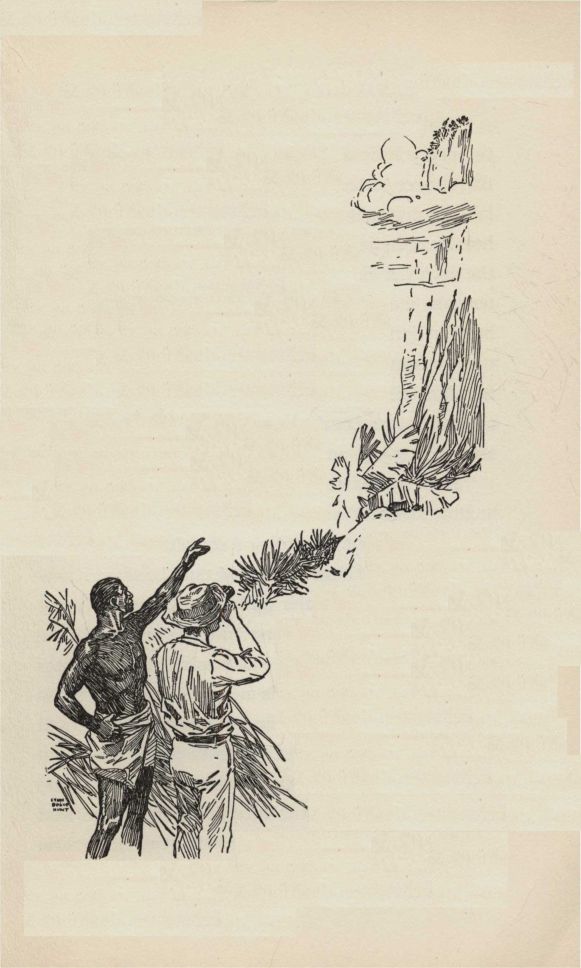
Men looking at mountain
In this connection it was my good fortune to meet a retired police officer who probably had more to do with the suppression of "witchery" in the Islands than any man living.
"It mostly began with long-pig," he told me. "Long-pig? Well, you know the Kanaka fashion of rolling bush pig in banana leaves and cooking it in the ground. Long-pig doesn't happen to be pig, that's all.
"And long-pig was enough for us. We broke up the party by marching the diners off in irons. But there were other things that had us beat. I've lain on my belly of a night, looking through a rat-hole in a native grass house, and seen some queer things: a war club stand on end, and dance on its own over the mats the length of the house. I'm no fool, but I'm darned if I could see how it was done. There was no harm in it, any more than there is in these new-fangled séances where spooks blow trumpets and rattle tambourines; but with Kanakas it may lead to long-pig, and that's what we were after.
"Then again, we watched one place for close on a month, and at the end of it found nothing we could lay hands on, but something I sha'n't forget.
"There must have been close on a hundred Kanakas squatting round the walls of the house in stony silence, when a wind sprang up that nearly blew the roof off and yet never so much as stirred the leaves on the palms twenty yards away. It was still blowing when something dropped through the roof, and squatted on the mats in the middle of the house.
"There wasn't much light—there never is at these chivarees, but there was enough for me to see that whatever it was it was a leper. It wasn't all there. It wasn't the right shape, or colour, but it boomed out answers to questions that the others put to it, and, knowing the lingo, I listened. It was the usual business: So-and-so's father was all right, but hoped that his son would join him before long as he was a trifle lonely. And somebody else's brother was having the time of his life with a brand-new sailing canoe that was the fastest thing yet. And somebody else was going to die soon....
"Now, you can arrest a leper on suspicion, and I did my best, but I never got that one. He just went, and so did the others, though they made more of a fuss about it; and all the time that wind was blowing the hair of my head this way and that.
"Fake? Of course it was a fake, but clever at that. I never got the leper, and that 'somebody else' died all right, because I saw him. But then Kanakas are like that: they die to order...."
True, the foregoing is hearsay, but it is first-hand hearsay, and on the best possible authority.
The only other Island witchcraft that I have encountered and can vouch for personally is fire-walking, a well known Kanaka pastime. That natives can make a pit of stones white hot with burning brush-wood, and then walk bare-footed upon them for upward of two minutes, is not so wonderful to the skeptic who knows that they paint the soles of their feet with a secret preparation that is a non-conductor of heat. But the fact that they can lead a white man, whose feet are not so treated, over the same stones, is a "trick" that needs some explaining.
Then, there is the herb for the unfailing and harmless production of abortion; a preparation of such preservative powers that it will keep the human body for centuries; and an innumerable array of magic potions undreamed of in our philosophy. Undoubtedly the Islands have their secrets, as quaint and wonderful as any in darkest Africa, and some day—which I trust is not far off—I hope to "inquire more closely."
Our planter friends of Moorea appeared to lead a pleasant life. Theirs was a bachelor bungalow run by efficient house-boys, and set on the fringe of a palm grove overlooking a vista of sea and reef and mountain as beautiful as any in the Island—which means in the world.
They were growing vanilla, and, although Britishers, had chosen Moorea as the scene of their labours because they preferred French rule.
"The French don't mess you about like our own people," one of them informed us. "They're not anti-this and anti-that. They leave you alone, and I can tell you we appreciate it after visiting a few of our colony-governed colonies." He referred, of course, to the mandates given to Australia and New Zealand over certain groups of the South Pacific. "It's like giving a kid something to play with. He's bound to break it."
The other of our two hosts was engaged in a passage-at-arms with Peter, and I pitied him. Trust a woman for either kindling or dousing a flame of enthusiasm in the male breast. But as she still holds to her viewpoint, and the question at issue involves every white woman who contemplates living in the South Sea Islands, it is of interest, and I take the liberty—and the risk—of quoting from her diary:
"One of them (our hosts) was engaged to an English girl of eighteen, and was going to send for her in a month or two, but expected opposition from her parents, who thought the Society Islands too uncivilized and out of the world for a young girl to be happy in. I must say I agreed with them.
"Perhaps for the first few months the novelty would keep her amused; but after that! I cannot imagine an intelligent, energetic girl being content to live her life on an island, however beautiful, where she would be the only white woman.
"I said something of the sort to her fiancé, since he asked my opinion. He said he had promised her a horse, as she was intensely keen on riding. Even then it meant that she would have to keep to the track which ran round the island, and one soon wearies of the same ride day after day, when there is no object in view but exercise.
"I suggested that she might help on the plantation, and that perhaps making things for her new home would keep her occupied, but was told it would be impossible for her to do a hand's tap of manual work as she would lose prestige with the natives (awful thought!) and that she was not the sort to like needlework or housekeeping as she was too much of a sport; besides, the 'boys' would do the latter.
"Then what would be left for the poor girl to do? I asked.
"'Oh, she could potter about; and then I should always be on hand,' was the reply.
"What could be said to a man who thought along those lines?"
The answer is an echo—"What?"
But I must confess to a sneaking sympathy for him, all the same. The position of the white man living alone amongst natives is difficult enough in all conscience, and any one who has done it will testify to the absolute necessity of retaining prestige. To lose it is an "awful thought!" for without it the white man sinks lower than his neighbours, and is soon regarded by them with unveiled contempt.
No; call it "bluff," what you will, but the white man cannot afford to part with his prestige. And how much more is it necessary when he has his womenfolk to protect?
In any case, the Islands are not a suitable home for white women, say what they will. There are isolated instances of them thriving there, but in the vast majority of cases they fall victims to a pernicious type of anæmia which, even if it does not kill, remains with them for the rest of their lives. And as for children, they thrive for about five years from birth, and then fade to mere weeds unless sent to more temperate climes.
Perhaps—who knows?—these things are but another proof that we harbingers of progress were not intended to invade the sanctuary of the South Seas.
PALMERSTON ISLAND
A hint of hurricane—The atoll of perfection, introducing "Mister Masters himself"
Chapter XIII headpiece
CHAPTER XIII
A hint of hurricane.—The atoll of perfection, introducing "Mister Masters himself"
Between the Societies and Australia there is a regular line of steamships calling at Raratonga, Samoa, and New Zealand, and it was to avoid this cut-and-dried route that we of the dream ship headed for Palmerston Island, a mere speck on the chart six hundred miles distant.
But we sailed just that trifle too soon that makes all the difference between a fair-weather passage and the reverse. December to April, inclusive, is the hurricane season in this part of the Pacific, when the schooner skippers from Raratonga and other places in the direct path of the cyclonic disturbance see fit to lie up in the comparative safety of Papeete harbour, and we sailed early in the latter month.
I am not claiming that we encountered a hurricane; far from it, for it is doubtful if even the dream ship would have survived a full-fledged demon of the species. In these same latitudes I have seen turf torn from the face of the earth and rolled up like a carpet by sheer force of wind, and mile-wide swaths cut as cleanly as with a sickle through settlement, plantation, and jungle. But these exhibitions of ferocity were witnessed from terra firma. It is a totally different thing from the deck of a small boat at sea.
Surely, if man does not recognize his own insignificance when faced with overwhelming turmoil of wind and wave, he never will. He shrivels on the instant from a being of considerable importance in his own estimation to the semblance of a microbe; and his craft follows suit by dwindling from a sturdy home to a cockleshell. That is why it is best for the mariner, if he can manage it, not to think too deeply during time of stress.
The demon was about, as evidenced by the barometer which fell to twenty-nine, but his main body, writhing in a circle as is his wont, must have missed us, for all we of the dream ship encountered was a lashing of his tail.
It was enough. It blew, and it rained. Lord, how it blew and rained! first from dead ahead, which caused us to heave to; then, as the vicious circle was completed, from dead aft, so that we "ran" like a wind-driven rag under double reef and storm jib.
It is an easy thing to "run"; the difficulty is to know when to stop. There is always the possibility of being "pooped," which simply means being overtaken by a mountain of water and crushed into the depths out of harm's way for good and all. To the uninitiated it would appear that the faster a ship travels the better chance she has of escaping a following sea. But this is not so. No one has yet succeeded in explaining the phenomenon satisfactorily, but it seems that the wake caused by even a small boat passing down the face of a comber induces it to break prematurely, and if the boat and the comber chance to be travelling at the same speed, the latter breaks aboard, that is all.
It is a chance that all who go down to the sea in ships must take when they "run," and the only way of obviating the disaster is to restrain a very natural desire to "get on with it" while the weather is fair, and heave to in time.
In the case of the dream ship there was no need to do this, as we had reduced canvas to such an extent that she was not doing more than ten knots, and rose to the summit of each breaking comber like a cork. I have yet to see the weather that she could not face without flinching, and I treasure her design beyond price.
After such a bucketing Palmerston was a welcome sight, as welcome as it was unique. It is doubtful if such another gem adorns the earth. Neither atoll nor island, it is a perfect combination of both; a natural necklace of surf-pounded coral strung with six equidistant, verdant islets, the whole enclosing a shallow lagoon slashed with unbelievable colour.
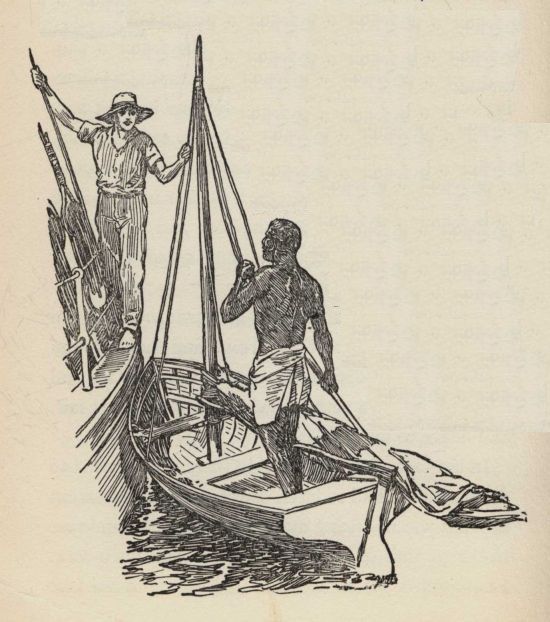
Men in boats
Such was Palmerston as we approached it before a stiff southeast "trade," to be welcomed by a fleet of amazingly fast luggers and their astonished crews.
Who were we?
Where had we sprung from?
Had we any matches?
To our own astonishment the questions were fired at us in English, and, what was more, English of a strangely familiar pattern. It is a quaint thing to hear one's own tongue fluently bandied amongst a brown-skinned people on an isolated speck of earth in mid-Pacific. But there was no opportunity of solving the riddle just then.
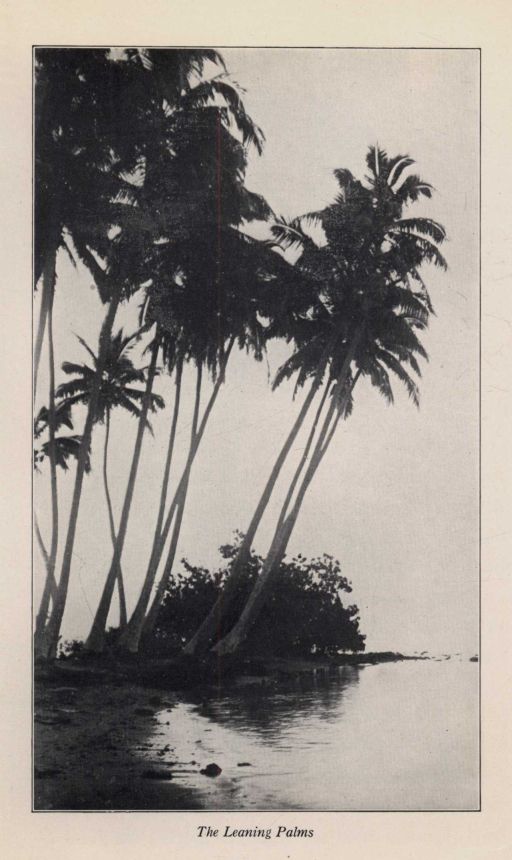
The Leaning Palms
"Let go!"
"She's set!"
"Lower the peak!"
"Lower the main!"
The dream ship had come to anchor on the north-west side of the reef, well sheltered from the almost eternal southeast trades of these latitudes, and the pilot, a six-foot figure of bronze sketchily attired in a converted flour sack, was addressing us with a courtesy as unusual as it was refreshing.
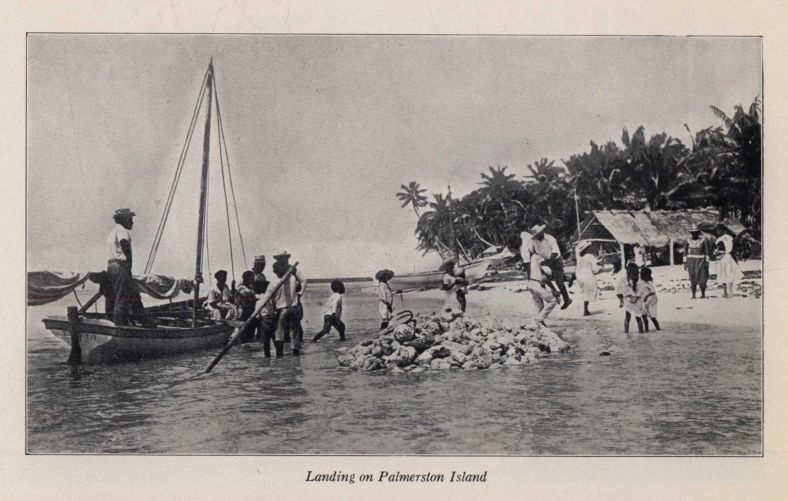
Landing on Palmerston Island
With our permission, he would take us ashore at once. Mister Masters himself had given instructions.
The "Mister Masters himself" settled it. We tumbled into one of the luggers, tumbled out again at the reef, and stood knee-deep in swirling waters while the pilot and his crew towed the craft against a ten-knot current through the boat passage; then aboard once more and away at an eight-knot clip through a maze of coral mushrooms, bumping, grazing, ricocheting, until finally sliding to rest on a glistening coral beach.
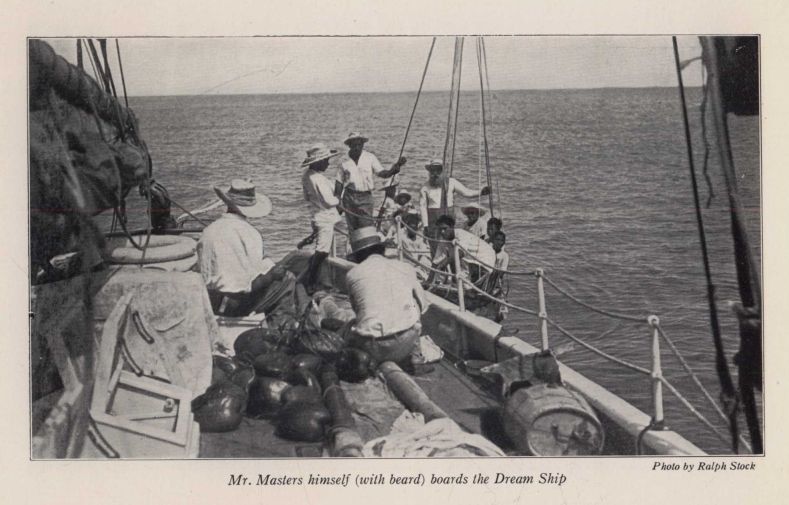
"Mister Masters himself," a dignified old gentleman with a flowing white beard, a tight alpaca jacket, and the general air of a patriarch, met us at the veranda steps of his spacious home, and inside of ten minutes we were sitting down to a meal of meals.
Our host informed us that the schooner was overdue and we must excuse the viands, but I saw no need for apology. In fact, how a few acres of powdered coral could have produced the variety of edibles we consumed at that meal passes my understanding. "Sailing Directions" in its own terse way, says of these atolls: "Inhabitants live entirely on cocoanuts and fish," and it sounds stringent enough, but I beg to state that our menu on one of them, namely Palmerston, read as follows:
SOUP: TURTLE
(Made of the genuine article, taken but a few hours ago from its playground in a zinc bath at the door.)
FISH
(I know not of what species, but tastier than most of the tropical varieties.)
BOILED FOWL
(And not the wretched victim of malnutrition emanating from most tropical barnyards; nor served undecapitated as appears usual in the Islands.)
ROAST PORK
(Which must have subsisted during its lifetime on something more nourishing than coral.)
VEGETABLES: SWEET POTATOES TARO ROOT
SWEETS: COCOANUT PUDDING
(The core of cocoanuts stewed in milk squeezed from the meat of the nut, a dainty warranted to send the restaurant connoisseur into ecstasies if it ever reaches him, which is unlikely.)
Over rum, emanating from the dream ship, as the local supply of liqueur was retained for strictly medicinal purposes, the history of Palmerston Island was unfolded.
What any student of Island history knows is that it was discovered by Captain Cook in 1774 on his second voyage, though some authorities claim it to be the "San Pablo" of Magellan, the first island discovered in the South Seas; that on his third and last voyage Cook landed again to get fodder for his starving cattle; and that later on it came under the critical notice of the Bounty mutineers, who, after a thorough spoiling in luxurious Tahiti, decided against Palmerston as their future home.
But what everyone does not know is the history of the Masters family who now occupy the island.
One William Masters, as fine an old English sea-dog as ever came off a whaler, took a fancy to the place in 1862, leased it from the British Government, and, not believing in half measures, took unto himself three native wives. By each he had a large and healthy family that he reared in strict accordance with his own standards of social usage.
That they were sound standards is evidenced in the people of Palmerston to-day. They read, write, and speak English, this last with an accent vaguely reminiscent of the southwest of England. They are courteous, hospitable, and honest to a degree little short of startling these days, and although naturally inbred, they do not show it mentally or physically.
The islets scattered round the reef have been equally distributed amongst the descendants of William Masters's three wives, who now number ninety-eight, and under the authority of the island council, presided over by "Mister Masters himself," are worked to such purpose that they produce a thousand pounds' worth of copra per year.
I have Palmerston securely pigeon-holed in my own mind as the spot of all others in which, when the time comes, to sit down and wait for the end. The outside world, in the shape of a schooner from the Cook Group, intrudes itself but once a year. The ordinary infirmities to which flesh is heir are non-existent. The lagoon and the neighbouring islets are a mine of interest to the naturalist or sportsman, and the people have a charm that is all their own.
One thing alone troubles the Masters of to-day. To whom do they and their island belong? The war has changed all things. The Cook Group, two hundred and seventy-three miles to the southeast, of which Palmerston has now been declared a far-flung unit, is administered by New Zealand. Is "Mister Masters himself" to be taxed, governed, and generally harried by a people who hardly existed when his father took over the island? It looks like it. Here is as fine an example of the communal system worked out on a practical and prosperous basis as will be found in the world to-day. Why, and again why, cannot incipient administrators be induced to leave well alone?
A tour of the tiny settlement is worth while. Not long ago a French brigantine rammed the reef on a clear night of stars, while the crew, including the lookout, was below playing cards, with the result that Palmerston settlement to-day is for the most part built of ship's timbers and planking, companions, portholes, bunks, and miscellaneous brass fittings.
The little church, which is in course of construction and meantime serves as a school house, boasts walls and pulpit composed entirely of panelled doors from the hulk; and fine old seasoned timber it is.
The recognized playground is outside the church door under the palms, where a cricket pitch entices all and sundry. But the real playground of Palmerston is the boat passage in the reef, through which a mill race rushes at each turn of the tide. Here the multitudinous offspring of William Masters disport themselves on every contrivance that floats, from a full-fledged sailing-boat to a weather-board, and at the rate of knots sweep yelling round tortuous curves to or from the sea.
The dream ship, riding at anchor outside the reef, became the centre of attraction, and finally added to her many accomplishments by becoming a bargain store.
It may be remembered that on setting out from England we had laid in certain commodities known as "barter." Well, they were still aboard—slightly mildewed, but aboard—for the good and sufficient reason that we had not been able to get rid of them. It appeared that our ideas on the subject of "barter" were archaic. Nothing short of silk stockings, real gold watch chains, gramaphones, and gin is acceptable in the Islands these days. How could we offer such a discriminating public rusty jew's-harps?
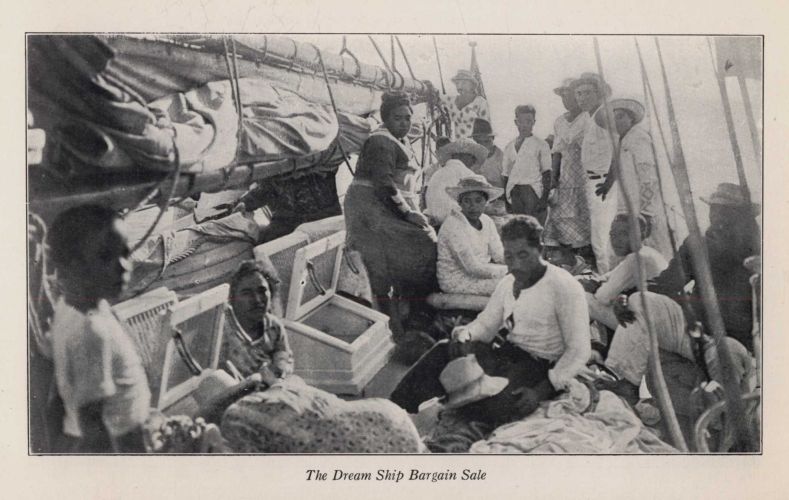
But here was an opportunity not to be missed. "Sale! Sale!! Sale!!! Heart-rending reductions!" was the notice I suggested nailing to the mast, but there was no need. The entire population of Palmerston tumbled aboard like an avalanche, and gigglingly surveyed our effects outspread on the engine-room hatch.
To any one requiring the services of a thoroughly efficient window-dresser and salesman, I can heartily recommend Steve. Until the occasion of the dream ship's jumble sale I had, it appears, misjudged the man. Prose poems to a piece of voile (double width, slightly soiled and cunningly displayed on an arm) fell from his lips like rain. Imitation leather belts, looking glasses conveying a somewhat distorted reflection, near tortoise-shell haircombs, rusty knives, even jew's-harps, each and all possessed some sterling virtue of which I had been ignorant until enlightened by Steve. And they "went." It was my humble duty to make a note of the sales, and there was no keeping tally of them. In twenty minutes our "counters" were bare, and our customers clamouring for more.
And this was not all. From below, where Peter was supposed to be conducting a kind of ice-cream social without the ice-cream, came the unmistakable sounds of "barter," and when we mere males had succeeded in fighting our way through a solid mass of femininity, it was to behold her surrounded with a drift of every domestic commodity from raspberry jam to a safety-pin.
"They wanted them so badly, poor things," she confessed to me after the fracas, but did not succeed in hiding from me the embers of battle in her eye. Brothers are awkward things.
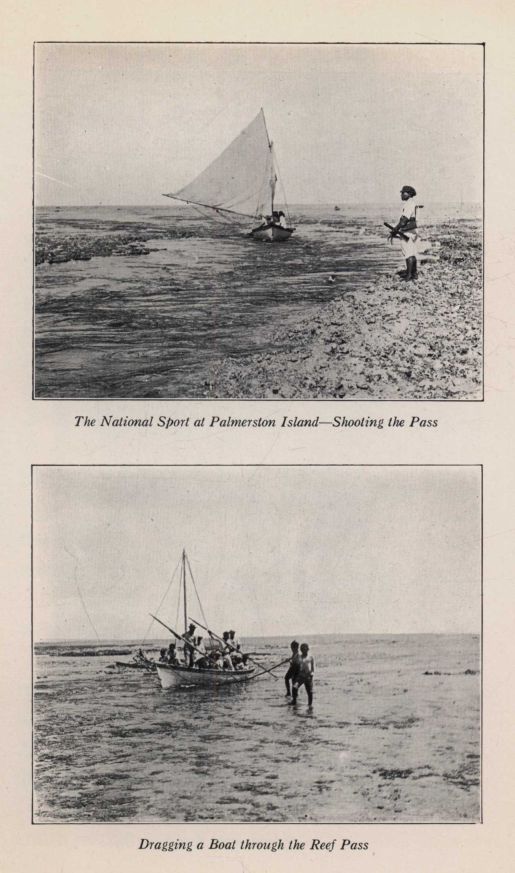
The National Sport at Palmerston Island—Shooting the Pass; Dragging a Boat through the Reef Pass
It was only when the last boatload of cheerful humanity had taken its departure, and we of the dream ship were dividing the spoils, that it was discovered by a closer reference to the invoices we had sold everything at cost!
Four more days we spent at Palmerston for the simple reason that we could not tear ourselves away.
It was a pleasant thing of an evening to wander over the firm wet sand of the beaches hand in hand with singing children, while a tribe of dogs leapt after mocking sea birds, or splashed into rock-pools snapping at the fish.
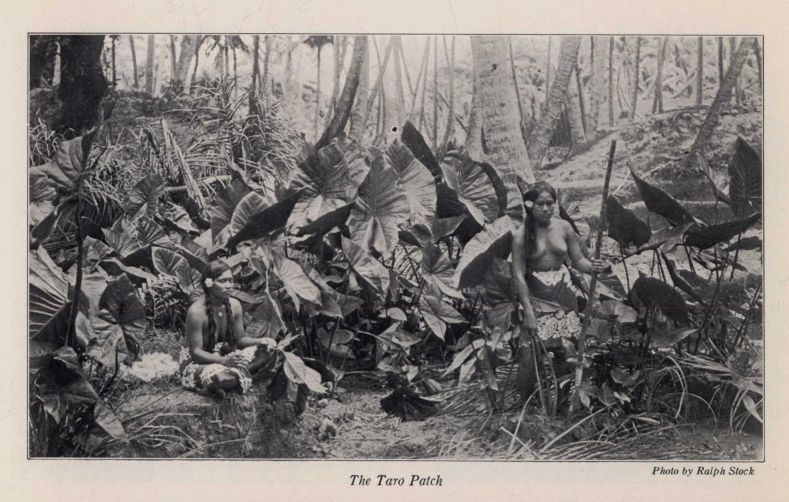
The Taro Patch
Perhaps the tide had turned, and one by one the coral mushrooms reared fantastic shapes out of the still waters of the lagoon—a gambolling elf, a ship under full sail, a mammoth bird or beast. It was difficult to realize one was not in fairyland—and an unworthy task at that. But again, even here, there entered the tragic touch of the South Seas. A thin spiral of blue smoke rose from the smallest of the islets across the lagoon, and I asked who lived there. A brother and sister, I was told, lepers.
"We're going to have shell in the lagoon as soon as we can get some by the schooner," "Mister Masters himself" told me on the veranda one evening. "Ought to do well enough. And we could run a few cattle here, too. But a schooner a year isn't much good to a man, is it?"
I admitted that it could hardly be called a "service."
"I'd have a proper passage dynamited in the reef," he went on, presently, "and you could do a bit of trading between here and the Cooks and Tahiti. And you could have a house here, and Matha to look after you—if you'd care to stay."
I looked at him, at Palmerston, at the dream ship, and regretfully shook my head.
"Not yet," said I.
Au revoir, little island. Some day in the not very distant future a decrepit, irritable old man will return to your hospitable shores in search of peace; and if you are then as you are now—which Heaven send!—he will assuredly find it.
SAVAGE ISLAND
The Island called "Savage" including the ordeal by Hospitality
Chapter XIV headpiece
CHAPTER XIV
The Island called "Savage," including the ordeal by Hospitality
When Captain Cook discovered Niué in 1774, he christened it "Savage Island," and went on his adventurous way without landing because of the ferocious appearance and demeanour of the natives.
They, poor fellows, protest to this day that the great navigator's title is a misnomer, that they have ever been as peaceful a folk as any in the South Seas, and that the true cause of their ancestors' objection to a landing-party was their fear of white men's diseases, of which they had heard painful accounts.
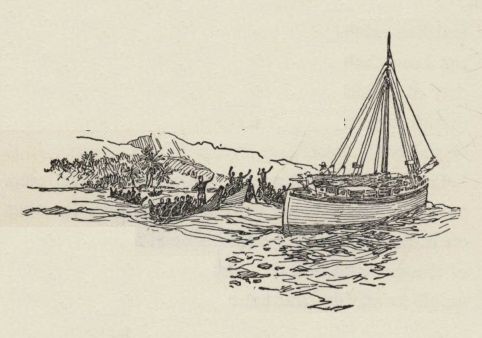
We of the dream ship could sympathize with both parties. On the one hand, the track of infection is scored deep across the fair face of the Pacific, and on the other we had never beheld such a villainous-looking horde of natives as came to greet us at Niué. There were hundreds of them, each in a remarkably seaworthy type of dugout canoe painted black, so that the whole resembled a mammoth shoal of porpoises as they leapt from wave to wave.
This, however, is where the resemblance ended, for the porpoise is a sleek and silent gentleman, and the Niuéan is anything but that. He catches sight of a dream ship gliding slowly along his coasts under power, hurls himself into his canoe and paddles, yelling like a maniac, in her wake. He then rears himself on end, waves his paddle, and yells some more. By Herculean efforts he gains on her, comes alongside, grins malevolently, and yells into one's very face.
No wonder Captain Cook thought better of his shore-leave.
Yet when one comes to know these people better, as we of the dream ship did during the ensuing week, they are the most inoffensive, good-natured, open-hearted creatures imaginable. This naval reception was their idea of a really touching welcome. They were glad to see us—they are glad to see any one on Niué. Appearances are against them, that is all.
No sooner had we dropped hook at Alofi, the deepest bay around this iron-bound coast, than we were boarded by three gentlemen of a magnificence, in their crisp white drills, that put us to shame. But we of the dream ship had suffered this type of indignity so often that we were used to it. Besides, the magnificence of our visitors was happily only external, though they proved to be the Resident Commissioner, the Judge of the High Court, the Judge of the Native Land Court, the Collector of Customs, and the Postmaster; the Registrar of Courts and the Registrar of Births, Deaths, and Marriages; and the Chief Medical Officer.
Boat at island
Although, as I have said, there were only three of them, that is what they were, and you must separate them by the semicolons. Clearly they do not believe in overstaffing on Niué.
The first glad news to reach our ears was that we had missed a hurricane by three days. Oh, yes, Niué had them occasionally, and before now had been swept bare, but this particular one had passed like a ravening beast a few miles to the eastward. Had we seen or heard nothing of it?
We shook our heads in infinitely grateful negation, and the Postmaster—I beg his pardon, the Commissioner—exchanged a thoughtful glance with the Chief Medical Officer whom, it is to be feared, we had already christened "Doc." They had asked because the Cook-Group schooner that visited Niué with the unprecedented frequency of five times a year was considerably overdue. But we must come and live ashore; there was Government House, and the Law Courts, and the Gaol to spread ourselves over at a pinch.
And that was how we of the dream ship came to be so royally treated on Savage Island.
Legend has it that a great god of the past, with one foot firmly planted in the Tonga Group and the other on Raratonga, took it into his head to lift Niué out of the sea, and one can almost believe it. It is of weird formation, known scientifically as "upheave coral," and consists of two terraces, the lower ninety feet above sea level, and the other, two hundred and twenty feet, the intervening space being slashed with deep chasms. In short, Niué is nothing more than an atoll hurled bodily out of the sea by some mighty convulsion of the earth's past. One can clearly see that what was once the reef is now a mighty cliff and that the lagoon inside it is now a coral basin, pitched high and dry.
And this hybrid of an island is wonderfully fertile. On the terrace, that I cannot help looking upon as the reef, cocoanuts, bananas, and most other tropical products grow to perfection, while the lagoon—I should say valley—is thickly timbered with ebony and other hard woods. How came they to be there, considering they were never planted by human hand? Perhaps the Island Hercules who dragged the atoll from the sea saw fit also to cover its nakedness. No other solution of the problem presents itself.
"It's a queer spot," I was told during a motor tour of the Island by what is called "road," though it more closely resembles a coral switchback—"as queer as its people until you come to know them. But try and remember yourself at the age of thirteen, and you have the average adult Kanaka. Several of them joined up voluntarily with the Maori contingent during the war, and wear service ribbons in their hair if they can find no other place for them.
"Disease is our great trouble. The Niuéan has always been a born wanderer, and he brings things back with him; but we're getting it under by keeping them at home, and making failure to report a penal offence. They've always been hard workers, too. We planted fifteen thousand nuts on Armistice Day, and away back this was a favourite hunting ground for 'black-birders' on account of the Niuéan's appetite for toil. Bully Hayes, the well-known South Sea buccaneer, used to come here often, and, when he couldn't get men, took women—cargoes of them—to sell down in the leisure-loving Societies.
"Those? Graves. They've always buried their dead alongside the tracks, and we saw no reason to interfere. Good grave, coral, like a sponge—everything into the sea in no time. On top? Oh, that may be anything from a canoe to a pair of old boots. They have the same idea of 'laying the table' with the deceased's personal belongings as so many others. I nearly stole one of them once. It was a perfectly good sewing-machine, and my wife had nothing to run up curtains and things with when we came here. But I thought better of it. You have to go warily with these gentry."
At this juncture the long-suffering car plunged axle-deep into a quagmire of disintegrated coral, and refused to emerge until an army of Niuéans—advancing on us like a devastating host—attached themselves to its various parts and, by sheer manpower accompanied with indispensable yelling, dragged it forth.
Mr. Masters himself (with beard) boards the Dream Ship
We were close to a village, and the piea makers were at work. As a sidelight on the painstaking industry of these people, their preparation of arrowroot for food is illuminating. In an age when machinery does everything but—I was going to say "talk," but correct myself advisedly—it is a lesson in certain virtues that we of to-day seem to have mislaid.
The Dream Ship Bargain Sale
Only one family works at a time, and brings its own implements. A stretch of coral sand is selected, and staffed with men, women, and children. The old women scrape off the discoloured rind of the roots with splintered cocoanut shell and throw them into a palm-leaf basket which the children rinse in salt water and carry to the men. They in turn grate the root into a coarse powder with instruments made of cylindrical-shaped pieces of wood bound at intervals with sinnet, the powder falling on to finely woven mats which are carried away by girls and tipped into a cradle of bamboo and cocoanut-fibre. This acts as a filter, through which salt water is poured while a man kneads the powder into a dough with such energy that he has to be relieved at frequent intervals.
The white spectators, if any, are then politely requested to retire while the final process of kneading and washing in fresh water is in progress, as it has been satisfactorily established that their mere glance turns piea sour.
Not wishing to dispute the fact, we complied—with the exception of Mrs. Commissioner's little girl, who had long cherished a desire to see the forbidden rite. Peering from behind a coral boulder, she was caught in the act and chased headlong and crying with fright before a shower of stones, to be comforted by her mother but severely reprimanded by the Commissioner, who is very rightly a stickler for etiquette where "his people" are concerned.
In these matters of form, convention, tradition—call it what you will—we of the outside world are inclined to imagine that we hold a monopoly, but such is far from being the case. The average South Sea Islander's codes are as numerous as, and far stricter than, ours, and when we deign to visit him with our particular brand of etiquette, and leave with the notion that we have in any way impressed him with our superiority, we make a vast mistake.
Inwardly (it is to be hoped), it causes us considerable amusement to note the "quaint customs of a picturesque people," but how often does it occur to us that our own antics are equally ludicrous to them, and that we are at a disadvantage in that our hosts are invariably too polite to show by word or look that we have infringed their code of ethics?
In this respect I have always remembered a visitor to China who was consumed with uncontrollable mirth at the spectacle of chop-sticks in action, the while he proceeded to fill himself with his knife.
Peter informed me that the chief trial she endured while moving in savage circles where it is impossible to converse was the necessity of wearing a more or less permanent smile; and I sympathized. We were in good company, for I believe Royalty is afflicted in the same way. But when you come to think of it, what else can you do with your face when confronted with a stonily staring multitude that you wish to impress with the fact that you are having a good time? It is a problem, the only solution of which to my mind is to carry a cheerfully expressioned mask, and don it as occasion demands.
Mrs. "Doc" had given up going with her husband on his rounds for this very reason. She said she found herself after a tour of inspection carrying a stationary smirk into private life, and it frightened her.
An occasion for the mask of appreciation, if we had chanced to carry one aboard the dream ship, presented itself the following evening. The paramount Chief of Niué very kindly invited us to a feast, and after consuming inordinate quantities of filling food, we sat, and continued to sit, while our host delivered an oration very ably translated by a pupil teacher from the mission school:
The paramount Chief of Niué, misnamed Savage Island, was overwhelmed by the honour we had done him in choosing his little island to visit—we who were used to the beauties and luxuries of the great outside. We must be brave warriors to cross so many miles of tempestuous ocean in order to see him and his people [the mask of modesty, please!]. Our ship, too, though small, must have been built by great artisans to have carried us so far and so safely.... When we returned, would we describe to the great King all that we had seen on Niué, and convey to him the loyalty of his subjects?
It was a neat speech, calling for a neat answer which, unfortunately, I have ever been incapable of supplying. But there was always Steve. After his unrivalled exhibition at the dream ship's jumble sale he was "called upon" by frenzied nudges in the ribs, and the confidence was not misplaced. Exactly what the dream ship would have done without Steve, I tremble to think.
Thursday Island Pearling Luggers
The after-dinner speeches disposed of, Peter, in a confessedly comatose condition owing to a super-abundance of heat and food, yet with her own particular brand of smile securely in place, came in for special attention. The ladies of Niué do not speak; they act. The paramount Chieftainess advanced upon her with a beautifully woven hat in one hand, and with the other attempted to rid her of her existing headgear. Unfortunately, and amidst general consternation, it failed to come adrift on account of the pins, but this was soon remedied, and the gift securely wedged into place amidst loud applause.
Time was when the Niuéans were the best hat-makers in the South Seas, but with the introduction of the Panama their product has fallen into disrepute. It is hoped by acclimatizing the Panama plant to revive the industry.
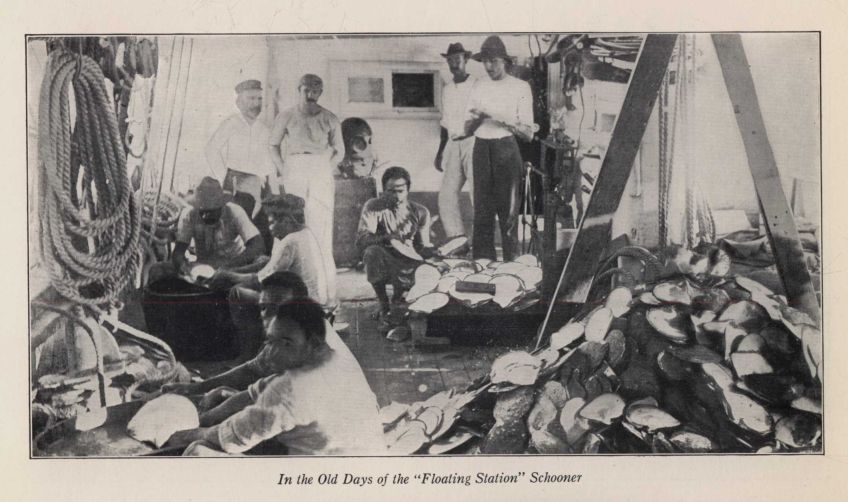
In the Old Days of the "Floating Station" Schooner
But Peter's adventures that day were not over. To quote from her invaluable diary:
"On our way back to Government House we met an aged and bent woman who stood still in the middle of the road and literally gibbered at us. When I tried to pass, she caught hold of my hand and shook it with astonishing vigour for one of her decrepit appearance.
"I asked 'Doc' what it was all about, and he told me the poor old thing had walked fifteen miles to see the woman in man's clothing! But she thought she had been deceived because I was wearing unmistakable skirts, and looked too weak to do all the wonderful things she had heard about me.
"The 'Doc' told me further that she must have started before daylight in order to walk that distance, for she was very feeble. I felt terribly embarrassed, as I had neither money nor any trinket with me that I could give her. But, feeling in my pocket, I discovered a little comb I always carry, and also a tube of lip-salve, as my lips dry and crack in a hot climate, and these I handed to her, the latter because it was bright and shiny.
"She evidently realized what the comb was for, but twisted the cosmetic in her poor old fingers and looked puzzled until the top fell off and the creamy-white substance protruded. This she instantly bit off and chewed with evident relish. I do so hope I gave satisfaction."
So, aboard the dream ship and away, carrying with us grateful memories of many kindnesses from Niué and its government. May they both prosper as they deserve!
The last farewell we received from this Island called Savage was a fearsome-looking inhabitant on the top-most peak of the reef—I should say terrace—waving a scarlet si-si, and yelling blue murder. But we of the dream ship knew better.
THE FRIENDLY ISLANDS AND THE END OF THE DREAM
The island that was savage—Dream's end, and a few realities
Chapter XV headpiece
CHAPTER XV
The island that was savage—Dream's end, and a few realities
South, and still south, the dream ship sailed, until the neighbourhood of the "southerly-buster" began to make itself felt in a league-long swell.
We were heading for Tonga Tabu, the southern-most island of the Friendly group where we might turn and sail almost due west for Australia in open sea, instead of picking a precarious and anxious way through the close-meshed network of islets, rocks, and submerged reefs that littered the more direct route.
Even so, we came nearer to disaster amongst these alleged Friendly Islands than we had throughout the entire voyage. Cook so christened them on account of the contrast of his reception here compared with Niué, but we of the dream ship suffered a reversed order of things, and consequently beg to differ with the great navigator.
On the fourth day out from Niué we sighted the group, but decided not to proceed as there are no lights on these outlying reefs, and we had been warned by every island skipper of consequence that a vessel "sights" and "hits" one of them as near simultaneously as no matter. So we hove-to on the tail-end, the very mildly wagging tail-end, of a "southerly-buster," and turned in.
Throughout the night we took it in turns to go on deck at intervals and see that we were not drifting on to anything, and, save for the eternal dirge of the sea that fills the night in the vicinity of any group of South Pacific Islands, all was well. Yet with the sudden sunlight of dawn in these latitudes, we stood aghast at the scene confronting us: on all sides waves, an apparently complete circle of breaking combers, their emerald-green bodies and white-capped heads flashing in the sun. To all appearances we were as effectually trapped as a rat in a cage. Yet how was the thing possible? If there were an inlet into this inferno of reefs there must assuredly be an outlet.
The engine was called upon, and responded nobly. During that day we systematically searched for a loophole of escape, and found none, until toward evening we glided through a passage no more than fifty yards wide, and to our intense relief found that it led to the open sea.
While hove-to the previous night the dream ship must have executed a miracle by drifting into a narrow-necked horseshoe of coral; that was all. And to some it may appear that we were an unconscionable time in finding a way out, but for the benefit of such I would point out that the inside of the horseshoe, as is often the case, was littered with broken reefs, each forming an apparent outlet which on closer inspection proved to be nothing of the sort. In short, I would commend those with a taste for maze-solving to visit the Friendly Islands.
I was not surprised to learn later that local trading craft, equipped with a band of lynx-eyed Kanakas, never sail at night in these waters. Apart from the constant danger of known reefs, others have a knack of appearing and receding in the most uncanny way, so that no chart issued can keep track of them.
In this connection a most enthralling theory engages the attention of the South Sea student. It is his firm belief that what is now the "milky way" of the Pacific was at one time a vast coral and volcanic continent; that it has subsided here, and been upheaved or erupted there, until broken into a myriad fragments, and that the day may still come when Nature will elect to raise them from the deep, welded once more into a mighty whole.
As has been said before (if it were not sufficiently evident without saying at all), I am not a scientist, but the existing indications in support of this theory meet even the casual observer at every turn in the Pacific Ocean to-day. There is a wall on Easter Island, not unlike the great wall of China, but which runs for a short distance and then plunges aimlessly into the sea. Where did it begin? Where did it end? What mighty city did it embrace? On Pitcairn there are the remains of a former and highly advanced civilization. On Lord Howe Island, a mere rock sprouting three thousand feet out of the sea four hundred and eighty miles from the Australian coast, there are sixty different species of land shell, 50 per cent. of which are not to be found anywhere else in the world. How do they come to be on Lord Howe? Land shell cannot swim. In the Carolines, you may look down into the water of lagoons and see the remains—mosaic floors and broken walls—of a submerged city.
So, from east to west, and from north to south, this mighty ocean of the Pacific holds its secrets of forgotten lands and peoples.
As for the dream ship, not content with escape from a coral death-trap, we sailed out, and still out to the open sea, until nothing short of a gale could carry us into danger, and there hove-to again for the night. There was nothing else to be done. What was more, and owing to an oversight attributable to no one but myself, we had no large-scale chart of Tonga Tabu, so that it took us three days of searching and three nights of heaving to before we found the eastern pass through the reef and waited with international code flag flying for the pilot.
Natives in canoe
We could see his station and flagstaff on a sandspit, but no flag in answer to our own. We waited, and continued to wait, while a three-knot current carried us up the ever-narrowing channel to within fifty feet of the coral bar at its end. And then it was that the motor auxiliary that I have so consistently reviled throughout these pages vindicated itself by saving us from certain destruction. It went! Literally inch by inch it fought the current for the hour or more we were obliged to wait on that pilot's pleasure.
I can hear the "expert's" wail of enquiry: "Why not have anchored?" My answer is that I should like to see him try. Is he aware that coral alters all one's preconceived ideas of seamanship? Does he know that although the passage walls were not more than fifty feet from either side of us, the water between was unfathomable; that to put out a kedge was equally hopeless because exposed coral is nothing more than a brittle honeycomb that breaks like pie-crust; that—— But I refuse further enlightenment. Let my imagined critic learn from experience as I was forced to do.
At long last the pilot came, in an outrigger canoe that was swept from under his feet by the current as he clambered aboard. He did not know... He thought our code flag was a burgee, that we were a local trading cutter, that we were almost anything but what we were. There are moments too full for words, and this was one.
The Friendly Islands have a real queen and a consort, and I reported that pilot to both of them, though my plaint merely elicited a charming smile from the one and the suggestion of a whisky-and-soda from the other. It's a way they have in the Islands.
I fear this account of Tonga Tabu will be unsympathetic, and for that reason I would suggest the perusal of several excellent books on the subject. For me it was a place of tragedy, and as such remains with me to this day. My views are jaundiced; let them lie! All I know is that in the island capital of Nukualofa there is a club, and from that club emerged a genial gentleman who, had I known what I know now, would never have set foot aboard the dream ship. He came, he saw, and we repaired to the club.
"Do you want to sell that boat of yours?" he asked me.
"No," said I.
"Will you sell her?" he corrected himself.
"Not for what any sane man would care to pay," I told him.
"And what is that, may I ask?"
I named a figure sufficiently preposterous to raise a laugh from most people. But the genial gentleman did not laugh.
"You would take no less?" he suggested bravely.
"Not a cent," said I. "As a matter of fact——"
"I suppose a draft on —— will satisfy you?"
"What's that?" I stammered.
"I'll take her," said the genial gentleman. "I was saying that...."
But I heard no more. I had sold the dream ship!
Confession is said to be good for the soul, but I have not noticed much improvement in the state of my own since making the above statement. Imagine parting for pelf with a home that has conveyed you across twelve thousand miles of ocean. Or, better, try to imagine selling your best friend, and you have some idea of my feelings since the transaction. And there was no going back on it. I have not the moral courage of such deeds. The draft lay on the table before me, I had a pocket full of money, and no ship. I have never been so miserable in my life.
It took me the best part of an hour's aimless wandering over the powdered coral roads of Nukualofa to summon the necessary courage to break the news to the crew of the dream ship, but by the end of that time I had some sort of scheme evolved. Between the Friendlies and Australia there were no islands of particular interest, anyway. We would continue our journey by steamer—it would be a pleasant change—and in New Zealand or Australia I would invest my ill-gotten gains in a far more magnificent vessel than the dream ship.
On this "more magnificent" craft, we would carry out our original programme of cruising up the Queensland coast to the islands of the northwest Pacific, and so home via Java, Colombo, and the Suez Canal, thereby avoiding the monotonous passage between the Friendlies and Australia. Rather clever, I thought. Nevertheless, I prefer to draw a veil over the communication of this brilliant scheme to the rest of the crew. Peter did not speak to me for the rest of the day. I verily believe she hates me, but not a tithe more than I hate myself. It is enough that we took our departure by steamer according to schedule, and without daring to look back on the good ship we had left behind. The heart had gone out of things; the dream was ended.
Or rather it had merged into a nightmare. We proceeded to rub shoulders with a horde of fellow-passengers who no doubt regarded us as unattractive as we regarded them; to consume beef-tea or ice-cream at eleven o'clock, and push lumps of wood about the deck with a stick for want of something better to do.
Is there anything more wearisome than a steamer voyage—after sailing your own ship? You sleep throughout the night instead of breaking the twenty-four hours into the sensible segments of four "on" and eight "off." You are called by a smug-faced steward instead of being gently squeezed or roughly shaken into life by the previous "watch"; and instead of commanding your own destinies at the tiller under the stars, you watch others doing it in brass buttons and electric light from a bridge. You begin to wonder if your tie is straight, if it would be permissible to rid your chafing neck of the unholy contrivance encircling it.
As for your fellow-passengers, they are—to a man, and to a woman—gross from over-indulgence of one form or another—mostly food and drink, and their interests are as far removed from yours as the stars. You begin to see how the average sailor-man feels in "polite society," and your heart goes out to him.
"How's the wind?" Ah, of course, it makes no difference to this smoke-belching machine that bears you at thirteen knots, and according to schedule, toward civilization. See that wave? The big fellow with the curling top! Isn't he twin brother to the one you met in the Caribbean when...
No, no. Give us the "sleepy" twelve-to-four watch, and even a "cooking week" aboard the dream ship that we may be content once more.
Already, we were changed to each other's eye. Oftentimes I stood with Steve on the promenade deck, and his well-known figure, camouflaged at the moment under a natty blue suit and collar and tie complete, would fade and merge like a dissolving view into a brown-skinned, happy savage in towel and sola topi. And as for Peter—she was no longer the Peter we had known for a happy ten-month, but a female slave to every twist and quiff of convention. And it was my doing ... all my doing. Or can I thrust the blame on other shoulders after the fashion of brother Adam? Is it not our women-folk who make convention necessary at all to men who, if they followed natural instincts, would revert to the enviable savage?
At Apia, Samoa, Steve was so heartily tired of his environment that he left the ship. He said he could scent civilization afar, and would have none of it. He had met a military official ashore who had offered him a post in the Government on the strength of his war services, and he had accepted. He would stay there in Samoa until I had found another dream ship, when he would join her on receipt of a cable, and continue with us over the remaining half of the world.
He made this promise with an ironical twinkle of the eye that puzzled me at the time, but which has since been abundantly and painfully accounted for.
He left in a native outrigger canoe, hugging his knees on a pyramid of bananas, while the remainder of "the crew" waved him farewell from the steamer's rail, and turned sadly away. A better mate for any venture calling on the best qualities of a man never breathed. Here's to him, "down under," and may that cable not be long delayed!
THURSDAY ISLAND
Concerning a wild-goose chase, and where it led
Chapter XVI headpiece
CHAPTER XVI
Concerning a wild-goose chase, and where it led
Life for the sad remnants of the dream ship's crew resolved itself into the pursuit of a will-o'-the-wisp.
It was a strange craft that we were after: sufficiently staunch to stand any weather, yet small enough to be handled by a crew of three. The New Zealand seaboard had neither heard of nor seen such a thing. At Auckland and Wellington we were hustled off in launch or car with high hope in our hearts, and shown every manner of contrivance that floats, but there was no choice between hundred-ton schooners and harbour racing machines. New Zealand is a beautiful, over-legislated, intensely earnest little country, but for us it held no dream ship, and we passed on.
Australia was little better. Adelaide, Melbourne, Sydney were visited in turn, and scoured from end to end without producing anything within coo-ee of what we sought. With an "I-told-you-so" glint in her eye, Peter departed on a jaunt to New Guinea, and I continued the search alone, after the fashion of the "last little nigger boy."
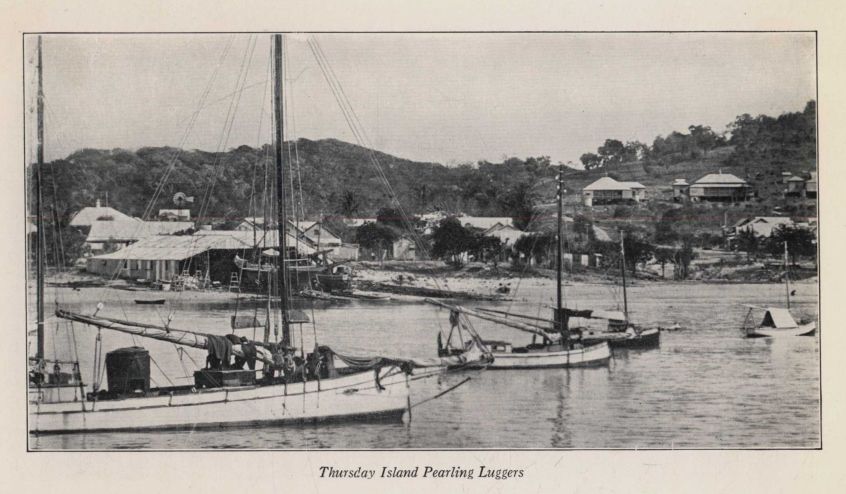
Hearing that the Torres Straits pearling luggers were likely craft, I set my teeth and journeyed on a Chinese liner—incidentally one of the most comfortable and well-managed ships it has been my good fortune to encounter—up through the myriad islets of the Queensland barrier reef to Thursday Island.
It is a strange thing on a ten-thousand-ton liner to awake at night to a silence unbroken even by the familiar throbbing of the engines, and to feel the great ship rising and falling on the swell like any cockleshell; to go on deck and find her lying at anchor under a panoply of stars, and apparently in mid-ocean, for there is no sign of land. Yet this is a frequent experience of any passenger traversing the barrier reef. Whether liner or dream ship, it makes no difference to the infinite care necessary in navigating these reef-infested seas.
A young navy of pilots performs the miracle—for miracle it is. After long apprenticeship they learn the exact dimensions of every open stretch of water, and if they leave one side at nightfall, they can tell by the vessel's speed, and to a yard, when they have reached the other, when they anchor until dawn. The farther we progressed up the magnificently rugged coast of Queensland, the more varied became the nature of our passenger list. There were sun-baked pastoralists from the cattle and sheep stations "out back" who owned herds and acreages that would cause the largest Western American rancher to open his eyes. One of them at a recent cattle "muster" had tallied up to half a million head, and he had not finished yet. The possibilities of the "Northern Territory," as it is called, are infinite—if it were not for the bugbear of labour troubles that stalks Australia with a heavier tread than any other country of the world.
Then, there were commercial travellers—not the sleek variety that boards a "flyer" and is on its battle-ground in a matter of hours, but lean, hard-bitten men who take a launch or trading cutter and traverse vast stretches of ocean to the farthermost corners of the Gulf of Carpentaria, sleeping, eating, and having their being for weeks together in a stifling, evil-smelling deck house with native "boys" and their own sample cases for sole company.
Wireless operators, engineers, pearlers, teachers of aboriginal schools, Chinamen, Japanese, all were on their way to this mysterious equatorial land of vast, unexplored spaces.
A great deal has been written about Thursday Island, otherwise known as "T.I.", but, without exception, accounts refer to a more picturesque past when this sun-baked tile on the roof of Australia was the busy headquarters of a pearling fleet manned by "whites" and native "boys"; when hefty schooners were employed as floating stations, where shell was opened and treated at sea under the lynx-eyed supervision of a skipper or mate who claimed the hidden treasure it might contain. To-day, the pearling fleet is manned entirely by Japanese, who work on a prosaic fifty-per-cent. basis, and are entitled to every pearl they find.
But of this, later. There were luggers in the bay, likely-looking craft, the most likely I had seen in all my weary pilgrimage. Was it possible that I was on the verge of being able to look Peter in the eye once more—and send a cable to Samoa?
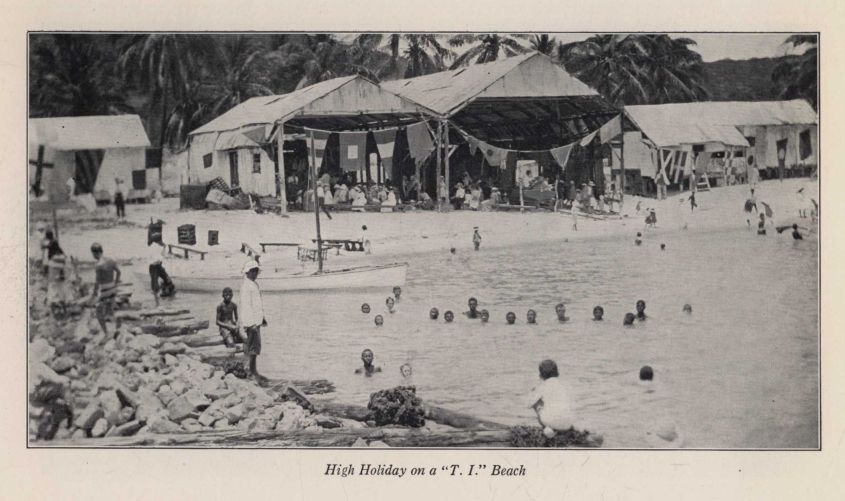
High Holiday on a "T.I." Beach
Not five minutes after landing in the corrugated-iron and goat-infested landscape of Thursday Island I was in the shipyards watching an army of Japanese workmen putting the finishing touches to a pearling lugger. Yes, I was told by the manager of the Pearling Company that had commissioned her, I could have a similar craft built for —— (a sum nearly double the seemingly preposterous figure I had received for the dream ship)—and she could be delivered in about a year! Labour, you know, prices of material—everything! Things were not as they used to be on 'T.I.'. Or yes; there were second-hand craft to be picked up, but it stood to reason they would have passed their day, or they would not be sold.
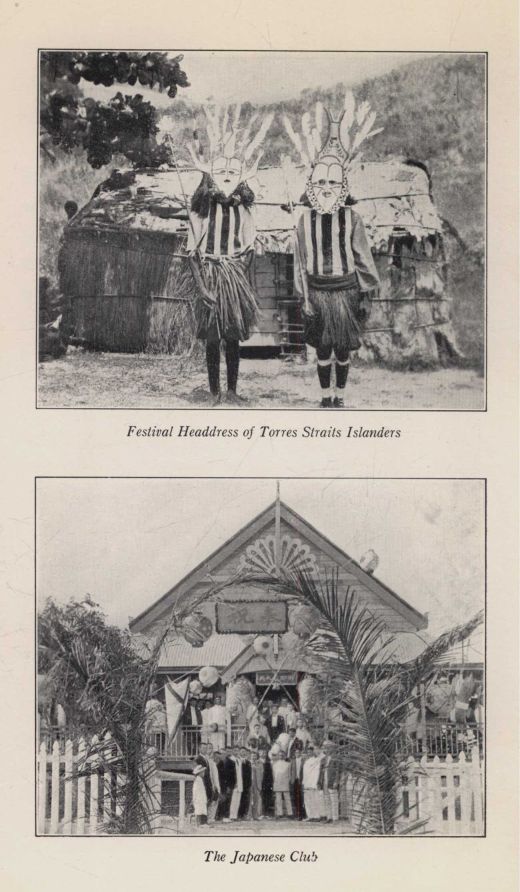
Festival Headdress of Torres Straits Islanders; The Japanese Club
I boarded twelve in all, and examined them from truck to keelson. In some cases one could scoop the dry-rot out of their timbers in handfuls; in others—— But why continue? In all of them the head-room was practically nil because of their light draught for negotiating reefs and sand-bars, and because the Japanese have no manner of use for head-room. When below, they live, move, and have their being on their heel-supported haunches. It would be necessary for the average Anglo-Saxon to crawl on all fours to escape a permanent crick in the neck and stooped shoulders aboard a pearling lugger.
It was in that hour that I realized my final defeat. Peter and Steve were right—there never would be another dream ship. I resigned myself to the inevitable, and settled down on Thursday Island to await the next southern-bound steamer in two weeks' time. I wandered amidst sweltering corrugated iron and herds of cavorting goats, thinking my own sad and secret thoughts, until taken under the wing of two as bright lads as one could wish to meet. We "batched it," if you please, and I am consequently in a position to state precisely how one may live on T.I. in this year of grace.
Taking it in turns to leave your sagging camp bed a trifle before dawn, you steal forth into the iron-bound forest of the settlement, and stalk your prey. It is a simple process. You offer the most appetizing-looking kid in sight a lump of sugar with one hand, and, seizing its hind leg with the other, smother its cries with a towel. Half an hour later it has been converted over a Primus into something that looks like shoe-leather and tastes like kerosene.
In the alleged "cool" of the evening, you may play lawn tennis. We did, in shorts and a vest, and with diver's-suit rubber an inch thick glued to the soles of our shoes by way of protection against the heat and hardness of the court. In five minutes you are a dripping rag of perspiration, but no matter, it is tennis, and the bright lads could play, though argument across the net seemed their strongest point. One of these resolved itself into a bet as to who would win a game played in diver's helmet and boots respectively. It was put to the test with the utmost gravity, and resulted in a dead heat, the man in the helmet being unable to see through his three glass windows quickly enough to take the ball, and the booted competitor being unable to move.
Such were some of the social amenities of T.I., interspersed with delightful evenings spent with the haute monde, consisting of military authorities and owners of pearling fleets, in their charming bungalows situated behind and above the settlement. But for the most part we kept to the beach. It was more interesting—and kids were more plentiful.
As for the industries of this queer little island with a white population of five hundred and a black-and-tan one of unknown dimensions, pearling predominates, as different a form of pearling from that of the Paumotus as can well be imagined. Here machinery is permissible, and with the up-to-date motor compressor keeping up a mechanically uniform and unfailing air supply, great depths are attained, and shell of a prodigious size and lustre obtained.
"I don't know," mused a pearling-lugger owner of my acquaintance; "I'm beginning to think it's the survival of the fittest, after all. The Japs are the best machine divers in the world. They don't seem to put the same value on life that we do, and maybe they're right; I don't know.
"But I can tell you this: they work as no white man would ever work—day and night for two weeks without shutting an eye; then they bring the stuff in, sleep two days and nights on end, and are ready for another two weeks.
"I used to go out with a crew now and then, and I've seen them go down fifty-two fathoms, and be hauled up dead, and another man climb into his suit and be 'down' inside of ten minutes.
"Another little trick they've got is to sail—almost into the wind, mind you, but still sail—towing a diver along the bottom. It saves him having to walk and he covers more ground; but would you like to be in that suit? What happens if it catches on a bit of coral? ...
"I tell you what it is: they come over here on a three-years' indenture—it's the only way we allow them into Australian territory—and during that time they set out to make enough to keep 'em for the rest of their lives. And they do it—because they don't live long anyway after much fifty-two-fathom diving.
"Skin divers? We've got as good here in Torres Straits as any in the world! Twenty fathoms, and three minutes under water in the Paumotus? Well, that's not so bad, but we can beat it with a good abo (aboriginal). Come and see."
I did, and am forced to give the palm to Torres Straits. Our crew was a hotch-potch of mainland aboriginals—Islanders, Malays, and Filipinos—but it was the aboriginal who did the diving, and his performance was every whit as good as, and in some cases better than, that of the Paumotan. But with what different results! Instead of the cleanly pearl-shell, bèche-de-mer or trepang was brought to light, immense brown or black sea slugs that are gutted, impaled on a stick, and cured in a smoke-box amidships. When cooked they make a soup as nutritious and appetizing as turtle, and although China is by far the largest consumer of bèche-de-mer at the present time, it is rapidly gaining favour in Europe.
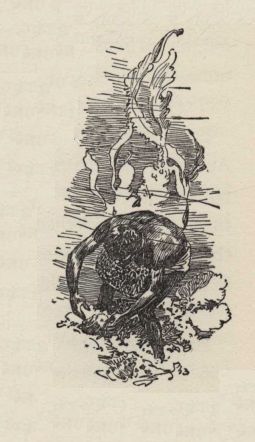
Pearl diver
The remaining important products of the Coral Sea and its coasts are trochas shell and sandal wood. The first of these is second only to mother-of-pearl for buttons, knife-handles, and what-not; and as for sandalwood, its uses are too familiar to call for mention here. But I am grateful to this externally unlovely but fragrant tree for taking me to the shores of the Gulf of Carpentaria where it grows in profusion, for a stranger, more deserted land—saving always the Galapagos Islands—it would be difficult to find.
You may stand on these shores and look inland over thousands of miles of gently undulating and lightly timbered country, containing not a living soul with the exception of a few bands of ever-wandering and rapidly decreasing aboriginals. Cotton grows here to perfection. What would not grow? There are rivers that Western-American irrigators would smack their lips over, a light but assured rainfall, a rich loam soil, and millions of acres of pasture untouched save by wallaby and kangaroo. Yet we still cry out that the world is over-full.
Some day the entirely admirable bluff of "white Australia" will be called, and these territories of vast possibilities will be inundated by a people able and eager to develop them. It will be unpleasant, but then so are most penalties of degeneration and sloth in this cannibalistic old world of ours.
Back from "the Gulf," we celebrated a successful trip in the approved fashion at one of Thursday Island's numerous and well-known circular bars, presided over by a high priestess who, after three years in New Guinea, favoured the native style of coiffure.
Discussion turned on a race meeting of the morrow. A race meeting on T.I.! Why not? I had forgotten that wherever you find an assembly of more than two Australians, there you will find a race-course of some sort. It appeared that someone had stolen the favourite; nothing less! The horse had been pastured on Friday Island, a few miles distant, and now, a day before the race, it had vanished. The owner, who happened to be present, was telling us just what he was going to do to the culprit when he caught him, but I fear my attention wandered. An aboriginal was standing at my elbow with the most ghastly healed wound encircling his neck that could have been inflicted without decapitation. How the man could have suffered it and remained alive, was beyond my comprehension.
"That," I was told, "is Treacle, the only man who's had his head in a shark's mouth and got it out again. Care for an introduction?"
I did care, and after sundry amenities elicited the following: "Me push; 'im leave go." That was all, delivered with every appearance of delight and pride in the accomplishment. Some of the shark's teeth were still embedded in the fellow's skull. With a vast grin, he will guide your finger to the spot—for sixpence; and for a like amount one is permitted to photograph Treacle the miraculous.
The Australian "abo's" recuperative qualities are equalled only by his inventiveness. Was he not the originator of the boomerang, that most ingenious of weapons? And had he not, before the advent of the white man, instituted certain surgical operations which might, with advantage, be introduced into other lands? For example, the rendering incapable of a degenerate male parent to propagate his species, whereby his race was kept up to the highest standards of physique.
But let these things pass, as relics of barbarism if you will, and there is still a quaint originality in his make-up that shows itself in his speech. Bèche-de-mer, or Pidgin-English, is his tongue for dealing with white folk, and here is some of his vocabulary:
"Trousers belong letter" = Envelope.
"Bokkus belong noise" = Gramaphone, piano, or almost any musical instrument.
"Pull um come; push um go, brother belong tomahawk" = Saw.
"Belly belong me fnuast" = I am hungry.
"What time papa belong you plant um you?" = How old are you?
Some day there will be a dictionary of Pidgin-English. It would make a diverting document.
For a tiny community like that of Thursday Island, the racing on the following day was too commendable to be treated otherwise than seriously. The course was complete with grandstand and "bleacher" seats, totalisator, judge's box, and bar, and was soon thronged with the entire white population of T.I., and most of the coloured. Jockeys wore anything from orthodox "silk" to an undervest, and rode anything on four legs with immense earnestness, and amidst thunderous acclamation. We lost money or won money, as the case might be, but there is no doubt that we enjoyed ourselves.
At the end of a pleasant and instructive fortnight a south-bound steamer, direct from New Guinea, touched at T.I., and as she came alongside, my gaze became fixed on a slight, inconspicuous but vaguely familiar figure standing at the rail.
It was Peter.
There, on T.I.'s rickety jetty, seated on a stack of sandalwood, we talked of many things; but behind all lurked the eternal question, and I was obliged to answer it:
"I'm beat. You're right, both of you. There never will be another dream ship."
But there I was wrong.
ADVICE TO DREAMERS OF DREAM SHIPS
For the prospective dream-ship owner the world over
Chapter XVII headpiece
CHAPTER XVII
For the prospective dream-ship owner the world over
There are more dreamers in the world than I had reckoned on. So much is evident from the snowdrift of letters received from every corner of the world, asking this, that, and the other in connection with the dream ship, until it became a physical impossibility for me to answer them individually.
Here I hope to answer them all, out of sympathy more than anything else, for I know how the dreamer feels; but let me tell him or her this at the outset: unless you are willing to take a chance, your dream will never be realized. To sail away on a dream cruise is an easier thing than to climb out of the rut you are probably in. There may be the most excellent reasons for your remaining in that rut—marriage and family ties, or ill health—but those are the only insurmountable obstacles in the path of any dream merchant worth his salt.
You will notice, no doubt, that penury is not included in this catalogue of obstacles, and the reason of its absence is that penury ought to be an incentive rather than an obstacle. One must work for dream fulfilment as one is obliged to work for anything worth while.
"It's all very well for you to talk," people have said to me more than once, "but you have no ties; and you always have your writing."
If they only knew, neither of these statements is true. To hear them talk one would think I had neither friend nor relation in the world, and that the average writer makes as much money as a plumber. My reply to such folk is: "All right, let's be personal. You have no ties but what you could fling aside for a while without hurting yourself or any one else, for it is a fifty-to-one chance that they are nothing but money-grubbing at best. It has become a habit with you, that is all. You have enough money to buy a car, why not a tight little cruiser, and sail where you will? And if you have not, you could soon make it, for your trade is less precarious than mine.
"No, my friend, you may sit in that chair, and simulate the adventurous spirit beating its wings at the prison bars of Duty, or some such stuff, but what really ails you is that you are in a rut, and afraid to get out; or else your dream has not taken firm enough hold to hoist you out. The latter is a matter of personal temperament, and cannot be helped, but the former is something quite different. It simply means that you lack initiative, dread possible discomfort, and fear the world."
Please do not imagine because I am pointing out the disabilities of the average dreamer that I claim to be exempt myself. I possess them in an all-too-marked degree, but my dream was strong enough to lift me above them, and it was worth it.
I know a man who, at the age of thirty, and while I was working the soul out of myself on cattle and horse ranch, in lumber-camp and salmon-cannery for an average of two dollars a day, bought a decked-in, dug-out canoe for twenty dollars, and with a capital of a like amount went clean up the British Columbia coast. During the summer he sailed, fished, and shot deer, trading his bag with farmers and store-keepers for other commodities that he needed. In the winter, he laid up the canoe, but lived aboard and trapped fur. He was his own man, and he lived. That was his dream, and he accomplished it. And I might have been doing precisely the same thing all those weary years, and come out a good deal better off at the end of them if I had only had the courage of my dream.
For the benefit of the apparent multitude whose dream lies along much the same lines as my own, I must attack the more technical side of the dream cruise, and, before doing so, I want it to be clearly understood that everything I may say in these pages is simply the outcome of my own personal experience. Others have had different and, perhaps, much wider experience, and will no doubt differ with me at every point. But then, after a woman, and a horse, there never was a subject more provocative of dissension than the proper conduct of a ship. So here's to it!
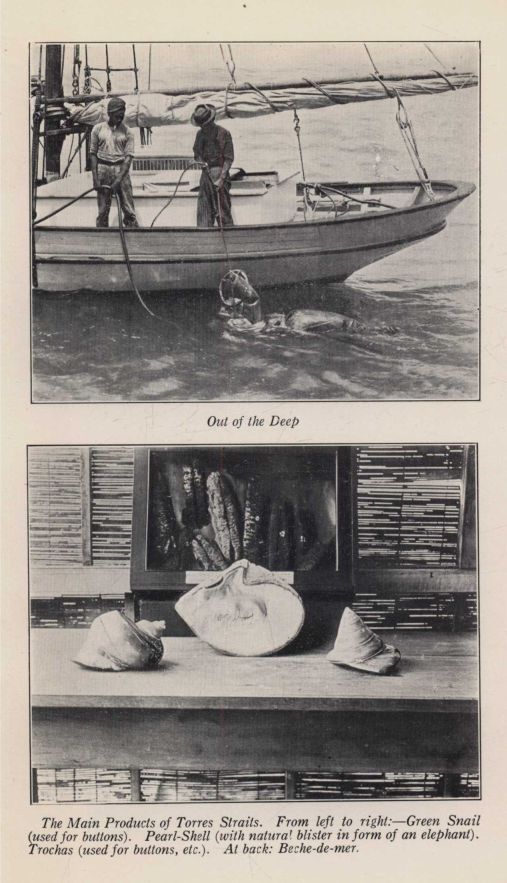
Out of the Deep; The Main Products of Torres Straits. From left to right:—Green Snail (used for buttons). Pearl-Shell (with natural blister in form of an elephant). Trochas (used for buttons, etc.). At back: Beche-de-mer.
The Dream Ship.—The dream ship is my idea of the ideal ocean cruiser to be handled by a crew of three. That is why I bought her, and she cost (second hand) £300 or about $1,500. She was designed as a North Sea pilot cutter by the late Colin Archer, who also designed the Fram for Nansen, and was the originator of this type of vessel. She was built at Porsgrund, Norway, in 1908, and I reduced her canvas to make for easy handling by a small and light-weight crew. For this reason she was slow going to windward, but I would not have had her otherwise for one cannot have everything—there is bound to be a compromise somewhere—and one does not expect to go round the world "on a wind."
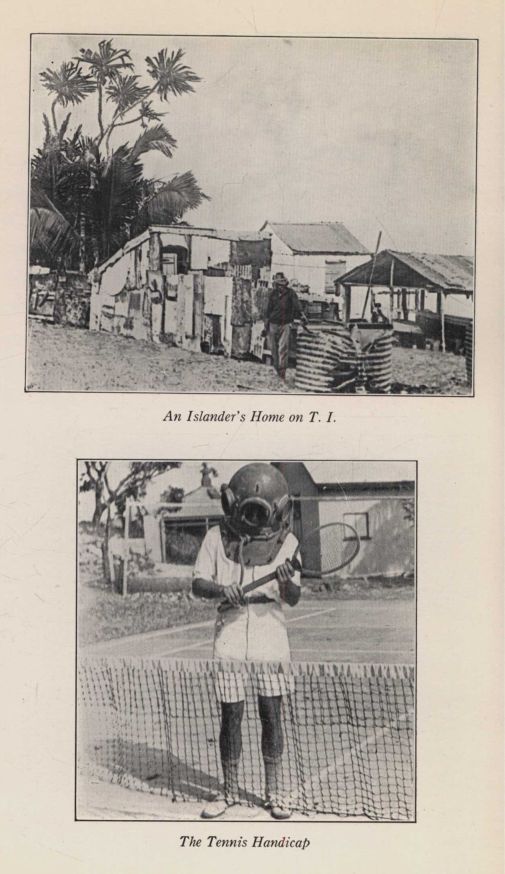
An Islander's Home on T.I.; The Tennis Handicap
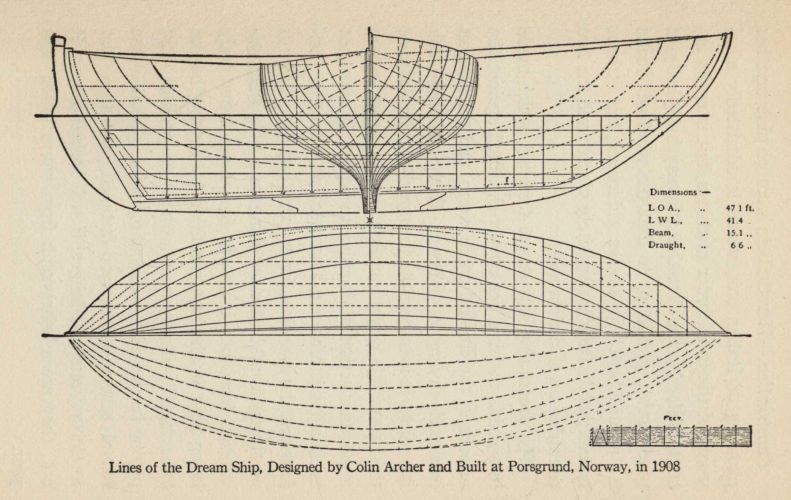
Lines of the Dream Ship, Designed by Colin Archer and Built at Porsgrund, Norway, in 1908
Construction.—Her timbers were of pine and her planking of Italian oak, which is admittedly a reversal of the usual order of things, but is easily accounted for by the fact that Norway has plenty of pine (grown on hilltops so that the wind will make it "natural bent" for elbows and knees), but little or no oak; while Italy is oppositely placed, and the two countries trade their woods.
The dream ship was copper-fastened, which made it possible to have her copper-sheathed against the inroads of the tropical cobra worm, and this was an immense saving of labour. With ordinary iron fastenings it is impossible to copper-sheathe because the two metals, when immersed in salt water, set up a galvanic action destructive to both. It must not be imagined, however, that because a boat is iron-fastened she is useless for tropical waters. There is no stronger and better fastening for a boat than galvanized iron, but it entails her under-water body being kept in the best condition by putting her on "the hard" wherever and whenever possible, and paying her up with anti-fouling paint. Most of the Island schooners are iron-fastened, and they last for forty years and longer, if well looked after. If not, they are a honeycomb from worm inside of a year.
The dream ship was of life-boat or "double-ender" build, which means that she was "all ship," and had no counter. Various stems and sterns are recommended by various people, but I have found nothing better than the life-boat.
Rig.—She was cutter rigged, and, always provided that the boom does not extend too far beyond the counter to be easily accessible, it is as handy an arrangement of sail as any other, and admittedly the best for sailing.
I can almost hear the noble army of schooner-, ketch-, and yawl-owners howling their execration at these remarks, but I cannot help it. I have tried most rigs, and come back to the cutter. The howlers will at least admit that she sails as close to the wind as any, and closer than most; and as for facility in handling by the smallest possible crew, we of the dream ship had no trouble on this score, for she would heave-to in a gale under single reef like a duck, and with the wind abeam would go for hours on end with the tiller pegged.
Our main difficulty was that the dream ship was too heavily sparred. The boom was the size of an average mast for a vessel of her tonnage, and the gaff little smaller in proportion.
Next time, we shall have smaller spars, and a top-mast instead of a pole mast. Aboard the dream ship our topsail yard was twenty-three feet long, and many were the anxious moments in lowering it when taking in the topsail during a squall. The topmast does away with any necessity for a yard, and can be lowered to the deck in foul weather, thus also eliminating considerable top-hamper.
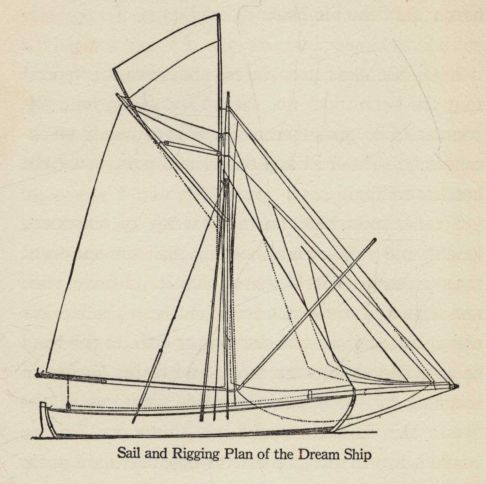
Sail and Rigging Plan of the Dream Ship
A hollow topmast and a hollow squaresail yard sound alluring, and have proved themselves efficient in temperate climes, but would they stand the intense heat of, say, the Paumotus? I know they are put to a boiling test for several hours, but what about months? It would be a disconcerting episode, to say the least, if one's spars commenced to open out like a flower in mid-ocean. I am sufficiently generous to allow someone else to make the experiment.
Gear.—The importance of good ground tackle cannot be over-emphasized. Never carry less than one hundred fathoms of sound, galvanized-iron cable, preferably amidships, and see that the anchors have long shanks. We carried three: a skeleton, for dropping for short periods; a medium, for ordinary use; and a large, for holding her in an emergency. We never used any but the medium, and we never dragged anchor, mainly on account of the length of shank.
A winch is better than a capstan for heaving anchor, and if placed abaft the mast, serves also for "swigging" on halyards, or hoisting sail.
As for sails, the dream ship's were all "barked" or tanned after the fisherman style, and there is no doubt that this process prevents rot, especially in the humid tropics. We carried one medium-weight mainsail, a working and a balloon foresail, storm and balloon jibs, and a squaresail, and of these the last was the most generally useful. Again I hear the howlers howling: "Why not a spinnaker?" and my reply is that a squaresail can be used whenever a spinnaker can be used; it is a larger sail, yet infinitely easier to handle.
Our main halyards were of "combination" rope, that is, hemp to all outward appearances, but internally carrying several strands of flexible steel wire. There is nothing stronger, and nothing that will stand the perpetual chafe of a long passage better. Its slight awkwardness in handling compared with ordinary manila is amply atoned for by its durability. I was afraid to use it for peak halyards on account of its inelasticity, but next time it shall be rove throughout, with the exception of the main sheet, which must perforce be of manila.
Wheel- or tiller-steering gear is a matter of taste. Personally, I like to feel the "life" of a ship, and this is better accomplished with a tiller.
Fittings.—A deep-sea cruiser should always be flush-decked, and have an entirely detached, self-emptying cockpit. Coach roofs and immense skylights make for additional headroom below, but during bad weather are an abomination.
We did not carry davits. They look "yachty," but we were not anxious to look that way, and found it far less trouble to haul the thirteen-foot dinghy over the bulwarks with the fore halyards. If one went in for every "fitting" advertised in a yachting catalogue, the deck—which must be kept as clear as possible—would be a scrap-heap of "gadgets."
Brass, too, is a good thing to do without. Again, it looks well, but think of the work it entails, and have painted galvanized-iron instead. There is no reason why a vessel should not look as "ship-shape" with these latter fittings as with all the glinting—and dulling—brasswork in the world.
Good paint is the best wood-preserver there is; for that reason, and several others not unconnected with labour, the dream ship was painted throughout instead of varnished. The decks were painted (pinewood colour), and remained as sound and unscathed at the end of the voyage as they had been at the beginning. Boom and gaff were painted the same colour, hatches and skylights were white, as also were her top sides.
And that is another thing: never have black paint if going to the tropics. The dream ship's cockpit was black, and the helmsman could scarcely bear to touch any part of it with his naked hand, though the white ship's rail was comparatively cool. The mere thought of black top sides in the neighbourhood of the Paumotus causes me to break into a profuse perspiration to this day.
Down below, the two prime factors are ventilation and light. In order to secure the first of these, the dream ship's internal arrangements were of the simplest. There were no separate staterooms, which confine space and are difficult to air. She was open from end to end, save for the bulkheads, each containing a comprehensive doorway, so that the for'ard hatch could be opened and a current of air pass clean through the ship.
As for light, the interior decoration was white enamel, which reflects every gleam from the skylights.
The engine-room was a problem, until we decided—very rightly, as we discovered later—to sacrifice some living space in order to have a roomy "chamber of horrors." It is far more satisfactory to be tortured in a palace than in a pill-box. It leaves adequate space for the expression of feeling.
Because his ship is essentially a sailing vessel, the present-day owner too often tucks his engine away anywhere. It does not do. Some time or other, when the necessary atrocity is engaged in saving life, as ours did on more than one occasion, a vital part of the machinery is found to be out of reach, or so difficult to get at that invaluable time is lost.
As regards cooking and artificial lighting, we had three Primus stoves and an oven on gimbals, over which we contrived to render food eatable, and ordinary swinging lamps. There are those, I know, who prefer electric light on account of its comparative coolness, and to such I would say: "Enterprising fellow! You like dynamos and fiddling with 'gadgets' generally. Very well." Personally, I am a coward in this department.
Ballast.—There is something peculiarly unattractive about ballast. One sees nothing for many laborious hours spent upon it, and it takes up valuable space. But it must not be forgotten that on its correct distribution the whole stability of a vessel depends. Whether lead, pig-iron, or stone, according to purse, for a cruise anywhere in the neighbourhood of coral, it must be inside, and immovable. The reasons for these stipulations are obvious, but too often cruising yachts do not return, and it is not always a matter of a lee shore, broaching to, or being pooped; but ballast.
An excellent plan is to have it cemented in, for this also ensures a clean bilge, but if this is done, the owner would be well advised to have the vessel's timbers surveyed first and a certificate of soundness given, because before now cement has been used for nothing less than hiding rotten timbers.
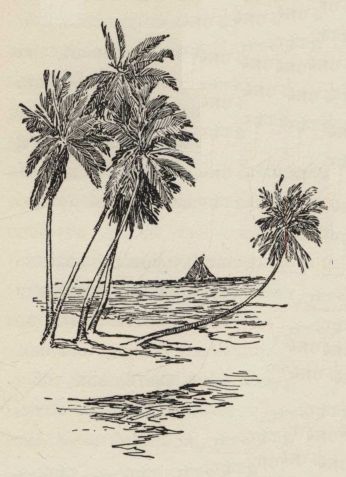
Palm trees
Auxiliary Engines.—There is no doubt that an auxiliary engine for a deep-sea cruiser is well-nigh indispensable. It may be used but twice in a passage of four thousand miles, as ours was—once for getting out of harbour and once for getting in. But what of the countless contingencies that may arise, such as lee shores, narrow waters, contrary currents and calms, when without power a vessel is helpless?
The heavy-duty, comparatively slow-revolutioned, kerosene-burning type is the best. It may be more cumbersome, and make more noise than the natty little launch engine, but it is infinitely more reliable. A thirteen-horsepower drove the dream ship at four knots through calm water, so one's own particular fancy may be selected on that basis. Each has his own idea as to motor marine engines, and all I can do here is to extend to the engineer my good wishes—and sincerest sympathies.
Deep-Sea Cruising.—The inevitable remark that greets the deep-sea cruiser in small craft on completing a passage is: "Fancy coming all this way in that little thing!" And if the speaker only knew it, his remark is an insult to the owner. There is no reason in the world why a staunch, seaworthy craft of not less than forty-one feet on the waterline should not continue to circumnavigate the globe indefinitely, and with every whit as much safety as a ten-thousand-ton liner. The forty-one-footer goes to the top of every wave; the ten-thousand-tonner rests upon two or more; that is the sole difference.
Before leaving England, "know-alls" were good enough to point out to me that it was a silly game at best; that I was risking my precious life for no particular purpose, and that I should never get where I wanted to, anyway. As for taking one's sister, it was nothing short of murder.
When I returned, the self-same people, chatting over a club "port" between races, agreed that there was, after all, nothing in it. Was not deep-sea cruising in fair-weather latitudes safer than coastal navigation in our pestiferous home waters?
With this latter argument I entirely agree, and would point out that I never held any other view. Moreover, we made the cruise because we wanted to, and not because it was a safe or daring thing to do.
Where to find a Dream Ship.—This, as I think has been sufficiently demonstrated in the foregoing pages, is the most difficult question of all to answer at the present time.
I have given here the design and sail plan of my dream ship, and if it meets with your approval sufficiently to impel you to have a replica, and if you are willing and able to spend in the neighbourhood of £2,500 or about $12,500, I can only suggest going to Porsgrund, Norway, or better still Randers, Denmark (where her timbers could be of Danish oak), and have her built. For this particular type of boat, Scandinavia cannot be equalled, let alone beaten. But in these days, building boats is a pastime for millionaires only.
From this giddy pinnacle of affluence we fall to the next best thing, which is a second-hand boat as like the dream ship in seaworthiness and handiness as it is possible to procure, and that is what I have been searching for ever since the dream cruise ended. There are no more pilot boats of the dream-ship type being built in Norway. Steam has dethroned them, and those still in use are either too old to buy or too invaluable to sell. So, we are reduced to the inevitable compromise, and personally, I think I have found it in an English, Bristol Channel Pilot cutter, for which I paid £450 or, at par, about $2,250.
Yes, I have another dream ship. I have notified Peter. I have cabled to Samoa. Next time....
But that is another dream.
THE END
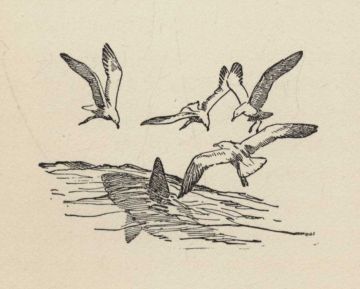
Chapter XVII tailpiece
APPENDIX*
State of Affairs Aboard the Ship—Contents of her Larder—Length of South Seamen's Voyages—Account of a Flying Whale-man—Determination to Leave the Vessel—The Bay of Nukuheva—The Typees—Invasion of their Valley by Porter—Reflections—Glen of Tior—Interview Between the Old King and the French Admiral.
*From "Typee" by Herman Melville, copyright 1892 by Elizabeth S. Melville. Reprinted by permission of The Page Company, publishers of the works of Herman Melville, as follows: Typee, Omoo, Moby Dick, White Jacket
Our ship had not been many days in the harbour of Nukuheva before I came to the determination of leaving her. That my reasons for resolving to take this step were numerous and weighty, may be inferred from the fact that I chose rather to risk my fortunes among the savages of the island, than to endure another voyage on board the Dolly. To use the concise, point-blank phrase of the sailors, I had made up my mind to "run away." Now, as a meaning is generally attached to these two words no way flattering to the individual to whom they are applied, it behooves me, for the sake of my own character, to offer some explanation of my conduct.
When I entered on board the Dolly, I signed, as a matter of course, the ship's articles, thereby voluntarily engaging, and legally binding myself to serve in a certain capacity for the period of the voyage; and, special considerations apart, I was of course bound to fulfil the agreement. But in all contracts, if one party fail to perform his share of the compact, is not the other virtually absolved from his liability? Who is there who will not answer in the affirmative?
Having settled the principle, then, let me apply it to the particular case in question. In numberless instances had not only, the implied but the specified conditions of the articles been violated on the part of the ship in which I served. The usage on board of her was tyrannical; the sick had been inhumanly neglected; the provisions had been doled out in scanty allowance; and her cruises were unreasonably protracted. The captain was the author of these abuses; it was in vain to think that he would either remedy them, or alter his conduct, which was arbitrary and violent in the extreme. His prompt reply to all complaints and remonstrances was—the butt-end of a hand-spike, so convincingly administered as effectually to silence the aggrieved party.