Front matter (continued 2)
Reading edition
"Is that the best she can do?" enquired the pilot.
I lifted an apologetic, perspiring, and begrimed face to him and admitted that it was. Moreover, that we were very lucky to be doing that.
"Ah, well, the day is young," he commented, cheerfully. "What about an awning? We shall be baked alive before we've done."
Did I tell him that the reason we had not rigged an awning was that I was more than half expecting the engine to break down, and that we should have to hoist sail? I did not. Whoever heard of sailing through the Panama Canal? An awning was rigged, and we entered Gatun Lock in style, followed by two more liners.
The giant gates closed. There was an eruption of water seemingly under our stern that caused the tiller to fly over and extract a groan of anguish from Steve as it crushed him against the cock-pit wall; the aft warp snapped, and the dream ship commenced to rise, more like an elevator than a ship in a lock, until the blank, greasy wall ended, and above it appeared a row of grinning faces.
"That's that," said the pilot; and it was.
By some miracle the engine carried us to the next lock, where the same performance was gone through, with such slight variations as the loss of a hat, three fenders, and the remainder of the port covering-board.
We passed out into Gatun Lake, a fairy place of verdure-clad islets and mist-enshrouded reaches, where cranes flew low over the water, and strange, wild cries came out of the bush.
It was also the place where our engine refused its office peremptorily, irrevocably. I was engineer of the dream ship, probably the worst on earth, but still, the engineer, and for an agonized hour I wrestled with lifeless scrap-iron. How the profession of marine motor engineering ever attracts adherents it is beyond me to imagine. I know one man it has sent to an asylum, and many others who to this day bear the marks of having trifled with it—finger-nails that nothing short of cutting to the quick and gouging with a shovel will render clean; hands, clothes, and for some unknown reason face ingrained with ineradicable grime; a permanently furrowed brow; and a wistful expression that goes to the heart of the beholder.
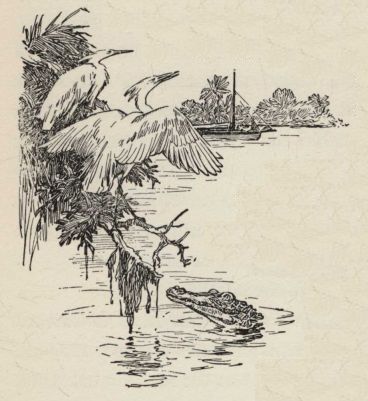
Egret, crocodile
In order to avoid such a fate I have made it a practice to try hard for one solid hour and, failing to gain a response from the atrocity, leave the matter in other, and perhaps more capable, hands. I communicated this information to the pilot, and there and then the man's more human side came to the surface. It was raining as it knows how to rain on the Isthmus, he was soaked to the hide, his natty uniform resembled nothing more closely than a dish rag, yet he smiled, and proceeded to remove his jacket.
"Guess we'd better sail," he said.
Behold once more the dream ship sailing through the Panama Canal; alternately scudding before rain squalls, lying becalmed, and making tacks of fifty yards and less, a passage surely unique in the annals of "the Zone." The pilot said he enjoyed it, and by the way he swigged on halyards and gave us an old-time chanty to work by, I am inclined to believe him. We were lucky in our pilot.
Toward evening, and during a stark calm, Steve dived overboard and made us fast to a light-buoy, his jaw dropping perhaps half an inch, and a thoughtful expression coming into his eyes, when a little later a log on the muddy shore was suddenly imbued with life, and slipped into the water with a whisk of a horny tail.
So it was that we had afternoon tea in comfort, some alleged music on piano and clarionet, and a pleasant chat with the pilot concerning the older and better days of the wind-jammer, while dainty egrettes watched us from a tree fern, ungainly pelicans swooped and dived, and somewhere ten-thousand-ton liners were being hustled through the Panama Canal.
We had no wireless, that was why it was impossible to summon a tug to take us on our way, but finally a monstrous steamer passed so close that it was possible to hail her, and a few hours later we were taken in tow by an apparition of noiseless engines, shining varnish, and gleaming brass.
It would cost us six dollars an hour, the pilot told us, and I sat back to figure out just how long seventy-eight dollars would last under such an onslaught. The result was alarming. We held a board meeting about it in the bows, and decided there was nothing for it but to go on, and keep going on, until we stopped. We had hoped to reach lands where money was of secondary importance, but we were not there yet, that was evident.
So we continued to race through the canal at the rate of six dollars an hour until we reached the approaches to Pedro Miguel lock, where the apparition tied us up and steamed off, still at six dollars an hour.
Something happened to us that night at Pedro Miguel. Looking back on it all I can hardly persuade myself that it was not a dream. We met some canal officials, tall, sun-burned youths with the mark of efficiency upon them yet with a merry twinkle in the eye. We asked them aboard, and they came and marvelled at what they saw. Their verdict was, as far as I remember: "Some novelty!" Then they asked us ashore, and it was our turn to marvel. One of our hosts was the chief operator of a lock, and we saw the miracle of the Isthmus of Panama from behind. Futility overwhelms me at the thought of trying to describe what we saw that night, over the lock, under the lock, at the sides of the lock; besides, you will find it all reduced to cold figures in technical journals if you are that way inclined. It was the spirit of the thing that took hold of me: a pigmy man sitting at a lever! What was not possible after this?
We returned to the ship almost stupefied. One feels much the same when he attempts to think in Westminster Abbey. We were in the process of turning in when a cheerful head appeared through the skylight.
"We await your pleasure," quoth a voice.
I explained that the owner of the head was no doubt unconsciously violating, but still violating, the sanctity of my sister's bedroom. It made no difference. I protested that at that moment my sister's costume consisted of a pair of ill-fitting pyjamas and a kimono; that Steve and I had nothing to our backs but what we had worn all day—an undershirt and a pair of football shorts; that we were all tired to death and literally ached for our pillows; that his kindness was overwhelming but that—— Nothing made any difference.
Somehow we found ourselves in a car, the chief operator's first car that he had learnt to drive during the dinner hour the previous day. Out into the moonlight we sped, or rather zigzagged, at the rate of forty, while between Peter and myself a youth named Bill—I shall never forget Bill—kept up a running flow of informative rhetoric: "On the left we have the famous Isthmus of Panama, intersected by the still more famous canal, a miracle of modern engineering, as it has been aptly termed. Fear not, lady!" [this in an aside to Peter] "the man at the wheel values his life as much as yours, perhaps more. And now we approach the historic city of Panama, passing on our left the Union Club, otherwise known as the Onion Club, frequented solely by the nobility and gentry of the neighbourhood, hence our exclusion. And on the right——"
On the right was the blazing portico of a cabaret, and the car had come to a jarring full stop.
In vain we pleaded our costume, the hour of night the utter degradation of exposing ourselves to the public gaze in such a condition. We literally found ourselves at a table drinking imitation lager beer and grape juice, and listening to raucous-voiced imported ladies rendering washy ballads to the accompaniment of tinkling ice and tobacco smoke.
It all sounds sordid enough, but it was vastly amusing to sea-weary wanderers, and will remain with us a memory of kindness and good-fellowship.
So, at last, we lay at anchor off Balboa on the Pacific Ocean. We had come far adown the vista of our dream, and hoped to go a great deal farther. To do so, we came to the conclusion that it would be necessary to make some money. How? Well, we had a dream ship, a group of pearling islands lay thirty miles to the eastward, and——
A strange life, my masters, but one that I would not exchange with any man on earth.
THE GALAPAGOS ISLANDS
The ash heap
Chapter VIII headpiece
CHAPTER VIII
The ash heap
When Balboa came to Balboa, it is safe to say that no ice cream awaited him there. Indeed, according to history the place was little more than a mosquito-infested swamp, and that is where we of the dream ship had the pull over Señor Balboa.
The town is in the Canal Zone, which is United States territory, though cutting clean through the Republic of Panama, and in this particular sample of United States territory, though founded upon a swamp, you will encounter—among other such amazing things as an entire absence of mosquitoes, charming residences set in park-like surroundings, and a well-conducted club free to all—an assortment of ice-cream creations warranted to hypnotize the uninitiated.
I have to mention this seemingly trivial detail because our lives at Balboa appeared to consist in rowing ashore to transact important business in Panama, and being waylaid en route and held captive by insidious messes.
Besides, it was over a Something Sundae that I met the man who came very near to shaping our destiny. True, there were pearling islands to the eastward, he informed me; he had fished there himself in the past with varying success, and would like nothing better than to try again aboard the dream ship. He would make enquiries.
The fruits of these were imparted the next day over a Peach Something Else. The group had been done to death, and was "closed" for a term of three years, but—this over an Orange Orangoutang—if we cared to go a little farther afield, and divert our attention from pearl shell to gold, he knew of a spot not far south where the natives were in the habit of washing the stuff out of clods of earth from their backyards, held under the eaves of the houses during a rain storm. What about it? The answer at the moment, and as far as I can remember, was a Strawberry Slush.
But we had decided to go. Preparations for making the wherewithal we so sorely needed were already afoot when a miracle intervened. On succeeding one afternoon in getting clean past temptation and into the city of Panama, I found a letter awaiting me from a certain magician who dwells in a place called New York. To hide the truth no longer, he had sold a story of mine to the "movies" at a figure that to our starved gaze looked like the war indemnity, and inside of a week the amount, in beautiful, round, twenty-dollar gold pieces, littered the cabin table of the dream ship.
I am aware that in most accounts of travel such sordid details as the financial difficulties encountered are invariably omitted, either because there were none, or because the writer considers it in the light of bad form to mention them. In our particular case they certainly existed, and personally I am not very strong on form. After all, money is a means to an end—even to the realization of a dream, and I can only say that ours would have evaporated into thin air at Balboa but for the miracle performed by the magician in New York.
On the strength of our sudden affluence, the dream ship received a sleek and well-deserved coat of paint, a new main sheet of good manila, a hundred gallons of kerosene, a fresh supply of provisions, and incidentally a new lease of life.
She sailed in charge of a genial pilot who seemed as pleased as his confrère of the canal at being under sail again, and sighed wistfully on taking his leave at the last fairway buoy. There are many such men engaged in the routine of life, who long to break away and answer the call of the sea and adventure, but who rarely do, either because they cannot or have not the courage of their dream.
We had been advised that Panama Bay was a promising trolling ground, and for once report spoke true, for we caught a fine bonito within an hour of our departure. We were doing about five knots at the time, and it was a fine sight to see a fifteen-pound fish leaping and splashing astern; and a still finer to see sections of him sizzling in the frying pan.
A very different class of fish visited us a day or two later but, spurning our spoon bait, gave his attention to the log. A large shark, looking like a sinister shadow in the turmoil of our wake, investigated the twinkling fan with interest. Five times he approached it and withdrew, before risking indigestion and swallowing it whole.
As about a week later precisely the same thing occurred to our last remaining fan, from then onward we were bereft of log and "dead reckoning" at one fell swoop. However, as the sun is an almost constant companion in these latitudes, and the chronometer, after a thorough overhauling at Panama, appeared to be behaving itself, the loss was not as serious as might be expected.
Each day now brought us appreciably nearer the Equator, and its presence began to make itself felt in gasping moments at the tiller, a glare from the water that caused blood-shot eyes until Peter the practical produced a pair of smoked glasses, and deck seams running and bubbling marine glue.
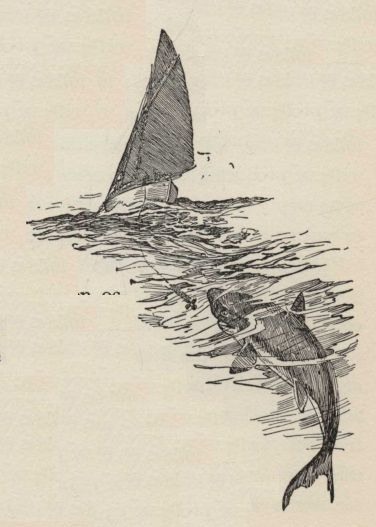
Sailboat, shark
Peter's watch was a spectacle not to be missed, consisting as it did of pyjamas, smoked glasses, and a parasol! I have often wondered what sort of entertainment we should have provided for a passing steamer on occasion, but as we never sighted one from the beginning to the end of our cruise, I fear I shall never know.
"To-morrow," said Steve, after twelve days of fair though light winds, "we ought to raise Tower Island."
We were approaching the ash heap of the world. At the time we had no notion that it was an ash heap, but you shall judge. Throughout that night we took our appointed four-hour single-handed watch, slept our four hours as we had come mechanically so to do during the past four months, and went on deck at dawn to see Tower Island.
It was not there.
Steve, who was at the tiller, looked vaguely troubled, but offered no comment. Neither did we, by this time being used to such things. Besides, "Leave a man to his job," had become our watch-word through many vicissitudes. But when night followed day with customary inexorableness, and without producing anything more tangible than the same empty expanse of ocean, Steve was constrained to mutter, a sure preliminary to coherent speech.
"One of three things has happened," he announced: "the chronometer's got the jim-jams, the chart's wrong, or the blinking island has foundered."
As skipper of the dream ship, it devolved upon myself to verify these surprising statements, which, after a superhuman struggle, I did. By our respective observations and subsequent calculations the ship's position proved identical. According to instruments we were at that moment plumb in the middle of Tower Island. It was thoughtless of it to have evaporated at the very moment when we so sorely needed it as a landmark. We said so in strong terms. We were still saying something of the sort when a small, high-pitched voice came from aloft:
"Land O!"
Peter, in striped white-and-green pyjamas, was astride the jaws of the gaff. Steve and I exchanged relieved glances, and, with a lashed tiller, we all went below for a "swizzle," the now inevitable accompaniment to a landfall. We had reached the Galapagos Islands.
The southeast "trade" was blowing as steadily as a "trade" knows how, and there was nothing between us and Cristobal, the only inhabited island of the group; consequently, I slept the sleep of a mind at peace until awakened by a well-known pressure on the arm.
"Come and take a look at this," whispered Steve so as not to wake Peter in the opposite bunk.
"This" proved to be a solid wall of mist towering over the ship like a precipice. The trade wind had fallen to a stark calm, and the dream ship lay wallowing on an oily swell. A young moon rode clear overhead, and myriads of monstrous stars glared down at us; yet still this ominous gray wall lay fair in our path.
"It ought not to be land," said Steve, "but I don't like the look of it."
Neither did I. We stood side by side, straining our eyes into the murk. A soft barking, for all the world like that of a very old dog, sounded somewhere to port. Splashes, as of giant bodies striking the water, accompanied by flashes of phosphorescent light, came at intervals from all sides, and presently the faint lap of water reached our ears.
"Mother of Mike!" breathed Steve. "We're alongside something."
At that moment, and as though impelled by some silent mechanism, the pall of mist lifted, revealing an inky black wall of rock not fifty yards distant.
My frenzied efforts at the flywheel of the motor auxiliary were futile, as I had more than half expected. Who has ever heard of these atrocities answering in an emergency? We had no sweeps. To anchor was a physical impossibility; the lead-line vanished as probably twenty other lead-lines would have vanished after it in those fathomless waters. So we stood, watching the dream ship drift to her doom.
What happened during the next hour is as hard to describe as I have no doubt it will be to believe. The Galapagos Islands are threaded with uncertain currents, and one was setting us now on to the rocky face of an islet cut as clean and sheer to the sea as a slice of cheese. We should have touched but for our fending off. There is no other way of describing our antics than to say that we clawed our way along that rocky wall until at the end of it a faint air caught the jib, the foresail, the mainsail, and we stood away without so much as a scratch.
Sunrise that morning was the weirdest I have ever seen. There are over two thousand volcano cones in the Galapagos Islands, and apparently we were in the midst of them. On all hands and at all distances were rugged peaks one hundred to two thousand feet high, rising sheer from a rose-pink sea into a crimson sky. Sleek-headed seals broke water alongside, peered at us for a space with their fawnlike eyes, barked softly, and were gone. Pelicans soared above our truck, and fell like a stone on their prey. Tiny birds, yellow and red, flitted about the deck or flew through the skylights, and settled on the cabin fittings with the utmost unconcern. And down under, in the crystal-clear depths, vague shapes hovered constantly: sharks, dolphin, turtle, and ghastly devil fish.
All life seemed confined to water and air; never was dry land so desolate and sinister as those myriads of volcanic cones. Yet one of them was peopled with human beings. Which? We were lost, if ever a ship was lost, in the labyrinths of an ash heap.
All we knew was that Cristobal was the eastern-most of the group. We sailed east, only to be becalmed inside of an hour and to lose by current what we had gained by wind. Close to this same group a sailing vessel has been known to have her insurance paid before she reached port. The calms run in belts of varying widths, and unless a ship can be towed or kedged to one side or the other there is nothing to prevent her remaining in the same spot for six months. Our water would not last that time, and there is none on any of the islands except Cristobal. We began to think. We continued to think for four mortal days until the fitful southeast "trade" revived as by a miracle, and we were bowling along at a seven-knot clip. What a relief was the blessed motion of air! We hardly dared breathe lest it should drop.
It held, and we made what we took to be Cristobal. The dinghy was lowered, the ship cleaned up for port, and we began to discuss the possibilities of fresh milk, eggs, and bread. But it was not Cristobal Island. Neither were three others that we visited, all as alike as peas—a chain of ash heaps, an iron-bound coast of volcanic rock broken here and there by a dazzling coral beach.
I admit that to professional seafarers our inability to find Cristobal must appear ridiculous. For their benefit I would point out that we were not professional seafarers but a party of inconsequent and no doubt over-optimistic landlubbers engaged in the materialization of a dream—to cruise through the South Sea Islands in our own ship; that what navigation we knew had been learnt in three weeks; and that I would invite any one who fancies his bump of locality to test it in the Galapagos Islands.
We had more than half decided to cut out Cristobal and its five hundred inhabitants, and shape a course for the Society Islands, three thousand miles to the southwest'ard, when Steve gave a yell like a wounded pup.
"I see Dalrymple Rock," he chanted as one in a trance, with the binocular to his eyes. "I see Wreck Point, and a bay between 'em with houses on the beach. What more do you want?"
How supremely simple it was to recognize each feature by the chart—when there was an unmistakable landmark to go by. What fools we had been to—— But we left further recriminations till a later date. At the present moment it was necessary to enter Wreck Bay through a channel three hundred yards wide without a mark on either side in the teeth of a snorting "trade," and with a lee tide.
At one time during the series of short tacks that were necessary to get a "slant" for the anchorage we were not more than fifty yards from the giant emerald-green rollers breaking on Lido Point to port with the roar of thunder. To starboard one could see the fangs of the coral reef waiting for us to miss stays to rip the bottom out of us. But the dream ship did not miss stays, and finally we shot through the channel into Wreck Bay, and anchored in three fathoms off a rickety landing-stage.
While the agony of removing a three-weeks' beard was in progress a crowd had assembled on the beach, and presently a boatload of three put off to us. Steve, with his smattering of Spanish, received them at the companion with a new-born elegance that matched their own. They proved to be the owner of the island, a good-looking youth of about twenty-five; the chief of police (presumably "chief" because there is only one representative of the law in the Galapagos), a swarthy Ecuadorean in a becoming poncho; and a little, wrinkled old man with a finely chiselled face and delicate hands.
The owner of Cristobal informed us in excellent French (he had been four years in Paris previous to marooning himself on his equatorial possession) that the island was ours, and the fulness thereof; that he also was ours to command, and would we dine with him that evening at the hacienda, it being New Year's eve?
The "chief" of police demanded our ship's papers, which, when placed in his hands, he gracefully returned without attempting to read, and gave his undivided attention to a rum "swizzle" and a cigar.
The little old man, whom we soon learnt to call "Dad," sat mum, with a dazed expression on his face and his head at an angle after the fashion of the deaf. When he spoke, which he presently did with an unexpectedness that was startling, it was in a low, cultured voice, and in English! "What about this Dutch war he had heard rumours of during the last year or two? With Germany, was it? Well, now, and who was winning? Over, eh?—and with the Allies on top? That was good, that was good!" He rubbed his wrinkled hands and glared round on the assembled company with an air of triumph, but without making any appreciable impression on the owner of Cristobal or the "chief" of police.
Dad was a type, if ever there was one, of the educated ne'er-do-well hidden away in the farthest corner of the earth to avoid those things which most of us deem so desirable. He had a split-bamboo house on the beach, a wife who could cook, freedom, and God's sunlight. What more did man desire? He had run away to sea at the age of seventeen, run away from sea two years later at the Galapagos Islands, and remained there ever since. This was the second time he had spoken English in fifty years, so we must excuse his halting diction, but the tales he could tell—the tales!
He was here when the pirates of the South American coast murdered for money, even as they have a knack of doing to this day, and hid the loot at their headquarters in the Galapagos Islands, silver and gold, boatloads of it. He had built a cutter with his own hands, and sailed in search of this same loot, only to encounter the sole owner, still guarding his ill-gotten gains though reduced to nakedness and hair. At a distance Dad had seen him first, and, mistaking him for a mountain goat, had shot him through the heart. It was the first man he had killed, and he could not stay on the island after that—especially at night.
Afterward, I asked the owner of Cristobal if one might believe half the old man said, and he nodded gravely.
"There is much, also, that he does not say," he added with a smile.
There is undoubtedly treasure still lying hidden in the Galapagos Islands. Two caches have been unearthed, silver ingots and pieces of eight respectively. The finder of one built himself a handsome hotel in Ecuador, and the other drank himself to death in short order. But there is definite proof that there is more.
As a field for the treasure hunter it is doubtful if any place in the world offers better chances of success to-day than the Galapagos Islands, but—and there is always a "but"—the uncertainty of wind and current amongst the islands makes it impossible for a sailing ship to undertake the search, a motor auxiliary is too unreliable, and a small steamer is too large for the creeks and reef channels it would be necessary to negotiate. With a full-powered launch and diving apparatus, and a parent ship in attendance, and unlimited time, and patience, and money—but these be dreams beyond the reach of the penniless world-wanderer: dreams, nevertheless, that will assuredly one day be realized.
No one thinks of the Galapagos Islands. Situated a bare six hundred miles from the American coastline in the direct trade route between the South Pacific Islands and the United States of America, this group is seldom visited more than twice a year, and then for the most part by Ecuadorean schooners. The veriest atoll in the South Pacific receives more attention, and with not a tithe of the cause. The cause? Well, come with us to the hacienda of the owner of Cristobal and you shall see.
For this purpose it is necessary to transfer one's activities from the heaving deck of the dream ship to the equally heaving back of a mountain pony, and lope for an hour up a winding, boulder-strewn track through a wilderness of low scrub and volcanic rock. "Still an ash heap," you think, "nothing but an ash heap."
Then you surmount a ridge, the last of half a dozen, and rein in to breathe your pony and incidentally to marvel. You remind yourself that you are precisely on the Equator; yet it is positively chilly up here. A green, gently undulating country, dotted with grazing cattle and horses, patches of sugar-cane, coffee bushes, and lime trees, stretches away to a cloud-capped range of mountains.
The soil is a rich red loam, almost stoneless, and scarcely touched with the plough. There are three thousand five hundred head of cattle at present on Cristobal Island, and it could support fifty thousand with ease. There is no disease and no adverse climatic condition with which to contend, and at three years old a steer brings one hundred dollars (gold), live weight, at Guayaquil—when a steamer can be induced to call and take it there.
There are a few hundred acres under cultivation when there ought to be thousands, and two hundred bone-lazy peons do the work of fifty ordinary farm hands.
Looking down on this fertile valley it is hard to realize that one is standing on the lip of a long-extinct crater, that in reality Cristobal is a series of these, dour and uninviting to a degree, viewed from outside, but veritable gardens within. And there are four other islands in the Galapagos Group—some smaller, some larger, than Cristobal—uninhabited and exactly similar in character. Nominally, they belong to Ecuador, which accounts for their tardy development; but here, surely, is a new field for enterprise.
In the midst of the valley, situated on a hillock and surrounded by the peons' grass houses, is the owner's hacienda. Here we met, at a dinner of strange but appetizing dishes, the accountant and the comisario, the former a rotund little gentleman with very long thumb nails (the insignia of the brain worker), which he clicked together with gusto when excited or amused; the latter a tall, handsome youth and something of an exquisite, if one may judge by biscuit-coloured silk socks and an esthetic tie.
It was a cheerful occasion, followed by the best coffee I have ever tasted and songs to a guitar accompaniment.
Out in the compound, under the stars, the peons also indulged in a New Year's fiesta; so that by midnight the place was a blur of tobacco smoke, oil flares, thrumming guitars; gyrating, brightly hued ponchos, with their owners somewhere inside them; dogs, chickens, and children.
Everyone seemed thoroughly happy and contented. And after all, what else matters? That is the Ecuadorean point of view, and who shall say it is a bad one?
A starlit ride to the beach, a few strokes of the oars that carve deep caverns of phosphorescent light in the inky waters, and we are again aboard. And herein lies one of the manifold joys of one's own ship. One may travel at will over the highway of the earth, carrying his home and his banal but treasured belongings with him. Like the hermit-crab, he may emerge where and when he will, take a glimpse at life thereabouts, and return to the comfort of accustomed surroundings—a pipe-rack ready to hand, a favourite book or picture placed just so.
Sheltered by a coral reef that broke the force of the Pacific rollers, and with holding-ground of firm white sand, we made up arrears of sleep that night, and scattered after breakfast to explore the beach.
There was a lagoon swarming with duck, not half a mile inland, that attracted Steve and his new twelve-bore gun like a magnet. Peter interviewed the lighthouse-keeper's wife anent cooking for us during our stay, and I—I lazed; it gives one time to notice things that escape the attention of the industrious.
A steam-engine was chugging somewhere behind the belt of stunted trees that fringed the beach, and I found it to be a coffee-grinder fuelled, if you please, with sawed lengths of lignum-vitæ—a furnace of wood at something like five dollars a stick in most countries! I should have liked to see the face of a block-maker of my acquaintance at such vandalism. But here it is nothing of the sort. Little else in the way of indigenous scrub grows on Cristobal.
Mechanically gravitating toward Dad's split-bamboo abode, I came upon him seated on a log, staring meditatively at the crumbling skeleton of what had been, or was at one time going to be, a ship.
"Why didn't you finish her?" I shouted into his "best" ear.
He stared at me in a daze, then burst forth in Spanish, until I succeeded in convincing him that he might as well talk double Dutch.
"Of course, of course," he muttered. "I forgot; Lord, how I forget! It's queer to me that I can speak English at all after all these years; but I can; that's something, isn't it?"
"Sure thing," I yelled; "keep it up. Tell me why you didn't finish your ship."
He pondered the matter; then spoke slowly:
"I told you of the other I built—and why. Well, I ran her on a reef—splinters in five minutes. Took the heart out of me for a bit, that did.
"Then I began to think of that loot again. I do still, for that matter; can't help it. You see, I think I know where it is. So I started on this one." He nodded toward the hulk, silhouetted against the crimsoning sky.
"I'd got to the planking when it occurred to me I'd want a partner for the job, at my age; and who could I trust? They'd slit your throat for ten dollars in those days. They murdered the present owner's father in cold blood. I wouldn't put it beyond 'em to do the same to this one if it wasn't that he's a smart lad and carries the only firearms on the island.
"No one's come here since, no one that I'd trust.... Then, too, what if I found the stuff? What good would it do me—now?" He spread out his delicately shaped hands in a deprecating gesture. "I should die in a month if I left here. Finest climate on earth, this is...." Suddenly he laughed—a low, reminiscent cackle of mirth.
"But that wasn't all that decided me. I'd got to the planking, Guayaquil oak it was, and I was steaming it on when a nail drew, and the plank caught me in the chest, knocked me six yards, and broke a rib. It's broken yet, I guess; there was no one to mend it. Well, that finished it. I wasn't meant to build that ship."
He stopped abruptly and stared down at his battered rawhide shoes.
The inference was obvious.
"Well, what about it?" I suggested.
He looked up at that.
"I've been thinking about it ever since you came here," he confessed. "I'll go with you; but mind this, you mustn't curse me if nothing comes of it. I don't promise anything. All I say is I think I know where the stuff is, if someone hasn't got it."
"I'll let you know to-morrow," said I, and left him sitting there.
Was the man senile? There was nothing to make one think so. Was he a liar? There was equally nothing to prove it. At least half his story was a matter of island history.
We of the dream ship held a board meeting on the subject of loot that evening. We discussed it from every angle, and came to the conclusion that with the present atrocity called a motor auxiliary and the weather conditions of the group, we might take three days over the business and we might take three months; that the chances of finding something were outweighed by the risk of losing the ship, and that we were in pursuit of something visionary, anyway, so we had better get on with it.
The voting went two to one against, and I leave you to decide whose was the deciding voice.
I give this interview with Dad for what it is worth, and simply because I see no prospect of undertaking the search as it should be undertaken. I am aware that it reads like the purest romance, but it is true in every particular, as any one will soon discover on visiting Wreck Bay, Cristobal Island, in the Galapagos Group.
The old man still waits there on the beach for a ship and someone he can trust; but judging by his frail appearance (he is seventy-seven), he will not wait much longer.
Often during the days that followed I found myself standing at the dream ship's rail, looking seaward to a dim outline of mountains against the blue, and wondering.... But only the ash heap knows.
THE MARQUESAS ISLANDS
The real South Seas—Big-game shooting extraordinary—A case of thwarted ambition
Chapter IX headpiece
CHAPTER IX
The real South Seas—Big-game shooting extraordinary—A case of thwarted ambition
We of the dream ship were "watering," or rather transferring, three hundred gallons of a doubtful-looking fluid from the beach reservoir of Cristobal to the ship's tanks by means of kerosene tins, a rickety landing-stage swarming with sand flies, and an equally rickety dinghy.
We were, in fact, enjoying a spell, to the accompaniment of vast quantities of cocoanut milk, before setting sail for the Marquesas, three thousand miles distant, and were in no mood for an interruption, which is probably why it came. A pigmy figure on the landing was apparently dancing a hornpipe and emitting strange cries.
"Who is it, and what the —— does he want?" I queried with customary amiability.
"It's the comisario," said Steve, with binocular upheld in one hand and a brimming cocoanut shell in the other, "and he's probably found that we need a bill of health or clearance or something."
I believe I sighed. I have a notion that Steve swore, and I am quite sure that we rowed ashore and interviewed the comisario, the handsome youth whose silk socks and passionate tie contrasted strangely with his surroundings. He still danced.
"He says that it is necessary that he should accompany us," Steve translated.
"To the Marquesas?"
"To anywhere."
"Really? And where does the necessity come in?"
After still further variations of the hornpipe and a prodigious outflow of Ecuadorean Spanish, the following was evolved: They were after him—a trifling indiscretion in the matter of issuing grog licenses to the peons. The Ecuadorean Government was to blame. They expected an official to live on twenty dollars a month and nothing else! How was it possible? Moreover, the President himself, elected on a wage basis of forty-dollars-a-month-and-bring-your-own-blankets, would be getting the boot in a short three months, and with him went everyone—everyone!
What was then to happen to the officials he had placed in power? More important still, what was to happen to this particular official? He must accompany us. It was the only possible solution. He would work. Carramba, how he would work! and for nothing but his passage to anywhere—anywhere!
Steve and I exchanged glances. The entire crew of the dream ship was, as I think I have before mentioned, exceedingly tired of cooking. The comisario seized on our silence.
Maybe we thought he could not work?
With a dramatic gesture he tore from his neck the passionate tie, from his feet the silk socks, from his back a virulently striped shirt, and stood revealed in a natty line of undervests.
"Poor devil!" said I, thinking of the dream ship's fo'c's'le in a seaway.
"Poor nothing!" said Steve. "He wants work; let him have it."
And that was how Señor ——, hereafter known as Bill, came to join the dream ship.
We sailed, and continued to sail before a steady southeast "trade" for twenty-two days, during which the comisario suffered alternately from seasickness, homesickness, and sheer inability to do anything but smoke cigarettes and sleep; our water tanks, under the magic wand of the Galapagos beach reservoir, transformed themselves into aquariums of energetic animalcules; and our entire biscuit supply crumbled to dust under the onslaughts of a particularly virulent red ant.
But these be incidentals to life aboard dream ships, and, at the first sight of Nukuhiva they faded to little more than amusing memories.
We had reached our goal! The South Sea Islands were ours! It was hard to realize. At the sight of gorgeous Nukuhiva gliding toward us over the sparkling blue water I remember looking round at the good old ship that had slowly but steadfastly carried us all these thousands of miles, and wondering what she thought of it all. I am aware that the idea of a ship having thoughts savours of senile decay, but that is what passed through my mind at the time, and has passed through it a hundred times since.
More nonsense has probably been written about the South Sea Islands than about any other part of the world. The library novelist, the globe-trotting journalist, and a reading public athirst for exotic romance have all contributed to this end: so that here, at the outset of attempting to describe what we of the dream ship saw there, I find myself at a loss. In short, "these few remarks" may be taken as an apology and a warning.
I have nothing to offer on a par with the standard article, such as struggles with sharks, conflicts with cannibals, or philandering with princesses. My line, I fear, is facts as I find them.
A fine island is Nukuhiva—as fine an example of volcanic formation as one will find anywhere. Sheer walls of cloud-capped rock six thousand feet high, some literally overhanging the crystal-clear water, and all embossed and engraved with strangely patterned basalt. There are pillars, battlements, turrets, so that with half-closed eyes it seems one is approaching a temple, a mediæval castle, a mosque of the East. And the valleys—deep, river-threaded, verdure-choked valleys fading away into mysterious purple mists. But it is little better than an impertinence to attempt a description of Nukuhiva after Melville's "Typee."*
*See Appendix.
For once the monstrosity in our engine-room was induced to exert three of its four cylinders, and we entered the harbour of Tai o Hae in style. It was as well, for a trim trading schooner flying the French flag was at anchor close inshore, and her entire crew lined the rail to see what manner of insect had invaded her privacy.
"Where are you from?" hailed a surprisingly English voice as soon as our anchor-chain had ceased its clamour.
"London," we chorused.
"Well, I'm damned!" came a response, evidently not intended for our ears, but audible nevertheless.
In rather less than three minutes a whaleboat-load of visitors was aboard the dream ship, and the silent bay echoed to a fusillade of question and counter-question.
Followed a dinner at the trading station on a wide, cool veranda, where, under the influence of oysters, California asparagus, fowl, bush pig, taro root, and French champagne, we became better acquainted with our hosts—two as amiable Frenchmen as ever I met. They represented a trading company of Papeete and Paris, and lived as only Frenchmen appear to know how to live.
The Marquesans, we gathered over coffee and cigars, were dying rapidly. Consumption. Introduced in the form of Panama fever by labourers returning from canal construction. The fever afterward developed into the white plague by reason of the natives' unresisting, if not acquiescent, nature. And when all were gone, what then? Chinese.
The Chinese appear to be the answer to most questions in the South Pacific to-day. They come; it costs them but fifty dollars to land; and after that they grow—mon Dieu, how they grow!
And can nothing be done? A shrug of the shoulders and the offer of a refilled glass are the answers of the Frenchman. But a short time now and he personally will be in a position to return to his beloved Paris, or Marseilles, or Brittany.
But we had lately returned from dealing with the Boche; so had our hosts. We drank respectively to the Royal Field Artillery, the Mitrailleurs, the Machine-gun Corps, and the incomparable French Infantry. What of it, if we continue the sport on the morrow, among the wild cattle and goats of Nukuhiva? To-morrow, then, at five o'clock.
The schooner, scheduled at daylight to load copra worth five hundred dollars a ton, was cheerfully detained for the trip, and loaded to capacity with bottled beer, coughing Marquesans, and a varied armoury of firearms.
We sailed down a coast that it is a sore temptation to describe and landed by whaleboat on a surf-pounded beach. Thereafter we plodded, crawled, and stumbled over as vicious a country as it is possible to imagine—crumbling shale, razor-edged ledges, and deceptive tableland of knee-high grass that only served to hide the carpet of keen-edged volcanic rocks beneath.
And the heat! But a representative of the incomparable infantry led the way; and who would not follow to the death, out of very shame? At each halting place the élan of this same representative seemed to increase. Sitting crosslegged on a rock in the meagre shade of a scrub tree, he would discourse on any subject under the sun, while his audience gasped, emptied the perspiration out of their boots, and cursed the cantine (a gigantic native bearing an almost as gigantic sack of bottled beer) for lagging.
I was under the impression that the game was to have been wild; hence my surprise when a herd of something like a hundred and fifty goats of all ages, from the bearded and maned veteran, or "stinker," down to the daintiest kid, cavorted up to our resting-place and sniffed at us inquisitively. It was necessary to fling stones to keep some of the more daring at bay.
So much for goat-hunting in the Marquesas. It is evident that these beasts are so "wild" that they know nothing of man; who shall say they have missed much in consequence?
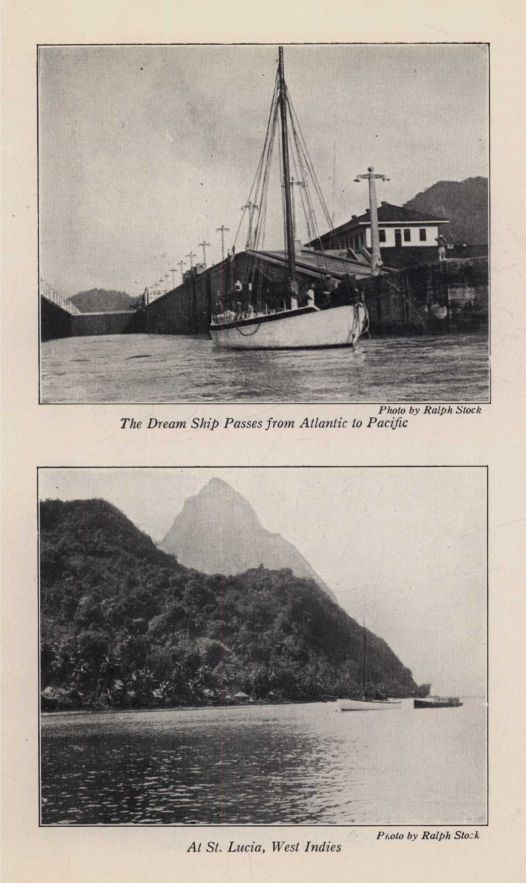
The Dream Ship Passes from Atlantic to Pacific; At St. Lucia, West Indies
The cattle are a different matter. Shy as deer, they must be warily stalked and shot mostly on the run, at anything from a hundred to a hundred and fifty yards; also, they have an engaging habit of turning when wounded and giving the huntsman the worst possible time in their power, which in the case of a hefty bull or cow with calf is not inconsiderable.
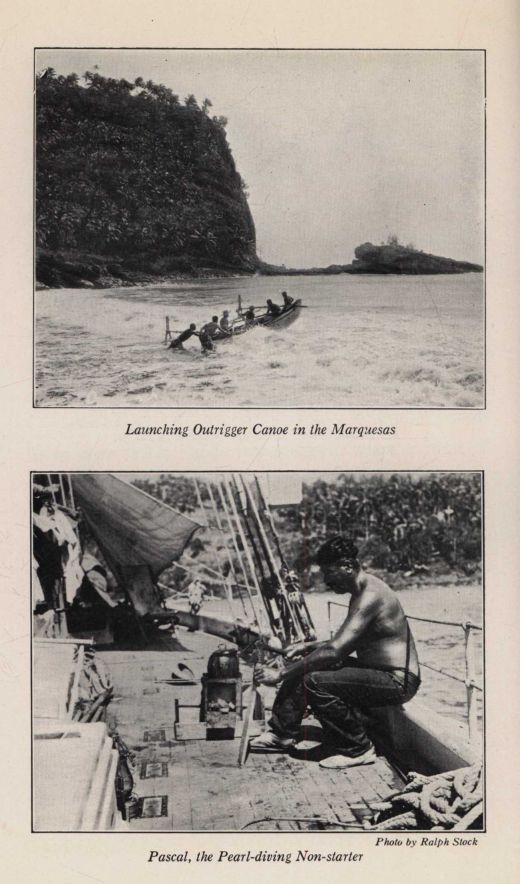
Launching Outrigger Canoe in the Marquesas; Pascal, the Pearl-diving Non-starter
There must have been a herd of something like fifty grazing on the precipitous hillside, and the first shot, fired by an over-anxious Marquesan, against strict orders, sent them scuttling like antelope out of the valley and over the ridge. One fine bull received his medicine from my trusty little Winchester on the very brink, collapsed, and rolled like an avalanche of meat to the bottom.
We bagged four of this herd, and the Marquesans fell on them, quartering and selecting with extraordinary skill, and finally carrying one hundred pounds each of solid meat to the beach five miles below. How this last feat was accomplished by a band of ramping consumptives I have no notion, though I saw it done. I only know that after carrying two rifles and a gun over the same country I literally tumbled on to the beach, bruised and bleeding and trembling from sheer fatigue. Even the representative of incomparable infantry admitted to being tired, and, thank heaven, he looked it!
It had been a successful day, I was given to understand, and there followed in consequence song and dance aboard the dream ship until dawn touched the peaks of Tai o Hae.
A native dance is a dreary and monotonous affair to the average white man, because he does not take the trouble to understand. He sees before him an assembly of posturing, howling natives, and seldom realizes that he is witnessing a pageant of history that has never been written or read.
The performance opened with a pantomimic representation of the cruise of the dream ship. According to the actors' ideas, all aboard suffered acutely from seasickness, were utterly unable to stand upright, and continually looked for land under the shade of an upraised hand. Our vigour in battling with storms was extraordinary; we stumbled over rope-ends, clung to the rigging, nearly capsized, and one of us fell overboard, to be rescued, amid shrieks of laughter, by means of a boat-hook and the seat of his pants.
We were a joke, there was no doubt about that, and any one who takes a ten-thousand-mile journey in a twenty-three-ton yacht to the Marquesas and wants to be taken seriously had better go elsewhere.
From such trivialities the performers passed on to what was evidently their stock repertoire—the history of the Marquesas as handed down from father to son. It was all there in gesture and chant—mighty battles with their neighbours the Paumotans, cannibalism, peace, the advent of the white man with his rum, the plague that still consumes them, and all enacted without resentment.
That is the most astounding thing, that these people who were living their own lives, and surely as happy lives as ours, bear no ill will for the incredible sufferings our civilization has brought among them. Perhaps they do not think, and if so it is as well.
Conceive yourself, if you can, oh, denizen of Park Lane, Fifth Avenue, or Champs Elysées, a healthy, upstanding, unclad savage of-the South Seas, and living your own life.
You may be a cannibal; and are there no cannibals, and worse, west of Suez? You will be a warrior and fight for your country and your womenfolk. Is there anything wrong about that?
You will have a stricter moral code than most white folk, but that cannot be helped. You will hunt and fish and gather fruit for your family—in fact, you will live in the only way you know how to live, in contentment.
One day an extraordinary-looking object called a white man presents himself and informs you that you are not living in the right way at all. A much better way, according to this gentleman, is to exchange a ton of your cocoanuts for a bottle of rum or a death-dealing instrument made of rusty iron.
You are a tolerant sort of person, and you listen and drink his rum. The next day you have an insufferable headache, and, logically concluding that he has poisoned you, you kill him.
But that is not the end. Replicas of him keep arriving, and you find you need his rum and his rusty iron, the one for its elevating properties, the other for its dispatch in dealing with enemies. Still more replicas arrive, but of a different order. Many of them are kindly, well-meaning men, and great talkers. They tell you that they have found a God—the only God—and you must worship him in their way. The trouble is that each has a different way, but they are all right, and they all prove it by the same book.
Preserve me from the futilities of theological argument; but I met at Tai o Hae a Seventh Day Adventist missionary, an earnest, clean-living, kindly man, without a spark of humour in his composition. He was consumed by a genuine and mighty fervour to demonstrate to the native Marquesan that he was keeping the Sabbath on the wrong day.
"Does that matter so very much?" I asked him, and that was all I had a chance to ask. Apparently it did matter. And he was getting converts. Why? Because the native is not slow to discover that by embracing Seventh Day Adventism he gets two days of rest in the week.
Elsewhere I have met Roman Catholic, Mormon, Latter-Day Saint, Presbyterian, and Anglican Church missionaries, all at work in the same field, all earnest, well-meaning men, and each convinced that he is right.
Is it any wonder, then, that after listening to them all the dazed South Sea Island native asks himself what all the pother is about, and, finding no satisfactory answer to the conundrum, turns to his tangible rum bottle?
To revert to safer topics, there is pearl shell in the Marquesas. The representative of incomparable infantry told us so while we sat on his incomparable veranda one morning, consuming large quantities of papia, rolls, honey, and coffee, each in his particular brand of pyjamas.
The information brought upon our serene lives at Tai o Hae the white man's blight of avariciousness. Was this thing possible, with shell at one thousand dollars a ton delivered at Philadelphia? Yes; he, the incomparable, had seen it through a water-glass, in anything from five to fifteen fathoms, between the islands of Hivaoa and Tahuata.
Why had it not been prospected? It was doubtful if any but he and the natives knew of its existence. Undoubtedly it was worth looking into. He made us a present of the information to do with as we willed. His cook was an old Paumotan diver, who would no doubt accompany us—Pascal!—accompany us to the island, a bare ninety miles distant. We could take samples of shell to the company in Papeete, and no doubt make arrangements—Pascal!—arrangements with them to advance working capital in return for a lien on the shell—Pascal!!!
"Monsieur." An enormous Paumotan native stood in the doorway smiling benignly.
He would accompany us. He would cook, and he would dive.
We sailed that evening, the deck being littered with green bananas, live chickens tied by the leg to bulwark stanchions, a rabbit, firewood, a stove composed of a kerosene tin half filled with earth, and—Pascal.
There was apparently nothing this extraordinary man could not do. He knew every island of the Marquesas like the palm of his hand. He could produce savoury messes from a kerosene tin, remain under water three minutes, discourse entertainingly in pidgin-English, French, German, Marquesan, and Paumotan, and secure a ship's provisions without the annoying triviality of paying for them.
"But whom do we owe for all this?" I asked him, eyeing the menagerie that surrounded us.
Pascal smiled and waved a hand.
"Rabbit no money," he informed us; "chickens, bananas, all no money. Me get um."
Here surely is a solution of the high-cost-of-living problem. Take Pascal to the profiteering areas and the thing is done.
Dawn revealed to us Tahuata close abeam. Each island of this group seems more lovely than the last: waterfalls pouring three thousand feet to the sea, blow-holes at the base of rocky cliffs that spray the air with spindrift and miniature rainbows, deep bays with coral beaches at their head.
But the beauties of nature were not for us on this occasion; we were prospecting. It was a serious business. There might be money in it. After this I can scarce believe that in Paradise itself the white man will not be dogged by the curse of opportunism.
Leaving the dream ship at anchor a cable's length from shore, we took to the dinghy and explored the floor of the ocean thereabouts through water-glasses, consisting of wooden boxes with glass bottoms. This was the place, Pascal informed us, and, sure enough, there was shell, old barnacle-encrusted shell, but widely scattered.
What of a few samples? Pascal grinned and shook his head. "Shark," he muttered, apologetically; which, being interpreted, meant that he refused to dive.
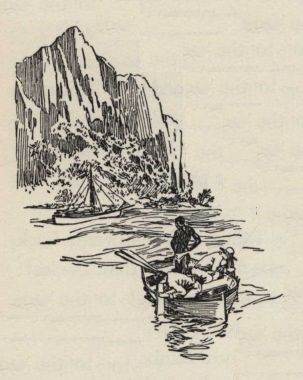
Men with water-glasses in boat
He pointed out that in the Paumotus it was different. In the Paumotus there was always a reef-surrounded lagoon where few sharks found entrance. In the Paumotus men dived in couples as a safeguard. In the Paumotus——
In vain we pointed out that we happened to be in the Marquesas and not the Paumotus; that he had been hired to dive in the Marquesas; that we were really very angry—in the Marquesas. He grinned.
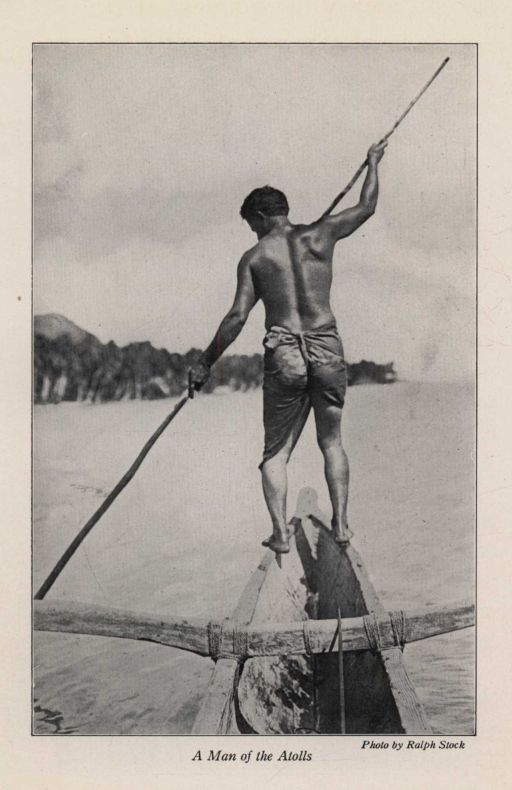
A Man of the Atolls
In rather less than half an hour, and to Pascal's utter amazement, we had put him and his belongings ashore, paid him his wages, and were under way for Tahiti.
Ah, Monsieur of the incomparable infantry, I rather suspect you of pulling our legs. Or was it that your innate enthusiasm ran away with you? Or that we should have been less hasty? I do not know. All I know is that you spoke truth; there is shell in the Marquesas—and it is likely to remain there.
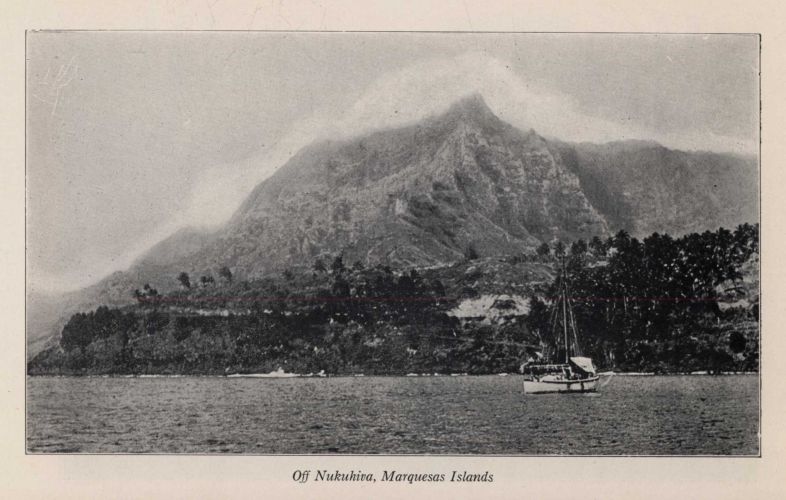
Off Nukuhiva, Marquesas Islands
As the South Pacific Islands become more widely known, which they are rapidly doing, the Marquesas are bound to attract the attention they deserve. Apart from their scenic grandeur and healthful climate, they are as fertile a group as any in the Pacific, and more so than most. It has been proved that cotton of the best quality flourishes there, as well as sugar cane and every other tropical product, and there are thousands of acres of knee-high, well-watered pastures for the stockman.
Since this visit to the Marquesas I have been living in France, to which country the group belongs, and I have not yet met a Frenchman who knows of their existence. In fact, the average Frenchman's ignorance of his own possessions is nothing short of amazing.
Some day the congested areas of this queer old world will overflow, and the Marquesas will be discovered afresh. When that time comes, France will have people knocking at her door and demanding to know why she debars all other nationalities from acquiring land that she does not attempt to develop herself.
Already there is a movement afoot in England to establish a colony in the Marquesas. Permission has somehow been obtained from the French Government—a process comparable with the extraction of a particularly obstinate winkle from its shell—to purchase blocks of land, and distribute them amongst intending settlers who already number over a thousand.
"Lucky thousand!" say I, "and good luck to them!"
THE PAUMOTU ISLANDS
The people of the atolls—including Mr. Mumpus
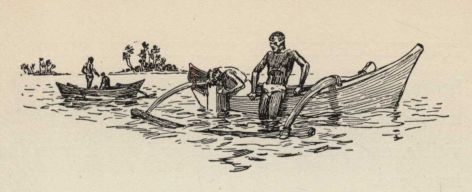
Chapter X headpiece
CHAPTER X
The people of the atolls—including Mr. Mumpus
From the moment I first set eyes on an atoll it fascinated me, and its lure has not departed with the years.
Think of any place in the world that you have seen, and an atoll is different. It is the fairy ring of the sea. Out of the depths it comes, rearing a vegetation and people of its own, and often into the depths it goes, leaving no trace. How? Why? Scientists murmur something about the coral polyp; but, not being a scientist, I prefer my theory of the fairy ring. That was how it looked to me many years ago, and that was how it looked again from the masthead of the dream ship.
We had left the Marquesas seven days previously, and were now becalmed in that maze of atolls known as the Paumotu or Low Archipelago.
Imagine a circular beach of glistening coral sand and green vegetation from five to fifty yards wide, thrust up through the sea for all the world like a hedge, and enclosing a garden of coral fronds submerged under water so still and clear as to be hardly visible, and you have an atoll as I saw it from the masthead.
And there were myriads of them—big atolls, little atolls, fat and thin atolls—fading away into the shimmering heat haze of the horizon. The fairies must have been mighty busy down this way.
I descended to the deck and things mundane. What to do when becalmed in a network of coral reefs and seven-knot currents was the problem that confronted us. I had no text book on the subject, but by some miracle the monstrosity was persuaded to fire on two cylinders.
Imagine yourself, then, passing through the narrow gateway in the hedge—I should say, passage in the reef—and coming to anchor in the garden—I mean lagoon.
It is sunrise, and already the pearling canoes are putting out from the village and scurrying to the fishing grounds over the glassy surface of the lagoon.
A fine people, these of the atolls—upstanding, deep of chest, a race of mermen if ever there was one. From birth up, if they are not in the water they are on it or as close to it as they can get. Take them inland and they die. So they squat on their canoe outriggers, smoking, chatting, laughing, until the spirit moves them (nothing else will), and one of their number drops from sight, feet first, with hardly a ripple.
You look down and you see him, as though through green-tinted glass, crouched on the sloping floor of the lagoon. He is plucking oysters as one would gather flowers in a garden. There is no haste in his movements, nothing to indicate that there is any time limit to his remaining down there, under anything from five to fifteen fathoms of water.
A minute passes, two minutes; still he pursues his leisurely way, plucking to right and left and thrusting the shells into a network bag about his neck.
The man of the atolls is in a world of his own where none but his kind can follow, and they still squat on their outriggers, chatting and laughing like a crowd of boys at a swimming pool.
One alone seems interested in the diver's movements: his mate, a fair-skinned woman, with streaming blue-black hair, leans over the gunwale of the canoe, looking down through a kerosene tin water-glass.
The diver's dark figure against the pale-green coral becomes more blurred; a stream of silver air bubbles floats upward. Three minutes by the watch have come and gone. To the landsman it seems incredible; and even then there is no haste, no shooting to the surface and gasps for breath.
The dark body becomes clearer in outline as it emerges from the depths, and slowly, quite slowly, floats upward until a jet-black head breaks water and the diver clings to the gunwale of the canoe, inhaling deep but unhurried breaths and exhaling with a long-drawn whistle peculiarly his own.
In what way this whistle helps matters it is impossible to say, but whether a habit, a pose, or an aid in the regaining of breath, it is universal throughout the Paumotus; so much so that a busy afternoon with the pearlers sounds more like a tin-whistle band than anything else.
With the people of the atolls the ability to remain under water for long periods is more than an art; it is second nature. Instinctively, they do just those things that make one breath suffice for three minutes and sometimes four.
Preparatory to a descent they do not take a deep breath and hold it until the surface is reached again. They fill their lungs with a normal amount of air, which lasts them about a minute and a half; the other minute and a half is occupied in its exhalation. Then, too, every movement below water is made with the utmost conservation of energy; yet a good diver can bring up a hundred and fifty kilos of shell in a day, which means in the neighbourhood of six hundred francs.
And it is just these same nimble francs that tempt the Paumotan to abase his talents, even as others are tempted the world over. For the sake of a few more shells, another cluster a little farther down, he remains below just that trifle longer than is good for him, and in time it tells. The eyes become bloodshot and start from the head, he goes deaf, or paralysis seizes him.
"But the women are the worst," a sun-baked trader informed me; "the worst or the best, as you like to put it," he added, grinning. "They'll go on till they burst, or pretty near it. Bargain-counter instinct, I guess. We call it the 'bends.'"
'"The bends?'"
"Yes, one of 'em goes down, and down; sees some more shell a bit lower, and some more a bit lower than that. Then she's reaching out for one last flutter at something like twenty fathoms when they get her the 'bends,' I mean. You can see her fighting against them, but it's no good; they bring her knees to her chin, and she can't straighten up, and she drops the last lot of shell she's gathered, and hates that worse than the 'bends'."
"What does she do?"
"Nothing, except lie there crumpled up until her mate fetches her up and massages her back to life. Then she's no sooner conscious than she's down again.
"Water never kills this crowd; it takes dry land to do that. Why, there's a diver close on fifty years old here, paralyzed clean down one side. He can't walk, but he can swim. He gets them to carry him down to the reef and heave him in; says it's the only place he can get any comfort."
"How about sharks?"
"Oh, there are sharks all right, but the diver's mate looks after that; gives the signal, and they're all in after him double quick."
"Finish him off with knives, eh?"
The sun-baked trader smiled reminiscently.
"Well, hardly," he said. "A dead shark makes a square meal for the others, and that's all. What they need is an example, and they get it. They're cruising about sometime when they come on one of their number with no tail, one fin, and sundry other decorations that wouldn't exactly please the S.P.C.A. He is not nice to look at, and they clear out of a place where such things are possible.
"When an island's thrown open for pearlings, we spend weeks mutilating sharks before the divers'll go down, and small blame to them, I say. Sharks are—well, sharks."
The casual reader picks up a good deal of information about "gold rushes" and such-like romantic undertakings from the plethora of novels on the subject; but who has ever heard of a pearl-rush? Yet they occur every year in the Paumotus.
The group belongs to the French, and is administered from the local seat of government at Papeete, Tahiti. Here a heterogeneous collection of humanity awaits the opening of the pearling season like a hovering cloud of mosquitoes.
There are pearl buyers from Paris and London, representatives of shell-buying concerns from Europe and America; British, Chinese, and Indian traders, speculative schooner skippers and supercargoes, not to mention the riff-raff of the beaches, all intent on pickings from the most prolific pearling islands in the South Pacific.
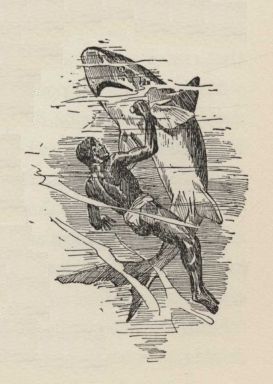
Shark, pearl diver
And this is the law of the group—infringed, circumvented, broken, but still the law—that although under French Government, the Paumotus and all they produce belong to the Paumotans.
Still further to protect the native, diving apparatus is banned throughout the group. The oyster, as he brings it from the water, is the diver's property. He must open the shell aboard his canoe before touching land, remove the flesh, and, after testing it for pearls (usually by kneading it so thoroughly between finger and thumb as to crush the life out of it), throw it back into the lagoon to propagate its species. Should he find a pearl, it is his also.
It is then up to the cloud of "mosquitoes" before mentioned to get both shell and pearl out of him as best it can. One can imagine the buzzing and biting that ensue.
From the buyer's point of view, the sooner and the deeper he gets a good diver into his debt the better. He then has some hold. Consequently, he spoon-feeds his selected divers like the infants that they are. Tinned delicacies of all sorts, Prince Albert suits of unbelievable thickness and cut, silk socks, and stockings are a good diver's for the asking during the closed season.
With shell at one thousand dollars a ton in Philadelphia (the largest consumer at the present time), and pearls soaring to apparently limitless heights, all will be well when work starts.
And the diver? From long experience of "mosquitoes," he is by no means slow. Shortly before the season opens he is presented with a bill that would cause most of us to register apoplexy. He looks at it, grins, and proceeds to dive. He also proceeds to make caches of shell on the floor of the lagoon, only bringing up half of what he collects in payment of his debts. At night he retrieves his cache and sells for cash to the smaller "mosquitoes" who infest the beach. As for pearls, from the moment the diver's finger and thumb encounter foreign matter in the flesh of the oyster, he becomes about as communicative on the subject as his catch. Should the truth leak out, his find will promptly be confiscated in payment of his everlasting debts, or the wily pearl-buyer will use threats of exposure to reduce the price.
No, the diver, if he is up to snuff, will work his passage to Papeete on a schooner, sell to a Chinaman, who neither asks questions nor tells tales, and proceed to enjoy himself according to his lights.
Blossoming into a Prince Albert suit, a red tie, and silk socks, he will hire a car, load it up with lady friends and execrable rum, and vanish into thin air for a fortnight, at the end of which time he has somehow contrived to get rid of all he possessed and is perfectly prepared to return to his atolls and his debts. He has lived like a white man and cheated the "mosquitoes"; what more can Paumotan heart desire?
The thing we call progress has slain the picturesque in most industries of this world, but not so with pearling in the Paumotus. During the season, the beach of one of these atolls resembles an Old-World fair more than anything I can call to mind.
A crazy merry-go-round brays and rocks in the shade of the palms, luring the adventurous to invest three pearl shells in a ride on a broken-necked camel. The ubiquitous movie "palace" has reared its unlovely head, and for more shell or five cocoanuts one may witness on the shores of a South Sea lagoon the battered remnants of a love affair enacted not far from Los Angeles. I have often wondered what happens to all the worn-out films in the world. Now I know.
This season, and for the first time, the people of the atolls are to be initiated into the mysteries of ice-cream. Truly, the "mosquito" stops at nothing.
It was down in this part of the world that I met Mr. Mumpus, though that is not his name. To reach him you must pick your way with the motor auxiliary through a maze of reefs, lie off and on, because there is no pass into his lagoon, and plod through blazing sand in a temperature of ninety in the shade, which there is not. But it is worth it.
You will probably find him in the pearl orchard, a green-lined umbrella in one hand and a dripping oyster shell in the other. He will stare fixedly at you for upward of half a minute and then say: "How the devil did you get here?" with a brusqueness that is alarming until you get used to it.
In my own case I indicated the dream ship, looking particularly smart in her recent coat of white paint.
"What! In that thing?" remarked Mr. Mumpus.
I was smitten to silence for a space.
"I heard you were making pearls," I told him on regaining something of my equanimity, "and thought you might be so good as to tell me about it."
"Come up to the house," he barked, and led the way to a rambling erection of corrugated iron and palm leaves containing, as far as I could make out, a gaping "boy" of uncertain origin, some empty soap boxes, and a microscope.
"There's nothing new in what I'm doing here," he told me over two brimming shells of cocoanut milk, "nothing that the Chinese have not been doing for centuries. The pearl is a disease of the oyster; introduce the disease and you will get a pearl."
"Quite," said I.
"No one has succeeded up to the present," continued Mr. Mumpus, "but there is no reason why it should not be done in time, no reason at all. I am appreciably nearer than I was a year ago, for instance. In the meantime, I am producing the ordinary blisters, or half pearls, with various foundations. You see, the cestoid——"
But I cannot hope to set down here all that this amazing man told me in scientific jargon, as he strode back and forth across his mat-strewn floor.
He was a doctor by profession, had tired of it, and come to the islands to pursue his hobby of pearl culture. He takes an oyster from the lagoon, opens it very carefully by the slow insertion of a wooden wedge, and places a pilule of beeswax against the main muscle. The mantle of the oyster then covers it with mother-of-pearl, and in the course of a few months our friend cuts from the shell a very fair imitation of a half pearl.
But, as most people are aware, the real pearl comes from the flesh of the oyster, and it is on the production of the genuine article that Mr. Mumpus centres his efforts. He breeds oysters in the lagoon and dissects them under the microscope for signs of the parasite that undoubtedly causes the pearl. He injects into the flesh of others all manner of foreign matter.
Down there on his speck of an atoll he treats the oyster as a surgeon treats an interesting case and—who knows?—some day there may burst upon an astonished world the name of a man who can make pearls, and that name will not be Mr. Mumpus.
PAPEETE, TAHITI
Tahiti: its pleasures and problems
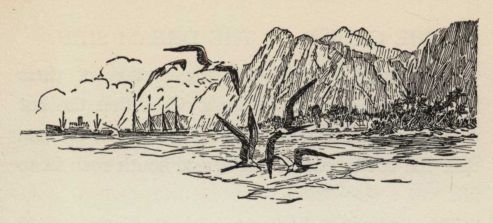
Chapter XI headpiece
CHAPTER XI
Tahiti: its pleasures and problems
Although the Paumotus fully deserve their subtitle of "Low Archipelago," they have a marked effect on the southeast winds that are so prevalent in these latitudes, and so much relied upon by sailing craft.
The law of the "trades" is simplicity itself, and as a matter of general interest is perhaps worthy of mention here.
"Fickle as the winds" is a synonym that does not apply at certain seasons and in certain areas, and these areas, through mariners' reports, have been definitely located and recorded in the British Admiralty and United States Hierographic Office wind charts. A schooner skipper may now lay a course from, say, San Francisco to Sydney, and know to within a couple of points from which direction the wind will come for the entire voyage. He will be careful to "hug the trades"—the northeast down to the Equator, and the southeast beyond—and the reason of these steadfast and accommodating winds is that the hot air of the Equator naturally rises, leaving a vacuum that the cooler airs of north and south rush in to fill.
The Paumotus, however, with the intense heat generated in their mighty lagoons, form a miniature Equator of their own, and completely disorganize the "trades" thereabouts, with the result that weather conditions between this group and the Societies are notoriously unreliable.
A greater contrast between two islands a bare forty-eight hours apart can hardly be imagined than between the last of the Paumotus with its coral reef invisible at ten miles, and the cloud-capped volcanic peaks of Tahiti. It is like approaching another world. It is another world.
At the pass in the barrier reef off Papeete, a genial French pilot took charge, and secured us the best berth in the harbour. Here the coral wall that forms the beach is so sheer that it is possible to make fast to the trunk of a flamboyant, as though to a bollard on a quay, and walk ashore on a gangplank—which we of the dream ship promptly did and dined in splendour at the best hotel.
With unaccustomed collars chafing our leathern necks, and perspiring freely under the burden of clothes after a régime of towel and sola topi, we consumed iced vin rouge, poulet rôti with salad, and omelette à la maître d'hotel. Papeete was a pleasant place in that hour. Indeed, Papeete is a pleasant place at any hour. It is the metropolis of the south-eastern Pacific islands, just as Honolulu is of the northeastern, attracting as varied an assortment of humanity as any in the world.
Here we have the planter of vanilla and cocoanuts, the trader in anything from copra to silk stockings, the pearl buyer, the schooner skipper, and the ubiquitous adventurer on their native heath—and under conditions to make it possible for each to live and prosper.
The French may be wrong from our iron-bound, Anglo-Saxon point of view, but they certainly have the knack of making life a more enjoyable affair under their administration than under any other at the present time.
It was at Papeete that we of the dream ship lost our cook. It may be remembered that in the Galapagos Islands, five thousand miles back on our tracks, we rescued an exquisite Ecuadorean Government official from a delicate position by christening him "Bill" and installing him in our culinary department, where he was expected to work his passage to Australia.
He proved to be an expert cigarette smoker and little more, so that when he approached us after the first night in Papeete and intimated that he found it "necessary" to leave, we were neither surprised nor pained.
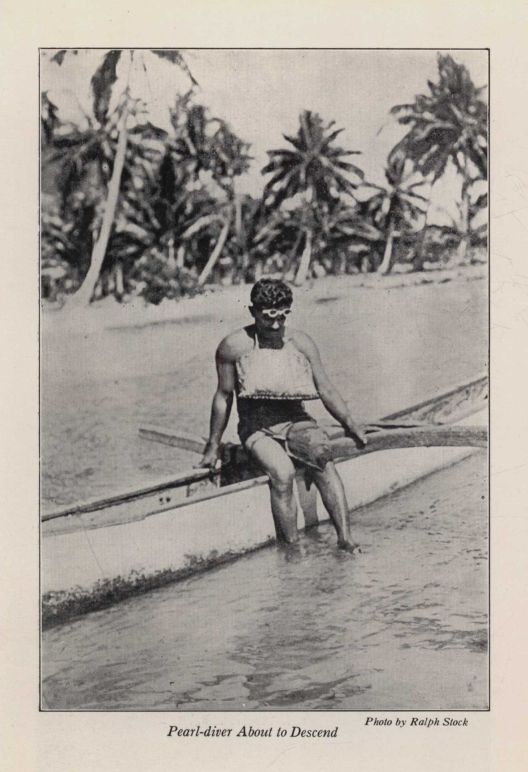
Pearl-diver About to Descend
And so you may see to this day Bill, of the biscuit-coloured socks and passionate tie, leaning gracefully over the soft-goods counter of a French store, extolling the virtues of a new line in underwear or gallantly escorting a bevy of Tahitian beauty to the movies of an evening.
Bill has found his niche in the scheme of things, and who can say more?
"If you manage to get past here without trouble aboard, you'll be the first yachting party to do it."
So spake that kindliest of men, the acting British Consul of Papeete, and although we of the dream ship were fortunate enough to succeed where others had failed, I recognize the truth of his words. Right down from Bligh of Bounty mutiny fame to the most recent of pleasure cruises there is a succession of enterprises that have found their quietus at Papeete. There is something peculiarly demoralizing about the place. It invites to a laxity of mind and muscle unequalled in the Pacific, which perhaps accounts for its fatal fascination.
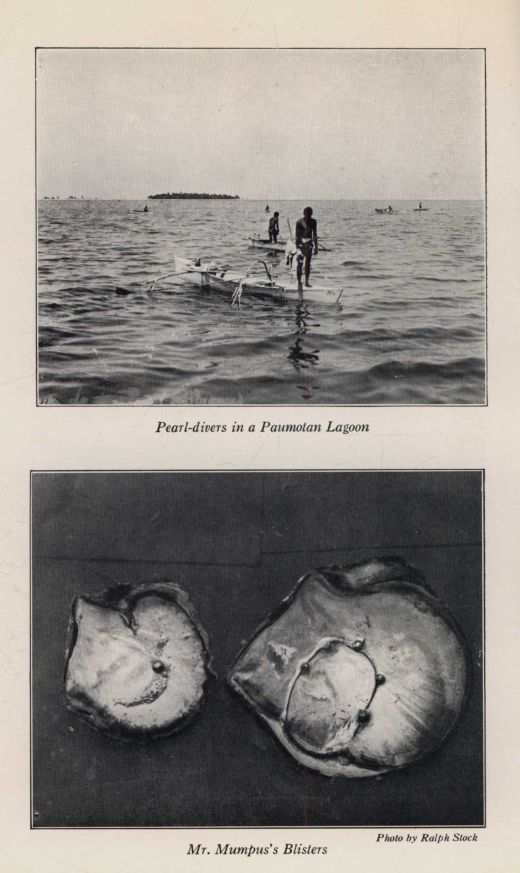
Pearl-divers in a Paumotan Lagoon; Mr. Mumpus's Blisters
How everyone lives, including a goodly sprinkling of whites, is a mystery that intrigues. I know a man hereabouts living in a twelve-by-fourteen corrugated iron shed furnished with empty crates and kerosene tins. At any odd hour that he chances to awaken from a more or less permanent state of torpor, he lounges into town and pays the smaller stores a visit. He pays nothing else. Starting at one end of a counter, with its sample edibles outspread, he systematically talks and eats his way to the other, and by the time the process is complete he leaves with a parting bon mot, and a full stomach.
He is a type of the present-day beach-comber, hardly such a romantic figure as his prototype of the "good old days," but in his way interesting. His is the art of getting something for nothing, and who amongst us shall say he has never essayed the feat?
I cannot let this gentleman pass without enlarging upon him, if only to illustrate the mental processes by which a cultured man may descend to the status of a beach-comber.
He had never worked, and declared that he never would, both of which statements I could readily believe. Why should he work? To make a living? He has one without it. To make money for the mere sake of making money? Such a pastime did not attract him. To save himself from boredom? He was never bored. Were not sunsets and cloud effects, and all the strange living things of the beach (including store-keepers) provided for his entertainment? To retain his self-respect? Not at all. If others found it necessary to plan and strive in order to retain their self-respect, let them proceed! Personally, he did not find it necessary, that was all; and he fell to gouging his foul nails with a jackknife.
"Of course," I ventured to murmur, "there is self-respect and self-respect."
"Quite," he agreed, cheerfully.
But the man's real secret, the canker at the back of his diseased mind, was revealed to me—as I have no doubt it has been to many others—in the most startling fashion. Suddenly, and apropos of nothing either of us had said, he sprang to his feet and struck an attitude in front of the rusty hurricane lantern standing on an empty fruit crate.
"Do you notice anything?" he asked me.
All I noticed was an elderly gentleman, inclining to corpulence and baldness, with rather a fine profile terminating in a Vandyke beard, standing rigidly with folded arms and an air of imperiousness that struck me as out of place.
"You see no resemblance?" he suggested, incredulously.
I saw none in particular, and said so. He took his seat with an air of disappointment.
"Then perhaps I may help you," he said. "My mother was lady-in-waiting to Queen Victoria when King Edward was Prince of Wales. Does that convey anything to you?"
Naturally, it did, and I was forced to admit a resemblance that had escaped me.
Touched? Perhaps.
Taking this unworthy as the lowest rung of the white Tahitian social ladder, one comes next to the clerks of the larger stores, who, after a year or two with their firm, are marooned in charge of a trading station on some distant island at a wage that makes honesty and prosperity incompatible.
Then comes the store manager in crackling white drills and a luxuriant office, who welcomes you with a winning smile, and speeds you with a staggering bill; the schooner skipper, a genial soul possessed of an enviable independence that empowers him to tell his "owners" to go to the devil for three months of a hurricane season each year, the while his ship lies in port, and he disports himself and his latest yarn over variegated drinks on the balcony of the Bougainville Club; the French Government official, as awe-inspiring in business hours as he is charming out of them.
Island inhabitants
As for the natives, they are to-day a relic—rather a sad relic when one comes to think of it—of a once-superb race. White man's blight has descended upon them and they have withered like so many of their brothers throughout the milky-way of the Pacific.
When shall we learn that what may be one man's meat is another's poison, and refrain from attempting to instil our ideas of progress into a people on whom they have precisely the opposite effect? The answer is, "Never—so long as there is money in it."
But an additional rung must be added to our social ladder of Tahiti, and a sturdy rung at that. The half-caste—especially the French-Tahitian half-caste—is deservedly becoming a power in the land.
The accepted idea of him is that he retains in his composition all the failings of the white man and none of his virtues, but like so many accepted ideas it is entirely erroneous. He is a human being with the failings and virtues of any other, and there is not a doubt that he possesses a physical and mental virility that carries him further than most toward success in the tropics. He is usually extremely handsome, quietly mannered, and industrious, and the women of his species are among the most beautiful in the world.
Lastly there is the Chinaman; and the more one sees of this bland, uninterfering race, the more one is driven to the conclusion that he has come nearer to solving the riddle of existence than any other.
When Tahiti suffered one of its periodical awakenings to the fact that it must have plantation and road labour, it imported some thousands of Chinese. But what it failed to do was to specify on its indent the kind of Chinaman required, with the result that the majority turned out to be of the store-keeping class, and about as much use for road-making or copra-getting as a sick jelly-fish. Some stayed by the work for which they were intended, but many more, in their own insidious fashion, set up shop, and to-day wield a financial influence in Papeete second to none. "I'd sooner work for the Chinks," a white super-cargo told me. "You know where you are with them. They give you a square deal, expect a square deal from you, and if they don't get it, give you the boot without back-chat. They're not in an ever-lasting, all-fired hurry, either."
So here are one or two secrets of the Chinaman's success. Is it another that he will buy a pearl for no other purpose than to drink it pulverized in tea? Who can say? It is certain that he won't.
It was here in Papeete that I became a garçon d'honneur; at least, that is what I was told I was, though at the time I felt, and I am sure looked, like nothing on earth.
If it had not been for Liza I should never have suffered the indignity of transition from the semblance of a man to that of a stuffed and hustled dummy. But who can listen to the pleadings of a particularly attractive half-caste Tahitian by moonlight on the deck of a dream ship without surrender? I cannot.
It was explained to Peter, as intermediary, that she (Liza) needed an escort to her sister's wedding, and thought that I should lend an air of distinction to the proceedings. She had fallen in love with my particular brand of sola topi, and she thought me très gentil. I expect this settled the matter. In any case, at nine o'clock that night, arrayed as ordered, and securely wedged between Liza and one of her innumerable and attractive female relatives, I was conveyed, swift as Ford could fly, to the offices of the Maire, where I was dragged forth and pushed into position to form one of a long procession of youths and maidens, the former in white gloves and evening dress ties, the latter in frills.
From, then onward I have no clear recollection of how I came to be in the various places that I found myself. Liza managed it. Liza was the most efficient tug I had ever made fast to. Up a lane of giggling onlookers we trickled and, after the civil ceremony, down it again, to be whirled away to the church, where the same performance, with certain variations, was enacted. Then to the home of the bride, and incidentally of Liza, a palace of light and heat, music and movement, where I found solace in a life-saver before the tug again made fast and towed me in to "breakfast."
I had fancied the marriage complete, the knot irrevocably tied. Not so. We stood about a long table, our hands itching to descend on a glass of inviting champagne, while the native department of the ceremony, and to my mind the most impressive, was conducted by a venerable Tahitian, a relation of the bride's mother.
He spoke, and continued to speak, untroubled by the growing restlessness of his audience. Liza pouted, and whispered in my ear, from which I gathered that the speaker had not been invited, that his mere presence constituted an insult. I failed to see why a representative of one side of Liza's family should receive such scurvy treatment, but lacked the courage to say so, which is perhaps as well. Instead, I asked what he was saying, and elicited the following:
"It is old Tahitian custom—he should not be here! It is old Tahitian custom when you marry you have new name. He is telling new name which must be 'WIND'; and when they have children, they are to be more 'WIND'. He should not be here! There, it is finish; drink your champagne."
Which, ever obedient, I proceeded to do.
Followed dancing, a strange mixture of hula and fox-trot, until four o'clock of the morning, a farewell to Liza under the stars, and a somewhat clumsy boarding of the dream ship.
Such is present-day Papeete, a place of pleasure, interest, or profit, according to taste.
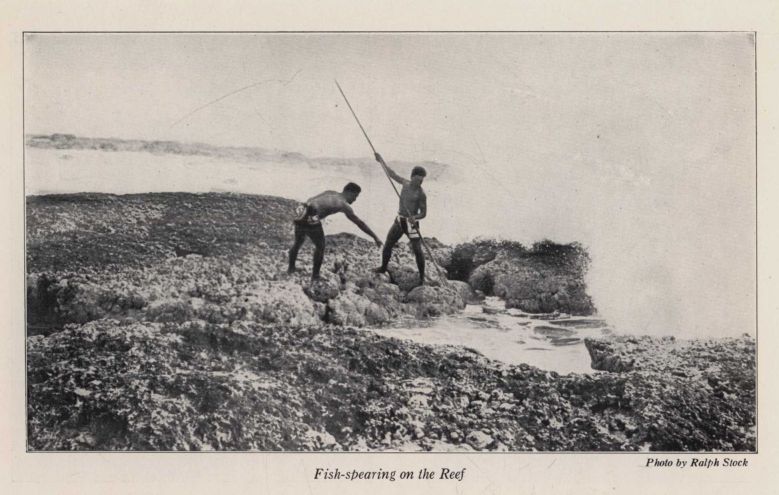
Fish-spearing on the Reef
The main trouble in the Societies, as elsewhere in the Pacific islands, is scarcity of labour. Each group in this mighty ocean is struggling with the problem at the present time, and has not yet succeeded in reaching a solution. The native will not work. He does not believe in toiling for others when he is a self-supporting landlord himself, and, when you come to think of it, why should he? The Pacific Islands, ambitious for development, are consequently forced to turn for help to the more congested quarters of the globe, such as India and China, and herein lies the danger. The influx has already begun, and there is not a doubt that in time it will swell from a beneficial stream into an overwhelming flood unless ultimately returned to its source by a conduit of stringent legislation.
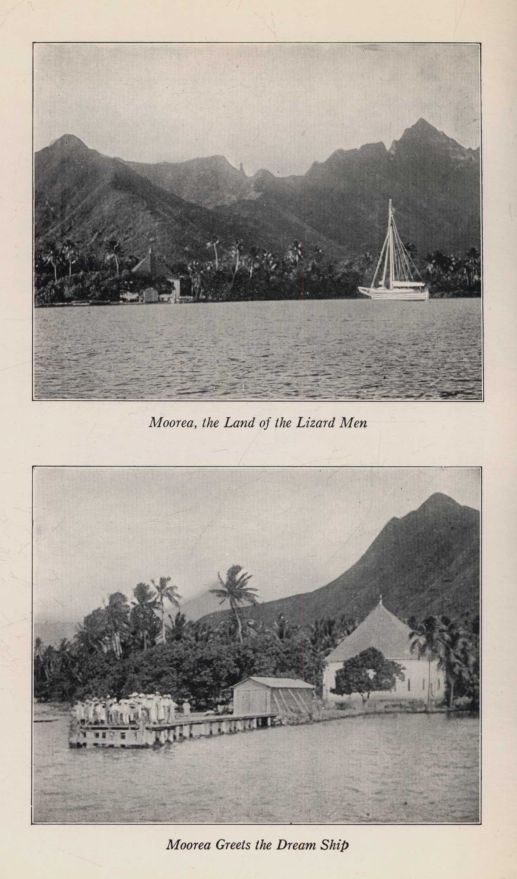
Moorea, the Land of the Lizard Men; Moorea Greets the Dream Ship
We of the dream ship left the pleasures and problems of Papeete with regret, but succeeded in leaving with our ship's company intact, to the lasting wonder of our very good friend the British Consul—to whom salaams from a less salubrious clime.
THE ISLAND OF MOOREA
The land of the lizard men—Facts and fancies, including a few horrors
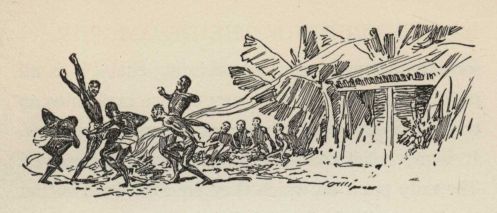
Chapter XII headpiece
CHAPTER XII
The land of the lizard men—Facts and fancies, including a few horrors
Many an hour of quiet content had we of the dream ship spent while moored off Papeete, in watching the ever-changing beauties of Moorea, a bare fifteen miles distant.
Whether viewed in fair or foul weather, at sunrise or sunset, this island with its fantastic volcanic peaks and deep, mysterious valleys of purple haze attracts the eye of the dreamer like a magnet. What secrets lay hidden in those valleys? What might not be seen from the summit of those peaks? We determined to find out.
But first it was necessary to attend to things practical in the shape of our alleged auxiliary engine. It was perfectly possible, here in Papeete, to hire an expert to diagnose the trouble, but I had had my fill of "experts" the world over. They have an engaging habit of setting the contraption in motion by some happy accident, and declaring that "it is all right now," but never by any chance explaining to the harassed owner what was the matter with it. It is my belief that they do not know themselves. The only point on which they are all agreed is that the "expert" who preceded them "made an unholy mess of the job," and that if it had not been for themselves, it is doubtful if the engine would have ever run again. Moreover, their bill is usually in keeping with their modesty.
After a three-hour heart-to-heart consultation with the patient, I discovered, quite by accident and with Peter's hat pin, that the tiny air-vent in the screw-top of one of the carburetors was clogged. Consequently, when the top was screwed down, the air had no outlet and forced down the float. Hence a persistent flooding.
It sounds absurd. It was absurd, but that was the entire trouble, and the accidental insertion of the hat pin converted lifeless scrap-iron into the power that the dream ship had so often and so sorely needed during the past months.
I hear the "experts" laugh, but I solace myself with the remembrance of one of their number leaping on his hat in an effort to locate an equally trivial trouble in marine motor engines, and draw the moral that it is as well to carry sisters who use hat pins.
A few hours' sail brought us to Moorea, and one of the finest natural harbours in the South Pacific, where we were met by a plantation owner of our acquaintance in an outrigger canoe, and piloted through a tortuous reef channel to an anchorage of firm coral sand.
The entrance to this harbour is fully half a mile wide, so how the captain of a French gunboat contrived to pile his vessel securely on the reef is something of a mystery. It is said that he had dined "not wisely but too well" in Papeete, and was filled with élan to demonstrate how close a shave he could accomplish without cutting himself. And again, that he had been sent to bring back cattle, a mission that, as a naval officer, he so abhorred that he had done the deed deliberately.
In any case, there lies his craft, a fine old hulk, with the rollers rumbling and seething through her vitals; fit warning to the mariner who would toy with coral.
Such grim monuments to mischance, negligence, or deviltry litter the reefs of the Pacific; and what tales they could tell! I know of one on Middleton Reef, now used as a store ship for other possible victims, that was piled there on a lee shore during a south-west gale, and the bottom ripped clean out of her. For a week she lay half-submerged, her crew wading the decks knee-deep in water, and gazing over her sides or down through her hatches at the provisions scattered on the coral. There was water down there—fresh water in breakers and tanks, and food in tins that only needed block and tackle to hoist them up to the poop. But who would dive down and make the tackle fast? It meant almost certain death of an even more hideous kind than faced them as it was, and, unlike the orthodox romance, there were no heroic volunteers. The skipper was ready and willing, but he had his wife aboard who restrained him by swearing that if he did any such thing she would throw herself and their three-year-old daughter after him.
In all, they waited a week without food or water before the threatening attitude of the crew forced the skipper to make the attempt in spite of his wife's entreaties and threats. He dived; he made fast the tackle, but all of him that came to the surface was a severed leg, and the wife followed him with her child in her arms.