Introductory material (continued 4)
Reading edition
“Impossible that Roddy should be an associate of such people!” declared the girl, whom I knew herself to be a member of a most desperate international gang.
“Now Wilson was, to your knowledge, a thief?” I asked, whereupon she replied:
“I have heard so. Do they suspect the man Dufour?”
“Yes. He tried to escape abroad from Southampton, but was arrested.”
“And he has been discharged,” she said, in a tone of relief.
“Yes. There was no evidence,” I replied, but I did not tell her that his every movement was being carefully watched.
“I cannot understand why the police should suspect Roddy,” said the pretty woman, seated with her hands lying idly in her lap.
“Because it was known that he was a friend of the dead man.”
“But he would never have slipped away from the police. There could be no motive.”
“Not if he were innocent of any hand in the affair,” I ventured to remark.
“Then you think he had a hand in Tuggy’s murder?” she exclaimed, regarding me resentfully.
“Not at all,” I assured her. “I only follow the police views that he discovered they were watching, and grew frightened.”
“But he might have fallen a victim of his enemies just as your girl friend has done,” she said.
“What do you know about Joan?” I asked quickly. “Tell me. I have told all I know about Owen.”
“What you have told me concerning him, Signor Hipwell, has made plain to me many things that were mysterious. It has opened my eyes, and given me a clue to much that was perplexing. I can only thank you for it,” she said, in a quiet, strained voice. “I quite see what fear would fall upon Roddy when young Wilson was killed by some unknown person. The reason of his disappearance is now quite clear to me. I only hope that the police will relax their vigilance in due course, and that he will be able to escape abroad without further trouble. He is, I am sure, quite innocent.”
“You mentioned that he was a friend of Joan’s; this is entirely new to me. How did you know that?”
“He wrote me a long time ago, saying he had met her, and that she was your fiancée.”
“How long ago?”
“Oh, quite a year now.”
I reflected that I was at that time in my unconscious state.
“There is a belief that, on the night of Joan’s disappearance, she was at the Florida dance-club with a fair-haired young man closely resembling Owen. Have you any knowledge of it?”
“Not in the least,” she said. “I know nothing more than what he told me.”
“It is strange that Joan never mentioned him,” I remarked. But I inwardly reflected that their acquaintance was during my period of ignorance.
I longed to reveal my knowledge to the clever criminal who sat there before me, and to demand from her the meaning of that piece of music she had sent me.
I felt it wiser, however, not to show my hand. That she was playing some very deep game was apparent. By pretending loss of memory, then, and giving her the impression that I was still her cats-paw, I might discover much more than by denouncing her.
“Well, Contessina,” I said, addressing her by the name which I was confident misled her into a sense of security. “I have told you all I know about your friend Mr. Owen. Now—explain your knowledge of Joan.”
For a few moments she remained silent. Her eyes were fixed on mine with a distinctly suspicious look. She was still uncertain, I think, whether I had penetrated her true identity, though I had strained every nerve in pretence of ignorance. I still treated her as the Little Countess, beside whom I had had my ridiculous tumble under the British Ambassador’s table in Rome.
“I can tell you very little, Signor Hipwell,” she replied. “I fear that you regard both Mr. Owen and me, as your enemies, rather than your friends. Now tell me truthfully, is not that so?” and she crossed her legs, leaned her chin upon her hand, and smiled up at me.
“Now that you tell me what I never dreamt before—that Joan was acquainted with Roddy Owen—I confess I begin to suspect that he has some hand in her disappearance. And the more so, because certain people have stated that she danced with him at the Florida on the night she was lost.”
“All rubbish,” she laughed. “Depend upon it that Roddy has had nothing to do with Miss Gell’s disappearance. It is a case of revenge and retaliation. That is my view.”
“How?”
“Has it never occurred to you that her father, Mr. Gell, the famous prosecutor for the Crown, has been instrumental in sending dozens of crooks, of various sorts and ages, for long stretches on the Moor? And what more natural than the crooks themselves have had their own back on him?”
I paused and looked at her. Though she spoke with the pretty foreign accent that I cannot here attempt to reproduce—the same accent which had charmed me when we used to breakfast in our unpretending lodgings in Camberwell—yet was not that word “stretches” criminal slang for terms of penal servitude, and “the Moor” for His Majesty’s Penal Institution at Dartmoor?
“Do you really think that Joan’s disappearance is due to revenge for some conviction or other, which her father has secured at the Old Bailey?” I asked, eager to learn her views.
“Without a doubt,” was her reply. “That is why I came here in order to tell you my candid opinion!”
“Well—and what can I do?” I asked, in blank dismay. Her theory was one which had suddenly gripped me.
“Discover what serious conviction her father has of late obtained,” she replied, in a low, intense voice.
She was posing as my friend, yet I knew instinctively, and with no better proof than the trickery in Kensington Gardens, that she was my fierce, subtle enemy.
Oh, how I longed to turn on her, and demand an explanation of her masquerade as daughter of an Italian count, and why she had sent me that sheet of puzzling manuscript music!
But I managed to remain unperturbed. How I accomplished it I know not.
“Then your theory is that Joan is the victim of enemies of her father—criminals whom he, as prosecutor for the Crown, has sent to penal servitude?”
“Of that I am convinced,” she said. Then, after a moment’s pause, she added frankly: “What you have told me about Tuggy Wilson has revealed much to me, Signor Hipwell. I had never dreamt of that!”
“Neither have I ever imagined that Joan’s disappearance is due to her father’s success as a criminal lawyer.”
“Well, there you are,” said the woman, who had two years before suggested I should be blinded, so that I could never identify her accomplices. “We exchanged promises, and we have fulfilled them. What more can be done?”
“You will seek Owen, eh?”
“Of course I shall. I must find him. And you—you must discover your fiancée, Joan Gell.”
“Ah! If I only could!” I cried. “The weeks go on, yet Scotland Yard are ever at fault. After being seen at the Florida she vanished completely.”
“A reprisal on the part of her father’s enemies,” she remarked. “By revealing to me what you have, concerning Roddy’s friendship with young Wilson, and the latter’s murder, you have done me a very good service. If I can assist you in any way to find Joan Gell, I will. I think I may have my own channel of inquiry.”
“I thank you heartily, Contessina,” I replied quickly, suspicious at once of her reference to her own channel of inquiry. She knew much more than she would reveal to me. Of that I felt certain.
The strong incentive within me at that moment was to seize the guilty-faced crook by the throat and wring the truth from her lips. But I hesitated again, still feeling that only by watchfulness could I hope to cope with the plot against me, of which I had been warned by the mysterious Illona.
The Contessina knew her and feared her. Evidently she intended that we should never meet.
In the drawer in my writing-table lay the letter I had written to Illona, enclosing the sheet of music which Lisely had sent me. How I longed to present it to the woman who thought she was so cleverly tricking me, and who, after all, had set up in my mind a new theory as to the cause of Joan’s absence.
She took up the little red morocco handbag and rose to leave, rather reluctantly it seemed to me.
“Is there anything else I can do to assist you, Contessina?” I asked, with studied politeness.
“Nothing, I fear, Signor Hipwell. Except,” and she paused, “except, when we next meet, I hope you will believe in my sincerity a little more strongly than you do to-day,” she added with a strange, meaning smile.
“Sincerity!” I echoed. “Why, of course, we are friends, Contessina—Hence, I certainly believe in your sympathy,” I said, in an endeavor to assure her further of my continued ignorance of her true identity.
But she only gave way to a little hysterical laugh. As we shook hands I asked her where I could write to her.
“To Cook’s Office in Berkeley Street,” she replied. “Letters sent there always find me sooner or later.”
And then she went out, Bruce seeing her into the elevator.
CHAPTER TWENTY. TO-MORROW!
As soon as she had gone, I rang up Mr. Gell at his chambers. But he was still at the Old Bailey, and would not return to the Temple. So I rang up Queen’s Gate, and asked his man to let me know instantly that he would return home.
About seven o’clock the bell rang and I found myself talking to the famous lawyer.
“I want to see you at once,” I said. “I’m taking a taxi along to you.”
“All right, Lionel. But I have a dinner of the Silk and Stuff Club at eight. Come along with me. You’ll be interested, I think.”
I thanked him, slipped into a dinner-jacket, and made all haste possible down to Queen’s Gate.
The stout old gentleman, already dressed, was sitting in his den poring over a brief of many folios when I entered.
He greeted me cordially, as he usually did. But, noting my gravity of manner, he asked what was the matter.
Without disclosing the source of my inspiration as to the cause of Joan’s fate, I asked:
“Among all the criminals you have lately prosecuted do you think you have many enemies?”
“Well, that’s rather a strange question,” he replied, looking up at me in some surprise. “I don’t fancy any prisoner against whom I secure a conviction really likes me. The majority of habitual crooks, however, are good sportsmen. If they are unfortunate enough to make a slip, and fall into the hands of the police, they usually blame themselves for not being smart enough.”
“Have you ever had threats uttered against you?”
“Sometimes,” he laughed, in his hearty way.
“But aren’t prisoners often incensed at what counsel says against them?” I queried.
“Counsel’s instructions are precise, and to the point. He has the statement of the prosecutor, and uses it to the full. To the jury he is impartial—unlike counsel for the defence, whose moving appeal may soften the hearts of the men sitting, to decide on the prisoner’s innocence or guilt. The work of counsel for the prosecution is a cut-and-dried job into which he puts no acrimony or sentiment. He is simply the mouthpiece of the Crown.”
“And, as such, you think that he never incurs the malice of the accused’s friends?”
“I won’t go so far as to say that,” Mr. Gell replied at once. “Of course, in the case of one member of a gang being convicted, the others, unknown and unidentified, might easily wreak private vengeance on counsel.”
“Mr. Gell,” I said, looking straight into his round, clean-shaven face, “has it never occurred to you that Joan’s disappearance might be due to such private spite?”
“God, Lionel!” cried the man, springing from his chair. “I believe you are right, after all! You’re right!” he shouted. “You’re right! I’m sure you are! As you say, it is the devil’s work of some gang.”
“There is more than suspicion that Joan was with that fellow Owen on the night of her leaving home,” I pointed out. “We know that Owen was at least on friendly terms with an expert thief. And, further we know that he made himself scarce as soon as he suspected that he was under the eye of the police!”
“True!” cried the distressed man. “The brutes have my poor girl in their clutches—if she is still alive.”
“They know you are seeking her, and that Scotland Yard intends to find her, dead or alive.”
“Ah, she may be dead! Their vengeance is perhaps complete!” he said brokenly.
“But whose vengeance?” I queried. “Go over your recent cases, and discover if, in any one of them, either Owen, Wilson, or Dufour was implicated.”
“I wonder,” he said reflectively. “I wonder!”
He pointed out that, if a man were charged with a crime, the police would perhaps know his associates, but their names would not be given to him. His duty was simply to prosecute, and bring upon the culprit the just and legal sentence of the law.
In view of Lisely’s connection with that mysterious gang in Camberwell—who were sharing out those priceless jewels when I inadvertently entered the room—and her friendship with Owen, I asked:
“Have you of late prosecuted, say, any gang of jewel-thieves?”
“Not recently,” he replied, thinking deeply. “But about a year ago I had a case at the Old Bailey—a rather curious case, I remember—and one which caused me to suspect the existence of a gang, who had in secret given a woman away to the police, and who afterwards made themselves scarce. The woman made a statement—a wild allegation, it seemed.”
“What was the woman’s name?” I asked, much interested.
“I can’t remember. I’ll look it up.” And he took down a diary from a shelf, and after turning over many pages, exclaimed: “Here it is! Before the Recorder in April of last year. The prisoner’s name was Hilda Bennett, alias May, and she was charged with complicity in a jewel-robbery at Dover Marine Station.”
“Hilda Bennett!” I repeated astounded.
“Yes. You probably read of the affair,” he went on. “She stole the jewel-case of the wealthy Baroness d’Armenonville, wife of the Paris banker, who was on her way to London. There was a rope of pearls worth fifty thousand pounds, and a quantity of other jewels. The lady, no doubt, was followed by the thieves in the Golden Arrow train from the Gare du Nord in Paris. And, at Dover the prisoner, a big, well-built woman, snatched the case from the Baroness’s hand after she had passed the Customs. Then, with the connivance of her confederates, she succeeded in getting away in a motor-car. The alarm was given, and the Dover police, knowing that the thief would not attempt to go by train to London, telephoned along the roads. A car had been seen going swiftly towards Folkestone. Outside the latter town the car was stopped, and the prisoner was arrested, with the jewels in a big false pocket. The case had been thrown away into a hedge, where it was found next day.”
“Hilda Bennett!” I repeated, for across my brain passed the horrible recollection of that fatal night in Bloomsbury.
“Yes. The case was of more than usual interest, because of a statement given by the police after the jury had pronounced a verdict of guilty. It was given in evidence that the woman was present in Bloomsbury about fourteen months previously, when her lover, a man named Rodwell, was shot dead by a man unknown. The pistol was found to have been stolen by burglars from a house in Cromwell Road, and his finger-prints taken after death showed the man to be one of the most expert jewel-thieves, who was wanted by the police of half Europe. This man Rodwell, alias May, lived quite respectably in a nice house in Fitz-John’s Avenue, Hampstead, and was ostensibly a corn merchant, in a big way of business, at Highbury. His finger-prints, however, had been identified as Monkey Dick’s, one of a desperate gang of motor bandits who had operated in and around Riga, on the Russian border. Indeed, I myself saw the report from the police of Riga asking for any information concerning the English bandit. But he was dead, and a report was sent to them to that effect.”
“But the prisoner? What sort of woman was she? Interesting, no doubt?” I asked, keeping my information to myself.
“I recollect her as a smart, rather overdressed, attractive woman, full of alertness, but with that sly expression beneath the eyes that we legal men as prosecutors always look for. Few of us, at the Criminal Bar, make mistakes. I have prosecuted persons whom I have realized at once are innocent, and about whom I have agreed with my learned friend for the defence. No innocent man or woman has guilt written on the countenance. But the guilty have, and the sense of crime is such in a practised advocate, that he can himself separate the guilty from the innocent.”
“And this woman Bennett was guilty?” I asked, staggered by his statement.
“Of course. It seemed to me that she had been implicated with Rodwell, the cosmopolitan motor bandit, who had a hand in certain amazing thefts. Who killed her lover will probably never be known. In any case, the jury found her guilty, and she left the dock shrieking when the Recorder sentenced her to five years.”
“Five years. So she is in prison now?” I remarked.
“Yes. But I think the jury were certain that the woman was more sinned against than sinning. She declared most vehemently that one of her enemies had deliberately murdered Rodwell, and that the same enemy had betrayed her to the police.”
I said nothing. My thoughts were full. I saw now what I had never seen before—the reason of Joan’s disappearance. The friends of that woman of the night, whose evil face was ever impressed on my memory, had wrought vengeance on the man who had secured her conviction.
I recalled that, at that crucial moment in Camberwell, she had failed to recognize me as her lover’s antagonist. Perhaps it was because of Lisely’s declaration that I was a police informer. Still, I owed my life to her, just as I owed my eyesight to the woman who had so cleverly mystified me.
“Well,” I exclaimed at last. “Doesn’t this case of the woman Bennett throw some light on the present position, Mr. Gell? Don’t you think that her friends, proved as they were by the police to be a desperate cosmopolitan gang, might not have retaliated by decoying Joan?”
“It certainly seems so,” he said. “I might admit that I have not thought so until now. I have now to see Scotland Yard, and endeavor to trace who were her friends, and if the gang now exists, as no doubt it does.”
Then, glancing at the old-fashioned marble clock upon the mantelshelf, he remarked:
“By jove! We must be off. We’re very late, Lionel. I only wish I could escape to-night. I’m in no mood for a humorous speech. But that’s the worst of popularity, my boy. You must always give the public what they expect, or you go under in their estimation like a dead dog attached to a stone.” He stretched his arms above his head, yawned wearily, and then said, “Come along. Let’s go. The car is outside.”
Through the busy London streets, where the lights were twinkling, we drove, but he spoke little. His one obsession, like my own, was the fate of poor Joan. Yet we both felt that we were on the eve of discovery, and that the future held for us some amazing disclosures.
What he had told me about that woman Hilda Bennett astounded me. I never dreamt that, due to his cold, hard accusation in court, she was now languishing in a female convict prison—that woman who had declared to the police that I had deliberately killed her lover, yet well knowing that it was he who had drawn the weapon on me.
To her false allegations had been due my flight, my trouble, my ill-fortune, and now the loss of the woman whom I loved so dearly. To her had been due the loss of two of the best years of my life, thrown as I had been within that time, into a maelstrom of uncertainty and despair.
To her was due my amazing marriage with the unknown and elusive Illona, whoever she might be. That she was my friend was plain, but who she was, her age, her beauty, or ugliness, I knew not.
Sometimes I pictured her as a smart, young, up-to-date girl with well-chosen clothes and smart stockings and shoes—just those differences which attract or repel a man. Nothing repels the modern young man, used as he is to chic and dancing, so much as cheap, ill-fitting stockings and shoes. The modern girl may be smart on her feet, if dowdy above. But nobody forgives the laddered stocking, however well darned, or the shoe which has the slightest turn-over at the heel.
We have all changed, not only the gentler sex to whom, guided by the fashion pages of our daily journals, we all allow changes of mode. Yet even the mere male who puts on his multi-colored abomination and plus fours is still relegated to his funereal black at night. Men are still replicas of undertakers and waiters, I daresay more than one of my male readers, like myself, has been “asked the way” in a crush, being taken for the man from the caterers.
Life to-day is a succession of problems—terrible problems which few care to face.
Alas, that it is so! But the truth must be confronted. The divorce courts are daily examples of man’s perfidy and woman’s weakness. They are examples under which the judges writhe, and yet have their duty to perform. They are examples, too, in which the King’s Proctor is daily bamboozled, and the decree nisi, like a Rolls Royce, is open to anybody who deals in daily commodities and “makes money” in any form whatever.
One famous divorce judge, in his memoirs, has said with truth:
“Nobody in my court ever tells the truth. I listen to a hundred perjuries a day!”
And this is in our modern post-Soviet England!
The dinner of the Silk and Stuff Club proved a long affair, its principal speaker being its famous president, Mr. John Gell, K.C. Many were the jokes and many the toasts, yet I knew that Joan’s father like me, had a heavy heart amid all the hilarity.
It was nearly two o’clock in the morning before I opened the door of my chambers. Bruce, awakened by my entrance, rose from a chair in which he had been waiting for me.
“Oh, sir,” he said sleepily. “I tried to get you at Mr. Gell’s and at the club, but was unable. About ten o’clock the lady called.”
“The lady. Who?” I cried.
“The lady for whom you left a note some time ago—Madame Illona. She waited half an hour to see if I could find you, but she had to go. And she left word that she would call to-morrow!”
To-morrow!
CHAPTER TWENTY-ONE. I MEET ILLONA
The enigma was increasingly bewildering. Ever since the moment when that woman of the night, Hilda Bennett, had declared that I was not her lover’s assailant, and in consequence of which I had been punished as a police-spy, I had existed in an atmosphere of excitement, doubt, and mystery.
Daily, mystery piled upon mystery, as a natural sequence. And through it all I experienced an intense agony of mind because of Joan’s disappearance.
The fact that Joan’s father had represented the Treasury at the prosecution of the woman Bennett, whose accusation had led me into that maelstrom of adversity, certainly pointed to a motive of vindictiveness on the part of the woman’s criminal friends. But I felt myself up against a blank wall. With all the energy and spirit I possessed I had chased the phantom of hope. Each time, however, it had eluded me.
Illona was but a will o’ the wisp. Was she a fraud? Did she really exist? Was she some unknown woman whom I had married during that long period of my other self, when I lived in another world, created by that baneful drug injected into my veins by the girl typist who had been my fellow-lodger?
The discovery that this same young and good-looking, soft-eyed criminal, whom I had known as Lisely Hatten, was masquerading as the Contessina Angela Ugostini, a popular figure in diplomatic circles in Rome, had staggered me. And whenever I had searched for the truth, I had only drawn blank. Yet, I remained patient with one fixed object; to discover the whereabouts of my beloved Joan, and to punish those who had harmed her.
And if she were dead? Then I would have a life for a life.
That night I suffered from insomnia, as I had done frequently, through the most silent hours. From three to five in the morning I wandered the streets of London.
No one has really seen our wonderful metropolis who has not stood upon Westminster Bridge by the long façade of the Houses of Parliament, when Big Ben has boomed forth half-past three on a summer’s morning. At that hour the dawn is pale, the great highway with its thundering traffic is silent and deserted, save for an occasional constable who looks askance at any loiterer upon the bridge. There is a solitary taxi upon the stand, and the fine statue of Boadicea and her horses stands out against the eastern sky by the faint flush of the rising sun. That has long been my favorite spot when I cannot sleep. From my point of vantage I can look down to the dome and steeples of the gray mysterious City, and up stream along the Terrace to St. Stephen’s Tower, and the bend of the Thames at Battersea, with its trees and Park. A silent, sleeping, quaint London—our marvelous capital around which civilization revolves—lies unconscious of the slowly awakening world. The air is fresh; man and machine are resting from their labors. For an hour one can enjoy rest, and reflect on many things, the things which, united, we call life. In two hours more London will awaken to its activity. Hordes of men and women will be scurrying to business; cars, motor-buses and trams will be roaring increasingly across the bridge which Boadicea is guarding. And Babylon will once more be plunged into its greed for gain, its sins, and its incessant iniquities. And, peer and politician, magnate and mechanic, lawyer and laborer, patrician and prostitute, criminal and charlatan will vie with each other to make money, which is the heart’s blood of London’s life.
Yet where was Joan?
I returned to Sackville Street about seven, and Bruce served my breakfast. Then, I washed and read the newspaper, each moment impatient for the return of my elusive “wife” Illona.
Just before eleven I was startled by the electric bell, and, a few moments later, my man ushered in a strange, stunted female figure, who rushed forward to welcome me with the breathless words:
“Lionel dear! At last!” Then, turning to see if Bruce had closed the door, she gripped my hand and in a low intense whisper asked, “Have you heard anything further?”
“About what?” I asked, looking into her narrow, drawn face, utterly staggered.
“About the Avignon affair?”
“The Avignon affair? I don’t understand you,” I replied.
“What?” she cried. “Come, Lionel, you are joking. You know the great risk I have run in coming to you to-day. I called last night and you were out.”
She paused in the manner of expecting an explanation.
“You had my note?”
“Yes—and the evidence of treachery,” she said. “We will talk of that later. But, Lionel,” she added, gazing into my face with a puzzled expression, “you are not yourself, dear. Why? What has happened?”
I stood before the queer, undersized little woman, utterly bewildered. Not more than five feet in height, her head and hands seemed abnormally large. She was well and fashionably dressed in a beige-colored gown, with hat to match. And she carried in her hand an expensive bag of pale-green lizard skin. Her features once had been attractive, perhaps, but the bloom of youth had long passed, and vain endeavors had been made to efface the havoc of time by the application of toilet requisites, and especially of lip-stick.
And this ugly, ill-formed woman with the rouged face was Illona—my secret wife whom I imagined to be young, sweet, enticing!
“No,” I managed to reply, “I am not myself.”
“I don’t wonder, after your recent narrow escape.”
“Where?”
“In Kensington Gardens. They evidently knew that I intended to meet you, and sent you that message so that you should not wait for me.”
“And the piece of music,” I added. “What did that signify?”
“Why, you know,” she said in an intensely earnest and refined voice.
“But was there any motive in preventing our meeting?” I demanded quickly.
“Of course, they have done all in their power to prevent us coming together again,” said Illona. “That is why I risk so much in coming here to see you.”
“Risk!” I echoed. “I don’t follow you.”
“Ah! don’t you think, knowing what I do, and the relentlessness of our mutual enemies, I am not ready to take any risk to save you, Lionel—you—my husband?” she said in a voice full of emotion.
Words failed me. That she had a right to call me husband I certainly would challenge. It required all my self-restraint to refrain from doing so at that moment. Yet I saw that by my resentment I might easily lose my chance of learning the truth.
Truly, I was in an amazing predicament, for of what follies I had been culpable during my period of unconsciousness I knew not. Hence I saw that the best course was to hold my tongue, and allow my supposed wife to explain.
“I know that you have warned me against my enemies, and especially against a blind man,” I said.
“Has he been here?” she asked breathlessly.
“On several occasions.”
“Ah! Then they contemplate carrying out their threat!” she cried. “Lionel, dear, you are in great danger! You must fly—anywhere.”
“But why?” I asked, standing aghast. “I’ve done nothing!”
“Not in our eyes. But in the eyes of the police,” she declared. “Ever since you became one of us they have always suspected you. You surely know that!”
“What do you mean?” I asked. “How did I become ‘one of us,’ as you put it? I don’t understand.”
The middle-aged dwarf with the made-up countenance smiled and said:
“Ah! I see you are not yourself, poor dear!” And she placed her well-gloved hand tenderly upon my shoulder. “So much traveling upsets your nerves, no doubt. I expected you to come and see me at Lausanne, for you often passed to and fro on the Simplon route to Italy and the Balkans. Yet you never broke your journey. Again, I expected you to meet me one night at Pretty’s Club in Wardour Street, where we are all members.”
“You told me to make an appointment, but as a matter of fact I’d forgotten the name of your club,” I declared, very lamely, I fear.
“Ah, my dear! Your memory was always faulty. I’ve noticed it ever since you married me at the Kensington Registry Office. Do you remember that morning—the morning after poor Hilda was sentenced? Poor girl! I wonder how she is.”
Hilda! She meant Hilda Bennett, the woman who was the cause of all my present troubles and incertitude, the woman who had been prosecuted by Joan’s father.
“Hilda was one of us, eh?” I hazarded.
“Of course. But she was game and fortunately gave nobody away.”
“And Lisely Hatten?” I asked, for it seemed by her remarks that I was in some way still allied with the gang who had captured me on that foggy night in Camberwell.
“She is my worst enemy, Lionel. She ascertained your family connections, as you know, and intended to marry you. To her, you no doubt owe your eyesight, for I know that she only pretended to blind you, because you and she had been friends. His Excellency never suspected it, or you would not be alive now.”
“His Excellency?” I queried.
“Oh dear, Lionel! How dense you are!” she said, throwing her bag upon the table, and sinking into a chair beside the fireplace. “You remember Felix Zuroff, the little black-haired Russian, who presided at the meeting into which you so unfortunately tumbled. We call him His Excellency, as he is the representative of others.”
I remembered distinctly the beetle-browed foreigner, apparently head of that criminal gang, who at the moment of my innocent intrusion were dividing their spoils.
“Yes, I know,” I ejaculated. “But is His Excellency still in power?”
“Most certainly. And his right hand is Lisely Hatten—or the Contessina, as she is just now known. It is almost time the great coup was brought off. Everything is arranged for it.”
“The woman who prevented our meeting in Kensington Gardens.”
“Ah! I suspected as much,” said my undersized visitor—the woman who called me husband.
According to her story, I had married her at the Kensington Registry Office. I intended to confirm that, for it would not be in the least difficult.
“Tuggy Wilson, who was recently shot, was one of us—was he not?” I asked her.
“Of course. Dufour killed him, we know. There was, however, a good reason. It’s most fortunate that he has got clear.”
“What was the reason?” I inquired eagerly.
“Oh, a quarrel over a woman, I hear.”
“A woman? Who?” I asked.
“Some girl with whom young Owen fell in love.”
“What was her name?”
“I don’t know. You see, I’ve been out of England for months—ever since I came to you after the Avignon affair and we made our compact. The police have searched Europe for the packet, but they’ve never found it. And they are not likely to, eh?” she asked, with a knowing look.
“It’s not my affair,” I declared.
“Well, who knows where it is if you don’t?” laughed the mysterious Illona.
“I really don’t follow you,” I answered her.
She rose, and, standing determinedly before me, said:
“Now look here, Lionel. I’ll be really angry with you in a minute, if you pretend all this silly ignorance.”
“It’s not pretence. I don’t know,” I protested.
“What?” she cried angrily. “When I risk everything to come here to see and talk to you, you mean to stand there and tell me you are in ignorance of the great coup we effected on the road outside Avignon just after midnight? We had two cars traveling towards Aix-en-Provence. The first, in which you were, overtook the car with two men, and deliberately ran into it, completely wrecking it. His Excellency, Owen, Lisely, and myself were in the second car, and, on coming up, offered assistance. It was accepted. But while the damage was being examined Owen managed to get hold of two big cases filled with fine jewels belonging to Bonnard Frères, of the Rue de la Paix, in Paris—some of their most expensive stock—which were being taken for the winter season to their branch shop at Monte Carlo. The firm’s manager, Monsieur Perrin, realizing his loss, shouted, but was shot dead for his pains by His Excellency; the chauffeur was drugged, while the clerk accompanying Monsieur Perrin was attended by Lisely, who used a hypodermic needle upon him. In five minutes all was finished. The two cars locked together in the smash, with the dead man and the other unconscious, we left blocking the road, while the chauffeur of the first car, who was really Tuggy Wilson, joined us, and we turned and were swiftly on our way to Geneva.”
Without uttering a word, I listened to the description of their daring exploit. She had alleged that I, as a member of that gang of motor-car bandits, was party to that deliberate theft and murder. It was impossible, and I told her so. The calm way in which she had related the attack, and the part she herself had played in it, horrified me.
“My dear Lionel!” she laughed. “You are certainly not yourself to-day. What utter rot you are talking.”
“I am speaking the truth!” I protested.
“Do you mean that you deny all knowledge of the fine haul we made that night?”
“My dear lady,” I said, “I certainly do. I have never even heard of the affair.”
“Really, Lionel, I think you have taken leave of your senses,” she exclaimed familiarly. “What is the use of trying to bamboozle me—of all women?” And she stood staring at me for a few moments. Then she said, “If you are really in such innocent ignorance as you declare, how about the check you received from His Excellency last Thursday, the first of the month, for over eight thousand pounds as your share of a certain other little bit of crooked business? Examine your pass-book now, and see if I tell the truth!”
CHAPTER TWENTY-TWO. “REMEMBER THE NAME!”
I acted as she suggested.
From my writing-table I took out my pass-book which had only been sent by the bank the day before. And there, to my surprise, I saw that she was correct.
On the second of the month, two days before, my account had been credited with eight thousand three hundred and forty pounds! On my table there lay a letter from the bank which had only arrived on the previous morning, and which I had not opened, so preoccupied had I been. I tore it open, and found the usual formal notice that the check in question had been received from a mysterious Mr. Charles Davis.
“Well!” laughed the stunted little woman, “am I not correct?”
I nodded. What could I say? Evidently I was actually in association with that desperate gang of bandits, and from them derived a substantial income. The thought held me appalled. I, a trusted servant of the Foreign Office, and son of one of the best known parliamentarians in the kingdom, a member of a gang of jewel-thieves!
I saw she was much puzzled at my attitude; for, of course, she had no knowledge that I had been at last extricated from that long, trance-like stupor in which I had existed ever since that terrible night. How could she know that, at length, I had been rescued from that precarious state of a period concerning which I had no recollection of the foolish actions I might have committed, perchance. Little could she imagine that I had been released from the obscurity of memory of the two years that I had been within the grip of the low, beetle-browed man whom I so well remembered—the man they called His Excellency who, according to Illona’s statement, had shot dead the jeweler’s manager.
“You surely cannot now deny the truth, Lionel!” said the woman somewhat severely. “It is really amusing that you should deny all knowledge of association with us. You must remember your own little escapade—how cleverly you pinched Lady Rathgormly’s famous twenty-thousand-pound rope of pearls, as she came out of the Garrick Theatre.”
“Lady Rathgormly’s pearls!” I echoed. “What do you mean, Illona? Are you mad?” I cried. “Whatever I may be, I’m no thief.”
A queer, sarcastic laugh escaped the woman’s lips. It irritated me so much that I could have forcibly ejected her from my room.
“Most excellent acting, Lionel dear. But with me it really won’t wash!”
“I swear I have no knowledge of any woman’s pearls!” I cried. “I’m not a thief.”
“Then shall I give you proof of it?” she asked in a hard voice. “Since you deny everything, you must be made to produce the evidence of your guilt yourself.”
Then, crossing to the opposite wall, which was faced with books arranged on shelves to the height of seven feet from the floor, she ran her eye along the many volumes until she came upon an old brown leather-backed and frayed one—an eighteenth-century copy of Voltaire in French, as its faded gilding denoted.
“Will you please take that out?” Illona commanded, placing her finger upon it.
I obeyed wonderingly. Of late I had read hardly anything, and of the several hundred books I possessed—perhaps indeed a thousand volumes—I had for years taken no heed of them.
I took it out—a stout little volume in an old calf binding—and held it in my hand.
“Open it,” she ordered. And I did so. There were fifty or so old pages, stained yellow by damp and age, but beyond was a cavity. The remainder of the pages of the book had been securely stuck together each to the next, hardened, and then the whole centre had been cut out neatly.
My eyes fell on a packet in white paper, secured by a piece of thin blue string.
“Open it!” she demanded.
Utterly astounded, I moved to the table, pulled at the string hard, and next moment a magnificent rope of pearls fell into my hands!
“There!” she laughed. “You still have her ladyship’s pearls intact in your possession, though the police of Europe have been hunting for them. But His Excellency knows they are safe enough in your custody, for you have never been and never will be suspected—unless you are given away by your enemies,” she added meaningly.
“My enemies? You mean Lisely?” I remarked.
“And Owen,” she added. “Blind Roddy is not your friend, even if you think he is. As I warned you, beware of him. He intends evil against you.”
“But he has fled,” I remarked.
“I know,” she said. “He was with Tuggy when he was shot.”
“But why does Owen hate me so intensely?” I asked her.
“Because of Lisely. It was she who saved your eyesight—she who defended you against them all. Again, she chose you as bearer of the Double Nought to him in London—a beautiful piece of pierced aquamarine, which in the fifteenth century adorned the neck of the Queen of Matthias Corvinus, King of Hungary, and which His Excellency annexed three years ago from the Art History Museum in Vienna.”
“Then the Double Nought has some serious significance?” I remarked, eager for information.
“As you well know, it is of very great and serious meaning among us,” she replied. “Into whose hands it is given, the command of His Excellency must be obeyed without question. You, Owen’s rival in Lisely’s affections, brought it to him from Rome. And since that he has vowed vengeance upon you.”
I again took up the stolen pearls. The rope was certainly a glorious one, graduated to a splendid diamond, emerald, and platinum clasp, and a delicate safety-chain, which was broken. Each pearl shone with a brilliant lustre and iridescence in the daylight, so different from the white, silvery-looking imitations so commonly worn. On each pearl was that wonderful sheen which can be very closely imitated, but can be detected even by the non-expert eye.
I had never held such a magnificent string of pearls in my hands before. I ran them through my fingers and examined them, afterwards placing them upon the polished table.
“I am no thief, Illona,” I said quietly. “I shall return them to their owner anonymously.”
“You’d better not,” she cried.
“Why? It is surely the easiest way out of the difficulty.”
“But what would His Excellency say? All our spoils belong to him. You are only keeping them in safe custody, until they can be split up, and distributed in New York, Paris, Brussels, and Buenos Aires,” she remarked. “No pearls pass from us in the form of the string, as they come to us. Fresh strings are often made by old Hartley, who lives out at Streatham Common, out of pearls from a dozen other lots of various sources. Fresh clasps are put on, and their owners could never recognize them again. As you know, there are dozens of such strings which have come through our hands, and are now displayed in the windows of smart jewelers in Paris and New York.”
“But I can’t keep it there!” I cried, again handling the beautiful rope.
“You must. You surely don’t want to risk His Excellency’s displeasure,” she said. “You have enough enemies already.”
“Suppose they were traced to me?” I said.
“Suppose pigs could fly,” laughed Illona carelessly, “how long would a porker take to cross the Atlantic? No, my dear Lionel,” she went on affably, “you must keep them as they are till His Excellency wants to sell them. Then you will get your share—a decent one, considering it was you who pinched them. The good lady is a friend of yours and you were one of the theatre party. Dotty Lewis taught you the delicate trick how to touch pearls.”
I stood staggered.
“When will His Excellency relieve me of them?” I asked at last.
“Any day now. They were mentioned at the meeting last Friday, and so were the Edendon sparklets. They’re going over to Antwerp next week packed in Turkish delight, to be re-cut. Balling’s kid is taking them over. He loves Turkish delight on the journey, and the Custom House noseys never dream that there’s anything wrong with the little round box he holds in his chubby hand. And if they did examine the stuff, they’d never believe that in each square of the sticky sweetmeat there reposed a diamond or two.”
“What game has Lisely been playing in Rome?” I asked suddenly.
“Oh, a little fifteen-thousand-pound deal,” laughed this queer little woman. “The wife of the French Ambassador in Rome firmly believes her rubies to be secure in their case in the safe in her room. But when she comes to wear them next, she’ll find that they have been transformed into bits of red glass! Ah, my dear Lionel, from us no jewels are safe. We are too wide-spread, and are invincible, so long as we do not quarrel among ourselves.”
That the spoils they gained were of enormous value I had seen, indeed, with my own eyes. How I had received instruction from an expert thief, and emulated his practices, was the most appalling of thoughts.
From Illona—whoever she might be; my lawful wife or otherwise—I had learned more in one half hour than I had in all the weeks of my consciousness. What she had revealed to me gave a clue to many things.
“You have said that in order to come here to me you have run serious risks,” I remarked presently. “How?”
“They wish to prevent us meeting because they are afraid I may tell you certain things which may give you a whiphand over them. That is why I have all along feared that some plot was afoot, led by the man who so cleverly pretends blindness—the man to whom you carried the Double Nought.”
“I really don’t understand,” I declared, honestly puzzled. All was so amazing, so dramatic, and so tragic, now that I found myself—the son of an ancient and honorable family serving His Majesty’s Foreign Office—tricked into acting as an expert jewel-thief.
As I looked again into the woman’s painted face, I felt intense repulsion. Surely she could not actually bear my name. What would the dear old governor or my friends say?
At that second Teddy, ever merry and buoyant, burst into the room, saying:
“Look here, old chap, what about a spot of lunch?”
Next second, realizing that I had a visitor, he exclaimed: “Awfully sorry! Do forgive me.” And, turning, he left, closing the door after him.
“Who’s that fellow?” asked Illona in quick suspicion.
“Oh, only a good pal of mine—Teddy Day. He’s a bit of an ass, perhaps, but quite all right.”
“I don’t appreciate such interruptions, Lionel,” she said very coldly.
“Neither do I,” I agreed, suddenly aware that the stolen pearls were lying openly upon the table. Bruce had no doubt let him in, and he had rushed past him into my room, as was his habit. If he had noticed the pearls, what then?
From everybody I had withheld the existence of that mysterious, deformed woman who called me her husband, and I had no great desire to reveal the fact to even my most intimate friend.
My greatest concern at the moment was how to rid myself of the stolen pearls. I repeated my intention to return them anonymously to the owner, but Illona instantly waxed furious, warning me of His Excellency’s wrath if I dared to do so.
“I will have nothing to do with the affair!” I cried angrily.
“That’s really amusing!” she laughed. “Don’t forget that it was you who pinched them—just as you did that woman Carslake’s emeralds at Biarritz. My dear Lionel, you are getting very squeamish nowadays. Why?”
“Because, whatever I may have done in the past—according to your statements—I’m leading an honest life in future.”
“And accepting the checks of Mr. Charles Davis,” she said, with biting sarcasm.
“Not knowingly,” I declared. “I shall return the money,” I added, in ignorance, however, of the person to whom I should send it.
“And quarrel openly with His Excellency!” she cried. “My dear Lionel, that would be utter madness. No! Do as I suggest. Lie low and remain inactive. I have your interests at heart, as you surely know! Have I not warned you of your enemies, and I will stick by you, as you stuck by me in the Tyrell affair. In that we both narrowly escaped going for a stretch.”
“The Tyrell affair! What was that?”
“Oh, Lionel, you are getting on my nerves with all this affected ignorance of yours. Surely you know how Tuggy climbed up to the window of that old ivy-covered country house of the Tyrell’s, near Worcester—an easy job. He passed me the contents of the woman’s jewel-case, while the party were feeding below, and you and I escaped in a motor car. A constable of the Bath police stopped us, but you biffed him one in the face and laid him out. Then we went on to Gloucester, where we abandoned the car and returned to Paddington by train as two perfectly respectable citizens. But for your prompt action we should now each be doing three years or so. By Jove! you hit that copper a knock-out blow!” she added triumphantly.
What she had disclosed was certainly staggering. Surely I could not be the lawful husband of such an object as she was!
At that moment the telephone bell rang and I was compelled to attend to it.
The message was from the Foreign Office. Lord Oxenwood, His Majesty’s Foreign Minister, had left to take the cure at Evian-les-Bains, the quiet little watering-place on the Lake of Geneva, and urgent dispatches would have to be sent to him. Would I call for them on the morning of the day after to-morrow, and leave London by the eleven o’clock boat-train for Paris?
The request was a command; so, with a sigh, I replied in the affirmative. Then I rang up the Sleeping Car Company’s office in Pall Mall, and reserved a compartment on the Orient Express from Calais to Lausanne.
“So you have to be off again, dear,” the woman remarked, overhearing the conversation. “Strange that you are going to Lausanne. Of course, you will cross the lake from there direct to Evian.”
“It is the quickest way,” I remarked, for few men perhaps had a wider knowledge of Continental travel than I had.
“You will probably call upon His Excellency, eh?” she said. “He will be extremely pleased if you do, and further, it will place you in his good books. Though the police of Europe are ever in active search of him, he lives just now in Lausanne—one of the most cosmopolitan and most pleasant towns in Europe.” And she gave me an address in the Avenue de la Gare, a handsome, tree-lined thoroughfare which I knew quite well.
“And under what name is he known there?” I asked with considerable interest; for it seemed that the wide-spread gang of criminals was controlled from Switzerland.
“It is a secret to all but us. As one of us I can tell you, if you really don’t know it already. Felix Zuroff is now Nicholas Sarasti. Remember the name, and keep it strictly confidential. His Excellency never forgives those who betray a secret.”
“I shall certainly not forget it,” I replied. “Nicholas Sarasti.”
CHAPTER TWENTY-THREE. THE SIX CIRCLES
The woman Illona, by this time, had made herself thoroughly at home in my rooms, for she had passed into my bedroom, where she had powdered her face and settled her hat. And now, on her return, she took one of my cigarettes, lit it, and again cast herself into the arm-chair, saying:
“What cozy quarters you have here, Lionel! I expect when on your long journeys in those stuffy sleeping-cars you often wish you were in your own rooms, eh?”
“Sometimes,” I said, with a laugh. “The conductors on the cars make night traveling as comfortable as they can for me. Most of them know me, and bring me a cup of coffee at the early morning stopping-place. Frequently I am unable to sleep, especially on that ill-laid line between Calais and Bâle, or between Paris and Irun, so I spend the night reading a book, while long journeys from Calais to Constantinople I usually spend in bed, except to get up for meals.”
“It must be terribly monotonous for you, poor dear,” she said in a tone of affection.
“Oh, but it has its brighter side,” I declared. “A couple of days at Evian just now, for instance, will not be amiss, except that I have so much to attend to here at home.”
I was about to replace Lady Rathgormly’s pearls in the hollowed volume of Voltaire when I saw within a folded paper, which I drew forth with interest. The paper was thick, and of good texture, and as I opened it I saw six circles drawn one within the other, as three double noughts—a circle of musical notes, outside of which were letters in bold Roman capitals, each against a drawn section, and each corresponding with a particular musical note.
In order that the reader may follow my discovery I give here a reproduction of the piece of cartridge paper which I found in the old volume in which the pearls had been concealed.
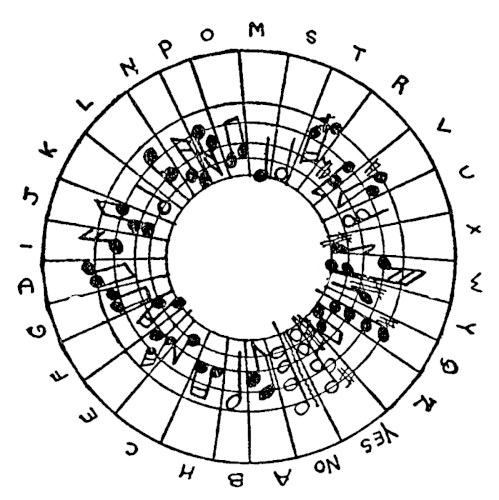
THE DIAGRAM WITH THE PEARLS.
As will be noticed, the partitions were drawn at different angles, and apparently the curious design had been made by a woman’s hand.
“The key!” she cried, the second I opened it. “I could not read the message Lisely sent you to Kensington Gardens because I foolishly left my key in Lausanne. Let us read it if you have not already done so.”
“I surely have not,” I alleged, astonished at the find. “Is this the key to that imitation music?”
“Oh, how foolish you are, Lionel! Of course it is.” And she snatched the piece of paper from my hands.
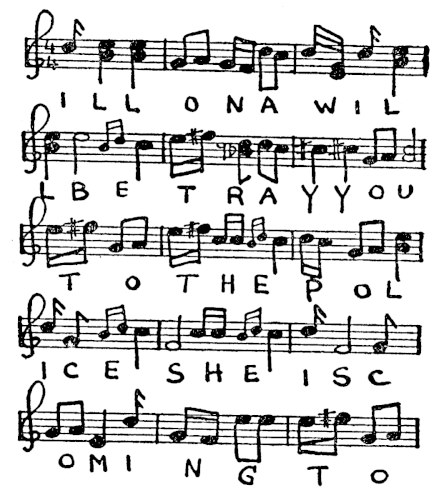
From her handbag she drew forth the piece of music which the girl Lisely had sent me, by the hands of the manicurist, to Kensington Gardens. She calculated for a few seconds. Then, with the pencil from her bag, she quickly deciphered the secret message, placing a letter beneath each musical note.
As she wrote, I read the message as follows:
“Illona will betray you to the police. She is coming to London with that object. Beware of her! Trust in me.—Lisely.”
“The infernal liar!” cried the woman in fierce resentment, her hands clenched in fury. “What does she mean? Why has she sent you this, except in order to deceive you, and draw you into still further entanglements?”
“What entanglements?” I demanded. “Surely there has been enough mystery already. Through no fault of mine, save my fear of scandal, I have been compelled to take part in the nefarious operations of an accursed gang.”
“To your own profit, Lionel dear,” she remarked, with a quiet smile. “And, besides, His Excellency declares that you’re the most expert dipper for stones he has ever known—you’ve got such a marvelously light touch.”
“I certainly didn’t know I have that,” I declared, staring at her.
The discovery of the musical code used by the wide-spread gang astounded me. It was certainly a marvel of ingenuity, and could be varied in numberless ways. The “time” shown on the message was one of the easiest. But any message might be marked with figures of addition, or subtraction, which would render the message utterly unintelligible, even though it might be suspected by others, into whose hands it might fall.
The use of secret inks, combinations of figures and letters, or other means of confidential correspondence, surely faded into insignificance as compared with this latest creation of a criminal’s brain.
That distinct warning given me by Lisely made her furious.
“She intends to betray me. That I know!” she declared. “She thinks that, on account of a slip which Tuggy Wilson made in Paris, I have been the means of drawing the attention of the police to her lover, Owen. But,” she added, in a voice full of hatred, “Dufour is not ignorant of what she has done, and he will see that she gets her just deserts.” A silence fell between us.
“Look here, Illona,” I said at last, “you have sworn to be my friend, as well as my wife. Will you assist me? I beg of you to do so.”
“Assist you? Have I not all along tried to warn you?” she asked. “What do you require of me?”
“I want you to help me out of the strange predicament in which I now find myself—a tool of that man known as His Excellency.”
“How can I release you?” she asked in dismay. “You have for two years or more accepted payment, and His Excellency is always inexorable. You are
one of us, my dear, and one of us you will remain,” said the woman, regarding me with those strange, deep-set eyes. “Only His Excellency himself can free you from your bond.”
“Whatever promise I made was made while I was unconscious of the truth,” I affirmed vehemently. “That drug given to me by Lisely Hatten destroyed my self-will, and rendered me inert, helpless, ignorant of my true existence.”
The woman smiled grimly.
“Yes, I know,” she replied. “You are not the only one. For over two years I myself remained in a state of mental lethargy, and only six months ago I recovered to a true sense of my position. Like yourself, I have acted involuntarily as the tool of others who held me irrevocably in their power. But Lisely was at least your friend on that night when you were discovered eavesdropping. She saved your eyesight at risk of punishment upon herself.”
“Then she is really my friend, notwithstanding what you say,” I remarked.
“She was then—not now.”
“Why?” I asked, remembering our romantic meeting in the deserted church in Rome, and how in my ignorance I had admired her, and carried that wonderful piece of aquamarine to Roddy Owen.
She shrugged her shoulders. “Who knows?” she asked. “Women sometimes contract strange hatreds.”
“How can I rid myself of these pearls?” I begged of her.
“Why do you wish to do that? You are not suspected. Besides, His Excellency may demand them at any moment.”
“Is it not possible to return them to Lady Rathgormly?” I suggested.
“You could do so. But it would be extremely risky to incur His Excellency’s displeasure. Don’t you think so? To him alone they represent eight or nine thousand pounds profit.”
“And he used me as his cat’s paw. My hands stole them—for him, eh?”
“His Excellency never does a job himself. Like all leaders of men, he pays others to do his dangerous work,” she laughed. “Both of us are his agents.”
“His slaves, you mean!” I cried angrily, flinging the pearls heedlessly back into the hollow book.
Then she rose quietly, and, taking the little calf-bound volume, replaced it among the many others upon the shelf, saying:
“Let it remain there for the present—until wanted.”
“And if any secret enemy of mine denounces me, the pearls will be found in my possession!” I cried. “No, I shall return them to their owner.”
“Not before seeing His Excellency,” she urged. “Call upon him in Lausanne, and explain your position. He may relent; who can tell? In any case, he will have sufficient confidence in you, if you give your word of honor to remain silent.”
“He would not accept my word on that night in Camberwell,” I said.
“Because you were a stranger, and you were denounced as a police-spy, which he naturally believed you to be.”
“But I can’t allow the pearls to remain here in my possession! My man might discover them. Perhaps he already has!”
“He’s not likely to read Voltaire,” she laughed. “But if you prefer it, why don’t you deposit the string in your bank?”
“An excellent idea!” I cried enthusiastically. “I’ll take them to-day. But, Illona, I want you to help me in another matter,” I said, leaning against the table, and lighting the fourth cigarette she had just taken from my box.
“Get me a drink before we go on, will you dear?” she asked caressingly.
Immediately I rang for Bruce, who at once mixed us a couple of cocktails.
“Really,” she remarked, sipping hers, “your man is truly an artist. One gets such awful concoctions everywhere except at restaurants.”
“Yes,” I laughed, when the man had left, “Bruce knows his business, I think.”
“Well, what is the other matter?” she asked, lazily watching her cigarette smoke ascending to the ceiling.
After a moment, I asked with suppressed eagerness:
“Have you ever heard of a girl called Joan Gell, the daughter of old Mr. Gell, the King’s Counsel?” I paused, looking straight into her rouged and powdered face.
“The girl whom you promised to marry before you married me?” she sneered. “Of course. She found out that you were a crook and refused to become your wife.”
“What!” I gasped, dumbfounded. “She found out that I was a thief?”
“Of course she did. You surely remember the quarrel between you?”
“I remember no quarrel,” I declared. “But how did she find me out?”
“Why, you related the incident to me with your own lips. You were sitting together side by side in her father’s drawing-room when she felt something in the pocket of your dinner-jacket, and, playfully putting her hand in, brought out a very fine diamond and emerald bracelet, which you had that evening pinched from the Countess of Edendon. You had been dining at Berkeley Square, and, making an excuse, had left the table, slipped upstairs, and taken it from her dressing-table.”
“Impossible!” I cried breathlessly.
“Ask her! You yourself told me how, on discovery of it, she became mystified, and how three days later she saw in the papers a sketch of the stolen bracelet, with an offer of three hundred pounds reward for its return.”
“Then she knows I’m a thief,” I cried despairingly, for surely the strain of it all was sending me mad.
“Of course she does,” answered the woman, with a triumphant jeer. I realized the reason, for apparently I had married her while still remaining engaged to Joan.
Was she lying to me? Did Joan—my Joan—actually know that I was a crook? Had she accidentally found stolen jewelry in my possession? Could it be possible?
The woman’s mocking laugh ringing in my ears bewildered me. In any case, Joan had been engaged to me until the moment she vanished, and certainly she had never mentioned the matter since I had awakened from my long period of involuntariness, that spell of fatality, with actions over which I had had no control. If I had really been a thief, as Illona alleged, then at least I had acted automatically and blindly, led by a master-hand—the hand of the man Felix Zuroff, who now called himself Nicholas Sarasti.
Since that night at Camberwell I had been the shuttlecock of circumstance, a creature of blind impulses, unwilling and unconscious. If Joan had actually discovered the shameful truth, it certainly had made no difference in her affection. What excuse had I given her? I wondered. How had I explained the presence of the stolen bracelet in my pocket?
“You mentioned Hilda Bennett a short time ago,” I remarked suddenly. “She’s in prison now, and her conviction was secured by Joan’s father.”
“Yes, and some of them swore at the time that the fat old lawyer, who is paid such big fees by the Treasury for prosecuting people, should suffer. Hilda’s stretch was far too long. They say the Recorder overdid it. You see, the police brought up the nasty fact that Hilda was with Monkey Dick when he was shot in Bloomsbury. Dicky had a pretty murky record, but I wonder who shot him? I’ve always suspected Roddy Owen,” said the woman, her sunken eyes set on mine.
Possibly I flinched; but apparently she did not notice it.
“It was revenge, I suppose,” I ventured to remark.
“But did not you admit that it was suspected that you shot him? Hilda told me so.”
I pretended to treat the matter as a joke, and hastened to assure her that, as an accusation had been leveled against me that I was in the employ of the police, I had endeavored to clear myself by declaring I was suspected, and thus gain time.
“I know,” she said. “Hilda did not recognize you as Dicky’s assailant. She acted foolishly. When he was shot she ought to have bunked, and they’d never have known that she was one of us.”
“Well, Illona,” I said, “I suppose you know that Joan has been missing for weeks, and that her parents are frantic?”
“I heard something about it the other day,” she replied in a rather cold tone.
“Do you think that her disappearance is due to the threat made against her father?”
“Possibly,” she responded, in a manner which made me suspect that she knew more about it than she pretended.
“Look here, Illona,” I cried, “do be honest with me! Do you know whether Joan is still alive?”
“I should think she most probably is,” was her brief reply, as her thin lips closed almost with a snap.
“You know something!” I exclaimed, advancing towards her determinedly. “Tell me at once what it is!”
She merely laughed sarcastically, and answered:
“Don’t upset yourself, my dear Lionel. Joan’s father did us a bad turn. I suppose it is only tit for tat, eh?”
“Then she is actually in the hands of the—the gang——”
“Of which you are one, remember!” she interrupted sharply.
“But won’t you tell me what you know, Illona?” I begged of her, grasping her hand and looking imploringly into her face.
She, however, remained obdurate. Her manner instantly changed, as she said in a hard, sarcastic tone:
“I am your wife, Lionel. Is it at all likely that I should assist you to find the girl with whom you are so desperately in love?”
I appealed to her in the name of humanity to give me a clue, however slight, to the girl’s whereabouts. But she flatly and blankly refused.
Her attitude was so irritating that I could have struck her. I felt that I could place my hands around her neck and wring from her the truth, so goaded had I become in those weeks of uncertainty and mystery.
Her manner and her words told me that she was well aware of Joan’s fate, but because of her jealousy she refused to utter a word, save to say:
“I never betray my friends!”
For a further half hour we argued, and high words arose between us. I fear I was very impolite towards her. But presently, when I saw that she did not intend to reveal anything more, my agitation grew less, and I resolved on a policy of silence and watchfulness.
“Well,” she exclaimed at last, dabbing her face with her powder-puff, and gathering up her gloves and bag ready for departure, “I see you do not intend to invite me out to lunch, eh?”
“Because you are the reverse of friendly, even though you may be my wife!” was my cutting retort.
“And when are we to be together again?” she asked, with a faint smile on her made-up countenance.
“Not until you have told me the truth concerning your knowledge of Joan,” was my firm reply.
“Then I assure you, my dear husband, that will never be!” she answered, as she walked out, leaving me standing upon the hearthrug.
CHAPTER TWENTY-FOUR. SOME PLAIN FACTS
I ate a hasty sandwich, drank a glass of sherry at the club, and then took a taxi to a small, rather shabby office in a narrow street off High Street, Kensington, the registry of marriages for the district.
The affable clerk whom I saw was disappointing, however.
“If you call at the registry at Somerset House, you can obtain a copy of the entry made here, sir,” he replied.
As I went in, I had been followed by two couples about to be wedded, attended by two witnesses. Both were of the working class, happy young men with their smiling brides. I glanced around, but to me the cheerless surroundings were entirely unfamiliar. I did not remember ever having been there before.
An hour later I was at Somerset House, amid a bustling throng of solicitors’ clerks and curiosity-mongers, to whom every now and then a blue slip of paper was handed out, a certified copy of a marriage, birth, or death. Every such event occurring in Great Britain, on the high seas, or abroad, in which a British-born subject is concerned, is registered in those ponderous volumes preserved there.
In accordance with the directions, I filled up a form, paid the nominal fee, and awaited the result.
Imagine the tension of those moments. It was to be decided once and for all if Illona was actually my wife!
Full of keen anxiety I could hardly contain myself, as I paced up and down before the long window looking out on the great paved courtyard. It was growing late, and the office was soon closing, hence a dozen or so clerks, obviously from lawyers’ offices, being known to the officials, asked favors familiarly.
At last my name was called, and the dark blue slip handed to me—the copy of the registry of my marriage.
I scanned it breathlessly as I turned away from the counter. It was certified to be a true copy of an entry made in the marriage register of the Borough of Kensington on April the eighteenth, the year before, in which I had apparently described myself as:
“Lionel George Chetwynd Hipwell, bachelor, age 29, of Sackville Street, Piccadilly, son of Charles Augustus Chetwynd Hipwell, gentleman.”
on the occasion of my marriage to
“Elizabeth Mary Illona Patrick, spinster, age 39, of Stafford Road, Notting Hill, daughter of William Henry Patrick, grocer, deceased.”
So my wife was the daughter of a tradesman, who followed the honorable calling of grocer, and her age was now forty, just ten years older than my own. Her abode, as given, was not altogether a salubrious quarter, for Stafford Road, I knew, was on the border of a wretched slum. Perhaps it was her hiding-place from the police!
I read and re-read that confounding document many times. There was no doubt. There it was in black and white to hold in any court of law.
Illona was my legal wife!
My hands were tied. In every quarter I looked, I could see no way out of the impasse. All my efforts on Joan’s behalf were unavailing. And further, how could I confess myself a thief to Mr. Gell, or even to my father?
Back at Sackville Street I took the piece of manuscript music from the drawer into which I had thrown it. Lisely had sent me warning, it was true. But which was my real friend, Lisely or my unpresentable wife?
That point I had to decide. I sat in the chair where Illona had sat, and pondered until darkness fell. Within my sight was the unsuspicious-looking old leather-bound volume containing Lady Rathgormly’s pearls. Again I took them out and re-examined them. They were certainly magnificent. I looked at the key to that ingenious musical cipher, and saw how cleverly it was arranged, so that each day or each week it could be altered according to arrangement. And who would suspect a roll of manuscript music passing through the post, from hand to hand, to be a communication between members of a criminal association?
Teddy Day looked in just as I was dressing and eagerly inquired who the “old bird” was that he found me entertaining. “A bit of a has-been, wasn’t she?” he laughed in his good-humored way, as he sat on the side of my bed and watched me manipulating my tie.
“Yes,” I said. “She’s a woman I met in Vienna some months ago. She’s looking for a missing friend and called to ask my advice.”
And with that explanation he was satisfied. Then he forced me to dine at the Piccadilly with him, and we went to a revue afterwards, though so little interested in the latter was I that I don’t remember the name of the piece or the theatre where it was played.
My own thoughts were of Joan. The hateful woman who called herself my wife knew the truth; but for spite she had refused to reveal a single fact. In that, she had not shown herself as my friend, hence could Lisely’s secret warning be actually true? Was it for that reason that she had succeeded in preventing my meeting Illona?
This theory struck me as the correct one. Yet, when I reflected that I had all unconsciously received training, and had become an expert purloiner of women’s jewels, I was staggered. Suppose possession of those pearls was traced to me, what explanation could I offer?
Such a scandal would be appalling, more especially in regard to my high official capacity as a servant of His Majesty’s Foreign Ministry.
The more I pondered, the more dangerous the situation became. I had foes without doubt, and how did I know from hour to hour that I might not be anonymously denounced? I had not even the opportunity to pay my enemies the price of their silence.
That night when I returned, Bruce having retired, I again took out the pearls, and found a small cardboard box without any mark upon it. I placed them inside, and, having made a neat packet, sealed it with plain black wax, and was about to address them to their owner, when an idea suddenly struck me. Instead of doing so, and risking the displeasure of the man of mystery they called His Excellency, I would take them to Lausanne with me, and make them an excuse for calling on him.
My diplomatic valise being immune from Customs examination at Calais, or at the Swiss frontier at Vallorbe, nobody would know that I had taken them out of the country, and if I deposited them with Nicholas Sarasti, as he called himself, my responsibility would then be at an end.
Next day I rang up Mr. Gell, as usual. He had heard nothing of Joan, though he had another appointment at Scotland Yard at noon. I dined with my father at the House that night, and afterwards spent an hour in the Lobby with my friend Cecil Duncombe, Parliamentary Secretary to the Foreign Office, retiring early; for I had to be up and on my journey on the morrow.
At eleven next morning I left Victoria Station by the Simplon-Orient service, which runs daily by way of Calais, Paris, Lausanne, and up the Rhône Valley to Brigue, and thence on to Italy—Milan, Venice, Zagreb, Belgrade, Sofia, to Stamboul—that hot and dusty three day journey which I knew so well. There were few passengers beyond Paris. After eating my dinner in the wagon-restaurant, I retired to bed, to be awakened by the conductor at the Swiss frontier, at half-past five in the morning.
Soon after six o’clock I alighted into the great new station of Lausanne—one of the finest and cleanest in all Europe, to find that the little steamer across the beautiful Lake of Geneva would not leave for another hour. With its fringe of high mountains, whereon still remained the snows of the past winter, the lake lay blue and sparkling in the sunlight. I went into the big buffet, and took my morning coffee. Afterwards I took a taxi and drove down to the little landing-stage at Ouchy, surrounded as it is by shady trees and pretty gardens, so well known to the summer tourist.
Soon the small white steamer, which traverses the lake, to and fro, to the French shore half a dozen times a day, set out. I found the morning air gloriously fresh after the oppressive heat of the narrow, rolling sleeping-car.
As we left the Swiss shore, to cross the eight mile stretch of water, coming down from the Rhône, I could just discern, far away in the grey distance on the left, the grim walls and turret of the historic Castle of Chillon, while the white clusters of houses on the lake-side showed Vevey, and the popular English resort, Montreux. The morning was beautiful, the sky was cloudless, and on every side, the Alps stood forth in all their rugged grandeur—a panorama of lake and mountain, perhaps one of the finest in all Europe.
Shortly afterwards we reached the little landing-stage of Evian-les-Bains, world-famed for its mineral springs, and for its fine Casino which, under the same management as the Municipal Casino at Nice, is devoted to baccarat. Unlike the garish, uproarious town of Nice, Evian is a rural, select resort, where people go for repose and for the cure. Upon the green hill-side, half hidden in the trees, the great white façades of the hôtels-de-luxe could be seen, each over-looking the quiet little town, and the wide expanse of placid water beyond.
Up to one of them, the Hôtel Royal, I took a taxi, and, after inquiring of the concierge, I soon discovered Lord Oxenwood, a grey-haired, aristocratic figure in a drab lounge suit, taking his coffee al fresco beneath a tree, upon the wide flower-embowered terrace. With him sat my friend Bob Ludlow, his private secretary.
“Hulloa, Hipwell!” exclaimed the Foreign Secretary, with a laugh. He was one of Britain’s leading statesmen, who had arisen since the war, to uphold the nation’s prestige abroad. And he had done so, notwithstanding all the insidious political intrigues of certain of the Powers.
Outwardly he was a most charming and unassuming man. But in politics he was stern, unbending, and relentless, as the League of Nations well knew.
“Up early this morning, eh?” he laughed meaningly. And after I had handed him the dispatch box, secured by a great black seal which bore the bold arms of Great Britain, he invited me to join him at coffee.
It was a delightful spot. In the trees the birds were loud in their songs, while beyond the stone balustrade there stretched the broad, placid lake, opalescent at that early hour, its waters unflecked, save for the sail of a stone-barge, and a little streak of distant smoke showing the steamer on its way up from Geneva to Montreux, and on to Bouveret, at the head of the sixty-mile-long stretch of waters.
As I chatted with Bob Ludlow I inhaled with delight the fresh air of the French lake-side after the stuffiness of Piccadilly. Each time I traveled, I enjoyed the change of air, whether the invigorating atmosphere of Paris, the dolce far niente of Rome, the fun-impelling air of Vienna, or the keen mountain air of Berne.
While I chatted with Ludlow, the great statesman opened the dispatch box with his key, adjusted his gold pince-nez, and slowly digested the contents of the papers, one after another.
The waiter had brought me my coffee, and as I smoked, Lord Oxenwood, with the gold pencil attached to his watch chain, scribbled from time to time remarks in the margin of the documents he was perusing.
“We must write a dispatch to Paris presently, Ludlow,” he remarked suddenly. “And you must take it by the mail to-night, Hipwell,” he said, turning to me.
“I’ll come back from Lausanne at six, sir,” I said, “and I can catch the Orient back to Paris.”
“Yes, do. You’re a living time-table of Continental travel,” laughed the grey-haired Foreign Secretary. “What a wonderful tourist conductor you’d make!”
“Yes, Lionel,” said my friend Ludlow. “You’d make quite a success of a round-the-world trip, I’m sure.”
“Well, I only know my routes and times, as every one of my corps knows them. It is part of our training to travel to a given point in the quickest possible time, isn’t it?” And, turning to Lord Oxenwood, I added, “If I had had the dispatch in Lausanne a couple of hours ago, I could have been in Paris to-night.”
“It is not quite so urgent,” was the great Englishman’s reply. “If you leave to-night, you will be at the Paris Embassy in the morning. That will be quite early enough for Lord Thornbury to receive my instructions.”
And he sipped his coffee, gazing thoughtfully across the lake to the peaks of the distant Jura in the haze. The man whose shoulders bore the heavy burden of Britain’s complications with the Powers in those days of sedition and revolution, sighed wearily. And then, after a few moments, he scribbled some further memoranda on the back of a document. He was there for rest and recreation, but alas! his brain was ever at work. Intricate questions of policy and evasion reached him daily from the representatives of His Majesty at the various capitals; hence he was practically as busy as when he was at the Foreign Office, except for those daily conferences, and the approval of the answers given to questions put in the House.
On glancing at my watch I saw that in a quarter of an hour the boat would leave on the return journey to Lausanne and, making my excuse, I caught it.
Just after eleven o’clock I walked up the hill from the railway station along the Avenue de la Gare, in search of the house where, in secret, lived the notorious criminal, Felix Zuroff, known in his hiding-place as Nicholas Sarasti.
CHAPTER TWENTY-FIVE. I MEET HIS EXCELLENCY
A steep, tree-lined boulevard of hotels and private residences, upon the hill-side overlooking Ouchy and the lake, the Avenue de la Gare is one of the principal streets of the clean, cosmopolitan town of Lausanne.
The yellow trams pass by incessantly, and there is a never-ending stream of motor traffic. With my precious little packet of pearls in my pocket, I went up the thoroughfare of plane-trees in the morning sunshine, past the Eden, the Jura, and the Mirabeau Hotels, in search of the house of the notorious but mysterious criminal beneath whose hateful thraldom I had fallen.
The numbers of the houses became difficult, and the one I sought was bis. I presently found myself in a small cul-de-sac on the right, with high blocks of modern flats standing in spacious gardens full of lilacs, magnolias, roses, and geraniums. Flowers grow profusely in that mild climate, and in the remote, refined corner, I noticed the brass-plates of many famous doctors.
Entering a pretty garden, I came to the door of a handsome building, from a window of which floated the strains of a piano, played by someone with exquisite touch. Examining the row of letter-boxes in the hall, I found one marked: “Sarasti, 2me Étage.”
Full of excitement and curiosity I ascended to the second floor, and at the door, which bore a neat bronze tablet, I rang the bell. A smart, shrewd-eyed young foreigner answered.
I noticed that before I spoke, he surveyed me swiftly.
“I wish to see Monsieur Sarasti,” I said in French.
“Monsieur Sarasti is not at home,” was the young man’s prompt, but polite, reply.
“I wish to see him on very pressing business,” I urged. “I have traveled from London to see him,” I went on, and handed him my card.
He glanced at it, regarded me inquiringly for a second, and then, excusing himself for closing the door in my face, said he would go and consult his master’s secretary.
In a few moments he returned, saying briefly, “Monsieur will see you,” and conducted me down a long passage into a spacious, rather barely-furnished room, which had the appearance of a doctor’s waiting-room. There were a number of chairs and a quantity of magazines upon the centre table.
Then I was left alone. The big windows gave a picturesque view over the gardens, the lake, and the Alps beyond. As I stood gazing out, I heard someone behind me; and turning, I faced a tall, thin, lantern-jawed man, immaculately dressed, and smiling benignly.
“Will you please walk this way?” he said, and I followed his footsteps into a large, luxuriously-furnished salon where, in a deep arm-chair of crimson silk damask, sat the dark-faced little man whom I so well remembered on that night in Camberwell.
He nodded coldly and invited me to a chair opposite him. Upon the tables were great bowls of yellow roses, the perfume of which was overpowering. I loved roses. But, in that room their scent was, to me at the moment, quite nauseous.
“Well, and to what do I owe the honor of this visit, Monsieur Hipwell?” he asked coldly, speaking with a strong foreign accent. His appearance might have been that of an under-servant at an hotel. He was uncouth and unwashed. His finger-nails were uncared for and dirty, and his black beard ragged and untrimmed. And yet, this man, with his active and ingenious brain, controlled one of the most daring and successful gangs of motor-bandits in Europe.
And I was one of the few who knew his true identity, a secret that the police of Europe would give much to learn. I recollect that the drama of the situation caused me to hesitate.
“I have called to see you on several urgent matters,” I said. “I wish to be quite frank and open with you, without any unfriendliness, but rather as one of your friends and assistants.”
“Bien! That is well,” he grunted approvingly, stirring quickly in his great crimson chair, in which he sat as though he were a judge. “We are friends—bien! trés bien! And now further. Continue.”
“First, I wish to hand you these,” I said bluntly, drawing out the string of fine pearls.
He took them in his hands, ran them slowly through his fingers, and again grunted approbation.
“Afraid to keep them any longer, eh?” he laughed, with a sarcastic curl of his lips. “Well, I’m really not surprised. In your position it would be a bit awkward for your family, and for your Foreign Office at Downing Street, wouldn’t it—hein?”
“That is just my point, monsieur,” I said quickly. “As you well know, I quite inadvertently stumbled into your private affairs on that foggy night, and you very naturally believed that girl Hatten’s allegation that I was a police-spy. By now, however, you surely have established my innocence—that just by a freak of circumstance I blundered in on you. Have you yet forgiven me?” I asked very seriously.
“Most certainly I have. I am always just, Monsieur Hipwell. None of those who were under me have ever accused me of either parsimony or injustice. We are united to make war upon society, and as comrades we all share each other’s perils and profits,” he replied quite openly, in very fair English which had just a trace of Russian accent in it.
His countenance had altered but little since I had seen him in that small stuffy room in Camberwell, with that great heap of wonderful jewels piled upon the table before him.
As he spoke, he still held Lady Rathgormly’s graduated pearls caressingly in his fingers, while now and then his expert eye fell on the larger ones. To me it was amazing that Felix Zuroff, the notorious criminal, whom his followers called “His Excellency,” was living in genteel and luxurious surroundings, unsuspected in a foreign city. Many stories have been afloat of master-criminals living at their ease, while others in their pay took the risks consequent upon malpractices. But in my case, I was the actual cat’s-paw of the most daring and cunning motor-bandit in Europe.
“I have come here, Monsieur Sarasti, to make an appeal to you, to release me in return for my oath of silence,” I blurted forth at last.
“Release you, monsieur!” he cried, raising himself, and staring straight at me. “And pray, why should I? You are a very excellent asset to us. And, besides, you are an expert where women’s necklaces are concerned. You move in good society in England; hence you are a very valuable indicator.”
“Indicator!” I echoed, not knowing what he meant.
“You can always indicate where fine jewels are to be found, and at the same time you can pinch a little yourself off your lady friends you take out to dances—as you have done so often. Why, I ask, in such circumstances should I release you?”
For some moments I remained silent. His reply nonplussed me. Then I found tongue boldly.
“Well—as a matter of fact, Monsieur Sarasti, the drug given to me by that girl Hatten has lost its potency. I am my true self again!”
“Ah! That is most unfortunate for you,” he remarked, with a light laugh. “The influence of the injection usually lasts about four years. Possibly she gave you an underdose. If so, it was unwise of her.” Then after a second’s pause, he added: “At least the girl proved herself your good friend. She did not blind you, as we all believed she had done.”
“No. I have to thank her for leaving my sight unimpaired,” I said with a sigh of relief. “But I confess to you that the mystery and uncertainty of my present position is now driving me mad.”
“I can’t see how there can be any mystery, except what you make of it yourself.”
“I will tell the truth from the very beginning,” I declared. “On that night Dicky Rodwell attacked me in Bloomsbury, and in the struggle he shot himself. Yet that woman Hilda Bennett vowed that I was not the man. She lied to you, for I swear that—I was! For that very reason I was hiding from the police in Avenue Road, Camberwell, as I told you that night, in the same house where Lisely Hatten lived. She believed me to be a police-spy, never dreaming that I was fleeing from the police.”
The desperate motor-bandit looked into my eyes with his.
“Is this really true, Monsieur Hipwell?” asked the man, rising from his chair, evidently suddenly intrigued.
“I declare on my oath that every word I have said is the absolute truth!” I cried.
“Then you shot Rodwell?”
“No. He tried to kill me, and in doing so shot himself,” I asserted. “I am no murderer! He was ill-treating the woman, and because I interfered, as any man would, he attacked me. That’s all!”
The low-browed man passed his big sallow hand down his dark beard, and held it for a few seconds in thought.
“Rodwell was a damned cur!” he blurted forth at last. “I have since discovered that on the night in question he was on his way to Vine Street Police Station to give me away. We had had, that afternoon, a little difference about a set of fine stones we got from outside the Ritz in Paris. He struck me in the face and I swore that I would never forgive him. Hilda knew his intentions, and, as they walked together, she was trying to dissuade him from defying me and giving me away to the police. Then you suddenly appeared upon the scene, and through you, he, fortunately for me, closed his own lips!”
The bandit hesitated for a second, and then in sudden enthusiasm he put out his hand, exclaiming warmly:
“Monsieur Hipwell, in that case it is to you I owe my narrowest escape! Now let us talk further. Please explain exactly what occurred on that night.”
I did so, relating the whole tragic occurrence, just as I have already related it in the opening of this narrative of fact.
With his hairy chin upon his hand, he listened without uttering a word. I recalled how that thin, claw-like hand would instantly draw an automatic and shoot any adversary without compunction. Indeed, I knew only too well what a desperate malefactor he was, and how, in the many brushes he had had with the French police five years before, he had always managed to escape after showing desperate fight. In one affair near Tours, he had killed a gendarme and wounded two others, afterwards getting safely away. So elusive was he, such an adept at disguises, and so loyal were his accomplices, that he had always escaped arrest.
I spoke of the atmosphere of mystery in which I was compelled to live, as I glanced round his pleasant, sunlit room. “I am sorely puzzled to discriminate between my enemies and my friends. Can you help me?” I asked him.
“Surely it is not difficult, Monsieur Hipwell. I fear that your worst enemy is your wife,” he said, calmly looking into my face.
“Illona! Is she actually my enemy?” I gasped, astounded at his words.
“I should safeguard myself against her if I were you,” was his quiet reply. “I happen to know that she has evil intentions towards you. As you have served me well, I tell you in strict confidence the plain truth.”
“But with what object?” I demanded. “As far as I know I have done nothing against her. Indeed, it is only two days ago I realized that she was actually my wife.”
“If you are not careful she will give you away to the police,” said the master-criminal. “It is therefore very fortunate for you that you decided to bring the pearls here, or they might have been found in your possession, or at your bank.”
“But why is it that this woman hates me?”
“She is jealous of a girl named Joan Gell, whom they say you promised to marry before you married her.”