Introductory material (continued 3)
Reading edition
“What, as far as you can tell, was the exact time she left the house?”
“About eight o’clock, sir.”
“Why did she not come to me and tell me she was going out?” asked her mother. “Always when she goes out late she tells me. Girls to-day are, alas! not like they were when I was a girl, John. They run such risks, and yet they are so self-reliant that one can’t help liking the modern girl, after all.”
“But where is our girl?” asked Mr. Gell, bewildered.
The ’phone rang from his chambers in the Temple. He was due to appear at the London Sessions, to prosecute in a case of stolen motor-cars, but in a few brief sentences he told his clerk that he was indisposed, he regretted, and asked his junior associate to carry on the case in his absence.
“Mr. Fortescue knows the whole story,” he went on. “The case is quite simple, Matthews. Both prisoners have been previously convicted. Tell Mr. Fortescue to apologize for my enforced absence, and let me know the result over the ’phone. I expect they will get three years each, unless Bowden puts up an alibi. He may—who knows?”
And he rang off.
Till noon we remained at Queen’s Gate. I rang up Bruce, but he had heard nothing. Half a dozen of Joan’s friends were rung up by her mother, but nobody had seen or heard of her. From the moment the taxi had left the curb outside she had disappeared into space.
“We must advertise for the taxi-driver,” I suggested. “He may tell us where he left her.”
“Yes. But the notice cannot appear till to-morrow morning,” replied her father excitedly. Mr. Gell, usually such a calm, composed man, whom no circumstance, however untoward, could ruffle, was now beside himself at Joan’s disappearance.
“Who could possibly have imitated your handwriting?” he asked blankly.
We both went to her empty bedroom and searched her waste-paper basket for evidence of the plot. But, she had apparently taken the note with her. There had been no fire in the room, therefore she could not have burned it, as she might have done in winter.
At noon the car took us down to Scotland Yard, where, without delay, we were ushered into the bare, official room of the Assistant Commissioner of Metropolitan Police, Mr. Cunningham Lee.
The tall, thin-faced official rose to greet the famous K.C., and then, reseating himself, listened to the story which the bereaved father related.
“This is Mr. Lionel Hipwell of the Foreign Office,” he said, indicating me. “The letter my daughter received purported to come from him, but he never sent any message, either written or verbal.”
“Then your daughter was decoyed away last night, Mr. Gell, eh?”
“No doubt. Or—or perhaps an accident has occurred to her, and she may be in one of the hospitals.”
“The receipt of the note rather points to her being decoyed, does it not?” said the Assistant Commissioner very seriously, as he touched an electric button.
“Send Mr. Nicholas to me,” he said to the clerk who answered his summons. “And—and send Mr. Hayes also.”
In a few minutes the two officers of the Criminal Investigation Department entered. To them the eminent lawyer, who was so well known, gave a detailed description of Joan, together with the clothing she had worn, and described the curious circumstances under which she had left home in a taxi for Wardour Street, about eight o’clock.
Both detectives made some scribbled notes, when Hayes, a round-faced, middle-aged man, who had to his credit the arrest of the bungalow-murderer Collins, hanged only a couple of months before, asked:
“Excuse me, Mr. Gell, but do you think the motive might be vengeance, because you have successfully prosecuted one or other of the recent gangs? You remember the Pittard crowd—the ‘cat’ burglars whom you prosecuted for the Treasury. Don’t you recollect that after they were sentenced by the Recorder they vowed vengeance against you?”
John Gell laughed, his usual hearty laugh.
“My dear Mr. Hayes, every advocate who prosecutes for the Treasury has hundreds of threats and anonymous letters of abuse and warning! I’m not alone. I received two yesterday morning.”
“That is so, Mr. Gell,” admitted the Assistant Commissioner, “but Mr. Hayes is perfectly within his right to suggest a motive.”
“Of course! of course!” said the stout lawyer. “But I leave the matter entirely in your hands to do your best to restore my daughter to me.”
“Every effort shall be made, I assure you,” said Mr. Cunningham Lee. “We will send to all the hospitals and ambulance stations, and we will get hold of the taxi-man without delay.” Then after a pause the high official of Scotland Yard turned to me, and in a strange, half-suspicious manner, asked:
“You are quite certain that you sent no note to Miss Gell last night?”
“I certainly did not,” I replied. “But I have reason to believe that Miss Gell has fallen the victim to some deeply laid and desperate plot. Some clever forger has been at work who sent her a message of greatest urgency, for I had been with her only an hour and a half before she received the mysterious message which caused her to change hurriedly and rush out to Wardour Street.”
“Yes,” remarked the Assistant Commissioner, “I agree entirely. The young lady, I fear, has fallen victim to some plot, the motive of which is at present entirely obscure.”
CHAPTER THIRTEEN. AN AFFAIR IN FULHAM
What could we do save to leave the matter in the hands of the police?
In a couple of hours every police-constable in greater London would hear the description read over before going on duty, while search would be made of every hospital and every ambulance post.
We afterwards drove along to the offices of The Times and Morning Post in which we placed advertisements, begging the taxi-driver, who took a young lady from Queen’s Gate at eight o’clock on the evening in question to communicate at once with the nearest police-station.
There was no more to be done save to wait in patience.
How that day passed, or what I did, I cannot tell. My wife Illona might be in London as she said she intended. I re-read the letter I had found in Rome, in which she told me that if she dared she would call on me. If she dared? What could that mean?
She asked me to write to her at her club in London. But what club? In neither of her letters had she given me any address save that vague one “Lausanne.”
I knew the tree-lined city on the hill above the blue Lake of Geneva. But it was a large place in which to search for anyone. Yet if she were a traveler, as it seemed, she would no doubt be at one of the fifty or more hotels. And if she had assumed my name I might be able to discover her in the visitors’ list.
My first impulse was to go to Lausanne, but I remembered that she had stated her intention of coming to me in London. Hence I decided to wait.
Four days went by, but we could gather nothing concerning Joan. She had completely disappeared, and, like myself, her parents were beside themselves with grief.
In my excited state of mind I called on my friend Teddy Day and told him of Joan’s disappearance, though I withheld from him the secret of Illona’s existence. I told him of my romantic mission from the Little Countess to Roddy Owen, though I gave him no inkling of who the charming lady really was.
“She’s an adventuress, no doubt, old boy,” he declared, as he stretched his long legs out upon the hearthrug, and smoked his cigarette. “If she is received at the Embassy in Rome and elsewhere, she ought to be exposed. You ought not to allow her and her chaperon to go further.”
I discussed the situation from every angle. It was difficult to write to Sir Richard Kingscliffe. I could only wait until my duties took me again into Italy. Meanwhile, I knew that something very serious must have happened to Joan, and that I myself remained in some mysterious but deadly peril.
I was, I think, no coward; yet I had enemies on every hand. Since that never-to-be-forgotten night in Bloomsbury, when, because I tried to rescue a defenseless woman from the hands of a brute, I brought upon myself dire disaster, I seemed to have been hounded out of life.
When I reflected, I saw visions of the face of Lisely Hatten distorted horribly by hate, when she had made that brutal proposal to put out my eyes. And yet I was perfectly innocent, and, moreover, I was her friend.
Was it because of my friendship that she had spared me? Did she continue, by some subtle means, to evade doing what she and that man friend of hers had suggested? Had she relented, and allowed me to go with my eyesight unimpaired? Still, the effect on me of that unknown drug had remained, blotting out my consciousness for two whole years. Nevertheless, I had led another life, energetic, manly, tireless, as I sped hither to and fro between Downing Street and the capitals of Europe. I had once or twice contemplated consulting a doctor about it. But, like most young men, I had a silly terror of the medical profession, refusing medical aid, unless, perhaps, I had a touch of fever that sent me to bed.
Teddy was sympathetic and full of suggestions. Meanwhile, Mr. Gell, with all his influence in police circles, was daily active in searching for Joan.
Happily we had managed to keep the affair out of the papers save for the advertisement addressed to the taxi driver. But that told the public nothing.
On the fourth day after her disappearance a taxi driver named Cowley, living at Streatham Common, called at the Brixton Police Station and made a statement.
He had been passing along Queen’s Gate when a young lady had come out of a house and ordered him to drive to Wardour Street. At the door of the Cosmo Club a fair-haired young man, in evening dress, was waiting to meet her. They had had a short and very excited discussion, whereupon the young man had entered the taxi and told the man to drive to the Florida Club. There he set them down. And he knew nothing more.
This story was told to me by Mr. Gell, who ’phoned me to come over to Queen’s Gate at once. Together we went to Bruton Street, where we saw the commissionaire on duty, who apparently had no recollection of the incident. In the book was Joan’s signature as a member.
In the broad light of day the popular night haunt of society looked horribly tawdry and bizarre. Princes and nobles danced upon the glass floor, drank their wines, and ate rich foods at night beneath the glamor of shaded lights, while listening to the soft, seductive music of the highest paid orchestra in London. Yet the club looked strange and unreal as we interviewed the manager, while several foreign baize-aproned waiters were arranging choice flowers upon the tables for the coming night.
We failed to discover anything further than the signature of Joan as she had entered. The Florida was most exclusive. There was no subterfuge of membership, as there is in so many London dance-clubs—no joining by immediate payment of a subscription. Each member was an approved person, passed by the committee at its monthly meeting, just as at any other West End club. There were, indeed, men and women on the waiting list; hence it was a club almost as exclusive as the Carlton, White’s, the Travelers’, or the Devonshire.
We drew blank—a disappointing blank. We could discover nothing further than her rather faintly written signature—“Joan Gell”—in the big membership book, held by the old, white-moustached military commissionaire. Underneath her signature was that of a world-famous explorer, and above it was the scribble of a rather reckless young peer.
I wondered whether the explorer had known or had ever seen her. He was a member of the Junior United Service Club, so I called on him.
Alert, erect, and full of genuine bonhomie, the elderly traveler told me that he knew Joan by sight, that he had but a faint recollection of seeing her that evening.
“I have an idea I saw her dancing with a young, fair-haired man,” he told me as we sat together in the club. “He struck me as a young, empty-headed fool, but he was a very good dancer. They charlestoned well. That’s all I know. I left the Florida about half past one and went to the Travelers’ with Janning Chase, the stockbroker, for a final drink.”
That was all we could gather.
A dozen times I consulted with Teddy, but our conversation carried us no further.
Who, we wondered, was her fair-haired dancing-partner? Was it my enemy who pretended blindness?
Scotland Yard could obtain no clue. The most diligent inquiries were made of the staff of the Florida as regards the fair young man who was such an excellent dancer. But his identity could not be fixed. All the signatures of both members and their visitors on that night were carefully verified, but there was no fair-haired young man among those registered.
Yet Anthony Marsh, the explorer, whom I saw on two different occasions afterwards, remained certain that he had seen her with the young fellow whom he described.
The description struck me as very like that of Roddy Owen! If the latter was acquainted with my enemy, the woman Lisely Hatten, then might he not be one of the conspirators against me? Since I had realized my foolish failure to recognize the Little Countess, I held the romantic young bachelor in great distrust.
My first impulse was to call on him and demand an explanation of the events of that night when Joan was decoyed by the message purporting to come from me. But Teddy suggested remaining watchful, and I agreed with him.
“He doesn’t know me. Therefore I’ll follow him and see where he goes and what company he keeps,” he said. “I’ll watch to-night.”
And he did.
I went down to Queen’s Gate to hear if any news had been received, but there was nothing. A week had gone by, and my love was either held in some hateful bondage or was dead. The number of women and girls who disappear weekly in London is incredible; drugs and the white-slave traffic, alas! being responsible for many deserted homes.
We all entertained the worst fears, and yet we were powerless.
I got back to Sackville Street just after midnight, and, after smoking an hour over the evening paper, as was my habit, I was about to retire when Teddy entered.
“There’s some mystery about that fellow Owen,” he said, throwing himself into a chair wearily. “I don’t exactly know what has happened, but we ought to know something in the morning.”
“What do you mean?” I gasped.
“Well, I waited for an hour and a half outside Harrington Court until I saw him come out. He was in evening clothes, with a crush hat, and walked leisurely along down Grosvenor Place, where he made a call. But evidently the person he wanted was out.
“He then came back along Piccadilly to Scott’s, where he met a man accidentally, and they both had a meal down below. I sat in the next compartment to them. But their conversation was so low that I could not distinguish what they said. His friend was a big, round-faced, overdressed fellow, and they were evidently discussing something of an extremely confidential nature. After that they had coffee, then both strolled along Shaftesbury Avenue to Ham Yard, where they entered a little obscure club, which I know to be the resort of West End thieves and undesirables. It was pointed out to me once as one of the plague spots of London. Both of them went upstairs and remained there for over an hour. Then Owen came out accompanied by an ill-dressed, thin young fellow in dark clothes and a cap, who might have been a pickpocket—evidently a fellow of evil repute. Both got into a taxi in Shaftesbury Avenue, and I followed them in another taxi down to Rutland Gate. The young man left the taxi, and while it went on farther down the road, he sauntered along alone, his attention being fixed on an upper window of one of the largest houses.
“I stood back under a portico, so that he did not see me,” Teddy went on. “At last, after quite ten minutes, loitering near the house, he moved on, and rejoined Owen at the end of the road. Afterwards, they drove down to Fulham where, in a dark street, they descended. I dared not go near them. But my taxi driver, who was a discreet young fellow, and had entered into the spirit of the adventure, drew up so that they did not know they were being followed. I had just got to the corner of the street when I saw the flash of a pistol fired from a doorway at a figure that was ascending the steps. The shot rang out, and the figure reeled. But, not wishing to be mixed up with the affair, I stepped back into the taxi and drove with all speed to Sloane Square, where I left the vehicle. ‘There’s been murder done, I think, sir,’ said the taxi driver as I alighted, ‘and we’re far better out of it!’ ”
“Well,” I remarked, when he had finished his strange story, “there will surely be something in the papers about it to-morrow.”
“I think it is proved beyond all doubt that your friend Owen is an associate of undesirables. That club in Ham Yard has been several times raided by the police when in search of criminals,” Teddy said. “From what happened in Fulham they seem to be a pretty desperate lot!”
It was two o’clock before my watchful friend left, and I turned in.
Next morning I scanned the paper eagerly, but found nothing regarding the affair at Fulham.
The Evening News that night, however, contained the following:
“Shortly before midnight a constable, on passing the Fulham Almshouses, heard the sound of a shot coming from Finlay Street, which runs down to the Fulham Football Ground. He hastened to the spot, but at first found nothing, though he heard the sound of a taxi being driven rapidly away, apparently in Bishop’s Park Avenue, which borders on the grounds of Fulham Palace.
“After a rapid search, in which he was joined by several passers-by, and by one or two alarmed residents in Finlay Street, the body of a young man was discovered at the foot of the steps leading up to the front door of the house number 246. A rapid examination by the light of the constable’s torch showed that he had received a bullet in the heart and was quite dead.
“The identity of the person who had fired the shot cannot, at present, be ascertained. The constable naturally at once made demand at the house as to its occupants; but the place proved to be empty and to let. As far as can be gathered, the man was shot by some unknown hand, and the affair is one of London’s mysteries of the night.
“The body was taken to the Fulham mortuary, and as result of police inquiries, and the taking of the dead man’s finger-prints, it has been definitely affirmed that he was in active association with the desperate gang of cat-burglars who have for a considerable time terrorized the West End of London, and constituted a great trouble to the police.
“It has been proved that the dead man’s name is Henry Wilson, alias ‘Tuggy,’ an ex-naval seaman, whose cat-like climbing had first earned him recognition with his mates. He returned from the Navy, and utilized his powers of climbing, by entering bedrooms in West End houses while their occupants were below at dinner or out for the evening, securing, in that way, enormous quantities of jewelry and other valuables. According to the finger-prints he left two months ago in a bedroom in one of the biggest houses in Park Lane, he appropriated thirty thousand pounds’ worth of jewelry, as well as fifty thousand pounds’ worth of negotiable securities, which he found in the unlocked safe of the wife of one of the most notable of British financiers.
“So clever was he in association with a great and most desperate criminal gang which had long troubled Scotland Yard, that only once was he convicted. He was sentenced at the Gloucester Assizes to three years’ imprisonment for a cat-burglary, with violence, at a big mansion at Leckhampton. Since his discharge the police are aware that he has been the catspaw of others, and responsible for many clever thefts which were amazing in their audacity.
“The identity of his assailant is being actively searched for, and the police are satisfied that, through certain channels already known, the murderer will be discovered.”
CHAPTER FOURTEEN. SOME CURIOUS FACTS
I read the Evening News at eight o’clock and at once Bruce called up Teddy to come and see me.
In half an hour he stood in my room. He, too, had read it.
“Now our only course is to go to Queen’s Gate, see Joan’s father, and tell him of our knowledge of the gentleman with such a pretty name, Mr. Roddy Owen—a name well known in sporting circles twenty years ago. He will see the Assistant Commissioner at Scotland Yard and put matters in trim. Evidently the police are pleased that the young scoundrel Tuggy Wilson is dead, but they are groping about for the truth. And on this we certainly can enlighten them.”
I concurred with him that we could.
Together we drove down to Queen’s Gate, and, seated in Mr. Gell’s cozy library, Teddy told him of his night’s adventure and showed him the report in the Evening News.
“This fellow Owen imposed on you, Lionel,” the stout old K.C. said, turning to me. “You know him. We must go down to the Yard at once and see Cunningham Lee.”
He took up the telephone on his table, and a few moments later was speaking with the Assistant Commissioner at his house.
“Right! We’ll come along now. I must see you to-night, Lee. We can tell you something.”
Twenty minutes later we were all three ushered into a back sitting-room, luxuriously furnished, in Onslow Square, and instantly Mr. Cunningham Lee entered, greeting us warmly.
“Of course, Mr. Gell, I’m only too delighted to see you at any hour. You’ve heard nothing regarding your daughter, or you would have told me. Well now, what is it you know about this murder of a cat-burglar at Fulham? Very interesting case. We’ve been months trying to get at the truth. Some masterhand is at work controlling the whole organization. Duprez, the chief inspector of the Sûreté in Paris, was over here last week, and we had a long conference on it. The organizer, whoever he is, no doubt must be a genius!”
“Well,” said Joan’s father, “we know something which will be undoubtedly of interest to you. Hipwell’s friend here—Mr. Edward Day—had a most interesting experience last night. He will tell you about it.”
As the Assistant Commissioner listened, Teddy told him of the secret observation which he had kept of the wealthy young bachelor of Harrington Court, his movements, and his association with the young fellow whose finger-prints had revealed him to be London’s most alert and expert cat-burglar.
“Let us go down together to the Yard,” Mr. Lee suggested at last. “We can look up the record, and probably we may be able to see further into the matter than we can at the moment.”
Half an hour later we were in the police official’s private room, with one of the famous inspectors of the finger-print department exhibiting to us the prints taken at Gloucester, in comparison with those taken from the dead man’s hand.
To the folio with the finger-prints upon it was attached the criminal’s name, his past record as far as was known, his date of conviction, with the date of discharge. I noticed that following the latter record were the words “Conduct good.”
If he were the star criminal of an expert organization, who was it that had killed him in cold blood as he had ascended to the unoccupied house?
I pointed out the fact that, even if the house were empty, there must have been some motive for both men to visit it. Why? And, if so, then the assassin must have concealed himself behind the front door ready to greet the visitor with a fatal bullet.
That the young man Owen and Tuggy Wilson were accomplices appeared proved up to the hilt. But in what manner? That remained to be seen.
In our presence the Assistant Commissioner ordered full inquiry to be made into Owen’s antecedents, how he derived his income, and that surveillance be kept on him. He was not to be approached, and no question asked of him concerning his friendship with the dead ex-convict.
“The affair is probably a matter of revenge,” said Mr. Cunningham Lee. “Possibly they believed him to have turned informer, a circumstance which, in criminal circles, accounts for many mysterious deaths.”
The revelation regarding the bona fides of the rich young bachelor of Harrington Court was gratifying to me, but it carried us no nearer the solution of the mystery of Joan’s whereabouts. Nevertheless, I somehow experienced a vague belief that, in view of Owen’s alliance with my secret enemy, it was really he who had last been seen with Joan.
I hoped against hope that we should eventually discover her, and I remained on the alert, with the assistance of my good friend Teddy.
The result of the police investigations concerning the unoccupied house in Fulham, in front of which young Wilson had been shot dead by an unknown hand, was forthcoming two days later, and was full of interest.
It appeared that a man named Dufour and his wife had rented it about ten months before, that they sometimes took in lodgers. Dufour was understood to be a waiter at a restaurant in the West End. He came home very late always, and sometimes parties of men of his own class were held there until early morning. The two lodgers were waiters like himself; but, according to the neighbors, they sometimes had mysterious callers, men and women, well dressed and obviously not of their own class.
The many parties, at which a gramophone was played and the guests drank and danced throughout the night, caused the neighbors to watch the place with unusual keenness. And, according to a statement by a Mrs. Richmond, wife of a draper’s assistant, who lived next door, she heard, on several occasions, a woman’s shrill scream for help. She put it down to the fact that Dufour was knocking his English wife about, until one day she saw the woman go out, and almost immediately afterwards she heard the same frantic screams for help.
This puzzled her. But, it being no affair of hers, she merely told her husband, and they resolved to take no notice.
Three nights before the tragedy in the street, Mr. and Mrs. Richmond were awakened at about one o’clock by noises outside, and Richmond, on looking between the blinds, saw that the furniture was being hurriedly removed. He saw Dufour in conversation with a police constable on duty, and then returned to bed.
When they awoke again the house next door was empty and closed.
It is the duty of the police to note removals of furniture, especially at night, and, the records having been looked up, it was found that Police Constable Shayler, on duty near the spot, saw the removal van and went to inquire. A foreigner, who gave the name of Dufour, informed him that that afternoon his wife had eloped with one of his lodgers, and that he had resolved to clear out the furniture, which was his property, and sell it at an auction room in Goldhawk Road, Shepherd’s Bush. The statement was confirmed by the auctioneer next day, but the whereabouts of the foreign waiter could not be traced.
The mention of the presence of a mysterious, unseen woman in the house aroused my interest. If Owen had been with Joan at the Florida, then it might have been my beloved who was held in hateful bondage in that house!
Had I not been warned of the intended machinations of my enemies, by my mysterious wife, Illona?
Fortunately, I had received no orders to go abroad on my official duties. But orders sometimes came unexpectedly, notwithstanding the rota, according to which I was not due to go on another journey for nearly a month. More than once I had been rung up in the night with orders to leave Victoria with some important dispatch at nine o’clock next morning. I waited in vain for some sign from Illona, who I knew, would explain much that was an entire enigma. But I was always in suspense, fearing that at any moment I might be called away.
As the days went by, the vigilance of the police, as far as Owen was concerned, was unrewarded. The young fellow who was reported to be living the idle life of a man-about-town, was a member of a good club, and had a very substantial bank balance at the Midland. His money appeared to come through the Crédit Lyonnais in Paris, probably from investments in France. I learnt that one evening both he and his man were seen to go out, when the police entered his rooms in secret and thoroughly searched them, but found nothing. Yet it remained quite certain that he was an associate of expert thieves.
Had it not been that the girl I loved so fondly and devotedly was missing, I should have left London and gone in search of that woman who had shown herself my bitterest enemy on that night in Camberwell—the girl criminal who was posing as the daughter of an Italian count.
At all costs her activity must be stopped. With what motive was she moving in diplomatic circles in Italy? I felt that—knowing what I did, and having awakened to the truth, while she still believed my memory to be destroyed, as a result of the drug she had given me—it was my duty to warn those whom she was so cleverly deceiving.
It occurred to me that the reason she was moving in that smart circle of Italian society, where so many women wore their magnificent jewels, was some ingenious plot afoot on the part of her confederates to make a big coup. A panic might be created at one or other of the diplomatic receptions, the ballroom placed in darkness, and the well-dressed bandits, tearing off the jewels from the women, might escape.
This feeling obsessed me. Lisely Hatten was, like her associates, as desperate a criminal as her friend Hilda Bennett, who had on that night in Bloomsbury Square so glibly accused me of murdering her lover, but had later declared I was not the man. Was Tuggy Wilson, too, a member of the wide-spread criminal association?
One morning I received an urgent telephone message from Mr. Gell which took me down to his dingy chambers in Fig Tree Court, in the Temple. He was at his brief-piled table in an ancient brown room, paneled and filled with musty law books, anxiously awaiting me.
“They have at last found that fellow Dufour!” he exclaimed. “He has been taken to Bow Street, and I’ve been there. It seems that, after leaving Fulham, he went to Southampton and took a passage for Cape Town. The boat sailed yesterday, but when he presented himself on board, a detective, who had traced him down there, detained him and brought him up to London this morning. He will be charged this afternoon with being concerned in the murder of John Wilson, alias Dale.”
“Ah, then we shall now get at some facts,” I said. “He must be made to explain who was the woman who lived in the house in Finlay Street. We must ascertain whether it was really Joan!”
“My boy, I hardly suspect it is she,” was the famous lawyer’s reply. “We’ve not yet actually established whether that fellow Owen was with Joan at the Florida. If she went out to meet you, it is hardly understandable why she went to the dance-club without you.”
“Except that she might have gone there expecting to meet me!” I argued. “The false message might have said that I was awaiting her there.”
“True, but I don’t think so,” exclaimed Mr. Gell, shaking his head dubiously. “This foreign waiter, no doubt, will make some statement in order to save himself. The prosecution may allege that it was he who fired the shot from his front door, and then left the empty house by the back premises; for the landlord says that he still retains the key.”
We ate a frugal lunch together at The Cock in Fleet Street, and at two o’clock were at Bow Street Police Court, Mr. Gell sitting without his robe and wig at the table set aside for the bar, while I sat in a public seat.
Sir Humbert Perry, the white-haired chief magistrate, was on the bench when a short, ferret-eyed, little, black-haired foreigner, shabbily dressed, was put into the dock and the formal charge read over to him. After a first glance round, he appeared quite unconcerned.
Speaking with a strong accent, he declared that he was not guilty.
“Dieu! I know nothing! I was not there!” he cried, as though suddenly realizing his serious position.
Formal evidence of arrest was given, when the magistrate, scarcely looking up, scribbled something, and said:
“Remanded in custody for a week.” And the prisoner was hurried away.
I walked back to the Temple with Joan’s father, who expressed satisfaction at the man’s arrest.
“He knows something,” he said, for his keen eyes had scanned the accused’s face from the first moment he had entered the dock. “If he did not fire the shot, he knows who did. We shall learn more before long.”
We did, within half an hour; for, suddenly Mr. Gell’s clerk entered the room saying that his master was wanted urgently on the telephone.
“Scotland Yard wishes to speak to you, sir,” he added.
The ponderous man rose and rushed into the adjoining room.
A few minutes later he rejoined me in a state of great excitement.
“That fellow Owen has slipped through the fingers of the police! He apparently knew that he was being watched, and was also aware of Dufour’s arrest. He’s in fear, and managed to get away early this morning. His man says he gave his bag to a man who called for it last night, and when he went to his master’s room he found that he had left.”
“But the police!” I cried in dismay.
“They knew he was in bed, and did not resume their surveillance until seven o’clock this morning. At noon, as he did not emerge and walk to the Ritz for a cocktail, as was his habit, they made discreet inquiry, only to find that he had eluded them and gone!”
CHAPTER FIFTEEN. A SCRAP OF MUSIC
The mystery increased hourly. Though Scotland Yard had to its credit the arrest of the fugitive foreign waiter, there was practically no evidence to show that he was even acquainted with the dead young criminal, Tuggy Wilson.
That the latter had dealings with Owen was known by Teddy, who had watched them go in company to Fulham. Further, the fact that Owen had fled was sufficient proof of his guilty connection with the affair.
The enigma was rendered the more insoluble by a circumstance which happened on the following day. I had been out to lunch and spent the afternoon at my club, when on my return Bruce said:
“The blind man called on you an hour ago! He says he must see you.”
“You were friendly towards him this time, I hope,” I said, annoyed that I should have been absent.
“Yes, sir. I watched him go out, slipped on another coat, put on my glasses, and went down after him,” replied my man. “He tapped his way into Piccadilly and right along to the Circus, where he was met by another man, an elderly, rather well-dressed, person with a grey beard. They spoke together for about five minutes, and then the old man hailed a taxi, and they drove away. I dared not follow them, sir, as I didn’t know if you had your latch-key.”
“I wish you had watched them,” I said. “Next time don’t worry about me, as long as you run the blind man to his home. You are sure he was blind? I mean, he used his stick all the time?”
“Yes, sir. And he kept on his glasses. I noticed how his friend led him to the taxi.”
I was wondering whether it was not Owen who had appeared in the guise of the blind man against whom I had been warned.
It was a day of irritating surprises, for not the least occurred just after ten o’clock that night. I was sitting reading, Bruce being out for the evening, when my telephone rang, and, on answering it, I heard a man’s voice, with which I was not familiar, asking if I were speaking.
I replied in the affirmative, when the stranger said in rather refined tones:
“I have to apologize to you, Mr. Hipwell. I am unknown to you, but I have just arrived at Victoria from the Continent, and have an urgent message to you from a lady—your wife. I am sorry that I cannot deliver it personally, as I am only passing through London to Liverpool to catch a steamer.”
“From my wife!” I gasped. “Yes.”
“There were reasons, she says, that she has neither written nor telegraphed to you; but she did not know whether you were in London. She asks you to meet her next Friday afternoon at four o’clock in Kensington Gardens, at the third seat on the right up the Broad Walk from Palace Gate.”
“Thank you very much,” I replied, my heart giving a great bound. Then I repeated the appointment: “At the third seat on the right up the Broad Walk in Kensington Gardens, on Friday at four o’clock.”
“Yes. That is the message. I am glad I have been able to deliver it safely, Mr. Hipwell. You are, please, to remember that your meeting is a secret one. Au revoir.”
“But would you do me one great favor?” I asked. “Will you tell me my wife’s address?”
I listened for a reply. But there was none! He had rung off hurriedly, in all probability to catch his train.
In frantic appeal I spoke to the clerk at the exchange, who instantly set to work to discover the source of the call. At last I heard her say:
“I’m afraid I can’t get them for you. The call was from the public booth on Victoria Station.”
Thus again were my efforts, to discover the whereabouts of Illona, thwarted.
The day was Wednesday. Hence I must wait till Friday. If Illona was still in Lausanne, she was evidently following closely on the footsteps of the mysterious bearer of that message to me.
I told no one. I could not confide in either Mr. Gell or Teddy; for I had revealed nothing about my mysterious wife. I could only wait until Friday.
Ah, how those interminable hours dragged by! I thought much of Joan, wondering where she was and into what pitfall she had fallen, for I loved her with my whole soul, and I was distracted with anxiety and grief. Yet, when I met Illona, no doubt, she would explain to me the deep conspiracy against me, and put me on my guard against my enemies.
That she feared lest her meeting with me should result in some fatal reprisal seemed palpable, because of the precautions she was taking to meet me in secret. She evidently dared not call at Sackville Street, but preferred to meet me as though casually, by an appointment made verbally, so that none should know.
All was romantic, all so strange, that I sometimes felt myself doubting whether I was not still in that state of mental unreality in which I had existed for two whole years.
All the amazing circumstances were, alas! solid facts. Joan, my Joan, whom I loved with every fibre of my soul, had been decoyed away, and was in the hands of my enemies.
Yet why had unknown persons formed a plot against me? To my knowledge I had neither harmed nor wronged anyone, neither man nor woman. That misadventure in Camberwell, surely, was not of my own seeking, if, indeed, that criminal gang were still bent on reprisals because I had inadvertently entered into their midst.
How can I adequately describe the long, weary, never-ending night before Friday dawned? Sleep would not come to my eyes. I tossed upon my bed, hot and weary, my brain muddled by the thousand and one inexplicable facts that had arisen since my sudden awakening in Rome.
At last I arose and dressed but found it to be a grey, sunless day, with threatening rain. Indeed, the atmosphere was heavy and there was every indication of a coming storm.
I lunched at the club with Teddy, spent an hour in the smoking-room chatting with several friends, whiling away the intervening time until, soon after half-past three, I hailed a taxi in St. James’s Street—after getting rid of Teddy by the way—and drove to Palace Gate. A slight shower had just fallen sufficiently to freshen up the pretty gardens, and had sent in the usual crowds of nursemaids with children. Hardly a soul was astir in the Broad Walk, but I found the seat, dried it well with my raincoat, and, sitting down, lit a cigarette, waiting on tenterhooks for the arrival of my unknown wife.
Those moments, I think, were the most tense in my whole life. Imagine yourself waiting for the woman you had unconsciously married and had never seen!
I pictured her in all sorts of guises, from a young and beautiful foreign woman, with all the chic, charm, and daintiness of the true Parisienne, to the flat-footed, thick-ankled, and ponderous frau of Teutonic breed, a type I particularly detested. Of her age I knew nothing, of her voice or features I knew as little, and as I waited there in patience, the grim humor of the situation struck me as ridiculous.
The hour of four chimed solemnly from the tower of St. Mary Abbot, followed almost instantly by the low booming of Big Ben. But, glancing each way up the broad, graveled promenade, I saw only two elderly men approaching.
Five more minutes passed, and I grew restless. Was I being fooled?
I was always suspicious of telephone messages. And that had been a swift and anonymous one. Was there still another trap set for me?
Surrounded as I seemed to be with enemies, I viewed every circumstance with suspicion, and perhaps scented danger where none existed.
Here I venture to beg pardon of the reader. This narrative is only a plain and straightforward one of what actually occurred to me—adventures which might easily happen to any man of my age and temperament in London, New York, Paris, or in any other great city, for that matter. I seek to repress no ill deed of my own. I am no better than other men. Yet, unlike others, I discovered myself, in astounding circumstances, married—or alleged to be married—to somebody whose name was Illona, and on whom my eyes had never consciously gazed. If you can realize this, you can well imagine my feelings as I sat there upon a public seat, in a public park, expecting my wife to claim me.
But what if her allegations were untrue? Suppose she were only my self-styled wife? If I had been legally married to her under British law, wherever the ceremony had been performed, a record of it would be found at Somerset House.
I had once or twice intended to go there in order to make search. But it was quite possible that my marriage might be in a false name; so I decided to wait. The whole affair was utterly amazing.
For some reason I was full of suspicion; and, whatever Illona might be like, I had formed the firm intention of challenging her right to call me husband. Surely such an attitude would be only natural.
On the other hand, why was she so solicitous of my welfare if I were nothing more to her than a friend?
Several persons passed and repassed, now that the shower was over; but, though I could scan the wide pathway for some distance, I could discern no one who might possibly be the mysterious Illona.
Suddenly a rather pretty, fair-haired girl of about sixteen, wearing a small, black felt hat and a serviceable dark blue raincoat, came and seated herself near me, a fact which greatly annoyed me, as I wanted to be there alone for my romantic meeting with my wife.
She glanced once or twice into my face, and then exclaimed:
“I beg your pardon, but are you Mr. Lionel Hipwell?”
“I am,” I replied in surprise.
“I have been sent by madame to tell you that she is unfortunately prevented from meeting you to-day. She——”
“Not coming!” I gasped in despair.
“No. There are reasons, she says, why she is obliged to remain away,” she added in a low voice.
“You know her!” I cried. “Where is she? Where can I find her?”
“I really don’t know,” was her tantalizing response.
“But you must tell me. Much depends on my finding her—perhaps the life of one I hold dearest. Do tell me something, miss. Every hour’s delay is dangerous now.”
“I am aware that there is danger—danger to yourself, Mr. Hipwell,” the girl said in a strange voice. “But perhaps this will explain.” And she took a large, thin envelope from her handbag and handed it to me.
In eagerness I tore it open, and found within nothing but a sheet of manuscript music, boldly written and folded in four; but without a single message, without a single word.
“What does this mean?” I asked, staring at the girl.
“I really don’t know,” she said, looking at the music. “I am just as much in ignorance as you are.”
I looked at the notes; but, knowing nothing of music, and unable to read a bar, I felt that some ill-considered trick was being played on me.
“Where did you see madame?” I demanded of the girl.
“At the Adelphi Hotel in Liverpool last night,” she replied. “I am a manicurist there and she sent me with this message and envelope.”
“Is she staying in the hotel?” I demanded.
“I think so.”
Liverpool! The mysterious man who had rung me up from Victoria had been on his way to Liverpool. I would go there by the next train, and by making my name known in the hotel, if still there, she might venture to approach me.
“Can you tell me nothing else, miss?” I asked persuasively.
“Unfortunately I cannot. The lady simply asked me to come to London and deliver the message to you. My parents live at Wandsworth. Therefore, I was glad of an opportunity to see them.”
“What kind of lady gave you the message? Describe her to me.”
She reflected a moment.
“She was under thirty, rather pretty, with auburn hair, and extremely well dressed. She spoke with an accent, and no doubt, was a foreigner. She said that I was to mention the word Illona to you. I remember she wore on her finger one of the finest diamond rings I have ever seen.”
“Had she anyone with her?”
“Not when she spoke to me. Previously I had seen her sitting in the lounge talking to a rather tall, fair young man, whom I had seen about the hotel for several days. But,” the girl added, “the lady asked me particularly to give you no information whence I had come. I ought not to have told you, only you—well, you seem so distressed.”
“I have only to thank you, miss,” I said. “And if I decide to follow you back to Liverpool it is no affair of yours, and you cannot help it, can you?”
The girl smiled, and, noticing her friendliness towards me, I ventured to slip three one-pound Treasury notes into her gloved hand.
“I am in great trouble,” I told her, “and I want you, if you can, to assist me.”
“I don’t see how I can, sir,” was her reply. “I have only acted as messenger for a woman who is a perfect stranger.”
“When are you returning to Liverpool?”
“To-morrow morning.”
“Then I shall go up to-night and remain at the Adelphi. You see, I do not know this lady Illona, and I want you to point her out to me.”
“Certainly I will, if she is still there.”
“Under what name has she registered?” I asked eagerly.
“Ah, that I do not know!” she replied. “She simply came into our manicure room, and while I attended her she asked me to go to London, and, after having obtained leave from my boss, I consented. That is as much as I know about her,” she concluded.
“I haven’t the pleasure of your name.”
“Moss—Ruby Moss,” she replied.
“Very well, Miss Moss,” I said, rising, “I shall see you at the Adelphi to-morrow evening, eh?”
“Yes,” she agreed as we walked together to Palace Gate. “About half-past six I’ll be back. As you say, if you like to follow me to Liverpool, I can’t prevent it.” And she laughed as she boarded a passing bus, leaving me to continue my walk alone.
How tantalizing it all was. Instead of meeting the elusive Illona, I had only received from her a verbal message of regret and a sheet of music.
As I, unfortunately, knew nothing of music, I hailed a passing taxi, and took the manuscript to Teddy Day, whom I found at home.
He was a fairly good pianist, so I showed it to him without telling him how it came into my possession.
I reproduce part of it here:
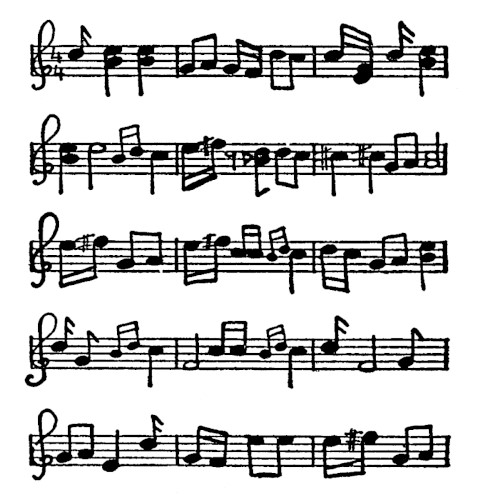
He opened it, glanced at it for a few moments, and then, looking up to me, said:
“Who’s playing the fool with you, Lionel? This is only rubbish! There isn’t any music in it!”
“It looks like music,” I said in surprise.
“Yes. But if you knew anything about music you would see that there is neither time nor rhythm in it.”
CHAPTER SIXTEEN. TRICKED
That piece of manuscript music was certainly as puzzling as the manner in which it had been placed in my hands.
“Where did you get it?” asked Teddy, much interested. “It’s been written by a woman evidently—somebody with a very firm handwriting.”
“Oh, it’s been given to me,” I said evasively. “A fellow knowing my ignorance of music has played a joke on me. I’ll play him one back before long.”
And, though I was much perplexed, I managed to laugh it off.
“I’m going up to Liverpool by the next train,” I said. “I’ll be at the Adelphi if anything turns up regarding Joan. I’ve got a bit of urgent business to attend to. Bruce will keep in touch with me and I’ll be back in about a couple of days.”
“Righto,” laughed my old chum. And he offered me a drink; but, because of my haste, I declined.
An hour later I was in the dining-car express on my way to Liverpool. I knew the Adelphi, and had no difficulty in getting a room. I arrived for late dinner, dressed hurriedly, descended to the restaurant, and read the evening paper over my lonely meal.
In the big, well-lit room there were no women save a girl with her father and an old, decrepit woman with a young man. The table d’hôte was over long ago.
Later, I hastened to the big lounge, where many people were taking coffee, and, finding a corner table, looked around at my fellow-guests.
In a far corner I discerned a fair young man, of a Scandinavian type, with a mop of yellow hair, taking coffee with a little, dark-haired, vivacious woman who was all nerves and gestures. But it became impressed on me that the woman in question was not Illona, the woman who sent me false music.
Teddy’s declaration that the music was a fake puzzled and mystified me more than ever.
What could those false bars, so firmly written, denote? What in the world could they convey to me? Surely, in all conscience, and through no fault of mine, I had had enough of mystery without that folded piece of music being handed to me to still further mislead and mystify me.
“All silly rot!” Teddy had declared frankly, on reading over the carefully written notes of music. “Perfect rubbish! Some fool has had you here, my dear Lionel!”
Through the next hour I wandered about the hotel, trying to fix on some woman that might be my wife. But I could not discover one who answered to the description given by the pretty manicurist.
Yet she might be out at the theatre, I thought. Already it was ten o’clock, so I took up my position at a small table, whence I could command a view of all who entered the hotel by the big door of the main entrance. And I kept careful watch on those going to and fro.
One woman, auburn-haired, of middle height, and rather good-looking, entered about eleven o’clock. She wore a purple, brocaded velvet evening-coat trimmed with fur, while the man with her was slightly older, with fair hair, a trifle bald on the crown. They laughed together as they entered, and I had a faint suspicion that she spoke with a foreign accent.
She passed me without noticing me and from the concierge they obtained their keys. Next moment they disappeared into the elevator.
“Who is that lady?” I asked anxiously of the night porter when they had gone.
For a moment he consulted his register, and then replied:
“That lady, sir, is Madame Stefen.”
Madame Stefen! Could she be Illona?
She was the only woman who in any way answered to the description given by Ruby Moss.
For yet another hour I waited at my post of vantage, but without avail. Then, tired out by my adventure in Kensington Gardens, my journey, and my long vigilance, I ascended to bed.
Next day, though I wandered through the great hotel, I saw nothing of Madame Stefen; she evidently kept to her room. I spent hours idling about the Landing Stage, which is always full of interest, and after tea in the hotel lounge, where again I sat with alert eyes, I awaited the coming of my little friend, the manicurist.
I entered the toilet saloon of the hotel at a quarter to seven, and there saw her alone, wearing her long white cotton robe.
She greeted me merrily. Then I suggested to her that, after her duties had ended, she should join me, and, if possible, point out the lady who had called herself Illona.
She raised a difficult point, saying that the management would not allow her to sit with the guests. Such a thing was strictly forbidden. I realized her argument instantly. But, after some discussion, she arranged to look into the table d’hôte room and restaurant during dinner and see if she could recognize the lady in question.
“I’d know her instantly,” she said. “If I can find her I’ll ascertain her name and the number of her room from the reception clerk. It will be better for me to carry out my search alone.”
She was insistent on this; hence I allowed her to have her way.
A dozen times during the evening I saw her flit across the lounge, the waiting-rooms, and the other public apartments, and, though I waited till about half past ten, she did not approach me.
Where, I wondered, was the elusive woman who, after arranging to meet me, only fooled me by sending me a sheet of faked music?
The girl met me at last in a quiet corner of the lounge, where I was seated, waiting expectantly for her.
“I’m very much afraid that the lady must have left, sir,” she said disappointedly. My spirits instantly dropped.
That Madame Stefen was not the lady in question was proved, because only five minutes before, she had entered the lounge and passed her on her way upstairs.
“She may be out,” I said, clinging to the last hope.
“She may. But I fear not. I’ve asked at the bureau, and of the chief hall-porter. They both think the lady left yesterday afternoon. I’ve described her, and especially the ring which attracted me so much. Do you know the name of Ugostini?”
“Ugostini!” I gasped, staring at her blankly. “How do you know that name?”
“Well, in the reception office they think that was the lady’s name—Countess Ugostini. I described her to Mr. Fraser, the chief clerk, and he thinks so.”
I held my breath.
Angela! If that were the truth, then she had posed as Illona, my wife! Lisely Hatten—or the Contessina as she was known—was my worst enemy. And yet she had fooled me into that strange meeting with the young manicurist.
With what motive? Only in order to send me a piece of pretended music!
My brain reeled. Could the thief-girl of Camberwell and Illona be one and the same?
That was the chief point before me. I went to the reception office and saw the dapper, clean-shaven chief clerk, in his morning-coat and grey trousers, who interviewed all newcomers and allotted rooms to them.
“The lady Countess Ugostini arrived three days ago, alone. She has signed the register as coming from Piacenza, in Italy.”
“Was she alone?” I asked.
“Yes. I received her. She had but little luggage, and mentioned that she was only passing through Liverpool,” said Mr. Fraser. “That evening, however, I saw her talking to a fair-haired man who had arrived early in the morning—an Englishman named Detmold.”
“When did the Countess leave?” I asked.
He turned over the leaves of a book upon the mahogany counter, and replied:
“At three-eighteen yesterday. She took a taxi to the Landing Stage.”
“You can’t find out which boat she boarded.”
“No,” he replied politely. “I fear I cannot. After she paid her bill and left, we have no further trace of her. Is she, by chance, a friend of yours, sir?”
“Yes,” I faltered. “A very great friend. I’ve come down from London to meet her, but I’m just too late.”
I bade good night to Miss Moss, and thanked her for assisting me. I went to my room.
I took from my pocket that inexplicable sheet of manuscript music and cast my eye over it. The notes were Chinese to me. To Teddy Day they had conveyed nothing. And, hence, to me they were utterly unintelligible.
I flung myself into a chair to think.
Was Illona, my wife, identical with the Little Countess, my enemy? It certainly seemed so. I reviewed the facts in their true sequence. That the little Italian pseudo-aristocrat was an intimate friend of the fugitive Owen had been proved by me, myself. In Rome she had wilfully misled me, knowing that in my condition of aberration I did not recognize her; and, she still believed in her power to impose on me. So far all was clear. But had she further imposed on me during my two years of unconsciousness so that I had married her under the euphonious name of Illona?
Could that be possible?
I rose and paced my narrow room in my fierce agitation of mind.
There were some facts which, when I clearly considered them, gave color to this idea. First, for some unknown and inconceivable reason, she had spared me the blindness which in her fury she had suggested. Why? Was it because she had relented, or because her young man friend had prevented her? Finding my brain in such a hopeless state owing to loss of memory caused by the drug she had injected into my veins, could she have married me pretending herself to be another person called Illona?
If so, why had she sent me that strange warning concerning the blind man? If she were my enemy, as she certainly had been, why, then, should she pose as my friend?
And again, why had she sent me that curious folio of tuneless music?
And now, the thought of Joan’s disappearance, and the utter inability of the whole police system of England to find the slightest trace of her, drove me to distraction. I felt myself going mad.
My sole desire was to return to London. I did not undress, for I knew I could not sleep. Instead, I went down to the night porter, and, finding that a train left at three o’clock in the morning for London, I flung my things into my bag, and left by it.
Just before eight o’clock I entered my rooms with my latch-key. Bruce was about and got me a cup of tea, while I undressed and threw myself upon my bed.
After drinking the tea I must have fallen asleep, for it was not till nearly noon, by my little traveling clock at my bedside, that I woke up in surprise.
Beside my bed were my letters, one of which, by the embossed stamp on the back, I knew, was from the governor at the House of Commons.
“I am much worried about you, my dear boy,” he wrote. “Come down and see me! Dine with me at the House to-morrow at eight.”
Dear old pater! I knew that his sole thoughts were of me, and of my future. No man had ever had a better father than mine. My only regret was the fierce enmity which existed between Joan’s father and him.
Two other letters I opened contained bills, but a third was in a square envelope, the address written in a bold hand.
It was Illona’s. I opened it instantly in great expectation.
There was neither address nor date, but on a plain card was written:
“My Adored Husband,—Why did you not keep our appointment in Kensington Gardens? I was, alas! half an hour late owing to the motor-car breaking down. I thought you would await me. But I fear you grew tired, as the rain came on.
“I have much to tell you. Be very careful of your dear self. You have many enemies, just as I have. Ring me up at the club and let us meet at the earliest possible instant.
“Your own Illona.”
CHAPTER SEVENTEEN. ACROSS EUROPE
Then the message from Illona, delivered to me in Kensington Gardens, had been a false one, sent by the Little Countess in order to mislead me! Why? With what motive?
Angela, or whatever her true name was, evidently had been aware of Illona’s appointment with me, and had sent the girl with that cock-and-bull story so that we should be prevented from meeting. Possibly the delay in Illona’s arrival was purposely brought about by the woman who had been my enemy on that night in Camberwell.
Whither had she gone with her man friend who called himself Detmold?
She had driven to the Landing Stage at Liverpool, it was true; but, she might easily have taken the train to London, instead of embarking upon a boat.
I was to ring up Illona at her club. Again she had failed to give her address. However, there seemed to be some object in withholding it. And she evidently believed me to be well aware of it.
This constant strain had brought me well nigh to craziness. Everywhere I turned some obstacle arose which prevented my learning the truth. My memory had returned, but at what cost! Would that I had remained in the state of mental unbalance in which I had existed until that evening in Rome; for, now that I had lost Joan, my anxiety and grief bordered on frenzy.
I spent that morning ringing up the many ladies’ clubs. I had never believed they were so numerous. What name could I ask for save my own—Hipwell?
From every one of the various feminine social centres came the same regretful reply that they had no member of that name. When all that failed, I rang up a number of bridge-clubs in the West End. But, from several there came no reply as they were closed at that hour of the day, and from the rest came the usual negative response.
Five minutes later, Bruce brought in a note that had just been delivered by hand, the envelope of which bore the familiar words, “On His Britannic Majesty’s Service.” With eager fingers I tore it open, to find my orders to leave Victoria at two o’clock with dispatches for Brussels, Berne, and Vienna.
How could I go, when at any moment Illona might ring me up, or call on me?
I spoke over the telephone to my friend Gordon at the Foreign Office, begging him to send somebody else.
“I’m really awfully sorry, old boy,” he replied. “But the whole staff are traveling. Morton will be the first back, but he can’t be in till Saturday night. He’s on his way home from Constantinople, by Bucharest. So there’s nobody else to take your place. I’m so awfully sorry, old chap. I’d do anything to arrange it for you, as you well know. I’m afraid you really must do this trip. You’ll be back in five days,” he added.
Five days! What might not happen in that period? Besides, the man Dufour would be brought up again at Bow Street.
There was no alternative. Already it was past twelve o’clock; so, I told Bruce to get out my small suit-case, which he always kept packed with everything I required for a fortnight. Then, I sat down and wrote a letter of explanation to Illona regarding the appointment in Kensington Gardens, and what had occurred there. I asked for her address, and, enclosing the piece of impossible music, I sealed the envelope with my lapis-lazuli ring and addressed it: “To Illona.”
“Bruce,” I said very seriously. “While I am away, a lady may call—or she may ring up. Tell her that I shall be back next Wednesday, and ask her to kindly give you her Christian name. If the name is Illona, give this letter to her. It is most urgent and important. Perhaps you may have difficulty in inducing her to give her name, but use tact, and tell her exactly what I’ve said to you.”
“Yes, sir. I quite understand,” my man replied in his well-trained manner. “But what kind of lady will she be—old or young, sir?”
That question completely floored me.
“Well, as a matter of fact, Bruce”—I hesitated lamely—“I’ve never seen the lady. I only know of her.”
“Very well, sir. I will exercise discretion,” he said. And I dashed out to the Piccadilly, where I swallowed a hasty lunch in the grill-room. And, just before two o’clock, I entered a coupé of one of the Pullmans of the first portion of the Continental train, which had been reserved for me, and into which a porter placed six little white canvas bags of dispatches. The Foreign Office bags carried by King’s Messengers always intrigue the traveling public. They imagine them to be full of State secrets, whereas their contents are mostly dull, uninteresting Consular reports, Treasury accounts, memoranda, and perhaps some private letters for Ambassadors to Downing Street, marked “Per favour of Foreign Office bag.” If all were stolen they would not amount to much.
Indeed, there is a tradition in the Foreign Office that before the war a certain Captain Gordon Smith—that was not his real name—one of the most cheery and most cosmopolitan of the corps of King’s Messengers, one day discovered, in a locked cupboard in his rooms, a bag of dispatches that had been there for four years! His man, who had long since left his service, had found them among his kit on his return one night from Madrid and had locked them up for safety! Now every bag is minutely numbered and signed for, both by the messenger on receiving it and by the secretary at the Embassy abroad, or the official in charge of incoming dispatches at Downing Street. Hence it is impossible for a bag to go astray. Yet in this instance somebody carelessly signed a receipt for so many incoming bags, with the result that Gordon Smith had one over. The story goes that rather than get anybody hauled over the coals for negligence, he cut it open, and made a bonfire in his sitting-room of the whole of the contents, including the bag itself.
The “crossed dispatch,” as it is known—the secret instructions intended only for the eye of the representative of His Majesty the King abroad—is carried on the person of the messenger, who, like myself, usually has a very serviceable Browning to defend it from any possible pilferer.
As I settled myself with a magazine, Crawford, the conductor of the car, looked in, and, wishing me good afternoon, asked if I were comfortable, while several travelers glanced in with interest at seeing my little white bags piled in front of me. I have been taken by tourists to be of many professions. Some have whispered to each other that I am a bank clerk taking bags of banknotes to Paris. Others think I am employed by some bookmaker. Still others have thought me to be a dress-designer, or the runner of an illegal lottery. Then there have been those who have seen me piled with thirty or forty bags on the big round which includes Vienna, the Balkan capitals, Athens, Constantinople, Bucharest, and back. Those people have thought I was traveling for some great advertising agency to boom American corn-flakes, or perhaps a traveling circus!
At Dover Maritime, that ever-genial official of the Southern Railway, Mr. Harvey Beresford—whom every King’s Messenger and most distinguished travelers know—that energetic, untiring inspector who is alert to see every outgoing or incoming boat from Calais, Boulogne, or Ostend—catching sight of me, rushed up and gripped my hand.
“Hulloa, Beresford,” I exclaimed, greeting the smart, nautical-looking man, who always wore his peaked cap at an angle.
“A long journey this time?” he asked, as we went through the little side door and strode down to the boat, where a strong wind was blowing.
My dispatch bags were locked in a deck cabin. And, I stood outside, chatting with the cheery friend of King’s Messengers and distinguished travelers. For, the popular Harvey Beresford is the friend of kings, princes, diplomats, ministers, and the great ones who visit England. It is his unique job to receive them or wish them God-speed.
The average traveler to and fro the Continent knows him not. He will see a pleasant, round-faced naval-looking man, who is chatting with a railway official, an obtrusive man. But he is perhaps the best-known person to the great ones of our century.
The siren sounded that the mails were on board and had been duly counted and checked. Electric cranes were still dumping luggage into the nets. An invitation for a cocktail had been firmly refused by my old friend, because he was on duty. The captain came along over the gangway and passed the time of day with us both.
“Well, so long, Mr. Hipwell,” laughed Beresford. “I’m forever on this quay, but I’m going over at the end of August on a little run round Belgium; taking the wife. Just a little quiet trip to take me out of the five-times-a-day cross-Channel traffic. Oh, the tourist rush which we’re going to have this season! They tell me that Cook’s have over a hundred guides with parties going to Switzerland alone this season! But, my dear Mr. Hipwell, when you travel with that firm, you travel under a master. People may jeer at tourist agencies; but neither of us does. A ‘Cookite’ of the stage of the ’nineties with the saying, ‘Follow the man from Cook’s’ was humorous. But ‘Cookites’ who go over by each boat for their holidays are properly fathered from the moment they leave London till they’re back at Victoria. We can’t say that for all the travel agencies, can we—eh?”
“I agree, Beresford—I entirely agree,” I said, laughing. He was always bluff and outspoken, even though so tactful and courteous.
The warning siren blew again. All the baggage had been stowed, and the steamer was ready to cast off. Only the one gangway remained down, and crowded around it stood the usual mixed assortment of travelers, from chic French actresses in rich furs to the usual thin, be-spectacled Indian civil servants on their return East, accompanied by their wives.
“Well, good-bye, my dear Beresford,” I said, gripping his hand. Next moment he nipped nimbly across the gangway just as it was drawn up, and the vessel moved away.
It was near midnight when, on alighting at Brussels, I gave over two of the bags and a special dispatch to Carew, the second secretary of the Embassy, who had come down to the station in the car to meet me.
Until the Ostend-Bâle night express roared in, I stood on the platform with him. Then, I entered the single berth that had been reserved for me in the wagon-lit, which was to bear me south to Bâle. There, again, I would be compelled to change for Berne, the capital of the peaceful little Swiss confederation.
In that narrow little bed, as the train rocked and rolled throughout the night, along the valleys of the Ardennes and down to Strasburg, sleep refused to come to my eyes. My thoughts were ever of Joan, and of my mysterious wife, who begged me to meet her, yet whose whereabouts I had no means whatever of ascertaining.
My life had become so perplexing, so full of apprehension, with hourly dread and a terror of dire disaster pending, that, sleeping or waking, the mystery of Illona was my one concern.
I took my morning coffee in the big frescoed restaurant at Bâle station, and presently took train with my bags to Berne. There I delivered one of them at the Legation. Then, driving back to the station, I went on to Zürich; and thence, that night, caught the express to Vienna.
My only object was to fulfil my duties and get back to London with all haste. On arrival at the big, echoing West Bahnhof at Vienna, I took a taxi to our fine Embassy in the Metternichgasse, and there delivered my bags and dispatches over to Charlie Denby, the first secretary.
He invited me to remain to dinner, but I declined, and, as a bag was ready to go back, I flung it into the taxi. I found that I had time to spare to catch the Orient Express for Paris, so I drove around the Ring, that wonderful succession of the finest boulevards in all the world.
I knew Vienna well. At other times I would have been glad of a couple of days’ enjoyment and rest there after the dusty journey from London. But that night I merely took a capuziner outside the Prückel Café in the Stuben-Ring, and then went along to the Stephans-Keller to have my evening meal, an exquisitely-cooked goulasch with paprika, followed by deliciously thin palatschinken. Usually a King’s Messenger is well versed in foreign dishes, and I fear I was no exception.
Just after ten o’clock the great Orient Express thundered into the station on its way from Constantinople to Calais, a dining-car and four dusty sleeping-cars. The brown-uniformed conductor, who stepped out, knew me. He saluted, and soon had me comfortably installed.
But hardly had he done so than Charlie Denby breathlessly entered the car, saying:
“Glad I’ve caught you, Lionel. We’ve just had a wire from the Foreign Office altering your route. You are to go by the Paris portion from Wels instead of by Brussels and Ostend. There are dispatches waiting for you in Paris.”
“Gosh!” I laughed. “What a life one leads on these gridirons of railways!”
The express waited twenty minutes, therefore my kit and I were quickly transferred into the wagon-lit for Paris, and Charlie and I had cocktails in the wagon-restaurant.
I looked around at my fellow-travelers. They were mostly commercial and financial people from the near East, together with one or two really nice American families, the sort that we Englishmen love to meet—smart, well-behaved people, with the neatest luggage in the world.
American travelers can be picked out of millions by reason of their pleasant looks and the tidiness of their belongings.
As a constant traveler, wherever I go, I meet Americans fathered by Cook’s, Raymond & Whitcomb, the American Express, and other tourist firms, who always look after their clients well.
Only King’s Messengers can be true judges of tourist agencies, the amazing wonders of their organization, and their few failures.
Modern travel is a most complicated affair. No one knows or sees more of it than the unobtrusive man in a serviceable traveling-coat. It is the man who invariably eats a modest sandwich in the smoking-room of a cross-Channel steamer; the most trusted servant of the State; the messenger who is directly in the service of his Sovereign.
CHAPTER EIGHTEEN. “A LADY TO SEE YOU, SIR!”
Fagged and weary, I slept until the conductor brought me my coffee and biscuits.
“Laroche, m’sieur!” he said. And I knew we were fast approaching Paris. I pulled aside the blind, and saw the familiar long lines of poplars and the flat, uninteresting landscape.
I shaved and dressed leisurely, for I had no reason to go to the Embassy. The dispatches would be brought to me; for the Orient Express ended its long journey at Calais.
As we ran into Paris, I saw Pallant, one of the attachés, a tall, well-set-up figure, waiting with his driver, carrying two little white bags. Through the open window of my sleeping-berth I waved, perhaps rather wearily. And, in a few moments he joined me, followed by the chauffeur.
“Glad we got you, Hipwell,” he said. “There’s been a lot of trouble. All you fellows seem to be traveling just now.”
“Why didn’t Farmer go over to London?” I asked. “He’s always ready for a couple of days in town.”
“Got the ’flu, my dear fellow. If not, you bet Gerry would be the first to run over. They told us over the ’phone from Downing Street that you were in Vienna, so I wired to divert your journey here.”
“Thanks for nothing, my dear Pallant,” I laughed. “Anything special?” I asked, looking at the two ordinary little white canvas bags.
“Oh! yes,” he said. “I quite forgot,” and from his pocket he took one of the familiar narrow, blue envelopes with a cross printed on it. And he presented an official form for my signature, which I scribbled off, hurriedly.
“Nearly forgot what you came for!” I laughed.
The moment I entered my rooms that evening, Bruce met me on the threshold, saying:
“Mr. Gell has just rung up. He wants you to go to Queen’s Gate the moment you arrive.”
“And has the lady Illona called?”
“No, sir,” was his reply, and I saw the note still lying upon my table.
After a hasty wash, I jumped into a taxi in Piccadilly and drove to Joan’s father. Had he news of her, I wondered?
The moment we met, I saw that the whereabouts of my beloved was still a mystery.
“That fellow Dufour has been brought up at Bow Street again this afternoon,” he said. “The police know that he is an associate of criminals, but he refused to disclose where his wife was, declaring that she had left him and he did not know her whereabouts. The proper course would be to commit him for trial, but I hear the police think they can learn more if he were discharged. They could then watch his movements.”
“And allow him to slip through their hands as the fellow Owen has done?” I laughed.
“That’s just it! They hope to catch both in the end,” said the well known barrister. “My own idea is, that Dufour shot the young scoundrel Wilson out of revenge.”
“He surely didn’t run away with Dufour’s wife, eh?” I hazarded.
“By jove! I never thought of that,” he cried. “That might certainly have been the motive.”
“Yet, in any case, it brings us no nearer the solution of the problem of poor Joan,” I remarked.
“No,” he said, in a low, despondent tone. “Oh, if we could only find some clue as to where she really is! The police seem to regard the matter as hopeless.”
I remained silent. Was she dead, or did she still live? Of one thing I felt more than ever convinced, that the decoying of her away had been directed against me. My enemies, of whom Illona had warned me, had executed a vile and subtle plot in which I felt confident the man Owen was implicated. If he were the honest man he pretended to be, he would not have been an associate of the young thief, Tuggy Wilson; nor, finding himself watched, would he have so cleverly slipped away into obscurity.
Again, what was his true connection with Lisely Hatten who, with such amazing success, had imposed on me? And what could be the mysterious significance of that beautiful piece of clear, blue aquamarine with the double nought on it? Its receipt, no doubt, was some pre-arranged signal. In any case, my beloved Joan had fallen helpless and defenseless into the hands of my enemies.
Next day I heard from Mr. Gell that Dufour had been discharged from custody, owing to the lack of sufficient evidence. I knew that Scotland Yard would keep a very wary eye on him in the hope that he might meet the fugitive Owen.
Two days later, at about three o’clock in the afternoon, I was seated in my room with Teddy Day discussing the situation, when I heard a ring, and Bruce entered, saying:
“There’s a lady to see you, sir. She objects to giving her name.”
I rose in quick surprise, whereat Teddy took up his hat, and, making an excuse, left.
“Show her in,” I said, the instant my friend had gone.
Next moment I could scarce believe my eyes. Upon the threshold stood Angela—the Little Countess!
In an instant I recovered myself, determined not to allow her to know that my brain had returned to its normal balance. What could her visit to me portend?
“My dear Contessina!” I cried, rushing forward to greet her enthusiastically. “This is a surprise, indeed! Do come in and sit down.”
She laughed merrily, a dainty figure, in a cool summer gown of pearl-grey crêpe-de-chine.
“I thought I should surprise you, Signor Hipwell,” said the woman who had successfully prevented me from meeting Illona, and whom I knew to be my enemy.
It was strange, I could not help thinking, that from the first moment of the recovery of my senses in Rome, I felt certain that I had met her somewhere previously. It was strange, too, I contemplated, that not until I had stood with Owen, had I actually awakened to the fact that she and the City typist, whose associates were such desperate criminals, were identical.
“I have first to thank you for carrying out your promise to me,” said the slim, pretty girl who had so attracted me in Rome, and whose movements were so suspicious. As she sat in my arm-chair she certainly did not look like a criminal.
“I found Mr. Owen and delivered to him that pretty cut aquamarine. What a delightful pendant it was!”
“Yes,” she said carelessly. “Rather pretty. But the reason I’ve dared to call on you is because my friend Mr. Owen is missing. He disappeared early one morning, his man tells me, and has not returned.”
I pretended surprise, at the same time feeling that she was misleading me with some purpose of her own. I did not forget that she was my worst enemy. Nevertheless, it still seemed that, from the fact that I had discovered her at that assembly in Camberwell, she feared lest I should inform the police.
I remembered that it was she who had suggested that horrible punishment of putting out my eyes, and yet she had not carried out her brutal suggestion. Why? And why, instead, had she given me a drug that had paralyzed certain cells of my brain?
“Is there any reason why Mr. Owen should have disappeared?” I asked, with feigned ignorance.
“Not in the least, as far as I know,” she replied, unaware that I knew of her visit to Liverpool, and how she had tricked me by sending the young manicurist to Kensington Gardens. “Of course, he may have gone to Turin, expecting to find me there.”
“He knew you were in Turin?” I asked.
“Yes. I let him know that. He had begged to see me,” she replied, with her slight foreign accent.
Then, in order to change the subject, and to allow her to reveal the true reason of her visit to me, I asked:
“And how are all our mutual friends in Rome? How did you leave them?”
She shifted uneasily. Did she suspect that I had recognized her? I hoped not, for I strove to pretend ignorance; to pretend to know her only as the Contessina Angela Ugostini.
“Oh! Most of them have left Rome—all who can. It is getting hot there. But the staffs of the Embassies have to remain. Some of them have gone to the Tuscan mountains, the French Ambassador and his wife are at Vallombrosa, and the Spanish is at Montecatini for the cure, while the Ruspolis are at the sea at Livorno, and my aunt is at Santa Margherita.”
“And the political situation?” I asked, handing her a cigarette and lighting it. I felt that she was hesitating to reveal the true object of coming to me. Perhaps by putting her at her ease, I might yet disarm her.
Through the rising tobacco smoke, she regarded me strangely, with half-closed eyes. And, after a brief pause, she spoke:
“You know, Signor Hipwell, quite as much as I do of the seriousness of the situation—much more, no doubt.”
Her manner had strangely changed, and it surprised me.
“It is growing worse, eh?” I asked.
“You have not been again to Italy since the morning we met in the church?” she asked.
“No, Contessina,” I replied. “Had I been, I should surely have endeavored to find you.”
She smiled contentedly, for my polite words made it appear that I still believed her to be the aristocratic character she had assumed, and that, even now, my mind remained sufficiently disordered not to associate her with the virago in Camberwell.
“I should have been very delighted indeed to have met you again, Signor Hipwell,” she said, looking at me lazily through the smoke of her cigarette. “After Rome I went to the Lake of Garda, then back to Florence and Venice. Then to Milan, and here.”
“And the Contessina is as well known and popular in all those places as in Rome,” I added smiling.
“On the contrary,” she declared. “Only in Florence I went out once or twice into society. But I found it not nearly such a nice, cosmopolitan, and friendly circle as in the capital. I have an uncle living up at Fiesole.”
“A delightful quarter,” I remarked. “I had a relative living there a few years ago.”
“Ah, yes!” she sighed, as though in regret. “Italy is very beautiful and full of charm. It is only one’s bitter memories that sometimes rise to mar its recollections.”
“That can be said of all countries, Contessina,” I remarked.
“Yes. I suppose you, on your constant travels, meet with many amorous adventures which cause you to ponder on your return, and sometimes regret, eh?” she laughed.
“I don’t plead guilty to amorous adventures,” I said, fencing with her, and wondering still if the object of her call was to satisfy herself that my memory was not yet restored. “My whole life was wrapped up in political aspirations until I got dumped into my present official position.”
“A very responsible one—one of the most responsible surely,” said the neat little lady who, in her Paris gown, looked so chic and unlike the skirted and bloused City typist, as I had first known her.
Two and a half years had wrought a marvelous change in her. The chrysalis of a working-class world had evolved into a gay butterfly of fashion. When I recalled our humble breakfasts together, and her rush to the office, I could scarcely believe it possible that she was one and the same.
Yet, as you may well imagine, it exercised all my tact and will power still to make pretense of ignorance of the past.
The girl was my enemy—my bitterest enemy. Why then should she come there to my rooms and pose as my friend? Why should she whine to me over the disappearance of her lover of the euphonious name of Roddy Owen—the name of a great and popular sportsman of the ’nineties?
I handed her another cigarette; for, she had settled herself comfortably in my big bachelor chair. Her neat, silk-encased legs, and smart, well-fitting shoes which so perfectly matched her stockings, were stretched out in perfect relaxation.
I managed to keep my head, in the strained circumstances of knowing full well that my pretty visitor was only posing as my friend.
It was nearly four o’clock; so, finding that I could discover nothing further, I suggested that we should stroll round to the Carlton lounge for tea. Together we went along Piccadilly, down the Haymarket, into the palm court where we sat at one of the little well-known tables. And she poured out tea for me.
The Carlton teas differ not at all from the teas served in other hôtels-de-luxe in any part of the world with their orchestras—the bêtes noires of every constant world-traveler.
At last, with trepidation, I ventured to say:
“Haven’t we had enough of this, Angela?”
“I agree. I hate these tea-dancings.” Then, after a few moments’ pause, in which she looked straight into my eyes—the first time she had ever been straightforward to me—she added:
“Will you take me back to your rooms, Signor Hipwell? I—I—well, I want to speak very confidentially and openly to you.”
CHAPTER NINETEEN. ANGELA IS FRANK
When we were back again at Sackville Street and she was reseated, I stood upon the hearth-rug and gazed at her expectantly.
I knew well she was testing me in order to reassure herself that memory of the past had not returned to me, that I still failed to recognize her. By dint of great effort I had kept up the fiction. Yet it was difficult to pretend friendship when I knew her to be my most dangerous enemy.
I wanted to ask her why she had interfered with my meeting with Illona, and why she had sent me that scrap of false music. Yet how could I do so without disclosing what I knew?
“Well,” I said at last. “What have you to say to me, Angela?” And I waited for lies to fall from her lips.
“I want to speak to you of something that closely concerns both of us,” she said, in a quiet, changed voice. “You know that Roddy is missing, and I am extremely anxious to find him. Have you the slightest idea why he should be missing, or of the motive?”
And she fixed her eyes straight upon mine.
“How should I?” my surprise at her question was genuine, but at the same time I realized her cleverness in trying to trick me into admitting secret knowledge of her friend.
“I thought you were friendly with him.”
“Only in consequence of the interview I had with him on your behalf,” was my reply.
“I thought he knew a lady friend of yours—a Miss Gell,” she said, as though speaking to herself.
“Did he know her?” I cried, in quick anxiety.
“I have heard so,” she answered. “So I thought you might know something concerning his mysterious disappearance. Has Miss Gell told you nothing?”
“No, nothing.”
“Ah! That is curious,” my visitor said.
“No, not curious in the least,” I blurted forth. “Miss Gell is also missing and cannot be found.”
The Little Countess started.
“Miss Gell also missing!” she gasped. “Then they might both have gone away together, eh?”
“I think not, because Joan disappeared some time before Owen.”
The girl masquerading as daughter of an Italian count paused for some time, her eyes upon the empty grate.
“Look here, Signor Hipwell,” she said at last. “Let us be frank with each other.”
“I am entirely frank,” I ventured.
“I mean, let us act in each other’s interests. Each of us has a friend who seems to have dissolved into space. Why cannot we help each other and tell the truth as far as we know it?” Then, after another pause, she looked at me strangely and added, “I can tell you something if you tell me what you know concerning Roddy.”
“Do you know anything about Joan?” I asked eagerly. “Tell me.”
“When you have told me what you know about Roddy,” was her firm reply. “That is a bargain.”
“But I know so little,” I declared with truth. “I only heard that early one morning he left his flat and has not been seen since.”
“That I know. But who informed you?”
I hesitated a moment. There was an agreement between us that we should each tell what we knew.
“I was told by the police,” I said.
“The police!” she cried, starting up in genuine alarm. “Are they after him?”
“I think so.”
“For what reason?” she asked breathlessly. “Tell me all you know about the affair. Remember our compact.”
“Your friend Owen, I believe, was on terms of friendship with a young man known in certain circles as Tuggy Wilson.”
“Yes, I know.”
“Well, Owen and the latter were in Fulham one night when Wilson was shot dead by somebody unknown.”
“Tuggy dead!” she cried, staring at me in astonishment.
“Yes. It was in the papers.”
“I was in Italy and saw nothing of it. Surely they didn’t suspect Roddy of murdering him?”
“No. A man named Dufour, a foreign waiter, was arrested; but, there being no evidence, he was discharged.”
“Dufour!” she echoed. “But of what did the police suspect Roddy?”
“Of being an accomplice of Wilson, whose finger-prints, taken after death, proved him to be an expert thief, well known to the police.”