LETTERS AND PAPERS ON PHILOSOPHICAL SUBJECTS. ———— ELECTRICITY. (continued 4)
Reading edition
I am, Sir, with sincere respect,
Your most obedient and most humble servant,
EBEN. KINNERSLEY.
TO MR. KINNERSLEY.
Answer to some of the foregoing Subjects.—How long the Leyden Bottle may be kept charged.—Heated Glass rendered permeable by the electric Fluid.—Electrical Attraction and Repulsion.—Reply to other Subjects in the preceding Paper.—Numerous Ways of kindling Fire.—Explosion of Water.—Knobs and Points.
London, Feb. 20, 1762.
Sir,
I received your ingenious letter of the 12th of March last, and thank you cordially for the account you give me of the new experiments you have lately made in electricity.—It is a subject that still affords me pleasure, though of late I have not much attended to it.
Your second experiment, in which you attempted, without success, to communicate positive electricity by vapour ascending from electrised water, reminds me of one I formerly made, to try if negative electricity might be produced by evaporation only. I placed a large heated brass plate, containing four or five square feet on an electric stand; a rod of metal, about four feet long, with a bullet at its end, extended from the plate horizontally. A light lock of cotton, suspended a fine thread from the cieling, hung opposite to, and within an inch of the bullet. I then sprinkled the heated plate with water, which arose fast from it in vapour. If vapour should be disposed to carry off the electrical, as it does the common fire from bodies, I expected the plate would, by losing some of its natural quantity, become negatively electrised. But I could not perceive, by any motion in the cotton, that it was at all affected: nor by any separation of small cork-balls suspended from the plate, could it be observed that the plate was in any manner electrified.
Mr. Canton here has also found, that two tea-cups, set on electric stands, and filled, one with boiling, the other with cold water, and equally electrified, continued equally so, notwithstanding the plentiful evaporation from the hot water. Your experiment and his agreeing, show another remarkable difference between electric and common fire. For the latter quits most readily the body that contains it, where water, or any other fluid, is evaporating from the surface of that body, and escapes with the vapour. Hence the method, long in use in the east, of cooling liquors, by wrapping the bottles round with a wet cloth, and exposing them to the wind. Dr. Cullen, of Edinburgh, has given some experiments of cooling by evaporation; and I was present at one made by Dr. Hadley, then professor of chemistry at Cambridge, when, by repeatedly wetting the ball of a thermometer with spirit, and quickening the evaporation by the blast of a bellows, the mercury fell from 65, the state of warmth in the common air, to 7, which is 22 degrees below freezing; and, accordingly, from some water mixed with the spirit, or from the breath of the assistants, or both, ice gathered in small spicula round the ball, to the thickness of near a quarter of an inch. To such a degree did the mercury lose the fire it before contained, which, as I imagine, took the opportunity of escaping, in company with the evaporating particles of the spirit, by adhering to those particles.
Your experiment of the Florence flask, and boiling water, is very curious. I have repeated it, and found it to succeed as you describe it, in two flasks out of three. The third would not charge when filled with either hot or cold water. I repeated it, because I remembered I had once attempted to make an electric bottle of a Florence flask, filled with cold water, but could not charge it at all; which I then imputed to some imperceptible cracks in the small, extremely thin bubbles, of which that glass is full, and I concluded none of that kind would do. But you have shown me my mistake.—Mr. Wilson had formerly acquainted us, that red hot glass would conduct electricity; but that so small a degree of heat, as that communicated by boiling water, would so open the pores of extremely thin glass, as to suffer the electric fluid freely to pass, was not before known. Some experiments similar to yours, have, however, been made here, before the receipt of your letter, of which I shall now give you an account.
I formerly had an opinion that a Leyden bottle, charged and then sealed hermetically, might retain its electricity for ever; but having afterwards some suspicion that possibly that subtle fluid might, by slow imperceptible degrees, soak through the glass, and in time escape, I requested some of my friends, who had conveniences for doing it, to make trial, whether, after some months, the charge of a bottle so sealed would be sensibly diminished. Being at Birmingham, in September, 1760, Mr. Bolton of that place opened a bottle that had been charged, and its long tube neck hermetically sealed in the January preceding. On breaking off the end of the neck, and introducing a wire into it, we found it possessed of a considerable quantity of electricity, which was discharged by a snap and spark. This bottle had lain near seven months on a shelf, in a closet, in contact with bodies that would undoubtedly have carried off all its electricity, if it could have come readily through the glass. Yet as the quantity manifested by the discharge was not apparently so great as might have been expected from a bottle of that size well charged, some doubt remained whether part had escaped while the neck was sealing, or had since, by degrees, soaked through the glass. But an experiment of Mr. Canton's, in which such a bottle was kept under water a week, without having its electricity in the least impaired, seems to show, that when the glass is cold, though extremely thin, the electric fluid is well retained by it. As that ingenious and accurate experimenter made a discovery, like yours, of the effect of heat in rendering thin glass permeable by that fluid, it is but doing him justice to give you his account of it, in his own words, extracted from his letter to me, in which he communicated it, dated Oct. 31, 1760, viz.
"Having procured some thin glass balls, of about an inch and a half in diameter, with stems, or tubes, of eight or nine inches in length, I electrified them, some positively on the inside, and others negatively, after the manner of charging the Leyden bottle, and sealed them hermetically. Soon after I applied the naked balls to my electrometer, and could not discover the least sign of their being electrical, but holding them, before the fire, at the distance of six or eight inches, they became strongly electrical in a very short time, and more so when they were cooling. These balls will, every time they are heated, give the electrical fluid to, or take it from other bodies, according to the plus or minus state of it within them. Heating them frequently, I find will sensibly diminish their power; but keeping one of them under water a week did not appear in the least degree to impair it. That which I kept under water, was charged on the 22d of September last, was several times heated before it was kept in water, and has been heated frequently since, and yet it still retains its virtue to a very considerable degree. The breaking two of my balls accidentally gave me an opportunity of measuring their thickness, which I found to be between seven and eight parts in a thousand of an inch.
A down feather, in a thin glass ball, hermetically sealed, will not be affected by the application of an excited tube, or the wire of a charged phial, unless the ball be considerably heated; and if a glass pane be heated till it begins to grow soft, and in that state be held between the wire of a charged phial, and the discharging wire, the course of the electrical fluid will not be through the glass, but on the surface, round by the edge of it."
By this last experiment of Mr. Canton's, it appears, that though by a moderate heat, thin glass becomes, in some degree, a conductor of electricity, yet, when of the thickness of a common pane, it is not, though in a state near melting, so good a conductor as to pass the shock of a discharged bottle. There are other conductors which suffer the electric fluid to pass through them gradually, and yet will not conduct a shock. For instance, a quire of paper will conduct through its whole length, so as to electrify a person, who, standing on wax, presents the paper to an electrified prime conductor; but it will not conduct a shock even through its thickness only; hence the shock either fails, or passes by rending a hole in the paper. Thus a sieve will pass water gradually, but a stream from a fire engine would either be stopped by it, or tear a hole through it.
It should seem, that to make glass permeable to the electric fluid, the heat should be proportioned to the thickness. You found the heat of boiling water, which is but 210, sufficient to render the extreme thin glass in a Florence flask permeable even to a shock.—Lord Charles Cavendish, by a very ingenious experiment, has found the heat of 400 requisite to render thicker glass permeable to the common current.
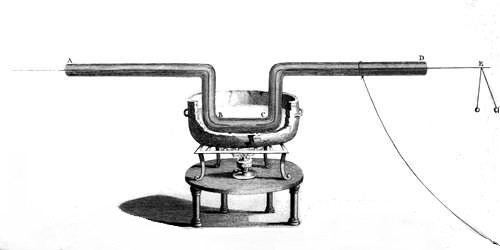
"A glass tube, (See Plate III.) of which the part C B was solid, had wire thrust in each end, reaching to B and C.
"A small wire was tied on at D, reaching to the floor, in order to carry off any electricity that might run along upon the tube.
"The bent part was placed in an iron pot, filled with iron filings; a thermometer was also put into the filings; a lamp was placed under the pot; and the whole was supported upon glass.
"The wire A being electrified by a machine, before the heat was applied, the corks at E separated, at first upon the principle of the Leyden phial.
"But after the part C B of the tube was heated to 600, the corks continued to separate, though you discharged the electricity by touching the wire at E, the electrical machine continuing in motion.
"Upon letting the whole cool, the effect remained till the thermometer was sunk to 400."
Vol. I. page 348.
Plate III.
It were to be wished, that this noble philosopher would communicate more of his experiments to the world, as he makes many, and with great accuracy.
You know I have always looked upon and mentioned the equal repulsion in cases of positive and of negative electricity, as a phenomenon difficult to be explained. I have sometimes, too, been inclined, with you, to resolve all into attraction; but besides that attraction seems in itself as unintelligible as repulsion, there are some appearances of repulsion that I cannot so easily explain by attraction; this for one instance. When the pair of cork balls are suspended by flaxen threads, from the end of the prime conductor, if you bring a rubbed glass tube near the conductor, but without touching it, you see the balls separate, as being electrified positively; and yet you have communicated no electricity to the conductor, for, if you had, it would have remained there, after withdrawing the tube; but the closing of the balls immediately thereupon, shows that the conductor has no more left in it than its natural quantity. Then again approaching the conductor with the rubbed tube, if, while the balls are separated, you touch with a finger that end of the conductor to which they hang, they will come together again, as being, with that part of the conductor, brought to the same state with your finger, i. e. the natural state. But the other end of the conductor, near which the tube is held, is not in that state, but in the negative state, as appears on removing the tube; for then part of the natural quantity left at the end near the balls, leaving that end to supply what is wanting at the other, the whole conductor is found to be equally in the negative state. Does not this indicate that the electricity of the rubbed tube had repelled the electric fluid, which was diffused in the conductor while in its natural state, and forced it to quit the end to which the tube was brought near, accumulating itself on the end to which the balls were suspended? I own I find it difficult to account for its quitting that end, on the approach of the rubbed tube, but on the supposition of repulsion; for, while the conductor was in the same state with the air, i. e. the natural state, it does not seem to me easy to suppose, that an attraction should suddenly take place between the air and the natural quantity of the electric fluid in the conductor, so as to draw it to, and accumulate it on the end opposite to that approached by the tube; since bodies, possessing only their natural quantity of that fluid, are not usually seen to attract each other, or to affect mutually the quantities of electricity each contains.
There are likewise appearances of repulsion in other parts of nature. Not to mention the violent force with which the particles of water, heated to a certain degree, separate from each other, or those of gunpowder, when touched with the smallest spark of fire, there is the seeming repulsion between the same poles of the magnet, a body containing a subtle moveable fluid in many respects analagous to the electric fluid. If two magnets are so suspended by strings, as that their poles of the same denomination are opposite to each other, they will separate, and continue so; or if you lay a magnetic steel bar on a smooth table, and approach it with another parallel to it, the poles of both in the same position, the first will recede from the second, so as to avoid the contact, and may thus be pushed (or at least appear to be pushed) off the table. Can this be ascribed to the attraction of any surrounding body or matter drawing them asunder, or drawing the one away from the other? If not, and repulsion exists in nature, and in magnetism, why may it not exist in electricity? We should not, indeed, multiply causes in philosophy without necessity; and the greater simplicity of your hypothesis would recommend it to me, if I could see that all appearances would be solved by it. But I find, or think I find, the two causes more convenient than one of them alone. Thus I might solve the circular motion of your horizontal stick, supported on a pivot, with two pins at their ends, pointing contrary ways, and moving in the same direction when electrified, whether positively or negatively: when positively, the air opposite to the points being electrised positively, repels the points; when negatively, the air opposite the points being also, by their means, electrised negatively, attraction takes place between the electricity in the air behind the heads of the pins, and the negative pins, and so they are, in this case, drawn in the same direction that in the other they were driven.—You see I am willing to meet you half way, a complaisance I have not met with in our brother Nollet, or any other hypothesis-maker, and therefore may value myself a little upon it, especially as they say I have some ability in defending even the wrong side of a question, when I think fit to take it in hand.
What you give as an established law of the electric fluid, "That quantities of different densities mutually attract each other, in order to restore the equilibrium," is, I think, not well founded, or else not well expressed. Two large cork balls, suspended by silk strings, and both well and equally electrified, separate to a great distance. By bringing into contact with one of them another ball of the same size, suspended likewise by silk, you will take from it half its electricity. It will then, indeed, hang at a less distance from the other, but the full and the half quantities will not appear to attract each other, that is, the balls will not come together. Indeed, I do not know any proof we have, that one quantity of electric fluid is attracted by another quantity of that fluid, whatever difference there may be in their densities. And, supposing in nature, a mutual attraction between two parcels of any kind of matter, it would be strange if this attraction should subsist strongly while those parcels were unequal, and cease when more matter of the same kind was added to the smallest parcel, so as to make it equal to the biggest. By all the laws of attraction in matter, that we are acquainted with, the attraction is stronger in proportion to the increase of the masses, and never in proportion to the difference of the masses. I should rather think the law would be, "That the electric fluid is attracted strongly by all other matter that we know of, while the parts of that fluid mutually repel each other." Hence its being equally diffused (except in particular circumstances) throughout all other matter. But this you jokingly call "electrical orthodoxy." It is so with some at present, but not with all; and, perhaps, it may not always be orthodoxy with any body. Opinions are continually varying, where we cannot have mathematical evidence of the nature of things; and they must vary. Nor is that variation without its use, since it occasions a more thorough discussion, whereby error is often dissipated, true knowledge is encreased, and its principles become better understood and more firmly established.
Air should have, as you observe, "its share of the common stock of electricity, as well as glass, and, perhaps, all other electrics per se." But I suppose, that, like them, it does not easily part with what it has, or receive more, unless when mixed with some non-electric, as moisture for instance, of which there is some in our driest air. This, however, is only a supposition; and your experiment of restoring electricity to a negatively electrised person, by extending his arm upwards into the air, with a needle between his fingers, on the point of which light may be seen in the night, is, indeed, a curious one. In this town the air is generally moister than with us, and here I have seen Mr. Canton electrify the air in one room positively, and in another, which communicated by a door, he has electrised the air negatively. The difference was easily discovered by his cork balls, as he passed out of one room into another.—Pere Beccaria, too, has a pretty experiment, which shows that air may be electrised. Suspending a pair of small light balls, by flaxen threads, to the end of his prime conductor, he turns his globe some time, electrising positively, the balls diverging and continuing separate all the time. Then he presents the point of a needle to his conductor, which gradually drawing off the electric fluid, the balls approach each other, and touch, before all is drawn from the conductor; opening again as more is drawn off, and separating nearly as wide as at first, when the conductor is reduced to the natural state. By this it appears, that when the balls came together, the air surrounding the balls was just as much electrised as the conductor at that time; and more than the conductor, when that was reduced to its natural state. For the balls, though in the natural state, will diverge, when the air that surrounds them is electrised plus or minus, as well as when that is in its natural state and they are electrised plus or minus themselves. I foresee that you will apply this experiment to the support of your hypothesis, and I think you may make a good deal of it.
It was a curious enquiry of yours, Whether the electricity of the air, in clear dry weather, be of the same density at the height of two or three hundred yards, as near the surface of the earth; and I am glad you made the experiment. Upon reflection, it should seem probable, that whether the general state of the atmosphere at any time be positive or negative, that part of it which is next the earth will be nearer the natural state, by having given to the earth in one case, or having received from it in the other. In electrising the air of a room, that which is nearest the walls, or floor, is least altered. There is only one small ambiguity in the experiment, which may be cleared by more trials; it arises from the supposition that bodies may be electrised positively by the friction of air blowing strongly on them, as it does on the kite and its string. If at some times the electricity appears to be negative, as that friction is the same, the effect must be from a negative state of the upper air.
I am much pleased with your electrical thermometer, and the experiments you have made with it. I formerly satisfied myself by an experiment with my phial and syphon, that the elasticity of the air was not increased by the mere existence of an electric atmosphere within the phial; but I did not know, till you now inform me, that heat may be given to it by an electric explosion. The continuance of its rarefaction, for some time after the discharge of your glass jar and of your case of bottles, seem to make this clear. The other experiments on wet paper, wet thread, green grass, and green wood, are not so satisfactory; as possibly the reducing part of the moisture to vapour, by the electric fluid passing through it, might occasion some expansion which would be gradually reduced by the condensation of such vapour. The fine silver thread, the very small brass wire, and the strip of gilt paper, are also subject to a similar objection, as even metals, in such circumstances, are often partly reduced to smoke, particularly the gilding on paper.
But your subsequent beautiful experiment on the wire, which you made hot by the electric explosion, and in that state fired gunpowder with it, puts it out of all question, that heat is produced by our artificial electricity, and that the melting of metals in that way, is not by what I formerly called a cold fusion. A late instance here, of the melting a bell-wire, in a house struck by lightning, and parts of the wire burning holes in the floor on which they fell, has proved the same with regard to the electricity of nature. I was too easily led into that error by accounts given, even in philosophical books, and from remote ages downwards, of melting money in purses, swords in scabbards, &c. without burning the inflammable matters that were so near those melted metals. But men are, in general, such careless observers, that a philosopher cannot be too much on his guard in crediting their relations of things extraordinary, and should never build an hypothesis on any thing but clear facts and experiments, or it will be in danger of soon falling, as this does, like a house of cards.
How many ways there are of kindling fire, or producing heat in bodies! By the sun's rays, by collision, by friction, by hammering, by putrefaction, by fermentation, by mixtures of fluids, by mixtures of solids with fluids, and by electricity. And yet the fire when produced, though in different bodies it may differ in circumstances, as in colour, vehemence, &c. yet in the same bodies is generally the same. Does not this seem to indicate that the fire existed in the body, though in a quiescent state, before it was by any of these means excited, disengaged, and brought forth to action and to view? May it not constitute a part, and even a principal part, of the solid substance of bodies? If this should be the case, kindling fire in a body would be nothing more than developing this inflammable principle, and setting it at liberty to act in separating the parts of that body, which then exhibits the appearances of scorching, melting, burning, &c. When a man lights an hundred candles from the flame of one, without diminishing that flame, can it be properly said to have communicated all that fire? When a single spark from a flint, applied to a magazine of gunpowder, is immediately attended with this consequence, that the whole is in flame, exploding with immense violence, could all this fire exist first in the spark? We cannot conceive it. And thus we seem led to this supposition, that there is fire enough in all bodies to singe, melt, or burn them, whenever it is, by any means, set at liberty, so that it may exert itself upon them, or be disengaged from them. This liberty seems to be afforded it by the passage of electricity through them, which we know can and does, of itself, separate the parts even of water; and perhaps the immediate appearances of fire are only the effects of such separations? If so, there would be no need of supposing that the electric fluid heats itself by the swiftness of its motion, or heats bodies by the resistance it meets with in passing through them. They would only be heated in proportion as such separation could be more easily made. Thus a melting heat cannot be given to a large wire in the flame of a candle, though it may to a small one; and this not because the large wire resists less that action of the flame which tends to separate its parts, but because it resists it more than the smaller wire; or because the force being divided among more parts acts weaker on each.
This reminds me, however, of a little experiment I have frequently made, that shows, at one operation, the different effects of the same quantity of electric fluid passing through different quantities of metal. A strip of tinfoil, three inches long, a quarter of an inch wide at one end, and tapering all the way to a sharp point at the other, fixed between two pieces of glass, and having the electricity of a large glass jar sent through it, will not be discomposed in the broadest part; towards the middle will appear melted in spots; where narrower, it will be quite melted; and about half an inch of it next the point will be reduced to smoke.
You were not mistaken in supposing that your account of the effect of the pointed rod, in securing Mr. West's house from damage by a stroke of lightning, would give me great pleasure. I thank you for it most heartily, and for the pains you have taken in giving me so complete a description of its situation, form, and substance, with the draft of the melted point. There is one circumstance, viz. that the lightning was seen to diffuse itself from the foot of the rod over the wet pavement, which seems, I think, to indicate, that the earth under the pavement was very dry, and that the rod should have been sunk deeper, till it came to earth moister, and therefore apter to receive and dissipate the electric fluid. And although, in this instance, a conductor formed of nail rods, not much above a quarter of an inch thick, served well to convey the lightning, yet some accounts I have seen from Carolina, give reason to think, that larger may be sometimes necessary, at least for the security of the conductor itself, which, when too small, may be destroyed in executing its office, though it does, at the same time, preserve the house. Indeed, in the construction of an instrument so new, and of which we could have so little experience, it is rather lucky that we should at first be so near the truth as we seem to be, and commit so few errors.
There is another reason for sinking deeper the lower end of the rod, and also for turning it outwards under ground to some distance from the foundation; it is this, that water dripping from the eaves falls near the foundation, and sometimes soaks down there in greater quantities, so as to come near the end of the rod, though the ground about it be drier. In such case, this water may be exploded, that is, blown into vapour, whereby a force is generated, that may damage the foundation. Water reduced to vapour, is said to occupy 14,000 times its former space. I have sent a charge through a small glass tube, that has borne it well while empty, but when filled first with water, was shattered to pieces and driven all about the room:—Finding no part of the water on the table, I suspected it to have been reduced to vapour; and was confirmed in that suspicion afterwards, when I had filled a like piece of tube with ink, and laid it on a sheet of clean paper, whereon, after the explosion, I could find neither any moisture nor any sully from the ink. This experiment of the explosion of water, which I believe was first made by that most ingenious electrician, father Beccaria, may account for what we sometimes see in a tree struck by lightning, when part of it is reduced to fine splinters like a broom; the sap vessels being so many tubes containing a watry fluid, which, when reduced to vapour, rends every tube lengthways. And perhaps it is this rarefaction of the fluids in animal bodies killed by lightning or electricity, that, by separating its fibres, renders the flesh so tender, and apt so much sooner to putrify. I think too, that much of the damage done by lightning to stone and brick-walls may sometimes be owing to the explosion of water, found, during showers, running or lodging in the joints or small cavities or cracks that happen to be in the walls.
Here are some electricians that recommend knobs instead of points on the upper end of the rods, from a supposition that the points invite the stroke. It is true that points draw electricity at greater distances in the gradual silent way; but knobs will draw at the greatest distance a stroke. There is an experiment that will settle this. Take a crooked wire of the thickness of a quill, and of such a length as that one end of it being applied to the lower part of a charged bottle, the upper may be brought near the ball on the top of the wire that is in the bottle. Let one end of this wire be furnished with a knob, and the other may be gradually tapered to a fine point. When the point is presented to discharge the bottle, it must be brought much nearer before it will receive the stroke, than the knob requires to be. Points besides tend to repel the fragments of an electrised cloud, knobs draw them nearer. An experiment, which I believe I have shewn you, of cotton fleece hanging from an electrised body, shows this clearly when a point or a knob is presented under it.
You seem to think highly of the importance of this discovery, as do many others on our side of the water. Here it is very little regarded; so little, that though it is now seven or eight years since it was made public, I have not heard of a single house as yet attempted to be secured by it. It is true the mischiefs done by lightning are not so frequent here as with us, and those who calculate chances may perhaps find that not one death (or the destruction of one house) in a hundred thousand happens from that cause, and that therefore it is scarce worth while to be at any expence to guard against it.—But in all countries there are particular situations of buildings more exposed than others to such accidents, and there are minds so strongly impressed with the apprehension of them, as to be very unhappy every time a little thunder is within their hearing;—it may therefore be well to render this little piece of new knowledge as general and as well understood as possible, since to make us safe is not all its advantage, it is some to make us easy. And as the stroke it secures us from might have chanced perhaps but once in our lives, while it may relieve us a hundred times from those painful apprehensions, the latter may possibly on the whole contribute more to the happiness of mankind than the former.
Your kind wishes and congratulations are very obliging. I return them cordially;—being, with great regard and esteem,
My dear Sir,
Your affectionate friend,
And most obedient humble servant,
B. FRANKLIN.
Accounts from Carolina (mentioned in the foregoing Letter) of the Effects of Lightning on two of the Rods commonly affixed to Houses there, for securing them against Lightning.
Charlestown, Nov. 1, 1760.
"——It is some years since Mr. Raven's rod was struck by lightning. I hear an account of it was published at the time, but I cannot find it. According to the best information I can now get, he had fixed to the outside of his chimney a large iron rod, several feet in length, reaching above the chimney; and to the top of this rod the points were fixed. From the lower end of this rod, a small brass wire was continued down to the top of another iron rod driven into the earth. On the ground-floor in the chimney stood a gun, leaning against the back-wall, nearly opposite to where the brass wire came down on the outside. The lightning fell upon the points, did no damage to the rod they were fixed to; but the brass wire, all down till it came opposite to the top of the gun-barrel, was destroyed[76]. There the lightning made a hole through the wall or back of the chimney, to get to the gun-barrel[77], down which it seems to have passed, as, although it did not hurt the barrel, it damaged the butt of the stock, and blew up some bricks of the hearth. The brass wire below the hole in the wall remained good. No other damage, as I can learn, was done to the house. I am told the same house had formerly been struck by lightning, and much damaged, before these rods were invented."——
FOOTNOTES:
Mr. William Maine's Account of the Effects of the Lightning on his Rod, dated at Indian Land, in South Carolina, Aug. 28, 1760.
——"I had a set of electrical points, consisting of three prongs, of large brass wire tipt with silver, and perfectly sharp, each about seven inches long; these were rivetted at equal distances into an iron nut about three quarters of an inch square, and opened at top equally to the distance of six or seven inches from point to point, in a regular triangle. This nut was screwed very tight on the top of an iron rod of above half an inch diameter, or the thickness of a common curtain-rod, composed of several joints, annexed by hooks turned at the ends of each joint, and the whole fixed to the chimney of my house by iron staples. The points were elevated (a) six or seven inches above the top of the chimney; and the lower joint sunk three feet in the earth, in a perpendicular direction.
Thus stood the points on Tuesday last about five in the evening, when the lightning broke with a violent explosion on the chimney, cut the rod square off just under the nut, and I am persuaded, melted the points, nut, and top of the rod, entirely up; as after the most diligent search, nothing of either was found (b), and the top of the remaining rod was cased over with a congealed solder. The lightning ran down the rod, starting almost all the staples (c), and unhooking the joints without affecting the rod (d), except on the inside of each hook where the joints were coupled, the surface of which was melted (e), and left as cased over with solder.—No part of the chimney was damaged (f), only at the foundation (g), where it was shattered almost quite round, and several bricks were torn out (h). Considerable cavities were made in the earth quite round the foundation, but most within eight or nine inches of the rod. It also shattered the bottom weather-board (i) at one corner of the house, and made a large hole in the earth by the corner post. On the other side of the chimney, it ploughed up several furrows in the earth, some yards in length. It ran down the inside of the chimney (k), carrying only soot with it; and filled the whole house with its flash (l), smoke, and dust. It tore up the hearth in several places (m), and broke some pieces of china in the beaufet (n). A copper tea-kettle standing in the chimney was beat together, as if some great weight had fallen upon it (o); and three holes, each about half an inch diameter, melted through the bottom (p). What seems to me the most surprising is, that the hearth under the kettle was not hurt, yet the bottom of the kettle was drove inward, as if the lightning proceeded from under it upwards (q), and the cover was thrown to the middle of the floor (r). The fire dogs, an iron logger-head, an Indian pot, an earthen cup, and a cat, were all in the chimney at the time unhurt, though a great part of the hearth was torn up (s). My wife's sister, two children, and a negro wench, were all who happened to be in the house at the time: the first, and one child, sat within five feet of the chimney; and were so stunned, that they never saw the lightning nor heard the explosion; the wench, with the other child in her arms, sitting at a greater distance, was sensible of both; though every one was so stunned that they did not recover for some time; however it pleased God that no farther mischief ensued. The kitchen, at 90 feet distance, was full of negroes, who were all sensible of the shock; and some of them tell me, that they felt the rod about a minute after, when it was so hot that they could not bear it in hand."
REMARKS BY BENJAMIN FRANKLIN.
The foregoing very sensible and distinct account may afford a good deal of instruction relating to the nature and effects of lightning, and to the construction and use of this instrument for averting the mischiefs of it. Like other new instruments, this appears to have been at first in some respects imperfect; and we find that we are, in this as in others, to expect improvement from experience chiefly: but there seems to be nothing in the account, that should discourage us in the use of it; since at the same time that its imperfections are discovered, the means of removing them are pretty easily to be learnt from the circumstances of the account itself; and its utility upon the whole is manifest.
One intention of the pointed rod, is, to prevent a stroke of lightning. (See pages 283, 310.) But to have a better chance of obtaining this end, the points should not be too near to the top of the chimney or highest part of the building to which they are affixed, but should be extended five or six feet above it; otherwise their operation in silently drawing off the fire (from such fragments of cloud as float in the air between the great body of cloud and the earth) will be prevented. For the experiment with the lock of cotton hanging below the electrified prime conductor shows, that a finger under it, being a blunt body, extends the cotton, drawing its lower part downwards; when a needle, with its point presented to the cotton, makes it fly up again to the prime conductor; and that this effect is strongest when as much of the needle as possible appears above the end of the finger; grows weaker as the needle is shortened between the finger and thumb; and is reduced to nothing when only a short part below the point appears above the finger. Now it seems the points of Mr. Maine's rod were elevated only (a) six or seven inches above the top of the chimney; which, considering the bulk of the chimney and the house, was too small an elevation. For the great body of matter near them would hinder their being easily brought into a negative state by the repulsive power of the electrised cloud, in which negative state it is that they attract most strongly and copiously the electric fluid from other bodies, and convey it into the earth.
(b) Nothing of the points, &c. could be found. This is a common effect. (See page 312.) Where the quantity of the electric fluid passing is too great for the conductor through which it passes, the metal is either melted, or reduced to smoke and dissipated; but where the conductor is sufficiently large, the fluid passes in it without hurting it. Thus these three wires were destroyed, while the rod to which they were fixed, being of greater substance, remained unhurt; its end only, to which they were joined, being a little melted, some of the melted part of the lower ends of those wires uniting with it, and appearing on it like solder.
(c)(d)(e) As the several parts of the rod were connected only by the ends being bent round into hooks, the contact between hook and hook was much smaller than the rod; therefore the current through the metal being confined in those narrow passages, melted part of the metal, as appeared on examining the inside of each hook. Where metal is melted by lightning, some part of it is generally exploded; and these explosions in the joints appear to have been the cause of unhooking them; and, by that violent action, of starting also most of the staples. We learn from hence, that a rod in one continued piece is preferable to one composed of links or parts hooked together.
(f) No part of the chimney was damaged: because the lightning passed in the rod. And this instance agrees with others in showing, that the second and principal intention of the rods is obtainable, viz. that of conducting the lightning. In all the instances yet known of the lightning's falling on any house guarded by rods, it has pitched down upon the point of the rod, and has not fallen upon any other part of the house. Had the lightning fallen on this chimney, unfurnished with a rod, it would probably have rent it from top to bottom, as we see, by the effects of the lightning on the points and rod, that its quantity was very great; and we know that many chimneys have been so demolished. But no part of this was damaged, only (f)(g)(h) at the foundation, where it was shattered and several bricks torn out. Here we learn the principal defect in fixing this rod. The lower joint being sunk but three feet into the earth, did not it seems go low enough to come at water, or a large body of earth so moist as to receive readily from its end the quantity it conducted. The electric fluid therefore, thus accumulated near the lower end of the rod, quitted it at the surface of the earth, dividing in search of other passages. Part of it tore up the surface in furrows, and made holes in it: part entered the bricks of the foundation, which being near the earth are generally moist, and, in exploding that moisture, shattered them. (See page 358.) Part went through or under the foundation, and got under the hearth, blowing up great part of the bricks (m)(s), and producing the other effects (o)(p)(q)(r). The iron dogs, loggerhead and iron pot were not hurt, being of sufficient substance, and they probably protected the cat. The copper tea-kettle being thin suffered some damage. Perhaps, though found on a sound part of the hearth, it might at the time of the stroke have stood on the part blown up, which will account both for the bruising and melting.
That it ran down the inside of the chimney (k) I apprehend must be a mistake. Had it done so, I imagine it would have brought something more than soot with it; it would probably have ripped off the pargetting, and brought down fragments of plaster and bricks. The shake, from the explosion on the rod, was sufficient to shake down a good deal of loose soot. Lightning does not usually enter houses by the doors, windows, or chimneys, as open passages, in the manner that air enters them: its nature is, to be attracted by substances, that are conductors of electricity; it penetrates and passes in them, and, if they are not good conductors as are neither wood, brick, stone nor plaster, it is apt to rend them in its passage. It would not easily pass through the air from a cloud to a building, were it not for the aid afforded it in its passage by intervening fragments of clouds below the main body, or by the falling rain.
It is said that the house was filled with its flash (l). Expressions like this are common in accounts of the effects of lightning, from which we are apt to understand that the lightning filled the house. Our language indeed seems to want a word to express the light of lightning as distinct from the lightning itself. When a tree on a hill is struck by it, the lightning of that stroke exists only in a narrow vein between the cloud and tree, but its light fills a vast space many miles round; and people at the greatest distance from it are apt to say, "The lightning came into our rooms through our windows." As it is in itself extremely bright, it cannot, when so near as to strike a house, fail illuminating highly every room in it through the windows; and this I suppose to have been the case at Mr. Maine's; and that, except in and near the hearth, from the causes above-mentioned, it was not in any other part of the house; the flash meaning no more than the light of the lightning.—It is for want of considering this difference, that people suppose there is a kind of lightning not attended with thunder. In fact there is probably a loud explosion accompanying every flash of lightning, and at the same instant;—but as sound travels slower than light, we often hear the sound some seconds of time after having seen the light; and as sound does not travel so far as light, we sometimes see the light at a distance too great to hear the sound.
(n) The breaking some pieces of china in the beaufet, may nevertheless seem to indicate that the lightning was there: but as there is no mention of its having hurt any part of the beaufet, or of the walls of the house, I should rather ascribe that effect to the concussion of the air, or shake of the house by the explosion.
Thus, to me it appears, that the house and its inhabitants were saved by the rod, though the rod itself was unjointed by the stroke; and that, if it had been made of one piece, and sunk deeper in the earth, or had entered the earth at a greater distance from the foundation, the mentioned small damages (except the melting of the points) would not have happened.
TO DR. H[78]. AT LONDON.
On the Electricity of the Tourmalin.
Craven-street, June 7, 1759.
Sir,
I now return the smallest of your two tourmalins, with hearty thanks for your kind present of the other, which, though I value highly for its rare and wonderful properties, I shall ever esteem it more for the friendship I am honoured with by the giver.
I hear that the negative electricity of one side of the tourmalin, when heated, is absolutely denied (and all that has been related of it ascribed to prejudice in favour of a system) by some ingenious gentlemen abroad, who profess to have made the experiments on the stone with care and exactness. The experiments have succeeded differently with me; yet I would not call the accuracy of those gentlemen in question. Possibly the tourmalins they have tried were not properly cut; so that the positive and negative powers were obliquely placed, or in some manner whereby their effects were confused, or the negative parts more easily supplied by the positive. Perhaps the lapidaries who have hitherto cut these stones, had no regard to the situation of the two powers, but chose to make the faces of the stone where they could obtain the greatest breadth, or some other advantage in the form. If any of these stones, in their natural state, can be procured here, I think it would be right to endeavour finding, before they are cut, the two sides that contain the opposite powers, and make the faces there. Possibly, in that case, the effects might be stronger, and more distinct; for though both these stones that I have examined have evidently the two properties, yet, without the full heat given by boiling water, they are somewhat confused; the virtue seems strongest towards one end of the face; and in the middle, or near the other end, scarce discernible; and the negative, I think, always weaker than the positive.
I have had the large one new cut, so as to make both sides alike, and find the change of form has made no change of power, but the properties of each side remain the same as I found them before. It is now set in a ring in such a manner as to turn on an axis, that I may conveniently, in making experiments, come at both side of the stone. The little rim of gold it is set in, has made no alteration in its effects. The warmth of my finger, when I wear it, is sufficient to give it some degree of electricity, so that it is always ready to attract light bodies.
The following experiments have satisfied me that M. Æpinus's account of the positive and negative states of the opposite sides of the heated tourmalin is well founded.
I heated the large stone in boiling water.
As soon as it was dry, I brought it near a very small cork ball, that was suspended by a silk thread.
The ball was attracted by one face of the stone, which I call A, and then repelled.
The ball in that state was also repelled by the positively charged wire of a phial, and attracted by the other side of the stone, B.
The stone being a-fresh heated, and the side B brought near the ball, it was first attracted, and presently after repelled by that side.
In this second state it was repelled by the negatively charged wire of a phial.
Therefore, if the principles now generally received, relating to positive and negative electricity, are true, the side A of the large stone, when the stone is heated in water, is in a positive state of electricity; and the side B, in a negative state.
The same experiments being made with the small stone stuck by one edge on the end of a small glass tube, with sealing-wax, the same effects are produced. The flat side of the small stone gives the signs of positive electricity; the high side gives the signs of negative electricity.
Again:
I suspended the small stone by a silk thread.
I heated it as it hung, in boiling water.
I heated the large one in boiling water.
Then I brought the large stone near to the suspended small one.
Which immediately turned its flat side to the side B of the large stone, and would cling to it.
I turned the ring, so as to present the side A of the large stone, to the flat side of the small one.
The flat side was repelled, and the small stone, turning quick, applied its high side to the side A of the large one.
This was precisely what ought to happen, on the supposition that the flat side of the small stone, when heated in water, is positive, and the high side negative; the side A of the large stone positive, and the side B negative.
The effect was apparently the same as would have been produced, if one magnet had been suspended by a thread, and the different poles of another brought alternately near it.
I find that the face A, of the large stone, being coated with leaf-gold (attached by the white of an egg, which will bear dipping in hot water) becomes quicker and stronger in its effect on the cork ball, repelling it the instant it comes in contact; which I suppose to be occasioned by the united force of different parts of the face, collected and acting together through the metal.
I am, &c.
B. FRANKLIN.
FOOTNOTE:
FROM PROFESSOR WINTHROP, TO B. FRANKLIN.
New Observation relating to Electricity in the Atmosphere.
Cambridge, N. E. Sept. 29, 1762.
Sir,
There is an observation relating to electricity in the atmosphere, which seemed new to me, though perhaps it will not to you: however, I will venture to mention it. I have some points on the top of my house, and the wire where it passes within-side the house is furnished with bells, according to your method, to give notice of the passage of the electric fluid. In summer, these bells, generally ring at the approach of a thunder-cloud; but cease soon after it begins to rain. In winter, they sometimes though not very often, ring while it is snowing; but never, that I remember, when it rains. But what was unexpected to me was, that, though the bells had not rung while it was snowing, yet, the next day, after it had done snowing, and the weather was cleared up, while the snow was driven about by a high wind at W. or N. W. the bells rung for several hours (though with little intermissions) as briskly as ever I knew them, and I drew considerable sparks from the wire. This phenomenon I never observed but twice; viz. on the 31st of January, 1760, and the 3d of March, 1762.
I am, Sir, &c.
FROM MR. A. S[79]. TO B. F.
Flash of Lightning that struck St. Bride's Steeple.
I have just recollected that in one of our great storms of lightning, I saw an appearance, which I never observed before, nor ever heard described. I am persuaded that I saw the flash which struck St. Bride's steeple. Sitting at my window, and looking to the north, I saw what appeared to me a solid strait rod of fire, moving at a very sharp angle with the horizon. It appeared to my eye as about two inches diameter, and had nothing of the zig-zag lightning motion. I instantly told a person sitting with me, that some place must be struck at that instant. I was so much surprized at the vivid distinct appearance of the fire, that I did not hear the clap of thunder, which stunned every one besides. Considering how low it moved, I could not have thought it had gone so far, having St. Martin's, the New Church, and St. Clements's steeples in its way. It struck the steeple a good way from the top, and the first impression it made in the side is in the same direction I saw it move in. It was succeeded by two flashes, almost united, moving in a pointed direction. There were two distinct houses struck in Essex-street. I should have thought the rod would have fallen in Covent-Garden, it was so low. Perhaps the appearance is frequent, though never before seen by
Your's, A. S.
FOOTNOTE:
TO MR. P. F[80]. NEWPORT.
Best Method of securing a Powder Magazine from Lightning.
----You may acquaint the gentleman that desired you to enquire my opinion of the best method of securing a powder magazine from lightning, that I think they cannot do better than to erect a mast not far from it, which may reach fifteen or twenty feet above the top of it, with a thick iron rod in one piece fastened to it, pointed at the highest end, and reaching down through the earth till it comes to water. Iron is a cheap metal; but if it were dearer, as this is a public thing the expence is insignificant; therefore I would have the rod at least an inch thick, to allow for its gradually wasting by rust; it will last as long as the mast, and may be renewed with it. The sharp point for five or six inches should be gilt.
But there is another circumstance of importance to the strength, goodness, and usefulness of the powder, which does not seem to have been enough attended to: I mean the keeping it perfectly dry. For want of a method of doing this, much is spoiled in damp magazines, and much so damaged as to become of little value.—If, instead of barrels it were kept in cases of bottles well corked; or in large tin canisters, with small covers shutting close by means of oiled paper between, or covering the joining on the canister; or if in barrels, then the barrels lined with thin sheet lead; no moisture in either of these methods could possibly enter the powder, since glass and metals are both impervious to water.
By the latter of these means you see tea is brought dry and crisp from China to Europe, and thence to America, though it comes all the way by sea in the damp hold of a ship. And by this method, grain, meal, &c. if well dried before it is put up, may be kept for ages sound and good.
There is another thing very proper to line small barrels with; it is what they call tin-foil, or leaf-tin, being tin milled between rollers till it becomes as thin as paper, and more pliant, at the same time that its texture is extremely close. It may be applied to the wood with common paste, made with boiling-water thickened with flour; and, so laid on; will lie very close and stick well: but I should prefer a hard sticky varnish for that purpose, made of linseed oil much boiled. The heads might be lined separately, the tin wrapping a little round their edges. The barrel, while the lining is laid on, should have the end hoops slack, so that the staves standing at a little distance from each other, may admit the head into its groove. The tin-foil should be plyed into the groove. Then, one head being put in, and that end hooped tight, the barrel would be fit to receive the powder, and when the other head is put in and the hoops drove up, the powder would be safe from moisture even if the barrel were kept under water. This tin-foil is but about eighteen pence sterling a pound, and is so extremely thin, that I imagine a pound of it would line three or four powder-barrels.
I am, &c.
B. FRANKLIN.
FOOTNOTE:
Of Lightning, and the Methods (now used in America) of securing Buildings and Persons from its mischievous Effects.
Experiments made in electricity first gave philosophers a suspicion, that the matter of lightning was the same with the electric matter. Experiments afterwards made on lightning obtained from the clouds by pointed rods, received into bottles, and subjected to every trial, have since proved this suspicion to be perfectly well founded; and that whatever properties we find in electricity, are also the properties of lightning.
This matter of lightning, or of electricity, is an extreme subtile fluid, penetrating other bodies, and subsisting in them, equally diffused.
When by any operation of art or nature, there happens to be a greater proportion of this fluid in one body than in another, the body which has most will communicate to that which has least, till the proportion becomes equal; provided the distance between them be not too great; or, if it is too great, till there be proper conductors to convey it from one to the other.
If the communication be through the air without any conductor, a bright light is seen between the bodies, and a sound is heard. In our small experiments, we call this light and sound the electric spark and snap; but in the great operations of nature, the light is what we call lightning, and the sound (produced at the same time, though generally arriving later at our ears than the light does to our eyes) is, with its echoes, called thunder.
If the communication of this fluid is by a conductor, it may be without either light or sound, the subtle fluid passing in the substance of the conductor.
If the conductor be good and of sufficient bigness, the fluid passes through it without hurting it. If otherwise, it is damaged or destroyed.
All metals, and water, are good conductors.—Other bodies may become conductors by having some quantity of water in them, as wood, and other materials used in building, but not having much water in them, they are not good conductors, and therefore are often damaged in the operation.
Glass, wax, silk, wool, hair, feathers, and even wood, perfectly dry are non-conductors: that is, they resist instead of facilitating the passage of this subtle fluid.
When this fluid has an opportunity of passing through two conductors, one good, and sufficient, as of metal, the other not so good, it passes in the best, and will follow it in any direction.
The distance at which a body charged with this fluid will discharge itself suddenly, striking through the air into another body that is not charged, or not so highly charged, is different according to the quantity of the fluid, the dimensions and form of the bodies themselves, and the state of the air between them.—This distance, whatever it happens to be between any two bodies, is called their striking distance, as, till they come within that distance of each other, no stroke will be made.
The clouds have often more of this fluid in proportion than the earth; in which case, as soon as they come near enough (that is, within the striking distance) or meet with a conductor, the fluid quits them and strikes into the earth. A cloud fully charged with this fluid, if so high as to be beyond the striking distance from the earth, passes quietly without making noise or giving light; unless it meets with other clouds that have less.
Tall trees, and lofty buildings, as the towers and spires of churches, become sometimes conductors between the clouds and the earth; but not being good ones, that is, not conveying the fluid freely, they are often damaged.
Buildings that have their roofs covered with lead, or other metal, and spouts of metal continued from the roof into the ground to carry off the water, are never hurt by lightning, as, whenever it falls on such a building, it passes in the metals and not in the walls.
When other buildings happen to be within the striking distance from such clouds, the fluid passes in the walls whether of wood, brick or stone, quitting the walls only when it can find better conductors near them, as metal rods, bolts, and hinges of windows or doors, gilding on wainscot, or frames of pictures, the silvering on the backs of looking-glasses, the wires for bells, and the bodies of animals, as containing watery fluids. And in passing through the house it follows the direction of these conductors, taking as many in its way as can assist it in its passage, whether in a strait, or crooked line leaping from one to the other, if not far distant from each other, only rending the wall in the spaces where these partial good conductors are too distant from each other.
An iron rod being placed on the outside of a building, from the highest part continued down into the moist earth, in any direction strait or crooked, following the form of the roof or other parts of the building, will receive the lightning at its upper end, attracting it so as to prevent its striking any other part; and, affording it a good conveyance into the earth, will prevent its damaging any part of the building.
A small quantity of metal is found able to conduct a great quantity of this fluid. A wire no bigger than a goose-quill has been known to conduct (with safety to the building as far as the wire was continued) a quantity of lightning that did prodigious damage both above and below it; and probably larger rods are not necessary, though it is common in America, to make them of half an inch, some of three quarters, or an inch diameter.
The rod may be fastened to the wall, chimney, &c. with staples of iron.—The lightning will not leave the rod (a good conductor) to pass into the wall (a bad conductor) through those staples.—It would rather, if any were in the wall, pass out of it into the rod to get more readily by that conductor into the earth.
If the building be very large and extensive, two or more rods may be placed at different parts, for greater security.
Small ragged parts of clouds, suspended in the air between the great body of clouds and the earth (like leaf gold in electrical experiments) often serve as partial conductors for the lightning, which proceeds from one of them to another, and by their help comes within the striking distance to the earth or a building. It therefore strikes through those conductors a building that would otherwise be out of the striking distance.
Long sharp points communicating with the earth, and presented to such parts of clouds, drawing silently from them the fluid they are charged with, they are then attracted to the cloud, and may leave the distance so great as to be beyond the reach of striking.
It is therefore that we elevate the upper end of the rod six or eight feet above the highest part of the building, tapering it gradually to a fine sharp point, which is gilt to prevent its rusting.
Thus the pointed rod either prevents a stroke from the cloud, or, if a stroke is made, conducts it to the earth with safety to the building.
The lower end of the rod should enter the earth so deep as to come at the moist part, perhaps two or three feet; and if bent when under the surface so as to go in a horizontal line six or eight feet from the wall, and then bent again downwards three or four feet, it will prevent damage to any of the stones of the foundation.
A person apprehensive of danger from lightning, happening during the time of thunder to be in a house not so secured, will do well to avoid sitting near the chimney, near a looking glass, or any gilt pictures or wainscot; the safest place is in the middle of the room (so it be not under a metal lustre suspended by a chain) sitting in one chair and laying the feet up in another. It is still safer to bring two or three mattrasses or beds into the middle of the room, and, folding them up double, place the chair upon them; for they not being so good conductors as the walls, the lightning will not chuse an interrupted course through the air of the room and the bedding, when it can go through a continued better conductor, the wall. But where it can be had, a hammock or swinging bed, suspended by silk cords equally distant from the walls on every side, and from the cieling and floor above and below, affords the safest situation a person can have in any room whatever; and what indeed may be deemed quite free from danger of any stroke by lightning.
B. FRANKLIN.
Paris, Sept. 1767.
FROM J. W.[81] ESQ. PROFESSOR OF NATURAL PHILOSOPHY AT CAMBRIDGE, IN NEW ENGLAND, JAN. 6, 1768.
St. Bride's Steeple.—Utility of Electrical Conductors to Steeples.—Singular kind of Glass tube.
"**** I have read in the Philosophical Transactions the account of the effects of lightning on St. Bride's steeple. It is amazing to me, that after the full demonstration you had given, of the identity of lightning and of electricity, and the power of metalline conductors, they should ever think of repairing that steeple without such conductors. How astonishing is the force of prejudice even in an age of so much knowledge and free enquiry!"
ANSWER TO THE ABOVE.
**** It is perhaps not so extraordinary that unlearned men, such as commonly compose our church vestries, should not yet be acquainted with, and sensible of the benefits of metal conductors in averting the stroke of lightning, and preserving our houses from its violent effects, or that they should be still prejudiced against the use of such conductors, when we see how long even philosophers, men of extensive science and great ingenuity, can hold out against the evidence of new knowledge, that does not square with their preconceptions; and how long men can retain a practice that is conformable to their prejudices, and expect a benefit from such practice, though constant experience shows its inutility. A late piece of the Abbé Nollet, printed last year in the memoirs of the French Academy of Sciences, affords strong instances of this: for though the very relations he gives of the effects of lightning in several churches and other buildings show clearly, that it was conducted from one part to another by wires, gildings, and other pieces of metal that were within, or connected with the building, yet in the same paper he objects to the providing metalline conductors without the building, as useless or dangerous.[82] He cautions people not to ring the church bells during a thunder-storm, lest the lightning, in its way to the earth, should be conducted down to them by the bell ropes,[83] which are but bad conductors; and yet is against fixing metal rods on the outside of the steeple, which are known to be much better conductors, and which it would certainly chuse to pass in, rather than in dry hemp. And though for a thousand years past bells have been solemnly consecrated by the Romish church[84], in expectation that the sound of such blessed bells would drive away those storms, and secure our buildings from the stroke of lightning; and during so long a period, it has not been found by experience, that places within the reach of such blessed sound, are safer than others where it is never heard; but that on the contrary, the lightning seems to strike steeples of choice, and that at the very time the bells are ringing[85]; yet still they continue to bless the new bells, and jangle the old ones whenever it thunders.—One would think it was now time to try some other trick;—and ours is recommended (whatever this able philosopher may have been told to the contrary) by more than twelve years experience, wherein, among the great number of houses furnished with iron rods in North America, not one so guarded has been materially hurt with lightning, and several have been evidently preserved by their means; while a number of houses, churches, barns, ships, &c. in different places, unprovided with rods, have been struck and greatly damaged, demolished or burnt. Probably the vestries of our English churches are not generally well acquainted with these facts; otherwise, since as good protestants they have no faith in the blessing of bells, they would be less excusable in not providing this other security for their respective churches, and for the good people that may happen to be assembled in them during a tempest, especially as those buildings, from their greater height, are more exposed to the stroke of lightning than our common dwellings.
I have nothing new in the philosophical way to communicate to you, except what follows. When I was last year in Germany, I met with a singular kind of glass, being a tube about eight inches long, half an inch in diameter, with a hollow ball of near an inch diameter at one end, and one of an inch and half at the other, hermetically sealed, and half filled with water.—If one end is held in the hand, and the other a little elevated above the level, a constant succession of large bubbles proceeds from the end in the hand to the other end, making an appearance that puzzled me much, till I found that the space not filled with water was also free from air, and either filled with a subtle invisible vapour continually rising from the water, and extremely rarefiable by the least heat at one end, and condensable again by the least coolness at the other; or it is the very fluid of fire itself, which parting from the hand pervades the glass, and by its expansive force depresses the water till it can pass between it and the glass, and escape to the other end, where it gets through the glass again into the air. I am rather inclined to the first opinion, but doubtful between the two. An ingenious artist here, Mr. Nairne, mathematical instrument-maker, has made a number of them from mine, and improved them, for his are much more sensible than those I brought from Germany.—I bored a very small hole through the wainscot in the seat of my window, through which a little cold air constantly entered, while the air in the room was kept warmer by fires daily made in it, being winter time. I placed one of his glasses, with the elevated end against this hole; and the bubbles from the other end, which was in a warmer situation, were continually passing day and night, to the no small surprise of even philosophical spectators. Each bubble discharged is larger than that from which it proceeds, and yet that is not diminished; and by adding itself to the bubble at the other end, that bubble is not increased, which seems very paradoxical.—When the balls at each end are made large, and the connecting tube very small and bent at right angles, so that the balls, instead of being at the ends, are brought on the side of the tube, and the tube is held so as that the balls are above it, the water will be depressed in that which is held in the hand, and rise in the other as a jet or fountain; when it is all in the other, it begins to boil, as it were, by the vapour passing up through it; and the instant it begins to boil, a sudden coldness is felt in the ball held; a curious experiment, this, first observed and shown me by Mr. Nairne. There is something in it similar to the old observation, I think mentioned by Aristotle, that the bottom of a boiling pot is not warm; and perhaps it may help to explain that fact;—if indeed it be a fact.—When the water stands at an equal height in both these balls, and all at rest; if you wet one of the balls by means of a feather dipt in spirit, though that spirit is of the same temperament as to heat and cold with the water in the glasses, yet the cold occasioned by the evaporation of the spirit from the wetted ball will so condense the vapour over the water contained in that ball, as that the water of the other ball will be pressed up into it, followed by a succession of bubbles, till the spirit is all dried away. Perhaps the observations on these little instruments may suggest and be applied to some beneficial uses. It has been thought, that water reduced to vapour by heat was rarefied only fourteen thousand times, and on this principle our engines for raising water by fire are said to be constructed: but if the vapour so much rarefied from water is capable of being itself still farther rarefied to a boundless degree by the application of heat to the vessels or parts of vessels containing the vapour (as at first it is applied to those containing the water) perhaps a much greater power may be obtained, with little additional expence. Possibly too, the power of easily moving water from one end to the other of a moveable beam (suspended in the middle like a scale-beam) by a small degree of heat, may be applied advantageously to some other mechanical purposes. ****
I am, &c.
B. FRANKLIN.
FOOTNOTES:
Experiments, Observations, and Facts, tending to support the Opinion of the Utility of long pointed Rods, for securing Buildings from Damage by Strokes of Lightning.
Read at the Committee appointed to consider the erecting Conductors to secure the Magazines at Purfleet, Aug. 27, 1772.
EXPERIMENT I.
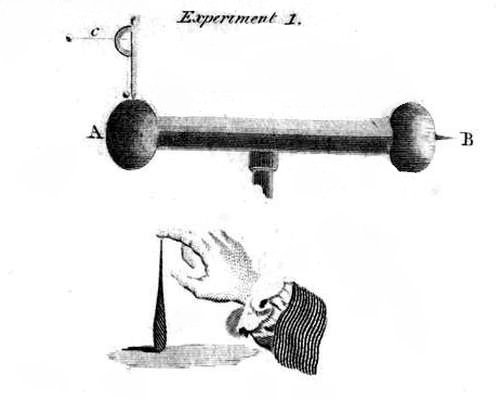
The prime conductor of an electric machine, A. B. (See Plate IV.) being supported about 10 inches and a half above the table by a wax-stand, and under it erected a pointed wire 7 inches and a half high, and one-fifth of an inch thick, and tapering to a sharp point, and communicating with the table; when the point (being uppermost) is covered by the end of a finger, the conductor may be full charged, and the electrometer c[86], will rise to the height indicating a full charge: but the moment the point is uncovered, the ball of the electrometer drops, showing the prime conductor to be instantly discharged and nearly emptied of its electricity. Turn the wire its blunt end upwards (which represents an unpointed bar) and no such effect follows, the electrometer remaining at its usual height when the prime conductor is charged.
Vol. I. page 388.
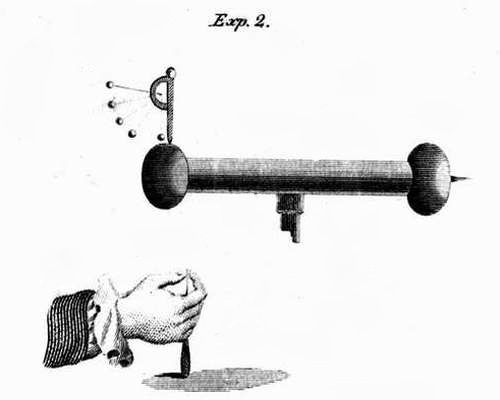
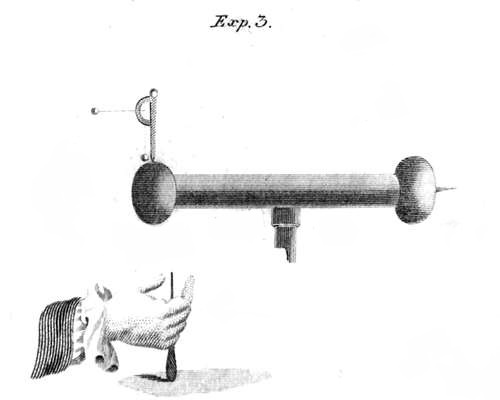
Plate IV.
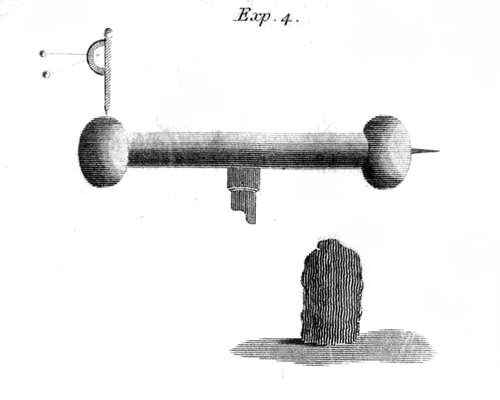
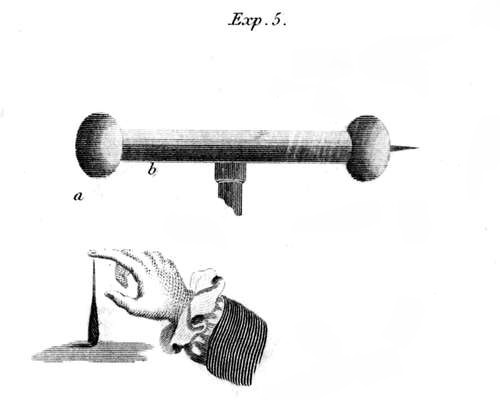
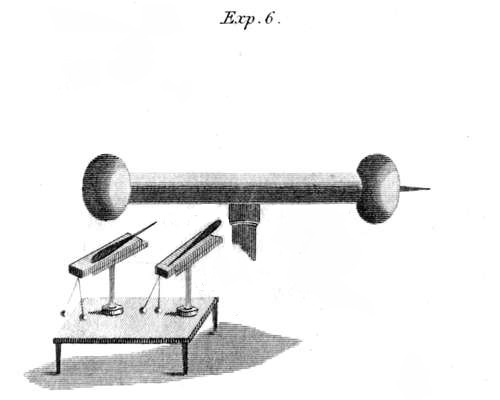
Published as the Act directs, April 1, 1806, by Longman, Hurst, Rees & Orme, Paternoster Row.
OBSERVATION.
What quantity of lightning, a high pointed rod well communicating with the earth may be expected to discharge from the clouds silently in a short time, is yet unknown; but I have reason from a particular fact to think it may at some times be very great. In Philadelphia I had such a rod fixed to the top of my chimney, and extending about nine feet above it. From the foot of this rod, a wire (the thickness of a goose-quill) came through a covered glass tube in the roof, and down through the well of the stair-case; the lower end connected with the iron spear of a pump. On the stair-case opposite to my chamber-door, the wire was divided; the ends separated about six inches, a little bell on each end; [and] between the bells a little brass ball suspended by a silk thread, to play between and strike the bells when clouds passed with electricity in them. After having frequently drawn sparks and charged bottles from the bell of the upper wire, I was one night waked by loud cracks on the stair-case. Starting up and opening the door, I perceived that the brass ball, instead of vibrating as usual between the bells, was repelled and kept at a distance from both; while the fire passed sometimes in very large quick cracks from bell to bell; and sometimes in a continued dense white stream, seemingly as large as my finger, whereby the whole stair-case was enlightened as with sunshine, so that one might see to pick up a pin[87]. And from the apparent quantity thus discharged, I cannot but conceive that a number[88] of such conductors must considerably lessen that of any approaching cloud, before it comes so near as to deliver its contents in a general stroke:—An effect not to be expected from bars unpointed; if the above experiment with the blunt end of the wire is deemed pertinent to the case.
EXPERIMENT II.
The pointed wire under the prime conductor continuing of the same height, pinch it between the thumb and finger near the top, so as just to conceal the point; then turning the globe, the electrometer will rise and mark the full charge. Slip the fingers down so as to discover about half an inch of the wire, then another half inch, and then another; at every one of these motions discovering more and more of the pointed wire; you will see the electrometer fall quick and proportionably, stopping when you stop. If you slip down the whole distance at once, the ball falls instantly down to the stem.
OBSERVATION.
From this experiment it seems that a greater effect in drawing off the lightning from the clouds may be expected from long pointed rods, than from short ones; I mean from such as show the greatest length, above the building they are fixed on.
EXPERIMENT III.
Instead of pinching the point between the thumb and finger, as in the last experiment, keep the thumb and finger each at near an inch distance from it, but at the same height, the point between them. In this situation, though the point is fairly exposed to the prime conductor, it has little or no effect; the electrometer rises to the height of a full charge.—But the moment the fingers are taken away, the ball falls quick to the stem.
OBSERVATION.
To explain this, it is supposed, that one reason of the sudden effect produced by a long naked pointed wire is, that (by the repulsive power of the positive charge in the prime conductor) the natural quantity of electricity contained in the pointed wire is driven down into the earth, and the point of the wire made strongly negative; whence it attracts the electricity of the prime conductor more strongly than bodies in their natural state would do; the small quantity of common matter in the point, not being able by its attractive force to retain its natural quantity of the electric fluid, against the force of that repulsion.—But the finger and thumb being substantial and blunt bodies, though as near the prime conductor, hold up better their own natural quantity against the force of that repulsion; and so, continuing nearly in the natural state, they jointly operate on the electric fluid in the point, opposing its descent, and aiding the point to retain it; contrary to the repelling power of the prime conductor, which would drive it down.—And this may also serve to explain the different powers of the point in the preceding experiment, on the slipping down the finger and thumb to different distances.
Hence is collected, that a pointed rod erected between two tall chimnies, and very little higher (an instance of which I have seen) cannot have so good an effect, as if it had been erected on one of the chimneys, its whole length above it.
EXPERIMENT IV.
If, instead of a long pointed wire, a large solid body (to represent a building without a point) be brought under and as near the prime conductor, when charged; the ball of the electrometer will fall a little; and on taking away the large body, will rise again.
OBSERVATION.
Its rising again shows that the prime conductor lost little or none of its electric charge, as it had done through the point: the falling of the ball while the large body was under the conductor therefore shows, that a quantity of its atmosphere was drawn from the end where the electrometer is placed to the part immediately over the large body, and there accumulated ready to strike into it with its whole undiminished force, as soon as within the striking distance; and, were the prime conductor moveable like a cloud, it would approach the body by attraction till within that distance. The swift motion of clouds, as driven by the winds, probably prevents this happening so often as otherwise it might do: for, though parts of the cloud may stoop towards a building as they pass, in consequence of such attraction, yet they are carried forward beyond the striking distance before they could by their descending come within it.
EXPERIMENT V.
Attach a small light lock of cotton to the underside of the prime conductor, so that it may hang down towards the pointed wire mentioned in the first experiment. Cover the point with your finger, and the globe being turned, the cotton will extend itself, stretching down towards the finger, as at a; but on uncovering the point, it instantly flies up to the prime conductor, as at b, and continues there as long as the point is uncovered. The moment you cover it again, the cotton flies down again, extending itself towards the finger; and the same happens in degree, if (instead of the finger) you use, uncovered, the blunt end of the wire uppermost.
OBSERVATION.
To explain this, it is supposed that the cotton, by its connection with the prime conductor, receives from it a quantity of its electricity; which occasions its being attracted by the finger that remains still in nearly its natural state. But when a point is opposed to the cotton, its electricity is thereby taken from it, faster than it can at a distance be supplied with a fresh quantity from the conductor. Therefore being reduced nearer to the natural state, it is attracted up to the electrified prime conductor; rather than down, as before, to the finger.
Supposing farther that the prime conductor represents a cloud charged with the electric fluid; the cotton, a ragged fragment of cloud (of which the underside of great thunder-clouds are seen to have many) the finger, a chimney or highest part of a building.—We then may conceive that when such a cloud passes over a building, some one of its ragged under-hanging fragments may be drawn down by the chimney or other high part of the edifice; creating thereby a more easy communication between it and the great cloud.—But a long pointed rod being presented to this fragment, may occasion its receding, like the cotton, up to the great cloud; and thereby increase, instead of lessening the distance, so as often to make it greater than the striking distance. Turning the blunt end of a wire uppermost (which represents the unpointed bar) it appears that the same good effect is not from that to be expected. A long pointed rod it is therefore imagined, may prevent some strokes; as well as conduct others that fall upon it, when a great body of cloud comes on so heavily that the above repelling operation on fragments cannot take place.
EXPERIMENT VI.
Opposite the side of the prime conductor place separately, isolated by wax stems, Mr. Canton's two boxes with pith balls suspended by fine linen threads. On each box, lay a wire six inches long and one-fifth of an inch thick, tapering to a sharp point; but so laid, as that four inches of the pointed end of one wire, and an equal length of the blunt end of the other, may project beyond the ends of the boxes; and both at eighteen inches distance from the prime conductor. Then charging the prime conductor by a turn or two of the globe, the balls of each pair will separate; those of the box, whence the point projects most, considerably; the others less. Touch the prime conductor, and those of the box with the blunt point will collapse, and join. Those connected with the point will at the same time approach each other, till within about an inch, and there remain.
OBSERVATION.
This seems a proof, that though the small sharpened part of the wire must have had a less natural quantity in it before the operation, than the thick blunt part; yet a greater quantity was driven down from it to the balls. Thence it is again inferred, that the pointed rod is rendered more negative: and farther, that if a stroke must fall from the cloud over a building, furnished with such a rod, it is more likely to be drawn to that pointed rod, than to a blunt one; as being more strongly negative, and of course its attraction stronger. And it seems more eligible, that the lightning should fall on the point of the conductor (provided to convey it into the earth) than on any other part of the building, thence to proceed to such conductor. Which end is also more likely to be obtained by the length and loftiness of the rod; as protecting more extensively the building under it.
It has been objected, that erecting pointed rods upon edifices, is to invite and draw the lightning into them; and therefore dangerous. Were such rods to be erected on buildings, without continuing the communication quite down into the moist earth, this objection might then have weight; but when such compleat conductors are made, the lightning is invited not into the building, but into the earth, the situation it aims at, and which it always seizes every help to obtain, even from broken partial metalline conductors.
It has also been suggested, that from such electric experiments nothing certain can be concluded as to the great operations of nature; since it is often seen, that experiments, which have succeeded in small, in large have failed. It is true that in mechanics this has sometimes happened. But when it is considered that we owe our first knowledge of the nature and operations of lightning, to observations on such small experiments; and that on carefully comparing the most accurate accounts of former facts, and the exactest relations of those that have occurred since, the effects have surprizingly agreed with the theory; it is humbly conceived that in natural philosophy, in this branch of it at least, the suggestion has not so much weight; and that the farther new experiments now adduced in recommendation of long sharp-pointed rods, may have some claim to credit and consideration.
It has been urged too, that though points may have considerable effects on a small prime conductor at small distances; yet on great clouds and at great distances, nothing is to be expected from them. To this it is answered, that in those small experiments it is evident the points act at a greater than the striking distance; and in the large way, their service is only expected where there is such nearness of the cloud, as to endanger a stroke; and there, it cannot be doubted the points must have some effect. And if the quantity discharged by a single pointed rod may be so considerable as I have shown it; the quantity discharged by a number will be proportionably greater.
But this part of the theory does not depend alone on small experiments. Since the practice of erecting pointed rods in America (now near twenty years) five of them have been struck by lightning, viz. Mr. Raven's and Mr. Maine's in South Carolina; Mr. Tucker's in Virginia; Mr. West's and Mr. Moulder's in Philadelphia. Possibly there may have been more that have not come to my knowledge. But in every one of these, the lightning did not fall upon the body of the house, but precisely on the several points of the rods; and, though the conductors were sometimes not sufficiently large and complete, was conveyed into the earth, without any material damage to the buildings. Facts then in great, as far as we have them authenticated, justify the opinion that is drawn from the experiments in small as above related.
It has also been objected, that unless we knew the quantity that might possibly be discharged at one stroke from the clouds, we cannot be sure we have provided sufficient conductors; and therefore cannot depend on their conveying away all that may fall on their points. Indeed we have nothing to form a judgment by in this but past facts; and we know of no instance where a compleat conductor to the moist earth has been insufficient, if half an inch diameter. It is probable that many strokes of lightning have been conveyed through the common leaden pipes affixed to houses to carry down the water from the roof to the ground: and there is no account of such pipes being melted and destroyed, as must sometimes have happened if they had been insufficient. We can then only judge of the dimensions proper for a conductor of lightning, as we do of those proper for a conductor of rain, by past observation. And as we think a pipe of three inches bore sufficient to carry off the rain that falls on a square of 20 feet, because we never saw such a pipe glutted by any shower; so we may judge a conductor of an inch diameter, more than sufficient for any stroke of lightning that will fall on its point. It is true that if another deluge should happen wherein the windows of heaven are to be opened, such pipes may be unequal to the falling quantity; and if God for our sins should think fit to rain fire upon us, as upon some cities of old, it is not expected that our conductors of whatever size, should secure our houses against a miracle. Probably as water drawn up into the air and there forming clouds, is disposed to fall again in rain by its natural gravity, as soon as a number of particles sufficient to make a drop can get together; so when the clouds are (by whatever means) over or under-charged [with the electric fluid] to a degree sufficient to attract them towards the earth, the equilibrium is restored, before the difference becomes great beyond that degree. Mr. Lane's electrometer, for limiting precisely the quantity of a shock that is to be administered in a medical view, may serve to make this more easily intelligible. The discharging knob does by a screw approach the conductor to the distance intended, but there remains fixed. Whatever power there may be in the glass globe to collect the fulminating fluid, and whatever capacity of receiving and accumulating it there may be in the bottle or glass jar; yet neither the accumulation or the discharge ever exceeds the destined quantity. Thus, were the clouds always at a certain fixed distance from the earth, all discharges would be made when the quantity accumulated was equal to the distance: But there is a circumstance which by occasionally lessening the distance, lessens the discharge; to wit, the moveableness of the clouds, and their being drawn nearer to the earth by attraction when electrified; so that discharges are thereby rendered more frequent and of course less violent. Hence whatever the quantity may be in nature, and whatever the power in the clouds of collecting it; yet an accumulation and force beyond what mankind has hitherto been acquainted with is scarce to be expected[89].