LETTERS AND PAPERS ON PHILOSOPHICAL SUBJECTS. ———— ELECTRICITY. (continued 3)
Reading edition
B. FRANKLIN.
ELECTRICAL EXPERIMENTS,
With an attempt to account for their several phænomena. Together with some observations on thunder-clouds, in further confirmation of Mr. Franklin's observations on the positive and negative electrical state of the clouds, by John Canton, M. A. and F. R. S.
Electrical experiments, with an attempt to account for their several phenomena &c.
Dec. 6, 1753.
EXPERIMENT I.
From the cieling, or any convenient part of a room, let two cork-balls, each about the bigness of a small pea, be suspended by linen threads of eight or nine inches in length, so as to be in contact with each other. Bring the excited glass tube under the balls, and they will be separated by it, when held at the distance of three or four feet; let it be brought nearer, and they will stand farther apart; entirely withdraw it, and they will immediately come together. This experiment may be made with very small brass balls hung by silver wire; and will succeed as well with sealing-wax made electrical, as with glass.
EXPERIMENT II.
If two cork-balls be suspended by dry silk threads, the excited tube must be brought within eighteen inches before they will repel each other; which they will continue to do, for some time, after the tube is taken away.
As the balls in the first experiment are not insulated, they cannot properly be said to be electrified: but when they hang within the atmosphere of the excited tube, they may attract and condense the electrical fluid round about them, and be separated by the repulsion of its particles. It is conjectured also, that the balls at this time contain less than their common share of the electrical fluid, on account of the repelling power of that which surrounds them; though some, perhaps, is continually entering and passing through the threads. And if that be the case, the reason is plain why the balls hung by silk, in the second experiment, must be in a much more dense part of the atmosphere of the tube, before they will repel each other. At the approach of an excited stick of wax to the balls, in the first experiment, the electrical fire is supposed to come through the threads into the balls, and be condensed there, in its passage towards the wax; for, according to Mr. Franklin, excited glass emits the electrical fluid, but excited wax receives it.
EXPERIMENT III.
Let a tin tube, of four or five feet in length, and about two inches in diameter, be insulated by silk; and from one end of it let the cork-balls be suspended by linen threads. Electrify it, by bringing the excited glass tube near the other end, so as that the balls may stand an inch and an half, or two inches, apart: then, at the approach of the excited tube, they will, by degrees, lose their repelling power, and come into contact; and as the tube is brought still nearer, they will separate again to as great a distance as before: in the return of the tube they will approach each other till they touch, and then repel as at first. If the tin tube be electrified by wax, or the wire of a charged phial, the balls will be affected in the same manner at the approach of excited wax, or the wire of the phial.
EXPERIMENT IV.
Electrify the cork-balls as in the last experiment by glass, and at the approach of an excited stick of wax their repulsion will be increased. The effect will be the same, if the excited glass be brought towards them, when they have been electrified by wax.
The bringing the excited glass to the end, or edge of the tin-tube, in the third experiment, is supposed to electrify it positively, or to add to the electrical fire it before contained; and therefore some will be running off through the balls, and they will repel each other. But at the approach of excited glass, which likewise emits the electrical fluid, the discharge of it from the balls will be diminished; or part will be driven back, by a force acting in a contrary direction: and they will come nearer together. If the tube be held at such a distance from the balls, that the excess of the density of the fluid round about them, above the common quantity in air, be equal to the excess of the density of that within them, above the common quantity contained in cork; their repulsion will be quite destroyed. But if the tube be brought nearer; the fluid without being more dense than that within the balls, it will be attracted by them, and they will recede from each other again.
When the apparatus has lost part of its natural share of this fluid, by the approach of excited wax to one end of it, or is electrified negatively; the electrical fire is attracted and imbibed by the balls to supply the deficiency; and that more plentifully at the approach of excited glass; or a body positively electrified, than before; whence the distance between the balls will be increased, as the fluid surrounding them is augmented. And in general, whether by the approach or recess of any body; if the difference between the density of the internal and external fluid be increased, or diminished; the repulsion of the balls will be increased, or diminished, accordingly.
EXPERIMENT V.
When the insulated tin tube is not electrified, bring the excited glass tube towards the middle of it, so as to be nearly at right angles with it, and the balls at the end will repel each other; and the more so, as the excited tube is brought nearer. When it has been held a few seconds, at the distance of about six inches, withdraw it, and the balls will approach each other till they touch; and then separating again, as the tube is moved farther off, will continue to repel when it is taken quite away. And this repulsion between the balls will be increased by the approach of excited glass, but diminished by excited wax; just as if the apparatus had been electrified by wax, after the manner described in the third experiment.
EXPERIMENT VI.
Insulate two tin tubes, distinguished by A and B, so as to be in a line with each other, and about half an inch apart; and at the remote end of each, let a pair of cork balls be suspended. Towards the middle of A, bring the excited glass tube, and holding it a short time, at the distance of a few inches, each pair of balls will be observed to separate: withdraw the tube, and the balls of A will come together, and then repel each other again; but those of B will hardly be affected. By the approach of the excited glass tube, held under the balls of A, their repulsion will be increased: but if the tube be brought, in the same manner, towards the balls of B, their repulsion will be diminished.
In the fifth experiment, the common stock of electrical matter in the tin tube, is supposed to be attenuated about the middle, and to be condensed at the ends, by the repelling power of the atmosphere of the excited glass tube, when held near it. And perhaps the tin tube may lose some of its natural quantity of the electrical fluid, before it receives any from the glass; as that fluid will more readily run off from the ends and edges of it, than enter at the middle: and accordingly, when the glass tube is withdrawn, and the fluid is again equally diffused through the apparatus, it is found to be electrified negatively: for excited glass brought under the balls will increase their repulsion.
In the sixth experiment, part of the fluid driven out of one tin tube enters the other; which is found to be electrified positively, by the decreasing of the repulsion of its balls, at the approach of excited glass.
EXPERIMENT VII.
Let the tin tube, with a pair of balls at one end, be placed three feet at least from any part of the room, and the air rendered very dry by means of a fire: electrify the apparatus to a considerable degree; then touch the tin tube with a finger, or any other conductor, and the balls will, notwithstanding, continue to repel each other; though not at so great a distance as before.
The air surrounding the apparatus to the distance of two or three feet, is supposed to contain more or less of the electrical fire, than its common share, as the tin tube is electrified positively, or negatively; and when very dry, may not part with its overplus, or have its deficiency supplied so suddenly, as the tin; but may continue to be electrified, after that has been touched for a considerable time.
EXPERIMENT VIII.
Having made the Torricellian vacuum about five feet long, after the manner described in the Philosophical Transactions, vol. xlvii. p. 370, if the excited tube be brought within a small distance of it, a light will be seen through more than half its length; which soon vanishes, if the tube be not brought nearer; but will appear again, as that is moved farther off. This may be repeated several times, without exciting the tube afresh.
This experiment may be considered as a kind of ocular demonstration of the truth of Mr. Franklin's hypothesis; that when the electrical fluid is condensed on one side of thin glass, it will be repelled from the other, if it meets with no resistance. According to which, at the approach of the excited tube, the fire is supposed to be repelled from the inside of the glass surrounding the vacuum, and to be carried off through the columns of mercury; but, as the tube is withdrawn, the fire is supposed to return.
EXPERIMENT IX.
Let an excited stick of wax, of two feet and an half in length, and about an inch in diameter, be held near its middle. Excite the glass tube, and draw it over one half of it; then, turning it a little about its axis, let the tube be excited again, and drawn over the same half; and let this operation be repeated several times: then will that half destroy the repelling power of balls electrified by glass, and the other half will increase it.
By this experiment it appears, that wax also may be electrified positively and negatively. And it is probable, that all bodies whatsoever may have the quantity they contain of the electrical fluid, increased, or diminished. The clouds, I have observed, by a great number of experiments, to be some in a positive, and others in a negative state of electricity. For the cork balls, electrified by them, will sometimes close at the approach of excited glass; and at other times be separated to a greater distance. And this change I have known to happen five or six times in less than half an hour; the balls coming together each time and remaining in contact a few seconds, before they repel each other again. It may likewise easily be discovered, by a charged phial, whether the electrical fire be drawn out of the apparatus by a negative cloud, or forced into it by a positive one: and by which soever it be electrified, should that cloud either part with its overplus, or have its deficiency supplied suddenly, the apparatus will lose its electricity: which is frequently observed to be the case, immediately after a flash of lightning. Yet when the air is very dry, the apparatus will continue to be electrised for ten minutes, or a quarter of an hour, after the clouds have passed the zenith; and sometimes till they appear more than half-way towards the horizon. Rain, especially when the drops are large, generally brings down the electrical fire: and hail, in summer, I believe never fails. When the apparatus was last electrified, it was by the fall of thawing snow, which happened so lately, as on the 12th of November; that being the twenty-sixth day, and sixty-first time it has been electrified, since it was first set up; which was about the middle of May. And as Fahrenheit's thermometer was but seven degrees above freezing, it is supposed the winter will not entirely put a stop to observations of this sort. At London, no more than two thunder-storms have happened during the whole summer; and the apparatus was sometimes so strongly electrified in one of them, that the bells, which have been frequently rung by the clouds, so loud as to be heard in every room of the house (the doors being open) were silenced by the almost constant stream of dense electrical fire, between each bell and the brass ball, which would not suffer it to strike.
I shall conclude this paper, already too long, with the following queries:
1. May not air, suddenly rarefied, give electrical fire to, and air suddenly condensed, receive electrical fire from, clouds and vapours passing through it?
2. Is not the aurora borealis, the flashing of electrical fire from positive, towards negative clouds at a great distance, through the upper part of the atmosphere, where the resistance is least?
EXPERIMENTS
Experiments Made in Pursuance of those made by Mr. Canton, dated December 6, 1753; with Explanations, by Mr. Benjamin Franklin.
Read at the Royal Society, Dec. 18, 1755.
Philadelphia, March 14, 1755.
PRINCIPLES.
I. Electric atmospheres, that flow round non-electric bodies, being brought near each other, do not readily mix and unite into one atmosphere, but remain separate, and repel each other.
This is plainly seen in suspended cork balls, and other bodies electrified.
II. An electric atmosphere not only repels another electric atmosphere, but will also repel the electric matter contained in the substance of a body approaching it; and without joining or mixing with it, force it to other parts of the body that contained it.
This is shewn by some of the following experiments.
III. Bodies electrified negatively, or deprived of their natural quantity of electricity, repel each other, (or at least appear to do so, by a mutual receding) as well as those electrified positively, or which have electric atmospheres.
This is shewn by applying the negatively charged wire of a phial to two cork balls, suspended by silk threads, and many other experiments.
PREPARATION.
Fix a tassel of fifteen or twenty threads, three inches long, at one end of a tin prime conductor (mine is about five feet long, and four inches diameter) supported by silk lines.
Let the threads be a little damp, but not wet.
EXPERIMENT I.
Pass an excited glass tube near the other end of the prime conductor, so as to give it some sparks, and the threads will diverge.
Because each thread, as well as the prime conductor, has acquired an electric atmosphere, which repels and is repelled by the atmospheres of the other threads: if those several atmospheres would readily mix, the threads might unite, and hang in the middle of one atmosphere, common to them all.
Rub the tube afresh, and approach the prime conductor therewith, crossways, near that end, but not nigh enough to give sparks; and the threads will diverge a little more.
Because the atmosphere of the prime conductor is pressed by the atmosphere of the excited tube, and driven towards the end where the threads are, by which each thread acquires more atmosphere.
Withdraw the tube, and they will close as much.
They close as much, and no more; because the atmosphere of the glass tube not having mixed with the atmosphere of the prime conductor, is withdrawn intire, having made no addition to, or diminution from it.
Bring the excited tube under the tuft of threads, and they will close a little.
They close, because the atmosphere of the glass tube repels their atmospheres, and drives part of them back on the prime conductor.
Withdraw it, and they will diverge as much.
For the portion of atmosphere which they had lost, returns to them again.
EXPERIMENT II.
Excite the glass tube, and approach the prime conductor with it, holding it across, near the end opposite to that on which the threads hang, at the distance of five or six inches. Keep it there a few seconds, and the threads of the tassels will diverge. Withdraw it, and they will close.
They diverge, because they have received electric atmospheres from the electric matter before contained in the substance of the prime conductor; but which is now repelled and driven away, by the atmosphere of the glass tube, from the parts of the prime conductor opposite and nearest to that atmosphere, and forced out upon the surface of the prime conductor at its other end, and upon the threads hanging thereto. Were it any part of the atmosphere of the glass tube that flowed over and along the prime conductor to the threads, and gave them atmospheres (as is the case when a spark is given to the prime conductor from the glass tube) such part of the tube's atmosphere would have remained, and the threads continue to diverge; but they close on withdrawing the tube, because the tube takes with it all its own atmosphere, and the electric matter, which had been driven out of the substance of the prime conductor, and formed atmospheres round the threads, is thereby permitted to return to its place.
Take a spark from the prime conductor near the threads, when they are diverged as before, and they will close.
For by so doing you take away their atmospheres, composed of the electric matter driven out of the substance of the prime conductor, as aforesaid, by the repellency of the atmosphere of the glass tube. By taking this spark you rob the prime conductor of part of its natural quantity of the electric matter; which part so taken is not supplied by the glass tube, for when that is afterwards withdrawn, it takes with it its whole atmosphere, and leaves the prime conductor electrised negatively, as appears by the next operation.
Then withdraw the tube, and they will open again.
For now the electric matter in the prime conductor, returning to its equilibrium, or equal diffusion, in all parts of its substance, and the prime conductor having lost some of its natural quantity, the threads connected with it lose part of theirs, and so are electrised negatively, and therefore repel each other, by Pr. III.
Approach the prime conductor with the tube near the same place as at first, and they will close again.
Because the part of their natural quantity of electric fluid, which they had lost, is now restored to them again, by the repulsion of the glass tube forcing that fluid to them from other parts of the prime conductor; so they are now again in their natural state.
Withdraw it, and they will open again.
For what had been restored to them, is now taken from them again, flowing back into the prime conductor, and leaving them once more electrised negatively.
Bring the excited tube under the threads, and they will diverge more.
Because more of their natural quantity is driven from them into the prime conductor, and thereby their negative electricity increased.
EXPERIMENT III.
The prime conductor not being electrified, bring the excited tube under the tassel, and the threads will diverge.
Part of their natural quantity is thereby driven out of them into the prime conductor, and they become negatively electrised, and therefore repel each other.
Keeping the tube in the same place with one hand, attempt to touch the threads with the finger of the other hand, and they will recede from the finger.
Because the finger being plunged into the atmosphere of the glass tube, as well as the threads, part of its natural quantity is driven back through the hand and body, by that atmosphere, and the finger becomes, as well as the threads, negatively electrised, and so repels, and is repelled by them. To confirm this, hold a slender light lock of cotton, two or three inches long, near a prime conductor, that is electrified by a glass globe, or tube. You will see the cotton stretch itself out towards the prime conductor. Attempt to touch it with the finger of the other hand, and it will be repelled by the finger. Approach it with a positively charged wire of a bottle, and it will fly to the wire. Bring it near a negatively charged wire of a bottle, it will recede from that wire in the same manner that it did from the finger; which demonstrates the finger to be negatively electrised, as well as the lock of cotton so situated.
Turkey killed by Electricity.—Effect of a Shock on the Operator in making the Experiment.
As Mr. Franklin, in a former letter to Mr. Collinson, mentioned his intending to try the power of a very strong electrical shock upon a turkey, that gentleman accordingly has been so very obliging as to send an account of it, which is to the following purpose.
He made first several experiments on fowls, and found, that two large thin glass jars gilt, holding each about six gallons, were sufficient, when fully charged, to kill common hens outright; but the turkeys, though thrown into violent convulsions, and then lying as dead for some minutes, would recover in less than a quarter of an hour. However, having added three other such to the former two, though not fully charged, he killed a turkey of about ten pounds weight, and believes that they would have killed a much larger. He conceited, as himself says, that the birds killed in this manner eat uncommonly tender.
In making these experiments, he found, that a man could, without great detriment, bear a much greater shock than he had imagined: for he inadvertently received the stroke of two of these jars through his arms and body, when they were very near fully charged. It seemed to him an universal blow throughout the body from head to foot, and was followed by a violent quick trembling in the trunk, which went off gradually, in a few seconds. It was some minutes before he could recollect his thoughts, so as to know what was the matter; for he did not see the flash, though his eye was on the spot of the prime conductor, from whence it struck the back of his hand; nor did he hear the crack, though the by-standers said it was a loud one; nor did he particularly feel the stroke on his hand, though he afterwards found it had raised a swelling there, of the bigness of half a pistol-bullet. His arms and the back of the neck felt somewhat numbed the remainder of the evening, and his breast was sore for a week after as if it had been bruised. From this experiment may be seen the danger, even under the greatest caution, to the operator, when making these experiments with large jars; for it is not to be doubted, but several of these fully charged would as certainly, by increasing them, in proportion to the size, kill a man, as they before did a turkey.
N. B. The original of this letter, which was read at the Royal Society, has been mislaid.
TO DR. L——[65], AT CHARLES TOWN, SOUTH CAROLINA.
Differences in the Qualities of Glass.—Account of Domien, an Electrician and Traveller.—Conjectures respecting the Pores of Glass.—Origin of the Author's Idea of drawing down Lightning.—No satisfactory Hypothesis respecting the Manner in which Clouds become electrified.—Six Men knocked down at once by an electrical Shock.—Reflections on the Spirit of Invention.
Philadelphia, March 18, 1755.
Sir,
I send you enclosed a paper containing some new experiments I have made, in pursuance of those by Mr. Canton that are printed with my last letters. I hope these, with my explanation of them, will afford you some entertainment[66].
In answer to your several enquiries. The tubes and globes we use here, are chiefly made here. The glass has a greenish cast, but is clear and hard, and, I think, better for electrical experiments than the white glass of London, which is not so hard. There are certainly great differences in glass. A white globe I had made here some years since, would never, by any means, be excited. Two of my friends tried it, as well as myself, without success. At length, putting it on an electric stand, a chain from the prime conductor being in contact with it, I found it had the properties of a non-electric; for I could draw sparks from any part of it, though it was very clean and dry.
All I know of Domien, is, that by his own account he was a native of Transylvania, of Tartar descent, but a priest of the Greek church: he spoke and wrote Latin very readily and correctly. He set out from his own country with an intention of going round the world, as much as possible by land. He travelled through Germany, France, and Holland, to England. Resided some time at Oxford. From England he came to Maryland; thence went to New England; returned by land to Philadelphia; and from hence travelled through Maryland, Virginia, and North Carolina to you. He thought it might be of service to him in his travels to know something of electricity. I taught him the use of the tube; how to charge the Leyden phial, and some other experiments. He wrote to me from Charles-Town, that he had lived eight hundred miles upon electricity, it had been meat, drink, and cloathing to him. His last letter to me was, I think, from Jamaica, desiring me to send the tubes you mention, to meet him at the Havannah, from whence he expected to get a passage to La Vera Cruz; designed travelling over land through Mexico to Acapulco; thence to get a passage to Manilla, and so through China, India, Persia, and Turkey, home to his own country; proposing to support himself chiefly by electricity. A strange project! But he was, as you observe, a very singular character. I was sorry the tubes did not get to the Havannah in time for him. If they are still in being, please to send for them, and accept of them. What became of him afterwards I have never heard. He promised to write to me as often as he could on his journey, and as soon as he should get home after finishing his tour. It is now seven years since he was here. If he is still in New Spain, as you imagine from that loose report, I suppose it must be that they confine him there, and prevent his writing: but I think it more likely that he may be dead.
The questions you ask about the pores of glass, I cannot answer otherwise, than that I know nothing of their nature; and suppositions, however ingenious, are often mere mistakes. My hypothesis, that they were smaller near the middle of the glass, too small to admit the passage of electricity, which could pass through the surface till it came near the middle, was certainly wrong: For soon after I had written that letter, I did, in order to confirm the hypothesis (which indeed I ought to have done before I wrote it) make an experiment. I ground away five-sixths of the thickness of the glass, from the side of one of my phials, expecting that the supposed denser part being so removed, the electric fluid might come through the remainder of the glass, which I had imagined more open; but I found myself mistaken. The bottle charged as well after the grinding as before. I am now, as much as ever, at a loss to know how or where the quantity of electric fluid, on the positive side of the glass, is disposed of.
As to the difference of conductors, there is not only this, that some will conduct electricity in small quantities, and yet do not conduct it fast enough to produce the shock; but even among those that will conduct a shock, there are some that do it better than others. Mr. Kinnersley has found, by a very good experiment, that when the charge of a bottle hath an opportunity of passing two ways, i. e. straight through a trough of water ten feet long, and six inches square; or round about through twenty feet of wire, it passes through the wire, and not through the water, though that is the shortest course; the wire being the better conductor. When the wire is taken away, it passes through the water, as may be felt by a hand plunged in the water; but it cannot be felt in the water when the wire is used at the same time. Thus, though a small phial containing water will give a smart shock, one containing the same quantity of mercury will give one much stronger, the mercury being the better conductor; while one containing oil, only, will scarce give any shock at all.
Your question, how I came first to think of proposing the experiment of drawing down the lightning, in order to ascertain its sameness with the electric fluid, I cannot answer better than by giving you an extract from the minutes I used to keep of the experiments I made, with memorandums of such as I purposed to make, the reasons for making them, and the observations that arose upon them, from which minutes my letters were afterwards drawn. By this extract you will see that the thought was not so much "an out-of-the-way one," but that it might have occurred to an electrician.
"Nov. 7, 1749. Electrical fluid agrees with lightning in these particulars: 1. Giving light. 2. Colour of the light. 3. Crooked direction. 4. Swift motion. 5. Being conducted by metals. 6. Crack or noise in exploding. 7. Subsisting in water or ice. 8. Rending bodies it passes through. 9. Destroying animals. 10. Melting metals. 11. Firing inflammable substances. 12. Sulphureous smell.—The electric fluid is attracted by points.—We do not know whether this property is in lightning.—But since they agree in all the particulars wherein we can already compare them, is it not probable they agree likewise in this?—Let the experiment be made."
I wish I could give you any satisfaction in the article of clouds. I am still at a loss about the manner in which they become charged with electricity; no hypothesis I have yet formed perfectly satisfying me. Some time since, I heated very hot a brass plate, two feet square, and placed it on an electric stand. From the plate a wire extended horizontally four or five feet, and, at the end of it, hung, by linen threads, a pair of cork balls. I then repeatedly sprinkled water over the plate, that it might be raised from it in vapour, hoping that if the vapour either carried off the electricity of the plate, or left behind it that of the water (one of which I supposed it must do, if, like the clouds, it became electrised itself, either positively or negatively) I should perceive and determine it by the separation of the balls, and by finding whether they were positive or negative; but no alteration was made at all, nor could I perceive that the steam was itself electrised, though I have still some suspicion that the steam was not fully examined, and I think the experiment should be repeated. Whether the first state of electrised clouds is positive or negative, if I could find the cause of that, I should be at no loss about the other, for either is easily deduced from the other, as one state is easily produced by the other. A strongly positive cloud may drive out of a neighbouring cloud much of its natural quantity of the electric fluid, and, passing by it, leave it in a negative state. In the same way, a strongly negative cloud may occasion a neighbouring cloud to draw into itself from others, an additional quantity, and, passing by it, leave it in a positive state. How these effects may be produced, you will easily conceive, on perusing and considering the experiments in the enclosed paper: and from them too it appears probable, that every change from positive to negative, and from negative to positive, that, during a thunder-gust, we see in the cork-balls annexed to the apparatus, is not owing to the presence of clouds in the same state, but often to the absence of positive or negative clouds, that, having just passed, leave the rod in the opposite state.
The knocking down of the six men was performed with two of my large jars not fully charged. I laid one end of my discharging rod upon the head of the first; he laid his hand on the head of the second; the second his hand on the head of the third, and so to the last, who held, in his hand, the chain that was connected with the outside of the jars. When they were thus placed, I applied the other end of my rod to the prime conductor, and they all dropped together. When they got up, they all declared they had not felt any stroke, and wondered how they came to fall; nor did any of them either hear the crack, or see the light of it. You suppose it a dangerous experiment; but I had once suffered the same myself, receiving, by accident, an equal stroke through my head, that struck me down, without hurting me: and I had seen a young woman that was about to be electrified through the feet (for some indisposition) receive a greater charge through the head, by inadvertently stooping forward to look at the placing of her feet, till her forehead (as she was very tall) came too near my prime conductor: she dropped, but instantly got up again, complaining of nothing. A person so struck, sinks down doubled, or folded together as it were, the joints losing their strength and stiffness at once, so that he drops on the spot where he stood, instantly, and there is no previous staggering, nor does he ever fall lengthwise. Too great charge might, indeed, kill a man, but I have not yet seen any hurt done by it. It would certainly, as you observe, be the easiest of all deaths.
The experiment you have heard so imperfect an account of, is merely this: I electrified a silver pint can, on an electric stand, and then lowered into it a cork ball, of about an inch diameter, hanging by a silk string, till the cork touched the bottom of the can. The cork was not attracted to the inside of the can as it would have been to the outside, and though it touched the bottom, yet, when drawn out, it was not found to be electrified by that touch, as it would have been by touching the outside. The fact is singular. You require the reason; I do not know it. Perhaps you may discover it, and then you will be so good as to communicate it to me[67]. I find a frank acknowledgment of one's ignorance is not only the easiest way to get rid of a difficulty, but the likeliest way to obtain information, and therefore I practise it: I think it an honest policy. Those who affect to be thought to know every thing, and so undertake to explain every thing, often remain long ignorant of many things that others could and would instruct them in, if they appeared less conceited.
The treatment your friend has met with is so common, that no man who knows what the world is, and ever has been, should expect to escape it. There are every where a number of people, who, being totally destitute of any inventive faculty themselves, do not readily conceive that others may possess it: they think of inventions as of miracles; there might be such formerly, but they are ceased. With these, every one who offers a new invention is deemed a pretender: he had it from some other country, or from some book: a man of their own acquaintance; one who has no more sense than themselves, could not possibly, in their opinion, have been the inventor of any thing. They are confirmed, too, in these sentiments, by frequent instances of pretensions to invention, which vanity is daily producing. That vanity too, though an incitement to invention, is, at the same time, the pest of inventors. Jealousy and envy deny the merit or the novelty of your invention; but vanity, when the novelty and merit are established, claims it for its own. The smaller your invention is, the more mortification you receive in having the credit of it disputed with you by a rival, whom the jealousy and envy of others are ready to support against you, at least so far as to make the point doubtful. It is not in itself of importance enough for a dispute; no one would think your proofs and reasons worth their attention: and yet, if you do not dispute the point, and demonstrate your right, you not only lose the credit of being in that instance ingenious, but you suffer the disgrace of not being ingenuous; not only of being a plagiary, but of being a plagiary for trifles. Had the invention been greater it would have disgraced you less; for men have not so contemptible an idea of him that robs for gold on the highway, as of him that can pick pockets for half-pence and farthings. Thus, through envy, jealousy, and the vanity of competitors for fame, the origin of many of the most extraordinary inventions, though produced within but a few centuries past, is involved in doubt and uncertainty. We scarce know to whom we are indebted for the compass, and for spectacles, nor have even paper and printing, that record every thing else, been able to preserve with certainty the name and reputation of their inventors. One would not, therefore, of all faculties, or qualities of the mind, wish, for a friend, or a child, that he should have that of invention. For his attempts to benefit mankind in that way, however well imagined, if they do not succeed, expose him, though very unjustly, to general ridicule and contempt; and, if they do succeed, to envy, robbery, and abuse.
I am, &c.
B. FRANKLIN.
FOOTNOTES:
TO MONS. DALIBARD, AT PARIS, INCLOSED IN A LETTER TO MR. PETER COLLINSON, F. R. S.
Beccaria's Work on Electricity.—Sentiments of Franklin on pointed Rods, not fully understood in Europe.—Effect of Lightning on the Church of Newbury, in New England.—Remarks on the Subject.
Read at the Royal Society, Dec. 18, 1755.
Philadelphia, June 29, 1755.
Sir,
You desire my opinion of Pere Beccaria's Italian book[68]. I have read it with much pleasure, and think it one of the best pieces on the subject that I have seen in any language. Yet as to the article of water-spouts, I am not at present of his sentiments; though I must own with you, that he has handled it very ingeniously. Mr. Collinson has my opinion of whirlwinds and water-spouts at large, written some time since. I know not whether they will be published; if not, I will get them transcribed for your perusal[69]. It does not appear to me that Pere Beccaria doubts of the absolute impermeability of glass in the sense I meant it; for the instances he gives of holes made through glass by the electric stroke are such as we have all experienced, and only show that the electric fluid could not pass without making a hole. In the same manner we say, glass is impermeable to water, and yet a stream from a fire-engine will force through the strongest panes of a window. As to the effect of points in drawing the electric matter from clouds, and thereby securing buildings, &c. which, you say, he seems to doubt, I must own I think he only speaks modestly and judiciously. I find I have been but partly understood in that matter. I have mentioned it in several of my letters, and except once, always in the alternative, viz. that pointed rods erected on buildings, and communicating with the moist earth, would either prevent a stroke, or, if not prevented, would conduct it, so as that the building should suffer no damage. Yet whenever my opinion is examined in Europe, nothing is considered but the probability of those rods preventing a stroke or explosion, which is only a part of the use I proposed for them; and the other part, their conducting a stroke, which they may happen not to prevent, seems to be totally forgotten, though of equal importance and advantage.
I thank you for communicating M. de Buffon's relation of the effect of lightning at Dijon, on the 7th of June last. In return, give me leave to relate an instance I lately saw of the same kind. Being in the town of Newbury in New England, in November last, I was shewn the effect of lightning on their church, which had been struck a few months before. The steeple was a square tower of wood, reaching seventy feet up from the ground to the place where the bell hung, over which rose a taper spire, of wood likewise, reaching seventy feet higher, to the vane of the weather-cock. Near the bell was fixed an iron hammer to strike the hours; and from the tail of the hammer a wire went down through a small gimlet-hole in the floor that the bell stood upon, and through a second floor in like manner; then horizontally under and near the plaistered cieling of that second floor, till it came near a plaistered wall; then down by the side of that wall to a clock, which stood about twenty feet below the bell. The wire was not bigger than a common knitting-needle. The spire was split all to pieces by the lightning, and the parts flung in all directions over the square in which the church stood, so that nothing remained above the bell.
The lightning passed between the hammer and the clock in the above-mentioned wire, without hurting either of the floors, or having any effect upon them (except making the gimlet-holes, through which the wire passed, a little bigger,) and without hurting the plaistered wall, or any part of the building, so far as the aforesaid wire and the pendulum wire of the clock extended; which latter wire was about the thickness of a goose-quill. From the end of the pendulum, down quite to the ground, the building was exceedingly rent and damaged, and some stones in the foundation-wall torn out, and thrown to the distance of twenty or thirty feet. No part of the afore-mentioned long small wire, between the clock and the hammer, could be found, except about two inches that hung to the tail of the hammer, and about as much that was fastened to the clock; the rest being exploded, and its particles dissipated in smoke and air, as gunpowder is by common fire, and had only left a black smutty track on the plaistering, three or four inches broad, darkest in the middle, and fainter toward the edges, all along the cieling, under which it passed, and down the wall. These were the effects and appearances; on which I would only make the few following remarks, viz.
1. That lightning, in its passage through a building, will leave wood to pass as far as it can in metal, and not enter the wood again till the conductor of metal ceases.
And the same I have observed in other instances, as to walls of brick or stone.
2. The quantity of lightning that passed through this steeple must have been very great, by its effects on the lofty spire above the bell, and on the square tower all below the end of the clock pendulum.
3. Great as this quantity was, it was conducted by a small wire and a clock pendulum, without the least damage to the building so far as they extended.
4. The pendulum rod being of a sufficient thickness, conducted the lightning without damage to itself; but the small wire was utterly destroyed.
5. Though the small wire was itself destroyed, yet it had conducted the lightning with safety to the building.
6. And from the whole it seems probable, that if even such a small wire had been extended from the spindle of the vane to the earth, before the storm, no damage would have been done to the steeple by that stroke of lightning, though the wire itself had been destroyed.
FOOTNOTES:
TO PETER COLLINSON, ESQ. F. R. S. LONDON.
Notice of another Packet of Letters.
Philadelphia, Nov. 23, 1753.
DEAR FRIEND.
In my last, via Virginia, I promised to send you per next ship, a small philosophical packet: but now having got the materials (old letters and rough drafts) before me, I fear you will find it a great one. Nevertheless, as I am like to have a few days leisure before this ship sails, which I may not have again in a long time, I shall transcribe the whole, and send it; for you will be under no necessity of reading it all at once, but may take it a little at a time, now and then of a winter evening. When you happen to have nothing else to do (if that ever happens) it may afford you some amusement[70].
B. FRANKLIN.
FOOTNOTES:
Extract of a Letter from a Gentleman in Boston[72], to Benjamin Franklin, Esq. concerning the crooked Direction, and the Source of Lightning, and the Swiftness of the electric Fire.
Boston, Dec. 21, 1751.
Sir,
The experiments Mr. K. has exhibited here, have been greatly pleasing to all sorts of people that have seen them; and I hope, by the time he returns to Philadelphia, his tour this way will turn to good account. His experiments are very curious, and I think prove most effectually your doctrine of electricity; that it is a real element, annexed to, and diffused among all bodies we are acquainted with; that it differs in nothing from lightning, the effects of both being similar, and their properties, so far as they are known, the same, &c.
The remarkable effect of lightning on iron, lately discovered, in giving it the magnetic virtue, and the same effect produced on small needles by the electrical fire, is a further and convincing proof that they are both the same element; but, which is very unaccountable, Mr. K. tells me, it is necessary to produce this effect, that the direction of the needle and the electric fire should be north and south; from either to the other, and that just so far as they deviate therefrom, the magnetic power in the needle is less, till their direction being at right angles with the north and south, the effect entirely ceases. We made at Faneuil Hall, where Mr. K——'s apparatus is, several experiments to give some small needles the magnetic virtue; previously examining, by putting them in water, on which they will be supported, whether or not they had any of that virtue; and I think we found all of them to have some small degree of it, their points turning to the north: we had nothing to do then but to invert the poles, which accordingly was done, by sending through them the charge of two large glass jars; the eye of the needle turning to the north, as the point before had done; that end of the needle which the fire is thrown upon, Mr. K. tells me always points to the north.
The electrical fire passing through air has the same crooked direction as lightning[73]. This appearance I endeavour to account for thus: Air is an electric per se, therefore there must be a mutual repulsion betwixt air and the electrical fire. A column or cylinder of air, having the diameter of its base equal to the diameter of the electrical spark, intervenes that part of the body which the spark is taken from, and of the body it aims at. The spark acts upon this column, and is acted upon by it, more strongly than any other neighbouring portion of air.
The column, being thus acted upon, becomes more dense, and, being more dense, repels the spark more strongly; its repellency being in proportion to its density: Having acquired, by being condensed, a degree of repellency greater than its natural, it turns the spark out of its strait course; the neighbouring air, which must be less dense, and therefore has a smaller degree of repellency, giving it a more ready passage.
The spark, having taken a new direction, must now act on, or most strongly repel the column of air which lies in that direction, and consequently must condense that column in the same manner as the former, when the spark must again change its course, which course will be thus repeatedly changed, till the spark reaches the body that attracted it.
To this account one objection occurs; that as air is very fluid and elastic, and so endeavours to diffuse itself equally, the supposed accumulated air within the column aforesaid, would be immediately diffused among the contiguous air, and circulate to fill the space it was driven from; and consequently that the said column, on the greater density of which the phenomenon is supposed to depend, would not repel the spark more strongly than the neighbouring air.
This might be an objection, if the electrical fire was as sluggish and inactive as air. Air takes a sensible time to diffuse itself equally, as is manifest from winds which often blow for a considerable time together from the same point, and with a velocity even in the greatest storms, not exceeding, as it is said, sixty miles an hour: but the electric fire seems propagated instantaneously, taking up no perceptible time in going very great distances. It must then be an inconceivably short time in its progress from an electrified to an unelectrified body, which, in the present case, can be but a few inches apart: but this small portion of time is not sufficient for the elasticity of the air to exert itself, and therefore the column aforesaid must be in a denser state than its neighbouring air.
About the velocity of the electric fire more is said below, which perhaps may more fully obviate this objection. But let us have recourse to experiments. Experiments will obviate all objections, or confound the hypothesis. The electric spark, if the foregoing be true, will pass through a vacuum in a right line. To try this, let a wire be fixed perpendicularly on the plate of an air pump, having a leaden ball on its upper end; let another wire, passing through the top of a receiver, have on each end a leaden ball; let the leaden balls within the receiver, when put on the air pump, be within two or three inches of each other: the receiver being exhausted, the spark given from a charged phial to the upper wire will pass through rarefied air, nearly approaching to a vacuum, to the lower wire, and I suppose in a right line, or nearly so; the small portion of air remaining in the receiver, which cannot be entirely exhausted, may possibly cause it to deviate a little, but perhaps not sensibly, from a right line. The spark also might be made to pass through air greatly condensed, which perhaps would give a still more crooked direction. I have not had opportunity to make any experiments of this sort, not knowing of an air-pump nearer than Cambridge, but you can easily make them. If these experiments answer, I think the crooked direction of lightning will be also accounted for.
With respect to your letters on electricity, * * * * * * * * * * * * * * *. Your hypothesis in particular for explaining the phenomena of lightning is very ingenious. That some clouds are highly charged with electrical fire, and that their communicating it to those that have less, to mountains and other eminencies, makes it visible and audible, when it is denominated lightning and thunder, is highly probable: but that the sea, which you suppose the grand source of it, can collect it, I think admits of a doubt: for though the sea be composed of salt and water, an electric per se and non-electric, and though the friction of electrics per se and non-electrics, will collect that fire, yet it is only under certain circumstances, which water will not admit. For it seems necessary, that the electrics per se and non-electrics rubbing one another, should be of such substances as will not adhere to, or incorporate with each other. Thus a glass or sulphur sphere turned in water, and so a friction between them, will not collect any fire; nor, I suppose, would a sphere of salt revolving in water; the water adhering to, or incorporating with those electrics per se. But granting that the friction between salt and water would collect the electrical fire, that fire, being so extremely subtle and active, would be immediately communicated, either to those lower parts of the sea from which it was drawn, and so only perform quick revolutions; or be communicated to the adjacent islands or continent, and so be diffused instantaneously through the general mass of the earth. I say instantaneously, for the greatest distances we can conceive within the limits of our globe, even that of the two most opposite points, it will take no sensible time in passing through: and therefore it seems a little difficult to conceive how there can be any accumulation of the electrical fire upon the surface of the sea or how the vapours arising from the sea should have a greater share of that fire than other vapours.
That the progress of the electrical fire is so amazingly swift, seems evident from an experiment you yourself (not out of choice) made, when two or three large glass jars were discharged through your body. You neither heard the crack, was sensible of the stroke, nor, which is more extraordinary, saw the light; which gave you just reason to conclude, that it was swifter than sound, than animal sensation, and even light itself. Now light (as astronomers have demonstrated) is about six minutes passing from the sun to the earth; a distance, they say, of more than eighty millions of miles. The greatest rectilinear distance within the compass of the earth is about eight thousand miles, equal to its diameter. Supposing then, that the velocity of the electric fire be the same as that of light, it will go through a space equal to the earth's diameter in about 2/60 of one second of a minute. It seems inconceivable then, that it should be accumulated upon the sea, in its present state, which, as it is a non-electric, must give the fire an instantaneous passage to the neighbouring shores, and they convey it to the general mass of the earth. But such accumulation seems still more inconceivable when the electrical fire has but a few feet depth of water to penetrate, to return to the place from whence it is supposed to be collected.
Your thoughts upon these remarks I shall receive with a great deal of pleasure. I take notice that in the printed copies of your letters several things are wanting which are in the manuscript you sent me. I understand by your son, that you had writ, or was writing, a paper on the effect of the electrical fire on loadstones, needles, &c. which I would ask the favour of a copy of, as well as of any other papers on electricity, written since I had the manuscript, for which I repeat my obligations to you.
I am, &c.
J. B.
FOOTNOTES:
TO J. B. AT BOSTON.
Observations on the Subjects of the preceding Letter.—Reasons for supposing the Sea to be the grand source of Lightning.—Reasons for doubting this hypothesis.—Improvement in a Globe for raising the Electric Fire.
Read at the Royal Society, May 27, 1756.
Philadelphia, Jan. 24, 1752.
Sir,
I am glad to learn, by your favour of the 21st past, that Mr. Kinnersley's lectures have been acceptable to the gentlemen of Boston, and are like to prove serviceable to himself.
I thank you for the countenance and encouragement you have so kindly afforded my fellow-citizen.
I send you enclosed an extract of a letter containing the substance of what I observed concerning the communication of magnetism to needles by electricity. The minutes I took at the time of the experiments are mislaid. I am very little acquainted with the nature of magnetism. Dr. Gawin Knight, inventor of the steel magnets, has wrote largely on that subject, but I have not yet had leisure to peruse his writings with the attention necessary to become master of his doctrine.
Your explication of the crooked direction of lightning appears to me both ingenious and solid. When we can account as satisfactorily for the electrification of clouds, I think that branch of natural philosophy will be nearly complete.
The air, undoubtedly, obstructs the motion of the electric fluid. Dry air prevents the dissipation of an electric atmosphere, the denser the more, as in cold weather. I question whether such an atmosphere can be retained by a body in vacuo. A common electrical phial requires a non-electric communication from the wire to every part of the charged glass; otherwise, being dry and clean, and filled with air only, it charges slowly, and discharges gradually, by sparks, without a shock: but, exhausted of air, the communication is so open and free between the inserted wire and surface of the glass, that it charges as readily, and shocks as smartly as if filled with water: and I doubt not, but that in the experiment you propose, the sparks would not only be near strait in vacuo, but strike at a greater distance than in the open air, though perhaps there would not be a loud explosion. As soon as I have a little leisure, I will make the experiment, and send you the result.
My supposition, that the sea might possibly be the grand source of lightning, arose from the common observation of its luminous appearance in the night, on the least motion; an appearance never observed in fresh water. Then I knew that the electric fluid may be pumped up out of the earth, by the friction of a glass globe, on a non-electric cushion; and that, notwithstanding the surprising activity and swiftness of that fluid, and the non-electric communication between all parts of the cushion and the earth, yet quantities would be snatched up by the revolving surface of the globe, thrown on the prime conductor, and dissipated in air. How this was done, and why that subtle active spirit did not immediately return again from the globe, into some part or other of the cushion, and so into the earth, was difficult to conceive; but whether from its being opposed by a current setting upwards to the cushion, or from whatever other cause, that it did not so return was an evident fact. Then I considered the separate particles of water as so many hard spherules, capable of touching the salt only in points, and imagined a particle of salt could therefore no more be wet by a particle of water, than a globe by a cushion; that there might therefore be such a friction between these originally constituent particles of salt and water, as in a sea of globes and cushions; that each particle of water on the surface might obtain from the common mass, some particles of the universally diffused, much finer, and more subtle electric fluid, and forming to itself an atmosphere of those particles, be repelled from the then generally electrified surface of the sea, and fly away with them into the air. I thought too, that possibly the great mixture of particles electric per se, in the ocean water, might, in some degree, impede the swift motion and dissipation of the electric fluid, through it to the shores, &c.—But having since found, that salt in the water of an electric phial does not lessen the shock; and having endeavoured in vain to produce that luminous appearance from a mixture of salt and water agitated; and observed, that even the sea-water will not produce it after some hours standing in a bottle; I suspect it to proceed from some principle yet unknown to us (which I would gladly make some experiments to discover, if I lived near the sea) and I grow more doubtful of my former supposition, and more ready to allow weight to that objection (drawn from the activity of the electric fluid, and the readiness of water to conduct) which you have indeed stated with great strength and clearness.
In the mean time, before we part with this hypothesis, let us think what to substitute in its place. I have sometimes queried whether the friction of the air, an electric per se, in violent winds, among trees, and against the surface of the earth, might not pump up, as so many glass globes, quantities of the electric fluid, which the rising vapours might receive from the air, and retain in the clouds they form? on which I should be glad to have your sentiments. An ingenious friend of mine supposes the land-clouds more likely to be electrified than the sea-clouds. I send his letter for your perusal, which please to return me.
I have wrote nothing lately on electricity, nor observed any thing new that is material, my time being much taken up with other affairs. Yesterday I discharged four jars through a fine wire, tied up between two strips of glass: the wire was in part melted, and the rest broke into small pieces, from half an inch long, to half a quarter of an inch. My globe raises the electric fire with greater ease, in much greater quantities, by the means of a wire extended from the cushion, to the iron pin of a pump handle behind my house, which communicates by the pump spear with the water in the well.
By this post I send to ****, who is curious in that way, some meteorological observations and conjectures, and desire him to communicate them to you, as they may afford you some amusement, and I know you will look over them with a candid eye. By throwing our occasional thoughts on paper, we more readily discover the defects of our opinions, or we digest them better and find new arguments to support them. This I sometimes practise: but such pieces are fit only to be seen by friends.
I am, &c.
B. FRANKLIN.
FROM J. B. ESQ. OF BOSTON, TO BENJAMIN FRANKLIN, ESQ. AT PHILADELPHIA.
Effect of Lightning on Captain Waddel's Compass, and the Dutch Church at New York.
Read at the Royal Society, June 3, 1756.
Boston, March 2, 1752.
Sir,
I have received your favour of the 24th of January past, inclosing an extract from your letter to Mr. Collinson, and ****'s letter to yourself, which I have read with a great deal of pleasure, and am much obliged to you for. Your extract confirms a correction Mr. Kinnersley made a few days ago, of a mistake I was under respecting the polarity given to needles by the electrical fire, "that the end which receives the fire always points north;" and, "that the needle being situated east and west, will not have a polar direction." You find, however, the polarity strongest when the needle is shocked lying north and south; weakest when lying east and west; which makes it probable that the communicated magnetism is less, as the needle varies from a north and south situation. As to the needle of Captain Waddel's compass, if its polarity was reversed by the lightning, the effect of lightning and electricity, in regard of that, seems dissimilar; for a magnetic needle in a north and south situation (as the compass needle was) instead of having its power reversed, or even diminished, would have it confirmed or increased by the electric fire. But perhaps the lightning communicated to some nails in the binnacle (where the compass is placed) the magnetic virtue, which might disturb the compass.
This I have heard was the case; if so, the seeming dissimilarity vanishes: but this remarkable circumstance (if it took place) I should think would not be omitted in Captain Waddel's account.
I am very much pleased that the explication I sent you, of the crooked direction of lightning, meets with your approbation.
As to your supposition about the source of lightning, the luminous appearance of the sea in the night, and the similitude between the friction of the particles of salt and water, as you considered them in their original separate state, and the friction of the globe and cushion, very naturally led you to the ocean, as the grand source of lightning: but the activity of lightning, or the electric element, and the fitness of water to conduct it, together with the experiments you mention of salt and water, seem to make against it, and to prepare the way for some other hypothesis. Accordingly you propose a new one, which is very curious, and not so liable, I think, to objections as the former. But there is not as yet, I believe, a sufficient variety of experiments to establish any theory, though this seems the most hopeful of any I have heard of.
The effect which the discharge of your four glass jars had upon a fine wire, tied between two strips of glass, puts me in mind of a very similar one of lightning, that I observed at New-York, October, 1750, a few days after I left Philadelphia. In company with a number of gentlemen, I went to take a view of the city from the Dutch church steeple, in which is a clock about twenty or twenty-five feet below the bell. From the clock went a wire through two floors, to the clock-hammer near the bell, the holes in the floor for the wire being perhaps about a quarter of an inch diameter. We were told, that in the spring of 1750, the lightning struck the clock hammer, and descended along the wire to the clock, melting in its way several spots of the wire, from three to nine inches long, through one-third of its substance, till coming within a few feet of the lower end, it melted the wire quite through, in several places, so that it fell down in several pieces; which spots and pieces we saw. When it got to the end of the wire, it flew off to the hinge of a door, shattered the door, and dissipated. In its passage through the holes of the floors it did not do the least damage, which evidences that wire is a good conductor of lightning (as it is of electricity) provided it be substantial enough, and might, in this case, had it been continued to the earth, have conducted it without damaging the building.[74]
Your information about your globe's raising the electric fire in greater quantities, by means of a wire extended from the cushion to the earth, will enable me, I hope, to remedy a great inconvenience I have been under, to collect the fire with the electrifying glass I use, which is fixed in a very dry room, three stories from the ground. When you send your meteorological observations to ****, I hope I shall have the pleasure of seeing them.
I am, &c.
J. B.
FOOTNOTE:
Proposal of an Experiment to measure the Time taken up by an Electric Spark, in moving through any given Space. By J. A.[75] Esq. of New-York.
Read at the Royal Society, Dec 26, 1756.
If I remember right, the Royal Society made one experiment to discover the velocity of the electric fire, by a wire of about four miles in length, supported by silk, and by turning it forwards and backwards in a field, so that the beginning and end of the wire were at only the distance of two people, the one holding the Leyden bottle and the beginning of the wire, and the other holding the end of the wire and touching the ring of the bottle; but by this experiment no discovery was made, except that the velocity was extremely quick.
As water is a conductor as well as metals, it is to be considered whether the velocity of the electric fire might not be discovered by means of water; whether a river, or lake, or sea, may not be made part of the circuit through which the electric fire passes? instead of the circuit all of wire, as in the above experiment.
Whether in a river, lake, or sea, the electric fire will not dissipate and not return to the bottle? or, will it proceed in strait lines through the water the shortest courses possible back to the bottle?
If the last, then suppose one brook that falls into Delaware doth head very near to a brook that falls into Schuylkil, and let a wire be stretched and supported as before, from the head of the one brook to the head of the other, and let the one end communicate with the water, and let one person stand in the other brook, holding the Leyden bottle, and let another person hold that end of the wire not in the water, and touch the ring of the bottle.—If the electric fire will go as in the last question, then will it go down the one brook to Delaware or Schuylkill, and down one of them to their meeting, and up the other and the other brook; the time of its doing this may possibly be observable, and the further upwards the brooks are chosen, the more observable it would be.
Should this be not observable, then suppose the two brooks falling into Sasquehana and Delaware, and proceeding as before, the electric fire may, by that means, make a circuit round the North Cape of Virginia, and go many hundreds of miles, and in doing that, it would seem it must take some observable time.
If still no observable time is found in that experiment, then suppose the brooks falling the one into the Ohio, and the other into Sasquehana, or Potomack, in that the electric fire would have a circuit of some thousands of miles to go down Ohio to Mississippi, to the Bay of Mexico, round Florida, and round the South Cape of Virginia; which, I think, would give some observable time, and discover exactly the velocity.
But if the electric fire dissipates, or weakens in the water, as I fear it does, these experiments will not answer.
Answer to the foregoing.
Read at the Royal Society, Dec. 25, 1756.
Suppose a tube of any length open at both ends, and containing a moveable wire of just the same length, that fills its bore. If I attempt to introduce the end of another wire into the same tube, it must be done by pushing forward the wire it already contains; and the instant I press and move one end of that wire, the other end is also moved; and in introducing one inch of the same wire, I extrude, at the same time, an inch of the first, from the other end of the tube.
If the tube be filled with water, and I inject an additional inch of water at one end, I force out an equal quantity at the other, in the very same instant.
And the water forced out at one end of the tube is not the very same water that was forced in at the other end at the same time, it was only in motion at the same time.
The long wire, made use of in the experiment to discover the velocity of the electric fluid, is itself filled with what we call its natural quantity of that fluid, before the hook of the Leyden bottle is applied to one end of it.
The outside of the bottle being at the time of such application in contact with the other end of the wire, the whole quantity of electric fluid contained in the wire is, probably, put in motion at once.
For at the instant the hook, connected with the inside of the bottle, gives out; the coating, or outside of the bottle, draws in a portion of that fluid.
If such long wire contains precisely the quantity that the outside of the bottle demands, the whole will move out of the wire to the outside of the bottle, and the over quantity which the inside of the bottle contained, being exactly equal, will flow into the wire, and remain there, in the place of the quantity the wire had just parted with to the outside of the bottle.
But if the wire be so long as that one-tenth (suppose) of its natural quantity is sufficient to supply what the outside of the bottle demands, in such case the outside will only receive what is contained in one-tenth of the wire's length, from the end next to it; though the whole will move so as to make room at the other end for an equal quantity issuing, at the same time, from the inside of the bottle.
So that this experiment only shews the extreme facility with which the electric fluid moves in metal; it can never determine the velocity.
And, therefore, the proposed experiment (though well imagined, and very ingenious) of sending the spark round through a vast length of space, by the waters of Susquehannah, or Potowmack, and Ohio, would not afford the satisfaction desired, though we could be sure that the motion of the electric fluid would be in that tract, and not under ground in the wet earth by the shortest way.
B. FRANKLIN.
FOOTNOTE:
FROM MR. KINNERSLEY TO B. FRANKLIN, ESQ.
Experiments on boiling Water, and Glass heated by boiling Water.—Doctrine of Repulsion in electrised Bodies doubted.—Electricity of the Atmosphere at different Heights.—Electrical Horse-race.—Electrical Thermometer.—In what Cases the electrical Fire produces Heat.—Wire lengthened by Electricity.—Good Effect of a Rod on the House of Mr. West, of Philadelphia.
Philadelphia, March 12, 1761.
Sir,
Having lately made the following experiments, I very chearfully communicate them, in hopes of giving you some degree of pleasure, and exciting you to further explore your favorite, but not quite exhausted subject, electricity.
I placed myself on an electric stand, and, being well electrised, threw my hat to an unelectrised person, at a considerable distance, on another stand, and found that the hat carried some of the electricity with it; for, upon going immediately to the person who received it, and holding a flaxen thread near him, I perceived he was electrised sufficiently to attract the thread.
I then suspended, by silk, a broad plate of metal, and electrised some boiling water under it at about four feet distance, expecting that the vapour, which ascended plentifully to the plate, would, upon the principle of the foregoing experiment, carry up some of the electricity with it; but was at length fully convinced, by several repeated trials, that it left all its share thereof behind. This I know not how to account for; but does it not seem to corroborate your hypothesis, That the vapours of which the clouds are formed, leave their share of electricity behind, in the common stock, and ascend in the negative state?
I put boiling water into a coated Florence flask, and found that the heat so enlarged the pores of the glass, that it could not be charged. The electricity passed through as readily, to all appearance, as through metal; the charge of a three-pint bottle went freely through, without injuring the flask in the least. When it became almost cold, I could charge it as usual. Would not this experiment convince the Abbé Nollet of his egregious mistake? For while the electricity went fairly through the glass, as he contends it always does, the glass could not be charged at all.
I took a slender piece of cedar, about eighteen inches long, fixed a brass cap in the middle, thrust a pin horizontally and at right angles, through each end (the points in contrary directions) and hung it, nicely balanced, like the needle of a compass, on a pin, about six inches long, fixed in the centre of an electric stand. Then, electrising the stand, I had the pleasure of seeing what I expected; the wooden needle turned round, carrying the pins with their heads foremost. I then electrised the stand negatively, expecting the needle to turn the contrary way, but was extremely disappointed, for it went still the same way as before. When the stand was electrised positively, I suppose that the natural quantity of electricity in the air being increased on one side, by what issued from the points, the needle was attracted by the lesser quantity on the other side. When electrised negatively, I suppose that the natural quantity of electricity in the air was diminished near the points; in consequence whereof, the equilibrium being destroyed, the needle was attracted by the greater quantity on the opposite side.
The doctrine of repulsion, in electrised bodies, I begin to be somewhat doubtful of. I think all the phenomena on which it is founded, may be well enough accounted for without it. Will not cork balls, electrised negatively, separate as far as when electrised positively? And may not their separation in both cases be accounted for upon the same principle, namely, the mutual attraction of the natural quantity in the air, and that which is denser or rarer in the cork balls? it being one of the established laws of this fluid, that quantities of different densities shall mutually attract each other, in order to restore the equilibrium.
I can see no reason to conclude that the air has not its share of the common stock of electricity, as well as glass, and perhaps, all other electrics per se. For though the air will admit bodies to be electrised in it either positively or negatively, and will not readily carry off the redundancy in the one case, or supply the deficiency in the other, yet let a person in the negative state, out of doors in the dark, when the air is dry, hold, with his arm extended, a long sharp needle, pointing upwards, and he will soon be convinced that electricity may be drawn out of the air; not very plentifully, for, being a bad conductor, it seems loth to part with it, but yet some will evidently be collected. The air near the person's body, having less than its natural quantity, will have none to spare; but, his arm being extended, as above, some will be collected from the remoter air, and will appear luminous, as it converges to the point of the needle.
Let a person electrised negatively present the point of a needle, horizontally, to a cork ball, suspended by silk, and the ball will be attracted towards the point, till it has parted with so much of its natural quantity of electricity as to be in the negative state in the same degree with the person who holds the needle; then it will recede from the point, being, as I suppose, attracted the contrary way by the electricity of greater density in the air behind it. But, as this opinion seems to deviate from electrical orthodoxy, I should be glad to see these phenomena better accounted for by your superior and more penetrating genius.
Whether the electricity in the air, in clear dry weather, be of the same density at the height of two or three hundred yards, as near the surface of the earth, may be satisfactorily determined by your old experiment of the kite. The twine should have throughout a very small wire in it, and the ends of the wire, where the several lengths are united, ought to be tied down with a waxed thread, to prevent their acting in the manner of points. I have tried the experiment twice, when the air was as dry as we ever have it, and so clear that not a cloud could be seen, and found the twine each time in a small degree electrised positively. The kite had three metalline points fixed to it: one on the top, and one on each side. That the twine was electrised, appeared by the separating of two small cork balls, suspended on the twine by fine flaxen threads, just above where the silk was tied to it, and sheltered from the wind. That the twine was electrised positively, was proved, by applying to it the wire of a charged bottle, which caused the balls to separate further, without first coming nearer together. This experiment showed, that the electricity in the air, at those times, was denser above than below. But that cannot be always the case; for you know we have frequently found the thunder-clouds in the negative state, attracting electricity from the earth; which state, it is probable, they are always in when first formed, and till they have received a sufficient supply. How they come afterwards, towards the latter end of the gust, to be in the positive state, which is sometimes the case, is a subject for further enquiry.
After the above experiments with the wooden needle, I formed a cross, of two pieces of wood, of equal length, intersecting each other at right angles in the middle, hung it horizontally upon a central pin, and set a light horse with his rider, upon each extremity; whereupon, the whole being nicely balanced, and each courser urged on by an electrised point of a pair of spurs, I was entertained with an electrical horse-race.
I have contrived an electrical air thermometer, and made several experiments with it, that have afforded me much satisfaction and pleasure. It is extremely sensible of any alteration in the state of the included air, and fully determines that controverted point, Whether there be any heat in the electric fire? By the enclosed draught, and the following description, you will readily apprehend the construction of it. (See Plate II.)
A B is a glass tube, about eleven inches long, and one inch diameter in the bore. It has a brass ferrule cemented on each end, with a top and bottom part, C and D, to be screwed on, air-tight, and taken off at pleasure. In the centre of the bottom part D, is a male screw, which goes into a brass nut, in the mahogany pedestal E. The wires F and G are for the electric fire to pass through, darting from one to the other. The wire G extends through the pedestal to H, and may be raised and lowered by means of a male screw on it. The wire F may be taken out, and the hook I be screwed into its place. K is a glass tube, with a small bore, open at both ends, cemented in the brass tube L which screws into the top part C. The lower end of the tube K is immersed in water, coloured with cochineal, at the bottom of the tube A B. (I used, at first, coloured spirits of wine, but in one experiment I made, it took fire.) On the top of the tube K is cemented, for ornament, a brass ferrule, with a head screwed on it, which has a small air-hole through its side, at a. The wire b, is a small round spring, that embraces the tube K, so as to stay wherever it is placed. The weight M is to keep strait whatever may be suspended in the tube A B, on the hook I. Air must be blown through the tube K, into the tube A B, till enough is intruded to raise, by its elastic force, a column of the coloured water in the tube K, up to c, or thereabouts; and then, the gage-wire b, being slipt down to the top of the column, the thermometer is ready for use.
Vol. I. page 336.
Plate II.
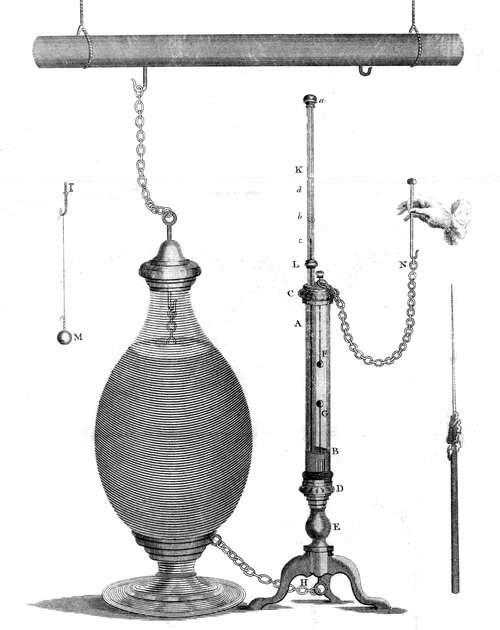
Published as the Act directs, April 1, 1806, by Longman, Hurst, Rees & Orme, Paternoster Row.
I set the thermometer on an electric stand, with the chain N fixed to the prime conductor, and kept it well electrised a considerable time; but this produced no sensible effect; which shews, that the electric fire, when in a state of rest, has no more heat than the air, and other matter wherein it resides.
When the wires F and G are in contact, a large charge of electricity sent through them, even that of my case of five and thirty bottles, containing above thirty square feet of coated glass, will produce no rarefaction of the air included in the tube A B; which shows that the wires are not heated by the fire's passing through them.
When the wires are about two inches apart, the charge of a three pint bottle, darting from one to the other, rarefies the air very evidently; which shows, I think, that the electric fire must produce heat in itself, as well as in the air, by its rapid motion.
The charge of one of my glass jars (which will contain about five gallons and a half, wine measure) darting from wire to wire, will, by the disturbance it gives the air, repelling it in all directions, raise the column in the tube K, up to d, or thereabouts; and the charge of the above-mentioned case of bottles will raise it to the top of the tube. Upon the air's coalescing, the column, by its gravity, instantly subsides, till it is in equilibrio with the rarefied air; it then gradually descends as the air cools, and settles where it stood before. By carefully observing at what height above the gage-wire b, the descending column first stops, the degree of rarefaction is discovered, which, in great explosions, is very considerable.
I hung in the thermometer, successively, a strip of wet writing paper, a wet flaxen and woollen thread, a blade of green grass, a filament of green wood, a fine silver thread, a very small brass wire, and a strip of gilt paper; and found that the charge of the above-mentioned glass jar, passing through each of these, especially the last, produced heat enough to rarefy the air very perceptibly.
I then suspended, out of the thermometer, a piece of small harpsichord wire, about twenty-four inches long, with a pound weight at the lower end, and sent the charge of the case of five and thirty bottles through it, whereby I discovered a new method of wire-drawing. The wire was red hot the whole length, well annealed, and above an inch longer than before. A second charge melted it; it parted near the middle, and measured, when the ends were put together, four inches longer than at first. This experiment, I remember, you proposed to me before you left Philadelphia; but I never tried it till now. That I might have no doubt of the wire's being hot as well as red, I repeated the experiment on another piece of the same wire, encompassed with a goose-quill, filled with loose grains of gun-powder; which took fire as readily as if it had been touched with a red hot poker. Also tinder, tied to another piece of the wire, kindled by it. I tried a wire about three times as big, but could produce no such effects with that.
Hence it appears that the electric fire, though it has no sensible heat when in a state of rest, will, by its violent motion, and the resistance it meets with, produce heat in other bodies when passing through them, provided they be small enough. A large quantity will pass through a large wire, without producing any sensible heat; when the same quantity passing through a very small one, being there confined to a narrower passage, the particles crowding closer together, and meeting with greater resistance, will make it red hot, and even melt it.
Hence lightning does not melt metal by a cold fusion, as we formerly supposed; but, when it passes through the blade of a sword, if the quantity be not very great, it may heat the point so as to melt it, while the broadest and thickest part may not be sensibly warmer than before.
And when trees or houses are set on fire by the dreadful quantity which a cloud, or the earth, sometimes discharges, must not the heat, by which the wood is first kindled, be generated by the lightning's violent motion, through the resisting combustible matter?
If lightning, by its rapid motion, produces heat in itself; as well as in other bodies (and that it does I think is evident from some of the foregoing experiments made with the thermometer) then its sometimes singeing the hair of animals killed by it, may easily be accounted for. And the reason of its not always doing so, may, perhaps, be this: The quantity, though sufficient to kill a large animal, may sometimes not be great enough, or not have met with resistance enough, to become, by its motion, burning hot.
We find that dwelling-houses, struck with lightning, are seldom set on fire by it; but when it passes through barns, with hay or straw in them, or store-houses, containing large quantities of hemp, or such like matter, they seldom, if ever, escape a conflagration; which may, perhaps, be owing to such combustibles being apt to kindle with a less degree of heat than is necessary to kindle wood.
We had four houses in this city, and a vessel at one of the wharfs, struck and damaged by lightning last summer. One of the houses was struck twice in the same storm. But I have the pleasure to inform you, that your method of preventing such terrible disasters, has, by a fact which had like to have escaped our knowledge, given a very convincing proof of its great utility; and is now in higher repute with us than ever.
Hearing, a few days ago, that Mr. William West, merchant in this city, suspected that the lightning in one of the thunder-storms last summer had passed through the iron conductor, which he had provided for the security of his house; I waited on him, to enquire what ground he might have for such suspicion. Mr. West informed me, that his family and neighbours were all stunned with a very terrible explosion, and that the flash and crack were seen and heard at the same instant. Whence he concluded, that the lightning must have been very near, and, as no house in the neighbourhood had suffered by it, that it must have passed through his conductor. Mr. White, his clerk, told me that he was sitting, at the time, by a window, about two feet distant from the conductor, leaning against the brick wall with which it was in contact; and that he felt a smart sensation, like an electric shock, in that part of his body which touched the wall. Mr. West further informed me, that a person of undoubted veracity assured him, that, being in the door of an opposite house, on the other side of Water-street (which you know is but narrow) he saw the lightning diffused over the pavement, which was then very wet with rain, to the distance of two or three yards from the foot of the conductor; and that another person of very good credit told him, that he being a few doors off on the other side of the street, saw the lightning above, darting in such direction that it appeared to him to be directly over that pointed rod.
Upon receiving this information, and being desirous of further satisfaction, there being no traces of the lightning to be discovered in the conductor, as far as we could examine it below, I proposed to Mr. West our going to the top of the house, to examine the pointed rod, assuring him, that if the lightning had passed through it, the point must have been melted; and, to our great satisfaction, we found it so. This iron rod extended in height about nine feet and a half above a stack of chimneys to which it was fixed (though I suppose three or four feet would have been sufficient.) It was somewhat more than half an inch diameter in the thickest part, and tapering to the upper end. The conductor, from the lower end of it to the earth, consisted of square iron nail-rods, not much above a quarter of an inch thick, connected together by interlinking joints. It extended down the cedar roof to the eaves, and from thence down the wall of the house, four story and a half, to the pavement in Water-street, being fastened to the wall, in several places, by small iron hooks. The lower end was fixed to a ring, in the top of an iron stake that was drove about four or five feet into the ground.
The above-mentioned iron rod had a hole in the top of it, about two inches deep, wherein was inserted a brass wire, about two lines thick, and, when first put there, about ten inches long, terminating in a very acute point; but now its whole length was no more than seven inches and a half, and the top very blunt. Some of the metal appears to be missing, the slenderest part of the wire being, as I suspect, consumed into smoke. But some of it, where the wire was a little thicker, being only melted by the lightning, sunk down, while in a fluid state, and formed a rough irregular cap, lower on one side than the other, round the upper end of what remained, and became intimately united therewith.
This was all the damage that Mr. West sustained by a terrible stroke of lightning;—a most convincing proof of the great utility of this method of preventing its dreadful effects. Surely it will now be thought as expedient to provide conductors for the lightning, as for the rain.
Mr. West was so good as to make me a present of the melted wire, which I keep as a great curiosity, and long for the pleasure of shewing it to you. In the mean time, I beg your acceptance of the best representation I can give of it, which you will find by the side of the thermometer, drawn in its full dimensions as it now appears. The dotted lines above are intended to shew the form of the wire before the lightning melted it.
And now, Sir, I most heartily congratulate you on the pleasure you must have in finding your great and well-grounded expectations so far fulfilled. May this method of security from the destructive violence of one of the most awful powers of nature, meet with such further success, as to induce every good and grateful heart to bless God for the important discovery! May the benefit thereof be diffused over the whole globe! May it extend to the latest posterity of mankind, and make the name of FRANKLIN, like that of NEWTON, immortal.