SECTION II. (continued 4)
Reading edition
Canary-seed, obtained from Phalaris canariensis, is grown rather largely in Kent, the Isle of Thanet, and other parts of the south of England, as much as 500 tons being annually consumed here for feeding singing birds. The produce is three to five quarters the acre, and it is sold at about £25 the ton. We receive foreign supplies of the seed from Germany and the Mediterranean, and the duty on imports is 2s. 6d. per bushel.
PULSE.
There are a variety of pulses and leguminous seeds extensively cultivated as food for both man and cattle, and which form an important article in the husbandry of tropical countries. The importance of peas and beans is well appreciated, both by the horticulturists and agriculturists in Europe and our temperate colonies, where, however, they are comparatively of less importance than the smaller pulses and grains are in various tropical countries, such as haricots in the Brazils and West Indies; ground or earth nuts in South America, and especially in Western Africa; beans of different kinds amongst the miners of Peru; gram (Ervum lens), and dholl (Cajanus), with innumerable varieties of beans and small lentils among the natives of India and Egypt; and the Carob bean, or St. John's bread (Ceratonia siliqua), in the Mediterranean countries.—("Jury Reports.")
Of leguminous grains there are various species cultivated and used by the Asiatics, as the Phaseolus Mungo, P. Max and P. radiatus, which contain much alimentary matter; the earth-nut (Arachis hypogæa), which buries its pods under ground after flowering.
The gram (Cicer arictinum) which is mentioned by Dr. Christie ("Madras Journal of Science," No. 13) as exuding oxalic acid from all parts of the plant. It is used by the ryots in their curries instead of vinegar. It is the chick pea of England, and chenna of Hindostan.
Among the most commonly cultivated leguminous plants are the lentil (Ervum lens), horse gram (Dolichos biflorus, Linn), various species of Cytisus and Cajanus, &c. Many of these are grown in India as fodder plants; others for their seeds, known as gram, dholl, &c. The Cajanus flavus, of Decandolle (Cytisus Cajan), is very generally cultivated along the Western coast of Africa, and continues to bear for three years. Several species of dolichos are used as food in various countries, as D. ensiformus in Jamaica, D. tuberosus in Martinique, D. bulbosus and D. lignosus in the East Indies.
The vessels of the North bring to Shanghae a great quantity of a dry paste, known under the name of tanping, the residuum or husk of a leguminous plant called Teuss, from which the Chinese extract oil, and which is used, after being pressed, as manure for the ground. Captain H. Biggs, in a communication to the Agri.-Hort. Soc. of India, in 1845, states that of the esculents a large white pea forms the staple of the trade of Shanghae, or nearly so, to the astonishing amount of two and a-half millions sterling. This he gives on the authority of the Rev. Mr. Medhurst, of Shanghae, and Mr. Thorns, British Consul at Ningpo. These peas are ground in a mill and then pressed, in a somewhat complicated, though, as usual in China, a most efficient press, by means of wedges driven under the outer parts of the framework with mallets. The oil is used both for eating and burning, more for the latter purpose, however, and the cake, like large Gloucester cheese, or small grindstones in circular shape, is distributed about China in every direction, both as food for pigs and buffaloes, as also for manure.
We import on the average about 20,000 quarters of beans, peas, &c., from Ireland, 450,000 quarters of beans and 200,000 quarters of peas from foreign countries.
The land under cultivation with pulse, and the crops raised, have been estimated as follows:—
Acres.Quarters.
England500,0001,875,000
Ireland130,000540,000
Scotland50,000150,000
680,0002,565,000
This is of course exclusive of garden cultivation. The average produce of beans per acre in England is 3¾ quarters, 3½ in Ireland, and three in Scotland.
The price of beans per quarter in the last ten years has ranged from 39s. to 27s. the quarter; peas from 40s. 6d. to 27s. 6d.
Algaroba beans.—The seed pods or bean of the carob-tree (Ceratonia siliqua, or Prosopis pallida?) a tree common in the Levant and South of Europe, are used as food. The pods contain a large proportion of sweet fecula, and are frequently used by singers, being considered to improve the voice. The name of St. John's Head has been applied to them, from the supposition that they were the wild honey spoken of in Scripture as the food of John the Baptist. About 40,000 quintals of these carobs are annually exported from Crete. During the Peninsular war, the horses of our cavalry were principally fed upon these algaroba seeds. The pods of the West India locust tree, Hymenæa courbaril, also supply a nutritious matter.
That well known sauce, Soy, is made in some parts of the East, from a species of the Dolichos bean (Soja hispida), which grows in China and Japan. In Java it is procured from the Phaseolus radiatus. The beans are boiled soft, with wheat or barley of equal quantities, and left for three months to ferment; salt and water are then added, when the liquor is pressed and strained. Good soy is agreeable when a few years old; the Japan soy is superior to the Chinese. Large quantities are shipped for England and America. The Dolichos bean is much cultivated in Japan, where various culinary articles are prepared from it; but the principal are a sort of butter, termed mico, and a pickle called sooja.
1,108 piculs of soy were shipped from Canton in 1844, for London, British India, and Singapore. 100 jars, or about 50 gallons of soy, were received at Liverpool in 1850. The price is about 6s. per gallon in the London market.
THE SAGO PALMS, BREAD-FRUIT, &c.
Sago, and starchy matter allied to it, is obtained from many palms. It is contained in the cellular tissue of the stem, and is separated by bruising and elutriation. From the soft stem of Cycas circinalis, a kind of sago is produced in the East and West Indies. The finest is, however, procured from the stems of Sagus lævis (S. inermis, of Roxburgh), a native of Borneo and Sumatra; and Arenga saccharifera, or Gomutus saccharifus, of Rumphius. The Saguerus Rumphii, or Metroxylon Sagus, which is found in the Eastern Islands of the Indian Ocean, yields a feculent matter. After the starchy substance is washed out of the stems of these palms, it is then granulated so as to form sago. The last-mentioned palm also furnishes a large supply of sugar. Sago as well as sugar, and a kind of palm wine, are procured from Caryota urens.
In China sago is obtained from Rhapis flabelliformis, a dwarfish palm; and some sago is made from it for native use in Travancore, Mysore, and Wynaad, and the jungles in the East Indies.
The trunk of the sago palm is five or six feet round, and it grows to the height of about 20 feet. It can only be propagated by seed. It flourishes best in bogs and swampy marshes; a good plantation being often a bog, knee deep. The pith producing the sago is seldom of use till the tree is fourteen or fifteen years old; and the tree does not live longer than thirty years. Mr. Crawfurd says there are four varieties of this palm; the cultivated, the wild, one distinguished by long spines on the branches, and a fourth destitute of these spines, and called by the natives female sago. This and the cultivated species afford the best farina; the spiny variety, which has a slender trunk, and the wild tree, yield but an inferior quality of sago. The farinaceous matter afforded by each plant is very considerable, 500 lbs. being a frequent quantity, while 300 lbs. may be taken as the common average produce of each tree.
Supposing the plants set at a distance of ten feet apart, an acre would contain 435 trees, which, on coming to maturity in fifteen years, would yield at the before-mentioned rate 120,500 lbs. annually of farinaceous matter. The sago meal, in its raw state, will keep good about a month. The Malays and natives of the Eastern Islands, with whom it forms the chief article of sustenance, partially bake it in earthenware moulds into small hard cakes, which will keep for a considerable time. In Java the word "saga" signifies bread. The sago palm (Metroxylon Sagus) is one of the smallest of its tribe, seldom reaching to more than 30 feet in height, and grows only in a region extending west to Celebes and Borneo, north to Mindanao, south to Timor, and east to Papua. Ceram is its chief seat, and there large forests of it are found. The edible farina is the central pith, which varies considerably in different trees, and as to the time required for its attaining proper maturity. It is eaten by the natives in the form of pottage. A farina of an inferior kind is supplied by the Gomuti palm (Borassus gomutus), another tree peculiar to the Eastern Archipelago growing in the valleys of hilly tracts.
At so great a distance it is difficult to decide as to which of these trees really produce the ordinary sagos of commerce, for there are several kinds. Planche, in an excellent memoir on the sagos, has described six species, which he distinguishes by the names of the places from which they come. Preferring to classify them according to their characters, M. Mayet distinguishes only three species.
The first he denominates Ancient sago, which comes from different parts, and varies much in color. It comprehends—1st, Maldivian sago of Planche, in spherical globules, of two or three millimetres in diameter, translucid, of an unequal pinkish white color, very hard and insipid. 2nd, New Guinea sago, of Planche, in rather smaller globules, of a bright red color on one side, and white on the other. 3rd. Grey sago of the Moluccas or brown sago of the English; of unequal globules, from one to three millimetres in diameter, opaque, of a dull grey color on one side, and whitish on the other. This grey color probably arises from long keeping and humidity. 4th. Large grey sago of the Moluccas, exactly resembling No. 3, only that the globules are from four to eight millimetres in diameter. 5th. Fine white sago of the Moluccas; entirely resembling No. 3, only that it is purely white, owing to the complete edulcoration of the fecula of which it is made.
Whatever may be the places of origin of these sagos, they all possess the following characters—
Rounded globules, generally spherical, all isolated, very hard, elastic, and difficult to break or powder. The globules put into water, generally swell to twice their original size, but do not adhere together.
Second sage.—This species corresponds with the pinkish sago of the Moluccas of Planche. It is in very small globules, less regular than those of the "first sago," and sometimes stuck together to the number of two or three. Soaked in water, it swells to double its volume.
Third Species.—Tapioca sago.—-This name has been applied to a species of sago now abundant in commerce, because it bears the same relation to the ancient or first sago, and even to the preceding sago, that tapioca bears to "Moussache," which is the fecula of the manioc, Janipha manihot (Manihot utilissima).
Whilst the two preceding species of sago, whatever may have been stated to the contrary, have been neither baked nor submitted to any heating process, as is proved by the perfect state of nearly all their grains of fecula, this species has been subjected to the action of heat while in a state of a moist paste. This sago is not in spherical globules, like the two preceding species, or at least there are but few of the globules of that form; it is rather in the form of very small irregular tubercular masses, formed by the adherence of different numbers of the primary globules. The facility with which this sago swells and is divided by water, has occasioned it to be preferred as an article of food to the ancient sago. It has been described by Planche under the name of the white sago of the Moluccas, and by Dr. Pereira under the name of pearl sago.
Bennet, in his work on "Ceylon and its Capabilities," (1843), states that sago is procured from the granulated pith of the talipot palm, Corypha umbraculifera.
The Sagus Rumphii, Willdenow, and S. farinifera, Gaertner.—Before maturity, and previous to the formation of the fruit, the stem consists of a thin hard wall, about two inches thick, and of an enormous volume of tissue (commonly termed the medulla or pith), from which the farina or sago is obtained. As the fruit forms, the farinaceous medulla disappears, and when the tree, attains full maturity, the stem is no more than a hollow shell. Sago occurs in commerce in two states, pulverulent and granulated. 1. The meal or flour as imported in the form of a fine amylaceous powder. It is whitish, with a buffy or reddish tint. Its odor is faint, but somewhat unpleasant and musty. 2. Granulated sago is of two kinds, pearl and common brown. The former occurs in small hard grains, not exceeding in size that of a pin's head, inodorous, and having little taste. They have a brownish or pinkish yellow tint, and are somewhat translucent. By the aid of a solution of chloride of lime they can be bleached, and rendered perfectly white. The dealers, it is said, pay £7 per ton for bleaching it. Common sago occurs in larger grains, about the size of pearl barley, which are brownish white.
Sago is an article of exportation to Europe, and is also shipped to India, principally Bengal, and to China. It is in its granulated form that it is usually sent abroad. The best sago is the produce of Siak, on the north coast of Sumatra. This is of a light brown color, the grains large, and not easily broken. The sago of Borneo is the next in value; it is whiter, but more friable. The produce of the Moluccas, though greatest in quantity, is of the smallest estimation. The cost of granulated sago, from the hands of the grower or producer, was, according to Mr. Crawfurd, only a dollar a picul. It fetches in the London market—common pearl, 20s. to 26s. the cwt., sago flour, 20s. the cwt. The Chinese of Malacca and Singapore have invented a process by which they refine sago, so as to give it a fine pearly lustre, and it is from thence we now principally derive our supplies of this article. The exports from Singapore in 1847 exceeded 6½ million pounds, but are now much larger.
The following is a description of the manufacture of this important article of commerce:—The tree being cut down, the exterior bark is removed, and the heart, or pith of the palm, a soft, white, spongy and mealy substance is gathered; and for the purpose of distant transportation, it is put into conical bags, made of plantain leaves, and neatly tied up. In that state it is called by the Malays Sangoo tampin, or bundles of sago; each bundle weighs about 30 lbs.
On its arrival at Singapore it is purchased by the Chinese manufacturers of sago, and is thus treated:—Upon being carried to the manufactory, the plantain-leaf covering is removed, and the raw sago, imparting a strong acid odor, is bruised, and is put into large tubs of cold spring water, where it undergoes a process of purification by being stirred, suffered to repose, and again re-stirred in newly-introduced water. When well purified thus, it is taken out of the tubs by means of small vessels; and being mixed with a great deal of water, the liquid is gently poured upon a large and slightly inclined trough, about ten inches in height and width; and in the descent towards the depressed end, the sago is deposited in the bottom of the trough, whilst the water flows into another large tub, where what may remain of sago is finally deposited. As the strata of deposited sago increases in the trough, small pieces of slates are adjusted to its lower end to prevent the escape of the substance. When by this pouring process the trough becomes quite full of sago, it is then removed to make room for a fresh one, whilst the former one is put out into the air, under cover, for a short time; and on its being well dried, the sago within is cut into square pieces and taken out to be thoroughly dried, under cover, to protect it from the sun. It has then lost the acid smell already noticed, and has become quite white. After one day's drying thus, it is taken into what may be called the manufactory, a long shed, open in front and on one side, and closed at the other and in the rear. Here the lumps of sago are broken up, and are reduced into an impalpable flour, which is passed through a sieve. The lumps, which are retained by the sieve are put back to be re-bruised, whilst that portion which has passed is collected, and is placed in a long cloth bag, the gathered ends of which, like those of a hammock, are attached to a pole, which pole being suspended to a beam of the building by a rope, one end of it is sharply thrown forward with a particular jerk, by means of which the sago within is shortly granulated very fine, and becomes what is technically termed "pearled." It is then taken out and put into iron vessels, called quallies, for the purpose of being dried. These quallies are small elliptical pans, and resemble in form the sugar coppers of the West Indies, and would each hold about five gallons of fluid. They are set a little inclining, and in a range, over a line of furnaces, each one having its own fire. Before putting in the sago to be dried, a cloth, which contains a small quantity of hog's-lard, or some oily substance, is hastily passed into the qually, and the sago is equally quickly put into it, and a Chinese laborer who attends it, commences stirring it with a pallit, and thus continues his labor during the few minutes necessary to expel the moisture contained in the substance. Thus each qually, containing about ten pounds of sago, requires the attendance of a man. The sago, on being taken off the fire, is spread out to cool on large tables, after which it is fit to be packed in boxes, or put into bags for shipment; and is known in commerce under the name of "pearl sago." Thus the labor of fifteen or twenty men is required to do that which, with the aid of simple machinery, might be done much better by three or four laborers. A water-wheel would both work a stirring machine and cause an inclined cylinder to revolve over a fire, for the purpose of drying the sago, in the manner used for corn, meal, and flour in America, or for roasting coffee and chicory in England. But the Chinese have no idea of substituting artificial means, when manual ones are obtainable.
A considerable quantity of sago is exported from Singapore in the state of flour. The whole quantity made and exported there exceeds, on the average, 2,500 tons annually. The quantity shipped from this entrepot is shown by the annexed returns, nearly all of which was grown and manufactured in the settlement. The estimated value for export is set down at 14s. per picul of 1¼ cwt.
EXPORTS FROM SINGAPORE.
Piculs
1840-41Pearl sago41,146
"Sago flour33,552
1841-42Pearl sago46,225
"Sago flour7,447
1842-43Pearl sago25,306
"Sago flour4,838
1843-44Pearl sago14,266
"Sago flour14,067
1844-45Pearl sago18,472
"Sago flour36,141
1845-46Pearl sago19,333
"Sago flour26,925
1846-47Pearl sago40,765
"Sago flour9,025
Imports of sago into the United Kingdom, and quantity retained for home consumption:—
Imports. Cwts.Home consumption. Cwts.
18269,6442,565
18302,6773,385
183425,76313,827
183818,62728,396
184245,64650,994
184638,59545,671
184865,000
184983,71172,741
185089,88483,954
THE BREAD-FRUIT TREE.
Artocarpus incisa.—This tree is less cultivated than would be supposed from its useful properties. In the West Indies and the Indian Islands, where it has been introduced from its native place, the South Sea Islands, it is held in very little consideration, the graminea, tuberous roots, and farinaceous plants being more easily and readily cultivated. There are two or three varieties known in the Asiatic regions. The properties of this tree are thus enumerated by Hooker:—The fruit serves for food; clothes are made from the fibres of the inner bark; the wood is used for building houses and making boats; the male catkins are employed as tinder; the leaves for table cloths and for wrapping provisions in; and the viscid milky juice affords birdlime.
A. integrifoliais the Jack or Jacca, the fruit of which attains a large size, sometimes weighing 30 lbs., but is inferior in quality to the bread-fruit.
The nuts or fruit of Brosimum Alicastrum, an evergreen shrub, native of Jamaica, are nutritious and agreeable articles of food. When boiled with salt fish, pork or beef, they have frequently been the support of the negroes and poorer sorts of white people in times of scarcity, and proved a wholesome and not unpleasant food; when roasted it eats something like our common chesnut, and is called bread-nut.
Kafir Bread.—According to Thunberg, the Hottentots being very little acquainted with agriculture, or with the use of the cerealia, and subsisting principally upon wild bulbs and fruits, obtain food also from Encephalartos caffer, a species of Zamia, with a cylindrical trunk, the thickness of a man's body, and about seven feet high. Having cut down a tree, they took out the pith, that nearly fills its trunk, and which abounds in mucilage and an amylaceous fluid; after keeping this for some time buried under ground in the skin of an animal, they reduced it by pounding and kneading into a kind of paste; and then baked it in hot ashes, in the form of round cakes, nearly an inch thick. The Dutch colonists, in consequence of this practice of the natives, called the plant brood-boon, which signifies literally bread tree.
THE PLANTAIN AND BANANA.
The several varieties of the edible plantain which are known and cultivated throughout the West Indies, Africa, and in the East are all reducible to two classes, viz., the Plantain and the Banana (Musa Paradisiacaand sapientum). The difference between these two plants is even so slight as to be scarcely specific; it is therefore most probable that there was originally but one stock, from which they have, by cultivation and change of locality, been derived.
The tiger plantain (M. maculata) and the black ditto (M. sylvestris) are cultivated in Jamaica. The whole of the species and varieties of the tribe are what are called polygamous monœcious plants, each individual tree bearing the male and female organs of reproduction.
The plantain and its varieties invariably bear male, female and hermaphrodite flowers within the same spathe, all of them being imperfect and consequently unproductive of seed. An individual may, even from excess of culture, moisture, &c., be entirely incapable of flowering. During the prevalence of a disease or blight among the plantain walks of Demerara in the years 1844 and 1845, it was seriously proposed to introduce male plantains, or obtain fresh stock by seed.
It is, therefore, necessary to determine with exactness, if possible, whether the Plantain or Banana, (whichever be the parent stock) exists anywhere at present, or has been known to have existed as a perfect plant, that is bearing fertile seeds; or, whether it has always existed in the imperfect state, that is, incapable of being procreated by seed, the only state in which it at present exists in our colonies.
Whether Linnæus be right in his conjecture (Spec. Plant, 1763) that the "Bihai" (Heliconia humilis), a native of Caraccas, which produces fertile seeds, is the stock plant of the plantain, it is almost impossible to ascertain; but the absence of any description of a wild seed-bearing plantain, renders it highly probable that the cultivated species are hybrids produced long ago. The banana, from time immemorial, has been the food of the philosophers and sages of the East, and almost all travellers throughout the tropics have described these plants exactly as they are known to us, either as sweet fruit eaten raw, or a farinaceous vegetable roasted or boiled. It is remarkable that the plantain and banana should be indigenous, or at all events cultivated for ages both in the Old and New World. Numerous South American travellers describe some one of these plants as being indigenous articles of food among the natives, thus showing (if the plantain and its varieties be hybrids) a communication between the tropics of America, Asia and Africa, long before the time of Columbus. The older writers on the colony of Guiana, as Hartsinck, Bellin and others, consider the plantain to be a native. It is remarkable that Sir R. Schomburgk, during his travels, found a large species of edible plantain far in the interior. It appears, therefore, from all the investigations that have been made, that the plantain is either a hybrid, or its power of production from seed has been destroyed long ago by cultivation, and that it is not known to exist anywhere in a perfect state; in which case any attempt to improve the present stock by the introduction of suckers from elsewhere, must be totally futile. Mr. A. Garnett recommends the following system of cultivation, as calculated to prevent the blight. The walk or plantation is to be formed into beds 36 feet wide, divided by open drains 30 inches deep. Two rows of plantains to be planted upon each bed at 18 feet distance, both between and along the rows, to afford a clear ventilation to the enlarging plants, and so soon as the plantation has been established, the space of land between each row to be shovel-ploughed 12 inches deep; the same to be repeated annually, and upon the interspace may be planted maize, yams, sugar cane, or eddoes, and the whole kept clear at all times. Thus, with the conjoined principles of good tillage, free ventilation, and mixed crops, the blight may yet be successfully combated.
A great diminution in the cultivation of the plantain has been occasioned in British Guiana by this blight or disease, which first made its destructive appearance in Essequibo, upwards of thirty years ago, where its ravages increased with such fatal intensity as to render the profitable growth of the plant almost hopeless; and up to this hour no one has been able to discover the immediate or remote cause of this extraordinary vegetable endemic; whether arising from the action of insects among the sheathes of the petioles of the leaves, or in the soil, or from organic decay of the plant, remains without solution. The last-named cause seems to be rejected, by the fact that the fructification of the plant is as healthy and abundant in parts of the colony where the blight does not prevail, both in number and size of the fruit upon the spike, as at any former period. On the east coast of Demerara, both the plantain and banana have been grown for more than twenty years upon the same land, without any attack of the disease, and without any extraneous manure or even lime having been applied, and the plants still exhibit great luxuriance, and produce their former weight of fruit.
The foliage of the plantain affords food and bedding, and is used for thatch, making paper, and basket making; and from its petioles is obtained a fine and durable thread. The tops of the young plants are eaten as a delicate vegetable; the fermented juice of the trunk produces an agreeable wine.
The abundance and excellence of the nutritive food which the plants of this valuable genus supply are well known; but of the numerous uses to which they are applied I may mention, the following:—
The fruit is served up both raw and stewed; slices fried are also considered a delicacy. Plantains are sometimes boiled and eaten with salt meat, and pounded and made into puddings, and used in various other ways. In their ripe state these fruits contain much starchy matter. From their spurious stems, the fibres of the spiral vessels may be pulled out in such quantity as to be used for tinder. M. textilis yields a fibre which is used in India in the manufacture of fine muslins, and the coarser woody tissue is exported in large quantities from Manila, under the name of white rope or Manila hemp. Horses, cattle, swine, and other domestic animals are fed upon the fruit, leaves, and succulent trunks.
The same extent of ground which in wheat would only maintain two persons, will yield sustenance under the banana to fifty. That eminent naturalist and elegant writer, the Baron Von Humboldt, states ("Political Essay on New Spain," vol. ii.) that an acre of land cultivated with plantains produces nearly twenty times as much food as the like space sown with corn in Europe. He refers to a place in Venezuela, where the most careful tillage was rendered to a piece of land, yielding produce supporting a humble population residing in huts, each placed in the centre of an enclosure, growing the sugar cane, Indian corn, the Papaw tree, and the Musa—a tropical garden!—upon the elaborate culture of which a whole family relied for subsistence.
Although from the extensive plantain walks in our colonies—which are seldom cultivated with a garden-like care—so large an average proportion may not be obtained as twenty times the production of wheat in Europe, yet I have had practical experience of the prodigious quantity of farinaceous matter obtainable from an acre of tolerably well-cultivated plantains, and no esculent plant requires less labor in its culture upon land suitable for its production. They are readily increased by suckers, which the old plants produce in abundance.
Lindley enumerates ten species of Musa, some of which grow to the height of 25 or 30 feet, but that valuable species M. Cavendishii, does not grow more than four or five feet high.
The bananas of the family of the Musaceæ, appear to be natives of the southern portion of the Asiatic continent (R. Brown, "Bot. of Congo," p. 51). Transplanted at an unknown epoch into the Indian Archipelago and Africa, they have spread also into the, New World, and in general into all intertropical countries, sometimes before the arrival of Europeans.
According to Humboldt it affords, in a given extent of ground, forty-four times more nutritive matter than the potato, and 133 times more than wheat. These figures must be considered as only approximative, since nothing is more difficult than to estimate the nutritive qualities of different aliments.
Musa paradisiaca is cultivated in Syria, to latitude 34 deg. Humboldt says it ceases to yield fruit at a height of 3,000 feet, where the mean annual temperature is 68 deg., and where, probably, the heat of summer is deficient.
The banana seems, however, to be found no higher than 4,600 feet in a state of perfection.
No fruit is so easily cultivated as are the varieties of the plantain. There is hardly a cottage in the tropics that is not partly shaded by them; and it is successfully grown under other fruit trees, although it is independent of shelter. Its succulent roots and dew-attracting leaves render it useful in keeping the ground moist during the greatest heats. The plantain may be deemed the most valuable of fruits, since it will, in some measure, supply the place of grain in time of scarcity. To the negroes in the West Indian Islands the plantain is invaluable, and, like bread to the Europeans, is with them denominated the staff of life. In Jamaica, Demerara, Trinidad, and other principal colonies, many thousand acres are planted with these trees.
The vegetation of this tree is so rapid that if a line of thread be drawn across, and on a level with the top of one of the leaves, when it begins to expand, it will be seen, in the course of an hour, to have grown nearly an inch. The fruit when ripe is of a pale yellow, about a foot in length and two inches thick, and is produced in bunches so large as each to weigh 40 lbs. and upwards.
The soil best suited to the growth of the plantain is found in the virgin land most recently taken in from the forest, having a formation of clay and decomposed vegetable substances. A large portion of organic matter is required, as well as clay or other ponderous strata, to afford the greatest production of fruit. I have known good plantains produced in the West Indies, upon land considerably exhausted by the culture of cotton, but which was enriched by the application of a quantity of the decomposed seed of that shrub near the roots of the young plantains.
In the Straits' settlements of the East, the following are the most approved varieties:—The royal plantain, which fruits in eight months; one which bears in a year, the milk plantain, the downy plantain, and the golden plantain or banana. A species termed gindy has been lately imported from Madras, where it is in great request. It has this advantage over the other kinds, that it can be stewed down like an apple while they remain tough.
The Malays allege that they can produce new varieties, by planting three shoots of different sorts together, and by cutting the shoots down to the ground three successive times, when they have reached the height of nine or ten inches.
About 144 suckers of the plantain are set on an orlong (1⅓ acres), each of which spreads into a group of six or eight stems, of about six inches to one foot in diameter, which yield each a bunch of fruit, and are then cut down, when fresh shoots succeed. In very rich soils the plant will continue to bear for twenty years, but otherwise it is dug up after the seventh or eighth year. The cost of cultivating 100 orlongs of land exclusively with plantains, will be nearly 2,000 Spanish dollars until produce be obtained. About 43,200 bunches may be had afterwards yearly, which might give a return of 2,160 dollars, or, deducting the cost of cultivation and original expenses, a profit per annum of 1,450 dollars.
The plantain has frequently been suggested as an article of export from our colonies. A few bunches are occasionally brought over by the Royal West India Mail Company's steamers running to Southampton, but more as a curiosity than as articles of commerce.
In its ripe state no unexceptionable and sufficiently cheap method of preserving it has yet been suggested.
In some districts of Mexico it is, indeed, dried in the sun, and in this state forms a considerable article of internal commerce under the name of "plantado pasado."
It is sometimes so abundant and cheap in Demerara, Jamaica, Trinidad, and other of our colonies, that it might, if cut and dried, in its green state, be exported with advantage.
It is in the unripe state that it is so largely used by the peasantry of the colonies as an article of food. It has always been believed to be highly nutritive, but Dr. Shier states that, in any sample of the dried plantain which he analysed, he could not find a larger amount than 88 per cent of nitrogen, which corresponds with about 5½ per cent. of proteine compounds.
When dried, and reduced to the state of meal, it cannot, like wheat flour, be manufactured into maccaroni or vermicelli, or at least the maccaroni made from it falls to powder when put into hot water. The fresh plantain, however, when boiled whole, forms a pretty dense firm mass, of greater consistency and toughness than the potato. The mass, beaten in a mortar, constitutes the foo-foo of the negroes. The plantain meal cannot be got into this state unless by mixing it up with water to form a stiff dough, and then boiling it in shapes or bound in cloths.
Plantain meal is prepared by stripping off the husk of the plantain, slicing the core, and drying it the sun. When thoroughly dry it is powdered and sifted. It is known among the Creoles of the West Indies under the name of Conquin tay. It has a fragrant odour, acquired in drying, somewhat resembling fresh hay or tea. It is largely employed as the food of infants, children, and invalids. As food for children and convalescents, it would probably be much esteemed in Europe, and it deserves a trial on account of its fragrance, and its being exceedingly easy of digestion. In respect of nutritiveness, it deserves a preference over all the pure starches on account of the proteine compounds it contains.
The plantain meal would probably be best and freshest were the sliced and dried plantain cores exported, leaving the grinding and sifting to be done in Europe. The flavor of the meal depends a good deal on the rapidity with which the slices are dried; hence the operation is only fitted for dry weather, unless indeed, when there was occasion for it, resource were had to a kiln or stove. Above all, the plantain must not be allowed to approach too closely to yellowness or ripeness, otherwise it becomes impossible to dry it. The color of the meal is injured when steel knives are used in husking or slicing, but silver or nickel blades do not injure the color. On the large scale a machine, on the principle of the turnip slicer, might be employed. The husking could be greatly facilitated by a very simple machine. Were the plantain meal to come into use in England, and bear a price in any way approaching to that of Bermuda arrowroot, it would become an extensive and very profitable export. Full-sized and well-filled bunches give 60 per cent. of core to 40 of husk and top-stem, but in general it would be found that the core did not much exceed 50 per cent., and the fresh core will yield 40 per cent. of dry meal, so that from 20 to 25 per cent. of meal is obtained from the plantain, or 5 lbs. from an average bunch of 25 lbs.; and an acre of plantain walk of average quality, producing during the year 450 such bunches, would yield a ton and 10 lbs. of meal, which, at the price of arrowroot, namely, 1s. per lb., would be a gross return of £112 10s. per acre. A new plantain walk would give twice as much. Even supposing the meal not to command over half the price of arrowroot, it would still form an excellent outlet for plantains whenever, from any cause, the price in the colony sank unusually low.
In respect of the choice of a situation for establishing a plantain walk, with a mill, boiling-house and drying ground, it will be necessary to fix upon new land with plenty of moisture, and flat if possible, in order that there may be no difficulty in making roads to carry the trees; whilst a deep river traversing the land, where there is no tide or danger of salt water—where facility would be afforded in making the basins wherein to wash the fibre; where a sea port would be near at hand for shipping the produce—where workmen, provisions, and fuel would be readily obtained, and where the climate is particularly healthy, should be especially sought after.
The plantain grows in profusion between the tropics in all parts of the world; but as it is an object to have the London market available for the prepared fibre, the following places may be mentioned as best calculated to produce a good and constant supply, viz:—the West India Colonies, the British Colonies in Africa, the South American Republics, along the Mosquito shore, and other places on the Continent of America, including Porto Rico, Hayti, and Cuba. The advantages to the paper manufacturer in employing the prepared fibre instead of rags, will be numerous, for the fibre is equal in texture, clean, and aromatic; whilst rags are dirty, full of vermin, and very often pestilential.
A large stock of the plantain can always be secured, without fear of its being injured by keeping. The paper will be superior to that made of rags, and the process of making it will be more economical, inasmuch as the sorting of the material will not be required. Another advantage is, that a new article of commerce will be opened for the benefit of the colonial shipping interests, and a stimulus will be given to the cultivation of a fruit which is the favorite food of large masses of the population.
The following is a "specification" of articles requisite for making three tons of prepared fibre in a day:—
Four wooden boilers lined with lead, in the form of coolers, 7 feet deep by 6 in diameter. One hydraulic press, from 400 to 500 tons. One stout screw press, to compress the fibre before it is submitted to the hydraulic press. One iron mill with horizontal cylinders. Six waggons; twenty mules. Utensils, such as spatulas, cutlasses, hoes, rakes, &c. &c. One lever, to take out the fibre from the boilers. One steam boiler, equal to 12-horse power, to steam the four wooden boilers.
It being very desirable that the works should be in the immediate neighbourhood of a river, the machinery should be worked by water-power; but if this mode should be inconvenient, a steam engine in addition must be obtained, of about 8 or 10-horse power; or if one steam engine of 20-horse power were employed, it would be sufficient for all purposes. Thirty men are required to make three tons of fibre in a day.
Buildings.—A store, 100 feet long by 25 feet broad, in wood, covered with straw, to contain the dried fibre and the presses. One open shed of the same dimensions, covered with straw for the boilers.
Capital required.—It is ascertained that the following outlay will be sufficient:—
The materials will cost£2,000
Buildings500
Purchase of land1,500
Working capital1,000
£5,000
The estimated expense in cultivating one quarree, or 5 1-5th English acres, in plantains, will be £30, as the work can be easily performed by one laborer in 300 days, at 2s. sterling per day.
A quarree will produce 18 tons of mill fibre, the cost of the preparation of which is as follows:—
For workmen's wages, soda, lime, and fuel, at £3 per ton£54
Freight to Europe at £4 per ton72
Managers30
Duty, insurance, office fees, &c., at £1 per ton18
£174
Thus, making the total expense of producing 18 tons of fibre £174, or £9 13s. 4d. per ton. In 1848 Manila rope, or plantain fibre of good quality, was worth £38 per ton.
A correspondent in Jamaica, who has devoted much attention to the subject, has furnished me with some very valuable detailed information, the most complete and practical that has ever yet appeared:—
Cultivation.—The first care of a planter in superintending the cultivation of the banana tree, with the two-fold object of collecting both fibre and fruit, will be to study the nature of the tree to which he will give the preference. A number of experiments have been made upon different species of the banana with a view of obtaining therefrom the largest quantity and the best color of fibre, as well as the finest fruit. Those experiments were very tedious and minute, but were absolutely necessary, in order to arrive at the most economical and advantageous method of rendering the fibre into a state fit for shipment to Europe. At the same time, it was of the utmost importance to find out the best description of tree, for producing the strongest, the most abundant, and the most silky fibre—for containing the least quantity of juice, for producing the color sufficiently white to facilitate the operation of bleaching, for bearing fruit of the most esteemed quality, and, therefore, the most favorable for general consumption.
A banana tree, which seemed at first sight to possess all those good qualities—being of a large size, with whitish or flaxen colored fibre, and producing very savoury fruit, only gave 2 per cent, of fibre after preparation; that is to say, 100 lbs. in its raw state, only gave two pounds of fibre after it was boiled. In endeavoring to find out the cause of such a small result, it was discovered that this specimen of banana (commonly called the "pig banana,") contained a larger proportion of water than of fibre, compared with other sorts—that the heart was too large, and that the inside leaves were so tender that they almost dissolved in the process of boiling. These were the greatest inconveniences of this species of tree. There was also another disadvantage, in the quality of its fruit, which was yellow in color, and not so useful as those descriptions of banana which are generally eaten as a substitute for bread. The results of several experiments made upon various descriptions of banana, demonstrated the properties of each species, both as regarded fibre and fruit. The most profitable in both respects is undoubtedly the yellow banana, or common plantain. This tree grows to the height of about fifteen feet, it is nine or ten inches in diameter, its fibre is firm and abundant, and its fruit is used both in a green and ripe state. This plantain abounds on the continent of Spanish America and between the tropics, where the natives cultivate it as producing the most nutritious fruit of its kind. Cargoes of the fruit are frequently exported from Surinam and Demerara. On the Spanish part of the American continent, land is measured by fanegas, each fanega containing twelve quarrees, and each quarree five and one-fifth English acres. A quarree measures one hundred geometrical paces, or three hundred square feet.
In the first instance, the suckers of the plantain (the tree being propagated by cuttings or suckers which shoot up from the bulb), should be set at ten feet distance from each other; this proposition gives 300 plants on one line of trees, or 900 on the surface of one quarree of land. Each plant propagates itself and gives upon an average ten trees of the same size and bearing. On one quarree of land, therefore there would be 9,000 trees, yielding four pounds of fibre and one bunch of fruit each, which is 9,000 bunches of fruit, and 36,000 lbs. nett of fibre, in the whole. In good ground the same plant will last fifteen years without any further trouble. Flat lands ought to be cultivated in preference to any other. The plantain thrives with the root in the water, and the head to the sun. On the borders of the river Orinoco it grows to the height of twenty feet, is one foot in diameter, and the stalks of the branches are three inches in circumference.
Cutting.—The tree which has not produced its ripe fruit ought to be cut, for two reasons—first, that the fruit be not lost; and secondly, that the tree will not have arrived at its full growth and ordinary size, and the fibres will be too tender. In cutting it down, take it off six inches above the surface of the ground, then divide it longitudinally into four parts, take out the heart, which must be left to serve for manure, and if fermentation is decided upon, leave the pieces at the foot of the tree, otherwise take them to the mill to be crushed. The tree being very tender, may, on being bent down, be cut asunder with a single stroke of a hatchet, cutlass, or other convenient instrument. One man can cut down 800 trees, and split them in a day.
Carrying.—The trees being thus divided, may be immediately carried to the mill to be crushed, or may remain until the fermentation separates the juice of sap from the fibres and the pith. By fermenting the trees, their weight will be so much reduced as to render their carriage considerably lighter than if taken away when first cut down. A wagon, with oxen or mules, can carry about a ton per day, and one man can load the wagon and drive the cattle.
Crushing.—If the tree is carried from the plantation without being subjected to fermentation, it must be passed through a mill, the rollers of which, if made about three feet in length, and one foot in diameter, will be found a very convenient size. In this operation, care should be taken, first of all, to separate the tender from the harder or riper layers of fibre. The tree is composed of different layers of fibre, which may be divided into three sorts; those of the exterior, having been exposed to the atmosphere, possess a great degree of tenacity—whilst those of the interior, having been secluded from the air, are much more soft and tender. If, therefore, the layers of the plantain are passed indiscriminately through the mill, those which are hard or firm will not be injured by the pressure, whilst those which are soft will be almost reduced to pulp. Therefore, the rollers of the mill should be always placed horizontally, and upon passing the trees lengthways through the mill, the pressure will be uniform and the fibre uninjured. In this manner, pass the different sorts of layers separately, and the produce will be about four pounds of fibre from each tree. The stalks of the branches of the plantain give the best fibre, and a large quantity, as compared with the body of the tree; 100 lbs. of the stalk will give 15 lbs. nett of fibre. In general, if a tree will give 4 lbs. nett of fibre, the stalks will give 1 lb. out of the 4 lbs. The stalks ought also to be crushed separately, because they are harder than the exterior layers of the tree. About 3,000 trees may be passed through the mill in a day. Whilst the experiments were in progress it was ascertained that with a single horse, 100 plantain trees on an average were crushed in twenty minutes, giving five minutes rest for the horse.
Fermentation.—This operation may be performed in several ways. If the trees are allowed to ferment upon the spot after being cut, a great saving will occur in respect of carriage; this matter ought to be carefully studied, because, on an extensive scale of manufacture, it is of serious importance. It is found that the trees when cut and heaped up, are subject to a drainage of juice, which, having a tanning property, discolors those pieces which lie at the bottom; hence much time is consumed in afterwards restoring the fibre to its natural color. The cut plants should be removed from the stumps of the trees, and then placed in heaps, shaded from the sun by laying the leaves over them. They will take several weeks to ferment. To pursue this process in the immediate vicinity of the establishment, would give rise to many inconveniences, in consequence of the very large space of ground that would thereby be occupied. Fermentation requires a mean temperature. A tree cut down and exposed to the sun, would be nearly dry at about 30 deg. centigrade, showing a result quite different to that which ought to be obtained; whilst a tree placed on a wet soil, and open for the fresh air to circulate between the plants, covered at the same time with its own leaves, and shaded by the foliage of the plantation, would be decomposed at the desired point of about 22 degrees. The different modes of fermentation require the same proportions. If the cut plants be covered with a thick layer of earth, they will not decompose in six months; but if, on the contrary, they are covered slightly, so that they may receive the freshness of the earth, and the heat of the air, they will decompose in six weeks. It is the same with the fermentation of alkaline baths. Baths at only one degree will produce decomposition, whilst baths at three degrees will not produce any decomposition. The stuff after being passed through the mill, or after fermentation, will be put into the chemical baths, or vats, or chemical liquor, and the persons in charge of the mill and boilers will do this work. Fermentation may be advantageously used, in cases where the trees are grown at a distance from the establishment—but, where they are in the immediate vicinity of the works, it will be best to crush them by the mill. The principal saving that is occasioned by fermentation, will be found in the carriage, as the substance will be much reduced in weight by that process. In an establishment where the manufacture is carried on upon a very large scale, trees cut down at a distance can be fermented, whilst those produced near the mill can be crushed.
Chemical Agents.—For decomposing the gluten in the trees during the process of boiling, soda, carbonate of soda, and quick lime, are used. The proportions herein given, are those requisite for making three tons of fibre per day, upon which scale the cost price of the fibre in a prepared state for bleaching, is subsequently calculated. To make three tons of fibre per day, it is necessary to have four boilers of 800 gallons each, and give five boilings in a day, or 1,650 lbs. of nett fibre for each boiler, or 6,600 lbs. for the four boilers per day. After having put into the boiler a sufficient quantity of water to cover the material, wait until the water begins to boil, and then add the chemical agents.
lbs.
To the first boiling of a copper, put of soda60
To the 2nd, 3rd, 4th, and 5th boilings of the same copper, 15 lbs., each making60
120
Therefore the four boilings will take of soda480
The same liquid will serve for two other days, by adding 15 lbs. to each fresh boiling, say, in the whole, 40 lbs., or600
It will consume in soda for nine tons made in three days1,080
Or 360 lbs. for three tons made in one day.
On the fourth day commence again in the same manner, and go on for the two remaining days as above, producing eighteen tons in the six days. The quick lime is to be employed in each of the boilings, in the proportion of one-third less than the quantity of soda. Crude soda may be used in the boilings, without previously discarbonising it, and quick lime reduced to lime water; but, to render the action of the chemical ingredients more quick and certain, it is better to discarbonise the soda before it is put into the boiler. This may be done by preparing in a small separate boiler the quantity of liquid necessary for a day's consumption, which is prepared in about an hour. The carbonisation is effected in the following manner:—
Ten parts of salt of soda.}In weight.
Six parts of quick lime.
Seventy parts of water (never less.)
Boiling.—This is a most important operation. By it the gluten and coloring matter are separated from the fibres, which separation is absolutely necessary, in order to prepare the fibre to receive the bleaching. It is necessary to observe that the three several sorts of layers which are found in the tree, and which, under the head of "crushing," are recommended to be pressed separately, should be also boiled separately, because the outermost layer has more coloring matter than the next under it, which again has more than the innermost layer. As they are boiled so will they be dried and shipped, and each sort will have a different price in the market; that fibre which is lightest in color bearing the preference, in consequence of its not requiring more than six hours to bleach—whilst the darkest will, probably from its greater tenacity, take twelve to eighteen hours. It is advisable to place over each boiler the means of lifting the mass of fibre when boiled, and suffering it to drain into the boiler before it is carried away to be washed. This is easily effected by a chain from the roof, to which may be hung a lever, having at that end over the boiler some hooks attached to it, whereby the mass is lifted out of the boiler, and the liquor thus preserved for the next boiling.
Washing.—It is absolutely necessary that the fibre should be well washed after being taken out of the boiler, in order that all extraneous matter may be separated therefrom. In choosing the site for an establishment of this kind, care must always be taken to make choice of a spot in the immediate neighbourhood of a large river, or other plentiful supply of fresh clean water. The machinery necessary for cleansing and washing the fibre may be of various descriptions; but, perhaps a selection from one of the three following sorts will be found to answer every purpose, viz., those used by paper manufacturers in England, and by coffee planters and arrowroot growers in the West Indies.
Drying.—The washed fibre, when hung over lines made of the twisted fibre, or any other convenient material, will be sufficiently dry in a few hours to be taken down, when more can be hung up, and then several batches can be dried in a day; and it will be necessary to have the drying ground as near the water as possible, in order to save weight in carriage.
Pressing.—When the fibre is perfectly dry, it must be well pressed, for the convenience of packing, carriage, and shipment. The hydraulic press is the best machine that can be used for the purpose; but in the absence of that, the lever and screw will make a large amount of pressure available. A hydraulic press of from 400 to 500 tons, will press bales of from four to five hundred weight each, which will not be too large for shipment."
STARCH-PRODUCING PLANTS INVESTIGATED.
Starch is one of the constituent parts in all mealy farinaceous seeds, fruits, roots, and other parts of plants, and is in large demand for domestic use, the arts, &c. Our common starch is made from wheat, and a good deal from potatoes. Pure fecula is separated by art from a variety of plants.
Of plants yielding starch we have the Indian arrowroot, which is the fecula in the rhizomata of several species of the Marantaceæ. In the West Indies it is obtained from the Maranta arundinacea, Allomyca and nobilis, and also from various species of Canna called Tous les mois, and in the East Indies from species of Curcuma, and from Maranta ramossissima in Silhet.
The bread fruit (Artocarpus incisa), already alluded to, yields a large quantity of starch; as do the sweet potato (Convolvulus Batatas, or Batatas edulis). The pith or farinaceous part of the trunk of the Caryota urens, is almost equal to the finest sago. In Assam the sago of this palm is much used.
The two varieties of the Cassava afford a very superior fecula, which is imported under the name of Brazilian arrowroot. 8,354 bags of tapioca and farina were imported from Maranham in 1834. Some excellent starch from Norfolk Island was shown at the Great Exhibition.
The Cycadaceous family yields much starchy matter, along with mucilage. From the soft stems of Cycas revoluta and C. circinalis, natives of China and the East Indies, a kind of sago is made. These plants are propagated by suckers. Zamia pumila, a native of the Cape of Good Hope, and other species of this remarkable genus of plants, which is nearly related to both ferns and palms, supply an amylaceous matter, which has been sold as arrowroot. A similar product is obtained from Alstrœmeria pallida, a perennial plant, with pink red flowers, growing in Chili. From the nuts of the Cycas circinalis, the Singalese prepare an inferior kind of starch, by pounding the fresh kernels. These are cut in slices, and well dried in the sun before they are fit for use, otherwise when eaten they are intoxicating, and occasion vomiting and purging.
The quantity of starch in a plant varies according to the period of growth. The results of examination on the comparative yield of starch in the potato, showed that while it abounded towards the latter part of the season, it decreased when the tubers began to germinate in the spring. It was found by Professor Balfour that 240 lbs. of potatoes left in the ground, contained of starch—
lbs.Per cent.
In August23to25or9.6to10.4
September32"38"13.3"16
October32"40"13.3"16.6
November38"45"16"18.7
April38"28"16"11.6
May28"20"11.6"8.3
The quantity of starch remained the same during the dormant state of winter, but decreased whenever the plant began to grow, and to require a supply of nourishment.
Mr. Harris, of Jamaica, some years ago, made experiments upon the nutritious qualities of the principal roots and vegetables of the West Indies. These being well washed and scraped, were grated, in each case into two gallons of clear rain-water, and the whole then filtered through a clean linen strainer, after which it was left to settle; when the amylaceous matter had wholly subsided the supernatant liquor was carefully decanted, and fresh water added, which process was repeated until every foreign substance appeared to be removed; the produce of these several operations was then carefully collected and dried with a temperature of about 110 deg. Fahrenheit, and, when dry, weighed. In this manner the results given in the following table were obtained:—
PRODUCE FROM FIVE POUNDS OF THE
Oz.Drms.Centes. prop.
Root of the sweet cassava (Janipha Loeflingii)14117.27
Root of ocoes or taniers (Caladium esculentum)111714.29
Root of the bitter cassava (Janipha manihot), the Yucca amarga of the Spaniards11213.90
Full grown but unripe fruit of the plantain (Musa paradisiaca)11113.82
Root of the Guinea yam (Dioscorea bulbifera)8610.46
Root of the sweet potato (Batatas edulis)8610.46
Root of the arrowroot (Maranta arundinacea)566.71
The full-grown but unripe fruit of the banana (Musa sapientum)000.00
This table exhibits, no doubt, very unexpected results, since it places the sweet cassava at the very top, and the banana at the lowest place in the list, while the bitter cassava, which seems to be little more than a variety of the sweet, notwithstanding its being the staple material of West Indian bread, occupies two places lower down, and is followed by the plantain. The sweet potato and the yam, both of which are considered to be less nutritious than the arrowroot, rank above it in the centesimal proportion of their amylaceous produce. Upon what, then, do the nutritive properties of these various substances depend? Is it upon a gluten which was overlooked by Mr. Harris, in his experiments, or, if not, may we not suspect some inaccuracy in the proportion of starch assigned by him to each? It is to be wished that similar experiments were repeated with care in different quarters, and the list extended to other tropical products applicable to human sustenance, especially the roots which yield the farinaceous starch of the South Sea islanders, to the achira of Choco, &c.
I shall extract largely from a very valuable report drawn up by Dr. John Shier, agricultural chemist, of Demerara, and submitted to the Governor of that colony in 1847, on the starch-producing plants, which is deserving of more widely extended publicity than the merely local circulation it has received. The remarks and results of experiments are worthy of deep consideration; and although they were meant to apply specially to British Guiana, they are equally pertinent to the West India colonies generally, our African and Australian settlements, and many other of our foreign possessions.
For many reasons it is desirable that the number of the staples of cultivation and export of our colonies should be increased. It is the general experience of British agriculturists, that the mixed system of agriculture is more profitable to the farmer and safer for the land, than the continued cultivation of any single crop, or indeed of nearly allied crops; and although fewer valid objections can be urged against the continued cultivation of the sugar cane, when properly conducted, than against that of grain crops, it is nevertheless certain that a well-arranged alternation or rotation of crops would be better. When an efficient system of covered drainage is adopted in British Guiana, there can be no doubt that the sugar cane will be replanted at shorter intervals of time than at present, and that other crops, such as provender crops for cattle, and provision crops for the colonial and perhaps the home market, will be made to alternate in cultivation with the cane. When the cane rows are as far apart as they require to be, to admit of sufficient tillage with the plough and other implements, it will also be possible to intercalate crops of rapidly growing plants; and were this done, as it easily might, in such a manner as to prevent undue exhaustion of the land, or impoverishment of the sugar crop, the returns could not fail to be materially increased. It would then probably be found that the fluctuations in prices would be less felt, for they would not likely, at the same time, affect different crops in the same manner.
It has been ascertained, in regard to some plants at least, that a much larger return can be obtained in the colonies than can be grown in temperate countries, however fertile. This is partly owing to the greater fertility of the soil under powerful tropical atmospheric influences, and partly to the fact that vegetation is continuous throughout the year, so that slow growing plants can do more within the time, from their functions not being arrested by the chill of winter; and of many rapidly growing plants, two successive crops can be grown within the year.
Starch is a substance easily manufactured, and being largely used in several of the arts, as well as an article of diet, there consequently exists a considerable demand for it in England. It may be obtained from a great variety of plants, and many of the most productive of it are natives of the tropics.
The high prices commanded by grain and breadstuffs in Europe, renders the present a remarkably favorable time to ascertain what can be done in this branch of tropical agriculture; for should the potato disease return, or this root be less extensively planted than hitherto, starch must maintain a high price, and it will be worth ascertaining whether some of the superior starch-producing plants of the tropics might not be cultivated to such an extent as to supply the English market, and thus be at once profitable to the colonies and advantageous to the mother country.
Before entering on such a cultivation, however, various points require investigation. We ought to be able to answer such questions as the following:—
1. What differences exist between the characters of starch produced by different plants?
2. What are the qualities or properties that lead manufacturers—calico printers for example—to prefer one variety to another?
3. For culinary purposes, and as an article of diet, what qualities or characters obtain a preference?
4. Can the starches from different plants be distinguished from one another by distinct and well marked characters, so that the substitution of a less esteemed variety for a more esteemed one, or the adulteration of a high priced variety with a cheaper one, could be readily detected?
5. What plants produce the most esteemed varieties?
6. What plants produce it in the largest quantity?
7. What plants produce the largest yield per acre?
8. From what plants is it most easily manufactured?
9. Is the process attended with any particular difficulties that ought to deter the East and West India planters from engaging in it?
In the following observations (continues Dr. Shier) I shall be able to reply to several of these questions, especially those capable of being settled in the laboratory. On other points, particularly those relating to the returns per acre, I am at present but imperfectly informed, in consequence of the limited extent to which these plants have hitherto been cultivated in this colony (Demerara), and from the total absence of authentic data regarding the amount of yield.
Characters of starch produced from different plants.—Starches from different plants are best distinguished from one another by examination under a good miscroscope. The grains or globules may be examined either as transparent or opaque objects; and although in the same species there are considerable differences in size and form, the different kinds are, on the whole, quite distinguishable. One of the best ways of examining the form of the globules, under the microscope, is to lay them on a plate of glass and cover them with a drop of aqueous solution of iodine, which renders them gradually blue and opaque. When the difference in size and form between the globules of different species is considerable, as between the Tous les mois starch and cassava starch, or even between the arrowroot starch and cassava starch frequently used to adulterate it, it is not difficult, with a little practice, to detect the fraud.
TABLE ILLUSTRATIVE OF THE SIZE AND FORM OF THE STARCH GLOBULES OF VARIOUS PLANTS.
1. Tous-les-mois (Canna coccinea).—Grown in Grenada, 1-300 to 1-2,000 of an inch; general size, 1-500; form of the globules, large, elliptical and ovate, and remarkably transparent.
2. Ditto ditto (species unknown).—From a plant grown in the garden of the Hon. J. Croal, Georgetown, but gathered before the root was fully ripe; globules spherical, shortly ovate and elliptical; size, from 1-600 to 1-1,600; general size, 1-800.
3. Buck Yam (Dioscorea triphylla).—Grown on the banks of the Demerara River. Form of globules, elliptical, often truncated at one end, so as to be mullar-shaped, some pear-shaped; length, twice the width; size, 1-600 to 1-2,000; general size, 1-800.
4. Common Yam (D. sativa).—Grown on No. 1 Canal, Demerara River. Elliptical, some long elliptical; size, 1-700 to 1-2,000; general size, 1-1,000.
5. Guinea Yam (D. aculeata).—Grown in the same locality. Larger globules, elliptical; smaller ditto, spherical, often truncated; some shortly ovate, with the appearance of being flattened; general size and range, same as No. 4.
6. Barbados Yam, grown on banks of Demerara river. Globules, pear-shaped and mullar-shaped; range, 1-700 to 1-1,600; general size, 1-1,000.
7. Plantain (Musa paradisiaca).—Grown on the banks of the Demerara river. Globules long and narrow, generally long elliptical, often more acute at the ends than in any other species, some linear ended abruptly; length, often three times the width; range, from 1-400 to 1-4,000 of an inch; general size, 1-800.
8. Potato (Solanum tuberosum).—Irish tubers, from Belfast Sound. Globules, 1-600 to 1-2,000; general size, 1-1,200.
9. Potato (Commercial).—Locality unknown. Range from 1-600; globules generally same as former, but a few stray ones as large as 1-40 of an inch.
10. Sweet Potato (Convolvulus Batatas).—Grown at the Lodge, Demerara. Form of globules, spherical aggregated; range, 1-1,000 to 1-4,000; general size, 1-2,400.
11. Arrowroot (Maranta arundinacea).—Specimens from Bermuda, where the highest priced and best quality is prepared. Ovate and elliptical; length in the larger globules, twice the width; range, from 1-800 to 1-2,400; general size, 1-1,400.
12. Ditto ditto, grown on plantation Turkeyen, Demerara, by J.W. King. Size and description same as No. 11.
13. Ditto ditto, grown and prepared in Barbados. Characteristics the same, but globules more uniform in size.
14. Ditto ditto, grown on plantation Enmore; not quite so uniform in size.
15. Bitter Cassava (Janipha Manihot).—Grown on Haagsbosch plantation. A few globules occur as large as the 1-1,000 of an inch; these are ovate, the rest are spherical. The range is from 1-2,000 to 1-8,000; general size, 1-4,000.
16. Sweet Cassava (Janipha Loeflingii).—Grown on No. 1 Canal, Demerara River.
17. Tannia (Caladium sagittifolium).—Grown at the Lodge. Globules not so truly spherical as the foregoing, but range and size the same.
18. Wheat (Triticum sativum).—Locality unknown. Form of globules, spherical and slightly elliptical, some very small; range, 1-2,000 to 1-6,000, the former the general size.
19. Maize (Zea Mays).—Grown in the colony, but locality uncertain. Globules, approaching to spherical, much aggregated; range, 1-2,000 to 1-4,000; general size, 1-3,000.
From an inspection of this list, it does not appear that the species would be easily distinguishable, and it is not easy briefly to describe the differences; in practice, however, and especially when the observer has a number of pure and authentic specimens before him, to have recourse to as standards of comparison, the discrimination is by no means difficult.
Specific gravity of starch derived from various plants.—Of many bodies the determination of the specific gravity is one of the best modes of distinguishing the purity. With the view of ascertaining whether the different varieties of starch have all the same density, as has been asserted by some, trials were carefully made of as many specimens as I could procure. The results are embodied in the following table:—
TABLE No. I.—DENSITY OF STARCH DERIVED FROM VARIOUS PLANTS.
Names of PlantsDensityTem. at time of Obs. °F.Remarks
1. Bitter cassava1.477387.Grown in the colony and prepared in the Colonial Laboratory.
2. Tannia1.477387.Ditto ditto
3. Arrowroot1.477286.25Ditto ditto
4. Arrowroot1.474886.25Ditto ditto
5. Common yam1.473383.25Ditto ditto
6. Sweet potato1.471885.75Ditto ditto
7. Arrowroot1.471782.75St. Vincent's, commercial
8. Arrowroot1.470184.75Grown in the colony and prepared in C.L.
9. Tous les mois1.469885.25Ditto ditto
10. Sweet cassava1.469286.5Ditto ditto
11. Wheat starch1.463285.Commercial, of English manufacture
12. Plantain1.461585.75Grown in the colony and prepared in C.L.
13. Tous les mois1.461184.25Grenada, commercial
14. Barbados yam1.460783.5Grown in the colony and prepared in C.L.
15. Irish potato1.458984.75Tubers from Belfast; prepared in C.L.
16. Guinea yam1.458184.2Grown in the colony and prepared in C.L.
17. Potato1.456184.Commercial
18. Buck yam1.448981.25Grown in the colony and prepared in C.L.
19. Arrowroot1.444385.5Barbados, commercial
20. Arrowroot1.415886.25Bermuda, ditto
21. Maize1.410985.5Grown in the colony and prepared in C.L.
From this it will be seen that the order of density does not correspond with the order in any of the other tables. Probably those specimens prepared from dry seeds, such as wheat and maize starch, which, as commercial articles at least, are less pure than those prepared from recently dug roots, have also the lowest density.
Hygroscopic properties of starch produced from different plants.—Such of the specimens as are marked in the following table, as prepared in the colonial laboratory, were dried in the sun in shallow trays, to which they had previously been transferred in the wet state. When sun dried, the masses were broken down, and the starches freely exposed to the air in the shade for ten days. Any adherent masses were then rubbed to powder by light pressure in a glazed mortar, and the whole sifted. Portions of each of these starches, and of others for the sake of comparison, were then dried, at 212 degrees Fahrenheit, in a current of dry air, and the loss determined:—
TABLE No. II.—SHOWING THE HYGROSCOPIC WATER CONTAINED BY STARCH PRODUCED FROM DIFFERENT PLANTS.
Percentage of water.Remarks.
1. Potato20.27Commercial, locality unknown
2. Sweet potato19.57C., C.L.**
3. Buck yam19.43C., C.L.
4. Barbados yam19.40C., C.L.
5. Arrowroot18.81Bermuda, commercial
6. Irish potato17.28Tubers from Belfast, C.L.
7. Guinea yam17.14C., C.L.
8. Tous les mois16.74Grenada, commercial
9. Arrowroot16.43Barbados, ditto
10. Common yam16.36C., C.L.
11. Plantain16.23C., C.L.
12. Arrowroot15.65C., C.L.
13. Arrowroot14.84C., Plantation Enmore
14. Tous les mois14.64C., C.L.
15. Tannia14.60C., C.L.
16. Sweet cassava14.30C., C.L.
17. Maize14.22C., C.L.
18. Arrowroot13.36C., C.L.
19. Bitter cassava11.88C., C.L.
20. Wheat starch11.16Commercial, of English manufacture
[** The initial C. throughout these tables indicates that the plant was grown in the colony; C.L., that the starch was prepared in the colonial laboratory.]
That the extremes in this table should occur in the case of the starches of commerce, was, perhaps, to be expected; nevertheless the difference between the starch of the sweet potato and that of the bitter cassava is nearly as great, and both these specimens were prepared in the laboratory, by the same process, and subject to the same temperature and exposure.
Characters of the jellies formed by various starches.—Tenacity.—I have met with no very precise results on this subject, except the well-known fact that it takes a much larger quantity of some starches, the arrowroot for instance, to form a jelly of equal tenacity with that formed by others, such as the Tous les mois; and hence in the West Indies the latter is universally preferred to the cassava starches.
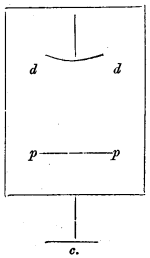
After trying various plans, the method which I found best fitted for comparing the tenacity of different starch jellies, was the following:—Of each of the kinds of starch, 24 grains were weighed out and mixed with 400 grains of distilled water, in a porcelain capsule of suitable size. The mixture was then heated and boiled briskly for three minutes, with constant stirring, and was immediately poured into a conical test-glass,[45] which the jelly nearly filled. The time at which each glass was filled was noted, and exactly two hours were allowed for the contents to cool in a current of air. The glass is then set on a plate of glass, supported on a ring of a retort stand, and the weight ascertained, which was necessary to force a metallic disc, of ascertained size, through the jelly. The most convenient way of doing this was by using a piece of apparatus of the form rudely represented on the margin. The rectangular frame is of thin brass wire, and the slightly cup-shaped disc, d d, is soldered to a wire, attached to the upper short side of the rectangle. From the opposite or lower side of the rectangle a small glass cup, c., is suspended, into which weights are put as soon as the disc has been made to rest on the surface of the jelly, pp is the plate of glass on which the test-glass is set. Whenever the disc tears the skin of the jelly and begins to sink in it, no further addition, of weights is made, and the weight of the disc, framework, and cup being known, we have an estimate of the tenacity of the jelly. This process is but approximative, and some practice is necessary before the operator succeeds in getting uniform results from the same series of specimens.
The following statement shows the results on such specimens as I could procure. The disc was exactly 7/10ths of an inch in diameter.
TABLE NO. III.—TENACITY OF STARCH IN JELLIES.
No.Names of specimens.Weight in grains required to break the jelly.
1.Tous les mois, C., C.L.2,446 *
2.Tous les mois, Grenada, Commercial1,742
3.Maize, C., C.L.955
4.Barbados yam, C., C.L.895
5.Irish potato, from Belfast, C.L.756
6.Tannia, C., C.L.630
7.Bermuda arrowroot, finest Commercial627
8.Common yam, C., C.L.657
9.Guinea yam, C., C.L.571
10.Plantain, C., C.L.467
11.Potato starch, Commercial467
12.Arrowroot, C., C.L.393
13.Sweet potato, C., C.L.368
14.Arrowroot, C., C.L.340
15.Arrowroot, C.301
16.Arrowroot, St. Vincent's, Commercial289
17.Barbados arrowroot, Commercial273
18.Wheat starch, Commercial183
19.Buck yam, C., C.L.151
20.Bitter cassava, C., C.L.150
21.Sweet cassava, C., C.L.78
[* In this instance the weight stated detached the jelly from the side of the glass, but the skin of the jelly was not torn as in the other cases.]
From this list it is obvious that, in respect of tenacity, there is a very great difference between the jellies prepared from the different starches—greater, indeed, than exists in regard to any other character. At first I thought it probable that the tenacity of the jelly would bear some relation to the size of the globules, and it is true that we find the Grenada Tous les mois, the largest globule, next the top, and the cassava among the smallest, at the bottom of the scale. But, on the other hand, we have the Buck yam starch, a large sized globule, very high; together with many other exceptions.
As an article of diet, the most tenacious varieties of starch are preferred, on account of the economy of employing an article of which a less quantity will suffice; and the same is true when applied to starching linen, provided the jelly be not deficient in clearness.
Clearness of jellies.—When starch jelly is used for the purpose of starching, or glazing linen, or cotton goods, those varieties that are most transparent are understood to be preferred, provided, at the same time, they possess the requisite tenacity. This and other matters will be best determined by practical men in England; but having had occasion many times to prepare specimens for trying the tenacity, the opportunity was always taken of arranging the specimen of jellies in the order of their clearness, or, to speak more accurately, of their translucency. In this respect also they exhibit considerable differences, varying, when prepared according to the formula described under the head of tenacity, from very translucent approaching to opaque. The order is shown in the annexed list, which begins with the clearest.
TABLE NO. IV.—SHOWING THE ORDER OF CLEARNESS OR TRANSLUCENCY OF UNIFORMLY PREPARED STARCH JELLIES.
Order.Names of specimens.
1.St. Vincent Arrowroot, Commercial
2.Arrowroot, C., C.L.
3.Sweet cassava, C., C.L.
4.Bitter cassava, C., C.L.
5.Bermuda arrowroot, Coml.
6.Arrowroot, C., C.L.
7.Irish potato, C.L.
8.Potato starch, Coml.
9.Buck yam, C., C.L.
10.Arrowroot, C.
11.Plantain, C., C.L.
12.Tannia, C., C.L.
13.Sweet potato, C., C.L.
14.Common yam, C., C.L.
15.Tous les mois, Grenada, Cml.
16.Barbados arrowroot, Coml.
17.Tous les mois, C., C.L.
18.Barbados yam, C., C.L.
19.Guinea yam, C., C.L.
20.Wheat starch, Coml.
21.Maize, C., C.L.
On comparing this list with the former one, and taking a general view of the subject, it will be seen that the jellies that are most tenacious are generally the least translucent, and that the order of the two lists is more nearly the converse than occurs in regard to any other properties.
Percentage of starch yielded by different plants.—On this point no two writers do or can agree. The quantity of starch, even in the same plants, the potato for instance, varies with the season, the soil, climate, age, ripeness, length of time the roots have been out of the ground, &c.
In the following table I have given the result of a series of trials made in the Colonial Laboratory, Demerara. The roots were all fresh dug, and, with two exceptions, noticed in the remarks, were fair average specimens. The process was the common one. The grater or rasping machine was of copper, to avoid injuring the color of some of the starches, which an iron grater is liable to do:—
TABLE NO. V.—PERCENTAGE OF STARCH YIELDED BY DIFFERENT PLANTS.
No.Names of plants.Percentage of starch.
1.Sweet cassava26.92
2.Bitter cassava24.84
3.Another sample20.26
4.A third16.02
5.Common yam24.47
6.Arrowroot (roots scarcely ripe)21.43
7.Another sample17.28
8.Barbados yam18.75
9.Tannia17.05
10.Another sample15.35
11.Guinea yam17.03
12.Plantain16.99
13.Sweet potato16.31
14.Buck yam16.07
15.Another sample15.63
16.A third, from a dark colored variety14.83
From the foregoing list it appears that the sweet and bitter cassava merit attention as starch-producing plants. They are occasionally grown for this purpose in the colonies, and yield a large per centage of starch; but there exists an opinion, whether well or ill founded, that it is liable to rot linen, and the preference is given here to the starch of arrowroot. It remains to be seen, however, what estimate will be formed of this starch in England, for if it should prove an esteemed variety, there can be no doubt of its proving a highly profitable cultivation. Cassava grows readily in almost any soil, and when the drainage is tolerable, two crops of the sweet variety can, it is stated be grown in a year. I have seen it growing luxuriantly in the light soils of the interior, as well as in the stiff clay soils of the coasts. It is considered an excellent preparatory crop in new and stiff land, on account of its tendency to loosen the soil. Were the bitter variety fixed on, the preparation of Casareep might be combined with the preparation of starch; and as that substance is one of the most esteemed bases for the preparation of various sauces, it is probable that this might turn out the most profitable part of the produce. At all events, bitter cassava would have this advantage over all other starch-producing roots, that the juice of the roots could be turned, to account as well as the starch.
Of all the plants mentioned in the list, starch is most readily separated from the arrowroot, in consequence of the tissue being more fibrous, and yielding little or no cellular tissue requiring to be run off the starch. Time and water are thus saved in the process, and were the fibrous residue pressed and dried, it could probably be turned to good account in the manufacture of paper.
In respect of facility of preparation, the plantain starch, though of excellent quality, ranks lowest, for the flesh-colored tissue in which the starch is embedded is somewhat denser than the starch, and settles down under it, and it is not a little difficult to arrange the process so as completely to separate the finer parts of this matter from the starch, and hence its color is never perfectly white.
Yield of starch-producing plants per acre.—On this subject, as already remarked, I do not at present possess sufficiently accurate data.
In England ten tons of potatoes are not unfrequently produced per acre; now assuming 15 the per centage of starch, there would be a yield of one-and-a-half tons per acre, which, at the-lowest quotation, 28s. a cwt., would give £42 per acre; and were the starch to rank with that prepared from wheat, it would produce £40 per ton, or £60 per acre. In the thorough drained land of Demerara, and under a good system of cultivation, I have no doubt that ten tons of cassava could easily be grown, and if it yielded 25 per cent. of starch, it would be a return of 2½ tons, or of £62 10s. per acre, reckoned at the price of potato starch.
Of the yield of the plantain we possess much more accurate information. A new plantain walk in this colony (British Guiana) will yield 450 bunches, of 50 lbs. each, of which, as nearly as possible, 50 per cent. will be of core, containing 17 per cent. of starch, thus producing 17 cwt. of starch per acre. But an old plantain walk, even when free from disease, could not be reckoned to yield more than half this quantity, namely, 8½ cwt. per acre. Considering the value that is set on the plantain as an article of food, and the difficulties incident to the process of making starch from it, it is by no means probable that it will ever be used as a source from which to obtain starch.
Of the quantity of arrowroot that can be grown per acre, I have been able (continues Dr. Shier) to procure no information; but from the price it commands in the market, the facility with which it can be grown, and the ease with which the process of separating the starch can be carried on, it deserves a fair trial here. To cultivate it to advantage it ought to be done on thorough-drained and well-tilled land, planted at the proper season, and not dug till ripe and in dry weather.
Of the Tous les mois, I have only been able to procure a single plant, for which I am indebted to the kindness of the Hon. John Croal. As the root was immature, it would be unfair to deduce from the quantity of starch obtained, the per centage generally contained by the plant. Its immaturity was also indicated by the globules being smaller than in the specimen obtained from Grenada; in other respects, however, such as the tenacity of its jelly, it stands highest. It is altogether one of the most promising starch-producing plants, and obviously deserves a careful trial. It is a plant that expends a good deal of matter in maturing a considerable quantity of dense and bulky seeds, but as it propagates both by root and seed, it is probable that, as a root-crop, it would be highly advantageous to procure a variety that does not flower.
Both the tannia and the sweet potato can be readily grown, and the produce per acre is large; but from the foregoing tables it would appear that there are other plants whose starch is likely to be held in greater estimation.
Difficulties attendant on the process of preparing starch.—Were the manufacture of superior starch to be carried out in this colony (British Guiana) on a large scale and profitably, recourse would require to be had to all the well-known means of economising labor. In the cultivation as much as possible would require to be done by cattle and implement labor, and this would be the easier to accomplish, inasmuch as, to grow roots to great advantage, the land would require to be thorough drained. When the produce was brought to the buildings, machinery similar to what is already in use in Europe, for the purpose of washing and rasping roots, and of separating and washing starch, would suffice with comparatively little manual labor. An ordinary amount of judgment being exercised in determining the proper period of ripeness of the roots, and in selecting seasons when the weather is usually most suitable for conducting the process of manufacture, it does not appear that any unusual difficulty would have to be encountered by growers or manufacturers, unless as regards the obtaining of a sufficient supply of good water; for that is essential to the production of good starch.
The creek water of the colony is generally too brown, and the trench water too muddy, and contains often too much salt to produce starches of the finest color, hence recourse would require to be had to rain water, or Artesian water. The first is remarkably pure, and it certainly does not appear that were sufficiently capacious reservoirs built, or ponds dug, and protected from infiltration by the usual well-known means, there would be great difficulty in getting a sufficient supply of rain water. It is done in Bermuda, and why not here? On the other hand, almost all the Artesian wells in the colony contain a large quantity of oxide of iron held in solution by carbonic acid, and which separates as an ochrey deposit on free exposure to the air. Were this water used in the starch process, it would certainly injure the color materially; but by a chemical process, exceedingly simple, inexpensive, and easy of application, it is possible to purify the Artesian water, and render it almost as fit as rain water for the purpose of manufacturing starch.
In some of the other colonies a great deal of the best starch is produced by the holders of small lots of land, and many parts of the labor being light, and suited for women and children, it is one of the most desirable cultivations for small holders, and would be very beneficial for Demerara, where the lands of the peasantry too generally lie in a state of utter neglect; yet small holders could not be expected to be able to compete with those who should grow starch on the large scale, and prepare it with the best machinery.
Cassava meal, plantain meal, &c., as articles of export.—It may soon become an important question whether the plantain, or some of the edible roots grown in the tropics, might not be sent to Europe in a fresh state as a substitute for the potato. Many of them, the buck yam and the cassava, for instance, ought to be used when fresh dug, for every day they are out of the ground they deteriorate. This, however, is not so much the case with some of the larger yams. It is worth trying whether the finer sorts that deteriorate by keeping, might not, after being sliced and dried in the sun, become articles of export, either in that state or when ground to meal. For this purpose the bitter cassava, the plantain, and the buck yam are the most promising.
Of the bitter cassava mention has already been made as a substance from which the starch and casareep might be prepared. In this case, however, the woody and cellular tissue, with the small quantity of starch left in it by the ordinary starch process, would form far too poor an article of diet to constitute part of the food of man. But the roots might be used as a medium from which to prepare cassava meal, casareep, and the very small quantity of starch which is expressed along with the juice, leaving all the rest of the starch to form part of the meal. It is of such meal that the cassava cakes of the Indians are prepared; and although by no means so nutritive as Indian corn meal[46], there can be little doubt that in the Scotch and Irish markets the cassava meal would obtain a preference; and were it exported in quantity it would probably come into extensive use among all classes.
The process would be as follows:—After washing in a revolving apparatus, by which means the adherent earth would be got quit of, and almost the whole of the thin dark colored cuticle become detached, the roots could be reduced to pulp in a rasping-mill, without the use of water; the pulp might be compressed in bags by hydraulic pressure, whereby the juice, together with a small portion of the starch, would be expressed. After allowing the starch to subside, the juice should be concentrated to about the density of 1.4. The starch would be washed, purified, and dried. The contents of the bags would then be broken up and dried in the sun or in a current of air, after which the meal would be sifted through a coarse sieve to separate the coarser parts, which, if their amount was considerable, could be ground and added to the rest. In this state of rough meal it is fit for making the cassava cakes. If ground to flour it might be used to mix with wheat, rye, or barley flour.
The process is usually conducted as follows:—The squeezed pulp is broken up, sifted, and exposed to the sun on trays or mats till it is fully more than half dry. An iron hoop of the size and thickness of the cake to be made is then laid on a griddle or hot plate, and the space within the hoop is filled evenly with the somewhat moist meal, no previous kneading or rolling having been employed. As soon as the coarse meal coheres, the ring is lifted and the cake is turned and heated on the opposite side. The heat should not be sufficient to brown the cake. The cakes are finally dried by exposure to the sun. From the dry cassava meal cakes may be prepared by sprinkling it with as much cold water as to moisten it to the proper point, and then proceeding as above. Hot water cannot be employed, neither can kneading, or any considerable degree of compression be used, otherwise the water does not evaporate readily enough; the starch gets too much altered by the heat, and the cake becomes tough.
If an acre of well-tilled thorough-drained land yield 10 tons of fresh roots, and I have every reason to believe that such a return might be obtained, I have ascertained that the produce would be 3½ tons of meal, 598 lbs. of casareep, and 2 cwt. of starch; and estimating the meal at 1d. per lb., the casareep at 1s. 5d. per lb., and the starch at 40s. per cwt., the gross amount would be £78 13s. 4d. per acre. In ascertaining these proportions, very simple machinery was employed, and had the pulp been better pressed the quantity of casareep would have been considerably greater.