Chapter II
Reading edition
THE FOUNDING OF NEW SPAIN (1492-1543)
SPAIN DURING THE CONQUEST
The discoveries of Columbus opened to Spain the opportunity to found a great colonial empire in the new world. For this work Spain had been prepared by the welding of the nation which was perfected during the reign of Ferdinand and Isabella.
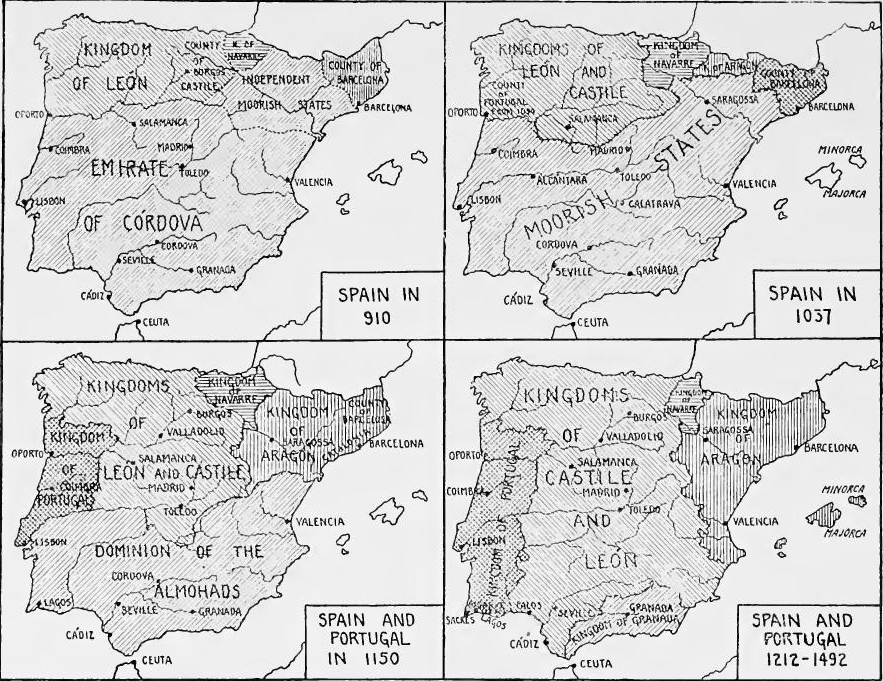
The Christian reconquest.—In the eighth century the Mohammedan Berbers had overthrown the Visigothic kingdom, the unconquered Christian princes retiring to the mountain regions of the north. Gradually they reconquered the country. By 910 they had established the kingdoms of León and Navarre, and the county of Barcelona. By 1037 León and Castile had united and conquered a wide tract south of the Douro River. Aragon, originally a Frankish country, had also become an independent kingdom. By 1150 almost two-thirds of the peninsula had been conquered; Portugal now extended from the Minho River to the Tagus; Castile occupied the central region, and Aragon had incorporated Barcelona and Catalonia. During the next two centuries the rest of the peninsula, except the small kingdom of Granada, was conquered, and Aragon established her power in the Balearic Isles, Sardinia, and southern Italy. In 1469 Isabella of Castile married Ferdinand of Aragon, thus uniting the two great states. In 1481 they made war upon Granada, completing its conquest in the year of the discovery of America. All of these changes had been chiefly of rulers, the great body of the people remaining of the original Iberian stock.
Lack of unity.—But there was neither unity of speech, customs, nor institutions. There were three main religious groups, Christians, Mohammedans, and Jews. The people were also divided into social classes, nobility, clergy, common people, and slaves. The ranks and privileges of the nobility varied greatly, some having immense estates and almost sovereign powers, others being landless soldiers of fortune. Castile was the land of castles. The nobles were turbulent and warlike. They delighted in chivalry, which probably attained a higher development in Spain than in any other country. Furthermore, there were three great military orders, which had grown in strength during the Moorish wars; these were the Knights of Santiago, of Calatrava, and of Alcántara, at the head of each of which was a grand master. The orders, the landed nobility, and the church owned about one-third of the land and controlled large military forces. The cities were also powerful; they were strongly fortified, regulated their own affairs, and many of them had great fleets and extensive commerce. Life outside of the cities was largely pastoral, wool, growing being the principal industry. Both Castile and Aragon contained governing bodies called Cortes, to which some of the larger cities sent representatives, but they were of little importance, most of the work of lawmaking being done by the sovereign acting with his Council of State.
Establishment of unity.—To bring the entire country into religious and political unity was the great task of Ferdinand and Isabella. This was accomplished partly through the Hermandad and the organization of several royal councils. The Hermandad, originally a local police, was organized as a state police; captured offenders were punished before local officers of the crown called alcaldes. Turbulent nobles and brigands were made to feel the long arm of the royal power. The nobles were also curbed by transferring the grand masterships of the military orders to the crown and the sovereigns resumed control of many estates which had been granted to churches and nobles. The royal council of twelve had been the principal governing body. Under Ferdinand and Isabella it was divided into three councils, justice, state, and finance. Other councils were added from time to time; among these was the Council of the Inquisition, whose business it was to stamp out heresy. By its efforts unbaptized Jews and Moors were expelled. The rulers also sent royal officers called corregidores into the local communities, who gradually extended the powers of the crown at the expense of local government. Thus were laid the foundations of an absolute monarchy, which, in the sixteenth century, became the most influential in Europe.
The Unification of Spain. (Based on Maps in Shepherd, W.R., Historical Atlas, pp. 82-83.).
Charles V.—The prestige of Spain was greatly enhanced in the sixteenth century by the Emperor Charles V, the grandson of Ferdinand and Isabella. From his mother he inherited Spain, Naples, and Sicily, and possessions in the new world and the Far East; from his father the Netherlands; from his grandfather, Maximilian I, the Hapsburg inheritance in Germany. By election he became Holy Roman Emperor. The larger part of the reign was occupied by three great European contests; a series of struggles with Francis I of France for the control of Italy, the Reformation in Germany, and the curbing of the westward advance of the Turks. The almost constant wars of the Emperor kept him away from Spain nearly his entire time, but he used the centralized system of Ferdinand and Isabella to supply him with soldiers and money. The constant drain of treasure overtaxed the resources of Spain, but the rich mines of the new world furnished the surplus for his vast undertakings. The fact that Charles was successful in retaining his power in Italy, coupled with his struggle against the Protestants and the Turks, made him the recognized protector of the Catholic church. His reign, marked by many sad failures in Europe, witnessed a phenomenal expansion of Spain's colonies.
THE OCCUPATION OF THE WEST INDIES
The rule of Columbus in the Indies.—When Columbus discovered a new world for Spain, that country was placed in a new situation, and a settled colonial policy was developed only with experience. A department of Indian affairs was created at once and put in charge of Fonseca, a member of the royal council. A combined interest in commerce, religion, and colonization was shown in all the arrangements for a second voyage by Columbus, but commerce was the primary object. At first it was planned to send a thousand colonists, but so eager were the applicants that fifteen hundred embarked. The expedition was equipped at the queen's expense, and most of the colonists were in her pay.
Reaching Española in November, 1493, Columbus found Navidad destroyed by Indians; he accordingly established a new settlement, named Isabella, at a point farther east. Leaving his brother Diego in charge, Columbus explored the southern coast of Cuba, discovered Jamaica, and circumnavigated Española. Complaints being made against his administration, in 1495 Columbus returned to Spain to defend himself. Shortly after his departure, gold being found in the southern part of Española, the new town of Santo Domingo was founded there and became the capital. Other men were eager for commercial adventure, and, in response to their demands, in 1495 trade in the Indies was opened to all Spaniards, at their own expense. Columbus regarded this an infringement upon his rights, and on his return to Spain he protested, but to little purpose.
In 1498 Columbus sailed on a third voyage, taking some two hundred colonists. On the way he discovered the mainland of South America near the Orinoco River, and, farther west, valuable pearl fisheries. During his absence a civil war had occurred in Española, and, at the end of two years of trouble with the contending factions, Columbus was sent to Spain in chains by Bobadilla, a royal commissioner, who remained to govern in his place. The charges against Columbus were dismissed, but he was not restored to his rule in the Indies. In 1502 Nicolás de Ovando was sent to replace Bobadilla, taking with him 2500 new colonists.
Spread of settlement in the West Indies.—After 1496 Santo Domingo became the chief town of Española and the seat of Spanish rule in America. In rapid succession posts and mining camps were established in various parts of the island, and by 1513 there were seventeen chartered towns in Española alone. Santo Domingo at that time had a population of fifteen hundred persons. It was some fifteen years after the settlement of Española before the other islands began to be occupied, attention being first given to making cruises along the southern mainland. Ovando began the conquest of the other islands, however, and Diego Columbus, his successor, prosecuted the work with more vigor. In 1508 Ponce de León was sent to conquer Porto Rico, and in 1511 the present city of San Juan was founded. The settlement of Jamaica was begun in 1509 by Esquivel, under orders of Diego Columbus. Several towns were soon established, and a shipyard opened. In 1537 Jamaica became a possession of the family of Columbus, with the title of Marquis till 1557, then of Duke of La Vega. In 1508 Ocampo circumnavigated Cuba and in 1511 Velasquez began the conquest of the island. Santiago was founded in 1514 and Havana a year later. Thus the West Indies became the nursery of Spanish culture and institutions in America.
The Development of the West Indies, 1492-1519.
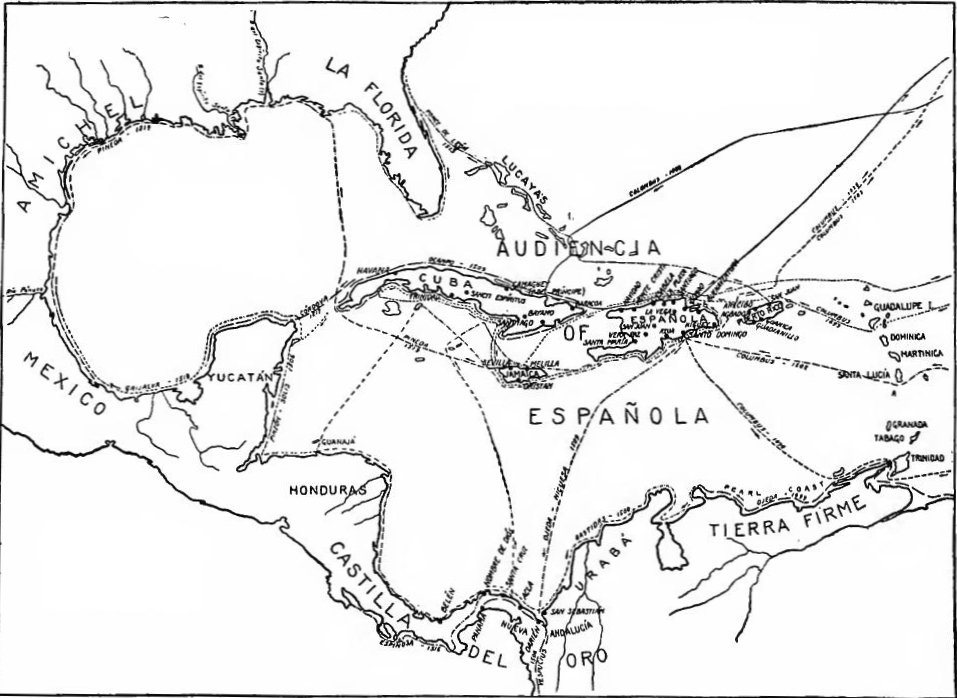
Gold mining was important in Española for a time, but the mines were soon exhausted. In all the islands cotton, sugar, and cattle raising soon acquired some proportions, but the native population rapidly decreased, negro slaves were expensive, and rich profits attracted the settlers to the mainland; consequently, after the first quarter century the islands declined in prosperity and Porto Rico was for a time actually abandoned.
BEGINNINGS OF COLONIAL ADMINISTRATION AND POLICY
The Casa de Contratación.—For ten years Fonseca remained at the head of American affairs, being in effect colonial minister. In 1503 the Casa de Contratación or House of Trade was established at Seville, to direct commerce, navigation, and all related matters of the Indies. In charge of the Casa was a board of officials, including factors, treasurer, auditor, and notary. They maintained a warehouse for receiving all goods and treasure going to or from the islands. They were required to keep informed of the needs of the Indies, assemble and forward supplies, organize trading expeditions, and instruct and license pilots. Later on a professorship of cosmography was established for the purpose of instructing pilots, who were required to keep diaries of their voyages. This provision resulted in the accumulation of a vast amount of historical and geographical information in the government archives, much of which is still extant.
The Council of the Indies.—Spanish America was a possession of the sovereigns of Castile, as heirs of Queen Isabella, under whose patronage America had been discovered. At first, legislative and political matters relating to the Indies had been considered by the sovereigns in consultation with Fonseca and other personal advisors, but to supervise these matters a new board was gradually formed. In 1517 it was formally organized, among the members being Fonseca and Peter Martyr, the historian. In 1524 the board was reorganized as the Council of the Indies. This body was the supreme legislative and judicial authority, under the king, of Spanish-America. The Casa de Contratación was subordinate to the Council, which likewise supervised all civil and ecclesiastical appointments in the colonies. Usually some of the members of the Council had served in the Indies.
The governors-general and the audiencia.—Ovando ruled in Española until 1509, when Diego Columbus, son of Christopher, after a struggle for his hereditary rights, was made admiral and governor-general of the Indies. Complaint against Diego's administration led to the establishment at Santo Domingo of a superior court with appeals from the decisions of the governor-general. This was the germ of the Audiencia of Santo Domingo, which, for a time, was the administrative head of the greater part of the Indies. By decree of September 14, 1524, the Audiencia was formally established, with a president, four judges, a fiscal, a deputy grand-chancellor, and other officers.
The towns.—In the early sixteenth century the colonial towns showed some political activity. In 1507 the municipalities of Española sent delegates to Spain to petition for the rights enjoyed by Spanish towns. The request was granted, and, among other privileges, fourteen towns were granted coats-of-arms. Conventions of delegates from the towns were often held in these early days, to consider common needs and to draw up memorials to the home government. In 1530 Charles V decreed that such conventions should not be held without his consent, and the tendency thereafter was toward stronger absolutism and away from local political life. But there never was a time when the right of petition was not freely exercised, and with great effect on actual administration. In the sixteenth century the towns sometimes elected proctors to represent them before the Council of the Indies. In the seventeenth century they sometimes employed residents of Spain for this purpose.
In the colonial towns, both Spanish and native, there was some degree of self-government. Each Spanish town had its cabildo composed of regidores. In 1523 the regidores were made elective, but the tendency was to secure the office by purchase or inheritance, as was the case in Spain. The functions of the cabildos were similar to those of a New England town council, embracing legislation, police matters, care of highways, sanitation, and analogous functions.
Emigration.—The notion sometimes voiced that Spain did not "colonize" America is unfounded. Emigration to America was encouraged by subsidies and other means, and in early days large colonies were sent by government authority. It has been seen, for example, that on his first three voyages Columbus took over about 100, 1500, and 200 colonists respectively, and that Ovando took 2500. During the entire sixteenth century the emigration to America averaged from 1000 to 2000 persons per year. In general, emigration was restricted to Spaniards of undoubted orthodoxy, hence Jews, Moors, and recent converts were excluded. Naturalization was relatively easy, however, and by means of it many foreigners were admitted. Portuguese, for example, were numerous in the Indies, especially among the seamen. Charles V adopted the liberal policy of opening the Indies to subjects of all parts of his empire, but Philip II returned to the more exclusive practice. Later on, as the trade monopoly broke down, it became necessary to admit foreign traders to American ports, but they were required to return within specified periods.
Married Spaniards emigrating from Spain were urged or even required to take their families but the emigration of unmarried Spanish women was discouraged. Intermarriage of Spaniards with native women was favored by the authorities and, as a large majority of the immigrants were single men, the practice was common, either with or without formal sanction. An effort to supply the lack of women by sending white slaves to the islands failed, and in 1514 marriage with Indian women was approved by royal order. With the opening of Mexico and Peru the island colonies were in danger of depopulation. To prevent this from happening, migration to the mainland was forbidden under heavy penalties (1525-1526), and the recruiting of new conquering expeditions in the islands was prohibited. To secure settlers for Española, in 1529 attractive feudal lordships were offered to founders of colonies.
Agriculture.—Agriculture in the West Indies was encouraged by all means available. Duties on imports were remitted for a term of years. In 1497 the sovereigns ordered a public farm established to provide loans of stock and seed, to be paid back by colonists within a term of years. Free lands were granted to settlers, with a reservation of the precious metals to the crown. Special orders were given for mulberry and silkworm culture. These efforts to promote agriculture in the West Indies, however, were made largely nugatory by commercial restrictions and the superior attractions of the mainland.
Indian policy.—Columbus found Española inhabited, it was estimated, by a quarter of a million of Indians, and the other islands similarly populated. He was instructed to treat the natives well and to do all in his power to convert them. The sovereigns frequently repeated these orders, and commanded that the natives be treated as free men and paid for their work. But the shortage of a labor-supply and the relative position of the two races led quickly and almost inevitably to the practical enslavement of the weaker.
Encomiendas.—Following the rebellion of 1495, the subdued natives were put under tribute in the form of specified amounts of products, commutable to labor. In 1497 a practice was begun of allotting lands to Spaniards, the forced labor of the natives going with the land. Complaint being made by priests and seculars that the Indians could neither be made to work, nor be taught or converted without restraint, in 1503 it was ordered that they should be congregated (congregados) in permanent villages and put under protectors (encomenderos), who were obliged to teach and protect them, and were empowered to exact their labor, though for pay and as free men. This provision contained the essence of the encomienda system, which was designed to protect and civilize the native, as well as to exploit him. But there was always danger that the former aim would yield to the latter, and, contrary to royal will, the condition of the natives fast became one of practical slavery.
Depopulation of the islands.—Moreover, in a very short time the islands became nearly depopulated of natives. Many were slain in the wars of conquest and during rebellions, or died of starvation while in hiding. Perhaps a greater number died of smallpox, measles, and other diseases brought from Europe. The result was that by 1514 the native population of Española was reduced to 14,000. A similar reduction of native population occurred in the other islands as they were successively occupied.
Indian slavery.—Indian slavery was not generally allowed in theory. But the Lesser Antilles, the Bahamas, and Florida were found to be inhabited by hostile cannibals, who were regarded as fair prize for enslavement. As early as 1494 Columbus suggested that permission be given to sell Caribs. In 1498 he took a cargo of six hundred of them to Spain. Soon it became an accepted legal principle that cannibals and rebellious Indians could be enslaved. The idea was encouraged by the lack of Spanish laborers, and by the disappearance of the native population of Española. Slave-hunting was soon extended, therefore, to the coasts of Florida, Pánuco, and other parts of the mainland. The practice was continued, as the frontier advanced, to the eighteenth century when, for example, Apaches of Texas and Pawnees of Kansas were often sold to Work on plantations in Louisiana or Cuba.
Las Casas.—Numerous prominent Spaniards in the Indies early opposed encomiendas on moral grounds. Among them the most aggressive was Father Bartolomé de las Casas. He had come to the Indies as a layman, had held an encomienda after becoming a priest, but in 1514 had renounced it. In the following year he went to Spain, secured the appointment of a commission of Geronymite friars to enforce the laws regarding Indians in the islands, and was himself made Protector of the Indians. In 1516 he returned to Española, but, being dissatisfied with the work of the commission, he returned to Spain, where he favored negro slavery as a means of sparing the natives. In 1521 he tried to found a Utopian colony on Tierra Firme, to furnish an humane example, but through unfortunate circumstances it failed completely.
EXPLORATION OF THE MAINLAND COASTS AND THE SEARCH FOR A STRAIT
Voyages toward the South.—The discovery by Columbus (1498) of pearls on the southern mainland, combined with the Portuguese successes in India, gave new incentive to voyages, and within the next few years many thousands of miles of coastline of South and Central America were explored in the interest of trade, discovery, and international rivalry. In 1499 Ojeda explored from near Paramaribo to the Gulf of Maracaibo. In 1500 Pinzón and DeLepe sailed north to the Pearl Coast from points near 8° and 10° south, respectively, and Bastidas made known the coast from the Gulf of Maracaibo to Nombre de Diós, on the Isthmus of Panamá. The chain of discoveries was carried in 1502 from the north shore of Honduras to Nombre de Diós by the fourth voyage of Columbus, made primarily in search of a strait through the troublesome lands which he had discovered. In 1504 La Cosa and Vespucius, during a trading voyage on the Gulf of Urabá, ascended the Atrato River two hundred miles by a route which has since been proposed as an interoceanic canal. Meanwhile numerous other voyages were made to the Pearl Coast for commercial purposes. They added little more to geographical knowledge, but led to colonization on the southern mainland.
Portuguese competition.—Spanish efforts to find a passage to the Indian Ocean by going to the southward were stimulated by the Portuguese voyages in the same direction. In 1500 Cabral, on his way to India, took possession for Portugal at a point near 18° south latitude on the Brazilian coast. In the following year a Portuguese expedition, in which Americus Vespucius was pilot, explored the coast from 5° to 32° south latitude, discovering the La Plata River on the way. It was to this voyage of Vespucius, made in the interest of Portugal, that America owes its name. First applied to South America, it was soon extended to the northern continent. A Portuguese voyage made in 1503 by Jaques, in search of a passage to the East, is said to have reached 52° south.
Establishment of the Portuguese Empire in the East.—Gama's voyage was promptly followed by the founding of Portuguese colonies in the East. The chief actor in this work was Alburquerque, who accompanied an expedition to India in 1503 and became viceroy in 1509, an office which he held until his death in 1515. During his rule the Portuguese established themselves at Goa, which gave them control of the Malabar coast, and at Malacca, from which point they were able to control the trade of the Malay Peninsula and the Spice Islands. Ormuz was captured, making them supreme in the commerce of the Persian Gulf. In succeeding years they acquired Ceylon and established trading settlements in Burma, China, and Japan.
Continued quest for a strait.—These Portuguese successes were an incentive to further Spanish efforts to find the strait. In 1506 Vicente Yáñez Pinzón, accompanied by Juan de Solís, in search of a passage explored the Gulf of Honduras and eastern Yucatán from Guanajá Islands, the western limit of Columbus's voyage, to the Island of Caría. In 1509 Solís, in the service of Spain, reached 42° south, while in search of the desired route. The discovery of the Pacific Ocean by Balboa in 1513 aroused Spain to renewed efforts to find the strait. Exploration was at once undertaken on the southern shores of Panamá, and in 1515 Solís again was sent down the Brazilian coast. Reaching the La Plata River, he was killed and eaten by the savages.
Magellan and Elcano.—The solution of the problem of the southern strait was left for Ferdinand Magellan, a Portuguese who had seen service in the Far East. Returning to Portugal, he proposed to the king the opening of a route to the East by going west. His offer being refused, like Columbus he turned to Spain, where his plan found favor. Sailing with five vessels in 1519, he discovered the Straits of Magellan and crossed the Pacific Ocean to the Philippines, where he was killed in 1521. Part of the crew, led by Elcano, continued round the world and reached Spain in September, 1522, after one of the most remarkable voyages in all history.
The mapping of the Gulf coast.—Meanwhile the outlines of the Gulf of Mexico had been made known, and by 1525 the continued search for the strait and efforts to settle on the mainland had carried Spanish, explorers nearly the whole length of the North Atlantic coast. In 1508 Ocampo had circumnavigated Cuba. Sailing from Porto Rico in 1513 Juan Ponce de León, who was interested in slave-hunting and exploration, discovered and coasted the Peninsula of Florida.
Four years later Córdova, under a license from Velásquez, governor of Cuba, explored Yucatán, finding signs of large cities and of wealth. The reports aroused new interest in the mainland, and Velásquez sent out Grijalva, who coasted the shore from Yucatán to Pánuco River, securing on the way twenty thousand dollars' worth of gold. To take advantage of Grijalva's discoveries, Velásquez organized another expedition and put it in charge of Hernando Cortés. Garay, governor of Jamaica, also sent out an expedition, under Pineda, with instructions to seek new lands and look for a strait. Sailing north to the mainland in 1519, Pineda completed the mapping of the Gulf by coasting from Florida to Vera Cruz and back. On the way west he discovered the Mississippi River, which he called Río del Espíritu Santo. On the strength of Pineda's discoveries, Garay now secured a patent to the northern Gulf shore, and undertook to colonize the province of Amichel.
The North Atlantic coast.—The exploration of the North Atlantic coast soon followed. In 1513 De León had rounded the Peninsula of Florida. Eight years later Gordillo, sailing from Española in the employ of Ayllón, and Quexos, a slave hunter whom Gordillo met on the way, reached the mainland at 33° 30', near Cape Fear in a region called Chicora. Ayllón in 1523 secured a patent authorizing him to seek a strait in the north and found a colony. In Ayllon's employ, Quexos in 1525 coasted north perhaps to 40°. In the same year Stephen Gómez, under contract to seek a northern strait, descended the coast from Nova Scotia to Florida. Over the northern part of his route he had been preceded by the English explorer John Cabot (1497). With the return of Gómez the entire Atlantic shore from the Straits of Magellan to Nova Scotia had been explored by expeditions made in the name of Spain.
THE MAYAS AND THE NAHUAS
A Double Movement.—Having subdued the islands and run the eastern coastline, the Spaniards proceeded to take possession of the mainland. To the southward they were attracted by trade, rumors of gold, and the hope of finding a strait leading to the East. To the westward they were drawn by the semi-civilized Nahuas and Mayas, who lived in substantial towns, possessed accumulated wealth, had a stable population used to hard labor, and were worth exploiting. The advance into the interior was a double movement, one proceeding north from a base on the Isthmus of Panamá, the other radiating in all directions from the Valley of Mexico.
Two Civilizations.—The Nahuas occupied Mexico south of a line drawn roughly from Tampico through Guadalajara to the Pacific Ocean. The Mayas lived principally in Yucatán and Guatemala. The Nahuas had acquired much of their culture from the Mayas, and the cultural areas overlapped. These peoples had several features in common. They lived in substantial pueblos, or towns, and practiced agriculture by means of irrigation, raising extensively maize, beans, potatoes, and tobacco. Maguey was a staple crop in the Valley of Mexico and henequén in Yucatán. Mayas and Nahuas both lacked important domestic animals. They were dominated by a powerful priesthood and practiced slavery and human sacrifice.
Maya Characteristics.—Certain features distinguished the two civilizations. The Mayas had imposing architectural structures devoted to religion, notably at Palenque, Uxmal, and Chichén Itza. They had made considerable advance toward written records in the form of ideograms. More than 1500 Maya manuscripts, written on henequén, have been preserved but are as yet in the main undeciphered.
The Nahuas.—The Nahuas had made remarkable progress in astronomical calculations, and their worship was closely connected with the planetary system. The most notable religious monuments were the pyramids which are widely scattered over the country. Some of these, it is believed, are of Maya origin. Calendars of great perfection had been devised, the famous Calendar Stone now preserved in the National Museum at Mexico being one of the rare treasures of archæology. The Nahuas had achieved a more highly developed agriculture than the Mayas, had a stronger military and political organization, and larger and better constructed towns. Of these the most notable was Mexico (Tenochtitlán). It was built in a lake in the center of the great valley of Anáhuac, and had a population of perhaps 60,000 when the Spaniards came.
Nahua History.—The Nahuas had come from the north about the time when the Germanic tribes were overrunning southern Europe. According to their own traditions the first Nahua tribe, the Toltecs, entered the Valley of Mexico in 596 A.D., and were overpowered by the barbarians whom they found there, but civilized them. In succeeding centuries they were followed by other Nahua tribes, whose names are now borne by numerous cities in the Valley of Mexico. Among the late comers were the Aztecs, who, according to tradition, founded their lake-city in 1325 A.D. Their military stronghold was the crag of Chapultepec, where the presidential mansion of Mexico now stands.
The Triple Alliance.—Among the numerous cities or pueblos built by these struggling tribes four emerged into prominence. First Atzcapotzalco, then Tezcuco, then Mexico acquired supremacy. Placing itself at the head of a triple alliance (Mexico, Tezcuco, and Tacuba), Mexico in the fifteenth century engaged in a series of conquests which carried the Aztec power to the Gulf of Mexico, to the Pacific Ocean, and well into the Maya regions of Central America. War became a national impulse, closely identified with the religion of which human sacrifice was a central feature. The "empire" was but a military overlordship, however, and had for its chief objects tribute and human beings for sacrifice.
The hegemony was not secure, nor did it embrace all of the semi-civilized peoples. The Tarascans and other tribes to the west had resisted its power, and shortly before the advent of the Spaniards the Tlascalans to the east had defeated the Aztecs in battle. At the coming of the Europeans the "empire" was losing its hold. The subject peoples were becoming more restless under the burden of tribute; and the ruler, Montezuma II, was a superstitious fatalist. The Spanish conquerors arrived at the opportune moment for success.
THE CONQUEST OF CENTRAL AMERICA
Castilla del Oro.—At the same time that the islands other than Española were being occupied, beginnings of settlement were made in Central America. In 1503 Christopher Columbus had attempted to establish a colony on the Veragua coast, but had failed. After several successful trading voyages had been made, however, two colonies were planned for the southern mainland. Ojeda received a grant called Urabá, east of the Gulf of Darién, and Nicuesa obtained a grant called Veragua, lying west of that Gulf. Ojeda founded a colony at San Sebastián (1509), which was shortly afterward moved to Darién, where Vasco Nuñez de Balboa soon became the leading figure and governor ad interim (1511). Nicuesa's colony was founded at Nombre de Diós (1510), but it did not flourish. The Darién region became known as Nueva Andalucía, and in 1513 the whole southern mainland, excepting Veragua, Honduras and Yucatán, to the west and Paria, to the east, was reorganized into one grand jurisdiction called Castilla del Oro, and made independent of Española.
Balboa.—Hearing of gold and a sea toward the south, Balboa led a band of men in 1513 across the Isthmus of Panamá and discovered the Pacific Ocean. The discovery was an important factor in leading to Magellan's great voyage, already recounted, and it set in motion a wave of explorations both up and down the Pacific coast, and led to the conquest of Peru. Balboa had made enemies, and he fell under the suspicion of the new governor of Castilla del Oro, Pedrárias de Ávila, who arrived at Darién in 1514 with a colony of fifteen hundred persons; but a conciliation occurred, and in 1515 Balboa was made Adelantado of the Island of Coíba, in the South Sea. To explore that water he built vessels on the north coast and had them transported across the Isthmus on the backs of Indians. The vessels proved unseaworthy, and while Balboa was building two more at the Isle of Pearls, he was summoned by Pedrárias, charged with treason, and beheaded (1519).
Exploration on the South Sea.—Balboa was succeeded by Espinosa in charge of the southern coast. He at once began plundering raids westward by land, seeking gold and slaves. The South Sea now became the chief center of interest, and, to provide a better base, in 1519 Pedrárias founded Panamá, moved his capital thither, refounded Nombre de Diós, and opened a road across the Isthmus between the two places.
Rapidly now the conquerors and explorers, under Pedrárias, pushed their way westward, by water and by land. With two of the vessels built by Balboa, in 1519 Espinosa sent an expedition under Castañeda which reached the Gulf of Nicoya, some five hundred miles from Panamá. In 1522 Andrés Niño and Gil González Dávila fitted out a joint expedition, planning to sail west one thousand leagues, to seek spices, gold, and silver. After sailing one hundred leagues westward, González proceeded west by land, while Niño continued with the fleet. González reached and conquered the country bordering on the Gulf of Nicoya and Lake Nicaragua, places so named from local chieftains. Niño sailed west to Fonseca Bay, thus coasting the entire length of Nicaragua. When the commanders returned to Panamá they reported thirty-two thousand baptisms, and presents in gold and pearls worth more than $112,000.
The Development of Central America, 1509-1543.
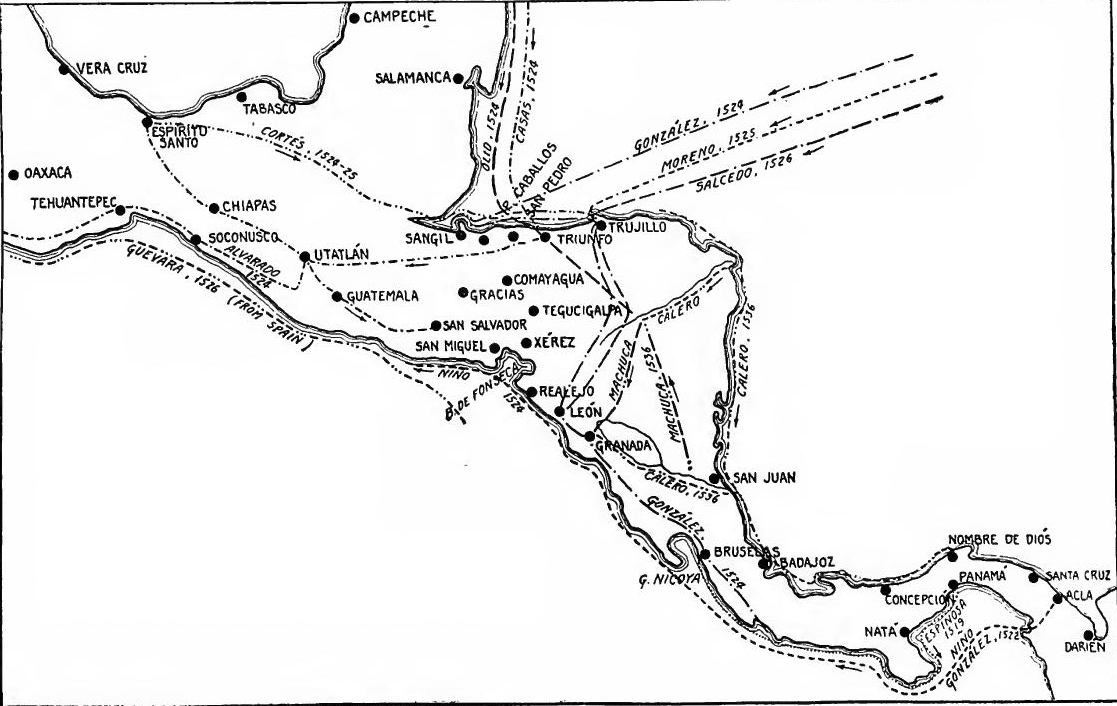
The Conquest of Costa Rica and Nicaragua.—These profitable explorations stimulated renewed interest, and were followed by conquest and settlement in Costa Rica and Nicaragua. González desired to return at once to occupy the country which he had explored, and, meeting hindrance from Pedrárias, he went to Española to organize another expedition, while awaiting royal consent. Meanwhile Pedrárias set about conquering Nicaragua for himself. With funds borrowed from Francisco Pizarro and others, he equipped a small expedition and sent it under Francisco Hernández de Córdova. One of the commanders was Hernando de Soto, who later became famous in Peru and Florida. Proceeding westward, in 1524 Córdova founded Bruselas, on the Gulf of Nicoya, and parceled out the natives among the settlers. Continuing into Nicaragua, he founded the cities of León and Granada. In the struggle which followed, Bruselas was abandoned and the settlement of Costa Rica proceeded slowly.
González in 1524, having secured royal permission, entered Honduras from the northeast, with an expedition destined for Nicaragua. De Soto, sent against him by Córdova, was easily subdued, but González was defeated by the agents of Cortés, who was now engaged in the conquest of Mexico. In Nicaragua Córdova revolted against Pedrárias and was executed. In 1527 Pedrárias became governor of Nicaragua, where he ruled till 1531. During all these wranglings the Indians were the chief sufferers. They were granted in encomienda, employed as beasts of burden, or branded and sold as slaves in Panamá, Peru, or the West Indies.
Guatemala, San Salvador, and Honduras.—Meanwhile the north-moving conquerors who went out from Panamá had met and struggled in Guatemala, San Salvador, and Honduras with the companions of Cortés, moving southward from Mexico. The history of the conquest of these disputed regions, therefore, becomes a part of the story of the exploits of Cortés and his lieutenants, recounted below.
Exploration of San Juan River.—One of the acts which relieve the bloody story of the career of Pedrárias was the sending in 1529 of an expedition under Estete to find the outlet to Lake Nicaragua. Estete descended the San Juan River until a glimpse was had of the sea, but hostile Indians prevented him from reaching it. It was believed that the lake and river drained a country rich with gold, and explorations continued. In 1536 the San Juan, with tributary branches, was explored by Alonso Carrero and Diego Machuco, under orders from the new governor of Nicaragua. Soon the lake and river became the principal highway from Nicaragua to the Atlantic Ocean, and to the Porto Bello fairs.
The Dukedom of Veragua.—It was a long time after Nicuesa's failure in 1510 before another attempt was made to settle Veragua, one reason being that the region was tenaciously claimed by the heirs of Columbus. In 1535 Alonso Gutiérrez was made governor of Veragua, as agent of the widow of Diego Columbus, but misfortune attended his efforts to found a colony. Shortly afterward (1537) the discoverer's grandson, Luis, was made Duke of Veragua; several attempts to colonize it failed, however, and in 1556 the region was surrendered for a small pension.
Continued struggle in Central America.—These conquests were but the beginning of a long struggle of the Spaniards with the natives in Central America. The first stages of the conquest were over by the middle of the sixteenth century, but many parts of the country were still unconquered at the end of the seventeenth. Some tribes, indeed, are unsubdued and uncivilized to this day.
THE CONQUEST OF THE VALLEY OF MEXICO
The revolt of Cortés.—In the very year of the founding of Panamá Hernando Cortés entered Mexico. The return of the expeditions of Córdova and Grijalva to the Mexican coast had caused excitement in Cuba. Governor Velásquez prepared an expedition to follow them up, and appointed Cortés to lead it. Becoming distrustful of his lieutenant, Velásquez sent messengers to recall him, but Cortés set forth, nevertheless. In defiance of the governor, on February 18, 1519, he left Cuba, a rebel, with eleven vessels, some six hundred men, and sixteen horses. Proceeding to Tabasco and up the coast, he founded Vera Cruz, by whose cabildo he was chosen captain-general and justicia mayor, and his position was thus given the color of legality. By this act Cortés placed himself under the immediate protection of the king.
The march to Mexico.—On the way and while at Vera Cruz Cortés had learned that the Aztec "empire" was honeycombed with dissension, and that the subject peoples were burdened with tribute and filled with hatred for Montezuma, the native ruler at the city of Mexico. He therefore assumed the rôle of deliverer, and the Indians rallied to his standard. At Cempoalla he connived at a revolt against Montezuma's tax gatherers. Scuttling his ships and thus cutting off all chance for retreat, in August he set out for Mexico. His march was a succession of audacious deeds. At Cempoalla he threw down heathen idols and imprisoned the chiefs. At Tlascala he was attacked by several thousand warriors, but his genius changed them into allies in his train. At Cholula, discovering a conspiracy, he raked the streets with cannon shot and burned the leaders at the stake. In triumph he entered the great pueblo of Tenochtitlán or Mexico. While lodged as a guest of Montezuma in the center of the city, he seized the Aztec ruler and held him prisoner.
The loss and recapture of the city.—In the spring of 1520 Cortés learned that Pánfilo de Narváez had arrived at Vera Cruz with nearly a thousand men, under orders from Velasquez to arrest him. Leaving Pedro de Alvarado in charge, he hastened to the coast, won over most of Narváez's men, and then hurried back to Mexico. During his absence the Aztecs had revolted, through the rashness of Alvarado. Soon after the return of Cortés the natives rose again, killed Montezuma, and replaced him by Cuauhtemoc, a more vigorous leader. Cortés now sought safety in flight, but during the night retreat he lost more than half his men. This "unfortunate night" became known as "Noche Triste." But the defeat was only temporary. Raising new allies, Cortés conquered the towns round about Mexico, built a fleet at Tlascala, launched it on Lake Tezcuco, besieged the city, and by a combined attack, by land and water, on August 13, 1521, he recaptured Mexico, the most important native town in all America.
Cortés's contest with Velásquez.—Knowing that Velásquez would oppose him, Cortés, while at Vera Cruz in 1519, had at once sent agents, bearing rich presents, to represent him at the court of Charles V. Then began a three-year contest with the agents of the Cuban governor. The delay was fortunate for Cortés, for in the course of it he won favor by his remarkable feats of conquest. Through the influence of Fonseca, Velásquez secured the appointment of Cristóbal de Tápia, an official of Española, as governor of New Spain, to take charge of the government and investigate Cortés. But Cortés got rid of him as he had disposed of Narváez. Arriving at Vera Cruz in December, 1521, Tápia was met by a council of delegates from the conqueror and practically driven from the country, on the ground that new orders were expected from the king.
Cortés made Governor and Captain-General.—Before this Cortés had sent Avila to the Audiencia of Santo Domingo to obtain its favor. Scarcely had Tápia been ejected when Avila returned with tentative authority for Cortés, subject to royal approval, to continue his conquests and to grant encomiendas. This greatly strengthened Cortés's position. Having succeeded so well in Española, Avila was now sent to Spain. Here he triumphed also, for on October 15, 1522, the emperor approved the acts of Cortés and made him governor and captain-general of New Spain. The victory of Cortés was as complete as the discomfiture of Velásquez and Fonseca.
Mexico rebuilt. Encomiendas granted.—The work of conquest on the mainland was accompanied by the evolution of government and the establishment of Spanish civilization, just as had been the case in the West Indies during the earlier stages of the struggle. Wherever the Spaniards settled, they planted their political, religious, economic, and social institutions. Mexico was rebuilt in 1522 as a Spanish municipality, Pedro de Alvarado, the most notable of Cortés's lieutenants, being made first alcalde mayor. In the regions subdued the principal provinces were assigned to the conquerors as encomiendas. Much of the actual work of control was accomplished through native chiefs, who were assigned Spanish offices and held responsible for good order and the collection of tribute. This method was later adopted by the British in India.
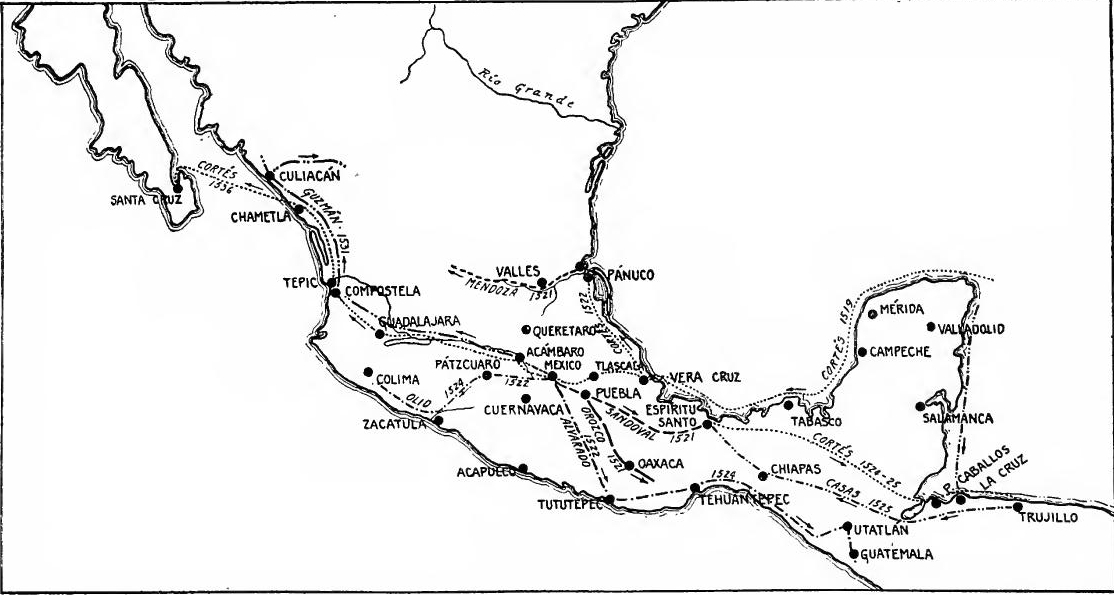
The Development of Southern Mexico, 1519-1543.
THE SPREAD OF THE CONQUEST
The semi-civilized tribes.—With the fall of the city the first stage of the conquest had ended. Within the following decade most of the semi-civilized tribes of southern Mexico and Central America were brought under the dominion of Spain. During this period Spanish activities were directed from the Valley of Mexico to the eastward, southward and westward. From the south came rumors of gold and reports of the South Sea, while to the north, among the barbarian tribes, there was little, at this stage of the conquest, to attract the conquerors.
Factors in the conquest.—Several factors explain the marvelous rapidity with which Spanish rule was extended. The conquerors were looking for gold and accumulated treasure; not finding it in one place they hastened to another, led off by any wild tale of riches. The fame of the Spaniards preceded them and paralyzed resistance. They were everywhere aided by great armies of allies, eager to help destroy their hated enemies. Finally, Cortés, himself a genius, was assisted by an able body of lieutenants; in the spread of the conquest Cortés remained the central figure, but the actual work fell mainly to Orozco, Alvarado, Olid, Sandoval, Chico, Avalos, Montejo and other subordinates.
Vera Cruz, Oaxaca, and Tehuantepec.—In the fall of 1520 Sandoval, in search of gold and to punish rebellious Indians, invaded southern Vera Cruz with a handful of soldiers, aided by thirty thousand Indian allies. To hold the district he founded the towns of Medellin and Espíritu Santo. Before the expulsion of Cortés from the city, goldseekers had been sent to Oaxaca and Tehuantepec and were well received, but the "Noche Triste" was followed by a reaction. Orozco was sent, therefore, to subdue Oaxaca, which he reported to be rich in gold. In 1522 an attack by hostile neighbors called Alvarado to Tehuantepec. Gold was found, and as the district bordered on the South Sea, settlements were formed to hold it.
Olid in Michoacán.—The same year, 1522, marks the extension of Spanish rule into Michoacán, the territory of the hitherto independent Tarascans. The cacique Tangaxoan visited Cortés and made submission, and in return Olid was sent to found a settlement at Pátzcuaro on Lake Chápala. Before the end of the year part of the settlers moved to the seacoast and settled at Zacatula, in the modern state of Guerrero, where a post had been established.
Colima and Jalisco.—From Michoacán the conquest at once spread north into Colima and Jalisco. Gold being reported in Colima, Avalos and Chico, lieutenants of Olid entered the country, but were defeated by the natives. Thereupon Olid followed, subdued the mountain region by force, and founded the town of Colima (1524), which became a base for new advances. On his return to Mexico, Olid brought samples of pearls from Colima, and reports of an Amazon Island ten days up the coast, where there were said to be great riches. To investigate these reports, in 1524 Francisco Cortés was sent north. He reached Río de Tololotlán, and secured the allegiance of the "queen" of Jalisco, but found little gold and no Amazon Island.
Amichel and Pánuco.—In 1522 the Huasteca country, to the northeast, came under the control of Cortés. It was three years before this that Pineda, as representative of Garay, governor of Jamaica, had visited the region. Garay applied for a grant of a province called Amichel, extending from Florida to Mexico, and set about colonizing it. In 1520, before the patent was secured, a party of his men met disaster near Pánuco River. Hearing of Garay's operations, in 1522 Cortés led forty thousand allies into the country, subdued it, and founded San Estéban, on Pánuco River. In 1523 Garay led a colony to the same region, but found himself forestalled by Cortés, by whom he was sent to Mexico, where he soon died. The rivalry of the Spaniards encouraged an Indian revolt, but Sandoval, as agent of Cortés, put down the disturbance with extreme cruelty. In 1527 the Pánuco district, under the name of Victoria Garayana was separated from Mexico, Nuño de Guzmán being made governor, while the region called Florida, further north, was assigned to Pánfilo de Narváez. Guzmán's rule of six months was characterized by attempts to extend conquests northward into Narváez's territory, by wars with the Huasteca chieftains, and by constant slave-hunting raids, through which the country was nearly depopulated.
Alvarado in Guatemala and San Salvador.—By this time the conquests of Cortés and his lieutenants had extended into Central America, where they encountered, the agents of Pedrárias. In 1522 embassies from the large cities of Utatlán and Guatemala had visited Cortés and made submission. In the following year Alvarado, with four hundred Spaniards and twenty thousand allies, entered the region and conquered the Quichés and Cakchiquels. This task partially completed, he continued south and extended his conquests into San Salvador (1524).
Olid and Casas in Honduras.—Cortés believed that Honduras was rich, and that a strait lay between it and Guatemala. Moreover, Gil González and the agents of Pedrárias had begun to operate there. Consequently, at the same time that Alvarado went to Guatemala, Olid was despatched to Honduras. Reaching there in 1524 he tried to imitate his master's example by making a conquest for himself. He succeeded in defeating González, as has been seen, but was in turn beheaded by Francisco de las Casas, who was sent by Cortés to overthrow him. During this struggle the city of Trujillo was founded.
The march of Cortés to Honduras.—In doubt as to the wisdom of sending Las Casas after Olid, in October, 1524, Cortés set out for Honduras in person, with about one hundred and forty Spaniards and three hundred Indians in his train, the latter led by three famous Aztec chiefs. In his rear was driven a herd of swine. The route lay through southern Vera Cruz, Tabasco, and Chiapas, to Golfo Dulce, his way being obstructed by vast morasses, swollen streams, and flint-strewn mountains. In a single province fifty bridges had to be constructed in a journey of as many miles. In Chiapas it became necessary to bridge with trees a channel five hundred paces wide. On the way the Aztec chieftains, including the noble Cuauhtemoc, being charged with conspiracy, were hanged, an act which is variously characterized as a "necessary punishment" and a "foul murder." Leaving his cousin, Hernando Saavedra, in command as captain-general in Trujillo, Cortés sent his men home by way of Guatemala and returned by sea to Mexico in May, 1526. After attempting for two years to explore on the South Sea, in 1528 he went to Spain to refute his enemies, chief of whom was Nuño de Guzmán, now president of the recently established Audiencia of Mexico. He returned two years later.
Yucatán.—The conquest of Yucatán was begun in 1527 by Francisco de Montejo, an agent of Cortés. Initial success was followed by native revolts, and it was 1541 before the conquest was made secure. There were frequent rebellions thereafter, but never again united resistance.
Las Casas in Guatemala.—Thus far the conquest had been one of force. But now an example of the power of gentleness was furnished by Father Las Casas, the Dominican friar who had opposed encomiendas so vigorously in Española. About 1532 he entered Nicaragua as a missionary, where he attacked the ill-treatment of the Indians. Being opposed by the governor, in 1536 he went to Guatemala. Shortly before this he had written a treatise to prove that conversion by force was wrong, and that only persuasion should be used. To test his views he was granted sole control for five years of a hostile region known as "the Land of War," and by mild means he and his companions soon converted the district into a land of True Peace (Vera Paz), as it is still called.
Guzmán in Sinaloa.—While Cortés was in Spain Guzmán, fearing his own downfall, and hoping to save himself by offering new provinces to the king, undertook the conquest of northern Jalisco and of Sinaloa. Leaving Mexico in December, 1529, with ten thousand allies, he marched through Michoacán and Jalisco, leaving behind a trail of fire and blood, for which he has ever since been execrated. Part of Sinaloa was explored, and Culiacán was founded as an outpost in 1531. The region subdued by Guzmán was named Nueva Galicia, of which the conqueror became governor and Compostela the capital.
Buffer province of Querétaro.—At the coming of the Spaniards the country north of the valley of Mexico had never been conquered by the Aztecs. The Spaniards, in turn, adopted the policy of entrusting its subjugation to native caciques, treating the region as a buffer Indian state. The leading figure in the conquest was a Christianized Otomi chief, named Nicolás de San Luis. By Charles V he was made a knight of the Order of Santiago and a captain-general in the army. Another Otomi cacique who played a similar though less conspicuous part was Fernando de Tapia. The most notable event in the conquest was the reduction of Querétaro in 1531. For thirty years San Luis served the Spaniards in the control of the Querétaro border.
The Mixton War.—The first half century of expansion toward the north was closed by a widespread native uprising in Nueva Galicia which for a time checked advance in that direction and even caused a contraction of the frontier. Guzmán had left Nueva Galicia in a deplorable condition. After several minor uprisings, the rebellious natives broke forth in 1541, during the absence of Governor Coronado and his army in New Mexico. The Indians refused to pay tribute, killed their encomenderos and the missionaries, destroyed the crops, and took refuge in the peñoles or cliffs of Mixton, Nochistlán, Acatic, and other places near Guadalajara. The defence fell to Cristóbal de Oñate, lieutenant governor of Nueva Galicia. Pedro de Alvarado, who chanced to arrive from Guatemala at Navidad with a force of men, led them against Nochistlán and lost his life in the encounter. Viceroy Mendoza at last took the field with four hundred and fifty Spaniards and thirty thousand allies, and crushed the revolt.
EXPLORATIONS IN THE NORTHERN INTERIOR AND ON THE PACIFIC
FLORIDA
De León.—While some conquerors were struggling in Central America, Mexico, and Peru, others were trying to subdue the vast northern region called Florida. In 1514 Juan Ponce de León secured a patent to colonize Florida and Bimini, which he had explored in the previous year. Instead of proceeding to the task, however, he engaged in a war against the Caribs, and it was not until 1521 that he attempted to carry out his project. In that year he led a colony of two hundred men to the Peninsula, landed on the west coast, and tried to establish a settlement. But he was attacked by natives, and driven back to Cuba, mortally wounded.
Ayllón's colony on the Carolina coast.—To carry out his contract to colonize Chicora, in July, 1526, Ayllón sailed from Española with six vessels and a colony of five hundred men and women, Dominican friars, and supplies, prepared to find a new home in Carolina. But the experiment was doomed to be another failure. Landing was first made on the river called the Jordan, perhaps Cape Fear River. On another stream; perhaps the Peedee, the settlement of San Miguel de Gualdape was begun. But supplies gave out, and at the end of two years Ayllón died (October, 1528). Quarrels ensued, and in midwinter the survivors, only about one hundred and fifty now, returned to Santo Domingo.
Narváez.—At the same time the conquest of Florida was attempted by Pánfilo de Narváez, the man who had been sent to Vera Cruz to arrest Cortés. In 1526 he secured a patent to the lands of Ponce de León and Garay. Raising a colony of six hundred persons in Spain, in 1528 he reached Florida, landing near Tampa Bay. Hearing of a rich province called Apalachen (Apalache), he sent his vessels along the coast and himself marched up the peninsula at the head of three hundred men to find the Promised Land. He found the place sought near modern Tallahassee, but it proved to be a squalid Indian village of forty huts. A few weeks having been spent in exploration and warfare, Narváez went to the coast near St. Marks Bay, built a fleet of horse-hide boats, and set out for Pánuco. After passing the mouth of the Mississippi a storm arose, and all were wrecked on the coast of Texas.
Cabeza de Vaca.—In a short time most of the survivors of Narváez's party died of disease, starvation, and exposure, or at the hands of the savages. Having passed nearly six years of slavery among the Indians, Alvar Núñez Cabeza de Vaca, the treasurer of the colony of Florida, with three companions, escaped westward, crossed Texas, Coahuila, Chihuahua, and Sonora, and in 1536 reached Culiacán, the northern outpost of Sinaloa, after a most remarkable journey.
De Soto.—Vaca went to Spain (1537) to apply for the governorship of Florida, but it had already been conferred on Hernando de Soto, who had taken a prominent part in the conquest of both Central America and Peru. In 1539 De Soto reached Florida with a colony of six hundred persons. Landing at Tampa Bay, as Narváez had done, he soon set out to look for a rich province called Cale. This was the beginning of an expedition lasting nearly four years, during which the Spaniards were led on by tales of gold and treasure from one district to another, hoping to repeat the exploits of Cortés and Pizarro. As he passed through the country De Soto imitated those captains by capturing the chiefs, holding them as hostages, and compelling them to provide food and men to carry the baggage. Going to Apalachen he wintered there, meanwhile discovering Pensacola Bay. From Apalachen he went to the Savannah River, thence northwest to the North Carolina Piedmont, south toward Mobile Bay, northwest to the Mississippi near modern Memphis, westward across Arkansas into Oklahoma, thence down the Arkansas River to its mouth, where he died, in May, 1542, being buried in the Mississippi.
Moscoso in Arkansas and Texas.—De Soto's followers, led by Luis de Moscoso, now set out for Pánuco, crossing Arkansas to the Red River, then turning southwest through eastern Texas, perhaps reaching the Brazos River. Giving up the attempt by land, they returned to the Mississippi, built a fleet of boats, descended the river, and skirted the Texas coast, reaching Pánuco in 1543. Thus ended the fourth attempt to colonize Florida.
CÍBOLA AND QUIVIRA
Cortés on the South Sea and in California.—Another line of advance toward the northern interior had been made by way of the Pacific slope. The discovery of the South Sea was followed immediately by exploration along the western coast. Balboa himself had begun that work, before his death in 1519. Espinosa had reached Nicaragua in 1519, and three years later Niño had reached Guatemala. By this time Cortés had also begun operations on the South Sea by building a shipyard at Zacatula, hoping, to discover a strait, find rich islands and mainland, reach India by way of the coast, and open communication with the Moluccas. In 1527 he sent three vessels under Saavedra across the Pacific: The operations of a new fleet built by him were hindered by the Audiencia of Mexico, but in 1532 he sent an expedition north under Hurtado de Mendoza, which reached Río Fuerte in northern Sinaloa. In the following year another expedition sent by Cortés, under Jiménez discovered Lower California, which was thought to be an island and where pearls were found. The discovery of an island with pearls confirmed the geographical ideas of Cortés, and in 1535 he himself led a colony to La Paz, but within a few months it was abandoned. This was the first of a long series of efforts to colonize California.
Explorations in the Northern Interior, 1513-1543. Enlarge
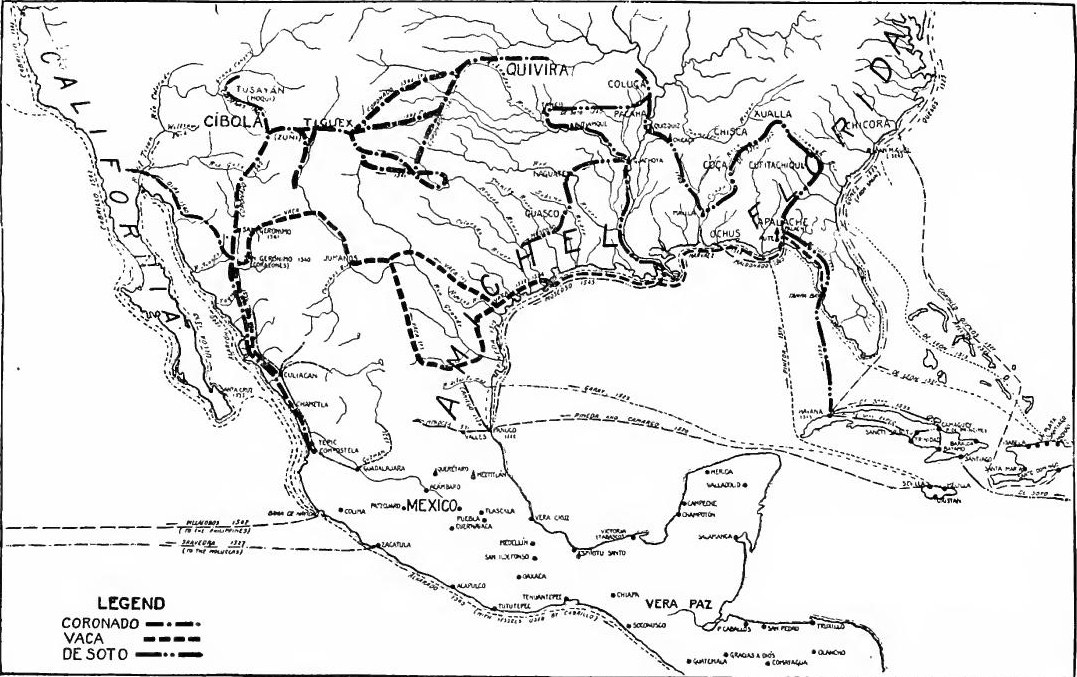
Friar Marcos discovers Cíbola.—Interest in the north country, both in Spain and America, was greatly quickened by the arrival of Cabeza de Vaca in Mexico after his journey across the continent. He had seen no great wonders, but he had heard of large cities to the north of his path, and it was thought that they might be the famed Seven Cities. The viceroy took into his service the negro Stephen, one of Vaca's companions, and sent him with Friar Marcos, a Franciscan missionary, to reconnoitre. In March, 1539, they set out with guides from Culiacán. Going ahead, Stephen soon sent back reports of Seven Cities, called Cíbola, farther on. Friar Marcos hastened after him, and reached the border of the Zuñi pueblos in western New Mexico, where he learned that Stephen had been killed. Returning to the settlement, he reported that Cíbola was larger and finer than Mexico. This story, of course, was the signal for another "rush," like that to Peru a few years before.
Ulloa rounds the peninsula of California.—Rivalry between Cortés and the viceroy regarding exploration was now keen, and about the time of the return of Fray Marcos, Cortés, hoping to forestall his competitor, sent three vessels north to explore under Francisco de Ulloa. One of the vessels was lost, but with two of them Ulloa succeeded in reaching the head of the Gulf of California, and learned that California was a peninsula. Descending the Gulf he proceeded up the outer coast of California to Cabo del Engaño.
The contest for leadership.—While Ulloa's voyage was still in progress, Cortés hurried to Spain to present his claim of exclusive right to conquer the country discovered by Fray Marcos and Ulloa. He never returned to Mexico. Other contestants arose. The agents of De Soto, who at the time was in Florida, claimed Cibola as a part of the adelantado's grant. Guzmán claimed it on the basis of explorations in Sinaloa. Pedro de Alvarado claimed it on the ground of a license to explore north and west, for which purpose he had prepared a fleet.
The Coronado expedition.—But the royal council decided that the exploration should be made on behalf of the crown, in whose name the viceroy had already sent out an expedition under Francisco Vásquez Coronado, governor of Nueva Galicia. To coöperate with Coronado by water, Alarcón was sent up the coast from Acapulco with two vessels.
In February, 1540, Coronado left Compostela with some two hundred horsemen, seventy foot soldiers, and nearly one thousand Indian allies and servants. So eager were the volunteers that it was complained that the country would be depopulated. The expedition was equipped at royal expense with a thousand horses, fine trappings, pack-mules, several cannon, and with droves of cattle, sheep, goats, and swine for food. From Culiacán Coronado went ahead with about one hundred picked men and four friars. Following behind their leader, the main army moved up to Corazones, in the Yaqui River valley, where the town of San Gerónimo was founded and left in charge of Melchor Díaz.
Zuñi, Moqui, the Colorado, and the Rio Grande.—In July Coronado reached the Zuñi pueblos, which he conquered with little difficulty. But the country was disappointing and the expedition resulted only in explorations. These, however, were of great importance. At Culiacán Alarcón procured a third vessel, then continued to the head of the Gulf, and ascended the Colorado (1540) eighty-five leagues, perhaps passing the Gila River. Shortly afterward Melchor Díaz went by land from San Gerónimo to the Colorado to communicate with Alarcón, but failed and lost his life. During the journey, however, he crossed the Colorado and went some distance down the Peninsula of California.
Hearing of the Moqui pueblos, to the north of Zuñi, in July Coronado sent Tobar to find them, which he succeeded in doing. Shortly afterward Cárdenas went farther northwest and reached the Grand Canyon of the Colorado. Moving to the Rio Grande, Coronado visited the pueblos in its valley and camped at Tiguex above Isleta. In the course of the winter the Indians revolted and were put down with great severity.
Gran Quivira.—Meanwhile Coronado heard of a rich country northeastward called Gran Quivira, and in April, 1541, he set out to find it. Crossing the mountains and descending the Pecos, he marched out into the limitless buffalo-covered plains, the "Llanos del Cíbola," inhabited by roving Apaches. Near the upper Brazos he turned north, crossed the Texas Panhandle and Oklahoma, and reached Quivira in eastern Kansas. It was probably a settlement of Wichita Indians. Disappointed, and urged by his men, Coronado now returned to Mexico. Three fearless missionaries remained to preach the gospel, and soon achieved the crown of martyrdom. Coronado had made one of the epochal explorations of all history.
The Pueblo Indians of New Mexico.—Coronado found large parts of New Mexico and adjacent regions inhabited by Indians who dwelt in substantial towns (pueblos) and possessed a civilization similar to that of the Aztecs. Their terraced dwellings, which were also fortifications, were built of stone or adobe, and were several stories high. The inhabitants lived a settled life, practiced agriculture by means of irrigation, and raised cotton for clothing. They were constantly beset by the more warlike tribes all about them, and were already declining under their incursions. At the time of the conquest there were some seventy inhabited pueblos, whose population may have been from 30,000 to 60,000. The principal pueblo regions were the upper Rio Grande, the upper Pecos, Ácoma, and the Zuñi and Moqui towns. Remains of prehistoric pueblos occupy a much wider range in the Southwest, and are now the scene of important archaeological research.
CALIFORNIA AND THE PHILIPPINES
Alvarado's fleet.—Shortly after Coronado left New Mexico, two important expeditions were despatched by Viceroy Mendoza to explore in the Pacific. Magellan's voyage had been a signal for a bitter conflict between Spain and Portugal in the East, in which Portugal long had the upper hand. After the failures of Loaisa (1525) and Saavedra (1527) Charles V sold Spain's claims on the Moluccas to Portugal, but continued to claim the Philippines. In spite of former disasters to eastern expeditions, both Cortés and Pedro de Alvarado planned discoveries in the South Sea. In 1532 Alvarado made a contract for the purpose, but was led off by the gold "rush" to Peru. In 1538 he obtained a new grant, authorizing him to explore "in the west toward China or the Spice Islands," or toward the north at the "turn of the land to New Spain." Early in 1539 he left Spain with equipment nor a fleet, which he transported across Honduras and Guatemala on the backs of natives. On hearing of the discoveries of Fray Marcos, he hastened north with his fleet, but stopped in Mexico, where he and Mendoza, who had already sent out Coronado, made an agreement, as mutual insurance, to divide the profits of their respective explorations. Before continuing his expedition Alvarado was killed in the Mixton War (1541). This left the fleet in Mendoza's hands, and with it he carried out Alvarado's plans by despatching two expeditions, one up the California coast, the other across the Pacific.
Cabrillo and Ferrelo.—The coast voyage was conducted by Juan Rodríguez Cabrillo, and was especially designed to look for a northern strait. Leaving Navidad in June, 1542, Cabrillo explored the outer coast of the Peninsula, discovered San Diego Bay, reached Northwest Cape (latitude 38°31'), descended to Drake's Bay, and then returned to the Santa Barbara Channel, where he died. Sailing north again in 1543, his pilot, Ferrelo, reached the Oregon coast (42 1/2°), returning thence to Navidad. Cabrillo and Ferrelo had explored the coast for more than twenty-three degrees, but had missed both San Francisco and Monterey bays.
Villalobos.—The other expedition was led by López de Villalobos, who was instructed to explore the Philippines and to reach China, but not to touch at the Moluccas. Sailing in November, 1542, he took possession of the Philippines, but, being forced to leave on account of native hostility, he was captured by the Portuguese. Villalobos died in the Moluccas, where the enterprise went to pieces. The expeditions of Coronado, De Soto, Cabrillo, and Villalobos brought to an end a remarkable half century of Spanish expansion in North America and in the Pacific Ocean.
THE ESTABLISHMENT OF THE VICEROYALTY OF NEW SPAIN
Cortés as administrator.—Cortés was not a mere conqueror. He appointed officers, and issued general ordinances affecting nearly all lines of activity. Encomenderos were required to equip themselves for defense and to promote agriculture. Cortés himself became a great planter, notably at Oaxaca. He introduced agricultural implements, opened a port at Vera Cruz, and established markets in Mexico City. In 1523 the king had forbidden encomiendas, but Cortés made so strong a protest on the grounds of policy and royal interest that the order was withdrawn.
Royal officials arrive.—In 1524 a corps of royal officials arrived to take the places of those appointed by Cortés. Estrada came as treasurer, Salazar as factor, Albórnoz, as contador, and Chirinos as veedor. They came empowered to interfere in the government of Cortés, especially in matters of finance, a policy quite in keeping with the general Spanish practice of setting one officer to watch another.
The powers of Cortés curtailed.—The new officials were not slow to make trouble for Cortés. While he was in Honduras his enemies set about undermining him, both in Mexico and Spain. Salazar and Chirinos usurped authority, persecuted the conqueror's partisans, confiscated his property, and spread reports that he was dead. At last the friends of Cortés rebelled, overthrew the usurpers, Salazar and Chirinos, and sent for Cortés to return from Honduras. In May, 1526, he reached Vera Cruz. Two years of investigation and persecution by other crown officials followed.
In response to complaints in Spain, Luis Ponce de León was sent early in the same year as governor and to hold a residencia of Cortés, while the latter's jurisdiction as captain-general was lessened by the appointment of Nuño de Guzmán as governor of Pánuco. Ponce de León died in July, leaving Aguilar as governor. Aguilar died early in 1527 and Estrada became governor. He interfered with Cortés's explorations in the South Sea, and banished him from Mexico City as dangerous, but the breach was soon healed when both were threatened by the usurpations of Guzmán. It was at this time that Cortés, finding his position unbearable, went to Spain for redress and to answer charges.
The first Audiencia of New Spain.—In view of the disturbed conditions in New Spain, in 1528 Charles V created an Audiencia or supreme court for Mexico, and empowered it to investigate the disorders and hold the residencia of Cortés. It was composed of four oidores and a president. To the latter office was appointed Nuño de Guzmán. He proved to be an extreme partisan against Cortés, and so avaricious that he soon won the hatred of almost everyone except a few favorites. The old friends of Cortés stood by him and he secured the support of Bishop Zumárraga.
Cortés made Marquis of the Valley.—The arrival of Cortés in Spain caused his detractors to slink from sight, and he was conducted to court with almost royal honors. In consideration of his brilliant services, in 1529 he was granted twenty-two towns, with twenty-three thousand vassals, with full civil and criminal jurisdiction and rentals for himself and his heirs. With these honors he was given the titles of Marquis of the Valley of Oaxaca, captain-general of New Spain, and governor of such islands as he might still discover in the South Sea. In 1530 he returned to New Spain, where he was acclaimed by the people, though opposed by the Audiencia.
The second Audiencia.—The abuses of the first Audiencia led to its replacement in 1530 by a new corps of judges, of whom the president was Sebastián Ramirez de Fuenleal. The oidores appointed were Salmerón, Maldonado, Ceynos, and Quiroga. They were especially instructed to hold the residencias of their predecessors, restore the estates of Cortés, and consider the abolition of encomiendas. To replace control by encomenderos, local magistrates called corregidores were introduced. A few of these functionaries were appointed, but the colonists raised such a cry that little change was accomplished, and the Audiencia confined itself, in this particular, to checking abuses of the encomienda system. Quiroga later became bishop and civilizer of Michoacán, where he is still gratefully remembered.
The viceroyalty established.—The difficulties of government and the spread of conquests made closer centralization necessary, and New Spain was now made a viceroyalty. The first incumbent of the office of viceroy was Antonio de Mendoza, a nobleman of fine character and ability. He arrived in 1535. As viceroy he was president of the Audiencia, governor, and captain-general, personally representing the king in all branches of government.
The Audiencias of Panamá and Guatemala.—Alvarado served as governor and captain-general of Guatemala through appointment by Cortés till 1528, when he was commissioned directly by the emperor. Though frequently absent, he continued in office till his death in 1541. In 1537 Panamá and Veragua were erected into the Audiencia of Panamá, which was later attached to the viceroyalty of Peru, because the commerce of Peru crossed the Isthmus. Six years later the Audiencia of the Confines of Panamá and Nicaragua was established. After various changes, by 1570 Guatemala became the seat of an Audiencia embracing all of Central America except Panamá, Veragua, and Yucatán.
The New Laws.—Las Casas and others continued to oppose the encomienda system. In 1539 the great missionary returned to Spain to conduct the fight. While there he wrote his celebrated works called The Destruction of the Indies and the Twenty Reasons why Indians should not be enslaved. His pleadings were not in vain, for in 1542 the Council issued a new Indian code called the New Laws, which provided that encomiendas should be abolished on the death of the present holders. But so great was the opposition that in 1545 the vital clauses of the ordinance were repealed. In Peru the attempt to enforce the laws even led to bloodshed.
Mendoza sent to Peru.—Viceroy Mendoza continued to rule for fifteen years. He proved to be a wise, able, and honest administrator, who tried to improve the condition of both the colonists and the helpless natives. He prohibited the use of the Indians as beasts of burden. In 1536 he established the printing press in Mexico, the first book published on the continent appearing in 1537. In that year he founded the college of Santa Cruz de Tlatelalco for the education of noble Indians. He opened roads from Mexico to Oaxaca, Tehuantepec, Acapulco, Michoacán, Colima, Jalisco, and other distant points. In 1550 he was sent to rule in troubled Peru, where the Spaniards were duplicating the brilliant exploits of Cortés and his followers.
READINGS
SPAIN DURING THE CONQUEST
Armstrong, E., The Emperor Charles V.; Bourne, E.G., Spain in America, Ch. I; Chapman, Charles E., A History of Spain, 1-246, especially Chapters X-XXII; Cheyney, E.P., European Background of American History, Ch. V; Hume, M.A.S., Spain, its Greatness and Decay; Hume, M.A.S., The Spanish People; Lane-Poole, S., The Moors in Spain; Lowery, W., Spanish Settlements within the present limits of the United States, 1513-1565, pp. 79-101; Merriman, R.B., The Rise of the Spanish Empire; Prescott, W.H., Ferdinand and Isabella; Haring, C.H., Trade and Navigation between Spain and the Indies in the Time of the Hapsburgs.
THE WEST INDIES, CENTRAL AMERICA, AND MAGELLAN
Altolaguirre y Davale, D. Angel de, D. Pedro de Alvarado, Conquistador de Guatemala y Honduras; Vasco Nuñez de Balboa; Bancroft, H.H., Central America, I, 183-247, 321-412, 478-511; Bourne, E.G., Spain in America, 20-53; 115-132; Fiske, John, The Discovery of America, I, 465-512, II, 184-212; Fortier, A., and Ficklen, J.R., Mexico and Central America, 1-102; Guardia, R.F., History of the Discovery and Conquest of Costa Rica; Guillemand, F.H.H, Life of Magellan; Helps, Arthur, The Spanish Conquest, I, 89-142, 193-320; Lowery, Woodbury, Spanish Settlements within the present Limits of the United States, 102-122; Richman, L.B., The Spanish Conquerors, 64-91, 139-154; Wright, L.A., The early History of Cuba, 1492-1586.
CORTES AND HIS FOLLOWERS
Bancroft, H.H., Central America, I, 522-643; Díaz del Castillo, Bernal, True History of the Conquest of New Spain; Fortier and Ficklen, Mexico and Central America, 181-238; Helps, Arthur, Life of Cortés; Life of Las Casas; The Spanish Conquest, III, 23-67, 164-289; McNutt, F.A., Cortés and the Conquest of Mexico, 43-67; The Letters of Cortés to Charles V.; Prescott, W.H., The Conquest of Mexico, Bks. II-IV; Bolton, H.E., The Spanish Borderlands; Means, P.A., History of the Spanish Conquest of Yucatán and of the Itzas.
EXPLORATIONS TO THE NORTH AND IN THE PACIFIC
Bancroft, H.H., History of California, I, 64-81; Bandelier, A.D.F., The Gilded Man; Journey of Cabeza de Vaca (Trail Makers' Series); Blair and Robertson, The Philippine Islands, I-II; Bolton, H.E., Spanish Exploration in the Southwest, 1542-1706 (Original Narratives Series), 1-39; Bourne, E.G., Spain in America, 158-174; Narratives of the Career of Hernando de Soto (Trail Makers' Series); Brittain, Alfred, Discovery and Exploration, 343-361; Hodge, F.W., and Lewis, T.H., The Spanish Explorers in the Southern United States, 1528-1543 (Original Narratives Series); Irving, Theodore, The Conquest of Florida; Lowery, Woodbury, Spanish Settlements within the present Limits of the United States, 130-350; Richman, L.B., California under Spain and Mexico, 3-11; Schafer, Joseph, Pacific Coast and Alaska, 3-23; Winship, G.P., The Coronado Expedition (Bureau of American Ethnology, 14th Report, Part I.); The Journey of Coronado (Trail Makers' Series), Richman, I.B., The Spanish Conquerors, 91-139.