Chapter VII · Early Setting of a young Morning Star
Reading edition
And Jacob served Laban for Rachel seven Years; and they seemed unto him but so many Days, for the Love he had unto her." Albeit I was not serving my Master for my Master's Daughter, yet her being in the House helped, I wot, to make the seven Years speed like seven Days. Sure, never was so gracious a Creature! Her Nature was so excellent, and her Countenance, which was the Index of her Mind, was so full of Sweetness and Goodness, that one could scarce look upon her without blessing Him who had created her so lovely.
Meantime my Master's Fortune and Credit from small Beginnings had risen mightily, as is often the Case in this commercial and prosperous City. He had gone through the three Degrees of Wardenship of his Company, had been elected of the Common Council, and was now Alderman of the Bridge Ward Without. And if he still lived and went plain, he laid by and laid out in Commerce the more: there was no Shew, nor no Stinting.
Yes: those were happy Days! All the fairer they seem now, for the dark ones that were coming. The only Sorrow among us that I remember was when the Pestilence brake out, in the fifth Year of our young King, which at first only prevailed in the North, but at length reached London, where it raged with prodigious Fury, carrying off eight Hundred Souls the first Week, and mostly after a Sickness of only twelve or twenty-four Hours. We had it not on the Bridge, which was attributed to the free Access of fresh Air to our Dwellings; howbeit, Mistress Anne (like a ministering Angel as she was,—such a Child, too! only in her twelfth Year!) must needs go about, relieving poor Wretches in their Dwellings; whereby she caught a low Fever that brought her to Death's Door, and filled the House with Tears. If my Master, a Man in Years, forbare not to weep, Reason was, a Lad such as I should weep too. Howbeit, through the Grace of God, she recovered: but for a long Time she was too enfeebled to walk, wherefore Master Hewet took her much on the Water during the long Summer Evenings, after we had been nigh stifled by the Day's sultry Heat. For the eastern Side of the House was close; and the western, though open, yet was much exposed to the Glare of the Sun on the River. We shut it out with Blinds and Lattices all we could; but still, the Crown of the Day was after Sundown on the Water. Master Hewet liked his 'Prentices to pull; and sometimes we fell into the Wake of some Court Barge with Horns and Sackbuts, and lay on our Oars; Mistress Anne full silent, resting her Head, for Weakness, against my Master's Shoulder, and with the Tears sometimes stealing down from her large, bright Eyes. My Master carried her down to the Boat, but 'twas my Portion, for I will not say Burthen, to carry her up. How light she was! She did not much like it, and managed presently to ascend slowly, with the help of my Master's Arm; but I remember the Goodness and Sweetness with which, with a sweet Blush on her Face, she sayth, "Do you remember the first Time? But for thee, I had not been here now."
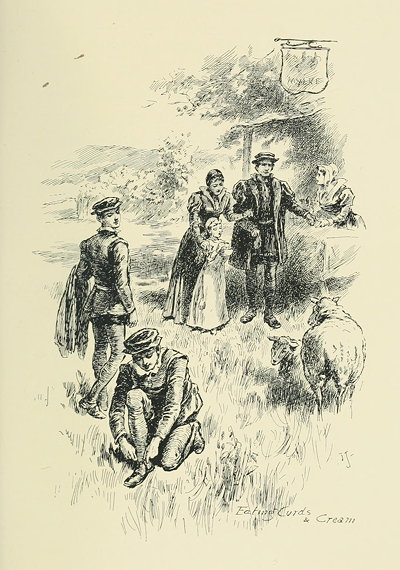
As she strengthened, we kept out longer, and went up to Chelsea and Fulham, and rambled about the pleasant Fields; eating Curds and Cream at Milkhouses, and returning by Moonlight; Miles and I singing, "Row the Boat, Norman."
J J
"Eating Curds & Cream"
Then Master Hewet carried her down into the Country, to the Hall of his Brother the Squire; and there she abode till she was quite well. When she returned, the Leaves were falling, and Master Hewet would walk with her of an Evening to Finsbury Fields, and stand with her at a Distance to see us young Men shoot the long Bow, leap, wrestle, cast the Stone, and practise our Shields; in all which, Miles came in for his full Share of Praise; and I was always well content to be thought equal to him. Sometimes I overshot him, sometimes he overshot me; sometimes I outleaped him, sometimes he outleaped me; but we loved the Game beyond the Competition; there was never any ill Blood between us.
'Twas on All Saints' Day, this Year, that the new Service Book, called of Common Prayer, was first used in Paul's Church, and the like throughout the whole City. Dr. Ridley, Bishop of London, performed the same in Paul's, in his Rochet only; and in the Afternoon preached at Paul's Cross before the Lord Mayor, Aldermen, and Livery Companies, which Sermon, being on the Subject of the new Service, lasted till five o' the Clock, so that, the Days being short, we returned by Torch-light.
Then had the Church great Rest. The Enemy, knowing his Time was at Hand, lay mighty quiet: and, for the Multitude of notable Foreigners that resorted to us for Safeguard, England might have been called Christi Asylum. Howbeit, the Canker was already i' the Bud!
The King, earlier in the Year, had ta'en the Measles; and during the Summer, had ridden a Progress with greater Magnificence than ever he had done before. In the January following, whether procured by sinister Practice or natural Infirmity, he fell into an Indisposition of Body which soon grew to a Cough of the Lungs. Perhaps it had been happy if Lord Robert Dudley (now my Lord of Leicester,) had not recently been sworn one of the six Gentlemen of the King's Chamber ... we must not speak ill, Hew, of them that are set high in Authority, save upon great Conviction and Certitude: howbeit, you and I know what the private Report of that Gentleman is—When I'm sick, don't give me a Leicester Cordial, that's all!
The common Talk was, that a poisoned Nosegay had been given the pretty Boy at New-year's-tide, which brought him into this slow but deadly Languishment. To think, what Poison may lie 'neath Flowers! At all Events, the Duke of Northumberland, now the powerfullest Man in the Realm since he had swallowed up his unhappy Rival Somerset, beginneth to aim at nothing short of Crown matrimonial for his young Son Lord Guilford Dudley, lately espoused to the Lady Jane Grey; therefore inculcateth on the kingly Boy now a-dying, how much it concerned him to have a Care for Religion, not only during Life, but after his Death; which could not be preserved in its Purity to the Realm should the Lady Mary succeed; and, if he set aside one Sister, he might as well put away the other also, and devise his Crown to her who after them was his next Kinswoman, the good and godly Lady Jane.
So soon as this was obtained of him, he might die as soon as he would—the sooner the better—and, to help Matters, the Leeches were dismissed, and a Gentlewoman (thought to have received her Instructions before hand,) set over him; under whose Applications his Pulse presently failed, his Skin changed Colour, and other Symptoms speedily appeared of Mortal Dissolution. Turning his Face then to the Wall like good Hezekiah, he was heard by one that sate behind the Curtain to say, "O Lord God, deliver me out of this miserable and wretched Life! O Lord, thou knowest how happy it were for me to be with thee; yet, for thy Chosen's Sake, if it be thy Will, send me Life and Health that I may truly serve thee!" After a little Space, again he sigheth, "O save thy People England!" Then, turning about, and noting some one behind the Curtain, "I had thought," saith he, "I was alone." "Sir," sayth the Attendant, "I heard you speak, but heard not what you were saying." "Nay," sayth he, "I was but praying to God. Oh! I am faint! faint unto Death! Lord, receive my Spirit!" And forthwith breathed out his white, innocent Soul. Early ripe, early gathered!
Thus we sometimes see the Nation's prime Hope, the Desire of all Eyes, cut off as a sweet Rose snaps its Stalk; and we mourn, thinking the Lord hath forgotten to be gracious and will no more be entreated, and his Mercy is clean gone from us for ever; not knowing that, after he hath tried and purified his own, yea, like Silver over the Fire, till the thick Scum separates and he seeth his own Image reflected in the bright Metal, he will return unto us and be gracious, like as a Father pitieth his Children, and make our latter Day better than our Beginning. Had we not known the early Setting of this young Hesperus, we had not now sunned ourselves in the Light of our bright Occidental Star.
And now, the bright Boy being dead, the Duke of Northumberland took upon him to sit at the Stern, and order all Things according unto his Pleasure. The Demise of the Crown was kept close that Day and the next, he hoping to obtain Possession of the Lady Mary, who, however, learned the Secret, and rode off to the Coast. Meantime, he took heed to occupy and fortify the Tower; and, on the second Day, sent for the Lord Mayor, six Aldermen, not including Master Hewet, six Merchants of the Staple, and as many Merchant Adventurers, to attend the Council at Greenwich, where they were advised of the King's Death and how he had ordained for the Succession by Letters Patent, to the which they were sworn, and charged to keep the Matter secret.
When my Master presently heard of this from one of his brother Aldermen, (for such Secrets are not long kept,) he said, in his own Family, that however he might desire a Protestant Succession, he was persuaded that this would not, nor could not, come to Good. "To say Nothing," quod he, "of the Lady Jane's questionable Birth; for the Duke, though few know it, had, when he married her Mother, a Wife living already."
Howbeit, at Three o' the Clock on the Monday Afternoon, the Lady Jane was conveyed, in Sight of us all, by Water from Syon to the Tower, and there received as Queen. At Five o' Clock, the King's Death and her Accession were proclaimed; but few cried "God save Queen Jane!" A Drawer at a Tavern within Ludgate said in the Hearing of some, that he thought the Lady Mary had the better Title; whereon he was incontinent arrested and set in the Pillory in Chepe, whereto both his Ears were nailed, and then clean cut off.
Meantime the Duke of Northumberland heareth that the Lady Mary's Party makes head, whereon he resolves to send Lady Jane's Father, the Duke of Suffolk, to put it down and seize her Person. Whereon the Lady Jane, who hath all along had no Mind to the Crown, weepeth sore, and begs her Father may be let off that Enterprize and that her Father-in-law will take it on himself; which he, after short Demur and much Flattery of his Bravery and Skill, consenteth to do. But his Heart misgiveth him, both as to what he goes to and what he leaves behind; and, sayth he to the Council, "Should ye in mine Absence waver in your Resolution, it may be ye will contrive your own Safety with my Destruction." Quod they, "Your Grace makes a Doubt of that which cannot be, for which of us all can wash his Hands clean of this Business?" So the Duke set forth with eight Thousand Foot and two Thousand Horse; and, as he rode along Shoreditch, quod he to Lord Grey, "See how the People press forward to see us! but not one of them sayth, 'God speed you!'"
In Truth, Gentle and Simple fell off to the Lady Mary, though Bishop Ridley preached at Paul's, to invite us to stand firm to Lady Jane. The Duke's Party melted away; and the Duke of Suffolk, learning how his Daughter's Partizans had defalked to the Lady Mary or been defeated and captivated, entereth the young Queen's Chamber and telleth her in brief, she must now put off her royal Robes and be content with a private Life. To which the meek young Lady made Answer, that she should put them off with more Contentation than she had put them on; and would never have done so but to please him and her Mother. And so ended her ten Days' Reign.