Chapter V · Edward convalesceth i' the Green Lattice
Reading edition

When mine Eyes opened next Morning, my loved Mother's dear, pale Face was hanging over me. "Child," quod she, "Misfortunes never come alone—When Master Hewet's Post came to Ashford with News of thy Sickness, I was far from Home, in Westmoreland, at the Death-bed of thine Uncle Lancelyn; and I wist not till Yesterday, what News was awaiting my Return." ... And she hung over me, and bathed my Face in her Tears. "But I am proud of thee, my Ned" quod she, "and so would thy Father have been. And thou hast taken off from thee the Reproach of being taught of a Woman as well as born of a Woman ... my dear, dear Son!"
Oh! what a Heaven it was to get well! There was my loved Mother beside me at her Sewing, telling me of Ashford and the green Lanes of Kent, and of the wild Hills of Westmoreland, till I seemed to be there myself. There was Mistress Fraunces cockering me up, first with Sweets and cooling Drinks, and then with savoury and strengthening Things; even to Mortreuse and Leche Lombard! And when I was able to sit up at the green Lattice, Mistress Anne and I would look down on the Barges and Boats, and play at divers Games and tell divers Stories. The Lodger that had beforetime occupied this Chamber, had left a Heap of old Books and written Papers, which, having Nothing private in them, my Master said I was free to look over. There was Part of a Chronicle of English History, whether the Writer's own Composure or a Traduction, I wot not; but brave and pleasant Reading, about the Courts of England, France, Spain, and Flanders, in the Time of our Edward the Third, and Queen Philippa. Another Work was a Romaunt of Love and Chivalry: also an Account of London Bridge, and Chaucer's Canterbury Tales, and a Treatyse on Fysshynge. Likewise, there was a great Roll of Drawings, done, I afterwards found, by another Lodger, in black and red Chalk, much fouled, smeared, and chafed, but diverting to look at, being Representations of Men, Women, Children, Skeletons, Death's Heads, Bones, Angels, Fiends, Hippogriffs,—and divers other Presentments; with H. H. writ at the End.
Thus pleasantly passed the Time till the Doctor said I had only now to pick up my Strength; and my Mother then thought it Time for her to return to my little Brothers. The Evening before she left, she sayth unto me somewhat apologetically, "Ned, thine Uncle Edward having died childless, and left all to thine unmarried Uncle Lancelyn, who hath now left me his Heir, I am now well to do, with an hundred Pound by the Year, real Estate, and, personal Estate, five hundred Pounds, which I have taken kind Master Hewet's Advice concerning the Disposal of. And he, being kindly affectioned unto thee just now, (as well he may be,) is pleased to say thou art sure to make thine own Way in the World, and to advise my devising all my personal Estate unto thy younger Brothers, thou being secure of the other at my Death."
Quod I, "Dear Mother, mayst thou live as long as I shall! There is Nothing thou canst do so much to my Mind as to care for Thomas and Julian, the one of whom is weakly and unfit for active Life, and the other, I think, will love Farming. Master Hewet, I am certified, hath spoken wisely." And in sooth, I was glad to note what a good Understanding seemed to exist, on so short Acquaintance, between him and my dear Mother.
So, when she was gone, I had Nothing to do but to get well. Marry! what a hard Matter, though, it was!—At first I was glad to think I might go forth abroad, and resume my old Gossips with Tomkins. But the very first Time I essayed to clamber up to his Attick, though 'twas only two short Flights, I found myself so weak that I was fain to sit down on the Stair and shed Tears, whether I would or no. And there, to my very great Shame, I was found of my Master. He bespake me kindly, and helped me up, and said this Weakness would soon go off: howbeit, it did not.—I always think that Chirurgeon bled me too freely: I noted his saying, "We'll knock him down first, and then build him up again!" which carryeth a Sound of Smartness, but not always answereth with the Event. Thus, 'twas now found I must still go softly; and the Weather being sultry, Master Hewet bade me keep as much as I could i' the open Air and Shade, and creep out, as my Strength permitted, to the Fields, with Mistress Anne to my Mate. So we went forth Hand in Hand, for I was past carrying her; and presently I say, "Oh me, Mistress! ... I must sit down"—and sayth she, "There's a Door-step i' the Shade a little farther on, with a nice old Woman on it, selling Mulberries." So we creep on, and the little Maid buyeth me Mulberries, and I eat and rest, and am refreshed. Then quod I, "Let's go back now, Mistress;" but sayth she, "Oh, let's try to go on to Trolop's Milk-farm." So I love not to cross the little Fondling, and as soon as we reach the green Meadows, the fresh, sweet Air seems to take away that queer, light, fluttering Feel in my Head, and to refresh and brace me; and I lie on the Grass i' the Shade, and she runs hither and thither and gathers Borage, and Blue Bugloss, and Bushy Red-mint, and bringeth them to me, saying, "What's this?" and "What's this?" And so we go on Day by Day.
Now as touching Miles Hackathrift. When I first lay sick, I have said he was mighty softened, and went gently and seemed amain concerned for me. Howbeit, Boy's Grief not long lasteth, and he soon fell tired of feeling or feigning any; more by Token, he perceived his was outrun by that of Everyone in the House. Whereupon he turned about, and grew indifferent, then jealous, then surly, then envious, doubtless by small Degrees; but of this, I, being apart from him, was not cognizant; and the Change made itself apparent to me all at once. First, when Master Hewet was out, he took Advantage of it to come trampling up Stairs with all the Clamour he could, singing, "Row the Boat, Norman!" in a defiant sort of Way; and when Mistress Fraunces put her Head forth of the Lattice Chamber and sayth, "Make not such a Turmoil, Miles," he pretended to stumble on Tomkins's Stair, and let a heavy Weight roll all the way down it. When he clattered down after it, Mistress Fraunces, watching her Opportunity, gave him a Rap on the Head, which I know that white Hand of hers could not have dealt very heavily; natheless he took Occasion by it to cry out sharply, and then give one or two dismal Grones, which he was too spirited to have done had he in verity been mal-entreated. However, finding he might not sing nor slam Doors while I lay under the Leech's Care, he turned sulky and held close, so as that scarce yea or nay was to be had out of him. When at length I returned to our Loft, he took Care to do me to wit how pleasant it had been to him to have it all to himself; and immediately took Advantage of my coming back, to oversleep himself of a Morning. Also he instantly intermitted all the little Share of my Work that had been put upon him while I was ill. Seeing me turn white from Time to Time, he said I was shamming for the Sake of Soups and Cordials; and when I went forth with Mistress Anne, he called me a special good Nursery-maid. All this I cared for very little, knowing that when I got stout, I could soon put him down; but meantime, 'twas not over-pleasant to be scoffed at as a languid Lad, who, if trodden on, could not turn again. One Day, when some Trifle had made me start and change Colour,—I think it was seeing Mistress Anne go nigh the open Window,—he had half pronounced, "You Coward!" when, suddenly changing his Mind, he sayth, "Dost know what new Name I have found for thee, and taught the Lads along the Bridge? 'The Knight of the Flying Leap!'" Which was humourous, but not well natured. Howbeit I heard it often enough for awhile, but as a Title of Distinction instead of Derision; which incensed the Author of it.
But all these little Clouds blew over during the three Weeks I spent with my Mother at Ashford. When I came back, I was the same Lad as ever, and took Things as I found them, and fell into my old Place.
J Jellicoe
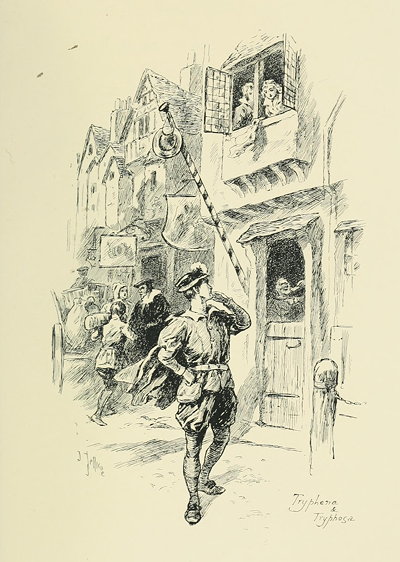
Tryphena & Tryphosa
In the October of this Year, Sir John Gresham, Mercer, being chosen Mayor, his Company resolved to get up their famous Pageant of the Maiden Chariot; and having vainly cast about among their own Fraternity for a young Damsel sufficiently comely to be the Admiration of all the City, and likewise able and willing to play the Part of Chariot Maiden, they at length offered it to the youngest Daughter of Master Soper the Barbitonsor who lived on the Bridge. Now Master Soper had two Daughters, good and pretty Girls enow as Times went, Tryphena and Tryphosa by Name, fresh-coloured, sprightly, and much admired by the Bridge 'Prentices. These two Sisters were seldom apart, inasmuch as both their Heads might commonly be seen out of one upper Lattice, looking after every Thing that passed in the Strete; and 'twas in their Favour that they always seemed on the best of Terms with one another. But whether by Reason of any Unguent of Master Soper's, or mere Liberality of Nature, I wot not, the younger, who in no other Wise excelled her Sister, was notorious for the excessive Length and Thickness of her glossy flaxen Hair. And this being an indispensable Requisite for the Chariot Maiden, the Mercers without more Ado offered her the Part, which she with great Glee accepted. Now hereupon, I lament to say, ensewed great Disruption between the twain hitherto so harmonious; for Public Admiration of Beauty is as true a Test of what is the Nature of a Woman's Heart, as the black Marble the Goldsmiths call Touchstone is of their precious Metals. If her Head be not turned by it, good: if she can bear it bestowed upon another and o'erlooked in herself, why, good also,—she can stand the Touchstone: howbeit, all have not this Virtue. And, whereas Tryphosa was now so elate with thinking of her white satin Gown, her golden Sandals, her jewelled Crown, and her Feast in the Hall, as to suppose the Ground scarce good enow for her to tread upon, Tryphena was ready to burst with Envy of her Sister, and could scarce speak peaceably unto her. However, she came to her common Sense and good Feeling at last, and found her Account in playing Second; many good Things being in Store for both. A notable Thing was, that Master Soper's Shop was now literally besieged with Customers who wanted to have a Glimpse of the Chariot Maiden, insomuch that he said he never had had such a Trafficking for Pennyworths in any given Year, as he had in this Month of October; only the worst was that every Customer gave as much Trouble for a Penny as he should have done for a Shilling, and would hang about, keeping away fresh Comers, when his Purchase was made. While Tryphosa, who had never to this Time shewn any Symptoms of Shyness, now turned coy and kept herself close; now and then letting Tryphena flit through the Shop and be mistaken for her, after which the two would shut themselves up and go into Fits of Laughter. The Women all along the Bridge were out of Patience with her for what they would have it was simulated Bashfulness in one who meant to be stared at from Morn to Night on Lord Mayor's Day. And they satisfied themselves that she was shutting herself up for Fear of freckling or sunburning. As for Miles, who always loved to do like the rest, he was evermore running over to Master Soper to have his Hair cut, till at last it was hardly longer than the Nap of his Gown; and I almost think he would have submitted one of his good white Teeth to the Barber's Pincers, if he could have gained Admittance on no cheaper Terms; just to boast of it afterwards. At last, when the grand Day came, he and every 'Prentice on the Bridge mobbed the Barbitonsor's Door till Tryphosa was fetched away in a close Litter. Then there was a Rush to the Mercers' Hall, where Master Gresham, in his Scarlet and Gold, met his Livery in their new Gowns furred with Foins and Budge; and accompanied them, mounted, to Guildhall, where the late Mayor, Sheriffs, and Aldermen, met them on Horseback. Then they all took Barge to Westminster and back, to the Sound of Trumpets, Sackbuts, and Shawlms, and the firing of small Guns, and exploding of Crackers. On re-landing at Three Cranes' Wharf, they re-mounted, and proceeded to Paul's Churchyard, where they met the Pageant, consisting of an exceeding magnifical Chariot, twenty-two Feet high, of the Roman Build, entirely covered with silver embossed Work, having Tryphosa therein, set on high, in Jewels and spangled Satin; her fair flaxen Tresses dishevelled, a Sceptre in one Hand, a Shield in the other, with all the Glory and Majesty possible to imagine:—Fame, blowing of a Trumpet right over her Head, Wisdom, Modesty, and all the rest, including the nine Muses, each in their proper Places; Triumph, driving nine white Flanders Horses, three abreast; Grooms, Lictors, and Pages marching alongside the Equipage; and a Score of Salvages and Jacks-i'-the-Green, making diverting Remarks to all; and keeping the Crowd off with Squibs and Crackers.
Oh! was ever Woman exalted one Day so high (even to the first-floor Windows), to come down so low into the Retiredness of domestic Life the next! What was Cleopatra sailing down the Cydnus to this? Did Zenobia, did Semiramis ever have anything so fine in the Way of Triumph? Pish!—Moreover, there was a separate Table prepared for Tryphosa, who dined in State with her chosen Ladies, attended by Seneschals, Squires, and Pages, as if she had been a Queen. And had Swans' Pudding and Leche Lombard, I promise ye!
—But oh! poor Humanity.—'Twas noted at the Feast, more in special by some of the chosen Ladies that thought themselves set lower than they might have been,—that poor Tryphosa's Face was so tanned by Exposure all Day to Sun and Wind, as that my Lord Mayor's Gown was scarce more Scarlet. And by the Space of a Fortnight or so from that Hour, 'twas so blistered and scorched that she hated to be seen, and was obliged to blanch and mollify it with Buttermilk, Cream of Almonds, and I wot not what Female Recipes. Which was the more provoking, as some of the inferior Officers of the Company called, the Day after the Feast, to know how she fared, and she was constrained to leave their Entertainment to Tryphena. Miles, who had a Glimpse of her through an upper Casement, was so offended at her Aspect that he spent no more Pence at Master Soper's. And by the Fortnight's End, the Matter had ceased to be talked about, and the two Girls might be seen, sewing together, and keeping an Eye to the Bridge, as contentedly and harmoniously as ever.
During my Visit to my Mother, a new Inmate had been brought into the Family: to wit, a superior Kind of Maid for Mistress Anne, named Damaris, who had lived aforetime in the Household of Master Hewet's Brother in the Country. She was a Miracle of Composedness and discreet Demeanour, which gave her the Air of being somewhat older than she really was. Mistress Anne now spent the Chief of the Day with her in the Green Lattice, where Damaris kept herself much reserved, sewing fine Linen, and teaching her little Charge to read.
One Day, when I was moving some Laths and Cases that had stood against the Wall in Tomkins's Attick till they were begrimed with Dust, I was in Amaze to behold delineated on the White-wash with black Chalk, an exact Portraicture of Tomkins, stooping over his Work, with every Line and Furrow of his intent, earnest Visage accurately made out.
"What's this?" quod I.
Tomkins brake forth into Laughing. "I wist what you would come to," quod he, "when you set about moving those Laths. That's Master Hans Holbein's Handywork. He must needs befoul the Wall with his Scrawling, just after it had been fresh Lime-washed. I told him 'twas a Pity it had not been scrawled first, and limewashed afterwards. So, then, in his Despite, he scored it through with that Cross; and then I set the Lumber against it, and told him Nobody should see it again."
"Who is Hans Holbein?" quod I.
"A prime Flemish Painter," returned Tomkins; "he tables at the Goldsmith's, nearer the north End of the Bridge. When Master Hewet first married, he had Hans Holbein for a Lodger; and the Green Lattice was filled from End to End with his Pictures—there's a Bundle of his Scratchings down there now. Howbeit, he was too boisterous an Inmate to please Mistress Alice, so Master Hewet was glad to get quit of him. There's a famous Thing of his at Surgeons' Hall; old King Harry granting the Charter to the Company; howbeit, though he painted half the Court, he did nothing better, to my Mind, than his Likeness of Mistress Alice, that now hangs at the Foot of her Husband's Bed. When the Door standeth ajar, thou mayst see it without going in."
So, the next Time I passed, I looked in, and saw the Presentment of my Master's late Wife. Of a Truth, she must have been a fair Creature: with Eyes as blue and truthful as Mistress Anne's, and sunny Hair that would have fallen over her fair Shoulders in as heavy Curls, but for her Matron's Frow's-paste. Also the same full, cherry Lips, and dimpled Chin; the same small Nose, small Ear, small Hand; in fine, the Foreshadow of what Mistress Anne in After-time became, rather than what she was yet.... Pity, so fair a Lady should die so young!
And she made a good End, Tomkins told me—knew 'twas at Hand, took composed Leave of all, and desired she might be buried in the Church of St. Martin Orgar; and that 30s. and no more should be spent to bury her decently, and 10s. more for Cakes, Wine, and Spices for the Mourners. Also 20s. out of her own private Purse to be put in the Common-box of the Fraternity for an Alms; Five Shillings to the mortuary Priest, and Five Shillings to the Poor in Bread. Six of the Company bare her to Church, each of whom received a silver Spoon.
Somewhere about this Time, the Clothworkers' new Overseer came to examine the Premises; and, when he had concluded his Inspection below-stairs, told my Master, with some Hesitation, he had Reason to think there was a Journeyman hid away above who worked in the House. Master Hewet smiled, and told him of the Exception made in Favour of Tomkins, and accompanied him up-stairs, to let him witness for himself that his Statement was true. When we went in, Tomkins, for once, was off Duty, intent upon a Book, and so buried in it, that he started and blushed like a Boy caught conning Tom Thumb in School-time. When the Overseer was gone, Tomkins sayth to me with a little Dryness, "Who would have thought of your taking me by Surprise?"
I made Answer, "Who would have thought of your being surprised?" at which he laughed.
"So," quod he, after weaving a little While in Silence, "they've set up Erasmus's Paraphrase, now, alongside of the chained Bible in St. Magnus's."
"They have it in all the Churches," quod I; "but how came you to know it?"
He was silent awhile, and smiled a little. "Well," quod he, "thou knowest I have crawled out a little lately, before Breakfast; and I thought it as well to turn into the Church for a Rest; and found that a Spell of Reading helped to pass the Time.... I go there o' Sundays, now: have done so ever since that Night."
"Then," quod I softly, as I leaned over him, "God hath been merciful to you a Sinner."
And spake never a Word moe.