Volume 1 — AN IMPARTIAL HISTORY
Reading edition
AN IMPARTIAL HISTORY
of the
RISE, PROGRESS, and EXTINCTION
of the late
REBELLION
In Britain, in the Years 1745 and 1746.
Giving an ACCOUNT of every Battle, Skirmish, and Siege, from the Time of the PRETENDER’S coming out of France, until he landed in France again; with Plans of the Battles of Preston-pans, Clifton, Falkirk, and Culloden.
With a real DESCRIPTION of his Dangers and Travels through the HIGHLAND Isles, after the Break at CULLODEN.
[The History of the Rebellion, as given in the following pages, is a reprint, verbatim et literatim, of the third edition—the earliest now existent—published in 1774 by John Robertson, Glasgow. It is from a beautiful copy in the possession of Mr. George Gray, Clerk of the Peace, Glasgow, who kindly placed it at the disposal of the editor.]
PREFACE.
It is grown customary to introduce New Publications (however trifling) to the Public, with some kind of Oration in their Favour——Some must have their Literary Productions shelter’d under the Protection of the Great, that they may have an Opportunity of showing their Talents in paying flattering Compliments, to gratify their Patron’s Vanity, often at the expence of Truth, and always with the sinister View of Advantage to themselves——Others, take their own Word for it, are prevail’d upon, to publish their Writings at the request of judicious Friends, thereby, laying the Public under a kind of Tribute to their friends, by obliging them to subscribe to their Judgment, or condemn their Taste, and excuse the poor Author, whose Modesty would otherwise have kept his Productions a Secret.——Some have wrote with the momentuous View of instructing and amending the World——A laudable, but arduous Task! and every One alledges some Reason or other for commencing Author.
I too have my Reasons, which I will candidly own: I shall not say they are as weighty as others are; but I will venture to affirm, they are as common, and such as have introduced into the World ten thousand Brats of the Brain, besides mine.
First then, I have an Itch for Scribling, and having wrote the following for my Pleasure, I had an Ambition to have this Child of mine out in the world, expecting, if it should thrive and do well, it might bring Credit or Comfort to the Parent——For it is my firm Opinion, that Parental Affection is as strong towards Children of the Brain, as those produced by natural Generation.
Having thus far shown my Reason for Publishing, allow me in the next Place, to show my Method——I have no dread of any Body’s finding Fault with me for telling the Truth, because Charles has no Sway here; Duke William, once the Idol of the loyal British, is gone to the house of Silence, and I believe, if I should take the Liberty to tell the Truth of him, no Body could blame me—therefore, I have impartially related all that to me seemed worth while, of the Actions of either Party in that confused Fray, from the Writings of the Celebrated Voltaire, from the Author of Ascanius, or from my own Observation, having been an Eye-witness to most of the Movements of the Armies, from the Rebels first crossing the Ford of Frew to their final defeat at Culloden.——The Highlanders Stealt, Raivt, and Sipped the Kirn, I really think, pinching Hunger caused most of their Disorders.——The Red-coats unmercifully houghed the Cows, and burnt the Houses of many poor Folks who were innocent of the Rebellion: By both, the Sakeless suffered.——I have wrote it in Vulgar Rhyme, being what not only pleased my own Fancy, but what I have found acceptable to the most part of my Countrymen, especially to those of common Education like myself. If I have done well, ’tis what I should like: and if I have fail’d, ’tis what Mankind are liable to——Therefore, let Cavillers rather write a better one, than pester themselves and the Public with their Criticisms of my Faults.——To the candid Public, I beg leave to present it, such as it is, and if they applaud, let Zoilus carp his fill——I have gained my End, and am
The Public’s most obedient Servant,
DOUGAL GRAHAM.
THE
HISTORY
OF THE
REBELLION
In Britain in the years 1745 and 1746.
CHAP. I.
Introduction and Origin of the War. Charles’ landing in Scotland and march to Tranent.
In the year se’enteen hundred and forty one, An imperious and bloody war began, Amongst kings and queens in Germanie, Who should the Roman Emperor be. French and Prussians did jointly go, The Hungarian queen to overthro’; But British, Hanoverians, and Dutch, Espous’d her cause, and that too much. From year to year, the flame it grew, Till armies to the field they drew, At Dittingen and Fontenoy, Did many thousand lives destroy. And then the French, they form’d a plan, To animate our Highland clan, By sending the Pretender’s son To claim Great Britain as his own; Which drew the British forces back, And made the German war to slack. In the month of July, forty-five, This project into act, they drive. Prince Charles, the Pretender’s son, On board a French frigate is gone, With Sullivan, of Irish birth, And Tilly-bairn of noble worth; With other five Scots natives more, Left Lazare, on Brittany shore. First to Belleisle they steer’d their way July the fifteenth, that very day, Where they the Elis’beth did join, A man-of-war, with arms and coin, To be his guardian ship, and store, But could not reach the British shore; Altho’ well mann’d with sixty guns, The English Lion, made blood and wounds, Her captain slew, and seventy more; Made all her crew with wounds and gore, Fly with the wind in haste to France, And into Brest they got by chance. Right narrowly, escaping sinking, Show’rs of balls around them clinking. Thus by the Lion, and captain Brett, He and his convoy, were separate. His frigate eleven guns did carry, But on the battle, she did not tarry, And thought it best to get away, Because he’d been the richest prey: The Scottish coast, he reach’d at last, Amongst the Isles, into the west; Near Lochaber, there did he land, At Kinloch-moidart, I understand; With one Macdonald he did stay, And on his standard, did display This motto, Tandem Triumphans, At length triumphant, the English is. His Manifestoes, also spread, Which for the Scots, great favour had; How that the Union, he’d dissolve, And the tax from Malt, Salt and Coal; And as for the High Church of England, As now establish’d, ’twas to stand: But for Scots Kirk, call’d Presbytry, He would consider at more delay. This set the clergy on his tap, And kept some thousands from the trap, Wherein with him they had been snar’d If under arms, they had appear’d. The Highland Chiefs drew clans together, But of the end, did not consider, If their designs, miscarry should, How that they were, of all befool’d. The Camrons rose, headed by Lochiel, And Stewarts did under Appin dwell, With the Macdonalds of Glengary. These clans did first his arms carry, Numbred one thousand, eight hundred men, But badly arm’d, as you may ken; With lockless guns, and rusty swords, Durks and pistols of ancient sorts, Old scythes, with their rumples even, Into a tree, they had them driv’n; And some, with battons of good oak, Vow’d to kill at every stroke: Some had hatchets upon a pole, Mischievous weapons, antick and droll, Was both for cleaving and for clieking, And durking too, their way of speaking. Their uniform, was belted plaids, Bonnets of blew upon their heads, With white cockade and naked thie Of foot, as nimble as may be. The rumour spread thro’ all the land, Of the Pretender and his band, Then two companies padrolling went Of Sinclair’s soldiers, with intent, For to disperse this rebel crew, But found it was too hard to do; Being surrounded by the way, And forc’d their arms down to lay, They prisoners of war were made, Or with them list, they freedom had; And, Swethenham of Guise’s foot, But he on parole, release got, Who gave the real authentic count What strength, the Highland pow’rs did mount, Who did command, what clans they were, How they encamped, when and where. Then Sir John Cope gen’ralissimo, Troops in Scotland prepar’d to go, Break and scatter them, if he might, Before they came to a great height, And all inventions did contrive, To catch that Prince, dead or alive. A proclamation there was made, Of thirty thousand[41] for his head, Yet this did not prevent his friends, Him to assist with men, and means, From different corners of the land, They came for to augment his band. But Cope into the North he went, Thinking their growth for to prevent; With all the foot he could collect, Light arm’d they were, thinking to break And scatter a wild unarmed crew, Who that of fighting, nothing knew. The horse he made at Stirling stay, Under the wall encamp’d they lay, While he march’d on from hill to hill, But them to find he had no skill, For Charles sent in their way a scout, At which they follow’d close pursuit, O’er the mountains to Inverness; Before he heard where Charlie was, Possessed of the town of Perth, And there was join’d by men of worth, The Drummonds and duke John by name Whose stile was Perth, of noble fame; There Elcho came, and Broughton too, With Balmarino not a few, Kilmarnock also gave consent And afterwards unto them went, With many more, from north to south, Of gentlemen, the flow’r of youth. Here of Prince Regent, he took the name, And his royal Father did proclaim, King of Great Britain, and Ireland, With all its titles, you’ll understand; And here they lifted tax and cess, Which did the lieges sore oppress, And what was worse, I understand Without his knowledge or command, Some thievish bands, in many parts, To cloak their rog’ry, us’d these arts, In tartan dress’d from top to toe, Arms and livery had also; Plunder’d the country where they went, Profess’d they by the Prince were sent, To levy horse, men and money, Extorting cash and horse from many; Excise and cess made people pay, And gave receipts, so just were they: A famous way for making rich, But Charlie got the blame of such, Which did his merit sore defame, And gave his men a thievish name. Many of his crew indeed were greedy, To fill their bellies when they were needy; They cocks and hens, and churns and cheese Did kill and eat, when they could seize, And when owners did them exclaim; “Hup poup, hersel be far frae hame, “You need not fash to say no thing, “Hersel brings you a bra’ new king.” From Perth they march’d unto Dumblane, And then by Down the road they’ve ta’en; By Stirling bridge they could not go, Fearing the castle, and troops also, Gard’ner and Hamilton’s dragoons Which lay encampt between the towns Of St. Ninians and Stirling wall, Impatiently waiting the call, Thinking John Cope was on their rear, Though no tidings could from him hear. They watch’d their motions day and night But five miles distant in their sight; Until inform’d by an express, Of Cope’s marching from Inverness, And then was bound for Aberdeen, From thence to sail for East Lothi’n: And so from Stirling to retreat, On his arrival there to wait; And were by no means to oppose Them on their march, or come to blows, Until the foot and horse unite; This was John Cope’s orders complete, While Charles yet, he lay at Down, And the dragoons at Stirling town: A council call’d at his desire, Held in the house of Arnprior, With chiefs and heads of ev’ry clan, Their expedition south to plan. Some was with Gard’ner for to fight, And others said, that was not right; Unless in Glens, or mountain tops, To fight horsemen they had no hopes. If field they lost, what could they do, Nought but their heels could them rescue; We’ll cross the Forth, then take the hill Where horse can do us little ill; Thus take the South at any rate, Arms and money we’ll surely get: Then shall we be more fit by far, To fight with men that’s learn’d in war. And that in field open and plain, The victory they’d surely gain; The mountain road ’tween Forth and Clyde, Where’s glens and bogs on ev’ry side, A famous field, if need there be We’ll fight with more securitie. Perhaps these horse will not us face, Because no foot is in the place; For certain, they’ll not fight alone Without infantry to lead them on. Then reply’d Stewart of Glenbuck, “We’re them that loup before we look; “What madness is’t for so few, he said, “To ’ttempt down pulling a crown’d head; “’Bout two thousand is our number, “What can we do, but raise a rumour, “Though all be north us could be trusted, “Yet by the South we will be worsted; “Without a num’rous aid from France, “With them we can have little chance. “A people that’s to Whiggism bound, “With life and blood will keep their ground; “And ’mongst them if we broken be, “For shelter then, where can we flee? “We already stand ’tween two fires, “And yet go South is your desires. “There’s Cope behind, Gard’ner before; “Beat one of these, I’ll say no more. “Gain but one battle, and then pursue, “’Twill raise your fame and army too; “But still run forward and be chac’d, “That is no conquest but a jest. “I’ll rather choose to turn about, “And try our might, this Cope to rout; “For if the two rejoin, ’tis true, “We’ll find the work more hard to do; “First break the foot, if that ye may, “The horse then will no longer stay.” At this high speech they took offence, And charg’d him and his men, go hence; For such a tim’rous soul as he, Should not go in their companie: A cow’rd, they said, so full of care, Would fill their troops with dread and fear; No trust he had in Providence, In feats of war could have no chance. And thus their counsel ends in rage, Glenbucket’s schemes they’ll not engage, But call’d him cow’rd and shabby names, Who ’gainst their eager plan exclaims; And in their strife they parted so, Glenbucket to his sleep did go; But how it happen’d none can tell, Such accident on him befel: They were alarmed with a shot, Then found him bleeding on the spot; Into the bed he lay alone, But friend nor foe, with him was none. Whether it was dregs of remorse, Or thoughtful of the dang’rous course He was engag’d to undergo; But here he di’d, that’s what I know. His men the body carried home, And decently did him intomb; And through displeasure of the act, Not one of them returned back. September, on the thirteenth day, From Down they march’d in good array; And at the Frew they cross’d the Forth, The only passage from the North; Without the help of boat or brigs, Charles himself first wet his legs; Being on the front of all his foot, For help of horse there sought he not; And on the south bank there he stood, ’Till all of them, had pass’d the flood. Here for a space they took a rest, And had refreshment of the best The country round them could afford, Though many found but empty board; As sheep and cattle were drove away, Yet hungry men sought for their prey: Took milk and butter, kirns and cheese; On all kinds of eatables, they seize: And he who could not get a share, Sprang to the hills like dogs for hare; There shot the sheep, and made them fall, Whirl’d off the skin and that was all; Struck up fires and broil’d the flesh, With salt and pepper, did not fash. This did enrage the Cam’ron’s chief, To see his men so play the thief; And finding one into the act, He fir’d and shot him through the back: Then to the rest himself addrest, “This is your lot, I do protest, “Who e’er amongst you wrongs a man, “Pay what you get, I tell you plain; “For yet we know not friend or foe, “Or how all things may chance to go.” And then to arms they order’d were, On thoughts of Gard’ner’s coming there: But finding that he did decline, They took the hills on some design, Where men on horse could hardly sit, They speal’d the rocks like goat or cat. Out o’r the top, above Red-ha’, To th’ moor of Touch went one and a’, And in that moor lay all that night, Where Stirling castle’s in their sight, About three miles south from the town, Which made Gard’ner to leave his ground, Who lay encampt in Stirling park, And judging they might in the dark Upon him have some rude design, For which his camp he did resign, But for Falkirk they march’d away, And all that night in field they lay, Between Larbour and Falkirk town, Then the morrow were eastward bound, Through Lithgow to Edinburgh went, To meet with Cope was his intent. When Charlie found that they were fled, Upon their rear, his front he led, And near to Stirling marched by, While the castle at him let fly; But being too far, and badly serv’d, Nought but terror was observed; Which made th’ straglers mend their bicker, And only run a pace the quicker; Which kept them in from seeking plunder, And cry, “That pe o’er muckle thunder.” So through St. Ninian’s they passed wi’ speed; To Bannockburn they did proceed, There on the moor lay down to rest, And from their friends got a repast, Of what the country could afford, As of ’munition they were not stor’d; Neither of bread nor baggage carts, Got bread and ale to cheer their hearts. Came crowding in many a hunder And all to keep them back from plunder; As hunger will make men to steal. Forsooth they took both brose and kail, And when refresh’d, they march’d away Yet some indeed forgot to pay. Then through Torwood with speed they past, To Callender house they came at last, A little by east Falkirk town Where store of arms in it they foun’, Whereof they surely stood in need. Then to Linlithgow did proceed; Op’ned the pris’n in search of more, Thinking to seize on Gard’ner’s store, But th’ information was but mocks, For all they found was sacking frocks, Which troopers use dressing their horse, This made Hersel to rage and curse, Saying, “Het, tat soger has been chac’d, “And left his auld sark in the haste.” To Borrowst’ness they did advance, Where powder and lead they found by chance; To Winceburgh then, they march’d that day And form’d a camp in regular way, About eight miles from Edin. west, Expecting to be ’ttack’d in haste By horse, cit’zens and city-guard, Who all for marching were prepar’d, Thinking, upon Corstorphin plain, To give them battle they did intend: But yet the Achans in the town Advis’d to lay all arms down. Then Gen’ral Guest to the castle went, Perceiving what was their intent With what arms and reg’lars he had, For nought they should not it invade. When Charles found how all might be, He marched on courageouslie, Within two miles west from the town; Then by Slateford took compass round, By the south side of Burrow-muir, Out of the castle’s sight and power. South from the city he camp’d again, While the surrender was made plain. In the night, September the seventeen, Into the city all marched in; Which gave to many a sad surprize, Rapping at their doors to make them rise: The castle then struck round her clear, None in its sight there durst appear. They fix’d a guard at the West-bow-head, And the Weigh-house their Guard-house made, Crowding it full, ’bove and below; When this the Castle came to know, Their half-moon-cannons ’gan to play: Like mad-men then they ran away; But such a furich was never there, As they tumbled headlong down the stair: All in a haste got out together, And riding one above another; Each striving foremost for to get, Their naked hips and noses met. They centries kept at the West-port, Which did afford the Castle sport: As oftentimes they did let fly, Made many on the streets to lye: And also on the Castle-hill, Sham sallies did them many kill: Ev’n for to draw them in the snare, When they return’d, pursu’d they were, Being unacquaint with such play, They pop’d them off both night and day. Then tidings came in from Dunbar, Of Gen’ral Cope’s arrival there But twenty miles from Ed’nburgh east, Which made them all take arms in haste. On the east side of Arthur’s seat, They rendezvouz’d both small and great, And call’d a council what to do: For ten miles east they had a view Of all the coast to Aberlady, And so for battle made all ready. The Duke of Perth and great Lochiel They chus’d for ground, that rising fell West from Tranent, up Brislie brae, A view both South and North to ha’e. A few were left on Arthur’s Seat, Thinking the king’s army to cheat.
CHAP. II.
Battle of Preston pans. Rebels return to Edinburgh, and behaviour there.
Now, at Dunbar, both foot and horse Were join’d again, with full purpose, The proud Pretender’s force to try, And all the Highland pow’rs defy: Commanded by Cope and fur’ous Fowke, Who, alas! their plan had quite mistook; Though Loudon and Gard’ner both were there, They in council had, but little share: For Cope he challeng’d the sole command, And Fowke was still at his demand. A day’s march made from Haddington, Judg’d great fatigue, four miles of ground. Between Cow-canny and Tranent There Cope encamp’d, to council went, Loudon and Gard’ner were of a mind, That night to fight were well design’d: Cope shamm’d it till another day, In hope ’twould prove a cheaper way: “Old men and boys, he said, would run, “Sight of his army would them stun, “A rabble undisciplin’d to fight, “They neither have courage nor might. “This day we’ve march’d enough, you’ll grant, “T’ morrow we’ll make the rogues repent.” —— With that the Highlanders appear’d (While Cope huzza’d, mocked and jeer’d) On the hill top bewest Tranent, All in good order, for battle bent. Then Cope began to Cannonade, So back behind the hill they fled, Thought it too hard to face his shot, As ’tween them lay a ditch or moat; Their Chiefs in council quickly chose On the east side Cope to enclose, South, north and west, he was hemm’d in, No ways but one could at him win. This was about the hour of two, When first they did each other view. The afternoon was fair and clear; Yet Sir John Cope stopt all, we hear, The fields are plain around Tranent, Besouth the town grow whins and bent, Where Charles kept his men secure, Thinking on battle ev’ry hour. But, Cope to move no man could treat, More than he had been Arthur’s seat, On which hillside he spy’d some men, And vow’d they were the Rebel train, Which was divided in parties two, And on his rear in ambush drew; For which the piece of ground he chus’d, As on all sides it was inclos’d. So under arms they stood all night, Till break of day began the fight. His troops indeed, none can deny, Were form’d in order gallantly; The foot into the centre stood, And cavalry, wings covered, With each battalion was seen Counter guards, cannons between. All night he in this posture stood, While Charlie in a bushy wood, A little bewest of Seaton-town, Picquets and spies went him around, Lay undiscover’d till break of day, Then rouz’d like lions for their prey, In full brigades and oval form, Upon Cope’s front came as a storm, The orders were not for to fire, Until they came a little nigh’r; To sham the first fell to the ground, By which means few receiv’d a wound: And ere they gave the other charge, They on them with their sword and targe. The furious Cam’rons, led by Lochiel, With hideous cries gave such a knell As frighted both dragoons and horse, They could not fight, but rore and curse: And Sir John Cope, for all his might, Went with the foremost out of sight. Fierce Fowke, brave Hume and Loudon both, For to be ta’en that day were loth, Few of the horsemen stood at all, Woe to their conduct! worst of all; For those who on the right wing stood, A whole battalion over rode, That kept the rear Corps de garde Quite over them they headlong tread. One thing they knew, they were inclos’d, And where to flee, was not dispos’d: They always sought the way they came, Though in their face were sword and flame: So when they got down to the sea, Took east the coast most furiouslie: And some through Preston vennal fled, Then west by Mussleburgh they raid, Up to the hills above Dalkeith, O’er Sutrae hill, then out of skaith, In such a pannic, ’twas a shame, Ran thirty miles, even to Coldstream, And there to rest they would not yet; But unto Berwick, next morning set, Where all the fugitives did meet, And Sir John Cope his cheeks did weet; Because they swore he had sold them, To fight nor flee he ne’er told them. The poor foot, left here, paid for all, Not in fair battle, with powder and ball; But horrid swords, of dreadful length, So fast came on, with spite and strength, Lochaber axes and rusty scythes, Durks and daggers prick’d their thighs: Fix’d bay’nets had but little share With the long shanked weapons there; Although they kept together fast, Their en’mies close upon them prest; And back to back long did they stand, Till lost was many a head and hand. Then after Gard’ner’s party’s beat, The whole of’s horsemen clean defeat, Himself on foot rejoic’d to see The brave lads fight so valiantly, With no commander on their head, To join that party swift he gade: Although some wounds he’d got before, To lose the field his heart was sore. Then all around he was enclos’d, Behind, before, fiercely oppos’d, With sword in hand he hew’d his way, While blood in streams did from him fly. Ere him down on the field they got, His head was clove, his body shot, And being sep’rate from the rest, The battle sore upon him prest, Ev’n after he lay on the ground, No mercy was unto him shown, I mean by the rude vulgar core, Yet gentlemen lamented sore; Because he would no quarter have, While they endeavour’d ’s live to save. One man he had, who by him staid, Until he on the field was laid, And then he fled to the Meadow-mill, Where he acquainted was right well, Thence in disguise return’d again, And bore him off, from ’mongst the slain. His stately dwelling was near by; But now he could not lift an eye, His speech was laid, all hopes were gone No signs of life, except a groan. Of hours he liv’d but very few, “A good Christi’n and soldi’r too,” This character he’s left behind Military men there’s few of ’s kind. The poor foot, on field, I can’t forget, Who now were caught as in a net, From ’bove Cow-canny to Preston-dyke, About a mile or near the like, They were beat backward by the clans, Along the crofts ’bove Preston-pans, Till the high dyke held them again, Where many taken were and slain; Although they did for quarters cry, The vulgar clans made this reply, “Quarters! you curst soldiers, mad, “It is o’er soon to go to bed.” Had not their officers and chiefs Sprung in and begg’d for their reliefs, They had not left one living there: For in a desp’rate rage they were, ’Cause many clans were hack’d and slain; Yet of their loss they let not ken: For by the shot fell not a few, And many with bay’nets pierc’d thro’. ’Bove three hundred lay on the field, Fifteen hundred were forced to yield, The rest with Cope got clear away. And so ended this bloody fray, Since call’d the battle of Preston-pans, Fought by John Cope and Charlie’s clans, September the twenty-first day, Below Tranent a little way; From Gladsmoor church two miles and more, The place old Rhymer told long before, “That between Seaton and the sea, “A dreadful morning there should be, “Meet in the morning lighted by the moon, “The lion his wound here, heal shall not soon.” In Thomas’ book of this you’ll read, Mention’d by both Merlin and Bead. Now, the field tents and warlike store And cannons, which they’d not before, All fell into the conq’rers hand, Of arms many a hundred stand. To Edinburgh then he did return, His great triumph made many mourn. Through Lothian then it was the way, Whose man ye was ye durst not say. Nor to what side you’d wish good speed; So critical were times indeed. To Holyrood-house, great Charles then, Went in with all his noblemen, Being low out of the castle’s view There to him flocked not a few, Who were in dread to come before; But now they thought the conquest o’er, Rich presents were unto him sent, And much time in gallanting spent. His army here strove to recruit, Large collections were contribute, Taxes, cess, and all king’s dues, His orders no man durst refuse. The whole country and neighbouring towns Obediently sent in their pounds: Horses and carts they did provide, And men likewise these carts to guide. Yet when of all he was prepar’d, Another hardship was declar’d, As they were ’bout to leave the land, Six weeks cess before the hand, They gave a charge for all to pay Who dealt into the malting way, Forthwith to raise this contribution On pain of military execution. This did the brewers exasp’rate, But to answer they knew not what. An honest quaker brew’d good ale, Who never wanted a ready tale, To him the brewers did apply, For his good counsel what to say: After that he had heard them speak, “Your speech, says he, does make me sick, “By Yea and Nay, I think it’s fit, “To keep our money and pay with wit, “Though he’s noble born, I do not lo’e him; “Yet ne’ertheless I will go to him: “Were he all the earthly into one skin, “He’s but a lump of dust and sin, “If I regard the face of clay, “To morrow be my bury’ng day: “He’s fenc’d around with men and swords, “Which I’ll repel with simple words.” This honest quaker took his way, And call’d for Charles without delay, I am a man who want to see him; Because I have some bus’ness wi’ him. Said one, You must tell that to me, By Yea and Nay, thou art not he, The tidings which I have to tell Concerneth none but Charles himsell, And if he’ll not permit me in, My mouth I’ll shut and not begin: Then at the door he entrance gat, Yet neither mov’d his hand or hat, Says——“Charles, man what dost thou mean? “Thou sure are not this countries friend, “Thou’rt worse than all that came before thee, “And will make the country quite abhor thee, “Thou’rt worse than George for all his stents, “He ne’er before-hand charg’d his rents; “But gave six weeks to scrape it in; “Thou car’st not whether we lose or win; “We may die, ere six weeks be past, “Look what thou do’st, run not too fast.” Charles replies, “a strait we’re on; “But ’gainst your wills, it sha’n’t be done.” Then thank thee kindly for thy grant, And off he came as mild’s a saint.
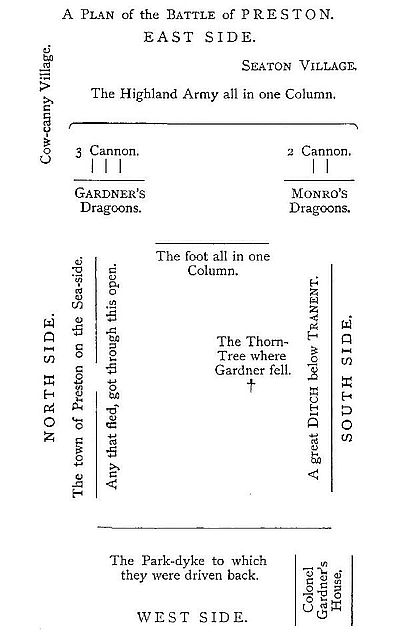
A Plan of the Battle of PRESTON.
EAST SIDE.
Cow-canny Village.
Seaton Village.
The Highland Army all in one Column. ____________________________________ / \ 3 Cannon. 2 Cannon. | | | | | _________ ________ Gardner’s Monro’s Dragoons. Dragoons. ___________________ The foot all in one Column.
NORTH SIDE. The town of Preston on the Sea-side. Any that fled, got through this open. The Thorn- Tree where Gardner fell. † A great DITCH below TRANENT. SOUTH SIDE.
________________________________________ The Park-dyke to which they were driven back.
| Colonel | | Gardner’s | | House. |
WEST SIDE.
CHAP. III.
Their March into England. Taking of Carlisle. Rout through England and retreat back.
Then, taking leave of Edinr, they Unto Dalkeith all march’d away, First of November camped there, And then for England did prepare. Short time they in that camp did stay, Till south they went the nearest way. At Kelso town they pass’d the Tweed, And west the Border went with speed: By Jedburgh and through Liddisdale, They spread themselves o’er hill and vale: And some by Moffat took their route; Although it was some miles about. In this order they march’d along, Only about sev’n thousand strong. Chief in command was duke of Perth, And Lord George Murray of noble birth; Lord Elcho son to the Earl of Wemyss, Col’nel of the Life-guard it seems; The Earl Kilmarnock, in this cause, Commanded those they call’d Hussars; Lord Pitsligo gen’ral of the horse, With Lords Nairn and Ogilvie there was; Bold Balmarino and brave Dundee, MacDonald th’ aid de’ camp was he: Sheridan too, and Sullivan, By birth an Irish gentleman: The squire of Broughton his secret keeper, Who got the name of bosom-viper: Besides the worthy brave Lochiel, Other Chiefs I have not room to tell. At the English border they did unite, All in a body their troops complete, Near Canabie in Liddisdale They enter’d Cumberland in hail. Then did assault the fort Carlisle, Which did hold out but little while. Having friends within and round about, Long to resist they seem’d unstout. The town and castle both they got Call’d England’s Key, an useful spot. At Carlisle he did leave a band The town and fort for to command, From thence to Penrith did proceed, And then for Kendal march’d with speed: To Lancaster they came indeed, Which news put England in great dread; To Proud-preston and Manchester They still advanc’d withouten fear, Being join’d by none of English train, But five hundred Lancaster men, Which to him was of small effect; For hard marching made them to ake, And miss’d their dinner many a day, Made them, repenting, sigh and say “Woe worth the Scots; for they can feed “On drinking water and eating bread: “Their irony soles do never tire “On stony ground, dub or mire. “Beef or pudding they never mind: “Them Scots can live on snuffing wind, “For me, my belly clings to my back, “Since I have join’d this hellish pack. “If in this state all soldiers be, “The dev’l be soldi’r again for me.” —— To such hard frets thus driven were Poor hungry Toms, of Lancashire: For in all haste they marched up, At Manchester they made a stop; Here his faithful Clans perceiv’d and saw, That English vows were nought at a’; Some kind enough; but no way friendly: Only through terror they acted meanly. Said the Scots Chiefs, “We blinded be, “That’s come far from our own countrie. “As friends, indeed, some English own us; “But if once defeat, they’d set upon us. “France and England, by perjurie, “Will be our ruin, we clearly see: “They’ve charm’d us out as working tools, “Now use us as a band of fools, “England to Whiggism is inclin’d, “And with the Georgian house combin’d; “They cry, Oppression, from high to low: “Yet Redeeming-time they do not know. “’Gainst Acts and Tax on ev’ry trade: “They’re all bewitch’d, and we’re mislead: “Here in a trap betwixt two fires, “And what we’ll do counsel requires. “The Duke before and Wade behind, “And where now shelter can we find?” Then Charles, hearing all this, said, With heart full sore he answer made, “My Lords and Gentlemen (said he), “Our case is bad, I plainly see; “But all’s not lost that’s in a peril, “Kind providence can ease the quarrel. “Both French and English have betray’d us; “But I trust a better hand will guide us: “On Preston field, ye all well ken, “We found the English there but men. “I trust in field they’re no more here, “Though thrice our number should appear: “Could we pass the Duke without a blow, “And with all speed to London go, “Our friends there would so well assist, “That en’mies were of small request. “That stalward Duke’s so fierce and keen, “Were he defeat, ’twould end the scene, “And give aspects another face, “Which we can’t do in such a case; “For if here defeat, then all is lost; “Battle avoid we surely must, “I trust the French to come by sea; “But where can their invasion be? “If at sea indeed they have been check’d “It damps our hope; but does not wreck’t. “Then let’s push on and do our best; “Kind providence make out the rest!” Then proclaiming his father there, As done in ev’ry town elsewhere, In form, all market towns he past, To Staffordshire he came at last: Where the Duke’s army lay ’fore him Well prepar’d for to devour him. He here to fight had no desire, Took east the muirs for Derbyshire, Directed his rout by th’ town of Leek, Left Cumberland to claw his cheek: Kept south by east to Derby town, In full career for London boun’: But there receiv’d intelligence, His friends to rise had now no chance, The Georgian party was so strong, And mixt in each place them among, No assembling could be together, Nor word of French ships coming hither. The south coast all was guarded round, An English fleet cruis’d up and down; And through each county in the south lands Militia swarm’d, like locust-bands. These tidings put him in great fear, But for to flee, he knew not where. They all in council did agree, Backward for Scotland then to flee. This did the vulgar sore chagreen, To plunder London that were keen. When Cumberland perceived this, He form’d a plan was not amiss, To intercept ’em in Lancashire: But how he miss’d you may admire. Wade on the north, was marching to him. The Duke behind, did still pursue him. One Oglethorpe upon his right, With a thousand hunters all in flight: Yet he, still his way did keep, Through Derby town and Ashburn peak: Which towns indeed for rash proceeding, Were badly paid for what was needing, When they perceived their flight was back, Quite contrary was their kind act, For all the praise they got before, They now were savages and more. December the fourth, they turn’d about, Out of England they took their rout, At Derby town they staid two nights, To get in superscription writes, Form’d by an English party there, Which made that town and country bare, And furnish, at an easy price, A vast of things for their supplies. When to Manchester back they came, Their usage there was much the same: And for their using them that way, Two thousand Sterling were made t’ pay, To save the plund’ring of the town; Paid when the kingdom was his own. So north they came to Wigan then, Next day they did Proud Preston gain. The Duke behind him but a day, Ride as they will he kept his way. And could not gain a mile upon ’em, Tho’ stout hors’d, they did outrun ’em. From Preston on the thirteenth day, Early at morn he march’d away. No sooner had they quit these towns, Than Oglethorpe with Wade’s dragoons Enter’d just at the other end, To give them chase they did intend; But being fatigu’d, chose rest a while. In three days they march’d a hundred mile, Through ice and hills cover’d with snow, Across Yorkshire as they did go, With full intent to intercept him And at Proud Preston thought to kep him, They had no footmen here, ’tis true, But royal hunters not a few, Who were so keen in battle rage, On foot they offer’d to engage, Being zealous youths of gentle fame, Who, by fighting thought to gain a name. And as they were to march again, A false alarm gave them pain, That French invaded had the south, Which passed for a certain truth: Such tidings from Duke William came, Who actually believ’d the same, And stopt his forces for a day, Till Charles was got out of the way. And Orders sent to Oglethorpe To come to him with all his troop: As soon as he the Duke had join’d, The news prov’d such as Jacks had coin’d. Then Oglethorpe he got command, To go in chace of Charlie’s band, And, if possible, get before him, While he behind would soon devour him. But, on the fifteenth, I understand, Charles reach’d Kendal in Westmoreland, Now thinking that the chace was over, Slacked his march; but did discover The English bloody flag behind, And colours waving in the wind. To range their rear they were not slow, But the front, of this they did not know. At the village Clifton, in Westmoreland, They prudently pitch’d out a stand, At a Quaker’s house stood near the way, Which rous’d his sp’rit ’bove Yea and Nay: Behind the hedges, walls and lones, Where unperceiv’d they stood as stones. The eighteenth day of dark December, In Forty Five, you’ll this remember, After the setting of the sun, Just as Black night was coming on, The King’s dragoons and Kingston’s horse Came prancing up, at unawares. A volley shot out thro’ the hedge, Full on their flank did them engage, Which in confusion did them throw, And through the hedge they could not go. Brave gen’ral Bland commanded here Who quickly caused his troops retire; For had they more such volleys got, Few had returned from the spot. Young Honeywood was wounded sore, The Duke, enrag’d, then highly swore That he’d revenged be that night, Or die before the morning light: Yet counsell’d was for to desist; For ambuscades were hard to trust, So the pursuit he did delay, Till near about the break of day: Brave men and horse lay on the field, Tho’ both the sides did flee and yield: Yet this check Charles’ end did gain, For he that night wou’d been o’erta’en: Lord Elcho and Murray form’d that plan, And did the party here command, Not without loss, I truly say; On both sides dead and wounded lay. Few Highlanders did come to blows, Till thro’ the hedge some horsemen goes, And did engage with sword in hand; But made nought of it with the Clan, Who did come on in numbers thick, And horse and men did hough and prick. ’Bout twenty five lay on the field, And thirty wounded fled for bield, With gen’ral Bland they rode away Toward the Duke, who heard the fray And came the battle to renew; But in the dark it would not do. Of Highlanders, as I heard say, But fourteen on the field there lay. George Hamilton of Stewart’s reg’ment, As prisoner he did consent, After a stout resistance made, And deeply wounded in the head, Cut by an Austrian Hussar, Who serv’d the Duke during this war. Then from the field they fled in haste, And to Penrith at midnight past, Where the main body was come before, Which spread the alarm more and more; Dreading th’ English did yet pursue, Then all out of the town they flew. Good for Penrith it happen’d so, Or next morn had been a day of woe: They vow’d in ashes it to lay For what they’d done the other day, To those who plunder’d Lowther-hall. And Penrith guards did on them fall, Beat and broke them, and some slew, And some they into prison threw: The rest into Carlisle did run, As from that fortress they had come, The while that Charles was in the south, Wanting something to taste their mouth, A foraging they came about, Only a small band in a scout, And Penrith guards upon them fell So Charles by chance of it heard tell: Perth vow’d revenge, in dreadful ire, A recompense with sword and fire; But when such hurry on them came, They minded nought but up and ran. As one behind another did stand, He cries, Furich tere be Cumberland. Dark was the night and rough the way, Carlisle they reach’d by break of day: There’s sixteen miles between these towns, But the weak and weari’d, left in wounds, Were all catched on the next day, By their fierce foes coming that way, About an hundred men or more, And badly us’d you may be sure. Being into loathsome jails confin’d But poorly kept and badly din’d. The Duke to Penrith came next day, On the twentieth at Hasket lay, Being then within twelve short mile Of the strong fortress of Carlisle. And hearing the Scots were safely there, To follow hard he took no care: Upon his rear thought fit to rest, And counsel call’d to do what’s best. On the twenty-second they marched on But finding that the Scots were gone, All but a few who did pretend, The town and castle to defend. Who there were left, I understan’, By sole advice of Sullivan, (Of Irish birth although he be) The cowardliest of the company. Unlike was he to Blakeney’s blood; For Irishmen are soldiers good, Will fight for what they take in hand, Abroad or yet in native land. This Sullivan he did pretend, They would the English so suspend, That they should come no further north Till Scots had join’d their friends on Forth. And Hamilton from Aberdeen To guard the place appear’d so keen; Had they stood on but for a day, As open to the north it lay, Which was Perth, Murray and Elcho’s plan, In it they need not lost a man, They might at ev’ning issued out, And ev’ry one been out of doubt: Through boasted courage and hot zeal, For a month, said, they would not fail, Cannon, powder and wealth of balls, Very strong gates and stately walls: As in despair, they did pretend, It to the last they would defend. Lancashire reg’ment chus’d there to ’bide, For to keep the fort were not afraid: The English gate of iron and oak, For fear with cannon it should be broke They built it up with stones within, And swore the de’il should not come in; Unless that he got wings to fly, And all by oaths would do or die. This being done, Charles and his men For Scotland marched back again, By the Langtown on Esk’s side, The water swoln, not by the tide, But a mighty current from the hills Made all to stop against their wills. And then to fly they knew not where, North, south and west, inclosed were. And though Carlisle lay on their rear, They knew not but the English were Hard behind them on the pursuit, By only going six miles about, To a bridge lies near Brampton town, And on the north side to come down, Whereof they had great fear and dread; Which put them to this desp’rate deed, The fords they tried which were too strong, Horse of more strength and legs more long They would require at such a place, And there to stay great danger was. They chus’d a swamp above a ford, And in they plung’d with one accord, The horse went first and swim’d half thro’, Foot at their tails they forward drew, Who hung together with arms a-cleek, Tho’ floods went over head and cheek: And those who were of stature low, Hard was their lot in wading so, Their powder clothes and arms wet, This was the bath these poor men gat. Not one shot was preserved dry, But these that did on horseback ly: They in the water plung’d so fast, That many lost their grips at last, And tumbling, went off with the stream, Down went their heads, up came their wame: Though people stood on ev’ry shore, Alas! their lives were now no more. Both men and women were wash’d away, Into the firth of Sollaway. And some at Bowness were cast out, At Annan-foot and thereabout. To Gretna, and Annan they march away, Thence to Dumfries on the next day, And charg’d a ransom off that town, Or else to plunder they were boun’: Two thousand Sterling made them pay, And carried hostages away When cash failed them, to the North, To join their friends upon the Forth.
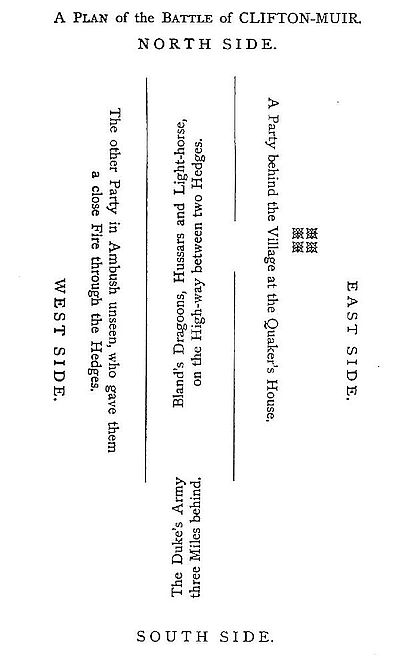
A Plan of the Battle of CLIFTON-MUIR.
NORTH SIDE.
WEST SIDE. The other Party in Ambush unseen, who gave them a close Fire through the Hedges. Bland’s Dragoons, Hussars and Light-horse, on the High-way between two Hedges. A Party behind the Village at the Quaker’s House. ⌂⌂ ⌂⌂ EAST SIDE.
The Duke’s Army three Miles behind.
SOUTH SIDE.
CHAP. IV.
Retaking of Carlisle by Cumberland. His return to London. Battle of Inverurie. The Rebels march from Dumfries by Glasgow to Stirling.
December, on the twenty-two, The English round Carlisle they drew, On south west side fix’d on a place Which opposite the castle was. The Duke all round it took a view, And of the castle had no brow, It seem’d to him like a dung hill, Or like a German old brick kiln: But yet their cannon play’d right smart, Which caus’d them from the hills depart. To capit’late the terms they crav’d, Were, T’ march with honour away to leav’t. The Duke reply’d, “That is a due “Ne’er given to any rebel crew; “But ne’ertheless take it I shall, “Either with honour or not at all.” Then in the dark time of the night, He caus’d lay down, to cloud their sight, Loads of straw and ricks of hay; There dig’d a trench of turf and clay: But batt’ring cannon he had none, But small field guns to mount thereon; Till from Whitehav’n, thirty miles away, Drove heavy cannon on it to lay. As soon as they began to fire, They beat the walls as low as mire, And made a breach both broad and wide, In the castle wall on the west side; To enter there, began to form, And take the fort by bloody storm. No quarters they propos’d to give, Put all to death, not one to live; When this they saw, without all doubt, A flag of mercy they hung out; But all that could obtained be, Was pris’ners at the King’s mercy. From thence they were to London sent, Where heads and hearts were from them rent Some executed in that place, And members dash’d into their face, Their very hearts cut out alive, Such butch’ry’s horrid to descrive. Many of the commons banish’d were To plantations, I know not where, John Hamilton the governor, His head, from off his body shore, Fix’d on a pole on the Scots-port, Scots for the future to exhort, By viewing the spectacles were there, Against rebellion to have a care. Two Lancashire men’s heads also, On th’ English gate fixt as a show, Whom they did English rebels call, A proof Scots are not rebels all; I only show there’s part of both, And for their fate, I say, “Oh, hogh!” A dreadful sight for human eyes, For to behold such sacrifice ’Mong Christian people, as I think, At what I’ve seen my heart does shrink; When I view the place and on it ponder, The bloody butch’ry that’s been yonder, I mean in the streets of Carlisle, The mangling that was there a while. Of such like acts I’ll say no more, But follow the subject just before. The Duke forthwith to London went, And gen’ral Hawly to Scotland sent, Who round by Berwick took his rout, Near a full hundred miles about, Ev’n by Newcastle and Dunbar, It must be own’d the stretch was far, Before he came to E’nburgh town Fatigu’d were both foot and dragoon. While Charles did through England pass, Lord Loudon lay at Inverness, And with him did two thousand men To keep in awe the Highland Clan: For several lairds their Clans did raise, And some took part in both the ways; Others kept them in their own bounds, For preservation of their grounds, And when Duke William gain’d the day, It was for him, they then did say; But if Charles had chanc’d to prevail Some think they’d told another tale. Yet Loudon to King George was true, And by his conduct did subdue Many who were as foes inclin’d, And kept them in a neutral mind. The Frazers’ clan he drove away, Who around Fort Augustus lay, Commanded by lord Lovat’s son, He made them from that fort to run. Lord Lewis Gordon lay from him south, With lord John Drummond, a furious youth, And brother to the Duke of Perth, Who wish’d Loudon sent off the earth, And under their command, it seems, Was the French Regiment de Fitz James, With Clan’s rais’d on the northern shore, About three thousand men or more, Kept Aberdeen, Perth, and Dundee, And all the low towns by the sea: The fierce MacLeod lay west from them, Who on George’s side had rais’d his men, Intending to take Aberdeen, Knowing that Gordon lay therein, He as far as Inverurie came, In hopes next day to reach the same; But Gordon of this was aware, And for to meet him did prepare, But march’d his men another way, As tho’ he would not on him stay. West from the road he took his rout, Altho’ it was some miles about, Kept hollow ways not to be seen, Where woods and planting did him screen, And ’bout the setting of the sun, He spy’d them entering the town. A halt he made, judg’d what to do, Of’s being there they nothing knew. Much like his own their number seem’d, Then for to fight, it best he deem’d: And what favour’d his notion more, He saw them billoting, a score Or more into each country town, At two miles distance all around. When the full half of them were gone, He thought it time to draw them on, In full brigade at the town’s end, Before MacLeod ought of him kend: The first intelligence some got Was by the rattling of the shot. Confus’d he was in this sad case His men dispers’d, and few to face. The foes assault, upon the hill He rallied them near to the mill. They fir’d full brisk on every side; Yet Gordon’s force was hard to bide, They being to arms bred in France, Knew how to retreat, and to advance. MacLeod’s men, in number few, Quite raw and undisciplin’d too, Lost nearly twenty upon the spot, And forty fled gall’d by the shot. The laird himself, to end the matter, Did fly and could not make it better. His men in crowds came running in, Crying, Master did ye loss or win? But for to rally in such a stour, He had no time, might, or power; The darksome night was coming on, And his best men lay dead and gone, Or wounded, they before him fled: While Gordon brisk advancing made, Whose loss that night was not heard tell, Alledging that none of them fell; He gained the field and town, ’tis true, But yet ’twas judg’d he lost a few, Whom they did bury in the night, To keep their losses out of sight. This bloody battle, as they say, Was fought the night before Yuil day, At the end of Inverurie town, Led on by Gordon and Drummond, Against MacLeod and all his Clan, Who did not well concert the plan: Spreading his men so far a breed, Was nothing like a martial deed: For the one half they overthrew, Before the other ought on’t knew. It was a trick of war ye ken For making them more wise again; No sooner Gordon got the town, Than centries plac’d were all aroun’, Who kept patrolling through the night, Lest MacLeod shou’d renew the fight; But to the hills he did proceed, There to bewail his luckless deed. Gordon return’d to Aberdeen Rejoicing he’d victorious been, From thence to Stirling got his rout, To join his Prince when thereabout. When from Dumfries they came away, Hamilton they reach’d on the next day; Knowing no danger then before them, They levied all things fit to store them, As horse, of which they had great need, Many of them being rode to dead. Of meat and drink they spier’d no price; But little harm did otherwise, Save changing shoes when brogues were spent, For victuals sure they could not want. To Glasgow they came the next day, In a very poor forlorn way, The shot was rusted in the gun, Their swords from scabbards would not twin, Their count’nance fierce as a wild bear, Out o’er their eyes hang down their hair, Their very thighs red tanned quite; But yet as nimble as they’d been white; Their beards were turned black and brown, The like was ne’er seen in that town, Some of them did barefooted run, Minded no mire nor stony groun’; But when shav’n, drest and cloth’d again They turn’d to be like other men. Eight days they did in Glasgow rest, Until they were all cloth’d and drest: And though they on the best o’t fed, The town they under tribute laid, Ten thousand Sterling made it pay, For being of the Georgian way, Given in goods and ready cash, Or else to stand a plundering lash: And ’cause they did Militia raise, They were esteem’d as mortal faes: For being oppos’d to Jacobites, They plainly call’d them Whiggonites. But, for peace sake, to get them clear, Of ev’ry thing they furnish’d were, A printing Press and two workmen To print their journals as they ran. From Glasgow then they took their rout, Lochiel he led his Clan about By Cumbernauld, another way, Lest Kir’ntilloch they should repay, Which had killed two of their Clan, That a spulzieing unto it came; As they were passing through the town, They by the rabble were knock’d down, For which the place was taxed sore, And dreaden much ’twould suffer more. Near Stirling then, they all did meet, Summon’d the town for to submit, Militia therein were quartered, And the townsmen also, armed, Who did defend a day or two; But found their force it would not do: Though a good wall both stout and strong, Lay on the south where they came on; Yet ’tween the water and the town It lay quite open, halfway roun’. The bridge was cut on the south side, The water deep they could not wade; Their nearest pass was at the Frew, Full four miles west and in their view. Four thousand lay on the north side, Threat’ning the town whate’er betide. Glasgow Militia had left the place, And to met Hawley at Ed’nbro’ was. Militia they had; but not enew, Such duty was too hard to do. Those who did ly on the north hand, Were not of those were in England; But with Lord Lewis Gordon came, Brother to th’ Duke of that same name, Which he had raised in the north, Help’d by lord John, brother to Perth, Who did command Fitz-James’s horse, That came from France into Montrose: Most of their riders Irish and Scots, Nat’rally bent to join such plots, Inclin’d to love the Stewart race, Whose fathers did that side embrace. These foresaid Lords most active were, Both men and money to prepare, And would have rais’d some thousands more, Had but six thousand French came o’er, Which, time from time, they promised; But the seas were too well guarded. Lord Loudon lay into the north, Long way beyond the Murray firth, Twenty sev’n hundred men had he, Which made the Frazer’s Clan to flee, When Fort Augustus they did besiege; Yet in open field would not engage. Likewise MacLeods, Grants and Munroes, Against the Stewarts in arms rose: The Sutherlands and name of Gun, To arms did against them run. Sir Duncan Forbes, Lord president, Caus’d many rise by his consent. Thus, in the north, I you assure, There was an army of great pow’r, All upon the Georgian side, Beside what was besouth the Clyde, Who all in arms there did unite, Unto the cause with noble sp’rit. Also the brave men of Argyle, Who were preparing all the while; But could not find safe passage east, Until they were from Glasgow past: And then they went by Airdrie town, When Hawley was through Lothian come, Him join’d at Ed’nburgh where they lay Preparing for the battle day; Glasgow and Paisley troops were there, To serve king George free volunteer.
CHAP. V.
Siege of Stirling Castle. Battle of Falkirk.
Now as Charles around Stirling lay, To surrender they did give way, All but brave Blakney, who withdrew Into the Castle, with those thought true, Who chose with him the siege to stand To their life’s end, with sword in hand. His stores, indeed, were ill laid in, S’ unexpected it did begin, No time had they for to provide, Charles being so long on their south side. Their ammunition too was small, No stock of powder, nor yet of ball; Yet all encouragement he gave To those who’d help the Fort to save: His endeavours he spared not To find such stores as could be got: And all he thought of use to be, Were welcome to his companie: And those who fearful were to stay Freely got leave to go away; Th’ unloyal he charg’d not to ’tend it; For to the last he would defend it. Summons he got for to surrender; But answer made, “He was defender, “Intrusted by king George command, “To which, he vow’d, he’d firmly stand.” Then to assault they did prepare, Milit’ry engines erected there, Cannon from th’ other side the Forth, Which had been landed in the north. British cannons lost at Fount’noy, Came home this Fort for to destroy. To raise a trench, in haste they got, As near the walls as pistol shot, On the east side, on a hill top, To breach the wall it was their hope: And then by storm they did pretend, Of all within to make an end: But at this instant Hawley came, Which put a stop to their fierce aim. Then all their force together drew, Those in the north past at the Frew; Near by Torwood they rendezvouz’d, Where Hawley’s camp, afar they view’d, Hard by Falkirk, on the north side, The English banners were display’d. From th’ banks of Carron they had in view, All passes where they could come thro’: Ev’n from Forth side up to the hills; But high presumption their courage fills, As they were arm’d in such a case, The rebel Scots would not them face: And as in scorn did them deride, So to advance did slow proceed: And spent their time in vain delay Ev’n the forepart of th’ battle-day. While Charlie, with much active care, His res’lute troops did well prepare: From Torwood-head they issu’d down To the south side, on rising groun’. Cross’d Carron at Dunnipace mill. By foot of Bonny took th’ hill, And still he kep’t a sharp look out, In hopes that Hawley would take th’ rout; As in his camp sure news he had From’s out-guard posts who there had fled. Mean time the Highlanders gain’d th’ hill, Wind on their back just at their will. Hawley’s camp it was alarmed; But he himself could not be had: Chief orders then they could get none, Which caused some confusion, And when that Hawley did appear, He’d not believe they were so near. Husk form’d his men and took the hill, The horsemen also march’d there-till, Glasgow and Paisley volunteers, Eager to fight, it so appears, With the dragoons advanc’d in form, Who ’mong the first did feel the storm. The Highlanders, seeing their zeal, Their highland vengeance pour’d like hail, On red coats they some pity had, But ’gainst Militia were raging mad. Cob’s dragoons they southmost stood; But gain a flank they never cou’d: For Murray led on the front line, And kept them both from flank and wind: Some time was spent these points to gain; But all the struggle prov’d in vain. Gardner’s and Monroe’s were next, On worse ground troopers could not fix; I don’t mean as to th’ en’mies fire; But on their front a boggie mire, Which in th’ attack the horse confounded, And they on all sides were surrounded; Next to them the volunteers, Between the foot and Grenadiers. Some reg’ments coming up the hill, And as they came, they formed still. The Highlanders in columns three, Came moving on couragiouslie, With loud huzzas on every side, Their bloody banners were display’d, The front line only three men deep, They in reserve the rest did keep: Their plaids in heaps were left behind, Light to run if need they find: And on they came with a goodwill, At the dog-trot, adown the hill. At Cob’s dragoons the first rank fir’d: But rear and centre were desir’d To keep their fire, and then to pour’t Into their face, while front in scourd With sword in hand, (as they intended) This was design’d them to defend it. So near their front at flight they came, They turned back both horse and man, They kept up fire then crack by crack, They surely found it on their back; For men and horse to field they brang, And many in their saddles swang. The brave Monroe, with his troops too Disdain’d to flee; but went quite thro’ Their front line, centre, and the rear; But fell himself, as he came near, Two balls out thro’ his body ran, Alas! he never raise again. He was a soldier, bold and true, Rather too fierce as some avow, His whole troop now was in the mire, Inclos’d about with sword and fire, Hacking, slashing, behind, before ’em, All enrag’d for to devour them: Th’ horses legs to their bellies was, Few with life from ’mong them pass. By this the horse were fairly beat, And those were left made full retreat; But oh! such wind and rain arose, As if all conspir’d for Hawley’s foes. The southside being fairly won, They fac’d north, as all had been done, Where next stood, to bide the brush The volunteers, who zealeous Kept firing close, till near surrounded, And by the flying horse confounded: They suffer’d sore into this place, No Highlander pity’d their case— You curs’d Militia, they did swear, What a devil did bring you here? Ligonier’s, Husks and Cholmondelly, Gave from them many a dreadful volley, Two running fires, from end to end, Which broad swords could no way defend: But seeing so many run and fall, They thought they were in danger all, And for their safety did prepare, In haste they form’d a hollow square: The horsemen being all fled or slain, The very Loyal fled like men. Some reg’ments marching up the hill To turn again, had right good will. Brave col’nel Jack, being then a boy, His warlike genious did employ, He form’d his men at the hill foot, Which was approv’d as noble wit: But if Husk had not check’d their fury, Some thousands more had been to bury; He beat them fair quite out of sight, But O! the rain and blowy night, Horse or cannon, there, he had none, He could not keep the field alone, Some cannon which on th’ field there was, Being spik’d up with iron flaws, And render’d useless for that time, The hole being stopt whereat they prime, Barrel’s grenadiers to some yok’d too And eastward to Falkirk them drew; Yet all their toil no effect had, Their drivers and the horse were fled, The cannon, for some time, were lost, The chance of war so rul’d the roast. Husk in form made safe retreat, Where all were flying the other gate Out from the camp, the Lithgow way, He form’d the Buffs behind to stay, In trust, to cover the retreat, Which was nought but a pannick fright: For had they kept their camp, I’m sure, The Clans wou’d soon have left the Muir; For there was but few who kept th’ field, Many dispers’d to seek for bield. No sooner the battle was begun Than on both sides the cow’rdly run; And thro’ the country word was spread, How George had won, and Charles fled: Ev’n Charles himself could hardly tell, That very night how it befel; But the abandoning their camp Confirm’d all, and made them ramp. It is well known by all about, The battle was not half fought out:— But to run, O shame! and leave your tents, Like brok’n tennants with unpaid rents? The dread of Highlandmen to consider! And not two hundred of them together; But all dispers’d the country thro’, Afraid of them, and they of you! For had they known th’ English retreating, ’Hind Tamtallan, had been a beating. This was the step which Hawley took, Which ruined all, else I mistook. The duke of Perth laught in his sleeve, And Charles himself could scarce believe, That Hawley was turn’d such a cow, As flee when none was to pursue. When those about heard of the flight, They came and took the town that night. Both town and camp left to their will, As Hawley march’d on eastward still, To Lithgow and Borrowstounness, And some to Edinburgh did pass, There gave it out, “That all was lost, “Few left alive of Hawley’s host, “Charles was driving all before him, “The very wind and rain fought for him.” On Janu’ry sixteenth, afternoon, This battle was fought, but never won: But on the morn both great and small Unto Falkirk assembled all, To view the field and bury the slain; But which was which, was ill to ken: For by their clothes no man could tell, They stripped were as fast’s they fell. The plund’ring wives, and savage boy Did many wounded men destroy; With durks and skians they fell a sticking, For which they well deserved a kicking: Some of the brutish commons too, I saw them run the wounded thro’! The brave Monroe his corpse was there, Among the slain and stripped bare; In Falkirk yard, you’ll read his name, Interr’d hard by Sir John the Grahame. All who Militia were suspected, To catch that day was not neglected, And hundreds more, I you assure, Who came to see their Falkirk-muir, Ev’n for such curiosity Were brought into much misery. Being driven north to Inverness, Their cold and hunger I can’t express: Those who felt it, best can tell, I leave them to express’t themsel. An accident happ’ned next day T’ one Glengarie on the Street-way, A man in plunder got a gun, Two balls from which he had new drawn, Judging in it there was no more, Yet another she had in store. Out at a window did her lay, Dreading no harm he did let fly, Which kill’d Glengary as he past, Dead on the street it laid him fast. They siezed the fellow and did bang him, Would give no time to judge or hang him; But with guns and swords upon him drave, Which made him minch-meat for the grave. For Stirling then they march’d again, With prisoners and all their train: To Blackney new summons were given For to surrender, or be driven Unto death, by fire and sword; Just now to yield—or trust the word, That they would make that fort his grave, And not a soul therein would save. But Blackney said, The fort was his, And each within aminded was, To stand the last extremitie: Take this for answer now from me, “When my King and Master gives me word, “You will have it without stroke of sword.” Then with fury began the siege, Both day and night they did engage: On the east side upon a height, Open’d a batt’ry in the night, Of wooden faggots fill’d with mud: Upon a rock the trench it stood, To dig it deep it would not do, At last they purchas’d packs of woo, For which Perth’s duke gave his own bill, Smith may protest it when he will, For Perth and Blackney both are gone, And I trow, it was paid by none. The country ’round they did compel Faggots to make and trees to fell. The one built up, th’ other beat down, Their noise was heard the country round. Indeed hersel was loth to do it; But on pain of death she was put to’t. French engineers indeed they had, Who order’d all to work like mad. Here many a poor man lost his life, Being unaccustom’d to such strife, Crying Shentlemen, ye’d best let be; For feth wese hae a meuds of ye; If we had up our muckle dyke We’ll tak your Castle when we like. These engineers, who knew far better, Out of their lives did still them flatter, At ev’ry point where danger was They made the poor unthoughtfu’ pass: Which only did prolong the time, To murder men they thought no crime: For well they knew it would not do, With such batt’ries of mud and woo: Unless they made a cover’d way Dug in the earth, thro’ sand or clay. Ten days they wrought with all their pow’r, And men they lost on’t ev’ry hour, Night and day there was no rest, And Blackney always had the best. The fort being high above their trench, To see their work it was no pinch, Dung hill like on a rock ’twas laid: In form of a potatoe-bed. With tow and tar when it was dark He let them see to do their wark, Which as a lamp burnt on their trench, Caus’d many die who thought to quench’t. They skirmish’d on, both night and day, With cannons and small arms did play: Four big guns were brought up at last; But soon were off their carriage cast, Their very muzzles were beaten in, And off their wheels they made them spin. One called Fife on Blackney’s side, At ev’ry shot he laid their pride, Experienc’d by hand and eye, A perfect gunner, by land and sea; But the worst thing which did ensue, Of cannon balls they had but few, Which caus’d them fire with coals and stones, Or ought was fit for smashing bones: For of the balls he was but sparing, Unless to give some hearty fairing. An engineer who plagu’d him sadly, Whereat he was enraged madly, By his upbraiding speech and mocks, As he’d been more than other folks, Some did believe he had a charm, As ’gainst a shot he’d wag his arm, Fife try’d with ball, iron and stones, Then curs’d his cantraips skin and bones; He was some de’il as all did miss him, Said he, I’ll find a way to bless him, Having drunk some beer, bottles were by, With glass, methinks, this devil I’ll try: When broken small, he cram’d them in, “I trust, with this, to pierce thy skin,” Then play’d it off with all his art, Which minch’d him quite above the heart, So down he fell, spoke never more; Soon after this the siege gave o’er. The cannons all off carriage driven And trenches with the rocks made ev’n. Then to all those who went to see, Like potatoe field it seem’d to be. Many dead bodies in’t were found, White noses sticking thro’ the ground. All being o’er, since it began, Brave Blackney lost only one man; Six were wounded, ’tis very true; But poor John Fife got not his due Recompence, equal to his merit; For which the poor lad broke his spirit, He went again back to the sea, Got a wat’ry tomb, as they tell me. He was but a Scot, and meanly born, Had no good speakers, Scots then at scorn. Now, to ev’ry body, ’tis a wonder, How that so many liv’d on plunder; For between Falkirk and Kippen ay It is but sixteen miles of way, Which space maintain’d ten thousand more Than th’ usual number within each door, For full four weeks, or nearly thereby, The time they at the siege did ly, The happy Janet kept the Forth, And curb’d all vessels from the north. About the Queens-ferry she lay, Came with the tides, and gave them play Up by Airth and Higgins nook, Where was a batt’ry prov’d a mock. They thought to keep Forth to themsel; But what it cost there’s few can tell: For all th’ shipping they had at sea, Did not exceed in number three, Which kept about Perth and Montrose, And privily to France did cross. So all round Stirling where they lay, Oft did they wish they were away. Commands they sent all round about, And searched all provisions out. Some of them paid like honest men, Others did not, I tell you plain: But this I have so far to say, They duly got their weekly pay; But yet when plunder came in use, They spared neither duck nor goose, Butter, cheese, beef, or mutton, All was theirs that could be gotten, Pocks of meal, hens and cockies, They made that country bare of chuckies, Made many a Carlin whinge and girn, By crowdie of her meal and kirn: All this they did before their eyes, Guidwife cum sup here an ye please, I own indeed it was a failing; But yet I cannot call it stealing: Because some folks refus’d to sell: How long, now, cou’d ye fast yoursell? For the hungry came, chas’d out the fu’, Where meat was found, this was their due.
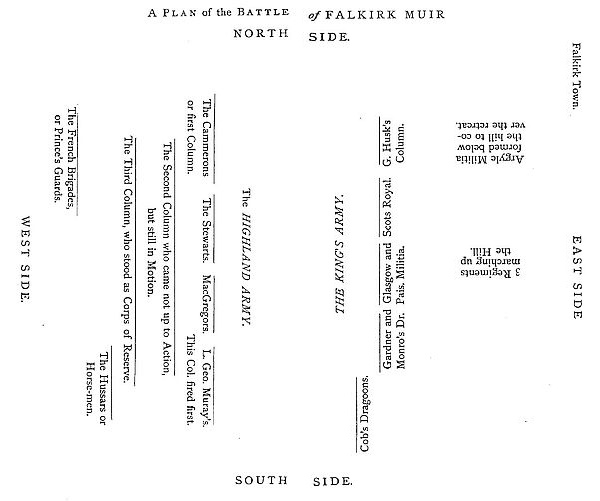
A Plan of the Battle of FALKIRK MUIR
EAST SIDE.
Falkirk Town.
Argyle Militia formed below the hill to cover the Retreat.3 Regiments marching up the Hill.
G. Husk’s Column.Scots Royal.Glasgow and Pais. Militia.Gardner and Monro’s Dr.
________________________________________
Cob’s Dragoons.
_____________
THE KING’S ARMY
NORTH
SOUTH
SIDE.
SIDE.
The HIGHLAND ARMY
____________________________________________________
The Cammerons or first Column.The Stewarts.Macgregors.L. Geo. Muray’s. This Col. fired first.
____________________________________________
The Second Column who came not up to Action, but still in Motion.
________________________________________________
The Third Column, who stood as Corps of Reserve.
______________
The Hussars or Horse-men.
____________________
The French Brigades, or Prince’s Guards.
WEST SIDE.
CHAP. VI.
The Duke’s return. His Speech to the Army. March to Stirling. Explosion of St. Ninian’s Church.
Now when the news to London went, Guess ye if George was well content, At Hawley’s being so defeat, And making such a foul retreat. On Friday’s night the deed was done, This was on Sunday afternoon. The council’s call’d, and in all haste, The Duke again they did request To go, and take the whole command, For to reduce the Highland band That so disturbed Briton’s peace, Which was accepted by his Grace. All things prepar’d for posting ways, He on the road was near six days. To Ed’nburgh town he came at last, Which gave their sp’rits a quickning blast. The troops review’d and brought together, All for the field he did consider, The Glasgow and the Paisley Core He order’d home, knowing of more, Six thousand Hessians beside dragoons Were entring in the Scottish boun’s, On pressing march towards the north, Expecting battle, south side of Forth.
The Duke’s Speech to his Army at Edinburgh, January 30th, 1746.
“Now Gentlemen, hear this of me, “You’re th’ soldi’rs of a people free, “Not like the poor starv’d slaves in France, “Bound to a Popish ordinance. “I know there’s many of you here “Who’ve shown your merit, that I can swear, “Others, perhaps, n’er had occasion “To show your valour in foreign nation, “Yet think yourselves as good as they, “I doubt not but part of you may; “Tho’ native soil you’ve yet possest, “In foreign land no foes have fac’d, “You descend from men, as well as they, “Who never turn’d their backs to fly: “I hope you’re now resolv’d to fight “All for your King and countries Right, “’Gainst their rebellious resolution, “Who’re for turning order to confusion, “A set of plunderers and thieves, “Which in ev’ry age disturbs and grieves: “Ay, learn’d from their fathers they are, “In troublous times to raise up war: “Boasting themselves in bauling words, “To do great actions with broad swords: “I think they’ll prove to be small stops, “In front of well disciplin’d troops. “Stand and behold them in the face, “And use your points in such a case. “If you don’t fly and break your line, “By swords you can no danger find; “But when you turn your backs to fly, “You throw honour and life away; “You murder by this means yoursell, “And foes encourage to excel. “Think on Tourney and Fontenoy. “Fear not this Rabble, who wou’d destroy “All that’s good, if they had power. “May heav’n protect us in battle hour! “Remember you’re for a right cause, “Against subverters of the laws.” From Ed’nburgh town they march’d away To Lithgow came that very day, The Campbells on front also this night Retook Falkirk, and put to flight Part of the Highland troops were there, Who straight for Stirling did repair; But orders met them by the road, That night to stop at the Torwood: Because against the morning light, Their army would be there on sight. The council call’d at Bannockburn, Where all agreed for to return And fight the Duke, whate’er betide, But his Lowland men would not ’bide; These Nor’landers swore by their saul That Cumberland would kill them all. But the Highlanders made this reply, That for their Prince they’d fight and die, Where’er he went, they’d with him go And face the Duke, tho’ ten for two. So then to morrow by break of day, The Northern men march’d all away; And yet the Clans they were so kind As offer to fight if he inclin’d. But all agreed to take the rout, More of the Clans for to recruit: Then all of them took to their heels, Kept no high road; but cros’d the fields, The nearest way unto the Frew, For otherwise it would not do, Stirling Militia the bridge had cut, And on the water there was no boat, But what was broken or haul’d away, To keep the Forth when north they lay. Their cannon and baggage, all forsaken, Lay round Stirling and soon was taken. Their magazine of powder and ball, Falkirk plunder, tents and all, Were stor’d up in St. Ninian’s church, An engineer enter’d the porch, On purpose for to lay a train; But too much haste did him atten’. He broke one barrel, as they say, Began the powder for to stray All along upon the floor, Without the threshold of the door. Some people in the kirk there was, The love of plunder was the cause, The engineer backward did run, And at the powder fir’d his gun, Himself he thought quite secure too; But to the air with it he flew. Other eight persons there was slain, And one blown up, but fell again, So senseless, that he was thought dead, As he lay on a midden-head. He first fell on a thatched house, Next on a midden, with a souse: His clothes and hair were really sing’d, Sat on the midden, curs’d and whing’d, So stupid drove, knew not the cause But own’d his mercy in such fa’s. But others were in pieces torn, And from the church a long way born; One safe before the pulpit lay, When all above was blown away: This roar did him so stupid drive, He knew not whether dead or alive; In flames and smoak he was benighted, And own’d that he was fairly frighted. Charles and his court from a hill top, Stood and beheld the catastrop’; Then to the north they march’d away Unto St. Johnston upon Tay. This great explosion, I heard say, Was heard full forty miles away. Duke William at Lithgow heard th’ crack, And cry’d, “Now Blackney’s gone to wreck,” Not knowing what the meaning was, Till in Falkirk he heard the cause, Now all of them had cross’d the Forth Quite o’er the hills into the North. The Campbells, and some troops of horse, That night arriv’d at Stirling cross, Who came harrassing the retreat, And pick’d some straglers by the gate: Blackney also sallied out, And catch’d some strollers thereabout. Many of them were so mischiev’d, It shocked nature to perceiv’t, Legs and arms shot clean awa’, And some wanting the nether-jaw; Some were out of the trenches drawn, Being bury’d alive ’midst the san’. The Campbells kept upon the chace, And pick’t ’em up in many a place. Some cannon were found near the Frew, Their horse, being weak, could not go thro’. Much baggage left and several things, With a Printing press, called the king’s, Which back to Stirling was return’d, While Charles, by Crief, to Perth adjourn’d.
CHAP. VII.
The Duke’s arrival at Stirling. The Rebels’ Retreat, and the Rout both Armies took to the North.
Soon after William to Stirling came, With all his troops, a warlike ban’: Reg’ments of foot, there were fourteen, Sixteen field pieces of brass, full clean: Kingston’s, Cobham’s, and Ker’s dragoons. The trusty Campbells, all chosen ones, With Hawley, Husk, and John Mordaunt, Brave Ligonier he could not want, With Cholmondely, bred soldiers all, For battle ready at any call. One day his march was here suspended, The broken bridge for to get mended, O’er which the foot were safely past, And all the carriages at last. The horsemen forded Forth at Drip, Then to Dumblain they marched up. While the army into Stirling lay, They catched one they call’d a spy, Whom Hawley, by some uncouth laws, Condemn’d for carrying Charles’ pass, Likewise another from the Duke, Which made him more like traitor look, Hawley seiz’d them, and with an oath Swore he should be depriv’d of both: Go, said he, and get a rope, And take the dog and hing him up, Which was no sooner said than done, As soon’s the hangman could be foun’, Without confession, or clergy’s stamp, Was like a dog hung to a lamp. Next day the duke went to Dumblane, Campbells’ and th’ horse had Crief reta’en. Here the Highlanders did divide, Some took the hills, some water-side; The highland road by bridge of Tay, Or by Dundee, the sea-side way, The horse and French brigades did chuse; And the Highland roads did refuse, So kept their rout north by Montrose, While th’ others climb’d o’er hills and moss: Short time they took in Perth to tarry, All the stores they could not carry, They threw into the river Tay, With cannon they could not take ’way, Thirteen of iron they spiked up, And swivels of the Hazard sloop, Which was taken off John’s haven, By help of that town’s fisher-men. Argyle Militia and the horse To Perth straight came; but did not cross The river Tay for to pursue, Till the whole army came in view. Some would have a party take the hill, But to this the Duke deny’d his will, And kept his march down by Dundee, Thro’ towns that lay hard by the sea Toward the town called Montrose, And great resentment there he shows: All the suspect’ did apprehend, And south to Stirling did them send, Where they’re detain’d close prisoner, ’Till ’bout the ending of the stir; Many of them were innocent, As afterwards was truly kent, If ’twas not for their thought and wish: For few durst say whose man he was Who lived into such a clime, And in such a critical time. Thence he unto John’s-haven sent, As being upon vengeance bent For taking of the Hazard sloop, And burnt their boats both stoop and roop. Two off’cers here he also broke, For their goodwill to Charlie’s folk, The one’s sash was in pieces cut, And quite out of the army put, His sword was broke above his head; Because he unto Charlie fled. The other, because he stopt the plunder Of th’ house of Gask, being sent under Strict command, to do such duty; But kept his party from the booty, For which he got’s commission torn, Himself depos’d with shame and scorn. From thence they march’d to Aberdeen, Where a storm of snow and frost full keen, Which on the mountains some time lay, Caus’d them into that town to stay. Hesse’s band in Perth then quarter’d was, And at Dunkeld keeped the pass, The remains of Gardner’s broke dragoons Kept Blair in Athole, and such towns: These horsemen twice had suffer’d sore, Here, by surprise, they suffer’d more: As they next to the Highlands lay, They skelped at them night and day. Being station’d in this utmost pass, They bore the brunt of all distress; But the Hessians kept about Dunkeld, And did into more safety dwell. These Hessians were a warlike band, Six thousand did their prince command, Earl Crawford in their company, To guide them thro’ the Scots country. Their countenance was awful fierce, They spake High-Dutch, or German Earse, Had white buff-belts, and all blue clothes, With a long beard beneath their nose, And those who were in wedlock state, Had all long whiskers, like the cat. Their spatterdashes with pick were gilt, And long swords with a brazen hilt, Bars on the outside of the hand, And in their guns an iron wand. The finest music e’er you did hear Would make one dance who could not stir, Their whistles and drums in chorus join Did cheer one’s heart, they played so fine: Their grenadier’s had caps of brass, Thus order’d were the men of Hesse, Who camp’d for some time near Dunkeld, And kept that pass, till they hear’d tell How at Culloden all were broke, And they had never fought a stroke, Except one canonading bout; The clans afar came on a scout To view their camp from a hill top Who soon retir’d when they drew up: Whene’er their cannon began to play, They skipt like rams and ran away, Describ’d the Hessians ev’n as they can, Said, “He was a blue and bloody man, “His drums and guns pe ready, got “Hersell pe rin, or else be shot.”
CHAP. VIII.
Blowing up the Castle of Cargarf by the Earl of Ancram. Skirmishes at Keith and Inverness, &c.
Now while the duke lay at Aberdeen, From England did his troops maintain, Brought in his stores ay by the sea, And laid no stress on that country, From thence the earl of Ancram went, One hundred horse were with him sent, Major Morris with three hundred foot, Near to the head of Don they got, To take the Castle of Cargarf, But ere they came all were run aff, Wherein was a large magazine Of amunition, and arms clean, Which did become the Earl’s prey; But could not get it born away, No horse he could get to employ, Most of the spoil he did destroy, ’Bout thirty barrels of powder there, Made soon that fort fly in the air, And so returned to Aberdeen, Long forty miles there were between. Next Col’nel Stuart of Charlie’s band, At Strathbogie he did command One thousand foot, beside Hussars, Who kept that country round as theirs: Against him were sent on command The generals Moredant and Bland; But to Stra’bogie as they drew near, Stuart did unto Keith retire. Then captain Holden with volunteers Follow’d in chase, as it appears, Seventy Campbells by Bland were sent, And thirty Kingston’s horse too went, To clear the village of Keith while light, And to Stra’bogie return that night: But their presumption ran so high, They ventur’d there that night to lye, When Stuart return’d with secret pains, Enter’d the town at both the ends, And set upon them unawares, Till few were left of men and horse: Their loss was this, you may consider, Because they were not got together. The Campbells sold their lives like men, And of the horsemen left were ten. This did the Highlandmen revive, And rais’d their sp’rits for more mischief, And to the Duke’s men gave a caution, Where to quarter on like occasion. His army in three divisions lay, The first at Strathbogie, they say, Second at Old Meldrum, half-way between Strathbogie town and Aberdeen, The last at Aberdeen still lay, Until April on the eighth day. While Charles must the mountains keep, Among the goats, cows and sheep, His army sure was sorely spent, Ere into Inverness he went, Having nought but deserts by the way, Want of meat and scant of pay. Rivan of Badenoch they took, And laid it flat on every nuik. To Inverness when they drew near, Lord Loudon did from it retire, Having but sixteen hundred men All newly rais’d, could not preten’ To face them fairly in open field: Therefore, Retreat was safest bield. Two companies he left behind, The fort to major Grant resign’d, To defend it to extremitie Strict orders, thus to do or die, But no sooner did Charles’ troops appear, Than soldiers hearts did quake for fear, And being threaten’d with a siege They durst not stand their spiteful rage. So town and castle became his own, The fort was levell’d with the groun’. Lord Loudon fled but little way, The firth of Murray between them lay, Perth and Cromartie play’d a brogue, Assisted by a hazie fog, Unexpectedly sallying over, Upon them fell, and would not hover, Till many they in pieces cut, Some officers they pris’ners got: As before them they could not stand, Being forc’d to flee from Sutherland. Another party at castle of Blair, Had beat the Duke’s detachment there; This gave the king’s army some pain, And rais’d their Highland blood again. Fort Augustus too they did attack, And in short time beat it to wreck: Three companies of Guise’ therein, ’Gainst Highland fury not worth a pin: Major Wentworth did here command, Who had not force them to withstand, None stood but Fort William now, And it in haste they ’sieged too. A large detachment chosen was; Of artillery the best he has, Commanded by brave Stapleton, A French brig’dier of great renown. On the third of March at Glenavis, Which opposite Fort William is, The first attack began at sea, Betwixt the Baltimore and he, A sloop then lying at Fort William, Into the straits of Carrion, Stapleton siezing of their boat, Thought t’ master them with num’rous shot: The Serpent sloop, captain Askew Caus’d man his boat, with other two, And soon were master of Carrion, Where put to flight was Stapleton. Their next ’ttempt was Kilmadie barns, Where many shot were thro’ the herns: Yet the Baltimore she could not stand it, Nor could their troops at all get landed: For shells and cannons play’d so fast, Their engineer they kill’d at last. The Baltimore she could not take it, Forc’d to sheer off and so forsake it, Some prisoners of Guise’s men, In this hurry did liberty gain, During the time the parties fir’d, Took to their heels and so retir’d, And got safe to the garrison, Without the reach of Stapleton. Now for some time they stopped were, Thro’ loss of their chief engineer, And ere another fill’d his place, The garrison had their wall in case, Their bastions raised seven feet high, Ere the besiegers did draw nigh. It was on March the twenti’th day, Their battery began to play, From a hill top, call’d Sugar loaf, Eight hundred yards, or thereby off: Their shots fell weak and came too short, Some fell before they reach’d the fort: Cohorns, bombs and a twelve pounder In vain at such a distance thunder. Finding their batt’ry was too far, They erect another half way nigh’r; But being in a hollower place, It did not alter much the case, Except the cohorns and some bombs Broke some roofs, beat down two lums; Three men indeed they did dissable, And kill’d a poor horse in a stable. Stapleton a French Tambour sent, Beating a parly on he went: The captain ask’d for what he came? He said, From gen’ral Stapleton, To you, Sir Governor, with this letter, ’Tis to surrender, You can’t do better. Then to your Gen’ral this answer give, “No letters from rebels I’ll receive, “I shall do better, and him defy, “Ev’n to the last extremity.” The drummer return’d to Stapleton, O then a fierce bombard went on, For several hours on either side, At last the garrison laid their pride, By tearing their chief battery, Flat with the ground they made it ly, And many buried were therein, Besides the wounded that did run, The people within the garrison, Without the houses keeped none, For being wounded with the slate, During the hurry of this heat: The rest behind the ramparts stood, And so were free from wounds and blood. Thus in a rage, before they tir’d, Near two hundred royal were fir’d, With sixteen cannons, ’gainst the fort, As afterwards they did report: Yet did no harm was worth a fig, But a poor soldier lost his leg. And on the morrow when day appear’d, The garrison their trenches clear’d. Then for a day they let them slack, Another batt’ry to erect, Nearer the Fort one hundred yard At which no labour there was spar’d. At this time, a party sallied out To make provision in, no doubt, Who spar’d no bullock, sheep or cow, Some prisoners they in brought too From the laird of Apin’s estate, Burnt every house came in their gate, And those who did resistance shew, They made no stop to run them thro’. Their ships came in with meal and bread So to hold out they had no dread. Now when the last batt’ry was raised, To fire again they soon practis’d; The garrison too began a fresh, And soon their batt’ry down did thresh. At last their powder store took fire, Which dash’d the gunners here and there. The garrison perceiv’d the case, And took advantage in short space, Twelve men out of each companie, Then sallied out couragiouslie, And set upon them without dread, Till many on the place lay dead, One serjeant of the Campbells slain The rest victorious turn’d again. Into the Fort with them they drew Three brazen cannons and mortars two, Spik’d up the rest but only five, At which they could not get a drive: Yet timely retreat safety procur’d, Or with numbers they’d been o’erpowr’d. Stapleton did yet again direct Another batt’ry there to make; But at that time came an express Forthwith to march for Inverness. Thus on the third day of April, From the third of March a dreary while. They left their cannon and took the rout But never more came thereabout. Now another party prince Charles had At the castle of Blair prosper’d as bad, Under lord George Murray’s command, Who took this doughty deed in hand, For to conquer this castle of Blair: The duke of Athole oft lived there, Who was upon the Georgian side, And had the Stewarts oft aid deny’d. The garrison therein was few, Commanded by Andrew Agnew, An old Scots Worthy, I well may say, No better soldier was in’s day. He could do more by wiles and flight, Than those who were five hundred weight; He did defend them in such ways, The siege prolong’d for several days. Till word reach’d the camp at Dunkeld How with Sir Andrew it befel. Earl Crawford with the Hessian men, Two troops of horse to him did sen’; In all great haste they march’d away; But Murray got other fish to fry: For he receiv’d a hot express, Forthwith to come to Inverness, That very day that Stapleton Left the siege of Fort-William. All parties of the Chevalier Did to their head quarters draw near, By which Sir Andrew relief had, And made this siege a fair blockade. Here the wheel it turn’d, I trow, And luck to Charles bad adieu. ’Tis oft misfortunes come together, Or after one mischief another, His men half mad for want of pay, Had little to eat, what’s worse, I say? Being hemm’d in on ev’ry side, Among the hills and muirs so wide. On the Hazard sloop they did depen’, Which went to France for money and men: As back and fore she oft did go, Her name’s changed to Prince Charles’ Snow: On her return, unluckilie, Met with the Sheerness sloop, at sea, Commanded by Captain O’Brian, With whom she fought but did not gain The day, nor yet could get away; But was chas’d into Tongue-bay, Where she upon the shallows ran, And in the fight lost many a man. O’Brian enrag’d still kept the sea, But mann’d his boat right hastilie: For fifty leagues they gave her chace, And forc’d them to land in this place; Into the country of lord Rea, From whence they no relief could ha’e. His lordship’s house it was near by, Just then was there captain Mackay My lord’s son, with Henry Monroe, Lord Charles Gordon was there also, Captain MacLeod a trusty han’, And fourscore of lord Loudon’s men, Who had fled there from Inverness When Perth had put them in distress, And as the crew came to the land, As pris’ners they’re compell’d to stand, One hundred men and fifty-six As prisoners they here did fix, Soldiers, sailors and gentlemen, War-officers from France and Spain, Who were to join Charles the Prince; But bold O’Brian did them convince, That such a thing was not to be: To Aberdeen the whole sent he, With the crew of a French priv’teer Who off the Orkney’s cruising were. Besides the arms found in her hold, Thirteen thousand guineas of gold, Brave O’Brian thus carry’d away On March the five and twenti’th day. This was bad luck for Charles too; For wanting money what could he do, They had no meal, mutton or beef, Of cheese and butter no relief: The cry among them night and day, Was, Give me money, meat or pay.