Volume 1 — AN IMPARTIAL HISTORY (continued 2)
Reading edition
CHAP. IX.
Kings Army pass the Spey. Battle of Culloden. Defeat of the Rebels, &c.
Upon the eight day of April, When air and season sweet did smile, Duke William then began to move, The time and season to improve; Towards the Spey he did approach, By wary steps and easy voy’ge: His fleet on sea no faster steer’d, Than he upon the land appear’d, Until they reach’d the banks of Spey: On the north side great Charles lay, To keep the fords was their intent; But see’ng the cannon durst not resent, Planted to cover the only pass, Where the safe passage unto them was: So in all haste they scowr’d away, And let them freely pass the Spey. Argyle’s men and lord Kingston’s horse, Did first of all the water cross, And after them the grenadiers To keep the front, if need appears: For the Duke had always in his thought, That crossing Spey would be dear bought; But when he found no opposition, Of other schemes he had suspicion: Wherein he did conjecture right, Altho’ the plot came not to light: That in the night he’d be attacked, Which by ill conduct was not acted. Thus over Spey all safely came, That rapid river and stalward stream; Th’ English women not us’d with wading, Being loth to lift up their plaiding Went in with petticoats and all, Which fagg’d their feet and made them fall. A trooper thinking lives to save, With them too got a wat’ry grave, The flood but to men’s middle went, They were with fording unacquaint: Cold water struck the women’s belly, It made them both prove faint and silly. One horseman, and four women that day, Were drown’d in crossing of the Spey: From other harms cannons did cover, And still they form’d as they came over, For to engage kept always ready, Caus’d pipes play Fair play, Highland laddie. To Elgin town they march’d that night, As the Highland core had ta’en their flight, From thence to Nairn on the next day, There on the fifteenth encamped lay, Where the Duke’s birth was celebrate, And Charles’ intent was to be at it; But when near to the camp they came, They could not execute their plan: For Murray and Sulli. could not agree, On what side the attack should be: For want of courage in such a plight, They argu’d till the morning light, Then the Duke’s drums fell a beating, And they thought fit to be retreating: So this attempt prov’d nought at all, But saving of their powder and ball. Now Charlie and his noblemen, In council night and day were then, And in their schemes could not agree, Where Achitophels among them be; Some for this, and some for that, Long time they in confusion sat: Some did incline to fight at Spey, And of all fords to stop the way; But Tullibardine and Sullivan, Were quite upon another plan, To let the Duke free passage have, And no disturbance there to give; But lead him to some ugly ground, Where cannon and horse were useless found: So pitch’d upon Culloden place, Where dykes and bogs might vex his Grace; In hopes, cannon could not get there, Which was great pain, I must declare, The way so rough was, and so ill, But drawn by men were up the hill. The Duke his march made very slow, Being form’d in lines as on they go: In four columns they march’d away, On cannon and baggage, made them stay, Did front and rear in a body keep, Except the Campbells, who ran like sheep, With Kingston’s horse as spies and van, From hill to hill they skipt and ran, Back and fore had many a bout, Act as Jackals to search them out, And that day near the hour of twelve, At Culloden house found them all. —— The Highland army here were ranged, That no position could be changed, Twelve piece of cannon; but highly mounted; By which the gunners were affronted: For should they level ere so low, Shot, down the hill is loth to go; And though they ply’d them ne’er so warm In such a posture could not harm. But the Duke’s cannon so conceal’d, They thought he’d got none on that field, In the centre-line he did them screen, That they at all could not be seen. Straight on their front he did advance, On right and left his made a stance: From Charles’ batt’ry the fire began By gunners who no honour wan. The Duke perceiving that his left, Would be took weak, for such a drift Of the stout Clans were coming on them, Sent Bland and Hawley to wait ’pon them, With foot and horse and Campbells too, As good as ere cauld iron drew. Then seeing all in order right, The signal gave for bloody fight. His front to fall some paces back, And then the cannon began to crack. Grape them, Grape them, did he cry, Then rank and file he made them ly; When bags of balls were fir’d at once, Where they did spread, hard was the chance: It hew’d them down, aye, score by score, As grass doth fall before the mow’r. Breaches they made as large and broad, As avenues in thro’ a wood; And then such terror on them fell, That what to do they could not tell; Whether that they should fight or flee, Or with the rest, stand there and die. They had no conduct to consider, Or in a body rush together; But some drew back, others advanc’d, They all into confusion launch’d. But M‘Phersons, Cam’rons and the Steuarts, Who did disdain the name of cowards, All rush’d on, quite void of fright, And chused death before a flight, Struck Barrel’s regiment on the flank, For two companies they made a blank, Wolf’s Bligh’s and Semple’s were attacked; But sore for this they were corrected. For Bland and Hawley came on behind ’em, Campbells and light horse, which so confin’d ’em Between two fires, and bay’nets fixt, That few got off being so perplext. The Campbells threw down a stone wall, To let the horsemen on them fall, Who with sword in hand put them to flight, And could no longer stand the fight. Yet many, in rage, came rushing on, Till bay’nets thro’ their backs were gone, The bright points on the other side; So bravely was their valour try’d. If all their front had so come on, I know not how the day had gone; Their lives they did not sell for nought, The Duke himself, own’d they were bought. Those on the left stood still as stupid, Some would advance, others back skipped: Dreadful cannons on them did blatter, Till at the last they’re forc’d to scatter. The French Brigades, who puff’d so hie, Into a bogue were fain to flee: Great Stapleton their Brigadier, In every spaul did quake for fear, Fitz James’s horse, for all their pride, Unto the rear were fain to ride. The Duke’s right stood and saw the fun, Some reg’ments never fir’d a gun; They only twice or thrice presented, But seeing them run it was prevented: For the order was, that fire they don’t, Till within few paces of their front. So when they see’d them so present, Back they fled with one consent, Brandisht their swords and pistols fir’d, Some threw their durks and then retir’d. The Hussars likewise took the flight, And never did presume to fight; But left their leader on the field, Who as pris’ner was forc’d to yield. The noble Earl of Kilmarnock, Whose head was from his body struck, Afterwards, upon Tower-hill; Great pity ’twas this Lord to kill! Were it but for his lenity To prisoners before that day, He favour shew’d to many a hunder And in no case would hear of plunder. Now Charles, the Prince yet kept the field, And loth was he to flee or yield: Major Kennedy with some troops of horse, Out of the field he did him force, About five miles from Inverness, The water of Nairn they did pass, As they had been for Bad’noch bound; But spread throughout the country round. And those behind on field who staid, Ran ev’ry where, be’ng so afraid; But those who ran by Inverness, Were hotly handled in the chase. Lord Ancram and general Bland, This fierce pursuit they took in hand. With Kingston’s horse and Kerr’s dragoons, They thro’ the bonnets clave their crowns, Struck with such vigour and desperation, Some hands were swell’d on this occasion, Within the hilting of the sword, That to pull out, they seem’d full gourd. They would not yield as vanquish’d men, Such discipline they did not ken, To ground their arms or turn their sword, Nor knew they ought of Quarters word; But madly run, was all their chance, And never turn’d to make defence. The pursuers had them at their will, Nought but follow and safely kill. Some hundreds who fell that day, Were a mean of throwing their life away. Two thousand lay upon the field, And those who took flight for their bield, Through Inverness and all about, Were hew’d down in this bloody rout: For Kingston’s men were young and rude, Of mercy nought they understood, When answer’d by a Highland tongue; But used cruelty all along. Of prisoners were told and seen, Full seven hundred and fifteen; But many more were after this, Which not into this number is; Lord Lewis Gordon, marquis of Giles. And Stapleton this number fills, Four ladies too, here taken was, And one of them into man’s dress, Who as a Captain did appear, In fighting for her Chevalier. Five thousand stand of arms were found, Ten brazen cannons, smart and sound, Twelve stand of colours were ta’en, I know, ’Twas the Royal Standard’s fate also For to be left, that fatal hour, On the field of Culloden Muir, With the baggage and milit’ry chest (Its contents did of nought consist.) Then brigadier Mordaunt was sent, Nine hundred chosen with him went, For to subdue all arm’d who were, Into the Frazer’s country there, Search’d ev’ry corner and each quorum, Thinking that Charles was still before ’em. Strathallan fell when on his flight, Lord Balmarino the next night, Into the hands of Grant he fell, Who made him pris’ner, as they tell, And to the Duke sent him also, Who soon to London made him go, And with him many a hundred more, To English jails and London-tower, Cargoes by sea were sent away; But to return ne’er saw the day. Now Charlie safe to Bad’noch rode, Where council held, and they conclude, That all of them should sep’rate be, And differ’nt ways for safety flee, For the miscarriage of their plan, They blam’d both Murray and Sullivan, For sending some brave Clans away, A hunting of the Gowke that day. Earl Cromartie and hundreds more, Were taken that morning before, Being sent home to’s own countrie, For raising men and more supplie. Lord Rae’s militia, hearing this, Upon him came at unawares: As each mischief follow’d another, Things went to wreck just altogether, Their parting was at Badenoch, With wat’ry eyes and loud Och-hoch: Their bag-pipes mournfully did rore, And Piperoch Dhonail was no more. This was a day of lamentation, Made many brave men leave their nation. Their eyes were open’d, all was vain, Now grief and sorrow was their gain.
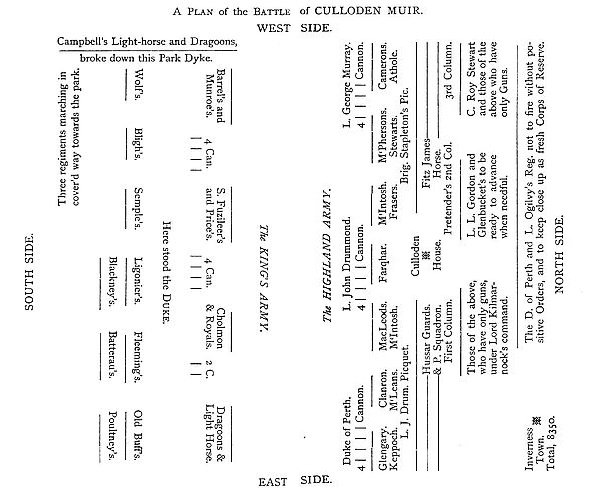
A Plan of the Battle of CULLODEN MUIR.
NORTH SIDE.
The D. of Perth and L. Ogilvy’s Reg. not to fire without Orders, and to keep close up as fresh Corps of Reserve.Inverness ⌂⌂ Town Total 8350.
_______________________________________
C. Roy Stewart and those of the above who have only Guns. L. L. Gordon and Glenbucket’s to be ready to advance when needful. Those of the above who have only guns, under Lord Kilmarnock’s command.
_____________________________________________
3rd Column.Pretender’ 2nd Column.First Column.
___________ Fitz JamesCullodenHussar Guards. ____________
___________ Horse.⌂⌂& P. Squadron. ____________
______________________House_________________________
Brig. Stapleton’s Pic.L. J. Drum. Picquet.
Athole. Camerons.Stewarts. M‘Phersons.Frasers. M‘Intosh. Farqhar.M‘Intosh. MacLeods.M‘Leans. Clanron.Keppoch. Glengary.
______________________________________________________
4 | | | | Cannon.4 | | | | Cannon.4 | | | | Cannon.
L. George Murray.L. John Drummond.Duke of Perth.
The HIGHLAND ARMY.
WEST
EAST
SIDE.
SIDE.
The KING’S ARMY.
__________________________________________
| Barrel’s andS. Fuzileer’sCholmonDragoons &
|Monroe’s.4 Can.and Price’s.4 Can.& Royals.2 Can.Light Horse.
|| | | || | | | | |
|
|Here stood the Duke.
|________________________________________________
|Wolf’s.Bligh’s.Semple’s.Ligonier’s.Fleming’s.Old Buff’s.
|________________________
|Blackney’s.Batterau’s.Poultney’s.
¦ >|
¦Three regiments marching in
¦cover’d way towards the park.
¦
¦Campbell’s Light-Horse and Dragoons,
broke down this Park Dyke.
SOUTH SIDE.
CHAP. X.
Charles’ flight. Arrival in the Isles. Hardships, hidings and narrow escape.
The Prince from Badenoch that night, Over the mountains took his flight. With only six in’s company, And one who led them on the way. O’er many a rock, thro’ glens they past, And to Invergary came at last. About two hours ere break of day; But none within that house did stay, Only one servant, the laird being gone, Bed or provisions there were none: No drink but water to be had, On the cold floor he made his bed, All in their clothes thus sleeping lay, Till near the middle of the day: Having had no sleep five nights before, And little food, you may be sure. No bread or cheese there could they find, Or ought to eat of any kind. No living poultry could they get; But in the water found a net, Wherein two salmon were present, Which they took as a blessing sent, And on them heartily did dine, Having no liquor but Adam’s wine. Then to their journey set again, For Donald Cam’ron’s at Glen Bean, Where they arrived late that night, Thro’ Lochiel’s country, ’twas their fright Of being known by friends or foes: He drest himself into Burke’s clothes, The rest be’ng gone but only three, No more was in his companie. Then on the morrow, the eighteenth day, To Clan-Ronnald’s country took their way, And in Mewboll lodged that night, Being kindly us’d, but still in fright, Delay’d next day some hours, to hear How all was gone; but yet for fear They quit their horse, and took the hill, O’er mountains climb’d scarce passible, To Arisaig or Borasdale: And here themselves they did conceal At Kinloch Moidart, where they lay, Not knowing what to do or say. There came lord Elcho and O’Neil, Who to their Prince did plainly tell How all had gone at Inverness, Since the fatal day of their distress; That all the Clans were scattered, So as rally again, they ne’er cou’d; For the Duke had parties ev’rywhere To burn and plunder, none did spare Who with them were the least concern’d, So where to flee must be determin’d. Here Sullivan and many more Their council gave as bad’s before, Their Prince to flee into some isle, And there to ly incog. a while, Sending for one Donald MacLeod, Who knew the isles and safest road. And while they were a-planning this, An alarm came for to dismiss, A party coming was that way, Direct as knowing where they lay, Then to the woods all of them fled, Took sundry ways be’ng sore afraid. The Prince himself bewilder’d ran, And with him there was not a man, Being thus dejected and all alone, Thro’ the wild woods he made his moan. While thus he melancholy lay, MacLeod came past on’s road from Sky; The Prince cried boldly, What art thou? And he reply’d, What’s that to you? My name’s MacLeod, from Gaultergill, I’m not afraid it to reveal. Then said the Prince, ’Tis thee I want, I am the man who for thee sent, The Son of your King, your Prince I am, And for your pity here I came. On you, Donald, myself I throw, Do what you will, prove friend or foe. Then Donald, in tears, stood all amaz’d, With dumb surprize he on him gaz’d: My Prince, my Prince and here to lurk! Oh! this would move the heart of Turk, To see the turns of time and fate, From honour to a wretched state; I’m old, I’m old, thus did he cry; Yet t’ serve my Prince I’d live and die. Then said the Prince, Since it is so, With these two letters, wilt thou go, To Sir Alexander? though that he And th’ laird of MacLeod’s my enemie, I’ll yet their clemency request, If humanity lies in their breast, In noble hearts pity is found, They’ll land me safe on German ground. No, no, said Donald, that will not do; For now they’re both in search of you: But my service sha’n’t cost you a groat, Near this there lies an eight oar’d boat, Get all you have, ready on sight, And we will go on board this night. To this the Prince did well comply, They went in search of all was nigh, To wit, brave O’Neil and Sullivan With Allan M‘Donald of Elen-o-ron, Alex. M‘Donald, Edward Burke, And four stout men the boat to work, Donald MacLeod was pilot too, No more were in his retinue. For store they had four pecks of meal, A pot they bought for making kail: This was on April twenty-sixth, They put to sea, full sore perplext, At the same place he came on shore, When first he landed the year before. Dark was the night, the wind blew high, The rain drove on, black was the sky, No deck or cover was to be got, Pump or compass had they not; Before the wind they durst not stand; Because they knew not where to land: In all the Isles were armed men; But in what place they did not ken. Ev’ry wave threat’ning their last, And shipt great seas, which o’er them past; Yet kept above from sand and rock, Till to morrow ’bout seven o’clock, They made Rushness-point, on the long isle, Call’d Benbecula in Gallic style, Two hundred miles in eight hours space, Past many a rock and dang’rous place, Where militia boats were out on spy, Which otherwise he’d not got by: But this vi’lent storm they could not stand, All fled for shelter to the land. Now on this isle they landed were; But found no house or shelter there, Except an old stye of a byre, Wherein they kindled up a fire, Shot a cow and did her boil, And made fine brochan of her oil. The place was hollow and remote, Upon dry land hauld up their boat; But when they view’d the raging sea, They prais’d their Maker heartilie, To think what dangers they’d come by ’Twixt the isles of Cole, Mull and Skye. The storm it still increased high’r, For fourteen hours it blew like fire. They spy’d, for dangers, round about, And then to sleep their prince was put. No bed-clothes but the sail all wet, Without straw, bolster, or a matt, Where cows had lain all night before, A poor palace without a door, A bed of state, all wet with shern: This may the great humil’ty learn. Here they remain’d for nights two, Until the storm did overblow: And then for Stornaway set sail, But meeting with a desp’rate gale, Were drove on Scalpa-isle, or Glass, Which to one MacLeod belonging was, By whom they wou’d been gripped fast; But for a shipwreckt crew they past, Old Sullivan the Prince’s father, And ev’ry one gave names to other. They said, they were to Orkneys bound, And here great lenity they found From Donald Campbell, a farmer there, Who for a passage did prepare A boat of his own for Stornaway. Which went off on the first of May, With Donald MacLeod, his trusty guide, Who went a vessel to provide, To get to the Orkneys by all means: For there he thought to meet with frien’s, Who, well he knew, would use their pow’r, To land him on the German shore. And in three days a message came, That a ship was ready at his deman’. Another boat was mann’d with speed, And to Storn’way they did proceed, Landing upon MacKinnon’s ground At Loch Seaforth, then to walk round, Long thirty miles, upon their foot, Before to Ayrnisk point they got. None with him but only Sullivan, Brave O’Neil and another man, Who was to guide them on the way; Yet by good chance led them astray: Long eighteen hours this stage it was, Through a long Muir all wet to plash: But had they come the nearest way, They had been catch’d in Stornaway. About a half mile from the town, Faint and weary they all sat down, And sent their guide for Donald MacLeod, To bring refreshment if he cou’d, Who brought them brandy, cheese and bread, Which cheer’d their hearts in time of need. Then took him to Lady Kildoun’s, The only friend found in that bounds, Who kindly did them all intreat And well refresh’d he went to sleep. So Donald return’d into the town, And found all to confusion grown, Above two hundred in arms were, And furich ha nish every where. A clergyman from the South Uist He sent a letter, for truth almost, That the Prince, with above five hunder, Was coming for to burn and plunder. Then Donald to their Chiefs did go, And curs’d and swore it was not so: For the Prince has not got a man but three, And I one of his number be. So gentlemen, think what you do, Lest, when too late, you come to rue; For if Seaforth himself were here, A hair of’s head you durst not steer; For, if you kill him, or catch alive, Think not for such an act to thrive. This island lies far out at sea, In faith it will revenged be By favourites he hath abroad, So stop your fury, cries brave MacLeod, For surely, gentlemen, if you do it, Your babes unborn may come to rue it. Then said they, Well, since it is so, Out of this island let him go; For if the rabble come to hear it, They’ll do it through a zealous sp’rit. The wind is fair and so be gone, We’ll still the people and send them home. Keep all right snug and let none know Whether he’s in this isle or no. The boatmen hearing of such a rout, And fearing what might be their lot, Two with the boat fled to the sea, And two up to the muirs did hie. MacLeod and Burke, here left on shore, Went to their Prince with hearts full sore. Cry’d Sullivan, We’ll take the hill, No, said the Prince, We’ll stand it still: Since here is friendship in the least, Take ye no fear, we’ll be releas’d, So in that night return’d again Their boat from sea, with the two men; But the other two who took the hill, Where they ran I cannot tell. Next morn they put to sea again, Though hard beset for want of men, Having only three who understood Either to row, or sail to crowd. For store they got two pecks of meal, Brandy, beef, butter and ale, So bid adieu to brave Kildoun, As to the Orkneys they were boun’. But to the south as they did steer, Two English ships there did appear, Which made them all in haste to turn, And put into the isle of Euirn, A desart place, where none abode, One mile in length, another broad, Where fishers oft frequent by day; But seeing them all fled away, Thinking they were the King’s press-boat, Their fish behind was all forgot, Both fresh and drying on the rock, Of Cod and Ling, the poor men’s stock; And here they stay’d a day or two, Until the ships were out of view, And on the fish well did they fare, Although their lodging was but bare, An old hut, like a swine’s stye Which fishers us’d to occupy: They had no bed but heathry feal, The hut’s roof cover’d with the sail. They roasted fish and brandy drank, No host they had to pay or thank. For what they did the fishers bereave, He was amind money to leave: But Donald says, No not a snishing; For that would cause a strong suspicion, That some good fellows had been here; Therefore be not so mad, my dear, For ’tis the men of wars’ men’s way, To take all fish, but not to pay. Now here to stay they thought was vain, On the tenth of May set sail again, And back to Scalpa came once more, Where they were kindly us’d before, And offer’d money for men and boat; But such a thing could not be got, To venture with them out to sea, To Noraway or Germanie.—— But here they found danger to stay, So in all haste they put away; For men in arms in ev’ry place, In search of him were in full chace. Ships and boats watching by sea, So without fresh store they’re forc’d to flee: And coming past the South of Uist, An English ship before they wist, Commanded by one Ferguson, For three full leagues came chasing on: They kept by shore, to windward lay, Till in the Loch call’d Esca-bay. Got on an island, and then by chance, Wind contrary rose and drove them thence. Rain and fog did favour shew, So who they chac’d they did not know. Well, said Charles, I see my lot Is neither to be drown’d nor shot, Nor can they e’er take me alive, While wind and rain against them strive. Yet piercing hunger’s hard command: For here no fresh water they fand, And to big isles they durst not go; But such as were a mile or two. So here they were so hard bestead, Of salt water they dramack made, And of it hastily did eat, Hunger for sauce, made it good meat. If e’er I mount a throne, said he, I’ll mind who din’d this day with me. A bottle of brandy then he took, And to them all drank better luck. So then for Benbecula, They hoisted sail, and steer’d awa’: And landed there among the rocks, Where Crab-fish and Partan flocks, To fishing these, with speed went all, And soon did fill a wooden pail. The hut was two miles from the shore, Where Charles carried this store, Lest suspicion should arise, This he did for mere disguise: And when near to this hut they drew, Such a cottage one did ne’er view, On feet and hands they crawled in, Sowre was the smoke their eyes to blin’: Then Edward Burke digg’d down the door And made the entry somewhat more. ’Twas here Clan-Ron. did visit make, To see what measures they could take, For sending him to France again, To see him so, it gave him pain, No shirts he had excepting two, And these unwash’d like dish-clouts blue; Sculking, lurking, here and there, A prey to all like hounds on hare, Though in times of prosperity, He was extoll’d most gallantly. Thus he no longer here could trust; But to Cardail into South Uist, He caus’d him to remove and go, And did provide for him also Bread, brandy, wine and clothes, And such necess’ries as he chose. At this time the faithful MacLeod, In Campbell’s boat the sail did croud, And steer’d for the main land again; How matters stood he long’d to ken With brave Lochiel and Murray too, And have their council what to do. Murray’s answer was, My money’s gone, And help from me you can get none. Then Donald laid out what cash he had For liquor and for other trade, Whereof his master stood in need, And so return’d again with speed, Being only eighteen days away, Which to his Prince seem’d a long stay. No counsel he brought, as I heard tell; But ev’ry man do for himsel, Which made his Master quite amaz’d, And for a time he on him gaz’d: It pierced Donald’s heart to see A Prince into such misery, Confin’d into a stinking stye, And ’bove his head two hydes of kye, To skonce away the sooty rain. And all his clothes in dirty stain. At this time soldi’rs came to Raski, An island, in length but miles three, Lying ’twixt Barra and South Uist; And therefore flee again he must. The Prince, O’Neil and Sullivan, Edward Burke and Donald the man, Just from the foot of Corradail, In Campbell’s boat they did set sail, And landed in the isle of Ouia, From South Uist not far awa’, And there they stayed a few nights; But constantly were in sad plights: For armed boats still passing by, They knew not where to hide or ly. Charles, O’Neil and a sure guide, Went thence unto Rushness to hide; But was not there above nights two, Till information was all thro’, Where he lodged at Rushness, Which trusty Donald did distress: So he, that night, with Sullivan Set sail, to save him if they can, And got him once more safe on board; But wind and rain upon him pour’d: So at Ushness point they shelter took, And lodg’d under a clifted rock. This storm it did the whole day blow, And then at night they came to know Of a party, distant, but miles two: So to sea again they’re forced to go. And as they steer’d to Loch Boisdale, One of the sailors a swearing fell, He saw a boat full of Marines, Which prov’d a rock at some distance. Cry’d, Hardy weather, and ship about, Then to Celie-stella that night they put. On next day Donald spy’d afar, Two sail of English men of war; Yet here they stayed for some days, And could not rest in any ways. Hearing captain Scot on shore was come At Kilbride, two miles off from them. Thus now they all were forc’d to part, Their Prince went off with heavy heart, And with him took none but O’Neil, Whose heart he found as true as steel. Two shirts apiece, for baggage they took, Tied up into a wallet or pock, Around the Prince’s neck and shoulder, Like master and man they trudge together. So here we leave them for a while In lonesome caves and mountains wild. The others two days hover’d near, And sunk their boat through perfect fear, Both night and day lay in the field, Nought but the sails they had for bield, The red coats swarming all around, And yet by chance none of them found. Then Donald MacLeod he went away, And was ta’en at Slate in isle of Sky, By Allan M‘Donald, the laird of Knock, Who him on board the Furnace took, Where gen’ral Campbell and Ferguson For to examine him thus began—— Gen. Was you with the Pretender, or was you no? Heth was I, quoth Donald, and that you know. Gen. Do you know what’s bidden for his head? Thirty thousand pound, a bra’ sum indeed! Prutish, quo’ Donald, it’s no worth a straw, Her ain sound conscience is better nor’t a’: Tho’ I’d got Scotland and England, a’ for my pains, I wadna see him hurt, for your muckle gains. He’s a good civil shentleman, his life on me threw, Wad I kill him, or drown him, or gie him to you. And deil care what ye do, he’s now far awa’, The win ran awa’ wi’m, the like you ne’er saw: For the win and water, Sir, did sae combine, Carri’d him twa hunder mile in aught hours time, They thought Donald a fool of the honest kind, He confessed so freely all to their mind, Suppos’d the Prince might lurking stay Into the isle of St. Kilday, A little island which does stand, Far nor-west from isles or land, The property of the laird MacLeod, A barren soil, and poor abode, Famed most for Soland Geese; Sea fowl and fish their living is: And there they thought, as Donald spake The Young Pretender for to take. Poor Donald to London they sent away, Where he twelve months in prison lay; Yet got his liberty at last, When the act-indemnity was past. Gen’ral Campbell with an armed fleet, Around St. Kilda came complete, Which frightened the poor natives there, Who ran to holes like fox or hare: And when they reach’d the wretched shore, They catched some who to them swore, That none did in that place sojourn, But who were in St. Kilda born: Of a Pretender they nothing knew; But what they heard of a boat’s crew, How the laird MacLeod had arm’d his men, To fight against some ill woman, Who lived somewhere far away; And this was all they had to say. So the gen’ral soon return’d again And saw St. Kilda for his pain. And here we’ll leave the Prince a while, Who hunted was from isle to isle, O’er hills and mountains, wood and glen, As afterwards I’ll let you ken. Poor Edward Burke was left alone, For now companions had he none, Lodg’d in a cave for weeks three, Ate Dulce and Lampets from the sea: In short, he thought he would turn wild, Seeing no man, woman, or child; Till an honest Souter and his wife, Agreed for to sustain his life, For two long months, he said, and more, Some meat each night they to him bore, Their like was not in all North Uist, For to pity rebels no man durst: Because ev’n at that very time, It had been made a mighty crime, Read from the pulpits by the priests, That none should pity man or beasts, Who had along with Charlie been, Give them no victuals, nor close their een In sleep, or warm within a door, Or excommunicate to be therefore, Besides, the pains of milit’ry law, Hanged or shot one of the twa. Of this act I know not what to say, Since Solomon speaks another way, And a great, yea wiser King than he, Bids us to feed our enemie, And give him water for to drink: For me, I know not what to think. But Burke of all at last got free, When th’ act of grace gave libertie, And home to Edinburgh came again, For’s love to Charles got nought but pain, And yet if Charles return, to morrow, He vows he’d go tho’ on a barrow.
CHAP. XI.
Procedure of the King’s men against the suspected. Confusion in the Army and severity against the Clans.
Now, the royal Duke, at Inverness, Did the whole North fully possess, Encamp’d, and sent his parties out To burn and plunder round about All the offenders, who for their crime, Were severely punish’d at this time. All those who were loyal and true, Had some acknowledgement as their due. He number’d first what he had lost, And what his signal vict’ry cost. Lord Robert Ker was ’mong the slain, A brave captain of Barrel’s men; Of Price’s reg’ment, captain Grossot Here did fall, it was his lot, Captain Campbell of Argyleshire men, Was likewise found among the slain. Near six hundred, rank and file, lay there, Two hundred and forty wounded were. His sole reflection was, in the chase, The Pretender’s rout he could not trace, Any farther than that afternoon, He drank with Lovat when all was done, When his very tears mingl’d with wine; But never could be catch’d sinsyne. As some ran east, and some ran west, To south and north in crouds they past; Some to Argyleshire, through Kintyre, And into Ireland flew like fire. Tullibairn by Loch Lomond came, Fled from the battle into the flame, Into the house of Drummiekill, Who stood on the cross way, to kill Those who from the battle fly, Against all such does Moses cry, As in the sacred Write, we read, They’re curs’d who’re guilty of such deed: Yet here was Tullibardine gripped, When from the roaring guns escaped, And prisoner to London led; Yet dy’d there quietly in his bed. Duke William still camp’d in the north, All was in stir beyond the Forth, Ports, pass, and ferries guarded, Who catch’d a rebel was well rewarded. Few but preachers, at this day, Were counted righteous in this way: For where the minister said the word, To life and liberty they’re restor’d, Resign their arms, with Mess John’s line That they were prest for to combine To go with Charlie, and his crew, By force control’d—— ’Tis very true, Most of the common men were prest, Drove to the slaughter like a beast: But one thing of Highlanders I see, To them they serve they’ll faithful be; For those who serv’d King George, just here, ’Gainst the rebels proved most severe, And rebels, who afterwards did list, Loyaller hearts no man could trust: And, ev’n the conquering of this field, Unto the English I will not yield: Had Scots and Irish run away, They’d found it hard to gain the day; Yet after all they ’gan to boast, ’Twas they only who rul’d the roast, And even where in camp they lay To upbraid the Scots, and oft did say, Mocking the mis’ries that befel, “These Scotsmen are but rebels all, “For which they all should hanged be,”— Which rous’d the Scots most veh’mentlie: And when they did complain thereof, Were answer’d with a mere put off: This did enrage them still the more, Vengeance to seek by the Clay-more, Which all into confusion threw: The Scots into a body drew, Irish, by blood and love allied, Did join unto the Scottish side. His Grace, the Duke, perceiving this, Into this broil most active was, Who, as with no party he would stand; But charg’d them by his high command, For to be still, and silent be, Till he’d the dispute rectifie; Then agents from each side were chose, Whom he in council did enclose, Where they made a solemn act, “That by a thousand on the back, “Every man should punish’d be, “Who’d thus upbraid any countrie.” So this again cemented peace, Thro’ mediation of his Grace, Which was indeed a virtuous scheme, And adds great honour to his name: For had they once come on to blows, ’T had been the glory of their foes, And the murd’ring of one another; But now they’re Britons all together, And yet the spite ended not here, As afterwards you’ll come to hear; But agitated the Parliament, Though contrary, it with them went, To put the Scots beating away, A march which vex’d them ev’ry day: Because it was a grief to hear it, And very irksome to their spirit, The dinging down of Tamtallan, They swore it mean’d some other dwallion. The bonnets, plaids, and spotted coats, A dress long time worn by the Scots, These by an act were laid aside, Thro’ nought, I think, but spite and pride: For when the Scots they came to need, They were restor’d again with speed, Ev’n by an order of the crown; But Tamtallan was ne’er beat down, The Scots still kept by their old march, In spite of all their foes could urge. But the cause of the Duke’s long stay here, Was to find out the Chevalier, As Scotland round by sea was guarded, If catch’d on land, so high rewarded The apprehender was to be, There was no hopes he could get free. Hesse camps, did at Perth and Stirling stand, Armed militia through all the land, And parties searching ev’ry isle: Being heard of ev’ry other while, They still kept on a close pursuing, Hard was the hunt for Charlie’s ruin. All prisoners, they catch’d, of note, On ship-board were securely put, And to England sent, trial to stand, But deserters judg’d were in Scotland, Who had as soldiers with Charlie gone, They hang’d and shot them every one: For Hawley’s verdict was so quick, “Go hang the dogs up by the neck,” Which was no sooner said than done, No pity he shew’d on woman’s son. The Duke, by half, not so severe, Did often the condemn’d set clear, Made his soldiers say, he was too civil; But swore, That Hawley wou’d hang the devil. The Duke did love to burn and plunder, And sweet revenge upon them thunder, On house and huts made devastation, As it had been a foreign nation. Their whole utensils, rock and reel, To see in flames he loved well, With dogs and cats, the rats and mice, And their old shirts, with nites and lice, Were all unto the flames consign’d, To bring them to a better mind, And never more for to rebel, A doleful time for her nain sell, For all that she had done or said, She thought it more than double paid; Eating kirns, and supping sheese, And codding of the Lothian pease, Or taking a bit of beef to eat, When she could get no other meat; And when she met a Lalan-rogue, But pate a shainshment on her brogue, The soger has done a ten times mair, Brunt her house, taen a her geer, And after that cuts aff her head, An shot on them that frae her fled. For all who did from the soldiers fly, Were fir’d upon immediately, By which, many a poor innocent Was put to death, by them unkent, Their flying away caus’d the error, The red-coats were to them a terror. Now Charles concealed was in Uist, And there to stay no longer durst, The Campbells were coming a ho, a ho, He durst not bide, and could not go: Every day he saw them well, And had none with him but O’Neil. The day was long and hot the sun, About the twenty first of June, Upon a mountain top they lay, And saw their motions ev’ry way, From glen to glen, caves and rocks, As ever hounds did search for fox, Campbells, and lads with the red coat, With them guides knew every spot, And corner of that country side; So here it dang’rous was to bide. But in a desart place remote, They found a lonely dismal hut, And there to stay they judged best, Until part of the hurry past. Such venison as they could take, Of ev’ry thing a prey they make: It was not out of cov’tous greed; But only as they stood in need. O’Neil alone was out at last, To hear of what was done or past, And met a lady whom he knew, Miss MacDonald good and true, To her their straits he did reveal, Who did with tears their sorrows feel, And vow’d by all was dear within her, She’d them relieve, if they should skin her: Then hasten’d O’Neil to him away, Appointing where to meet next day, And to the Prince with him did go, Her servant did the secret know, One Neil MacKechnie, an honest heart, Who in ev’ry point did act his part, There, they their whole plan did frame: And then to Malton came again Miss Flora and her man next day, Going to Clan Ronald’s house were they, For to perform the enterprize, And get clothes fit for his disguise. By a party of militia men, Both of them prisoners were ta’en, Miss ask’d who was their officer, And they in answer told it her: He prov’d her father-in-law to be, Preferr’d, for suppos’d loyaltie, No less than a king’s officer, She thought she might the better fare, And there did tarry all that night, Before of him she got a sight. Greatly surprized then was he, His step-daughter prisoner to see, Call’d her aside to know the matter, And gave her both a pass and letter, For herself, her lad, and Betty Burke, A woman who was to spin and work, Being a maid for her mother hir’d So all was done as she requir’d. Then to Clan Ronald’s house they came, And let the lady know the same, Where ev’ry thing in haste was got, Apron, gown, and a petticoat: Of printed cotton the gown it was, Just fitting for a servant lass: Then to the hut they went away, To get him drest without delay; And as they entred into the door They found their Prince, surpriz’d him sore, A cooking something for to eat, A sheep’s pluck on a wooden spit. This put them all in Brinish tears, A Prince brought to such low affairs! But he reply’d, Why weep ye so? ’Tis good for Kings sorrow to know: And ev’n the great, won’t after rue, They suffer’d part of what I do. That night they stayed all in the hut, Ere ev’ry thing was ready got, And on the morrow a message came For lady Clan-Ronald, in haste extreme, That cap. Ferguson, with Campbell’s men, Did all night in her house remain. And to confirm what they had said, The Captain took up her own bed. Now Charles by this time was drest, Like a Dutch frow, I do protest, His brogues, indeed, had leather heels, And beard, well shaven, all conceals; But gown and petticoat so short, Shew’d too much legs, but no help for’t. He of the lady took his leave, And left O’Neil behind to grieve, Who thro’ the world with him would go; But Flora said it would not do: Because their pass that number bore, And one too much was not secure, Herself, her servant, and Betty Burke, Who was going to her mother’s work. The boat’s prepar’d, away they set; But lady Clan-Ronald was in a strait: For soon as she had reached home, Was strict examin’d by Ferguson—— Pray where now, Madam, have you been, Seeing a sick child, a dying frien’; My servants might have told the matter; But the child now is somewhat better. For this no proof was but her lips, So he put them both on board of ships, I mean Clan-Ronald and his dame, Who did in sep’rate ships remain, Until to London they were sent, And nothing of each other kent, Long twelve months there they did remain; Before they saw their homes again. Now poor O’Neil was left alone, And through the hills a wand’ring gone, By chance he met with Sullivan; As on the shore they both did stan’ A French cutter came in their sight, With pendent flying, colours bright, O’Neil her hail’d, and to she came, To fetch the Prince was all her aim. O’Neil desir’d them there to stay, And he to bring him back wou’d try: Then off he sets along the shore, A trav’lling for a day or more, As the wind had contrary been, Into some creek they might be seen: But finding he was gone for Sky, He thought to touch there going by, Knowing the secret, the way plann’d, The very place he was to land. Night and day he did not spare, Back to the cutter he did repair; But ere he came she was away, Sullivan would no longer stay: For’s life was preciouser to him, Than all the princes in Christendom. He saw some ships afar at sea, Then pray’d the French with him to flee: But had they got O’Neil on board, From Sky the Prince had been secur’d; Yet here O’Neil was left behind, Who soon was taken and confin’d, And sent to Berwick upon Tweed, Where he remain’d some time indeed, Thence by cartel was sent to France Pass’d for an officer from thence. Sullivan was got home before him, The cow’rdliest cur in all the quorum: For had he staid three hours in Uist, They’d carry’d their Prince safe off the coast: For O’Neil would made them touch at Sky, The very place which they past by, Where he knew the Prince was to ’bide: But Sullivan sav’d his own hide, And with all speed went home to France, Left them behind to Providence. As the Prince, Miss Flora and her man, Were just about to quit the land, Four king’s wherries came in their view, Where armed men were not a few: Back to the heather they’re forc’d to fly, And there some time conceal’d to ly, These wherries soon went out of sight, And then came on a pleasant night, Their boat ready they put to sea; But were not gone past leagues three, ’Till dark and dismal grew the skies, The wind and waves did dreadful rise, In open boat, no compass had, Only two men, whose skill was bad. Here Charles’ courage was at a stand, Tempests by sea and storms by land; For wind and wave did fight again’ him And nothing seemed to befrien’ him. Miss Flora she fell fast asleep, The rest by oars and helm did keep, And when the day light did appear, They knew not to what hand to steer, The wind had vary’d in the night: At last of Sky they got a sight. At Waternish, the west of Sky, Upon that point to land did try; But the red-coats were swarming there, To ship about they did prepare: They smartly fir’d to bring ’em too, But all in vain, it would not do. Two men of war were hov’ring by, And there it was no time to stay; So, off they set before the wind, And all their foes they left behind. The alarm up to the village went; Yet to pursue they were not bent, Knowing all boats were in a fright; So about they put when out of sight, And landed in a little creek, Under a rock did shelter seek, The men to rest and be refresh’d, Who all the night were sorely dash’d: And then to sea again did go, Lest some should of their landing know. They were not half a mile from shore, Till they see’d pursuers half a score, All running to the very place, Which they had left a little space. Then to the north twelve miles they stood, At Tornish made their landing good. Near Alexander MacDonald’s house, Where went Miss Flora bold and crouse, As Sir Alexr. was not at home; But to visit Duke William gone, Only his factor, who prov’d a friend, And how to act Miss to him mean’d: As a military officer was there, She told him where he should repair, And meet the Prince in woman’s dress, To whom he went in full express, With bread and wine, and other food, Then took the hills, a private road To his own house to be conceal’d, Though afterwards it was reveal’d. Miss Flora on horseback, and another Kept the high-way, for to discover What militia or foes might be; From all dangers to keep him free, Miss Flora, her man, and a Highland maid, Coming on the way, She to Miss said, “That Lawland Carlin gangs like a man, “She strides o’er far by half a span, “I wonder Kingsborough’s not afraid, “To crack sae wi’ that English jade: “See how her coats wamels again, “These English women can fight like men.” No, said Miss, She’s an Irish woman: Cries, Lady Marg’ret, Are you coming? (Not liking what the girl had said) Go after Kingsborough yon road, And you’ll be there as soon as we, Thus she kept him from suspicion free; And to the house they came at last Before elev’n o’clock was past. But Kingsb’ro’s wife was gone to bed, Thinking that no such stranger wad, At such a time come to her door: For th’ two young ladies were oft before. She sent them word to take the key, With all in the house for to make free; But Kingsbro’ said that would not do, Herself must rise, and quickly too. The child ran back and told her plain, Such a lang wife she ne’er saw nane, As that was walking through the ha’, Her like was never there awa’, Therefore she’d go no more for fear, Then up she rose and did appear: And the one who walked through the hall, Did her salute and kiss with all, Whereat she started and was afraid, Being so prick’d with a lady’s beard: Then to her husband said, whisp’ring ways, Is not this a gentleman in disguise? His pricking beard does me convince, Pray ask him, What’s come of the Prince? The Prince, my dear, Why this is he—— Oh, said she, then we’ll hanged be—— A well, said he, We’ll die but once, Get supper for him, cakes and scones, Butter and cheese, we have eggs enow: What! That for a Prince will never do. Yes, for rarities be nowise griev’d; You little know how he has liv’d: And with ceremony be not affected, Lest by your servants he be suspected, He supp’d that night and went to sleep As a stranger lady, all snug was kept. On the morrow he rose and was drest, And for their kindness thanks exprest: Miss Flora and the other Miss, They had him in his robes to dress, The gown, the mutch, and petticoat, Such stuff to wear he loved not; But because to them in such he came, He should go off wearing the same, Lest by enquiry they might provoke What they were, being stranger folk. Then Kingsborough’s wife did them desire, To ask a pickle of his hair. And they in Galick did debate, Who should it ask, they were so blate: He understood, the reason speir’d Of their debate, desir’d to hear’t, This freely granted as soon as told, And to their sheers his head did hold, The lock was parted ’mongst the three, Of their dear Prince mindful to be, An ancient freit, a Highland charm, Look on that hair her heart will warm. Kingsb’rough a bundle of men’ clothes took Far from his house, to a wood nuik, Remounted him in Highland dress, There he much kindness did express—— They wept, they kiss’d, and off he goes, While drops of blood fell from his nose. Their hearts were great, you may weel ken, They parted ne’er to meet again. A guide sent wi’m the mountain way, Had a boat ready, the freight did pay, At Portree, or the king’s port, Miss Flora’s there ere he came to’t. And here they parted at Portree, Where thanking her most heartilie, Miss Flora did no longer wait; But went to ’r mother’s house at Slate. Now Kingsborough did Raaza send To meet the Prince, and be his friend, With sev’ral of his trusties there, Who in his expeditions were, Both at Culloden and Falkirk. To Portree came when it was dark, Both John MacKenzie and Donald Frier, Who had been with him far and near, They set off in a little boat, And safely into Glam all got: In a mean hut their dwelling made, For kid and lamb young Raaza gade: There was no bedding to be found, They’re oblig’d to lie upon the ground: His pillow was a wisp of Ling: Poor state for a pretended king! This was in July the first day, And here incog. some time they lay. Now Ferguson got the sure tract From the two men, as they went back, Who did him and Miss Flora bring Out of Uist, and everything, His coat, his mutch, his very gown, From whence they came, and whither boun’, How Malton’s daughter and Kingsborough too, Went all together out of their view. Then Ferg’son with a party came To Kingsb’ro’s house, and did deman’, Which way the young Pretender went? Where he and Miss Flora were sent? Whether they lay in one bed together? What clothes he came in, or went thither? Few answers to him Kingsb’rough made: What! said his wife, “Miss Flora’s maid, “They staid all night and went away, “Whether man or woman was I to try?” Then, said he, Show where they were laid, Where lay the Miss? where lay the maid? Now then, quoth he, I have you fast: Because the maid’s bed is the best. Then Kingsborough away was led To Fort-Augustus, hard bestead, Plunder’d of’s watch, buckles and shoes, And all the cash was in his trews, In a dungeon deep, iron’d he lay, Thence to Ed’nburgh castle sent away, And there confin’d was kept one year, Till by the Act of Grace set clear. For love of Charlie he got this, And poor Miss Flora no better was: For she was scarce ten days at home, Until she got a card to come And speak unto an officer, Who had no great good will to her: This for a night she did delay, And on the morrow, by the way, A party meets, in search of her, By whom she was made prisoner, And carry’d instantly away, On board a ship that very day, The Furnace, captain Ferguson, Who did show lenity to none. But good for her, as fortunes were, That gen’ral Campbell, as judge sat there: Though she before made ’quivocation, She told to him the true relation, And the general did use her well, Since she the truth did not conceal: For of the deed she thought no shame, To any in need she’d do the same. Said she, “I’ve no cause to betray, “Or yet to wish his life away, “Wherefore then should I do him wrong? “To you soldiers does such belong. “If that a price be on his head? “’Tis for those by blood who have their bread.” The gen’ral then had nought to say; But gave her leave, on the next day, Of her friends to go and take farewel; Her mother heart-sore grief did feel: An officer and forty men Did guard her there, and back again. Then she unto the Nore was sent, Five months on sea, where no friend kent, At last to London was convey’d, There with a messenger to bide, Till the month of July Forty Seven, That she was home to Edinburgh driv’n, When by the Act of Grace reliev’d, She’s now in Sky, yet unmischiev’d. Now Charles at Glam, in Raaza lay, Long, long he thought to get away, Hard was his living, poor his hut, Upon all heights they watches put. A stranger to this island came To sell tobacco, perhaps a sham; For after all his roll was sold, He daily through the island stroll’d, And to the hut one day drew nigh; Then Raaza swore he was a spy, And cockt his pistol, him to shoot, The Prince cry’d, No, You shall not do’t. That poor man may innocent be, Without a fault he shall not die. The poor man then went stepping by, And did not ev’n look to their stye. Now, said the Prince, what would ye said, If innocent blood had here been shed? Too much, indeed, on my account: At this some seem’d to take affront; Yet as a joke he past it by, And then propos’d to go for Sky, In the small boat which brought them there, So for the voy’ge they did prepare. Toward ev’ning they put to sea, And then the wind rose wond’rous high, The boatmen begg’d to put about; But he was obst’nate on his rout, And told them life was but a chance, They were in hands of Providence: He leav’d the water with a scoop, And bid them in their Maker hope, The boat is making a good way, No man will die but him that’s fey, We’ve all in dangers been ere now: At Nicolson’s rock they brought her to, Near Scorebreck in Trotternish, Their lodging in a byre it was, All wet and weary as they were, Lay on the ground, sleep seiz’d him there, In which he sigh’d, and starting said, “Poor people, poor people, hard bestead!” He then awak’d, and thus did say, “Malcom, dear captain, is it yet day? “You’ve watch’d too long, now take a sleep, “And I myself will centry keep.” “No, said MacLeod, Sir, if you please, “I know this ground best, take your ease, “There’s not a house near by two mile, “Our friends are few into this isle, “The red coats are not far from us, “To slip my charge is dangerous.” So here they did remain next day, Before they could venture away, Having no bread, or ought to eat, (For a King’s Court, a poor mean treat!) Except water, sprung from the ground, No meat or drink could there be found. Two bottles of brandy was all their store, On earth they had no substance more, Nor in that place durst one look out For en’mies planted round about. When night came on, they parted all, Captain MacLeod we shall him call, Did undertake to be his guide, One bottle of brandy by his side, Over muir and mountain, wood and glen, Between hope and despair they ran. The Prince as servant did appear; Because he did the baggage bear, A hairy wallet on his back, Just like a chapman and his pack, Wanting the breiks, with legs all bare, Into his hand his brogues did bear, A napkin ty’d around his head, In this posture forward they gade, Long thirty miles ere they took rest, Water and brandy was all their feast: Because they had no other cheer, For house or hut they went not near, Till at Ellighill, the place call’d Ord, Whereof MacKinnon is the lord, Their brandy-bottle now was done, And here they hid it under groun’: Yet were they in a strait again, Meeting two of MacKinnon’s men, Who had on the expedition been, And oft before the Prince had seen, Who knew him well, though in disguise, Fell down and bursted out in cries. Then Malcom, Hush, to them did call, Or else they would discover all, To which they swore, by all that’s Good, They’d rather spend their dearest blood, So faithfully they did conceal it, And did not in the least reveal it. Now were they come unto the place, Where Malcom’s sister married was To John MacKinnon, who’d captain been Along with Charles in armour keen; But had got clear by Proclamation, And for to skulk had no occasion. He orders the Prince, now Lewis Cawe, For to ly down some space awa’, While he into his sister’s went, Their doleful case to represent. She him embrac’d, and wept amain, As in the war she thought him slain: He said, dear sister, here I’m come Myself to hide, if you have room, With one, my servant, Lewis Cawe, In the same case, hard is our fa’: He’s a surgeon’s son, who came from Crief Shelter to seek and some relief. Then poor sick Lewis was called in, With head bound up, he look’d right grim, And by his master there he did stand, With head uncover’d, bonnet in hand: But the Captain urg’d him to sit down, And put his bonnet on his crown, Since there are no strangers here, Come, eat with me, Lewis, my dear. And when their dinner over was, The Captain says, Our feet we’ll wash: The servant-maid brought water then, And wash’d his feet with tender han’. Said he, my lad’s not well, I know, You’ll wash his feet before you go; But she reply’d, I ken some better, ’Tis fair enough if I bring water, He’s but your lad, as you me tell, Dat loon may wash her feet hersel; Being forc’d to do’t, through mere constraint, To work in a rude way she went, Rubbed his toes, made the water rise At every plash, betwixt his thighs; On this he to the Captain said, She rubs too hard this saucy maid, I had far better do’t mysell, In trout, quo’ she, an sae ye sall, Then both of them to sleep were put, The goodwife went to a hill-top For to keep watch, lest from the sea Incursions should come suddenlie. As King’s ships hover’d all about, And parties through the land did scout. Just as they wak’d the husband came, When Malcom heard, he to him ran, And did salute him in the field, Which meeting did great pleasure yield; Because that word was to them brought, He kill’d was at Culloden fight. And after they had talk’d a while, Think you yon ships will touch this isle? Says John, I know not but they might; Because they’re never out of sight. What if our Prince a pris’ner be, In one of those ships which we see? God forbid, then John reply’d; But of his ’scape I’m much afraid: For our nation’s guarded round about, And through the land there’s many a scout. But do you think, if he were here, He would be safe, in such a stir? Ay, safe be sure, whate’er they do, I wish we had him here just now. Then said he, John, he’s in your house; But to salute him, be cautious: Because your wife, nor none else knows, By the name of Lewis Cawe he goes, My servant, a surgeon’s son in Crief, Like us, brought to trouble and grief: Therefore behave when in you go, That none within the house may know. So home they came, and in he goes, Then courteously poor Lewis rose, Bare-headed stood, bonnet in hand, But John could not himself command, Burst out in tears, and on him flew, Oh-hon, Oh-hon, What’s this on you! From splendor into deep distress! He cry’d, and could no more express. Wife and servants stood in amaze, And did upon poor Lewis gaze: Then Malcom in a passion flew, And swore that he had fools enow, Hurry’d them to another place, And told his sister all the case, That he and poor Lewis was in, Charged her forthwith for to run, And bind her servants to secresie, Or else they soon would ruin’d be. When his sister knew what guest he was, Her kindness she did the more express, And said, Upon her very knees She’d travel for to give him ease. They then to consultation went, To get him to the Continent: Because the isles were dangerous, Soldiers searching every bush. John then unto the laird he went, To try how his affection bent, By long-wind stories laments his case, In being hunted from place to place. Oh, said the laird, were he now here, I’d lay my life to get him clear, And set him safe on the main land. Then John he told him, clean off hand, Where he was, and in what place, And to his conscience left his case. Go tell him, I’ll be with him soon, To see what quickly shall be done. John went home, the laird soon came, With loyal affections, as chief o’s Clan, And told, that for him he did provide A good stout boat, pilot and guide, That he himself design’d to go To the main land with him also, A thousand blessings on him prays, And wish’d him long and happy days. Then Malcom said, he would return, Which caus’d the Prince in tears to mourn: Captain, he said, will you leave me now? On the main land, what shall I do? Then said the laird, leave that to me, On the main land I’ll you supplie. Sir, said Malcom, by now I’m mist By friends, by foes, and this I trust For to be ta’en, when I return, Then I’ll tell a tale of my sojourn, Of all my travels how I was here, Seeing my friends and sister dear; But if they chance us to pursue, They’ll hear of me along with you: For answer then, what could I say? What man ye was, or gone what way? Which accordingly it came to pass: For he twelve months confined was, And saw great London for the same, There try’d and came with Flora hame. So to the boat they all did go, Which lay upon the shore below: And as to it they did draw near, Two men of war there did appear, Came cruising in before the wind, Hard on the shore, as they design’d, Which caused them to sit down a space, And smoak a pipe in a hollow place. A silver stock-buckle to Malcom he geid, And ten guineas too in his loof he laid, Which he did often times refuse; But begg’d some trifle that he did use; Then, said he, Captain, Your pay’s too cheap, Besides, you will have my cutty pipe, And when you blow’t, you’ll think on me, As I have got another you see: And take these lines to Murdoch MacLeod, To pay respect to him I’m proud. The men of war having laid about, Toward the boat they took the rout, The writing in the letter this, As writ verbatim, here it is,
SIR,
I THANK God, I am in good health and have got off as designed.——Remember me to all friends, and thank them for the trouble they have been at——I am, Sir, Your humble Servant,
James Thomson.
CHAP. XII.
Sundry dangers and hardships on the main shore. Meets with six men who relieve him. Almost starved. Goes to Lochaber. Meets with Lochiel. Gets off from Moidart.
Now, the men of war being out of sight, On the eighth of July, at eight at night, The laird of MacKinnon, John by name, With a pilot, guide, and four boat-men, All on board with him they went, To carry him to the Continent. The night indeed was fair and clear; But not above a mile they were, Till wind and waves did rise in ire, This providence we may admire, Which seemed to be frowning on him, The very waves striving to drown him, And on their boat, came straight a-head, A boat with men all well armed: But the sea was high, the wind so blew, And nought but present death in view, They hail’d each other, and that was all, It was no time to search or call: Had not this storm proved their frien’, He’d surely in their clutches been. And when they reached the main land, Under the lee they’re forc’d to stand, The pilot ran her into a creek, Got past the breakers, ’mong sand and sleik, There they landed him and his guide, And chus’d no longer to abide: But to the sea again did go; Because the storm did fiercely blow. And as they were returning back, A boat from Morar did them ’ttack; And old MacKinnon was pris’ner made, Being, by direction, to him led, By a party who did the two pursue, And the boat who of them had a view The night before, when going over: The facts of all they could discover, At Morar, on his going back, The laird MacKinnon they did take, And prov’d the deed which he had done, For which they sent him to London. In Southwark goal long did he ly, With heavy fetters did him ty, Till in Forty Seven, the next year By Act of Grace he got home clear. Now Charlie went to Glen-Brasdale, Where he heard tell of brave Lochiel, Who about Loch-aber was lurking there; But to get to him great dangers were: As a line was form’d from Inverness, Which reached to Fort-Augustus, From thence unto Fort-William again, Night and day stood armed men. The word, in a few minutes, did wheel, From end to end, All is well; And from Fort-William to Locharkaig-head, Another line was likewise made. Thus he did in Glen-Brasdale ly, Till circled almost every way. Gen’ral Campbell with four hundred men, Upon the south-west side did land: Captain Scot, with five hundred more, Advancing from the easter shore, And came within two miles of way, They knew not what to do or say: He sent for Cam’ron of Glen-Pan, Who chus’d to be his guide and van, To Lovat’s country for to go, The braes of Locharkaig as he did know, With them went Glenaladale and his brother, Boradale’s two boys, there was no other: First went the guide on’s hands and knees, After past the Prince and the two boys, Glenaladale and his brother at last, Favour’d by the night, they quietly past So near their tents they heard their speech, And ere day, got far out of reach, Right safe into Glen-Morriston, Left Glenaladale and him alone. One day, as they a travelling were, Over a desart mountain there, Glenaladale chanc’d to lose his purse, With forty guineas which in it was, And money behind it they had none, The Prince’s being spent and gone. While Glen. return’d his purse to seek, Charlie lay down at a bush cheek, And there appear’d unto his view, A band of soldiers not a few, Just upon that very spot Where they had met, were’t not the lot Of turning for that very purse Kept them from what had been much worse. So, close he lay, slie as a tod, Being at some distance from the road, And saw them take another rout, That they’d met Glen. he had no doubt, Being gone quite the contrary way For which he thankfully did pray. Glen. found his purse and turn’d again, They chang’d their rout through a wild glen, Where nothing had they for to eat, Full forty hours they wanted meat: Weak and weary were they both, Water indeed they had enough; But found no sheep or venison, The cattle being plund’red and gone. At last, they chanced for to spy A little smoking hut, near by: Then said the Prince, Thither I’ll go, Whether they should prove friend or foe: Better for us be kill’d like men, Than starved like fools: What say’st thou Glen? Yet Glen refus’d, and said, I fear, They may be King’s-men watching here: But in the Prince goes to the hut, Which them in some confusion put; Six sturdy thieves resided there, Who at their dinner sitting were, At a weighty piece of boiled beef, For hungry men a blest relief. Peace be here, the Prince did cry, You’re welcome, sir, they did reply; One star’d at him, then up he flew, Ah Dougal MacColony, is this you? I’m glad to see thee, with all my heart, Sit down with us and take a part. By winks, he found that he was known, Return’d him thanks, and then sat down, Ate hearty, and seem’d very merry, Talk’d of the times, found by enquiry, That ev’ry one spake as his frien’, And had all at Culloden been; But only one of them him knew, He then bethought him what to do, And after dinner they took a walk, With that same man to have some talk, Who told him all the strengths about, Where parties lay, and what to doubt. And as, said he, “The other five, “Are as faithful fellows as alive, “You may your safety to them trust, “Your case by them’s lamented most. “Here do we all in private stay, “And make incursions for our prey: “For meat and drink we do not want, “Of silver and gold we are not scant: “And since ’tis such a roaring time, “To steal and rob we think no crime.” The other five were call’d and told, Who did rejoice him to behold, And swore that he should with them stay, Till he found it safe to get away. ’Tween Strath-Ferrar and Glen-Morr’ston, They kept up huts, yea more than one, And kindly there did entertain him; To the very last they did befrien’ him, And ere that he should taken be, They every man would for him die. While here he liv’d on stollen beef, Right suddenly there came relief: Rod’rick MacKenzie, a merchant-man, At Ed’nburgh town had join’d the Clan, Had in the expedition been, And at this time durst not be seen, Being sculking in Glen-Morriston, Him the soldiers lighted on, Near about the Prince’s age and size, Genteelly drest, in no disguise. In every feature, for’s very face, Might well be taken in any case, And lest he’d like a dog be hang’d, He chose to die with sword in hand, And round him like a mad-man struck, Vowing alive he’d ne’er be took: Deep wounds he got, and wounds he gave, At last a shot he did receive, And as he fell, them to convince, Cry’d, Ah! Alas! You’ve kill’d your Prince; Ye murderers and bloody crew You had no orders this to do. This did confirm them in the thought, He was the very man they sought: And ere that he was really dead, They forthwith did cut off his head. Scarce took they time the corpse to bury, Being so o’erjoy’d, in such a hurry. To Fort-Augustus they went with speed, Triumphing o’er poor Charlie’s head. All who had seen him, came it to view, And vow’d the face was just and true; The very barber who us’d to shave him, The sim’lar treats seem’d to deceive him: But, said he, wer’t on his body set, And spake, his voice I’ll not forget. Then to the Duke in haste they’re bound, And claim’d the thirty thousand pound. The Duke thought now the work was done, When Charlie’s head was to him shown; Call’d in all out upon command, And caus’d the militia to disband; The ships of war went to the south And Charles’ death did pass for truth. He then for London took his rout, On July eighteenth did set out, As brave Culcairn had sent him word Of Lochiel’s death, ev’n as absurd—— When plund’ring of Locharkaig isle, He found the grass cut through the pile, Thinking it was some hidden store, He digg’d it up, and found therefore A man’s body, who dy’d of a sore wound, As appeared when they view’d him round; A fine Holland shirt he on him had, Which soon they whirled o’er his head, Being so much used to plunder, To rob the dead thought little wonder, And him they judg’d to be Lochiel, Yet a near friend of his, they tell, One Cameron, son of Callavat, After which Lochiel no hunting gat, Supposing him and Charlie dead, Though it was two others in their stead. So all the parties far and near, To Fort-Augustus did retire: Yet some of them were soon sent back To burn and plunder, and to take Some great offenders, as Barrisdale, In which attempts they oft did fail: For although the Duke’s to London gone, Burning and plunder still went on. Now, the Prince into Loch-aber went, The seat of Lochiel, where he was bent To know if he in life might be, As word of’s death o’er all did flee, And the Prince’s death so struck Lochiel, That neither did bemoan himsel; But each lamented for the other, And wept as one would for a mother: But when they heard both were alive, To meet in haste they did contrive, Being only twenty miles between, His brother, the doctor, did them conveen, With the other brother, John the priest, Who had sincerely been in quest, Through many a mountain, wood and glen, And found him out with eager pain, Into a hut, built in a wood, Near Achnasual where it stood. Charles at a distance did them spy, Made him and Achnasual fly, Not knowing what kind of men they were, Nor what might be their business there; But being inform’d, soon turn’d again, Embrac’d with tears in tender strain, And hearing that Lochiel was well, His heart-felt joy did not conceal. The Prince was now in a poor dress, Poverty’s picture in distress, A black coat with many patches, Barefooted, and wanting breeches, No signs of roy’lty or pride, A durk and pistol by his side, All weather-beaten, his gun in’s hand, Like a Gibeonite, once in Canaan. They had kill’d a cow the day before, Kept a pudding feast, you may be sure, Part of it roast, part of it sodden: But here no bread was to be gotten, No meal nor salt could there be bought; But what’s from Fort-Augustus brought. One man they had was passing free, Came home by chance, right cannilie, With a horse-load of provision, Meal and salt, bread and snishen, And with him brought a printed News, Which did their whole attentions rouze, How the young Pretender and Lochiel, O’er Corriarick, had pass’d that fell, That they were both alive again, And with them thirty armed men: This caus’d him longer to abide, As safely there he could reside, If a new searching should ensue, His watchmen here were good and true, Dismis’t Glenaladale for home, With the men came from Glen-Morriston, Kept with him only Captain MacRow, Cameron the priest, and other two, With Cluny’s children, they kept the hut, And tour about on watch were put. About this time from Dunkirk came Sixty gentlemen, who in a band As volunteers had freely join’d, To bring him from the British ground. At Polliver, in Seaforth’s country, Four of them landed privately, The rest, on sea, kept hov’ring round; And left a signal, how to be found, And where they were for to bring to: These were their orders how to do. Soon after two of them were ta’en, One Fitzgerald, called by name, An officer belong’d to Spain, Was hanged up at Fort-William, Proven to be a Flander’s spy, Judg’d for same end, he came that way. The other was Monsuer de Berards, An officer of the French guards, Who from the gallows was befrien’d, And by cartel again redeem’d. The other two wandered about, Till Lochgarie sent, and found them out; Strangers they seem’d, but who could know Whether that they were friend or foe? Captain MacRow did them invite, At Lochgarie’s with him to meet, To him they plainly did unfold From whence they came, and that they would Fain see the Prince, or yet Lochiel, Having letters to them and words to tell, Or else to one call’d Captain Drummond, And more they would reveal to no man. Lochgarie judg’d they might be spies, Strove to be cautious and wise, First he sent them to Lochiel, With what suspicion he had himsel: Lochiel order’d the Prince to come in, Under the name of Captain Drummond, As they the Prince did never see, He told them where the two should be, Bade him a letter bring, as from him come, To tell their secrets unto him, And this the Prince actually did, Met in a hut, built in a wood, And kept converse with them a day, Then to meet Lochiel went on his way, For to consult what might be done, Out of Scotland once for to win: For the small ship the Frenchmen left, Quite off the coast were, all abaft, And never did at all appear: But forc’d homeward with dread to steer, And the officers, as I heard tell, Were kept, by orders of Lochiel, Most secretly into a hut, Until a ship was ready got. While the Prince yet at Clun’s hut lay, One morning, early of the day, A child of Clun’s came running in, Crying, “O-hon! the red coats and the gun!” Which caus’d them hurry out and see A party coming, and that right nigh: Cluny, John Cameron and his son Into the wood did quickly run. Clun stood their motions to behold, The others ran to the Prince and told: He sleeping was in another hut, Farther in the wood and more remote; They plainly said, they were surrounded; Then up he rose, no wise confounded, Says he, My lads, review your guns, And let us die like Scotland’s sons, For me, I’ve been a shooter bred, To miss a mark I’m not afraid; Yet we’ll escape them if we may, And live to see a better day. Captain MacRow and Clun’s old son Were in another hut alone, He sent for them, they came with speed, And to the hill did all proceed, Being eight in number, they were no more, Soldiers they saw above five score. But what gave them the most surprise, Was that the soldiers had past their spies, Which they had planted round about, Them to inform of every rout: This caus’d them be the more afraid, And think they surely were betray’d. Then a hill-top they march’d unto, Where of the party they had a view, And all around could no more spy, Than what were of the first party. Next to Mallantagart’s top they flee, High above the braes of Glenkengie; Then Cameron, the priest, and Clun’s son, To make discov’ry did backward run. Two hundred men had gone that way, Headed by Knockardo of Strathspey, A going to plunder Barrisdale, And of Clun’s ten cow’s left not a tail, Which he few days before had bought, When burnt his house and left him nought, And yet they thought it was no crime, To plunder him a second time, The very hut they rummaged, Out of which they had lately fled. Clun in the wood all the while lay, And saw them drive his cows away, Until perceiving they were gone, Then he return’d crying, Oh-hon What, Shall I e’er thus plunder’d be? For shelter now, where shall I flee? Went with his son for bread and cheese, Four bottles of whisk they did not seize: His stores all under ground were hid, Cover’d with turff into the wood. Being midnight ere they reach’d the spot, Where Charles lay trembling and wet, They drank the whisk and eat the cheese, Then of the heather made a bleeze. When day came in, beek’d by the sun, They lay and slept till afternoon: Then took their travels that very night, To Achnacarie came full right, Through water to their cleavings high, Dark was the night, they could not see. Upon the morrow they kill’d a cow, Whereof they fill’d their bellies fu’, Without bread, salt or sallad, Sweet hunger relished their palate; They told the flesh, bread was before, And thankful were they had such store, The country being burnt, and plunder’d, And here to live no way they had. On the next day Lochgarie came, And with him doctor Cameron, On their return back from Lochiel, They bade the Prince for safety still, To cross the hills near Badenoch; For Athole braes were safe enough, Among good friends could skulk a while, Till time was found to leave this isle, Whereat the Prince was well content, And to their journey then they went, Travell’d by night and slept by day, Through many a glen and awkward way. Lochiel and he again did meet, And loud they cry’d like infants sweet, Contrived now what should be done, Once more all hazards for to run. His brother the priest, of modest mouth, To hire a vessel they sent south, To take them off from the north shore; Because that coast was watch’d no more. But ere that he could get that done, They found another of safer run, On north and west they watches set, Upon the French ships for to wait, Still thinking that the Dunkirk sloop, Might yet be hov’ring round about, From which the Frenchmen did come, And still attempt, to take them home: Their signals to many ships they us’d, But ne’er a one to answer chus’d. Now col’nel Warren had got to France, And brought a privateer from Nantz, With three hundred and forty men, Well arm’d, with thirty guns and ten Of carr’ge and swivels which she bore, The best sailer he could procure, The Bellona, of St. Maloes by name, To anchor in Loch Moidart came, And here the col’nel came on shore, To a house where he had been before, About the Prince for to enquire, By chance the watch was waiting there, Who knew what rout the Prince was gone, And made it to the col’nel known, Besides these officers of note, Who now were lurking in a hut. Then to the Prince express he sent, Now was the time for his intent, Who did set out that very night, And message sent to all he might, With speed at Moidart to appear, With Warren, on board of privateer, The two officers likewise came, And met the Prince, who dash’d their frame, Because with him they’d been so free, When they took him Drummond to be. But nevertheless he smil’d it over, Hoping from suff’rings they’d all recover. All who came, did haste on board, Last went himself, then sheath’d his sword, Regretted sore, he was so kind, So many suff’rers left behind.
CHAP. XIII.
Arrives at France. Reception there.
Thus on September the twenti’th day, He from Loch-Moidart sail’d away, The wind was low, the waves were kind, To clear the land they much inclin’d, No tempests rag’d as in times before, As now the blast of Fate was o’er, No foes on sea did them perplex, Till safe at Roscort, near Morlaix, They on the twenty-ninth did land, Poor Charlie and his broken band, Who all had surely been bewitch’d By Spaniards and the subtile French, They then to Paris did proceed, To be refitted, great was their need. He went incog. into Versailles, With no attendance at his heels, Receiv’d by King and Queen of France, To them he told his mournful chance, His sufferings they’re surpris’d to hear, And a thousand welcomes did appear. So for his honour, I understand, A Feu de joy they did command, That he should in procession come, With sound of trumpet, beat of drum. In the first coach there was conducted, Lord Og’lvie, Elcho, and Glen-Bucket; And with the Prince, there next came on Lochiel, and lord Lewis Gordon, Pages around, with ten footmen, The Prince of Wales’ liv’ry on them, Kept by the Prince on ev’ry side, While thousands did admire their pride.—— Here Kelly who broke London tower, And Stafford, late from Newgate bower, Who both from prison stole away, And in Britain could no longer stay, Young Lochiel brought up the rear, With three gentlemen of the bed chamber. These did all on horseback prance, In procession to the court of France. That night the Prince supt with the King, In Loch-aber the like he had not seen, Nor yet in Uist, fainting for fault, When glad of brochan wanting salt. He hir’d a fine house, The Theatine, Which stands upon the banks of Seine, A river does through Paris run, Ev’n as the Thames does through London. His nobles all commissions got, And form’d new reg’ments, Did they not, The Scots, English, and Irish too, Fought well at Vall, and stood full true? The British troops they did not spare, Which was not altogether fair, Commanded by Og’lvie and Lochiel; But Charles took no command himsel. Incog. he once to Madrid went; But soon return’d, right ill content: For about this time his brother gat, From Rome’s Bishop a Card’nal’s hat, Which does not any honour bring, To Princes of Protestant spring, In connexion with such a See No Protestant can ever be. At this great Charles was much chagrin’d, Would hear no more of him as friend, Omitted ev’n to drink his health, Meaning he’d pledge his soul for wealth. While he at Paris did reside, Were silver and copper medals made, With an inscription thus exprest, “Carolus Walliae Princeps.” This in letters round the head, On the reverse Britannia, read, Then ships with this motto you’d see, “Amor et Spes Britanniae.” This did offend the French grandees, And did the King himself displease: It did inform them, that he thought, His pay was poor for what he wrought. So here we leave him now to rest, And view his friends sorely distrest, And brought to desolation, Through this deluding cause alone: Schemes of the Devil, Pope and Spain, And French delusion, trust not again You brave Scots-men, I pray beware Of being trick’d into such war. Now when this campaign ended was, Troops did to winter quarters pass, Hessians set out for Germany, And at Burnt island put to sea, Where some other reg’ments also went, The Flanders war being still extant.
CHAP. XIV.
Trial and Execution of severals at Kensington, Brampton, and Carlisle.——The Lords Kilmarnock, Cromartie, Balmerino, Lovat, and Charles Ratcliff.
Poor Scotland yet did sigh and moan, Because her suff’rings were not gone, A time of trial for her deeds, Where many lost their hearts and heads. The mildest was Kensington muir, Not far from London to be sure, Seventeen officers by the neck Were hung like dogs, without respect: No clergy benefit, or Psalms at a’, Cheer’d by the mob with loud huzza: Elev’n at York, shar’d the same fate: Seven at Penrith, thus too were treat: Six at Brampton likewise fell: And nine were butcher’d at Carlisle: Many were sent to the Plantations, To live among the savage nations, Which indeed was a milder act, Than what is in the following tract, Of these poor souls at Carlisle, Whose execution was so vile, A wooden stage they did erect, And first, half strangl’d by the neck, A fire upon the stage was born, Their hearts out of their breasts were torn, The privy part unspared was, Cut off, and dash’d into their face, Then expanded into the fire; But such a sight I’ll ne’er desire, Some beholders swooned away, Others stood mute, had nought to say, And some of a more brutish nature, Did shout Huzza, to seal the matter, Some a mourning turn’d about A praying for their souls, no doubt, Some curs’d the butcher, Haxam Willie, Who without remorse used his gullie, And for the same a pension got, Thus butchering the Rebel Scot. God keep all foes, and friends of mine, From death of such a cruel kind: It did fulfil an English law; But such a sight I never saw. O! may it ever a warning be, From rebellious mobs, to keep us free! My dear Scots-men, a warning take, Superior pow’rs not to forsake, Mind the Apostle’s words, of law and love, Saying, All power is giv’n from above. ’Tis by will of heav’n kings do reign, The chain of Fate’s not rul’d by men. Every thing must serve its time, And so have kings of Stewart’s line. Methinks they’re fools, whate’er they be, Who draw their sword to stick the sea, Or call upon the wind to bide, Think not that strength will turn the tide; Though praying made the sun to stand, When help’d by an Almighty hand: All those who fight without offence, Get but a dreadful recompence: And those who trust in France or Spain, Are fools if e’er they do’t again: Witness poor Charlie and the Scots, What have they got, but bloody throats? Charlie’s from France banish’d, like a thief, A poor reward for his toil and grief. Poor simple Charles they have thee tricked, Thy wage is almost like the wicked. Now the trials were brought on, Of the Chiefs who had with Charlie gone, My lord Kilmarnock and Cromartie, In Westminster-Hall judged to be, Lord Lovat and Balmerino, One Mr. Ratcliff indicted also Before their peers, for high treason, Were to the bar brought, one by one, Lord Kilmarnock did first appear, Who humbly own’d his guilt was clear, Confess’d his folly, and heinousness, How obnoxious to punishment he was. For offences of so deep a dye, Begg’d they’d interceed with’s Majesty, That the unshaken fidelitie Of’s ancestors should remembred be, His father having been a steady one, In promoting the Revolution, Took active measures to secure The protestant succession to endure, Which keeps the kingdoms quiet and firm, From arbitrary and Popish harm: This was well known for certain truth. His own ev’ry action from his youth, Upon the strictest enquiry Was a course of firmest loyalty, Until that very unhappy time, He was seduc’d with them to join, Soon after the battle of Preston, He by flatt’ry was prevail’d upon: That he bought no arms, listed no men, Persuaded none to join that train: He endeavour’d their rage to moderate, For sick and wounded med’cines gat, And for prisoners begg’d lenity, This many a soldier could testify. That for his error he had feel’d smart, With pining grief and aching heart; Ev’n at Culloden, chus’d not to fly, But rather among the slain to ly: He wish’d Providence had aim’d a shot, That there to fall might been his lot, Ere he’d flee to foreign power for aid: No, that he never wou’d, he said: If he did so, conscience would tell, ’Twas continuing in Rebellion still: He had seen a letter from the French court, The British Sovereign to exhort, In what a manner he should deal With such subjects as did rebel. But he abhorr’d the mediation Of any foreign intercession; ’Pon his Majesty’s great clemency, For sacred mercy I rely, And if no favour’s to me shown, With resignation, I’ll lay down, My head upon the fatal block, For to receive the dreadful stroke, With my very last breath fervently pray, That th’ illustr’ous house of Hanover may, In peace and prosperity ever shine, And Britain rule, to th’ end of time. The earl of Cromartie came next, While all their eyes were on him fixt, He begg’d their lordships for to hear, How ungrateful guilt brought him there, Which justly merited indignation, Of his Majesty, and all the nation. The treasonable offence, said he, He’d ne’er attempt to justifie, His plea did on their compassion ly, And his Majesty’s royal clemency: Appeal’d to his conduct in time bygone, Ere that unhappy Rebellion. Witness the commander at Inverness, And the lord President Forbes, Who knew his acts and loyal ways, Till seduc’d by designing phrase: His awful remorse, made him to fret Severely now, Alas! too late, Life and fortune valu’d not at all, But his loving wife, now drown’d in gall, With a babe unborn, of children eight, All brought to a most mournful plight, His eldest son with these must drie The penalties of his miserie, “Let these Objects of mercy be “Known to his most gracious Majestie, “Let innocent children now produce “Bowels of pity in this house, “As men of honour be men of feeling, “My griefs to you needs no revealing.” He pled his blood might quench his crime, That their inn’cence should be kept in mind, That those to mis’ry should not be brought, Who of his guilt had never thought: Since public justice would not let pass From him that cup of bitterness, Desir’d their Lordships to go on, And said, The will of God be done. Then Balmerino next came on, Who, as friend or foe, regarded none; But star’d about, and look’d as bold, As he had been judge, that court to hold, And ’gainst them mov’d a point of law, His indictment was not worth a straw, As being in the county of Surry founded, For acts of treason in Scotland grounded: Therefore should be in Scotland try’d; But this the House of Lords deny’d, And said, The British Parliament Rul’d over all the king’s extent: Therefore he’s forc’d to wave his plea; But not a fig regarded he, As mercy he scorn’d for to crave. Then all three sentence did receive, “To be beheaded on Tower-hill, (A humble bow they gave there-till,) “On the eighteenth August, Forty-Six, “Their heads be sever’d by an ax, “Quite from their bodies, on open stage, “To lose both life and heritage, “Their estates forfeit to the crown.” Which makes the babes unborn frown And parents folly to lament. So to the Tow’r they all were sent, For to prepare for their exit, And with a greater Judge to meet. Kilmarnock was as a Christian mov’d, The time though short he well improv’d. Balmerino took little thought, As by the Sacrament all was bought, And the externals of the book, His persuasion did no farther look. When the Dead-warrant was to him sent, To Cromartie they did present A remit for life and libertie; But the other two Lords were to die. While Balmerino at dinner sat, The tidings came, how, and what Was to be done on the next day, His lady rose and swoon’d away; He rose from’s chair, says, You’re distracted, It is no more than I expected, Sit down, my lady, and did constrain her, It shall not make me lose my dinner, I know we all were born to die, From death at last, where can we flee? By his mild words she kept her seat; But ne’er a bit at all could eat. He took the Sacrament, they say, After th’ Episcopalian way, With a Roman courage and resolution, Boldly waited his dissolution, And of his fate oft made a jest, Which to English eyes wou’d be a feast. He often walked without his coat With shirt open about his throat, One of his friends unto him told, He’d wrong his health by getting cold, To which he answered again, The lease of it was near an end, ’Twas the height of folly to repair, For all the time it had to wear. On the next day, the stage being erect, All rail’d about and hung with black, A thousand foot-guards march’d theretil, And form’d betwixt the Tow’r and hill. The stage within the line enclos’d, A full free passage so compos’d, The horse Grenadiers posted without, As to awe the crowd they were more stout, Thus was it fixt right near until The Transport-office at Tow’r-hill, Which, that day, was hir’d for reception, Until they went to execution. About the hour of ten o’clock, Upon the stage they fixt the block, Which cover’d also was with black, And of saw dust had several sack, For to sprinkle upon the blood, Being judged for that purpose good: Their covered coffins within the rails, Ornamented with gilded nails, And plates, with their inscription, Were fixed upon ev’ry one— ’Twas thus upon Kilmarnock’s plate, In Capital Letters engraved, Gulielmus Comes de Kilmarnock, Decollatus 18mo. Augusti, Anno Dom, M, DCC, XLVI. Aetat. Suae, XLII. His Coronet was thereto added, Upon the plates likewise engraved, And Balmerino’s inscription, Was deeply grav’d the plate upon. Arthurus Dominus de Balmerino, Decollatus 18mo. Augusti, Anno Dom, M, DCC, XLVI. Aetat. Suae LVIII. Thus plac’d in a conspicuous light, With a Baron’s coronet shining bright. Then after ten, near half an hour, The two Sheriffs went to the Tow’r, Knock’d at the gate, the Porter cry’d, What do you want? They then reply’d, The bodies of these Lords two, Kilmarnock and Balmerino. The Lieutenants and his Wardens brought These two Lords for whom they sought, And got receipts for each of them, As usual is to give the same. And as they past out from the Tower, (’Tis usually said as they leave the door,) God bless King George, the Warder cry’d, God bless K——g J——s, Balmerino reply’d, But Kilmarnock made a humble bow, For Balmerino, seem’d nought to rue, His regimentals and all was on, The same as he had at Culloden. Now, this procession slowly steers, Under a guard of musqueteers, The Sheriffs and their officers, Tow’r-hamlets and tip-staves in pairs, Two hearses and a mourning coach, All to the scaffold did approach, Three clergymen were there also, The one with Balmerino Was of the Episcopalian strain, Th’ others were Presbyterian men, Who had of late from Scotland come, Their names were Forester and Hume, They did upon Kilmarnock wait, Assisting in his last exit. Unto the tavern first they went, Where some time in devotion spent, And taking of their friends farewel Tears did anguish and grief reveal: As to the tavern they did go, Some ask’d, Which is Balmerino? He turn’d about and smiling says, I’m Balmerino, if you please. In the inn they’re put in sep’rate rooms, Where mourning was, and heavy moans. Then Balmerino he did require A conference with Kilmarnock there. Then said, “My Lord, before we go, “One thing of you I want to know, “That of it the world we may convince; “Heard you of orders from our Prince, “If we had Culloden battle won, “That quarters should be giv’n to none?” To which Kilmarnock answer’d, NO; NOR I, Sir; cry’d Balmerino, “It seems this on invention borders, “To justify this way of murders.” “No, said the Earl, “by inference just, “To tell the truth, for so we must, “While prisoners at Inverness, “I heard some officers express, “That an order was sign’d by George Murray “Of such a nature as what you say, “That’s Grace the Duke had it to show: “More of the matter I do not know.” “If Murray (said he) did the same, “Why did they give the Prince the blame?” And then a final farewel took, And parted with a mournful look, “I’m sorry (he cry’d) as he was gone, “That I cannot pay this score alone,” Then turning round upon his heel, For time, my friend, For ay farewel. Kilmarnock some time in pray’r spent, While tears did flow from all present, Then took a glass to cool his heart, Before he did the room depart. The warrand him mention’d first to go, And being inform’d it must be so, Then to the stage he did approach, Seeing the hearse, coffins, mourning coach, The dreadful block, edg’d instrument, With the executioner and crowd’s lament, He paus’d a while, and thus said he, O Hume, ’tis terrible this to me! His pale countenance, contrite demure, Did pity from all around procure, Being tall and graceful, cloth’d in black, In a praying posture, mildly spake, Which did the multitude surprize, While brinish tears showr’d from their eyes, And many said, He’s dying well, Howe’er he liv’d we cannot tell. The head cutter first took a glass, Then came to ask him forgiv’ness; Yet drink did not quite drown his fears, At the awful scene he burst in tears: But the Earl bade him not be afraid, As it must be done by some, he said, Gave him five guineas in a purse, And bade him strike without remorse, When I let my handkerchief fall, Do you proceed by that signal. With eyes and hands lift up in pray’r, Most earnestly he did require, The pray’rs of’s greatest enemie, And all the crowd around that be, In the fatal moment of exit, That Jesus might receive his sp’rit, Pray’d for King George most fervently, And bless’d his royal Family. As he promis’d to do at his end, Upon that day he was condemn’d. Then for the block he did prepare, His gentleman ty’d up his hair, Took off the bag and the big coat, His neck made bare all ’round the throat, On a black cushion he kneel’d down, While friends stood weeping all around: The mournings off the rails they threw, That all around might have a view, His neck right on the block it lay, With hands stretcht out to swim away, And when he let the handkerchief go, He did receive the fatal blow, Which cut the head off to a tack Of skin, cut by a second hack. Thus did a brave Lord end his days, Whose head was kept upon red baize, And with his body in coffin laid, By Forester with his servants aid, Which quickly to the hearse they bore, And clear’d the block and stage of gore, By sprinkling fresh saw-dust thereon, That sign of slaughter there was none. Then Balmerino he came forth, Like a bold hero from the North, Who of death itself was not afraid, At least, he show’d but small regard, Cloth’d in his regimental Blue, Trimmed with gold, a warlike hue. He pray’d to God, and mercy sought; But fear of men was past his thought: Drank to’s friends ere he left the room, And charg’d them all for to drink round, Ain degree to heaven for me And wish’d them better times to see: Then said, Gentlemen a long adieu, I’m detaining both myself and you. Then to the scaffold he went full brief, No signs of sorrow, fear or grief, And round it walk’d a turn or two, Where he saw acquaintance, gave a bow: The inscription on his coffin read, Said, That is right, and shook his head. The block he call’d, His pillow of rest, And said, That ax has been well drest, The executioner’s shoulder did clap, And said, My friend, give a free chap, You ask my pardon, but that’s a fable, Your business is commendable: Here’s but three guineas, it is not much; For in my life I ne’er was rich, I’m sorry I can add no more to it, But my coat and vest, I will allow it, The buttons, indeed, they are but brass; But do thy bus’ness ne’ertheless, Stript off his coat and neck-cloth too, And them upon his coffin threw: A flannel waist-coat then put on, With a tartan cap his head upon, Then said, For honour of the Clan, This day I die as a Scots-man. Then adjusted his posture on the block, Shewing his signal for the stroke, Was by dropping of his arms down: Then turning to his friends aroun’, He once more of them took farewel, And to the crowd around did wheel, Perhaps you’ll think that I’m too bold, This to a gentleman he told, Whom he perceived standing near, But, Sir, I solemnly declare, ’Tis all through confidence in God, A sound conscience, and cause avow’d, If I dissemble with signs of fear, I were unworthy of dying here. Then to the executioner said, Strike resolute and have no dread: For I’ll surely count you for a foe, Unless you give a hearty blow, To the stage side did then retire, And call’d the Warder to come nigh’r, Asking which was the hearse for him, Bade the driver come nearer in, Immediately kneel’d to the block, Stretch’d out his arms, and thus he spoke, “O Lord reward my friends, he cries, “And now forgive mine enemies, “Receive my soul, good Lord, I crave,” So his arms fell, the signal gave. At this unlook’d for suddenness, Th’ executioner surpriz’d was, Did unprepar’d direct the blow, That deep enough it did not go, Before the second he turn’d his head, As if in anger his jaws they gade, Gnashing his teeth so veh’mently, The head went off by blows three. Upon red baize, the chopt-off head, Was in coffin with his body laid. Then the two hearses drove away, To the grave where Tullibardine lay, In St. Peter’s Church, into the Tower, Is these three Scots Lords’ sepulchre, All for one cause, into one grave, Whom French delusion did deceive. Next Charles Ratcliff was execute For an old heroic exploit, In the rebellious year fifteen, Had with his brother at Preston been, James the Earl of Derwentwater, Who likewise suffer’d for the matter. About thirty years before, He lost his life and land therefore, This Charles too was condemned; But he from Newgate safely fled, By slipping through a private door, Along with other thirteen more, Who by good fortune had the chance, For to get safe away to France: And he with King James went to Rome, And zealous Papist did become. Twice return’d to England again, Thinking his pardon to obtain; But when he found it would not do, A French commission he clapt into, And there remain’d till Forty-Six, When he thought, as heir, to refix Upon the lands of Derwentwater; But yet he did not mend the matter: For as he did for Scotland steer, On board of a French privateer, The Sheerness catched him at sea, With Scots and Irish more than he, Bold officers for the Pretender, Who yet were forced to surrender. His Sire was Sir Francis of Derwentwater, By extract from a Royal fornicator: His mother’s name was Mary Tudor, From Charles the second, a nat’ral brooder, Her mother’s name was Mary Davis, Whom the King lov’d as any mavis: By this he came of Stewarts’ line, And blood to blood doth much incline; Yet, b’ equivocation to get free, Deny’d himself Ratcliff to be, After the identic body’s prov’d, He for arrest of judgment mov’d, Said, He was a French officer, Claim’d usage as a prisoner, Being taken in a lawful war, To touch him did them boldly dare: But all this prov’d of no effect, For the old crime he lost his neck, Committed in the year Fifteen, Though three and thirty years between. Upon December the eighth day, He to Tow’r-hill was led away Where stage and block they did up-fix, And cut his head off at three licks, Yet of his death he was right vain, Gave his neck-cutter guineas ten. His coffin was made super-fine, Its handles all like gold did shine. In Roman faith he liv’d and pray’d, And in that sort of faith he dy’d: All seeming repentance he declin’d As in Purgatory to be refin’d: And had salvation so a cooking, As to think no more of death than ducking, Being so stout a Pope’s believer, Went to death as he would swim a river; The priest’ clear’d all the passes for him, Invok’d the saints full well to store him: So in his death there were no bands, Although his neck did feel some pains. He smil’d his coffin to look upon, Whereon was this inscription, Carolus Comes de Derwentwater, Decollatus Die 8vo Decembris, MDCCXLVI. Aetatis LIII. Requiescat in pace. After the cutting off the head, His corpse were in the coffin laid, And carry’d back into the Tow’r, Where they lay till th’ eleventh hour, That a procession of mourning coaches, Unto St. Giles with him approaches, To the Earl of Derwentwater’s grave; And here poor Ratcliff we shall leave. Now comes Lord Lovat, an aged man, And Chief of all the Frazer’s Clan, Was next before his Peers try’d, Most of th’ impeachments he deny’d, Half dead with age, and almost deaf, Which did them plague, and caus’d mischief: For when they cry’d and cry’d again, He answer’d on some other strain, And told them, it was no fair trade, As he did not hear one word they said, And did not see what they could do, As he ’gainst George his sword ne’er drew; But always was governments’ friend: Therefore he wonder’d what they mean’d. In the year Fifteen it was well known, How much his loyalty was shown, In quenching that rebellious storm, What brave exploits he did perform. Now, said he, I’m old and faild, And cannot walk without a hald, Without cause, ye need not my blood spill, For death right soon will come a will: If you judge I have been kind to foes, It is but what the world allows. Yet his servants were witness led Of every deed done and said, In supporting the rebellious way, And so their proof bore heavy sway, What Charles drank that afternoon, When from Culloden he did run. Then for his life was no remead, He was condemn’d to lose his head, Which he bore in a heroic way, As an ancient Roman thus did say, Dulce et decorum pro patria mori, ’Tis sweet and glorious a patriot to die. The proof was strong, though he deny’d, His letters also were apply’d, Which he to Lord President sent, When he advis’d him to repent, And recal his son and men again, Which counsel he held all in vain, Saying, He had six hundred Frazers got, To guard his body from the King’s hate, And ask’d from whence such law could come, As punish a father for the son? If’s son and the young clan were lost, Yet of the old he made a boast, That if his person were attack’d His foes should be in collops hack’d, Such were the brags in a letter sent, Was writ unto Lord President, When he advis’d him for his good, To call his clan from Charlie’s croud: Fight! that he would, and die at home, As it was not far unto his tomb. When dead, his countrywives he’d have Cronoch to sing around his grave. Likewise he wrote, I understand, Unto the Duke of Cumberland, Reminding him, that he with joy, Us’d him to carry when a boy, Through Kingston park and Hampton Court And to his Royal Sire made sport. So, of his Grace he did demand The favour, but to kiss his hand, And told him he would do more good, Than what they really understood. Says he, ’twill be a better way, Than take a poor man’s life away, Who cannot stand, ride or walk; But only ly, or sit and talk. To this the Duke no answer gave, ’Tis like, he wish’d him in his grave. A zealous Roman did to him write, And had in him so great delight, That he offer’d to suffer in his stead, Whereat he smil’d, and jeering said, This man’s contrair Scripture, I see, For a righteous man one’ll hardly die: But for me, indeed, I’se no regard; For I doubt he’ll hardly be preferr’d. When to the scaffold he was born, He looked round the croud with scorn: Preserve me Sirs, then did he say, What’s brought a thir fowk here the day? To see an auld grey head cut aff, That canna gang, no wi’ a staff, But maun be born here by men, The like o’ this we ne’er did ken. Then view’d the hatchet and the block, Said, a strange way of killing fowk, To th’ executioner, said he too, There’s nae man works, friend, after you, But you’ll have a kittle job of me, My neck’s sae short, strike cannilie, Here’s a bit purse, gi’t a guid drive, I needna wish your trade to thrive. Then fell a scaffold which rais’d a roar, He did enquire the cause therefore: They said, A scaffold’s fall’n, and many kill’d. “A-weel, said he, Their time’s fulfill’d, “I thought, this day, to dy’d my lane: “But the best of fowk will be mistane: “I cannot say, I am sorry for’t, “For the mair mischief, the better sport.” Then after Ave Maria and pray’r, With Salve Regina, in a heroic air, He laid his head upon the block, And there receiv’d the fatal stroke, In the eighty-third year of his age, Thus dy’d on Tow’r-hill, on open stage, Old Simon Frazer, Lord Lovat, ’Gainst rebellious Plots a Caveat.