INSTRUCTIONS TO LEARNERS.
Reading edition
Grasp the Horn firmly with the right hand about six inches from the mouthpiece, holding it out straight and in a line with the mouth, so as not to cause the body to assume a stooping position. Then press the mouthpiece about the centre of the mouth, a shade more on the top lip than on the lower. Then almost close the lips, but draw them tightly across the teeth as if in the act of spitting something unpleasant out of the mouth. Then, as it were, spit into the mouthpiece, but without discharging more saliva than can possibly be helped; thus blowing sharply into the Horn, being, at the same time, careful not to puff out the cheeks. Try to produce the sound “tpff” with the tip of the tongue, drawing it back again quickly, so as to be ready, as it were, for another note.
The sound at first will probably be but a short one, but after a little practice it can be prolonged by degrees. After doing this repeatedly, try then to hold or prolong the note, and not let it break or involuntarily subside into another sound.
Practise the same note repeatedly at first without trying to sound different ones; remembering that, before attempting to run it is necessary to know how to walk properly.
Beginners will find their top lip become swollen and numbed, after blowing a little time, in which case I would advise them to leave off entirely for at least half-an-hour, for it is of no use harassing the lip; 7and it is as futile to try to blow with a numbed lip as to try to win a race with a tired horse.
Five good, clear and natural notes can be produced on the Coach-horn, viz.,
[Audio content is not currently supported on your device.] [MusicXML]
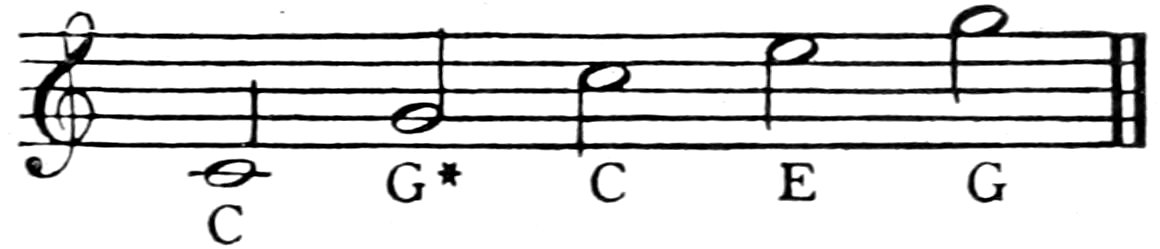
which, for the benefit of my non-musical readers, I have marked C, G*, C, E, and top G.
Upon the Post-horn four notes are about all that can be sounded with ease and comfort; indeed, it is seldom that more than the first three notes are used.
Nine persons out of ten will produce the note G* first, then, after a little practice, the upper notes will come by compressing the lips a little more tightly, and blowing, as it were, rather more against the top part of the interior or cup of the mouthpiece. A very little will do this, in fact, the extra pressure is almost imperceptible. On the contrary, to produce the bottom note C, the lowest note of all, it is necessary to relax the lips so as to cause them to slacken a very little, and then blow as straight and direct into the mouthpiece as possible.
These are about all the instructions it is possible to give, and I really believe that this is the first time the theory of Horn-blowing has been so minutely described. I only hope that I have succeeded in making myself intelligible, and, in conclusion, I can 8only urge my readers, as I said before, to take the trouble and to practise.
I quite agree with them that it is not exactly a treat to hear a novice trying to blow a Coach-horn in a house or in quiet lodgings, and therefore I would recommend learners always to carry a mouthpiece in their pockets. An ordinary cornet mouthpiece will do, and blowing on this occasionally in the manner I have described, whenever they feel inclined or have the opportunity, will harden the lip and accustom it to the mouthpiece, whilst the noise produced will not even “wake the baby” or cause any other more serious domestic disturbance.
A gallant Colonel, an eminent cornet player, whose name I am scarcely at liberty to mention, told me of a capital hint to persons learning to blow, which is to place a hair inside the mouth and then try to spit it out cleanly. This strikes me as an excellent suggestion, for the action of blowing a Horn is very similar and a hair is a very difficult thing to spit out of the mouth cleanly, as I observed. It is important to mention that when sounding a Horn on a coach, it is always advisable for the performer to turn his head aside a little, so as to avoid blowing right into the teeth of the wind. Attention to this little point will make a great difference in the ease of blowing.
Again, when driving through London or any other large cities, the Horn should be used only when necessary to clear the road of the innumerable ’buses and cabs, both “growlers” and “hansoms,” which block the way, rendering it almost impossible to 9“tool a team” through the crowded streets without the aid of a Coach-horn.
Most coachmen will admit that at present the sound of the Horn is always promptly and civilly attended to by drivers of the above-mentioned public conveyances; but this would not be the case if the “cry of wolf” were made too common, and the Horn sounded without occasion.
On a country road the case is very different, for there the performer can give vent to his wind and lungs to his heart’s content; his sounds, if musical, tending to cheer the spirits and enliven the journey; whilst if by chance discordant notes and queer noises are produced, the effect will be the same, inasmuch as the risible faculties and sympathies of his fellow-passengers are sure to be aroused.
I hope it will not be thought out of place for me here to acknowledge the kindness and hospitality of the many proprietors of crack Coaches travelling out of London in the season, who have so often offered me a seat when they have had one to spare. Such little outings have always afforded me much pleasure, tending, as they do, to grease the wheels of life, and make the journey more pleasant; and, although my fare has often been good-naturedly but positively refused, I have in such cases always made it a rule not to forget the old-fashioned claims of the “professional,” who is generally present, and the Guard attached to the Coach, thus leaving those worthies even more deeply impressed with my performance on the Coach-horn than perhaps they otherwise might have been.
10During these trips it has been my good fortune to meet with some extraordinary fellow-passengers, and if I were free to narrate the various scenes I have witnessed, this modest pamphlet would be increased to a good sized volume.
One incident which happened to me as a pedestrian may, however, be told without divulging any secrets of the road.
In the Autumn of 1875 I was spending my holidays at the very quiet seaside village of Felixstowe, near Ipswich, where the Carabiniers were at that time stationed. Strolling along the beach, watching the shipping and the ever-restless waves, I heard a noise not unlike the distant bellowing of a cow in the last stages of pulmonary consumption or pleuro-pneumonia. Slightly alarmed, I cast my eyes along the high road which runs parallel to the shore, where I saw an elegantly appointed Coach, with four horses and grooms in livery, pulled up by the roadside whilst a gentleman on the box seat was endeavouring to sound a Coach-horn, and so to assemble the passengers who had alighted for luncheon.
Having nothing whatever to do, I was seized with a sudden fit of compassion for the gentleman who was blowing the Horn—for he was getting black in the face, and it was a smoking hot day. I took the liberty to address him, saying that, if he would allow me to make an attempt, I thought I might be able to produce more musical sounds. With a “Ah, ah, thank you, er,” he politely handed me the Horn. First glancing at the maker’s name and Prize Medals which are conspicuously stamped on all genuine Coach-horns, I 11remarked, “Ah, this is a good Horn, and no mistake, for it came from the only man in London who knows how to make a Coach-horn;” and then proceeding to blow it in my usual inimitable style, I may say that I made “the welkin ring again.”
The company immediately made their appearance, and so delighted were they that I was even offered a ride back to Ipswich, which a previous appointment obliged me to decline with thanks, whilst the lady passengers even applauded my performance by enthusiastically clapping their hands.
This is not all, for I had almost forgotten the occurrence, when about a month afterwards a gentleman walked into the shop of the maker of the Coach-horn, whom I at once recognised as my acquaintance of the Felixstowe Coach. “Fine weather,” remarked he. “Yes!” I replied, “just the sort of day for a drive over to Felixstowe.” Staring at me for a moment, he exclaimed, “By Jove, why you’re the fellow who blew that Horn so well and praised the maker so highly. Dear me, what a capital joke.” I modestly replied something to the effect that it was necessary in these days to be able to sound one’s own trumpet, and that I seldom missed the opportunity of doing so.
I believe this tale was told over the mess-table, and I should like to have been present at the time.
Of course, there are Coach-horns and Coach-horns; some easy to blow and of proper tone, others just the reverse, and the difference is to be accounted for not only in the model, but also in the workmanship, 12gauge of metal, and mode of their construction. With these particulars I will not weary my readers, and it being an admitted fact that there is only one firm of musical instrument makers in London—I may say in the world—who know how to make really good Coach-horns, and that being the one with which I happen to be connected, I hardly like mentioning their name and address.
For very many years their old-fashioned workshop stood near Covent Garden, but the exigencies of the times, to say nothing about the increased rent of 50 per cent. demanded by the Ducal landlord at the termination of the lease, rendered a removal to Victoria Street, Westminster, advisable, if not compulsory(!) Circumstances further compelled Messrs. Köhler & Son to move first to Ebury Street, S.W., and then to Bromley, Kent. On taking over the concern in 1907, the present proprietors, Messrs. Swaine and Adeney, transferred the entire business to their own premises at 185 Piccadilly, W., and to this establishment gentlemen requiring good, easy-sounding Coach-horns, possessing the true Coaching tones, are confidently recommended.
13