Front matter
Reading edition
Transcriber’s Note:
New original cover art included with this eBook is granted to the public domain.
THE COACH-HORN WHAT TO BLOW AND HOW TO BLOW IT.
BY AN OLD GUARD
SEVENTH EDITION.
LONDON:
KÖHLER & SON
Sole Proprietors SWAINE ADENEY BRIGG & SONS LTD.
185 PICCADILLY, W.1.
Telegrams: Phone:
Swadeneyne, Piccy, London. Regent 4277–8–9
“For more than a century the name of ‘Köhler’ has been associated with the trade of Musical Instrument making; indeed, for four generations fathers and sons have been practical and bona fide manufacturers.”—Vide Sir George Grove’s “Dictionary of Music and Musicians,” Part VII, page 68.
BY APPOINTMENT
1801.
ESTABLISHED IN 1780.
H.R.H. the Prince of Wales was pleased to appoint Mr. Köhler a Juror at the International Inventions Exhibition, 1885, Military Band Instrument Section, Jury R.
1
THE COACH-HORN: WHAT TO BLOW and HOW TO BLOW IT
Some time ago I rather thoughtlessly remarked to a subaltern in the Guards that I had a notion of writing some instructions about blowing a Coach-horn, together with a few proper sounds appropriate to the road. The said officer mentioned this to his friends, who in turn told theirs; and since then I have been besieged with inquiries as to when the work would appear; and therefore, although immersed in far more important business, still from a desire to be as good as my word—to say nothing of promised subscriptions, and anticipated profits—I have at last made up my mind to “appear in print.”
A very worthy friend of mine, of no particular talent (although he can sound a Coach-horn right well, and drives his own four-in-hand), once asked me to play something on the violin, and when I had done so, he observed, “Ah, I learnt the fiddle when I was young, and should have played very nicely indeed, if I had taken the trouble.”
This sagacious remark applies not only to fiddle-playing, but to every other undertaking in this world, including even the proper sounding of a Coach-horn.
2Some persons can sound a horn almost by instinct from early childhood, others experience an insurmountable difficulty; and fabulous sums have been offered to me by certain persons, whose names I suppress for obvious reasons, if I could only make them blow as well as myself. The truth is, they won’t take the trouble.
Now I could sound a Horn at the early age of seven, and so can my son at a similar time of life (much to the annoyance of his mother, by-the-bye); but this precocity of talent may, perhaps, be accounted for by the fact that my father, my grandfather, and even my grandfather’s uncle were bona fide makers of Coach-horns, and I am, further, a practical disciple of Hiram of Tyre, who, I may remark, without incurring any penalties, was the first artificer in metals in the days of King Solomon (1 Kings vii. 14).
My principal object is to teach my readers—my gentle readers, I believe is the correct term—how to sound a Horn; but I have added a number of preludes in which I have been obliged to use musical notes, and I believe they will be found a useful addition to these remarks, inasmuch as they comprise easy calls, or soundings, familiar even to horses as well as to coachmen, and therefore especially appropriate to the road.
3

Before proceeding with my instructions, a description of a Coach-horn, and the difference between that and a Post-horn, may not be out of place, the former being nowadays used exclusively for a four-in-hand; although it should be borne in mind that the latter was really the recognised signal Horn used by all the guards on the fast Coaches which carried the mails fifty years ago. Hence the name “Post-horn.”
A Coach-horn should always be straight and made of copper, with German-silver or real silver mouthpiece and mountings, and the bell should be funnel-shaped, and not curved outwards like an ordinary trumpet-bell.

Although a strictly legitimate Coach-horn should be made in one entire piece of metal, still there has recently been introduced a “Telescope” Coach-horn, made with a joint ferrule in the middle, which allows the top half to slide inside the lower portion of the Horn, without actually falling out—something after the style of the portable metal drinking cups. From actual experience, I can safely say that the tone and ease in blowing are not in the least affected by this innovation—which, indeed, I consider an improvement—for Coach-horns when thus “telescoped” are not nearly so liable to get bent or injured, and are more easily packed and carried about.
4

A Coach-horn ought really not to exceed thirty-six inches in length, or else the peculiar ring or note (musicians would call it the timbre) of the true Coach-horn becomes lost, and merges into that more resembling the field-bugle used in the army.
I am, however, aware that in the present age, when so much is done for the sake of show and appearance, even to the sacrifice of utility and comfort, many fairly good Coach-horns are used measuring forty-six inches, and even more; and I can further account for such long Horns being adopted, not merely for show, but because more can be done upon them, as we say; that is, it is easier to blow, not the same notes, but the same number of notes upon them. There is no accounting for taste, and as some people like to hear the Coach-horn sounded as William Simmons played his little bugle in “Martin Chuzzlewit,” “who, whenever the conversation flagged, played the first half of a great many tunes, and regularly broke down in the second,” then I will admit that for playing “Buy a Broom” and other airs very imperfectly, a four-foot Coach-horn will answer the purpose; although for all the old-fashioned coaching calls, I still maintain that a shorter Horn is to be preferred.
My opinion has been confirmed by all the authorities whom I have consulted upon the subject; gentlemen, I may remark, belonging to a generation now almost gone by, who remember the days before the iron-horse made its appearance and wrought such changes 5amongst us; when nothing longer than the “yard of tin” was used on a Mail Coach, although the old key-bugle was reserved, by such few guards as could play it, for occasionally playing the simple and popular airs of the day.

Now the Post, or, as it is now so often called, the Tandem-horn, differs from the above, inasmuch as it is of a much smaller calibre or bore, being only twenty-eight or thirty-two inches in length, and made always of brass instead of copper. The bell, unlike that of the Coach-horn, should be trumpet-shaped, for the tone is materially affected thereby; and a well-curved bell will yield a sound far more appropriate to a pair of horses, tandem fashion, than a funnel-shaped bell.
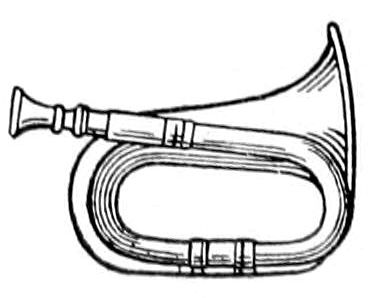
A proper Post-horn ought also to be made with a slide, to elongate it if necessary, for tuning purposes; for it is often effectively used in the orchestra as a musical instrument; for instance, in Kœnig’s unrivalled “Post-horn” gallop, also in the more modern “Down the Road” and the “New Derby” gallops, etc. It need not necessarily be straight, but may be coiled up so as to be carried in the pocket, in which shape it is handier for use in a dog-cart or gig.
Having thus described the two kinds of Horns used for coaching purposes, I will now proceed with my
6