Part 1 — CHAPTER VII MYTHS OF THE GREAT DIVINITIES OF HEAVEN
Reading edition
55. Myths of Jupiter and Juno. Not a few of the adventures of Jupiter turn upon his love affairs. Among the immortals his queen had rivals in his affection; for instance, Latona, a goddess of darkness, daughter of the Titans Cœus and Phœbe. This goddess became, as we have already seen, the mother of Apollo and Diana. The ire of Juno against her was never appeased. In consequence of it, numerous trials were visited upon Latona, some of which find a place among the adventures of her children.
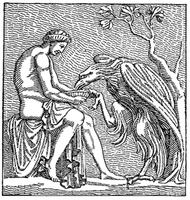
Fig. 45. Ganymede
56. Love Affairs of Jupiter. Not only with immortals but with mortals were Jupiter's relations sometimes of a dubious character. His devotion to the beautiful daughters of men involved him in frequent altercations with his justly jealous spouse. Of his fondness for Danaë, whom he approached in a shower of gold, particulars are given in the story of her son Perseus; of his love for Alcmene, the granddaughter of that Perseus, we are informed in the myths of her son Hercules; and of his attentions to Leda, whom he wooed in guise of a swan, we learn in the accounts of their children Pollux and Helen. Other love passages, upon which narratives depend, concern Io, Callisto, Europa, Semele, Ægina, and Antiope.
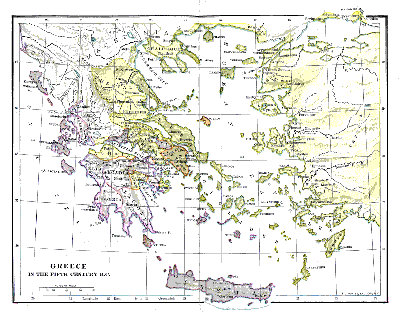
GREECE IN THE FIFTH CENTURY B.C.
57. Io[66] was of divine ancestry. Her father was the river-god Inachus, son of Oceanus. It is said that Juno one day, perceiving the skies suddenly overcast, surmised that her husband had raised a cloud to hide some escapade. She brushed away the darkness and saw him on the banks of a glassy river with a beautiful heifer standing near. Juno suspected, with reason, that the heifer's form concealed some fair nymph of mortal mold. It was Io, whom Jupiter, when he became aware of the approach of his wife, had changed into that form.
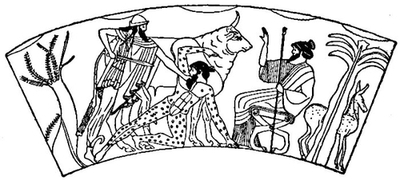
Fig. 46. Hermes Kills Argus
The ox-eyed goddess joined her husband, noticed the heifer, praised its beauty, and asked whose it was and of what herd. Jupiter, to stop questions, replied that it was a fresh creation from the earth. Juno begged it as a gift. What could the king of gods and men do? He was loath to surrender his sweetheart to his wife; yet how refuse so trifling a present as a heifer? He could not, without exciting suspicion, and he therefore consented. The goddess delivered the heifer to Argus, to be strictly watched.
Now Argus had a hundred eyes in his head, and never went to sleep with more than two at a time, so that he kept watch of Io constantly. He suffered her to graze through the day and at night tied a rope round her neck. She would have stretched out her arms to implore freedom of Argus, but that she had no arms to stretch out and her voice was a bellow. She yearned in vain to make herself known to her father. At length she bethought herself of writing, and inscribed her name—it was a short one—with her hoof on the sand. Inachus recognized it, and, discovering that his daughter whom he had long sought in vain was hidden under this disguise, mourned over her. While he thus lamented, Argus, observing, drove her away and took his seat on a bank from whence he could see in every direction.
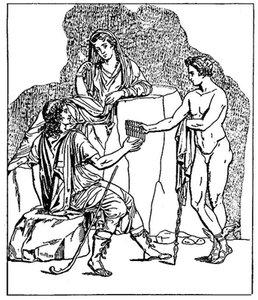
Fig. 47. Io, Argus, and Mercury
Jupiter, grieved by the sufferings of his mistress, sent Mercury to dispatch Argus. Mercury took his sleep-producing wand and presented himself on earth as a shepherd driving his flock. As he strolled, he blew upon his syrinx or Pandean pipes. Argus listened with delight. "Young man," said he, "come and take a seat by me on this stone. There is no better place for your flock to graze in than hereabouts, and here is a pleasant shade such as shepherds love." Mercury sat down, talked, told stories till it grew late, and played upon his pipes his most soothing strains, hoping to lull the watchful eyes to sleep, but in vain; for Argus still contrived to keep some of his eyes open, though he shut the rest.
But among other stories, Mercury told him how the instrument on which he played was invented. "There was a certain nymph," said he, "whose name was Syrinx,—much beloved by the satyrs and spirits of the wood. She would have none of them, but was a faithful worshiper of Diana and followed the chase. Pan, meeting her one day, wooed her with many compliments, likening her to Diana of the silver bow. Without stopping to hear him she ran away. But on the bank of the river he overtook her. She called for help on her friends, the water-nymphs. They heard and consented. Pan threw his arms around what he supposed to be the form of the nymph and found he embraced only a tuft of reeds. As he breathed a sigh, the air sounded through the reeds and produced a plaintive melody. Whereupon the god, charmed with the novelty and with the sweetness of the music, said, 'Thus, then, at least, you shall be mine.' Taking some of the reeds of unequal lengths and placing them together, side by side, he made an instrument and called it Syrinx, in honor of the nymph." Before Mercury had finished his story he saw the eyes of Argus all asleep. At once he slew him and set Io free. The eyes of Argus Juno took and scattered as ornaments on the tail of her peacock, where they remain to this day.
But the vengeance of Juno was not yet satiated. She sent a gadfly to torment Io, who, in her flight, swam through the sea, named after her, Ionian. Afterward, roaming over many lands, she reached at last the banks of the Nile. Then Jupiter interceded for her; and upon his engaging not to pay her any further attention, Juno consented to restore her to her form.
In a poem dedicated to Leigh Hunt, by Keats, the following allusion to the story of Pan and Syrinx occurs:
So did he feel who pulled the boughs aside, That we might look into a forest wide, ... Telling us how fair trembling Syrinx fled Arcadian Pan, with such a fearful dread. Poor nymph—poor Pan—how he did weep to find Nought but a lovely sighing of the wind Along the reedy stream; a half-heard strain, Full of sweet desolation, balmy pain.
58. Callisto of Arcadia was another maiden who excited the jealousy of Juno. Her the goddess changed into a bear. Often, frightened by the dogs, Callisto, though lately a huntress, fled in terror from the hunters. Often, too, she fled from the wild beasts, forgetting that she was now a wild beast herself; and, bear as she was, she feared the bears.
One day a youth espied her as he was hunting. She saw him and recognized him as her son Arcas, grown to manhood. She stopped and felt inclined to embrace him. He, alarmed, raised his hunting spear and was on the point of transfixing her, but Jupiter arrested the crime and, snatching away both of them, placed them in the heavens as the Great and Little Bear.
Juno, enraged at seeing her rival so set in honor, hastened to ancient Tethys and Oceanus and, complaining that she was supplanted in Heaven, cried, "So do my punishments result—such is the extent of my power! I forbade her to wear human form,—she and her hateful son are placed among the stars. Better that she should have resumed her former shape, as I permitted Io to do. Perhaps my husband means to take her to wife, and put me away! But you, my foster parents, if you feel for me, and see with displeasure this unworthy treatment of me, show it, I beseech you, by forbidding this guilty couple from coming into your waters." The powers of the Ocean assented, and consequently the two constellations of the Great and Little Bear move round and round in the neighborhood of the pole, but never sink, as do the other stars, beneath the Ocean.[67]
59. Europa was the daughter of Agenor, king of Phœnicia, son of the god Neptune. The story of Jupiter's love for her is thus told by the idyllic poet, Moschus:
To Europa, princess of Asia, once on a time, a sweet dream was sent by Cypris.... Then she beheld two continents at strife for her sake, Asia and the further shore, both in the shape of women. Of these one had the guise of a stranger, the other of a lady of that land, and closer still she clung about her maiden, and kept saying how she was her mother, and herself had nursed Europa. But that other with mighty hands, and forcefully, kept haling the maiden, nothing loth; declaring that, by the will of ægis-bearing Jupiter, Europa was destined to be her prize.
But Europa leaped forth from her strown bed in terror, with beating heart, in such clear vision had she beheld the dream.... And she said, "Ah! who was the alien woman that I beheld in my sleep? How strange a longing for her seized my heart, yea, and how graciously she herself did welcome me, and regard me as it had been her own child! Ye blessed gods, I pray you, prosper the fulfillment of the dream!"
Therewith she arose, and began to seek the dear maidens of her company, girls of like age with herself, born in the same year, beloved of her heart, the daughters of noble sires, with whom she was always wont to sport, when she was arrayed for the dance, or when she would bathe her bright body at the mouths of the rivers, or would gather fragrant lilies on the leas....
Now the girls, so soon as they were come to the flowering meadows, took great delight in various sorts of flowers, whereof one would pluck sweet-breathed narcissus, another the hyacinth, another the violet, a fourth the creeping thyme; and on the ground there fell many petals of the meadows rich with spring. Others, again, were emulously gathering the fragrant tresses of the yellow crocus; but in the midst of them all the princess culled with her hand the splendor of the crimson rose, and shone preëminent among them all like the foam-born goddess among the Graces. Verily, she was not for long to set her heart's delight upon the flowers.... For of a truth, the son of Cronus, so soon as he beheld her, was troubled, and his heart was subdued by the sudden shafts of Cypris, who alone can conquer even Jupiter. Therefore, both to avoid the wrath of jealous Juno, and being eager to beguile the maiden's tender heart, he concealed his godhead, and changed his shape, and became a bull....
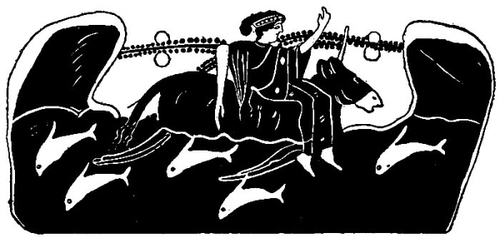
Fig. 48. Europa on the Bull
He came into the meadow, and his coming terrified not the maidens, nay, within them all wakened desire to draw nigh the lovely bull, and to touch him, and his heavenly fragrance was scattered afar, exceeding even the sweet perfume of the meadows. And he stood before the feet of fair Europa, and kept licking her neck, and cast his spell over the maiden. And she still caressed him, and gently with her hands she wiped away the deep foam from his lips, and kissed the bull. Then he lowed so gently, ye would think ye heard the Mygdonian flute uttering a dulcet sound.
He bowed himself before her feet, and bending back his neck, he gazed on Europa, and showed her his broad back. Then she spake among her deep-tressed maidens, saying,—
"Come, dear playmates, maidens of like age with me, let us mount the bull here and take our pastime, for, truly, he will bear us on his back, and carry all of us! And how mild he is, and dear, and gentle to behold, and no whit like other bulls! A mind as honest as a man's possesses him, and he lacks nothing but speech."
So she spake, and smiling, she sat down on the back of the bull, and the others were about to follow her. But the bull leaped up immediately, now he had gotten her that he desired, and swiftly he sped to the deep. The maiden turned, and called again and again to her dear playmates, stretching out her hands, but they could not reach her. The strand he gained, and forward he sped like a dolphin, faring with unwetted hooves over the wide waves. And the sea, as he came, grew smooth, and the sea monsters gamboled around, before the feet of Jupiter; and the dolphin rejoiced, and rising from the deeps, he tumbled on the swell of the sea. The Nereïds arose out of the salt water, and all of them came on in orderly array, riding on the backs of sea beasts. And himself, the thunderous shaker of the world, appeared above the sea, and made smooth the wave, and guided his brother on the salt sea path, and round him were gathered the Tritons, these hoarse trumpeters of the deep, blowing from their long conchs a bridal melody.
Meanwhile, Europa, riding on the back of the divine bull, with one hand clasped the beast's great horn, and with the other caught up the purple fold of her garment, lest it might trail and be wet in the hoar sea's infinite spray. And her deep robe was swelled out by the winds, like the sail of a ship, and lightly still did waft the maiden onward. But when she was now far off from her own country, and neither sea-beat headland nor steep hill could now be seen, but above, the air, and beneath, the limitless deep, timidly she looked around, and uttered her voice, saying,—
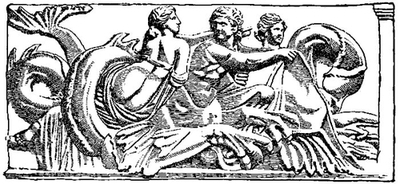
Fig. 49. Nereïds on Sea Beasts
"Whither bearest thou me, bull god? What art thou? How dost thou fare on thy feet through the path of the sea beasts, nor fearest the sea? The sea is a path meet for swift ships that traverse the brine, but bulls dread the salt sea ways. What drink is sweet to thee, what food shalt thou find from the deep? Nay, art thou then some god, for godlike are these deeds of thine." ...
So spake she, and the horned bull made answer to her again: "Take courage, maiden, and dread not the swell of the deep. Behold, I am Jupiter, even I, though, closely beheld, I wear the form of a bull, for I can put on the semblance of what thing I will. But 'tis love of thee that has compelled me to measure out so great a space of the salt sea, in a bull's shape. So Crete shall presently receive thee, Crete that was mine own foster-mother, where thy bridal chamber shall be."[68]
According to tradition, from this princess the continent of Europe acquired its name. Her three sons are famous in Greek myth: Minos, who became king of Crete, and after his death a judge in the lower world; Rhadamanthus, who also was regarded as king and judge in the world of ghosts; and Sarpedon, who was ancestor of the Lycians.
The adventures of Europa's brother Cadmus, who by the command of his father went forth in quest of the lost maiden, fall under the myths of Mars.[69]
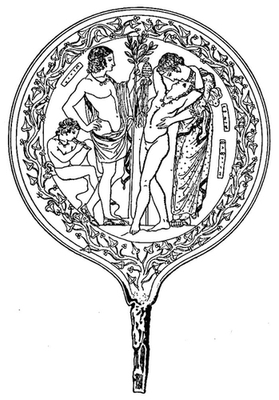
Fig. 50. Bacchus embracing Semele
60. Semele was the daughter of Cadmus, founder of Thebes. She was descended, through both parents, from the gods; for her mother Harmonia was daughter to Mars and the laughter-loving Venus. To Semele Jupiter had appeared, and had paid court in unostentatious manner and simple guise. But Juno, to gratify her resentment against this new rival for her lord's affections, contrived a plan for her destruction. Assuming the form of Beroë, the aged nurse of Semele, she insinuated doubts whether it was indeed Jove himself who came as a lover. Heaving a sigh, she said, "I hope it will turn out so, but I can't help being afraid. People are not always what they pretend to be. If he is indeed Jove, make him give some proof of it. Ask him to come arrayed in all his splendors, such as he wears in Heaven. That will put the matter beyond a doubt." Semele was persuaded to try the experiment. She asks a favor, without naming what it is. Jove gives his promise, and confirms it with the irrevocable oath, attesting the river Styx, terrible to the gods themselves. Then she made known her request. The god would have stopped her as she spake, but she was too quick for him. The words escaped, and he could neither unsay his promise nor her request. In deep distress he left her and returned to the upper regions. There he clothed himself in his splendors, not putting on all his terrors, as when he overthrew the giants, but what is known among the gods as his lesser panoply. With thunders and lightnings he entered the chamber of Semele. Her mortal frame could not endure the splendors of the immortal radiance. She was consumed to ashes.[70] Her son was the god Bacchus.[71] Semele, in the blissful seats of Heaven, whither she was transported by the sorrowful Jove, has been represented as recounting thus the story of her doom:
What were the garden-bowers of Thebes to me? What cared I for their dances and their feasts, Whose heart awaited an immortal doom? The Greek youths mocked me, since I shunned in scorn Them and their praises of my brows and hair. The light girls pointed after me, who turned Soul-sick from their unending fooleries.... There came a change: a glory fell to me. No more 'twas Semele, the lonely girl, But Jupiter's Beloved, Semele. With human arms the god came clasping me: New life streamed from his presence; and a voice, That scarce could curb itself to the smooth Greek, Now and anon swept forth in those deep nights, Thrilling my flesh with awe; mysterious words— I knew not what; hints of unearthly things That I had felt on solemn summer noons, When sleeping Earth dreamed music, and the heart Went crooning a low song it could not learn, But wandered over it, as one who gropes For a forgotten chord upon a lyre. Yea, Jupiter! But why this mortal guise, Wooing as if he were a milk-faced boy? Did I lack lovers? Was my beauty dulled, The golden hair turned dross, the lithe limbs shrunk? The deathless longings tamed, that I should seethe My soul in love like any shepherd girl? One night he sware to grant whate'er I asked: And straight I cried, "To know thee as thou art! To hold thee on my heart as Juno does! Come in thy thunder—kill me with one fierce Divine embrace!—Thine oath!—Now, Earth, at last!" The Heavens shot one swift sheet of lurid flame; The world crashed: from a body scathed and torn The soul leapt through, and found his breast, and died. Died?—So the Theban maidens think, and laugh, Saying, "She had her wish, that Semele!" But sitting here upon Olympus' height, I look down, through that oval ring of stars, And see the far-off Earth, a twinkling speck— Dust-mote whirled up from the Sun's chariot wheel— And pity their small hearts that hold a man As if he were a god; or know the god— Or dare to know him—only as a man! O human love! art thou forever blind?[72]
61. Ægina. The extent to which those who were concerned only indirectly in Jupiter's love affairs might yet be involved in the consequences of them is illustrated by the fortunes of Ægina. This maiden, the daughter of Asopus, a river-god, attracted the attention of Jupiter, who straightway ran off with her. Now, on the one hand, Sisyphus, king of Corinth, having witnessed the intrigue, was indiscreet enough to disclose it. Forthwith the vengeance of the king of gods and men fell upon him. He was condemned to Hades and, attempting to escape thence, had resort to a series of deceptions that resulted in his eternal punishment.[73] On the other hand, the inhabitants of the island that had the misfortune to bear Ægina's name incurred the displeasure of Juno, who devastated their land with a plague. The following account of this calamity is placed in the mouth of Æacus, king of the island:[74]
"At the beginning the sky seemed to settle down upon the earth and thick clouds shut in the heated air. For four months together a deadly south wind prevailed. The disorder affected the wells and springs. Thousands of snakes crept over the land and shed their poison in the fountains. The force of the disease was first spent on the lower animals,—dogs, cattle, sheep, and birds. The oxen fell in the midst of their work. The wool dropped from the bleating sheep. The horse groaned at his stall and died an inglorious death. Everything languished; dead bodies lay in the roads, the fields, and the woods; the air was poisoned by them. Next the disease attacked the country people, and then the dwellers in the city. At first the cheek was flushed and the breath drawn with difficulty. The tongue grew rough and swelled, and the dry mouth stood open, with its veins enlarged, and gasped for the air. Men could not bear the heat of their clothes or their beds, but preferred to lie on the bare ground. Nor could the physicians help, for the disease attacked them also. At last men learned to look upon death as the only deliverer from disease. All restraint laid aside, they crowded round the wells and fountains, and drank, without quenching thirst, till they died. On all sides lay my people strewn like over-ripened apples beneath the tree, or acorns under the storm-shaken oak. You see yonder a temple on the height. It is sacred to Jupiter. Often, while the priest made ready for sacrifice, the victim fell, struck down by disease without waiting for the blow. At length all reverence for sacred things was lost. Bodies were thrown out unburied, wood was wanting for funeral piles, men fought with one another for the possession of them. Finally there were none left to mourn; sons and husbands, old men and youths, perished alike unlamented.
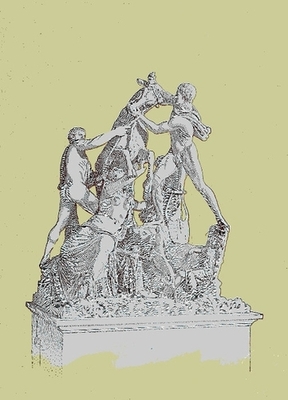
FARNESE BULL
"Standing before the altar, I raised my eyes to Heaven. 'O Jupiter,' I said, 'if thou art indeed my father, give me back my people, or take me also away!' At these words a clap of thunder was heard. 'I accept the omen,' I cried. By chance there grew by the place where I stood an oak with wide-spreading branches, sacred to Jupiter. I observed on it a troop of ants busy with their labor. Observing their numbers with admiration, I said, 'Give me, O father, citizens as numerous as these, and replenish my empty city.' The tree shook, and the branches rustled, though no wind agitated them. Night came on. The tree stood before me in my dreams, with its numerous branches all covered with living, moving creatures, which, falling to the ground, appeared to gain in size, and by and by to stand erect, and finally to assume the human form. Then I awoke. My attention was caught by the sound of many voices without. While I began to think I was yet dreaming, Telamon, my son, throwing open the temple gates, exclaimed, 'Father, approach, and behold things surpassing even your hopes!' I went forth; I saw a multitude of men, such as I had seen in my dream. While I gazed with wonder and delight, they approached and, kneeling, hailed me as their king. I paid my vows to Jove, and proceeded to allot the vacant city to the new-born race. I called them Myrmidons from the ant (myrmex), from which they sprang. They are a diligent and industrious race, eager to gain, and tenacious of their gains."
The Myrmidons were the soldiers of Achilles, the grandson of King Æacus, in the Trojan War.
62. Antiope was, according to the Odyssey, another daughter of Asopus, therefore a sister of Ægina. But later poets make this darling of Jove daughter of Nycteus, king of Thebes. While she was engaged in the Mænad dances, Jupiter as a satyr wooed and won her. She bore him two sons, Amphion and Zethus, who, being exposed at birth on Mount Cithæron, grew up among the shepherds, not knowing their parentage. After various adventures Antiope fell into the hands of her uncle Lycus, the usurping king of Thebes, who, egged on by his wife Dirce, treated her with extreme cruelty. Finally, when doomed by Dirce to be dragged to death behind a bull, Antiope found means to inform her children of her kinship to them. As it happened, they had been ordered to execute the cruel sentence upon their mother. But with a band of their fellow herdsmen, they attacked and slew Lycus instead, and, tying Dirce by the hair of her head to a bull, let her perish by her own device.[75]
While among the herdsmen, Amphion had been the special care of Mercury, who gave him a lyre and taught him to play upon it. His brother Zethus had occupied himself in hunting and tending the flocks. Amphion himself is one of the most famous of mythical musicians. Having become king of Thebes, it is said that when he played on his lyre, stones moved of their own accord and took their places in the wall with which he was fortifying the city.
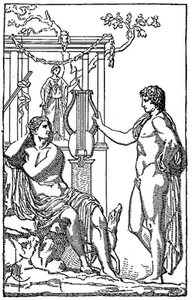
Fig. 51. Amphion and Zethus
... 'Tis said he had a tuneful tongue, Such happy intonation, Wherever he sat down and sung He left a small plantation; Wherever in a lonely grove He set up his forlorn pipes, The gouty oak began to move, And flounder into hornpipes. The mountain stirred its bushy crown, And, as tradition teaches, Young ashes pirouetted down Coquetting with young beeches; And briony-vine and ivy-wreath Ran forward to his rhyming, And from the valleys underneath Came little copses climbing. The linden broke her ranks and rent The woodbine wreaths that bind her, And down the middle, buzz! she went With all her bees behind her: The poplars, in long order due, With cypress promenaded, The shock-head willows, two and two, By rivers gallopaded. Came wet-shot alder from the wave, Came yews, a dismal coterie; Each plucked his one foot from the grave, Poussetting with a sloe-tree: Old elms came breaking from the vine, The vine streamed out to follow, And, sweating rosin, plumped the pine From many a cloudy hollow. And wasn't it a sight to see, When, ere his song was ended, Like some great landslip, tree by tree, The country-side descended; And shepherds from the mountain-eaves Looked down, half-pleased, half-frightened, As dashed about the drunken leaves The random sunshine lightened.[76]
The musician's life was, however, not all harmony and happiness. Owing to the pride of his wife Niobe, daughter of King Tantalus, there befell him and his house a crushing calamity, which is narrated among the exploits of Apollo and Diana.
63. Jupiter, a Friend of Man. The kindly interest evinced by the Thunderer toward mortals is displayed in the story of Baucis and Philemon. Once on a time Jupiter, in human shape, visited the land of Phrygia, and with him Mercury, without his wings.
They presented themselves as weary travelers at many a door, seeking rest and shelter, but found all closed; for it was late, and the inhospitable inhabitants would not rouse themselves to open for their reception. At last a small thatched cottage received them, where Baucis, a pious old dame, and her husband Philemon had grown old together. Not ashamed of their poverty, they made it endurable by moderate desires and kind dispositions. When the two guests crossed the humble threshold and bowed their heads to pass under the low door, the old man placed a seat, on which Baucis, bustling and attentive, spread a cloth, and begged them to sit down. Then she raked out the coals from the ashes, kindled a fire, and prepared some pot-herbs and bacon for them. A beechen bowl was filled with warm water, that their guests might wash. While all was doing, they beguiled the time with conversation.
The old woman with trembling hand set the table. One leg was shorter than the rest, but a piece of slate put under restored the level. When it was steady she rubbed the table down with sweet-smelling herbs. Upon it she set some of chaste Minerva's olives, some cornel berries preserved in vinegar, and added radishes and cheese, with eggs lightly cooked in the ashes. The meal was served in earthen dishes; and an earthenware pitcher, with wooden cups, stood beside them. When all was ready the stew, smoking hot, was set on the table. Some wine, not of the oldest, was added, and for dessert, apples and wild honey.
Now while the repast proceeded, the old folks were astonished to see that the wine, as fast as it was poured out, renewed itself in the pitcher of its own accord. Struck with terror, Baucis and Philemon recognized their heavenly guests, fell on their knees, and with clasped hands implored forgiveness for their poor entertainment. There was an old goose, which they kept as the guardian of their humble cottage, and they bethought them to make this a sacrifice in honor of their guests. But the goose, too nimble for the old folk, with the aid of feet and wings eluded their pursuit and at last took shelter between the gods themselves. They forbade it to be slain, and spoke in these words: "We are gods. This inhospitable village shall pay the penalty of its impiety; you alone shall go free from the chastisement. Quit your house and come with us to the top of yonder hill." They hastened to obey. The country behind them was speedily sunk in a lake, only their own house left standing. While they gazed with wonder at the sight, that old house of theirs was changed. Columns took the place of the corner posts, the thatch grew yellow and appeared a gilded roof, the floors became marble, the doors were enriched with carving and ornaments of gold. Then spoke Jupiter in benignant accents: "Excellent old man, and woman worthy of such a husband, speak, tell us your wishes. What favor have you to ask of us?" Philemon took counsel with Baucis a few moments, then declared to the gods their common wish. "We ask to be priests and guardians of this thy temple, and that one and the same hour may take us both from life." Their prayer was granted. When they had attained a great age, as they stood one day before the steps of the sacred edifice and were telling the story of the place, Baucis saw Philemon begin to put forth leaves, and Philemon saw Baucis changing in like manner. While still they exchanged parting words, a leafy crown grew over their heads. "Farewell, dear spouse," they said together, and at the same moment the bark closed over their mouths. The Tyanean shepherd still shows the two trees,—an oak and a linden, standing side by side.[77]
The story of Baucis and Philemon has been imitated by Swift in a burlesque style, the actors in the change being two wandering saints, and the house being changed into a church, of which Philemon is made the parson:
... They scarce had spoke, when, fair and soft, The roof began to mount aloft; Aloft rose every beam and rafter; The heavy wall climbed slowly after. The chimney widened and grew higher, Became a steeple with a spire. The kettle to the top was hoist, And there stood fastened to a joist, But with the upside down, to show Its inclination for below; In vain, for a superior force, Applied at bottom, stops its course; Doomed ever in suspense to dwell, 'Tis now no kettle, but a bell. A wooden jack, which had almost Lost by disuse the art to roast, A sudden alteration feels, Increased by new intestine wheels; And, what exalts the wonder more, The number made the motion slower; The flier, though 't had leaden feet, Turned round so quick you scarce could see 't; But slackened by some secret power, Now hardly moves an inch an hour. The jack and chimney, near allied, Had never left each other's side. The chimney to a steeple grown, The jack would not be left alone; But up against the steeple reared, Became a clock, and still adhered; And still its love to household cares By a shrill voice at noon declares, Warning the cook-maid not to burn That roast meat which it cannot turn. The groaning chair began to crawl, Like a huge snail, along the wall; There stuck aloft in public view, And with small change, a pulpit grew. A bedstead of the antique mode, Compact of timber many a load, Such as our ancestors did use, Was metamorphosed into pews, Which still their ancient nature keep By lodging folks disposed to sleep.
64. Juno's Best Gift. What the queen of heaven deemed the greatest blessing reserved for mortals is narrated in the beautiful myth of Biton and Cleobis. One Cydippe, an ancient priestess of the white-armed goddess, had desired to behold the famous new statue of Hera at Argos. Her sons testified their affection for their mother by yoking themselves, since no oxen were at hand, to her chariot, and so dragging her through heat and dust many a weary league till they reached the temple, where stood the gold and ivory masterwork of Polyclitus. With admiration the devoted priestess and her pious sons were received by the populace crowding round the statue. The priest officiating in the solemn rites thought meet that so reverend a worshiper should herself approach the goddess,—ay, should ask of Hera some blessing on her faithful sons:
... Slowly old Cydippe rose and cried: "Hera, whose priestess I have been and am, Virgin and matron, at whose angry eyes Zeus trembles, and the windless plain of heaven With hyperborean echoes rings and roars, Remembering thy dread nuptials, a wise god, Golden and white in thy new-carven shape, Hear me! and grant for these my pious sons, Who saw my tears, and wound their tender arms Around me, and kissed me calm, and since no steer Stayed in the byre, dragged out the chariot old, And wore themselves the galling yoke, and brought Their mother to the feast of her desire, Grant them, O Hera, thy best gift of gifts!" Whereat the statue from its jeweled eyes Lightened, and thunder ran from cloud to cloud In heaven, and the vast company was hushed. But when they sought for Cleobis, behold, He lay there still, and by his brother's side Lay Biton, smiling through ambrosial curls, And when the people touched them they were dead.[78]
65. Myths of Minerva. Minerva, as we have seen,[79] presided over the useful and ornamental arts, both those of men—such as agriculture and navigation—and those of women—spinning, weaving, and needlework. She was also a warlike divinity, but favored only defensive warfare. With Mars' savage love of violence and bloodshed she, therefore, had no sympathy. Athens, her chosen seat, her own city, was awarded to her as the prize of a peaceful contest with Neptune, who also aspired to it. In the reign of Cecrops, the first king of Athens, the two deities had contended for the possession of the city. The gods decreed that it should be awarded to the one who produced the gift most useful to mortals. Neptune gave the horse; Minerva produced the olive. The gods awarded the city to the goddess, and after her Greek appellation, Athena, it was named.
66. Arachne. In another contest, a mortal dared to come into competition with the gray-eyed daughter of Jove. This was Arachne, a maiden who had attained such skill in the arts of carding and spinning, of weaving and embroidery, that the Nymphs themselves would leave their groves and fountains to come and gaze upon her work. It was not only beautiful when it was done, but beautiful also in the doing. To watch her one would have said that Minerva herself had taught her. But this she denied, and could not bear to be thought a pupil even of a goddess. "Let Minerva try her skill with mine," said she. "If beaten, I will pay the penalty." Minerva heard this and was displeased. Assuming the form of an old woman, she appeared to Arachne and kindly advised her to challenge her fellow mortals if she would, but at once to ask forgiveness of the goddess. Arachne bade the old dame to keep her counsel for others. "I am not afraid of the goddess; let her try her skill, if she dare venture." "She comes," said Minerva, and dropping her disguise, stood confessed. The Nymphs bent low in homage and all the bystanders paid reverence. Arachne alone was unterrified. A sudden color dyed her cheek, and then she grew pale; but she stood to her resolve and rushed on her fate. They proceed to the contest. Each takes her station and attaches the web to the beam. Then the slender shuttle is passed in and out among the threads. The reed with its fine teeth strikes up the woof into its place and compacts the web. Wool of Tyrian dye is contrasted with that of other colors, shaded off into one another so adroitly that the joining deceives the eye. And the effect is like the bow whose long arch tinges the heavens, formed by sunbeams reflected from the shower,[80] in which, where the colors meet they seem as one, but at a little distance from the point of contact are wholly different.
Minerva wove the scene of her contest with Neptune (Poseidon). Twelve of the heavenly powers were represented, Jupiter, with august gravity, sitting in the midst. Neptune, the ruler of the sea, held his trident and appeared to have just smitten the earth, from which a horse had leaped forth. The bright-eyed goddess depicted herself with helmed head, her ægis covering her breast, as when she had created the olive tree with its berries and its dark green leaves.
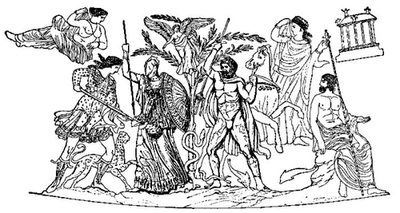
Fig. 52. Contest of Athena and Poseidon
Amongst these leaves she made a Butterfly, With excellent device and wondrous slight, Fluttering among the olives wantonly, That seemed to live, so like it was in sight; The velvet nap which on his wings doth lie, The silken down with which his back is dight, His broad outstretchèd horns, his hairy thighs, His glorious colors, and his glistering eyes. Which when Arachne saw, as overlaid And masterèd with workmanship so rare, She stood astonished long, ne aught gainsaid; And with fast-fixèd eyes on her did stare.[81]
So wonderful was the central circle of Minerva's web; and in the four corners were represented incidents illustrating the displeasure of the gods at such presumptuous mortals as had dared to contend with them. These were meant as warnings from Minerva to her rival to give up the contest before it was too late.
But Arachne did not yield. She filled her web with subjects designedly chosen to exhibit the failings and errors of the gods. One scene represented Leda caressing the swan; and another, Danaë and the golden shower. Still another depicted Europa deceived by Jupiter under the disguise of a bull. Its appearance was that of a real bull, so naturally was it wrought and so natural the water in which it swam.
With such subjects Arachne filled her canvas, wonderfully well done but strongly marking her presumption and impiety. Minerva could not forbear to admire, yet was indignant at the insult. She struck the web with her shuttle and rent it in pieces; then, touching the forehead of Arachne, she made her realize her guilt. It was more than mortal could bear; and forthwith Arachne hanged herself. "Live, guilty woman," said Minerva, "but that thou mayest preserve the memory of this lesson continue to hang, both thou and thy descendants, to all future times." Then, sprinkling her with the juices of aconite, the goddess transformed her into a spider, forever spinning the thread by which she is suspended.[82]
67. Myths of Mars. The relations of Mars to other deities may be best illustrated by passages from the Iliad, which, generally speaking, presents him in no very favorable light.
68. Mars and Diomede. In the war of the Greeks and the Trojans,[83] the cause of the former was espoused by Minerva, of the latter by Mars. Among the chieftains of the Greeks in a certain battle, Diomede, son of Tydeus, was prominent. Now when Mars, scourge of mortals, beheld noble Diomede, he made straight at him.
... And when they were come nigh in onset on one another, first Mars thrust over the yoke and horses' reins with spear of bronze, eager to take away his life. But the bright-eyed goddess Minerva with her hand seized the spear and thrust it up over the car, to spend itself in vain. Next Diomede of the loud war cry attacked with spear of bronze; and Minerva drave it home against Mars' nethermost belly, where his taslets were girt about him. There smote he him and wounded him, rending through his fair skin,—and plucked forth the spear again. Then brazen Mars bellowed loud as nine thousand warriors or ten thousand cry in battle as they join in strife and fray. Thereat trembling gat hold of Achæans and Trojans for fear, so mightily bellowed Mars insatiate of battle.
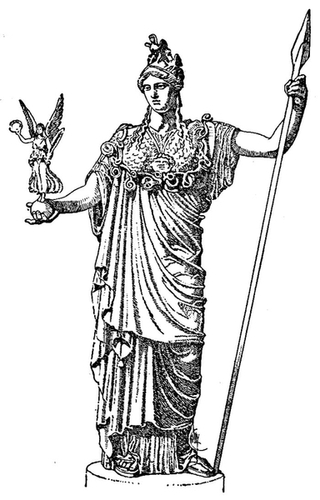
FIG. 53. ATHENA
Even as gloomy mist appeareth from the clouds when after heat a stormy wind ariseth, even so to Tydeus' son Diomede brazen Mars appeared amid clouds, faring to wide Heaven. Swiftly came he to the gods' dwelling, steep Olympus, and sat beside Jupiter, son of Cronus, with grief at heart, and showed the immortal blood flowing from the wound, and piteously spake to him winged words: "Father Jupiter, hast thou no indignation to behold these violent deeds? For ever cruelly suffer we gods by one another's devices, in showing men grace. With thee are we all at variance, because thou didst beget that reckless maiden and baleful, whose thought is ever of iniquitous deeds. For all the other gods that are in Olympus hearken to thee, and we are subject every one; only her thou chaste-nest not, neither in deed nor word, but settest her on, because this pestilent one is thine own offspring. Now hath she urged on Tydeus' son, even overweening Diomede, to rage furiously against the immortal gods. The Cyprian first he wounded in close fight, in the wrist of her hand, and then assailed he me, even me, with the might of a god. Howbeit my swift feet bare me away; else had I long endured anguish there amid the grisly heaps of dead, or else had lived strengthless from the smitings of the spear."
Then Jupiter the cloud-gatherer looked sternly at him, and said: "Nay, thou renegade, sit not by me and whine. Most hateful to me art thou of all gods that dwell in Olympus; thou ever lovest strife and wars and battles. Truly thy mother's spirit is intolerable, unyielding, even Juno's; her can I scarce rule with words. Therefore I deem that by her prompting thou art in this plight. Yet will I no longer endure to see thee in anguish; mine offspring art thou, and to me thy mother bare thee. But wert thou born of any other god unto this violence, long ere this hadst thou been lower than the sons of Heaven."
So spake he and bade Pæan heal him. And Pæan laid assuaging drugs upon the wound, and healed him, seeing he was in no wise of mortal mold. Even as fig juice maketh haste to thicken white milk, that is liquid but curdleth speedily as a man stirreth, even so swiftly healed he impetuous Mars. And Hebe bathed him and clothed him in gracious raiment, and he sate down by Jupiter, son of Cronus, glorying in his might.
Then fared the twain back to the mansion of great Jupiter, even Juno and Minerva, having stayed Mars, scourge of mortals, from his man-slaying.[84]
69. Mars and Minerva. It would seem that the insatiate son of Juno should have learned by this sad experience to avoid measuring arms with the ægis-bearing Minerva. But he renewed the contest at a later period in the fortunes of the Trojan War:
... Jupiter knew what was coming as he sat upon Olympus, and his heart within him laughed pleasantly when he beheld that strife of gods. Then no longer stood they asunder, for Mars, piercer of shields, began the battle and first made for Minerva with his bronze spear, and spake a taunting word: "Wherefore, O dogfly, dost thou match gods with gods in strife, with stormy daring, as thy great spirit moveth thee? Rememberest thou not how thou movedst Diomede, Tydeus' son, to wound me, and thyself didst take a visible spear and thrust it straight at me and pierce through my fair skin? Therefore deem I now that thou shalt pay me for all that thou hast done."
Thus saying, he smote on the dread tasseled ægis that not even the lightning of Jupiter can overcome—thereon smote blood-stained Mars with his long spear. But she, giving back, grasped with stout hand a stone that lay upon the plain, black, rugged, huge, which men of old time set to be the landmark of a field; this hurled she, and smote impetuous Mars on the neck, and unstrung his limbs. Seven roods he covered in his fall, and soiled his hair with dust, and his armor rang upon him. And Minerva laughed, and spake to him winged words exultingly: "Fool, not even yet hast thou learnt how far better than thou I claim to be, that thus thou matchest thy might with mine. Thus shalt thou satisfy thy mother's curses, who deviseth mischief against thee in her wrath, for that thou hast left the Achæans and givest the proud Trojans aid."
Thus having said, she turned from him her shining eyes. Him did Venus, daughter of Jupiter, take by the hand and lead away, groaning continually, for scarce gathered he his spirit back to him.[85]
70. The Fortunes of Cadmus. Toward mortals Mars could show himself, on occasion, as vindictive as his fair foe, the unwearied daughter of Jove. This fact not only Cadmus, who slew a serpent sacred to Mars, but all the family of Cadmus found out to their cost.
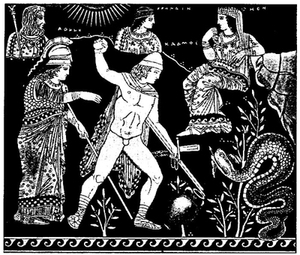
Fig. 54. Cadmus slaying the Dragon
When Europa was carried away by Jupiter in the guise of a bull, her father Agenor commanded his son Cadmus to go in search of her and not to return without her. Cadmus sought long and far; then, not daring to return unsuccessful, consulted the oracle of Apollo to know what country he should settle in. The oracle informed him that he would find a cow in the field, should follow her wherever she might wander, and where she stopped should build a city and call it Thebes. Cadmus had hardly left the Castalian cave, from which the oracle was delivered, when he saw a young cow slowly walking before him. He followed her close, offering at the same time his prayers to Phœbus. The cow went on till she passed the shallow channel of Cephissus and came out into the plain of Panope. There she stood still. Cadmus gave thanks, and stooping down kissed the foreign soil, then lifting his eyes, greeted the surrounding mountains. Wishing to offer a sacrifice to his protecting deity, Minerva, he sent his servants to seek pure water for a libation. Near by there stood an ancient grove which had never been profaned by the ax, in the midst of which was a cave thick covered with the growth of bushes, its roof forming a low arch from beneath which burst forth a fountain of purest water. But in the cave lurked a serpent with crested head, and scales glittering like gold; his eyes shone like fire; his body was swollen with venom; he vibrated a triple tongue and showed a triple row of teeth. No sooner had the Tyrians dipped their pitchers in the fountain and the in-gushing waters had made a sound, than the monster, twisting his scaly body in a huge coil, darted upon them and destroyed some with his fangs, others in his folds, and others with his poisonous breath.
Cadmus, having waited for the return of his men till midday, went in search of them. When he entered the wood and saw their lifeless bodies and the dragon with his bloody jaws, not knowing that the serpent was sacred to Mars, scourge of mortals, he lifted a huge stone and threw it with all his force at the monster. The blow made no impression. Minerva, however, was present, unseen, to aid her worshiper. Cadmus next threw his javelin, which penetrated the serpent's scales and pierced through to his entrails. The monster attempted to draw out the weapon with his mouth, but broke it off, leaving the iron point rankling in his flesh. His neck swelled with rage, bloody foam covered his jaws, and the breath of his nostrils poisoned the air around. As he moved onward, Cadmus retreated before him, holding his spear opposite to the serpent's opened jaws. At last, watching his chance, the hero thrust the spear at a moment when the animal's head thrown back came against the trunk of a tree, and so succeeded in pinning him to its side.
While Cadmus stood over his conquered foe, contemplating its vast size, a voice was heard (from whence he knew not, but it was Minerva's) commanding him to take the dragon's teeth and sow them in the earth. Scarce had he done so when the clods began to move and the points of spears to appear above the surface. Next, helmets with their nodding plumes came up; next, the shoulders and breasts and limbs of men with weapons, and in time a harvest of armed warriors. Cadmus prepared to encounter a new enemy, but one of them said to him, "Meddle not with our civil war." With that he who had spoken smote one of his earthborn brothers with a sword, and he himself fell pierced with an arrow from another. The latter fell victim to a fourth, and in like manner the whole crowd dealt with each other till all but five fell slain. These five joined with Cadmus in building his city, to which they gave the name appointed.
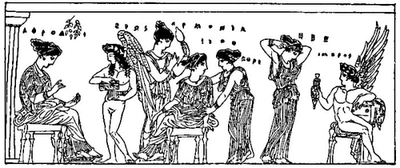
FIG. 55. Harmonia in Company of Deities
As penance for the destruction of this sacred serpent, Cadmus served Mars for a period of eight years. After he had been absolved of his impiety, Minerva set him over the realm of Thebes, and Jove gave him to wife Harmonia, the daughter of Venus and Mars. The gods left Olympus to honor the occasion with their presence; and Vulcan presented the bride with a necklace of surpassing brilliancy, his own workmanship. Of this marriage were born four daughters, Semele, Ino, Autonoë, and Agave, and one son, Polydorus. But in spite of the atonement made by Cadmus, a fatality hung over the family. The very necklace of Vulcan seemed to catch the spirit of ill luck and convey a baleful influence to such as wore it. Semele, Ino, Actæon the son of Autonoë, and Pentheus the son of Agave, all perished by violence. Cadmus and Harmonia quitted Thebes, grown odious to them, and emigrated to the country of the Enchelians, who received them with honor and made Cadmus their king. But the misfortunes of their children still weighing upon their minds, Cadmus one day exclaimed, "If a serpent's life is so dear to the gods, I would I were myself a serpent." No sooner had he uttered the words than he began to change his form. Harmonia, beholding it, prayed the gods to let her share his fate. Both became serpents. It is said that, mindful of their origin, they neither avoid the presence of man nor do they injure any one. But the curse appears not to have passed from their house until the sons of their great-great-grandson Œdipus had by fraternal strife ended themselves and the family.[86]
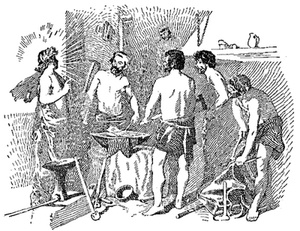
Fig. 56. The Forge of Vulcan
From the painting by Velasquez
71. Myths of Vulcan. The stories of Vulcan are few, although incidents illustrating his character are sufficiently numerous. According to an account already given, Vulcan, because of his lameness, was cast out of Heaven by his mother Juno. The sea-goddesses Eurynome and Thetis took him mercifully to themselves, and for nine years cared for him, while he plied his trade and gained proficiency in it. In order to revenge himself upon the mother who had so despitefully used him, he fashioned in the depths of the sea a throne of cunning device, which he sent to his mother. She, gladly accepting the glorious gift, sat down upon it, to find out that straightway all manner of invisible chains and fetters wound and clasped themselves about her so that she could not rise. The assistance of the gods was of no avail to release her. Then Mars sought to bring Vulcan to Heaven by force that he might undo his trickery; but before the flames of the fire-god, the impetuous warrior speedily retreated. One god, however, the jovial Bacchus, was dear to the blacksmith. He drenched Vulcan with wine, conducted him to Olympus, and by persuasion caused him to set the queen of gods and men at liberty.
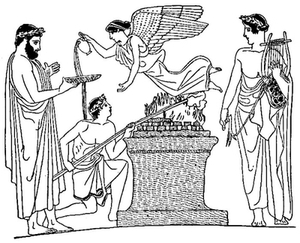
FIG. 57. A Sacrifice to Apollo
That Vulcan was not permanently hostile to Juno is shown by the services that on various occasions he rendered her. He forged the shield of her favorite Achilles; and, at her instance, he undertook a contest against the river Xanthus. Homer[87] describes the burning of elms and willow trees and tamarisks, the parching of the plains, the bubbling of the waters, that signalized the fight, and how the eels and other fish were afflicted by Vulcan till Xanthus in anguish cried for quarter.
72. Myths of Apollo. The myths which cluster about the name of Phœbus Apollo illustrate, first, his birth and the wanderings of his mother, Latona; secondly, his victory over darkness and winter; thirdly, his gifts to man,—youth and vigor, the sunshine of spring, and the vegetation of early summer; fourthly, his baleful influence,—the sunstroke and drought of midsummer, the miasma of autumn; fifthly, his life on earth, as friend and counselor of mankind,—healer, soothsayer, and musician, prototype of manly beauty, and lover of beautiful women.
73. The Wanderings of Latona. Persecuted by the jealousy of the white-armed Juno, Latona fled from land to land. At last, bearing in her arms the infant progeny of Jove, she reached Lycia, weary with her burden and parched with thirst. There the following adventure ensued. By chance the persecuted goddess espied in the bottom of the valley a pond of clear water, where the country people were at work gathering willows and osiers. She approached and kneeling on the bank would have slaked her thirst in the cool stream, but the rustics forbade her. "Why do you refuse me water?" said she. "Water is free to all. Yet I ask it of you as a favor. I have no intention of washing my limbs in it, weary though they be, but only of quenching my thirst. A draft of water would be nectar to me, and I would own myself indebted to you for life itself. Let these infants move your pity, who stretch out their little arms as if to plead for me."
But the clowns persisted in their rudeness; they added jeers, and threatened violence if she did not leave the place. They waded into the pond and stirred up the mud with their feet, so as to make the water unfit to drink. Enraged, the goddess no longer supplicated the clowns, but lifting her hands to Heaven exclaimed, "May they never quit that pool but pass their lives there!" And it came to pass accordingly. They still live in the water, sometimes totally submerged, then raising their heads above the surface or swimming upon it; sometimes coming out upon the bank, but soon leaping back again into the water. Their voices are harsh, their throats bloated, their mouths distended by constant railing; their necks have shrunk up and disappeared, and their heads are joined to their bodies. Their backs are green, their disproportioned bellies white. They dwell as frogs in the slimy pool.[88]
74. Apollo, the Light Triumphant. Soon after his birth the sun-god spent a year among the Hyperboreans, whose shining land has been already described.[89] On his return, slaying with his golden arrows the Python that had infested the slopes near Delphi, he sang for the first time that song of victory which, as the Pæan, is still among all nations synonymous with jubilation, praise, and thanksgiving. In his conflict with another monster of darkness and winter, the god of the silver bow had the assistance of his sister Diana. By their unerring fiery darts they subdued the giant Tityus, who not only had obstructed the peaceful ways to the oracle of Delphi, but had ventured to insult the mother of the twin deities. They overthrew also the Aloadæ, Otus and Ephialtes, sons of Iphimedia and Neptune. These monsters, the reputed sons of Aloeus, represent, perhaps, the unregulated forces of vegetation; they were renowned for their strength, stature, and courage. They grew at the rate of three cubits in height and one in breadth every year; and, when nine years of age, they attempted, by piling Mount Ossa upon Olympus, and Mount Pelion on top, to scale the skies and dethrone the immortals. It is reported that not Apollo and Diana, but Jupiter himself with his lightning slew them. They atoned for their presumption in Hades, where, bound by serpents to a pillar, they were tormented by the perpetual hooting of a screech owl.[90]
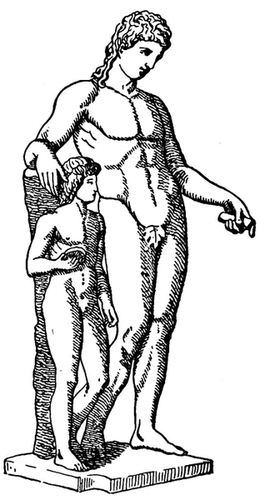
Fig. 58. Apollo with Hyacinthus
75. Hyacinthus. The fiery force of the Far-darter was not felt by the monsters of darkness alone. His friendship for the young and the vigorous was frequently as dangerous as it was dear to the objects of it. He was, for instance, passionately fond of a youth named Hyacinthus. The god of the silver bow accompanied the lad in his sports, carried the nets when he went fishing, led the dogs when he went to hunt, followed him in his excursions in the mountains, and neglected for him both lyre and arrows. One day they played a game of quoits; Apollo, heaving aloft the discus with strength mingled with skill, sent it high and far. Hyacinthus, excited with the sport and eager to make his throw, ran forward to seize the missile; but it bounded from the earth and struck him in the forehead. He fainted and fell. The god, as pale as himself, raised him and tried all his art to stanch the wound and retain the flitting life, but in vain. As when one has broken the stem of a lily in the garden it hangs its head and turns its flowers to the earth, so the head of the dying boy, as if too heavy for his neck, fell over on his shoulder. "Thou diest, Hyacinth," spake Phœbus, "robbed of thy youth by me. Would that I could die for thee! But since that may not be, my lyre shall celebrate thee, my song shall tell thy fate, and thou shalt become a flower inscribed with my regret." While the golden god spoke, the blood which had flowed on the ground and stained the herbage ceased to be blood; and a flower of hue more beautiful than the Tyrian sprang up, resembling the lily, save that this is purple and that silvery white. Phœbus then, to confer still greater honor, marked the petals with his sorrow, inscribing "Ai! ai!" upon them. The flower bears the name of Hyacinthus, and with returning spring revives the memory of his fate.[91]
It was said that Zephyrus (the west wind), who was also fond of Hyacinthus and jealous of his preference of Apollo, blew the quoit out of its course to make it strike Hyacinthus.
While this youth met his death by accident, another of Apollo's favorites, his own son, brought death upon himself by presumption. The story is as follows:
76. Phaëthon[2] was the son of Apollo and the nymph Clymene. One day Epaphus, the son of Jupiter and Io,[92] scoffed at the idea of Phaëthon's being the son of a god. Phaëthon complained of the insult to his mother Clymene. She sent him to Phœbus to ask for himself whether he had not been truly informed concerning his parentage. Gladly Phaëthon traveled toward the regions of sunrise and gained at last the palace of the Sun. He approached his father's presence, but stopped at a distance, for the light was more than he could bear. Phœbus Apollo, arrayed in purple, sat on a throne that glittered with diamonds. Beside him stood the Day, the Month, the Year, the Hours, and the Seasons. Surrounded by these attendants, the Sun beheld the youth dazzled with the novelty and splendor of the scene, and inquired the purpose of his errand. The youth replied, "Oh, light of the boundless world, Phœbus, my father—if thou dost yield me that name—give me some proof, I beseech thee, by which I may be known as thine!" He ceased. His father, laying aside the beams that shone around his head, bade him approach, embraced him, owned him for his son, and swore by the river Styx[93] that whatever proof he might ask should be granted. Phaëthon immediately asked to be permitted for one day to drive the chariot of the sun. The father repented of his promise and tried to dissuade the boy by telling him the perils of the undertaking. "None but myself," he said, "may drive the flaming car of day. Not even Jupiter, whose terrible right arm hurls the thunderbolts. The first part of the way is steep and such as the horses when fresh in the morning can hardly climb; the middle is high up in the heavens, whence I myself can scarcely, without alarm, look down and behold the earth and sea stretched beneath me. The last part of the road descends rapidly and requires most careful driving. Tethys, who is waiting to receive me, often trembles for me lest I should fall headlong. Add to this that the heaven is all the time turning round and carrying the stars with it. Couldst thou keep thy course while the sphere revolved beneath thee? The road, also, is through the midst of frightful monsters. Thou must pass by the horns of the Bull, in front of the Archer, and near the Lion's jaws, and where the Scorpion stretches its arms in one direction and the Crab in another. Nor wilt thou find it easy to guide those horses, with their breasts full of fire that they breathe forth from their mouths and nostrils. Beware, my son, lest I be the donor of a fatal gift; recall the request while yet thou canst." He ended; but the youth rejected admonition and held to his demand. So, having resisted as long as he might, Phœbus at last led the way to where stood the lofty chariot.
It was of gold, the gift of Vulcan,—the axle of gold, the pole and wheels of gold, the spokes of silver. Along the seat were rows of chrysolites and diamonds, reflecting the brightness of the sun. While the daring youth gazed in admiration, the early Dawn threw open the purple doors of the east and showed the pathway strewn with roses. The stars withdrew, marshaled by the Daystar, which last of all retired also. The father, when he saw the earth beginning to glow and the Moon preparing to retire, ordered the Hours to harness up the horses. They led forth from the lofty stalls the steeds full fed with ambrosia, and attached the reins. Then the father, smearing the face of his son with a powerful unguent, made him capable of enduring the brightness of the flame. He set the rays on the lad's head, and, with a foreboding sigh, told him to spare the whip and hold tight the reins; not to take the straight road between the five circles, but to turn off to the left; to keep within the limit of the middle zone and avoid the northern and the southern alike; finally, to keep in the well-worn ruts and to drive neither too high nor too low, for the middle course was safest and best.[94]
Forthwith the agile youth sprang into the chariot, stood erect, and grasped the reins with delight, pouring out thanks to his reluctant parent. But the steeds soon perceived that the load they drew was lighter than usual; and as a ship without ballast is tossed hither and thither on the sea, the chariot, without its accustomed weight, was dashed about as if empty. The horses rushed headlong and left the traveled road. Then, for the first time, the Great and Little Bears were scorched with heat, and would fain, if it were possible, have plunged into the water; and the Serpent which lies coiled round the north pole, torpid and harmless, grew warm, and with warmth felt its rage revive. Boötes, they say, fled away, though encumbered with his plow and unused to rapid motion.
When hapless Phaëthon looked down upon the earth, now spreading in vast extent beneath him, he grew pale, and his knees shook with terror. He lost his self-command and knew not whether to draw tight the reins or throw them loose; he forgot the names of the horses. But when he beheld the monstrous forms scattered over the surface of heaven,—the Scorpion extending two great arms, his tail, and his crooked claws over the space of two signs of the zodiac,—when the boy beheld him, reeking with poison and menacing with fangs, his courage failed, and the reins fell from his hands. The horses, unrestrained, went off into unknown regions of the sky in among the stars, hurling the chariot over pathless places, now up in high heaven, now down almost to the earth. The moon saw with astonishment her brother's chariot running beneath her own. The clouds began to smoke. The forest-clad mountains burned,—Athos and Taurus and Tmolus and Œte; Ida, once celebrated for fountains; the Muses' mountain Helicon, and Hæmus; Ætna, with fires within and without, and Parnassus, with his two peaks, and Rhodope, forced at last to part with his snowy crown. Her cold climate was no protection to Scythia; Caucasus burned, and Ossa and Pindus, and, greater than both, Olympus,—the Alps high in air, and the Apennines crowned with clouds.
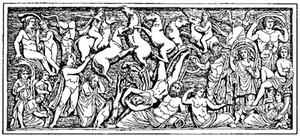
Fig. 59. The Fall of Phaëthon
Phaëthon beheld the world on fire and felt the heat intolerable. Then, too, it is said, the people of Æthiopia became black because the blood was called by the heat so suddenly to the surface; and the Libyan desert was dried up to the condition in which it remains to this day. The Nymphs of the fountains, with disheveled hair, mourned their waters, nor were the rivers safe beneath their banks; Tanaïs smoked, and Caïcus, Xanthus, and Mæander; Babylonian Euphrates and Ganges, Tagus, with golden sands, and Caÿster, where the swans resort. Nile fled away and hid his head in the desert, and there it still remains concealed. Where he used to discharge his waters through seven mouths into the sea, seven dry channels alone remained. The earth cracked open, and through the chinks light broke into Tartarus and frightened the king of shadows and his queen. The sea shrank up. Even Nereus and his wife Doris with the Nereïds, their daughters, sought the deepest caves for refuge. Thrice Neptune essayed to raise his head above the surface and thrice was driven back by the heat. Earth, surrounded as she was by waters, yet with head and shoulders bare, screening her face with her hand, looked up to heaven, and with husky voice prayed Jupiter, if it were his will that she should perish by fire, to end her agony at once by his thunderbolts, or else to consider his own Heaven, how both the poles were smoking that sustained his palace, and that all must fall if they were destroyed.
Earth, overcome with heat and thirst, could say no more. Then Jupiter, calling the gods to witness that all was lost unless some speedy remedy were applied, thundered, brandished a lightning bolt in his right hand, launched it against the charioteer, and struck him at the same moment from his seat and from existence. Phaëthon, with his hair on fire, fell headlong, like a shooting star which marks the heavens with its brightness as it falls, and Eridanus, the great river, received him and cooled his burning frame. His sisters, the Heliades, as they lamented his fate, were turned into poplar trees on the banks of the river; and their tears, which continued to flow, became amber as they dropped into the stream. The Italian Naiads reared a tomb for him and inscribed these words upon the stone:
Driver of Phœbus' chariot, Phaëthon, Struck by Jove's thunder, rests beneath this stone. He could not rule his father's car of fire, Yet was it much so nobly to aspire.[95]
77. The Plague sent upon the Greeks before Troy. It was not, however, only by accident, or by the ill-advised action of those whom he loved, that Apollo's gifts of light and heat were turned into misfortunes. Mortals who offended him were leveled by the cruel sunstroke, by arrows of malarial venom, of manifold sickness and death.
When the host of the Achæans was encamped before Troy, the king of men, Atrides, unjustly declined to restore his captive, Chryseïs of the fair cheeks, to her father Chryses, the priest of far-darting Apollo. Then the aged Chryses went apart and prayed aloud, "Hear me, god of the silver bow, ... let the Danaans pay by thine arrows for my tears!"
So spake he in prayer; and Phœbus Apollo heard him, and came down from the peaks of Olympus wroth at heart, bearing on his shoulders his bow and covered quiver. And the arrows clanged upon his shoulders in his wrath, as the god moved; and he descended like to night. Then he sate him aloof from the ships, and let an arrow fly; and there was heard a dread clanging of the silver bow. First did he assail the mules and fleet dogs, but afterward, aiming at the men his piercing dart, he smote; and the pyres of the dead burnt continually in multitude. Nor until Agamemnon had sent back his winsome captive to her father did Apollo remove from the Danaans the loathsome pestilence.[96]
78. The Punishment of Niobe is another illustration of the swift and awful vengeance of Apollo, and also of his sister Diana. This Niobe was the daughter of a certain Tantalus, king of Phrygia, who had been received at the table of the gods by his father Jupiter. But there was a strain of ingratitude and conceit in both father and daughter. The father not only betrayed the secrets of the gods, but, to ridicule their reputed omniscience, attempted at a banquet to deceive them into eating the roasted flesh of his own son Pelops. The gods were not deceived. Pelops was restored to life,—Tantalus consigned to Tartarus. The daughter Niobe, although she owed her happy marriage with Jupiter's son Amphion, and her seven stalwart sons and seven blooming daughters, to the favor of the gods and of Latona in particular, boasted of her birth, her marriage, and her offspring, bragged of her superiority to Latona, and, on one occasion, scoffed at the annual celebration in honor of the goddess and her two children. Surveying the people of Thebes with haughty glance, she said, "What folly to prefer beings whom you have never seen to those who stand before your eyes! Will you prefer to me this Latona, the Titan's daughter, with her two children? I have seven times as many. Were I to lose some of my children, I should hardly be left as poor as Latona with her two only. Put off the laurel from your brows,—have done with this worship!" The people left the sacred services uncompleted.
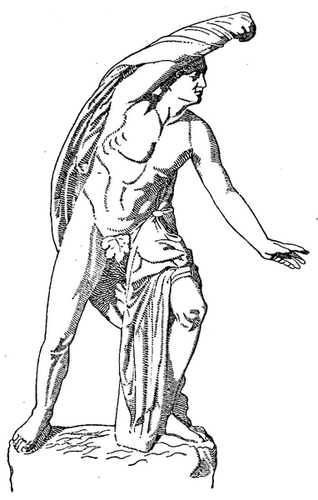
Fig. 60. A Son of Niobe
The goddess was indignant. On the Cynthian mountain top she thus addressed her son and daughter: "My children, I who have been so proud of you both and have been used to hold myself second to none of the goddesses except Juno alone, begin now to doubt whether I am indeed a goddess. I shall be deprived of my worship altogether unless you protect me." She was proceeding in this strain, but Apollo interrupted her. "Say no more," said he; "speech only delays punishment." So said Diana also. Darting through the air, veiled in clouds, they alighted on the towers of the city. Spread out before the gates was a broad plain where the youth of the city pursued their warlike sports. The sons of Niobe were there with the rest,—some mounted on spirited horses richly caparisoned, some driving gay chariots. Ismenos, the first-born, as he guided his foaming steeds was struck by an arrow from above. "Ah me!" he cried,—dropped the reins and fell lifeless. Another, hearing the sound of the bow, gave the rein to his horses and attempted to escape. The inevitable arrow overtook him as he fled. Two others, younger, stood wrestling breast to breast: one arrow pierced them both. Alphenor, an elder brother, hastened to the spot to render assistance, but fell in the act of brotherly duty. One only was left, Ilioneus. "Spare me, ye gods!" he cried, addressing all of them, in his ignorance that all needed not his supplication; and Apollo would have spared him, but the arrow had already left the string, and it was too late.
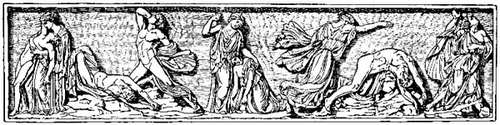
Fig 61. The Children of Niobe
When Niobe was acquainted with what had taken place, she was indignant that the gods had dared, and amazed that they had been able to do it. Her husband Amphion, overwhelmed with the blow, destroyed himself. But the mother knelt over the lifeless bodies and kissed them. Raising her pallid arms to heaven, "Cruel Latona," said she, "satiate thy hard heart while I follow to the grave my seven sons. Yet where is thy triumph? Bereaved as I am, I am still richer than thou, my conqueror." Scarce had she spoken, when the bow sounded and struck terror into all hearts except Niobe's alone. She was brave from excess of grief. Her daughters stood in garments of mourning over the biers of their dead brothers. One after another they fell, struck by arrows, beside the corpses that they were bewailing. Only one remained, whom the mother held clasped in her arms and covered, as it were, with her whole body. "Spare me one and that the youngest! Oh, spare me one of so many!" she cried; and while she spoke, that one fell dead. Desolate she sat among sons, daughters, husband, all dead, and seemed torpid with grief. The breeze moved not her hair, no color was on her cheek, her eyes glared fixed and immovable, there was no sign of life about her. Her very tongue cleaved to the roof of her mouth and her veins ceased to convey the tide of life. Her neck bent not, her arms made no gesture, her foot no step. She was changed to stone, within and without. Yet tears continued to flow; and borne on a whirlwind to her native mountain, she still remains, a mass of rock from which a trickling stream flows, the tribute of her never-ending grief.[97]
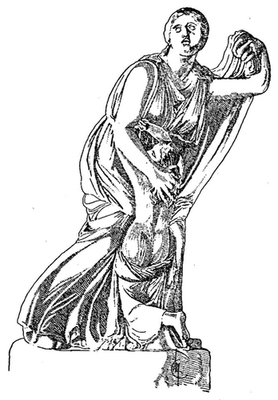
Fig. 62. Niobe and her Youngest Daughter
Amid nine daughters slain by Artemis Stood Niobe; she rais'd her head above Those beauteous forms which had brought down the scath Whence all nine fell, rais'd it, and stood erect, And thus bespake the goddess enthroned on high: "Thou heardest, Artemis, my daily prayer That thou wouldst guide these children in the pass Of virtue, through the tangling wilds of youth, And thou didst ever guide them: was it just To smite them for a beauty such as thine? Deserv'd they death because thy grace appear'd In ever modest motion? 'twas thy gift, The richest gift that youth from heaven receives. True, I did boldly say they might compare Even with thyself in virgin purity: May not a mother in her pride repeat What every mortal said? One prayer remains For me to offer yet. Thy quiver holds More than nine arrows: bend thy bow; aim here! I see, I see it glimmering through a cloud. Artemis, thou at length art merciful: My children will not hear the fatal twang."[98]
79. The Lamentation for Linus. How the people of Argos fell under the displeasure of Apollo is told in the story of Linus, a beautiful son of Apollo and Psamathe. In fear of her father the king, Psamathe exposed the child on the mountains where, brought up by shepherds among the lambs, he was in tender youth torn to pieces by dogs. Meanwhile, Psamathe herself was driven from her father's home; wherefore Apollo sent against the land of the Argives a monster that for a season destroyed the children, but at last was slain by a noble youth named Corœbus. To appease the wrathful deity, a shrine was erected midway between Argos and Delphi; and every year Linus and his mother were bewailed in melancholy lays by the mothers and children of Argos, especially by such as had lost by death their own beloved. The fate of Linus, like that of Hyacinthus and others who succumb in the springtime of life under the excessive love of some shining deity,[99] typifies the sudden withering of herbs and flowers and of animal life,—the calves and lambs, young children too, under the fierce shafts of summer. The very name of Linus is taken from the refrain ai-linon, or "woe is me," of the lament anciently sung by the country people when thus afflicted by the unhealthy heats, because of which the crops fail and the dogs go mad and tear the little lambs to pieces. In the Iliad there is a beautiful picture which shows us that the song was not reserved completely for the dog days. It is of a vineyard teeming plenteously with clusters:
And there was a pathway through it by which the vintagers might go. And maidens and striplings in childish glee bare the sweet fruit in plaited baskets. And in the midst of them a boy made pleasant music on a clear-toned viol, and sang thereto a sweet Linos-song with delicate voice; while the rest with feet falling together kept time with the music and song.[100]
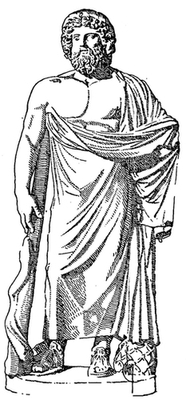
Fig. 63. Æsculapius
80. Æsculapius. The Thessalian princess Coronis (or the Messenian, Arsinoë) bore to Apollo a child who was named Æsculapius. On his mother's death the infant was intrusted to the charge of Chiron, most famous of the Centaurs, himself instructed by Apollo and Diana in hunting, medicine, music, and the art of prophecy. When the sage returned to his home bearing the infant, his daughter Ocyrrhoë came forth to meet him, and at sight of the child burst into a prophetic strain, foretelling, the glory that he should achieve. Æsculapius, when grown up, became a renowned physician; in one instance he even succeeded in restoring the dead to life. Pluto resented this, and, at his request, Jupiter struck the bold physician with lightning and killed him, but after his death received him into the number of the gods.[101]
81. Apollo in Exile. Apollo, indignant at the destruction of this son, wreaked his vengeance on the innocent workmen who had made the thunderbolt. These were the Cyclopes, who had their workshop under Mount Ætna, from which the smoke and flames of their furnaces are constantly issuing. Apollo shot his arrows at the Cyclopes, a deed which so incensed Jupiter that he condemned him to serve a mortal for the space of one year. Accordingly, Apollo went into the service of Admetus, king of Thessaly, and pastured his flocks for him on the verdant banks of the river Amphrysus. How the god lived among men, and what they thought of him, is well told in the following verses.
82. Lowell's Shepherd of King Admetus.
There came a youth upon the earth, Some thousand years ago, Whose slender hands were nothing worth, Whether to plow, or reap, or sow. Upon an empty tortoise-shell He stretched some chords, and drew Music that made men's bosoms swell Fearless, or brimmed their eyes with dew. Then King Admetus, one who had Pure taste by right divine, Decreed his singing not too bad To hear between the cups of wine: And so, well pleased with being soothed Into a sweet half-sleep, Three times his kingly beard he smoothed, And made him viceroy o'er his sheep. His words were simple words enough, And yet he used them so, That what in other mouths was rough In his seemed musical and low. Men called him but a shiftless youth, In whom no good they saw; And yet, unwittingly, in truth, They made his careless words their law. They knew not how he learned at all, For idly, hour by hour, He sat and watched the dead leaves fall, Or mused upon a common flower. It seemed the loveliness of things Did teach him all their use, For, in mere weeds, and stones, and springs He found a healing power profuse. Men granted that his speech was wise, But, when a glance they caught Of his slim grace and woman's eyes, They laughed, and called him good-for-naught. Yet after he was dead and gone And e'en his memory dim, Earth seemed more sweet to live upon, More full of love, because of him. And day by day more holy grew Each spot where he had trod, Till after-poets only knew Their first-born brother as a god.
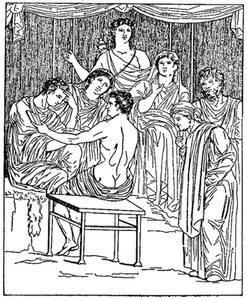
Fig. 64. Admetus must Die
83. Admetus and Alcestis.[102] Admetus was a suitor, with others, for the hand of Alcestis, the daughter of Pelias, who promised her to him who should come for her in a chariot drawn by lions and boars. This task Admetus performed by the assistance of his divine herdsman, and was made happy in the possession of Alcestis. But Admetus falling ill and being near to death, Apollo prevailed on the Fates to spare him on condition that some one should consent to die in his stead. Admetus, in his joy at this reprieve, thought little of the ransom, and, perhaps remembering the declarations of attachment which he had often heard from his courtiers and dependents, fancied that it would be easy to find a substitute. But it was not so. Brave warriors, who would willingly have periled their lives for their prince, shrunk from the thought of dying for him on the bed of sickness; and old servants who had experienced his bounty and that of his house from their childhood up were not willing to lay down the scanty remnant of their days to show their gratitude. Men asked, "Why does not one of his parents do it? They cannot in the course of nature live much longer, and who can feel like them the call to rescue the life they gave from an untimely end?" But the parents, distressed though they were at the thought of losing him, shrunk from the call. Then Alcestis, with a generous self-devotion, proffered herself as the substitute. Admetus, fond as he was of life, would not have submitted to receive it at such a cost; but there was no remedy. The condition imposed by the Fates had been met, and the decree was irrevocable. As Admetus revived, Alcestis sickened, rapidly sank, and died.
Just after the funeral procession had left the palace, Hercules, the son of Jupiter and Alcmena, arrived. He, to whom no labor was too arduous, resolved to attempt her rescue. Said he:
"I will go lie in wait for Death, black-stoled King of the corpses![103] I shall find him, sure, Drinking, beside the tomb, o' the sacrifice: And if I lie in ambuscade, and leap Out of my lair, and seize—encircle him Till one hand join the other round about— There lives not who shall pull him out from me, Rib-mauled, before he let the woman go! But even say I miss the booty,—say, Death comes not to the boltered blood,—why, then, Down go I, to the unsunned dwelling-place Of Koré[104] and the king there,—make demand, Confident I shall bring Alkestis back, So as to put her in the hands of him My host, that housed me, never drove me off: Though stricken with sore sorrow hid the stroke, Being a noble heart and honoring me! Who of Thessalians, more than this man, loves The stranger? Who that now inhabits Greece? Wherefore he shall not say the man was vile Whom he befriended,—native noble heart!" So, one look upward, as if Zeus might laugh Approval of his human progeny,— One summons of the whole magnific frame, Each sinew to its service,—up he caught, And over shoulder cast the lion-shag, Let the club go,—for had he not those hands? And so went striding off, on that straight way Leads to Larissa and the suburb tomb. Gladness be with thee, Helper of our world! I think this is the authentic sign and seal Of Godship that it ever waxes glad, And more glad, until gladness blossoms, bursts Into a rage to suffer for mankind, And recommence at sorrow: drops like seed After the blossom, ultimate of all. Say, does the seed scorn earth and seek the sun? Surely it has no other end and aim Than to drop, once more die into the ground, Taste cold and darkness and oblivion there: And thence rise, tree-like grow through pain to joy, More joy and most joy,—do man good again. So to the struggle off strode Herakles.
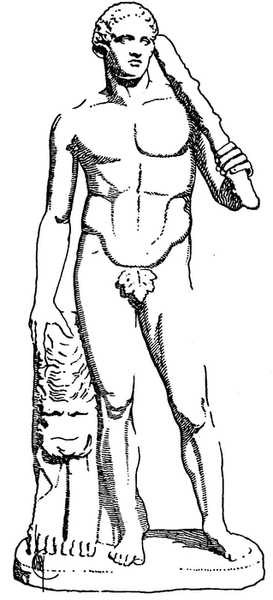
Fig. 65. Heracles
Long time the Thessalians waited and mourned. As for Herakles, no doubt they supposed him dead. When—but can it be?
... Ay, he it was advancing! In he strode, And took his stand before Admetos,—turned Now by despair to such a quietude, He neither raised his face nor spoke, this time, The while his friend surveyed him steadily. That friend looked rough with fighting: had he strained Worst brute to breast was ever strangled yet? Somehow, a victory—for there stood the strength, Happy, as always; something grave, perhaps; The great vein-cordage on the fret-worked front, Black-swollen, beaded yet with battle-dew The golden hair o' the hero!—his big frame A-quiver with each muscle sinking back Into the sleepy smooth it leaped from late. Under the great guard of one arm, there leant A shrouded something, live and woman-like, Propped by the heartbeats 'neath the lion-coat. When he had finished his survey, it seemed, The heavings of the heart began subside, The helpful breath returned, and last the smile Shone out, all Herakles was back again, As the words followed the saluting hand.
"Admetus," said he, "take and keep this woman, my captive, till I come thy way again." But Admetus would admit no woman into the hall that Alcestis had left empty. Then cried Herakles, "Take hold of her. See now, my friend, if she look not somewhat like that wife thou hast lost."
Ah, but the tears come, find the words at fault! There is no telling how the hero twitched The veil off; and there stood, with such fixed eyes And such slow smile, Alkestis' silent self! It was the crowning grace of that great heart, To keep back joy: procrastinate the truth Until the wife, who had made proof and found The husband wanting, might essay once more, Hear, see, and feel him renovated now— Able to do now all herself had done, Risen to the height of her: so, hand in hand, The two might go together, live and die. Beside, when he found speech, you guess the speech. He could not think he saw his wife again: It was some mocking God that used the bliss To make him mad! Till Herakles must help: Assure him that no specter mocked at all; He was embracing whom he buried once, Still,—did he touch, might he address the true, True eye, true body of the true live wife? ... And Herakles said little, but enough— How he engaged in combat with that king O' the dæmons: how the field of contest lay By the tomb's self: how he sprang from ambuscade, Captured Death, caught him in that pair of hands. But all the time, Alkestis moved not once Out of the set gaze and the silent smile; And a cold fear ran through Admetos' frame: "Why does she stand and front me, silent thus?" Herakles solemnly replied, "Not yet Is it allowable thou hear the things She has to tell thee; let evanish quite That consecration to the lower Gods, And on our upper world the third day rise! Lead her in, meanwhile; good and true thou art, Good, true, remain thou! Practice piety To stranger-guests the old way! So, farewell! Since forth I fare, fulfill my urgent task Set by the king, the son of Sthenelos."[105]
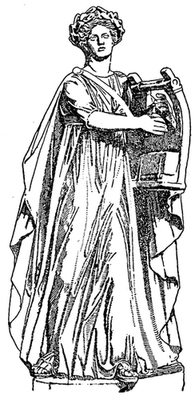
Fig. 66. The Palatine Apollo
84. Apollo, the Musician. Not only in Arcadia, Laconia, and Thessaly did Apollo care as a herdsman for the cattle of a mortal master; in Mount Ida, too, by the order of Jupiter he herded for a year the "shambling, crook-horned kine" of King Laomedon, and, playing on the lyre, aided Neptune to build the walls of Troy, just as Amphion, in his turn, had aided in the building of Thebes. Apollo's life as herdsman was spent in establishing wise laws and customs, in musical contests on the flute and the lyre, or in passages of love with nymphs and maidens of mortal mold.
85. Apollo, Pan, and Midas.[106] It is said that on a certain occasion Pan had the temerity to compare his music with that of Apollo and to challenge the god of the lyre to a trial of skill. The challenge was accepted, and Tmolus, the mountain-god, was chosen umpire. The senior took his seat and cleared away the trees from his ears to listen. At a given signal Pan blew on his pipes, and with his rustic melody gave great satisfaction to himself and his faithful follower Midas, who happened to be present. Then Tmolus turned his head toward the sun-god, and all his trees turned with him. Apollo rose, his brow wreathed with Parnassian laurel, while his robe of Tyrian purple swept the ground. In his left hand he held the lyre and with his right hand struck the strings. Tmolus at once awarded the victory to the lyric god, and all but Midas acquiesced in the judgment. He dissented and questioned the justice of the award. Apollo promptly transformed his depraved pair of ears into those of an ass.
King Midas tried to hide his misfortune under an ample turban. But his hair-dresser found it too much for his discretion to keep such a secret; he dug a hole in the ground and, stooping down, whispered the story, and covered it up. But a thick bed of reeds springing up in the meadow began whispering the story, and has continued to do so from that day to this, every time a breeze passes over the place.
86. Shelley's Hymn of Pan. In the following verses Pan taunts Apollo as he might have done when Midas was sitting contentedly by:
From the forests and highlands We come, we come; From the river-girt islands, Where loud waves are dumb, Listening to my sweet pipings. The wind in the reeds and the rushes, The bees on the bells of thyme, The birds on the myrtle bushes, The cicale above in the lime, And the lizards below in the grass, Were as silent as ever old Tmolus was Listening to my sweet pipings. Liquid Peneüs was flowing, And all dark Tempe lay, In Pelion's shadow, outgrowing The light of the dying day, Speeded by my sweet pipings. The Sileni, and Sylvans, and Fauns, And the Nymphs of the woods and waves, To the edge of the moist river-lawns, And the brink of the dewy caves, And all that did then attend and follow Were silent with love, as you now, Apollo, With envy of my sweet pipings. I sang of the dancing stars, I sang of the dædal Earth, And of Heaven—and the giant wars, And Love, and Death, and Birth,— And then I changed my pipings,— Singing how down the vale of Menalus I pursued a maiden, and clasp'd a reed: Gods and men, we are all deluded thus! It breaks in our bosom and then we bleed: All wept, as I think both ye now would, If envy or age had not frozen your blood, At the sorrow of my sweet pipings.
87. Marsyas also was unfortunate enough to underrate Apollo's musical ability. It seems that the flute, an invention of Minerva's, had been thrown away by that goddess because Cupid laughed at the grimaces which she made while playing it. Marsyas found the instrument, blew upon it, and elicited such ravishing sounds that he was tempted to challenge Apollo himself to a musical contest. The god, of course, triumphed, and he punished Marsyas by flaying him alive.
88. The Loves of Apollo. Beside Psamathe of Argos, Coronis of Thessaly, and the nymph Clymene, who have been already mentioned, Apollo loved the muse Calliope, who bore him Orpheus,[107] and the nymph Cyrene, whose son was Aristæus.[108] Of his relations with other maidens the following myths exist.
89. Daphne.[109] The lord of the silver bow was not always prosperous in his wooing. His first love, which, by the way, owed its origin to the malice of Cupid, was specially unfortunate. It appears that Apollo, seeing the boy playing with his bow and arrows, had tauntingly advised him to leave warlike weapons for hands worthy of them and content himself with the torch of love. Whereupon the son of Venus had rejoined, "Thine arrows may strike all things else, Apollo, but mine shall strike thee."
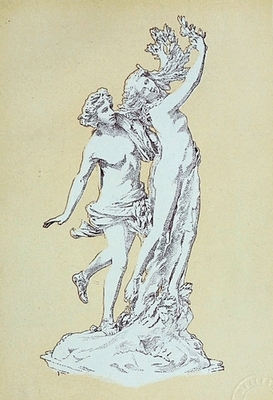
APOLLO AND DAPHNE
So saying, he took his stand on a rock of Parnassus, and drew from his quiver two arrows of different workmanship,—one to excite love, the other to repel it. The former was of gold and sharp pointed, the latter blunt and tipped with lead. With the leaden shaft he struck the nymph Daphne, the daughter of the river-god Peneüs, and with the golden one Apollo, through the heart. Forthwith the god was seized with love for the maiden, but she, more than ever, abhorred the thought of loving. Her delight was in woodland sports and in the spoils of the chase. Spurning all lovers, she prayed her father that she might remain always unmarried, like Diana. He consented, but, at the same time, warned her that her beauty would defeat her purpose. It was the face of this huntress maiden that Apollo saw. He saw the charming disorder of her hair, and would have arranged it; he saw her eyes bright as stars; he saw her lips, and was not satisfied with only seeing them. He longed for Daphne. He followed her; she fled swifter than the wind, nor delayed a moment at his entreaties. "Stay," said he, "daughter of Peneüs; I am not a foe. It is for love I pursue thee. I am no clown, no rude peasant. Jupiter is my father. I am lord of Delphi and Tenedos. I know all things, present and future. I am the god of song and the lyre. My arrows fly true to the mark; but alas! an arrow more fatal than mine has pierced my heart! I am the god of medicine and know the virtues of all healing plants. Alas! I suffer a malady that no balm can cure."