Part 1 — CHAPTER VII MYTHS OF THE GREAT DIVINITIES OF HEAVEN (continued 2)
Reading edition
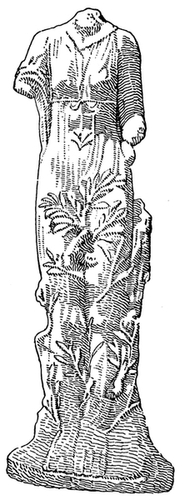
Fig. 67. Daphne
The nymph continues her flight and leaves his plea half-uttered. But even as she flies she charms him. The wind catches her garments, and her unbound hair streams loose behind her. The god, sped by Cupid, gains upon her in the race. His panting breath blows upon her hair. Her strength begins to fail, and, ready to sink, she calls upon her father, the river-god: "Help me, Peneüs! open the earth to inclose me, or change my form, which has brought me into this danger!" Scarcely had she spoken when a stiffness seized her limbs; and little by little she took on the appearance of a laurel tree. Apollo embraced the branches and lavished kisses on the wood. The branches shrank from his lips. "Since thou canst not be my wife," said he, "thou shalt assuredly be my tree. I will wear thee for my crown. I will decorate with thee my harp and my quiver. When the Roman conquerors conduct the triumphal pomp to the Capitol, thou shalt be woven into wreaths for their brows. And, as eternal youth is mine, thou also shalt be always green, and thy leaf know no decay." The laurel tree bowed its head in grateful acknowledgment.
The delicious humor of Lowell's extravaganza upon the story amply justifies the following citation:
Phœbus, sitting one day in a laurel tree's shade, Was reminded of Daphne, of whom it was made, For the god being one day too warm in his wooing, She took to the tree to escape his pursuing; Be the cause what it might, from his offers she shrunk, And, Ginevra-like, shut herself up in a trunk; And, though 't was a step into which he had driven her, He somehow or other had never forgiven her; Her memory he nursed as a kind of a tonic, Something bitter to chew when he'd play the Byronic, And I can't count the obstinate nymphs that he brought over By a strange kind of smile he put on when he thought of her. "My case is like Dido's," he sometimes remarked; "When I last saw my love, she was fairly embarked In a laurel, as she thought—but (ah, how Fate mocks!) She has found it by this time a very bad box; Let hunters from me take this saw when they need it,— You're not always sure of your game when you've treed it. Just conceive such a change taking place in one's mistress! What romance would be left?—who can flatter or kiss trees? And, for mercy's sake, how could one keep up a dialogue With a dull wooden thing that will live and will die a log,— Not to say that the thought would forever intrude That you've less chance to win her the more she is wood? Ah! it went to my heart, and the memory still grieves, To see those loved graces all taking their leaves; Those charms beyond speech, so enchanting but now, As they left me forever, each making its bough! If her tongue had a tang sometimes more than was right, Her new bark is worse than ten times her old bite."[110]
90. Marpessa. Another maiden who declined Apollo's love was Marpessa.[1] She is called by Homer "the fair-ankled daughter of Evenus."
The god Apollo from the heaven of heavens Her mortal sweetness through the air allured;[2]
but Idas, "that was strongest of men that were then on earth,"[111] carried her off, assisted by Poseidon who gave him a winged chariot. Her father Evenus vainly tried to catch up with the fleeing lovers; but Apollo found them in Messene, and wrested the maiden away. Then Jupiter, while the lovers were engaged in combat, separated them, saying, "Let her decide."
They three together met; on the one side, Fresh from diffusing light on all the world Apollo; on the other without sleep Idas, and in the midst Marpessa stood. Just as a flower after drenching rain, So from the falling of felicity Her human beauty glowed, and it was new; The bee too near her bosom drowsed and dropped.[2]
According to the story as romantically told by the English poet Phillips, first spoke Apollo. The god told her that he dreaded that one so fair should ever taste of sorrow and death; how, if she lived with him, she should bide
In mere felicity above the world In peace alive and moving, where to stir Is ecstasy, and thrilling is repose,[112]
immortal, scattering joy without intermission, lighting the world, bringing bliss to struggling men and sorrowing women, dispelling shadows and shadowy fear.
Then Idas, humbly,—
"After such argument what can I plead? Or what pale promise make? Yet since it is In women to pity rather than to aspire, A little will I speak."
And he tells her simply that he loves her,—loves her not only for her beauty, but
"Because Infinity upon thee broods; And thou art full of whispers and of shadows;—"
and because her voice is music, her face mystery beyond his power to comprehend;
"O beauty lone and like a candle clear In this dark country of the world! Thou art My woe, my early light, my music dying."
And Marpessa?—
As he was speaking, she with lips apart Breathed, and with dimmer eyes leaned through the air As one in dream, and now his human hand Took in her own; and to Apollo spoke,—
saying that she knew how sweet it might be forever with a god to aid suffering men and women and "gild the face that from its dead looks up"; but still she feared immortality, for, though dying not, she must grow old, and her god lover would tire of her when once her youth was faded. And as for that "existence without tears for evermore" which he promised,—
"Yet I being human, human sorrow miss. The half of music, I have heard men say, Is to have grieved."
To sorrow she was born. It is out of sadness that men have made this world beautiful. If she chooses Idas, then they two will prosper together, grow old together, and last descend into the "natural ground," and "leave behind a wholesome memory on the earth."
When she had spoken, Idas with one cry Held her, and there was silence; while the god In anger disappeared. Then slowly they, He looking downward, and she gazing up, Into the evening green wandered away.
91. Clytie.[113] In the story of Clytie the conditions are reversed. She was a water-nymph and in love with Apollo, who made her no return. So she pined away, sitting all day long upon the cold ground with her unbound tresses streaming over her shoulders. Nine days she sat, and tasted neither food nor drink,—her own tears and the chilly dew her only sustenance. She gazed on the sun when he rose; and as he passed through his daily course to his setting, she saw no other object,—her eyes fixed constantly on him. At last, they say, her limbs took root in the ground and her face became a flower, turning on its stem to follow the journeying sun.
In the following lines, Thomas Moore uses the flower as an emblem of constancy:
The heart that has truly loved never forgets, But as truly loves on to the close; As the sunflower turns on her god when he sets The same look that she turned when he rose.
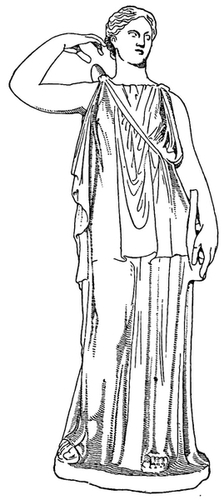
Fig. 68. Artemis
92. Myths of Diana. In company with her radiant brother, we find Diana subduing Tityus and the Python and assisting in the punishment of Niobe. The speedy transformation of Daphne has been attributed to this goddess, the champion of maidenhood. According to some, it was she, too, that changed Callisto into a bear, when for love of Jupiter that nymph deserted the huntress-band. Numerous are the myths that celebrate the severity of the goddess of the unerring bow toward those who offended her. How she served Agamemnon for slaying one of her hinds is told in the story of Troy;[114] how she punished Œneus for omitting a sacrifice to her is narrated in the episode of the Calydonian hunt.[115] Similar attributes of the goddess are exemplified in the myths of Arethusa, Actæon, and Orion. It is only when she is identified with Selene, the peaceful moonlight, that we perceive a softer side of character, such as that displayed in her relations with Endymion.
93. The Flight of Arethusa.[116] A woodland nymph of Elis was this Arethusa; she delighted not in her comeliness, but in the joys of the chase. One day, returning from the wood heated with exercise, she descended to a stream silently flowing, so clear that you might count the pebbles on the bottom. She laid aside her garments; but while she sported in the water, she heard an indistinct murmur rising as out of the depths of the stream. She made haste to reach the nearest bank. A voice followed her, "Why flyest thou, Arethusa? Alpheüs am I, the god of this stream." The nymph ran, the god pursued. Arethusa, at last exhausted, cried for help to Diana, who, hearing, wrapped her votary in a thick cloud. Perplexed, the river-god still sought the trembling maiden. But a cold sweat came over her. In less time than it takes to tell, she had become a fountain. Alpheüs attempted then to mingle his stream with hers. But the Cynthian queen cleft the ground, and Arethusa, still endeavoring to escape, plunged into the abyss and, passing through the bowels of the earth, came out in Sicily, still followed by the passionate river-god.
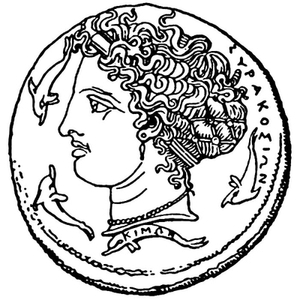
Fig 69. Arethusa
94. Shelley's Arethusa. In the following version of the pursuit, Arethusa was already a river when Alpheüs espied her.
Arethusa arose From her couch of snows In the Acroceraunian mountains,— From cloud and from crag, With many a jag, Shepherding her bright fountains, She leapt down the rocks, With her rainbow locks Streaming among the streams;— Her steps paved with green The downward ravine Which slopes to the western gleams: And gliding and springing She went, ever singing, In murmurs as soft as sleep; The Earth seemed to love her, And Heaven smiled above her, As she lingered towards the deep. Then Alpheüs bold On his glacier cold, With his trident the mountain strook And opened a chasm In the rocks;—with the spasm All Erymanthus shook. And the black south wind It concealed behind The urns of the silent snow, And earthquake and thunder Did rend in sunder The bars of the springs below; The beard and the hair Of the River-god were Seen through the torrent's sweep, As he followed the light Of the fleet nymph's flight To the brink of the Dorian deep.
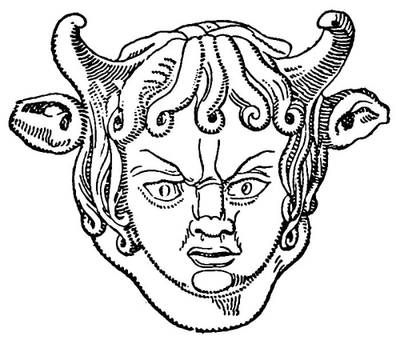
Fig. 70. A Young River-god
"Oh, save me! Oh, guide me! And bid the deep hide me, For he grasps me now by the hair!" The loud Ocean heard, To its blue depth stirred, And divided at her prayer; And under the water The Earth's white daughter Fled like a sunny beam; Behind her descended Her billows unblended With the brackish Dorian stream:— Like a gloomy stain On the emerald main, Alpheüs rushed behind,— As an eagle pursuing A dove to its ruin Down the streams of the cloudy wind. Under the bowers Where the Ocean Powers Sit on their pearlèd thrones, Through the coral woods Of the weltering floods, Over heaps of unvalued stones; Through the dim beams Which amid the streams Weave a network of colored light; And under the caves, Where the shadowy waves Are as green as the forest's night: Outspeeding the shark, And the swordfish dark, Under the ocean foam, And up through the rifts Of the mountain clifts They past to their Dorian home. And now from their fountains In Enna's mountains, Down one vale where the morning basks, Like friends once parted Grown single-hearted, They ply their watery tasks. At sunrise they leap From their cradles steep In the cave of the shelving hill; At noontide they flow Through the woods below And the meadows of Asphodel: And at night they sleep In the rocking deep Beneath the Ortygian shore;— Like spirits that lie In the azure sky When they love but live no more.
95. The Fate of Actæon.[117] Diana's severity toward young Actæon, grandson of Cadmus whose kindred fell under the curse of Mars, is thus narrated.
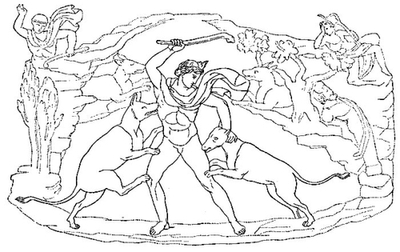
Fig. 71. Actæon
One day, having repaired to a valley inclosed by cypresses and pines, where gushed a fountain of sparkling water, the chaste Diana handed her javelin, her quiver, and her bow to one nymph, her robe to another, while a third unbound the sandals from her feet. Then Crocale, the most skillful of them, arranged her hair, and Nephele, Hyale, and the rest drew water in capacious urns. While the huntress queen was thus employed in the labors of the toilet, Actæon, the son of Autonoë and Aristæus, having quitted his companions of the chase and rambling without any especial object, came to the place, led thither by his destiny. As he presented himself at the entrance of the cave, the nymphs, seeing a man, screamed and rushed towards the goddess to hide her with their bodies. But she was taller than the rest and overtopped them all by a head. Such a color as tinges the clouds at sunset or at dawn came over the countenance of Diana, thus taken by surprise. Surrounded as she was by her nymphs, she yet turned half away and sought with a sudden impulse for her arrows. As they were not at hand, she dashed the water into the face of the intruder, saying, "Now go and tell, if you can, that you have seen Diana unappareled." Immediately a pair of branching stag's horns grew out of the huntsman's head, his neck gained in length, his ears grew sharp-pointed, his hands became feet, his arms, his long legs, and his body were covered with a hairy spotted hide. Fear took the place of his former boldness, and the hero fled. What should he do?—go home to the palace or lie hid in the woods? While he hesitated his dogs saw him. Over rocks and cliffs, through mountain gorges that seemed impracticable, he fled, and they followed. The air resounded with the bark of the dogs. Presently one fastened on his back, another seized his shoulder; the rest of the pack came up and buried their teeth in his flesh. His friends and fellow-huntsmen cheered on the dogs, and, looking everywhere for Actæon, called on him to join the sport. At the sound of his name, he turned his head and heard them regret that he should be away. He earnestly wished he was. But Diana had no pity for him, nor was her anger appeased till the dogs had torn his life out.
96. The Fortunes and Death of Orion. Orion, the son of Neptune, was a giant and a mighty hunter, whose prowess and manly favor gained for him the rare good will of Diana.
It is related that he loved Merope, the daughter of Œnopion, king of Chios, and sought her in marriage. He cleared the island of wild beasts and brought the spoils of the chase as presents to his beloved; but as Œnopion constantly deferred his consent, Orion attempted to gain possession of the maiden by violence. Her father, incensed at his conduct, made Orion drunk, deprived him of his sight, and cast him out on the seashore. The blinded hero, instructed by an oracle to seek the rays of morning, followed the sound of a Cyclops' hammer till he reached Lemnos, where Vulcan, taking pity on him, gave him Cedalion, one of his men, to be his guide to the abode of the sun. Placing Cedalion on his shoulders, Orion proceeded to the east, and there meeting the sun-god, was restored to sight by his beam.[118]
After this he dwelt as a hunter with the queen of the echoing chase; and it was even hinted that she loved him. Her brother, highly displeased, often chid her, but to no purpose. One day, therefore, observing Orion as he waded through the sea with his head just above the water, Apollo pointed out the black object to his sister, and maintained that she could not hit it. The archer goddess discharged a shaft with fatal aim: the waves rolled the dead body of Orion to the land. Then bewailing her fatal error with many tears, Diana placed him among the stars, where he appears as a giant, with a girdle, sword, lion's skin, and club.
Sirius, his dog, follows him, and the Pleiads fly before him.[119] In the beginning of winter, all through the night, Orion follows the chase across the heavens; but with dawn he sinks toward the waters of his father Neptune. In the beginning of summer, he may be seen with daybreak in the eastern sky, where, beloved by Aurora, he remains gradually paling before the light of day till, finally, Diana, jealous of his happiness, draws her gentle darts and slays him.
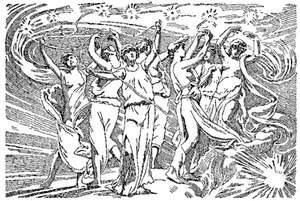
Fig. 72. The Pleiades
From the painting by Vedder
97. The Pleiads,[120] who still fly before Orion in the heavens, were daughters of Atlas, and nymphs of Diana's train. One day Orion saw them in Bœotia, became enamored of them, and gave pursuit. In their distress they prayed to the gods to change their form. Jupiter, accordingly, turned them into pigeons, and made them a constellation. Though their number was seven, only six stars are visible; for Electra, it is said, left her place that she might not behold the ruin of Troy, which had been founded by her son Dardanus. The sight had such an effect on her sisters that they blanched, and have been pale ever since. But Electra became a comet; her hair floating wildly behind her, she still inconsolably ranges the expanse of heaven. According to some, the lost Pleiad is Merope, who was vested with mortality in consequence of her marriage with the mortal Sisyphus, king of Corinth.
Tennyson's reference to the Pleiads, in "Locksley Hall," is of course familiar to all readers.
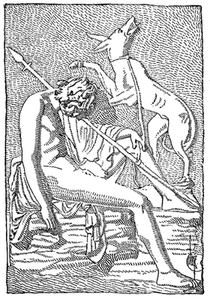
Fig. 73. Endymion
98. Endymion. The frequent absence of Diana from her duties in heaven is said to have awakened suspicion among the deities of Olympus, who doubted whether she actually occupied these intervals with hunting. It is easy to imagine the satisfaction with which Venus, who so often had been reproached by Diana with her undue fondness of beautiful youths, would welcome news of a corresponding weakness on the part of the cold-hearted and apparently unyielding huntress queen. And such satisfaction Venus once enjoyed, if we may trust the later classical and the modern poets who have identified Diana with Selene, the more ancient goddess of the moon.
For, one calm, clear night Selene looked down upon the beautiful Endymion, who fed his flock on Mount Latmos, and saw him sleeping. The heart of the goddess was unquestionably warmed by his surpassing beauty. She came down to him; she kissed him; she watched over him while he slept. She visited him again and again. But her secret could not long be hidden from the company of Olympus. For more and more frequently she was absent from her station in the sky, and toward morning she was ever paler and more weary with her watching. When, finally, her love was discovered, Jupiter gave Endymion, who had been thus honored, a choice between death in any manner that was preferable, or perpetual youth united with perpetual sleep. Endymion chose the latter. He still sleeps in his Carian cave, and still the mistress of the moon slips from her nocturnal course to visit him. She takes care, too, that his fortunes shall not suffer by his inactive life: she yields his flock increase, and guards his sheep and lambs from beasts of prey.[121]
Keats, whose Endymion journeys on a mission under sea, thus describes a meeting of the goddess and her lover:
On gold sand impearled With lily shells and pebbles milky white, Poor Cynthia greeted him, and soothed her light Against his pallid face: he felt the charm To breathlessness, and suddenly a warm Of his heart's blood: 'twas very sweet; he stayed His wandering steps, and half-entrancèd laid His head upon a tuft of straggling weeds, To taste the gentle moon, and freshening beads, Lashed from the crystal roof by fishes' tails. And so he kept, until the rosy veils, Mantling the east, by Aurora's peering hand Were lifted from the water's breast, and fanned Into sweet air; and sobered morning came Meekly through billows:—when like taper-flame Left sudden by a dallying breath of air, He rose in silence, and once more 'gan fare Along his fated way.[122]
99. Myths of Venus. Round the goddess of love cluster romances of her own tender passion, of the affairs of the winged Cupid, and of the loves of the worshipers at her shrine. Of the affection of Venus for Mars and of her relations with Anchises,[123] the father of Æneas, mention is elsewhere made. The following is the myth of Venus and Adonis.
100. Adonis.[124] The sweetly smiling goddess, playing one day with her boy Cupid, wounded her bosom with one of his arrows. Before the wound healed, she looked upon Adonis, the son of Cinyras and Myrrha, and was captivated by him. She no longer took any interest in her favorite resorts,—Paphos, and Cnidos, and Amathus, rich in metals. She absented herself even from Olympus, for Adonis was dearer to her than heaven. Him she followed and bore him company. She who loved to recline in the shade, with no care but to cultivate her charms, now rambled through the woods and over the hills, girt like the huntress Diana. She chased game that is safe to hunt, but kept clear of the wolves and bears. She charged Adonis, too, to beware of dangerous animals. "Be brave toward the timid," she would say, "courage against the courageous is not safe." Having thus, on one occasion, warned him, she mounted her chariot drawn by swans and drove away through the air. But Adonis was too noble to heed such counsels. The dogs had roused a wild boar from his lair, and the youth threw his spear and wounded the animal with a sidelong stroke. The beast drew out the weapon with his jaws, and, rushing after Adonis, buried his tusks in the lad's side, and stretched him dying upon the plain. The rest of the story is thus recounted:
THE LAMENT FOR ADONIS[125]
... Low on the hills is lying the lovely Adonis, and his thigh with the boar's tusk, his white thigh with the boar's tusk, is wounded; and sorrow on Cypris he brings, as softly he breathes his life away.
His dark blood drips down his skin of snow; beneath his brows his eyes wax heavy and dim; and the rose flees from his lip, and thereon the very kiss is dying, the kiss that Cypris will never forego.
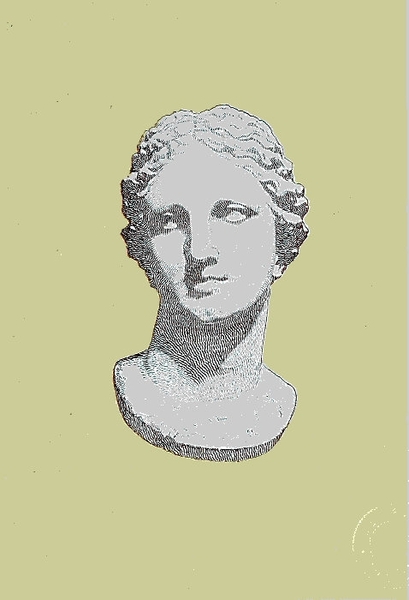
PETWORTH APHRODITE
... She hath lost her lovely lord, with him she hath lost her sacred beauty. Fair was the form of Cypris while Adonis was living, but her beauty has died with Adonis! Woe, woe for Cypris, the mountains all are saying. And the oak trees answer, Woe for Adonis! And the rivers bewail the sorrows of Aphrodite, and the wells are weeping Adonis on the mountains. The flowers flush red for anguish, and Cytherea through all the mountain-knees, through every dell, doth shrill the piteous dirge:
Woe, woe for Cytherea, he hath perished, the lovely Adonis!
... When she saw, when she marked the unstanched wound of Adonis, when she saw the bright red blood about his languid thigh, she cast her arms abroad, and moaned, "Abide with me, Adonis, hapless Adonis, abide!... Awake, Adonis, for a little while, and kiss me yet again, the latest kiss!... This kiss will I treasure, even as thyself, Adonis, since, ah, ill-fated, thou art fleeing me, thou art fleeing far, Adonis, and art faring to Acheron, to that hateful king and cruel, while wretched I yet live, being a goddess, and may not follow thee! Persephone, take thou my lover, my lord, for thyself art stronger than I, and all lovely things drift down to thee. But I am ill-fated, inconsolable is my anguish; and I lament mine Adonis, dead to me, and I have no rest for sorrow.
"Thou diest, oh, thrice-desired, and my desire hath flown away as a dream! Nay, widowed is Cytherea, and idle are the Loves along the halls! With thee has the girdle of my beauty perished. For why, ah, overbold, didst thou follow the chase, and being so fair, why wert thou thus overhardy to fight with beasts?"
So Cypris bewailed her, the Loves join in the lament:
Woe, woe for Cytherea, he hath perished, the lovely Adonis!
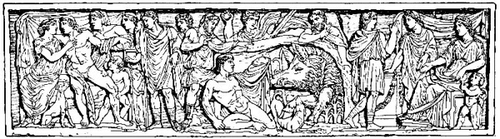
Fig. 74. The Death of Adonis
A tear the Paphian sheds for each blood-drop of Adonis, and tears and blood on the earth are turned to flowers. The blood brings forth the rose; the tears, the wind-flower.
Woe, woe for Adonis, he hath perished, the lovely Adonis!
... Cease, Cytherea, from thy lamentations, to-day refrain from thy dirges. Thou must again bewail him, again must weep for him another year.
101. Cupid and Psyche.[126] A certain king and queen had three daughters. The charms of the two elder were more than common, but the beauty of the youngest was such that the poverty of language is unable to express its praise. In fact, Venus found her altars deserted, while men paid their vows to this virgin. When Psyche passed, the people sang her praises and strewed her way with chaplets and flowers.
This perversion of homage gave great offense to Venus, who complained that Paris might just as well not have yielded her the palm of beauty over Pallas and Juno, if a mortal were thus to usurp her honors. Wherefore she called Cupid and, pointing out Psyche to him, bade him infuse into the bosom of that haughty girl a passion for some low, unworthy being.
There were in Venus's garden two fountains,—one of sweet waters, the other of bitter. Cupid filled two amber vases, one from each fountain, and suspending them from the top of his quiver, hastened to the chamber of Psyche, whom he found asleep. He shed a few drops from the bitter fountain over her lips, though the sight of her almost moved him to pity; and then he touched her side with the point of his arrow. She awoke, and opening her eyes upon Cupid (himself invisible), so startled him that in his confusion he wounded himself with his arrow. Heedless of his wound, his thought now was to repair the mischief he had done. He poured, at once, the waters of joy over her silken ringlets.
But Psyche, henceforth frowned upon by Venus, derived no benefit from her charms. Her two elder sisters had long been married to princes; but Psyche's beauty failed to awaken love. Consequently her parents, afraid that they had unwittingly incurred the anger of the gods, consulted the oracle of Apollo.
They received answer, "The virgin is destined for the bride of no mortal lover. Her husband awaits her on the top of the mountain. He is a monster whom neither gods nor men can resist."
This dreadful decree of the oracle filled the people with dismay; but, at Psyche's request, preparations for her fate were made. The royal maid took her place in a procession, which more resembled a funeral than a nuptial pomp, and with her parents, amid the lamentations of their subjects, ascended the mountain, where she was left alone.
While Psyche stood there, panting with fear and with eyes full of tears, the gentle Zephyr lifted her and, with an easy motion, bore her to a flowery dale. By degrees her mind became composed, and she laid herself down on the grassy bank to sleep. When she awoke refreshed with sleep, she beheld near by a pleasant grove of tall and stately trees. Entering, she discovered in the midst a fountain, and fast by a palace whose august front showed that it was not the work of mortal hands, but the happy retreat of some god. She approached the building and entered. Every object she met filled her with pleasure and amazement. Golden pillars supported the vaulted roof, and the walls were enriched with carvings and paintings that represented beasts of the chase and rural scenes. Other apartments were filled with still other beautiful and precious productions of nature and art.
While her eyes were thus occupied, the voice of an invisible being addressed her: "Sovereign lady, all that thou beholdest is thine. We whose voices thou dost hear are thy servants. Retire, we pray thee, to thy chamber, repose on thy bed of down, and when it may please thee repair to the bath. Food awaits in the adjoining alcove."
After repose and the refreshment of the bath, Psyche seated herself in the alcove, where, without any visible aid, a table immediately presented itself, covered with delicacies and nectareous wines. Her ears, too, were delighted with music from invisible performers.
For a long time she did not see her husband. He came in the hours of darkness and fled before the dawn of morning; but his accents were full of love and inspired a like passion in her. Often she begged him to stay and let her behold him, but he would not consent. "Having looked upon me," he said, "mayhap thou wouldst fear, mayhap adore, me; but all I ask of thee is love. I would rather thou shouldst love me as an equal than adore me as a god." This reasoning somewhat quieted Psyche for a time. But the thought of her parents and of her sisters, left in ignorance of her fate, preyed on her mind to such a degree that at last, telling her distress to her lord, she drew from him an unwilling consent that her sisters should be brought to see her.
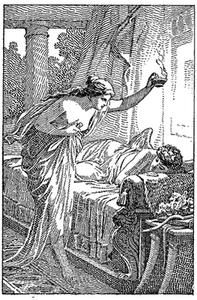
Fig. 75. Psyche at the Couch of Cupid
From the painting by Thumann
Zephyr, promptly obedient, soon brought them across the mountain down to their sister's valley. They embraced her. She returned their caresses, and then committed them to the care of her attendant voices, who should refresh them in her bath and at her table, and show them her treasures. The view of these delights caused envy to enter their bosoms. They plied their fortunate sister with questions about her husband. Psyche replied that he was a beautiful youth, who generally spent the daytime in hunting upon the mountains. The sisters, not satisfied with this reply, soon made her confess that she had never seen him. Then they proceeded to fill her bosom with dark suspicions. Probably her husband was a dreadful monster, such as the Pythian oracle had prophesied. Probably he was a direful serpent, who nourished her now to devour her by and by. They advised her to provide herself against the night with a lamp and a sharp knife, told her what to do if her husband turned out the monster that they surmised, and, so saying, departed.
These persuasions Psyche resisted as well as she could, but they did not fail to have their effect on her mind. She prepared a lamp and a sharp knife, and hid them out of sight of her husband. That night, when he had fallen into his first sleep, she silently rose and uncovering her lamp—
Scarce kept back a cry At what she saw; for there before her lay The very Love brighter than dawn of day; And as he lay there smiling, her own name His gentle lips in sleep began to frame, And, as to touch her face, his hand did move; O then, indeed, her faint heart swelled for love, And she began to sob, and tears fell fast Upon the bed.—But as she turned at last To quench the lamp, there happed a little thing That quenched her new delight, for flickering The treacherous flame cast on his shoulder fair A burning drop; he woke, and seeing her there The meaning of that sad sight knew full well, Nor was there need the piteous tale to tell.[127]
Without a word, Cupid spread his white wings, and flew out of window. Psyche, in vain endeavoring to follow, fell to the earth. For but an instant Cupid, staying, reproached her with distrust of him. "No other punishment inflict I than to leave thee forever. Love cannot dwell with suspicion." And so he flew away.
When Psyche had recovered some degree of composure, she looked around her. The palace and gardens had vanished. She found herself not far from the city where her sisters dwelt. Thither she repaired, and told them the story of her misfortunes, whereat they inwardly rejoiced. "For now," thought they, "he will perhaps choose one of us." With this idea, they rose early the next morning and, ascending the mountain, each called upon Zephyr to receive her and bear her to his lord; then, leaping up, failed of the support of Zephyr, fell down the precipice, and was dashed to pieces.
Psyche, meanwhile, wandered day and night, without food or repose, in search of her husband. But he was lying heartsick in the chamber of his mother; and that goddess was absent upon her own affairs. Then the white sea gull which floats over the waves dived into the middle deep,
And rowing with his glistening wings arrived At Aphrodite's bower beneath the sea.
She, as yet unaware of her son's mischance, was joyously consorting with her handmaidens; but he, the sea gull,
But he with garrulous and laughing tongue Broke up his news; how Eros fallen sick Lay tossing on his bed, to frenzy stung By such a burn as did but barely prick: A little bleb, no bigger than a pease, Upon his shoulder 'twas, that killed his ease, Fevered his heart, and made his breathing thick. "For which disaster hath he not been seen This many a day at all in any place: And thou, dear mistress," said he, "hast not been Thyself among us now a dreary space: And pining mortals suffer from a dearth Of love; and for this sadness of the earth Thy family is darkened with disgrace.... "'Tis plain that, if thy pleasure longer pause, Thy mighty rule on earth hath seen its day: The race must come to perish, and no cause But that thou sittest with thy nymphs at play, While on the Cretan hills thy truant boy Has with his pretty mistress turned to toy, And, less for pain than love, now pines away."[128]
And Venus cried angrily, "My son, then, has a mistress! And it is Psyche, who witched away my beauty and was the rival of my godhead, whom he loves!"
Therewith she issued from the sea, and, returning to her golden chamber, found there the lad sick, as she had heard, and cried from the doorway, "Well done, truly! to trample thy mother's precepts under foot, to spare my enemy that cross of an unworthy love; nay, unite her to thyself, child as thou art, that I might have a daughter-in-law who hates me! I will make thee repent of thy sport, and the savor of thy marriage bitter. There is one who shall chasten this body of thine, put out thy torch, and unstring thy bow. Not till she has plucked forth that hair, into which so oft these hands have smoothed the golden light, and sheared away thy wings, shall I feel the injury done me avenged." And with this she hastened in anger from the doors.
And Ceres and Juno met her, and sought to know the meaning of her troubled countenance. "Ye come in season," she cried; "I pray you, find for me Psyche. It must needs be that ye have heard the disgrace of my house." And they, ignorant of what was done, would have soothed her anger, saying, "What fault, Mistress, hath thy son committed, that thou wouldst destroy the girl he loves? Knowest thou not that he is now of age? Because he wears his years so lightly must he seem to thee ever to be a child? Wilt thou forever thus pry into the pastimes of thy son, always accusing his wantonness, and blaming in him those delicate wiles which are all thine own?" Thus, in secret fear of the boy's bow, did they seek to please him with their gracious patronage. But Venus, angry at their light taking of her wrongs, turned her back upon them, and with hasty steps made her way once more to the sea.[129]
And soon after, Psyche herself reached the temple of Ceres, where she won the favor of the goddess by arranging in due order the heaps of mingled grain and ears and the carelessly scattered harvest implements that lay there. The holy Ceres then counseled her to submit to Venus, to try humbly to win her forgiveness, and, mayhap, through her favor regain the lover that was lost.
Obeying the commands of Ceres, Psyche took her way to the temple of the golden-crowned Cypris. That goddess received her with angry countenance, called her an undutiful and faithless servant, taunted her with the wound given to her husband, and insisted that for so ill-favored a girl there was no way of meriting a lover save by dint of industry. Thereupon she ordered Psyche to be led to the storehouse of the temple, where was laid up a great quantity of wheat, barley, millet, vetches, beans, and lentils prepared for food for her pigeons, and gave order, "Take and separate all these grains, putting all of the same kind in a parcel by themselves,—and see that thou get it done before evening." This said, Venus departed and left the girl to her task. But Psyche, in perfect consternation at the enormous task, sat stupid and silent; nor would the work have been accomplished had not Cupid stirred up the ants to take compassion on her. They separated the pile, sorting each kind to its parcel and vanishing out of sight in a moment.
At the approach of twilight, Cytherea returned from the banquet of the gods, breathing odors and crowned with roses. Seeing the task done, she promptly exclaimed, "This is no work of thine, wicked one, but his, whom to thine own and his misfortune thou hast enticed,"—threw the girl a piece of black bread for her supper, and departed.
Next morning, however, the goddess, ordering Psyche to be summoned, commanded her to fetch a sample of wool gathered from each of the golden-shining sheep that fed beyond a neighboring river. Obediently the princess went to the riverside, prepared to do her best to execute the command. But the god of that stream inspired the reeds with harmonious murmurs that dissuaded her from venturing among the golden rams while they raged under the influence of the rising sun. Psyche, observing the directions of the compassionate river-god, crossed when the noontide sun had driven the cattle to the shade, gathered the woolly gold from the bushes where it was clinging, and returned to Venus with her arms full of the shining fleece. But, far from commending her, that implacable mistress said, "I know very well that by the aid of another thou hast done this; not yet am I assured that thou hast skill to be of use. Here, now, take this box to Proserpine and say, 'My mistress Venus entreats thee to send her a little of thy beauty, for in tending her sick son she hath lost some of her own.'"
Psyche, satisfied that her destruction was at hand, doomed as she was to travel afoot to Erebus, thought to shorten the journey by precipitating herself at once from the summit of a tower. But a voice from the tower, restraining her from this rash purpose, explained how by a certain cave she might reach the realm of Pluto; how she might avoid the peril of the road, pass by Cerberus, and prevail on Charon to take her across the black river and bring her back again. The voice, also, especially cautioned her against prying into the box filled with the beauty of Proserpine.
So, taking heed to her ways, the unfortunate girl traveled safely to the kingdom of Pluto. She was admitted to the palace of Proserpine, where, contenting herself with plain fare instead of the delicious banquet that was offered her, she delivered her message from Venus. Presently the box, filled with the precious commodity, was restored to her; and glad was she to come out once more into the light of day.
But having got so far successfully through her dangerous task, a desire seized her to examine the contents of the box, and to spread the least bit of the divine beauty on her cheeks that she might appear to more advantage in the eyes of her beloved husband.
Therewith down by the wayside did she sit And turned the box round, long regarding it; But at the last, with trembling hands, undid The clasp, and fearfully raised up the lid; But what was there she saw not, for her head Fell back, and nothing she rememberèd Of all her life, yet nought of rest she had, The hope of which makes hapless mortals glad; For while her limbs were sunk in deadly sleep Most like to death, over her heart 'gan creep Ill dreams; so that for fear and great distress She would have cried, but in her helplessness Could open not her mouth, or frame a word.[130]
But Cupid, now recovered from his wound, slipped through a crack in the window of his chamber, flew to the spot where his beloved lay, gathered up the sleep from her body and inclosed it again in the box, then waked Psyche with the touch of an arrow. "Again," said he, "hast thou almost perished by thy curiosity. But now perform the task imposed upon thee by my mother, and I will care for the rest."
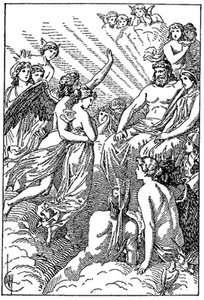
Fig. 76. Psyche and Cupid on Mount Olympus
From the painting by Thumann
Then Cupid, swift as lightning penetrating the heights of heaven, presented himself before Jupiter with his supplication. Jupiter lent a favoring ear and pleaded the cause of the lovers with Venus. Gaining her consent, he ordered Mercury to convey Psyche to the heavenly abodes. On her advent, the king of the immortals, handing her a cup of ambrosia, said, "Drink this, Psyche, and be immortal. Thy Cupid shall never break from the knot in which he is tied; these nuptials shall indeed be perpetual."
Thus Psyche was at last united to Cupid; and in due season a daughter was born to them whose name was Pleasure.
The allegory of Cupid and Psyche is well presented in the following lines:
They wove bright fables in the days of old, When reason borrowed fancy's painted wings; When truth's clear river flowed o'er sands of gold, And told in song its high and mystic things! And such the sweet and solemn tale of her The pilgrim-heart, to whom a dream was given, That led her through the world,—Love's worshiper,— To seek on earth for him whose home was heaven!
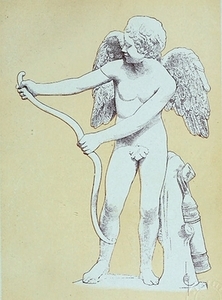
EROS WITH BOW
In the full city,—by the haunted fount,— Through the dim grotto's tracery of spars,— 'Mid the pine temples, on the moonlit mount, Where silence sits to listen to the stars; In the deep glade where dwells the brooding dove, The painted valley, and the scented air, She heard far echoes of the voice of Love, And found his footsteps' traces everywhere. But never more they met! since doubts and fears, Those phantom-shapes that haunt and blight the earth, Had come 'twixt her, a child of sin and tears, And that bright spirit of immortal birth; Until her pining soul and weeping eyes Had learned to seek him only in the skies; Till wings unto the weary heart were given, And she became Love's angel bride in heaven![131]
The story of Cupid and Psyche first appears in the works of Apuleius, a writer of the second century of our era. It is therefore of much more recent date than most of the classic myths.
102. Keats' Ode to Psyche. To this fact allusion is made in the following poem:
O Goddess! hear these tuneless numbers, wrung By sweet enforcement and remembrance dear, And pardon that thy secrets should be sung Even into thine own soft-conchèd ear: Surely I dreamt to-day, or did I see The wingèd Psyche with awakened eyes? I wandered in a forest thoughtlessly, And, on the sudden, fainting with surprise, Saw two fair creatures, couchèd side by side In deepest grass, beneath the whispering roof Of leaves and tumbled blossoms, where there ran A brooklet, scarce espied! 'Mid hushed, cool-rooted flowers, fragrant-eyed, Blue, silver-white, and budded Tyrian, They lay calm-breathing on the bedded grass; Their arms embracèd, and their pinions, too; Their lips touched not, but had not bade adieu, As if disjoinèd by soft-handed slumber, And ready still past kisses to outnumber At tender eye-dawn of Aurorean love: The wingèd boy I knew: But who wast thou, O happy, happy dove? His Psyche true! O latest born and loveliest vision far Of all Olympus' faded hierarchy! Fairer than Phœbe's sapphire-regioned star, Or Vesper, amorous glowworm of the sky; Fairer than these, though temple thou hast none, Nor altar heaped with flowers; Nor virgin-choir to make delicious moan Upon the midnight hours; No voice, no lute, no pipe, no incense sweet From chain-swung censer teeming; No shrine, no grove, no oracle, no heat Of pale-mouthed prophet dreaming. O brightest! though too late for antique vows Too, too late for the fond believing lyre, When holy were the haunted forest boughs, Holy the air, the water, and the fire; Yet even in these days so far retired From happy pieties, thy lucent fans, Fluttering among the faint Olympians, I see, and sing, by my own eyes inspired. So let me be thy choir, and make a moan Upon the midnight hours; Thy voice, thy lute, thy pipe, thy incense sweet From swingèd censer teeming, Thy shrine, thy grove, thy oracle, thy heat Of pale-mouthed prophet dreaming. Yes, I will be thy priest, and build a fane In some untrodden region of my mind, Where branchèd thoughts, new grown with pleasant pain, Instead of pines shall murmur in the wind: Far, far around shall those dark clustered trees Fledge the wild-ridgèd mountains steep by steep; And there by zephyrs, streams, and birds and bees, The moss-lain Dryads shall be lulled to sleep; And in the midst of this wide quietness A rosy sanctuary will I dress With the wreathèd trellis of a working brain, With buds, and bells, and stars without a name, With all the gardener Fancy e'er could feign, Who breeding flowers, will never breed the same; And there shall be for thee all soft delight That shadowy thought can win, A bright torch, and a casement ope at night, To let the warm Love in!
The loves of the devotees of Venus are as the sands of the sea for number. Below are given the fortunes of a few: Hippomenes, Hero, Pygmalion, Pyramus, and Phaon. The favor of the goddess toward Paris, who awarded her the palm of beauty in preference to Juno and Minerva, will occupy our attention in connection with the story of the Trojan War.
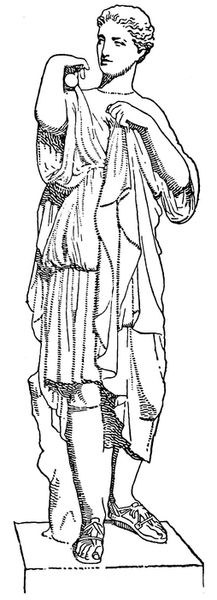
Fig. 77. Artemis of Gabii
103. Atalanta's Race.[132] Atalanta, the daughter of Schœneus of Bœotia, had been warned by an oracle that marriage would be fatal to her happiness. Consequently she fled the society of men and devoted herself to the sports of the chase. Fair, fearless, swift, and free, in beauty and in desire she was a Cynthia,—of mortal form and with a woman's heart. To all suitors (for she had many) she made answer: "I will be the prize of him only who shall conquer me in the race; but death must be the penalty of all who try and fail." In spite of this hard condition some would try. Of one such race Hippomenes was to be judge. It was his thought, at first, that these suitors risked too much for a wife. But when he saw Atalanta lay aside her robe for the race with one of them, he changed his mind and began to swell with envy of whomsoever seemed likely to win.
The virgin darted forward. As she ran she looked more beautiful than ever. The breezes gave wings to her feet; her hair flew over her shoulders, and the gay fringe of her garment fluttered behind her. A ruddy hue tinged the whiteness of her skin, such as a crimson curtain casts on a marble wall. Her competitor was distanced and was put to death without mercy. Hippomenes, not daunted by this result, fixed his eyes on the virgin and said, "Why boast of beating those laggards? I offer myself for the contest." Atalanta looked at him with pity in her face and hardly knew whether she would rather conquer so goodly a youth or not. While she hesitated, the spectators grew impatient for the contest and her father prompted her to prepare. Then Hippomenes addressed a prayer to Cypris: "Help me, Venus, for thou hast impelled me." Venus heard and was propitious.
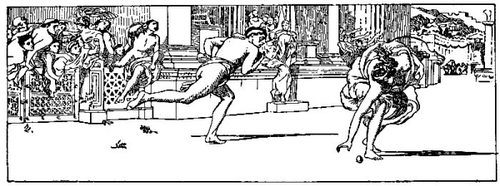
Fig. 78. Atalanta's Race
From the painting by Poynter
She gathered three golden apples from the garden of her temple in her own island of Cyprus and, unseen by any, gave them to Hippomenes, telling him how to use them. Atalanta and her lover were ready. The signal was given.
They both started; he, by one stride, first, For she half pitied him so beautiful, Running to meet his death, yet was resolved To conquer: soon she near'd him, and he felt The rapid and repeated gush of breath Behind his shoulder. From his hand now dropt A golden apple: she lookt down and saw A glitter on the grass, yet on she ran. He dropt a second; now she seem'd to stoop: He dropt a third; and now she stoopt indeed: Yet, swifter than a wren picks up a grain Of millet, rais'd her head: it was too late, Only one step, only one breath, too late. Hippomenes had toucht the maple goal With but two fingers, leaning pronely forth. She stood in mute despair; the prize was won. Now each walkt slowly forward, both so tired, And both alike breathed hard, and stopt at times. When he turn'd round to her, she lowered her face Cover'd with blushes, and held out her hand, The golden apple in it. "Leave me now," Said she, "I must walk homeward." He did take The apple and the hand. "Both I detain," Said he, "the other two I dedicate To the two Powers that soften virgin hearts, Eros and Aphrodite; and this one To her who ratifies the nuptial vow." She would have wept to see her father weep; But some God pitied her, and purple wings (What God's were they?) hovered and interposed.[133]
But the oracle was yet to be fulfilled. The lovers, full of their own happiness, after all, forgot to pay due honor to Aphrodite, and the goddess was provoked at their ingratitude. She caused them to give offense to Cybele. That powerful goddess took from them their human form: the huntress heroine, triumphing in the blood of her lovers, she made a lioness; her lord and master a lion,—and yoked them to her car, where they are still to be seen in all representations in statuary or painting of the goddess Cybele.
104 Hero and Leander were star-crossed lovers of later classical fiction.[134] Although their story is not of supernatural beings, or of events necessarily influenced by supernatural agencies, and therefore not mythical in the strict sense of the word, it deserves to be included here both because of its pathetic beauty and its long literary tradition. The poet Marlowe puts the story into English thus:
On Hellespont, guilty of true love's blood, In view and opposite two cities stood, Sea-borderers, disjoin'd by Neptune's might The one Abydos, the other Sestos hight. At Sestos Hero dwelt; Hero the fair, Whom young Apollo courted for her hair, And offer'd as a dower his burning throne, Where she should sit, for men to gaze upon.... Some say, for her the fairest Cupid pin'd, And, looking in her face, was strooken blind. But this is true: so like was one the other, As he imagined Hero was his mother; And oftentimes into her bosom flew, About her naked neck his bare arms threw, And laid his childish head upon her breast, And, with still panting rockt, there took his rest.
In Abydos dwelt the manly Leander, who, as luck would have it, bethought himself one day of the festival of Venus in Sestos, and thither fared to do obeisance to the goddess.
On this feast-day,—O cursèd day and hour!— Went Hero through Sestos, from her tower To Venus' temple, where unhappily, As after chanc'd, they did each other spy. So fair a church as this had Venus none; The walls were of discolored jasper-stone, ... And in the midst a silver altar stood: There Hero, sacrificing turtle's blood, Vail'd to the ground, veiling her eyelids close; And modestly they opened as she rose: Thence flew Love's arrow with the golden head; And thus Leander was enamourèd. Stone-still he stood, and evermore he gaz'd, Till with the fire, that from his countenance blaz'd, Relenting Hero's gentle heart was strook: Such power and virtue hath an amorous look. It lies not in our power to love or hate, For will in us is overrul'd by fate. When two are stript long e'er the course begin, We wish that one should lose, the other win; And one especially do we affect Of two gold ingots, like in each respect: The reason no man knows; let it suffice, What we behold is censur'd by our eyes. Where both deliberate, the love is slight: Who ever lov'd, that lov'd not at first sight? He kneel'd; but unto her devoutly prayed: Chaste Hero to herself thus softly said, "Were I the saint he worships, I would hear him"; And, as she spake those words, came somewhat near him. He started up; she blush'd as one asham'd; Wherewith Leander much more was inflam'd. He touch'd her hand; in touching it she trembled: Love deeply grounded, hardly is dissembled....
So they conversed by touch of hands, till Leander, plucking up courage, began to plead with words, with sighs and tears.
These arguments he us'd, and many more; Wherewith she yielded, that was won before. Hero's looks yielded, but her words made war: Women are won when they begin to jar. Thus having swallow'd Cupid's golden hook, The more she striv'd, the deeper was she strook: Yet, evilly feigning anger, strove she still, And would be thought to grant against her will. So having paus'd awhile, at last she said, "Who taught thee rhetoric to deceive a maid? Ay me! such words as these should I abhor, And yet I like them for the orator." With that Leander stoop'd to have embrac'd her, But from his spreading arms away she cast her, And thus bespake him: "Gentle youth, forbear To touch the sacred garments which I wear." ...
Then she told him of the turret by the murmuring sea where all day long she tended Venus' swans and sparrows:
"Come thither." As she spake this, her tongue tripp'd, For unawares, "Come thither," from her slipp'd; And suddenly her former color chang'd, And here and there her eyes through anger rang'd; And, like a planet moving several ways At one self instant, she, poor soul, assays, Loving, not to love at all, and every part Strove to resist the motions of her heart: And hands so pure, so innocent, nay, such As might have made Heaven stoop to have a touch, Did she uphold to Venus, and again Vow'd spotless chastity; but all in vain; Cupid beats down her prayers with his wings....
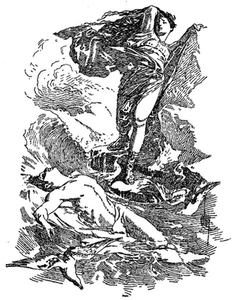
Fig. 79. Hero and Leander
From the painting by Keller
For a season all went well. Guided by a torch which his mistress reared upon the tower, he was wont of nights to swim the strait that he might enjoy her company. But one night a tempest arose and the sea was rough; his strength failed and he was drowned. The waves bore his body to the European shore, where Hero became aware of his death, and in her despair cast herself into the sea and perished.
A picture of the drowning Leander is thus described by Keats:[135]
Come hither all sweet maidens soberly, Down looking aye, and with a chasten'd light, Hid in the fringe of your eyelids white, And meekly let your fair hands joinèd be, As if so gentle that ye could not see, Untouch'd, a victim of your beauty bright, Sinking away to his young spirit's night, Sinking bewilder'd 'mid the dreary sea: 'Tis young Leander toiling to his death; Nigh swooning he doth purse his weary lips For Hero's cheek, and smiles against her smile. O horrid dream! see how his body dips Dead-heavy; arms and shoulders gleam awhile; He's gone; up bubbles all his amorous breath!
105. Pygmalion and the Statue.[136] Pygmalion saw so much to blame in women, that he came at last to abhor the sex and resolved to live unmarried. He was a sculptor, and had made with wonderful skill a statue of ivory, so beautiful that no living woman was to compare with it. It was indeed the perfect semblance of a maiden that seemed to be alive and that was prevented from moving only by modesty. His art was so perfect that it concealed itself, and its product looked like the workmanship of nature. Pygmalion at last fell in love with his counterfeit creation. Oftentimes he laid his hand upon it as if to assure himself whether it were living or not, and could not even then believe that it was only ivory.
The festival of Venus was at hand,—a festival celebrated with great pomp at Cyprus. Victims were offered, the altars smoked, and the odor of incense filled the air. When Pygmalion had performed his part in the solemnities, he stood before the altar and, according to one of our poets, timidly said:
O Aphrodite, kind and fair, That what thou wilt canst give, Oh, listen to a sculptor's prayer, And bid mine image live! For me the ivory and gold That clothe her cedar frame Are beautiful, indeed, but cold; Ah, touch them with thy flame! Oh, bid her move those lips of rose, Bid float that golden hair, And let her choose me, as I chose, This fairest of the fair! And then an altar in thy court I'll offer, decked with gold; And there thy servants shall resort, Thy doves be bought and sold![137]
According to another version of the story, he said not, "bid mine image live," but "one like my ivory virgin." At any rate, with such a prayer he threw incense on the flame of the altar. Whereupon Venus, as an omen of her favor, caused the flame to shoot up thrice a fiery point into the air.
When Pygmalion reached his home, to his amazement he saw before him his statue garlanded with flowers.
Yet while he stood, and knew not what to do With yearning, a strange thrill of hope there came, A shaft of new desire now pierced him through, And therewithal a soft voice called his name, And when he turned, with eager eyes aflame, He saw betwixt him and the setting sun The lively image of his lovèd one. He trembled at the sight, for though her eyes, Her very lips, were such as he had made, And though her tresses fell but in such guise As he had wrought them, now was she arrayed In that fair garment that the priests had laid Upon the goddess on that very morn, Dyed like the setting sun upon the corn. Speechless he stood, but she now drew anear, Simple and sweet as she was wont to be, And once again her silver voice rang clear, Filling his soul with great felicity, And thus she spoke, "Wilt thou not come to me, O dear companion of my new-found life, For I am called thy lover and thy wife?... "My sweet," she said, "as yet I am not wise, Or stored with words aright the tale to tell, But listen: when I opened first mine eyes I stood within the niche thou knowest well, And from my hand a heavy thing there fell Carved like these flowers, nor could I see things clear, But with a strange, confusèd noise could hear. "At last mine eyes could see a woman fair, But awful as this round white moon o'erhead, So that I trembled when I saw her there, For with my life was born some touch of dread, And therewithal I heard her voice that said, 'Come down and learn to love and be alive, For thee, a well-prized gift, to-day I give.'"[138]
A fuller account of Venus' address to the statue is the following:
O maiden, in mine image made! O grace that shouldst endure! While temples fall, and empires fade, Immaculately pure: Exchange this endless life of art For beauty that must die, And blossom with a beating heart Into mortality! Change, golden tresses of her hair, To gold that turns to gray; Change, silent lips, forever fair, To lips that have their day! Oh, perfect arms, grow soft with life, Wax warm, ere cold ye wane; Wake, woman's heart, from peace to strife, To love, to joy, to pain![139]
The maiden was called Galatea. Venus blessed the nuptials, and from the union Paphos was born, by whose name the city, sacred to Venus, is known.
106. Pyramus and Thisbe.[140] Pyramus was the handsomest youth and Thisbe the fairest maiden in Babylonia, where Semiramis reigned. Their parents occupied adjoining houses. Propinquity brought the young people together, and acquaintance ripened into love. They would gladly have married, but their parents forbade. One thing, however, parents could not forbid (for Venus and Cupid favored the match),—that love should glow with equal ardor in the bosoms of both. They conversed by signs and glances, and the fire burned the more intensely that it was covered. In the wall between the two houses there was a crack, caused by some fault in the structure. It afforded a passage to the voice; and tender messages passed back and forth through the gap. When night came and they must say farewell, the lovers pressed their lips upon the wall, she on her side, he on his.
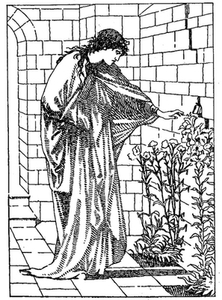
Fig. 80. Thisbe
From the painting by Edward Burne-Jones
One morning, when Aurora had put out the stars and the sun had melted the frost from the grass, they met at the accustomed spot and arranged a meeting for that night at a well-known edifice, standing without the city's bounds,—the Tomb of Ninus. The one who first arrived should await the other at the foot of a white mulberry tree near a cool spring. Evening came. Thisbe, arriving first, sat alone by the monument in the dim light of the evening. Suddenly she descried a lioness, her jaws reeking with recent slaughter, approaching the fountain to slake her thirst. The maiden fled at the sight, dropping her veil as she ran. The lioness, after drinking at the spring, turned toward the woods, and, seeing the veil on the ground, tossed and rent it with her bloody mouth.
Now Pyramus approached the place of meeting. He saw in the sand the footsteps of the lion. He found the veil all rent and bloody. "O, hapless girl," cried he, "I have been the cause of thy death; but I follow thee!" So saying, he drew his sword and plunged it into his heart. The blood spurted from the wound and tinged the white mulberries of the tree all red, and, sinking into the earth, reached the roots, so that the sanguine hue mounted through the trunk to the fruit.
By this time Thisbe, still trembling with fear, yet wishing not to disappoint her lover, stepped cautiously forth, looking anxiously for the youth, eager to tell him the danger she had escaped. When she came to the spot and saw the changed color of the mulberries, she doubted whether it was the same place. While she hesitated, she saw the form of her lover struggling in the agonies of death. She screamed and beat her breast, she embraced the lifeless body, poured tears into its wounds, and imprinted kisses on the cold lips. "O, Pyramus," she cried, "what has done this? It is thine own Thisbe that speaks." At the name of Thisbe Pyramus opened his eyes, then closed them again. She saw her veil stained with blood and the scabbard empty of its sword. "Thine own hand has slain thee, and for my sake," she said. "I, too, can be brave for once, and my love is as strong as thine. But ye, unhappy parents of us both, deny us not our united request. As love and death have joined us, let one tomb contain us. And thou, tree, retain the marks of slaughter. Let thy berries still serve for memorials of our blood." So saying, she plunged the sword into her breast. The two bodies were buried in one sepulcher, and the tree henceforth produced purple berries.
107. Phaon ferried a boat between Lesbos and Chios. One day the queen of Paphos and Amathus,[141] in the guise of an ugly crone, begged a passage, which was so good-naturedly granted that in recompense she bestowed on the ferryman a salve possessing magical properties of youth and beauty. As a consequence of the use made of it by Phaon, the women of Lesbos went wild for love of him. None, however, admired him more than the poetess Sappho, who addressed to him some of her warmest and rarest love-songs.
108. The Vengeance of Venus. Venus did not fail to follow with her vengeance those who dishonored her rites or defied her power. The youth Hippolytus who, eschewing love, preferred Diana to her, she brought miserably to his ruin. Polyphonte she transformed into an owl, Arsinoë into a stone, and Myrrha into a myrtle tree.[142] Her influence in the main was of mingled bane and blessing, as in the cases of Helen, Œnone, Pasiphaë, Ariadne, Procris, Eriphyle, Laodamia, and others whose stories are elsewhere told.[143]
109. Myths of Mercury. According to Homer,[144] Maia bore Mercury at the peep of day,—a schemer subtle beyond all belief. He began playing on the lyre at noon; for, wandering out of the lofty cavern of Cyllene, he found a tortoise, picked it up, bored the life out of the beast, fitted the shell with bridge and reeds, and accompanied himself therewith as he sang a strain of unpremeditated sweetness. At evening of the same day he stole the oxen of his half brother Apollo from the Pierian mountains, where they were grazing. He covered their hoofs with tamarisk twigs, and, still further to deceive the pursuer, drove them backward into a cave at Pylos. There rubbing laurel branches together, he made fire and sacrificed, as an example for men to follow, two heifers to the twelve gods (himself included). Then home he went and slept, innocent as a new-born child! To his mother's warning that Apollo would catch and punish him, this innocent replied, in effect, "I know a trick better than that!" And when the puzzled Apollo, having traced the knavery to this babe in swaddling clothes, accused him of it, the sweet boy swore a great oath by his father's head that he stole not the cows, nor knew even what cows might be, for he had only that moment heard the name of them. Apollo proceeded to trounce the baby, with scant success, however, for Mercury persisted in his assumption of ignorance. So the twain appeared before their sire, and Apollo entered his complaint: he had not seen nor ever dreamed of so precocious a cattle-stealer, liar, and full-fledged knave as this young rascal. To all of which Mercury responded that he was, on the contrary, a veracious person, but that his brother Apollo was a coward to bully a helpless little new-born thing that slept, nor ever had thought of "lifting" cattle. The wink with which the lad of Cyllene accompanied this asseveration threw Jupiter into uncontrollable roars of laughter. Consequently, the quarrel was patched up: Mercury gave Apollo the new-made lyre; Apollo presented the prodigy with a glittering whiplash and installed him herdsman of his oxen. Nay even, when Mercury had sworn by sacred Styx no more to try his cunning in theft upon Apollo, that god in gratitude invested him with the magic wand of wealth, happiness, and dreams (the caduceus), it being understood, however, that Mercury should indicate the future only by signs, not by speech or song as did Apollo. It is said that the god of gain avenged himself for this enforced rectitude upon others: upon Venus, whose girdle he purloined; upon Neptune, whose trident he filched; upon Vulcan, whose tongs he borrowed; and upon Mars, whose sword he stole.
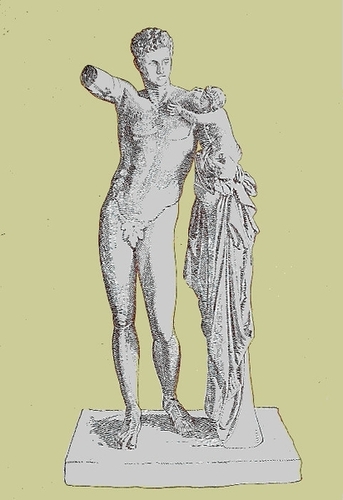
HERMES OF PRAXITELES
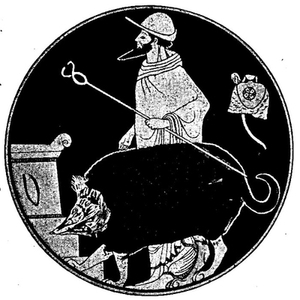
Fig. 81. Hermes and Dog
The most famous exploit of the Messenger, the slaughter of Argus, has already been narrated.