THE CAMPAIGN FOR CHATTANOOGA
Reading edition
On August 16th, the Union army started their forward movement. Thomas and McCook moved their corps down to the Tennessee River at Bridgeport. Crittenden moved down the Sequatchie Valley, having troops from just north of Jasper to a point above Pikeville. A part of the latter’s corps, (Wilder’s and Wagner’s Mounted Infantry) took positions along Walden’s Ridge and Signal Mountain where they were in plain view of the Confederates in Chattanooga. Numerous demonstrations were made at these points to attract the attention of the Confederates and to make them believe they were attempting to cross the river at some point above the city. They would beat on empty barrels to imitate the rolling of supply wagons. They also built huge bon-fires and would march back and forth in the flare of them. Buglers were placed at distant points where they would strike a few notes at regular intervals. They even sawed planks, boards and pieces of logs to float down the river to give the Confederates the impression they were building a pontoon bridge at some point above the city. On August 21st, a part of Wilder’s brigade advanced to Stringer’s Ridge where they shelled Chattanooga with artillery. One shell landed in front of the First Presbyterian Church at Seventh and Market streets, while services were being conducted. Some reports claim that a little girl had her leg broken by a piece of shell. However, according to the report of Confederate Gen. D. H. Hill, several women and children were killed. Today, Chattanooga’s tallest building, the Hamilton National Bank, stands on this site. The shelling of the city showed that the Union troops were on the immediate front of the Confederates. As a result, Cleburne’s division was sent to Harrison, and then distributed at every ford and ferry between the mouths of the Chickamauga Creek and the Hiwasee River—a distance of at least 50 miles. These troops were so placed in order to guard against any possible crossing by the Union troops. All of these positions were covered by rifle-pits and batteries. With the Confederates’ attention drawn in this direction, the main body of the Union army effected a crossing of the river at Bridgeport, 30 miles below Chattanooga, between August 29th and September 4th, unmolested. Thomas crossed over the Sand Mountain to Trenton, Georgia, after much difficulty.
When Bragg learned that the Union army had crossed the river below him he evacuated Chattanooga during the 8th and 9th of September, moving 26 miles southward to LaFayette, Georgia, behind the Pigeon Mountains. This movement was made in order that he could protect his line of communications and his base of supplies, his base being Atlanta. As the last of Bragg’s army was leaving the city on the morning of September 9th, the 92nd Illinois Mounted Infantry made a reconnaissance on Lookout Mountain. They then entered the city. Crittenden’s corps followed the railroad to Ringgold, 12 then westward to Rock Springs in pursuit of the Confederates. At this latter point, Crittenden was directly between Bragg and Chattanooga.
PRELIMINARY MOVEMENTS
Rosecrans was led to believe that Bragg was in full retreat to Rome and Atlanta. He had gathered this information from pretended deserters from the Confederate army. However, he was determined to head the Confederates off. He immediately dispatched Thomas and McCook down Lookout Valley to point 26 and 42 miles below Chattanooga where they crossed Lookout Mountain. Thomas moved into McLemore’s Cove; McCook to Alpine and Summerville, Georgia. In planning these movements and making such disposition of his troops, Rosecrans was falling into a trap which had been set for him. Bragg’s army was not in retreat. They had no intentions of retreating. Rosecrans was not aware of the fact that Bragg was not in retreat until about September 12th. His army was divided into three sections. It was at least 60 miles from the left to right of his troops. Meanwhile, Bragg at LaFayette, was opposite the Union center and in position to attack and crush the Union army in detail as they emerged from the mountains. He had already been re-enforced by Buckner from east Tennessee and Walker from Mississippi. He was only awaiting Longstreet’s arrival from Virginia before turning back in an effort to retake Chattanooga. The latter named troops were seasoned veterans who were sent down by Gen. Lee. A great many of them had fought in the battle of Gettysburg. Upon their arrival Bragg ordered the Confederates to turn back toward Chattanooga. His plan was to attack Crittenden and in case Thomas and McCook should arrive they could be taken care of, likewise, in order. Failure of his subordinate officers to comply promptly with these orders caused this opportunity to be lost. Rosecrans, upon learning that Bragg had received heavy re-enforcements and was turning back in an effort to retake Chattanooga, hurriedly ordered the concentration of his forces. McCook, contrary to orders, took a roundabout route from Summerville, causing some delay. However, on September 17th, he joined Thomas and they in turn started their movement to join Crittenden. At this time Crittenden was on the west side of Chickamauga Creek at Lee and Gordon’s Mill. It was necessary for Thomas and McCook to make a forced march day and night in order to reach Crittenden. They were practically exhausted when they reached him.
BRAGG’S PLAN FOR BATTLE
On September 17th, Bragg had ordered his troops to cross the Chickamauga Creek at Reed’s and Alexander’s bridges. They were to sweep up the creek toward Crittenden’s position. His objective was to gain possession of the main road between Rosecrans and Chattanooga. Incidentally, this main road is known today as Highway U. S. No. 27. The Confederates reached Chickamauga Creek on Friday afternoon, September 18th. Here they met with some opposition from the Union troops. After a great deal of skirmishing, of which some was rather severe, the Confederates effected a crossing.
THE BATTLE OF CHICKAMAUGA
On Saturday morning the right of the Confederate line extended to the Reed’s Bridge road. Forrest’s Cavalry Corps was posted on 13 the right of this line. Thomas’ troops arrived on the LaFayette road at the Kelley field near daylight on Saturday morning, the 19th. Brannan’s division moved up the main road to the McDonald field, thence east toward Reed’s bridge. When in the vicinity of Jay’s Mill they encountered Forrest’s cavalry. Croxton’s brigade fired into them and thus opened the battle of Chickamauga. Forrest’s men dismounted and returned the fire, fighting as infantry. It was now 7:30 A. M. The battle was slow to start. Then it became severe. Both sides sent for re-enforcements which were sent at once. Connell’s and VanDerveer’s brigades came to Croxton’s support while Walker and Liddell brought their divisions to Forrest’s assistance. Due to the Confederates not being in the positions which Bragg had ordered them, a great deal of confusion resulted. However, troops kept filling in on both sides until the lines were about three miles in length. Each side gained and lost ground many times by severe charging and counter-charging. Baird made an effort to reform his lines but while doing so, was attacked by Walker in greater numbers. King and Scribner were driven back some distance at the same time. The Union forces then drove Walker to his former position. At this time Cheatham came to Walker’s rescue and they drove Johnson, Palmer and VanCleve back in order. Reynolds was then overpowered by the Confederates, the rebels yelling wildly all the while. Davis and Wood then checked the advance of the Confederates. After adjusting their lines, they drove Cheatham, Walker and Stewart back to their former positions. Most of the fighting was in the woods at this time although some was in open fields. Much of it was at very close range. In just such manner the fighting lasted all the forenoon, neither side gaining very much. Casualties were high on both sides. It is believed that the 10th and 74th Indiana Infantry were the most severely engaged at this time. It may be interesting to learn that Col. William B. Carroll, commanding the 10th Indiana Infantry, was the first field officer to be killed at Chickamauga. By noon the fighting was general throughout the lines.
During the afternoon the most severe fighting took place near the opposite ends of the lines in the Vineyard field. Fighting at this point was all at close range and some was hand-to-hand. About 4:00 P. M., Col. Hans C. Heg, 15th Wisconsin Infantry, was mortally wounded. Col. Heg commanded the 3rd brigade of Davis’ division. With death staring him in the face, he again rallied his men and rode nearly one-quarter of a mile before the loss of blood weakened him to such an extent that he was forced to give up his command. His brigade was taken over by Col. John A. Martin of the 8th Kansas Infantry. Col. Heg was the first brigade commander to fall on the Chickamauga battlefield. After a restless night in a hospital, he passed away near noon of the 20th. After sundown the fighting ceased at all portions of the field. Neither side had gained any worthwhile advantage during this first day of battle, although the Union forces had been driven much closer to the main road. The left of the Union line under Thomas was well anchored across the main highway; the center under McCook was just west of the highway, and the right end of the line under Crittenden was still east of the highway. The Confederate line was very close to the Union line at all points. Shortly after dark the battle was renewed near the north 14 end of the lines. Cleburne and Cheatham encountered Johnson and Baird. The fighting lasted only about an hour but the losses were heavy. Two brigade commanders lost their lives about 7:00 P. M. On the Union side, Col. Philemon P. Baldwin of Indiana, was killed. Col. Baldwin commanded the 3rd brigade of Johnson’s division. Col. William W. Berry of the 5th Kentucky Infantry, assumed command of Baldwin’s brigade. On the Confederate side, Brig.-Gen. Preston Smith of Tennessee was killed. Gen. Smith commanded a brigade of Cheatham’s division. Col. Alfred J. Vaughn, Jr., 13th Tennessee Infantry, assumed command of Smith’s brigade. During the night both armies rearranged their lines in preparation for the next day’s battle. The right end of the Union line was shifted from the vicinity of the Vineyard field westward to the Crawfish Springs road near Widow Glenn’s. The Confederate line remained east of the highway at all points, slightly over-lapping the Union line on either end. The troops on the left of the Union line fortified their positions during the night by falling trees, stacking rails, stumps, etc., in preparation for Sunday’s battle. On the Confederate side Longstreet, the South Carolinian, arrived with his corps about 11:00 P. M. At this time Bragg divided his army into two wings, the left and right. Longstreet was given command of the left wing; Gen. Leonidas Polk, the North Carolinian, who was the first Protestant Episcopal Bishop of Louisiana, was placed in command of the right wing. Bragg gave order for the battle to be resumed at daylight on Sunday morning. His plan was to launch the Confederate right against the Union left, with each division and brigade to their left to take up the firing in order until the battle became general throughout the field. Hill’s corps was on the right of the Confederate line. Breckinridge commanded the extreme right division. The latter had three brigades, commanded by Helm, Adams and Stovall.
Sunday morning came. The battle was not resumed at daylight. Sunrise came, but still no battle. Bragg was waiting impatiently, listening and wondering. His orders were not being carried out, even in part. Finally, becoming nervous, he went in search of Polk, Hill and Breckinridge. He was determined to find the cause for delay. It seems that everyone but the right one had received their orders. Hill claimed he had no knowledge of Bragg’s plan, although his division commanders had received their orders. Some of the Confederates had not had their breakfast, although it was considerably past the breakfast hour. None of the troops were in position for battle as had been ordered. This necessitated a great deal of rearrangement in the lines. It is a known fact that Hill did not approve of Polk being in a higher command than himself. Hill insisted that he was senior to Polk in his rank. Possibly this caused the delay in resuming the battle. About 9:00 o’clock, the Confederate right was thrown forward against the Union left. The logworks were too strong for the Confederates. Time and again they charged, to be driven back with severe losses. This fighting was at very close range. Helm’s brigade was almost shattered, and while engaged in this desperate struggle, the commander, Brig.-Gen. Ben Hardin Helm of Kentucky was mortally wounded. Helm was a brother-in-law of President Lincoln’s wife. However, fragments of his brigade, in addition to Adams and Stovall, gained the left and rear of the Union left and entered the Kelley field. Later they were repulsed. Gradually the battle rolled from right to left along the Confederate line. Longstreet, near the Confederate center, was opposite the Brotherton house. About 11:15 A. M., a gap was created in the Union center when Wood’s division, through the misunderstanding of an order issued by Rosecrans, withdrew from the line and marched to the left and rear of Brannan.
15
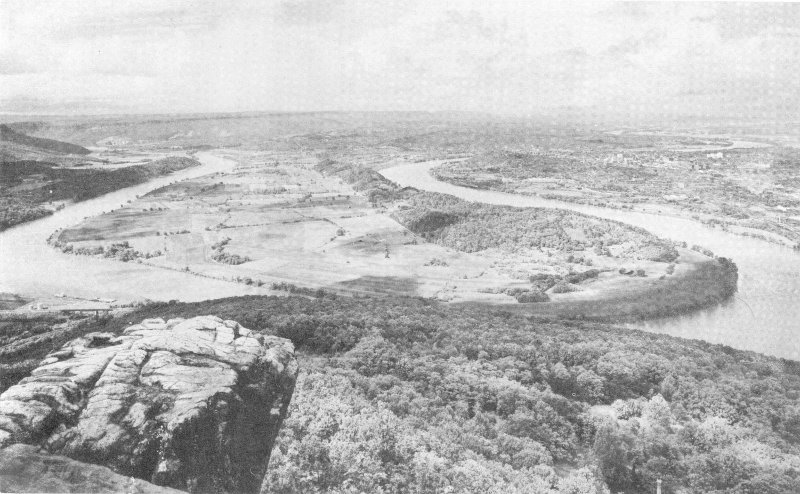
View from Point Lookout overlooking Moccasin Bend with Chattanooga in background.
16
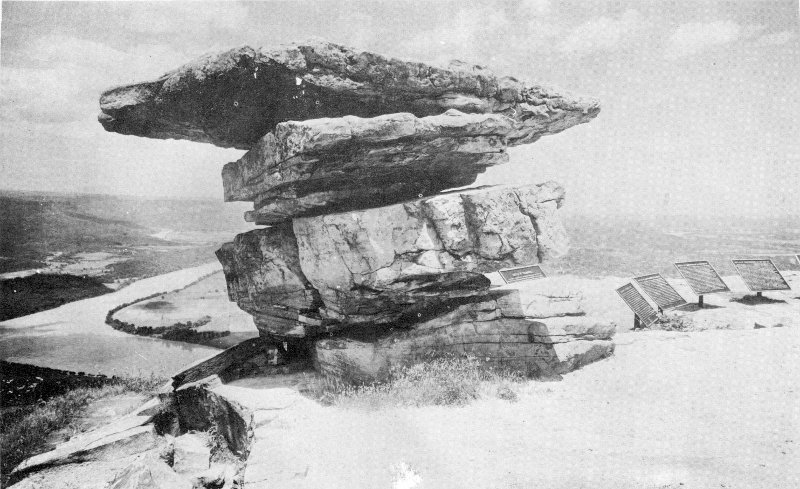
The famous Umbrella Rock, Lookout Mountain
17
Longstreet, with eight brigades, forced their way through, throwing the right and right center of the Union line back in confusion. Rosecrans, McCook and Crittenden left the field. A great many of the troops under the latter named two left the field. Some few of them later rallied and remained on the field during the afternoon. Gen. Thomas, then being the senior officer on the field, immediately assumed command. Holding a pivot with the extreme left of his line, the right end moved back until it reached Snodgrass hill. This gave him an almost impregnable position. With this newly formed east-west line he could check the advance of the Confederates and also cover Rosecrans’ retreat. The Confederates, upon crossing the road, changed front with their artillery. Their infantry swept around like a large gate on hinges. By almost continuous advancing, the Confederates reached the south side of Snodgrass hill where they established their line. Within less than an hour from the time of the break in the Union line, three other brigade commanders lost their lives. Near the Confederate right, Col. Peyton H. Colquitt, 46th Georgia Infantry, was mortally wounded about noon. Colquitt commanded Gist’s brigade of Walker’s division. Lt.-Col. Leroy Napier assumed command of Colquitt’s brigade. A short distance to the south, Brig.-Gen. James Deshler of Texas was killed about the same time. Deshler commanded a brigade in Cleburne’s division. His command was taken over by Col. Roger Q. Mills. Farther to the southwest in the Union line, Brig.-Gen. William H. Lytle, the Cincinnati soldier-poet, was killed while trying to rally his brigade against the Confederate sweep to the north. Lytle commanded the 1st brigade of Sheridan’s division. His command was taken over by Col. Silas Miller of the 36th Illinois Infantry.
THE PEAK OF THE BATTLE
By 2:00 P. M. the battle was raging on Snodgrass hill. This fighting was at very close range and a great deal was hand-to-hand struggling. The Confederates kept charging up the slopes, making every effort to drive the Union troops from their position. They were never able to carry the hill. A few of the Confederates passed over the hill to the right of the Union line. They moved to the rear of Brannan and entered the valley beyond his position. About 3.00 P. M., when the fighting reached its peak, Longstreet sent to Bragg for re-enforcements from the right wing. However, he never received them. On the contrary, he was told by Bragg that the troops of the right wing had been beaten back so badly that they would be of no service to him. There were Confederates in reserve which had scarcely been engaged, if Longstreet could only have gotten them. Along the Union line, it was quite different. At 3:30 P. M., Steedman’s division of Granger’s reserve corps came to Thomas’s assistance. These re-enforcements consisted of Mitchell’s and Whitaker’s 18 brigades. They drove the Confederates from the rear of Brannan, strengthened and prolonged the Union line westward. They also passed out ammunition along the line. While the fighting was so severe the woods caught on fire. This was caused by the artillery firing so low. Hundreds of the soldiers, both Union and Confederate, were burned and scorched beyond recognition. Steedman no doubt saved Thomas from having to retreat from the hill since the latter’s ammunition supply was completely exhausted. It was at this point that Thomas gained the name of “The Rock of Chickamauga.”
THE CLOSE OF THE BATTLE
At 4:45 P. M., Thomas received orders from Rosecrans directing him to withdraw. The withdrawal was not started at this time. There had been severe fighting in the Kelley field during the afternoon. At 5:00 P. M. Col. Edward A. King, 68th Indiana Infantry, was killed in the southeast corner of this field. King commanded the 2nd brigade of Reynolds division. He was the last of the eight brigade commanders who lost their lives on the Chickamauga battlefield. Col. Milton S. Robinson assumed command of his brigade. About 7:00 P. M., Thomas began to withdraw. The Confederates had gained possession of the LaFayette road to the left and rear of the Union line. Since Thomas wanted to re-establish his lines between Bragg and Chattanooga, the withdrawal was made via McFarland Gap to Rossville; then south on the Chattanooga-LaFayette highway to Rossville Gap and Missionary Ridge. Fortifications were thrown up along this portion of the ridge to keep the Confederates in check. The Union line also extended across Chattanooga Valley and up the slopes of Lookout Mountain. Thomas held this line along Missionary Ridge throughout Monday, the 21st. During the night they abandoned this position and moved into Chattanooga. Thus ended the battle of Chickamauga.
There were approximately 124,000 troops engaged at Chickamauga. Of this number, there were 58,000 Union soldiers and 66,000 Confederates. During the two-day battle, there were 34,000 casualties. Of these casualties, there were 16,000 Union; 18,000 Confederates.
The Union army had lost the battle of Chickamauga. Still they had reached their objective—Chattanooga. Bragg’s plan was to attack the Union troops in Chattanooga on the morning of the 22nd. However, this failed to materialize. After some light skirmishing it was decided to call off this attack due to the Union troops being too strongly entrenched. The Union army was still holding their line up Lookout Mountain. Soon this line was abandoned since they realized that Bragg would only have to place forces at any point below in order to have control of the river line of supplies.
REORGANIZATION OF THE ARMIES
Both Rosecrans and Bragg immediately started a reorganization of their armies. The Confederate army was divided into three corps, the commands being given to Longstreet, Hardee and Breckinridge. These three corps had a total of 10 divisions. Wheeler was in command of the cavalry. On the Union side, McCook and Crittenden were removed from their commands of the 20th and 21st Army Corps. These two corps were consolidated into the 4th and Granger was given the command. The Reserve Corps which was formerly commanded by Granger was consolidated into the 14th Army Corps, Maj.-Gen. John M. Palmer, commanding. The Union army at this time had six divisions, commanded by Baird, Cruft, Davis, Johnson, Sheridan and Wood. The Artillery Reserve was commanded by Brannan. This latter force consisted of two divisions, each with two brigades. Col. Parkhurst commanded the Post of Chattanooga.
19
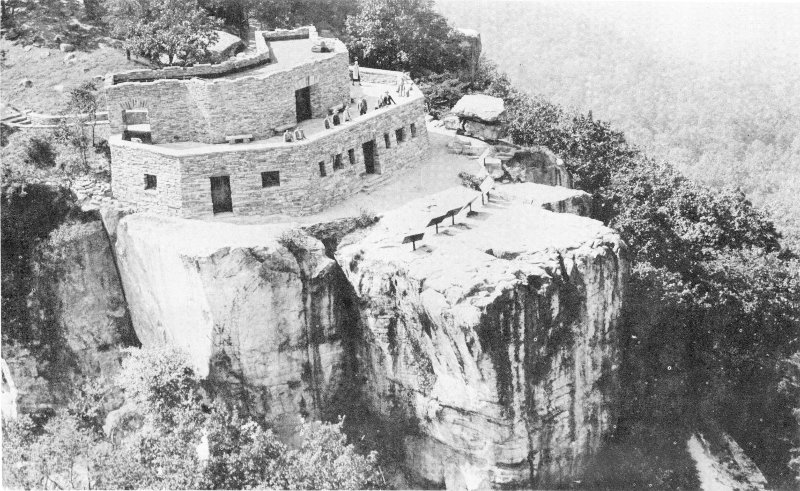
Ochs Memorial Observatory, Lookout Mountain
20
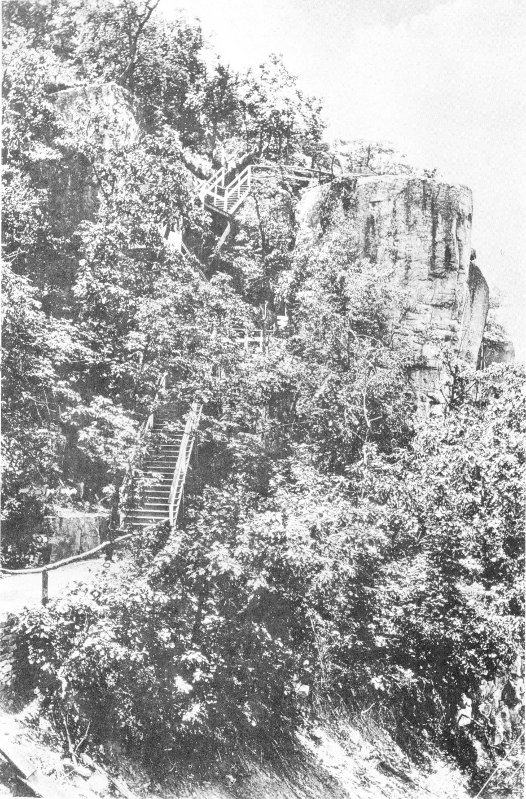
Roper’s Rock. Lookout Mountain Ladder represents where the Union troops reached the top.
21