Chapter VII · SEASONS OF PREPARATION AND PENITENCE
Reading edition
Advent
Advent, as the term is now employed, signifies a season, regarded as preparatory to the Festival of the Nativity of the Lord, including four Sundays and a variable number of days, as affected by the day of the week upon which December 25 falls.
As no evidence has been adduced for an established celebration of the Feast of the Nativity before the fourth century, so it is obvious that we cannot expect to find the appointment of a season of preparation before that date. As a matter of fact, it would seem that the earliest distinct notice of such a season, prescribed for general use, belongs to the latter part of the sixth century; and that the practice originated in Gaul. In a small council held at Tours about A.D. 567 there is vaguely indicated a fast for monks in December, to be kept every day ‘usque ad natale domini’ (can. 17). A few years later, in the south of Gaul, we find what seems a canon of general application, but less exacting in regard to the number of days on which the fast was to be observed. In the ninth canon of the Council of Mâcon (A.D. 581) it is enjoined that from the festival of St Martin (Nov. 11) the second, fourth and sixth days of the week should be fasting days, that the sacrifices should be celebrated in the quadragesimal order, and that on these days the canons (probably meaning the canons of this synod) should be read, so that no one could plead that he erred through ignorance. We have here something that at once reminds us of the pre-paschal season, as observed in some Churches. The season came to be known as Quadragesima S. Martini. But the length of this season (as was also true of Lent) seems to have varied much. The six Sundays which it covered, as we may infer from the canon of Mâcon referred to above, we find indicated probably by the six missae of Sundays of Advent in the Ambrosian and Mozarabic rites. Yet the oldest Gallican Sacramentary records only three Sundays, and the Gothic-Gallican only two[110].
In England, as we learn from Bede, forty days of fasting ‘ante natale domini’ were observed by Cuthbert († 687) and by Ecbert († 729). In both cases, however, it should be remarked, the observance seems mentioned as an indication of exceptional piety[111].
At the close of the sixth century Rome, under Gregory the Great, adopted the rule of the four Sundays in Advent; and in the following century this rule became prevalent (though not universal) in the West.
In the Greek Church the general observance of forty days’ penitential preparation for Christmas does not appear to have been established before the thirteenth century. In the Greek Church of to-day the forty days’ preparation begins on Nov. 15. It is sometimes called the Fast of St Philip, doubtless because the festival of St Philip was celebrated on Nov. 14. On Wednesdays and Fridays the fast is rigorous; but on other days, wine, oil, and fish are allowed.
The practice of the Armenians is peculiar: they observe a fast for the week preceding the Nativity, and for one week commencing fifty days before the Nativity. The conjecture has been offered that these two weeks are a survival of a fast that had originally lasted for the whole of fifty days.
In Churches of the Roman Communion at the present day, the practice as to fasting varies. In Great Britain and Ireland Wednesdays and Fridays are expected to be observed; but in many parts of the continent of Europe there is no distinction between weeks in Advent and ordinary weeks.
On December 16 in the West it was the practice to sing as an antiphon to the Magnificat the first of a series of seven antiphons, each beginning with ‘O’; thus, ‘O Sapientia’ (Dec. 16), ‘O Adonai’ (17), ‘O Radix Jesse’ (18), etc. In the Kalendar of the Book of Common Prayer the words ‘O Sapientia’ appear at Dec. 16. This is not, strictly speaking, a survival of mediaeval times; for it was first introduced into the English Prayer Book Kalendar in A.D. 1604.
The rule of the English Book of Common Prayer (1662) for determining Advent runs thus: ‘Advent Sunday is always the nearest Sunday to the Feast of St Andrew, whether before or after.’ As thus expressed, the rule does not seem to contemplate the case of Advent Sunday falling on St Andrew’s Day. It was a mistake not to add the additional words which were in the Scottish Prayer Book of 1637, namely, ‘or that Sunday which falleth upon any day from the twenty-seventh of November to the third of December inclusively.’ The word ‘or’ does not imply that the second part of the rule is an equivalent of the first; but it gives a rule to meet a case not contemplated in the first part.
The Fast preceding Easter (Lent)
That a fast preliminary to the Pascha was observed in the early Church is beyond question. Irenaeus, in his letter to Victor, bishop of Rome[112], states that at the time there were several differences as to the length of the fast; but in no case was a prolonged series of days prescribed. ‘Some,’ he says, ‘think they ought to fast one day; others, two; others more than two; others reckon together forty hours both of the day and the night as the day [of fasting][113].’ And Irenaeus adds that these differences existed long before (πολὺ πρότερον) the time when he wrote. The words about the forty hours may perhaps be illustrated by passages of Tertullian[114], where he speaks of persons fasting in the days ‘when the bridegroom was taken away,’ or, in other words, the time during which the Lord was under the power of death, i.e. certain hours of the day of the Crucifixion, the twenty-four hours of Saturday, and certain hours of the early part of Easter Day. We shall not delay to discuss the questions connected with the exact time of commencing and of closing the forty hours.
About the middle of the third century at Alexandria the whole week before Easter was observed as a time of fasting by some; but there were those who fasted only on four days; others contented themselves with three or even two; while there were some (evidently exceptional persons) who did not fast even one day[115]. It is plain that as yet no fixed rule was enforced.
In the fourth century we meet with the term τεσσαρακοστή, or Quadragesima. In the fifth canon of the Council of Nicaea it is ordered that one of the two annual provincial Synods should be held before ‘the tessarakoste.’ The sense of the term is assumed to be known, and is not explained. But it must not be inferred that the word necessarily signifies here forty days, or that forty days were assigned to fasting.
The classical authority for the variations of later usages is the passage of Socrates[116], where he describes many differences of practice in his own day (c. A.D. 440) and the varieties in the length of the fast in different countries. At Rome, he says, there was a fast of three weeks, excepting Saturdays and Sundays; at Alexandria and in Achaia and Illyricum a fast of six weeks; in other places the fast began seven weeks before Easter, but was limited to fifteen days, with an interval between each five days[117]. Not long after his time there were two prevailing usages—that of the Churches which deducted from the fasting days Sundays and Saturdays (always excepting the Saturday in Holy Week), and that of the Churches which deducted only the Sundays. The former was the prevailing usage in the East; the latter, in the West. The seven weeks in the East, with thirteen days deducted (seven Sundays and six Saturdays), and the six weeks of the West, with only six days deducted, agree precisely in each having only thirty-six fasting days.
At the time of the Peregrinatio Silviae (about the end of the fourth century), if we may trust the writer, at Jerusalem eight weeks of fasting preceded Easter, which, deducting eight Sundays and seven Saturdays, gave, as she expressly says, forty-one days of fasting. This is highly exceptional, if not unique. At any rate, the practice did not long continue.
The number 36 is nearly the tenth of 365—the number of the days of the year; and this thought struck the fancy of more than one writer. We were bound, they urged, to offer to God the holy tithe, not only of our increase, but of our time. And in the fifth century John Cassian presses this point, and attempts to bring the length of the fast to correspond more closely with the tithe of the year by observing that the fast was prolonged for some hours, ‘usque in gallorum cantum,’ on Easter morning[118].
At a later period the thought of the fasts of Moses and Elijah, and more particularly of the Lord’s fast of forty days in the wilderness, seems to have suggested that the fast of the faithful should correspond in length. The addition of four days—the Wednesday and three following days immediately preceding the first Sunday in Lent—has been frequently attributed to Gregory the Great. But the writings of Gregory testify to his knowing only thirty-six fasting days. And it is now generally acknowledged that no support for the supposition can be based on the language of the collects for Feria IV and Feria VI in the week begun on Quinquagesima, which speak of the beginning of the fast, and are to be found in the Gregorian Sacramentary[119]. The Sacramentary, as we now possess it, abounds in additions later than the time of Gregory.
It is impossible to say precisely when, or by whom, the additional four days were introduced. Approximately we may assign this change to about the beginning of the eighth century, and to Rome. It did not obtain everywhere. It was not till near the close of the eleventh century that the Scottish Church, at the persuasion of the Saxon princess, Queen Margaret of Scotland, fell into line with most of the other Western Churches, by accepting the four fasting days in the week before the first Sunday in Lent[120]. The Mozarabic Liturgy adopted it only at the instance of Cardinal Ximenes about the beginning of the sixteenth century. The Church of Milan still preserves, among its interesting survivals, the commencement of the rigorous Lenten Fast on the Monday after the first Sunday. But in 1563 St Charles Borromeo, then archbishop of Milan, succeeded, against vigorous local protests, in making the first Sunday in Lent a day of abstinence.
The term caput jejunii was applied sometimes to the Wednesday, known as Ash Wednesday, and frequently in service-books to the period of the four days preceding the first Sunday in Lent. Thus, these days are designated ‘Feria IV, Feria V, Feria VI, et Sabbatum, in capite jejunii.’ The distribution of ashes on the Wednesday in the Western Church is a much modified survival and relic of the ancient penitential discipline.
In the Orthodox Church of the East at the present day ‘the great and holy Tessarakoste’ contains, as in the West, six Sundays. But the Lenten offices commence at Vespers on the Sunday (known as Tyrinis, or Tyrophagus) preceding the first Sunday in Lent. In the week preceding this Sunday (corresponding to the Western Quinquagesima) the faithful give up the use of flesh meat, and confine themselves to cheese (τυρός) and other lacticinia. And it may be observed, in passing, that in the Greek Church there are other examples of the week being named from the Sunday which follows it. Thus, ‘the week of Palms’ is the week followed by Palm Sunday[121]. The Sunday (our Sexagesima) preceding Tyrinis is called Apocreos (Dominica carnisprivii). It is the last day upon which flesh may be eaten. After the Sunday ‘Tyrinis’ a more rigorous fast is prescribed; but Sundays and Saturdays (except the Saturday in Holy week) are exempted, so that there are only thirty-six days of rigid fasting; five days in each of the first six weeks, and six days in the last week[122].
The word quadragesima is the source of the Italian quaresima, and the French carême (in old French, quaresme); while our English word, Lent, is simply indicative of the season of the year when the fast occurs, being derived from the Anglo-Saxon Lencten, the spring-time.
Other Special Times of Fasting
I. Western Church—The three fasts called ‘Quadragesima’; Rogation Days; the Four Seasons.
In addition to Advent, which, as we have seen, is sometimes spoken of as the quadragesima of St Martin, and Lent (quadragesima ante Pascha)[123], we find in the eighth, ninth and tenth centuries in writers of Germany, France, Britain, and Ireland references to a third quadragesima which is styled sometimes the quadragesima after Pentecost, and sometimes the quadragesima before St John the Baptist. In the Paenitentiale of Theodore, Archbishop of Canterbury († A.D. 690), it is declared that ‘there are three fasts established by law (jejunia legitima) for the people generally (per populum)[124], forty days and nights before Pascha, when we pay the tithes of the year, and forty before the Nativity of the Lord, and forty after Pentecost[125].’ The remarkable collection of canons of the ancient Irish Church, which is known as the Hibernensis, is of uncertain date, but is attributed by such eminent authorities as Wasserschleben, Henry Bradshaw, Whitley Stokes, and J. B. Bury, to the end of the seventh or early part of the eighth century. The three penitential seasons called quadragesima are distinctly referred to[126]. In the Capitula of Charlemagne, priests are directed to announce to the people that these three seasons are legitima jejunia. In the canons collected by Burchard, Bishop of Worms (A.D. 1006), the three seasons called quadragesima are referred to, and the third is defined as the forty days before the festival of St John the Baptist. Many interesting questions are suggested by these passages with which we are unable to deal here. It must suffice to say that the quadragesima after Pentecost did not long survive. It disappeared, and has left no mark upon the Church’s year.
Rogation Days. There is a general agreement that the observance of the Monday, Tuesday, and Wednesday before the Ascension as days of special prayer and fasting, owes its origin to Mamertus, bishop of Vienne (about A.D. 470), who appointed litanies or rogations to be said, at a time when the people of his city were in great terror by reason of a severe earthquake and a conflagration consequent thereupon. The shaken walls and the destruction of public buildings, as vividly described by Sidonius Apollinaris, may have suggested practical reasons for the litanies being chanted out of doors. The practice of Rogations soon spread through the whole of Gaul, and in the Council of Orleans (A.D. 511), where thirty-two bishops were present, the three days’ fast, with Rogations, was enjoined upon all their churches. In England, the practice of observing the Rogations had evidently been long established when the Council of Cloveshoe (A.D. 747) enjoined it ‘according to the custom of our predecessors.’ At Rome, in the opinion of Baillet, and recently of Duchesne, the Rogation days were not introduced till about A.D. 800[127].
In the East there is nothing corresponding to the Rogation Days; and the ordinary fast of Wednesday is on the Wednesday before Ascension Day relaxed by a dispensation for oil, wine, and fish; for in the East the dies profestus commonly possesses something of a festal character, anticipatory of the morrow.
In the Anglo-Saxon Chronicle the term ‘gang-days’ is used more than once for the Rogation days; and in the Laws of Athelstan we find ‘gang-days’ and ‘gang-week.’ The name originated in the walking in procession on these days.
The Fasts of the Four Seasons (jejunia quatuor temporum). The earliest distinct reference to these fasts is to be found in the Sermons of Pope Leo I (A.D. 440-461), who speaks of the spring fast being in Lent, the summer fast ‘in Pentecost,’ the autumn fast in the seventh, and the winter fast in the tenth month. From St Leo we also learn that the fast was on Wednesday and Friday, and that on the Saturday a vigil was observed at St Peter’s[128]. The observance is characteristically Roman, and is found at first only at Rome, and in Churches in immediate dependence on Rome. Duchesne holds that the weeks in which these fasts occurred differed from other weeks mainly in the rigour of the fast, i.e. ‘the substitution of a real fast for the half-fast of the ordinary stations.’ And he adds the suggestion that on the Wednesday of the Four Seasons, if not on the Friday, the Eucharist was from the outset celebrated[129].
In England the Council of Cloveshoe (A.D. 747) enjoins that no one should neglect ‘the fasts of the fourth, seventh, and tenth month.’ The omission of any notice of the Ember days in Lent will be noticed later on.
In the Churches of Gaul we do not find the Ember days established long before the time of Charlemagne.
At first we find no trace of a connexion between the Ember seasons and the holding of ordinations; and, as is observed by Dr Sinker, ‘everything points to the conclusion that the solemnity attaching to the seasons led to their being chosen as fitting times for the rite[130].’
The Sacramentary that is known as St Leo’s exhibits ‘propers’ for masses of the fasts in the fourth, seventh, and tenth months, i.e. June, September and December[131]; and from these we can gather that on ‘the festival of the fasts’ assemblies and processions had been made on the Wednesdays and Fridays, and a vigil (with the Eucharist) held on the Saturdays. In these there is not only no reference to ordinations of the clergy, but also no reference that would suggest the special intention and significance of these days of fasting. The conjecture is not unreasonable that there was the desire to dedicate in penitence the year in its four several parts to the service of God; but neither the history nor the literature of the early Church is decisive in confirming the conjecture.
The practice of the Church at Rome spread gradually, with some varieties as to the particular weeks in which the three days of fasting were observed. For England the notices of the Ember days are earlier than they are for France. At first, at Rome, the spring fast seems to have been in the first week in March, but afterwards always in Lent. And as soon as it came to be observed in Lent it would (as regards the fast) require no special injunction. This may perhaps account for the omission of any mention of the fast of the first month in the canon of the Council of Cloveshoe referred to above. The fixing of the particular days now observed in the West is generally assigned to about the close of the eleventh century; but in England, as late as A.D. 1222, the Council of Oxford still speaks of the fast in the first week in March[132].
In the Eastern Church there is nothing corresponding to the fasts of the Four Seasons.
There is some uncertainty as to the etymology of our English phrase ‘Ember Days.’ The weight of authority is in favour of the derivation from the Old English words ymb, ‘about,’ ‘round,’ and ryne, ‘course,’ ‘running’; but the New English Dictionary (Oxford) adds that it is not wholly impossible that the word may have been due to popular etymology working upon some vulgar Latin corruption of quatuor tempora, as the German quatember, ‘ember tide.’
II. Eastern Churches.
The fasts before the Nativity and Easter have been treated of under Advent and Lent. In the Greek Church the season before Easter is called ‘the great Tessarakoste,’ for the word Tessarakoste is also applied to three other penitential seasons, (1) to the fast before the Lord’s Nativity, (2) the fast of the Apostles (Peter and Paul), and (3) the fast of the Assumption of the Theotokos. But, though the word Tessarakoste is applied to each of these, there is no apparent connexion between the number forty and the number of days observed as fasting-days; and this is notably the case in regard to the third and fourth. The fast of the Apostles extends for a variable number of days from the Monday after the Sunday of All Saints (i.e. the first Sunday after Pentecost) to June 28, both inclusive.
Examination will show that the interval between these two limits can very rarely amount to forty days; and when Easter falls at its latest possible date (April 25) the first Sunday after Pentecost is June 20, so that the Tessarakoste of the Apostles would in that case be only eight days in length.
The length of the Tessarakoste of the Assumption is fixed, and extends only from Aug. 1 to Aug. 14.
It would appear then that the term Tessarakoste has come in practice to signify simply a fast of a number of days, and has lost all reference to the number 40.
The Exaltation of the Cross (Sept. 14), although regarded as a festival (ἑορτή) of the highest dignity, is observed as a strict fast.
The same is true of the Decollation of the Forerunner (Aug. 29), because of ‘the murder of him who is greater than all the prophets.’ When it is remembered that all Wednesdays as well as Fridays are fasting days, it will not be a surprise to be told that the fasting days of the Greek Church amount in each year to some 190 in number.
The Armenians on fast-days abstain from flesh, milk, butter, eggs, and oil. Every day in Lent except Sundays is kept as a fast. Among peculiar observances is (1) the Fast of Nineveh, for two weeks commencing in the week before our Septuagesima. It is called by the Armenians Aratschavor-atz, meaning, it is said, ‘preceding abstinence,’ and this term has taken shape among the Greeks as ‘Artziburion.’ In the frequent controversies between the Greeks and Armenians the former denounce this fast as execrable and satanic. (2) The Armenians also observe as a fast the week after Pentecost. It has been maintained that in early times this fast was observed in the week before Pentecost, and that afterwards, in compliance with the general rule that the days between Easter and Pentecost should not be observed as fasts, a change was made.
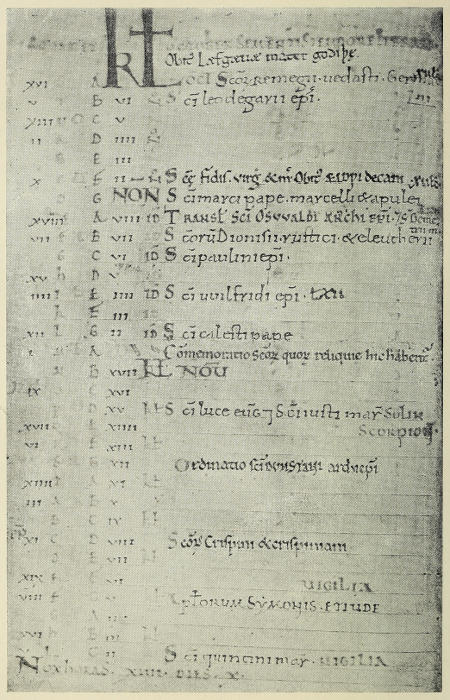
Kalendar of Worcester Book (October)
(Portiforium S. Oswaldi.) Corpus Christi College, Cambridge (MS. 391). Circa A.D. 1064.