THE CHURCHES OF KENSINGTON: INCLUDING SOUTH KENSINGTON, BROMPTON, AND NOTTING-HILL.
Reading edition
KENSINGTON PARISH CHURCH
At the moment of our writing, St. Mary Abbotts, Kensington, is, in a literal sense, without a parish church. The old one has passed away, and the new one is in course of erection. There is, however, the church, with its long, chequered, and interesting history and associations of the past, and, we trust, its equally interesting and still more glorious future. The Venerable Archdeacon Sinclair, the present vicar, his churchwardens and friends must feel themselves the subjects of peculiar and pleasurable feelings as being the chief actors in the great change now coming over the site lately occupied by the old church, and thus placing themselves on a line with a long and eventful history. We must go back far into the middle ages for the origin of the parish church of Kensington, and to the days of dark Papal rule in the land. In the time of Henry I. we read of this church being bequeathed, on his deathbed, by Godfrey de Vere, Lord of the Manor, to the Monastery of Abingdon. It was, however, shortly after claimed by and restored to the Diocese of London, in which it has ever since remained. This was in the thirteenth century. The first endowment of the Vicarage was in 1260, and from time to time it received consideration from various monarchs. In 1520 Queen Mary accorded to it a portion of the 7,000l. granted by Henry VIII. in augmentation of the living of incumbents and scholars in England. The history of the old Saxon church is bound up with that of the manor, which was bestowed, inclusive of the rectory, upon various noblemen by royal grants under several reigns. The collation of the vicarage has belonged to the Bishops of London, pleno jure, about 390 years. While the Reformation was yet struggling against Papal tyranny, as though we were to have a forecast of the Evangelical type and freedom which have marked this church in after times, it possessed a martyr. Not one, indeed, led, as far as we know, to the stake, but cruelly driven from his position and living, and possibly to temporal ruin. In 1527 Sebastian Harris, the curate, was proceeded against for having in his possession a translation of the New Testament and a book entitled Unio Dissidentium, containing the doctrines of Luther. He was, for this criminal offence, cited to appear before the Vicar-General in the long chapel, St. Paul’s Cathedral, and required there to make oath that he would not retain these books in possession any longer, nor sell them, nor lend them, nor make any acquaintance with any person suspected of heresy, and finally adjudged to quit London within twenty-four hours, and not to come within four miles of it for two years!
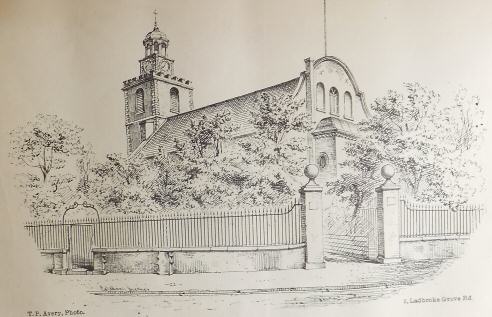
The late church began to supersede the first in 1683. The population even then was said to increase, and the inhabitants, to provide for the increase, built a new aisle on the south side. In the beginning of 1695 the north aisle and chancel were supplanted by others of larger dimensions; and in 1696 it was resolved to take down and rebuild the whole church, excepting the tower at the west end. The cost of this was met by subscription. King William gave 300l.; the Princess Anne 100l.; Earl Craven 100l.; the Bishop of London 50l.; and the Earl of Warwick 40l.; the entire expense amounting to no more than 1,800l. Bowack, who visited the church in 1705, thus describes the rebuilt church in his “Antiquities of Middlesex”: “In form quadrangular, somewhat broader than long, 80 feet from north to south, and hardly 70 from east to west. Paved handsomely with Purbeck stone. The pewing and galleries very neat and convenient. The pulpit and chancel handsomely adorned with carving and painting.” It might be added that the pulpit and desk were the gifts of King William the Third and Queen Mary, in addition to their contributions to the building fund. The pulpit has a crown inlaid with the initials, “W. & M. R.,” and the date, “1697.”
In 1704, the defects of the recent work evincing itself so clearly by the cracking of the building, it was found necessary to take off the old roof, pull down the north and south walls, and rebuild them; which was done at a further outlay of 1,800l.
Again in 1772 the church underwent a thorough repair, and the old Gothic tower was taken down and the later one erected.
Once more in the year 1811 the church showed signs of decay, and it was necessary to underpin the walls, rebuild the vaults, and entirely renovate and adorn the interior. This was done at an expense of 5,000l., which was met by a church-rate of sixpence in the pound, spreading over three years. This church, now spoken of as the “old church,” was a plain brick structure, with no pretensions to architectural display. The interior was composed of nave, chancel, and two aisles, separated by wooden pillars supporting the galleries. It was spanned from the entablature of six wooden columns over the nave, and three large brass chandeliers wore suspended from the ceiling. There was the royal pew curtained round in ancient style, which long continued to be used by high personages from the Palace. Here the Duke and Duchess of Kent and the late Duke of Cambridge worshipped; and from this very pew the Duchess returned thanks after the birth of our present gracious and beloved Queen Victoria. The brows of other distinguished persons have been seen within the old walls. Sir Isaac Newton, Addison (after his marriage with the Countess of Warwick, of Holland House), Lady Margaret Macdonald, “Lady of the Isles,” Wilberforce, George Canning, Sir David Wilkie, Lord Macaulay, Thackeray, &c.—all of whom were residents in Kensington, were attendants at the parish church. Such were the minor glories of the former house.
In 1866 it was seen that its fate was sealed. Competent architects pronounced that it would not be safe to use it for public worship more than two or three years beyond. The closing services were held on Whit-Sunday, May 16, 1869, when sermons were preached by the Bishop of London in the morning and by the Vicar in the evening. The church was crowded—said, indeed, to be “packed to the ceiling.” Collections made on the occasion towards the new building fund amounted to 265l. The church contained no less than 114 monuments and tablets, among which one in white marble was most conspicuous, dated 1759, in memory of the Earl of Warwick, the Countess, and their daughter, Lady Charlotte Rich. The Earl is represented sitting, resting his arm on an urn and clothed in a Roman habit. All the monuments were carefully removed before the church was pulled down, and some, it is expected, will be reinstalled in the new edifice.
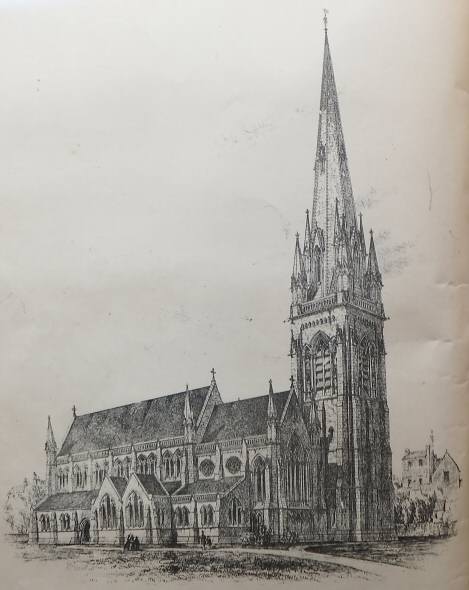
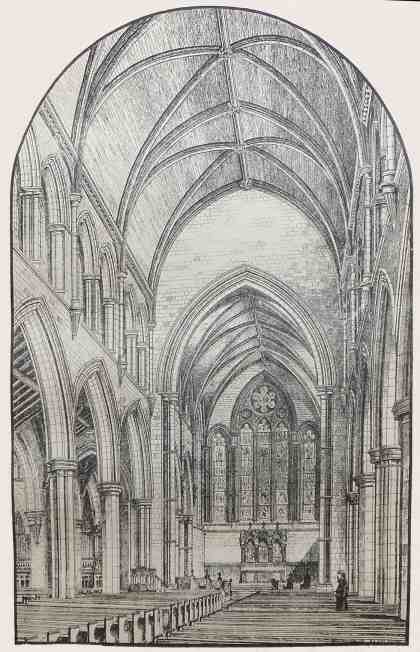
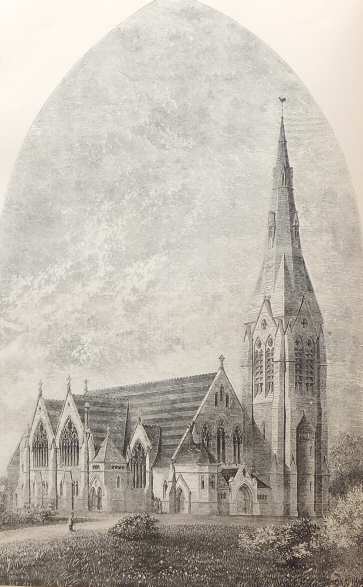
At first it was thought that the entire enterprise of the new parish church could not be undertaken at once, for want of funds, and it was resolved to proceed by degrees, laying the foundation and building vestry and chancel, with a temporary nave. But the funds shortly realised and promised encouraged the deacon and churchwardens to build the whole of the fabric at once, with the exception of tower and spire. The estimated cost of the work when completed is 35,000l., the tower and spire alone being estimated to cost 10,000l. of the amount. The fine old ring of bells—eight in number—which have quickened and delighted the ears of Kensingtonians for many a long year, will find a place in the new tower and be heard again, and probably their joyous music be listened to by generations to come. The spire, when completed, will be 240 feet from the base to the vane. The estimated cost of the interior fittings, pews, pulpit, screen, and altar is 4,460l. The church will be brilliantly lit with gas, and warmed with hot water on the most improved principle. The length of the interior is 155 feet, and its greatest breadth 100 feet, and is capable of accommodating 1,600 persons on one floor. There will be no galleries. The style of the building is Gothic, a specimen of the transitional period from the early English to the decorated, and the architect is Mr. Gilbert Scott R.A., of Spring-gardens; the contractors Messrs. Dove Brothers, of Islington; and the grotesque and other carving with which the church is ornamented is executed by Messrs. Farmer and Brindly. The external material of the building is Kentish rag, with selected Bath-stone dressings. From what can be seen of the work in progress, the ample Bath-stone turrets and mouldings will add much to the effect of the building. In the interior there is no plaster, but the whole of the church is faced with solid Bath ashlar. There are on plan, nave, side aisles, and transepts. The nave will be 107 ft. and the chancel 48 ft. long, and 27 ft. wide; the aisles are 14 ft. 6 in. wide. There are also chancel aisles, and on the north side of the chancel an organ chamber, and the tower—the tower space being occupied with a vestry, from which the clergy will pass to the chancel by a vestibule. The font is on the north side of the west door; it is intended to be a very handsome marble one, with a conical cover, the cost being 400l. Several ladies in Kensington are exerting themselves to raise funds for this particular work. The principal entrance to the church is on the west side, and the door has a sumptuous carving in Bath stone over it. The next principal entrance will be on the south side, through a porch, and another on the north side. A scheme is projected by the ladies of the congregation, and a plan is now preparing by Messrs. Clayton and Bell, to fill the whole church with painted windows. Should this be accomplished, and the eminent firm mentioned be employed to carry it out, it will doubtless add vastly to the effect of the interior.
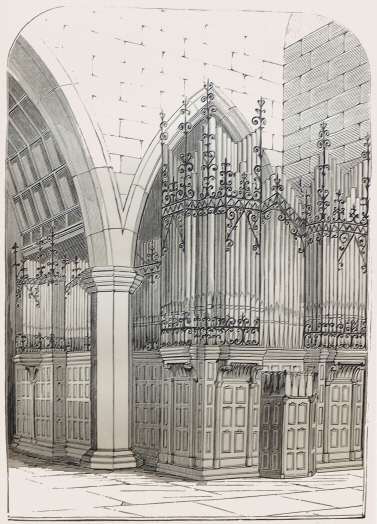
It is hoped and expected by the Vicar that the church will be opened by Easter next (1872). A very fine organ is now being built for this handsome fabric, by Messrs. Hill and Son, of the Euston-road, at a cost of about 1,200l., to be provided by a separate fund. This instrument has three manuals and a pedal organ. Great Organ—containing double open diapason and bourdon, 16 feet; open diapason, 8 feet; ditto, No. 2, 8 feet; gamba, 8 feet; stopped diapason, 8 feet; principal, 4 feet; harmonic flute, 4 feet; 12th, 3 feet; 15th, 2 feet; mixture, 4 ranks; Posaund, 8 feet; clarion, 4 feet. Choir Organ—open diapason, 8 feet; dulciana, 8 feet; Gedact, 8 feet; Gamshorn, 4 feet; Wald flute, 4 feet; flautina, 2 feet; clarionet, 8 feet. Swell Organ—Bourdon, 16 feet; open diapason, 8 feet; salcional, 8 feet; stopped diapason, 8 feet; principal, 4 feet; Suabe flute, 4 feet; 12th, 3 feet: 15th, 2 feet; mixture, 3 ranks; horn, 8 feet; oboe, 8 feet; clarion, 4 feet. Pedal Organ—CCC to F, 30 notes; sub-Bourdon, 32 feet; open diapason, 16 feet; violone, 15 feet; Bourdon, 16 feet; principal, 8 feet; 15th, 4 ft.; trombone, 16 ft.; 5 couplers. Up to the present time about 24,000l. has been received and promised to the Building Fund, to which Her Majesty the Queen subscribes 200l. It will be seen, therefore, that a large proportion of the money has yet to be raised, although no doubt is felt that public spirit will display itself in connection with this great public object, so as to relieve the promoters of all anxiety as to the speedy and successful termination of their work. Archdeacon Sinclair is the treasurer of the fund, and the Rev. W. Wright, of 2, Bath-place, the secretary. The present churchwardens are Charles Greenway, Esq., of 3, Bath-place, who has filled the office for sixteen years, and Robert Harvey, Esq., of 92, High-street, Notting-hill, who has been in office for two years. Attached to the parish church there are national schools, with 200 boys and 130 girls; an infant school with 200; and a ragged-school in Jennings’-buildings—a notoriously low part of the town—with 60 or 70. There is also an industrial school for young girls, where 35 or 40 are taught various useful domestic works. There are Sunday-schools answering to the day-schools; also a district visiting society, composed of ladies and clergymen who visit the poor and distribute alms; and annual collections are made for missionary and other religious and charitable purposes.
The venerable Archdeacon Sinclair has been Vicar for the last twenty-nine years, and was appointed Archdeacon soon after his accession to the Vicarage. It is known to be a wealthy living, but its exact value cannot be precisely stated. The net value, however, is estimated at 912l. per annum. The Vicar is well known and admired both for the elevation of his personal character and his able and truly Evangelical ministry. He is now well stricken in years—being seventy-four years of age—but retains a notable degree vigour, and preaches regularly twice every Sunday, at present to the congregation of St. Paul’s, Palace-gardens, one of the chapels of ease to the parish church. Christ Church, Victoria-road, is the other. Associated with the Vicar in the spiritual work of the parish are at present four curates, the Rev. W. Wright, M.A., the Rev. E. T. Carey, M.A., the Rev. G. Averill, M.A., and the Rev. J. J. T. Wilmot, M.A.
The principal congregation of the old church are, during the re-building, worshipping in the vestry-hall adjoining. Here we had the pleasure of uniting with them on the morning of Sunday, Oct. 15, 1871. The service is a reflection of what it was in the old temple, and what, under the venerable vicar, it is intended to be in the new. It was plain devout Church of England service, earnest and as inspiring as it could be in a plain hall. The officiating clergyman was the Rev. J. J. T. Wilmot, M.A., who took the whole of the service and preached the sermon. The latter was a faithful exposition and application of 1 Tim. i. 16—“Godliness with contentment is great gain.” Some very pointed remarks on the evils of the lust of riches, and the value of the gain of godliness, were delivered in a clear and sonorous voice, and pointed with familiar illustrations. The impression on our minds was that such a method of conducting worship, and such a style of pulpit or platform discourse, cannot but be the means of doing great good.
(See Notes.)
ST. ANDREW AND ST. PHILIP’S CHURCH, GOLBORNE ROAD, UPPER WESTBOURNE PARK.
This church is a recent instance of the modern forward movement to overtake the spreading population of the suburbs. It is situated at the extreme north of the parish, in the midst of a vast mass of new property, which is very properly called New-town, or Kensal New-town. The parish, which was formed out of the extensive one of All Saints’, Notting-hill, has a population of 9,000; and up to the present has been very ill-provided with means of religious worship. Indeed, it seems as if no effort can be abreast of the fast-growing needs of the metropolis. But here is, at least, a large and handsome church situate in a locality in which primâ facie it would appear a very God-send. Alighting at the Westbourne-park Station, and passing over the bridge, a sign-board directs the inquirer along the main Newtown-street, and after four or five minutes’ walk another board points out the site of the church. Or an equally ready way of access may now be found from the Notting-hill Station, by the Ladbroke and recently-opened Golborne-road. This edifice is the fruit of private and public zeal combined. A Christian lady in Bayswater devoted 5,000l. of her abundance, and the Bishop of London’s Fund, together with some local donations, supplied the remainder of 7,000l., which was the cost of the building. It is therefore unencumbered with debt, and has a free and open course before it for Christian usefulness. The ceremony of consecration took place on Saturday, the 8th of January, 1870, when our reporter in attendance wrote that, “Notwithstanding the furious gale over the parish, upwards of 700 ladies and gentlemen were present.” The then new Bishop of London (Dr. Jackson) officiated, and was assisted in the service by the Venerable Archdeacon Sinclair, Vicar of St. Mary Abbotts, Kensington; the Rev. A. G. Pemberton, of Kensal-green; the Rev. A. Campe; and the Rev. R. Towers, the incumbent. A number of other clergymen were also present, amongst whom were the Rev. R. W. Forest, the Rev. Daniel Moore, the Rev. Bryan Hodge, the Rev. W. A. Newton, the Rev. W. A. Bathurst, &c.
The building is of red brick with Bath-stone mouldings, covered with the best Welsh slates, and surrounded on all sides with a strong iron railing. In the exterior there is no other particular feature, except a prettily-shaped belfry, which is an ornament to the east front. The interior does credit to the architect, Mr. Keeling, of Gray’s-inn; who, forbidden the versatility of device he has displayed in St. Mark’s, Notting-hill, St. George’s, Campden-hill, and elsewhere, has given a free adaptation of early French Gothic. There are a nave and aisles, separated on either side by five handsome columns of Devonshire marble, with carved-stone capitals, and supporting an entablature of six arches on each side, from which a lofty groined roof spans the nave. The arches are of variegated brick, with Bath-stone dressings; and the higher part of the side walls in the same, the lower part being faced with Bath-stone ashlar. The choir and chancel are ample in dimensions, the former being furnished with high cathedral-backed stalls, and the former ornamented with neatly-illuminated texts, the Ten commandments, &c., and over the communion-table the words—which it may be hoped, will be a faithful index to the ministry ever to be exercised in the church, “Christ is the end of the law for righteousness to him that believeth.” The organ is a borrowed instrument of very inferior quality, and which is shortly to be supplanted by one more adapted to the beautiful and spacious edifice. Towards this most desirable improvement 40l. only has yet been raised, towards 250l., the estimated cost. As the congregation and immediate neighbourhood are mainly poor, it would be a real boon if some wealthier person or persons beyond the district could devise the means to present to the church a suitable instrument. The church is admirably adapted for the free passage both of light and sound, and the plain but variously-stained windows, without Scripture or canonical characters, add to the beautiful effect of the whole structure. There are no galleries; but the ground floor, well laid out with substantial open pews, supplies accommodation for 950, but is capable of taking 1,000 without overcrowding. We regretted to observe that the congregation present at the morning service were not anything like half the number. The audience in the evening, however, is said to be much larger, a feature very characteristic of poor localities, where many week-day working people are seldom prepared for church before evening on the Sabbath. The place is well warmed by a large stove, which sent a comforting glow of heat through the entire space; and is lit at night from ornamental pillars, each having four branches, and each branch three jets, specially designed by Messrs. Johnson Brothers, of High Holborn. The floors of the aisles, choir, and chancel are inlaid with tessellated tiles.
The first builder was unable to fulfil his contract, which occasioned considerable delay; but ultimately it was taken in hand by Messrs. Scriven and White, of Camden-town, who carried out their engagement to perfect satisfaction.
Church work, in this case, is yet in its infancy, and seems to ask for assistance. There are, however, the seeds of what, let us hope, may prove a future moral and spiritual harvest. The population requires to be wrought upon outside the walls, that they may be brought more fully to comprehend their privileges. It appears quite certain that within there are all the means of good to them. The service is devoutly and earnestly performed in its Evangelical interpretation, the prayers, psalms, and creeds being read, and responded to by the congregation. The musical part is Gregorian plain-song; but sufficiently varied to prevent the sense of severe monotony. The choir is at present a mixture of male and female voices; and there is some room for improvement, which will doubtless come when it is assisted by a better organ. The hymn-hook is the “Church and Home Metrical Psalter and Hymnal.” The Rev. Robert Towers, B.A., the Vicar, was without assistance in the clerical portion of the service. He reads in a distinct and feeling manner; and preaches extempore, purely and properly so. His text was taken from Matthew ix. 12: “They that be whole need not a physician, but they that are sick,” &c. In this discourse in simple language and illustration, we verily believe was preached the truth as it is in the Gospel. We could not but wish that the place had been crowded to hear it. The disease of sin was scripturally set forth as inherent in man’s nature, hereditary, loathsome, contagious, and by all human means incurable. Mr. Towers is a preacher who is not afraid to speak of sin in appropriate terms, telling his audience plainly that “it damns the soul and fills hell”; and that in the world wherever it is found, “the blast of the devil passes over, and carries its accursed infection beyond.” As to its human incurability, “Not even religious ceremonies in themselves could avail. Baptism was not regeneration.” Sin would still reign and increase “its deadly and damnable effects in the soul,” for there was “no getting through or living it down. It was very death itself.” “But thanks be unto God that though the wages of sin be death, the gift of God is eternal life, through our Lord Jesus Christ.” The character and ability of the great Physician, and the Divine mode of cure, through the application of “the precious blood” by “the Holy Ghost” to the repentant sinner, were impressively and unmistakeably set forth, together with the delightful effects in the experience of men. In short, we have never listened to more real Gospel within thirty minutes of time than on the morning of Sunday, November 12, 1871. We sincerely hope the church will soon be filled, from the chancel to the baptistry. There is a Sunday-school with about 150 scholars, and an excellent staff of teachers. A Church of England Young Men’s Society has been established about six months, and supplies a number of very competent male teachers to the school, which at present meets in the church in the afternoon. A near site, however, for a school is already purchased, and will be built upon as soon as funds are secured for the purpose. Mission-rooms attached, capable of holding about 100 persons, are at 15, Appleford-road, where a missionary is employed and holds service Sunday afternoons and Monday evenings; three Bible-women are also doing their useful work in the parish. There would appear, therefore, to be much of the machinery requisite for carrying on the work in this new locality; but the church is entirely dependent on voluntary support, and, the people being poor, that support is as yet but feeble. The weekly offertory was at first adopted; but soon discontinued, being considered unpopular, and boxes were placed at the doors. The financial result, however, is most insignificant; and it is evident that something more is necessary, if this fine church and zealous few are not to be crippled in their energies. An earnest appeal is therefore being made by the Vicar and the Churchwardens, Mr. W. J. Murlis and T. Horsman, for help to meet the expenses. One thing should not be unnoticed; a provident fund is established for the poor, from which the sick, aged, and persons suffering from want of work, are aided in time of need. The society adds two-pence to every shilling deposited by the members when able, and already between 60l. and 70l. stands to the credit of the fund.
ST. JUDE’S, SOUTH KENSINGTON.
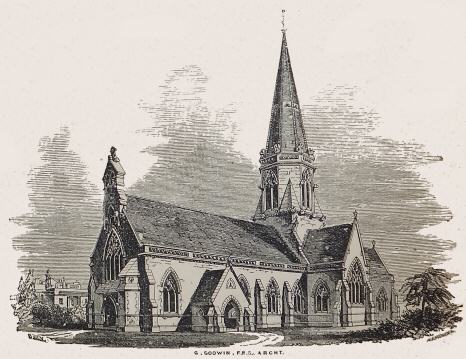
The new Church of St. Jude’s, South Kensington, is situate close to the Cromwell and Gloucester-roads, and stands out boldly, tree-less, and alone, a striking object in the surrounding plain, looming largely in the distance. Nor is it less striking on a closer view. It is in the early Gothic style, some fair detail of which it possesses, especially in the character of the west front, which is a happy composition; but its most remarkable features consist in the number of gables, gable-crosses, terminations, and chimneys, the great size of some of its windows, and a certain stilted appearance that the structure has, altogether a whole not perfectly pleasing or picturesque. The view from the north-west is perhaps the most telling in point of effect, but this would be greatly improved by the addition of the tower and spire, which we hope will soon appear, but there is a certain comfortable-looking bell-turret which seems to say, “I answer all purposes required.”
The church is built of Kentish rag and Bath stone dressings, and the roofs are covered with slate in bands of colour. The gates and approaches when finished will add greatly to the general appearance.
If the outside is peculiar, the inside, perhaps, is more so. The building, which is slightly cruciform on plan, covers a large area, about 135 feet long by 87 feet wide. These dimensions are sufficient to give a great idea of space, and this effect is increased from the fact of the floor being nearly free from the usual obstructing columns; for although there is the general arrangement of nave and aisles, yet the slight iron columns, that support the arcades offer but very little impediment either to sight or sound. The acoustic properties are exceedingly good, and the preacher can be seen and heard to advantage from all points; whilst the large north and south windows admit such volumes of light that there is an entire absence of that “dim religious light” favoured by a section of the English Church.
Architecturally the iron columns are suggestive of having too much to do—looking weak and unequal to the task of supporting the pretty nave roof and coloured-brick arches; this is especially the case with the columns at the transepts. The iron, as we have said, from its lightness, assists sight and sound, but then beauty is sacrificed to utility, which to some extent we think unfortunate; but the church has evidently been designed to assist the preacher’s voice, and therefore we must congratulate the architect, Mr. J. H. Godwin, of Brompton, on his complete success. The prevailing buff colour of the bricks, being imitated in the painting of the columns, is not pleasing, and we think may be altered with advantage. The church will hold 1,700 persons, and the galleries add to the auditorium, but are no assistance to effect, and compel the use of a stilted and old-fashioned pulpit.
The organ-chamber and a capital vestry are at the north-east angle of the church, and the baptistry, at the west end, is well arranged and contains a handsomely-designed early font. The east window is of stained glass, illustrating the life of Christ. The doors are ample and admit of good entrance and exit. The pewing is comfortable and compact. The school class rooms and offices below account for the stilted appearance before referred to.
St. Jude’s is one of the latest and most noticeable instances of aggressive effort on the part of the Established Church. It was originated by the Rev. J. A. Aston, late Vicar of St. Stephen’s, Kensington, to provide for the spreading suburban population in that part, and has cost, as it now stands, 10,000l., which is entirely the munificent gift to the district of Mr. J. D. Allcroft, of 55, Porchester-terrace, and Wood-street, E.C. When all complete, including the site and the vicarage shortly to be erected, the cost will be about 19,000l., the additional 9,000l. being jointly guaranteed by Mr. Allcroft, the Rev. J. A. Aston, and the present Vicar. There is a capital organ, ably presided at by Mr. M. Lochner, having four manuals, and favoured on the choir organ with that very rare stop, the Vox Humana, and capable of enlargement. This fine instrument was built by Mr. H. Wedlake, of Fitzroy-square, at a cost of 700l., and is another of the grand offerings in connexion with the St. Jude enterprise—being the sole gift of Mrs. Walter Powell of Notting-hill. The largest of the three rooms underneath the east end of the church is forthwith to be fitted up. It is capable of holding 400 people, and to be used for the purpose of meetings, Sunday-schools, &c. It is not intended at present to have day-schools.
Although opened for Divine Service so recently as the 23rd of Dec., 1870, it has within three months collected within its walls one of the largest congregations to be met with around London. It is estimated to accommodate 1,700 worshippers—and on a special occasion it might very well contain 2,000. On Sunday morning, February 26, there were from 1,500 to 1,600 present, and the church did not present a crowded appearance. A glance over the large assembly showed that it contained scarcely a sprinkling of the lower or labouring classes. It was composed almost entirely of the aristocracy and gentle people of the district, together with the middle and trading classes. The sittings are let at 2l. 2s., 35s., 30s., and 20s. per year; but as one-third of the entire number are to be free, it may be hoped that the “rich and the poor” will here also meet together before Him “who is the Maker of them all.”
The service is a vigorous rendering of the plain Church Service, cautiously guarded against Ritualistic signs. The members of the choir are not robed in white, nor have they anything to distinguish them but the place they occupy. The clergy wear a simple surplice at prayers, and appear in the pulpit in a black gown. The Rev. R. W. Forrest, M.A., of Trin. Col., Dublin, the first vicar of this new church, was transferred to it from the Lock Chapel, Paddington, having been previously incumbent of St. Andrew’s, Liverpool. In Paddington he enjoyed a well-deserved popularity, which appears still to attend him in his new sphere of duty. In appearance he is about forty years of age, tall and commanding in presence, and possessing a strong pleasant voice, used with ease and heard without effort in the remotest corner of the spacious edifice. His reading of the Holy Scriptures is specially distinct, natural, and impressive. The pulpit discourse was founded on Heb. iv., and part of the 16th verse, “But was in all points tempted, like as we are, yet without sin.” It was a practical and touching illustration of our Lord’s temptations in their bearing upon the experience and present comfort of his people, and, being delivered extempore, brought the preacher into direct sympathy with his audience. The Rev. F. Moran (curate) assisted in reading the prayers—a clergyman who also possesses a clear and distinct enunciation—suitable to the place and the congregation. Among Mr. Forrest’s hearers on the occasion of our visit were Bishop Barker, of Sydney, Metropolitan of Australia, and the Dean of Ripon.
ST. MATTHIAS WARWICK ROAD, EARL’S COURT, SOUTH KENSINGTON.
The Church of St. Matthias, Warwick-road, Earl’s-court, Kensington, is within sight of St. Jude’s, and, like it, stands almost alone in the open fields. It has no boundary walls or fences, unless a broken-down hedge on the east side can be called a fence. Externally, as a structure, there are no very pleasing features; the permanent and temporary portions do not harmonise, and, indeed, the chancel and aisles, the only parts finished, have not in point of detail and design much to recommend their brick walls with bath stone dressings and window tracery of simple character. Of course the temporary portions as such cannot fairly be criticised; yet if we must have temporary churches and of corrugated iron, we see no reason why they should not be picturesque, or at any rate sightly.
Internally the temporary nave has no attempt at appearance or effect, a remarkable fact seeing that the Anglican school generally pride themselves upon effects. A matched-boarded lining to walls and roof is simply varnished, the glazing of the windows is rendered shocking to taste by masses of blue and red colour, and a box pulpit is too much like a box. The excessively plain chancel, arch, and arcades, and general detail of the windows, have evidently been designed with a view to economy; and if, when the nave is built, the same quiet spirit is adopted, we shall be anxious to learn the cost of the structure, which will certainly be a minimum sum, and valuable to note in these church-building days. The style is early English. The dwarf stone parapet and ornamental iron screen across the chancel arch form rather a nice feature, and the stall-seats are of good design.
The east window is partly filled with effective stained glass, and as the predominant colour is blue, it is vexatious that the side-lights, not yet completed, are screened with green blinds.
Two figures of saints over the altar-table are not clearly seen—one might be St. Matthias; and the reredos might as well have English written on it—the unlearned could then understand and appreciate.
St. Matthias stands in the midst of a poor district, which was originally cut off from St. Philip’s, Kensington. A temporary iron church was first opened on April 17, 1869, and the permanent chancel was consecrated and opened on the following 10th of July. Nave and chancel together accommodate from 700 to 750 persons. The cost of the whole structure has been 4,800l.; and it is intended if possible to build the nave this year 1871, which will cost about 4,000l. or 5,000l. more. The architect is Mr. J. H. Hatrevile, 5, Southmolton-street. There are no appropriated sittings; all are free, and the church is always open for public or private prayer. It is supported by the offertory alone, which in 1869–70 amounted to the sum of 1,100l., and in 1870–71 it will amount, we are informed, to 1,600l. Out of this all the expenses of the church and the charities and the clergy are met. There are three priests attached—the Rev. S. C. Haines, M.A., the Vicar; the Revs. H. Westall, A.K.C., and S. Martin. There is a superb organ built by Jones, of the Fulham-road, with three manuals, forty stops, and 2,255 pipes, at a cost of 700l. The choir is large—about fifty in number—under the precentorship of Mr. J. Elwin, of 21, Coleherne-road, Brompton, professor of musical elocution. During Lent there is daily Communion at eight a.m., four services every day, and five on Friday, when there is an extra Communion at eleven a.m.
The service is Gregorian plain song, and on the morning of March 5, the second Sunday in Lent, the ceremonial is described as being extremely ornate and symbolical. Our representative says: The chancel is unusually deep, the space between the altar and the railing being apparently designed with a view to Ritualistic development. In fact, it is a large stage on which a numerous company can play their parts. The choristers wear surplices, and the clergy, over the surplice, a stole, which is at the present season of the true Lenten violet—according to the practice of Ritualists—who use the symbolic colours of violet for Lent, black for Good Friday, red for Martyrs, yellow for Confessors, and so on. The altar-cloth and pulpit-cover, and even the offering-bags, are also of the same tinge, the latter being embossed with a white cross. The prayers were intoned by Mr. Westall, a young gentleman whose voice is in some danger of collapsing from sheer tension of monotone. The Ritualists have attained perfection in denying to nature its own freedom and flexibility of voice. The lessons were read by the second curate, Mr. Martin, who, we learn, is new to the church, and whose voice, trained in the true Anglican style—rises always where it ought to fall, and vice versâ. The bowings, curtseys, and genuflexions of this service are so numerous and complicate, we almost despair of tracing them. Not only in the Creed, but in every other part where the name of the Saviour occurred and on every repetition of the Gloria Patri, there was a low curtsey as long as the body could be conveniently bent, which had a most singular effect in the general aspect of the congregation. In the Nicene Creed, in the part “Light of light” and up to “rose again,” there was a sudden drop of voice to a mere whisper—which, being quite unprepared for at the moment, might startle one into the idea that the congregation and choir had simultaneously lost their vocal power. But all this was merely dramatic. On entering the Communion Service the processional hymn is sung, during which the clergy three abreast commence their pilgrimage to the altar. They approach it by three stages, pausing at every one, and on arrival bow and cross themselves, and then dispose themselves on the left, in line with their backs to the congregation—one a step above the other—the highest reading the Commandments, turning meanwhile to the people. They then break line again, and one reads the Epistle for the day; they form inline again, and the centre figure, the Vicar, reads the Gospel, during which the curate at his feet turns towards him obliquely, bending in a worshipping attitude. After the Creed—and so as to chime in with the close—the Vicar passes with a sharp step to the pulpit, which is as close to the chancel as it can be; and on entering it, whilst the people are still standing, crosses himself, fronting them, and repeats quickly, “To God, the Father, Son, and Holy Ghost, Amen,” and at once announces his text. The short prayer before sermon is dispensed with. The motion with the finger to the two shoulders and the forehead is the great feature at this point.
The sermon was founded on 1 Cor. i. 20—“Where is the wise? Where is the scribe? Where is the disputer of this world? Hath not God made foolish the wisdom of this world?” Having on the previous Sunday treated of bodily mortification and fasting, the preacher would now speak of the subjugation of human imagination, intellect and reason to the dominion of truth—of the folly of the “wise,” the “scribe,” the “disputer of this world,” in view of the “wisdom of God.” In what was mainly an extempore address, aided only by copious notes, and accompanied by much declamation and earnest action, Mr. Haines denounced the intellect and literature of the day as extremely sordid, timeserving, and egotistic. It was “a day of advertisements,” when intellect was “bought and sold over the counter,” when one might “buy all the intellect of England for gold, and for so many guineas have so many pages;” and if in any case pride prevented this degradation, literature was then “but the expression of an extreme egotism.” Periodicals and books were “pretentious and misleading;” the novels of the age embodied its “sensualistic intellect;” our art in its exhibitions handed down pictures and ideas of depravity. “It would be well if the scientific world would send forth no more theories.” In short the preacher held in the profoundest contempt all the ordinary exercises of the human mind and reason. Perverted intellect had produced anarchy in America, revolution and bloodshed in Europe; and in the history of Christianity there had been nothing but contention and division since the intellect of the church first departed from the “holy Catholic religion,” and so rendered government impossible. The preacher eulogised, indeed, intellect sitting at the feet of Christ; but this was so explained as to mean, in fact, sitting at the feet of “Holy Catholic Church.” This part of the sermon was, to our minds, a virtual denouncement of the Protestant Reformation. In speaking of the mysteries of religion against which the world’s intellect revolted, the preacher adverted to that one, “the sacrifice of the altar,” which they were then daily celebrating. “Christ was in Heaven, but he was also there, yea,” glancing round to the spot, “on that altar was the real body and the real blood of our Lord.” Would they deny these mysteries because they could not understand them? Were there not mysteries in all nature? and did not the saint see all around him the great sacrifice of nature—the outward and visible sign of the inward, present, and omnipotent God? After sermon the preacher returns to the altar, when a fourth functionary appears, whom we suppose must be termed an acolyte. He carries in his hand a taper, with which he proceeds to light the candles in the candelabra at either end of the altar, each having seven lights. A hymn is being sung and the collection made at the same time, and when ended the offertory bags are borne to the altar, and, being solemnly placed upon it, one of the priests, prostrating himself before it, raises the offering high towards the cross, and there holds it for some moments in the act of consecration, after which the Benediction is pronounced. The church in the morning is filled with a congregation chiefly composed of the higher middle classes of the people, and in the evening principally of the poor of the immediate locality.
ST. PHILIP’S, SOUTH KENSINGTON.
A pleasant walk on a Sunday morning from westward, through that fashionable part of Kensington known as the Addison-road and Warwick-gardens, brings us to the Church of St. Philip, which stands at the corner where the Earl’s-court and Pembroke-roads join. It is a brick structure in the perpendicular decorated style belonging to the fifteenth century; and as, with its modest spire, it comes into view, and the worshippers slowly moving up every main approach, in response to the “church-going bell,” the whole produces a very pleasing effect. As one silently views the interior a somewhat mystical impression imperceptibly steals upon him. The architect, Mr. Thomas Johnson, of Lichfield, would appear to have studied and followed out the ideal of a former period in the details generally. This is especially seen in the windows, the arcades, &c. The nave has a lofty aspect, much more so than would be expected from the exterior view.
This church was built in 1858, and its district taken principally out of St. Barnabas, with a small portion from the old Kensington parish. It originally had accommodation for 1,000, but, in consequence of the increasing demand, it was enlarged in 1862 to 1,400 sittings, 500 of which are free. The cost of both the original building and the subsequent enlargement has been almost entirely borne by the Vicar, the Rev. J. Dickson Claxton, M.A., of Trinity College, Cambridge, he having been aided only to the amount of 1,400l. or 1,500l. in subscriptions, which were towards the first erection. The enlargement was carried out at his own sole cost. The great need of this was manifest from the magic rapidity with which population increased in the neighbourhood of the church. It stood at 8,000 until recently—the spring of 1869—when the formation of the sub-district of St. Matthias reduced it to 5,000. But so rapid is the growth that it has already again risen to fully 6,000. There is at present but one curate, the Rev. J. C. Sykes, B.A., of Queen’s College, Cambridge.
Three schools are in part connected with the church, being maintained in conjunction with St. Barnabas, and containing altogether upwards of 600 children.
The other charities maintained alone by St. Philip’s are several. There are “A Provident Fund and District Visiting Charity,” a “Maternity Charity,” “Work Charity,” “Soup Charity,” “Blanket Charity,” and “Old Clothing Charity.” Taking the year round it would seem that a large amount of temporal comfort most be distributed over the poorer parts of the district by these benevolent operations. The church itself contains several objects of interest worthy of note. There is a splendid reredos of Caen stone and alabaster, and a peculiarly handsome altar-rail of vert antique and alabaster. Over the altar is a beautiful stained window by Heaton and Butler, at the west end an immense and magnificent one to the memory of the late Lord Holland, also two other small memorial windows, all by the same firm. The organ is a superior instrument by Walker, of the Tottenham-court road, and cost upwards of 600l. It is played by Mrs. Higgins—whose husband holds the post of master over a choir without surplices, chiefly voluntary, aided by a few paid voices. Under the same direction there a large choral association connected with church. The services are principally, through not exclusively, Anglican. In the morning the responses are intoned, and at night the choral is adopted. Daily prayer at 9.30 a.m. and 5 p.m. On Sundays there is a children’s service at 9.30 a.m., and full service at 11 a.m., 3.30 p.m., and at 7 p.m. The weekly offertory, and proceeds of the Communion Service twice a month, are solely relied upon for the maintenance of the charities and church expenses, in lieu of church rates.
The vestments of the clergy are of the simplest and most irreproachable kind, and the performance of the service according to the order of the Common Prayer. There is certainly no trifling with rubrics, and no need for dexterous evasion of ecclesiastical injunctions. Yet the service we attended was earnest and solemn. The curate read audibly, and the preacher, who happened not to be the Vicar, was scholarly and Evangelical. But, on the whole, the service might be deemed a little too quiet to be a perfect model of what a service in our English Church should be. As to the general ministry under the Rev. J. D. Claxton, whom we had not the pleasure of hearing in propria persona, its effects must be taken as proofs of its acceptableness and usefulness. Commencing, as we understand, with an original congregation of ninety, he has had the gratification of seeing it increase to 1,400, and that, too, whilst so many other churches and chapels have risen all around. The congregation appeared to our eye to bear that settled and orderly aspect which is one of the readiest proofs of ministerial success and pastoral fidelity; and not the least pleasing feature was the large number of the poorer people who filled the free seats, and regarded with attention and reverence every part of the service. An official kept the door, who cannot be termed a verger, scarcely a beadle, but who, if he had no rod or robe, or staff, had a coat with bright buttons fixed upon a brown cloth. He handed the stranger over to the care of a matronly-looking female inside, with a white cap, who very courteously led the way to a seat. When there, the general effect upon us undoubtedly was that we were in a church of the people—one where the people were to be found quite at home in their worship of the Creator, and free from the stiffness and restraint of more tinselled and conventional forms.
ST. STEPHEN’S, GLOUCESTER ROAD.
St. Stephen’s, close to the Queen’s-gate-gardens in the Gloucester-road, South Kensington, is a very handsome and well-proportioned church, and is a pretty object seen from the Cromwell-road. The composition of its west front is remarkably good, and indeed there exists an agreeable harmony in the design and in the quiet general tone of colour in the stone of which it is built that is pleasing to the eye. There is a refined look about the building, and perhaps it would not be too much to say that it seems accustomed to good society. To the architect there are some portions of the detail rather interesting. The cloistered doorways beneath the buttresses, the triplet and rose-windows of the east front, and the north porch and back turret are all worthy of remark. The interior is exceedingly effective and elegant. Again the harmony strikes one as perfect; there is a peaceful influence produced by the quiet colouring and grey columns and excellent proportions of the church, such as ought to belong to the house of God. There is nothing glaring, nothing particular to arrest or attract the eye, yet every part is worthy of inspection, and the parts taken together produce one of the best and most exquisitely charming interiors with which we are acquainted in this neighbourhood. The plan of the church may be said to be cruciform, and is divided into a nave and aisles, north and south transepts, and chancel and aisles. The grey columns of the nave support the arcades and clerestory, and the light nave roof springs from angel-corbelled columns. The chancel arch is well-proportioned, and the dog-tooth enrichments harmonise with the caps of the columns. The chancel is parted from the aisles by light screens supported by alabaster columns, and on the north side above the screen is the organ loft, and the south side is occupied by a gallery. The chancel itself is simply decorated, the Communion-table space without any colouring other than of the softest kind. Three figures of saints occupy the triplet—St. Stephen filling the centre, and St. John and St. Paul the side lights; the rose window over has the Saviour in His Ascension scene. The stone pulpit on the north side of the chancel arch is well designed, and its little alabaster and coloured marble columns relieve the still colour of the stone. The font, of similar design, occupies a slight recess in the baptistry, close to the north porch door. An octagonal vestry is at the south east angle of the church. A new west gallery is not exactly an improvement to the effect. The pewing and stall seats are of good design. The passages are floored with tiles of simple pattern. The architecture is early English.
The one drawback to the external appearance of this church is its want of relative elevation. Its base appears to drop about two feet below the level of the roads and ways which form its approaches. The fault was that of the architect, who did not calculate on the effect of making-up roads where they had not previously existed. In 1866, when the church was built, that part of South Kensington was only beginning to open up. The base of the edifice should, therefore, have been raised. But instead of this the architect appears to have proceeded in utter disregard of the near and certain future of the locality. The result is that whereas originally steps upward were required to enter by the gates, it is now necessary to descend in reaching the interior; and a flat and depressed aspect is thus given to a building which would otherwise have been a most prominent and pleasing object in the view. We understand it is intended to add a spire to the edifice very shortly, and this will probably somewhat relieve to the eye the defect of which we have spoken.
The church was built under the ministry of the Rev. J. A. Aston, M.A., to replace an iron church which for some time he occupied on the opposite side of the road. The same continued minister until the autumn of 1870, when he was succeeded by the present officiating minister, the Rev. J. P. Waldo, M.A. The progress made under Mr. Aston’s pastorate is seen from the circumstance that it was found necessary in two or three years to increase the accommodation by the building of galleries on the west and south sides. This work was completed in March, 1870, at a cost of 600l., by Mr. Aldin, of Queen’s-gate-place. The cost of the whole, when completed, we are told will not be less than 20,000l., a very high figure when it is considered that the church has no more land than that on which it stands, and the narrow bare paths around it. There are about 1,150 sittings, which let at an average of 2l. 2s. per annum each, leaving about 150 sittings free—1,300 in all, which appear to be well occupied by a congregation of a superior class. Out of the pew-rents and collections the clergy and the church are supported. There are temporary day and Sunday schools attached, situated in the Queen’s-gardens, near the site, where from one to two hundred children are instructed. The organ is very ably played by Mr. Lowe. The choir is composed of both males in plain dress and females.
The prayers were read and also the psalms, with the exception of the first, which was chanted. There is no variance from the accepted English and Evangelical mode of conducting worship. The hymn book is the “Church and Home Metrical Psalter and Hymnal,” selections from various authors. The congregation did not join with so much zest and animation in the service as could be desired, except in one hymn—“Lord of the Worlds above,” &c., the peculiarly lively words and music of which appeared to evoke devotional feeling and dispel restraint. We are sorry, however, to see this hymn, which in its original dress, as it stands in another hymn-book, is one of the finest in the language, so sadly mutilated by the simple act of transference from one collection to another. We deplore the liberty which editors of our numerous collections sometimes take with the productions of even our best hymn-writers. Why should this be so? We have never seen an alteration of this kind which has not been for the worse as it regards both thought and expression. The curate reads well and agreeably to the ear, in a voice more remarkable for clearness than strength. The vicar, the Rev. Mr. Waldo, is still new to the audience, having been at St. Stephen’s about four months. His vocal powers and reading are good; the former have not that compass which enables them to meet the requirements of the large congregation with the greatest ease. The sermon, founded on Gen. xlv. 5, was an elegant piece of composition, not only read, but delivered in the reading, which is not always the case. The thoughts presented on the general and special providence of God, as unfolded in the history of Joseph, were those of a devout, thoughtful, and cultivated mind, and most comforting to the troubled and disconsolate. From what we saw and heard, we have much pleasure in recording our belief that good Christian work is being done at St. Stephen’s.
CHRIST CHURCH, SOUTH KENSINGTON.
This church, which stands at the foot of the Victoria road, might have been much better placed, so as to be seen in perspective, which indeed its near appearance would warrant. Its fair and well-proportioned tower and spire would then have formed a striking object, and might have been visible even from Kensington-gardens. Could it be lifted out of the pit in which it seems to nestle at the dark end of a road which is no thoroughfare, and out of its unsightly surroundings in Cornwall-gardens, it would be an immense benefit to the mere appearance of the building. The building in itself is generally very simple, but not without effect. It is built of ragstone with bath-stone dressings, and covered with slate. The enclosure is nicely planted, neatly kept, and fenced with dwarf walls. Internally the church is unimposing. The nave and aisles are surmounted by a heavy-looking but plain roof—without clerestory lights. The tower space on the north side of the chancel, is occupied as an organ chamber. The chancel is quite plain and without aisles. In the windows, which are of good design and filled with glass of geometrical patterns, there is an absence of stained glass and decoration; which in reality the church requires, to relieve that tame and cold look, which some day might be slightly altered with advantage. A large gallery at the west end does not tend to lighten the interior aspect of the church; nor do the exposed heating pipes, which it would be better to conceal from view. The font, pulpit, and pewing are of plain design, and the passages are paved with red and black tiles, laid diagonally. Christ Church is a chapelry of ease to the parish church of St. Mary Abbotts, Kensington, or rather a trust chapel, served by the Venerable Archdeacon Sinclair, Vicar of Kensington. It was opened and consecrated July 23, 1851, by Bishop Blomfield. The present officiating ministers are the Rev. W. Wright, the morning and evening preacher, who has been curate since 1855, and is now termed the “senior curate.” The Rev. E. T. Carey is the second curate and afternoon preacher, and entered upon his duty in 1869. Both ministers are much esteemed; and from the impressions of our visit the estimation in which they are held is well founded. Mr. Carey read the prayers and lessens in good voice, and with an evident mental appreciation of their religious sense and application. Mr. Wright officiated in the Communion Service and preached the sermon. His voice is penetrating, if not full, and leaves the most dull-eared without excuse. His sermon was an able and faithful exposition of Psalms 142 and 4th verse—“Refuge failed me; no man cared for my soul.” The distinction between the circumstances of the Psalmist and his times and our own was finely drawn. In the former case every incident of temporal life—adverse or favourable—was interpreted as a certain indication of the Divine favour or displeasure. With us it was not so much so. We had in general every spiritual advantage; although there were yet some, as at the East-end of London, who, from the scarcity of religious provision, might still say, “No man careth for my soul.” In short we quite thought we were listening to a charity sermon; and after so touching an appeal on behalf of the spiritually destitute, prepared ourselves for a collection. Mr. Wright, however, has our best thanks for touching in so delicate a manner a very sensitive chord in our moral nature.
The chapel is capable of holding 700 persons, and there are less than 100 free sittings; but although it was supposed to have not only its own, but also many of the congregation of the parish church—which is closed for re-erection—it was by no means full. It is hoped, when the central church is completed and reopened, it will have a good effect in the locality, and help to supply the dependent church with an adequate congregation. We have known churches and chapels in the worst situations, under special influence, to be filled with devout worshippers; but they are occasions too rare. Would that we could see them more frequently! One remark made by the preacher in speaking of the need of churches at the East-end was much to the point. It was to the effect that it would be useless to build churches unless there were efficient ministers to carry on the service and occupy the pulpit. Mr. Wright appears to have reflected long enough to learn that the greatest problem of the day is, after all not how churches may be built, but rather how, when built, they may be suitably and successfully served. Here is a good organ under the care of Mr. Brain, of the Eldon-road, but no choir. It is, therefore, purely congregational singing assisted by the organ.
ST. MARY’S, WEST BROMPTON.
The Church of St. Mary, West Brompton, from its position in the centre of the Boltons, can be seen from many points of view to great advantage. It is in the decorated Gothic style, and is an exceedingly good specimen of the Revival of Gothic architecture, having been built some fifteen years ago. Built in the shape of a cross, its tower and spire rise at the intersection of the nave, chancel, and transepts, and are in excellent proportion. The spire is octagonal, and is terminated at its junction with the tower by a pierced parapet with angels at the angles. The octagonal portion of the tower is continued downwards below the tower lights, when it becomes square, with corbelled angels at the four corners. The west front is well designed, and surmounted by a corbelled bell turret, in which hang the only two bells the church possesses, though there would appear to be ample room in the empty tower for a chime. The ragstone of which the church is built, with Bath stone tracing and dressings, has now enough of age to give a softened look to the exterior generally, and the young spring foliage and well-kept surrounding gardens lend their aid to make a rather pretty picture. Internally the church is effective, especially the view from the west end; but the absence of the usual nave arcades and aisle give a long, narrow look to the church, and take from the idea of its size, as at this point the transepts cannot in any way be seen. The nave roof is heavy, and the apostle corbels that support it too large and too near the eye to be in good taste. The choir stalls have lately been extended westwards under the tower space, and the pulpit, of very peculiar design, being more properly a rostrum, though by no means unsightly, stands at the north side of the nave arch, and a recently-erected gallery across the north transept contains the organ. The small vestry is at the north-east angle of the church. The chancel has lately been redecorated and made to agree with the usual arrangements of the Anglican school of worship. The stained glass in the east windows is poor, representing the Ascension some geometrical patterns fill some of the other windows, likewise of a very poor character. The pewing is very plain, and the passages are paved with tiles. The stone font is large and very well executed. The church, as we before said, is a Revival church, and as such it would be unfair to criticise it too much; but, on the contrary, much praise is due to the architect, Mr. Godwin, for giving so fair a specimen of Gothic work when the art was at so low an ebb.
The performance of Divine worship at St. Mary’s is decidedly of the High Church order, with a Ritualistic tendency. In this it differs from what it was under Mr. Swaile, the first minister of the church, and even under Mr. Pearson the second. The present vicar, the Rev. W. T. Du Boulay, M.A., has been there about two years, and during his time a constant Higher tendency has been observed. This has been traceable in the large increase of public services and Eucharistic celebrations. The latter takes place every Sunday morning at eight, and on every alternate Sunday at the eleven o’clock service as well. After Lent we understand a still further increase was intended in the number of these in ordinary. During Lent and other great festivals there is a celebration every morning at the early service, on Good Friday two, and on Easter Sunday three. Apart from this, the whole aspect of things in the chancel looks towards Ritualism. Thus, for instance, the Communion-table, or what High Churchmen call the “Altar” or “Altar-table,” is surmounted by a large gilt cross, which from its exceeding brightness forms a most conspicuous figure—also two large candlesticks, and other lustrous objects. The cover is of deep violet, trimmed with white, and all the moveable furniture, even to the cushions of the chancel, desks, and pulpit, are of the same—this being the colour used by the High Church party during Lent. The choristers number over thirty, and are led in procession to the choir, the people all rising as they and the clergy enter. The vestments are a surplice with the cassock underneath, and visible below the knees; and in addition, the clergy themselves wear the usual sign of degree. No change of dress is made for the pulpit. The Curate—the Rev. Arthur Veysey—intones the prayers, in, we may say, the most perfect style we have yet heard out of a cathedral. His voice is sonorous, and he has cultivated the manner of intoning to a high degree. He has certain little varieties, too, of his own, which render such a method of performing worship as pleasant as it can be. Thus the note is altered in the absolution, and the voice dropped to the lowest tenor, and at the same time quickened; and then again at the Lord’s Prayer a strong bass is put on in a low key. In like manner the Collects were sung quickly in an undertone. At every mention of the Saviour’s name, whether in the prayers, the Gloria Patri, creeds, epistle, or gospel, the reader bowed. And as in the latter it was often named, the frequent bowing of the head must have been a great task; for in this case the Curate read the gospel as well as the epistle, passing in the act from one side of the chancel to the other. The Vicar read the lessons well and distinctly, and preached the sermon. On entering the pulpit the customary invocation was not used; but, standing erect and glancing eastward, the preacher simply uttered the words, “The Father, Son, and Holy Ghost,” and at once proceeded. Too little, to our minds, was made of the sermon; it was a short homily in the midst of the service, very good in its way. It consisted largely of exhortation, found on Phil. ii. 3, in which the Saviour was presented as an example of passive and active obedience, and some very practical remarks were made. Quietly useful this style of preaching may be when based on pure Gospel doctrine and view; but it is one from which the old power and higher effect of the pulpit are absent. A novelty, at least to us, occurred in this service. Instead of the usual hymn on the minister entering within the Communion rail, another form is adopted, called the “Introit,” which is a selection of Scripture adapted as much as possible to the day, and sung as an anthem by the choir. To our modern ears the Introit is new; but it is in reality an old thing, in this and some other instances revived. In the first Prayer-book of Edward VI. there is a psalm, containing something proper to the day, printed before every collect, epistle, and gospel. This, from being sung or said whilst the minister made his entrance within the rails, was called introitus or introit. There is, therefore, an ancient reference in the adoption of this form; and by adoption of the name as well as the form, the Vicar of St. Mary’s betrays a certain mediæval direction in church matters. It is, in our opinion, far from an improvement. The “Introit” is a poor substitute for the devotional hymn, in which all the congregation can join, and which has no particular reference to the minister’s bodily movements.
There are connected with this church, a National School, situated in the Chelsea-grove, Fulham-road, and a Sunday-school, containing about one hundred scholars; and it is a pleasing circumstance that the ordinary afternoon service on Sunday is given to the children, and is called the “Children’s Service,” consisting of the Litany and catechising. There is also a lending library in the schoolroom, where books are given out and exchanged every Monday between twelve and one o’clock, the subscription being only one penny per month. There are District Visitors, and a “Mother’s Meeting” is held at the Vicarage on Mondays from 3 to 5 p.m. There are also a Maternal Charity, Coal, Clothing, Shoe, and Blanket Clubs, and even a “Guild” or association for servants. It is clear that the Rev. Mr. Du Boulay has laid himself out for extensive influence and usefulness, and, there is no reason to doubt, in all Christian sincerity. But there are certain forms and ecclesiastical signs about his church arrangements which in many minds cause fear, lest his zeal should not in its effects prove to be of the purest Evangelical character. We regret this very much, as the impression on our own minds of his personal spirit was most favourable. It is of course within his power to remove anything from before his congregation that tends to impair his usefulness. Experience will, no doubt, suggest to him that the Ritualistic line, or, what is really the same, the High Church, is not that in which a clergyman can now be so religiously useful as we are convinced Mr. Du Boulay desires to be. He has daily matins at 8 a.m. and evening song at 5 p.m., choral celebrations at great festivals and on the third Sunday in every month; and the Litany on Wednesdays and Fridays at 11 a.m. The musical arrangements for Easter Sunday, were very extensive and elaborate, and the music entirely Anglican. Less singing, more genuine prayer, with able and earnest preaching, would, as many think and feel, be a vast improvement in the services of this church. The choir is a partly paid one; and the organist, Mr. Buttery, of 173, Piccadilly, is highly esteemed both by the clergy and congregation, and no less so by the choir over which he presides. There are 720 sittings, 220 of which are free. There are no endowments; the church and services are supported by pew rents, valued at about 350l. per annum, and by the offertory, which raises about 440l. per annum. The numerous charities and the schools, together with the Water-side Mission Association, and one in aid of the Society for the Propagation of the Gospel, all have their distinct funds and resources; not at present to any large extent, but all capable of extension. There is a strong band of district visitors—consisting of fourteen or sixteen, chiefly ladies, with a few gentlemen, to whose care as many districts are allotted.
One of the most remarkable things connected with St. Mary’s is what the vicar has called the “Guild of St. Michael,” an association for female domestic servants, the object of which is stated to be to help and comfort “those who are striving to get their own living and to do their duty.” Among the terms of admission are: A year’s good character from last employer; that they be monthly communicants; that they engage to add to their morning and evening prayers a short prayer which will be given on admission; that they regularly deposit in a savings bank; that on the feast of St. Michael and All Angels they send back their cards of admission and receive fresh ones, and promise not to attend fairs, races, dancing, or music-halls. The privileges held out to secure obedience to this unique code are that at an annual meeting “refreshments will be provided,” a monthly paper to be sent to each, the benefit of a registry and the society’s recommendation for situations; a temporary home when out of place for a small weekly payment and a small added interest to their yearly savings. The intrinsic idea of all this is excellent; but why revert to the antiquated name of “Guild,” and why connect it with the feast of “St. Michael?” This veneration for saints’ days and festivals, of which the Vicar of St. Mary’s appears enamoured, is a mere relic of Popery, nay, very much a relic of old heathenism. It is this bent towards the obsolete and discarded, with the general tendency to ornament and formality in worship, that we fear will damage, if it does not entirely destroy the real good that might otherwise result from the multifarious labours undertaken by Mr. Du Boulay and his colleagues. The sooner these matters are looked carefully at in the light of Protestant sentiment and feeling, the better will it be for the church in the Boltons, and all the interests circling around it.
THE PRO-CATHEDRAL, KENSINGTON.
The Roman Catholic Church of Our Lady of Victories, commonly called the Pro-Cathedral, situate in Newland-terrace, Kensington, is a very fine, yet simple structure in early English style of Gothic architecture; but is so hidden by the houses behind which it has been placed that the real effect of the building is lost, and one can therefore only make a guess at the probable general appearance. The building is sufficiently lofty, however, to be easily seen from a distance, and its high-pitched and crested roof, with miniature angled and decorated spire, breaks up the sky line somewhat pleasingly. Upon closer inspection the north front (the church is built N. and S.) possesses some very excellent detail. The centre doorway is double, recessed and handsomely treated with polished granite shafts, and the doors are surmounted by a seated figure of the Saviour. The buttresses with ancient pinnacles are effective, and the general treatment of this front, though executed in simple brick and stone, is very bold. The architecture of the interior is also very boldly treated, and even more than the outside is strikingly plain—one might say white. This is accounted for by the absence of stained glass and coloured decorations of any kind, a defect which we understand is now about to be remedied. There are six altars besides the high altar. Looking up the nave towards the latter, the effect is certainly very good, and the polished granite columns and carved stone caps surmounted by the lofty arcade and clerestory and simple roof together make up a very excellent interior. The chancel is apsidal and has a groined ceiling, and is lighted by a very plain window on each side of the apse. The aisles are interspersed with the altars and confessionals, and the altar to the Virgin has an elaborate reredos, over which are various figures, the centre one being, as the Roman Catholics say, “Our Lady.” The organ, a very fine one, is mounted on granite columns at the north end of the nave, and is approached by a rather awkward open and spiral staircase, and the columns are confusing, which we do not think adds to the good effect of the church. The font is very nice indeed and carved in relief; on the four sides are the emblems of the Evangelists; it has a handsome oak cover, but, like the building itself, is lost in a corner. The benches are very plain, and the aisles are intended to be filled with chairs. The pulpit is enormous, and we must say unsightly; and the gas standards, like the pulpit, strike one as being too large, and appear to offer great obstruction to sight and sound.
The movement for a new Roman Catholic Church in Kensington began about six years ago, on account of the small dimensions of the former chapel in Upper Holland-street. The area of the latter was 71 ft. by 21 ft., that of the new church 144 ft. by 58 ft., making a difference of 6,861 square feet area; and the architect, J. Goldie, Esq., has made good use of the space at his disposal. There are 820 seats, of which 180 are free. The pews in the centre have 470 seats; the sides are occupied by chairs, and those on the right are free. By an extension of the same system, the church can accommodate about 1,100 persons. The works were commenced in 1867, and the church opened on July 2nd, 1869. The total cost, including the organ, is about 27,000l. Of this a considerable portion remains as a debt; which circumstance will prevent a most desirable improvement in the entry from the main road for some time to come. At the opening Dr. Manning made it his Pro-Cathedral—i.e., the church which he would use instead of a cathedral, until his own should be finished. The enterprise has been much assisted by the Very Rev. Mgr. Capel, the Travelling Chaplain of the Marquis of Bute, and the present principal priest of the church. The other clergy attached are the Rev. R. F. Clarke and the Rev. James O’Connell.
Intending to visit the church on Easter Sunday morning, we made a preliminary visit on Saturday afternoon. Although busy preparations were going on for the great ceremonial to follow, it was open for worship; and during our stay, from five to half-past six p.m., a considerable number came and went for prayer and confession, sprinkling themselves with the holy water from the vases both on entering and retiring, and bowing the knee towards the high altar. The majority of the comers were females, many of them young; but not a few older women, and some both young and old of the other sex. Those who intended confession gathered near the “confession boxes,” of which there are two. The one most in request was that on the east side, occupied, as confessor, by the Rev. Monseigneur Capel. The other, on the north side, was held by the Rev. Mr. O’Connell. A number of young persons on their knees awaited opportunity near the former and some near the latter. The box or cell known as the Confessional is a small wooden structure, fixed against the wall, having three niches concealed by curtains. In the centre one sits the confessor, his surplice being just visible where the curtains should join over the dwarf door; and on either side a niche into which the penitent enters, communicated with by the priest through a grated aperture. The visitor gently taps at this, and the confessor listens to hear the whispered complaint, and whispers back his reply, his queries, his comfort or admonition. Most that entered within the curtain were young women, apparently of the servant class, but to this there were a few exceptions, and in one instance a young man entered. As we tarried a great lady came, closely followed by her footman in powdered wig. It was the Countess of —, known in West-end circles during the London season. She has a handsome presence, and entered the church with a cheerful, beaming countenance. Addressing an instruction to her servant, he went to a small side chapel near the chancel, and soon returned with a young dark official in a dingy cassock, who might have been taken for an ardent Carmelite under all the depression of protracted fasting and bodily neglect. To him the Countess gave a note or a card, which he deposited with Mgr. Capel at the Confessional. Shortly both priests left their boxes and walked up the centre aisle to the side chapel, the Countess following. In about fifteen minutes they returned, and the lady took her departure. She was much altered in countenance, looking sad and discomposed.
On Easter Sunday—the great day of all the days in the year with the Catholics—at eleven a.m., commenced the performance of High Mass, and Archbishop Manning, as announced, was present, and preached the sermon. The church was well attended, but not crowded. There was no rush to obtain the “shilling” or “six-penny” seats, and a large number remained unlet to the end. This charge for the seats probably kept many out; but it is understood to be a necessary measure, in consequence of the heavy debt on the place, the large current expenses of the services, and the general poverty of the people. In the congregation were several notabilities; and far up towards the chancel the white hair and expressive features of Mr. Bellew, the well-known dramatic reader, were visible. He was until recently a clergyman in the Church of England, and is now a layman in the Romish Church at this place. It was impossible to repress a reflection on the score that the public reader in the pew and the principal actor in the scene were both during the better half of their days ministers in the Protestant Establishment. The first view of the ceremony revealed a crowd of priests and mass attendants variously arrayed and employed. One faced the altar at a little distance, swinging a censer vessel, to the time and motion of the pendulum of a clock. During the ceremony he appeared several times in the same position and act. A number, grouped round the Archbishop on his throne, having a gorgeous canopy and draped in scarlet and amber, were very busy in adjusting their vestments. The movements, to the uninitiated, might seem a simple toilette operation, but were really part and parcel of the ceremony, every one having a symbolical allusion to the events of the commemoration. Even the style and colour of the dresses were charmed by occult references, not traceable to the outsider. Taking off the Archbishop’s mitre and replacing the tall cloven covering on his head, which occurred several times, was a great formality, performed by a priest with the most tender and reverent care, all the others devoutly witnessing. The rising and stepping forth of the Archbishop, with his huge silver crook, to bow or prostrate himself before the altar, and to adore the sacrifice, were luminous points of interest, and brought into view a tout ensemble and tinsel of ornate worship never to be witnessed, except at High Mass in a Romish Church. To describe all the acts of this most intricate and complicate ceremonial would not be possible in this article. The flitting of acolytes with candles, the processions, the swinging of censers filled with incense, until the altar and chancel were enveloped in a cloud; the wafting of the perfume to the congregation till it reached the very limits of the church; kissing the altar, and all the mysterious movements thereat; the changes of books, the brief Latin recitations, the tinkling of bells, the elevation of the Host, all allied with perpetual animation, make up a whole which it is difficult, indeed, either to describe or understand. To witness it lays very large demands both upon the patience and gravity of ordinary mortals, and is liable to trouble even the conscience of a genuine Protestant.
The choir accompanied the performance with the grand music of Mozart’s 7th Mass, Herr Carl Stepan singing the principal bass with admirable effect, and the treble being well sustained by the boys. The organist is R. Sutton Swaby, Esq., of Gordon-cottages, Hammersmith. This instrument, built by Messrs. Bryceson Bros., is classed among the finest of the day. It has four manuals and a powerful pedal organ. In all there are fifty-four stops, and the solo stops, including the voix celeste and the voix humaine, are considered particularly fine. Mr. Swaby is master of a very superior instrument, and feels pleasure on Sunday evenings after service in giving the people an opportunity of hearing its different effects by playing a short selection of music in varied styles. On Sunday morning the offertory was accompanied with the Hæc Dies, and the Hallelujah Chorus formed a grand voluntary at the end. During the execution of this the Archbishop, crook in hand, the priests, and altar servants formed and walked in procession down the centre aisle and round the church to the side chapel, preceded by the acolytes with candles. The prelate waved his hand as he went in token of blessing the people, and the chief priests bore his train. Dr. Manning appeared in the closing scene to move feebly and to be well-nigh exhausted.
The sermon came in the midst of the service, a procession escorting the Archbishop to the pulpit. On reaching it, turning to the priests in the rear, he delivered to one his crook, and bowing his head another took off his mitre, and, wishing to be free from all impediments, he handed to them the book-rest and book, and, advancing to the front bareheaded and without book or paper, commenced an extempore discourse on John xi. 25: “I am the Resurrection and the Life.” Although somewhat aged of late, the Doctor retains remarkable strength and clearness of voice. As to the doctrine of the sermon, it was in the main in unison with the requirements of the Christian pulpit, being a review of the Saviour’s humanity in his incarnation, suffering, death, and resurrection. This latter event was most graphically portrayed in its various circumstances, and in the Christian’s hopes and interests which centre in it, in that chaste and elegant language for which the Archbishop is noted. The course of remark offered an opportunity for putting forward some of the distinguishing dogmas of Popery, but the preacher did not seem to avail himself of it. Having, however, done with the text and its doctrines, he launched into political questions connected with the Papacy. An article had appeared on the previous day in the Times treating of their services on Good Friday; and admonishing the Catholics to fall in with the course of “modern civilisation.” This the Archbishop called a “petulant, senseless, and clamorous” article; and stigmatised “modern civilisation” as the “world going its own course, without God, Christ, or religion.” He inveighed keenly upon this point, referring to the present and past condition of Paris as the “centre of so-called modern civilisation,” and confidently predicted that the temporal power of the Pope, which had been so wickedly assailed, could never be shaken. By that he meant not the mere possession of “a bit of land,” but “that independence of all earthly power and control with which the Vicar of Christ was invested.”
The Roman Catholic population of Kensington is from 1,800 to 2,000, a large proportion being of the poorer classes and principally the Irish residents. Three poor schools are supported—a boys’ school in Upper Holland-street, educating about 70 or 80; a girls’ and infant school in Earl’s-court, educating about 50; of which more than half are reported to be Protestants; the third school (girls’ and infants’) is by Kensington-square, with about 150 children. There are no district churches attached; but the clergy supply the convent in Kensington-square.
The congregation at the Pro-Cathedral is said to have greatly increased since the opening; and the collections now reach an average of 30l. per Sunday.
TRINITY CHURCH, BROMPTON.
Holy Trinity, Brompton, is a church beautiful for situation. One cannot fail to be struck by the sudden change from town to country experienced on entering the long and pretty avenue by which it is approached, and in the perspective of which the vestry-door overgrown with ivy is seen. We know of no other church in the metropolitan suburbs thus entered, and which has all disturbing sights and sounds so effectually shut out. The church cannot be said to be beautiful as a Gothic structure, being of plain brick and stone, but in these days we are so spoilt that nothing seems to satisfy us; yet we must not forget that the church was built when Gothic architecture was not much studied and but little appreciated, so that, added to its woodland effect, it is only a wonder that it is Gothic at all. Then, too, Professor Donaldson was the architect, who is now almost the father of his profession, and as such revered and respected by all. The church has undergone very considerable alteration with regard to the interior. The old high pewing has been substituted by low oak pewing of good design. A very handsome font has been added, and three sides of the bowl are ornamented with well-cut diaper and the side towards the nave is occupied by a panel in relief, containing the appropriate figure of Jesus receiving little children. The stem is formed of stout shafts of polished marble, and the foliated caps are freely executed. A rose window in the east wall of the south gallery is a good feature added a few years since. Some of the windows have been filled with stained glass; the font and rose windows are from designs by Mr. E. C. Hakewill. The interior effect is very heavy, owing to the flatness of the nave ceiling and the galleries which surround three sides of the church; but much evidently has been done to relieve this, especially with the exposed timbers of the aisle roofs. The plan of the church consists of a nave and aisles and a recess for the chancel at the east end, with a vestry. The tower is at the west end, the space of which is occupied by the organ.
Holy Trinity was consecrated on June 6, 1829, being a district church in that part of the old parish of Kensington known as Brompton. Since then great changes have come over the district of South Kensington, which includes, Brompton. Those who knew it only then would scarcely recognise it now. Wide open space has been converted into long streets and roads, nay, a city of palaces, under the magic touch of capitalists and builders like Mr. Freake and others. The former gentleman still lives, and happily continues his labours and enterprise in the neighbourhood; and, as though it were to remind us of the fact, as we approached the church on Sunday morning, the first thing that caught our eye was a handbill upon the board at the entrance convening a meeting for Thursday evening, to consider a generous offer of that gentleman to build an infant-school at his own cost on a piece of vacant ground in the churchyard, and present it to the district. The consent of the parishioners was needed to the use of this land for such a purpose, and of course it was readily given. As we are upon the subject of schools, it may at once be stated that there are connected with the church, national schools, which were established in 1842 in the Brompton-road, a school library, and evening classes for young men. There are, also, infant schools, and a Sunday-school, held only in the afternoon from 2.30. The church will accommodate about 1,500 persons, and from 300 to 400 sittings are free. In proportion as the external appearance of that now fashionable suburb has changed, the interior has been transformed. When the late vicar, Dr. Irons, was appointed to it thirty years ago he found, as above intimated, the old style of pew and the old style of everything. There was no organ-loft or stained window, or noticeable pulpit or chancel. But under his energetic and active measures—at a cost of upwards of 3,000l.—the interior became entirely modernised. During the greater part of his time his ministry was popular, and the church filled; so that he had only to ask and to have. But there was this peculiarity about his character and relations with the district—he was in himself, by training and connexion with Oxford, essentially High Church, but experience taught him that the principal elements composing his congregation would not admit of the development of his sympathies with Ritualism. He was wise enough to regard this circumstance, and aimed at establishing a medium—a modified form of High Churchism—as a compromise between himself and the people. As all half-done things are sure to create misunderstanding and ultimately to alienate some of both sides, the case of Dr. Irons was no exception to the rule. Despite his great pulpit talent and distinguished learning, the congregations declined; and about two years ago he retired to a quiet country living in Lincolnshire.
The present Vicar, the Rev. Thomas Fraser Stooks, M.A. (Cambridge), Prebendary of St. Paul’s, and Chaplain to the Lord Bishop of London, has not, to the present time, succeeded in refilling the church. On Sunday morning last it was thinly attended, but we remembered it was a wet morning. We are, however, informed by a constant attendant that it was quite an average congregation. In that case the church is considerably behind the general run of suburban churches as to the numbers attending it. But since this statement appeared in the Suburban Press it is but right to say that the editor has received the following from the Rev. W Conybeare Bruce: “While fully admitting that, owing to a variety of causes, into which it is not our place to enter here, our church is at present ‘considerably behind the general run of suburban churches as to the numbers attending it,’ I must, with the leave of a ‘Constant Attendant,’ distinctly state that the congregation on that particular Sunday was decidedly and evidently below the average. This is a point on which I cannot be mistaken as it is my habit to take special notice of the numbers of each congregation. You may, Sir, also accept it as a fact, on which I am sure you will congratulate us, that our congregations have increased, slowly but perceptibly, since the present Vicar’s accession.”
The Rev. Mr. Stooks has, it appears, taken his stand upon the question of the services. He will have no intoning, increase of singing, or excessive ritual. With High Churchism he has no compromise; and in so far is still wiser than his predecessor. The prayers are read and the responses said, and the only touches of formality are on entering the Communion, when an Introit is sung, and in the passage to the pulpit, which is illuminated by the following of a gold-laced church beadle, bearing a massive silver-mounted staff on his shoulder. The clergy, too, in addition to the surplice, wear rather a showy collegiate hood. It is in one of a bright violet colour, and in another a rich crimson, and in a third black silk trimmed with fur. The violet hood marks an Associate of King’s College, the crimson is the Oxford M.A. hood, and the black silk trimmed with white fur is the Oxford B.A. hood. The organist, H. Lahee, Esq., did his work well, but was unassisted by anything in the shape of an effective choir. There are three curates—among whom the Vicar himself did not appear on the occasion of our visit (April 16th). The Rev. Nathaniel Liberty read the prayers, the Litany, and the Epistle very devoutly, but a little more power of voice would have made it still more impressive. The Rev. W. Conybeare Bruce, B.A., read the first lesson, and the Rev. John Bliss, M.A., Senior Curate, read and preached the sermon. The text was John xx. and 20th verse: “Then were the disciples glad when they saw the Lord.” A beautiful text and seasonable, and commented upon with piety and Christian feeling.
At this church there are three general services on Sunday, at 11 a.m., 4 and 7 p.m., and Holy Communion is celebrated every Sunday at 8 a.m., and at midday. On week-days—morning and evening prayer daily at 8 and 5. Litany on Wednesdays and Fridays at 12. On holy days celebration of Holy Communion and an address, at 12. The hymn-book used is “Hymns for Public Worship,” published under the direction of a Committee of the Religious Tract Society. The church, since the abolition of church-rates, is supported entirely by the pew rents, offertory, collections, and subscriptions. The first source of income is appropriated for the clergy exclusively; one reason, assuredly, why the pews should be well occupied. The income from other sources is applied for the maintenance of the church, its services and accessories. Brompton is a fine field for Christian labour; and situated as Holy Trinity is, in the midst of a vast population composed of all classes, from the higher to the lower, and at the very next door to the Roman Catholic Oratory and the South Kensington Museum, it may—we hope it will—revive to an extent which will make it a centre of light and true religion influence to all around.