THE CHURCHES OF KENSINGTON: INCLUDING SOUTH KENSINGTON, BROMPTON, AND NOTTING-HILL. (continued 2)
Reading edition
ST. PAUL’S, ONSLOW SQUARE.
St. Paul’s, Onslow-square, South Kensington, is a specimen of one of those churches built not so much for effect as for utility. A church was wanted in this locality at the time it was erected, and hence the idea it gives one of having been built in a hurry. The plan of the church is reversed, the Communion table being at the west end; but the architecture is tame and poor. It may be said to be a perpendicular Gothic,—certainly not an excellent example. The tower and spire have a stunted appearance, and would have looked better a few feet higher. The inside is in the fashion of a past age. Roofed in one space, there is no arcade; large galleries run round three sides of the church, and to enable the reader and preacher to be seen from these, a large and very tall pulpit and desk are used, which quite shut out the west, or Communion end. There is an entire absence of decoration, the church being almost Quakerlike in its simplicity, and, to the searcher after the picturesque, contains but little to interest. There is some coloured glass of geometrical patterns, but not pleasant in tone.
For this church the district is largely indebted to the Christian liberality of Charles J. Freake, Esq., of Cromwell House, a near resident, and owner of large properties in the locality. The site and two-thirds of the building fund, which amounted to about 14,000l., were entirely from this source. Mr. Freake is also the patron.
On Sunday morning, the 23rd of April, some disappointment was felt at this church through the absence of the esteemed Vicar, on rather a prolonged after-Easter holiday. The Rev. Capel Molyneux—formerly of the Lock Chapel, Paddington—is favourably known as a very popular and attractive preacher. He is, also, distinctly Evangelical in his ministry, and anti-Ritualistic in all his services, which are conducted in the plainest style of outward devotion. Yet, out of one of the most aristocratic centres to be met with around London, he has succeeded in building up a very large congregation, upon whom he appears to have impressed that form as the very ideal of Christian worship. And we cannot refrain from saying that, as far as we could judge, a more lively and earnestly devout congregation is rarely to be met with. The church, which accommodates in all 1,600 persons—inclusive of 600 free sittings—was well filled, to our eye, except in the galleries; but we were informed the congregation was by no means equal to what it is when the Vicar himself is present. His place, however, was very ably and profitably supplied by the Rev. J. F. Sargeant, of St. Luke’s, Marylebone, who performed the entire service, and discoursed extempore with much pathos and power on the 23rd Psalm. There is no intoning in the prayers, and no chanting or singing but in the Jubilate, the Te Deum, the Gloria Patri, and the hymns; the latter being Psalms and Hymns based on “The Christian Psalmody” of the late Rev. G. Bickersteth, as compiled by his son, and sold by Dean and Son, Ludgate-hill—one of the very best of all the collections extant. The organist, Mr. Carter, uses an instrument by Bishop to good effect, and is accompanied in the vocal parts of the music by a rather numerous and full-voiced choir in, of course, plain dress. There is one assistant clergyman—the Rev. T. Burrows—who was not present on the occasion. On Sundays there are three services—at 11 a.m., 3.30, and 7 p.m.; Holy Communion on the first Sunday in the month after the morning, and on the third after the evening, service, and on the last Tuesday evening in the month. There is a usual week-day service on Thursday evening at seven, and on the first Monday evening in the month, at eight, there is a special service for working men, when all the seats are thrown open. This, we understand, is a most interesting and important service, and usually well attended.
Although St. Paul’s was opened by Bishop Blomfield on Christmas Eve, in the year of our Lord 1860, there are no day or Sunday-schools identified with it,—a fact in part resulting from the almost total absence of poor people in the district. The circumstance is remarkable; but may find some explanation also in the general character of Mr. Molyneux’s congregation, and in the direction of its zeal and resources to other Christian objects. We do not know whether, in London or out, any church can be found so distinguished for Christian benevolence, in all its social branches, as St. Paul’s, Onslow square. We have been familiar with many grand doings of Christian people, but we have not in our recollection any congregation which, as a whole, must feel it “more blessed to give than to receive” than this one. It is no small pleasure to us to record it as a matter of local Church history. Sometimes it has been said that Church people do not understand the art of giving. If there were any truth in this as a rule, we may point to St. Paul’s as a noble exception. The clergy and the church are maintained solely out of the pew-rents, and the offertory taken at the doors is for other purposes; and the latter, commonly thought not the most effective mode of making collections, yields an average of nearly 100l. per Sunday. The offertory at the Communion is in full proportion. In addition to this, the congregation supports a “Church Home for Destitute Girls,” for which about 500l. a-year is contributed at sermons preached by the Vicar, and in donations and subscriptions. An annual effort for the Church Missionary Society results in little short of 300l. The Irish Church Mission and Church Pastoral Aid Society are yearly united together in an appeal, and the response to the last was taken at the doors, in the morning, 53l. 10s. 9d.; and in the evening, 23l. 4s. 10d. The London City Mission, we hope, recognizes in St. Paul’s one of its strongest supports. The collection after sermon for this object amounted on the last occasion to 108l. 18s. 4d., and the regular subscriptions swelled the amount to over 450l. The “Jews’ Society” has also an annual benefit. The “Consumption Hospital,” which is situated within the parish bounds, has its funds replenished every year to a very important and gratifying extent. At the last preaching of sermons on its behalf, there was taken at the doors in the morning 70l. 10s., and in the evening 92l. 9s. 7d.—162l. 19s. 7d. All this is done in a general way; but there are special occasions on which the distinguished charity of this Church has shone forth with even greater lustre. We all remember what national sympathy was evoked by the Lancashire Famine in 1862. The Rev. Capel Molyneux made a collection for thirteen weeks in succession for this object. On the first day—November 9, 1862—there was taken at the doors in the morning 780l., and in the evening 299l. 9s. 9d., making for the day 1,079l. 9s. 9d. In the twelve following weeks the gross amount collected in the same way was 1,363l. 5s., making a grand total for that patriotic object of 2,442l. 14s. 9d., which was duly remitted to the Lord Mayor’s Committee. So recently as the 26th of February last, a collection was taken up in relief of the Paris distress which reached the figure of 229l. 16s. 8d. In the midst of all this we have further to record that for the past five years this congregation and people have contributed 600l. a-year towards poor and distressed churches in the east of London. We repeat, we do not know where, with an average congregation of 1,500, or where with any congregation, such figures as these can be paralleled. We confess to a profound admiration of such results. The persons who have contributed to them are known to Omniscience; it is not necessary that they should be known to the world. Although our architectural correspondent, from a professional point of view, does not appear to think highly of the church, as a material structure, it forms, to our eye, a very pleasing feature in Onslow-square. Even outwardly, it breaks up the monotony of palatial secular dwellings very agreeably; but religiously, morally, and socially, it is a bright and beautiful spot, which we trust will shine and flourish more and more unto the perfect day.
ST. PETER’S, ONSLOW GARDENS.
The Church of St. Peter, situate in Onslow-gardens, South Kensington, is a much more important church, on close examination, than a distant view leads the observer to believe. There are not many good points from which the church is seen, and the view from the north is cut up by the vicarage recently erected, which we suppose is to form part of a terrace, but which does not improve the general appearance. The west front, by no means a fine composition, possesses some good details, and the tower and spire, which form a portion of this elevation, do much to assist in lending a picturesque effect. The spire is of very good design, but the tower is too stunted, and, like St. Paul’s, would be improved by an additional ten feet in height. The spire wears the appearance of having been placed on too soon. Entering the church by the west door, the perspective view is very effective and telling; this is mainly attributable to the arcades, which, though of very simple Early English character, are very well-proportioned; and the pointed triplet arcades at the transept form a pleasing variety from the usual monotony of ordinary church nave arrangements. The transverse arch at the transepts rather takes from the perspective, and might with advantage have been less depressed. A very peculiarly corbelled chancel arch—in shape like a bishop’s mitre—is, we should think, unique. The arch, as originally built, was too contracted; the chancel pieces have been cut away, and large corbels introduced, suggesting the shape before referred to. Indeed, if it had been possible to open the apsidal chancel a little more, it would have been an improvement. The good general appearance of the eastern windows, with their excellent stained glass, by Messrs. Ward and Hughes, of Frith-street, Soho, is still very much obscured and lost. The nave roof is light and well-designed, but not quite agreeable, being somewhat too late in character. The details of the windows and clerestory are all very simply designed, to accord with the style of the church; the stalls, prayer-desk, and lectern, being somewhat in advance of the chancel arch, are enclosed by a dwarf-stone screen, which separates them from the body of the church. The font is very plain indeed—indicative of the simplicity of baptism, we suppose—possessing no ornamentation on the octagonal bowl save the monogram well cut in relief. But it is in contemplation further to embellish it. The stone pulpit is octagonal also, and has well-carved figures in relief of the four Evangelists. The floor of the church is well covered with some rather pretty benches, which, together with transept galleries, will contain a congregation of about 1,500. The vestry is on the north-east angle of the church, and the organ, quietly decorated, is placed in the south chancel aisle. This instrument, which is a very superior one, was built by Messrs. Hill and Sons, at a cost of 800l. It has three rows of keys and 29 stops.
St. Peter’s was consecrated on St. Peter’s Day, June 29, 1867, by the Bishop of London, Dr. Tait, now Archbishop of Canterbury. It was build and presented to the district by Chas. J. Freake, Esq., of Cromwell House, who is its patron, and the pulpit was the special gift of Mrs. Freake. The parsonage is also built on ground given by Mr. Freake. The district is composed of the area between the Fulham and the Brompton-roads, including Elm-place, and in about the centre of which the church stands, being at present only very sparsely populated. This church, like many others in the suburbs, was built in anticipation of future population, and meanwhile draws its congregation mainly from beyond. It is, however, a large one, there being present at the ordinary Sunday morning service over a thousand persons; but, almost without exception, of the upper class. Strictly speaking, there is not a poor person to be seen in it. There are few free sittings to mention; and such as go by that name at the remote end from the chancel appear ready to let as occasion may offer. Not that all the other sittings are taken; for although the body of the church appears tolerably full, there are not 700 sittings really let—scarcely one-half the number provided. We cannot, therefore, understand why the verger guards all that part of the church so jealously, and when a stranger asks for a seat higher up tells him with some peremptoriness that he cannot go. If, however, the Vicar has no poor people within his church walls, the Rev. Gerald Blunt, Vicar of Chelsea, has lately made him a present of 2,300, who border on his district, to care for. This sacred trust the rev. gentleman is setting himself to fulfil with zeal and diligence.
We must confess to some surprise, considering the evident social character of the congregation, that the collections and offertory yield comparatively so little. There are boxes at the doors for offerings towards church expenses, and the highest sum received from this source in one day, in 1870, was 4l. 19s. 5d., and that was on Easter-day. But, taking the year through, it does not average one pound per week. There is something in this more than ordinarily sad, for the people that go in and out at those doors count their income not by hundreds, but by thousands. The offertory is a more direct appeal, but it only yielded in the year 184l. 16s. 9s. Altogether, including subscriptions (less commission for collecting them), there was only 357l. 16s. 6d. raised for church expenses. For the poor of the district, by offertories and private donations, there was raised 144l. 1s. 6d. This sum was disbursed in various outlays for the relief and comfort of the needy poor. But how small the amount compared with the ability to do! There is a day-school in Arthur street, connected with the church, for the support of which from all sources, private subscriptions, collection after sermon, &c., there was raised 305l. 19s. 11½d. Collections in church for other than local purposes amounted to 121l. 6s., including 60l. 13s. for the Bishop of London’s Fund, and for the Chelsea Dispensary and Victoria Hospital for sick children 60l. 13s. The whole, therefore, of the visible liberality of this wealthy congregation is at present summed up in the figures 985l. 1s. 2½d. per annum. We trust that an era of larger heartedness will speedily dawn. Congregations, as well as individuals, require to learn the art and luxury of giving. It should not be passed without notice that Mrs. Byng, assisted by a few young ladies of the congregation, has established a Sunday-school and mothers’ meetings, which are in good working, although as yet in their infancy. There are also an evening sewing class, night-school and a clothing club, superintended and directed by Mrs. Byng.
The Hon. and Rev. Francis E. C. Byng, M.A. (Oxford), was formerly of Twickenham, from whence he was introduced to the new church of St. Peter’s by its patron, Mr. Freake. He is a minister unquestionably Evangelical in doctrine, and the ceremonial he has established in his church is a medium one, being at equal distance from excessive plainness on the one hand, and High Church Ritual on the other. The service is earnest and lively without over much singing; but what there is of the latter is excellently done by a choir in surplices, under the able direction of Mr. Arthur Sullivan, the organist; who, as a composer and conductor in other than church music, has just earned himself no small praise at the opening concert of the International Exhibition. Mr. Sullivan has conducted the musical part of the service from the first and it is owing to his zeal and talent that it has attained such efficiency. The prayers and lessons were well read in a clear voice by the Rev. C. Scholefield, M.A. (Cambridge), curate, the Litany being taken by the Vicar. Both as reader and preacher, the Hon. and Rev. Mr. Byng, gifted with a good voice and having a suitably animated manner, fixes and retains the attention of his audience. His sermon on April 30 was from Deut xxxiii., 25th verse, “And as thy days so shall thy strength be.” It was the effusion of a devout mind, intelligently comprehending the trials and experiences of our common life, and fully aware of the sole secret of human hope and consolation. Though read there was nothing perfunctory in the delivery, the preacher being sufficiently free from his manuscript to put himself on a line with the eye, and we cannot but think with the heart of all his hearers in every part of the church; occasionally even turning to look into the galleries and into the chancel, that the occupants of those parts may not think themselves forgotten. If all preachers used their MSS. in the manner of Mr. Byng, and always made them speak such excellent things, much of the current objection to their use in public would vanish. In taking leave for the present of St. Peter’s, we cannot but congratulate the people there on their beautiful church, and the religious advantages they enjoy.
ST. LUKE’S CHURCH, SOUTH KENSINGTON.
As another interesting example of how churches spring up in our midst, following or hastening before the population, we have now to notice another new enterprise in South Kensington. St. Luke’s is at present a temporary iron church, put up to await the erection of a more enduring one, on what is known as the Redcliffe Estate, in South Kensington, now being covered with dwellings of a superior order, by Messrs. Corbett and M‘Clymont. These gentlemen have presented the site for the new church, which is a most eligible one, situate in the yet uncompleted Redcliffe-square. Plans for the new-church are in preparation by Messrs. G. and D. Godwin, of the Fulham-road, and it is intended to be built in the course of 1872. By the time it is erected, it will show itself to be in one of the best-selected positions to be met with around London. The structure will be in the early decorated style, and is to cost about 10,000l., and it is a circumstance to place the promoters beyond the reach of much anxiety on the subject, that 7,000l. of the amount is already deposited. Meanwhile the iron church on the other side of the way is doing good service. It was put up in July last, and opened on the 23rd of that month, just six months ago, by the Rev. Wm. Fraser Handcock, M.A. (of Oxford) the vicar (designate), and previously vicar of St. Luke’s, Cheltenham. To this latter church South Kensington has recently given a new minister, in the person of the Rev. J. A. Aston, late vicar of St. Stephen’s, and has received in return the Rev. W. F. Handcock, but to open entirely new ground. Mr. Handcock not only came from Cheltenham, but he brought the material of the church in which he now preaches with him from thence. It was a wooden structure, and consequently before he could commence work in it, occasion was given for some correspondence and trouble with the Metropolitan Board of Works. He unwittingly incurred the Board’s disapproval by violating one of its bye-laws, and they compelled him to case it in iron of certain dimensions before it was opened. This caused a further outlay of 400l., which was a matter of some consequence to the rev. gentleman, as he had personally undertaken the whole responsibility of the temporary church. The district assigned to St. Luke’s is taken out of that of St. Mary’s in the Boltons, and includes at present about 3,000 population; but may have double that number four or five years hence. The present building has sittings for 700, and between 100 and 200 are free; the remainder let in the nave at 2l. per annum and in aisles at 1l. Considering the time it has been opened, the church is very well attended. At the morning service we found about 300 present, a full choir of youths in surplices; who rendered the chants, psalms, and hymns in a creditable manner to Anglican strains. The organ—well played by Mr. Henry P. Keens—is small; but, like the church itself, temporary. The prayers were read, and the whole tone of the service was Evangelical. Hymns in use, “Ancient and Modern.” There is a weekly offertory for the church expenses, which is taken before the sermon.
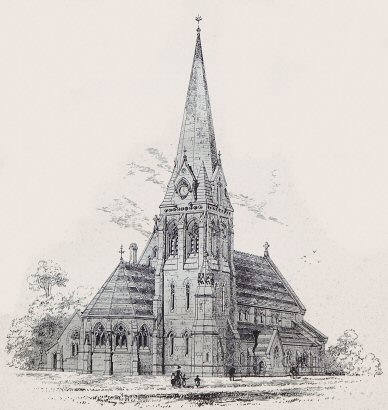
The Rev. W. Fraser Handcock is a minister apparently about forty years of age. He begins his service in rather a low tone of voice, but immediately rises to the compass of the auditorium, and thoroughly maintains it to the end. The emphasis in his reading is placed with almost faultless accuracy; so that the true sense is never lost to the hearer. The sermon was read, but delivered with very considerable effect. In matter it was most intelligent, instructive, and Evangelical. Discoursing from John xviii. 38: “Pilate saith unto him, what is truth?” the preacher considered Pilate as the representative sceptic of his age; and drew a striking parallel between him and modern sceptics, in their affected uncertainty and unbelieving inquiries, as to how the truth was to be determined; and, like Pilate, they found vain excuses for their infidelity in the divided state of Christendom. In France religion was suffering through the recoil from that “sham” of Christianity set up there by Popery; and in England, silently but too certainly, the evil leaven had been at work; in the Universities, in schools, and in literature. When a convert from Rome, as had often happened, first landed on our shores, it was not to be wondered at if, on a superficial survey of the Church as it was, he inquired, doubting, “What is truth?” When he glanced at the various tenets taught within even their own Church, could any other result be expected! We heard, for instance, from some that a species of magical spiritual power was vested in the ministers of religion, so that the sprinkling of a little water in baptism, or the uttering of a few words over the elements used in celebrating the Lord’s Supper, produced necessarily divine effects—teaching against which our finer sense revolted. He went to another extreme, and found others objecting to everything in the world not purely spiritual; even to all kinds of music not sacred in its character and use. Then, perhaps, he took up a book written by some plausible, philosophising author, the fallacies of which he was not able to detect; and it was easy enough for him in all these phases of our intellectual and religious life to find an excuse, and inquire, “What, then, is truth?” But after all, it was out a mere excuse, a vain pretence; for there were the great cardinal truths of Revelation plain enough to be understood: about God, about eternity, the soul, and God’s way of winning it. But men rejected or quibbled about these Bible truths and things raised upon them, because, in fact, Christianity was not merely a creed, but it was a life—a life that men must live both inwardly and outwardly. And this was the grand reason why men evaded it: the Master said, if any man would do God’s will, they should know of the doctrine that it was of him. But it was because they were not inclined humbly to do it, that men remained in such ignorance and confusion about it. This witness is faithful and true, for there can be no doubt that the chief difficulties in the way of the reception of the religion of the Bible are to be sought in the moral rather than the intellectual condition of men. This was the great point clearly and forcibly brought out by the preacher, and if this is an average sermon in purport and aim, we cannot but congratulate the neighbourhood on the advent of Mr. Handcock, and on the building of the new church. As yet, as a matter of course, the usual church adjuncts are only in contemplation. A Sunday-school, however, will be opened immediately, and before the permanent edifice is consecrated, all the usual parochial machinery will be at work. The assistant minister is the Rev. E. J. Haddock, B.A., Dublin. The churchwardens are Capt. A. Waldy, of 9, Stanhope-gardens, and Dr. Daniell, of Cathcart road, South Kensington.
CLARENCE-PLACE WESLEYAN CHAPEL, KENSINGTON.
There is a very old lady still living in Young-street, Kensington, whose recollections of early Methodism in that town are still with her, and who is fond of the opportunity of quietly recounting them. Among her remotest remembrances is a visit of Mr. Wesley, the incidents of whose advent were the talk of the neighbourhood when she first began to notice anything she heard. She tells how the great evangelist preached in a smithy, somewhere in the vicinity of the present Jenning’s-buildings, “amidst great opposition.” [21] Subsequently preaching services were held in a house—which has long since been taken down—but which stood upon the site 17, Young-street. This was the property of her husband’s father—who was one of the earliest Methodists in Kensington—and who suffered much persecution. It was, it appears, the object of his opponents to make him stop the Methodist service altogether; but his devotion to the cause enabled him to brave the taunts and injury to which he was subjected; and to afford larger accommodation he built up a temporary chapel in his own yard, which answered for the service of the Methodists many years. Methodism, however, has never flourished in the Court suburb to the extent to which the self-sacrifice and devotion of its few first members might have seemed to promise. To the first temporary building succeeded another; then followed the present chapel in Clarence-place in the year 1838. A ninety-nine years’ lease of the land was obtained at a ground-rent of 10l. per annum in 1836, and the foundation-stone was laid by the late Mr. Farmer, of Gunnersbury House, in 1836, and in June, 1838, the Rev. Dr. Bunting and the Rev. Dr. Beaumont conducted the opening services, when the collections amounted to 42l. 5s. 2d., the whole cost being 600l. It is a very plain edifice, almost completely hidden from view by the surrounding dwellings, and having no architectural expression. It has no gallery, and will accommodate on the ground-floor 200 persons, the congregation as a rule reaching to about half the number. About twenty sittings only are held as free, although many more must generally be so used. There are between fifty and sixty Church members meeting in class. Prior to 1861, when the Bayswater Wesleyan Circuit was formed, this chapel was ministerially supplied from Hammersmith circuit, and from the Theological Institution, Richmond. But since that date the services have been attended by the regular ministry of the Bayswater station, to which the chapel was at that period attached. The form of service is that belonging to the Wesleyan Body, which consists of 1, a hymn; 2, a prayer; 3, a lesson; 4, a hymn; 5, sermon; closing with another hymn and benediction. The hymns of the Wesleys are those mainly used; although there are bound up with them some select productions from other well-known hymn-writers, the whole forming, without any controversy, by a long way the best collection of hymns that Christendom has yet produced. Its excellence is attested by the fact that into whatever church or chapel we enter, the collections there in use, under all sorts of titles and editorships, are much indebted to its pages. In the present instance the singing is aided by a harmonium, which might very well give place to the more suitable instrument—the organ. Behind the chapel there is a very capital schoolroom, where about sixty children are taught on the Sabbath; and adjoining this a large vestry, both built in 1857, and forming a good reserve for meetings of all kinds connected with the church and congregation. In the Wesleyan circle in Kensington the following names appear to be much revered and honoured as having contributed at successive stages of the work, time, talent and money towards its building up, names for the most part well known in the town—Messrs. Rowland, Tomlinson, Maunder, Pocock, Bridgnell, Jarvis, Eyles, Bond, Gush, Rigg, Haine, Trownsan, Farmer, &c. The building of the larger and more beautiful Wesleyan chapel in Warwick-gardens has, however, tended to weaken the society at Clarence-place, by drawing away some of its principal members and supporters, and a small portion of its general congregation.
THE CHURCH OF ST. AUGUSTINE, SOUTH KENSINGTON.
St. Augustine’s Church, close to Hereford-Square, South Kensington, is a temporary iron erection, and, like most such buildings, possesses no architectural features or details worthy of notice. The Incumbent, the Rev. R. R. Chope, B.A., five or six years ago conceived a necessity for a church in that place, and, means failing him to obtain a substantial structure, or to procure a separate site, he made use of a corner of his own private garden, put up the iron building, and called it the “Church of St. Augustine.” It is a low, dull, dingy-looking object outside, and as a stranger approaches it—with its roof only just visible above the garden-wall, it is in danger of being passed without notice, except one should suppose it a rather large conservatory or garden shed. It must have required some courage in a minister to attempt a church for himself in such a position; and we are not surprised after this that Mr. Chope is now going on to a larger and more promising enterprise. In the Queen’s-gate, a new and permanent church is rising, under the same energy which originated the first.
The present “St. Augustine’s,” in the interior, is a long narrow space fitted with very plain benches, all being free to all-comers, and capable of containing 700 or 800 persons. They were well filled on Sunday morning, the 7th of May, with a congregation remarkable for its preponderance in the female element. One whole side of the church is reserved entirely for females, and no intrusion of the other sex is allowed. On the other side both sexes are compelled to mingle, and even there two-thirds are of the feminine gender. To say that the service here is High Church is not saying all the truth; it is Ritualistic, and highly so, in its whole spirit and ceremonial. It is, in fact, the nearest approach to Romanism that we have yet witnessed in an Anglican Church in the course of these visitations, if indeed it be not very Popery itself under the thinnest guise of the Protestant name. The communion-table is called an altar, and regarded as such in fact, and decorated accordingly. It is covered with a white cloth embroidered with yellow and red flowers and fringe. It has a large gilt cross upon it, two huge gilt candlesticks, and several vases of flowers. Branching candelabra also on its right and left. The ministers are called priests, and look very priestly in their garments, with short surplice and long cassock, and stole of yellowish silk with rich embroidery and fringe. In the absence of the Incumbent, the Curate, the Rev. A. J. Foster officiated.
Prior to the beginning of the service, an official in long cassock with tassels was busy in arranging the chancel furniture, and adjusting a silk embroidered covering upon the altar over the elements to be used in the celebration of the Eucharist. This work he performed with the minutest punctilio, moving backward and forward and on one side to see its effect, and never failing to bow on passing the Cross, and on leaving off moving backward and bowing.
On entering church, the people, before taking their seats, bow one knee in the aisle towards the altar, and some cross themselves precisely in the manner of Roman Catholics. The time of service arrived, the organist takes his seat, having on a surplice and purple hood with white fur trimming, and, sending out a few solemn strains, the choir is heard in the vestry at the remote end of the church singing “Amen.” It sounds like a distant echo among the mountains. Immediately the people rise, and choristers and clergy walk in procession through the centre aisle to the chancel.
Except the lessons, which were read in a serious and rational manner by a stranger, an aged clergyman, who did not seem quite at home in his priestly apparel, and appeared, amidst all the circumstances, somewhat to dislike himself, the whole service was intoned and sung. The music was Gregorian, and performed in its most sombre mood. The congregation appeared perfectly trained to bowings and genuflexions. At every mention of the Saviour’s name they bent lowly, and during the whole of the first part of the Gloria Patri. In one of the hymns, the sacred name occurred in every verse, and in some verses almost every line, and there was a constant bending and rising. It appeared merely a mechanical process, and quite inconsistent with that mental gravity which is essential to true devotion. Amidst all this mechanism of outward worship, we regret to say there was small visible evidence of spiritual concern. It was the coldest piece of formalism it has been our lot to witness in an English church.
In intoning the Litany, the clergyman came out of his desk, crossed himself, and knelt with both knees on the lowest step of the chancel in front of the altar, with his back to the people. This motion is quite advanced in Ritualistic practice; and, taken together with the peculiar strain of the intoner’s voice, and its rising at the end of every verse of that sublime and all-comprehending prayer, gave the service the stamp of parody rather than of sincere and enlightened Christian devotion. We can only express ourselves in this form, for nothing else will indicate our real sense and conscience of this mode of religious service. The puerilities of Romanism Englishmen we thought had learnt to despise, and yet here are some untalented young gentlemen in the Church of England whose habits would deprave our Protestant religious instincts and lead the young and weaker intellects of our race back into the thraldom of Popish superstition. After the Litany there was a hymn, and then followed the sermon, differing in this respect from the usual church order, which places the sermon after the Creed in the Communion Service. After ascending the pulpit and crossing himself, pronouncing “To God the Father, the Son and the Holy Ghost,” whilst standing erect, the text was taken from John xvi. 7, “Nevertheless, I tell you the truth; it is expedient for you that I go away,” &c. As in most cases where excessive attention is lavished on the mere ceremonial, the sermon failed to fulfil the most modest ideal of pulpit work. There appeared to be no intention or effort to give it effect either as an exposition or application of Scripture. In this case, too, it was evident the preacher could not shake off the intoning habit of voice, but carried it in great measure with him from the desk to the pulpit. The principal point of doctrine in the sermon was on the important subject of God dwelling in believers, and was stated in this way: “As St. Paul said we were the temples of God by the Holy Ghost dwelling in us; so God the Son dwelt in us by means of his holy sacraments”. “For,” it was further explained, “by the holy sacraments he gives us spiritual life; for, except we eat the flesh of the Son of God and drink his blood, we have no part in him,”—a strange confusion of ideas between the outward and visible, and inward and spiritual. Baptismal regeneration, sacramental efficacy, were clearly articles in the preacher’s creed. We always thought the teaching of Scripture to be that both God the Father and God the Son dwelt in the true believer by one and the same inhabitation of the Holy Ghost. In connection with this sublime principle of spiritual life, there is no place in the Bible where such words as “by means of the holy sacraments” are to be found. Feeble preaching can diffuse error if it cannot do justice to the truth. After the sermon, during the singing of the hymn, the offertory is taken every Sunday, by which the church is wholly supported, and the minister passes to the Communion Service. The collectors bow towards the altar on presenting the offertory bags in the chancel, or on leaving; and in preparing for the celebration the priest—with his back to the people—is long engaged, and on one occasion kneels and rises quickly twice or thrice in succession before the consecrated bread. The Rev. R. R. Chope has studied to make his service as ornamental, high, and formalistic as can be under the Anglican name. He says he believes that “the meanness and costliness of worship reflects the spirit of the worshippers,” a fundamental error if it be attempted to apply it as a general rule. We take it that there is a medium to be observed, and in all cases the costliness must be regulated by circumstances.
Every Sunday at 8 a.m. there is Communion, Prayer (choral), with sermon, at 11; second celebration at 12 30. Evening prayer (choral) and sermon at 7 p.m. Thursday, at 8. a.m., Communion. 11 a.m., morning prayer.
Saints’ days: Two celebrations and daily prayer, at 8 a.m. and 5 p.m.
There are several small charities, a day-school, and Sunday-school, both in their infancy.
THE ROMAN CATHOLIC ORATORY, BROMPTON.
The Roman Catholic Oratory stands within an enclosure of high brick walls and gates, above which its plain brick, warehouse-looking south gable is visible, and if it were not that the said gable is surmounted by a plain Latin cross, there is nothing to indicate an ecclesiastical structure. The interior (in effect reminding one of a large music-hall) is Italian in its style of the simplest kind, painted and gilded. The nave or body of the church is very long, roofed in one span, and covered with a plain panelled ceiling. The northern end is occupied by the high altar, richly decorated with artificial flowers and burdened with candles. The altar stands considerably elevated and enclosed by dwarf balustrades, and flanked by rather ornate benches or sedilia. The nave floor is entirely occupied by mean wooden benches, intersected by a centre and two side passages, the latter giving entrance and exit also to numerous recesses or bays, which serve as chapels, in which are erected altars to saints; and also to a number of confessionals, by which last we infer that the practice of confession is carried on to a great extent by Oratorians. As to the saints, those represented at the Oratory have their altars all duly supplied with pictures, candles, and flowers, and have their particular admirers and devotees. A large platform kind of pulpit is on the west side, in which the preacher is accommodated with a chair. The font is very plain, close to the main entrance doors in the bay called the Baptistry.
The “Oratory of St. Philip Neri,” situate next to the South Kensington Museum on the one side and Holy Trinity Church, Brompton, on the other, was dedicated to the “Immaculate Heart of Mary” in the year 1854. It had previously been established in King William-street, Charing-cross, since 1849, in the building now known as the Charing-cross Theatre. But the more eligible site in Brompton offering, it was embraced; and this centre of Roman Catholic propgandism in West London was transferred from amidst the shops, warehouses, and cafés of the Strand, to a scene of retirement, wealth, and fashion. The interior of this church is laid out in the most elaborate style of Roman Catholic art. On entering, the high altar in the distance—north—strikes the eye irresistibly. It has upon it a high cross and six tall candlesticks with candles lit. There are also other candles and suspended burning lamps through the entire vista. The æsthetic effect of the first glance is not soon forgotten. The details are not less effective, considered as mere imagery addressing the outward sense. Including the Baptistry, there are eight side chapels, or altar-recesses, four on each side, all richly and artistically furnished. On the left, or what is termed the “Gospel side,” the first is the “Chapel of the Sacred Heart;” second, the Chapel of St. Eutropius; then that of St. Joseph, and that of St. Philip. On the right, the first recess is the Baptistry; second, “Calvary Chapel,” where there are life-size figures of the crucified Saviour with the malefactors, and the mother of Jesus and his brother sitting at the foot of the cross; third, the Chapel of “Our Lady of Dolours” (sorrows); and forth, the Chapel of “Our Lady.” The altar here, with a large image of the Virgin and her infant Son upon it, is now profusely decorated with flowers. It is the month of May; and the following notice is attached to the doors of the church: “Offerings of flowers and candles will be thankfully received for the month of Mary.” The former part of the appeal appears to have been already liberally responded to. The bouquets are piled up to the very feet of the image, and decorating her brow in all their radiant freshness. The whole reminds one of a certain wax-figure display in Baker-street: only in this instance the kneeling worshippers around the rails of the chancels suggest that something more is involved. We saw many of them, especially in front of “Our Lady’s Altar.” But they were distributed all through in smaller numbers or in ones. The “Calvary Chapel” is intended as a most literal rendering of the crucifixion. It is a shocking scene to look upon—those carved images of bleeding and mangled forms. To any one who has really in imagination conceived something of what the actual crucifixion was, and dwelt upon its moral import, it is likely to seem an impious mockery. But some appeared to approach it with reverence; and a little girl, who had been kneeling by her mother’s side, crossed over the rail, crept up to and kissed the wooden cross on which the central image hung! These scenes are to be witnessed after every public service, matins or vespers, or whenever the church is open, which in fact is at all times when people can attend either by rule or chance.
The usual services at the Oratory are numerous and continuous. On Sunday there is Mass at 6.30 a.m., at 7, 8, 9, and 10; and at 11 High Mass and sermon; at half past 2 p.m. “Exposition of the Sacraments,” and “Vespers” at half-past 3; occasional courses of lectures at 4 p.m., and service with sermon and the benediction at 7 p.m. At this latter the meetings of the confraternities of “The Precious Blood” and of “St. Patrick” are held, and the “Intentions of members given out.” This means that each member confesses to some dominant desire or purpose then in his mind. It may be for the comfort of a sick friend, the repose of a dead one, the conversion of sinners or heretics, or any other matter that may engage his thoughts at the moment. There is also the “Little Oratory,” where there is a separate service for “Meditation and Mass,” for brothers only, at 7.30 a.m. and 4.15 p.m. On week-days there is Mass at 6.30, 7, 7.30, 8, 8.30, 9, 10. Sermon every evening at 8, except Saturday; and on Thursday and Saturday a benediction at 4.30. On holy days, High Mass, with sermon, at 11 a.m., and vespers at 4.40 p.m. The work of the confessionals appears to be interspersed at all times between these numerous services. The wonder is how such a machinery can be kept always going, how it does not wear out in interest and effect from sheer continuity of motion. We must assume that it has its flagging moments, and sleepy rests, by which its motive energies are recruited, and that at certain seasons and services the priests have it pretty much to themselves.
The Fathers.—At the present time there are fourteen attached to the Oratory, the majority, we are informed, having been previously clergymen in the Church of England. Their names are as follows: The Very Rev. W. T. Gordon (superior); the Rev. John B. Dalgairns, the Rev. Richard M. Stanton, Thomas F. Knox, John G. Bowden, Edward G. Bagshaw, James B. Rowe, Felix Philpin, Edward S. Keogh, W. B. Morris, Chas. H. Bowden, Kenelm Digby Beste, Thomas Graves Law (nephew of the Earl of Ellenborough), James Arthur V. Maude, Francis A. O. Carroll, Henry G. S. Bowden. There is a large library belonging to the Fathers in common, which occupies an entire quadrangle, about one-third the length of the church itself westward, where the clergy spend such spare moments as they can snatch from their other engagements. Little is known of these gentlemen by the outside world. They act their parts from day to day within the sombre enclosure of their high brick walls, and continue to be content to move in their appointed spheres amidst the gaudy but wearisome formalism within. On Sunday morning, May 14, it was High Mass at the eleven o’clock service. The magnificent organ, played by Mr. Pitts, sent forth its thrilling peals precisely at the moment. The organ itself is considered one of the very best in London, and cost 2,000l. Meanwhile four principal priests appeared at the altar, and after bowing several times turned to face the congregation. They proceed to the front of the chancel, the centre one waving a rod, and one on each side bearing his train and exhibiting the rich scarlet lining of his robe. He bows lowly, and stretches out the rod waving it right and left over the people, and they retire again to the altar. This action in glittering vestments, heralded and followed by bursting music, is in all respects like the opening scene of an opera, and ostensibly not a whit more solemn or religious. It is difficult to realise that you are in a house of prayer. It is useless here to give a description of the whole performance. Barring a few brief intonings of the priests in Latin it consisted entirely of the sundry dumb and complicated bodily movements peculiar to the Mass. If we were to criticise them it could only be to say, as we should say of any other performing company, that this performer was more graceful and striking in his action, et cetera, than the other. The plentiful smoke of incense and the music made up the rest. This latter accompanied the whole with the briefest intervals. There were solos and choruses innumerable, and the art-pretension of the performance was its great feature. The choir is railed in effectually from the congregation around the organ, and consists of male singers only in plain dress, under the conduct of M. Wilhelm Schulthes, a composer of some note. It is but just to say that the singing was in itself excellent, if one could forget the main object for which a church is erected. The voices were unexceptionally good, and the parts brilliantly executed; but the whole was operatic in effect—too secular, and too much of it, to assist devotion. But the Mass music of the day is employed with a special regard to popularity; which, however, as a matter of fact, and as a part of religious service, it does not succeed in acquiring. There is, after all, an idea, however vague, in the popular mind of the moral “fitness of things,” and if people find themselves in a place ostensibly for Christian worship, and yet chiefly entertained with an artistic and elaborate display of music not distinctively devotional, it does not commend itself to their better judgment. The congregation at the Oratory on Sunday morning appears to bear out this remark. Had the same musical skill been announced for an ordinary evening concert in any London music-hall it would have commanded plenty of patronage at 5s. and 2s. 6d.; but in this case (although the charge was only 3d., and 1s. for the best seats) they were far from fully occupied. Undoubtedly, the most rational and appropriate part of the service was the sermon, which was preached extempore by Father Law, who is the morning preacher for the “Month of Mary”—a somewhat youthful-looking Father, but he discovers considerable maturity of mind; and somewhat pleasingly surprised us at the Protestant colour of some parts of his teaching. Grounding his remarks upon Luke xix. 5: “Zaccheus make haste and come down, for to-day I must abide at thy house,” the preacher explained how it was that Jesus dwelt with his people. In passing, the preacher observed that Christ dwelt with us in his Church, sacraments, and through the “Blessed Lady,” who ruled over them that day, in allusion to the peculiar homage paid to the Virgin at this time. But this was only in passing, and as though to keep his Catholicism in countenance. He enlarged chiefly and with much feeling upon what was, he said, “most important of all,” “Christ dwelling in us by the Holy Ghost, and so abiding with us,” in our inner life. The Rev. Father seemed for the moment to rise above the trammels of peculiar Popish dogmas, and to conceive the fundamentals of religious life as practicable without them. Certainly he did not say as much in as many words, but if he did not intend it, his discourse was without meaning or aim. It is remarkable that on the previous Sunday we listened to an Anglican divine discoursing on the same subject, and were boldly told without any qualification that Christ dwelt in his people “by means of the Holy Sacraments.”
There are attached to the Oratory day-schools for boys and girls, which are carried on in Pont-place, near to St. Luke’s Church, and are rather numerously attended. There is also what is termed “The Nursery of our Lady and St. Philip Creche,” at 56, Walton-street, where infants of working people, from three weeks to five years old, are taken charge of whilst their parents are at work in the day-time. References must be given as to honesty and engagements before the child is admitted, and 3d. per day is charged for each child. The church itself will accommodate about 1,200 persons.
KENSINGTON CONGREGATIONAL CHAPEL.
Kensington Chapel, on the east side of Allen-street, is worthy of notice. It is substantially built of stone, and commands a foremost place amongst the best examples of classic architecture in the neighbourhood. The portico is the most noticeable portion. Its Corinthian columns and pilasters are in good proportion and well-executed, and assure even the most unpractised eye of their capability to support the massive entablature and pediments that surmount them. The present minister, Dr. Stoughton, laid the chief corner-stone in June, 1864. The interior is well and handsomely treated, and is light, commodious, and adapted for sound. The large British School recently erected is certainly not an improvement to the architectural appearance of the chapel. There is a want of truthfulness about the design, which one must regret, seeing that the chapel itself is in such good taste.
The church connected with this place traces its origin so far back as the year 1795, and owns a very interesting history. The first Congregational Chapel was in Hornton-street, and was founded in 1793; and in October, 1794, the Rev. Dr. Lake was chosen first pastor. In March of the following year he gathered into religious communion about forty persons, and on the 9th of April following was solemnly ordained to the pastorate by Dr. Hunter, author of “Scripture Biography,” who was assisted in the service by other ministers. The church and congregation gradually increased under Dr. Lake’s ministry, and also under his successors. These were men of no less eminence than the Revs. John Clayton, Dr. Liefchild, and Dr. Vaughan. For a church to have held such pastoral relations in unbroken succession, and for these to be followed and crowned by the worthy name of the present esteemed minister, Dr. Stoughton, is a remarkable fact, and prepares us for chronicles of superior influence and success. In this we are not disappointed. In the year 1845 the jubilee of the church was celebrated. Dr. Stoughton had commenced his ministry in 1843, and on the 50th anniversary preached a commemorative sermon. From this, which is in print, it would appear that the first half-century witnessed a gradual but certain growth of Congregationalism in the town, the number of church members having increased from the foundation number of 40 to 251. These were the figures when Dr. Stoughton began his work. The labour of those earlier times had been well and patiently done, and the basis firmly laid for a larger edifice of success to come. The Rev. John Stoughton appears to have been the well-chosen minister for the opening era of its later history. On Monday, October 4, 1868, the church and its friends rejoiced together over the fruits of the pastor’s labours through a quarter of a century. At that time, which may be allowed to speak for the present, 1,200 members had been added, and there was a fixed membership of 500, having just doubled itself since 1843. The Hornton-street Chapel had been enlarged in 1845 at a cost of 1,400l.; a branch chapel—now known as the Horbury Chapel, Notting-hill—had been built in 1849, and a church, of 40 members and 100 seat-holders, given it from the parent congregation to begin with. This new cause was largely aided and supported by Mr. Stoughton and his people. Notwithstanding this separation, the places of those who had retired to the north of the parish were soon filled, and the chapel became overcrowded, so that it became a necessity to provide new and enlarged accommodation. Hence the present commodious chapel in Allen-street, which was opened for Divine worship on the 30th of May, 1855, the foundation-stone having been laid in June, 1854. The entire cost, including the freehold site and organ, was 8,748l. 9s. 6d., the whole of which was defrayed by the end of January, 1860; 600l. more was laid out on repairs and embellishments in 1863. There is accommodation for 1,000, including about 250 free sittings. More recently British schools have been built, adjoining the chapel, at an outlay of 5,000l., which now have from 300 to 400 children in attendance. Here, also, large and important Sunday-schools are conducted, having about 700 children under religious instruction. These were established in the year 1809. We understand that every available sitting is at present let; and the congregation contains several persons of literary eminence and professional distinction. It is generally of that character which a minister of Dr. Stoughton’s ability may be expected to draw and keep around him. For Christian liberality it is justly entitled to a record; and is, undoubtedly, one of the best instances to be found of what can be achieved on the voluntary principle when intelligently and powerfully directed. During the first twenty-five years of Dr. Stoughton’s ministry—independently of the amounts raised by pew rents, &c., for support of the ministry—there was raised for various objects the noble sum of 32,821l., being an average of 1,313l. per annum. 12,800l. was for chapel and school building purposes; 8,870l. for missionary societies at home and abroad; 5,630l. for support of educational institutions; and 5,480l. for relief of the poor and distressed, both in a general way and in various cases of public need. This scale of giving is maintained and even enlarged upon, the church raising 500l. for the London Missionary Society last year; and—which may be considered an expression of genuine catholicity of spirit—contributing 100l. towards the building fund of the new parish church now in course of re-erection. Annual collections are made for St. Mary’s Hospital, Paddington, the West London Hospital, for a Christmas Poor Fund, Chapel Building Society, London City Mission, and various other Christian objects. There is no endowment, and the ministry is entirely supported from seat rents. As a proof of the esteem in which the minister is held, the church voted him 400l. in 1868, to enable him to visit Palestine, which he did; and it may be added that at the present time a co-pastor is being arranged for to assist him in his labours.
The Rev. Dr. Stoughton has the good fortune—attending but few settled pastors in the same degree—to enjoy the continued confidence and good opinion of his people; and through the effect of a prolonged ministry he has acquired an amount of influence over them seldom realised. That influence has been for good. It has lifted them out of the narrowness which, rightly or wrongly, is generally considered an attribute of close churches; it has moulded them into a catholic temper, and imbued them with social sympathies which render them a fact and a power in the town and district. “Like priest, like people,” is an old adage; and probably it has never found a better illustration than in the present instance. And where the former has strength and goodness combined, the likeness to himself he impresses upon his congregation over a long ministry, at any rate, ought to be traceable. Dr. Stoughton himself cultivates the most friendly relations with ministers and Christian people of all denominations. Occasionally at his house may be witnessed a little Evangelical Alliance, in the presence of a bishop, or a dean, or an archdeacon, with clergymen Episcopal, Baptist, Methodist, and Congregational; and the same genuine fraternal feeling he carries into public meetings and committees of all kinds where general Christian or social interests are concerned. On the rev. gentleman’s pulpit characteristics it is scarcely necessary to enlarge. In these sketches it is our plan only to say enough on this point to indicate the general standard of preaching, talent, or aptitude, together with the doctrinal teaching and mode of conducting service. As to the latter, the minister appears in the pulpit in a gown; and in the singing part of the service the usual Congregational Hymn-book is supplemented by a collection of church music, consisting of chants, anthems, Te Deum and Sanctuses. After the second prayer the Te Deum is sung; and the music, both for hymns and chants, inclines pretty much to the Gregorian strain. We may describe this congregation, in its general tone and style of worship, as occupying that part of the Dissenting territory which lies nearest the Church of England. In the minister’s personal part there is a brief opening prayer, a lesson, a second prayer, a second lesson, and a third prayer; and in these several extempore petitions, in the present instance, were included almost every conceivable object of supplication hardly exceeded in variety of matter by the Book of Common Prayer itself. The discourse was founded on 2nd Corinthians x, 5: “Bringing into captivity every thought to the obedience of Christ,” and was delivered extempore, with the aid only of a manuscript skeleton. The perfect ease and quiet of the preacher is apt at first to tempt the stranger to think him slightly indifferent to his hearers; but he has only to be heard a while to convince one that the feature arises from complete self-control and command of his own thoughts; and that, so far from indifference, it arises from deliberate anxiety to clear himself with the intellect and conscience of his audience. It is certain that this is achieved with great success. The clearness of the preacher’s thoughts, and equal clearness and felicity of his language, make one feel as though sitting in the calm light of intellect, reflected from every point of the compass. Starting with the assertion that the words of the text were directly “against the grain” of the “most fashionable thinking of the day,” which was on the side of what was called “freedom of thought,” he entered the lists with the free-thinkers of the period. Demonstrating with a masterly hand that the true liberty of our nature is only found in the captivity of thought to the obedience of Christ, he showed, on the other, with convincing power, that the boasted “freedom” of the day was slavery itself. It was slavishness to prejudice, to some human irresponsible authority, to the most “fantastic ideas,” without any basis in reason, to an idea of novelty and change, where, however, there was no originality; for, the preacher remarked, amidst all this, “originality was a very rare thing in our time.” The freedom contended for was one which bound our whole nature up in the bonds of fixed and rigid laws of development, which extinguished the very possibility of freedom. After so withering an exposure of the boasted free thought of the age, there was peculiar force and beauty in pressing home the great Gospel truth, “But if the Son shall make you free, then are ye free indeed.” Christ carries us away captive; but He does it as a conqueror of our foes, who tyrannised over us; and following in His train is our deliverance, our “freedom.”
On Sunday, service is held at 11 a.m. and 6.30 p.m., and at 3.15 p.m. a prayer-meeting in the Lecture-room. The Lord’s Supper the first Sunday in the month after morning service; baptism every three months, both to adults and children, or more frequently if desired. Communion tickets are distributed to members in December, which they are expected to put into the plate after each celebration. Members are accepted after private conversation with the minister, and approval by the church in its ensuing monthly meeting. The time when the minister may be consulted on this solemn subject is from six to seven on Thursday evenings weekly.
THE WESLEYAN CHAPEL, WARWICK GARDENS.
The Wesleyan Chapel, situate at the corner of Warwick-gardens, Kensington, is a specimen of one of those buildings by which we may say that Nonconformists have made a step in the right direction. It is architectural, and, though of simple character as regards material, being of brick and stone and covered with slate, yet the brick and stone have been treated very successfully in the design of the west front. It claims to be an example of Early English work, and, with its spire and pinnacles, forms a good feature, seen from the entrance of the gardens from the Kensington main road. Enclosed by iron gates and rails, and dwarf walls, the chapel is approached by a flight of steps and entered by a vestibule or lobby, which also gives access, to the right and left, to the gallery stairs. Inside, considering the large galleries, which at all times are an objection, the effect is exceedingly good. The light ribbed roof over the body of the chapel is supported by a timber arcade of very good design, and if, instead of iron, the columns that receive the arcade had been of wood, we should, in spite of the galleries, have been able to report some very successfully effective work. The organ is recessed, and appears just above a somewhat tall and bulky pulpit. Beyond this there is very little to remark save the quiet neatness that prevails generally. The basement is occupied by school and class rooms and offices, with separate entrances and approaches. The chapel is from the designs of Messrs. Lockwood and Mawson, of London and Bradford; and the building contract carried out by Mr. Nevill Simonds, of London. The warming was executed by Messrs. Stuart and Smith, of Sheffield; and the standard gas-lights by Messrs. Thomasson and Co., of Birmingham.
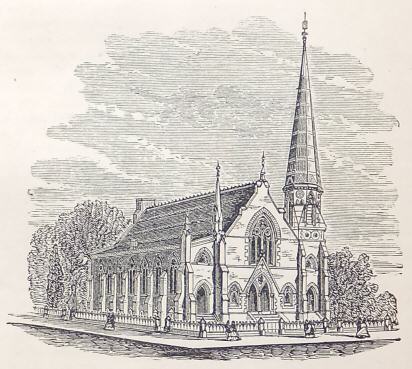
This chapel was opened for worship on Thursday, the 10th December, 1863, and is partly the fruit of a general effort among the Wesleyan Methodists for chapel extension in London and its suburbs. The first metropolitan chapel building fund was started in 1861, and zealously promoted by the Rev. W. Arthur, M.A., and the late Rev. John Scott, in connexion with several of the wealthier laymen. The spirit of church and chapel erection which has recently taken hold of other leading religious bodies, and notably of the Establishment, has been largely participated in by the Wesleyan body; so that the chapel business which centres in a Chapel Committee has become a very large and imposing department. It superintends the erection of chapels in every part of the Connexion, and has its rules upon which these works are to be carried out. Every chapel built without compliance with its regulations and primary sanction is jealously viewed, and reported to Conference as irregular, with profound “regrets” at the Methodistic insubordination implied in it. No matter though a chapel be made really a good property of and handed over, it cannot condone the offence against the spirit of red-tapeism centreing in the Conference Committee. It will only be officially recognised after a good scolding has been administered to the offenders for the pains they have taken to erect a chapel for Methodism. This is one of the points at which the Central Conference rule is liable to collision with local voluntary efforts, and often produces great irritation. The Committee administers the chapel erection fund and makes grants in aid. It also controls a large sum of money—raised some years ago to assist in clearing chapels from debt. This money is lent out to trustees upon application, to be returned in so many annual instalments, free of interest. Probably no fund has been more useful to the material interests of Methodism. Chapels formerly burdened with debt have been set free by yearly payments similar to what they were before paying for interest; and thus their resources have been left available for extension purposes. There is also a special fund for chapel building in Watering-places, commenced by the Rev. W. M. Punshon in 1861, which succeeded very well as far as it went, but did not attain large dimensions. The “Metropolitan Chapel Building Fund” is a more important and progressive affair. It started with a subscribed fund of 20,000l., to be kept up by annual appeals; and an effort is now being made to raise a very much larger sum—Sir Francis Lycett having made the generous offer of 50,000l., to be distributed in sums of 1,000l. each to fifty new chapels, that shall be erected in the metropolis with a specified accommodation, within a given time. For this offer to be utilised to the full extent, at least 200,000l. will have to be raised.
The Warwick gardens Chapel benefited from the first fund to the extent of 1,000l., the whole estimated cost being 4,700l. In default of a freehold, 32l. per annum is paid as ground-rent, which was to be covered by a yearly investment. 1,175l. was left as a temporary debt, to be paid off within one year. We believe, however, that this was found to be impossible, and the debt in whole or part, still remains. The estimated income from seat-rents was fixed at 200l. per annum, a very small estimate indeed, had the project succeeded. But in this there has been grievous disappointment. The chapel will accommodate 1,000 persons, but after more than seven years it hardly commands an average congregation, in all, of 200, and a number of these are from a distance, and properly belonging to other Methodist congregations. We fear, therefore, this is a case to be recorded as so far a failure.
A degree, perhaps, of laudable ambition has led some leading Methodist ministers and laymen of late years to desire to place chapels in neighbourhoods different from those usually occupied. In short, there has been a movement to plant chapels in more respectable localities, such as that of Warwick-gardens. But if the experiment is to be judged by its results in this instance, it would appear a lamentable mistake; and it may after all be worth considering whether John Wesley’s own rule will not yet serve Methodism for all time—“To preach the Gospel to the poor, and to go not only to those who need us, but to those who need us most.” There are Sunday-schools, where about 100 children of both sexes attend; and four or five small classes, which include all the society at present attached to the chapel. It is united in what is called the Bayswater Circuit, the headquarters of which are in the Denbigh-road, Bayswater, and which has three ministers appointed to it by the Conference. These are assisted in the occupation of the pulpits by ministers belonging to Connexional departments in London, or students from the college at Richmond. The chapel, therefore, has the best ministerial provision that the system of Methodism can supply, but there appears to be no public effect. On Sunday evening, 21st of May, the pulpit was occupied by the Rev. W. B. Boyce, one of the secretaries at the Mission-house in Bishopsgate-street. He holds a high position in the body, and on many accounts is deservedly respected. He has seen much service in the Mission-field; and to this it may be in part attributable that he retains in speech the broad provincialisms of his early life. He also holds fast to the old Methodist style of putting the doctrine of “Conversion,” which was the subject of his discourse. According to his teaching on this occasion, a man may be everything Christian to the outward eye—and even be a martyr for the truth—and yet be unconverted, unsaved, and perish eternally. If such a case be possible, we must remark it is so rare in experience that it may well cause a minister to pause before he gives it prominent and unqualified application in a sermon. There are certain to be a number of weak consciences and doubting minds in every congregation, who must be very much troubled and perplexed with such teaching, whereas there may not be a single individual to whom it really applies. It is a mode of preaching, in our idea, not based upon sufficiently large views of human experiences and circumstances; yet Mr. Boyce exhibits great sincerity and earnestness.
THE SCOTCH CHURCH, KENSINGTON.
The Scotch Presbyterian Chapel stands at the corner of the Foxley-road and Allen-street, and is a fair specimen of geometric gothic. Of course it requires the tower to be finished to make it the good architectural object that it should be in the long perspective of Allen-street; yet it is even now fairly prominent, and is substantially built of Kentish rag with Bath stone dressings, and roofed with slate. The principal entrance is on the north side, over which is a large and rather noticeable window, and the rose window in the west gable, too, seems to invite the visitor to an inspection of the interior. Passing through a very plain corridor or vestibule, the body of the chapel is immediately entered to the right and left hand. A feeling of disappointment it is impossible to repress ensues. The interior in no way accords with the idea conveyed by the outside inspection. It is roofed in one span, and heavily ceiled and panelled, producing a sense of depression. The walls are simply bare plaster, the pulpit very large and heavy, the pewing poor and plain. A northern gallery, evidently intended for an organ, is organless, and not much improved by large curtains. The Presbyterian movement in Kensington began in 1861, under the present pastor, the Rev. Gavin Carlyle, in a hall in Holland-street. After about a year’s labour in this place some forty or fifty members had collected, and it was then resolved to build a church. A site was first sought in Campden-hill, but was not to be found there. Ultimately the present site was scoured, the building commenced in July 1862, finished in May 1863, and opened on the 24th of that month, and the Rev. Mr. Carlyle, was formally ordained to the charge on June 2nd following. Since then the progress has been steady; and the membership has increased to between one and two hundred. The church is connected with the English Presbyterian Church, and the late Dr. Hamilton, of the latter, took great interest in it, and did much to originate it. It will contain 500 persons, and cost to build 5,280l.; by the addition of galleries, it would be capable of accommodating 700 or 800. There is no endowment, and the minister is dependent upon pew-rents and voluntary offerings. A Dorcas Society is kept up by a few ladies; and collections are made annually for foreign missions and other objects. The Duke of Argyll is a seatholder and frequent communicant; and other persons of general and literary distinction. At a meeting a few weeks since, at which the Duke of Argyll presided, several Indian and other notabilities were present, including Dr. Macleod, Sir Bartle Frere, Sir Wm. Hill, &c., who had assembled to hear a lecture on India, by Dr. Wilson, of Bombay. The Rev. Gavin Carlyle is an M.A. of the Edinburgh University, and studied theology in the Free Church College, Edinburgh, followed by a year’s study in Germany. He is a nephew of the famous Edward Irving; and editor of his uncle’s “Collected Writings,” published by Strahan and Co. He is also editor of the Weekly Review, the weekly organ of Presbyterianism in England; also of Christian Work, a monthly journal of religious and missionary intelligence. Mr. Carlyle’s congregation is at present a small one compared with many; but on the occasion of our visit his sermon was certainly such as to justify a larger attendance. It was the first of a series of discourses on the Ten Commandments, and founded on the first “I am the Lord thy God,” &c. The distinct existence and all-pervading presence and control of the Almighty was the subject. It was well and clearly treated, in a manner to meet the principal intellectual quibbles or difficulties of the times; and the preacher proved to the satisfaction of every thoughtful mind—to use his own words—that “all reason speaks to us of God; and that it is nothing but unreason and mystical cloudiness that attributes the effects of Nature to any other cause or operation,” and that science when rightly conceived is “the handmaid of religion.”
THE EPISCOPAL CHAPEL, BROMPTON.
The Brompton Episcopal Chapel, situate close to the Brompton-road, in Montpelier-street, is a structure strictly Georgian in its character, Georgian indeed to the back-bone, if one may be allowed to use such an expression ecclesiastically. It has no beauties to make it worthy a visit in the search after the picturesque. It is simply ugly outside, and very little more may be said of it inside. It rather reminded us of old Kensington Church, without its historical interest. Like all buildings of the kind, it has its painted columns supporting a flat ceiling, and high-back gallery. It has its high pulpit and prayer-desk, each duly draped in hot velvet, its high-backed pews comfortably shut up and cushioned, in fact, everything belonging to it is high, only that it would be too much to call it High Church.
This chapel attained its centenary in 1869, being opened on Easter Sunday, 1769, as a chapel of ease to the parish church of Kensington. The Rev. Richard Harrison was the first minister, who was a preacher of some note, and continued his labours to the end of life, which occurred in 1793. A tablet to his memory may now be seen on the south side of the Communion-table. Since then the course of the ministry has been somewhat chequered, and not always connected with the happiest reminiscences. Although so ancient a chapel, it appears to have been generally poor, and the only relic it contains of bygone days is a set of old pewter collecting-plates, having the original engraving, “The Parish of Kensington.” The building is now seen in every respect as it was at the beginning. It has successfully resisted all modern innovations; no alterations of any kind have taken place, excepting that a coating of stucco has been bestowed upon the front. The same is true of the character of the public service. It has rigidly preserved its own unadorned plainness, against all the ecclesiastical refinements of later years. The clergy are ordained ministers in the Church of England, and licensed by the Bishop of London, and the present are the Rev. W. Dunford, who is also the private owner of the property, and the Rev. W. Crofts Bullen, assistant minister. The latter was doing duty at the time of our visit, with rather a thin congregation, but showed considerable earnestness, read distinctly and audibly, and preached in his black gown an extempore discourse on Rev. iv. 3. The sublime passage was expounded by references to other parts of Scripture, connected with some plain, out-spoken utterances applied to the audience in a fearless and faithful manner. Regarding the text as symbolical of the Holy Trinity—it being Trinity Sunday—the preacher knew nothing about “the liberality of faith in the nineteenth century.” There was “a severe and hard line to be drawn between the believer and unbeliever, the saved and the unsaved.”
The Episcopal Chapel will hold about 800 persons, and the congregation averages from 400 to 500. Having no endowment, the clergy rely only on seat-rents and quarterly collections for church expenses, which are made by passing the pewter-plates round to the assembly in the pews. There is a good Sunday-school carried on in the chapel, morning and afternoon, with about 130 scholars, a number which it is said might be greatly added to but that the Churchwardens will not allow more space. This unfavourable condition, however, the zealous superintendent, Mr. Warder and teachers, assisted by the children, are seeking to remedy, having opened among themselves a weekly subscription towards a separate and commodious schoolroom. The weekly pence already contributed amounts to 50l. This is a most worthy example; and it may be hoped that some large-hearted persons outside the school, may some day or other feel inclined to encourage by large gifts so laudable an attempt at self-help. The school is also provided with a library by subscriptions of the teachers and churchwardens, from which books are lent free of charge. The Sunday-school is an interesting feature at this chapel, and is said in the neighbourhood to be highly prized by the children themselves, who are reported to be most regular in attendance. The services are—Sunday, morning at 11, evening at 6.30; Wednesday at 7 p.m.; the Lord’s Supper on the last Sunday in the month. The hymn-book used is a selection of psalms and hymns arranged by the Rev. Charles Kemble, M.A.—the 1853 edition.
ONSLOW CHAPEL.
Onslow Chapel, situate in Neville terrace, Brompton, has many pretensions to Gothic architectural effect. It is slightly decorated in design, and somewhat early. Long before the two churches were thought of, between which it now stands, St. Pauls and St. Peters, its two little spires could be seen like landmarks in the surrounding plain. It is one of those early attempts of the Nonconformists to establish a better style of architecture in their buildings for public worship. The west front is, however, all of which it can boast, the inside being of true chapel type, consisting, one may almost say, of a large hall, ribbed and vaulted in plaster. The western gallery adds to the accommodation for sittings, and the body of the chapel is well filled with simple pewing. The pulpit is tall, and backed up by the organ. In the usual way the Vestry is at the east end. The foundation-stone was laid by that great and good man, the Hon. Arthur Kinnaird, in 1856.
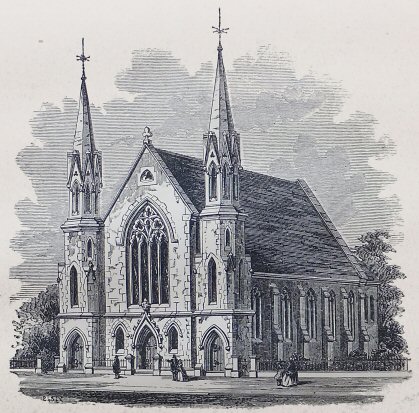
This chapel was built fifteen years ago, for the church then meeting in Alfred-place, under the pastorate of the Rev. G. Bigwood. It seats 650 persons, and cost 6,000l. But this outlay included, besides the chapel-proper, convenient class-rooms, and a spacious schoolroom which runs back on a line with the chapel into Neville-street, and is now mentioned as Onslow Hall, a suitable place for meetings and lectures. The Rev. G. Bigwood’s ministry lasted about eighteen years, and he was succeeded in 1870 by the Rev. Joseph Upton Davis, B.A., the present pastor. The minister is a Baptist, but the membership is open to Christians of other Evangelical communions. As a preacher, Mr. Davis has considerable gifts. To a pleasing manner and voice there is a goodly share of refinement, general evidence of culture, and preaching ardour, which are essential to the modern pulpit. “He that hath an ear let him hear what the spirit saith unto the churches” was solemnly enforced, and the dwellers in Laodicean ease—the “neither cold nor hot”—were keenly rebuked, although affectionately dealt with. The congregation was not a full one; but it was pleasing to note that with very few exceptions all remained to the Communion service, which immediately followed the first service. The hymn after the sermon was followed only by the benediction, briefly rendered, which, as a rule, is somewhat unlike Nonconforming services, in which the preacher generally offers a short prayer, having some reference in spirit to the matter of the discourse. A Sunday-school is conducted in the schoolroom, where, under management, 400 scholars assemble morning and afternoon, superintended by Mr. Mayers. The general services are—Sunday morning at 11, evening at 6.30, Thursday evenings at 7, and communion the first Sunday in the month.
ST. BARNABAS, KENSINGTON.
The Church of St. Barnabas is situated in the Addison-road, and can be seen with pleasing effect from the main road. In the distance the brickwork has a nice grey tone about it, and harmonises well with the stone dressings and tracery and the contrast of the mounting ivy round the pinnacled buttresses gives a picturesque appearance which is much assisted by pretty surrounding foliage. A nearer view, however, is somewhat disappointing as to architectural detail, in which it resembles the chapel of King’s College, Cambridge, which is generally considered the best example of perpendicular Gothic. The west elevation is worthy of description. The gable and pierced parapet partially conceal a low-pitched roof, which is flanked by open bell turrets. The centre of the gable is occupied by a large perpendicular window above the western entrance to the church. This consists of a centre and two side doors opening into a corridor or vestibule, giving access to the body of the building and to the galleries right and left. Flights of steps lead up to the several entrances, which are enclosed by rather lofty railings and gates. The interior, roofed in one span with sub-arcades or columns, is finished with a flat ceiling, relieved and pannelled by horizontal bands and kerbed ribs. Large galleries surround three sides of the church, and at the west end a double tier. At first sight these galleries look almost unsupported, the iron columns are so slender as well-nigh to escape observation. The body or ground floor is fitted with simple square pewing, divided by a centre and two side passages. Close to the western doors stands a bold font, a fair specimen of perpendicular work. The pulpit is tall and plain. The prayer-desk, lower and more ornate, is placed on the north side of a very simple chancel arch, before which the very handsome bronze eagle lectern stands slightly elevated. The chancel is a simple recess, and its entrance is occupied by stall benches. The front of the altar is pierced with tracery, which has a good effect. The east window is filled with stained glass of Georgian school design, strongly reminding us of the Church of St. Dunstan, Fleet-street, where there is a similar window.
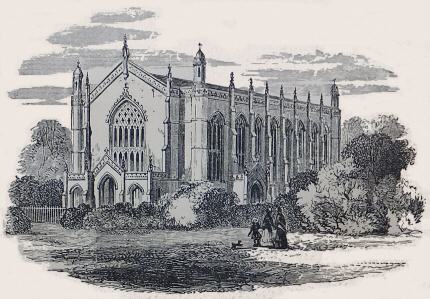
Three windows on the north side and four on others are also filled with stained and quarried glass, with designs of a better school.
The organ, a fine instrument by Walker, is at the west end in the gallery, and well decorated.
It is now forty-three years since this church was consecrated, and during the last eighteen years it has been under the same incumbent, who has been one of the Kensington Clergy for nearly thirty years. It occupies a large district in the west of Kensington, and has itself, in progress of time, become a parent church to several others which have risen within its bounds. St. Philip’s and St. Matthias are districts formed out of it; and the more recent erection of St. John the Baptist’s Church in the Holland-road marks a still further development. It has also a separate appendage to itself in the “Church House” in the Warwick-gardens, which has been built to accommodate the surplus of its regular congregation, sanctioned by the Bishop, and served by its own clergy. Here invalids who cannot conveniently attend the larger congregation, and such as cannot for the present obtain accommodation there, are invited to attend. In point of fact it is altogether a separate church served by the Vicar of St. Barnabas and his curates. As, however, it is treated simply as an out-building of St. Barnabas—and is used for the transaction of its various parochial business—we must consider it as included with it.
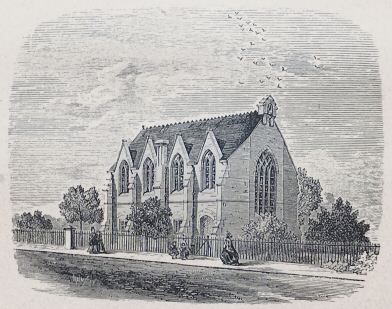
St. Barnabas’ Church has accommodation for about 1,500, and its morning congregation averages from 1,200 to 1,400, looking well filled. The evening congregation, however, is much smaller, as a rule, as is the case with most West London churches. But we may attribute this partly to the existence of an afternoon service, at which there is public catechising, which is very fully attended. The church is daily open, and the Holy Communion is celebrated every Sunday. There is no High Church costume, or parade of surpliced choristers, but there is a most efficient choir, who fill the space in front of the organ in the end gallery. On the occasion of our visit, which was St. Barnabas’ day, June 11, the church’s annual Feast of Dedication, the performance consisted in a Gregorian and other much more pleasing chants in D and A, with hymns special to the occasion. The Gregorian strain never pleases; and seems to us adapted mainly to break up and destroy the natural form, music, and sense of the English tongue. There are three curates, who perform their subordinate parts in the service with great propriety and credit. Such only who could accomplish this would be at all in keeping with the character of the chief pastor. Dr. Hessey has a matured, well-cultured Christian mind, in addition to learning, and natural talent and taste for the duties of the pulpit. There is also a gravity and kindliness in his general manner and utterance which leaves one in no doubt as to the secret of his power. The sermon on the occasion of our visit was an anniversary one, and as being confined to a portion of appropriate historical Scripture (Acts xi, 26), did not offer scope for the full exercise of the preacher’s powers. Yet the evidence of their existence was there.
The clergy are supported chiefly by pew-rents, and there are offertories and collections for various charities, missions, and other objects. For the poor, for schools, missions, choir, incidental church expenses, the Bishop of London’s Fund, in aid of hospitals and other charities, there was raised altogether in 1870 704l. 11s. 10¼d. Out of this it is found impossible to provide for the heavier church expenses. A church-rate is also levied, to which it does not appear what response is made. We have reason, however, to believe that no large sum is thus collected, or the churchwardens would have been able to spend more on the decoration of the church. There is clearly room for considerable improvement here, and we hope there will be no great difficulty in providing means to carry out the church repairs which are so much needed. The whitewasher, painter, and grainer might in the interior be employed with good effect.
ST. JOHN’S CHURCH, NOTTING HILL.
A building set on a hill cannot be hid, and it is literally true of St. John’s Church; it is just on the crest, of Notting-hill, and may be seen from a great distance in the perspective of the long road, to the west of which it stands. Its effect is at first sight very good; the spire, however, rising at the intersection of the nave and transepts, appears too stunted, as if it had been drawn down several feet into the tower, a fault to be deplored in many instances. Built of stone and covered with slate, the early English detail, generally very good, the character of the style very truthfully retained, as shown by the chancel windows, the well-executed caps and bosses, and in the eastern triplet, make up a very excellent attractive whole. The plan of the church is cruciform, and is divided into a nave and aisles, north and south transepts, chancel and aisles, with a vestry at the N.E. angle. There are several large galleries, one at the west end, one in each of the transept and chancel aisles, which add very considerably to the accommodation for sittings. The organ is placed in the west gallery, and rather takes from a good perspective, as seen looking westward, the stone columns and plaster-moulded arcade giving a very poor effect; and the church generally supports some well-designed work in the clerestory, where oddly enough we find stone used again, though we cannot help feeling glad to see it, instead of the plaster work before referred to. The roof is high-pitched and open, of good design, but, owing to so little of the light of heaven illuminating the interior, we are unable to say much about it. The lancet windows are not enough to admit the cheering rays, and this is certainly a drawback; it gives to the church a gloomy appearance which it ought not really to have. Most of the windows are filled with stained glass, but of no good type, except the eastern subject, representing the Lord’s Supper. The font, close to the west door, is of simple design, and has the emblems of the Evangelists sculptured in relief on the bowl. The pulpit, too much like a large wineglass, is lofty, and blocks out the view, looking east. The pewing is very mean, and on a level with the pewing of the passages, which is not improving. Some simple wooden screens shut out the chancel from the aisles, and the table is plain and railed off. The diaper work painted on the chancel wall is well done and effective.
Early in 1845 the Church of St. John was consecrated for divine service in the northern division of Kensington. Misgivings were expressed at the time that the site, one of the most attractive in London, had been chosen too far out in the fields; but the population of the district has since risen from less than 3,000 to more than 60,000, and has been partitioned among six new parish churches, all built from voluntary contributions, and maintained without endowments. The church, parsonage, and schools of St. John’s represent an expenditure of nearly 20,000l., almost entirely raised within the parish; and the subscriptions and collections for 1870 amounted to 996l. collected in the church, besides 850l. pew-rents, and 2,390l. collected in other ways for local and missionary purposes. Between 500 and 600 children are in attendance at the schools, and nearly 400 of them belong to the Parochial Provident Society, which consists in the aggregate of 731 members. The congregation appear much in need of the additional comfort and accommodation which would be derived from removing the organ out of the west gallery, and letting in the light from the handsome window behind it. The design of the architect might then be carried out, and the organ and pulpit be placed as originally intended, throwing back the fronts of the north and south transept galleries. This church has suffered a good deal at different times from well-meant efforts to provide additional accommodation for the vast population which has grown up round it; but nothing has been done which might not be easily set right at a small expenditure. The present incumbent has been seventeen years in residence, and was appointed by the late Bishop Blomfield, of London, the see to which the patronage belongs. The east window is an adaptation in coloured glass of the “Last Supper” of Leonardo da Vinci, and was offered by the parishioners as a memorial of their sorrow for the early loss of Eleanor Isabella, only child of Sir John Franklin, and wife of the incumbent, who was cut off in the midst of a career of singular activity and Christian usefulness about ten years ago. A mural monument close by records the decease of the previous incumbent, the Rev. E. Denniss, who fell a victim to cholera in 1854. This likewise was placed there by the parishioners as a monument of their affectionate regret; and it is very observable that our new churches derive increased solemnity and repose from the gradual increase of such mementoes as these.
Out of 1,400 sittings, this church has about 400 free; all the others let at rates varying from 4s. to 15s. per quarter. The congregation is composed mainly of the well-to-do people of that part, and the collections which are made for various objects through the year average from 50l. to 60l. a Sunday, whether it be for home or foreign objects. The organist, Mr. Cooper, is surrounded in the orchestra by a selection of the male Sunday scholars—who are evidently well-trained, and make up an effective choir—without surplices. The service is completely on the Evangelical model, animated and thoroughly devotional, and the congregation join in it earnestly. The prayers and lessons were well read by a substitute for one of the curates, who are two, the Rev. Messrs. Leicester and Newton. The sermon was preached by the incumbent, the Rev. J. P. Gell, from Psalm iii. 4, “He hath made his wonderful works to be remembered.” The rev. gentleman’s preaching is careful, practical, and devout; and appears to come directly home to his hearers, over whom, through a long series of years he has maintained a very manifest influence for good. The ordinary services are on Sundays at 11 a.m., and 7 p.m., and lecture on Wednesday evening. At 12.30 there is full Communion Service every first Sunday in the month, after the morning service; and an early celebration at 9 a.m. on every third Sunday in the month.
ST. GEORGE’S, CAMPDEN HILL, KENSINGTON.
St. George’s, Campden-hill, the spire of which, in the distance, is so closely allied to the Kensington Water-tower and that other familiar object of West London distance, Tower Cressy, that we suppose there are few who are unacquainted with the rather odd-looking trio. Either of them taken alone would form a good distance object, but as it sometimes happens they all three lump together in the landscape, the effect is not only odd, but certainly striking, the water-tower always looking like the big brother of the other two. St. George’s, however, must now be taken alone, and really it deserves to be especially noticed. The church stands N. and S., the south elevation being worthy of remark for much excellent and effective detail. The tower and spire, of fair proportion at the S.E. angle of the building, form an important feature of this view. The spire is broached and covered with slate in bands, and relieved with wooden spire lights with iron finials, giving a picturesque appearance. The tower is without buttresses, and, like all other portions of this south elevation, is faced with stone in random courses, with Bath stone quoins and dressings, and clean-cut bands of stone of warmer colour. It is lighted by deeply-recessed lancet windows, with columns and foliated caps, and bands on all sides. The staircase within is clearly marked by raking lines of windows, simple and effective. The centre of the gable of this elevation is occupied by a large and boldly-treated window, with geometric rose and four lancet lights, deeply recessed with label mould, encircling three well-carved heads in relief; this window is flanked by side two-light windows, partly concealed by the tile roof of the large cloistered porch. Being the principal entrance to the church, this roof is supported by dwarf and massive columns, with carved caps and cusped arcade. The whole forms a picturesque feature in perspective. The side and north elevations are very plainly treated in brickwork, with coloured bands or strings continued round the buttresses. The windows are executed in stone, plain-cut, unsplayed tracery; the reason for this change in design is evident—these elevations will shortly be hidden by the houses that are hourly springing up round the church. The usual stone finials and crosses are replaced by iron of like character.