WILLIAM JOBLING. EXECUTED FOR MURDER.
Reading edition
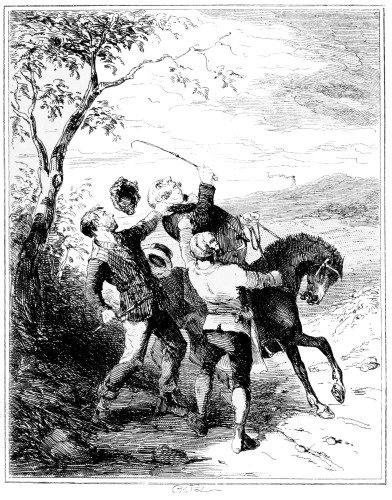
AT the Durham assizes, on Wednesday the 1st of August 1832, William Jobling was tried on an indictment charging him with the wilful murder of Mr. Fairles, a magistrate, on the previous 11th of June. Mr. Fairles, it appeared, had given offence to the colliers, from his spirited exertions to suppress their riotous proceedings. On the day in question he was returning from the Jarrow Colliery on his pony, when he was overtaken by the prisoner and a man named Armstrong, who, having first asked him for money, dragged him from his horse and beat him unmercifully with a bludgeon, and also pelted him with stones as he lay on the ground. Mr. Fairles was found in a state of insensibility, and, on his recovery, swore distinctly to the prisoner and Armstrong, as the persons by whom he had been attacked. He subsequently died of his wounds. The prisoner was secured at Shields; Armstrong escaped; the prisoner was found “Guilty,” and received sentence to die on Friday—his body to be hung in chains.
Jobling and Armstrong attacking Mr. Fairles. P. 354

This sentence was carried out to its full extent, the body of the criminal being suspended to a gibbet in the neighbourhood of the scene of the murder.
This exhibition, however, gave great offence to the colliers; and after the remains of the unhappy wretch had been exposed for several weeks, they were, on Saturday the 8th of September, suddenly missed, having been removed during the previous night. The deceased had been a collier; and little doubt was entertained that his late companions and fellow-workmen had done this service to his memory: all subsequent efforts to discover the place of concealment of his body proved unavailing. But although undoubtedly its unauthorised removal was a serious breach of the law, there were few to be found who looked upon it as matter for regret, or who did not view the circumstance as a convincing proof of the impolicy of reviving a practice so barbarous as the exposure of the bodies of executed criminals.
The law by which this exposure was authorised was enacted by the statute 2 and 3 W. 4, c. 75, s. 16. That act provides, “Whereas an act was passed in the 9th year of the reign of his late majesty (9 Geo. 4, c. 31), for consolidating and amending the statutes in England relating to offences against the person, by which latter act it is enacted, that the body of every person convicted of murder shall, after execution, either be dissected or hung in chains, as to the court who tried the offender shall seem meet, and that the sentence to be pronounced by the court shall express that the body of the offender shall be dissected or hung in chains, whichsoever of the two the court shall order; Be it enacted, that so much of the said last recited act as authorises the court, if it shall see fit, to direct that the body of a person convicted shall, after execution, be dissected, be and the same is hereby repealed; and that, in every case of the conviction of any person for murder, the court before which such prisoner shall have been tried shall direct such prisoner either to be hung in chains or to be buried within the precincts of the prison in which such prisoner shall have been confined after conviction, as to such court shall seem meet; and that the sentence to be pronounced by the court shall express, that the body of such prisoner shall be hung in chains, or buried within the precincts of the prison, whichsoever of the two the court shall order.”
The legislature appears to have duly estimated the extent of the disgust created by the two exhibitions which have been referred to of the remains of Cook and Jobling; and, by the 4 and 5 W. 4, c. 26, s. 1, the provisions of the statute last mentioned are repealed, so far as they relate to the hanging of criminals in chains. That act enacts (after reciting the provisions of the statutes of 9 Geo. 4, and 2 and 3 W. 4), “That so much of the said recited act, made and passed in the ninth year of the reign of Geo. 4, as authorised the court to direct that the body of a prisoner convicted of murder should, after execution, be hung in chains, and also so much of the said recited act, made and passed in the second and third year of the reign of W. 4 as provided, that in every case of the conviction of any prisoner for murder, the court should direct such prisoner to be hung in chains, should be and the same is hereby repealed.”