DANIEL DOODY, JOHN CUSSEN, alias WALSH, JAMES LEAHY, MAURICE LEAHY, WILLIAM DOODY, DAVID LEAHY, DANIEL RIEDY, WILLIAM COSTELLO, AND WALTER FITZMAURICE, alias CAPTAIN ROCK, CONVICTED OF ABDUCTION.
Reading edition
IT was the opinion of Dr. Johnson that many of the romantic tales of the middle ages had their origin in truth, and that the absolute distress of females might, in all probability, have called for the institution of “knight errantry.” To protect the defenceless is a natural impulse, which has its foundation in the sympathies of our nature; but when a female, young, beautiful, and innocent, is the victim of oppression, there is no man, with common feelings, who would not risk his life to snatch her from despair and misery. In this happy country there are few instances of abduction; but in Ireland this unmanly crime is too prevalent. The disturbed state of certain parts of the country gives aid to the schemes of unprincipled ruffians, acting on the presumption that injured females, when degraded and dishonoured, would, of necessity, save the violators of their innocence from ignominy by a marriage—the only means, they suppose, left them to escape from unmerited shame. The persons thus forcibly carried away are generally the daughters of opulent farmers—a fact which clearly shows the mercenary views of those who commit so base and cowardly an outrage on the most defenceless part of the creation.
Among the numerous outrages of this nature was one on the person of Miss Honora Goold, a young lady remarkable for her personal beauty. She lived in the house of her mother at Glangurt, in the county of Cork, and had two sisters older than herself, she being scarcely sixteen, and a brother. On the 4th of March 1822, about twelve o’clock at night, their dwelling was attacked by an armed banditti, who, on threatening to burn the house, were admitted. One of the ferocious ruffians burst into Miss Honora’s apartment, and asked if she was the eldest Miss Goold. She replied in the negative, and said that her sister was on a visit in Cork. The inquirer then withdrew, and having searched several other apartments, returned, followed by five or six others, and repeated his interrogations, but on this occasion answered them himself in the affirmative, and then ordered her to rise and dress herself, and to accompany them. At the suggestion of one of the party, they withdrew from the room; but Miss Goold was scarcely dressed when they returned; and one of them seizing her round the waist, carried her screaming to the outside of the house, where she was received by a stranger on horseback. She was placed in front of the horseman, and then the party, in spite of her cries and entreaties, set off in the direction of the Galties, a range of hills between the counties of Cork and Limerick. At the distance of several miles they halted, and there, having procured a pillion, their captive was compelled to ride behind the leader of this atrocious band. In her eagerness to escape she fell several times during their progress; and having continued her screams all the time, one of the ruffians threatened to murder her unless she desisted.
By daylight they had entered the recesses of the Galties; and several of the party having occasionally dropped off, she was conducted by the few that remained to the house of David Leahy, a substantial farmer.
The leader of this outrage was a young man named Brown, of a respectable family, and who had received an education which should have rendered him incapable of such base and unmanly conduct. The elder Miss Goold was entitled, on her marriage, to a large fortune; and Brown, hoping to possess himself of it, resolved to carry off the young lady. Being disappointed by the precipitancy and mistake of his assistants, he determined to make sure of the lovely victim who had fallen into his power, knowing that the opulence of her family could make him independent, provided he could insure the consent of the astonished girl he had forcibly carried off. With virtuous indignation, however, she repulsed his advances, and begged the protection of Mrs. Leahy, in whose parlour she now was; but, strange to say, this woman, who was herself a mother, connived at the ruin of her unprotected guest.
Foiled in his direct attack, Brown had recourse to an expedient which, for the honour of human nature, we would wish never to record, did not impartial justice demand an honest discharge of our duty as faithful narrators of criminal occurrences. It was proposed, immediately after breakfast, that Miss Goold should take some rest. A bed was in the parlour, and she was directed to repose upon it. This, indeed, after the fatigue of the night, was most desirable; but to her utter astonishment, the family in which were two females, left the room, at the same time locking the
Abduction of Miss Goold. P. 66.

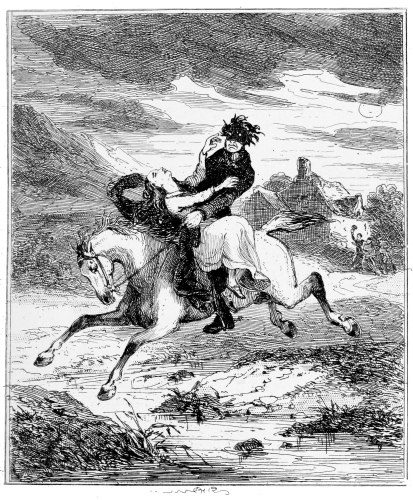
door upon herself and Brown. The monster, in spite of her entreaties and screams, proceeded to undress her, and insisted on lying beside her. The reader need not be told the rest—the purity of female innocence was grossly violated in the person of this young and lovely creature; and her destroyer arose from his bed of lust, the polluter of one whose peace of mind neither the world’s sympathy nor the world’s wealth could restore.
The friends of Miss Goold, who comprised the wealth and respectability of the county of Cork, instantly set about recovering the injured lady. The pursuit was continued from day to day for three weeks; and the vigilance of her friends was only evaded by her being removed from house to house, and from cabin to cabin; and even once, by her being exposed for a whole day and night to the inclemency of the weather on a bleak mountain, when she had the agony of seeing her friends at a distance, but was prevented from calling to them, or flying to join them, by a ruffian, who stood sentinel over her with a loaded pistol. At length, however, her sufferings were to be terminated. Though weak and almost exhausted by opposition to her foul abuser, she still remained firm in her virtuous resolve to be no consenting party to the violence offered to her, and at the conclusion of three weeks, she was placed by her ferocious guards in a poor cabin on the roadside, where her friends might find her. When discovered she was in a condition of the greatest misery, being so weak as to be unable to walk, stand, or sit. Seventeen hours were occupied in removing her thirteen miles, to her mother’s house, but when once restored to home and its enjoyments her recovery was rapid, and in a short time her health was re-established, as far as it was possible under all the frightful circumstances of her affecting case. From the description, which she gave of the perpetrators of this act of violence, several of the party were apprehended. Brown, the guilty contriver of the plan, escaped from the country; and Fitzmaurice, alias Captain Rock, evaded the pursuit of justice for a considerable time, but at last surrendered to a magistrate. The men whose names head this article, except Fitzmaurice and Costello, were brought to trial on the 29th of July 1822, at Limerick. Miss Goold appeared to give evidence, and her narrative, which she delivered with modest dignity, procured her the willing sympathy of a crowded court. The prisoners were found Guilty—Death; but the three Leahys and Cussen were subsequently discharged, on a point of law operating in their favour.
On the 23rd of August following, Walter Fitzmaurice, better known at the time as Captain Rock, pleaded guilty at the Cork assizes; and, along with Costello, who was found guilty on the solitary evidence of Miss Goold’s brother, who swore to his having seen him on the night of the abduction, received sentence of Death.
On the ensuing Saturday, Costello underwent the awful sentence of the law, but Fitzmaurice was respited, something having arisen in his favour, principally on the ground of his having pleaded guilty in consequence of the judge refusing to put off his trial in the absence of a material witness. Costello, to the last, declared his innocence, not only of the crime for which he was convicted, but of any connexion whatever with the White Boys.