The Christmas Kalends of Provence (continued 2)
Reading edition
The second section was such an explosion of sweets as might fly into space should a comet collide with a confectioner's shop—nougat, fougasso, a great poumpo, compotes, candied-fruits, and a whole nightmare herd of rich cakes on which persons not blessed with the most powerful organs of digestion surely would go galloping to the country of dreadful dreams. This was prodigality; but even the bare requirements of the case were lavish, the traditional law of the Great Supper ordaining that not fewer than seven different sweets shall be served. Misè Fougueiroun, however, was not the person to stand upon the parsimonious letter of any eating law. Here had been her opportunity, and she had run amuck through all the range of sugary things!
Of the dessert of nuts and fruit the notable features were grapes and winter-melons. Possibly because they are an obscure survival of some Bacchic custom connected with the celebration of the winter solstice, the grapes are considered a very necessary part of the Great Supper; but as Provençal grapes are of a soft substance and soon wither, though a world of care is taken to preserve a few bunches until Christmas, this part of the feast usually is a ceremony rather than a satisfaction.
But our melons were a pure vegetable delight. These winter-melons are a species of cantaloupe, but of a firmer texture than the summer fruit, sowed late in the season and laid away a little green on beds of straw in cool and dark and well-aired rooms. Thus cared for, they will keep until the end of January; but they are preserved especially for Christmas, and few survive beyond that day. They are of American origin: as I discovered quite by chance while reading a collection of delightful letters, but lately published, written near three hundred years ago by Dr. Antoine Novel; that Provençal naturalist, whom Buffon quotes under the wrongly Latinized name of Natalis, sometime physician to the Duke of Medina-Sidonia in Spain. He was a rolling stone of a naturalist, the excellent Novel; but his gatherings were many, and most of them were for the benefit of his beloved Provence. It was from "Sainct Luquar," under date of March 24, 1625, that he wrote to his friend Peiresc in Aix: "I send you by the Patron Armand a little box in which are two specimens of ore ... and ten sorts of seeds of the most exquisite fruits and flowers of the Indies; and to fill the chinks I have put in the seeds of winter-melons." And in a letter of June 12th, following, he wrote: "I hope that you have received my letter sent by the Patron Armand of Martigues, who sailed in Holy Week for that town, by whom I sent you some seeds of exquisite fruits and flowers of the Indies, together with two specimens of ore, the one from Potosí and the other from Terra-Firma, and also a box of seven winter-melons of that country." And so the winter-melons came into Provence from somewhere on the Spanish Main. I could wish that my gentleman had been a bit more definite in his geography. As he leaves the matter, his melons may have come from anywhere between the Orinoco and Florida; and down in that region somewhere, no doubt, they still are to be found.
With the serious part of the supper we drank the ordinary small wine diluted with water; but with the dessert was paraded a gallant company of dusty bottles containing ancient vintages which through many ripening years had been growing richer by feeding upon their own excellence in the wine-room of the Mazet or the cellar of the Château. All were wines of the country, it being a point of honour in Provençal households of all degrees that only from Provençal vineyards—or from the near-by vineyards of Languedoc—shall come the Christmas wines. Therefore we drank rich and strong Tavel, and delicate Ledenon, and heavy Frontignan—the cloyingly-sweet Mouscat de Maroussa—and home-made champagne (the clairette, with a superabundance of pop and fizz but undeniably cider-like), and at last, for a climax, old Châteauneuf-du-Pape: the dean of the Provençal vinous faculty, rich, smooth, delicate, with a slightly aromatic after-taste that the dallying bees bring to the vine-blossoms from the blossoms of the wild-thyme. Anciently it filled the cups over which chirped the sprightly Popes of Avignon; and in later times, only forty years back, it was the drink of the young Félibrien poets—Mistral, Roumanille, Aubanel, Mathieu and the rest—while they tuned and set a-going their lyres. But it is passing into a tradition now. The old vines, the primitive stock, were slain by the phylloxera, and the new vines planted to replace them do not produce a wine like that over which Popes and poets once were gay. Only in rich old cellars, such as that of Vièlmur, may still be found a bin or two of dust-grey Papal veterans: survivors of the brave army that has gurgled its life out in a happy past!
XIII
But the material element of the Great Supper is its least part. What entitles it to the augmenting adjective is its soul: that subtle essence of peace and amity for which the word Christmas is a synonym in all Christian lands. It is the rule of these family gatherings at Christmas time in Provence that all heartburnings and rancours, which may have sprung up during the year, then shall be cut down; and even if sometimes they quickly grow again, as no doubt they do now and then, it makes for happiness that they shall be thus banished from the peace-feast of the year.
Janetoun and one of her sisters-in-law were the only members of our party who had a hatchet to bury; and the burial was over so quickly—being but an extra hug and an explosion of kisses—that I should have known nothing about it but for the over-long tongue of Misè Fougueiroun: who, in a kindly way, is as thorough-going a gossip as ever lived. Of all things in the world to quarrel about, this quarrel had grown out of a spirited difference of opinion as to how the heel of a knitted stocking should be turned! But the matter had come to be quite of a seriousness, and all the family breathed freer when those resounding peace-kisses were given and received. Actually, as I happened to learn later, the reconciliation was pushed to such an extreme that each of them incontinently adopted the other's knitting creed—with the curious result that they now are in a fair way to have a fresh quarrel for next Christmas out of the same matter on inverted lines! It was before the lighting of the yule-log that the feud of the stocking heels thus happily (even though only temporarily) was pacified, and the family festival was cloudless from first to last.
When the serious part of the supper had been disposed of and the mere palate-tickling period of the dessert had come, I was much interested in observing that the talk—mainly carried on by the elders—was turned with an obviously deliberate purpose upon family history; and especially upon the doings of those who in the past had brought honour upon the family name. And I was still more interested when, later, the Vidame informed me that it is the Provençal custom at the Christmas festival for the old thus to instruct the young and so to keep family tradition alive. No doubt there is in this a dim survival of ancestor-worship; but I should be glad to see so excellent a relic of paganism preserved in the Christmas ritual of my own land.
The chief ancestral glory of the family of the Mazet is its close blood-relationship with the gallant André Étienne: that drummer of the Fifty-first Demi-brigade of the Army of Italy who is commemorated on the frieze of the Panthéon, and who is known and honoured as the "Tambour d'Arcole" all over France. It was delightful to listen to old Jan's telling of the brave story: how this André, their own kinsman, swam the stream under the enemy's fire at Arcolo with his drum on his back and then drummed his fellow-soldiers on to victory; how the First Consul awarded him the drum-sticks of honour, and later—when the Legion of Honour was founded—gave him the cross; how they carved him in stone, drumming the charge, up there on the front of the Panthéon in Paris itself; how Mistral, the great poet of Provence, had made a poem about him that had been printed in a book; and how, crowning glory, they had set up his marble statue in Cadenet—the little town, not far from Avignon, where he was born!
Old Jan was not content with merely telling this story—like a true Provençal he acted it: swinging a supposititious drum upon his back, jumping into an imaginary river and swimming it with his head in the air, swinging his drum back into place again, and then—Zóu!—starting off at the head of the Fifty-first Demi-brigade with such a rousing play of drum-sticks that I protest we fairly heard the rattle of them, along with the spatter of Italian musketry in the face of which André Étienne beat that gallant pas-de-charge!
It set me all a-thrilling; and still more did it thrill those other listeners who were of the Arcolo hero's very blood and bone. They clapped their hands and they shouted. They laughed with delight. And the fighting spirit of Gaul was so stirred within them that at a word—the relations between France and Italy being a little strained just then—I verily believe they would have been for marching in a body across the south-eastern frontier!
Elizo's old father was rather out of the running in this matter. It was not by any relative of his that the drum-sticks of honour had been won; and his thoughts, after wandering a little, evidently settled down upon the strictly personal fact that his thin old legs were cold. Rising slowly from the table, he carried his plate to the fire-place; and when he had arranged some live coals in one of the baskets of the waist-high andirons he rested the plate above them on the iron rim: and so stood there, eating contentedly, while the warmth from the glowing yule-log entered gratefully into his lean old body and stirred to a brisker pulsing the blood in his meagre veins. But his interest in what was going forward revived again—his legs being, also, by that time well warmed—when his own praises were sounded by his daughter: in the story of how he stopped the runaway horse on the very brink of the precipice at Les Baux; and how his wife all the while sat calmly beside him in the cart, cool and silent, and showing no sign of fear.
When Elizo had finished this story she whispered a word to Magali and Nanoun that sent them laughing out of the room; and presently Magali came back again arrayed in the identical dress which had been worn by the heroine of the adventure—who had perked and plumed herself not a little while her daughter told about it—when the runaway horse so nearly had galloped her off the Baux rock into Eternity. It was the Provençal costume—with full sleeves and flaring cap—of sixty years back; but a little gayer than the strict Arles dress of that period, because her mother was not of Arles but of Beaucaire. It was not so graceful, especially in the head-dress, as the costume of the present day; nor nearly so becoming—as Magali showed by looking a dozen years older after putting it on. But Magali, even with a dozen years added, could not but be charming; and I think that the little old bowed grandmother—who still was a bit of a coquette at eighty—would have been better pleased had she been spared this encounter with what must have seemed to her very like a meeting with her own young ghost, raised suddenly from the depths of the distant past.
MAGALI
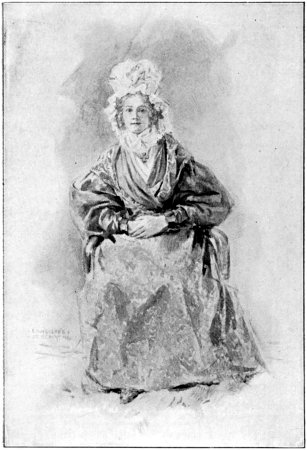
By long experience, gained on many such occasions, the Vidame knew that the culminating point of the supper would be reached when the family drummer swam the river and headed the French charge at Arcolo. Therefore had he reserved until a later period, when the excitement incident to the revival of that honourable bit of family history should have subsided, a joy-giving bomb-shell of his own that he had all ready to explode. An American or an Englishman never could have fired it without something in the way of speech-making; but the Vidame was of a shy temper, and speech-making was not in his line. When the chatter caused by Magali's costuming had lulled a little, and there came a momentary pause in the talk, he merely reached diagonally across the table and touched glasses with Esperit and said simply: "To your good health, Monsieur the Superintendent of the Lower Farm!"
It was done so quietly that for some seconds no one realized that the Vidame's toast brought happiness to all the household, and to two of its members a life-long joy. Esperit, even, had his glass almost to his lips before he understood to what he was drinking; and then his understanding came through the finer nature of Magali—who gave a quick deep sob as she buried her face in the buxom Nanoun's bosom and encircled that astonished young person's neck with her arms. Esperit went pale at that; but the hand did not tremble in which he held his still-raised glass, nor did his voice quaver as he said with a deep earnestness: "To the good health of Monsieur le Vidame, with the thanks of two very happy hearts!"—and so drained his wine.
A great danger puts no more strain upon the nerves of a man of good fibre than does a great joy; and it seemed to me that Esperit's absolute steadiness, under this sudden fire of happiness, showed him to be made of as fine and as manly stuff as went to the making of his kinsman who beat the pas-de-charge up the slope at Arcolo at the head of the Fifty-first Demi-brigade.
But nothing less than the turbulence of the whole battle of Arcolo—not to say of that whole triumphant campaign in Italy—will suffice for a comparison with the tumult that arose about our supper-table when the meaning of the Vidame's toast fairly was grasped by the company at large! I do not think that I could express in words—nor by any less elaborate method of illustration than a kinetoscope—the state of excitement into which a Provençal will fly over a matter of absolutely no importance at all; how he will burst forth into a very whirlwind of words and gestures about some trifle that an ordinary human being would dispose of without the quiver of an eye. And as our matter was one so truly moving that a very Dutchman through all his phlegm would have been stirred by it, such a tornado was set a-going as would have put a mere hurricane of the tropics to open shame!
Naturally, the disturbance was central over Esperit and Magali and the Vidame. The latter—his kind old face shining like the sun of an Easter morning—gave back with a good will on Magali's cheeks her kisses of gratitude; and exchanged embraces and kisses with the elder women; and went through such an ordeal of violent hand-shaking that I trembled for the integrity of his arms. But as for the young people, whom everybody embraced over and over again with a terrible energy, that they came through it all with whole ribs is as near to being a miracle as anything that has happened in modern times!
Gradually the storm subsided—though not without some fierce after-gusts—and at last worked itself off harmlessly in song: as we returned to the ritual of the evening and took to the singing of noëls—the Christmas canticles which are sung between the ending of the Great Supper and the beginning of the midnight mass.
XIV
The Provençal noëls—being some real, or some imagined, incident of the Nativity told in verse set to a gay or tender air—are the crèche translated into song. The simplest of them are direct renderings of the Bible narrative. Our own Christmas hymn, "While shepherds watched their flocks by night," is precisely of this order; and, indeed, is of the very period when flourished the greatest of the Provençal noël writers: for the Poet Laureate Nahum Tate, whose laurel this hymn keeps green, was born in the year 1652 and had begun his mildly poetic career while Saboly still was alive.
But most of the noëls—nouvè, they are called in Provençal—are purely imaginative: quaintly innocent stories created by the poets, or taken from those apocryphal scriptures in which the simple-minded faithful of Patristic times built up a warmly coloured legend of the Virgin's life and of the birth and childhood of her Son. Sometimes, even, the writers stray away entirely from a religious base and produce mere roistering catches or topical songs. Such are those Marseille noëls which are nothing more than Pantagruelian lists of succulent dishes proper to Christmas time—frankly ending, in one case, with the materialistic query: "What do I care for the future, now that my belly is well lined?" It was against such "bacchanals of noël" that the worthy Father Cotton preached in Marseille in the year 1602: but the flesh and the devil always have had things pretty much their own way in that gay city, and he preached in vain. And at Aix-en-Provence the most popular noël of all that were sung in the cathedral was a satirical review of the events of the year: that as time went on grew to be more and more of a scandal, until at last the Bishop had to put a stop to it in the year 1653.
The Provençaux have been writing noëls for more than four hundred years. One of the oldest belongs to the first half of the fifteenth century and is ascribed to Raimond Féraud; the latest are of our own day—by Roumanille, Crousillat, Mistral, Girard, Gras, and a score more. But only a few have been written to live. The memory of many once-famous noël-writers is preserved now either mainly or wholly by a single song. Thus the Chanoine Puech, who died at Aix almost two hundred and fifty years ago, lives in the noël of the Christ-Child and the three gypsy fortune-tellers—which he stole, I am sorry to say, from Lope de Vega. The Abbé Doumergue, of Aramon, who flourished at about the same period, is alive because of his "March of the Kings": that has come ringing down through the ages set to Lulli's magnificent "March of Turenne"; and it is interesting to note that Lulli is said to have found his noble motive in a Provençal air. Antoine Peyrol, who lived only a little more than a century ago, and who "in our good city of Avignon was a carpenter and wood-seller and a simple-hearted singer of Bethlehem" (as Roumanille puts it) has fared better, more than a dozen of his noëls surviving to be sung each year when "the nougat bells" (as they call the Christmas chimes in Avignon) are ringing in his native town. And, on the other hand, as though to strike a balance between fame and forgottenness, there are some widely popular noëls—as "C'est le bon lever"—of which the authorship absolutely is unknown; while there are still others—as the charming "Wild Nightingale"—which belong to no one author, but have been built up by unknown farm-house poets who have added fresh verses and so have passed on the amended song.
The one assured immortal among these musical mortalities is Nicolas Saboly: who was born in Monteux, close by Avignon, in the year 1614; who for the greater part of his life was chapel-master and organist of the Avignon church of St. Pierre; who died in the year 1675; and who lies buried in the choir of the church which for so long he filled with his own heaven-sweet harmonies. Of his beautiful life-work, Roumanille has written: "As organist of the church of St. Pierre, Saboly soon won a great and beautiful renown as a musician; but his fame and his glory have come to him because of the blessed thought that he had of composing his marvellous noëls. Yet it was not until the year 1658, when he himself was fifty-four years old, that he decided to tie together and to publish his first sheaf of them. From that time onward, every year until his end, a fresh sheaf of from six to a dozen appeared; and, although no name went with them, all of his townsfolk knew that it was their own Troubadour of the Nativity who made them so excellent a gift just as the nougat bells began to ring. The organ of St. Pierre, touched by his master hand, taught the gay airs to which the new noëls were cast. And all Avignon presently would be singing them, and soon the chorus would swell throughout the Comtat and Provence. The inimitable Troubadour of Bethlehem died just as he had tied together the eighth of his little sheaves.... His noëls have been reprinted many times; and, thanks be to God, they will be printed again and again forever!"[3]
In addition to being a genius, Saboly had the good fortune to live in one of the periods of fusing and recasting which give to genius its opportunity. He was born at the very time when Claude Monteverde was taking those audacious liberties with harmony which cleared the way for the transition from the old tonality to the new; and he died before the great modern masters had set up those standards which composers of our time must either accept or defy. He certainly was influenced by the then new Italian school; indeed, from the fourteenth century, when music began to be cultivated in Avignon, the relations between that city and Italy were so close that the first echoes of Italian musical innovators naturally would be heard there. Everywhere his work shows, as theirs does, a searching for new methods in the domain of modulation, and a defiance of the laws of transformation reverenced by the formal composers of his time. Yet he did his searching always on his own lines and in his own way.
Nor was his original genius lessened by his willingness at times to lay hands on the desirable property of other people—since his unlawful acquisitions received always a subtle touch which really made them his own. He knew well how to take the popular airs of the moment—the gavotte or minuet or vaudeville which every one was singing: the good old airs, as we call them now, which then were the newest of the new—and how to infuse into them his own personality and so to fit them like a glove to his own noëls. Thus, his Twelfth noël is set to an air composed by Lulli for the drinking song, "Qu'ils sont doux, bouteille jolie," in Molière's "Médecin malgré lui"; and those who are familiar with the music of his time will be both scandalized and set a-laughing by finding the uses to which he has put airs which began life in far from seemly company. But his forays were made from choice, not from necessity, and the best of his noëls are his own.
Saboly's music has a "go" and a melodic quality suggestive of the work of Sir Arthur Sullivan; but it has a more tender, a fresher, a purer note, even more sparkle, than ever Sullivan has achieved. In his gay airs the attack is instant, brilliant, overpowering—like a glad outburst of sweet bells, like the joyous laughter of a child—and everything goes with a dash and a swing. But while he thus loved to harmonize a laugh, he also could strike a note of infinite tenderness. In his pathetic noëls he drops into thrillingly plaintive minors which fairly drag one's heart out—echoes or survivals, possibly (for this poignant melody is not uncommon in old Provençal music), of the passionately longing love-songs with which Saracen knights once went a-serenading beneath castle windows here in Provence.
Nor is his verse, of its curious kind, less excellent than his music. By turns, as the humour takes him, his noëls are sermons, or delicate religious fancies, or sharp-pointed satires, or whimsical studies of country-side life. One whole series of seven is a history of the Nativity (surely the quaintest and the gayest and the tenderest oratorio that ever was written!) in which, in music and in words, he is at his very best. Above all, his noëls are local. His background always is his own country; his characters—Micolau the big shepherd, gossip Guihaumeto, Tòni, Christòu, and the rest—always are Provençaux: wearing Provençaux pink-bordered jackets, and white hats bedizened with ribbons, and marching to Bethlehem to the sound of the galoubet and tambourin. It is from Avignon, out by the Porte Saint Lazare, that the start for Bethlehem is made by his pilgrim company; the Provençal music plays to cheer them; they stamp their feet and swing their arms about, because the mistral is blowing and they are desperately cold. It is a simplicity half laughable, half pathetic—such as is found in those Mediæval pictures which represent the Apostles or the Holy Family in the garb of the artist's own time and country, and above the walls of Bethlehem the church spire of his own town.
This naïve local twist is not peculiar to Saboly. With very few exceptions all Provençal noëls are packed full of the same delightful anachronisms. It is to Provençal shepherds that the Herald Angel appears; it is Provençaux who compose the bregado, the pilgrim company, that starts for Bethlehem; and Bethlehem is a village, always within easy walking distance, here in Provence. Yet it is not wholly simplicity that has brought about this shifting of the scene of the Nativity from the hill country of Judæa to the hill country of Southeastern France. The life and the look of the two lands have much in common; and most impressively will their common character be felt by one who walks here by night beneath the stars.
Here, as in the Holy Land, winding ways pass out from olive-orchards, and on across dry reaches of upland broken by outcropping rocks and scattered trees and bushes and sparsely thatched with short dry grass. Through the silence will come now and then the tinkle of sheep-bells. Sometimes a flock will be seen, dimly in the starlight, feeding beside the road; and watching, from an overlooking standpoint on a rock or little upswelling hill-top, will be its shepherd: a tall muffled figure showing black against the loom of the sky. And it all is touched, in the star-haze of those sombre solitudes, with the poetic realism of unreality; while its deeper meaning is aroused by the stone crosses, telling of Calvary, which are found at every parting of the ways. Told to simple dwellers in such a land the Bible story was neither vague nor remote. They knew its setting because their own surroundings were the same. They practised the shepherd customs; the ass was their own beast of burden; the tending of vines and fig-trees and olive-orchards was a part of their daily lives. And so, naturally, the older noël writers without any thought of anachronism, and the modern writers by poetic instinct made complete their translation of the story of the Nativity into their vernacular by transferring its scene to their own land.
XV
It was with Saboly's "Hòu, de l'houstau!" that our singing began. It is one of the series in his history of the Nativity and is the most popular of all his noëls: a dialogue between Saint Joseph and the Bethlehem inn-keeper, that opens with a sweet and plaintive long-drawn note of supplication as Saint Joseph timorously calls:
"O-o-oh, there, the house! Master! Mistress! Varlet! Maid! Is no one there?"
And then it continues with humble entreaties for shelter for himself and his wife, who is very near her time; to which the host replies with rough refusals for a while, but in the end grants grudgingly a corner of his stable in which the wayfarers may lie for the night.
Esperit and Magali sang this responsively; Magali taking Saint Joseph's part—in which, in all the noëls, is a strain of feminine sweetness and gentleness. Then Marius and Esperit, in the same fashion, sang the famous "C'est le bon lever": a dialogue between an Angel and a Shepherd, in which the Angel—as becomes so exalted a personage—speaks French, while the Shepherd speaks Provençal.
"It's high time to get up, sweet shepherd," the Angel begins; and goes on to tell that "in Bethlehem, quite near this place," the Saviour of the world has been born of a Virgin.
"Perhaps you take me for a common peasant," the Shepherd answers, "talking to me like that! I am poor, but I'd have you to know that I come of good stock. In old times my great-great-grandfather was mayor of our village! And who are you, anyway, fine sir? Are you a Jew or a Dutchman? Your jargon makes me laugh. A virgin mother! A child god! No, never were such things heard!"
But when the Angel reiterates his strange statement the Shepherd's interest is aroused. He declares that he will go at once and steal this miraculous child; and he quite takes the Angel into his confidence—as though standing close to his elbow and speaking as friend to friend. In the end, of course, he is convinced of the miracle, and says that he "will get the ass and set forth" to join the worshippers about the manger at Bethlehem.
There are many of these noëls in dialogue; and most of them are touched with this same quality of easy familiarity with sacred subjects, and abound in turns of broad humour which render them not a little startling from our nicer point of view. But they never are coarse, and their simplicity saves them from being irreverent; nor is there, I am sure, the least thought of irreverence on the part of those by whom they are sung. I noticed, though, that these lively numbers were the ones which most hit the fancy of the men; while the women as plainly showed their liking for those of a finer spirit in which the dominant qualities were pathos and grace.
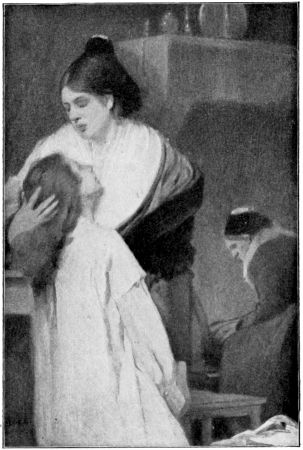
Of this latter class is Roumanille's rarely beautiful noël "The Blind Girl" ("La Chato Avuglo")—that Magali sang with a tenderness which set the women to crying openly, and which made the older men cough a little and look suspiciously red about the eyes. Of all the modern noëls it has come closest to and has taken the strongest hold upon the popular heart: this pathetic story of the child "blind from her birth" who pleads with her mother that she also may go with the rest to Bethlehem, urging that though she cannot see "the lovely golden face" she still may touch the Christ-Child's hand.
And when, all thrilling, to the stable she was come She placed the little hand of Jesus on her heart— And saw him whom she touched!
"THE BLIND GIRL"—NOËL
But without the music, and with only these crude translations in which is lost also the music of the words, I feel that I am giving very much less than the true effect of these Provençal Christmas songs. To be appreciated, to be understood, they must be heard as I heard them: sung by that Christmas company, with Magali's tenderly vibrant voice leading the chorus in which every one of those singing Provençaux joined. Even the old grandfather—still standing at the fire-place—marked the time of the music with the knife that he held in his hand; and his thin old voice piped in with the others, and had a gay or a tender ring in it with the changing melody, for all that it was so cracked and shrill.
I am persuaded, so thoroughly did they all enjoy their own carolling, that the singing of noëls would have gone on until broad daylight had it not been for the intervention of the midnight mass. But the mass of Christmas Eve—or, rather, of Christmas morning—is a matter not only of pleasure but of obligation. Even those upon whom churchly requirements at other times rest lightly rarely fail to attend it; and to the faithful it is the most touchingly beautiful—as Easter is the most joyous—church festival of the year.
By eleven o'clock, therefore, we were under way for our walk of a mile or so down the long slope of the hill side to the village: a little clump of houses threaded by narrow crooked streets and still in part surrounded by the crusty remnant of a battlemented wall—that had its uses in the days when robber barons took their airings and when pillaging Saracens came sailing up the slack-water lower reaches of the Rhône. Down the white road in the moonlight we went in a straggling company, while more and more loudly came to us through the crisp night air the sound of the Christmas bells.
Presently some one started a very sweet and plaintive noël: fairly heart-wringing in its tender beseeching and soft lament, yet with a consoling under-note to which it constantly returned. I think, but I am not sure, that it was Roumanille's noël telling of the widowed mother who carried the cradle of her own baby to the Virgin, that the Christ-Child might not lie on straw. One by one the other voices took up the strain, until in a full chorus the sorrowingly compassionate melody went thrilling through the moonlit silence of the night.
And so, singing, we walked by the white way onward; hearing as we neared the town the songs of other companies coming up, as ours was, from outlying farms. And when they and we had passed in through the gateways—where the townsfolk of old lashed out against their robber Infidel and robber Christian enemies—all the black little narrow streets were filled with an undertone of murmuring voices and an overtone of clear sweet song.
XVI
On the little Grande Place the crowd was packed densely. There the several streams of humanity pouring into the town met and mingled; and thence in a strong current flowed onward into the church. Coming from the blackness without—for the tall houses surrounding the Grande Place cut off the moonlight and made it a little pocket of darkness—it was with a shock of splendour that we encountered the brightness within. All the side-altars were blazing with candles; and as the service went on, and the high-altar also flamed up, the whole building was filled with a soft radiance—save that strange luminous shadows lingered in the lofty vaulting of the nave.
After the high-altar, the most brilliant spot was the altar of Saint Joseph, in the west transept; beside which was a magnificent crèche—the figures half life-size, beautifully modelled, and richly clothed. But there was nothing whimsical about this crèche: the group might have been, and very possibly had been, composed after a well-painted "Nativity" by some artist of the late Renaissance.
The mass was the customary office; but at the Offertory it was interrupted by a ceremony that gave it suddenly an entirely Mediæval cast: of which I felt more fully the beauty, and the strangeness in our time, because the Vidame sedulously had guarded against my having knowledge of it in advance. This was nothing less than a living rendering of the Adoration of the Shepherds: done with a simplicity to make one fancy the figures in Ghirlandojo's picture were alive again and stirred by the very spirit that animated them when they were set on canvas four hundred years ago.
By some means only a little short of a miracle, a way was opened through the dense crowd along the centre of the nave from the door to the altar, and up this way with their offerings real shepherds came—the quaintest procession that anywhere I have ever seen. In the lead were four musicians—playing upon the tambourin, the galoubet, the very small cymbals called palets, and the bagpipe-like carlamuso—and then, two by two, came ten shepherds: wearing the long brown full cloaks, weather-stained and patched and mended, which seem always to have come down through many generations and which never by any chance are new; carrying tucked beneath their arms their battered felt hats browned, like their cloaks, by long warfare with sun and rain; holding in one hand a lighted candle and in the other a staff. The two leaders dispensing with staves and candles, bore garlanded baskets; one filled with fruit—melons, pears, apples, and grapes—and in the other a pair of doves: which with sharp quick motions turned their heads from side to side as they gazed wonderingly on their strange surroundings with their bright beautiful eyes.
Following came the main offering: a spotless lamb. Most originally, and in a way poetically, was this offering made. Drawn by a mild-faced ewe, whose fleece had been washed to a wonder of whiteness and who was decked out with bright-coloured ribbons in a way to unhinge with vanity her sheepish mind, was a little two-wheeled cart—all garlanded with laurel and holly, and bedizened with knots of ribbon and pink paper roses and glittering little objects such as are hung on Christmas-trees in other lands. Lying in the cart placidly, not bound and not in the least frightened, was the dazzlingly-white lamb, decked like the ewe with knots of ribbon and wearing about its neck a red collar brilliant to behold. Now and then the ewe would turn to look at it, and in response to one of those wistful maternal glances the little creature stood up shakily on its unduly long legs and gave an anxious baa! But when a shepherd bent over and stroked it gently, it was reassured; lying down contentedly again in its queer little car of triumph, and thereafter through the ceremony remaining still. Behind the car came ten more shepherds; and in their wake a long double line of country-folk, each with a lighted candle in hand. There is difficulty, indeed, in keeping that part of the demonstration within bounds, because it is esteemed an honour and a privilege to walk in the procession of the offered lamb.
Slowly that strange company moved toward the altar, where the ministering priest awaited its coming; and at the altar steps the bearers of the fruit and the doves separated, so that the little cart might come between them and their offering be made complete, while the other shepherds formed a semi-circle in the rear. The music was stilled, and the priest accepted and set upon the altar the baskets; and then extended the paten that the shepherds, kneeling, might kiss it in token of their offering of the lamb. This completed the ceremony. The tambourin and galoubet and palets and carlamuso all together struck up again; and the shepherds and the lamb's car passed down the nave between the files of candle-bearers and so out through the door.
Within the past sixty years or so this naïve ceremony has fallen more and more into disuse. But it still occasionally is revived—as at Barbentane in 1868, and Rognonas in 1894, and repeatedly within the past decade in the sheep-raising parish of Maussane—by a curé who is at one with his flock in a love for the customs of ancient times. Its origin assuredly goes back far into antiquity; so very far, indeed, that the airs played by the musicians in the procession seem by comparison quite of our own time: yet tradition ascribes the composition of those airs to the good King René, whose happy rule over Provence ended more than four centuries ago.
Another custom of a somewhat similar character, observed formerly in many of the Provençal churches, was the grouping before the altar at the mass on Christmas Day of a young girl, a choir-boy, and a dove: in allegorical representation of the Virgin Mary, the Angel Gabriel, and the Holy Ghost. But the assembly of this quaint little company long since ceased to be a part of the Christmas rite.
XVII
When the stir caused by the coming and the going of the shepherds had subsided, the mass went on; with no change from the usual observance, until the Sacrament was administered, save that there was a vigorous singing of noëls. It was congregational singing of a very enthusiastic sort—indeed, nothing short of gagging every one of them could have kept those song-loving Provençaux still—but it was led by the choir, and choristers took the solo parts. The most notable number was the famous noël in which the crowing of a cock alternates with the note of a nightingale; each verse beginning with a prodigious cock-a-doodle-d-o-o! and then rattling along to the gayest of gay airs. The nightingale was not a brilliant success; but the cock-crowing was so realistic that at its first outburst I thought that a genuine barn-yard gallant was up in the organ-loft. I learned later that this was a musical tour-de-force for which the organist was famed. A buzz of delight filled the church after each cock-crowing volley; and I fancy that I was alone in finding anything odd in so jaunty a performance within church walls. The viewpoint in regard to such matters is of race and education. The Provençaux, who are born laughing, are not necessarily irreverent because even in sacred places they sometimes are frankly gay.
Assuredly, there was no lack of seemly decorum when the moment came for the administration of the Sacrament; which rite on Christmas Eve is reserved to the women, the men communing on Christmas Day. The women who were to partake—nearly all who were present—wore the Provençal costume, but of dark colour. Most of them were in black, save for the white chapelle, or kerchief, and the scrap of white which shows above the ribbon confining the knotted hair. But before going up to the altar each placed upon her head a white gauze veil, so long and so ample that her whole person was enveloped in its soft folds; and the women were so many, and their action was with such sudden unanimity, that in a moment a delicate mist seemed to have fallen and spread its silvery whiteness over all the throng.
Singly and by twos and threes those palely gleaming figures moved toward the altar, until more than a hundred of them were crowded together before the sanctuary rail. Nearest to the rail, being privileged to partake before the rest, stood a row of black-robed Sisters—teachers in the parish school—whose sombre habits made a vigorous line of black against the dazzle of the altar, everywhere aflame with candles, and by contrast gave to all that sweep of lustrous misty whiteness a splendour still softer and more strange. And within the rail the rich vestments of the ministering priests, and the rich cloths of the altar, all in a flood of light, added a warm colour-note of gorgeous tones.
Slowly the rite went on. Twenty at a time the women, kneeling, ranged themselves at the rail; rising to give room to others when they had partaken, and so returning to their seats. For a full half hour those pale lambent figures were moving ghost-like about the church, while the white-veiled throng before the altar gradually diminished until at last it disappeared: fading from sight a little at a time, softly—as dream-visions of things beautiful melt away.
Presently came the benediction: and all together we streamed out from the brightness of the church into the wintry darkness—being by that time well into Christmas morning, and the moon gone down. But when we had left behind us the black streets of the little town, and were come out into the open country, the star-haze sufficed to light us as we went onward by the windings of the spectral white road: for the stars shine very gloriously in Provence.
We elders kept together staidly, as became the gravity of our years; but the young people—save two of them—frolicked on ahead and took again with a will to singing noëls; and from afar we heard through the night-stillness, sweetly, other home-going companies singing these glad Christmas songs. Lingering behind us, following slowly, came Esperit and Magali—to whom that Christmas-tide had brought a life-time's happiness. They did not join in the joy-songs, nor did I hear them talking. The fullest love is still.
And peace and good-will were with us as we went along the white way homeward beneath the Christmas morning stars.
Saint-Remy-de-Provence, September, 1896.