A Feast-Day on the Rhône
Reading edition
I
This water feast-day was a part of the biennial pilgrimage to the Sainte-Estelle of the Félibrige and the Cigaliers: the two Félibrien societies maintained in Paris by the children of the South of France. Through twenty-three dreary months those expatriated ones exist in the chill North; in the blessed twenty-fourth month—always in burning August, when the melons are luscious ripe and the grapes are ripening, when the sun they love so well is blazing his best and the whole land is a-quiver with a thrilling stimulating heat—they go joyously southward upon an excursion which has for its climax the great Félibrien festival: and then, in their own gloriously hot Midi, they really live!
By a semi-right and by a large courtesy, we of America were of this gay party. Four years earlier, as the official representatives of an American troubadour, we had come upon an embassy to the troubadours of Provence; and such warm relations had sprung up between ourselves and the poets to whom we were accredited that they had ended by making us members of their own elect body: the Society of the Félibrige—wherein are united the troubadours of these modern times. As Félibres, therefore, it was not merely our right but our duty to attend the festival of the Sainte-Estelle; and our official notification in regard to this meeting—received in New York on a chill day in the early spring-time—announced also that we were privileged to journey on the special steamboat chartered by our brethren of Paris for the run from Lyons to Avignon down the Rhône.
II
We were called at five o'clock in the morning. Even the little birds of Lyons were drowsy at that untoward and melancholy hour. As I slowly roused myself I heard their sleepy twitterings out in the trees on the Cours du Midi—and my sympathies were with them. There are natures which are quickened and strengthened by the early day. Mine is not such. I know of nothing which so numbs what I am pleased to term my faculties as to be particeps criminis in the rising of the sun.
But life was several shades less cheerless by the time that we left the Hôtel Univers—which I ever shall remember gratefully because it ministered so well, even in the very midst of the driving bustle of the Lyons Exposition, to our somewhat exacting needs—and went down to the river side. Already the mists of morning had risen, and in their place was the radiant sunshine of the Midi: that penetrating, tingling sunshine which sets the blood to dancing and thence gets into the brain and breeds extravagant fancies there which straightway are uttered as substantial truths—as M. Daudet so often has told us; and also, when writing about this his own dearly-loved birth-land, so often has demonstrated in his own text.
Yet had we come to the boat while still in the lowering mood begotten of our intemperate palterings with the dawn we must have yielded quickly to the infectious cheerfulness which obtained on board the Gladiateur. Even a Grey Penitent would have been moved, coming unawares into that gay company, to throw off his cagoule and to dance a saraband. From end to end the big Gladiateur was bright with bunting—flags set in clusters on the great paddle-boxes, on the bow, on the stern—and the company thronging on board was living up to the brightness of the sunshine and the flags.
For they were going home, home to their dear South, those poet exiles: and their joy was so strong within them that it almost touched the edge of tears. I could understand their feeling because of a talk that I had had three days before, in Paris, with Baptiste Bonnet: up in his little apartment under the mansard, with an outlook over the flowers in the window-garden across roof-tops to Notre Dame. Bonnet could not come upon this expedition—and what love and longing there was in his voice while he talked to us about the radiant land which to him was forbidden but which we so soon were to see! To know that we were going, while he remained behind, made us feel like a brace of Jacobs; and when Madame Bonnet made delicious tea for us—"because the English like tea," as she explained with a clear kindliness that in no wise was lessened by her misty ethnology—we felt that so to prey upon their hospitality in the very moment that we were making off with their birthright was of the blackest of crimes. But because of what our dear Bonnet had said, and of the way in which he had said it, I understood the deep feeling that underlay the exuberant gayety of our boat-mates—and it seemed to me that there was a very tender note of pathos in their joy.
They were of all sorts and conditions, our boat-mates: a few famous throughout the world, as the player Mounet-Sully, the painter Benjamin Constant, the prose poet Paul Arène; many famous throughout France; and even in the rank and file few who had not raised themselves above the multitude in one or another of the domains of art. And all of them were bound together in a democratic brotherhood, which yet—because the absolute essential to membership in it was genius—was an artistic aristocracy. With their spiritual honours had come to many of them honours temporal; indeed, so plentiful were the purple ribbons of the Palms and the red rosette of the Legion—with here and there even a Legion button—as to suggest that the entire company had been caught out without umbrellas while a brisk shower of decorations passed their way. A less general, and a far more picturesque, decoration was the enamelled cigale worn by the Cigaliers: at once the emblem of their Society, of the Félibrien movement, and of the glowing South where that gayest of insects is born and sings his life out in the summer days.
Most of the poets came to the boat breakfastless, and their first move on board was toward the little cabin on deck wherein coffee was served. The headwaiter at the improvised breakfast table—as I inferred not less from his look and manner than from his ostentatiously professed ignorance of his native tongue—was an English duke in reduced circumstances; and his assistants, I fancy, were retired French senators. Indeed, those dignified functionaries had about them an air of high comedy so irresistible, and so many of the ladies whom they served were personages of the Odéon or the Comédie Française, that only the smell of the coffee saved the scene from lapsing into the unrealism of the realistic stage.
Seven o'clock came, but the Gladiateur remained passive. At the gang-plank were assembled the responsible heads of the expedition—who were anything but passive. They all were talking at once, and all were engaged in making gestures expressive of an important member of the party who had been especially charged to be on hand in ample time; who had outraged every moral principle by failing to keep his appointment; whose whereabouts could not be even remotely surmised; whose absence was the equivalent of ruin and despair—a far less complex series of concepts, I may add, than a southern Frenchman is capable of expressing with his head and his body and his hands.
It was the pianist.
A grave Majoral, reaching down to the kernel of the matter, solved the difficulty with the question: "Have we the piano?"
"We have."
"Enough!" cried the Majoral. "Let us go."
In a moment the gang-plank was drawn aboard; the lines were cast off; the great paddle-wheels began to turn; the swift current laid hold upon us—and the Gladiateur, slipping away from the bank, headed for the channel-arch of the Pont-du-Midi. The bridge was thronged with our friends of Lyons come down to say good-bye to us. Above the parapet their heads cut sharp against the morning glitter of the sun-bright sky. All together they cheered us as we, also cheering, shot beneath them: and then the bridge, half hidden in the cloud of smoke from our huge funnel, was behind us—and our voyage was begun.
III
Of all the rivers which, being navigable, do serious work in the world the Rhône is the most devil-may-care and light-hearted. In its five hundred mile dash down hill from the Lake of Geneva to the Mediterrænean its only purpose—other than that of doing all the mischief possible—seems to be frolic fun. And yet for more than two thousand years this apparently frivolous, and frequently malevolent, river has been very usefully employed in the service of mankind.
In the misty barbaric ages before history fairly began, and in the early times of the Roman domination, the Rhône was the sole highway into northern Gaul from the Mediterrænean; later, when the Gallic system of Roman roads had been constructed, it held its own fairly well against the two roads which paralleled it—that on the east bank throughout almost its entire length, and that on the west bank from Lyons southward to a point about opposite to the present Montélimar; in the semi-barbarous Middle Ages—when the excitements of travel were increased by the presence of a robber-count at every ford and in every mountain-pass—it became again more important than the parallel highways on land; and in our own day the conditions of Roman times, relatively speaking, are restored once more by steamboats on the river and railways on the lines of the ancient roads. And so, having served these several masters, the Rhône valley of the present day is stored everywhere with remnants of the barbarism, of the civilization, and of the semi-barbarism which successively have been ploughed under its surface before what we have the temerity to call our own civilization began. Keltic flints and pottery underlie Roman ruins; just beneath the soil, or still surviving above it, are remains of Roman magnificence; and on almost all the hill-tops still stand the broken strongholds of the robber nobles who maintained their nobility upon what they were lucky enough to be able to steal. Naturally—those ruined castles, and the still-existent towns of the same period, being so conspicuously in evidence—the flavour of the river is most distinctly Mediæval; but a journey in this region, with eyes open to perceive as well as to see, is a veritable descent into the depths of the ancient past.
Indeed, the Gladiateur had but little more than swung clear from Lyons—around the long curve where the Saône and the Rhône are united and the stream suddenly is doubled in size—than we were carried back to the very dawn of historic times. Before us, stretching away to the eastward, was the broad plain of Saint-Fons—once covered with an oak forest to which Druid priests bearing golden sickles came from the Île Barbe at Yule-tide to gather mistletoe for the great Pagan feast; later, a battle-field where Clodius Albinus and Septimius Severus came to a definite understanding in regard to the rulership of Gaul; later still, the site of a pleasure castle of the Archbishops of Lyons, and of the Villa Longchêne to which light-hearted Lyons' nobles came. Palace and Villa still are there—the one a Dominican school, the other a hospital endowed by the Empress Eugénie: but the oaks and the Druids and the battle are only faint legends now.
I am forced to admit that never a thought was given to that aggregation of antiquities by the too-frivolous passengers aboard the Gladiateur. At the very moment when we were steaming through those Gallo-Roman and Mediæval latitudes there was a burst of music from the piano that fired our light-headed company as a spark fires a mine. The music was the air of "La Coupe," the Félibrien Anthem, and instantly a hundred voices took up the song. When this rite was ended, the music shifted to a livelier key and straightway a farandole was formed. On the whole, a long and narrow steamboat is not an especially good place for a farandole; but the leader of that one—a young person from the Odéon, whose hair came down repeatedly but whose exceptionally high spirits never came down at all—was not one of the sort whom difficulties deter. At the head of the long line of dancers—a living chain held together by clasped hands—she caracoled and curveted up and down the narrow passes of the boat; and after her, also caracoling and curveting, came the chain: that each moment grew in length as volunteers joined it, or (in keeping with farandole customs) as the less vivacious members of the party were seized upon and forcibly impressed into its ranks. And so we farandoled clear away to Givors.
It took the place of a master of ceremonies, our farandole, and acted as an excellent solvent of formalities. Yet even without it there would have been none of the stiffness and reserve which would have chilled a company assembled under like conditions in English-speaking lands. Friendliness and courtesy are characteristics of the French in general; and especially did our American contingent profit by those amiable traits that day on the Rhône. Save for a slight correspondence with a single member of the party, all aboard the boat were strangers to us; but in that kindly atmosphere, before we had time to fancy that we were outsiders, we found ourselves among friends.
Givors slipped by almost unnoticed in the thick of the farandole: a little town hung out to sun in long strips upon terraces rising from the water-side; the walls and tiled roofs making a general effect of warm greys and yellows dashed with the bright greens of shrubs and trees and gardens and the yellow green of vines. 'Tis a town of some commercial pretensions: the gateway of a canal a dozen miles long leading up through the valley of the little river Gier to iron-works and coke-works and glass-works tucked away in the hills. The canal was projected almost a century and a half ago as a connecting channel between the Rhône and the Loire, and so between the Atlantic and the Mediterrænean; wherefore the Canal of the Two Oceans was, and I suppose continues to be, its high-sounding name. But the Revolution came, and the digging never extended beyond that first dozen miles; and thus it is that the Canal of the Two Oceans, as such, is a delusion, and that the golden future which once lay ahead of Givors now lies a long way astern. Yet the town has an easy and contented look: as though it had saved enough from the wreck of its magnificent destiny to leave it still comfortably well to do.
Before we fairly had passed it, and while the farandole was dying out slowly, there crashed down upon us a thunderous outburst of song: as though an exceptionally large-lunged seraph were afloat immediately above us in the open regions of the air. Yet the song was of a gayer sort than seraphs, presumably, are wont to sing; and its method, distinctly, was that of the modern operatic stage. In point of fact, the singer was not a seraph, but an eminent professor in a great institution of learning and a literary authority of the first rank—whose critical summary of French literature is a standard, and whose studies of Beaumarchais and Le Sage have been crowned by the Academy. In sheer joyousness of spirit that eminent personage had betaken himself to the top of the port paddle-box, and thence was suffering his mountain-cleaving voice to go at large: so quickening was the company in which he found himself; so stimulating was the racy fervour of his own Southern sun!
IV
From Givors the river runs almost in a straight line to Vienne. On both shores rise round-crested wooded hills—the foothills of the parallel ranges of mountains by which the wide valley is shut in. Down this perspective, commandingly upon a height, is seen the city—misty and uncertain at first, but growing clearer and clearer, as the boat nears it, until the stone-work of man and the rock-work of nature become distinct and the picture is complete in all its parts: the time-browned mass of houses on the hill-top; the tower of Philip the Fair; over all, the huge façade of Saint Maurice—an ogival wonder that for centuries was the cathedral church of the Primates of Gaul.
After Marseille, Vienne makes as handsome pretensions to age as are made by any town in France. The tradition of its founding lies hidden in the mists of heroic legend, and is the more momentous because it is so impressively vague. Over its very name the etymologists wrangle with such violence that one is lost in amazement at their ill-tempered erudition; and over its structure the archæologists—though a bit more civil to each other—are almost as violently at cross-purposes. The best esteemed of those antiquary gentry—at least the one whom I esteem the most, because I like the fine boldness of his claim—is the Dominican chronicler Lavinius: who says flatly that Vienne was founded thirteen centuries before the dawn of the Christian era by a contemporary of Moses, one King Allobrox—a Keltic sovereign descended from Hercules in a right line! That is a good beginning; and it has the merit of embodying the one fact upon which all of the testy antiquaries are agreed: that Vienne the Strong, as folk called it in those days, was a flourishing town long before Lyons was built or Paris even thought of, and an age or two before the Romans came over into Gaul.
When at last they did come, the Romans transformed the town into a great city—the metropolis of the region lying between Geneva and Marseille; and so adorned it with noble buildings—temples, forum, circus, theatre, aqueducts, baths—and so enriched it with all manner of works of art, that it came to be known as Vienne the Beautiful throughout the civilized world. One temple, approximately perfect, has survived to us from that time; and one statue—the famous Crouching Venus: and it seems fair enough to accept Vienne's beauty as proved by these. Moreover, painting and music were cultivated there, together with the other arts: and from all that the historians have to tell us it would appear that the Roman citizens of that city lived softly and well.
In the dark ages of Mediæval Christianity most of the beauties of Vienne vanished: being destroyed outright, or made over into buildings pertaining to the new faith and the new times. A pathetic little attempt, to be sure, was made by the Viennese to hold fast to their comfortable Paganism—when Valentinian II. was slain, and the old rites were restored, at the end of the fourth century; but it was a mere flash in the pan. The tendencies of the times were too strong to be resisted, and presently the new creed rode down the old. Then it was that Vienne was called Vienne the Holy—because, while losing nothing of her splendours temporal, she gained great store of splendours spiritual: whereof the culmination was that famous Council, at the beginning of the fourteenth century, which crushed the Templars and gave over their possessions to the Crown. While the Council deliberated, Philip the Fair "watched his case," as the lawyers would put it, from the village of Sainte-Colombe—across the river—where he was quartered with his court in the convent of the Cordeliers; and in Sainte-Colombe, the next year, he built the tower that was to safeguard the royal domains against the aggressions of the Archbishops: whose too-notorious holiness was making them overbold.
And nowadays Vienne is a mean little town; a withered kernel in the shell of its former grandeur; a mere sousprefecture; scarcely more than a manufacturing suburb of Lyons. In the tower of Philip the Fair are a cheap restaurant, and a factory of macaroni, and a carpenter-shop. It is enough to make the spirits of the Roman emperors indignant and the bones of the Archbishops rattle dismally in their graves. No longer either strong, or beautiful, or holy, they call it Vienne the Patriotic, now. A city must be something, of course—and patriotism is an attribute that may be had for the claiming, in these days.
But the saving grace of poetry, at least of the love of poetry, still abides in Vienne: as was proved in a manner mightily tickling to our self-complacency as we swept past the town. Taking the place of the stone bridge that was built in Roman times—and so well built that it was kept in service almost down to our own day—a suspension bridge here spans the stream: and the poets and the poet-lovers of Vienne were all a-swarm upon it, their heads and shoulders rising in an animated crenellation above its rail, in waiting for our galley to go by. While we still were a hundred yards away up stream there was a bustling movement among them; and then a bouquet, swinging at the end of a light line, was lowered away swiftly—the bright flowers flashing in the sunlight as they swayed and twirled. Our brethren had calculated to a nicety where our boat would pass. Right over the bow came the bouquet, and fairly into the eager hands stretched out for it—while a great cheer went up from the grateful poets in the boat that was echoed by the generous poets in the air. And the prettiest touch of all was the garland of verses that came to us with the flowers: to bid us welcome and to wish us God-speed on our way. Truly, 'twas a delicately fine bit of poetic courtesy. No troubadour in the days of Vienne the Holy (the holiness was not of an austere variety) could have cast a more graceful tribute upon the passing galley of the debonaire Queen Jeanne.
V
Before Vienne the river cuts its way narrowly through the rock, and on each side the banks lift high above the stream. Far above us was the town, rising in terraces to where was the citadel in the days of Vienne the Strong. We had a flying glimpse of it all as we flashed past, sped by the current and our great wheels; and then the valley widened again, and soft meadows bordered by poplars and gay with yellow flowers lay between us and the mountain ranges rising to right and left against the sky. Here and there along the banks, where an outcrop of rock gave good holding-ground, were anchored floating grist-mills carrying huge water-wheels driven by the current—the wooden walls so browned with age that they seemed to have held over from the times when the archbishops, lording it in Vienne, took tithes of millers' toll.
We were come into a country of corn and wine. The mills certified to the corn; and as we swung around the curves of the river or shot down its reaches we met long lean steamboats fighting against the current under heavy ladings of big-bellied wine-casks—on their genial way northward to moisten thirsty Paris throats. Off on the right bank was the ancient manor of Mont-Lys, where begins the growth of the Côtes-Rôties: the famous red and white wines, called the brune and the blonde, which have been dear to bottle-lovers for nearly two thousand years: from the time when the best of them (such as now go northward to Paris) went southward to the Greek merchants of Marseille and so onward to Rome to be sold for, literally, their weight in gold. And as to the melons and apricots which grow hereabouts, 'tis enough to say that Lyons bereft of them would pine and die.
The softly-swelling banks, capped by the long lines of yellow-green poplars, slipped by us at a gallop; while the mountains in the background, seen through the haze of flickering leaves, seemed to stand still. It was the most peaceful of landscapes: but there was endless fighting thereabouts in former times. In an Early Christian way the archbishops of Vienne ravaged among the Protestants; between whiles the robber-counts, without respect to creed, ravaged among the travelling public with a large-minded impartiality; and, down in the lowest rank of ravagers, the road-agents of the period stole all that their betters left for them to steal. As we passed the little town of Condrieu—where a lonely enthusiast stood up on the bank and waved a flag at us—we saw overtopping it, on a fierce little craggy height, the ruined stronghold of its ancient lords. Already, in the thirty miles or thereabouts that we had come since leaving Lyons, we had passed a half-dozen or more warlike remnants of a like sort; and throughout the run to Avignon they continued at about the rate of one in every five miles.
Singly, the histories of these castles are exceedingly interesting studies in Mediæval barbarism; but collectively they become a wearisomely monotonous accumulation of horrors. Yet it is unfair to blame the lords of the castles for their lack of originality in crime. With the few possible combinations at their command, the Law of Permutation literally compelled them to do the same things over and over again: maintaining or sustaining sieges ending in death with or without quarter for the besieged; leading forays for the sake of plunder, with or without the incentive of revenge; crushing peasant rebellions by hanging such few peasants as escaped the sword; and at all times robbing every unlucky merchant who chanced to come their way. It was a curious twist, that reversion to savagery, from the Roman epoch: when the Rhône Valley was inhabited by a civilized people who encouraged commerce and who had a genuine love for the arts. And, after all—unless they had some sort of pooling arrangement—the robber lords in the mid-region of the Rhône could not have found their business very profitable. Merchants travelling south from Lyons must have been poor booty by the time that they had passed Vienne; and merchants travelling north from Avignon, similarly, must have been well fleeced by the time that they were come to the Pont-Saint-Esprit. Indeed, the lords in the middle of the run doubtless were hard put to it at times to make any sort of a living at all. Nor could the little local stealing that went on have helped them much—since, their respective castles being not more than five miles asunder, each of them in ordinary times was pulled up short in his ravaging at the end of two miles and a half. In brief, the business was overcrowded in all its branches, and badly managed beside. The more that I look into the history of that time the more am I convinced that mediævalism, either as an institution or as an investment, was not a success.
Condrieu is a dead little town now. As a seat of thieving industry its importance disappeared centuries ago; and its importance as a boating town—whence were recruited a large proportion of the Rhône boatmen—vanished in the dawn of the age of steam. They were good fellows, those Condrieu boatmen, renowned for their bravery and their honesty throughout the river's length. Because of their leather-seated breeches they were nicknamed "Leather-tails"; but their more sailor-like distinction was their tattooing: on the fore-arm a flaming heart pierced with an arrow, symbol of their fidelity and love; on the breast a cross and anchor, symbols of their faith and craft. From Roman times downward until railways came, the heavy freighting of central France has been done by boat upon the Rhône—in precisely the same fashion that flat-boat freighting was carried on upon the Mississippi and its tributaries—and three or four of the river towns were peopled mainly by members of the boating guilds. Trinquetaille, the western suburb of Arles, still shows signs of the nautical tastes of its inhabitants in the queer sailor-like exterior and interior adornments of its houses: most noticeable of which is the setting up on a house-top of a good-sized boat full-rigged with mast and sails.
The survivors of the boating period nowadays are few. Five years ago I used to see whenever I crossed to Trinquetaille a little group of old boatmen sitting at the end of the bridge on a long bench that was their especial property. They moved stiffly and slowly; their white heads were bowed breastward; their voices were cracked with age. Yet they seemed to be cheery together, as they basked in the hot sunshine—that warmed only comfortably their lean old bodies—and talked of ancient victories over sand-bars and rapids: and the while looked southward over the broad Rhône water toward the sea. No doubt they held in scorn their few successors—one where of old were a hundred—who navigate the Rhône of to-day, clipped of its perils by dykes and beacons, in boats driven by steam.
Yet these modern mariners, charged with the care of the great steamboats two and three hundred feet long, are more heroic characters than were the greatest of the old-time navigators. The finest sight that I saw in all that day aboard the Gladiateur was our pilot at his post as he swung us around certain of the more dangerous of the curves: where rocks or sand-bars narrowed the channel closely and where a fall in the river-bed more than usually abrupt made the current fiercely strong. In such perilous passes he had behind him in a row at the long tiller—these boats are not steered by a wheel forward, but by a tiller at the stern—two, three, and at one turn four men. He himself, at the extreme end of the tiller, stood firmly posed and a little leaning forward, his body rigid, his face set in resolute lines, his eyes fixedly bent upon the course ahead; behind him the others, elately poised in readiness to swing their whole weight with his on the instant that his tense energy in repose flashed into energy in action as the critical turn was made—the whole group, raised above us on the high quarter-deck, in relief against the deep blue sky. Amy, or another of the Southern sculptors, will be moved some day, I hope, to seize upon that thrilling group and to fasten it forever in enduring bronze.
VI
As we approached the bridge of Serrières it was evident that another demonstration in our honour was imminent. On the bridge a small but energetic crowd was assembled, and we could see a bouquet pendent from a cord descending toward the point where our boat was expected to pass. The projectors of that floral tribute cheered us finely as we came dashing toward them; and up in our bows was great excitement—which suddenly was intensified into anguish as we perceived that our admirers had made a miscalculation: a fateful fact that was anticipated and realized almost in the same instant—as we saw the bouquet level with our deck but forty feet away a-beam! Yet good luck saved the day to us. As we shot the bridge we also rounded a curve, and a moment after the bow of the long Gladiateur had gone wide of the bouquet the stern had swung around beneath it and it was brought safe aboard. In the same breath we had passed under and beyond the bridge and were sending up stream to our benefactors our cheers of thanks.
When the discovery was made that a bottle was enshrined among the flowers, and that upon the bottle was an inscription—necessarily a sonnet, as we impulsively decided—our feeling toward Serrières was of the warmest. Without question, those generous creatures had sent us of their best, and with a posy of verse straight from their honest hearts. Only poets ministering to poets could have conceived so pretty a scheme. But the eager group that surrounded the Majoral who held the bottle flew asunder in wrath as he read out loudly, in place of the expected sonnet, these words: "Quinine prepared by Cuminat at Serrières"! And then our feeling toward Serrières grew much less warm. Yet I am not sure that Cuminat was moved only by the sordid wish to advertise at our expense his preparation of quinine. I am disposed to credit him in part with a helpful desire to check the fever rising in the blood of our boat-load of Southerners who each moment—as they slid down that hill-side of a river—were taking deeper and stronger drafts of the heady sunshine of their own Southern sun. On the other hand, I am forced to admit that had his motive been pure benevolence his offering would not have been so pitiably scant.
But the people of Tournon—to which generous town, and to the breakfast provided by its cordial inhabitants, we came an hour before noon—entreated us with so prodigal a liberality in the matter of bottles that the questionable conduct of the Serrières apothecary quickly faded from our minds. In ancient times Tournon had a black reputation for its evil-dealing with chance wayfarers along the Rhône, and one's blood runs cold with mere thought of the horrors which went on there in the times of the religious wars. But very likely because of an honest desire to live down its own bad record—which I mention here rather to its present credit than to its past shame—it now seems determined to balance matters by manifesting toward passing travellers the most obliging courtesy in the world. Certainly, we poets—coming thither famished, and going thence full fed and sleekly satisfied—had cause that day to bless its name.
As we came galloping around a curve in the river—I cannot insist too strongly upon the dashing impetuosity that was the constant buoyant undertone of our voyage—this Tournon the blessed shot up before us perked out upon a bold little hill thrust forward into the stream: a crowd of heavily-built houses rising around a church or two and a personable campanile, with here and there bits of crenellated ramparts, and higher still the tough remnant of a castle still fit to do service in the wars. Indeed, it all was so good in colour—with its blendings of green and grey shot with warm yellow tones; and its composition was so excellent—with its sweep upward from the river to the castle battlements—that to my American fancy (used rather to Mediæval semblances than to Mediæval realities) it seemed to be temporarily escaped from an exceptionally well-set operatic stage.
THE LANDING-PLACE AT TOURNON
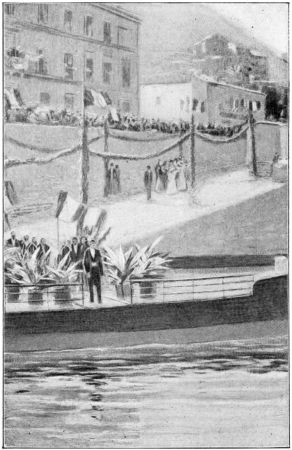
All Tournon was down at the water-side to meet us, and on the landing-stage was the very Mayor: a lean and tri-coloured man who took off his hat comprehensively to our whole company in a magnificent bow. Notables were with him—the Sous-Prefect, the Mayor of Tain, the Adjoint, leading citizens—who also bowed to us; but not with a bow like his! Laurel garlands decorated the landing-stage; more laurel garlands and the national colours made gay the roadway leading up the bank; and over the roadway was a laurel-wreathed and tri-coloured triumphal arch—all as suitable to welcoming poets and patriots, such as we were, as suitable could be. As the Gladiateur drew in to the bank there was a noble banging of boîtes—which ancient substitute for cannon in joy-firing still are esteemed warmly in rural France—and before the Mayor spoke ever a word to us the band bounded gallantly into the thick of the "Marseillaise."
With the boîte banging fitfully, with the band in advance playing "La Coupe," the tri-coloured Mayor led off with the most distinguished lady of our company upon his arm: and away we all went, under the triumphal arch and up the garlanded roadway two by two—as though Tournon were a Rhône-side Ararat and we were the animals coming out of the Ark. Our entry was a veritable triumph; and we endeavoured (I think successfully) to live up to it: walking stately through the narrow streets, made narrower by the close-packed crowds pressing to see so rare a poetic spectacle; through the cool long corridors of the Lycée; and so out upon a prettily dignified little park—where, at a triad of tables set within a garlanded enclosure beneath century-old plane-trees, our breakfast was served to us to the accompaniment of bangs from the boîte and musical remarks from the band. And all Tournon, the while, stood above us on a terrace and sympathetically looked on.
In its adaptation to the needs of travelling poets the breakfast was a master-stroke. It was simple, substantial, delicious; and in its accompanying prodigal outpouring of red and white Hermitage, Cornas, and Saint-Péray, the contrast with the bottle-niggardliness of Serrières was bravely marked. The Hermitage, from the hill-sides directly across the river from Tournon, around the town of Tain, scarcely lives up to its heroic tradition just now—the phylloxera having destroyed the old vines, planted by the hermit of blessed memory, and the new vines having in them still the intemperate strength of youth. Yet is it a sound rich wine, in a fair way to catch up again with its ancient fame.
While we feasted, the boîte and the band took turns in exploding with violence; and when, with the filet, the band struck up "La Coupe" away we all went with it in a chorus that did not die out entirely until well along in the galantine. The toasts came in with the ices, and on the basis of the regional champagne, Saint-Péray—sweet, but of good flavour—that cracked its corks out with the irregular volleyings of a line of skirmishers firing in a fog. The tri-coloured Mayor on behalf of Tournon, and Paul Arène and delightful Sextius Michel on behalf of the Félibrige and the Cigaliers, and M. Maurice Faure, the Deputy, on behalf of the Nation at large, exchanged handsome compliments in the most pleasing way; and the toasts which they gave, and the toasts which other people gave, were emphasized by a rhythmic clapping of hands in unison by the entire company—in accordance with the custom that obtains always at the feasts of the Félibres.
But that was no time nor place for extended speech-making. All in a whiff our feast ended; and in another whiff we were up and off—whisking through the Lycée corridors and the crowded streets and under the triumphal arch and so back on board the Gladiateur. The Mayor, always heroically ablaze with his patriotic scarf of office, stood on the landing-stage—like a courteous Noah in morning dress seeing the animals safely up the Ark gang-plank—and made to each couple of us one of his stately bows; the boîte fired a final salvo of one round; the band saluted us with a final outburst of the "Marseillaise"; everybody, ashore and afloat, cheered—and then the big wheels started, the current caught us and wrenched us apart from all that friendliness, and away we dashed down stream.
VII
Long before we came abreast of it by the windings of the river we saw high up against the sky-line, a clear three hundred feet above the water, all that is left of the stronghold of Crussol—still called by the Rhône boatmen "the Horns of Crussol," although the two towers no longer shoot out horn-like from the mountain-top with a walled war-town clinging about their flanks. One Géraud Bartet, a cadet of the great house of Crussol—of which the representative nowadays is the Duc d'Uzès—built this eagle's nest in the year 1110; but it did not become a place of importance until more than four hundred years later, in the time of the religious wars.
On the issue of faiths the Crussols divided. The head of the house was for the Pope and the King; the two cadets were for God and the Reform. Then it was that the castle (according to an over-sanguine chronicler of the period) was "transformed into an unconquerable stronghold"; and thereafter—always for the advancement of Christianity of one sort or another—a liberal amount of killing went on beneath its walls. In the end, disregarding the fact that it was unconquerable, the castle was captured by the Baron des Adrets—who happened at the moment to be on the Protestant side—and in the interest of sound doctrine all of its defenders were put to the sword. Tradition declares that "the streams of blood filled one of the cisterns, in which this terrible Huguenot had his own children bathed 'in order,' as he said, 'to give them strength and force and, above all, hatred of Catholicism.'" And then "the castle was demolished from its lowest to its highest stone."
This final statement is a little too sweeping, yet essentially it is true. All that now remains of Crussol is a single broken tower, to which some minor ruins cling; and a little lower are the ruins of the town—whence the encircling ramparts have been outcast and lie in scattered fragments down the mountain-side to the border of the Rhône.
It was on this very mountain—a couple of thousand years or so earlier in the world's history—that a much pleasanter personage than a battling baron had his home: a good-natured giant of easy morals who was the traditional founder of Valence. Being desirous of founding a town somewhere, and willing—in accordance with the custom of his time—to leave the selection of a site a little to chance, he hurled a javelin from his mountain-top with the cry, "Va lance!": and so gave Valence its name and its beginning, on the eastern bank of the river two miles away, at the spot where his javelin fell. At a much later period the Romans adopted and enlarged the giant's foundation; but nearly every trace of their occupation has disappeared. Indeed, even the ramparts, built only a few hundred years ago by Francis I., have utterly vanished; and the tendency of the town has been so decidedly toward pulling down and building up again that it now wears quite a modern and jauntily youthful air.
Valence was our next stopping-place, and we had a world of work to do there during the hour or so that we remained ashore. Very properly believing that we, being poets, could dedicate their local monuments for them far better than they could do such work for themselves, the excellent people of this town had accumulated a variety of monuments in expectation of our coming; and all of these it was our pleasant duty to start upon their immortal way.
Our reception was nothing short of magnificent. On the suspension bridge which here spans the river half the town was assembled watching for us; and the other half was packed in a solid mass on the bank above the point where our landing was made. The landing-stage was a glorious blaze of tri-colour; and there the Mayor, also gloriously tri-coloured, stood waiting for us in the midst of a guard of honour of four firemen whose brazen helmets shone resplendent in the rays of the scorching sun. A little in the background was the inevitable band; that broke with a crash, at the moment of our landing, into the inevitable "Marseillaise." And then away we all marched for half a mile, up a wide and dusty and desperately hot street, into the heart of the town. The detachment of welcoming townsfolk from the bank closed in around us; and around them, presently, closed in the detachment of welcoming townsfolk from the bridge. We poets (I insist upon being known by the company I was keeping) were deep in the centre of the press. The heat was prodigious. The dust was stifling. But, upheld by a realizing sense of the importance and honour of the duties confided to us, we never wavered in our march.
Our first halt was before a dignified house on which was a flag-surrounded tablet reading: "Dans cette maison est né Général Championnet. L'an MDCCLXII." M. Faure and Sextius Michel made admirable speeches. The band played the "Marseillaise." We cheered and cheered. But what in the world we poets had to do with this military person—who served under the lilies at the siege of Gibraltar that ended so badly in the year 1783, and who did a great deal of very pretty fighting later under the tri-colour—I am sure I do not know! Then on we went, to the quick tap of the drums, the Mayor and the glittering firemen preceding us, to the laying of a corner-stone that really was in our line: that of a monument to the memory of the dramatist Émile Augier. Here, naturally, M. Jules Claretie came to the fore. In the parlance of the Academy, Augier was "his dead man"; and not often does it happen that a finer, a more discriminating, eulogy is pronounced in the Academy by the successor to a vacant chair than was pronounced that hot day in Valence upon Émile Augier by the Director of the Comédie Française. When it was ended, there was added to the contents of the leaden casket a final paper bearing the autographs of the notables of our company; and then the cap-stone, swinging from tackles, was lowered away.
We had the same ceremony over again, ten minutes later, when we laid the corner-stone of the monument to the Comte de Montalivet: who was an eminent citizen and Mayor of Valence, and later was a Minister under the first Napoleon—whom he had met at Madame Colombier's, likely enough, in the days when the young artillery officer was doing fitful garrison-duty in that little town. Again it seemed to me that we poets were not necessarily very closely associated with the matter in hand; but we cheered at the proper places, and made appropriate and well-turned speeches, and contributed a valuable collection of autographs to the lead box in the corner-stone: and did it all with the easily off-hand air of thorough poets of the world. In the matter of the autographs there was near to being a catastrophe. Everything was going at a quick-step—our time being so short—and in the hurry of it all the lead box was closed and the cap-stone was lowered down upon it while yet the autographs remained outside! It was by the merest chance, I fancy, in that bustling confusion, that the mistake happened to be noticed; and I cannot but think—the autographs, with only a few exceptions, being quite illegible—that no great harm would have come had it passed unobserved. However, the omission being discovered, common courtesy to the autographists required that the cap-stone should be raised again and the much-signed paper put where it belonged.
Having thus made what I believe to be a dedicatory record by dedicating three monuments, out of a possible four, in considerably less than an hour, we were cantered away to the Hôtel de Ville to be refreshed and complimented with a "Vin d'honneur." That ceremony came off in the council chamber—a large, stately room—and was impressive. M. le Maire was a tall man, with a cherubic face made broader by wing-like little whiskers. He wore a white cravat, a long frock-coat, appositely black trousers, and a far-reaching white waistcoat over which wandered tranquilly his official tri-coloured scarf. The speech which he addressed to us was of the most flattering. He told us plainly that we were an extraordinarily distinguished company; that our coming to Valence was an event to be remembered long and honourably in the history of the town; that he, personally and officially, was grateful to us; and that, personally and officially, he would have the pleasure of drinking to our very good health. And then (most appropriately by the brass-helmeted firemen) well-warmed champagne was served; and in that cordial beverage, after M. Édouard Lockroy had made answer for us, we pledged each other with an excellent good will.
I am sorry to say that we "scamped" our last monument. To be sure, it was merely a tablet in a house-front setting forth the fact that Émile Augier had been born there; and already Augier had had one of the best speeches of the day. But that was no excuse for us. Actually, we scarcely waited to see the veil of pink paper torn away by a man on a step-ladder before we broke for the boat—and not a speech of any sort was made! Yet they bore us no malice, those brave Valençois. All the way down to the river, under the blaze of the sun, they crowded closely around us—with a well-meant but misapplied friendliness—and breathed what little air was stirring thrice over before it had a chance to get to our lungs. They covered again in a black swarm the bank and the bridge in our honour. Their band, through that last twenty minutes, blared steadfastly the "Marseillaise." From his post upon the landing-stage the cherubic Mayor beamed to us across his nobly tri-coloured stomach a series of parting smiles. The brass-helmeted firemen surrounded him—a little unsteadily, I fancied—smiling too. And as we slipped away from them all, into the rush of the river, they sent after us volley upon volley of cheers. Our breasts thrilled and expanded—it is not always that we poets thus are mounted upon high horses in the sight of all the world—and we cheered back to those discriminating and warm-hearted towns-folk until we fairly were under way down-stream. To the very last the cherubic Mayor, his hat raised, regarded us smilingly. To the very last—rivalling the golden glory of the helmet of Mambrino—the slightly-wavering head-gear of his attendant firemen shot after us golden gleams.
VIII
We drew away into calmer latitudes after leaving that whirlwind of a town. For the time being, our duties as public poets were ended; and there was a sense of restful comfort in knowing that for the moment we were rid of our fame and celebrity, and were free—as the lightest hearted of simple travellers—to enjoy the beauties of the river as it carried us, always at a full gallop, downward toward the sea.
In that tranquil spirit we came, presently, to the leaning Tour-Maudite: and found farther restfulness, after our own varied and too-energetic doings, in looking upon a quiet ruin that had remained soberly in the same place, and under the same sedative curse, for more than three hundred years. It is an architectural curiosity, this Curséd Tower—almost as far out from the perpendicular as is its better-known rival of Pisa; but more impressive in its unnatural crookedness because it stands upon an isolated crag which drops below it sheer to the river in a vast precipice. Anciently, before it went wrong and its curse came upon it, the tower was the keep of the Benedictine nunnery of Soyons. Most ungallantly, in the year 1569, the Huguenots captured the Abbey by assault; and thereupon the Abbess, Louise d'Amauze (poor frightened soul!) hurriedly embraced the Reformed religion—in dread lest, without that concession to the prejudices of the conquerors, still worse might come. Several of her nuns followed her hastily heterodox example; but the mass of them stood stoutly by their faith, and ended by making off with it intact to Valence. I admit that an appearance of improbability is cast upon this tradition by the unhindered departure from the Abbey of the stiff-necked nuns: who thus manifested an open scorn equally of the victorious Huguenots and of the Reformed faith. But, on the other hand, there are the ruins of the Abbey to prove conclusively that it truly was conquered; and there, slanting with a conspicuously unholy slant high up above the ruins, bearing steadfast witness to the wrath of heaven against that heretical Abbess and her heretical followers, is the Curséd Tower!
While the Abbess of Soyons, being still untried by the stress of battle, went sinless upon her still orthodox way, there lived just across the river on the Manor of l'Étoile a sinner of a gayer sort—Diane de Poitiers. The Castle of the Star dates from the fifteenth century; when Louis XI. dwelt there as Governor of Dauphiny and was given lessons in how to be a king. Diane the beautiful—"the most beautiful," as Francis I. gallantly called her—transformed the fortress into a bower, and gave to it (or accepted for it) the appropriately airy name of the Château de Papillon. There she lived long after her butterfly days were over; and in a way—although the Castle of the Butterfly is a silk-factory now—she lives there still: just as another light lady beautiful, Queen Jeanne of Naples, lives on in Provence. To this day her legend is vital in the country-side; and the old people still talk about her as though she were alive among them; and call her always not by her formal title of the Duchesse de Valentinois, but by her love title of "la belle dame de l'Étoile." Of this joyous person's family there is found a ghastly memento at the little town of Lène—a dozen miles down the river, beyond the great iron-works of Le Pouzin. It is the Tour de la Lépreuse: wherein a leper lady of the house of Poitiers was shut up for many years in awful solitude—until at last God in his goodness permitted her to die. I suppose that this story would have pointed something of a moral—instead of presenting only another case of a good moral gone wrong—had Diane herself been that prisoner of loathsome death in life.
But aboard the Gladiateur our disposition was to take the world easily and as we found it—since we found it so well disposed toward us—and not to bother our heads a bit about how moral lessons came off. With cities effervescing in our honour, with Mayors attendant upon us hat in hand, with brazen-helmeted firemen playing champagne upon us to stimulate our poetic fires, with boîtes and bands exploding in our praise—and all under that soul-expanding sun of the Midi—'tis no wonder that we wore our own bays jauntily and nodded to each other as though to say: "Ah, you see now what it is to be a poet in these latter days!" And we were graciously pleased to accept as a part of the tribute that all the world just then was rendering to us the panorama of mountains and towns and castles that continuously opened before us for the delectation of our souls.
Off to the right, hidden behind the factory-smoke of La Voulte, was the sometime home of Bernard de Ventadour, a troubadour whom the world still loves to honour—quite one of ourselves; off to the left, commanding the valley of the Drôme, were Livron and Loriol, tough little Huguenot nuts cracked all to pieces (as their fallen ramparts showed) in the religious wars; and a little lower down we came to Cruas: a famous fortified Abbey, surmounted by a superb donjon and set in the midst of a triple-walled town, whereof the Byzantine-Romanesque church is one of the marvels of Southern France. Cruas was founded more than a thousand years ago, in the time of Charlemagne, by the pious Hermengarde, wife of Count Eribert de Vivarais; being a thank-offering to heaven erected on the very spot where that estimable woman and her husband were set upon in the forest by a she-wolf of monstrous size. But the fortified Abbey was a later growth; and was not completed, probably, until the sixteenth century. It was toward the end of that century, certainly, that the Huguenots attacked it—and were beaten off finally by Abbot Étienne Déodel and his monks, who clapped on armour over their habits and did some very sprightly fighting on its walls.
Below Cruas, around the bend in the river, Rochemaure the Black came into sight: a withered stronghold topping an isolated rock of black basalt six hundred feet above the stream. It is a grewsome place: the ruin of a black nightmare of a basalt-built castle, having below and around it a little black nightmare of a basalt-built town—whereof the desperately steep and crooked streets are paved with black basalt, and are so narrowed by over-hanging houses as to show above them only the merest strip of sky. It is a town to which, by preference, one would go to commit a murder; but 'tis said that its inhabitants are kindly disposed. Only a step beyond it lies Le Teil: a briskly busy little place tucked in at the foot of a lime-stone cliff—town and cliff and the inevitable castle on the cliff-top all shrouded in a murky white cloud, half dust, half vapour, rising from the great buildings in which a famous hydraulic cement is made. Not a desirable abiding place, seemingly; but in cheerful contrast with its lowering neighbour up the stream.
And then, passing beyond a maze of islands—amidst which the river wandered so tortuously that our pilot had behind him a strong tiller-crew in order to carry us through safely—we came to the noble town of Viviers. From afar we saw its tall bell-tower, its beautiful cathedral, its episcopal palace; and as we drew nearer the whole environment of ancient houses and fortifications spread out around those governing points in a great amphitheatre. But what held us most was the gay dash of tri-colour on its bridge, and the crowd there evidently waiting for our coming to manifest toward us their good will. They cheered us and waved their hats and handkerchiefs at us, those poet-lovers, as we neared them; and as we passed beneath the bridge a huge wreath of laurel was swung downward to our deck, and a shower of laurel branches fluttered down upon us through the sunlit air. In all the fourteen centuries since Viviers was founded I am confident that nothing more gracious than this tribute to passing Poetry is recorded in the history of the town.
Naturally, being capable of such an act of nicely discriminating courtesy, Viviers has sound traditions of learning and of gentle blood. In its day it was a great episcopal city: whose bishops maintained an army, struck money, counted princes among their vassals, in set terms defied the power of the King of France—and recognized not the existence of any temporal sovereign until the Third Conrad of Germany enlarged their knowledge of political geography by taking their city by storm. Yet while finely lording it over outsiders, the bishops were brought curiously to their bearings within their own walls. Each of them, in turn, on his way to his installation, found closed against him, as he descended from his mule before it, the door of the cathedral; and the door was not opened until he had sworn there publicly that he would maintain inviolate as he found them the rights and privileges of the chapter and of the town. Moreover, once in each year the men and women of rank of Viviers asserted their right to a part enjoyment of the ecclesiastical benefices by putting on copes and mitres and occupying with the canons the cathedral stalls.
The line of one hundred and thirty bishops who in succession reigned here ended—a century back, in the time of the Revolution—in a veritable lurid flame; yet with, I think, a touch of agonized human nature too. The church historian can see only the diabolical side of the situation; and in a horror-struck way tells how that last Bishop, "being overcome by the devil, abjured the episcopacy; with his own hands destroyed the insignia of his sacred office; and thereafter gave himself up to a blasphemous attack upon the holy religion of which he had been for a long while one of the most worthy ministers."
It certainly is true that the devil had things largely his own way about that time here in France; but it does not necessarily follow that in this particular matter the devil directly had a hand. To my mind a simpler and more natural explanation presents itself: That the iconoclastic Bishop was a weak brother who had suffered himself to be forced into a calling for which he had no vocation, and into an apparent championship of a faith with which his inmost convictions were at war; that for years and years the struggle between the inward man and the outward Bishop had gone on unceasingly and hopelessly, until—as well enough might happen to one strong enough to resent yet not strong enough to overcome restraint—the galling irksomeness of such a double life had brought madness near; and that madness did actually come when the chains of a life and of a faith alike intolerable suddenly were fused in the fierce heat of the Revolution and fell away.
IX
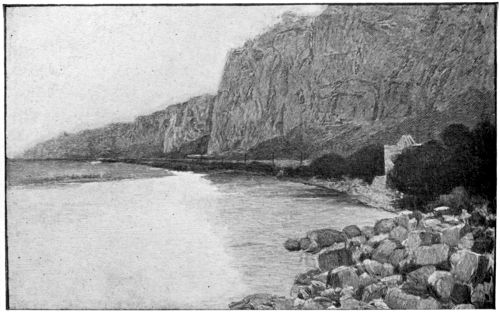
Below Viviers the Rhône breaks out from its broad upper valley into its broader lower valley through the Defile of Donzère. Here the foothills of the Alps and the foothills of the Cévennes come together, and behind this natural dam there must have been anciently a great lake which extended to the northward of where now is Valence. The Defile is a veritable cañon that would be quite in place in the Sierra Madre. On each side of the sharply-narrowed river the walls of rock rise sheer to a height of two hundred feet. The rush of the water is tumultuous. In mid-stream, surrounded by eddies and whirling waves, is the Roche-des-Anglais—against which the boat of a luckless party of English travellers struck and was shattered a hundred years ago. Indeed, so dangerous was this passage held to be of old—when faith was stronger and boats were weaker than in our day of skepticism and compound-engines—that it was customary to tie-up at the head of the Defile and pray for grace to come through it safely; and sincerely faithful travellers tied-up again when the passage was ended to offer a service of grateful praise. But nowadays they clap five men on the tiller and put on more steam—and the practical result is the same.
The cliffs bordering the cañon, being of a crumbling nature, are known as the Maraniousques; but usually are called by the Rhône boatmen the Monkey Rocks—because of the monkeys who dwelt in them in legendary times and stoned from their heights the passing travellers. It was a long while ago that the monkeys were in possession—in the time immediately succeeding the Deluge. During the subsidence of the waters it seems that the Ark made fast there for the night, just before laying a course for Ararat; and the monkey and his wife—desperately bored by their long cooping-up among so many uncongenial animals—took advantage of their opportunity to pry a couple of tiles off the roof and get away. The tradition hints that Noah had been drinking; at any rate, their absence was not noticed, and the Ark went on without them the next day. By the time that the Deluge fairly was ended, and the Rhône reopened to normal navigation, a large monkey family was established on the Maraniousques; and the monkeys thenceforward illogically revenged themselves upon Noah's descendants by stoning everybody who came along.
Later, the ill-tempered monkeys were succeeded by more ill-tempered men. In the fighting times the Defile of Donzère was a famous place in which to bring armies to a stand. Fortifications upon the cliffs entirely commanded the river; and at the lower end of the Defile the castle and the walled town of Donzère, capping a defiant little hill-top, commanded both the river and the plain. Even the most fire-eating of captains were apt to stop and think a little before venturing into the Defile in those days.
All of those perils are ended now. The dangers of the river are so shorn by steam that the shooting of the cañon rapids yields only a pleasurable excitement, that is increased by the extraordinary wild beauty of that savage bit of nature in the midst of a long-tamed land; and the ramparts and the castle of Donzère, having become invitingly picturesque ruins, are as placable remnants of belligerency as are to be found anywhere in the world. Indeed, as we saw them—with the afternoon sunlight slanting down in a way to bring out delectably the warm greys and yellows of the stone-work and to produce the most entrancing effects of light-and-shade—it was not easy to believe that people had been killing each other all over them not so very long ago.
THE DEFILE OF DONZÈRE
Having escaped from the Defile of Donzère, the river wanders away restfully into a wilderness of islands—a maze so unexplored and so unexplorable that otters still make their home in it, and through the thick foliage poke out their snub noses at passing boatmen now and then. Thence onward for a long way islands are plentiful—past Pierrelatte, and Bourg-Saint-Andéol, (a very ancient and highly Roman flavoured town), and the confluence of the Rhône and the Ardèche—to the still larger archipelago across which the Bridge Building Brothers, with God himself helping them, built the Pont-Saint-Esprit.
Modern engineers—possibly exalting their own craft at the expense of that of the architects—declare that this bridge was the greatest piece of structural work of the Middle Ages; certainly it was the greatest work of the Frères Pontifes: that most practical of brotherhoods which, curiously anticipating one phase of modern doctrine, paid less attention to faith than to works and gave itself simply to ministering to the material welfare of mankind. In the making of it they spent near half a century. From the year 1265 steadily onward until the year 1307 the Brothers labored: and then the bridge was finished—a half-mile miracle in stone. In view of the extraordinary difficulties which the engineer in charge of the work overcame—founding piers in bad holding-ground and in the thick of that tremendous current, with the work broken off short by the frequent floods and during the long season of high water in the spring—it is not surprising that the miracle theory was adopted to explain his eventual victory. Nor is it surprising that the popular conviction presently began to sustain itself by crystalizing into a definite legend—based upon the recorded fact that the Brothers worked under the vocation of the Holy Spirit—to the effect that the Spirit of God, taking human form, was the designer of the fabric and the actual director under whose guidance the work went on. And so the genesis of the bridge was accounted for satisfactorily; and so it came by its holy name.
Personally, I like miracles; and this miracle is all the more patent, I think, now that the bridge has been in commission for almost six hundred years and still is entirely serviceable. Yet while its piers and arches, its essential parts, remain nearly as the Brothers built them, the bridge has undergone such modifications in the course of the past century—in order to fit it to the needs of modern traffic—that its picturesqueness has been destroyed. The chapel of St. Nicholas upon one of its piers, and the tower at its centre, were razed about the end of the last century; a little later the fortified approaches were removed; in the year 1854, to provide for the increasing river navigation, the first two arches from the right bank were replaced by a single iron arch of two hundred feet span over the main channel; and in the year 1860 the entire superstructure on the north side, with a part of the superstructure on the south side, was torn down—and in place of the old narrow roadway, with turn-outs on each pier, there was built a roadway uniformly twenty-two feet wide. In a sentimental way, of course, these radical changes are to be regretted; but I am sure that the good Brothers, could they have been consulted in the premises, would have been the first to sanction them. For they were not sentimentalists, the Brothers; they were practical to the last degree. What they wanted was that their bridge, living up to their own concept of duty, should do the greatest amount of good to the greatest number of men.
Almost as we came out from beneath that monument to practical Christianity, we saw over on the left bank two monuments to the theoretical Christianity of three hundred years ago: the grisly ruins of Mornas and Montdragon—each on a hill dark green with a thick growth of chêne vert, and each having about it (not wholly because of its dark setting, I fancied) a darkly sinister air. In truth, the story of Mornas is sombre enough to blacken not merely a brace of hill-tops but a whole neighbourhood. In the early summer of the year 1565, a day or two before the Fête-Dieu, the Papists surprised and seized the town and castle and put the entire Huguenot garrison to the sword. Then, as now, it was the custom in honour of the Fête-Dieu to adorn the house-fronts with garlands and draperies; and by way of variant upon this pretty custom "certain of the conquerors, more fanatical than the rest, flayed the dead Huguenots and draped their houses bravely with Protestant skins." Thereupon the Baron des Adrets, the Huguenot commander in that region, sent one of his lieutenants, Dupuy-Montbrun, to avenge that deviltry. At the end of a three-days' siege Mornas was conquered again, and then came the vengeance: "for which the castle of Mornas, whereof the battlements overhung a precipice falling sheer two hundred feet to broken rocks below, offered great advantages." In a grave and orderly fashion, the survivors of the conquered garrison were assembled in the castle court-yard; were taken in orderly squads of ten up to the battlements; and thence were thrust over into that awful depth. And so the account was squared.
It is instructive to note that des Adrets, who ordered the vengeance on Mornas, a little later abjured the Reformed religion and became a Papist; and that Dupuy-Montbrun, who carried out his orders and who succeeded him upon his recantation in the command of the Protestant army, but a little while before had renounced Papacy to become a Huguenot. So the leaders, the worst of them, shifted from side to side as they happened to be swayed by pay or policy; and to such creatures of no real faith were due the direst of the atrocities of those hideous times. But the Huguenots of the rank and file were of another sort. Their singleness and sincerity in their fight for their faith were beyond question. They died for it willingly. Failing the happiness of death, yet being conquered, they still held fast to it. In the end, rather than relinquish it, they unhesitatingly elected—at a stroke giving up country, rank, fortune—to be outcast from France.
For me the history of those desperate wars has a very vital interest: for my own ancestors took the share in them that was becoming to faithful gentlemen vowed to the Reform, and I owe my American birthright to the honourable fact that they fought on the losing side. As I myself am endowed with a fair allowance of stubbornness, and with a strong distaste to taking my opinions at second hand, I certainly should have been with my kinsfolk in that fight had I lived in their day; and since my destiny was theirs to determine I am strongly grateful to them for having shaped it so well.
X
But I was glad when Mornas, vivid with such bitter memories, dropped out of sight astern. Sleeping dogs of so evil a sort very well may lie; though it is difficult not to waken a few of them when they lie so thickly as here in the Rhône Valley, where almost every town and castle has a chapter of nightmare horrors all its own.
Even Châteauneuf-du-Pape—which we saw a half hour later off to the eastward, rising from a little hill-top and thence overlooking the wide vineyard-covered valley—came to its present ruin at the hands of des Adrets; who, having captured and fired it, left standing only its tall square tower and some fragments of its walls. This was an unfairly lurid ending for a castle which actually came into existence for gentle purposes and was not steeped to its very battlements in crime; for Châteauneuf was built purely as a pleasure-place, to which the Popes—when weary with ruling the world and bored by their strait-laced duties as Saint Peter's earthly representatives—might come from Avignon with a few choice kindred spirits and refreshingly kick up their heels. As even in Avignon, in those days, the Popes and cardinals did not keep their heels any too fast to the ground, it is an inferential certainty that the kicking up at Châteauneuf must have been rather prodigiously high; but the people of the Middle Ages were too stout of stomach to be easily scandalized, and the Pope's responsibilities in the premises were all the lighter because the doctrine of his personal infallibility had not then been formulated officially. And so things went along comfortably in a cheerfully reprehensible way.
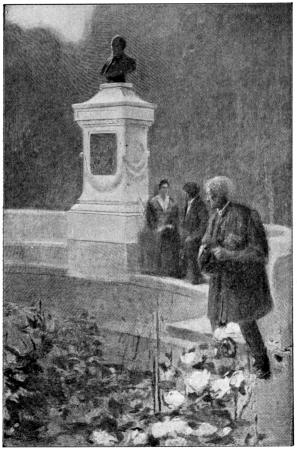
It was in those easy-going days that the vineyards were planted, on the slopes below the castle, which were destined to make the name of Châteauneuf-du-Pape famous the toping world over long after the New Castle should be an old ruin and the Avignon Popes a legend of the past. Only within the present generation did those precious vines perish, when the phylloxera began among them its deadly work in France; and even yet may be found, tucked away here and there in the favoured cellars of Provence and Languedoc, a few dust-covered bottles of their rich vintage: which has for its distinguishing taste a sublimated spiciness due to the alternate dalliance of the bees with the grape-blossoms and with the blossoms of the wild thyme. It is a wine of poets, this bee-kissed Châteauneuf, and its noblest association is not with the Popes who gave their name to it but with the seven poets—Mistral, Roumanille, Aubanel, Matthieu, Brunet, Giéra, Tavan—whose chosen drink it was in those glorious days when they all were young together and were founding the Félibrige: the society that was to restore the golden age of the Troubadours and, incidentally, to decentralize France. One of the sweetest and gentlest of the seven, Anselme Matthieu, was born here at Châteauneuf; and here, with a tender love-song upon his lips, only the other day he died. The vineyards have been replanted, and in the fulness of time may come to their glory again; but the greater glories of Châteauneuf—which belonged to it once because of its Popes, and again because of its sweet-souled Poet—must be only memories forevermore.
THE ROUMANILLE MONUMENT
The castles over on the right bank, Montfaucon and Roquemaure, are of the normal painful sort again. Roquemaure is a crooked, narrow, up-and-down old dirty town, where old customs and old costumes and old forms of speech still live on; and, also, its people have a very pretty taste in the twisting and perverting of historic fact into picturesque tradition—as is shown by the way in which they have rearranged the unpleasant details of the death of Pope Clement V. into a bit of melodramatic moral decoration for their own town. Their ingeniously compiled legend runs in this wise: Clement's death in the castle of Roquemaure occurred while he was on his way homeward from the Council of Vienne; where—keeping with the King the bargain which had won for him the Papal throne—he had abolished the Order of the Templars and had condemned their Grand Master, Jacques de Molay, to be burned alive. When that sentence was passed, the Grand Master, in turn, had passed sentence of death upon the Pope: declaring that within forty days they should appear together, in the spirit, to try again that cause misjudged on earth before the Throne of God. And the forty days were near ended when Pope Clement came to Roquemaure—with the death-grip already so strong upon him that even the little farther journey to Avignon was impossible, and he could but lay him down there and die. While yet the breath scarce was out of his body, his servants fell to fighting over his belongings with a brutal fierceness: in the midst of which fray a lighted torch fell among and fired the hangings of the bed whereon lay the dead Pope—and before any of the pillagers would give the rest an advantage by stopping in their foul work to extinguish the flames his body was half-consumed. And so was Clement burned in death even as the Grand Master had been burned in life; and so was executed upon him the Grand Master's summons to appear before the Judgment Seat on high!
It is interesting to note that this tradition does very little violence to the individual facts of the case, and yet rearranges them in such a fashion that they are at sixes and sevens with the truth as a whole. When, in my lighter youth, I entered upon what I fancied was antiquarian research I was hot for the alluring theory that oral tradition is a surer preserver of historic fact than is written record; and as I was not concerned with antiquities of a sort upon which my pretty borrowed theory could be tested I got along with it very well. But I am glad now to cite this capital instance in controversion of my youthful second-hand belief—because it entirely accords with my more mature conviction that oral tradition, save as a tenacious preserver of place-names, is not to be trusted at all. And as unsupported written record rarely is to be trusted either, it would seem that a certain amount of reason was at the root of King David's hasty generalization as to the untruthfulness of mankind.
The day was nearly ended as we passed that town with a stolen moral history: and so swept onward, in and out among the islands, toward Avignon. Already the sun had fallen below the crest of the Cévennes; leaving behind him in the sky a liquid glory, and still sending far above us long level beams which gilded radiantly—far off to the eastward—the heights of Mont-Ventour. But we, deep in the deep valley, threaded our swift way among the islands in a soft twilight which gently ebbed to night.
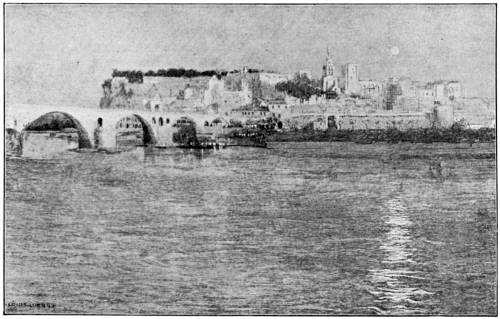
And then, as the dusk deepened to the westward, there came slowly into the eastern heavens a pale lustre that grew brighter and yet brighter until, all in a moment, up over the Alpilles flashed the full moon—and there before us, almost above us, the Rocher-des-Doms and the Pope's Palace and the ramparts of Avignon stood out blackly against the moon-bright sky. So sudden was this ending to our journey that there was a wonder among us that the end had come!
All the Félibres of Avignon were at the water-side to cheer us welcome as the Gladiateur, with reversed engines, hung against the current above the bridge of Saint-Bénézet and slowly drew in to the bank. Our answering cheers went forth to them through the darkness, and a stave or two of "La Coupe" was sung, and there was a mighty clapping of hands. And then the gang-plank was set ashore, and instantly beside it—standing in the glare of a great lantern—we saw our Capoulié, the head of all the Félibrige, Félix Gras, waiting for us, his subjects and his brethren, with outstretched hands. From him came also, a little later, our official welcome: when we all were assembled for a ponch d'honneur at the Hôtel du Louvre—in the great vaulted chamber that once served the Templars as a refectory, and that has been the banquet-hall of the Félibrige ever since this later and not less honorable Order was founded, almost forty years ago.
AVIGNON
Not until those formalities were ended could we of America get away to receive the personal welcome to which through all that day we had been looking forward with a warm eagerness—yet also sorrowing: because we knew that among the welcoming voices there would be a silence, and that a face would be missing from among those we loved. Roumanille was dead; and in meeting again in Avignon those who had been closest and dearest to him, and who to us were close and dear, there was heartache with our joy.
Saint-Remy-de-Provence, August, 1894.