Chapter XXII
Reading edition
THE LAST OF THE "EMDEN," AND THE SEA FIGHT OFF CORONEL.
If you look at a map of the Indian Ocean, you will see, some 700 miles south of Sumatra and 1,200 miles south-west of Singapore, a group of about twenty atolls,[142] known as the Cocos-Keeling Islands. They are covered with palm groves, and they export cocoa-nuts and copra. The "king" of the islands is Mr. Sydney Ross, a descendant of the Captain J. C. Ross who settled on them in 1825. It was to these remote islands that Captain von Müller brought the Emden in the early days of November. His object was to destroy the important British wireless station established on Direction Island.
On the morning of 9th November the operators in charge of the station saw a cruiser in the offing. At first they believed the vessel to be a British warship, but they were soon undeceived. Before a boat could be lowered and a landing-party sent ashore, the operators at the wireless station, with true British coolness, sent off distress signals, and warned the adjacent stations, by means of the three submarine cables which come ashore on the island, that the Germans were about to land. One launch and two cutters, containing three officers and forty men, arrived about 7.30; the wireless mast was blown up; the instruments were smashed, the storerooms and workshops were completely wrecked, and a dummy cable and one real cable were cut and a third damaged. The remaining cable was left uninjured, probably because the Germans did not know that it existed. In less than two hours the work of destruction was completed. Then suddenly loud and repeated siren calls were heard from the Emden. Before the boats could return she was off at top speed.
She had been trapped at last. In the wireless room of H.M.S. Sydney, then engaged in escorting Australian transports, a message had been received: "Strange warship off entrance." In a moment Captain Glossop guessed that it was the raider that had so long eluded him. Immediately he worked up to twenty knots an hour, and with the "white bone" in his ship's teeth sped towards the island. At 9.15 the feathery tops of the cocoa-nut trees were sighted, and a few minutes later the Emden was seen bearing down on the Sydney at a great rate. Captain von Müller knew that the Sydney's 6-inch guns could destroy his ship at a distance too great for his 4.7-inch guns to do much mischief. He therefore tried to close in with the Sydney, which endeavoured to keep sufficiently far off to obtain the advantage afforded by her bigger guns.
Then began a running fight which lasted for an hour and forty minutes. At first the Emden's fire was very rapid and accurate, but as the Sydney's shells began to burst on her decks it slackened quickly. The foremost funnel of the Emden was shot away, then the foremast, then the second funnel, and lastly the third funnel. She was now burning furiously, and her deck was strewn with dead and dying. A few minutes later and she was seen to be making for the beach on North Keeling Island, where she grounded at 11.20 a.m. Captain Glossop gave her two more broadsides, and then left her to pursue a merchant ship which had come up during the action.
The merchantman was overhauled, and found to be a captured British collier in a sinking condition. As she was past repair she was sent to the bottom, and the Sydney, with the crew of the collier on board, returned to the Emden, now a dismal wreck amidst the surf foaming on the reef. Her colours, however, were still flying at the masthead. When called upon to haul them down her captain replied that he would never surrender. Very reluctantly, Captain Glossop again fired at the Emden. Five minutes later white flags fluttered aloft, and her ensign was hauled down.
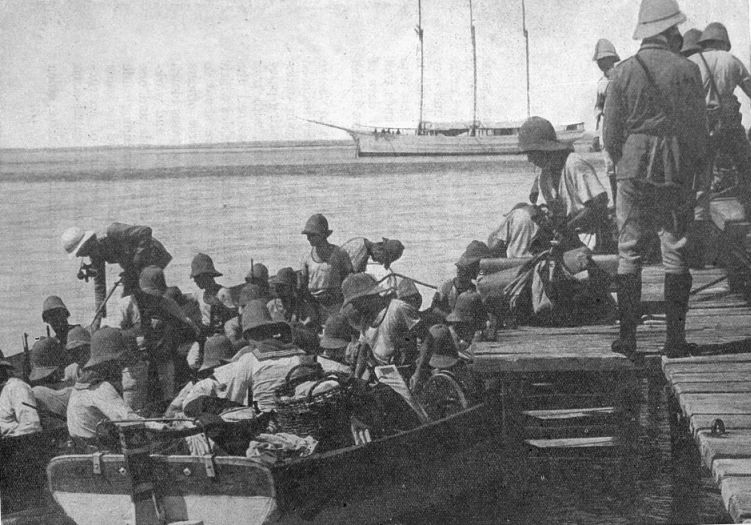
German Landing Party on the Cocos-Keeling Islands. Photo, The Sphere
The yacht shown in the photograph is the Ayesha, in which the landing party escaped from the island.
About six o'clock that night the Emden's landing-party seized and provisioned Mr. Ross's 70-ton schooner, the Ayesha, and made off. For months they were unheard of, though all sorts of rumours were current as to their fate. On March 1, 1915, it was reported that they had reached Damascus, and were on their way to Constantinople.
Captain von Müller was captured unwounded, and amongst his officers was Franz Josef of Hohenzollern, a nephew of the Kaiser. As a tribute to the gallantry and humanity which Captain von Müller had exhibited, he was permitted to retain his sword. While the German soldiers were making their name a byword of loathing in Belgium, Captain von Müller had been behaving as a sailor and a gentleman; consequently he was regarded in Britain as something of a hero. He had fought staunchly, and although he had perhaps violated the laws of war on several occasions, his sins were forgiven him because he had been merciful to the defenceless and the captive.
The Emden lost some 250 killed and wounded, while the Sydney had four killed and twelve wounded. Only about ten hits seem to have been made on the British vessel, and the damage done was surprisingly small. Australians were overjoyed to hear that a ship of their own navy had rid the seas of the famous raider. Their satisfaction was all the greater when they remembered that the victorious crew consisted largely of young and untried sailors.
Let me tell you of a pleasing little incident that happened when the Sydney, with prisoners on board, returned to the transports which she and the Melbourne were convoying. Captain Glossop had given orders that there was to be no cheering, as he had German wounded on board, and some of them might be dying. The Sydney steamed past forty transports, whose decks and rigging were crowded with patriotic men; but not a cheer was raised, though all were deeply stirred by the good news. Two German officers asked Captain Glossop the reason of the silence. When he explained, they were much affected. One of them shook him by the hand and said, "You have been kind, but this crowns all. We cannot speak to thank you for it."
The news was received with great delight by our soldiers in Artois and West Flanders. At one place where the opposing trenches were close together the men cheered, and passed on the information with appropriate comments to the enemy, who replied with a vindictive volley. At Lloyd's[143] the old Lutine bell[144] was rung, and when, amidst tense silence, the crier announced that the Emden's career of destruction had ended, underwriters,[145] brokers, and clerks burst forth into excited cheering, which was repeated again and again. During the past two months the insurance companies had been heavily hit; freight for the East had been difficult to obtain, Indian tea had gone up twopence per pound, the jute trade had been paralysed, and tin and rubber had largely increased in price. All this was now over, and shipping in Eastern waters resumed its normal course.
Almost equally good news arrived the same day. The Königsberg, after her attack on the Pegasus in Zanzibar harbour, had gone into hiding somewhere along the German East African coast. A diligent search was made for her by H.M.S. Chatham, and on 30th October she was discovered in shoal water about six miles up a river opposite Mafia island. The Chatham, owing to her greater draught, could not ascend the river; but she sank colliers in the only navigable channel, so that the German cruiser could not come out. She lay amidst dense palm groves, and was aground, except at high tide. Part of her crew had been landed and entrenched on the banks of the river. Both the entrenchments and the Königsberg were shelled, but owing to the thick foliage shrouding the ship it was not possible to estimate what damage had been done.
From the end of October 1914 until the beginning of July 1915 the Königsberg lay in this position. She was most difficult to attack, as only shallow-draught ships could get sufficiently close to engage her. In May 1915 the Admiralty decided to send to German East Africa two of the monitors—the Severn and the Mersey—which had done so much to foil the coast dash towards Calais. Aircraft accompanied the vessels, and discovered the exact whereabouts of the Königsberg. On 4th July the monitors entered the river and opened fire. The Königsberg replied, and fired salvos of five guns with great accuracy, twice hitting the Mersey, and causing some casualties.
The aeroplanes found great difficulty in "spotting" the effects of the monitors' fire, because of the dense jungle. For six hours the monitors continued firing, and the Königsberg was hit five times, though her masts were still standing. Then a salvo struck her, and she burst into flames. For a time she continued to fire with one gun, but during the last part of the engagement she made no reply, either because her ammunition had run out or because her guns were disabled. On 11th July another attack was made, and the Königsberg was battered into shapeless ruin.
During November 19 a British squadron approached the harbour of Dar-es-Salaam,[146] in which three German vessels had taken refuge. The entrance had been blocked by a floating dock, and only vessels of light draught could pass the obstruction. On November 28 a British flotilla supported by a cruiser entered the harbour, and after a parley the governor of the town hoisted the white flag. Commander Henry Peel Ritchie, R.N., who was in charge of the operations, now boarded the German ships, but soon discovered that the surrender of the town was a trick to destroy him and his men. A heavy fire was opened on the boats from trenches on shore, and Commander Peel Ritchie had the greatest difficulty in getting them safely out of harbour. He himself was one of the first to be hit, but he continued at his post until his eighth wound, received twenty-five minutes later, rendered him unconscious. The cockswain of his pinnace, though hit twice, gallantly stuck to the wheel until the boat was out of gunfire. For his splendid courage, and for the inspiring example which he set to his men, Commander Ritchie was awarded the Victoria Cross. The cockswain, Leading Seaman Thomas Arthur Gallagher, received the Conspicuous Gallantry Medal.
We will now follow the fortunes of the German squadron under Admiral von Spee. You will remember that it left Kiao-chau early in August for the South American coast. Von Spee's squadron, which consisted of modern ships, comprised two armoured cruisers, the Gneisenau and the Scharnhorst; and three light cruisers, the Dresden, Leipzig, and Nürnberg. The first two vessels had a speed of at least 23 knots, and were armed with eight 8.2-inch guns, six of 5.9-inch, and eighteen 21-pounders. The Dresden was a sister ship to the Emden, the Nürnberg was slightly smaller, and the Leipzig smaller still. The object of this squadron was to prey on British commerce in the Pacific. The Emden, as you know, was detailed for similar work in the Indian Ocean, and the Karlsruhe in the South Atlantic.
I have told at length of the short and merry life of the Emden. The Karlsruhe was not so successful, but she destroyed no fewer than thirteen steamers in the course of a week or two. She was remarkable for the number of attendant vessels which accompanied her, some of them her own captures. These she employed as scouts to warn her of danger, and to give notice of vessels which might be seized. It is said that she had many hairbreadth escapes from British cruisers. Towards the end of November she disappeared, and though many rumours were afloat, nothing was certainly known of her whereabouts. In March 1915 it was reported that she had gone down off the West Indian island of Grenada.
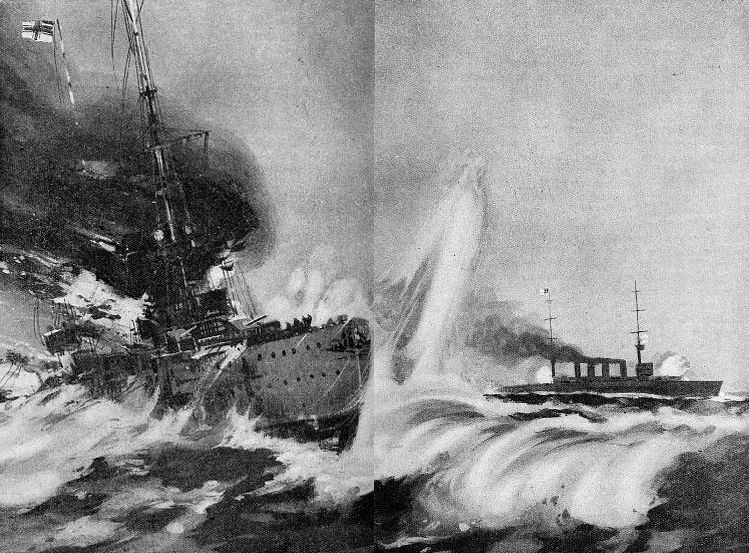
Destruction of the German Raider Emden by H.M.S. Sydney of the Australian Navy, November 9, 1914.
You can easily understand that without a regular supply of coal and provisions the German commerce-raiders could not long keep the seas. When a fighting ship in time of war puts into a neutral port, she may not receive more coal and provisions than will carry her to the nearest harbour of her own land, and she may not obtain any further supplies at that port for three months. Some of the South American states, however, were very slack in observing the rules of naval warfare, and two of them—Ecuador and Colombia—actually permitted German coaling and provisioning bases to be set up on their coasts, and allowed their wireless stations to be used for the purpose of ascertaining the movements of the British cruisers which were trying to catch the raiders. When Admiral von Spee sailed for the western coast of South America, he was going into waters where there were many harbours in which he could coal, and many friends who would see that he was well supplied. German merchants abound in Chile.
On 14th September von Spee's squadron touched at Apia, and on the 22nd two of his cruisers arrived off Papeete, in Tahiti, one of the loveliest of the Pacific Islands. A small French gunboat was sunk, and the town was bombarded. Then his squadron of five warships with attendant colliers concentrated near Valparaiso, and he was ready, like a twentieth-century Drake, to prey ruthlessly upon the merchantmen that came round the Horn.
Von Spee did not expect that he would go unmolested. He knew that Britain had a squadron which was even then cruising northwards along the coast of Chile, under the command of a renowned seaman, Sir Christopher Cradock. But this squadron was all too weak to meet him in fair fight. It consisted of two armoured cruisers, the Good Hope and the Monmouth, the light cruiser Glasgow, and an armed liner, the Otranto, the latter being incapable of engaging a ship of war. None of the vessels was speedy, and none was heavily armed. The Canopus, a seventeen-year-old battleship, was on its way to meet him, but had not yet arrived. Von Spee could count on sixteen 8.2-inch guns, and to oppose them Cradock had but two 9.2-inch guns. When the Canopus joined him his big-gun armament would be increased by four 12-inch guns, but even then the British squadron would be inferior in weight of broadside to the German squadron. Nor had the British any advantage of speed. The Glasgow could do 26 knots an hour, but the Monmouth could only do 23. In big guns, speed, and armour the Germans were greatly superior. Cradock was hourly expecting reinforcements, but for some reason they were not forthcoming. One of his officers wrote as follows on 12th October: "We think the Admiralty have forgotten their trade-route squadron 10,000 miles from London town. Five German cruisers against us. Pray that we may prevent them concentrating."
They had concentrated, as we know, and Cradock had now to decide whether he would give battle with his three cruisers or wait for the arrival of the Canopus. He was a dashing, fearless officer, and he took the risk. He sent off a wireless message to the Canopus: "I am going to attack the enemy now," and ordered speed to be increased to 17 knots. It is doubtful whether the Canopus ever received the message, for the enemy was "jamming the wireless"—that is, was sending out bogus messages to interfere with the messages of the British flagship. At any rate, the Canopus did not join Cradock, and he steamed without her towards the foe.
The Glasgow swept northward, and about four o'clock in the afternoon of 1st November sighted the enemy. She sent off wireless signals to the flagship, Good Hope, but they were jammed. The Monmouth and Otranto joined the Glasgow soon after, and at five o'clock the Good Hope came up. Both squadrons were now moving southwards, the Germans having the inshore course. At the head of the British line was the Good Hope, with the Monmouth, Glasgow, and Otranto following, one behind the other. The German line was headed by the Scharnhorst, with the Gneisenau, Dresden, and Nürnberg following.
Try to imagine the scene. The sea was running high; there was a stiff wind blowing, and away in the west the sun was sinking in a flaming sky of crimson and gold. Against the bright sunset the British ships stood out sharp and clear, while the German vessels were shrouded by the gathering gloom and the dark background of the land. Behind them were the long ridges and lofty peaks of the Andes, their eternal snows glowing red in the light of the setting sun. Amidst the roar of sea and wind the two squadrons raced south in the teeth of the gale. The day was speeding fast to its close, and the German admiral, owing to the superior speed of his ships, was able to choose the range at which the battle was to be fought.
The sun sank into the sea, and eight minutes later, at a range of about 12,000 yards—roughly, seven miles—the leading German cruiser opened fire with her biggest guns. Shells shrieked over and short of the Good Hope within a hundred yards of her, and the Otranto began to edge away to the south-west. The Good Hope and the Monmouth replied as best they could to the Scharnhorst and Gneisenau, but their fire was ineffective; the two 9.2-inch guns of the Good Hope could not be brought into action, because they were mounted so near to the water's edge that the waves washed over them. Meanwhile the Glasgow was exchanging shots with the light cruisers Leipzig and Dresden. The shooting of the enemy was deadly, and in a few minutes all was over—the British ships were pounded to pieces by guns which quite outranged those which they carried. "It was as though a man standing at Charing Cross were attacked with deadly accuracy by a foe on Ealing Common, without any possibility of replying." Think of the horror and hopelessness of it all!
Broadside after broadside of powerful guns crashed on the British cruisers. The third salvo set the Good Hope and the Monmouth on fire. The range had now narrowed down to 5,000 yards, and darkness was coming on apace. Many of the shells falling into the sea threw up huge geysers of white spray, which gleamed ghost-like in the twilight. The British could fire only at the flashes of the enemy's guns, and often even these slight indications were hidden from the gun-layers by the heavy head seas.
The Monmouth had been heavily hit, and was rapidly becoming unmanageable; the fore turret of the Good Hope was burning fiercely, and she began to fall away out of line towards the enemy. Suddenly, at about a quarter to eight, there was a roar louder than that of the booming guns; the flames had reached the magazine of the Good Hope, and a terrific explosion took place. A column of fire shot up 200 feet, and the sea was strewn with débris. The Good Hope never fired her guns again. Down she went headlong into the stormy deep, with gallant Sir Christopher Cradock and his crew of nearly 900 officers and men.
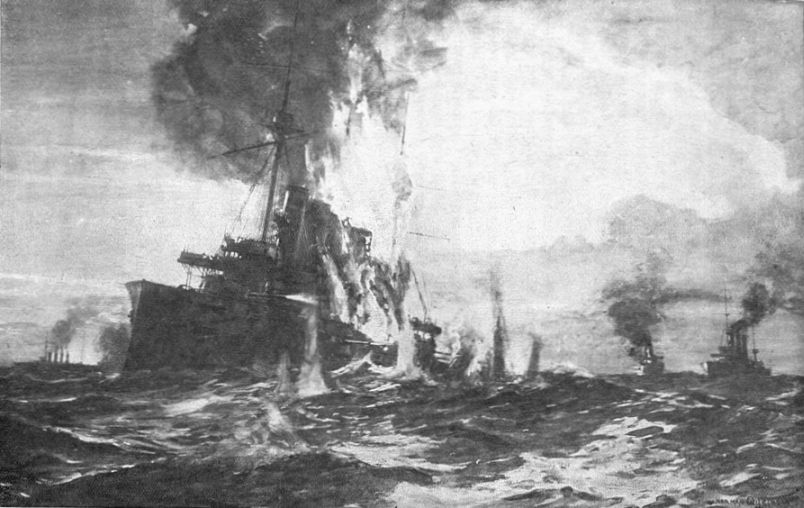
The Good Hope going down with her last Guns firing.
(From the picture by Norman Wilkinson. By permission of the Illustrated London News.)
The Monmouth, too, was in dire distress. She was so badly damaged by the terrific cannonade that she could no longer fire. She was down by the head, and was obliged to turn away to get her stern to the sea. The little unarmoured Glasgow was now left alone, and on her the Scharnhorst and Gneisenau concentrated their fire. Again and again she was hit, but fortunately not dangerously. The sea was now running higher than ever; rain and mist came on, though the moon was rising. The Glasgow could render no aid to the Monmouth; she could not rescue her crew in the raging sea, and she could not contend with the heavily-armoured vessels of the enemy. There was nothing for it but to abandon the Monmouth and seek safety in flight. If she stayed to the end she would be needlessly sacrificing herself and her crew; and the Canopus, now coming up from the south, could not be warned of the destruction that awaited her.
So with a heavy heart Captain Luce swung his vessel to the north-west, and steamed off at full speed. As he did so the doomed men on the Monmouth gave her a pealing cheer. Before the sinking vessel was lost to sight another and another cheer was heard. At twenty minutes past nine o'clock Captain Luce counted seventy-five flashes of fire stabbing the darkness. The Nürnberg had come up, and was dealing the Monmouth its death-blows. It is said that the British ship in her final throes made a gallant attempt to ram the enemy. For a few seconds the watching men on the Glasgow saw the play of her searchlight. It disappeared, and all was over; the Monmouth had gone down with her flag flying.
"Toll for the brave—the brave that are no more."
The sole survivor, the Glasgow, sped away at 24 knots an hour, and as she gained on her pursuers she bore round gradually to the south. Her wireless was working in the hope of picking up the Canopus; but the enemy again jammed her messages, and only after several hours did she get in touch with her sister ship. At length they fell in with each other, and steamed in company southward, threaded the wild, glacier-fringed Strait of Magellan, and in due time reached Stanley Harbour, in the wind-swept Falkland Isles.
This disastrous sea fight will go down to history as the Battle of Coronel, for the little Chilian port of Coronel was the nearest place to the stretch of wild waters in which the Good Hope and the Monmouth went down. We shall never learn the full details of the action, for those who played the leading part in it on the British side are no more. The Germans have called their victory "the fairest sea fight of the war." No more misleading description can be imagined—even in Germany. The enemy had swifter, better armed, and more heavily armoured ships than we had, and his victory was due to superior speed and greater gun power.
Captain Luce tells us that "nothing could have been more admirable than the conduct of the officers and men throughout. Though it was most trying to receive a great volume of fire without the chance of returning it adequately, all kept perfectly cool. There was no wild firing, and discipline was the same as at battle practice. . . . The serious reverse sustained has entirely failed to impair the spirit of officers and ship's company, and it is our unanimous wish to meet the enemy again as soon as possible." We need no assurance that on that dread November day our tars fought and died as Britons are wont to do.
The Falkland Islands lie some three hundred miles to the east of the Strait of Magellan. They were discovered by John Davis, the Arctic explorer, as far back as 1592, but were first settled by the French in 1764. Seven years later they became British. The group consists of two large islands and of about one hundred islets, rocks, and sandbanks. The two large islands are East Falkland and West Falkland, and the only town of importance is Stanley, in the north-east of the former island. Berkeley Sound and Port William are the two most important sounds in East Falkland. Stanley Harbour, on which the capital stands, is a large, safe, and easily entered inlet of Port William.
If New Zealand may be said to be the most English of all British possessions, the Falkland Islands are certainly the most Scottish. In appearance they resemble the Outer Hebrides, and a large part of the population is of Scottish descent. The winters are cold and misty, but not very severe. So violent are the winds that tennis and croquet can only be played on sheltered grounds, and unless walls are erected the cabbages in the gardens are blown clean out of the soil. There is only one real tree on the islands, and that stands in the governor's garden. Penguins are so numerous on the smaller islands and in the lagoons, that the governor is sometimes nicknamed King of the Penguin Islands. The total population is about 2,300, and the people are mainly occupied in sheep-farming and seafaring. The colony is prosperous, and Stanley, which has a wireless installation, is a refitting and coaling station for ships rounding Cape Horn.
When the Canopus and the Glasgow reached Port Stanley, and the defeat off Coronel became known, great was the alarm of the colonists. They felt sure that the victorious German squadron was about to swoop down on the islands. Their alarm was increased when the two British battleships were ordered by wireless to proceed to Rio de Janeiro,[147] where they were to be repaired.
One morning the church and dockyard bells pealed out an alarm; the lookout on the hill above the town had sighted a cruiser, cleared for action, and making straight for the wireless station. The volunteers paraded; non-combatants streamed out of the place, and all waited for the firing to begin. Signals were exchanged between the vessel and the shore, and the colonists breathed freely once more. It was a false alarm. The newcomer was not a German cruiser, but the Canopus.
Obeying orders, she and the Glasgow had made for Rio de Janeiro, but when two days from that port she had been instructed to return to Stanley, for a reason which we shall learn later. She came about at once, and tried to get into touch with the wireless station. As she could not do so, she concluded that the Germans had raided the island and destroyed the wireless station. Decks were immediately cleared for action; the guns were loaded and trained; and with every man at his post, ready to fight the whole of von Spee's squadron if necessary, the Canopus steered into Stanley Harbour. You can easily imagine the relief of the colonists when they discovered that the newcomer was a friend and not a foe.
Von Spee was a victor, but even while celebrating his victory he knew that his hours were numbered. He was well aware that the British would take good care to send an overpowering squadron against him, and that there would be only one end to the battle which could not be long delayed. It is said that when the German colony at Valparaiso gave a banquet to the admiral in honour of his victory, the steps near the door of the hall were strewn with flowers. Von Spee noticed them, and said, "I think you had better keep these for my grave; they may be wanted." He spoke the simple truth: they were wanted—in less than forty days.