Chapter XXI
Reading edition
THE STORY OF THE "EMDEN."
When the war broke out there was a German squadron of ships of war in Eastern waters, its base being Tsing-tau. Admiral von Spee, who commanded it, did not attempt to go to the rescue of the Pacific islands when the British attacked them, but departed with most of his ships for the west coast of South America. Two of his smaller cruisers—the Königsberg and the Emden—were, however, detached to prey on British commerce in the East. You have read[136] how the Königsberg caught H.M.S. Pegasus unawares, in Zanzibar harbour, and disabled her. I shall tell you later how this vessel was finally destroyed. In this chapter we will learn something of the career of the Emden.
A ship of war can do as much mischief amongst peaceful merchantmen as a cat among pigeons. Ordinary trading ships are entirely at the mercy of a fast cruiser armed with big guns. They have no means of resisting, and must surrender when called upon to do so. During the American Civil War a ship, afterwards known as the Alabama, was built at Birkenhead for the Southern States. By some mistake she was allowed to leave the Mersey and proceed to the Azores, where she was fully equipped as a vessel of war. In August 1862 she began to prey on the merchantmen of the Northern States, and by June 1864 she had captured and destroyed about sixty-eight of their ships. By hoisting the British flag she decoyed them within reach of her guns, and then they were obliged to yield. In the end the Alabama was chased by a Northern ship of war to the English Channel, and a fight took place off the French shore near Cherbourg. In an hour the Alabama was shattered, and her career was ended for ever.[137] Up to the time when the Emden left Kiao-chau, in August 1914, the Alabama was the most successful commerce-raider of history. The Emden, however, soon deposed her from that pride of place. In two short months she did more damage than the Alabama did in two years.
The Emden was a light cruiser of 3,544 tons displacement, and she dated from 1908. She had a speed of 25 knots, and her armament consisted of ten 4.1-inch guns, four 2.1-inch guns, and four machine guns, as well as two torpedo tubes. Her captain, was Commander Karl von Müller, who has thus been described: "Picture a young man of about thirty, tall, clean-shaven, with closely-cropped hair and keen eyes, a neatly-proportioned figure, a man with the manners of a drawing-room, possessed of a keen sense of humour and an extensive knowledge of the sea and its affairs." As the story proceeds you will learn that Commander Müller was a man of quick, ready, and inventive mind, and that for two months he played a successful game of hide-and-seek with the many Allied ships of war that were bent on his destruction.
The Emden's adventures began almost before she was out of sight of Kiao-chau. She knew that Japanese men-of-war were near at hand, and that she was more than likely to fall in with one of them. Sure enough, a Japanese vessel was sighted; but it was not the three-funnelled Emden, under the black, white, and red flag of Germany that passed the enemy warship, but a vessel of four funnels flying the British white ensign. The Japanese were completely deceived, especially when the Emden's crew lined the rails and greeted them with three hearty British cheers. By means of this clever trick the Emden gained the open sea unmolested.
What she did up to 10th September we do not know. Just when the first Indian contingent was leaving for Marseilles she appeared in the Bay of Bengal and began her career of destruction. Inside four days she had seized and sunk five ships, and before seven weeks were over had destroyed seventeen vessels of 70,000 tons burden, and worth more than £2,000,000. Captain von Müller fell in with some of these ships; others it is said that he decoyed by sending out the S.O.S. signal[138] in defiance of the rules of war which Germany had signed at the Hague. His practice was to close in upon his victim very quickly, destroy its wireless apparatus before the alarm could be given, put the crew on board one of his prizes, take what coal and provisions he required, and then with a mine or a few shots send the captured vessel to the bottom. It is said that when he overhauled the Kabinga he discovered that the captain's wife was on board, and released the ship. The captain's wife, on taking leave of him, hoped that he would soon be caught, but that his life would be spared. Commander Müller was generous to his prisoners, and in no case were they treated harshly.
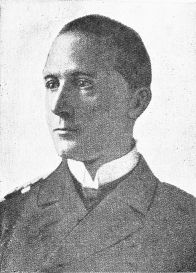
Captain von Müller.
(Photo, Record Press.)
On 22nd September the Emden was off Madras, that great straggling seaport which fronts a strand on which the sea foams in unceasing billows. One of the Emden's crew had worked in Madras, and he pointed out to the captain the position of the oil tanks at the entrance to the harbour. At 9.30 that night the Emden crept in, turned her searchlights on the tanks, and fired two broadsides to find the range. Then the searchlights were turned off, and salvos were fired which set the tanks on fire. While great flames were shooting skyward and making the night as bright as day, the Emden retired full speed northward. The shore batteries opened fire, but their shells fell short.
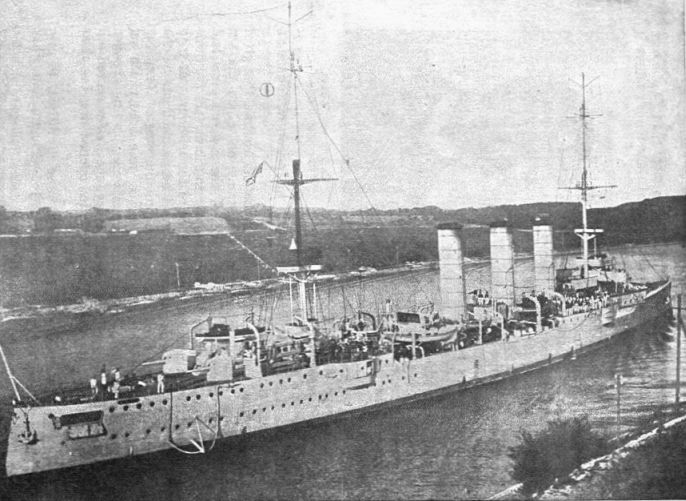
The Emden, the famous German Commerce-raider. Photo, Central News.
Next day the Emden turned her nose north-east, to give the impression that she was sailing for Calcutta, but when out of sight of land turned southwards. Off Pondicherry[139] she paused, but perceiving that the town was defenceless, refrained from firing a gun. She then ran past the east coast of Ceylon to the island of Diego Garcia, in the Chagos Archipelago, a group of low coral islands between Mauritius and Ceylon. Diego Garcia was reached on 10th October. The few European families on the island had not yet heard of the war, as they are only visited by a steamer once in three months. The Emden coaled at Diego Garcia, and took on board supplies of cocoa-nuts and fish.
About the middle of October she lost her attendant collier, and with it her reserve of ammunition, coal, and food. By this time it was clear that her course was practically run, and that she had better do what mischief she could to the warships and war material of the enemy before meeting her doom.
Early on the morning of 28th October the Emden was ten miles outside Penang, in the Straits Settlements,[140] and the carpenters were set to work rigging up a dummy funnel, to make her look like a British cruiser. She then hoisted British colours and entered the harbour, in which several ships could be seen, with an unknown cruiser well in front of them. When the Emden entered the harbour she discovered that this cruiser was the Russian ship Jemtchug. Mistaking the Emden for a British man-of-war, the Jemtchug did not attempt to prevent the German cruiser from getting between her and the land. The Emden then let fly two torpedoes, the first of which struck the Russian cruiser just under the after funnel. The other torpedo, fired at closer range, struck her below the bridge, and caused a terrible explosion. Meanwhile the Emden was firing salvo after salvo at the Jemtchug, which made but a feeble reply; all of her shots missed, but some of them hit ships in the harbour behind.
As the Jemtchug sank the Emden turned and left the harbour at full speed. Thirty miles out she fell in with the British steamer Glenturret, which had signalled to the shore for a pilot, who had just reached her in his launch. The Emden had swung out her boats to take possession of the prize when a warship appeared on the horizon. The Emden immediately recalled her boats and made off, as the warship appeared to be a large one. This, however, was only the effect of the early morning mirage.[141] At about 6,000 yards distance the newcomer was found to be the French destroyer Mousquet.
The Emden opened fire, and the Mousquet replied, though, of course, the destroyer was quite outclassed by the cruiser. The first few shots from the Emden hit the Mousquet's engine-room, and apparently wrecked her. "Cease fire" was then ordered, to enable the French destroyer to surrender; but instead of doing so she showed fight once more. A few more shots from the Emden were sufficient to sink her, bows first. About thirty-six of the crew were rescued. While this merciful work was going on, another destroyer was seen approaching from Penang; whereupon the Emden steamed off at full speed for the Indian Ocean. The destroyer chased her for three hours; but a heavy rainstorm came on, and the Emden escaped.
There was a good deal of discontent in England when news arrived that the Emden had sunk ship after ship, and had not been brought to account. The Admiralty explained that searching for the Emden over vast expanses of ocean was no easy task, and that the many thousand islands of the East Indies afforded her plenty of hiding-places, and the straits between them numberless avenues of escape. To catch the raider was a matter of time, patience, and good luck. The Germans were highly delighted that their ship had proved such a will o' the wisp, and one of their papers contained a caricature showing the Emden as a Jack-in-the-box that continually popped up to the annoyance of John Bull. It was inscribed, "Emden über Alles," and underneath was the following rhyme:—
"When you think you have him tightly, He springs forth again so lightly."
We are soon to hear how, by a stroke of good luck the Emden was caught tightly and destroyed.