THE MARSEILLAISE HYMN.
Reading edition
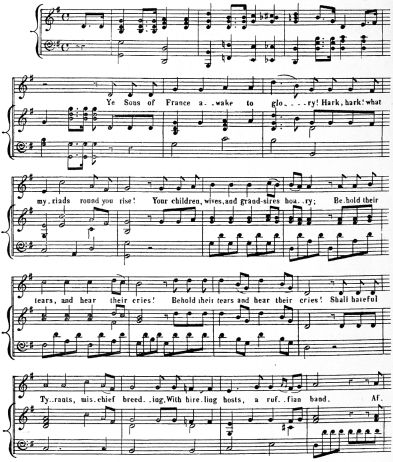
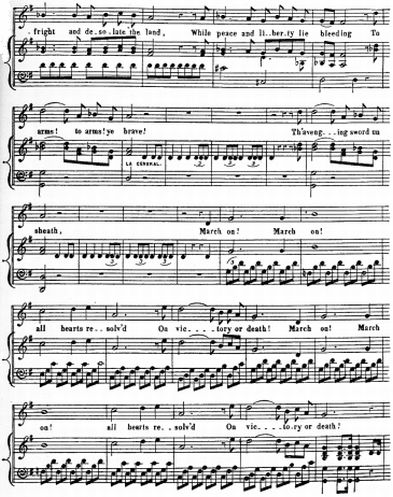
Ye Sons of France awake to glory! Hark, hark! what myriads round you rise! Your children, wives, and grandsires hoary; Behold their tears, and hear their cries! Behold their tears and hear their cries! Shall hateful Tyrants, mischief breeding, With hireling hosts, a ruffian band. Affright and desolate the land, While peace and liberty lie bleeding? To arms! to arms! ye brave! Th'avenging sword unsheath, March on! March on! all hearts resolv'd On victory or death! March on! March on! all hearts resolv'd On victory or death!
It will interest you to learn that this splendid marching song, which is the French national anthem, was composed during the years when France was fighting with almost all the other nations of Europe. In April 1792, when war was declared on Austria, a young captain of Engineers named Rouget de Lisle[40] was in Strassburg[41] with his company, waiting the order to advance. He was fond of writing verse and composing music, but up to this time he had written and composed nothing worthy of special mention. His heart and mind were fired with the thought of giving freedom to all the world; to him it seemed that the armies of France were engaged in a holy crusade.
Food was scarce in Strassburg at this time, and many of the officers and soldiers would have gone hungry but for the mayor, who did everything he possibly could to supply them with food. Every evening he asked a number of the officers to sup with him, and one evening Rouget de Lisle was invited. During the meal the mayor said that he wished some one would compose a new war song which would stir up the young soldiers about to march on Austria. A major who was one of the company turned to Rouget and said, "You are a poet and a musician; can't you compose something that will do?"
Rouget was a very modest young fellow, and at once he said that a war song was quite beyond his powers. Some of the other men seated at the table joined in the request, and Rouget at last began to think that he would try. He retired to his chamber, and as he thought of his beloved France and of the great battles which she had to fight, he became greatly excited. Then the words flowed from his pen, and as he wrote them a tune sprang into his mind which seemed to suit the words exactly. By seven o'clock in the morning he had composed both words and music. At once he hastened to his friend the major, and said, "Listen to this, and tell me what you think of it." The major listened and was delighted, and some hours later carried him off to the mayor's house. Here Rouget sang his song, while one of the mayor's nieces accompanied him on the piano. Every one who heard it was thrilled. It seemed to call forth all the fighting spirit in them.
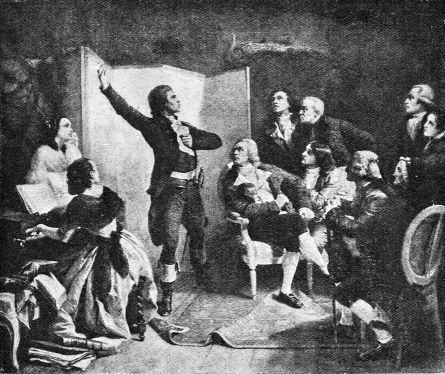
Rouget de Lisle singing "The Marseillaise."
(From the painting by Pils, in the Louvre Gallery. Photo by Mansell.)
The same day the song was published, and next day one of the military bands played it. Immediately it became all the rage. Through Alsace to the south of France it spread like wildfire; but the people of Paris knew nothing of the song until they heard the volunteers from Marseilles[42] chanting it as they marched through the streets. They had sung it in every town and village through which they had passed, and everywhere it had been greeted with loud cries of delight. Because it was first sung in Paris by the men of Marseilles, it was called the Marseillaise.
Such is the story of the great French war song which all Europe learned to know and fear in what is known as the War of the Revolution. It worked like a charm: men marched and fought and suffered and died to its strains. At the present time French soldiers are singing it as they swing along the roads to engage the enemy, and you and I sing it in this country because the French are our friends and allies, and their cause is ours.
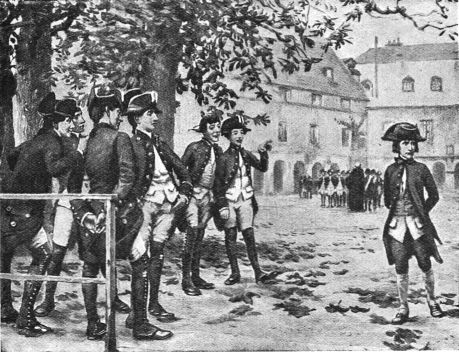
Napoleon at School.
When Napoleon was a boy at a French military school he was jeered at by his fellows, who called him a surly Corsican.
Out of the bloodshed and terror of this time arose the figure of Napoleon, the greatest war lord that the world has ever known. He was a Corsican,[43] who first proved his ability by forcing the British to give up Toulon.[44] Thereafter he rose rapidly in the service of the Republic, and in 1796 was placed in command of the army of Italy. In two campaigns he completely overthrew the Austrians, and was hailed by his countrymen as the greatest general of the age. As he rose in power and fame he began to dream of making himself the master of France, and then of all Europe. Before long Great Britain alone stood against him. On sea the British were then, as now, supreme, and our great Admiral Nelson, and others worthy to be mentioned with him, defeated his fleets again and again. Nevertheless he won so many great victories on land that in the year 1801 the continental nations were obliged to make peace with him. You already know that Prussia had done so six years before, and had been forced to give up the whole of the left bank of the Rhine. Next year Britain made peace with him too.
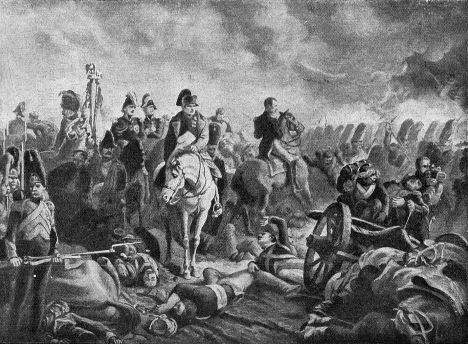
Napoleon at Austerlitz.
On May 18, 1804, Napoleon put an end to the French Republic, and made himself Emperor of the French. He now planned a great scheme for turning all Europe into one vast empire, with kings and princes over the various nations, but himself as the head of all. He sent an army into Hanover, and overran it; but Prussia did not interfere, because she hoped that Napoleon would hand over that state to her if she remained quiet. Great Britain now persuaded Austria, Russia, and Sweden to join together against France, but Frederick William III. would not unite with them. He allowed Napoleon to do as he pleased in Germany, because he thought that Austria would be beaten, and that the conqueror would reward him with some of the spoils. The Emperors of Austria and Russia begged him to desert Napoleon and join them, but he would not listen to them. When Napoleon won the famous battle of Austerlitz, at which the three great emperors of Christendom were present, Frederick William received his reward—Hanover was handed over to him.
Napoleon was now master of all Europe except Great Britain. In the next year sixteen of the German princes separated themselves from the German Empire and joined him, and he turned many of the provinces which he had won into kingdoms, and placed his relatives and his generals on their thrones. As for Prussia, Napoleon had no respect for her, and very soon showed that he was going to seize her too. Louisa, the beautiful Queen of Prussia, had alone seen what the end of her country would be, and had begged the king to draw the sword against the conqueror. When Napoleon took one of the Prussian fortresses she again besought her husband to fight. The Emperor of Russia visited him, and joined his entreaties to hers, and at last, in 1806, he took the field against the great war lord.
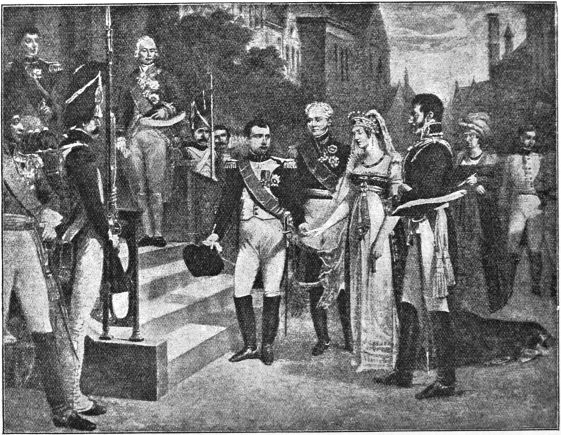
Napoleon with King Frederick William III. and Queen Louisa at Tilsit.
From the picture by von Gros.
Napoleon struck swiftly. At Jena[45] he held the Prussians in check till his cavalry came up, and when they dashed down on the foe all was over. The Prussian horse and foot fled in panic; 20,000 Prussians were killed or taken, as well as 300 guns and 60 standards. After the victory Napoleon treated the Prussians very harshly. He said many bitter things about the old Duke of Brunswick, who had fought so bravely against him, and he overran his states. He insulted the queen, and he told the nobles that he would make them so poor that they would be obliged to beg their bread. He quickly subdued the whole country, and made Prussia pay him some millions of money. Then the conquered states were divided into four parts, over which he set commanders.
Leaving 60,000 French to hold beaten Prussia, he now turned on Russia, and in February 1807 marched 100,000 men into Poland, where he met the Russian army and the remnants of the Prussian army. On a field covered with snow a battle was fought during the short hours of a winter day. The slaughter was horrible, and the battle was drawn. In the following May the armies met again, and this time Napoleon was victorious. A week later he and the Czar met on a raft moored on the river Niemen,[46] and made plans for the greatest scheme of robbery ever known to history: they agreed to divide Europe between them.
Great Britain still struggled against Napoleon, and her fleet was the only force which prevented him from becoming the unchecked master of the whole world. Napoleon now tried to bring Great Britain to her knees. Some years before he had gathered fleets of flat-bottomed boats at Boulogne,[47] and had prepared a huge army for the invasion of Britain, but could not obtain that twelve hours' mastery of the Channel which would enable him to cross the "silver streak." Now he tried another plan. He ordered the harbours of the Continent to be closed against the British, so that they could not carry on trade or sell their manufactures. In this way he hoped to make Great Britain so poor that she would be unable to hold out against him.
By this time the Czar was tired of being Napoleon's underling, and he now said that he would not close his ports against the British. Napoleon was furiously angry, and marched a great army towards the Russian frontier, which was crossed on June 23, 1812. The Russians did not attempt to fight; they fell back, and lured him on, meanwhile wasting the country over which he had to pass. Soon the French found themselves short of food, and thousands died of hunger. Napoleon's line of march was marked by the dead bodies of thousands of men and horses.
At last the Russians stood firm, and a great battle was fought some seventy miles from Moscow. One hundred thousand men lay dead or wounded on the field, but Napoleon was not checked. A week later his troops entered Moscow[48] with shouts of delight. To their dismay they found it as silent as a city of the dead. All the people had left it, but before doing so had set fire to the place. Soon after the French marched in, flames began to shoot up from a thousand different points. The fire burned for five days, and the city lay in ruins. Then want of food and shelter compelled Napoleon to retreat. When he left Moscow his army had dwindled to about 100,000 men. The Cossacks[49] hung upon their flanks and rear, and cut off all stragglers. Soon the snow began to fall, and the cruel Russian winter set in. Thousands perished daily of cold and hunger.
Napoleon's starving and frost-bitten army soon became a rabble. As he approached the river Beresina[50] he learned that the Russians were waiting to oppose the passage. A battery of guns commanded the bridge, and as the French tried to cross thousands of them were mowed down, and heaps of dead and wounded blocked the way. A miserable, crushed remnant of 20,000 men was all that struggled back to Germany. The downfall of Napoleon had begun.