Chapter IV
Reading edition
THE GREAT WAR LORD OF EUROPE.
The noblest street in all Berlin is called the Unter den Linden, which simply means "under the lime trees." In this fine, tree-shaded avenue stands a splendid monument to Frederick the Great, the man who laid the foundations of Prussia by means of force and fraud. His successor, Frederick William II., was a weak man, who squandered the public money on favourites. Under his rule Prussia grew poorer every day; instead of being the best governed state in Europe, it rapidly became one of the worst, and a clever Frenchman at his court declared that no country was nearer to ruin. The army, however, was still kept up in the old way, though it had lost much of its fiery spirit. Frederick William was just as eager for war as Frederick the Great; but he was no general, and when he did fight, was badly beaten. Then, as you will soon hear, he made peace with his victorious foe, and had to give up a part of his country. It was in his time, however, that further slices were taken from Poland and added to Prussia.
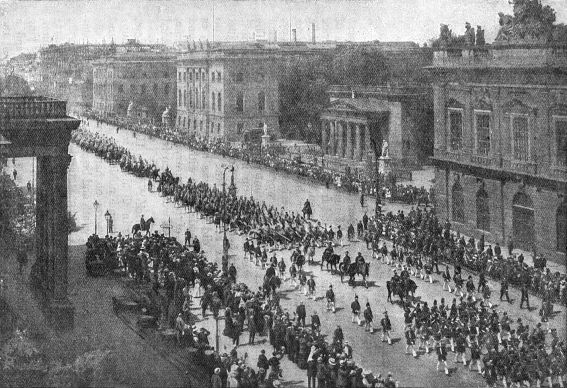
The Kaiser and his Troops in the Unter den Linden.
Photo, Exclusive News Agency.
Three years after Frederick William II. came to the throne, one of the greatest events in all history took place. For hundreds of years the kings and nobles of France had ground down the people in all sorts of harsh and cruel ways. At length the people rose in wrath and began to upturn the government and try to set up a new state of things. In July 1789 a Paris mob stormed the state prison and set free the prisoners; whereupon the peasants all over the country rose in rebellion, murdered the nobles, and burned their castles. The king dared not interfere; all power was taken from him, and a sort of Parliament began to pass laws sweeping away all the old abuses. The Revolution, or great upturning of the government, had begun.
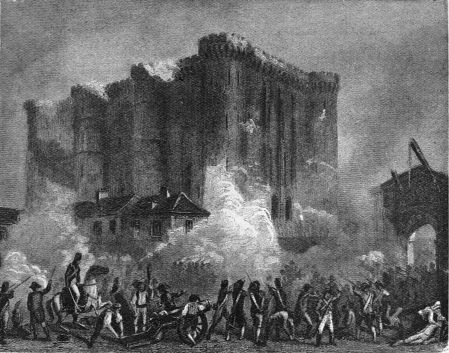
The Attack on the Bastille. From a contemporary print.
The leaders of the people grew more and more violent, and thousands of nobles and gentry fled the country. The king and his family tried to escape, but were caught and brought back as prisoners. Those who had managed to get out of France went to the courts of the various kings, and begged them to declare war against the country which was so cruelly treating them and their king. At length the kings of the other European countries began to perceive that their own thrones were in danger, and that they must unite to protect themselves. Leopold II., Emperor of Austria, and Frederick William of Prussia prepared to fight. At the head of 50,000 of his own men and 30,000 Austrians, Frederick William crossed the eastern frontier of France. At this the Paris mob was filled with fury. They burst open the prisons in which their nobles and gentry were confined, and killed many of them. The same dreadful scenes took place in several other towns of France.
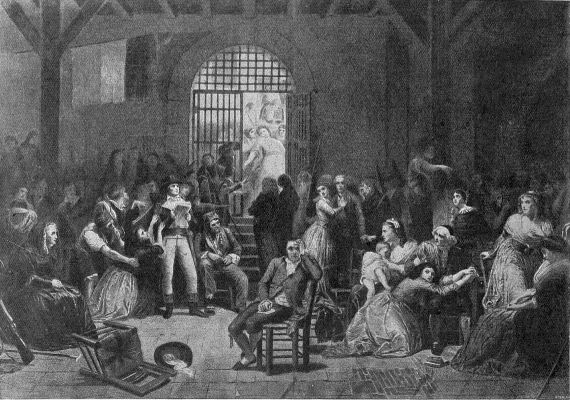
French nobles and gentry waiting the call to execution.
The French got together an army which was little better than a rabble, but was full of fiery zeal. It entered Belgium, and called on the people to rise against their government and set up a republic. Another French army advanced to the Rhine to meet Frederick. The anger of the French was now so great that they resolved to hurl at the kings of Europe the head of a king. On January 21, 1793, they cut off the head of their king, and a few months later that of the queen. A thrill of horror ran through the courts of Europe, and Great Britain, Holland, Spain, Austria, and Prussia united to make war on France. In the summer of 1793, during the six weeks of what was called the Reign of Terror, the French put to death more than 1,400 of their nobles and gentry, and some of the most bloodthirsty scenes in all history took place.
During this terrible time the French raised army after army, though they had scarcely the means of feeding and clothing and arming their men. These armies fought with wonderful spirit, and they attacked all the nations opposed to them. On the other hand, the Allies were jealous of each other, and were slow to mass their armies. The Prussians, with whom we are specially concerned, were beaten, and so were the Austrians. Then Frederick William II. deserted his fellow kings, and made peace with the French Republic,[38] giving up to it the whole of the left bank of the Rhine. He died two years later, and was succeeded by Frederick William III. At the end of the year 1795 France held the upper hand in Europe.
Every boy and every girl who reads these pages must have heard the Marseillaise,[39] the great French war song. Here are the words of it, and on the next page you will find the music:—
"Ye sons of France, awake to glory! Hark, hark! what myriads round you rise! Your children, wives, and grandsires hoary— Behold their tears and hear their cries! Shall hateful tyrants, mischief breeding, With hireling hosts, a ruffian band, Affright and desolate the land, While peace and liberty lie bleeding? To arms! To arms! ye brave. The avenging sword unsheathe. March on! March on! All hearts resolved on victory or death! "Now, now the dang'rous storm is rolling, Which treach'rous kings confed'rate raise; The dogs of war let loose are howling, And lo! our fields and cities blaze. And shall we basely view the ruin, While lawless Force, with guilty stride, Spreads desolation far and wide, With crime and blood his hands embruing? To arms! To arms! ye brave, etc. "With luxury and pride surrounded, The vile insatiate despots dare, Their thirst for pow'r and gold unbounded To mete and vend the light and air. Like beasts of burden would they load us, Like gods would bid their slaves adore; But man is man, and who is more? Then shall they longer lash and goad us? To arms! To arms! ye brave, etc. "O Liberty, can man resign thee, Once having felt thy gen'rous flame? Can dungeons, bolts, and bars confine thee, Or whips thy noble spirit tame? Too long the world has wept, bewailing That Falsehood's dagger tyrants wield; But Freedom is our sword and shield, And all their arts are unavailing. To arms! To arms! ye brave, etc."