MAURICE MAETERLINCK
Reading edition
SELECTED AND ARRANGED BY
ALFRED SUTRO AND HERSCHEL WILLIAMS
ILLUSTRATED BY
EDWARD J. DETMOLD
NEW YORK
DODD, MEAD AND COMPANY
1919
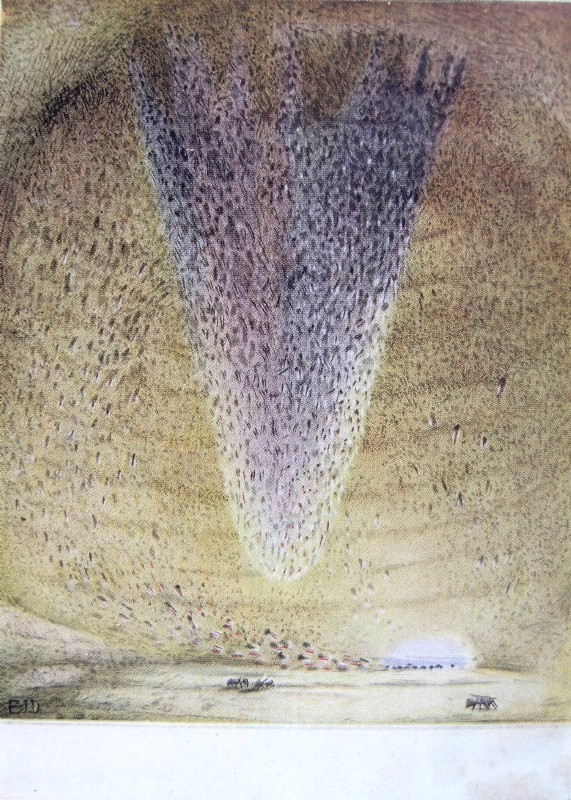
"The black throng issues, or rather pours forth, in a throbbing, quivering stream"—
CONTENTS
I ON THE THRESHOLD OF THE HIVE II THE SWARM III THE FOUNDATION OF THE CITY IV THE YOUNG QUEENS V THE MASSACRE OF THE MALES VI THE PROGRESS OF THE RACE
ILLUSTRATIONS
"The black throng issues, or rather pours forth, in a throbbing, quivering stream"—Frontispiece
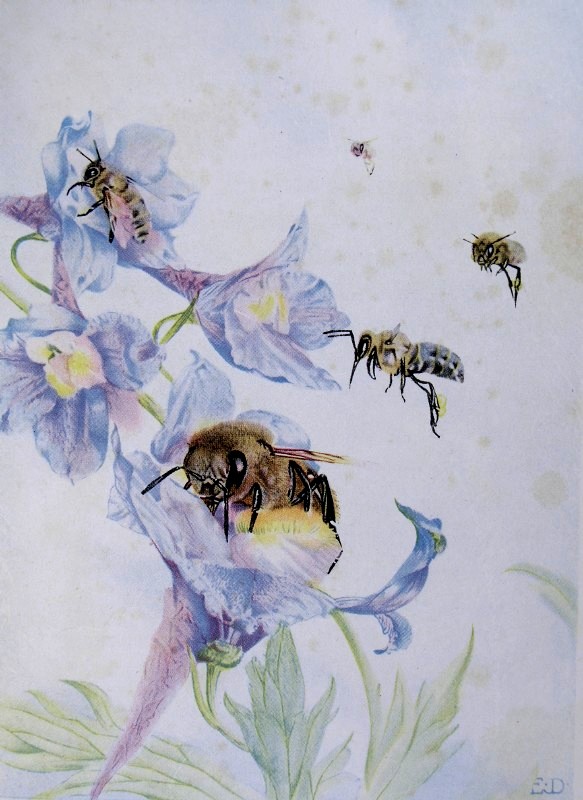
In the heart of the flower.
"And the bees, forming a circle around the two, will eagerly watch the strange duel"
"The queen takes possession together with her servants, guardians and counsellors"
The Sphinx
THE LIFE OF THE BEE
I
ON THE THRESHOLD OF THE HIVE
I have not yet forgotten the first apiary I saw, where I learned to love the bees. It was many years ago, in a large village of Dutch Flanders, the sweet and pleasant country that rejoices in brilliant flowers; a country that gladly spreads out before us, as so many pretty toys, her illuminated gables and wagons and towers; her cupboards and clocks that gleam at the end of the passage; her little trees marshaled in line along quays and canal-banks, waiting, one almost might think, for some splendid procession to pass; her boats and her barges with sculptured sterns, her flower-like doors and windows, her spotless dams and many-coloured drawbridges; and her little varnished houses, bright as new pottery, from which bell-shaped dames come forth, all a-glitter with silver and gold, to milk the cows in the white-hedged fields, or spread the linen on flowery lawns that are cut into patterns of oval and lozenge and are most amazingly green.
To this spot an aged philosopher had retired, having become a little weary; and here he had built his refuge. His happiness lay all in the beauties of his garden; and best-loved, and visited most often, were the bee-hives. There were twelve of them, twelve domes of straw; and some he had painted a bright pink, and some a clear yellow, but most were a tender blue, for he had noticed the fondness of the bees for this color. These hives stood against the wall of the house, in the angle formed by one of those pleasant and graceful Dutch kitchens whose earthenware dresser, all bright with copper and brass, was reflected through the open door on to the peaceful water of the canal. And the water, carrying these familiar images beneath its curtain of poplars, led one's eyes to a calm horizon of meadows and of mills.
Here, as in all places, the hives lent a new meaning to the flowers and the silence, the balm of the air and the rays of the sun. One seemed to have drawn very near to all that was happiest in nature. One was content to sit down and rest at this radiant cross-road, along which the busy and tuneful bearers of all country perfumes were incessantly passing from dawn until dusk. One heard the musical voice of the garden, whose loveliest hours seemed to rejoice and to sing of their gladness. One came here, to the school of the bees, to be taught how nature is always at work, always scheming and planning; and to learn too the lesson of whole-hearted labor which is always to benefit others.
In order to follow, as simply as possible, the life of the bees through the year, we will take a hive that awakes in the Spring and duly starts on its labors; and then we shall meet, in their order, all the great events of the bees. These are, first of all, the formation and departure of the swarm; then, the foundation of the new city, the birth and flight of the young queens, the massacre of the males, and, last of all, the return of the sleep of winter. We will try to give the reasons for each event, and to show the laws and habits that bring it about; and so, when we have arrived at the end of the bees' short year, which extends only from April to the last days of September, we shall have gazed on all the mysteries of the palace of honey.
Before we knock at the door, and let our inquisitive glance travel round, it need merely be said that the hive is composed of a queen, who is the mother of all her people; of thousands of female worker-bees, who are neuters or spinsters; and, finally, of some hundreds of males, who never do any work, and are known as drones.
When for the first time we take the cover off a hive we cannot help some feeling of fear, as though we were looking at something not meant for our eyes, something alarming and frightening. We have always thought of the bee as rather a dangerous creature. There is the distressful recollection of its sting, which produces so peculiar a pain that one knows not with what to compare it: a sort of dreadful dryness, as though a flame of the desert had scorched the wounded limb; and one asks oneself whether these daughters of the sun may not have distilled a dazzling poison from their father's rays, in order to defend the treasure which they have gathered during his shining hours.
There is no doubt that if some person, who neither knows nor respects the habits of the bee, were suddenly to fling open the hive, this would turn itself immediately into a burning-bush of heroism and fury; but the slight amount of skill needed to deal with the matter can be readily acquired. Let but a little smoke be deftly applied, let us be gentle and careful in our movements, and the heavily-armed workers will permit themselves to be robbed without the least thought of using their sting. It is not the fact, as some people have stated, that the bees recognize their owner, nor have they any fear of man; but, when the smoke reaches them, when they become aware of what is happening, so quietly and without any haste or disturbance, they imagine that this is not the attack of an enemy against whom any defense is possible, but that it is some natural catastrophe, to which they will do well to submit. Instead of vainly struggling, therefore, their one thought is to safeguard their future; and they rush at once to their reserves of honey, into which they eagerly plunge themselves in order to possess the material for starting a new city immediately, no matter where, should the old one be destroyed or they compelled to abandon it.
A person who knows nothing of bees will be a little disappointed the first time he looks into a hive. Let us say that it is an observation-hive, made of glass, with black curtains and shutters and only one comb, thus enabling the spectator to study both sides. These hives can be placed in a drawing-room or a library without any inconvenience or danger. The bees that live in the one I have in my study in Paris are able—even in that great city—to do their own marketing, as it were—in other words, to find the food they require—and to prosper. You will have been told, when you are shown this little glass box, that it is the home of a most extraordinary activity; that it is governed by a number of wise laws, that it enshrines deep mysteries; and all you will see is a mass of little, reddish groups, somewhat resembling roasted coffee-berries or bunches of raisins, all huddled up against the glass. They look more dead than alive; their movements are slow, and seem confused and without any purpose. We ask ourselves, can these be the dazzling creatures we had seen, but a moment ago, flashing and sparkling as they darted among the pearls and the gold of a thousand wide-open flowers?
In the heart of the flower.
Now, in the darkness, they seem to be shivering; to be numbed, suffocated, so closely are they huddled together. They look as though they were prisoners; or shall we say queens who have lost their throne, who have had their one moment of glory in the midst of their radiant garden, and are now compelled to return to the dingy misery of their poor overcrowded home.
It is with them as it is with all the real things in life; they must be studied, and we have to learn how to study them.
Much is happening inside this mass that seems so inactive, but it will take you some time to grasp it and see it. The truth is that every single creature in the little groups that appear scarcely to move is hard at work, each one at its own particular trade. There is not one of them that knows what it means to be idle; and those, for instance, that seem fast asleep, as they hang in great clusters against the glass, are entrusted with the most mysterious and fatiguing task of all; it is their duty to create the marvelous wax. But we shall tell later, and in its place, precisely what each of the bees is doing; for the moment we will merely point out why it is that the different classes of workers all cluster together so strangely. The fact is that the bee, even more than the ant, is only happy when she is in the midst of a crowd; she can only live in the crowd. When she leaves the hive, which is so densely packed that she has to keep on butting with her head in order to pass, she is out of her element, away from what she loves. She will dive for an instant into flower-filled space, as the swimmer will dive into the sea that is filled with pearls; but, just as the swimmer must come to the surface and breathe the air, so must she, at regular intervals, return and breathe the crowd—or she will die. Take her away from her comrades, and however abundant the food may be, however gentle the climate, she will perish in a few days, not of hunger or cold, but merely of loneliness. She needs the crowd, she needs her own city, just as she needs the honey on which she lives. This craving for companionship in some way helps us to understand the nature of the laws that govern the hive. For in these laws the individual bee, the one bee apart from the other, simply does not count. Her entire life is sacrifice, and only sacrifice, to the bees as a race; as it were, to the everlasting community, of which she forms part.
This, however, has not always been the case, for there is a lower order of bees that prefers to work alone, and very miserably too, sometimes never seeing its young, and at others, like the bumble-bee, living in the midst of its own little family. From these we arrive, through one stage after another, to the almost perfect but pitiless society of our hives, where the individual bee exists only for the republic of which it forms a part, and where that republic itself will at all times be sacrificed in the interests of the immortal city of the future.
II
THE SWARM
We will now leave our observation hive, and, in order to get nearer to nature, consider the different events of the swarm as they come to pass in an ordinary hive, which is about ten times larger than the other, and offers entire freedom to the bees.
Here, then, they have shaken off the sluggishness of winter. The queen started laying her eggs in the very first days of February, and the workers have gone in streams to the willows and nuttrees, the gorse and violets, anemones and lungworts. Then Spring comes upon the earth, and in the hive honey and pollen abound in cellar and attic, while each day sees the birth of thousands of bees. The overgrown males now all sally forth from their cells, and sun themselves on the combs. So crowded does the city become that hundreds of workers, coming back from the flowers in the evening, will vainly seek shelter within, and will be forced to spend the night on the threshold of the hive, where many will die from the cold.
The inhabitants of the hive become restless, and the old queen begins to stir. She feels that there is something to be done; something strange, that she has to do. So far, she has religiously fulfilled her duty as a good mother; but, to her, the accomplishment of this duty will bring no reward. An unknown power threatens her tranquillity; she will soon be forced to quit this city of hers, where she has so long reigned. But this city has been made by her. She is not its queen in the sense in which men use the word. She gives no orders; she obeys, as meekly as the humblest of her subjects, the hidden power that for the present we will call the "spirit of the hive." But she is the mother of the city; its inhabitants are all her children. It is she who has founded it, brought it together out of nothing, triumphed over the uncertainty and poverty of its beginning; it is she who has peopled it; and those who move within its walls—the workers, the males, the larvæ, the nymphs and young princesses—she is the mother of them all.
What is this "spirit of the hive"—where is it to be found? It is not like the special instinct that teaches the bird to build its well-planned nest, and then seek other skies when winter threatens. It is not a fixed and unchanging habit; it is not a law that deals with special cases. On the contrary, it deals with all cases; it studies them, watches them—and then gives orders for the right thing to be done—just as a faithful steward might do who had only the interests of his master at heart.
It deals unmercifully with the wealth and the happiness, the liberty and the life, of all this winged people; and yet it always acts with judgment and wisdom, as though it were itself directed by some overpowering duty. It is the "spirit of the hive" that decides how many bees shall be born every day, arranging this in accordance with the number of flowers that gladden the country-side. It is the "spirit of the hive" that warns the queen when it is time to depart, that compels her to allow the young princesses to come into the world, although these princesses shall be her own rivals. Or perhaps, when the season is on the wane, and the flowers are growing less plentiful, the spirit will instruct the workers to do away with the princesses, so that there may be no chance of disturbance, and work may once again become the sole object of all.
The spirit of the hive is prudent and wise, but never niggardly. In the glad summer days of sunshine and plenty it permits three or four hundred males to exist in the hive—pompous, useless, noisy creatures, who are greedy and dirty, vulgar and arrogant; but, one morning when the flowers are beginning to close earlier and open later, the spirit will quietly issue instructions that every male shall be killed. It draws up a sort of time-table for each one of the workers, allotting them tasks in accordance with their age; it selects the nurses who attend to the larvæ, and the ladies of honor who wait on the queen and never by any chance let her out of their sight. It has given the necessary orders to the house-bees who air and warm the hive by fanning their wings, thereby also helping the honey to settle; to the architects, masons, waxworkers and sculptors who form the mysterious curtain and build the combs; to the foragers who sally forth to the flowers in search of the nectar that turns into honey, of the pollen that feeds the larvæ, and of the water and salt required by the youth of the city.
It is the spirit of the hive that has chosen the chemists whose business it is to keep the honey sweet and fresh by allowing a drop of formic acid to fall in from the end of their sting; the capsule-makers, who seal up the provision-cells when these are filled; the sweepers, who clean the streets and public places of the hive; and the guards who all day and all night keep watch on the threshold, who question all comers and goers, recognize the young bees as they return from their very first flight, scare away vagabonds, loafers and trespassers, expel all intruders, and, if need be, block up and defend the entrance to the hive.
And, last of all, it is the spirit of the hive which decides on the hour at which the bees shall swarm; the hour, that is, when we find a whole people, who have reached the very height of prosperity and power, suddenly abandoning, in favor of the generation that is to follow, all their wealth and their palaces, their homes and the fruits of their labor, content themselves to face the perils and hardships of a journey into a new and distant country. This act will always bring poverty with it and sometimes ruin; and the people who once were so happy are scattered abroad in obedience to a law that they recognize to be greater than their own happiness.
These things that happen to the bee are regarded by us in the way we regard most things that happen in the world. We note some of the bees' habits; we say, they do this, and do that, they work in such and such a way, this is how their queens are born; we observe that the workers are all females and that they swarm at a certain time. And having said this, we think that we know them, and ask nothing more. We watch them hastening from flower to flower, we see the constant movement within the hive; and we tell ourselves that we understand all about their life. But the moment that we try to come nearer the truth, to see more clearly, we find puzzling questions confronting us, questions as to what part is played by destiny and what part by will, how much is due to intelligence and how much to nature; difficult questions, these, that are never absent even from the most simple acts of our own daily life.
Our hive, then, is preparing to swarm, making ready for the great sacrifice to the generation that is to come. In obedience to the order given by the "spirit of the hive," sixty or seventy thousand bees out of the eighty or ninety thousand that form the whole population, will forsake their old city at a given hour. They will not be leaving it at a moment of great unhappiness; they have not suddenly made up their minds to abandon a home that has been rendered miserable by hunger or illness, or ruined by war. No; on the contrary, preparations have for a long time been made, and the hour most favorable for departure patiently awaited.
If the hive were poor, or had suffered from storm or robbery; or if some misfortune had befallen the royal family, the bees would not dream of going away. They do this only when everything is at its very best in the hive; at a time when, thanks to the enormous amount of work done in the spring, the immense palace of wax has its 120,000 well-arranged cells overflowing with honey and with the many-colored flour, known as "bees' bread," on which the larvæ are fed.
Never is the hive more beautiful than on the eve of its great sacrifice. Let us try to imagine it for ourselves—not as it appears to the bee, for we cannot tell what it looks like to her, seen through the triple eye on her brow and the six or seven thousand facets of the eyes on her side—but as it would seem to us, were we no bigger than she is. From the height of a dome greater than that of St. Peter's at Rome waxen walls descend to the ground; and these walls, although they have all been built in the dark, are more perfect, more wonderful, than any that have been erected by human hands. Each one, smelling so fresh and so sweet, contains thousands of cells that are stored with provisions; enough, indeed, to feed the whole population for weeks. Here, too, are transparent cells filled with the pollen of every flower of spring, making brilliant splashes of red and yellow, of black and mauve. Close by, sealed with a seal to be broken only in days of distress, is the honey of April, clearest and most perfumed of all, stored in twenty thousand vats, which look like a long and beautiful embroidery of gold, with borders that hang stiff and rigid. Lower down still, the honey of May is maturing, in huge open tanks, that are fanned all the time by watchful, untiring guardians. In the center, in the warmest part of the hive, are the royal nurseries, the domain set apart for the queen and her attendants; here also are about 16,000 cells wherein the eggs repose, 15 or 16,000 chambers occupied by the youthful bees, and 40,000 rooms filled with infants in their cradles, cared for by thousands of nurses. And, last of all, in the most secret and private quarters, are the three, four, six or twelve sealed palaces, vast in size compared with the others, where the growing princesses lie who await their hour; wrapped in a kind of shroud, all of them motionless and pale, and fed in the darkness.
The appointed day arrives, the one that has been chosen by the "spirit of the hive"; and a certain part of the population will at once sally forth. In the sleeping city there remain the males, the very young bees that look after the brood-cells, and some thousands of workers who go on gathering honey, guarding the treasure, and keeping up the moral atmosphere of the hive. For it must be understood that each hive has its own moral code; some are admirable in every respect, while others have fallen away sadly from the paths of virtue. A careless bee-keeper will often spoil his people, and cause them to lose respect for the property of others, whereby they will become a danger to all the hives around. They will give up the hundreds of visits to neighboring flowers that are necessary in order to form one drop of honey, and will prefer to force their way into other hives, that are too weak for selfdefense, and to rob these of the fruit of their labors; and it is very difficult to bring back to the paths of duty a hive that shall have become so depraved.
All things go to prove that it is not the queen, but the "spirit of the hive," that fixes on the hour for the swarm. This queen of ours, like many a leader among men, is herself compelled to obey commands that are far more important, and far more secret, than those which she gives to her subjects. At break of dawn, or perhaps a night or two before, the word will be given; and scarcely has the sun drunk in the first drops of dew when a most unusual stir may be noticed inside and all around the buzzing hive. Sometimes, too, for day after day before the actual swarming takes place, one will find a curious excitement, for which there would seem no cause, that suddenly appears, and as suddenly vanishes, in the golden, gleaming throng. One asks oneself, has a cloud that we cannot see crept across the sky that the bees are watching; or is it their mere sorrow at the thought of leaving? Has a council of bees been summoned to consider whether they really must go? Of all this we know nothing; we do know that the "spirit of the hive" has no difficulty in letting its message be known to the multitude. Certain as it may seem that the bees are able to communicate with each other, we cannot tell whether this is done in our human fashion. It is possible that they themselves do not hear their own song, the murmur that comes to us heavily laden with perfume of honey, the joyous whisper of fairest summer days that the bee-keeper loves so well, the festival song of labor that rises and falls around the hive, and that might almost be the chant of the eager flowers, the voice of the white carnation, the marjoram, and the thyme.
Certain sounds that the bees put forth, however, can be readily understood by us, sounds that convey anger, sorrow, rejoicing or threats. They have their songs of abundance, when the harvest is plentiful, their psalms of grief and the chorus they chant to the queen; and at the time when she is being chosen the young princesses will send forth long and mysterious warcries.... It is quite possible that the sounds we ourselves make do not reach the bees; in any event these sounds do not seem in the least to disturb them, but are regarded by the bees perhaps as not intended for them, not in their world, and anyhow of no interest. In the same way perhaps we too only hear a very small part of the sounds that the bees produce, and there may be many of which we are ignorant. We soon shall be shown how quickly they contrive to understand each other, and how each one is told precisely the right thing to do, when, for instance, that great honey-thief, the dreadful moth that bears a death's head on its back, forces its way into the hive, humming its own strange song. The news travels quickly from group to group; and from the guards on the threshold to the workers on the most distant combs, the whole population of the hive becomes suddenly alert and eager, and trembles with fear.
For a long time it was thought that when these clever bees, usually so prudent and well-advised, left the treasures of their kingdom and sought a future that was so full of uncertainty, they were obeying some foolish impulse, some suggestion that had no especial meaning. It is our habit, when we consider the bees, to say that all that we do not as yet understand is just due to fate, that it happens because it had to happen. But now that we have discovered two or three of the secrets of the hive, we have learned why it is that the bees swarm; the reason being merely that the generation at present in the hive has thought it its duty to sacrifice itself on behalf of the generation that is to come.
The fact that this is the case can easily be proved. If the bee-keeper chooses to destroy the young queens in their cells, to enlarge the store-houses and dormitories in the hive, all the restlessness, confusion, the stir and the worry, would at once disappear. The bees would immediately take up their work again and revisit the flowers; the old queen, having no one to fill her place, would give up her great desire for the light of the sun, and decide to remain where she was. All her doubts as to the future being now set at rest, she would peacefully continue her labors, which consist in the laying of two or three thousand eggs a day, as she passes from cell to cell, omitting none, and never pausing to rest.
This particular hive, however, that we are now watching, has not been interfered with by man; the bees have been left to do what seemed right to them. On the appointed day then, the beautiful day, whose dawn, still moist with the dew, comes nearer and nearer beneath the trees, approaching with radiant and glowing steps, the bees all become impatient, and feverishly restless. Over the whole surface of the golden corridors that divide the walls of the hive, the workers are busily making preparations for the journey. Each one will first of all provide herself with honey sufficient for five or six days. From this honey that they carry within them they will distil the wax needed to build the new home. They will take with them also some kind of solid substance with which they will afterwards block up all the holes, strengthen weak places, varnish the walls and shut out the light; for the bees love to work in complete darkness, guiding themselves with their wonderful eyes, or perhaps with their antennæ, or feelers, which very possibly possess some sense, unknown to us, that enables them to triumph over the darkness.
This is the most dangerous day in the life of the bee; it is full of the most dreadful possibilities; and the bees are well aware of it. Thinking of nothing now but their mighty adventure, they will have no time to visit the gardens and meadows; and to-morrow, and after to-morrow, it may rain, or there may be wind; their wings may be frozen and the flowers refuse to open. They would soon die of hunger; no one would come to help them, and they would seek help from none. For one city knows not the other, and assistance never is given. And even if the bee-keeper place the new hive by the side of the old one, the queen and her cluster of bees would not dream of returning to the safety and wealth of the home they had left, no matter what hardships they might have to endure; and all, one by one, and down to the last of them, would perish of hunger and cold around their unhappy queen rather than go back to the hive where they were born.
This is a thing, some people might say, that men would not do; it is a proof that the bee cannot have much intelligence. Is this so certain? Other creatures may have an intelligence that is different from ours, and produces different results; and yet it does not follow that they are inferior to us. Are we so readily able to understand of what the people are thinking whom we see, perhaps, talking behind a closed window or moving about in the street? Or let us suppose that an inhabitant of Venus or Mars were to look down from the top of a mountain, and watch us, who to him would seem mere little black specks, as we come and go in the streets and squares of our towns. Would the mere sight of our movements, our buildings, machines and canals, give him any very real idea of ourselves? All he could do, like ourselves as we gaze at the hive, would be to take note of one or two facts that seem very extraordinary. And from these facts he would jump at conclusions that would be just as uncertain as those that it pleases us to form concerning the bee.
"What are they aiming at, what are they trying for?" he would wonder, after years and years of patient watching. "I can see nothing that seems to direct their actions. The little things that one day they collect and build up, the next they destroy and scatter. In a great many cases their conduct is quite extraordinary. There are some men, for instance, who seem to do no work and hardly to stir from their place. They can be told from the others by their glossier coat, and also by their being generally fatter. They live in buildings ten or twenty times bigger than those of the workers, very much richer, and full of little ingenious contrivances. They spend a great many hours every day at their meals, of which they take a great number. They appear to be held in high honor by all who come near them; and have numbers of men and women to wait on them, to feed them and look after them. It can only be assumed that these persons must be of the greatest use and service to the country, but I have so far not been able to discover what this service may be. There are others who do nothing but work, and work very hard indeed, in great sheds full of wheels that are always turning round and round, or in dark and dirty hovels, or on small plots of earth that from sunrise to sunset they are always digging and delving. It is certain that this labor must be an offense, and one which is punished. For the persons who are guilty of it are lodged in wretched little houses, in which there is absolutely no comfort at all, and very often no light and no air. They are clothed in some colorless sort of hide. They are so madly fond of the foolish things they are doing that they scarcely allow themselves time to eat or to sleep. In numbers they are to the others as a thousand to one. The curious thing is that, apart from this extraordinary craving for their work—which would seem to be very tiring—they appear to be quite gentle and harmless, and satisfied with the leavings of those who are evidently the guardians, if not the saviors, of the race."
Whatever we may think about the intelligence of the bee, we must at least admire the way in which it sacrifices itself to the one thing it seems to care for or value—and that is, the future. It is the future of the race, and that only, which directs the bee's actions, its virtues, and even its cruelties. That is its ideal, the one thing it lives for; and where shall we find one that is more sublime, where shall we look for a self-denial that is braver or more complete?
It is such a logical little republic, this one of the bees; they reason so clearly, they are so careful and wise; and yet they allow this dream of theirs, this dream that is so uncertain and full of doubt, to master them completely. Who shall tell us, oh little people, who are so deeply in earnest, who have fed on the warmth and the light and on all that is purest in nature, on the very soul of the flowers, who shall tell us why you seem to have found the answer to questions that to us are unanswerable still? Oh little city, so full of faith, and mystery, and hope, why do your thousands of workers sacrifice themselves so cheerfully? Another spring, another summer, would be theirs if only they would not waste their strength so recklessly, if only they would take a little more care of themselves and not work so dreadfully hard; but at the wonderful moment when the flowers are calling to them, the bees forget everything but their work, give themselves up to it whole-heartedly, passionately; with the result that in less than five weeks they are worn out, their wings are broken, their bodies shriveled and covered with wounds.
Why, we ask ourselves, why do they give up their sleep, the delights of honey, the leisure that their winged brother, the butterfly, enjoys so gaily? It is not because they are hungry. Two or three flowers will provide each bee with the nourishment that she requires, and in one hour she will visit two or three hundred, to gather a treasure whose sweetness she never will taste. Oh bees, we wonder, why all this toil and suffering? And the answer is that they aim at one thing only, to live, as long as the world itself, in those that come after them.
But we are forgetting the hive, where the swarming bees have begun to lose patience; the hive whose black and trembling waves are bubbling and overflowing, like melting copper beneath a hot sun. It is noon, and the heat so great that the trees around appear almost to hold back their leaves, as we hold our breath when something very solemn and wonderful is about to happen. The bees give their honey and sweet-smelling wax to the man who keeps them, but more precious gift still is their summoning him to the gladness of June, to the joy of the beautiful months; for events in which bees take part happen only when skies are pure, at the joyous hours of the year when flowers are brightest. The bees are the soul of the summer, the clock whose hands are marking the moments of plenty; they are the untiring wing on which delicate scents are floating; they are the guide of the quivering sunbeams, the song of the tranquil, gentle air. To see them in their flight recalls to us the many simple joys of the quiet hours of summer; as we look at them, we seem to hear the whisper of the good, kindly heat. To him who has known them and loved them, a summer where there are no bees becomes as sad and as empty as one without flowers or birds.
It will startle you just a little, the first time you see the great swarm of a bee-hive. You will be almost afraid to go near it. You will wonder, can these be the same friendly, hard-working bees that you have so often watched in the past? A few minutes ago, perhaps, you may have seen them flocking in from all parts of the country, as busy as little housewives, with no thought beyond household cares. You will have watched them stream into the hive, all out of breath, tired, flurried; you will have seen the young guards at the gate salute them as they passed by. They will have rushed through, to the inner court, and have quickly handed over their harvest of honey to the workers on duty there, exchanging with these the three or four necessary words; or perhaps they will have hastened to the great vats near the brood-cells, and will have emptied the two heavy baskets of honey that hung from their thighs, then going out again without giving a thought to what might be happening in the royal palace, the work-rooms, or the nurseries, where the young bees lie asleep; without for one instant heeding the babble in the public place in front of the gate, the place where the cleaners, when the heat is very great, are accustomed to gather and gossip.
But to-day everything is changed. A certain number of workers, it is true, will quietly go off to the fields, as though nothing were happening, and will come back, clean the hive, attend to the brood-cells, and take no part whatever in the general rejoicing. These bees are the ones who are not going away with the queen. They will remain to guard the old home, to look after the nine or ten thousand eggs, the eighteen thousand young bees, and the seven or eight royal princesses who to-day will be forsaken. The order has been given, and is faithfully obeyed; and hardly ever will one of these resigned Cinderellas be found in the giddy throng of the swarm.
And yet, the temptation must seem very great. It is the festival of honey, the triumph of the race; the one day of joy, of forgetfulness and light-heartedness, the only Sunday the bees ever know. It seems, too, to be the one day on which all eat their fill, and revel, to heart's content, in the treasure which they have amassed. They might be prisoners freed at last, suddenly led into a land overflowing with plenty. They cannot contain the joy that is in them. They come and go without aim or purpose; they depart and return, sally forth again to see if the queen is ready; they tease and play about with their sisters, and do anything to pass the time. They fly much higher than usual, and the leaves of the mighty trees round about are all quivering in reply. The bees have left all trouble behind, and all care. They no longer are fierce, suspicious, angry. On this day man can go near them and handle them, can divide the glittering curtain they form as they fly round and round in songful circles. He can take them up in his hand, he can gather them as he would a bunch of grapes; for to-day, in their gladness, possessing nothing, but full of faith in the future, they will submit to everything and injure no one, so long as they be not separated from their queen, on whom that future depends.
But the signal has not yet been given. In the hive there is the strangest confusion, a disorder which we are unable to understand. At ordinary times, each bee, as soon as she has returned to the hive, appears to forget her wings; she will do her work, scarcely making a movement, on that particular spot in the hive where her special duties lie. But to-day every bee seems bewitched; they fly in dense circles round and round the smooth walls, like a living jelly stirred by an unseen hand. There are times even when the air inside the hive will become so hot that the wax of which the buildings are made will soften, and twist out of shape.
The queen, who till now never has stirred from the center of the comb, is rushing wildly to and fro, in breathless excitement, clambering over the crowd that keeps on turning and turning. Is she hastening their departure, or trying to prevent it? Is she commanding or imploring? Is she the cause of all this emotion, or merely its victim?
There would seem reason to believe that the swarming always takes place against the wish of the queen. The workers, her daughters, are extraordinarily good to her, but it is just possible that they have not much faith in her intelligence. They treat her rather like a mother who has seen her best days. Their respect for her, their tenderness, is remarkable, and there is nothing they would not do for her. The purest honey is kept for her use. She has guardians who watch over her by day and by night, and get the cells ready in which the eggs are to be laid. She has loving attendants who pet and fondle her, who feed her and clean her. Should she meet with the slightest accident, the news will spread quickly from group to group, and the whole people will rush to and fro with loud expressions of sorrow. If she were to be taken away from the hive at a time when the bees had no hope of filling her place, the work of the city would stop in every direction. No one would look after the young; the bees would wander about looking for their mother, many of them leaving the hive. The workers who were building the comb would scatter, the gatherers of honey would no longer visit the flowers, the guards at the gate would give up their post; and the enemies of the hive, who are always watching for a chance to come in and steal, would enter and leave without any one giving a thought to the defense of the treasure which it had taken so long to collect. And poverty, little by little, would creep into the city; and the miserable inhabitants would before long all die of sorrow and hunger, though every flower of summer should be blossoming before them.
But if the queen be put back before the bees have suffered too much, before they believe her to be lost forever, they will give her the deepest, most touching welcome. They will flock eagerly round her; excited groups will crawl over each other in their anxiety to see her. They rush to offer her honey, and lead her in triumph back to the royal chamber. And order at once comes back and work starts again, from the comb gatherer of brood-cells to the furthest cells where the reserve honey is stored. And the bees go forth to the flowers, in long black files, to return, in less than three minutes sometimes, with their harvest of nectar and pollen. The streets will be swept, thieves and other enemies driven out, and in the hive will be heard the soft sounds of the strange hymn of rejoicing, which would seem to be the chant that denotes the presence of the queen.
A number of instances could be given of the absolute devotion that the workers show for their queen. Should a disaster fall on the city; should the hive or the comb collapse; should the bees suffer from hunger, from cold or disease, and die in their thousands, the queen will nearly always be found, alive and safe, beneath the bodies of her faithful daughters. They may be relied on to protect her, and help her to escape; they will keep for her the last drop of honey, the last morsel of food. And be the disaster never so great, they will not lose heart so long as the queen be alive. You may break their comb twenty times in succession, twenty times take from them their young and their food, you will still never succeed in making them despair of the future. Though they be starving, and so few in number that they scarcely can conceal their mother from the enemy's gaze, they will set about to start the city again and to provide for what is most pressing. They will quietly accept the new conditions, and divide the work between them in accordance with these conditions; they will take up their labors again with extraordinary patience, and zeal, and intelligence.
"I have come across a colony of bees," says Langstroth, "that was not sufficiently large to cover a comb of three inches square, and yet they tried to rear a queen. For two whole weeks did these bees cherish their hope. Finally, when their number was reduced by a half, their queen was born, but her wings were imperfect, and she was unable to fly. Incomplete as she was, her bees did not treat her with less respect. Another week, and scarcely a dozen remained alive; a few days more, and the queen had vanished, leaving only a few wretched, inconsolable insects mourning for her on the comb."
I have more than once had queens sent to me from Italy, for the Italian species is stronger, more active and gentler than our own. It is the custom to forward them in small boxes, with holes made in the top so as to let in the air. In these boxes, some food is placed, and the queen put in, together with a certain number of workers, who are selected as far as possible from among the oldest bees in the hive. (The age of the bee can easily be told by its body, which becomes more polished, thinner and almost bald as it grows older; and more particularly by the wings, which the hard work uses and tears.) It is the mission of these worker-bees to feed the queen during the journey, to tend her and guard her. I would frequently find, when the box arrived, that nearly every one of the workers had died. On one occasion, indeed, they had all perished of hunger; but in this instance, as in all others, the queen was alive, unharmed and full of strength. The last of her companions had probably died in the act of presenting the last drop of honey she held in her sac to the queen, who was the emblem of a life more precious and more sacred than her own.
It is probably not because of the queen herself, but of the future that she represents, that the bees show so great a devotion. For they are by no means sentimental; and should one of their number return to the hive so badly wounded that she will be unable to work again, they will unmercifully drive her away from the city. But for their mother they always show the same strong attachment. They will recognize her from among all; and even though she be old, crippled and forlorn, the guards at the gate will never allow another queen to enter the hive, however young and much needed she be.
When the queen has grown old, the bees will bring up a certain number of royal princesses to take her place. What happens then to the old queen? As to this, we have no certain knowledge; but bee-keepers will occasionally find a magnificent young queen perched on the central comb of the hive, and in some dark corner, hidden away at the back, the haggard old queen who had reigned before her. In cases like this the bees will have to take the greatest care to protect her from the hatred of the powerful newcomer who longs for her death; for queen hates queen so fiercely that, were two to find themselves under the same roof, they would immediately fly at each other. One would like to believe that the bees contrive to provide a shelter for their poor old queen, in some far-away corner of the hive, where she may end her days in peace. But here we are confronted again by one of the thousand mysteries of the city of wax; and we are once more shown that the habits and actions of the bees depend on themselves, and are governed by an intelligence much greater than we are inclined to believe.
What would the bees do, if we, by force or by some trick, were to bring a second queen into the city? Though their sting is always in readiness, and they make constant use of it in fights among themselves, they will never draw it against a queen; nor will the queen ever draw hers on man, or an animal or any ordinary bee. She will never unsheath her royal weapon—which is curved, instead of being straight, like that of the worker-bee—except only when she is opposed to, and fighting, another queen.
If a new queen were brought into the hive, the bees would at once surround her, making a ring with their bodies. They would thus form a sort of living prison in which the captive would be unable to move; and in this prison they would keep her for twenty-four hours, or longer if need be, till the victim shall have died of suffocation or hunger.
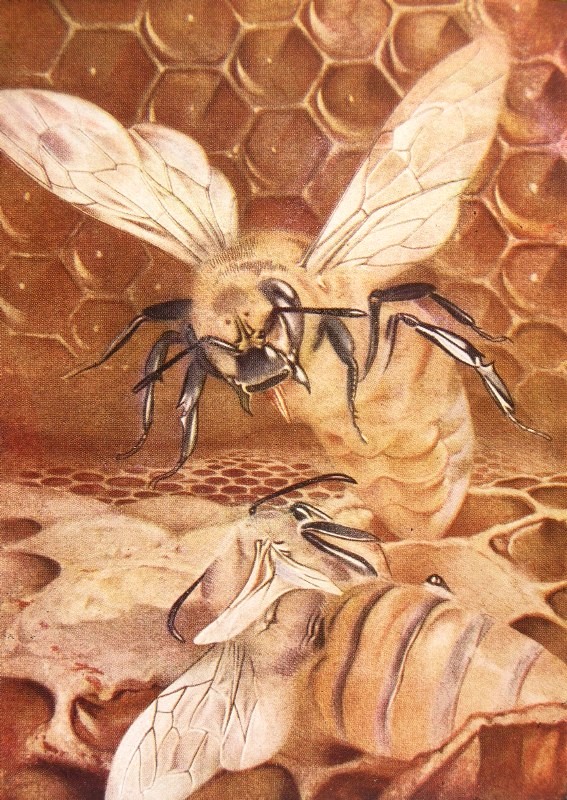
But if the reigning queen should approach, and seem anxious to attack the stranger, the living walls would at once fly open; and the bees, forming a circle around the two, will eagerly watch the strange duel, in which they themselves will take no part whatever. For it is written that against a queen-bee only another queen may draw her sting.
"And the bees, forming a circle around the two, will eagerly watch the strange duel."
If the fight should last too long, or one of the rivals attempt to escape, then, no matter whether she be the reigning queen or the intruder, she will at once be seized and kept in the living prison until she again shows readiness to attack her foe. The reigning queen will almost always conquer, being emboldened and encouraged perhaps by the knowledge that she is fighting in her own home, with her subjects around her. Perhaps too the bees may make some difference in their treatment of the rivals during the period of imprisonment, for their mother seems scarcely to suffer from it at all, while the stranger always appears a little weakened and bruised.
We have shown that, if the queen be taken away from the hive, her people will mourn her, and display every sign of the deepest distress. If she be put back, a few hours later, her daughters will hasten joyfully towards her, offering honey; one section will respectfully form a lane for her to pass through, while others, their heads bent low, will move in great semi-circles before her, singing the song of welcome that is only heard at moments of great happiness and solemn devotion.
But if a new queen were placed in the hive, instead of the old one, the greatest trouble and disturbance would ensue. The bees would know at once that a trick had been played on them; the impostor would be seized, and immediately confined in the terrible living walls made by their bodies, and held there until she died. She will hardly ever be allowed to come out alive.
There are ways, however, of dealing with this hatred of the new-comer; and one of them is to bring her into the hive enclosed in a little cage with iron wires, which is hung between two combs. The door of the cage is made of wax and honey; the bees, after their first display of fury, will gnaw at the wax and honey, thus freeing the prisoner, who will then sometimes be allowed to go unharmed, and be subsequently accepted. There is another way, too, that is used by a bee-master at Rottingdean, who imagined that the unfavorable reception of the new queen might in some degree be caused by her own curious behavior. No sooner will she have been put into the hive than she will rush wildly to and fro, vainly trying to hide in one place or another, and generally doing all she can to make the bees suspicious. Mr. Simmins, the bee-master in question, shuts the queen up for half an hour without any food before putting her into the hive. He then carefully raises a corner of the cover, and drops her on to the top of one of the combs. She seems overjoyed at finding the bees around her, and as she is starving she gladly accepts the food that they offer her. The workers, deceived by her manner, seem to believe that she actually is their old queen who has come back to them, and welcome her joyfully. In this case, therefore, it would seem that Huber, and the other experts who declare that the bees can always recognize their own queen, are not entirely right.
And there is also this to be said about the affection the bees have for their queen. That affection is real, and certainly exists; but it is certain also that it does not last very long. If you were to put back into the hive a queen who had been away for several days, her daughters would receive her so badly that you would have to snatch her up very quickly, and take her away. The explanation is that the bees will have made their arrangements to replace her, and will have turned a dozen workers'cells into royal cradles, thus providing for a new queen and rendering the future safe. They will therefore have nothing more to do with the old one.
The future is the bees' one consideration, and they sacrifice everything to it. As a curious instance, one may mention the way in which they will deal with a mouse, or a slug perhaps, that shall have managed to get into the hive. They will very soon kill the intruder, but then have to consider how they will get rid of the body. If they are unable to drag it out of the hive or tear it to pieces, they will build a perfect waxen tomb round it, which will tower strangely above the ordinary monuments of the city. In one of my hives last year I found three such tombs side by side; they had been made with party-walls, like the cells of the comb, so that no wax should be wasted. The careful grave-diggers had raised these tombs over the remains of three snails that a child had dropped into the hive. Generally, in the case of snails, the bees will be satisfied to seal the opening of the shell with wax. But here it seemed that the shells were broken, and the bees had therefore thought it wiser to bury the entire snail; and so that the entrance-hall should not be blocked, they had made a number of galleries, wide enough for the male bees, which are almost twice as big as the workers, to pass through. In districts where the hideous death's-head moth abounds, the bees erect little columns of wax at the entrance of the hive, and place them so closely together that the night-thief cannot pass through.
And now to return to our swarming hive, where the bees have already given the signal for flight. And at once, as though with one sudden impulse, every gate in the city is flung open wide; and the black throng issues, or rather pours forth, in a double or treble jet, in a throbbing, quivering stream, that quickly divides and melts into space, where the thousands of beating wings weave a tissue humming with sound. And this for some moments will hover above the hive, rustling like gossamer silk; then, like a veil of gladness, all stirring and quivering, it floats to and fro, from the flowers up to the sky. The radiant mantle will gather together its four sunlit corners; and, like the fairy carpet, will fly across space, steering its straight, direct course to the willow, the pear-tree or lime on which the queen will have settled. Around her each wave comes to rest, as though on a golden nail, and from it there hangs the tissue of pearls and of golden wings.
And then there is silence once more; and, in an instant, this mighty tumult, this bewildering golden hail that streamed upon every object near, becomes nothing more than a cluster of inoffensive and harmless bees, that wait patiently, in thousands of little motionless groups hanging down from the branch of a tree, for the scouts to return who have gone in search of a place of shelter.
This is the first stage of what is known as the "primary swarm," at whose head the old queen is always to be found. The bees will usually settle on the shrub or the tree that is nearest the hive; for the queen, who has spent all her life in the dark and has almost forgotten the use of her wings, is afraid to venture too far.
The bee-keeper waits till the great mass of bees is all gathered together; then, having covered his head with a large straw hat (for the most inoffensive bee will think it is caught in a trap if entangled in hair, and will at once use its sting) but, if he be experienced, wearing neither mask nor veil—having taken the precaution only of plunging his arms in cold water up to the elbow—he proceeds to gather the swarm by vigorously shaking, over an inverted hive, the bough from which the bees are hanging. Into this hive the cluster will fall just like an over-ripe fruit. Or, if the branch be too thick, he can plunge a spoon into the mass, and ladle it out, placing the living spoonfuls wherever it pleases him, as though they were grains of corn. He need have no fear of the bees that are buzzing around him, and settling on his face and hands; and he knows that the swarm will not divide, or grow fierce, will not scatter, or try to escape. This is a day when these strange workers seem to make holiday, and to be full of a faith and a confidence that nothing can shake. They have given up the treasure which they used to guard so preciously; they no longer have enemies. They are harmless because they are happy; though why they are happy we know not, unless it be because they are doing what they feel it is right to do.
Where the queen has alighted the swarm will remain; and if she goes into the hive, the long black files of the bees will closely follow, as soon as the news shall reach them. Most of them will go eagerly in; but many will stay for an instant on the threshold of the new home, and there form themselves into solemn, ceremonious circles, which is their method of celebrating happy events. "They are beating to arms," the French peasants say. The new home will at once be adopted, and its furthest corners explored. Its position, its shape, its color, are taken note of and never forgotten by these thousands of eager and faithful little memories, which have also duly recorded the neighboring landmarks; the new city is founded and the thought of it fills the mind and the heart of all its inhabitants; the walls resound with the song that proclaims the royal presence; and work begins.
But if the swarm be not gathered by man, its history will not end here. It will cling to the branch of the tree till the scouts return who have been flying in every direction looking for a new home. They will come back one by one, and give an account of their mission. The report of each scout will probably be very carefully considered. One of them, perhaps, will speak favorably of some hollow tree it has seen; another has something to say about a crack in a ruined wall, a hole in a grotto, or an abandoned burrow. Sometimes the assembly will stop and weigh matters over till the next morning; but at last the choice is made and agreed to by all. At a given moment the entire mass stirs, divides and sets forth; and then, in one sustained and impetuous flight that this time knows no obstacle, it steers its straight course, over hedges and cornfields, over haystack and lake, over river and village, to its fixed and always far-away goal. It is rarely indeed that this second stage can be followed by man. The swarm returns to nature; and we know not what becomes of it.
III
THE FOUNDATION OF THE CITY
The bee-keeper has gathered the swarm into his hive; let us now see what they will do. And, first of all, let us not be unmindful of the sacrifice that these fifty thousand workers have made, who, as Ronsard says "In a little body bear so brave a heart," and let us, yet again, admire the courage with which they begin their life anew in the desert into which they have fallen. They have forgotten the wealth and magnificence of their native city; they are indifferent to all they have left behind. They give not a thought to the vast store of pollen that they had collected, to the 120 pounds of honey, a quantity, let it be remembered, which is more than twelve times the weight of all the bees in the hive put together, and close on 600,000 times that of the single bee. Or you might say that to us it would mean something like 42,000 tons of provisions, a great fleet laden with nourishment more precious than any known to us; for to the bee honey is a kind of liquid life, which it absorbs with almost no waste whatever.
Here, in the new abode, there is nothing; not a drop of honey, not a morsel of wax; there is nothing to begin on, there is nothing to serve as a starting-point. There is only the dreary emptiness of an enormous building with its bare sides and roof. The smooth and rounded walls enclose only darkness; under the lofty arch is a mere void. But useless regrets are unknown to the bee; at any rate, they are not allowed to interfere with work. And instead of being depressed or moping in a corner, the bee sets to at once, and more energetically than ever.
Immediately, and without the smallest delay, the tangled mass divides, splits up and forms itself into groups. Most of these will proceed, marching abreast in regular columns, like regiments obeying the word of command, and will begin to climb the steep walls of the hive. The first bees to reach the dome will cling to it with the claws of their front legs; those behind will hang on to the ones in front of them, and the next the same, and so on to the end, till long chains have been made that serve as a sort of bridge for the crowd which is ever mounting and mounting. And, by slow degrees, these chains, as the number of bees which form them becomes greater and greater, become a kind of dense, three-cornered curtain. When the the last of the bees has joined itself to this curtain that hangs in the darkness, all movement ceases in the hive; and for long hours this strange cluster will wait, in a stillness so complete as to be almost uncanny, for the mystery of wax to appear.
In the meantime, the rest of the bees—those whose business it was to remain below in the hive—have paid not the smallest attention to the others who were forming the curtain, and have made no effort whatever to add themselves to the number. They have been told off to inspect the hive, and to do what is immediately necessary. They start sweeping the floor, and most carefully remove, one by one, every twig, grain of sand, and dead leaf. This satisfactorily accomplished, they will most thoroughly examine and test the floor of the new dwelling. They will fill up every crack and crevice with a kind of raw wax; they will start varnishing the walls, from the top to the bottom. A certain number of guards will be sent to the gate, to take up their post there; and very soon a detachment of workers will go forth to the fields, whence they will come back with their store of pollen.
Before we raise the folds of the mysterious curtain, let us try to form some idea of the skill and industry shown by the bees in fitting up the new hive to serve their purposes. Within the walls there is merely a desert; they must plan out their city, decide where the dwellings shall be; and these must be built as quickly as possible, for the queen is ready to begin to lay her eggs. They must consider the ventilation of these dwellings, and these, too, must be strong and substantial. Different buildings will be wanted for the different kinds of food that are to be stored in them; also it is important that they should be handily placed, so that there shall be no difficulty in finding them; and passages and streets must be contrived between the cells and store-houses. And there are many other problems besides, too many indeed to relate, but they have all to be dealt with.
Bee-keepers provide different kinds of hives for the bees, ranging from the hollow tree, or the earthenware pot, or the familiar bell-shaped dome of straw which we find in our farmers' kitchen-gardens or under their windows, hidden away between masses of sunflowers, phlox and hollyhock, to what may be called the model factory, which is, as it were, the last word of man's ingenuity as applied to the bee. It is a building that will hold more than three hundred pounds of honey, having three or four layers of combs set in a frame which makes it easy to remove or handle the combs and take out the honey; after which, the combs can be put back in their place like a book that we return to the shelf. Now let us imagine that one fine day an obedient swarm of bees is lodged in one of these hives. The little insects are expected to be able to find their way about, to make their home there, to accept all these strange things as natural. They have to make up their minds where the winter storehouses shall be, and where the brood-cells; and these last must not be too high or too low, neither too near to or far from the entrance gate. The swarm may very likely just have come from the trunk of a fallen tree, in which there was one long, narrow gallery; it finds itself now in a tower-shaped building, whose ceiling is lost in the gloom. And in the midst of this building is a confused and bewildering network of frames and scaffolding, the like of which the bee never has seen; and all around it are puzzling signs of the impertinent interference of man.
But all this makes no difference to the bee; and no case has ever been known of a swarm refusing to do its duty, or of allowing the strangeness of its surroundings to discourage it—except only if the new home should be too much exposed to the weather, or have an offensive smell. And even then they will not give way to despair; they will promptly abandon the place, fly away and seek better fortune a little further off.
But if no objection of this kind offers itself in a huge factory of this kind, the bees will calmly go their own way, paying no heed whatever to man's desires or intentions; the frames seem to them of use for their combs, they will readily accept them. This will be more particularly the case if the bee-keeper has artfully surrounded the upper layers of the comb with a little strip of wax; the bees will pick out the wax, and go on with the comb. If this should be covered all over with leaves of foundation-wax, the bees will often be content to deepen and lengthen the cells that have been traced out in the leaves, but will be careful to alter the position of the cells should these not form an absolutely straight line. And thus, in the space of a week, they will be in possession of a city as comfortable and well-built as the one they have left; whereas, in the ordinary way, if all the work had had to be done by them, it would have taken them two or three months to erect the buildings and storehouses out of their own shining wax.
Sir John Lubbock, who has written many interesting books on ants, bees, and wasps, does not believe that the bee has any real intelligence of its own, once it departs from what it has always been accustomed to do. And as a proof of this he mentions an experiment that any one can try for himself. If you put half a dozen bees, and the same number of flies into a bottle, then place the bottle on the table with its foot to the window, you will find that the bees will be quite unable to find their way out, and will go on flinging themselves against the glass, till they die of fatigue and hunger; while the flies will all have escaped, in less than two minutes, through the open neck of the bottle. Sir John Lubbock concludes from this that the bee cannot reason at all, and that the fly shows more ingenuity in getting out of a difficulty. It is not quite sure, however, that this conclusion is the right one. If you take up the bottle and turn it round and round, holding now the neck and now the foot to the window, you will find that the bees will turn with it, so as always to face the light. It is their love of the light, it is actually because of their intelligence, that they come to grief in this experiment. They feel convinced that the escape from every prison must be there where the light shines clearest. To them glass is a mystery which they have never met with in nature; they cannot understand why they are unable to pass through it, and convinced that there must be a way, they persevere to the end; in fact, it is because of their intelligence that they make these unhappy efforts to discover the secret. The feather-brained flies, on the other hand, to whom the mystery of glass means nothing and who possess no power of thought whatever, merely flutter wildly hither and thither, and end by rushing against the friendly opening that sets them free.
As another instance of the bees' lack of intelligence, Sir John Lubbock quotes a passage from a book written by a great American bee-keeper, Mr. Langstroth: "As the fly has to feed on many substances in which it might easily be drowned, it has learned to be very prudent, and alights carefully on the edge of a vessel containing liquid food; the bee, on the other hand, plunges in headlong, and very quickly perishes. The sad fate of their companions does not hinder others from madly rushing in in their turn, to share the same miserable end. No one can understand the extent of their folly till he has seen a confectioner's shop which has been besieged by a crowd of hungry bees. I have known thousands to be strained out from a vat of sirup in which they had been drowned; thousands more kept on plunging into the boiling sweets; the floors were covered and the windows completely darkened with bees, some crawling, others flying, and some so bedaubed that they could neither fly nor crawl—not one bee in ten able to carry home its ill-gotten spoil, and yet the air filled with new hosts of thoughtless comers!"
It will not do, however, to condemn the bees too hastily; there is something to be said on their side. They are accustomed to live in the midst of nature, which has her own regular laws; and the ways of man are strange and bewildering to them. In the forest, in their ordinary life, the madness which Langstroth describes might have come over them if some accident suddenly had destroyed a hive full of honey; but in that case there would have been no fatal glass, no boiling sugar or cloying sirup; there would have been no death or danger other than that to which every animal is exposed while seeking its food. And let us remember too that it was not mere greed, not the bees' own hunger, that caused them to rush so wildly into the boiling vat. It was not for themselves that they plunged into the deadly sugar; they can always feast on honey at home, if they want to. The first thing the bee does when it returns to the hive is to add the honey which it has gathered to the general store; thirty times in an hour perhaps it will bring its offering to the marvelous treasure-house. Their labors, therefore, their eagerness, have no selfish motive; they have one desire, and one only, to increase the wealth in the home of their sisters, which is also the home of the future.
However, the whole truth must be told. Their industry is beyond all praise; their methods, their sacrifice of self, arouse all our admiration; but there is one thing that shocks us somewhat, and that is the indifference with which they regard the misfortunes or death of their comrades. The bee appears to possess two sides to her nature; in the hive, in their home, they all help and care for each other; the union between them, the fellowship, is very close and very true. A thousand bees will sacrifice themselves to avenge an injury done by a stranger to one of their sisters. But outside the hive, away from the home, all this changes; they no longer appear to know one another. If a piece of honeycomb were placed a few steps away from their dwelling, and out of the crowd of bees that would flock to it you were to crush or injure twenty or thirty, the others who had not been attacked would not even turn their head. That strange tongue of theirs, curved like some Chinese weapon, would quietly go on licking up the fluid that they regard as more precious than life, and they would pay no heed whatever to the agony, the cries of distress, of their sisters. And when they have sucked the comb dry, they will be so anxious that not one drop shall be lost, that they will even climb over the dead and the dying to lick up the honey these hold in their jaws, and not one sound and unharmed bee will make the slightest effort to help or relieve the victims. The thought that they themselves run any danger does not disturb them; they give no thought to the death that may perhaps await them too.
But the fact is that the bees do not know the meaning of fear, and smoke is the one thing in the world that they are afraid of. When they are out of the hive, they are curiously inoffensive. They will avoid anything that comes in their way, they will appear not to notice it, provided always that it does not venture too near. This indulgence, however, this meekness, hides a heart that is very sure of itself, very confident, very reliant. No threat will induce the bee to alter her course; she will never attempt to escape. Inside the hive, any danger, whatever it be, will at once be boldly faced. Should any living creature, be it ant or bear or man, venture to attack the sacred dwelling, every bee will spring up and defend the home with passionate fury.
But we must frankly admit that they show no fellowship outside the hive, and no sympathy, as we understand the word, within it. On the other hand, nowhere in the world shall we discover a more perfect organization of work for the benefit of all, a more amazing devotion to the coming generation. It may be, perhaps, that this very devotion may have caused them to ignore everything else. All their love goes to what lies ahead of them; we give ours to what is around us. And are we so sure that, in our own lives, there are not many things that we do that would seem heartless and cruel to some being who might be watching us as closely as we watch the bees?
Let us now see what means the bees have of communicating with each other. Such means must obviously exist, for it would not be possible for the work of so large a city, work which is so varied and so perfectly organized, to be carried on without them. They must have some method of communication, either by sounds or by some language of touch. This strange sense may perhaps lie in the antennæ, which are little horns, or feelers, containing, in the case of the workers, 12,000 delicate hairs and 5,000 "smell hollows"; with these antennæ they seem to question and understand the darkness.
It is evidently not only in their work that the bees are able to communicate with each other, for we know that any news, good or bad, any sudden event, will at once be noised about in the hive; the loss or return of the queen, for instance, the entrance of an enemy, the intrusion of a strange queen, or the discovery of treasure. And each separate incident produces such a different emotion among them, the sounds they make are so essentially varied, that the experienced bee-keeper, listening to the murmur that arises from the hive, can at once and without any difficulty tell what it is that disturbs the multitude that are moving restlessly to and fro in their city.
If you would like to have a more definite proof, you have only to watch a bee which shall just have found a few drops of honey on your window-sill or the edge of your table. She will immediately lap it up; and so eagerly that you will have time to put a tiny touch of paint on her belt without disturbing or interrupting her. It is not that she is greedy; she rejoices at the thought that she has found some honey for the hive. As soon as she has filled her sac, she will go, but watch her manner of going; she will not, like the fly, for instance, merely buzz around or make a dart for the window; for a moment or two she will hover about the room, with her back to the light, eagerly fixing in her mind the exact position of the honey. Then, and not till then, she will return to the hive, empty her sac into one of the provision-cells; and in three or four minutes you will find her back again, going unhesitatingly to the spot, and making straight for the honey. And so she will come and go, till evening, if need be, as long as a drop remains; and her journeys from the hive to the window, from the window to the hive, will be as regular as clock-work; there will be no interval for rest; there will be no interruption.
I will frankly admit that the marked bee often returns alone. Are there the same differences among the bees, perhaps, as among ourselves, some of them being gossips, and others not given to talk? When I was trying this experiment once a friend who was with me said that it must be mere selfishness or vanity on the part of the bee that kept her from letting her comrades know of the treasure she had found. But, be this as it may, it will often happen that the lucky bee will bring two or three friends back with her; and I have found this to be the case four times out of ten. One day it was a little Italian bee which was the first to find the honey; I marked her belt with a touch of blue paint. When she had gorged herself she flew off, and came back with two of her sisters; these I imprisoned, but did not interfere with her. After her second feast she went forth once more, and this time returned with three friends, whom I again shut away, and kept on doing this for the rest of the afternoon, when, counting my prisoners, I found that she had brought no less than eighteen bees to the feast.
One may safely say that the bees will very frequently communicate with each other, even though this is not an invariable rule. American bee-hunters are so sure of the bees possessing this faculty that their methods of searching for nests depend in some measure upon it. "They will take a box of honey," Mr. Josiah Emery writes, "to a field or a wood far away from any tame bees, and then pick up two or three wild ones, and let them fill themselves with the honey. The bees will fly off to their home with the spoil, and soon return with their friends, to whom they have told the glad news. These will again be allowed to drink their fill, and then taken to different points of the compass, and allowed to fly home; the direction of their flight will be carefully noted, and in this way the hunters are able to discover the position of the tree in which the bees have built their nest."
It is to be noticed, too, that the bees do not all come together to feed on the honey we have put on the table; there will be several seconds between the different arrivals. We ask ourselves therefore whether the bees are led by, and merely follow the original discoverer, or whether they go independently, having been told by her where it is? Experts hold different opinions as to this; in the case of the ant Sir John Lubbock is satisfied that the ant which finds the treasure merely leads the way and is followed by the others; but the ant, of course, merely crawls along the ground, while the bee's wings throw every avenue open.
My study in the country is on the first floor, and rather above the ordinary range of the flight of the bees, except at times when the lime and chestnut trees are in blossom. I took an open honeycomb, and kept it on my table for a week, without its perfume having attracted a single bee. Then I went to a glass hive that was close by the house, took an Italian bee, brought her in to my study, set her on the comb, and marked while she was feeding. When she had drunk her fill, she flew off and returned to the hive. I followed quickly, saw her crawl over the huddled mass of the bees, plunge her head into an empty cell, disgorge her honey, and then get ready to set forth again. At the entrance of the hive I had placed a glass box, divided by a trap-door into two compartments. The bee flew into this box; and as she was alone, and no other bee seemed to accompany or follow her, I left her there, and then repeated the experiment on twenty bees in succession. By means of the trap, with its two little compartments, I was able in each case to separate the marked bee from the ones that might accompany her, and to keep her a prisoner in one of the little rooms. Then I marked all the bees in the other room with paint of a different color, and set them free; I myself returned quickly to my study, to await their arrival.
Now if the bees which had not visited my study had been able to communicate with the others, and to be told by them precisely where the comb was, with instructions how to get at it, a certain number of them would have found their way to my room. I must frankly admit that, to my disappointment, there was only one that did actually arrive. And I cannot tell even whether this may not have been a mere chance. I went down and released the first bee, and my study soon was invaded by the buzzing crowd to whom she showed the way to the treasure.
We need not trouble any further with this unsatisfactory experiment of mine, for there are many other curious circumstances to be noted among the bees which make it quite certain that they can tell each other things that go much further than a mere yes or no. In the hive, for instance, the wonderful way in which they divide up their work, the way in which the work is combined, one bee holding herself in readiness to take the place of another who has finished her own particular job and is waiting for her—these things all prove that they must be able to let each other know. I have often marked bees that went out in the morning collecting food; and found that, in the afternoon, if there was no special abundance of flowers, these same bees would take on another job altogether; would either be fanning and heating the brood-cells, or perhaps adding themselves to the mysterious, motionless curtain in whose midst the sculptors and waxmakers would be at work. In the same way I have found that bees which for one whole day would be gathering nothing but pollen would, on the next, evidently in obedience to some order that had been given, devote themselves entirely to the search for nectar.
Day after day, the sun will scarcely have risen when the explorers of the dawn return to the hive, which awakes to receive the glad tidings of what is happening on the earth. "The lime-trees are blossoming to-day on the banks of the canal." "The grass by the roadside is gay with white clover.", "The sage and the lotus are about to open." "The mignonette, the lilies, are overflowing with pollen." The news is handed in to headquarters, and arrangements are quickly made to divide up the work. Five thousand of the strongest and most active will be sent to the lime-trees, while three thousand juniors sally forth to the clover. Those who yesterday were gathering nectar will to-day give a rest to their tongues and the glands of their sac, and will bring back red pollen from the mignonette or yellow pollen from the tall lilies; for you will never find a bee gathering or mixing up pollens of a different color or species, and indeed it is one of the special cares of the hive to keep the different-hued pollens apart in separate store-rooms.
The workers set out, in long black files, each one flying straight to its own particular task. George de Layens stoutly declares that they have been told where to go to, and which flowers they are to visit; that they are aware how much nectar each flower will give, and know its precise value. It is their business to collect the greatest possible amount of honey; and if we watch the different directions in which the bees fly, we will find that they divide themselves up most carefully among the flowers which offer the best chance of a prosperous harvest. As these vary day by day, so will the different orders be given. In the spring, for instance, when the fields are still bare, the bees will flock to the flowers in the woods, and eagerly visit the gorse and the violets, langworts and anemones. But, a few days later, when cabbage and colza are beginning to flower, the bees will turn their attention to these alone, neglecting the woods almost entirely, for all the abundance that still may be found there. They know that the colza and cabbage flowers are richer in honey, and therefore give them the preference; thus deciding, day by day, what plants they shall visit, their one idea being to amass the greatest value of treasure in the least possible time.
You may ask, perhaps, what does it matter to us whether the bees have or have not a real intelligence of their own? I think that it matters a very great deal. If we could be quite certain that other creatures beside ourselves are able to think or to reason it would give us something of the emotion that came over Robinson Crusoe when he saw the print of a human foot on the sandy shore of his island. Like him, we should seem less alone. And when we study, when we try to understand, the intelligence of the bees, we are at the same time trying to understand what is the most wonderful thing in ourselves; the power that enables the will to effect its purpose, and overcome obstacles in its way.
We will now go on with the story of the hive, take it up where we left it, and lift a fold of the curtain of bees which are hanging, head downwards, from the dome. A curious kind of sweat, as white as snow and airier than the down on the wing of a bird, is beginning to show itself. This is the wax that is forming; but it is unlike the wax that we know; it has no weight, it is amazingly pure, being, as it were, the soul of the honey, which is itself the essence of the flowers.
It is very difficult to follow, stage by stage, the manufacture of wax by the swarm, or even the use to which they put it, for all this comes to pass in the very blackest depth of the mass of bees all huddled together. We know that the honey in the sac of the bees that are clinging to each other turns itself into wax, but we have no idea how this is done. All we can tell is that they will stay in this position, never stirring or making the least movement, for eighteen or twenty-four hours, and that the hive becomes so hot that it is almost as though a fire had been lit. And then at last white and transparent scales show themselves at the opening of four little pockets that every bee has underneath its stomach.
When the bodies of most of the bees forming the curtain have thus been adorned with ivory tablets, we shall suddenly see one of them detach herself from the crowd, and eagerly, hurriedly, clamber over the backs of the motionless crowd till she has reached the top of the dome. To this she will fix herself firmly, banging away with her head at those of her neighbors who seem to interfere with her movements. Then, she will seize with her mouth and her claws one of the scales that hang from her body, and set to work at it like a carpenter planing a soft piece of wood. She will pull it out, flatten it, bend it and roll it, moistening it with her tongue and licking it into shape; and, when at last she has got it to be just what she wanted, she will fix it to the highest point of the dome, thus laying the stone, the foundation, of the new city; for we have here a city that is being built downwards from the sky, and not from the earth upwards, like the cities of men. To this beginning she will add other morsels of wax, which she takes from beneath her belt; and at last, with one final lick of the tongue, one last touch of her feelers, she will go, as suddenly as she came, and disappear among the crowd. Another bee will at once take her place, carry on the work from the point where the first has left it; she will go through her own carpentering, just like her sister, and add to or improve the first one's job if she thinks this is called for. And then a third will follow, a fourth and a fifth, all coming from different corners, all eager and earnest, till numbers and numbers have taken their turn, none of them finishing the work but each adding her share to the task in which all combine.
A small lump of wax, as yet quite formless, hangs down from the top of the hive. As soon as it is sufficiently thick, we shall see another bee coming out of the mass. This one is very sure of herself, puts on a little side as it were; and she is watched very closely by the eager crowd below. She is one of the sculptors or carvers; she does not make any wax herself, her job being to deal with the material which the others have provided. She marks out the first cell, settles where it shall be; digs into the block for a moment, putting the wax she has taken out from the hole on the borders around it; and then she goes, making way for another, who is impatiently waiting her turn, and will go on with the work that a third will continue, while others close by are digging away at the wax on the opposite side. And very soon we shall be able to see the outline of the new comb. In shape it will be something like our own tongue, if you can imagine this to be made up of little six-sided cells, which all lie back to back. When the first cells have been built, the architects put on the ceiling, and then start building a second row, and a third and a fourth, and so on, gallery on the top of gallery, and the dimensions so carefully worked out that there will always be ample space, when the comb is finished, for the bees to move freely between its walls.