MAURICE MAETERLINCK (continued 2)
Reading edition
It happens, however, sometimes that a mistake has been made; that too much space, or too little, will have been left between the combs. The bees will do the best they can to set matters right; they will slant the one comb that is too near the other, or fill up the space that has been left with a new comb specially shaped.
The bees build four different kinds of cells. There are the royal cells, rather like an acorn in shape; the large cells in which the males are reared, and provisions stored when flowers are plentiful; the small cells used as cradles for the workerbees and also as ordinary store-rooms. These last are the most common kind, and about four-fifths of the buildings will be composed of them. Then there are also a certain number of what are known as "transition-cells," irregular in shape, which connect the larger cells with the smaller.
Each cell, with the exception of the transition ones, is worked out absolutely to scale, with extraordinary accuracy. It is a kind of six-sided tube, and two layers of these tubes form the comb. It is in these tubes that the honey is stored; and to prevent it from spilling, the bees tilt the tubes slightly forward. Each cell is solidly built, and the position of one to the other has been carefully thought out and arranged. Indeed, such wonderful skill and ingenuity is shown in the construction of the cells that it is difficult to believe that instinct alone is sufficient to account for it. The wasps, for instance, also build combs with six-sided cells; but their combs have only one layer of cells, and are not only less regular, but also less substantial; further, the wasps are so wasteful in their manner of working that, to say nothing of the loss of material, they also deprive themselves of about a third of the space that they might have used. Some bees again—which are not as civilized as those in our hives—build only one row of rearing-cells and rest their combs on shapeless and extravagant columns of wax. Their provision-cells are nothing but great pots, grouped together without any system or order. You could no more compare these nests with the cities of our own honey-bees than you could a village made up of huts with a modern town.
The very greatest ingenuity is shown in the construction of the combs, quite apart from the admirable precision of the architecture. Thus, for instance, there is a most skillful arrangement of alleys and gangways through and around the comb, which provide short cuts in every direction, allow the air to circulate, and prevent any block of the traffic. The connecting cells again, which join the large cells to the small ones, are so made that their shape can be altered with the least possible delay. There may be different reasons for desiring this alteration: an overflowing harvest may render more store-rooms necessary, or the workers may consider that the population of the hive should not be further increased, or it may be considered advisable that more males should be born. In any of these cases the bees will proceed, with unerring, unhesitating accuracy and precision to make the necessary changes, turning small cells into large, and large into small; and this without any waste of space or material, without allowing a single one of their buildings to become mis-shapen or purposeless, without in any way interfering with the neatness or general harmony of the hive.
The swarm whose movements we are following have started building their combs, which are already becoming fit for use. And although, as we look into the hive, we see little happening, there will be no pause, either by day or by night, in the creation of the wax, which will proceed with amazing quickness. The queen has been restlessly pacing to and fro on the borders that shine out gleamingly white in the darkness; and no sooner has the first row of cells been built than she eagerly takes possession, together with her servants, her guardians and counselors—though whether it be she who leads them, or they who direct her, is a matter beyond our knowledge. When the spot has been reached that she, or her retinue, regard as the proper one, she will arch her back, lean forward, and introduce the end of her long spindle-shaped body into one of the cells. Her escort form a circle around her, their enormous black eyes watching her every movement; they caress her wings, they feverishly wave their antennæ as though to encourage her, to urge her on, or perhaps to congratulate her. You can always easily tell where the queen is, because around her there will be a kind of starry cockade, something like the oval brooch that our grandmothers used to wear; of this she will be the center. And there is one curious thing that we may note here: the worker-bees never by any chance turn their back to the queen. When she approaches a group they immediately form themselves so as to face her, and walk backwards before her. It is a token of respect or reverence that they never fail to show; it is the unvarying custom.
Very soon the queen will be passing from cell to cell, busily laying her eggs. She will first peep into the cell to make sure that all is in order, and that she has not been there before. In the meanwhile two or three of her escort will have hastened into the cell which she has just left, in order to see that her work has been properly done, and to care for, and as it were tuck up, the little bluish egg she has laid. From now on right up to the first frosts of autumn the queen will never stop laying; she lays while she is being fed, she even lays in her sleep, if she ever does sleep, which may perhaps seem rather doubtful.
"The queen takes possession together with her servants, guardians and counsellors."
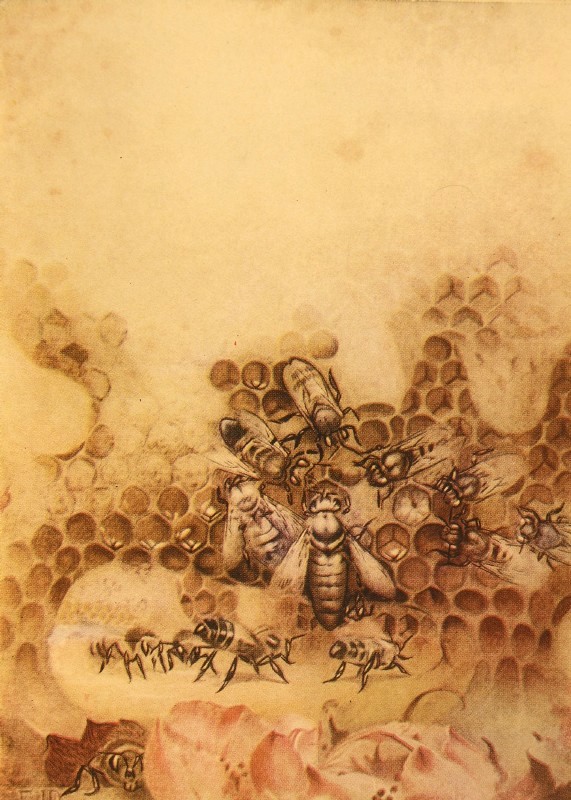
It will sometimes happen that the worker-bees, in their eagerness to find room for their honey, will have stored it in some of the vacant cells reserved for the queen; when she comes to these the workers frantically carry away the honey so that she may lay her eggs. If there is a shortage of cells for honey, and this is accumulating very fast, the bees will contrive, as quickly as they can, to get ready a block of large cells for the queen, as these take less time to build. But they are cells for male bees; and when the queen comes to them, she seems vexed; she will lay a few eggs, then stop, move away, and insist on being given the smaller cells that are used for the workers' eggs. Her daughters obey; they set to at once and reduce the size of the cells; and the queen, in the meantime, goes back to the cells at which she had started at the very beginning. These will be empty now, for the larvæ will have come to life, leaving their shadowy corner, and will already have spread themselves over the flowers around, glittering in the rays of the sun and quickening the smiling hours; and soon they will sacrifice themselves in their turn to the new generation that now is beginning to take their place in the cradles they have left.
The bees all obey the queen; and yet they themselves contrive to direct her movements; for the number of eggs that she lays will be in strict proportion to the food that is given her. She does not take it herself; she is fed like a child by the workers. And if flowers are abundant, so will the food be, and therefore the number of eggs. Here we find, as everywhere in life, cause and effect working together in a circle of which one part is always in darkness; the bees, like ourselves, obey the lord of the wheel that is always turning and turning.
Some little time back I was showing one of my glass hives to a friend, and he was almost startled to see the frantic activity there. Each comb seemed alive; on every side there was movement, hurry, bustle, activity; the nurses, incessantly stirring and doing, were busy around the broodcells; the wax-makers were forming their ladders and living gangways; the sculptors, the architects, cleaners, the builders, all were at work, feverishly, restlessly, never pausing for food or sleep; there was constant and pitiless effort among them all, save only in the cradles where lay the larvæ that soon themselves would be taking their turn in this chain of unending duty, which permits of no illness and accords no grave. And my friend, his curiosity soon satisfied, turned away, and in his eyes there were signs of sorrow, and almost of fear.
And in good truth, beneath all the gladness that we find in the hive, with its memories of precious jewels of summer—of flowers, of running waters and peaceful skies—beneath all this there dwells a sadness as deep as the eye of man ever has seen. And we, who dimly gaze at these things, we who know that around us, in our own lives, among our own people, there also is sadness, we know too that this has to be, as with all things in nature. And thus it ever shall be, so long as we know not her secret; and yet there are duties all must do, and those duties suffice. And in the meantime let our heart murmur, if it will, "It is sad," but let our reason be content to add "So it must be."
IV
THE YOUNG QUEENS
Let us now leave the new hive, which we find to be already beginning to work as before, and go back to the old one, the mother-city, which the swarm had left. Here, at the start, all looks forlorn, and dreary, and empty. Two-thirds of the population have gone, have departed forever. But thousands of bees remain; and these, whatever their feelings may be, still are faithful to the duty that lies on them, and have not forgotten what they have to do. They set to work, therefore, and try their best to fill the places of those who have joined the swarm. They start cleaning the city, look to the store-cells and put things in order there, attend to what is necessary in the hive, and despatch their bands of worker-bees to collect fresh food from the flowers.
And if the outlook at first appear rather gloomy, there still are signs of hope wherever the eye may turn. One might almost fancy oneself in one of the castles they tell of in fairy-stories, where there are millions of tiny phials along the walls containing the souls of men about to be born. For here, too, are lives that have not yet come to life. On all sides, asleep in their closely-sealed cradles, in their thousands of waxen cells, lie the larvæ, the baby bees, whiter than milk, their arms folded and their head bent forward as they wait for the hour to awake. Around them hundreds of bees are dancing and flapping their wings. The object of this seems to be to increase the temperature, and procure the heat that is needed—or perhaps there may be some reason that is still more obscure; for this dance of theirs combines some very extraordinary movements whose meaning no observer has as yet been able to understand.
In another few days the lids of these thousands of urns—of which there will be from sixty to eighty thousand in a hive—will break, and two large, earnest black eyes will peer forth, while active jaws will be busily gnawing away at the lid, to enlarge the opening. The nurses at once come running; they help the young bee out of her prison, they clean her and brush her, and with the tip of their tongue they give her the first drop of honey that ushers in the new life. But the bee that has come so strangely from another world is still trembling and pale, and stares wildly around; she has something of the look of a tiny old man who might have been buried alive, and has made his escape from his tomb. She is perfect, however, from head to foot; and she loses no time, but hastens at once to other cells that have not yet opened, and there joins in the dance and starts beating her wings with the others, so that she may help in quickening the birth of her sisters who have not yet come to life.
The most arduous labors, however, will at first be spared her. She will not leave the hive till a week has passed since the day of her birth. She will then undertake her first flight, known as the "cleansing-flight," and absorb the air into her lungs, which will fill and expand her body; and thenceforward she becomes the mistress of space. The first flight accomplished, she returns to the hive, and waits yet one week more; and then, with her sisters, who were born the same day as herself, she will for the first time sally forth and visit the flowers. A special emotion, now, will lay hold of her; a kind of shrinking, almost of fear. For it is evident that the bees are afraid; that these daughters of the crowd, of secluded darkness, shrink from the vault of blue, from the infinite loneliness of the light; and their joy is halting, and woven of terror. They cross the threshold, and pause; they depart, they return twenty times. They hover aloft in the air, their heads turned towards their home; they describe great soaring circles, their thirteen thousand eyes taking in, registering and recording, the trees and the fountain, the gate and the walls, the neighboring windows and houses, till at last the outside world becomes familiar to them, and they know that they will be able to find their way back to the hive.
It is curious how they are able to accomplish this; to return to a home that they cannot see, that is hidden perhaps by the trees, and that in any event must form so tiny a point in space. Put some of them into a box and set them free at a place that is two or three miles from their hive, they will almost invariably succeed in discovering their way home. Have they landmarks by which they guide themselves, or do they possess the instinct, the sense of direction, that is common among swallows and pigeons? Different experiments that have been made appear to show that this latter is not the case. I have, however, on more than one occasion noticed that the bees seem to pay no attention to the color or shape of the hive. It is rather the platform on which the hive rests that attracts them, the position of the entrance-gate and of the alighting-board. When the winter comes on, a hive may be taken away and put perhaps into some dark cellar where it will remain till the spring; if then it should be set a little to right or to left of its former position on the platform, all the bees, on their first return from visiting the flowers, will steer their straight, direct, unhesitating course to the precise spot which the hive had occupied in the preceding year; and it will only be after much hesitating and groping that they will find the door whose place has now been shifted. And some will be unable to do this, or will be altogether lost.
In the old hive thousands of cradles are stirring and the larvæ coming to life; such bustle and movement is there that the solid walls seem to shake. But the city still lacks a queen. In the center of one of the combs you may notice seven or eight curious structures, each one about three or four times as large as the ordinary worker's cell; they look something like the circles and hillocks that we see on the photographs of the moon. These dwellings are surrounded by guards who never leave them, and are always watchful and alert. They know that they are protecting the home of the queen that is to be.
In these cells eggs will have been placed by the old queen, or more probably perhaps by one of the workers, before the departure of the swarm; the eggs will have been taken from some cell that was near, and will be exactly the same as those from which the ordinary worker-bee is hatched. And yet the bee that will in due time come out is so unlike the others that she might almost belong to an entirely different race. Her life will last four or five years, instead of the six or seven weeks that are the portion of her worker-sister. Her body will be twice as long, her color clearer, and more golden; her sting will be curved, and her eyes have only seven or eight thousand facets instead of twelve or thirteen thousand. Her brain will be smaller, and she will have no brushes, no pockets in which to secrete the wax, no baskets to gather the pollen. She will not crave for air, or the light of the sun; she will die without once having sipped at a flower. She will spend her life in the darkness, in the midst of an ever-moving crowd; and her one thought, her one idea, will be the constant search for cradles in which she can lay her eggs. It is probable that she will not, twice in her life, look on the light of day; and as a rule she will only once make use of her wings.
A week has passed, let us say, since the old queen has gone, at the head of the swarm. The royal princesses who still are asleep in their cots are not all of the same age; for the bees prefer that there should be an interval between the birth of each one. The time of the eldest princess draws near; she is already astir, and has begun eagerly to gnaw at the rounded lid of her cradle, whose walls the workers have already for several hours been thinning, so as to make it easier for her to get out. And at last she thrusts her head through the lid; the workers at once rush eagerly to her, and help her to get clear; they brush her, caress her and clean her, and soon she is able to take her first trembling steps on the comb. At first, her food will be the same as that given to the ordinary workers, but after a very few days she is nourished on the choicest and purest milk, which is known as "royal jelly."
The princess, at the moment of birth, is weak and pale; but in a very few minutes she gets her strength, and then a strange restlessness comes over her; she seems to know that other princesses are near, that her kingdom has yet to be won, that close by rivals are hiding; and she eagerly paces the waxen walls in search of her enemies.
This is the gravest and most serious moment in the history of the hive. The bees have to consider how many swarms they intend to send out; at times they make mistakes, and leave the mother-city too empty, at times also the swarms themselves are not sufficiently strong. These are matters that the "spirit of the hive" has to settle; it has to decide whether another queen will be required, in addition to the young one who has just come to birth, in order that she may head a swarm in the future. On this decision rests the whole prosperity of the hive; and very rarely will the judgment of the bees go astray.
But let us assume that here the spirit of the hive has decided against a second swarm. The young princess, who has just come to life, will be allowed to destroy the rivals who are still asleep in their cradles. She will hasten towards them, and the guard will respectfully make way. She will fling herself furiously on to the first cell she comes across, strip off the wax with teeth and claws, tear away the cocoon and dart her sting into the victim whom she has laid bare. She will stab her to death and then go, with the same passionate fury, to the next cell, and then the next, again uncovering the cradle and killing her rival, till at last, breathless and exhausted, she has destroyed all her sleeping sisters.
The watchful circle of bees who surround her have stood by, inactive and calm, and have not interfered; they have merely moved out of her way and have let her indulge her fury; and no sooner has a cell been laid waste than they rush to it, drag out the body, and greedily lap up the precious royal jelly that clings to the sides of the cell. And if the queen should be too weak or too tired to carry out her dreadful purpose to the end, the bees will themselves complete this massacre of the innocent princesses, and the royal race, and their dwellings, will all disappear. This is the terrible hour of the hive.
At times it will happen that two queens will come to life together, though this occurrence is rare, as the bees take special pains to prevent it. But should such a case arise, the deadly combat would start the very moment the rivals come out of their cradles. Afraid of each other, and yet filled with fury, they attack and retreat, retreat and attack, till at last one of them succeeds in taking her less adroit, or less active, rival by surprise, and in killing her without risk to herself. For the law of the race has demanded one sacrifice only.
But let us suppose that the spirit of the hive has decided that there shall be a second swarm. In this case, as before, the queen will advance threateningly towards the royal cells; but instead of finding herself surrounded by obsequious servants, her way will be blocked by a guard of stern and unflinching workers. In her mad fury, she will try to force her way through, or to get round them; but in every direction sentinels have been posted to protect the sleeping princesses. The queen will not be denied; she returns again and again to the charge, puts forth every effort; but each time she will be driven back, hustled even, till at last it begins to dawn upon her that behind these little workers there stands a law that does not yield even to a queen. And at last she goes, and wanders unhappily from comb to comb, giving voice to her thwarted fury in the war-song that every bee-keeper knows well; a note like that of a far-away silver trumpet, and so clear that one may hear it, at evening especially, two or three yards away from the double walls of the hive.
This cry, this war-song, has the strangest effect on the workers. It fills them with terror, it has an almost paralyzing influence upon them. When she sends it forth, the guards, who the moment before may have been treating her rather roughly, will at once cease all opposition, and will wait, with bent heads, in meekest submission, till the dreadful song shall have stopped.
For two or three days, sometimes even for five, the queen's lament will be heard, the fierce challenge to her well-guarded rivals. And these, in their turn, are coming to life; they are beginning to gnaw at the lids of their cradles. Should they emerge from them while the angry queen is still near, with her one desire to destroy them, a mighty confusion would spread itself over the city.
But the spirit of the hive has taken its precautions, and the guards have received the necessary instructions. They know exactly what must be done, and when to do it. They are well aware that if the princesses were to come out of their lodging too soon, they would fall into the hands of their furious elder sister, who would destroy them one by one. To avoid this, therefore, the workers keep on adding layers of wax to the cells as fast as the princesses within are stripping it away; so that all their gnawing and eagerness are of no avail, and the captives must bide their time. One of them perhaps will hear the war-cry of her enemy; and although she has not yet come into contact with life, nor knows what a hive may be, she answers the challenge from within the depths of her prison. But her song is different; it is hollow and stifled, for it has to pass through the walls of a tomb; and when night is falling and noises are hushed, while high over all is the silence of the stars, the bee-keeper is able to distinguish, and recognize, this exchange of challenges between the restlessly wandering queen and the young princesses still in their prison.
The young queens will have benefited by the long stay in their cradles, for when at last they come out they are big and strong, and able to fly. But this period of waiting has also given strength to the first-born queen, who is now able to face the perils of the voyage. The time has come, therefore, for the second swarm, called the "cast," to depart, with the eldest queen at its head. No sooner has she gone than the workers left in the hive will release one of the princesses from her cradle; she will at once proceed to show the same murderous desires, to send forth the same cries of anger, as her sister had done before her, till at last, after another three or four days, she will leave the hive in her turn, at the head of the third swarm, to build a new home far away. A case has been known where a hive, through its swarms and the swarms of its swarms, was able in a single season to send forth no less than thirty colonies.
This excessive eagerness, which is known as "swarming-fever," usually follows a severe winter; and one might almost believe that the bees, always in touch with the secrets of nature, are conscious of the dangers that threaten their race. But at ordinary times, when the seasons have been normal, this "fever" will rarely occur in a strong and well-governed hive; many will swarm only once, and some, indeed, not at all.
The second swarm will in any event generally be the last, as the bees will be afraid of unduly impoverishing their city, or it may be that prudence will be urged upon them by the threatening skies. They will then allow the third queen to kill the princesses in their cradles; whereupon the ordinary duties of the hive will at once be resumed, and the bees will have to work harder than ever in order to provide food for the larvæ and generally to replenish the storehouses before the arrival of winter.
The second and third swarms will sally forth in the same way as the first, with the difference only that the bees will be fewer in number, and that, owing perhaps to less scouts being available, operations will not be conducted with quite as much prudence and forethought. Also, the younger queen will be more active and vigorous than her sister, and will therefore fly much further away, leading the swarm to a considerable distance from the hive. As a consequence, these second and third swarms will have greater difficulties to meet, and their fate will be more uncertain. So all-powerful, however, is the law of the future, that none of these perils will induce the queen to show the least hesitation. The bees of the second and third swarms display the same eagerness, the same enthusiasm, as those of the first; the workers flock round the fierce young queen, as she gropes her way out of her cell, and there is not one of them that shrinks from accompanying her on the voyage where there is so much to lose and so little to gain. Why, one asks, do they show this amazing zeal; what makes them so cheerfully abandon all their present happiness? Who is it selects from the crowd those who shall stay behind, and dictates who are to go? The exiles would seem to belong to no special class; around the queen who is never to return, veteran foragers jostle tiny worker-bees who will for the first time be facing the dizziness of the skies.
We will not attempt to relate the many adventures that these different swarms will encounter. At times, two of them will join forces; at others, two or three of the imprisoned princesses will contrive to join the groups that are forming. The bee-keeper of to-day takes steps to ensure that the second and third swarms shall always return to the mother-hive. In that case, the rival queens will face each other on the comb; the workers will gather around and watch the combat; and, when the stronger has overcome the weaker, they will remove the bodies, forget the past, return to their cells and their storehouses, and resume their peaceful path to the flowers that are awaiting and inviting them.
V
THE MASSACRE OF THE MALES
If the skies remain pure, the air still warm, and pollen and nectar are plentiful in the flowers, the workers will endure the presence of the males for a brief space longer. The males are gross feeders, untidy in their habits, wasteful and greedy; fat and idle, perfectly content to do nothing but feast and enjoy themselves, they crowd the streets, block up the passages, and are always in the way; they are a nuisance to the workers, whom they treat with a certain good-natured arrogance, apparently never suspecting how scornfully they themselves are regarded, or the deep and ever-growing hatred to which they give rise. They are still happily unconscious of the fate in store for them.
Careless of what the workers have to do, the males invariably select the snuggest and warmest corners of the hive for their pleasant slumbers; then, having slept their fill, they stroll jauntily to the choicest cells, where the honey smells sweetest, and proceed to satisfy their appetite. From noon till three, when the radiant countryside is a-quiver beneath the blazing stare of a July or August sun, the drones will saunter on to the threshold, and bask lazily there. They are gorgeous to look at; their helmet is made of enormous black pearls, they have doublet of yellowish velvet, two towering plumes and a mantle draped in four folds. They stroll along, very pleased with themselves, full of pomp and pride; they brush past the sentry, hustle the sweepers, and get in the way of the honey-collectors as these return laden with their humble spoil. Then one by one, they lazily spread their wings, and sail off to the nearest flower, where they doze till they are awakened by the fresh afternoon breeze. Thereupon they return to the hive, with the same pomp and dignified air, sure of themselves and perfectly satisfied; they make straight for the storehouses, and plunge their head up to the neck into the vats of honey, taking in nourishment sufficient to restore their strength that has been exhausted by so much labor; afterwards, with ponderous steps, seeking the pleasant couch and giving themselves up to the good, dreamless slumber that shall fold them in its embrace till it be time for the next meal. But bees are less patient than men; and one morning the long-expected word of command goes through the hive. And there is a sudden transformation: the workers, hitherto so gentle and peaceful, turn into judges, and executioners. We know not whence the dreadful word issues; it may be that endurance has reached its limit, and that indignation and anger have bubbled over. At any rate we find a whole portion of the bee-people giving up their visits to the flowers, and taking on themselves the administration of stern justice.
An army of furious workers suddenly attacks the great idle drones, as they lie pleasantly asleep along the honeyed walls, and ruthlessly tear them from their slumbers. The startled drones wake up, and stare round in amazement, convinced at first that they must be dreaming, and the prey of some dreadful nightmare. There must be some shocking mistake; their muddled brains grope like a stagnant pond into which a moonbeam has fallen. Their first impulse is to the nearest food-cell, to find comfort and inspiration there. But gone for them are the days of May honey, the essence of lime-trees and the fragrant ambrosia of thyme and sage, of marjoram and white clover; the path that once lay so invitingly open to the tempting reservoirs of sugar and sweets now bristles with a burning-bush of poisonous, flaming stings. The air itself is no longer the same; the dear smell of honey is gone, and in its place only now the terrible odor of poison, of which thousands of tiny drops glisten at the tip of the threatening stings. Around them is nothing but fury and hatred; and before the bewildered creatures have begun to realize that there is an end to the happy conditions of the hive, each drone is seized by three or four ministers of justice, who proceed to hack off his wings and antennæ and deftly pass their sword between the rings of his armor. The huge drones are helpless; they have no sting with which to defend themselves; all they can do is to try to escape, or to oppose the mere force of their weight to the blows that rain down. Forced on to their back, with their enemies hanging on to them, they will use their powerful claws to shift them from side to side; or, with a mighty effort, will turn round in wild circles, dragging with them the relentless executioners, who never for a moment relax their hold. But exhaustion soon puts an end; and, in a very brief space, their condition is pitiful. The wings of the wretched creatures are torn off, their antennæ severed, their legs hacked in two; and their magnificent eyes, now softened by suffering, reflect only anguish and bitterness. Some die at once of their wounds, and are dragged away to distant burialgrounds; others, whose injuries are less, succeed in sheltering themselves in some corner, where they lie, all huddled together, surrounded by guards, till they perish of hunger. Many will reach the gate, and escape into space, dragging their tormentors with them; but, towards evening, driven by famine and cold, they return in crowds to the hive and pray for admission. But there they will meet the merciless guard, who will not allow one to pass; and, the next morning, the workers, before they start on their journey to the flowers, will clear the threshold of the corpses that lie strewn on it; and all recollection of the idle race will disappear till the following spring.
It will often happen that, when several hives are placed close together, the massacre of the drones will take place on the same day. The richest and best-governed hives are the first to give the signal; smaller and less prosperous cities will follow a few days later. It is only the poorest and weakest colonies that will allow the males to live till the approach of winter. The execution over, work will begin again, although less strenuously, for flowers are growing scarce. The great festivals of the hive, the great tragedies, are over. The autumn honey, that will be needed for the winter, is accumulating within the hospitable walls; and the last reservoirs are sealed with the seal of white, incorruptible wax. Building ceases; there are fewer births and more deaths; the nights lengthen and days grow shorter. The rain and the wind, the mists of the morning, the twilight that comes on too soon—these entrap hundreds of workers who never return to the hive; and over this sunshine-loving little people there soon hangs the cold menace of winter.
Man has already taken for himself his good share of the harvest. Every well-conducted hive has presented him with eighty or a hundred pounds of honey; there are some even which will have given twice that quantity, all gathered from the sun-lit flowers that will have been visited a thousand or two times every day. The bee-keeper gives a last look at his hives, upon which slumber now is falling. From the richest he takes some of their store, and distributes it among those that are less well-provided. He covers up the hives, half closes the doors, removes the frames that now are useless, and abandons the bees to their long winter sleep.
They huddle together on the central comb, with the queen in the midst of them, attended by her guard. Row upon row of bees surround the sealed cells, the last row forming the envelope, as it were; and when these feel the cold stealing over them, they creep into the crowd, and others at once take their places. The whole cluster hangs suspended, clinging on to each other; rising and falling as the cells are gradually emptied of their store of honey. For, contrary to what is generally believed, the life of the bee does not cease in winter; it merely becomes less active. These little lovers of sunshine contrive, through a constant and simultaneous beating of their wings, to maintain in their hive a degree of warmth that shall equal that of a day in spring. And they owe this to the honey, which is itself no more than a ray of heat which has passed through their bodies, and now gives its generous blood to the hive. The bees that are nearest the cells pass it on to their neighbors, and these in their turn to those next them. Thus it goes from mouth to mouth through the crowd, till it reaches those furthest away. And this honey, this essence of sunshine and flowers, circulates through the hive until such time as the sun itself, the glorious sun of the spring, shall thrust in its beam through the half-open door, and tell of the violets and anemones that are once more coming to life. The workers will wake, and discover that the sky again is blue in the world, and that the wheel of life has turned, and begun afresh.
VI
THE PROGRESS OF THE RACE
It is as well, before ending this book—as we have ended the story of the hive with the silence that winter brings—to add a few words about the extraordinary industry of the bees. People are apt to say, while admitting that it is very wonderful, that it has always been the same from the very beginning of time. Have the bees not, for thousands of years, built their combs, their marvelous combs, in just the same way; these combs that combine the most perfect science of chemist and architect, mathematician and engineer; combs in which it would be impossible for us to suggest a single improvement? Where shall we find any instance of progress, of the bees having discovered some new method or change in the old; show us that, and we will gladly admit that the bees, besides their instinct, possess also an intellect worthy of being compared with that of man!
This method of reasoning is not without its perils. It is the same kind of "mere common sense" that the people of Galileo's time displayed when they refused to believe that the earth revolved in space. "The earth cannot possibly turn," they would say, "for we can see the sun move in the sky, see it rise in the morning and set in the evening. Nothing can deceive our eyes." Common-sense is all very well; but it is not a sure guide unless it go hand in hand with a certain reflection and judgment.
The bees give abundant proof that they are capable of reason. As an instance, we may mention that Andrew Knight, a wellknown student of insect life, once covered the bark of some diseased trees with a kind of cement which he had made out of turpentine and wax. Some time after he noticed that the bees round about were making use of this mixture, which they had tried and adopted; they had found it close to their hive, and appeared to prefer it to their own. As a fact, the science of bee-keeping consists largely in giving the bees the opportunity of developing the spirit of initiative that they undoubtedly possess. Thus the bee-keeper, when pollen is scarce and it is important that there should be food for the larvæ, will scatter a quantity of flour near to the hive. This is a substance that the bees, in a state of nature, in their native forests in Asia, can never have met with, or known. And yet, if care be taken to tempt them with it—if one or two be placed on the flour, and induced to touch it and try it, they will quickly realize that it more or less resembles the pollen of which they are in need; they will spread the news among their sisters, and we shall soon find every forager-bee hurrying to gather this strange food, and supplying it to the infant-bees in place of the accustomed pollen.
It is only during the last hundred years that the bees have been seriously studied by man; only fifty years ago that the movable frames and combs were designed by means of which we were able to watch their movements. Need we wonder, then, if our knowledge is still somewhat limited? The bees have existed many thousands of years; we have observed them only for what is relatively a very short time. And if it could be proved that, during that time, no change has taken place in the hive, should we be right in assuming that there had been no change before our first questioning glance? Remember that a century is no more than a drop of rain that falls into the river; that a thousand years glide over the history of nature as a single one over the life of man.
It is of interest to compare the honey-bee of the hive with the great tribe of "Apiens," which includes all the wild bees. We shall discover differences more extraordinary than those that exist among men. But let us merely, for the moment, consider what is known as the domestic bee, of which there are sixteen different kinds, all, the largest as the smallest, exactly alike, except for the slight modifications caused by the climate or the conditions in which they exist. The difference between them, in appearance, is no greater than between an Englishman and a Russian, a European or a Japanese.
Bees do not, like ourselves, dwell in towns that are open to the sky and exposed to the caprice of rain and storm, but in cities that are entirely covered with a protecting envelope. If they were guided solely by their instinct, they would build their combs in the air. In the Indies we find that they do not even seek a hollow tree or a cleft in the rocks. The swarm will hang down from the branch of a tree, and the comb will be lengthened, the queen's eggs laid, provisions stored, with no shelter other than that which the workers' own bodies provide. Our Northern bees have at times been known to do this, deceived perhaps by a too gentle sky; and swarms have been found living in the center of a bush.
But even in the Indies this exposure to all weathers is by no means an advantage. So many workers are compelled to remain always on one spot, in order to keep up the heat that is required for those who are molding the wax and rearing the brood, that they are unable to erect more than a single comb; whereas, if they have the least shelter, they will build four or five more, thereby increasing the wealth and population of the hive. And so we find that every species of bee that lives in cold and temperate regions has given up building its hive in exposed places. Its intelligence has decided that it is better to select more sheltered spots. But it is none the less true that, in forsaking the open sky that was so dear to them, and seeking shelter in the hollow of a tree or a cave, the bees have been guided by what was at first a daring idea, which came to them through their observation, experience and reasoning.
There can be no doubt that they have made great progress. We have already mentioned the intelligence they show in using flour instead of pollen, cement in place of wax. We have seen with what skill they are able to adapt a new building to their requirements, and the amazing cleverness they display in the matter of combs made of foundation wax. They handle these marvelous combs, which are so curiously useful and yet so incomplete, in the most ingenious fashion, and actually contrive to meet interfering man half-way.
Imagine for a moment that we had for centuries past been building our cities, not with bricks, stones and lime, but with a substance as soft as is the wax secreted by the bees. One day an all-powerful being lifts us into the air and places us in the midst of a fairy city. We recognize that it is made of a substance resembling the wax that we have been using; but, as regards all the rest, we are merely lost and bewildered. We are called upon to make this city suit our requirements. Each of the houses in it is so small that our two hands can cover it. We can distinguish the beginnings of thousands of incomplete walls. There are many things that we have never come across before; there are gaps to be filled and joined up with the rest, there are many parts that have to be propped up and supported. We see a chance of getting things right, but around us there is nothing but hardship and danger. Some superior intellect, able to guess at most of our desires, has evidently been at work, but has been baffled and confused by the vastness and variety of the necessary details.
It becomes our business, therefore, to disentangle this confusion, to induce order where now is disorder; we must find out what this superior intellect wanted us to do; we must build in a few days what would normally have taken us years; we must alter our methods of labor, we must change these in accordance with the work that has already been done. In the meanwhile we must deal with all the problems that arise, we must meet all the difficulties that the superior intellect had not foreseen; we must learn how to make the fullest use of the wonderful opportunities that have been provided. This is more or less what the bees are doing to-day in our modern hives.
What one may call the local self-government, the bees' methods of dealing with their own affairs—such as the swarm, for instance, or the treatment of queens—these vary in every hive. Syrian hives have been known to produce 120 queens, whereas our own will never rear more than ten or twelve. In one hive in Syria 120 dead queen-mothers were found, together with ninety living ones. The bee is capable, too, of altering her ways, should conditions require it; of changing her methods. Take one of them to California or Australia, and her habits will become quite other than when she was in Europe. Having discovered that summer always abides in the land and that flowers never are absent, she will, after a time, be content to live from day to day, and gather only honey and pollen sufficient for her immediate requirements; and her observation of the new conditions will teach her that it is not necessary to make provision for the winter. All this she will learn in a year or two; and in fact it becomes necessary for the bee-keeper to deprive her of the fruits of her labor, in order to maintain her activity. Similarly it is said that, in the Barbadoes, the bees in such hives as are close to the sugar-refineries will entirely cease visiting the flowers, but will gather their store from the vast quantity of sweets that surround them.
Of wild bees no less than 4500 varieties are known. Some naturalists believe that the "Prosopis," a little wild bee that is found all over the world, is the original kind from which all the others have sprung. This unfortunate little insect is to our domestic bee more or less what a cave-dweller would be to a highly-civilized man of to-day. You will probably more than once have seen it, hovering over the bushes in a deserted corner of your garden, and it will never have occurred to you that there, fluttering before you, was the first-comer of those to whom we probably owe most of our flowers and plants; for it is a fact that more than a hundred varieties of plants would disappear if they were not regularly visited by the bees.
The Sphinx.
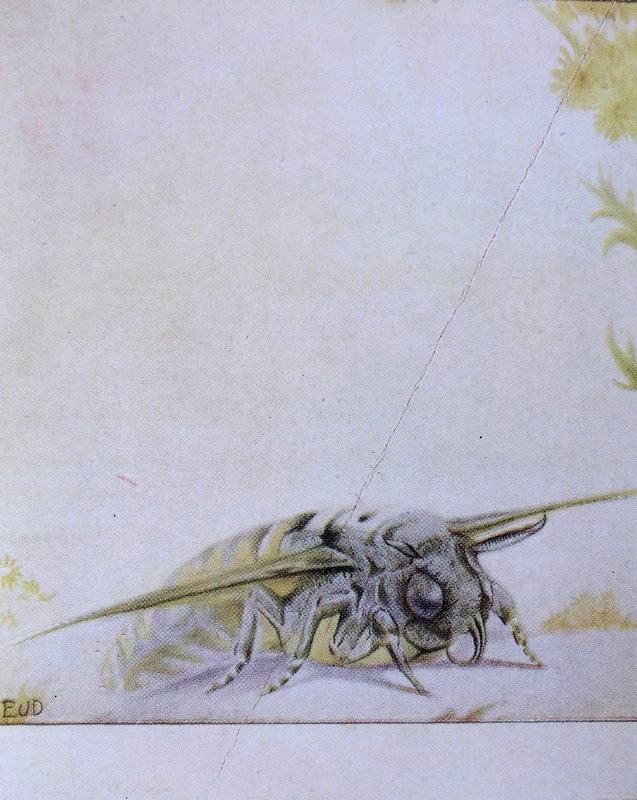
The prosopis is nimble and not unattractive, the French variety being elegantly marked with white over a black background. She leads a miserable life of starvation and solitude. Her body is almost bare; she has not the warm and sumptuous fleece of her happier sisters. She has no baskets in which to gather the pollen, no brushes, no towering plumes. With her tiny claws she must scratch away the powder from the cups of the flowers; and she must swallow this powder in order to bring it home. She has no tools to work with, nothing but her tongue, her mouth and her claws; and her tongue is short, her claws are feeble and her jaws without strength. Unable to form any wax, to bore holes through wood or dig in the earth, she builds clumsy galleries in the soft pith of dry berries; she puts up a few shapeless cells, and stores these with a little food for the young whom she never will see. And then, having done all this as best she can, she goes off and dies in some hidden corner, as lonely now at the end as she has been through all her poor life.
As the bees progress from wildness to civilization, we note that their tongue gradually lengthens, thus enabling more nectar to be drawn from the flowers; hairs and tufts grow and develop, and brushes for collecting the pollen; mandibles and claws become firmer and stronger and the bees acquire the intellect that enables them to make improvements in their dwellings. To relate all the different changes would require a whole volume; I will merely dwell on one or two instances of their development.
We have seen the unhappy prosopis living her lonely little life in the midst of this vast and indifferent universe. Some of her more civilized sisters, who have tools of their own and are skilled in the use of them, still exist in absolute solitude. If by chance some creature attach itself to them and share their dwelling, it will be an enemy or, more often, what is known as a parasite. For the world of bees contains many strange phantoms; and there are some species which will have a kind of indolent double, a creature exactly similar to the victim it has chosen to live with, save only that its uninterrupted idleness has caused it to lose one by one its implements of labor. It never works, or tries to work, it collects no food itself, but lives on that which is painfully got together by the unfortunate bee on whom it has fastened.
Little by little, by slow degrees and slow stages, the bees advance in civilization and intellect till we find them dwelling together in the regular life of a city. They have abandoned their solitude, their isolation; their existence, formerly so narrow and incomplete, has now become more assured, more concerned with the existence of those round about them. Instead of thinking only of their own offspring, they have learned that they must devote themselves to the race, that they must live and work together in order to make the future sure and safe.
There are certain building-bees which dig holes in the earth, and unite in large colonies to construct their nests. Between the individual members of the crowd, however, there is no communication and no understanding; they join together in a common task, but each one thinks only of her own particular interest. A little higher up in the scale we come to a race of bees, known as the Panurgi, who seem to have recognized the advantage of living and working as one community. They build in the same haphazard fashion as the others, each one digging its own underground chambers, but the entrance is common to all, as is also the gallery which winds from the surface to the different cells below. Here we find the idea of fellowship beginning to penetrate into the life of the bee, and it progresses with their civilization. As this increases, their manners and methods soften; what was formerly a mere instinct, due to the fear of cold and hunger, has become an active intelligence, working in the interests of life.
The bumble-bees, the great, hairy creatures that are so familiar to us all, so inoffensive although they appear so fierce, begin their life in solitude. In the first days of March the mother-bee, who has survived the winter, will start to construct her nest, either underground or in a bush, according to the species to which she belongs. She is alone in the world, and around her is only the miracle of awakening spring. She chooses a spot that seems favorable; she clears the rubbish away, digs down and builds her cells. Into these, which will have no special shape of their own, she will store the honey and pollen that she collects, and here she will lay and hatch her eggs; soon a troop of daughters will surround her, and these will all help in the work within the nest and without. More cells will be added, and the construction of these will be better; the colony grows, and there are signs of some prosperity. The old mother finds herself now at the head of a little kingdom which might serve as the model on which that of our honey-bee was formed. But the model is still in the rough. The good-fortune of the humble-bee never lasts. If they have laws, they do not obey them; the elder bees will at times devour the larvæ, the buildings still are far from perfect and much material has been wasted in putting them up; but the most remarkable and essential difference between the two is that the honey-bees' city will endure forever while the poor shelter that the humble-bees have raised will disappear when the winter comes, its two or three hundred inhabitants all perishing, with the exception of one single female. The others have vanished, and left no trace behind; she, when next spring comes, will begin again, in the same solitude and poverty as her mother before her, and with the same useless result.
Yet another stage up, and we find a more civilized class of bee, whose organization is as complete as in our own hives. The males of this race, which are known as the "Meliponitæ," are not wholly idle, and they help in the secretion of wax. The entrance to the hive is carefully guarded; it has a door that can be closed when nights are cold, and a sort of curtain that will let air in when the heat is oppressive. But still there is not the same good government, the same security and general prosperity, as among the honey-bees. Labor is not so well distributed; much less skill is shown in the designing of the city, and the spirit of the hive is not so fully developed.
It is only about a hundred and ninety years ago that people first began to study the habits of wild bees; at that time few were known, and although since then many others have been observed, there may be hundreds, possibly thousands, of whom we know very little. It was in the year 1730 that the first book on the subject was published; and the humble-bees, all powdered with gold, that were feasting then on the flowers, were precisely the same, as regards their habits and ways, as those that to-morrow will be noisily buzzing in the woods round about you. A hundred and ninety years, however, are but as the twinkling of an eye; and many lives of men, placed end to end, form but a second in the history of Nature.
Although the highest type of bee-life is found in our domestic hives, it must not be imagined that these reveal no faults. They contain one masterpiece, the six-sided cell, which displays absolute perfection; a perfection that all the geniuses in the world, were they to meet in council, could in no way improve. No living creature, not even man, has achieved in his sphere what the bee has achieved in her own; and if some one from another world were to descend on this globe and to ask what was the most perfect thing that unaided reason had produced here below, we should have to offer the humble comb of honey.
But such perfection as the honey-comb reveals is not shown in all the works of the bee. We have already drawn attention to some shortcomings, such as the vast number of males and their persistent idleness, the excessive swarming, the entire absence of pity, and the almost monstrous sacrifice that each individual is called upon to make to the community. To these must be added a curious inclination to store enormous masses of pollen, often far in excess of what is required; with the result that the pollen soon turns rancid and goes solid, blocking up the surface of the comb.
Of these defects the most serious is the repeated swarming. But here we must bear in mind that for thousands of years the bee has been interfered with by man. From the Egyptian of the time of Pharaoh down to the peasant of our own day the bee-keeper has always disregarded the desires and the intentions of the bees. The most prosperous hives are those which send out only one swarm after the beginning of summer. They have done their duty; they have safeguarded the future of the swarm, which is composed of so large a number of bees that they will have ample time to erect solid and well-provisioned dwellings before the arrival of autumn. If man had not come in the way, it is clear that these first swarms and their colonies would have been the only ones to survive the hardships of winter, which would have destroyed the others, owing to their weakness and poverty; and the bees would gradually have learned the folly of swarming so frequently, and would have acted accordingly. But it is precisely these prudent, careful hives that man has always destroyed in order to possess himself of the honey which they contained. He allowed only the feeblest colonies to survive; the second or third swarms, which had barely sufficient food to endure through the winter. The result will probably have been that the habit of excessive swarming fastened itself on the bees, in whom, particularly in the black varieties, it is much too general. For some years, however, modern and scientific bee-keeping has done much to correct this dangerous habit; and it is possible, perhaps, that in time the bees themselves will learn to abandon it.
As for the other faults which we have noticed, they are probably due to causes unknown to us, that still remain the secrets of the hive. As for the bees' intelligence, their power of reasoning, let every one judge for himself. To me, many actions of theirs appear to prove that they do possess this power; but, were it otherwise, if it could be conclusively established that all that they do is directed by some blind instinct, my interest in them would not be one whit the less. We are taught by them at least that there are many things in nature that we cannot understand and cannot explain, and this induces us to look with more eagerness on the things around us, and is not without its effect on our thoughts and our feelings, and on all that we try to say.
And, further, I am not at all sure that our own intellect is the proper tribunal to judge the bees and pass a verdict upon their mistakes. Do we not ourselves live in the midst of errors and blunders without being aware of them; and even when aware of them, are we so quick at finding a remedy? The bees might have much to say if they passed us in review, and criticized our world as we do theirs; they would find a good deal to puzzle them in our own reason and moral sense, and would be compelled to admit that we seemed to be governed by principles quite beyond their understanding.
I have referred to the way in which man interferes with the bees; and truly they do here provide a most admirable lesson. No matter to what extent their own plans have been thwarted, they will none the less do what they know to be their profound and primitive duty. And as to what this duty may be they are never in doubt. It is written in their tongue, in their mouth, over every organ of their body, that they are in this world to make honey; as it is written in our eyes, our ears, our nerves, in every lobe of our brain, that we have been created to think, to reason, to understand, to improve our sense of justice, our knowledge, to cultivate our soul. The bees know not who will eat the honey they harvest, as we know not who shall profit by the spiritual treasure we gather. As they go from flower to flower absorbing nectar beyond what they or their hive will need, so let us go from thought to thought, forever seeking the truth. And let the knowledge that this is our duty quicken the zeal, the ardor and purity with which our soul turns to the light.
THE END