Volume 3 — ULYSSES IN ITHACA
Reading edition
Ulysses Lands on the Shore of Ithaca
By F.S. Marvin, R.J.C. Mayor, and F.M. Stowell
Return to Table of Contents
[For ten years Ulysses was driven hither and thither over the water, seeking for his homeland, Ithaca. At length he was shipwrecked on the shores of Phœacia. The king, Alcinous, entertained him most hospitably, and Ulysses related to him the story of his wanderings.]
When Ulysses had finished his story, there was silence in the hall till Alcinous said, “Ulysses, now that you have come to my house after all these troubles, you shall return without more wandering to your home.” And then he bade the princes go home for the night and meet again in the morning to bring their gifts.
So next day the Sea-kings went down to the ship and put their gifts on board and then returned to the palace and sacrificed an ox to Zeus. And then they feasted and drank their good wine and waited till the sun went down. And the minstrel sang to them, but Ulysses kept looking at the sun impatiently, like a hungry ploughman tired out at the close of day. At last the time arrived, and then Ulysses said, “Alcinous, let me go now, and fare you well. My escort and my gifts are all prepared, and I could wish no more. May I but find my wife and my dear ones all safe and sound at home! And may Heaven grant you, too, happy homes and every blessing and no distress among your people!” And to Queen Arete he said, “Lady, may you live happily with your husband and children, and all this people, till old age comes to you and death, which must come to all!”
Then the herald led the way and Ulysses followed to the ship, and the queen sent her servants with him to carry warm clothing for the voyage and food and drink. And when they had stored the ship he lay down silently in the stern, and the rowers took their places in the benches and plied their oars, while a deep, sweet sleep fell upon him, like the sleep of death. Then the wonderful ship leapt forward on her way, like a team of chariot horses plunging beneath the whip, and the great dark wave roared round the stern. No hawk could fly so quickly as that ship flew through the waves, and the hawk is the swiftest of all birds. And as she sped, the man who had suffered so much and was as wise as the Gods lay peacefully asleep, and forgot his sufferings.
But when the bright star rose that tells of the approach of day, the ship drew near the island of Ithaca. There is a haven there between two steep headlands which break the waves, so that ships can ride in safety without a mooring rope, and at the head of it an olive-tree, and a shadowy cave where the water fairies come and tend their bees and weave their sea-blue garments on the hanging looms and mix their wine in bowls and jars of stone. There are springs of water in the cave, and two ways into it, one to the north for men to enter, and one to the south where none but the Gods may pass.
The Sea-kings knew this harbor and rowed straight into it and ran their ship half a keel’s length ashore. Then they lifted Ulysses out of the stern, wrapt in the rugs and coverlet, and laid him still asleep upon the sand. And the gifts they placed in a heap by the trunk of the olive-tree, a little out of the road, so that no passer-by might rob him as he slept.
Then they sailed away; and after they were gone Ulysses awoke, but he could not recognize the land where he lay, for Athene had cast a mist about him so that everything looked strange, though he was the lord of it all. There were the mountain paths and the sheltering creeks, the high, steep rocks and the trees in bloom; but he could not see it aright, and started up and smote his hands upon his thighs and cried aloud,—
“What land have I come to now? And what can I do with all this treasure? If the Sea-kings did not really mean to send me back to Ithaca they should have conveyed me to some other people who would have sent me home.” And then he counted the gifts over, the golden vessels, and the beautiful garments, and found nothing missing, but they gave him no pleasure; and he turned sadly to walk along the shore and dream of home, when a young herdsman met him, of noble figure, with a javelin in his hand and a fine mantle in double folds upon his shoulders. Ulysses was glad to greet him, and asked what country he had reached. It was Athene in disguise, and she answered, “Truly, stranger, you must have come from far indeed. For this is a famous island that all men know, whether they live in the east or in the west. It is a rugged land, and no place for horses and chariots, but though it is narrow, it is not so poor; for there are stores of corn and wine, plenty of water for the cattle and plenty of wood. Its name is Ithaca, and some men have heard of it even at Troy, which they say is a long way off.”
Then brave Ulysses rejoiced in his heart to hear that it was his native land; but he would not tell the herdsman who he was, and made up a cunning story that he had escaped as an outlaw from Crete and had been left upon the island by a Phœnician crew. And the goddess smiled to hear him, and stood forth in her own true form, a wise and noble woman, tall and fair, and put her hand upon his shoulder, and said,—
“Come, let us practice no more craft on one another, Ulysses, for we are both famous for our wit and wiles, you among mortals and I among the Gods. I am Pallas Athene, daughter of Zeus, and I have stood beside you and protected you in all your wanderings and toil. And now I have come here to tell you of the troubles that await you in your house, and to help you with my counsel. But you must still endure in silence, and tell no one that Ulysses has returned.”
And Ulysses made answer, “It is hard, goddess, for a mortal to know you, wise though he may be, for you come in many shapes. Truly I have known your kindness from of old in Troy, but when we went on board the ships, I never saw you at my side again. Tell me, I pray you, if this is Ithaca indeed, my native land.”
Then the goddess answered, “I see, Ulysses, that you keep your ready wit and steadfast mind. I could not show myself your friend before for fear of angering Neptune, my own father’s brother. But come now, and I will show you Ithaca; there is the haven and the olive with its slender leaves, and the cave where you once made many an offering to the water nymphs.”
And then she rolled away the mist, and the long-suffering hero rejoiced to see his native land again. He kissed the kindly earth, and vowed to the nymphs that he would bring them offerings as of old if he lived to see his dear son a man.
Then the goddess bade him be of good cheer, and showed him a hiding-place in the cavern for the gifts. And then they sat down by the trunk of the olive-tree, and Athene told him all the misdeeds of the suitors, and how his wife had beguiled them and kept them waiting till his return, and how he must avenge himself and her.
Then Ulysses said, “Truly, I should have perished in my own halls, like Agamemnon, if you had not warned me. Help me, therefore, with your wisdom, and stand beside me again and put strength and courage within me as in the days of Troy. For with you by my side I could fight against three hundred men.”
And Pallas Athene made answer, “I will be with you, Ulysses, when the hour of the conflict is come, and the blood of the suitors who eat up your substance shall be shed at last. But now I will change you into a poor beggar, so old and so wretched that no one will know you, and in that guise you must go and stay with the herdsman Eumæus, who tends your swine, until I have brought your son Telemachus from Sparta, where he has gone to seek tidings of you.”
Then she touched him with her magic wand, and the fair flesh withered on his limbs, and the golden locks fell from his head, and he was changed into an old man. His skin was shriveled and his bright eyes dimmed, and for his covering she gave him a tattered wrap, begrimed with smoke, and a worn deerskin on his shoulder, and a wallet and a staff in his hand.
Then she vanished, and left him to take his way alone across the hills.
Ulysses at the House of the Swineherd
By F.S. Marvin, R.J.C. Mayor, and F.M. Stowell
Return to Table of Contents
Ulysses went up along the rough mountain path, through the forest and over the hills, till he came to the house where his faithful steward lived. It stood in an open space, and there was a large courtyard in front with a wall of heavy stones and hawthorn boughs and a stout oak palisade. Inside the yard there were twelve sties for the pigs, and the swineherd kept four watch-dogs to guard the place, great beasts and fierce as wolves, that he had reared himself. Ulysses found him at home, sitting in the porch alone, and cutting himself a pair of sandals from a brown oxhide.
The dogs caught sight of the king as soon as he came up and flew at him, barking, but he had the wit to let go his staff and sit down at once on the ground. Still it might have gone hard with him there in front of his own servant’s house had not Eumæus rushed out of the porch, dropping the leather in his haste, and scolded the dogs, driving them off with a volley of stones.
Then he said to Ulysses, “A little more, old man, and the dogs would have torn you in pieces, and disgraced me forever. And I have my full share of trouble as it is, for I have lost the best master in all the world and must sit here to mourn for him and fatten his swine for other men, while he is wandering somewhere in foreign lands, hungry and thirsty perhaps, if he is still alive at all. But now come in yourself, and let me give you food and drink and tell me your own tale.”
So he took Ulysses into the house and made a seat for him with a pile of brushwood boughs and a great thick shaggy goat-skin which he used for his own bed, and all with so kind a welcome that it warmed the king’s heart and made him pray the Gods to bless him for his goodness. But Eumæus only said, “How could I neglect a stranger, though he were a worse man than you? All strangers and beggars are sent to us by Zeus. Take my gift and welcome, though it is little enough I have to give, a servant such as I, with new masters to lord it over him. For we have lost the king who would have loved me and given me house and lands and all that a faithful servant ought to have, whose work is blest by the Gods and prospers, as mine does here. Alas! he is dead and gone! he went away with Agamemnon to fight at Troy and never came home again.”
So saying, the good swineherd rose and fetched what meat and wine he had, and set it before Ulysses, grieving that he had nothing better for him because the shameless suitors plundered everything.
But Ulysses ate and drank eagerly, and when his strength had come again he asked Eumæus, “My friend, who is this master of yours you tell me of? Did you not say he was lost for Agamemnon’s sake? Perhaps I may have seen him, for I have traveled far.”
But the swineherd answered, “Old man, his wife and son will believe no traveler’s tale. They have heard too many such. Every wandering beggar who comes to Ithaca goes to my mistress with some empty story to get a meal for himself, and she welcomes him and treats him kindly and asks him about it all, with the tears running down her cheeks in a woman’s way. Yes, even you, old man, might learn to weave such tales if you thought they would get you a cloak or a vest. No, he is dead, and dogs and birds have eaten him, or else he has fed the fishes and his bones lie somewhere on the seashore, buried in the sand. And he has left us all to grieve for him, but no one more than me, who can never have so kind a master again, not though I had my heart’s desire and went back to my native land and saw my father and mother, and the dear home where I was born. It is Ulysses above all whom I long to see once more. There, stranger, I have called him by his name, and that I should not do; for he is still my dear master though he is far away.”
Then Ulysses said, “My friend, your hope has gone and you will never believe me. But I tell you this and seal it with an oath: Ulysses will return! Poor as I am, I will take no reward for my news till he comes to his own again, but you shall give me a new vest and cloak that day, and I will wear them.”
But the swineherd answered, “Ah, my friend, I shall never need to pay you that reward. He will never come back again. But now drink your wine in peace, and let us talk of something else, and do not call to mind the sorrow that almost breaks my heart. Tell me of yourself and your own troubles and who you are, and what ship brought you here, for you will not say you came afoot.”
Then Ulysses pretended he was a Cretan and had fought at Troy, and told Eumæus a long tale of adventures and how he had been wrecked at last on the coast of Epirus. The king of the country, he said, had rescued him, and he had learned that Ulysses had been there a little while before, and was already on his way to Ithaca.
The swineherd listened eagerly to it all, but when Ulysses had finished he said, “Poor friend, my heart aches to hear of all your sufferings. But there is one thing you should not have said, one thing I can never believe, and that is that Ulysses will return. And why need you lie to please me? I can see for myself that you are old and unhappy, a wanderer whom the Gods have sent to me. It is not for such a tale I will show you the kindness that you need, but because I pity you myself and reverence the law of Zeus.”
“If I lie,” Ulysses answered, “you may have me thrown from the cliff as a warning to other cheats. I swear it, and call the Gods to witness.”
But the true-hearted swineherd only said, “I should get a good name by that, my friend, if I took you into nay house and had you for my guest, and then murdered you brutally! Do you think I could pray to Zeus after that without a fear? But now it is supper-time, and my men will be coming home.” While they spoke, the herdsmen came up with the swine, and the sows were driven into the pens, grunting and squealing noisily as they settled in for the night. Then Eumæus called out, “Bring in the fattest boar, and let us make a sacrifice in honor of our guest, and get some reward ourselves for all the trouble we have spent upon the drove,—trouble lost, since strangers take the fruit of it all.”
So they brought in a big fat white-tusked boar, while Eumæus split the wood for the fire. And he did not forget the Immortals, for he had a pious heart: he made the due offerings first and prayed for his master’s return, and then he stood up at the board to carve, and gave each man his share and a special slice for his guest from the whole length of the chine. Ulysses took it and thanked him with all his heart:—
“May Father Zeus be your friend, Eumæus, and give you what I would give you for your kindness to a poor old man like me.”
But the swineherd said, “Take it, my good friend, take it and enjoy it. Zeus will give or withhold as it may please him, for he can do all things.”
So they sat down to the feast, and after they had had their fill the swineherd’s servant cleared everything away, and then they made ready for sleep. The evening closed in black and stormy, and a west wind sprang up bringing the rain with it, and blew hard all the night; so Eumæus made up a bed of fleeces for Ulysses by the fire and gave him a great thick cloak as well, that he kept for the roughest weather. But he could not bring himself to stay there too, away from his herd of pigs, and he wrapped himself up warmly and went out to sleep beside them in the open. Ulysses saw, and smiled to see, what care he took of everything, while he thought his master was far away.
[On the following morning] Ulysses and the swineherd were already preparing their breakfast when Telemachus came up. The dogs knew him and played round him lovingly. “Eumæus,” said Ulysses, “some friend of yours is coming, for I hear footsteps, and the dogs are pleased and do not bark.”
He had hardly finished speaking when his own dear son stood in the doorway. The swineherd started up and dropped the vessels in which he was mixing the wine. He went to meet his young master and fell on his neck and kissed him as a father would kiss an only son escaped from death. “Light of my eyes, dear son, have you come home at last? When you sailed away to Pylos, I never thought to see you again. But come in and let me feast my eyes upon you; for you do not often visit us, but are kept at home in the town, watching that crowd of ruinous suitors.”
And Telemachus answered, “Gladly, good father; I have come to see you, and to hear tidings of my mother.”
Then the swineherd told him that his mother still waited patiently at home, and spent her days and nights in weeping.
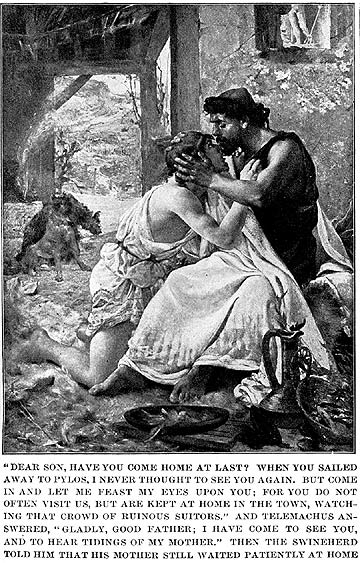
“DEAR SON, HAVE YOU COME HOME AT LAST? WHEN YOU SAILED AWAY TO PYLOS, I NEVER THOUGHT TO SEE YOU AGAIN. BUT COME IN AND LET ME FEAST MY EYES UPON YOU; FOR YOU DO NOT OFTEN VISIT US, BUT ARE KEPT AT HOME IN THE TOWN, WATCHING THAT CROWD OF RUINOUS SUITORS.” AND TELEMACHUS ANSWERED, “GLADLY, GOOD FATHER; I HAVE COME TO SEE YOU, AND TO HEAR TIDINGS OF MY MOTHER.” THEN THE SWINEHERD TOLD HIM THAT HIS MOTHER STILL WAITED PATIENTLY AT HOME.
Then Telemachus went into the house, and as he came up Ulysses rose to give him his seat, but he would not take it, and said, “Keep your seat, stranger, this man shall make up another for me.” So Ulysses sat down again, and the swineherd made a seat for Telemachus of the green brushwood and put a fleece upon it. Then he set food before them, and when they had eaten, Telemachus asked who the stranger was, and how he had come to Ithaca. And Eumæus told him Ulysses’s own story and begged him to protect the wanderer. But Telemachus thought of the suitors and did not wish to take him to the palace.
“I will give him a coat and a vest,” he said, “and shoes for his feet, and a two-edged sword, and I will send him on his way. But I cannot take him into the house, where the suitors would mock at him and use him ill. One man cannot restrain them, and he so young as I.”
Then Ulysses said, “Sir, if I may speak, I would say foul wrong is done you in your house, and my heart burns at the thought. Do your people hate you, or will your brothers give you no support? Would that I were as young as you are, and were Ulysses’s son or Ulysses himself. I would go to the palace and fall upon all the throng, and die there, one man against a hundred, sooner than see the shameful deeds that are done in that glorious house.”
And Telemachus answered, “Hear me, stranger, and I will tell you all. My people do not hate me, and I have no quarrel with them. But I have no brothers to stand by me, for Zeus has never given more than one son to each generation of our line. And there are many foemen in the house, all the princes of the islands, and they too woo my mother and threaten my life, and I cannot see how it will end.”
Then he said to Eumæus, “Go up to the house, old father, as quickly as you can, and tell my mother that I am come back safe from Pylos, and I will wait for you here.”
And Eumæus answered, “I hear, master, and understand. But shall I not go to Laertes on my way and tell him too? For since you set sail for Pylos, they say he has not eaten or drunk or gone about his work, but sits in his house sorrowing and wasting away with grief.”
But Telemachus bade him go straight to the palace and return at once, and let the queen send word to Laertes by one of the maids. So Eumæus went forth, and when Athene saw him go, she drew near, and came and stood by the gateway and showed herself to Ulysses, a tall and beautiful woman, with wisdom in her look. The dogs saw her too and were afraid, and shrank away whining into the corner of the yard, but Telemachus could not see her. Then the goddess nodded to Ulysses, and he went out and stood before her, and she said, “Noble Ulysses, now is the time to reveal yourself to your son, and go forth with him to the town, with death and doom for the suitors. I shall be near you in the battle and eager to fight.”
Then she touched him with her golden wand and gave him his beauty and stature once more, and his old bronzed color came back and his beard grew thick and his garments shone bright again: and so she sent him to the hut. And when Telemachus saw him, he marveled and turned away his eyes, for he thought it must be a god.
“Stranger,” he said, “you are changed since a moment ago; your color is not the same, nor your garments. If you are one of the Immortals, be gracious to us, and let us offer you gifts and sacrifice.”
Then Ulysses cried out, “I am no god, but your own dear father, for whose sake you are suffering cruel wrongs and the spite of men.” And then he kissed his son and let his tears take their way at last.
But Telemachus could not believe it, and said, “You cannot be my father, but a god come down to deceive me and make me grieve still more. No mortal could do what you have done, for a moment since you were old and wretched, and poorly clad, and now you seem like one of the heavenly Gods.”
Then his father answered, “My son, no other Ulysses will ever come back to you. Athene has done this wonder, for she is a goddess and can make men what she will, now poor, now rich, now old, now young; such power have the lords of heaven to exalt us or bring us low.”
Then Telemachus fell on his neck, and they wept aloud together. And they would have wept out their hearts till evening, had not Telemachus asked his father how he had come to Ithaca at last; and Ulysses told him that the sea-kings had brought him and put him on shore asleep, and that Athene had sent him to the swineherd’s hut. “But now tell me of the suitors. How many are they and what manner of men? Can the two of us make head against the throng?”
“Father,” he answered, “I know well your fame, mighty and wise in war. But this we could never dare, two men against a host. They are a hundred and twenty in all, the best fighting men from Ithaca and the islands round. Think, if you can, of some champion who would befriend us and give us help.”
And Ulysses made answer, “What think you, if Father Zeus and the goddess Athene stood by our side? Should we still need other help?”
“Truly they are the best of champions,” said Telemachus, “though they sit on high among the clouds; and they rule both men and Gods.” “And they will be with us,” said his father, “when we come to the trial of war. Now at daybreak you must go home and mix with the suitors, and later on the swineherd will bring me to the town, disguised again as the old beggar-man; and if they ill-treat me or even strike me or drag me out of the house, you must look on and bear it. You may check them by speaking, but they will not listen, for the day of their doom is at hand. And tell no one that Ulysses has come home, not even Laertes nor the swineherd nor Penelope herself; we must keep the secret until we are sure of our friends.”
Then Telemachus said that his father might trust him, and so they talked on together. Meanwhile Eumæus had reached the palace with the tidings that Telemachus had returned; and the suitors who were in the hall heard it and were dismayed, for they saw that their plot had failed. They went out of the palace and sat down before the gates, and were talking of sending word to their ship that was lying in wait for Telemachus, when the ship itself came into the harbor, with the other princes on board. So they all went up together to the public square and debated what to do, and they resolved to murder Telemachus as soon as they found another chance. Then they went back and sat down again on the polished seats in the hall.
Now Medon the herald had heard them plotting together in the square, and went and told Penelope all they had said, and how they had purposed putting her son to death. She went down at once to the hall with her women, and stood in the doorway with her bright veil before her face and spoke to Antinous and said, “Wicked and insolent man, can it be that they call you in Ithaca one of their wisest men? No, it is a fool’s work you are doing, plotting to kill my son. He is helpless before you now, but Zeus is the friend of the helpless and avenges their wrongs. Impious and ungrateful too! Did not Ulysses once shield your father from his enemies and save his life? Yet you waste his substance and would murder his son?”
Then Eurymachus spoke and tried to soothe her. No one, he said, should injure Telemachus while he was alive, for he loved him more than any man on earth. Eurymachus’s words were fair, and Penelope could say no more; yet all the while he was planning the death of her son.
In the evening the swineherd reached his hut again, and found Ulysses changed to the old beggar-man once more, preparing supper with Telemachus.
“What news, good Eumæus?” said the young man. “Have the proud lords come home from their ambush, or are they still waiting out yonder to take me as I return?” And Eumæus replied, “I did not stay, master, to go through the town and find out the news, for when I had given my message I wanted to be at home. But one thing I saw from the brow of the hill as I came along. A swift ship was entering the harbor, full of armor and armed men. They may have been the princes, but I cannot say.”
As he heard this, Telemachus looked at his father and smiled, but he took good care that the swineherd should not see.
The Vengeance of Ulysses
A. His Reception at the Palace
By F.S. Marvin, R.J.C. Mayor, and F.M. Stowell
Return to Table of Contents
Early next morning, when the rosy-fingered dawn was in the sky, Telemachus bound on his sandals and took his stout spear in his hand, and said to the swineherd, “Old friend, I must now be off to the city and let my mother see me, for I know she will weep and sigh until I am there myself. And as for this poor stranger, I would have you take him to the town and let him beg for bite and sup from door to door, and those who choose can give. For I cannot be host to every wanderer with all the trouble I have to bear. And if that makes him angry—well! it is only the worse for him; I am a man that speaks his mind.”
Then Ulysses answered readily, “Sir, I do not ask to stay here myself; a beggar should not beg in the fields. Nor am I young enough to work on a farm at a master’s beck and call. So go your ways, and your man shall take me with him to the town. But I will wait till the sun is high, for I am afraid of the morning frost with these threadbare rags of mine.”
So Telemachus strode away until he reached the palace, and went into the hall. The old nurse Eurycleia was there with the maids, spreading fleeces on the inlaid stools and chairs; and she saw him at once and went up to him with tears in her eyes, and then all the women gathered round and kissed him and welcomed him home again. And Penelope came down from her chamber and flung her arms round her son, and kissed his head and both his eyes, and said to him tearfully, “You have come home, Telemachus, light of my eyes! I thought I should never see you again, when you sailed away to Pylos secretly, against my will, to get tidings of your father. And now tell me all you heard.”
But Telemachus said to her, “Mother, why make me think of trouble now, when I have just escaped from death? Rather put on your fairest robes, and go and pray the Gods to grant us a day of vengeance. But I must be off to the public square to meet a guest of mine whom I brought here in my ship. I sent him on before me with the crew, and bade one of them take him to his house until I came myself.”
So Penelope went away and prayed to the Gods, while the prince went down to the public square and found Theoclymenus and brought him back to the palace, and they sat down together in the hall. Then one of the old servants brought up a polished table and spread it for them with good things for their meal, and Penelope came and sat beside the door, spinning her fine soft yarn. She did not speak till they had finished, but then she said to her son, “Telemachus, I see I must go up to my room and lie down on my bed, the bed I have watered with my tears ever since Ulysses went away to Troy; for you are determined not to talk to me and tell me the news of your father before the suitors come into the hall!”
Then Telemachus said, “Mother, I will tell you all I know. We reached Pylos and found Nestor there, and he took me into his splendid house, and welcomed me as lovingly as though I had been a long-lost son of his own. But he could tell me nothing of my father, not even if he were alive or dead, and so he sent me on to Sparta, to the house of Menelaus. There I saw Helen, the fairest of women, for whom the Greeks and Trojans fought and suffered so long. Menelaus asked me why I came and I told him about the suitors and all the wrong they did. Then he cried, ‘Curse on them! The dastards in the hero’s place! Oh, that Ulysses would return! They would soon have cause enough to hate this suit of theirs!’ And then he told me how he had heard tidings of my father from Proteus, the wizard of the sea. He was living still, so the wizard said, on an island far away, in the cave of a wood nymph called Calypso, who kept him there against his will, and he had no ship to carry him over the broad sea. That was all Menelaus could tell me; and when I had done my errand I came away, and the Gods have brought me home in safety.”
And as Penelope listened her heart filled with sorrow; but Theoclymenus, the seer, said to her, “Listen to me, wife of Ulysses, and I will prophesy to you; for your son has heard nothing certain, but I have seen omens that are sure. I swear by Zeus, the ruler of the Gods, and by the board and the hearth of Ulysses himself where I am standing now, he is already here in Ithaca, he knows of all this wickedness, and is waiting to punish the suitors as they deserve.”
At that moment the princes came in from their sport and flung their cloaks aside, and set about slaughtering the sheep and the fatted goats and the swine for their feast.
Meanwhile Ulysses was starting for the town, with the swineherd to show him the way. He had slung the tattered wallet across his shoulder, and Eumæus had given him a staff, and every one who met them would have taken the king for a poor old beggar-man, hobbling along with his crutch.
So they went down the rocky path till they reached a running spring by the wayside where the townsfolk got their water. There was a grove of tall poplars round it, and the cool stream bubbled down from the rock overhead, and above the fountain there was an altar to the nymphs where the passers-by laid their offerings.
There they chanced to meet Melanthius, the king’s goatherd, driving his fattest goats to the town for the suitors’ feast. He was a favorite of theirs, and did all he could to please them. Now as soon as he saw the two he broke out into scoffs and gibes, till the heart of Ulysses grew hot with anger.
“Look there!” he shouted, “one rascal leading another! Trust a man to find his mate! A plague on you, swineherd, where are you taking that pitiful wretch? Another beggar, I suppose, to hang about the doors and cringe for the scraps and spoil our feasts? Now if you would only let me have him to watch my farm and sweep out my stalls and fetch fodder for my kids, he could drink as much whey as he liked and get some flesh on his bones. But no! His tricks have spoilt him for any honest work!”
So he jeered at them in his folly, and as he passed he kicked Ulysses on the thigh, but the king stood firm, and took the blow in silence, though he could have found it in his heart to strike the man dead on the spot. But Eumæus turned round fiercely, and cried to the Gods for vengeance.
“Nymphs of the spring,” he prayed, “if ever my master honored you, hear my prayer, and send him home again! He would make a sweep of all your insolence, you good-for-nothing wretch, loitering here in the city while your flocks are left to ruin!”
“Oho!” cried Melanthius. “Listen to the foul-mouthed dog! I must put him on board a ship and sell him in a foreign land, and make some use of him that way! Why, Ulysses will never see the day of his return! He is dead and gone; I wish his son would follow him!”
With that he turned on his heel and hastened away to the palace hall, where he sat down with the suitors at their feast. And the other two followed slowly until they reached the gate. There they paused, and Ulysses caught the swineherd by the hand, and cried,—
“Eumæus, this must be the palace of the king! No one could mistake it. See, there is room after room, and a spacious courtyard with a wall and coping-stones and solid double doors to make it safe. And I am sure that a great company is seated there at the banquet, for I can smell the roasted meat and hear the sound of the lyre.”
Then Eumæus said, “Your wits are quick enough; it is the very place. And now tell me: would you rather go in alone and face the princes while I wait here, or will you stay behind and let me go in first? But if you wait here, you must not wait too long, for some one might catch sight of you and strike you and drive you from the gate.”
Then the hero said to him, “I understand; I knew what I had to meet. Do you go first and I will wait behind. For I have some knowledge of thrusts and blows, and my heart has learned to endure; for I have suffered much in storm and battle, and I can bear this like the rest.”
But while they were talking, a dog who was lying there lifted his head and pricked his ears. It was the hound Argus, whom Ulysses had reared himself long ago before the war, but had to leave behind when he went away to Troy. Once he used to follow the hunters to the chase, but no one cared for him now when his master was away, and he lay there covered with vermin, on a dung-heap in front of the gates. Yet even so, when he felt that Ulysses was near him, he wagged his tail and dropped his ears; but he had not strength enough to drag himself up to his master. And when Ulysses saw it, he turned away his face so that Eumæus should not see the tears in his eyes, and said, “Eumæus, it is strange that they let that dog lie there in the dung. He looks a noble creature, but perhaps he has never been swift enough for the chase, and they have only kept him for his beauty.”
“Ah, yes!” Eumæus answered, “it is easy to see that he has no master now. If you had been here when Ulysses went to Troy, you would have wondered at the creature’s pace and strength. In the thickest depth of the forest no quarry could escape him, and no hound was ever keener-scented. But now he is old and wretched and his lord has perished far away, and the heedless women take no care of him. Slaves can do nothing as they ought when the master is not there, for a man loses half his manhood when he falls into slavery.”
Then Eumæus went on into the palace and up to the hall where the suitors were. But Argus had seen his master again at last, and when he had seen him, he died.
As soon as the swineherd came in, Telemachus caught sight of him, and beckoned him to a stool at his side, and gave him his share of the feast. After a little while Ulysses came up too, and sat down on the threshold like a poor old beggar-man. Then his son sent him meat and bread by the swineherd, and said that a beggar should be bold, and he ought to go among the princes and ask each man for a dole. So he went round from one to the other, stretching out his hand for a morsel in the true beggar’s way. And every one else felt some pity and gave him an alms, but Antinous mocked at them all and told them they were ready enough to be generous with another’s wealth. And at last he grew angry and cursed Ulysses for a whining rascal, and hurled a footstool at his head, bidding him begone and trouble them no more. The stool struck Ulysses on the shoulder, but he stood like a rock, motionless and silent, with black thoughts in his heart. Then he went back straight to the threshold and sat down and spoke to all the company:—
“Listen to me, my lords! No man bears any rancor for a blow in open war, but Antinous has struck me because I am a beggar and know the curse of hunger. If there be any gods who avenge the poor man’s cause, I pray that he may die before his marriage day!”
At that the others felt shame, and told Antinous he did wrong to strike the homeless wanderer.
“Who knows?” they said. “He might be one of the heavenly Gods, and woe to you if he were! For sometimes the Immortals take upon themselves the likeness of strangers, and enter our cities, and go about among men, watching the good and evil that they do.”
Thus they warned him, but he cared little for all they said. And Telemachus sat there full of rage and grief to see his father struck, but he kept back the tears and held his peace.
Now Penelope was sitting in her room behind the hall, and she saw what had happened, and was angry with Antinous, and called the swineherd to her side.
“Go, good Eumæus, and tell the stranger to come here. And I will ask him if he has ever heard of Ulysses, for he looks like a man who has wandered far.”
And the swineherd said, “Yes, he is a Cretan, and has had all kinds of adventures before he was driven here, and he could tell you stories that would charm you like a minstrel’s sweetest song, and you would never tire of listening. And he says that he has heard of Ulysses, near home, in the rich land of Epirus, and that he is already on his way to us, bringing a store of treasures with him.”
Then Penelope said, “Quick, bring the stranger here at once, and let him speak with me face to face. And if I see that he tells the truth I will give him a vest and a cloak for himself.”
So the swineherd hurried back with the message; but Ulysses said he dared not face the princes a second time and it would be better to speak with Penelope later in the evening, alone by the fireside; and when the queen heard this, she said that the stranger was right. By this time it was afternoon, and Eumæus went up to Telemachus and whispered that he must be off to his work again. Telemachus said he might go, but bade him have supper first and told him to come back next morning without fail. So the swineherd took his food in the hall, and then started home for his farm, to look after his pigs and everything that he had charge of there.
B. The Trial of the Bow
Translated by George Herbert Palmer
Return to Table of Contents
And now the goddess, clear-eyed Athene, put in the mind of Icarius’s daughter, heedful Penelope, to offer to the suitors in the hall the bow and the gray steel, as means of sport and harbingers of death. She mounted the long stairway of her house, holding a crooked key in her firm hand,—a goodly key of bronze, having an ivory handle,—and hastened with her damsels to a far-off room where her lord’s treasure lay, bronze, gold, and well-wrought steel. Here also lay his curved bow and the quiver for his arrows,—and many grievous shafts were in it still,—gifts which a friend had given Ulysses when he met him once in Lacedæmon,—Iphitus, son of Eurytus, a man like the Immortals. At Messene the two met, in the house of wise Orsilochus. Ulysses had come hither to claim a debt, which the whole district owed him; for upon ships of many oars Messenians carried off from Ithaca three hundred sheep together with their herdsmen. In the long quest for these, Ulysses took the journey when he was but a youth; for his father and the other elders sent him forth. Iphitus, on the other hand, was seeking horses; for twelve mares had been lost, which had as foals twelve hardy mules. These afterwards became the death and doom of Iphitus when he met the stalwart son of Zeus, the hero Hercules, who well knew deeds of daring; for Hercules slew Iphitus in his own house, although his guest, and recklessly did not regard the anger of the Gods nor yet the proffered table, but slew the man and kept at his own hall the strong-hoofed mares. It was when seeking these that Iphitus had met Ulysses and given the bow which in old days great Eurytus was wont to bear, and which on dying in his lofty hall he left his son. To Iphitus Ulysses gave a sharp-edged sword and a stout spear, as the beginning of a loving friendship. They never sat, however, at one another’s table; ere that could be, the son of Zeus slew godlike Iphitus, the son of Eurytus, who gave the bow. Royal Ulysses, when going off to war in the black ships, would never take this bow. It always stood in its own place at home, as a memorial of his honored friend. In his own land he bore it.
Now when the royal lady reached this room and stood on the oaken threshold,—which long ago the carpenter had smoothed with skill and leveled to the line, fitting the posts thereto and setting the shining doors,—then quickly from its ring she loosed the strap, thrust in the key, and with a careful aim shot back the door-bolts. As a bull roars when feeding in the field, so roared the goodly door touched by the key, and open flew before her. She stepped to a raised dais where stood some chests in which lay fragrant garments. Thence reaching up, she took from its peg the bow in the glittering case which held it. And now she sat her down and laid the case upon her lap, and loudly weeping drew her lord’s bow forth. But when she had had her fill of tears and sighs, she hastened to the hall to meet the lordly suitors, bearing in hand the curved bow and the quiver for the arrows, and many grievous shafts were in it still. Beside her, damsels bore a box in which lay many a piece of steel and bronze, implements of her lord’s for games like these. And when the royal lady reached the suitors, she stood beside a column of the strong-built roof, holding before her face her delicate wimple, the while a faithful damsel stood on either hand. And straightway she addressed the suitors, speaking thus:—
“Hearken, you haughty suitors who beset this house, eating and drinking ever, now my husband is long gone; no word of excuse can you suggest except your wish to marry me and win me for your wife. Well then, my suitors,—since before you stands your prize,—I offer you the mighty bow of prince Ulysses; and whoever with his hands shall lightliest bend the bow and shoot through all twelve axes, him will I follow and forsake this home, this bridal home, so very beautiful and full of wealth, a place I think I ever shall remember, even in my dreams.”
So saying, she bade Eumæus, the noble swineherd, deliver to the suitors the bow and the gray steel. With tears Eumæus took the arms and laid them down before them. Near by, the neatherd also wept to see his master’s bow. But Antinous rebuked them, and spoke to them and said,—
“You stupid boors, who only mind the passing minute, wretched pair, what do you mean by shedding tears, troubling this lady’s heart, when already her heart is prostrated with grief at losing her dear husband? Sit down and eat in silence, or else go forth and weep, but leave the bow behind, a dread ordeal for the suitors; for I am sure this polished bow will not be bent with ease. There is not a man of all now here so powerful as Ulysses. I saw him once myself, and well recall him, though I was then a child.”
He spoke, but in his breast his heart was hoping to draw the string and send an arrow through the steel; yet he was to be the first to taste the shaft of good Ulysses, whom he now wronged though seated in his hall, while to like outrage he encouraged all his comrades. To these now spoke revered Telemachus:—
“Ha! Zeus the son of Cronos has made me play the fool! My mother—and wise she is—says she will follow some strange man and quit this house; and I but laugh and in my silly soul am glad. Come then, you suitors, since before you stands your prize, a lady whose like cannot be found throughout Achaian land, in sacred Pylos, Argos, or Mycenæ, in Ithaca itself, or the dark mainland, as you yourselves well know,—what needs my mother praise?—come then, delay not with excuse nor longer hesitate to bend the bow, but let us learn what is to be. I too might try the bow. And if I stretch it and send an arrow through the steel, then with no shame to me my honored mother may forsake this house and follow some one else, leaving me here behind; for I shall then be able to wield my father’s arms.”
He spoke, and flung his red cloak from his shoulders, rising full height, and put away the sharp sword also from his shoulder. First then he set the axes, marking one long furrow for them all, aligned by cord. The earth on the two sides he stamped down flat. Surprise filled all beholders to see how properly he set them, though he had never seen the game before. Then he went and stood upon the threshold and began to try the bow. Three times he made it tremble as he sought to make it bend. Three times he slacked his strain, still hoping in his heart to draw the string and send an arrow through the steel. And now he might have drawn it by force of a fourth tug, had not Ulysses shaken his head and stayed the eager boy. So to the suitors once more spoke revered Telemachus:—
“Fie! Shall I ever be a coward and a weakling, or am I still but young and cannot trust my arm to right me with the man who wrongs me first? But come, you who are stronger men than I, come try the bow and end the contest.”
So saying, he laid by the bow and stood it on the ground, leaning it on the firm-set polished door. The swift shaft, too, he likewise leaned against the bow’s fair knob, and once more took the seat from which he first arose. Then said to them Antinous, Eupeithes’ son,—
“Rise up in order all, from left to right, beginning where the cupbearer begins to pour the wine.”
So said Antinous, and his saying pleased them. Then first arose Leiodes, son of Œnops, who was their soothsayer and had his place beside the goodly mixer, farthest along the hall. To him alone their lawlessness was hateful; he abhorred the suitor crowd. He it was now who first took up the bow and the swift shaft; and going to the threshold, he stood and tried the bow. He could not bend it. Tugging the string wearied his hands,—his soft, unhorny hands,—and to the suitors thus he spoke:—
“No, friends, I cannot bend it. Let some other take the bow. Ah, many chiefs this bow shall rob of life and breath! Yet better far to die than live and still to fail in that for which we constantly are gathered, waiting expectantly from day to day! Now each man hopes and purposes at heart to win Penelope, Ulysses’ wife. But when he shall have tried the bow and seen his failure, then to some other fair-robed woman of Achaia let each go, and offer her his suit and woo her with his gifts. So may Penelope marry the man who gives her most and comes with fate to favor!”
When he had spoken, he laid by the bow, leaning it on the firm-set polished door. The swift shaft, too, he likewise leaned against the bow’s fair knob, and once more took the seat from which he first arose. But Antinous rebuked him, and spoke to him, and said,—
“Leiodes, what words have passed the barrier of your teeth? Strange words and harsh! Vexatious words to hear! As if this bow must rob our chiefs of life and breath because you cannot bend it! Why, your good mother did not bear you for a brandisher of bows and arrows. But others among the lordly suitors will bend it by and by.”
So saying, he gave an order to Melanthius, the goatherd: “Hasten, Melanthius, and light a fire in the hall and set a long bench near, with fleeces on it; then bring me the large cake of fat which lies inside the door, that after we have warmed the bow and greased it well, we young men may try the bow and end the contest.”
He spoke, and straightway Melanthius kindled a steady fire, and set a bench beside it with a fleece thereon, and brought out the large cake of fat which lay inside the door, and so the young men warmed the bow and made their trial. But yet they could not bend it; they fell far short of power. Antinous, however, still held back, and prince Eurymachus, who were the suitors’ leaders; for they in manly excellence were quite the best of all.
Meanwhile out of the house at the same moment came two men, princely Ulysses’ herdsmen of the oxen and the swine; and after them came royal Ulysses also from the house. And when they were outside the gate, beyond the yard, speaking in gentle words Ulysses said,—
“Neatherd, and you too, swineherd, may I tell a certain tale, or shall I hide it still? My heart bids me speak. How ready would you be to aid Ulysses if he should come from somewhere, thus, on a sudden, and a god should bring him home? Would you support the suitors or Ulysses? Speak freely, as your heart and spirit bid you speak.”
Then said to him the herdsman of the cattle, “O father Zeus, grant this my prayer! May he return and Heaven be his guide! Then shall you know what might is mine and how my hands obey.”
So prayed Eumæus too to all the Gods, that wise Ulysses might return to his own home. So when he knew with certainty the heart of each, finding his words once more Ulysses said,—
“Lo, it is I, through many grievous toils now in the twentieth year come to my native land! And yet I know that of my servants none but you desire my coming. From all the rest I have not heard one prayer that I return. To you then I will truly tell what shall hereafter be. If God by me subdues the lordly suitors, I will obtain you wives and give you wealth and homes established near my own; and henceforth in my eyes you shall be friends and brethren of Telemachus. Come, then, and I will show you too a very trusty sign,—that you may know me certainly and be assured in heart,—the scar the boar dealt long ago with his white tusk, when I once journeyed to Parnassus with Autolycus’s sons.”
So saying, he drew aside his rags from the great scar. And when the two beheld and understood it all, their tears burst forth; they threw their arms round wise Ulysses, and passionately kissed his face and neck. So likewise did Ulysses kiss their heads and hands. And daylight had gone down upon their weeping had not Ulysses stayed their tears and said,—
“Have done with grief and wailing, or somebody in coming from the hall may see, and tell the tale indoors. Nay, go in one by one, not all together. I will go first, you after. And let this be agreed: the rest within, the lordly suitors, will not allow me to receive the bow and quiver. But, noble Eumæus, bring the bow along the room and lay it in my hands. Then tell the women to lock the hall’s close-fitting doors; and if from their inner room they hear a moaning or a strife within our walls, let no one venture forth, but stay in silence at her work. And noble Philoetius, in your care I put the courtyard gates. Bolt with the bar and quickly lash the fastening.”
So saying, Ulysses made his way into the stately house, and went and took the seat from which he first arose. And soon the serving-men of princely Ulysses entered too.
Now Eurymachus held the bow and turned it up and down, trying to heat it at the glowing fire. But still, with all his pains, he could not bend it; his proud soul groaned aloud. Then bitterly he spoke; these were the words he said,—
“Ah! here is woe for me and woe for all! Not that I so much mourn missing the marriage, though vexed I am at that. Still, there are enough more women of Achaia, both here in sea-girt Ithaca and in the other cities. But if in strength we fall so short of princely Ulysses that we cannot bend his bow—oh, the disgrace for future times to know!”
Then said Antinous, Eupeithes’ son, “Not so, Eurymachus, and you yourself know better. To-day throughout the land is the archer-god’s high feast. Who then could bend a bow? Nay, quietly lay it by; and for the axes, what if we leave them standing? Nobody. I am sure, will carry one away and trespass on the house of Laertes’ son, Ulysses. Come then, and let the wine-pourer give pious portions to our cups, that after a libation we may lay aside curved bows. To-morrow morning tell Melanthius, the goatherd, to drive us here the choicest goats of all his flock; and we will set the thighs before the archer-god, Apollo, then try the bow and end the contest.”
So said Antinous, and his saying pleased them. Pages poured water on their hands; young men brimmed bowls with drink and served to all, with a first pious portion for the cups. And after they had poured and drunk as their hearts would, then in his subtlety said wise Ulysses,—
“Hearken, you suitors of the illustrious queen, and let me tell you what the heart within me bids. I beg a special favor of Eurymachus, and great Antinous too; for his advice was wise, that you now drop the bow and leave the matter with the Gods, and in the morning God shall grant the power to whom he may. But give me now the polished bow, and let me in your presence prove my skill and power and see if I have yet such vigor left as once there was within my supple limbs, or whether wanderings and neglect have ruined all.”
At these his words all were exceeding wroth, fearing that he might bend the polished bow. But Antinous rebuked him, and spoke to him and said, “You scurvy stranger, with not a whit of sense, are you not satisfied to eat in peace with us, your betters, unstinted in your food and hearing all we say? Nobody else, stranger or beggar, hears our talk. ’Tis wine that goads you, honeyed wine, a thing that has brought others trouble, when taken greedily and drunk without due measure. Wine crazed the Centaur, famed Eurytion, at the house of bold Peirithous, on his visit to the Lapithæ. And when his wits were crazed with wine, he madly wrought foul outrage on the household of Peirithous. So indignation seized the heroes. Through the porch and out of doors they rushed, dragging Eurytion forth, shorn by the pitiless sword of ears and nose. Crazed in his wits, he went his way, bearing in his bewildered heart the burden of his guilt. And hence arose a feud between the Centaurs and mankind; but the beginning of the woe he himself caused by wine. Even so I prophesy great harm to you, if you shall bend the bow. No kindness will you meet from any in our land, but we will send you by black ship straight to King Echetus, the bane of all mankind, out of whose hands you never shall come clear. Be quiet, then, and take your drink! Do not presume to vie with younger men!”
Then said to him heedful Penelope, “Antinous, it is neither honorable nor fitting to worry strangers who may reach this palace of Telemachus. Do you suppose the stranger, if he bends the great bow of Ulysses, confident in his skill and strength of arm, will lead me home and take me for his wife? He in his inmost soul imagines no such thing. Let none of you sit at the table disturbed by such a thought; for that could never, never, be!”
Then answered her Eurymachus, the son of Polybus, “Daughter of Icarius, heedful Penelope, we do not think the man will marry you. Of course that could not be. And yet we dread the talk of men and women, and fear that one of the baser sort of the Achaians say,’Men far inferior sue for a good man’s wife, and cannot bend his polished bow. But somebody else—a wandering beggar—came, and easily bent the bow and sent an arrow through the steel.’ This they will say, to us a shame indeed.”
Then said to him heedful Penelope, “Eurymachus, men cannot be in honor in the land and rudely rob the household of their prince. Why, then, count this a shame? The stranger is right tall, and well-knit too, and calls himself the son of a good father. Give him the polished bow, and let us see. For this I tell you, and it shall be done: if he shall bend it and Apollo grants his prayer, I will clothe him in a coat and tunic, goodly garments, give him a pointed spear to keep off dogs and men, a two-edged sword, and sandals for his feet, and I will send him where his heart and soul may bid him go.”
Then answered her discreet Telemachus, “My mother, no Achaian has better right than I to give or to refuse the bow to any as I will. And out of all who rule in rocky Ithaca, or in the islands off toward grazing Elis, none may oppose my will, even if I wished to put the bows into the stranger’s hands and let him take them once for all away. Then seek your chamber and attend to matters of your own,—the loom, the distaff,—and bid the women ply their tasks. Bows are for men, for all, especially for me; for power within this house rests here.”
Amazed, she turned to her own room again, for the wise saying of her son she laid to heart. And coming to the upper chamber with her maids, she there bewailed Ulysses, her dear husband, till on her lids clear-eyed Athene caused a sweet sleep to fall.
Meanwhile the noble swineherd, taking the curved bow, was bearing it away. But the suitors all broke into uproar in the hall, and a rude youth would say, “Where are you carrying the curved bow, you miserable swineherd? Crazy fool! Soon out among the swine, away from men, swift dogs shall eat you,—dogs you yourself have bred,—will but Apollo and the other deathless Gods be gracious!” At these their words the bearer of the bow laid it down where he stood, frightened because the crowd within the hall cried out upon him. But from the other side Telemachus called threatening aloud, “Nay, father! Carry on the bow! You cannot well heed all. Take care, or I, a nimbler man than you, will drive you to the fields with pelting stones. Superior in strength I am to you. Ah, would I were as much beyond the others in the house, beyond these suitors, in my skill and strength of arm! Then would I soon send somebody away in sorrow from my house; for men work evil here.”
He spoke, and all burst into merry laughter and laid aside their bitter anger with Telemachus. And so the swineherd, bearing the bow along the hall, drew near to wise Ulysses and put it in his hands; then calling aside nurse Eurycleia, thus he said,—
“Telemachus bids you, heedful Eurycleia, to lock the hall’s close-fitting doors; and if a woman from the inner room hears moaning or a strife within our walls, let her not venture forth, but stay in silence at her work.”
Such were his words; unwinged, they rested with her. She locked the doors of the stately hall. Then silently from the house Philoetius stole forth and straightway barred the gates of the fenced court. Beneath the portico there lay a curved ship’s cable, made of biblus plant. With this he lashed the gates, then passed indoors himself, and went and took the seat from which he first arose, eyeing Ulysses. Now Ulysses already held the bow and turned it round and round, trying it here and there to see if worms had gnawed the horn while its lord was far away. And glancing at his neighbor one would say,—
“A sort of fancier and a trickster with the bow this fellow is. No doubt at home he has himself a bow like that, or means to make one like it. See how he turns it in his hands this way and that, ready for mischief,—rascal!”
Then would another rude youth answer thus: “Oh, may he always meet with luck as good as when he is unable now to bend the bow!”
So talked the suitors. Meantime wise Ulysses, when he had handled the great bow and scanned it closely,—even as one well skilled to play the lyre and sing stretches with ease round its new peg a string, securing at each end the twisted sheep-gut, so without effort did Ulysses string the mighty bow. Holding it now with his right hand, he tried its cord; and clear to the touch it sang, voiced like the swallow. Great consternation came upon the suitors. All faces then changed color. Zeus thundered loud for signal. And glad was long-tried royal Ulysses to think the son of crafty Cronos had sent an omen. He picked up a swift shaft which lay beside him on the table, drawn. Within the hollow quiver still remained the rest, which the Achaians soon should prove. Then laying the arrow on the arch, he drew the string and arrow notches, and forth from the bench on which he sat let fly the shaft, with careful aim, and did not miss an axe’s ring from first to last, but clean through all sped on the bronze-tipped arrow; and to Telemachus he said,—
“Telemachus, the guest now sitting in your hall brings you no shame. I did not miss my mark, nor in the bending of the bow make a long labor. My strength is sound as ever, not what the mocking suitors here despised. But it is time for the Achaians to make supper ready, while it is daylight still; and then for us in other ways to make them sport,—with dance and lyre; for these attend a feast.”
He spoke and frowned the sign. His sharp sword then Telemachus girt on, the son of princely Ulysses clasped his right hand around his spear, and close beside his father’s seat he took his stand, armed with the gleaming bronze.
C. The Slaying of the Suitors
By F.S. Marvin, R.J.C. Mayor, and F.M. Stowell
Return to Table of Contents
Ulysses sprang to the great threshold with the bow and quiver in his hand. He poured out the arrows at his feet, and shouted to the princes, “So ends the game you could not play! Now for another mark which no man has ever hit before!”
With that he shot at Antinous. He, as it chanced, was just lifting a golden cup from the board, never dreaming that death would meet him there with all his comrades round him at the feast. But before the wine touched his lips the arrow struck him in the throat, and the cup dropped from his hand, and he fell dying to the floor. The princes sprang to their feet when they saw their comrade fallen, and looked round the walls for armor, but there was not a spear or shield to be found. Then they turned in fury on Ulysses: “Madman, are you shooting at men? You have slain the noblest youth in Ithaca, and you shall not live to draw bow again.”
But Ulysses faced them sternly and said, “Dogs, you thought that I should never return. You have rioted in my home, and outraged the women of my household, and you have wooed my own wife while I was yet a living man. You took no thought for the Gods who rule in heaven, nor for the indignation of men in days hereafter. Now your time is come.”
All grew pale as he spoke, and Eurymachus alone found words: “If you are in truth King Ulysses, your words are just; there have been many shameful deeds done upon your lands and in your house. But Antinous, who was the cause of all, lies dead; it was he who lead us on, hoping that he might take your kingdom for himself. Spare us now that he has met his doom, for we are your own people; and we will make you full atonement for all that has been eaten and drunk in your halls.”
“Eurymachus, you might give me all you have, but even then I would not hold my hands until I had taken vengeance for every wrong. You have your choice. Fight, or fly, if you think that flight can save you.”
At that their knees shook beneath them, but Eurymachus cried, “Comrades, this man will have no mercy. He has got the bow in his hands, and he will shoot us down from the threshold, so long as there is one of us left alive. Draw your swords, and guard yourselves, with the tables; and let us all set upon him at once and drive him from the doorway. If we can reach the city, we are safe.”
As he spoke he drew his sword and sprang forward with a cry; and at the same moment Ulysses shot. The arrow struck him in the breast, and he dropped forward over the table, while the mist of death sank upon his eyes. Then Amphinomus made a rush on the doorway. But Telemachus was too quick for him; he hurled his spear and struck him from behind between the shoulders, and he fell crashing on the floor. Telemachus sprang back, leaving the spear, for he dared not wait to draw it out. He darted to his father’s side. “Father, we ought to have armor; I will go and get weapons for us.”
“Run and bring them,” said. Ulysses, “while I have arrows left; when these are gone I cannot hold the doorway against them all.”
So Telemachus ran to the armory and hurried back with helmets and shields and spears; and he armed himself and made the two servants do the same, and they took their stand beside the king. While the arrows lasted, Ulysses shot, and struck down the wooers man by man. And then he leant the bow against the doorpost, and slung the shield about him and put on the helmet and took two spears in his hand.
Now there was a postern in the hall, close beside the great doorway and opening on the corridor. Ulysses had put the swineherd to guard it, and now the boldest of the suitors said to the rest, “Could not some of us force a passage there and raise the cry for rescue?”
“Little use in that,” said Melanthius, “the great doorway is too close, and one brave man might stop us all before we reached the court. I have a better plan. Ulysses and his son have stowed away the weapons, and I think I know where they are. I will go and fetch you what you need.”
With these words he clambered up through the lights of the hall and got into the armory, and fetched out twelve shields and as many spears and helmets, and brought them to the princes. The heart of Ulysses misgave him when he saw the armor and the long spears in their hands; and he felt that the fight would go hard, and said to Telemachus, “Melanthius or one of the women has betrayed us.”
“Father, it was my fault,” said Telemachus; “I left the door of the armory open, and one of them must have kept sharper watch than I did. Go, Eumæus, make fast the door, and see whether this is the doing of Melanthius, as I guess.”
While they spoke, Melanthius went again to fetch more armor, and the swineherd spied him and said, “There is the villain going to the armory, as we thought; tell me, shall I kill him, if I can master him, or shall I bring him here to suffer for his sins?” “Telemachus and I will guard the doorway here,” said Ulysses, “and you and the shepherd shall bind him hand and foot and leave him in the chamber to wait his doom.”
So the two went up to the armory, and stood in wait on either side of the door; and as Melanthius came out, they leapt upon him and dragged him back by the hair and flung him on the ground and bound him tightly to a pillar hand and foot. “Lie there,” said Eumæus, “and take your ease: the dawn will not find you sleeping, when it is time for you to rise and drive out your goats.” With that they went back to join Ulysses, and the four stood together at the threshold,—four men against a host.
Then Athene came among them in the likeness of Mentor, and Ulysses knew her and rejoiced. “Mentor,” he shouted, “help me in my need, for we are comrades from of old.” And the wooers sent up another shout, “Do not listen to him, Mentor; or your turn will come when he is slain.” But Athene taunted Ulysses and spurred him to the fight: “Have you lost your strength and courage, Ulysses? It was not thus you did battle for Helen in the ten years’ war at Troy. Is it so hard to face the suitors in your own house and home? Come, stand by me, and see if Mentor forgets old friendship.” Yet she left the victory still uncertain, that she might prove his courage to the full. She turned herself into a swallow and flew up into the roof and perched on a blackened rafter overhead.
Then the wooers took courage, when they saw that Mentor was gone, and that the four stood alone in the doorway. And one of them said to the rest, “Let six of us hurl our spears together at Ulysses. If once he falls, there will be little trouble with the rest.” So they flung their spears as he bade them; but all of them missed the mark. Then Ulysses gave the word to his men, and they all took steady aim and threw, and each one killed his man; and the wooers fell back into the farther end of the hall, while the four dashed on together and drew out their spears from the bodies of the slain. Once more the suitors hurled, and Telemachus and the swineherd were wounded; but the other spears fell wide. Then at last Athene lifted her shield of war high overhead,—the shield that brings death to men,—and panic seized the wooers, and they fled through the hall like a drove of cattle when the gadfly stings them. But the four leapt on them like vultures swooping from the clouds; and they fled left and right through the hall, but there was no escape.
Only Phemius, the minstrel, whom the wooers had forced to sing before them, sprang forward and clasped the knees of Ulysses and said, “Have mercy on me, Ulysses: you would not slay a minstrel, who gladdens the hearts of Gods and men? The princes forced me here against my will.”
And Telemachus heard and said to his father, “Do not hurt him, for he is not to blame: and let us save the herald too, if he is yet alive, for he took care of me when I was a child.”
Now the herald had hidden himself under a stool and pulled an ox-hide over him, and when he heard this he crept out and clasped the knees of Telemachus and begged that he would plead for him. “Have no fear,” said Ulysses; “my son has saved your life. Go out, you and the minstrel, and wait in the courtyard, for I have other work to do within.” So the two went out into the courtyard, and sat down beside the altar, looking for their death each moment.
Then Ulysses searched through the hall, to see if any one was yet lurking alive. But they all lay round him fallen in the dust and blood, heaped upon each other like fishes on a sunny beach when the fisherman has drawn his net to land. Then he told Telemachus to call out the old nurse Eurycleia. She came and found Ulysses standing among the bodies of the slain, with his hands and feet all stained with blood, and she was ready to shout aloud for triumph when she saw the great work accomplished. But Ulysses checked her cry and said, “Keep your joy unspoken, old nurse; there should be no shout of triumph over the slain. It is the judgment of Heaven that has repaid them for the evil deeds they did.”
Then he gave orders that the bodies of the dead should be carried out and that the blood should be washed away. And when this was done he turned to Eurycleia and said, “Bring fire and sulphur now and I will purify the hall. Then bid Penelope meet me here.”
“Yes, my child,” said the old nurse, “I will obey you. But let me bring you a mantle first: it is not fitting that you should stand here with only your rags to cover you.” But Ulysses said that she must do his bidding at once. So she brought sulphur and lit a fire, and Ulysses purified the hall.
D. Penelope Recognizes Ulysses
Translated by George Herbert Palmer
Return to Table of Contents
The old woman, full of glee, went to the upper chamber to tell her mistress her dear lord was in the house. Her knees grew strong; her feet outran themselves. By Penelope’s head she paused, and thus she spoke:—
“Awake, Penelope, dear child, to see with your own eyes what you have hoped to see this many a day! Ulysses is here! He has come home at last, and slain the haughty suitors, the men who vexed his house, devoured his substance, and oppressed his son.”
Then heedful Penelope said to her, “Dear nurse, the Gods have crazed you. They can befool one who is very wise, and often they have set the simple in the paths of prudence. They have confused you; you were sober-minded heretofore. Why mock me when my heart is full of sorrow, telling wild tales like these? And why arouse me from the sleep that sweetly bound me and kept my eyelids closed? I have not slept so soundly since Ulysses went away to see accursed Ilium,—name never to be named. Nay then, go down, back to the hall. If any other of my maids had come and told me this and waked me out of sleep, I would soon have sent her off in sorry wise into the hall once more. This time age serves you well.”
Then said to her the good nurse Eurycleia, “Dear child, I do not mock you. In very truth it is Ulysses; he is come, as I have said. He is the stranger whom everybody in the hall has set at naught. Telemachus knew long ago that he was here, but out of prudence hid his knowledge of his father till he should have revenge from those bold men for wicked deeds.”
So spoke she; and Penelope was glad, and, springing from her bed, fell on the woman’s neck, and let the tears burst from her eyes; and, speaking in winged words, she said,—
“Nay, tell me, then, dear nurse, and tell me truly; if he is really come as you declare, how was it he laid hands upon the shameless suitors, being alone, while they were always here together?”
Then answered her the good nurse Eurycleia, “I did not see; I did not ask; I only heard the groans of dying men. In a corner of our protected chamber we sat and trembled,—the doors were tightly closed,—until your son Telemachus called to me from the hall; for his father bade him call. And there among the bodies of the slain I found Ulysses standing. All around, covering the trodden floor, they lay, one on another. It would have warmed your heart to see him, like a lion, dabbled with blood and gore. Now all the bodies are collected at the courtyard gate, while he is fumigating the fair house by lighting a great fire. He sent me here to call you. Follow me, then, that you may come to gladness in your true hearts together, for sorely have you suffered. Now the long hope has been at last fulfilled. He has come back alive to his own hearth, and found you still, you and his son, within his hall; and upon those who did him wrong, the suitors, on all of them here in his home he has obtained revenge.”
Then heedful Penelope said to her, “Dear nurse, be not too boastful yet, nor filled with glee. You know how welcome here the sight of him would be to all, and most to me and to the son we had. But this is no true tale you tell. Nay, rather some immortal slew the lordly suitors, in anger at their galling insolence and wicked deeds; for they respected nobody on earth, bad man or good, who came among them. So for their sins they suffered. But Ulysses, far from Achaia, lost the hope of coming home; nay, he himself was lost.”
Then answered her the good nurse Eurycleia, “My child, what word has passed the barrier of your teeth, to say your husband, who is now beside your hearth, will never come! Your heart is always doubting. Come, then, and let me name another sign most sure,—the scar the boar dealt long ago with his white tusk. I found it as I washed him, and I would have told you then; but he laid his hand upon my mouth, and in his watchful wisdom would not let me speak. But follow me. I stake my very life; if I deceive you, slay me by the vilest death.”
Then heedful Penelope answered her, “Dear nurse, ‘tis hard for you to trace the counsels of the everlasting Gods, however wise you are. Nevertheless, let us go down to meet my son, and see the suitors who are dead, and him who slew them.”
So saying, she went from her chamber to the hall, and much her heart debated whether aloof to question her dear husband, or to draw near and kiss his face and take his hand. But when she entered, crossing the stone threshold, she sat down opposite Ulysses, in the firelight, beside the farther wall. He sat by a tall pillar, looking down, waiting to hear if his stately wife would speak when she should look his way. But she sat silent long; amazement filled her heart. Now she would gaze with a long look upon his face, and now she would not know him for the mean clothes that he wore. But Telemachus rebuked her, and spoke to her and said,—
“Mother, hard mother, of ungentle heart, why do you hold aloof so from my father, and do not sit beside him, plying him with words and questions? There is no other woman of such stubborn spirit to stand off from the husband who, after many grievous toils, comes in the twentieth year home to his native land. Your heart is always harder than a stone!”
Then said to him heedful Penelope, “My child, my soul within is dazed with wonder. I cannot speak to him, nor ask a question, nor look him in the face. But if this indeed is Ulysses, come at last, we certainly shall know each other better than others know; for we have signs which we two understand,—signs hidden from the rest.”
As she, long tried, spoke thus, royal Ulysses smiled, and said to Telemachus forthwith in winged words, “Telemachus, leave your mother in the hall to try my truth. She soon will know me better. Now, because I am foul and dressed in sorry clothes, she holds me in dishonor, and says I am not he. But you and I have yet to plan how all may turn out well. For whoso kills one man among a tribe, though the man leaves few champions behind, becomes an exile, quitting kin and country. We have destroyed the pillars of the state, the very noblest youths of Ithaca. Form, then, a plan, I pray.”
Then answered him discreet Telemachus, “Look you to that, dear father. Your wisdom is, they say, the best among mankind. No mortal man can rival you. Zealously will we follow, and not fail, I think, in daring, so far as power is ours.”
Then wise Ulysses answered him and said, “Then I will tell you what seems best to me. First wash and put on tunics, and bid the maids about the house array themselves. Then let the sacred bard with tuneful lyre lead us in sportive dancing, that men may say, hearing us from without, ‘It is a wedding,’ whether such men be passers-by or neighboring folk; and so broad rumor may not reach the town about the suitors’ murder till we are gone to our well-wooded farm. There will we plan as the Olympian shall grant us wisdom.”
So he spoke, and willingly they heeded and obeyed. For first they washed themselves and put on tunics, and the women also put on their attire. And then the noble bard took up his hollow lyre, and in them stirred desire for merry music and the gallant dance; and the great house resounded to the tread of lusty men and gay-girt women. And one who heard the dancing from without would say, “Well, well! some man has married the long-courted queen. Hard-hearted! For the husband of her youth she would not guard her great house to the end, till he should come.” So they would say, but knew not how things were.
Meanwhile within the house Eurynome, the housekeeper, bathed resolute Ulysses and anointed him with oil, and on him put a goodly robe and tunic. Upon his face Athene cast great beauty; she made him taller than before, and stouter to behold, and made the curling locks to fall round his head as on the hyacinth flower. As when a man lays gold on silver,—some skillful man whom Vulcan and Pallas Athene have trained in every art, and he fashions graceful work, so did she cast a grace upon his head and shoulders. Forth from the bath he came, in bearing like the Immortals, and once more took the seat from which he first arose, facing his wife, and spoke to her these words:—
“Lady, a heart impenetrable beyond the sex of women the dwellers on Olympus gave to you. There is no other woman of such stubborn spirit to stand off from the husband who, after many grievous toils, comes in the twentieth year home to his native land. Come, then, good nurse, and make my bed, that I may lie alone. For certainly of iron is the heart within her breast.”
Then said to him heedful Penelope, “Nay, sir, I am not proud, nor contemptuous of you, nor too much dazed with wonder. I very well remember what you were when you went upon your long-oared ship away from Ithaca. However, Eurycleia, make up his massive bed outside that stately chamber which he himself once built. Move the massive frame out there, and throw the bedding on,—the fleeces, robes, and bright-hued rugs.”
She said this in the hope to prove her husband, but Ulysses spoke in anger to his faithful wife: “Woman, these are bitter words which you have said! Who set my bed elsewhere? A hard task that would be for one, however skilled,—unless a god should come and by his will set it with ease upon some other spot; but among men no living being, even in his prime, could lightly shift it; for a great token is inwrought into its curious frame. I built it; no one else. There grew a thick-leaved olive shrub inside the yard, full-grown and vigorous, in girth much like a pillar. Round this I formed my chamber, and I worked till it was done, building it out of close-set stones, and roofing it over well. Framed and tight-fitting doors I added to it. Then I lopped the thick-leaved olive’s crest, cutting the stem high up above the roots, neatly and skillfully smoothed with my axe the sides, and to the line I kept all true to shape my post, and with an auger I bored it all along. Starting with this, I fashioned me the bed till it was finished, and I inlaid it well with gold, with silver, and with ivory. On it I stretched a thong of ox-hide, gay with purple. This is the token I now tell. I do not know whether the bed still stands there, wife, or whether somebody has set it elsewhere, cutting the olive trunk.”
As he spoke thus, her knees grew feeble and her very soul, when she recognized the tokens which Ulysses exactly told. Then bursting into tears, she ran straight toward him, threw her arms round Ulysses’ neck and kissed his face, and said,—
“Ulysses, do not scorn me! Ever before, you were the wisest of mankind. The Gods have sent us sorrow, and grudged our staying side by side to share the joys of youth and reach the threshold of old age. But do not be angry with me now, nor take it ill that then when I first saw you I did not greet you thus; for the heart within my breast was always trembling. I feared some man might come and cheat me with his tale. Many a man makes wicked schemes for gain. Nay, Argive Helen, the daughter of Zeus, would not have given herself to love a stranger if she had known how warrior sons of the Achaians would bring her home again, back to her native land. And yet it was a god prompted her deed of shame. Before, she did not cherish in her heart such sin, such grievous sin, from which began the woe which stretched to us. But now, when you have clearly told the tokens of our bed, which no one else has seen, but only you and I and the single servant, Actoris, whom my father gave me on my coming here to keep the door of our closed chamber,—you make even my ungentle heart believe.”
So she spoke, and stirred still more his yearning after tears; and he began to weep, holding his loved and faithful wife. As when the welcome land appears to swimmers, whose sturdy ship Neptune wrecked at sea, confounded by the winds and solid waters; a few escape the foaming sea and swim ashore; thick salt foam crusts their flesh; they climb the welcome land, and are escaped from danger; so welcome to her gazing eyes appeared her husband. From round his neck she never let her white arms go. And rosy-fingered dawn had found them weeping, but a different plan the goddess formed, clear-eyed Athene. She checked the long night in its passage, and at the ocean-stream she stayed the gold-throned dawn, and did not suffer it to yoke the swift-paced horses which carry light to men, Lampus and Phaethon, which bear the dawn. And now to his wife said wise Ulysses,—
“O wife, we have not reached the end of all our trials yet. Hereafter comes a task immeasurable, long and severe, which I must needs fulfill; for so the spirit of Tiresias told me, that day when I descended to the house of Hades to learn about the journey of my comrades and myself. But come, my wife, let us to bed, that there at last we may refresh ourselves with pleasant sleep.”
Then said to him heedful Penelope, “The bed shall be prepared whenever your heart wills, now that the Gods have let you reach your stately house and native land. But since you speak of this, and God inspires your heart, come, tell that trial. In time to come, I know, I shall experience it. To learn about it now, makes it no worse.”