Volume 3 — STORIES OF THE TROJAN WAR
Reading edition
The Apple of Discord
By Josephine Preston Peabody
Return to Table of Contents
There was once a war so great that the sound of it has come ringing down the centuries from singer to singer, and will never die.
The rivalries of men and gods brought about many calamities, but none so heavy as this; and it would never have come to pass, they say, if it had not been for jealousy among the immortals,—all because of a golden apple! But Destiny has nurtured ominous plants from little seeds; and this is how one evil grew great enough to overshadow heaven and earth.
The sea-nymph Thetis (whom Zeus himself had once desired for his wife) was given in marriage to a mortal, Peleus, and there was a great wedding-feast in heaven. Thither all the immortals were bidden, save one, Eris, the goddess of Discord, ever an unwelcome guest. But she came unbidden. While the wedding-guests sat at feast, she broke in upon their mirth, flung among them a golden apple, and departed with looks that boded ill. Some one picked up the strange missile and read its inscription, “For the Fairest;” and at once discussion arose among the goddesses. They were all eager to claim the prize, but only three persisted.
Venus, the very goddess of beauty, said that it was hers by right; but Juno could not endure to own herself less fair than another, and even Athene coveted the palm of beauty as well as of wisdom, and would not give it up! Discord had indeed come to the wedding-feast. Not one of the Gods dared to decide so dangerous a question,—not Zeus himself,—and the three rivals were forced to choose a judge among mortals.
Now there lived on Mount Ida, near the city of Troy, a certain young shepherd by the name of Paris. He was as comely as Ganymede himself,—that Trojan youth whom Zeus, in the shape of an eagle, seized and bore away to Olympus, to be a cup-bearer to the gods. Paris, too, was a Trojan of royal birth, but like Œdipus, he had been left on the mountain in his infancy, because the oracle had foretold that he would be the death of his kindred and the ruin of his country. Destiny saved and nurtured him to fulfill that prophecy. He grew up as a shepherd and tended his flocks on the mountain, but his beauty held the favor of all the wood-folk there and won the heart of the nymph Œnone.
To him, at last, the three goddesses intrusted the judgment and the golden apple. Juno first stood before him in all her glory as queen of Gods and men, and attended by her favorite peacocks as gorgeous to see as royal fan-bearers.
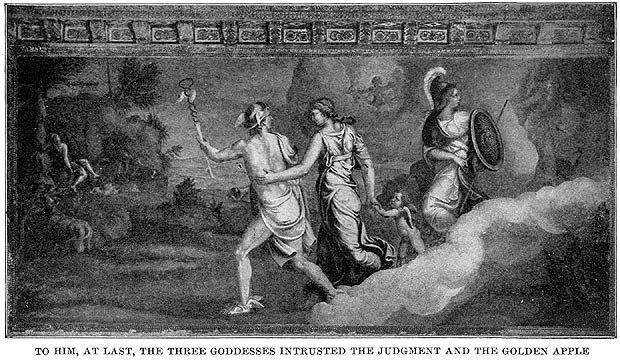
TO HIM AT LAST THE THREE GODDESSES INTRUSTED THE JUDGMENT AND THE GOLDEN APPLE
“Use but the judgment of a prince, Paris,” she said, “and I will give thee wealth and kingly power.”
Such majesty and such promises would have moved the heart of any man; but the eager Paris had at least to hear the claims of the other rivals. Athene rose before him, a vision welcome as daylight, with her sea-gray eyes and golden hair beneath a golden helmet.
“Be wise in honoring me, Paris,” she said, “and I will give thee wisdom that shall last forever, great glory among men, and renown in war.”
Last of all, Venus shone upon him, beautiful as none can ever hope to be. If she had come, unnamed, as any country maid, her loveliness would have dazzled him like sea-foam in the sun; but she was girt with her magical Cestus, a spell of beauty that no one can resist.
Without a bribe she might have conquered, and she smiled upon his dumb amazement, saying, “Paris, thou shalt yet have for wife the fairest woman in the world.”
At these words, the happy shepherd fell on his knees and offered her the golden apple. He took no heed of the slighted goddesses, who vanished in a cloud that boded storm.
From that hour he sought only the counsel of Venus, and only cared to find the highway to his new fortunes. From her he learned that he was the son of King Priam of Troy, and with her assistance he deserted the nymph Œnone, whom he had married, and went in search of his royal kindred.
For it chanced at that time that Priam proclaimed a contest of strength between his sons and certain other princes, and promised as prize the most splendid bull that could be found among the herds of Mount Ida. Thither came the herdsmen to choose, and when they led away the pride of Paris’s heart, he followed to Troy, thinking that he would try his fortune and perhaps win back his own.
The games took place before Priam and Hecuba and all their children, including those noble princes Hector and Helenus, and the young Cassandra, their sister. This poor maiden had a sad story, in spite of her royalty; for, because she had once disdained Apollo, she was fated to foresee all things, and ever to have her prophecies disbelieved. On this fateful day, she alone was oppressed with strange forebodings.
But if he who was to be the ruin of his country had returned, he had come victoriously. Paris won the contest. At the very moment of his honor, poor Cassandra saw him with her prophetic eyes; and seeing as well all the guilt and misery that he was to bring upon them, she broke into bitter lamentations, and would have warned her kindred against the evil to come. But the Trojans gave little heed; they were wont to look upon her visions as spells of madness. Paris had come back to them a glorious youth and a victor; and when he made known the secret of his birth, they cast the words of the oracle to the winds, and received the shepherd as a long-lost prince.
Thus far all went happily. But Venus, whose promise had not yet been fulfilled, bade Paris procure a ship and go in search of his destined bride. The prince said nothing of this quest, but urged his kindred to let him go; and giving out a rumor that he was to find his father’s lost sister Hesione, he set sail for Greece, and finally landed at Sparta.
There he was kindly received by Menelaus, the king, and his wife, Fair Helen.
This queen had been reared as the daughter of Tyndarus and Queen Leda, but some say that she was the child of an enchanted swan, and there was indeed a strange spell about her. All the greatest heroes of Greece had wooed her before she left her father’s palace to be the wife of King Menelaus, and Tyndarus, fearing for her peace, had bound her many suitors by an oath. According to this pledge, they were to respect her choice, and to go to the aid of her husband if ever she should be stolen away from him. For in all Greece there was nothing so beautiful as the beauty of Helen. She was the fairest woman in the world.
Now thus did Venus fulfill her promise and the shepherd win his reward with dishonor. Paris dwelt at the court of Menelaus for a long time, treated with a royal courtesy which he ill repaid. For at length, while the king was absent on a journey to Crete, his guest won the heart of Fair Helen, and persuaded her to forsake her husband and sail away to Troy, or Ilium.
King Menelaus returned to find the nest empty of the swan. Paris and the fairest woman in the world were well across the sea.
When this treachery came to light, all Greece took fire with indignation. The heroes remembered their pledge, and wrath came upon them at the wrong done to Menelaus. But they were less angered with Fair Helen than with Paris, for they felt assured that the queen had been lured from her country and out of her own senses by some spell of enchantment. So they took counsel how they might bring back Fair Helen to her home and husband.
Years had come and gone since that wedding-feast when Eris had flung the apple of discord, like a firebrand, among the guests. But the spark of dissension that had smouldered so long burst into flame now, and, fanned by the enmities of men and the rivalries of the Gods, it seemed like to fire heaven and earth.
A few of the heroes answered the call to arms unwillingly. Time had reconciled them to the loss of Fair Helen, and they were loath to leave home and happiness for war, even in her cause.
One of these was Odysseus, or Ulysses, king of Ithaca, who had married Penelope, and was quite content with his kingdom and his little son Telemachus. Indeed, he was so unwilling to leave them that he feigned madness in order to escape service, appeared to forget his own kindred, and went ploughing the seashore and sowing salt in the furrows. But a messenger, Palamedes, who came with the summons to war, suspected that this sudden madness might be a stratagem, for the king was far famed as a man of many devices. He therefore stood by, one day (while Ulysses, pretending to take no heed of him, went ploughing the sand) and he laid the baby Telemachus directly in the way of the ploughshare. For once the wise man’s craft deserted him. Ulysses turned the plough sharply, caught up the little prince, and there his fatherly wits were manifest! After this he could no longer play madman. He had to take leave of his beloved wife Penelope and set out to join the heroes, little dreaming that he was not to return for twenty years. Once embarked, however, he set himself to work in the common cause of the heroes, and was soon as ingenious as Palamedes in rousing laggard warriors.
There remained one who was destined to be the greatest warrior of all. This was Achilles, the son of Thetis,—foretold in the day of Prometheus as a man who should far outstrip his own father in glory and greatness. Years had passed since the marriage of Thetis to King Peleus, and their son Achilles was now grown to manhood, a wonder of strength indeed, and, moreover, invulnerable. For his mother, forewarned of his death in the Trojan War, had dipped him in the sacred river Styx when he was a baby, so that he could take no hurt from any weapon. From head to foot she had plunged him in, only forgetting the little heel that she held him by, and this alone could be wounded by any chance. But even with such precautions Thetis was not content. Fearful at the rumors of war to be, she had her son brought up, in woman’s dress, among the daughters of King Lycomedes of Scyros, that he might escape the notice of men and cheat his destiny.
To this very palace, however, came Ulysses in the guise of a merchant, and he spread his wares before the royal household,—jewels and ivory, fine fabrics, and curiously wrought weapons. The king’s daughters chose girdles and veils and such things as women delight in; but Achilles, heedless of the like, sought out the weapons, and handled them with such manly pleasure that his nature stood revealed. So he, too, yielded to his destiny and set out to join the heroes.
Everywhere men were banded together, building the ships and gathering supplies. The allied forces of Greece (the Achaians, as they called themselves) chose Agamemnon for their commander-in-chief. He was a mighty man, king of Mycenæ and Argos, and the brother of the wronged Menelaus. Second to Achilles in strength was the giant Ajax; after him Diomedes, then wise Ulysses, and Nestor, held in great reverence because of his experienced age and fame. These were the chief heroes. After two years of busy preparation, they reached the port of Aulis, whence they were to sail for Troy.
But here delay held them. Agamemnon had chanced to kill a stag which was sacred to Diana, and the army was visited by pestilence, while a great calm kept the ships imprisoned. At length the oracle made known the reason of this misfortune and demanded for atonement the maiden Iphigenia, Agamemnon’s own daughter. In helpless grief the king consented to offer her up as a victim, and the maiden was brought, ready for sacrifice. But at the last moment Diana caught her away in a cloud, leaving a white hind in her place, and carried her to Tauris in Scythia, there to serve as a priestess in the temple. In the mean time, her kinsfolk, who were at a loss to understand how she had disappeared, mourned her as dead. But Diana had accepted their child as an offering, and healing came to the army, and the winds blew again. So the ships set sail.
Meanwhile, in Troy across the sea, the aged Priam and Hecuba gave shelter to their son Paris and his stolen bride. They were not without misgivings as to these guests, but they made ready to defend their kindred and the citadel.
There were many heroes among the Trojans and their allies, brave and upright men, who little deserved that such reproach should be brought upon them by the guilt of Prince Paris. There were Æneas and Deïphobus, Glaucus and Sarpedon, and Priam’s most noble son Hector, chief of all the forces, and the very bulwark of Troy. These and many more were bitterly to regret the day that had brought Paris back to his home. But he had taken refuge with his own people, and the Trojans had to take up his cause against the hostile fleet that was coming across the sea.
Even the Gods took sides. Juno and Athene, who had never forgiven the judgment of Paris, condemned all Troy with him and favored the Greeks, as did also Neptune, god of the sea. But Venus, true to her favorite, furthered the interests of the Trojans with all her power, and persuaded the warlike Mars to do likewise. Zeus and Apollo strove to be impartial, but they were yet to aid now one side, now another, according to the fortunes of the heroes whom they loved.
Over the sea came the great embassy of ships, sped hither safely by the god Neptune; and the heroes made their camp on the plain before Troy. First of all Ulysses and King Menelaus himself went into the city and demanded that Fair Helen should be given back to her rightful husband. This the Trojans refused, and so began the siege of Troy.
The Quarrel between Agamemnon and Achilles
By Alfred J. Church
Return to Table of Contents
The Greeks sacked the city of Chryse, where was a temple of Apollo, and a priest that served the temple. And when they divided the spoil, they gave to King Agamemnon with other gifts, the priest’s daughter, Chryseïs. Thereupon there came to the camp Chryses, the priest, wishing to ransom his daughter. Much gold he brought with him, and on his staff of gold he carried the holy garland, that men might reverence him the more. He went to all the chiefs, and to the sons of Atreus first of all, saying,— “Loose, I pray you, my dear daughter, and take the ransom for her; so may the gods that dwell in Olympus grant you to take the city of Troy, and to have safe return to your homes.”
Then all the others spake him fair, and would have done what he wished. Only Agamemnon would not have it so.
“Get thee out, graybeard!” he cried in great wrath. “Let me not find thee lingering now by the ships, neither coming hither again, or it shall be the worse for thee, for all thy priesthood. And as for thy daughter, I shall carry her away to Argos, when I shall have taken this city of Troy.”
Then the old man went out hastily in great fear and trouble. And he walked in his sorrow by the shore of the sounding sea, and prayed to his god Apollo.
“Hear me, god of the silver bow! If I have built thee a temple, and offered thee fat of many bullocks and rams, hear me, and avenge my tears on the Greeks with thine arrows!”
And Apollo heard him. Wroth was he that men had so dishonored his priest, and he came down from the top of Olympus, where he dwelt. Dreadful was the rattle of his arrows as he went, and his coming was as the night when it cometh over the sky. Then he shot the arrows of death, first on the dogs and the mules, and then on the men; and soon all along the shore rolled the black smoke from the piles of wood on which they burnt the bodies of the dead.
For nine days the shafts of the god went throughout the host; but on the tenth day Achilles called the people to an assembly. So Juno bade him, for she loved the Greeks, and grieved to see them die. When they were gathered together he stood up among them, and spake to Agamemnon:—
“Surely it were better to return home, than that we should all perish here by war or plague. But come, let us ask some prophet or priest or dreamer of dreams why it is that Apollo is so wroth with us.”
Then stood up Calchas, best of seers, who knew what had been, and what was, and what was to come, and spake:—
“Achilles, thou biddest me tell the people why Apollo is wroth with them. Lo! I will tell thee, but thou must first swear to stand by me, for I know that what I shall say will anger King Agamemnon, and it goes ill with common men when kings are angry.”
“Speak out, thou wise man!” cried Achilles; “for I swear by Apollo that while I live no one shall lay hands on thee, no, not Agamemnon’s self, though he be sovereign lord of the Greeks.”
Then the blameless seer took heart, and spake: “It is not for vow or offering that Apollo is wroth; it is for his servant the priest, for he came to ransom his daughter, but Agamemnon scorned him, and would not let the maiden go. Now, then, ye must send her back to Chryse without ransom, and with her a hundred beasts for sacrifice, so that the plague may be stayed.”
Then Agamemnon stood up in a fury, his eyes blazing like fire.
“Never,” he cried, “hast thou spoken good concerning me, ill prophet that thou art, and now thou tellest me to give up this maiden! I will do it, for I would not that the people should perish. Only take care, ye Greeks, that there be a share of the spoil for me, for it would ill beseem the lord of all the host that he alone should be without his share.”
“Nay, my lord Agamemnon,” cried Achilles, “thou art too eager for gain. We have no treasures out of which we may make up thy loss, for what we got out of the towns we have either sold or divided; nor would it be fitting that the people should give back what has been given to them. Give up the maiden, then, without conditions, and when we shall have taken this city of Troy, we will repay thee three and four fold.”
“Nay, great Achilles,” said Agamemnon, “thou shalt not cheat me thus. If the Greeks will give me such a share as I should have, well and good. But if not, I will take one for myself, whether it be from thee or from Ajax or from Ulysses; for my share I will have. But of this hereafter. Now let us see that this maiden be sent back. Let them get ready a ship, and put her herein, and with her a hundred victims, and let some chief go with the ship, and see that all things be rightly done.”
Then cried Achilles, and his face was as black as a thunder-storm: “Surely thou art altogether shameless and greedy, and, in truth, an ill ruler of men. No quarrel have I with the Trojans. They never harried oxen or sheep of mine in fertile Phthia, for many murky mountains lie between, and a great breadth of roaring sea. But I have been fighting in thy cause, and that of thy brother Menelaus. Naught carest thou for that. Thou leavest me to fight, and sittest in thy tent at ease. But when the spoil is divided, thine is always the lion’s share. Small, indeed, is my part,—‘a little thing, but dear.’ And this, forsooth, thou wilt take away! Now am I resolved to go home. I have no mind to heap up goods and gold for thee, and be myself dishonored.”
And King Agamemnon answered, “Go, and thy Myrmidons with thee! I have other chieftains as good as thou art, and ready, as thou art not, to pay me due respect; and Zeus, the god of council, is with me. I hate thee, for thou always lovest war and strife. And as for the matter of the spoil, know that I will take thy share, the girl Briseïs, and fetch her myself, if need be, that all may know that I am sovereign lord here in the host of the Greeks.”
Then Achilles was mad with anger, and he thought in his heart, “Shall I arise and slay this caitiff, or shall I keep down the wrath in my breast?” And as he thought he laid his hand on his sword-hilt, and had half-drawn his sword from the scabbard, when lo! the goddess Athene stood behind him (for Juno, who loved both this chieftain and that, had sent her), and caught him by the long locks of his yellow hair. But Achilles marveled much to feel the mighty grasp, and turned and looked, and knew the goddess, but no one else in the assembly might see her. Terrible was the flash of his eyes as he cried, “Art thou come, child of Zeus, to see the insolence of Agamemnon? Of a truth, I think that he will perish for his folly.”
But Athene said, “Nay, but I am come from heaven to abate thy wrath, if thou wilt hear me; white-armed Juno sent me, for she loveth and cherisheth you both alike. Draw not thy sword; but use bitter words, even as thou wilt. Of a truth, I tell thee that for this insolence of to-day he will bring thee hereafter splendid gifts, threefold and fourfold for all that he may take away. Only refrain thyself and do my bidding.”
Then Achilles answered, “I will abide by thy command for all my wrath, for the man who hearkens to the immortal gods is also heard of them.” And as he spake he laid his heavy hand upon the hilt, and thrust back the sword into the scabbard, and Athene went her way to Olympus.
Then he turned him to King Agamemnon, and spake again, for his anger was not spent. “Drunkard, with the eyes of a dog and the heart of a deer! never fighting in the front of the battle, nor daring to lie in the ambush! ’Tis a race of dastards that thou rulest, or this had been thy last wrong. But this I tell thee, and confirm my words with a mighty oath—by this sceptre do I swear. Once it was the branch of a tree, but now the sons of the Greeks bear it in their hands, even they who maintain the laws of Zeus; as surely as it shall never again have bark, or leaves, or shoot, so surely shall the Greeks one day miss Achilles, when they fall in heaps before the dreadful Hector; and thou shalt eat thy heart for rage, to think that thou hast wronged the bravest of thy host.”
And as he spake he dashed the sceptre, all embossed with studs of gold, upon the ground, and sat down. And on the other side Agamemnon sat in furious anger. Then Nestor rose, an old man of a hundred years and more, and counseled peace. Let them listen, he said, to his counsel. Great chiefs in the old days, with whom no man now alive would dare to fight, had listened. Let not Agamemnon take away from the bravest of the Greeks the prize of war; let not Achilles, though he was mightier in battle than all other men, contend with Agamemnon, who was sovereign lord of all the hosts of Greece. But he spake in vain. For Agamemnon answered,—
“Nestor, thou speakest well, and peace is good. But this fellow would lord it over all; yet there are some, methinks, who will not obey him. For if the immortal Gods have made him a great warrior, do they therefore grant him leave to speak lawless words? Verily he must be taught that there is one here, at least, who is better than he.”
And Achilles said, “I were a slave and a coward if I owned thee as my lord. Not so; play the master over others, but think not to master me. As for the prize which the Greeks gave me, let them do as they will. They gave it; let them take it away. But if thou darest to touch aught that is mine own, that hour thy life-blood shall redden on my spear.”
Then the assembly was dismissed. Chryseïs was sent to her home with due offerings to the god, the wise Ulysses going with her. And all the people purified themselves, and offered offerings to the Gods; and the sweet savor went up to heaven in the wreathing smoke.
But King Agamemnon would not go back from his purpose. So he called to him the heralds, Talthybius and Eurybates, and said,—
“Heralds, go to the tents of Achilles, and fetch the maiden Briseïs. But if he will not let her go, say that I will come myself with many others to fetch her; so will it be the worse for him.”
Sorely against their will the heralds went. Along the seashore they walked, till they came to where, amidst the Myrmidons, were the tents of Achilles. There they found him, sitting between his tent and his ship. He did not rejoice to see them, and they stood in great terror and shame. But he knew in his heart wherefore they had come, and cried aloud, “Come near, ye heralds, messengers of Gods and men. ’Tis no fault of yours that ye are come on such an errand.”
Then he turned to Patroclus (now Patroclus was his dearest friend) and said,—
“Bring the maiden from her tent, and let the heralds lead her away. But let them be witnesses, before gods and men, and before this evil-minded king, against the day when he shall have sore need of me to save his hosts from destruction. Fool that he is, who knoweth not to look back and to look forward, that his people may be safe!”
Then Patroclus brought forth the maiden from her tent, and gave her to the heralds. And they led her away; but it was sorely against her will that she went. But Achilles went apart from his comrades, and sat upon the seashore, falling into a great passion of tears, and stretching out his hands with loud prayer to his mother, Thetis, daughter of the sea. She heard him where she sat in the depths by her father, the old god of the sea, and rose from the gray sea, as a vapor rises, and came to where he was weeping, and stroked him with her hand, and called him by his name.
“What ails thee, my son?” she said.
Then he told her the story of his wrong, and when he had ended he said,—
“Go, I pray thee, to the top of Olympus, to the palace of Zeus. Often have I heard thee in my father’s hall boast how, long ago, thou didst help him when the other gods would have bound him, fetching Briareus of the hundred hands, who sat by him in his strength, so that the Gods feared to touch him. Go now, and call these things to his mind, and pray him that he help the sons of Troy, and give them victory in the battle, so that the Greeks, as they flee before them, may have joy of this king of theirs, who has done such wrong to the bravest of his host.”
And his mother answered him, “Surely thine is an evil lot, my son. This life is short, and it should of right be without tears and full of joy; but now it seems to me to be both short and sad. But I will go as thou sayest to Olympus, to the palace of Zeus; but not now, for he has gone, and the other Gods with him, to a twelve days’ feast with the pious Ethiopians. But when he cometh back I will entreat and persuade him. And do thou sit still, nor go forth to battle.”
Meanwhile Ulysses drew near to Chryse with the holy offerings. And when they were come within the haven, they furled the sail, and laid it in the ship, and lowered the mast, and rowed the ship to her moorings. They cast out the anchor stones, and made fast the cables from the stern. After that they landed, taking with them the offerings and the maid Chryseïs. To the altar they brought the maid, and gave her into the arms of her father, and the wise Ulysses said, “See now; Agamemnon, King of men, sends back thy daughter, and with her a hundred beasts for sacrifice, that we may appease the god who hath smitten the Greeks in his wrath.”
Then the priest received his daughter right gladly, and when they had ranged the beasts about the altar, and poured out the water of purification, and taken up handfuls of bruised barley, then the priest prayed, “Hear me, God of the silver bow! If before thou didst hearken to my prayer, and grievously afflict the Greeks, so hear me now, and stay this plague which is come upon them.”
So prayed he, and the god gave ear.
Then they cast the barley on the heads of the cattle, and slew them, and flayed them, and they cut out the thigh-bones and wrapped them up in folds of fat, and laid raw morsels on them. These the priest burned on fagots, pouring on sparkling wine; and the young men stood by, having the five-pronged forks in their hands. And when the thighs were consumed, then they cut up the rest, and broiled the pieces carefully on spits. This being done, they made their meal, nor did any one lack his share. And when the meal was ended, then they poured a little wine into the cups to serve for libations to the Gods. After that they sat till sunset, singing a hymn to the Archer God, and making merry; and he heard their voice and was pleased.
When the sun went down, they slept beside the stern-cables; and when the dawn appeared, then they embarked, raising the mast and spreading the sail; and Apollo sent them a favoring wind, and the dark blue wave hissed about the stem of the ship as she went: so they came to the camp of the Greeks.
But all the time Achilles sat in wrath beside his ships; he went not to the war, nor yet to the assembly, but sat fretting in his heart, because he longed for the cry of the battle.
The Fight between Paris and Menelaus
By Walter C. Perry
Return to Table of Contents
In obedience to the summons of their leaders, the great host of the Achaians assembled on the plain of the flowing river Scamander, innumerable as the leaves and flowers in the season of spring. And in the midst of them stood the great ruler, Agamemnon: his head and eyes like those of Loud-thundering Zeus; his waist like that of the Man-slaying Mars; and with a breast like that of Neptune, the Ruler of the Sea. As the mail-clad Argives marched on, and rushed across the plain, the earth groaned beneath them.
Now Ægis-bearing Zeus sent his messenger, Iris, to the assembly of the Trojans, with the voice of Polites, son of Priam, their sentinel at Priam’s gate, and spake thus to Hector: “This is no time for idle words, for stern war is already upon you. But to thee, O Hector, do I especially speak; and do thou obey my voice! As thou hast many allies, of diverse nations and tongues, let each chief marshal and command his own people, and lead them forth to war.”
And the glorious Hector knew the voice of the messenger, and hastened to obey. He straightway dissolved the assembly. The gates of Troy were then thrown open, and the Trojan host rushed forth, with a mighty din. The blameless Hector, with his glancing helmet, was foremost of all, and led the bravest and strongest of the men; Æneas, son of the goddess Aphrodite, or Venus, born amidst the peaks of Ida, led the Dardans; and of the other leaders of the allies, the most famous were Sarpedon, son of Zeus, and blameless Glaucus, who led the Lycians, from distant Lycia, by the swift-eddying Xanthus.
And, as the countless hosts advanced, to meet each other in deadly conflict, the Trojans marched with noisy shouts, like the clamor of the cranes, when they fly to the streams of Oceanus, in the early morning, screaming, and bringing death and destruction to the Pigmy men; but the Achaieans came on in silence, breathing dauntless courage.
But when they came near to each other, the goodly Paris went before the front rank of the Trojans, and brandished his spear, and challenged all the Argive chiefs to single combat. When the warlike Menelaus, whom Paris had so deeply wronged by carrying off his wife, the beautiful Helen, saw Paris there, he was glad, thinking that he should now punish the false traitor for his wickedness. So he leaped from his chariot, in his clanging armor, and advanced to meet the challenger. And Paris saw him; and pale fear got hold of him, like to a man who has trodden on a serpent, in a wooded valley among the mountains; and he shrank back among the lordly Trojans.
His brother Hector saw him, and reproached him with scornful words. “Base deceiver of women, beautiful in appearance and favor, but coward at heart! would that thou hadst never been born, or that thou hadst died unwedded! Now thou seest what kind of man is he, whose lovely wife thou hast carried off by stealth. Of no avail will be thy sounding lyre, thy beauteous face and curling hair, or all the gifts of golden Venus, when thou liest groveling in the dust.”
And the goodly Paris answered him, “Hector, thou rightly chidest me, and not more than I deserve. Thy heart is ever undaunted, and keen as the axe, which cutteth the strong oak, in the hands of a skillful shipwright. But reproach me not for the lovely gifts of golden Aphrodite; for no man can obtain them by wishing for them, for they are among the precious gifts of the blessed Gods. But if thou desirest that I should do battle with the valiant Menelaus, make the Trojans and the Achaians sit down; and set me and Menelaus in the midst, to fight for Helen and for all the treasures which were taken away with her. And whichever of us twain shall be the victor, let him bear away the woman and the treasure, and take them home.”
So spake he, and they all kept silence; but Menelaus of the loud war-cry stood forward amongst the Greeks and made harangue, “Hearken now to me, for my heart hath endured the greatest grief. Whosoever of us twain shall fall, there let him lie. But now bring a goodly sacrifice, a white ram and a black ewe, for the Earth and for the Sun; and another for Loud-thundering Zeus; and summon hither the great King Priam, that he may take the pledge; for his sons are reckless and faithless; young men’s hearts are too frivolous and fickle, but an old man looketh to the future and the past.”
And Hector sent heralds to the city, to fetch two lambs, and to summon Priam; while Agamemnon sent Talthybius for a ram. Now Iris, in Troy, came to Helen, in the semblance of Laodice, Paris’s sister, fairest of Priam’s daughters, wife of Helicaon, the son of Antenor. She found Helen weaving a great purple web, on which she was embroidering the battles of the Argives and the Trojans. The swift-footed Iris came near her, and said, “Come hither, dear lady, come with me, to see the wondrous deeds of the horse-taming Trojans and the mail-clad Argives; for now the battle is suspended, while Paris, and Menelaus, dear to Mars, will fight alone with their spears, for thee; and thou wilt be the fair wife of the victor.” So Iris spoke, and put into Helen’s bosom a longing for her former husband, and for her darling daughter. Then Helen veiled her face, and went straightway to the Scæan Gate, letting fall a tear; and her two handmaidens, Æthre and Clymene, followed her.
On the tower above the Scæan Gate, she found the Trojan elders. These, on account of their age, had ceased from war, but were still good orators, with voices like the grasshoppers which sit upon a tree, and send forth their lily-like voice; so sat the elders of the Trojans on the Tower. When those ancient sages saw the fair Helen coming to them, they were astounded, and whispered one to another, “No wonder that the Trojans and the Achaians have suffered so many things for such a glorious woman! But, fair as she is, let her sail away, and not stay here to trouble us and our children after us.”
But the aged King Priam addressed her kindly. “Dear Daughter! come hither, and see thy former husband and kinsmen! I do not blame thee, but the Gods, and especially Venus, by whom this sad war has been brought upon us. But tell me who is that huge Achaian warrior? Many are taller than he, but I have never seen a man so stately and royal.” And the fair Helen, the daughter of Zeus, replied, “O venerable Father of my lord! would that death had been my lot, when I followed thy son to Troy, and left my home and husband, and my dear young daughter, and all the loved companions of my girlhood! But that was not to be, and therefore I mourn and weep. The man of whom thou speakest is Atreides, the wide-ruling monarch Agamemnon, who is both a stately king and a doughty warrior; he is the brother of Menelaus my husband—shameless thing that I am!”
Then the aged Priam asked her about the other Achaian chiefs,—Ulysses, and the gigantic Ajax, the bulwark of the host, and the godlike Idomeneus; and the lovely Helen told him all, and said, “I see all the other bright-eyed Achaians, and could tell their names; but two I see not, even mine own brothers, horse-taming Castor and the boxer Pollux; peradventure they came not with the Achaians; or if they came, they fight not, for fear of the revilings which men heap on me—shameless that I am!” She knew not that the earth already covered them, in Lacedæmon, their dear native land. Now the aged Priam drove out through the Scæan Gate, with Antenor by his side; and, when he had come to the Achaians and the Trojans, he descended from his chariot, and stood on the Earth, the bounteous grain-giver. Then Agamemnon, the king of men, and Ulysses, the man of many devices, rose up; and the stately heralds brought the holy oath-offerings to the gods, and mixed the ruddy wine in the mixing-bowl, from which they gave portions to the Achaian and the Trojan chiefs. Agamemnon raised his hands to heaven and prayed, “O Father Zeus, most great and glorious! O Sun, who seest and hearest all things! O ye Rivers, and thou, Mother Earth! be ye all witnesses to our oaths! If Paris shall kill Menelaus, then let him keep Helen and all her possessions; but if the yellow-haired Menelaus slay Paris, then let the Trojans give back Helen and her treasures!”
Then the lordly Agamemnon slew the lambs, and prayed again to Zeus. But Priam spake unto the Achaians and the Trojans. “I verily will return to breezy Ilium; for I cannot bear to see my own son engaged in deadly conflict with the war-loving Menelaus.”
Then the goodly Paris, lord of the fair-haired Helen, put on his beautiful armor. First he set the splendid greaves upon his legs, fastened round the ankles with silver clasps; then he donned the corslet, which he had borrowed from his brother Lycaon; and he threw over his shoulders the silver-studded sword-belt with his sword, and took up his mighty shield; and upon his beauteous head he placed the helmet, with a horsehair crest, and the plume nodded terribly; and he took a strong spear in his hand.
Then he and Menelaus stood face to face, on the ground which Hector and Ulysses had meted out; and they brandished their spears, with wrath against each other. Paris drew the lot to be the first to cast his long-shafted spear; he threw it, and it struck the round shield of Atreides Menelaus, but did not pierce it; for the point of the spear was turned.
Then Menelaus, poising his lance, prayed to Zeus, “O Father Zeus! grant me to take vengeance on goodly Paris, who did me such foul wrong—me, who had shown him so much kindness!” He said, and hurled his strong spear, which struck the bright shield of the son of Priam; and the sharp point passed through it, and through his breastplate, and rent the tunic, close to the side of his body; but Paris swerved from it, and shunned the black fate of death. Then Menelaus drew his sword from the silver-studded sheath, and smote on the helmet of Paris, but the sword was shattered, and fell in pieces from his hand. Then he looked up to heaven, and exclaimed, “O Father Zeus! thou art the most cruel of all the Gods!”
So saying, he caught Paris by his horse-hair crest, and dragged him towards the well-greaved Achaians, and the embroidered strap of the helmet went nigh to strangle him. But Venus, daughter of great Zeus, who loved the beauteous Paris, drew near him, and tore the strap of leather; and the helmet came away, empty, in the strong hand of the son of Atreus. Full of wrath, he hurled it towards his trusty companions, and they took it up. He then rushed back again, to slay his enemy; but golden-haired Venus, being a goddess, easily caught up Paris, and hid him in thick darkness, and carried him into Troy, to his high and fragrant chamber.
Venus, the golden Goddess of Love, then went to summon Helen, in the likeness of an old woman, a wool-comber, who had worked for Helen in Lacedæmon, and whom she greatly loved. She found the white-armed Helen on the high tower, and spake: “Come hither to Paris, who sends for thee; he is there in the fragrant chamber, shining in beauty—
“Not like a warrior parted from the foe, But some fair dancer from the public show.” (Pope’s Translation of the Iliad.)
But Helen’s heart was greatly moved; she knew the golden Venus, saw her fair neck and sparkling eyes, and called her by her name. “O thou strange Goddess! wouldst thou again deceive me? Now Menelaus hath conquered Paris, and will carry me home—accursed as I am! And now do thou no more return to Olympus, but leave the dwelling of the Gods, and go and sit by Paris, till he make thee his wife—or perchance, his slave. But I will not go to him; for all the Trojan women would justly blame me hereafter; I have innumerable griefs within my heart.”
Then was the bright goddess sore displeased, and spake harshly to her. “Beware! thou foolish woman! lest in my wrath I leave thee, and henceforth hate thee, as I have loved thee until now!” Venus spake, and Helen, daughter of great Zeus, trembled and obeyed, wrapping her beautiful garments about her; and the goddess led her to the fragrant chamber in the palace, and set her on a chair before the goodly Paris.
But Helen looked askance at her lord, and chode him with bitter words. “Would that thou hadst never come back from the fight, but hadst perished by the arm of the warrior who was once my husband! Thou didst boast thyself to be a better man than Menelaus! Go then, and challenge him again, to meet thee face to face once more!”
Yet Helen, though she could not but despise Paris, soon became reconciled to him, partly from a remnant of her former love for him, and partly from her fear of Venus.
In the meantime, Menelaus was raging through the field in search of him. Nor could any of the Trojans find him, or they would have given him up; for they hated him like death, as the cause of all their sufferings.
And King Agamemnon said to the Trojans, “Now that the Mars-loving Menelaus hath conquered Paris do ye give back to us Helen and all her treasures!” But this was not to be.
The Duel between Hector and Ajax
By Walter C. Perry
Return to Table of Contents
And now we must speak of Hector, the noble Trojan prince, who, after Achilles, was the most famous warrior of the two hostile armies. Achilles, indeed, was the son of a goddess, even silver-footed Thetis; while Hector’s mother, Hecuba, was a mortal woman.
Well knowing the dangers to which he was exposed, and how soon he might fall in battle, Hector now bethought him of his lovely wife, Andromache, and his little boy Astyanax. When he came to the Scæan Gate, the Trojan women came running to him, with eager questions about their husbands, sons, and brothers; and sorrow filled their hearts. Among them came his fond and generous mother, Hecuba, leading by the hand the fairest of her daughters, Laodice, and she called him by his name, and spoke: “Dear Son! why hast thou left the field? Do the Achaians press thee hard? Dost thou come to make prayers to Father Zeus, from the Citadel? But come, I will bring thee honey-sweet wine, that thou mayest pour out a libation to Almighty Zeus, the Son of Cronos, and refresh thyself with a draught.”
But Hector answered her, “Bring me no luscious wine, dear mother! lest thou rob me of my strength and courage. Nor dare I make a libation to Zeus, with hands unwashen and soiled with blood. But go thou to the Temple of Athene, driver of the spoil; and lay the finest robe, the most precious to thyself, upon her knees; and vow to sacrifice twelve fat kine to her; and beg her to have mercy on the Trojans, and on their wives and little children! So, perhaps, she will hold back the terrible warrior, Tydides, from sacred Ilium. And I will go and seek out Paris; would that the earth would swallow him up! for Zeus hath cherished him to be the bane of his country, and of his father Priam.”
Then Hecuba went to her ambrosial chamber, and took the finest of her embroidered robes, the work of Sidonian women, which shone like a star; and went, with other aged women, to the temple of Athene. And the fair-cheeked Theano, daughter of Kisseus, the priestess, wife of Antenor, opened the temple gates, and took the shining robe, and laid it upon Athene’s knees, and prayed to the great daughter of Zeus. But the goddess did not grant her prayer.
But Hector went his way to the fair palace of Paris, and found him in his chamber, polishing his beautiful armor, and proving his curved bow. Then, when Hector saw him, he reproached him with bitter words. “O thou strange man! thou dost not well to nurse thy spite against the Trojans, who are now perishing before the city, and all for thy sake! Rise, then, now, lest the city be burned with fire!”
And the goodly Paris answered, “It is not so much by reason of my wrath against the Trojans, but I would fain indulge my sorrow. My wife, too, hath urged me to the battle. Tarry then awhile, and I will don my armor; or go thou before, and I will follow.”
Then the divine Helen, daughter of great Zeus, came and spoke gently to Hector, and said, “O brother! brother of vile me, who am a dog—would that, when my mother bare me, the storm-wind had snatched me away to a mountain, or a billow of the loud-roaring sea had swept me away, before all these evil things had befallen me! Would that I had been mated with a better man than Paris, whose heart is not sound, and never will be. But come, my brother, and sit by me; for thou verily hast suffered most for me, who am a dog, and for the grievous sin of Paris, upon whom, surely, Zeus is bringing evil days; he will be, hereafter, a song of scorn in the mouths of future men, through all time to come.”
But noble Hector answered her, “If thou lovest me, dear Helen, bid me not stay; for I go to succor my friends, who long for me in my absence. But do thou try and rouse this husband of thine, and bid him overtake me. As for me, I shall first go to my home, and to my wife and my little son; for who knoweth whether I shall ever return to them again?”
So spake the glorious Hector, and went his way to his own well-furnished house; but he found not Andromache there; for she had gone to the tower, with her fair-robed nurse and with her boy, all bathed in tears. Hector asked the servants whither the white-armed Andromache was gone; and the busy matron of the house replied, “She is gone to the tower of holy Troy; for she heard that the Trojans were defeated, and the Achaians victorious.” Then Hector returned, by the same way, down the wide streets, and came to the Scæan Gate.
And his peerless wife, even Andromache, daughter of the high-minded Eëtion, king of Cilicia—she whom he had won by countless gifts—came running to meet him. And with her came the handmaid, the nurse, bearing in her arms Hector’s tender boy, Astyanax, beautiful as the morning star. And Hector smiled, and looked on his darling boy, while Andromache stood beside him weeping. And she clasped his hand, and called him by his name. “O my dear lord, thy dauntless courage will destroy thee! Hast thou no pity for thy infant child, and for thy hapless wife, who soon will be a widow? It were far better for me to die, if I lose thee; for nevermore can I know comfort, but only pain and sorrow. For I shall be utterly alone. I have neither father nor mother; for Eëtion, my royal sire, was slain by great Achilles. And all my seven brothers went down to Hades on the selfsame day! they too were slain by swift-footed Pelides. But my mother was smitten in her father’s halls, by the gentle arrows of the archer Artemis. Lo! now, thou art all in all to me, father, mother, brother, and dearly loved husband! Come, then, take pity on us, and abide in the tower, and make not thy boy an orphan, and thy wife a widow!”
And the glorious Hector of the glancing helm answered her, and said, “Dear Wife! I too think of all these things. But how can I shun the battle, like a coward, to be the mock of the Trojans, and of the Trojan dames with trailing robes? I, who have always fought in the van of battle, and won glory for my father and myself? I know that the day will come, when sacred Ilium shall be leveled with the ground, and Priam and the people of Priam shall perish. But it is not so much the fate of Priam, and of my mother, Hecuba, and of my brethren, which fills my soul with anguish; but it is thy misery, dear one, in the day when some Achaian warrior shall bear thee away, weeping, and rob thee of thy freedom. Thou, alas! wilt abide in Argos, and ply the loom, the slave of another woman; or bear water from the Hypereian fount, being harshly treated! And one will say, as he looketh upon thee, ‘This was the wife of Hector, the foremost of the horse-taming Trojans in the war round Ilium.’ But may the deep earth cover me, ere I hear thee crying in the day of thy captivity.”
So spake he, and held out his arms to take his darling boy. But the child shrank crying, and nestled in the bosom of his well-girdled nurse; for he feared the horsehair crest, nodding terribly from the brazen helmet. Then the fond parents laughed; and Hector doffed his helmet, and laid it on the ground. And he kissed his dear child, and fondled him, and prayed thus to Zeus:—
“O Zeus! and all ye Gods! grant that this, my son, may like me be foremost to fight among the Trojans, and rule as a king in Ilium; so that men may say, ‘He is far better than his father’!”
Thus speaking, he laid the child in the fragrant bosom of his dear wife Andromache; and he pitied her, and caressed her with his hand, and called her by her name. “Dear one! be not thus utterly cast down. No man can slay me till my hour of destiny is come. But no man, when once he hath been born, can escape his fate, be he a brave man or a coward. Go thou to thy house, to the distaff and the loom, and make thy maidens ply their labors. But men shall engage in war, and I the first of all in Troy.”
So spake Hector of the glancing helmet, and went his way. And his dear wife went to her home, looking back at him as she went, shedding bitter tears. And she found her maidens there, and with them she bewailed her lord, while yet he lived; for they feared that he would never again return from battle.
And the goodly Paris donned his beautiful armor, and hastened after his brother, whom he overtook, and he made excuse for his long tarrying. And Hector answered him, “No man can justly speak lightly of thy deeds, for thou art strong; but thou art slack and careless, and I am grieved when I hear shameful things said of thee by the Trojans, who for thee bear so much toil. But let us be going.”
So the twain brothers, the glorious Hector and the goodly Paris, went forth to the battle. And Paris slew Menesthius, of Arne, son of Areïthous; and Hector smote noble Eïoneus in the neck, and relaxed his limbs in death. And Glaucus, captain of the Lycian allies, cast his spear at Iphinous, and pierced his shoulder; and he fell from his chariot, and his limbs were loosened.
But when the fierce-eyed Athene saw the Trojans making havoc of the Achaians, she rushed down from the peaks of Olympus, to sacred Ilium. And Apollo, who favored the Trojans, saw her from Pergamus, and hastened to meet her; and they met by the beech-tree, and Apollo of the Silver Bow addressed her: “Why dost thou come, O Daughter of the Loud-Thunderer? Is it to bring victory to the Greeks? for thou hast no pity on the Trojans. But hearken unto me, and let us stop the battle for this day—hereafter they shall fight again.”
And the fierce-eyed goddess answered him, “Be it so, Far-Darter! for this was my purpose when I came from high Olympus. But how thinkest thou to make the war to cease?”
Then King Apollo spake. “Let us rouse the valiant spirit of horse-taming Hector, to challenge one of the Greeks to deadly single combat.” And the fierce-eyed Maid assented to his words.
And the dear son of royal Priam, Helenus, the wise augur, who knew the counsel of the Gods, drew near to Hector, and spake thus to him: “Dear brother, who art peer of Zeus in counsel, wouldst thou listen to me? Make the Trojans and the Achaians sit down; and do thou challenge the bravest of the Achaians to meet thee in single combat. I hear the voice of the deathless Gods, that it is not yet thy lot to die.”
And the great Hector rejoiced at his words; and going into the throng, he held back the companies of the Trojans with his spear, holding it in the middle, and made them all sit down. And Agamemnon made the well-greaved Achaians sit down. And Athene and Apollo, in the form of vultures, sat on a lofty tree, and watched the hosts. And Hector stood between the two armies, and spake: “Hear me, ye Trojans and Achaians! Amongst you are the great chiefs of the Achaians. Now let one of these be your champion, to fight with me, Hector: and I call Zeus to witness, that if he slay me, you shall let him carry off my armor, but give my body to the Trojans, that they may render to me the honor of the funeral pyre. But if the Far-Darter shall grant me glory, that I may slay him, then will I strip him of his armor, and hang it in the Temple of Apollo; but his lifeless body I will give back to the long-haired Achaians, that they may bury him, and build him a barrow by the Hellespont.”
Thus spake the glorious Hector; but all were silent; for they were afraid to meet him. Then, at last, Menelaus, groaning deeply, reproached the Achaians, and said, “O ye women of Achaia, no longer men! surely this will be an everlasting shame to us, if none of the Greeks dare to fight with the noble Hector! But I myself will arm me; for the issues of victory are with the Gods.”
And he began to put on his dazzling armor. And now wouldst thou, Menelaus, have yielded up thy life at the hands of Hector; but the great ruler, Agamemnon, rose up and stayed thee. “Art thou mad, O foster-son of Zeus? Draw back, though with grief and pain; and think not to fight with Hector, the man-slaying son of Priam; for he is a far better man than thou, even godlike Achilles feareth to meet this man in battle. Go then and sit down; and we will choose another champion.”
And the fair-haired Menelaus obeyed his brother’s words, and his henchmen gladly took off his bright armor. And the wise Nestor arose, and upbraided all the Achaian chiefs: “Fie on us! Shame and lamentation have come upon us all. Surely the aged Peleus, the goodly king of the Myrmidons, would deeply groan, if he heard that we are all cowering before great Hector; he would pray that his soul might leave his body and go down to Hades. Would to Zeus, and to Athene and Apollo, that I were young, as when the Pylians met the Arcadians in battle, and Ereuthalion, the squire of King Lycurgus of Arcadia, wearing the divine armor of Areïthous, of the iron mace, before the walls of Pheia, by the waters of Iardanus, challenged all our host; and they were afraid and trembled. Then I, the youngest of all, stood up and fought with him, and Athene gave me great glory; for he was the tallest man, and of the greatest bulk, that I have ever slain. Would that I were still so young and strong! But of you, leaders of the Achaians, not one has heart enough to meet great Hector.”
The wise old man’s reproaches filled the Achaian chiefs with shame; and nine of them rose up, ready to fight; namely, Agamemnon, king of men; and the stalwart Diomedes; and Idomeneus, and his brother in arms, Meriones, equal in fight to murderous Mars; and Eurypylus, and Thaus, and the wily Ulysses, and two others. Then Nestor spake again. “Now cast lots for him that shall be champion.” Then each man marked his lot, and threw it into Agamemnon’s helmet; and all men prayed that the lot might fall on Ajax or Diomedes, or the king of rich Mycenæ. Then Nestor shook the helmet, and the lot of Ajax leapt out; and the herald placed it in the hand of mighty Ajax, and he was glad; for he said, “I think that I shall vanquish goodly Hector.” And they all prayed to the Son of Cronos, to give victory to Ajax, or to grant unto each of them equal glory and renown.
Then huge Ajax donned his bright armor of bronze, and came forth like the war-god Mars when he goeth to battle. The Achaians were glad, but the Trojans trembled; and even the brave Hector felt his heart beat quicker in his breast. But he would not shrink from the combat, seeing that he had himself challenged all the Achaians. And Ajax came on, bearing a mighty shield, like a tower, which Tychius, the cunning leather-worker, had made for him, of sevenfold hides of lusty bulls, all overlaid with bronze. And he stood near godlike Hector, and spake: “Now shalt thou see what manner of men the Greeks have among them, even now when Achilles, the lion-hearted, hath left us in his wrath. But do thou begin the fight!”
And Hector answered him, “Great Ajax, son of Telamon, sprung from Zeus! speak not to me as if I were a poor weak boy, or a woman! for I too have knowledge of war and slaughter. I know how to charge into the midst of the chariots, or, at close quarters, to join in the wild dance of Mars.” He said, and hurled his long-shafted spear, and struck the sevenfold shield of Ajax; it passed through six folds, but was stopped by the seventh.
Then Ajax, sprung from Zeus, threw his ponderous lance at the shield of mighty Priam’s son. It passed right through the bright shield, and through the well-wrought corselet, and rent his tunic; but he swerved aside, and escaped gloomy death. Then the two fell upon each other, like ravening lions or wild boars; and Hector smote the shield of Ajax with his spear, but the sharp point was turned by the stout buckler. Then Ajax leapt upon him, and drove his spear at Hector’s neck, making a wound from which the dark blood flowed.
But Hector, undismayed, took up a great stone from the ground, and with it smote the boss of Ajax’s shield. And Ajax heaved up a far bigger stone and threw it on the buckler of Hector, and it fell on him like a huge millstone, and stretched him on his back! But Apollo raised him, and set him on his legs again.
Then they would have furiously attacked each other with their swords, had not the Achaian herald, Talthybius, and the Trojan herald, Idaius, intervened and stopped the fight, holding their staves of office between the godlike warriors; and Idaius spake to them: “Fight no longer, brave youths; for Zeus loveth you both; and we know well what gallant warriors ye are. Night is upon us, whose commands it behooveth us to obey.”
And the Telamonian Ajax answered, “Let Hector say those words; for it was he who challenged us.”
And Hector of the shining helmet said, “Ajax, since thou hast received strength and wisdom from the Gods, and dost excel all the Achaians in the fight, let us now cease from battle for the day, and hereafter we will fight again, until the Gods shall give victory to one of us. Go now, and rejoice thy friends and kinsmen by the ships, and I will gladden the hearts of Trojan men and long-robed dames in the holy city of King Priam. But now let us exchange costly gifts, that Trojans and Achaians may say of us that we, having met in this heart-gnawing strife, have parted like good friends.” He spake, and gave to Ajax a silver-studded sword; and Ajax gave him a purple belt. So they parted, and went their way; the one to the ships of the Achaians, and the other to the holy city of Troy. And the Trojans rejoiced that Hector had escaped unhurt from the unapproachable hands of mighty Ajax.
The Death of Patroclus and the Battle of the River
By Alfred J. Church
Return to Table of Contents
Patroclus came and stood by the side of Achilles weeping. Then said Achilles, “What ails thee, Patroclus, that thou weepest like a girl-child that runs along by her mother’s side, and would be taken up, holding her gown, and looking at her with tearful eyes till she lift her in her arms? Hast thou heard evil news from Phthia? Menoetius yet lives, they say, and Peleus. Or art thou weeping for the Greeks, because they perish for their folly?”
Then said Patroclus, “Be not wroth with me, great Achilles, for indeed the Greeks are in grievous straits, and all their bravest are wounded, and still thou cherishest thy wrath. Surely Peleus was not thy father, nor Thetis thy mother; but the rocks begat thee, and the sea brought thee forth. Or if thou goest not to battle, fearing some warning from the Gods, yet let me go, and thy Myrmidons with me. And let me put thy armor on me; so shall the Greeks have breathing-space from the war.”
So he spake, entreating, nor knew that for his own doom he entreated. And Achilles made reply,—
“It is no warning that I heed, that I keep back from the war. But these men took from me my prize, which I won with my own hands. But let the past be past. I said I would not rise up till the battle should come nigh to my own ships. But thou mayest put my armor upon thee, and lead my Myrmidons to the fight. For in truth the men of Troy are gathered as a dark cloud about the ships, and the Greeks have scarce standing-ground between them and the sea. For they see not the gleam of my helmet. And Diomed is not there with his spear; nor do I hear the voice of Agamemnon, but only the voice of Hector as he calls the men of Troy to the battle. Go, therefore, Patroclus, and drive the fire from the ships. And then come thou back, nor fight any more with the Trojans, lest thou take my glory from me. And go not near, in the delight of the battle, to the walls of Troy, lest one of the Gods meet thee to thy hurt; and, of a truth, the keen Archer Apollo loves the Trojans well.”
But as they talked the one to the other, Ajax could hold out no longer. For swords and javelins came thick upon him, and clattered on his helmet, and his shoulder was weary with the great shield which he held; and he breathed heavily and hard, and the great drops of sweat fell upon the ground. Then at the last Hector came near and smote his spear with a great sword, so that the head fell off. Then was Ajax sore afraid, and gave way, and the men of Troy set torches to the ship’s stem, and a great flame shot up to the sky. And Achilles saw it, and smote his thigh and spake:—
“Haste thee, Patroclus, for I see the fire rising up from the ships. Put thou on the armor, and I will call my people to the war.” So Patroclus put on the armor—corselet, and shield, and helmet—and bound upon his shoulder the silver-studded sword, and took a mighty spear in his hand. But the great Pelian spear he took not, for that no man but Achilles might wield. Then Automedon yoked the horses to the chariot, Bayard and Piebald, and with them in the side harness, Pedasus; and they two were deathless steeds, but he was mortal.
Meanwhile Achilles had called the Myrmidons to battle. Fifty ships had he brought to Troy, and in each there were fifty men. Five leaders they had, and the bravest of the five was Pisander.
Then Achilles said, “Forget not, ye Myrmidons, the bold words that ye spake against the men of Troy during the days of my wrath, making complaint that I kept you from the battle against your will. Now, therefore, ye have that which you desired.”
So the Myrmidons went to the battle in close array, helmet to helmet, and shield to shield, close as the stones with which a builder builds a wall. And in front went Patroclus, and Automedon in the chariot beside him. Then Achilles went to his tent and took a great cup from the chest, which Thetis his mother had given him. Now no man drank of that cup but he only, nor did he pour out of it libations to any of the Gods, but only to Zeus. This first he cleansed with sulphur, and then with water from the spring. And after this he washed his hands, and stood in the midst of the space before his tent, and poured out of it to Zeus, saying, “O Zeus, I send my comrade to this battle; make him strong and bold, and give him glory, and bring him home safe to the ships, and my people with him.”
So he prayed, and Father Zeus heard him, and part he granted and part denied.
But now Patroclus with the Myrmidons had come to where the battle was raging about the ship of Protesilaus, and when the men of Troy beheld him they thought that Achilles had forgotten his wrath and was come forth to the war. And first Patroclus slew Pyræchmes, who was the chief of the Pæonians who live on the banks of the broad Axius. Then the men of Troy turned to flee, and many chiefs of fame fell by the spears of the Greeks. So the battle rolled back to the trench, and in the trench many chariots of the Trojans were broken, but the horses of Achilles went across it at a stride, so nimble were they and strong. And the heart of Patroclus was set to slay Hector; but he could not overtake him, so swift were his horses. Then did Patroclus turn his chariot, and keep back those that fled, that they should not go to the city, and rushed hither and thither, still slaying as he went.
But Sarpedon, when he saw the Lycians dismayed and scattered, called to them that they should be of good courage, saying that he would himself make trial of this great warrior. So he leapt down from his chariot, and Patroclus also leapt down, and they rushed at each other as two eagles rush together. Then first Patroclus struck down Thrasymelus, who was the comrade of Sarpedon; and Sarpedon, who had a spear in either hand, with the one struck the horse Pedasus, which was of mortal breed, on the right shoulder, and with the other missed his aim, sending it over the left shoulder of Patroclus. But Patroclus missed not his aim, driving his spear into Sarpedon’s heart. Then fell the great Lycian chief, as an oak, or a poplar, or a pine falls upon the hills before the axe. But he called to Glaucus, his companion, saying, “Now must thou show thyself a good warrior, Glaucus. First call the men of Lycia to fight for me, and do thou fight thyself, for it would be foul shame to thee, all thy days, if the Greeks should spoil me of my arms.”
Then he died. But Glaucus was sore troubled, for he could not help him, so grievous was the wound where Teucer had wounded him. Therefore he prayed to Apollo, and Apollo helped him and made him whole. Then he went first to the Lycians, bidding them fight for their king, and then to the chiefs of the Trojans, that they should save the body of Sarpedon. And to Hector he said, “Little carest thou for thy allies. Lo! Sarpedon is dead, slain by Patroclus. Suffer not the Myrmidons to carry him off and do dishonor to his body.”
But Hector was troubled to hear such news, and so were all the sons of Troy, for Sarpedon was the bravest of the allies, and led most people to the battle. So with a great shout they charged, and drove the Greeks back a space from the body; and then again the Greeks did the like. And so the battle raged, till no one would have known the great Sarpedon, so covered was he with spears and blood and dust. But at the last the Greeks drave back the men of Troy from the body, and stripped the arms, but the body itself they harmed not. For Apollo came down at the bidding of Zeus, and carried it out of the midst of the battle, and washed it with water, and anointed it with ambrosia, and wrapped it in garments of the Gods. And then he gave it to Sleep and Death, and these two carried it to Lycia, his fatherland.
Then did Patroclus forget the word which Achilles had spoken to him, that he should not go near to Troy, for he pursued the men of the city even to the wall. Thrice he mounted on the angle of the wall, and thrice Apollo himself drove him back, pushing his shining shield. But the fourth time the god said, “Go thou back, Patroclus. It is not for thee to take the city of Troy; no, nor for Achilles, who is far better than thou art.”
So Patroclus went back, fearing the wrath of the archer god. Then Apollo stirred up the spirit of Hector, that he should go against Patroclus. Therefore he went, with his brother Cebriones for driver of his chariot. But when they came near, Patroclus cast a great stone which he had in his hand, and smote Cebriones on the forehead, crushing it in, so that he fell headlong from the chariot. And Patroclus mocked him, saying,—
“How nimble is this man! how lightly he dives! What spoil he would take of oysters, diving from a ship, even in a stormy sea! Who would have thought that there were such skillful divers in Troy!”
Then again the battle waxed hot about the body of Cebriones, and this too, at the last, the Greeks drew unto themselves, and spoiled it of the arms. And this being accomplished, Patroclus rushed against the men of Troy. Thrice he rushed, and each time he slew nine chiefs of fame. But the fourth time Apollo stood behind him and struck him on the head and shoulders, so that his eyes were darkened. And the helmet fell from off his head, so that the horse-hair plumes were soiled with dust. Never before had it touched the ground, for it was the helmet of Achilles. And also the god brake the spear in his hand, and struck the shield from his arms, and loosed his corselet. All amazed he stood, and then Euphorbus, son of Panthous, smote him on the back with his spear, but slew him not. Then Patroclus sought to flee to the ranks of his comrades. But Hector saw him, and thrust at him with his spear, smiting him in the groin, so that he fell. And when the Greeks saw him fall, they sent up a terrible cry. Then Hector stood over him and cried,—
“Didst thou think to spoil our city, Patroclus, and to carry away our wives and daughters in the ships? But lo! I have slain thee, and the fowls of the air shall eat thy flesh; nor shall the great Achilles help thee at all,—Achilles, who bade thee, I trow, strip the tunic from my breast, and thou thoughtest in thy folly to do it.”
But Patroclus answered, “Thou boasteth much, Hector. Yet thou didst not slay me, but Apollo, who took from me my arms, for had twenty such as thou met me, I had slain them all. And mark thou this: death and fate are close to thee by the hand of the great Achilles.”
And Hector answered, but Patroclus was dead already, “Why dost thou prophesy death to me? Maybe the great Achilles himself shall fall by my hand.” Then he drew his spear from the wound, and went after Automedon, to slay him, but the swift horse of Achilles carried him away.
Fierce was the fight about the body of Patroclus, and many heroes fell, both on this side and on that.
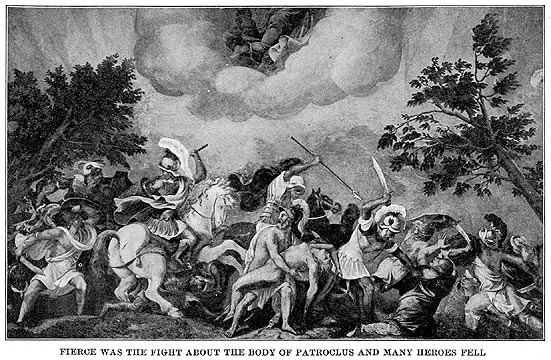
FIERCE WAS THE FIGHT ABOUT THE BODY OF PATROCLUS AND MANY HEROES FELL
Meanwhile Antilochus, son of Nestor, ran to Achilles and said, “I bring ill news; Patroclus lies low. The Greeks fight for his body, but Hector hath his arms.”
Then Achilles took of the dust of the plain in his hand, and poured it on his head, and lay at his length upon the ground, and tare his hair. And all the women wailed. And Antilochus sat weeping; but ever he held the hands of Achilles, lest he should slay himself in his great grief.
Then came his mother, hearing his cry, from where she sat in the depths of the sea, and laid her hand on him and said,—
“Why weepest thou, my son? Hide not the matter from me, but tell me.”
And Achilles answered, “All that Zeus promised thee for me he hath fulfilled. But what profit have I, for my friend Patroclus is dead, and Hector has the arms which I gave him to wear. And as for me, I care not to live, except I can avenge me upon him.”
Then said Thetis, “Nay, my son, speak not thus. For when Hector dieth, thy doom also is near.”
And Achilles spake in great wrath: “Would that I might die this hour, seeing that I could not help my friend, but am a burden on the earth,—I, who am better in battle than all the Greeks besides. Cursed be the wrath that sets men to strive the one with the other, even as it set me to strive with King Agamemnon! But let the past be past. And as for my fate—let it come when it may, so that I first avenge myself on Hector. Wherefore, seek not to keep me back from the battle.”
Then Thetis said, “Be it so; only thou canst not go without thy arms which Hector hath. But to-morrow will I go to Vulcan, that he may furnish thee anew.”
But while they talked the men of Troy pressed the Greeks more and more, and the two heroes, Ajax the Greater and Ajax the Less, could no longer keep Hector back, but that he should lay hold of the body of Patroclus. And indeed he would have taken it, but that Zeus sent Iris to Achilles, who said,—
“Rouse thee, son of Peleus, or Patroclus will be a prey for the dogs of Troy.”
But Achilles said, “How shall I go?—for arms have I none, nor know I whose I might wear. Haply I could shift with the shield of Ajax, son of Telamon, but he, I know, is carrying it in the front of the battle.”
Then answered Iris, “Go only to the trench and show thyself; so shall the men of Troy tremble and cease from the battle, and the Greeks shall have breathing-space.”
So he went, and Athene put her ægis about his mighty shoulders, and a golden halo about his head, making it shine as a flame of fire, even as the watch-fires shine at night from some city that is beseiged. Then went he to the trench; with the battle he mingled not, heeding his mother’s commands, but he shouted aloud, and his voice was as the sound of a trumpet. And when the men of Troy heard, they were stricken with fear, and the horses backed with the chariots, and the drivers were astonished when they saw the flaming fire above his head which Athene had kindled. Thrice across the trench the great Achilles shouted, and thrice the men of Troy fell back. And that hour there perished twelve chiefs of fame, wounded by their own spears or trampled by their own steeds, so great was the terror among the men of Troy.
Right gladly did the Greeks take Patroclus out of the press. Then they laid him on a bier, and carried him to the tent, Achilles walking with many tears by his side.
But on the other side the men of Troy held an assembly. Standing they held it, for none dared to sit, lest Achilles should be upon them.
Then spake Polydamas: “Let us not wait here for the morning. It was well for us to fight at the ships while Achilles yet kept his wrath against Agamemnon. But now it is not so, for to-morrow he will come against us in his anger, and many will fall before him. Wherefore, let us go back to the city, for high are the walls and strong the gates, and he will perish before he pass them.”
Then said Hector, “This is ill counsel, Polydamas. Shall we shut ourselves up in the city, where all our goods are wasted already, buying meat for the people? Nay, let us watch to-night, and to-morrow will we fight with the Greeks. And if Achilles be indeed come forth from his tent, be it so. I will not shun to meet him, for Mars gives the victory now to one man and now to another.”
So he spake, and all the people applauded, not knowing what the morrow should bring forth.
Thus did it come to pass that Achilles went again into the battle, eager above all things to meet with Hector and to slay him.
But Apollo stood by Æneas, and spake to him: “Æneas, where are now thy boastings that thou wouldst meet Achilles face to face?”
Then Æneas answered, “Nay, I have stood up against him in the day when he took the town of Lyrnessus. But I fled before him, and only my nimble feet saved me from falling by his spear. Surely a god is ever with him, making his spear to fly aright.”
Him Apollo answered again, “Thou, too, art the son of a goddess, and thy mother is greater than his, for she is but a daughter of the sea. Drive straight at him with thy spear, and let not his threats dismay thee.”
Then Æneas stood out from the press to meet Achilles and Achilles said, “Fightest thou with me because thou hopest to reign over the men of Troy, or have they given thee a choice portion of ground, ploughland and orchard, to be thine when thou hast slain me? Thou wilt not find it easy. Dost thou not remember how thou fleddest before me in the day that I took Lyrnessus?”
Then Æneas answered, “Think not to terrify me with words, son of Peleus, for I, too, am the son of a goddess. Let us make a trial one of the other.”
Then he cast his spear, and it struck the shield of Achilles with so dreadful a sound that the hero feared lest it should pierce it through, knowing not that the gifts of the Gods are not easy for mortal man to vanquish. Two folds, indeed, it pierced, that were of bronze, but in the gold it was stayed, and there were yet two of tin within. Then Achilles cast his spear. Through the shield of Æneas it passed, and though it wounded him not, yet was he sore dismayed, so near it came. Then Achilles drew his sword, and rushed on Æneas, and Æneas caught up a great stone to cast at him. But it was not the will of the Gods that Æneas should perish, seeing that he and his sons after him should rule over the men of Troy in the ages to come. Therefore Neptune lifted him up, and bore him over the ranks of men to the left of the battle, but first he drew the spear out of the shield, and laid it at the feet of Achilles. Much the hero marveled to see it, crying, “This is a great wonder that I behold with mine eyes. For I see my spear before me, but the man whom I sought to slay, I see not. Of a truth Æneas spake truth, saying that he was dear to the immortal Gods.”
Then he rushed into the battle, slaying as he went. And Hector would have met him, but Apollo stood by him and said, “Fight not with Achilles, lest he slay thee.” Therefore he went back among the men of Troy. Many did Achilles slay, and among them Polydorus, son of Priam, who, because he was the youngest and very dear, his father suffered not to go to the battle. Yet he went, in his folly, and being very swift of foot, he trusted in his speed, running through the foremost of the fighters. But as he ran Achilles smote him and wounded him to the death. When Hector saw it, he could not bear any more to stand apart. Therefore he rushed at Achilles, and Achilles rejoiced to see him, saying, “This is the man who slew my comrade;” and to Hector he cried, “Come hither, and taste of death.”
And Hector made answer, “Son of Peleus, seek not to make me afraid with words. For though I be weaker than thou, yet victory lieth on the knees of the Gods, and I, too, bear a spear.”
Then he cast his spear, but Athene turned it aside with her breath, and laid it again at his feet. And when Achilles leapt upon Hector with a shout, Apollo snatched him away. Three times did Achilles leap upon him, and three times he struck only the mist. But the fourth time he cried with a terrible voice, “Dog, thou hast escaped from death, Apollo helping thee; but I shall meet thee again, and make an end of thee.”
Then Achilles turned to the others, and slew multitudes of them, so that they fled, some across the plain, and some to the river, the eddying Xanthus. And these leapt into the water as locusts leap into a river when a fire which men light drives them from the fields. And all the river was full of horses and men. Then Achilles leapt into the stream, leaving his spear on the bank, resting on the tamarisk trees. Only his sword had he, and with this he slew many; and they were as fishes which fly from some great dolphin in the sea. In all the bays of a harbor they hide themselves, for the great beast devours them apace. So did the Trojans hide themselves under the banks of the river. And when Achilles was weary of slaying, he took twelve alive, whom he would slay on the tomb of Patroclus.
Yet there was one man who dared to stand up against him, while the others fled. This was Asteropæus, who was the grandson of the river-god Axius, and led the men of Pæonia. And Achilles wondered to see him, and said, “Who art thou that standest against me?”
And he said, “I am the grandson of the river-god Axius, fairest of all the streams on the earth, and I lead the men of Pæonia.”
And as he spake he cast two spears, one with each hand, for he could use either alike; and the one struck the shield, nor pierced it through, for the gold staved it, and the other grazed the right hand of Achilles so that the blood spurted forth. Then did Achilles cast his spear, but missed his aim, and the great spear stood fast in the bank. And thrice Asteropæus strove to draw it forth. Thrice he strove in vain, and the fourth time he strove to break the spear. But as he strove Achilles smote him that he died. Yet had he some glory, for that he wounded the great Achilles.
When the River saw that Asteropæus was dead, and that Achilles was slaying many of the Pæonians—for these were troubled, their chief being dead—he took upon him the shape of a man, and spake to Achilles, saying, “Truly, Achilles, thou excellest all other men in might and deeds of blood, for the Gods themselves protect thee. It may be that Zeus hath given thee to slay all the sons of Troy; nevertheless, depart from me and work thy will upon the plain; for my stream is choked with the multitude of corpses, nor can I pass to the sea. Do thou, therefore, cease from troubling me.”
To him Achilles made answer, “This shall be as thou wilt, O Scamander. But the Trojans I will not cease from slaying till I have driven them into their city and have made trial of Hector, whether I shall vanquish him or he shall vanquish me.”
And as he spake he sped on, pursuing the Trojans. Then the River cried to Apollo, “Little thou doest the will of thy father, thou of the Silver Bow, who bade thee stand by the men of Troy and help them till darkness should cover the land.” And he rushed on with a great wave, stirring together all his streams. The dead bodies he threw upon the shore, roaring as a bull roareth; and them that lived he hid in the depths of his eddies. And all about Achilles rose up the flood, beating full upon his shield, so that he could not stand fast upon his feet. Then Achilles laid hold of a lime-tree, fair and tall, that grew upon the bank; but the tree brake therefrom with all its roots, and tare down the bank, and lay across the River, staying its flood, for it had many branches. Thereupon Achilles leapt out of the water and sped across the plain, being sore afraid. But the River ceased not from pursuing him, that he might stay him from slaughter and save the sons of Troy. So far as a man may throw a spear, so far did Achilles leap; strong as an eagle was he, the hunting-bird that is the strongest and swiftest of all birds. And still as he fled the River pursued after him with a great roar. Even as it is with a man that would water his garden, bringing a stream from a fountain; he has a pick-axe in his hand to break down all that would stay the water; and the stream runs on, rolling the pebbles along with it, and overtakes him that guides it. Even so did the River overtake Achilles, for all that he was swift of foot, for indeed the Gods are mightier than men. And when Achilles would have stood against the River, seeking to know whether indeed all the Gods were against him, then the great wave smote upon his shoulders; and when he leapt into the air, it bowed his knees beneath him and devoured the ground from under his feet. Then Achilles looked up to heaven and groaned, crying out, “O Zeus, will none of the Gods pity me, and save me from the River? I care not what else may befall me. Truly my mother hath deceived me, saying that I should perish under the walls of Troy by the arrows of Apollo. Surely it had been better that Hector should slay me, for he is the bravest of the men of Troy, but now I shall perish miserably in the River, as some herd-boy perisheth whom a torrent sweeps away in a storm.”
So he spake; but Poseidon and Athene stood by him, having taken upon them the shape of men, and took him by the hand and strengthened him with comforting words, for Poseidon spake, saying, “Son of Peleus, tremble not, neither be afraid. It is not thy fate to be mastered by the River. He shall soon cease from troubling thee. And do thou heed what we say. Stay not thy hands from the battle, till thou shalt have driven all the sons of Troy that escape thee within the walls of the city. And when thou shalt have slain Hector, go back to the ships; for this day is the day of thy glory.”
Then the two departed from him. Now all the plain was covered with water, wherein floated much fair armor and many dead bodies. But Achilles went on even against the stream, nor could the River hold him back; for Athene put great might into his heart. Yet did not Scamander cease from his wrath, but lifted his waves yet higher, and cried aloud to Simois, “Dear brother, let us two stay the fury of this man, or else of a surety he will destroy the city of Priam. Come now, fill all thy streams and rouse thy torrents against him, and lift up against him a mighty wave with a great concourse of tree-trunks and stones, that we may stay this wild man from his fighting. Very high thoughts hath he, even as a god; yet shall neither his might nor his beauty nor his fair form profit him; for they shall be covered with much mud; and over himself will I heap abundance of sand beyond all counting. Neither shall the Greeks be able to gather his bones together, with such a heap will I hide them. Surely a great tomb will I build for him; nor will his people have need to make a mound over him when they would bury him.”
Then he rushed again upon Achilles, swelling high with foam and blood and dead bodies of men. Very dark was the wave as it rose, and was like to have overwhelmed the man, so that Juno greatly feared for him, lest the River should sweep him away. And she cried to Vulcan, her son, saying, “Rouse thee, Haltfoot, my son! I thought that thou wouldst have been a match for Scamander in battle. But come, help us, and bring much fire with thee; and I will call the west wind and the south wind from the sea, with such a storm as shall consume the sons of Troy, both them and their arms. And do thou burn the trees that are by the banks of Xanthus, yea, and the River himself. And let him not turn thee from thy purpose by fury or by craft; but burn till I shall bid thee cease.”