Book 4 — CHAPTER V. UNITED STATES.
Reading edition
The Future of America.—Obstacles in the Way of Progress.—Commercial Conditions Illustrated by Tariff.—Expense of Artistic Work.—Lack of Public Support.—American Marks.—Misrepresentation of American Wares.—Materials.—Early Use in England by Wedgwood, etc.—Cookworthy and a Virginian.—Native Use of Clay.—New Jersey.—Value of Clay Deposit Illustrated.—American Kaolin.—Vague Use of Word.—Analysis.—Opinions of American Deposits.
WE now approach the potters and artists of the present day. That there is a brilliant future in store for the ceramic art of America may be inferred from the rapidity with which it has been pushed forward to the stage it has already reached. With a limitless wealth of material at his command, and gifted with enterprise, originality, and taste, the American artist can look confidently forward to taking his place beside the best the world has produced.
And here it may be profitable to consider some of the obstacles in his way. The first of these is commercial. With a high protective tariff the home manufacturer is barely enabled to compete with the foreign producer in plain domestic wares. The import duty does not cover the greater expense of working in this country. Statistics show that in the items of labor and material the American manufacturer, as compared with the European, labors under a disadvantage of about one hundred per cent. In works of art this disadvantage is vastly increased. The makers of the tariff draw a distinction of only ten per cent. between white granite and decorated porcelain, or, in other words, they give the makers of artistic porcelain protection greater by twenty-five per cent. than that accorded the makers of granite. A distinction to the extent of five per cent. is drawn in the tariff between undecorated and decorated porcelain and parian. Art work, therefore, is benefited to the extent of one-ninth more than plain goods of the{443} same material. It need not be pointed out that art is thus protected less than workmanship, since the proportionate cost of artistic work, as compared with skilled and unskilled labor, is far greater here than in Europe. As a consequence, there is little to induce manufacturers to turn to art unless some profit can be drawn from the reputation which it brings. It is not intended to discuss here the question of protection versus free trade. The tariff is merely brought forward to illustrate the difficulty of rearing up something worthy of being called an American art. To demonstrate this by example, here (Fig. 429) is a porcelain plate made at Greenpoint on a challenge. It is a copy of a plate now in the possession of Mr. George Such, of South Amboy, by whom it was purchased at the sale of the effects of Louis Philippe. The original is from Sèvres, and is decorated chiefly in gold. The Greenpoint copy was made in order to test the question whether it were altogether unreasonable to entertain the hope that American decoration might not—at some future day, of course—equal that of Sèvres. Those who saw both had some difficulty in distinguishing the original from the copy, and in some instances could not do so without examining the ware as well as the decoration. The copy is a remarkably fine specimen of decorative art, and would lead us to entertain great expectations regarding the work of the artist when his skill is devoted to original designs.
Fig. 429.—Greenpoint Porcelain. Sèvres Decoration.

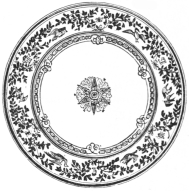
The challenge made was, therefore, fully answered. Should it be asked why, under these circumstances, similar work should not be done regularly, the answer is simple. The existing state of the market, in so far as the demand for American artistic work is concerned, is such that prices will barely bring back the actual cost of production. Toward lessening that cost the efforts of manufacturers must be directed; and in connection with this subject a remark may be quoted, made by President T. C. Smith at the Convention of the Potters’ Association:{444} “Foreign clays can be put down in New York tide-water cheaper than you can buy Pennsylvania clays, by about fifteen per cent.”
The great expense attending the production of works of art is not, however, the only drawback with which the American manufacturer has to contend. It may, in fact, be said that the impediments to the rapid advancement of ceramic art in America have not yet been touched upon. They consist of neither the lack of capital, enterprise, experience, nor skill.
It is a singular fact that while native manufacture advances with rapid strides, and finds on all sides a public ready to give it a hearty reception, native art must force its way to recognition. Its first honors must be won abroad. It must bear a foreign stamp to be accepted at all in the home of its birth. The cause of this is not far to find. The American market is a good market, and is so regarded by the world at large. Foreign artists send their works to it, and are sure of a welcome. Competition by a native superior is thereby made difficult; by an equal almost impossible; by an inferior, an absurdity. The foreign competitor comes branded as a genius, and home critics hesitate about issuing a verdict in favor of a countryman. They appear to have a lack of confidence in their own judgment, and would rather endorse or modify another’s opinion, than take the responsibility of issuing an independent one of their own. Patrons suffer from a similar diffidence. On the one hand they see certainty, on the other uncertainty. On this side is the work of one who has won the praise of all Europe; on the other, nothing but that of one who makes a direct appeal to their own discrimination.
Under such conditions it is difficult for an art to struggle into existence. French art is to a Frenchman the finest and best the world ever saw. Englishmen support English art because it is their own. They are satisfied with it, if all the universe should wonder what it is they nurse and cherish. It is good to them, and that is enough. If their own opinion should change, it will then have become a curiosity, and therefore doubly worthy of their care. American art may be good, even equal to the best, but unfortunately it is American. Receiving no notice, the artist loses even the benefit of criticism, and concludes that his own people compliment themselves by believing that no work of art can be produced among them.{445}
This may appear overdrawn, but the facts are eloquent. It has been said that, as a rule, Americans take a pride in their own manufactures. That of pottery is an exception. Almost anywhere granite-ware can be seen bearing as a mark the royal arms of England, with the motto in full—in this case very appropriately—honi soit qui mal y pense. It is a curious mark for an American potter, or at first sight seems so. The ware may have been made at Trenton, or anywhere else in America, and the explanation is simple. The dealers will not buy it without that mark, and first suggested its use as they would order a certain style of decoration. Inquiry among the dealers brings out the whole truth. Their customers look for the English mark, and finding it, are satisfied. After this we need not inquire if the English granite-ware is superior to the American. There is no question of superiority or inferiority, but only one of the potency of a name.
Again, in the matter of porcelain, that made and decorated in this country is sold every day for French, German, or English. It is, in fact, “all things unto all men,” according to the requirements of the purchaser and the ingenuity of the dealer. In some cases it is bought plain, and decorated, after it leaves the factory, in the various foreign styles. No objection is ever made to its appearance, its finish, purity, durability, or decoration, only it has the misfortune to be American, and its parentage must be concealed at all hazards, and even in spite of the manufacturer’s mark. Here, again, there is no question of quality, but only one of the effect of a name.
To discuss the objectionable part of misrepresentation is away from the present purpose, and the deduction from these facts is the only thing now requiring to be made. They argue that upon their merits there are wares produced in America which, if made anywhere else, would cope with the corresponding qualities now imported.
For artistic works the struggle is still harder. In their case the test is not practical, but critical. They demand taste, and not use, to be appreciated; and, as a consequence, very rarely receive the recognition to which they are entitled. Art grows slowly, and, especially in a country so largely interested in commerce as America, is long in reaching its maturity. Looking at it aright, there is all the more reason why, when it makes its appearance, it should be received with{446} warmth and treated with deferential respect, in order that its growth may be hastened and not retarded. America is, in this respect, an exception to the nations of the earth. The question may be looked at from various points of view. The patriotic course would certainly be to encourage, and not by neglect to stifle, a budding art. If the art be poor, it stands in all the greater need of encouragement, in order that, for America’s sake, it may rise to an equality with that of other countries.
In France, Germany, Prussia, Russia, Italy, China, and England, the ceramic art received the support of governments and wealthy patrons, and the result has been recorded. In America such support is neither given nor required. What is chiefly needed is appreciation. In the Republic the people are the rulers and patrons. In their hands are both power and wealth, to be used in the rearing of art, surely with as much discrimination and judgment as in the monarchies of Europe and the Orient. We might say from another stand-point that the earliest works in any branch of the arts are those of the highest value in the future. They reveal to the historian the foundations of the eminence from which he views the past, and that eminence America will undoubtedly attain. The skill now being developed, and the taste now being cultivated, are the legacy of the present generation to the next, and future attainments will be but the interest of present struggle and endeavor.
These considerations, however, are, in a certain sense, extraneous. The American artist and artist-manufacturer demand no exceptionally favorable position, nor that their works shall be viewed in any other than a fairly critical and commercial light. Prejudice in art is the end of criticism; prejudice in commerce is suicidal.
The materials for making every kind of ware are found in different parts of the country, and the industry is for that reason well distributed. As early as 1766 American clays were imported into England, captains on their return voyages often taking samples from the Carolinas, Georgia, and Florida. Many of these reached Wedgwood, who, in allusion to one of them, says, “It will require some peculiar management to avoid the difficulties attending the use of it.” He elsewhere avows his willingness to make all necessary experiments with American clays. These trials turned out well, as we find him{447} making arrangements for a regular supply from Ayor, in the country of the Cherokees, about three hundred miles from Charleston. He desired a monopoly by patent or parliamentary grant, but ultimately sent out an agent, of whom we learn nothing more, except that he began his journey to the Cherokee deposit. In October, 1768, a cargo of Carolina clay reached Liverpool, and the trade became general both in the Cherokee and Pensacola clays, Wedgwood apparently giving the preference to the latter. What use he made of it is not precisely stated. More interesting is the fact that America contributed to Cookworthy’s invention of natural porcelain in England in 1760. It is said that an American showed Cookworthy, in 1745, specimens of both kaolin and petuntse found in Virginia, and samples of the ware made from them. Cookworthy’s own account of it is slightly different, inasmuch as lie only mentions having seen specimens of the manufactured china. He says: “I had lately with me the person who has discovered the china earth. He had with him several samples of the china ware, which I think were equal to the Asiatic. It was found on the back of Virginia, where he was in the quest of mines; and having read Du Halde, he discovered both the petuntse and the kaolin. It is this latter earth which he says is essential to the success of the manufacture. He is gone for a cargo of it, having bought from the Indians the whole country where it rises.” Mr. Cookworthy was not favorably impressed by the gentleman from Virginia, of whom no more is heard. Nor does it appear that he returned to England with the cargo, which he thought he could land there at about sixty-five dollars per ton. There is one purely American feature of the story, and that is the purchase from the Indians of “the whole country where it rises.”
The final practical effect of Mr. Cookworthy’s association with this American was the foundation of the English porcelain industry. The acknowledgment is thus made in the catalogue of the Museum of Practical Geology: “The great advance of the porcelain manufacture in England is due to the discovery of the kaolin of Cornwall by William Cookworthy, of Plymouth, about 1755. He apparently had his attention directed to the subject by an American, who showed him samples of china-stone and kaolin from Virginia, in 1745.” One hundred and thirty-two years later, the country from which the suggestion{448} came is importing kaolin from that which received and acted upon it.
New Jersey is the only State of the clay deposits of which we know much historically or have any precise information. The facts here presented are gleaned from a report issued by the State Geological Survey, and will give an idea of the value of our native clays. It is stated, on the authority of Mr. Samuel Dally, of Woodbridge, that the clay there was known to the soldiers before and during the Revolution, and that, when stationed at Perth Amboy, they called it fuller’s-earth, and used it for cleaning their buckskin breeches. In 1800 the South Amboy clay was dug for making stone-ware, and after 1812 the use of New Jersey clays for fire-bricks and other refractory materials began. Soon after 1816, Mr. Price was shipping fire-clay from Woodbridge to Boston, to be used in making fire-bricks. About 1820, Mr. Jacob Felt, of Boston, bought fifty tons of Woodbridge clay from Jeremiah Dally, at twenty-five cents per ton, and so started a regular trade, which was maintained for many years. The Woodbridge deposit is very rich, and is now extensively worked, the clay being suitable for different purposes. It can be used as fire and pipe clay, or for white-ware, and also meets the requirements of paper-makers. In 1835 the same clay was in use by Howell & Bros., Philadelphia, for satining wall-paper. Gordon, in his Gazetteer (1833), speaks of a discovery of extensive beds of white pipe-clay between Woodbridge and Amboy; but even in 1840 its extent and uses were not fully known. Coming down to 1855, we find clay for fifty millions of fire-bricks being taken from the pits at Woodbridge, Perth Amboy, and South Amboy; 2000 tons for the paper-makers; 2000 tons for making alum, and a large quantity for fine pottery. In 1868 the aggregate production had doubled. In 1874 265,000 tons of fire-clay were dug, and brought, at an estimated average price of $3 50 per ton, $927,000; 20,000 tons of South Amboy stone-ware clay, at $4 per ton, brought $80,000. These figures are sufficient for the formation of an opinion of the worth of a good clay deposit.
With regard to the materials to be obtained in this country, it may be premised that, from a vague use of words having an otherwise definite meaning, it has been difficult to obtain satisfactory information upon some of the most interesting points. The following extract is{449} taken from a report upon the pottery industry, by the secretary of the United States Pottery Association to the Industrial Directory for 1876: “The clay, or kaolin, mines of the United States have been wonderfully developed the past few years. Rich and inexhaustible beds of fine kaolin are now being worked in the following States: Delaware—three extensive deposits; Pennsylvania—three very fine mines are worked, and the whole of Chester County abounds with as fine a deposit as England can boast; Illinois, Missouri, and Indiana can boast of rich deposits also now being worked; New Jersey abounds in ball-clay, common white-ware clay, and all kinds of fire and retort clays; while Maine, Connecticut, and Maryland furnish felspar in abundance, and Pennsylvania and Maryland endless quantities of quartz or silica. Every section of the country, from the Rocky Mountains to the State of Maine, has raw material in great variety, as yet unimproved.” In view of these statements, it may appear singular that the Union Porcelain Works at Greenpoint are consuming large quantities of imported kaolin. To explain this, we must believe the word kaolin in the above extract to be applied to the native clay as found, and before it is freed from any impurity. This belief is supported by M. Ch. de Bussy, one of the French members of the International Jury at the Centennial Exhibition. In his report he says: “Les matières premières pour la poterie sont abondantes aux États-Unis. Des dépôts de kaolin sont exploités dans un grand nombre d’États, principalement dans ceux de New Jersey, Delaware, Pennsylvania, Illinois, Georgia. Plusieurs des matières désignées sous le nom de kaolin ne sont pas toutefois le produit de la décomposition du feldspath in situ; ce ne sont à proprement parler, que des argiles blanches qui ne peuvent servir à la fabrication de la porcelaine que par leur association à du feldspath et du quartz.” He then goes on to say that the kaolin is not prepared with sufficient care, and that for that reason the Greenpoint factory uses for its table porcelain a great deal of English kaolin.
Another reason is that the English clay can always be depended upon, and that the native, for lack of proper preparation, cannot. The general conclusions of M. Ch. de Bussy are confirmed by investigations made here. The above mentioned report by the Geological Survey, embracing all or the greater number of the clays of the State{450} of New Jersey, gives much valuable information, and farther substantiates our view. The following table has been compiled from the data there given, for the purpose of comparing the imported kaolin with the New Jersey clays, and thus arriving at the truth upon this point:
Cornwall, England. Cornwall.Standard Kaolin. Redruth, Cornwall. Perth Amboy. Staten Island.Washington.
Silica 46.32 46.29 46.00 28.40 77.10 92.70 99.40
Alumina 39.74.... 40.00 24.11 17.10 5.70 7.80
Water 12.67.... 13.00 7.90 4.50 0.70 2.60
Potash............ 0.96 1.30 0.35....
Line 0.36 0.50 0.33................
Magnesia........ 0.33................
Iron 0.27 0.27 0.33 0.79............
Titanic Acid............ 0.20............
Sand............ 37.80............
1 2 3 4 5 6 7
No. 4.—This clay is used with others to give toughness to vessels to be exposed to sudden changes of temperature.
Nos. 5, 6, and 7.—In these the silica and sand are added together, and the alumina includes the iron.
In the selected clays of New Jersey the great preponderance of silica at once attracts attention, and is to be attributed to the admixture of sand, which averages about seventy-five per cent. of the mass. Whenever the silica is present in a greater amount than the standard percentage given in the table, and particularly when it appears in the form of sand, the clay becomes less fit for making fine ware. The body is proportionately coarser. The Jersey clay, therefore, although locally dignified with the name of kaolin, cannot be used by the manufacturer of porcelain.
The deposit has been made under less favorable circumstances than that of south-western England. There nature has to a great extent performed the washing process, by carrying the decomposed felspar along a valley and dropping the impurities and coarser ingredients by the way. The artificial process is simply the counterpart of that of nature. In New Jersey the clay and quartz-sand are in some places deposited together, and are then miscalled felspar; in others they have been partially assorted, the fine particles being deposited in one bed, the quartz-sand in another. An analysis of three specimens{451} of this “felspar” shows the following ingredients, the decrease of sand and increase of alumina being especially noteworthy:
Silicic Acid and Quartz-sand75.8874.0077.40
Alumina18.9517.5516.07
Water4.906.304.30
Iron0.490.540.53
Magnesia..........0.25
Potash0.150.120.15
Soda0.210.21.....
Titanic Acid.....0.90.....
100.58 99.62 98.70
These tables will explain the language of the report, that the New Jersey “kaolins” are “simply mica-bearing sands,” and that the felspar “is more properly a kaolin.” “The so-called kaolin is a micaceous sand, consisting of fine-grained white quartz-sand, mixed with a small and varying percentage of white mica, in small flakes or scales, and a very little white clay.” In other words, there is no New Jersey clay entitled to the distinctive name of kaolin, and the inveterate misapplication of the word illustrates the difficulty to be encountered by the inquirer into this matter. M. de Bussy, for example, in the passage quoted, falls very naturally into the error of classing New Jersey with the “large number of States in which deposits of kaolin are found.” His mistake, and the confusion of terms which led to it, makes it all the more desirable that something definite should be known of the deposits in other States.
As to the deposits of Pennsylvania and the West, there appears to be considerable difference of opinion, but the existence of clay for making every kind of ware, from drain-pipes to porcelain vases, is beyond all doubt. A partial analysis of Georgia kaolin showed that in the leading ingredients of silica and alumina it approached very nearly the standard given in the table. The whole question appears to be one of analysis, preparation, and experiment, so that when the manufacturers buy clay for a special purpose, they can depend absolutely upon what they obtain.
Mr. T. C. Smith, of Greenpoint, is so confident of the richness of this country, that he believes kaolin of the best quality exists in abundance, and that it will in course of time be an article of export.
At the Centennial Exhibition, Mr. Laughlin, of East Liverpool,{452} Ohio, appeared as one of the representatives of Western enterprise. He thinks the varieties of clay in America outnumber those of all the rest of the world. At East Liverpool all the varieties are used. A new clay found in Missouri, and expected to be very valuable, has recently been added to the list. It gives the paste a peculiar softness of color, and lends additional beauty to the manufactured ware. Mr. Laughlin said nothing of exporting clays, but thought it highly probable that European capital would be brought into this country to work the inexhaustible materials which it contains for every kind of ware. What are wanted to render these kaolinic treasures available are the enterprise, skill, and capital to prepare and compound them. It is, at least, suggested that this is the greater part of the difficulty, and that if the peculiar qualities of each deposit were more precisely known, if the crude material were skilfully cleaned, and experiments were systematically conducted for the purpose of discovering the combinations necessary for making a true and regular porcelain clay, there would be no necessity for going away from home for any ingredient of the requisite porcelain paste. This supposition is borne out by the fact that a few years ago a number of American potters attempted to make porcelain with kaolin brought from the South, and in every instance failed. Others have since met with success more or less complete. Böttcher did not succeed on his first attempt, and, in fact, it was not until several years after his death that the best Dresden ware was made. In a similar manner, experiment alone can enable American potters to avail themselves of the undoubted wealth of their own country. Meantime, it is noteworthy that the deposits of all kinds now being worked are of sufficient value to maintain a number of mills for levigating, drying, and grinding. Several are on the Susquehanna, in Maryland; at East Liverpool, Ohio; at Fort Ann, New York; on the Connecticut River; and at Trenton, New Jersey.{453}
POTTERY.
Dependence upon England.—Wedgwood’s Fears of American Competition.—Norwich.—Hartford.—Stonington.—Norwalk.—Herbertsville.—Sayreville.—South Amboy.—Philadelphia.—Baltimore.—Jersey City.—Bennington.—New York City Pottery.—Trenton.—Present Extent of Industry.—Trenton Ivory Porcelain.—Terra-cotta.—Beverly.—Chelsea.—Portland.—Cambridge.
The few known incidents in the development of the art may be stated as nearly as possible in chronological order; and, to keep the thread of the narrative unbroken, reference may at the same time be made to the early and unsuccessful attempts at establishing the manufacture of porcelain in conjunction with that of pottery. During the eighteenth century the records open to our inspection, especially the journals of the day, make occasional references to imported wares, chiefly of English manufacture. Mr. Marryat, in treating of English pottery, refers to the popular indifference in England to the advantages of crockery over pewter dishes and wooden trenchers. He then says, “The introduction of stone-ware in the sixteenth century, and of Oriental porcelain in its imitation delft-ware shortly afterward, and, lastly, the Staffordshire earthen-ware, gradually expelled pewter dishes and plates, though it is but recently they have been entirely dismissed.” Popular usage in America followed a parallel course, and there are many places at which the substitution of crockery for wood and metal was made within the memory of persons now living. Mr. J. F. Watson, in his “Annals of Philadelphia,” describing the furniture of a room of presumably about a century ago, gives some interesting particulars in regard to this subject. “One corner,” he says, “was occupied by a beaufet, which was a corner closet with a glass door, in which all the china of the family and the plate were intended to be displayed for ornament as well as use. A conspicuous article in the collection was always a great china punch-bowl, which furnished a frequent and grateful beverage; for wine drinking was then much less in vogue. China teacups and saucers were about half their present size; and china teapots and coffee-pots with silver nozzles were a mark of superior finery. The sham of plated ware was not then known, and all who showed a silver service had the massive metal too. This occurred in the wealthy families, in little coffee and{454} tea pots; and a silver tankard for good sugared toddy was above vulgar entertainment. Where we now use earthen-ware, they then used delft-ware, imported from England; and instead of queen’s-ware (then unknown) pewter plates and porringers, made to shine along a dresser, were universal. Some, and especially the country people, ate their meals from wooden trenchers.” This passage may be taken as affording a faithful view of American usage in regard to the different points upon which it touches, not in Pennsylvania alone, of which Mr. Watson is more particularly treating, but throughout the country. China was still an article of luxury, in which only the rich could indulge. We are, therefore, prepared to find that it was not until the close of the last century, and after the Revolutionary troubles, that crockery assumed any importance as an article of commerce between England and the United States. For a long time prior to that period it is reasonable to suppose that America had been able to satisfy the home demand for all the coarser wares, and also for bricks; but at the close of the eighteenth century the manufacture had made little or no progress. It had not advanced beyond the production of bricks, tiles, and certain kinds of coarse stone-ware and pottery. It is, to say the least, amusing to find Wedgwood, in 1765, expressing fears for England’s earthen-ware trade with America, on account of the establishment of some “new Pottworks in South Carolina.” “They have,” he said, “every material there, equal if not superior to our own, for carrying on that manufacture;” and on these and other grounds he asked if something could not be done to protect the home manufacture!
Miss Meteyard, Wedgwood’s biographer, relates that in 1766 a Mr. Bartlem, a Staffordshire potter, emigrated to South Carolina, and having induced several workmen to join him, began his trade in that State. He failed there, as he had done in England, and a similar fate befell an enterprise which had for its object the establishment of china works in Pennsylvania.
Previous to 1796 both earthen and stone ware were made by Mr. Charles Lathrop at Norwich, Connecticut; and in 1789 Mr. Samuel Dennis made an unsuccessful application for State aid in founding a stone pottery in Connecticut, at which he promised to make ware resembling the Staffordshire queen’s-ware. The industry was also pursued at Hartford by Isaac Hanford, at Stonington by Adam States,{455} and at Norwalk. Shortly afterward, or in the first decade of the present century, ware of an apparently higher class began to be made in the Eastern States, and although large quantities continued to be imported from England, the native wares rapidly improved in quality and increased in quantity.
About the year 1800, Van Wickle’s stone-ware factory was in operation at Old Bridge, now Herbertsville, New Jersey. The clay used was obtained from Morgan’s Bank at South Amboy. Two years later a similar factory, using the same material, was started by the Prices at Roundabout, now Sayreville, on the Raritan. In 1833 J. R. Watson, of Perth Amboy, established a factory of fire-brick, and was working it regularly three years later.
The workshop now carried on by Mr. Richard C. Ramey at Philadelphia is one of the oldest stone-ware factories in America. It turns out a good quality of fire-brick and ware for chemical purposes. A few other Philadelphia firms may here be noticed. Harvey & Adamson make a strong and durable quality of stone-ware, with a hard vitreous glaze (grès cérames), and artistic terra-cotta. Jeffords & Co., of the same city, manufacture an excellent grade of fine stone-ware for household purposes, and table wares. The pieces have usually mouldings in relief, and are colored brown or yellow on the outside and white inside. The latter is apparently produced by making use of an engobe of very white clay. Galloway & Graiff make earthen-ware of various kinds, including terra-cotta in Greek shapes. Moorhead & Wilson have very extensive clay works at Spring Mills, and manufacture terra-cotta for building purposes. They also make terra-cotta vases, after the antique, for decorators.
At Baltimore good qualities of common earthen-ware and salt-glazed stone-ware are made by Perrine & Co.
Fig. 430—Jersey City Earthen-ware Pitcher.
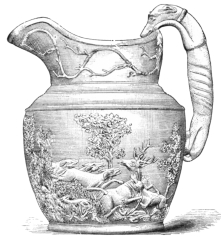
About 1825 a factory of natural porcelain was founded by a number of Frenchmen in Jersey City. We have a specimen of this porcelain, made in 1826—a small bowl, with excellent body and glaze, and decorated with a gold band round the outside of the rim. The venture did not prove a success, and the production ceased within a year or two. In 1829 the works were assumed by David Henderson & Co., and carried on under the firm of the American Pottery Company. It was here that the throwing and turning of earthen-ware upon the{456} English principle was first performed in America, by William and James Taylor. This was also the first successful attempt to compete with England, and was made in connection with the manufacture of a yellow ware. Three years later, or in 1832, the same potters were making a cream-colored ware chiefly from imported materials. To the decoration of a white ware the English process of printing was successfully brought, and a brown earthen-ware, made about the same date, was variously ornamented with reliefs and colored enamels. Three specimens of the latter are in the Metropolitan Museum. One consists of a water-pitcher modelled by Daniel Greatbatch (Fig. 430), with the handle in shape of a hound, and a hunting scene in relief, and belongs to the earlier period of the factory. About 1845 a change appears to have taken place in the proprietorship, as we then find the company consisting of Messrs. William Rhodes (whom we shall meet again in Trenton), Strong, and M’Gerron. The firm made white granite and cream-colored ware until 1854. At that time the pressure of foreign competition was so great that they could not gain a foothold in the regular trade. Their wares were chiefly sold by peddlers and itinerant dealers, who were in the habit of going to the factory with wagons, when they knew that a kiln was to be drawn, and carting off the goods before they were trimmed. Rhodes resigned in 1854, and went to Vermont; and the remaining partners sold out, in 1855, to Rouse, Turner, Duncan & Henry, of whom Messrs. Rouse & Turner are now carrying on the establishment. The popularity occasionally reached by a single form was, perhaps, never better exemplified than by the brown pitcher above mentioned. It is made down to the present time, and has become so identified with the factory, that, when wishing to send a memento to his{457} friend Mr. John Haslem, of the Derby Works in England, Mr. Rouse thought he could not do better than send him one of these pitchers, of a size larger than ordinary. The present firm have not used any imported clay for the past fifteen years. They now obtain spar from Connecticut, flint from Lantern Hill, Connecticut, China clay from South Carolina, and other clays from New Jersey. The staple of the factory is granite-ware, for which a peculiar ivory-colored glaze has recently been adopted. Parian is also made. The Jersey City biscuit is extensively consumed by decorators, and some new and very handsome shapes have been designed for this special branch of trade (see Fig. 457).
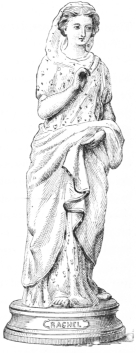
Fig. 431.—Porcelain Statuette, New York City Pottery.
Messrs. Lyman, Fenton & Co. embarked, in 1847, in an enterprise at Bennington, Vermont, which promised to be a commercial success. They made both pottery and artificial porcelain. The enamel upon certain specimens of the former in the Metropolitan Museum, and belonging to the Trumbull-Prime collection, is of a notably good quality. The works stopped, after running for about twelve years.
The oldest establishment in New York is the Hudson River Pottery, in West Twelfth Street. It was founded in 1838, and is now carried on under the firm of William A. Macquoid & Co. The only products, until within a year ago, were stone-ware and glazed earthen-ware. At that time the demand by decorators for terra-cotta in the choicest antique forms led the firm to add it to their list of productions. The experiment was successful. The paste is fine and well worked.
The “Manhattan Pottery” of Stewart & Co., in West Eighteenth Street, New York, is engaged chiefly in the production of drain-pipes and terra-cotta. The former are glazed with “Albany slip,” obtained from the bed of the Hudson at Albany, which{458} renders them perfectly impervious to the action of acids.
Fig. 432.—Iron-stone China Plaque.
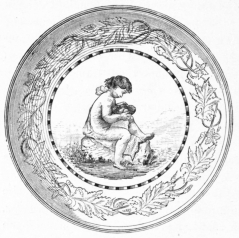
Fig. 433.—New York City Pottery. Lambeth style.
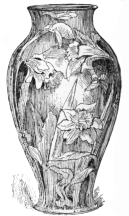
Mr. James Carr, of the New York City Pottery, after working for some time with the American Pottery Company, in Jersey City, went, in 1852, to South Amboy, and founded an establishment for making yellow, Rockingham, and cream-colored ware. Twenty-two years ago he removed to his present premises in West Thirteenth Street, New York. Mr. Carr makes use of six or seven different bodies, all composed of American materials. Some time ago he made a few pieces, including a tea-service and two statuettes (Fig. 431) of artificial porcelain, using bone and kaolin from Chester County, Pennsylvania. The table-pieces are decorated with festoons of flowers, in pink and green, and a rim of blue and gold. The statuettes are well modelled and very tastefully colored. The staple product of the factory is stone china, which is largely sought in biscuit by decorators. The quality is probably as fine as it is possible to make stone china, and styles of decoration are followed which are rarely found on a similar body. Dinner-services are decorated with all the care usually reserved for porcelain, and many ornamental pieces, including a series of circular plaques, show admirable taste and workmanship (Fig. 432). A third quality of ware is called “Semi-china,” and is nearly as translucent as porcelain. It is made from American kaolin clay, with a large admixture of felspar. It is decorated in styles{459} similar to those found upon the iron-stone china. Mr. Carr also makes statuettes and busts in terra-cotta, of a warm, rich tint, and in a fine, partially translucent parian. Besides these, the works produce cream-colored ware and majolica. The latter is made into a great variety of forms—jars, pedestals, seats, boxes, and cups, the leading colors of which are a clear deep blue, yellow, and green.
Some of the colors found upon iron-stone china pieces are remarkably good, notably a fine mazarine blue and a brilliant black. Artistic work of all kinds is receiving attention. Mr. Carr has made many experiments, and continues making them with unremitting ardor (Fig. 433). Beginning to work at a time when the mechanical difficulties in the way of success seemed insuperable, he gradually extended his efforts as these difficulties disappeared, and is now reaching toward the higher forms of the art. The story of his life is the history of modern American pottery.
The history of Trenton is interesting from the enormous development of the manufacture in that city within a very short space of time. The business was begun in 1852, by the firm of Taylor & Speeler. Taylor is said to have made the first porous cup at Jersey City, for Professor Morse’s experiments. This honor is also claimed for the Robertsons of Chelsea, Massachusetts. But leaving that question in the mean time, it would appear that the Taylor here spoken of is the same whom we have seen at work as a thrower with the American Pottery Company. The Trenton firm made yellow and Rockingham ware, with which they were successful from the first. They also attempted porcelain and parian; but these wares, though of fine quality, were not received with such favor as to make their production a commercial success. This resulted, in all probability, from the difficulties attending the manufacture. Since their day the business has almost entirely turned toward another class of white goods, the granite-ware in common use, and for a long time no attempts to manufacture porcelain were made except in the way of experiment. This was done by nearly every firm in the business.
Taylor & Speeler were making white granite in 1856, but only to a limited extent, and in connection with yellow-ware and Rockingham. A medal was awarded them for the manufacture of superior pottery. This honor was conferred in 1856, by the Franklin Institute{460} of the State of Pennsylvania. The medal is now in Mr. Taylor’s possession. As a memento of the skill shown in the early days of American pottery it will bear description. It is made of silver, and has on one side the inscription, “Reward of skill and industry to Taylor, Speeler & Bloor, Trenton, New Jersey, for china, granite, and earthen ware, 1856.” On the obverse is a likeness of Benjamin Franklin, and the words “Franklin Institute of the State of Pennsylvania, 1824.” To Mr. Taylor, the senior partner of the firm, the credit is due of first firing a kiln with anthracite coal.
The factory is now called the Trenton Pottery Works. Mr. Bloor joined the original firm of Taylor & Speeler in 1854, and retired in 1859. Soon afterward Mr. Speeler sold out to John F. Houdayer, and in 1870 the firm consisted of Mr. Taylor and John Goodwin. A year later Mr. Goodwin was bought out by his son, James H. Goodwin, and Isaac Davis, the latter of whom soon afterward acquired Goodwin’s share, and in 1875 became sole proprietor by purchasing Mr. Taylor’s interest. Mr. Davis, like several others of the older Trenton potters, is an Englishman, and the fact is noteworthy, in view of the opposition to goods of American manufacture. It shows how blind was the prejudice which, there being no question of the excellence of American materials, will not concede to an Englishman in America the skill and ability of the same Englishman in England. Mr. Davis went to Trenton from Staffordshire in 1862, worked first with William Young & Sons, formed a copartnership with George Lawton, upon a capital of $300, joined the Glasgow Pottery Company, and then, as we have seen, bought an interest in the firm of Taylor & Goodwin.
The first to make cream-colored ware for the market were William Young & Sons, Astbury & Millington, who comprised the firm which, in 1853, laid the foundation of an industry which has since attained to enormous dimensions. They had large orders for strawberry bowls from a trucker near Rocky Hill, and these they fired in Taylor & Speeler’s yellow-ware kiln. The business, although greatly increased, has not changed its character, and is at the present time carried on by William Young’s sons.
Of the original partners Astbury formed a copartnership with Mr. Maddock, and the present firm is Astbury & Maddock, of which the{461} latter is the only surviving partner. Its chief product is sanitary and druggists’ ware, and experiments are also made with American kaolins—those of Missouri, Pennsylvania, and other States—with a view to the manufacture of a true American porcelain. Decorating and printing are now receiving a considerable amount of attention. Mr. Millington, also of the old firm, resigned, and founded the pottery now bearing his name.
The first pottery fitted up for the exclusive manufacture of white granite and cream-colored ware was that of Rhodes & Yates, in 1859, at the present City pottery, on Perry Street. This Mr. Rhodes is the same one who was partner in the Jersey City pottery. On going to Vermont, in 1854, he established the manufacture of white-ware, and remained there until the fall of 1859, when he joined Mr. Yates in a new enterprise in Trenton. The previous history of the City pottery is a story of continuous changes. At one time it was occupied by William Young & Sons, who were making porcelain hardware trimmings. In 1853 it was purchased by Mr. Charles Hattersley, and in 1856 passed into the possession of Mr. Yates, who leased it to James and Thomas Lynch. For two years they occupied it as a drain-pipe factory, and in 1859 it was assumed by Mr. Yates, in partnership with Mr. Rhodes. In putting granite and cream-colored ware upon the market, the firm had many obstacles to overcome. Chief among them was the all-prevailing prejudice of dealers and consumers in favor of imported goods. Success, however, came in course of time. An entrance was forced into the market, and other firms which rapidly sprung into existence seconded their efforts in securing for Trenton a remunerative recognition in the white-ware trade. Meantime several changes took place in the firm of Rhodes & Yates. Mr. Higginson became leading partner, and in 1865 the firm was Yates & Titus, which was changed, in 1870, to Yates, Bennett & Allen, and in the fall of 1875 to the City Pottery Company, of which Mr. Yates and Mr. John Rhodes—a son of William Rhodes—are two of the partners. The period of seven years between Taylor & Speeler’s venture and that of Rhodes & Yates may be called the infancy of the Trenton manufacture. Since that time the production has increased year by year, and Trenton well deserves the title conferred upon it of “The Staffordshire of America.” Its annual productive capacity is about{462} two and a half millions, and during 1876 the actual production was about $1,750,000. There are, in all, nineteen potteries in the city, and several decorating establishments. To illustrate what is now being done, and to indicate the new channels which the industry is seeking, a few of the leading factories may be referred to.
The Etruria Pottery Company is now working the factory built, in 1863, by Messrs. William Bloor, Joseph Ott, and Thomas Booth. Mr. Booth retired in 1864, and was succeeded by G. S. Burroughs, who, in 1865, withdrew and made way for J. Hart Brewer. In 1871 Mr. Bloor retired, and the firm of Ott & Brewer remained in possession until January, 1878, when the Etruria Pottery Company was organized. Until 1876 the staple products of the factory were white granite and cream-colored ware. Its ivory porcelain and parian will be noticed hereafter.
The Glasgow Pottery of John Moses & Company sends out an immense quantity of white granite and cream-colored ware, and experiments are also conducted, chiefly with Pennsylvania kaolin, with a view to making porcelain. That now regularly made is called semi-porcelain, and many trial pieces have a pure translucent body and excellent glaze.
The firm of Coxon & Co. was founded, in 1863, by Mr. Charles Coxon, and is now composed of his widow, J. G. Forman, and S. M. Alpaugh. Mr. Coxon began with cream-colored ware, and conjoined it with white granite toward the end of 1863. Since that time the firm has produced both qualities.
One of the later establishments is the Mercer Pottery, built in 1868, of which Mr. James Moses is sole proprietor. Besides the common grades of earthen-ware, stone china and semi-porcelain are made and decorated. There is a decided tendency here toward the production of a finer quality of ware, and of styles of decoration possessed of artistic merit.
At the Arsenal Pottery Mr. Joseph Mayer manufactures Rockingham and brown stone-ware, and is in the possession of a number of excellent designs. Of the remaining Trenton potteries—the East Trenton Pottery Company, the American Crockery Company, Joseph H. Moore’s, the Greenwood Pottery Company, and the Millham—it is unnecessary to give details. Within the past two or three years all{463} have been turning their attention to work of a more or less artistic character, some directing their efforts more particularly to decorating, and others to the perfecting of a body which shall enable them to compete with the manufacturers of porcelain. In the latter respect the Greenwood company has met with gratifying success, and has given their ware the name of “American China.”
It will thus be seen that the history of modern American art and manufacture does not extend much beyond a century. Progress has been rapid, and the trade has developed with gigantic strides.
It is estimated that there are in all seven hundred and seventy-seven pottery establishments in the United States, including those for all kinds of ware, from terra-cotta to porcelain. All, or nearly all, these have sprung up within twenty-five years, and many of them since the Civil War. The productive capacity of some of the leading centres may be judged from the number of kilns they require. At Trenton there are fifty-seven kilns; at East Liverpool, forty-six; at Cincinnati, twelve; at Flushing and Greenpoint, Long Island, eleven; at Pittsburg six; or there are at sixteen seats of the industry, and excluding terra-cotta manufactories, one hundred and seventy kilns. The capital invested by the forty firms, members of the Potters’ Association, is upward of four millions, an amount vastly increased by the remaining seven hundred and thirty odd establishments throughout the country. White granite-ware, an abomination in point of art, but eminently useful, is made at other places in this country besides Trenton in great abundance. The only manufactory of white granite and cream-colored ware in the Eastern States is that of the New England Pottery Company at East Boston. It was established in 1854.
A display was made at the Centennial Exhibition of what was called “Ivory Porcelain,” from the Etruria Pottery of Ott & Brewer, Trenton. It has a hard, semi-translucent body, and clear, smooth boracic glaze. It bears a close resemblance to Mr. Carr’s semi-china, and is substantially the same ware that is now receiving attention from many of the other Trenton potters. It may be said to mark the first stage on the way to a true American porcelain. By exhibiting it at the Centennial Exhibition, Ott & Brewer were really the first to draw the public attention to this new departure in American manufacture.{464} Its distinctive name is taken from its soft, ivory-like tint. The advantages claimed for it are, that while it answers all the purposes of china, its manufacture is less expensive, and permits its being put upon the market at a much lower price; that it equals the average china in point of both utility and appearance; and that its consistency is such that it can be made into more graceful or less clumsy shapes than granite. Experience alone can dispose of these claims. It is fired, like granite-ware, hard in the biscuit and soft in the gloss-kiln, from which it would appear that the glaze and paste are not homogeneous, as in natural porcelain. Practically, however, this new ware represents a great and substantial improvement in the manufacture of a general domestic article. All the component ingredients of both paste and glaze are found in America.
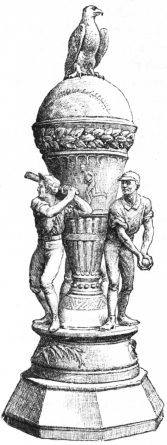
Fig. 434.—Parian Vase. Etruria Pottery Company.
At Ott & Brewer’s, also, are to be discovered the first glimmerings of what may be called an art, in the studio of Mr. Isaac Broome, an American artist of considerable repute and skill. Mr. Broome devoted himself to both painting and sculpture before turning his attention to ceramic art. Some years ago he established a terra-cotta workshop in Pittsburg; but the locality was unfavorable, and the enterprise was abandoned. A similar venture in New York city also failed.
Several months prior to the Centennial Exhibition he was employed by Messrs. Ott & Brewer to design and model certain works in parian. These were exhibited at Philadelphia, and were very favorably received. The improved kiln previously described (see page{465} 79) was built after his plans, and under his personal direction for firing the works turned out of his studio. Of these one of the best was suggested by Mr. J. Hart Brewer, and consists of (Fig. 434) a pair of vases in parian designed to illustrate the national game of base-ball. Great variety of detail is attained without detriment to a certain severity of outline. From a narrow base the body contracts quickly to its smallest girth, and thence expands gradually to the top. Round the foot of each vase, and standing on the supporting pedestal, are arranged three figures of base-ball players, modelled after a thoroughly American ideal of physical beauty, embodying muscular activity rather than ponderous strength. The attitudes are very well chosen, and invest the figures with an appearance of life and vigorous action. A series of clubs belted round with a strap ornaments the stem of the vases, and some exquisitely wrought leaves and berries are woven round the top. The orifice is covered by a cupola or dome, composed of a segment of a base-ball, upon which stands an eagle. These vases are the work of a genuine artist, who has surrounded a general design of great merit with many finely executed and suggestive details.
Fig. 435.—Pastoral Vase. Etruria Pottery Co.
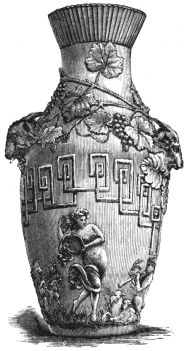
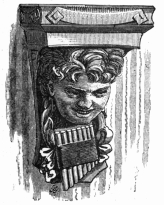
Fig. 436.—Faun’s Head Bracket. Etruria Pottery Company.
The same artist’s “rustic,” or “Pastoral,” vases (Fig. 435) illustrate a different order of ideas. Here the surface is covered with mouldings in relief, composing{466} a design partly suggested by mythology, partly original. It carries us back to the golden age of the poets. A female figure, which might be that of Flora or Proserpina, dances to a satyr who plays a musical instrument. The details are all in perfect harmony—the dancing goats, the grape-vines, the leaves, rustic wood-work, and goat’s-head handles. A tasteful finish is given to the decoration by a fluting running round the upper part of the neck to the lip. To produce a good effect, work of this kind, all in relief and uncolored, demands the nicest finish, and a design which shall lean neither toward scantiness on the one hand, nor overloaded ornamentation on the other. In both respects Mr. Broome has been fortunate. The decoration relieves without destroying the fine outline of the vase.
Fig. 437.—Parian Vase. Etruria Pottery Company.
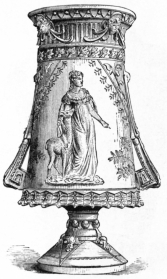
Mr. Broome’s “Fashion” vases (Fig. 437) are embellished with some very fine illustrations of the fashions of a century ago and also of the present time. Of these the shapes are exceedingly quaint and uncommon, and the figures in low relief are very highly finished.
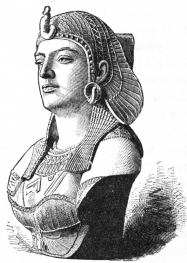
Besides these, Mr. Broome has modelled a great number of the heads and busts which have always been the staple of workers in parian. Some are original, others are reproductions from the antique. To the former class belongs an ideal Cleopatra (Fig. 438). The artist has chosen a full and sensuous type of beauty, vastly different from that adopted by recent painters who have ventured to portray upon canvas the charms which melted the stern Cæsar and enslaved Antony. Somehow one associates the style of beauty represented in Mr. Broome’s bust rather generally with the land of Egypt than specially with the conquests of Cleopatra. This may result from a familiarity with less truthful conceptions, and in that view implies a decided merit. The artist has in details followed history as closely{467} as it seems possible for him to have done, and has wisely preferred study and research to giving his imagination a free rein. Imagination, or an American model, might have led him to present a higher type of beauty, but neither would have led him to produce a distinctively Egyptian Cleopatra. Accepting his ideal, it is worked out with unmistakable talent, and with the most painstaking attention to workmanship.
It is unnecessary to particularize farther. The Etruria Pottery Company have made a good beginning, and in directing the efforts of their artists it is to be hoped that they may not allow the commercial success of copies of the antique to divert attention from such works as those described. The paste employed is fine, compact, and hard, and assumes in some pieces the clear and polished appearance of marble. Its precise composition is not known. The paste is, as in the usual case, poured in a fluid state into plaster moulds, which absorb the superfluous water. Oxides are used to vary the color of the casts, and a number of tints of great delicacy and beauty have been secured.
Fig. 438.—Cleopatra, in Parian.
American terra-cotta must be briefly dismissed. At the Centennial Exhibition an extensive assortment was shown from works situated in many parts of the country. One or two makers displayed an utterly misguided taste in attempting something original. Others appeared to confine themselves to the well-known Apollo Belvederes, Niobes, and other antique subjects. Garden vases and ornaments were meritorious as a class; but whatever artistic work may be produced in some quarters, in others art is only budding, and will take some time before it blooms into flower. Some excellent work in terra-cotta is executed in Philadelphia and New York, and has been referred to above. Of the hundreds of other{468} factories throughout the country few have done anything distinctive. One or two might possibly be mentioned, such as the Halm Art Pottery Company, of Sandy Hill, New York, which are gradually drawing away from the commonplace, and may be expected, sooner or later, to possess an artistic individuality. Among Eastern workshops may be mentioned those of Beverly, Portland, North Cambridge, and Chelsea, Massachusetts. A great deal of the red terra-cotta of Beverly is consumed by decorative artists and students. The Portland terra-cotta is well known both for excellence of body and beauty of shape. The paste is unusually fine and close in texture, and is excellent under the brush. The North Cambridge establishment also turns out ware of a high quality. The designing department is evidently under skilful and competent supervision, and the forms have an antique grace which never loses its charm. As in the case of Beverly, the products of both these workshops are well adapted to the purposes of the decorator.
Chelsea demands a larger share of our attention for styles of work in terra-cotta unique among American products. The establishment is at present carried on by Robertson & Sons, under the name of the “Chelsea Keramic Art Works.” The firm consists of J. Robertson and his two sons, A. W. Robertson and Hugh C. Robertson. The workshop was founded on 1st June, 1868, by A. W. Robertson, for the production of English brown-ware. He was joined by his brother, and the chief wares made at that time were fancy flower-pots. J. Robertson was admitted to the firm by his sons on 1st June, 1872, and affords a good instance of the wide experience it is possible to compress into one lifetime. Mr. Robertson was born in Edinburgh, Scotland, and first worked in the Fife pottery, at Dysart, where his father was head workman. He there acquired a knowledge of modelling and mould-making, and at the age of sixteen was engaged by the Watsons of Prestonpans, Mid-Lothian, then the leading fine-ware factory in Scotland. He next tried the North of England, and worked as modeller and mould-maker at several factories, gaining experience and proficiency, and ultimately took the management of a small red-ware pottery, where he introduced both white and printed ware, “smeared black” and “lustred” ware. On leaving, he tried manufacturing on his own account for a time, and then accepted the position of superintendent{469} of a black-ware factory at North Shields. He arrived in America in 1853, and worked first in a factory at South River; then with Mr. J. Carr, at South Amboy, and afterward at Thirteenth Street, New York; next with Speeler, Taylor & Bloor, at Trenton; and lastly as manager of the East Boston pottery. His next step was to join his sons at Chelsea, each of whom has had a more or less varied career, and is expert in at least one branch of the business. Since the establishment was opened, a great many experimental pieces have been made of different materials, sizes, and shapes. What are known as porous cones were made some time ago for chemical purposes, and are of so open a body that the breath can be drawn through them with ease. We have already seen that Jersey City claims this discovery. The credit is probably due to both, as they appear to have arrived at the same result by independent courses. Work of a more purely artistic character was tried about eight years ago, but, commercially speaking, without success. A second attempt was made in 1873, and the production has been continued down to the present time. The artists and collectors of Boston soon discovered certain qualities in the Chelsea potters and their works deserving recognition. They may possibly have reached the conviction that Chelsea is to be numbered among the places where artists value their work solely according to its truth, excellence, and beauty. Without affecting to disregard commercial considerations, they succeed in giving their art the precedence. It is not, therefore, a matter of surprise either that they should have convinced a section of the public that Chelsea can do noble service in the cause of American art, or that many excellent works should bear its mark. Allusion may first, however, be made to certain matters with which the Robertsons allow their attention to be diverted from more serious pursuits. They have been inspired by Doulton’s treatment of stone-ware to make certain small pieces of fine earthen-ware of a gray color faintly tinged with blue, and very brilliantly glazed. The decoration consists of incised designs. The pieces do not bear a very close resemblance to Doulton ware, but are in themselves decidedly attractive. The Robertsons, having mastered the fundamental secret of the Haviland process, viz., of applying the colors upon the unbaked clay, have, in the second place, brought out a few pieces after the style of the Limoges faience. Their success here is limited{470} by a palette which must be considerably enriched before the effects of the French ware are reached.
Fig. 439.—Chelsea (Robertson) Terra-cotta.
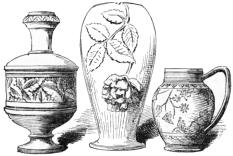
Fig. 440.—Chelsea (Robertson) Terra-cotta.
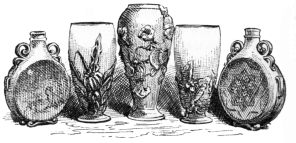
The best Chelsea works are in red and white unglazed earthen-ware. Of these we give two illustrations (Figs. 439 and 440). Some of the forms are original, and others are after the Greek, Italian, and other types. The decoration consists of designs graved in the paste, of mouldings in relief, and of carvings in relief. The application of moulded ornaments to the surface has been practised in all ages, and the Chelsea work does not demand special comment, although many of the designs are attractive and simple. The carving in relief belongs to a different order of work. Instead of being moulded, the ornamentation of leaves or flowers is carved out of clay laid upon the surface of the vase while still moist from the hands of the thrower. The effect is similar to that obtained by mouldings, but the work is finer, the details more highly finished, and the outlines sharper and clearer. Of the designs in these and the pieces decorated with mouldings, the best are those in which leaves either lie across the vase or form a calyx from which it rises upward. The absence of color allows the attention to rest solely upon the fidelity with which every detail is rendered. If this be the quality of work with which the Robertsons tested American taste eight years ago, it is not easy to understand why they did not succeed.{471}
PORCELAIN.
Philadelphia.—William Ellis Tucker.—Bennington.—Jersey City.—Greenpoint.—Decorating Establishments.—Metal and Porcelain.
The history of American porcelain is necessarily brief. The impetus toward the higher branches of the art, emanating from Europe, in due time reached these shores. It affected the rapidly developing enterprise of the citizen of the young Republic, and touched his faith in the vast and varied resources of his country. Previous to the achievement of independence, however, and during the early colonial intercourse with England, an incident occasionally transpired not without interest in our narrative. When Mr. Richard Chaffers died in Liverpool, and his porcelain establishment was closed, many of his workmen came to this country. In 1771 it was reported in England that a large china manufactory was established in Philadelphia, where “better china cups and saucers are made than at Bow or Stratford.” It may astonish many who are not acquainted with anything in American ceramics beyond the competitive spirit which rules the business, to find that more than a century ago it had left England behind in the race!
Fig. 441.—Philadelphia Natural Porcelain. (Trumbull-Prime Coll., New York Metropolitan Museum.)
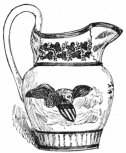
There appears to be no longer any doubt of the existence of a porcelain factory in Philadelphia about the year 1770, and that, therefore, the report alluded to above was “founded on fact.” Advertisements have been discovered which go far toward settling the question. They promise work equal to that of Bow, and are therefore in all probability the basis of the rumor above mentioned, which was current in England a year later. How long the works were carried on is not known.
Fig. 442.—Philadelphia Natural Porcelain. (Trumbull-Prime Coll., New York Metropolitan Museum.)
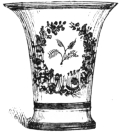
The next porcelain venture was made in the same city, between 1816 and 1830, by William Ellis Tucker. Tucker began as a decorator, and, after a series of experiments, made first a non-translucent ware of good quality, and then natural porcelain (Figs. 441 and 442).{472}
Fig. 443.—Bennington Artificial Porcelain. (Trumbull-Prime Coll., New York Metropolitan Museum.)
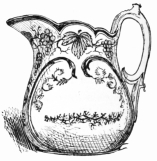
His works were originally situated behind his father’s china store in Market Street, and afterward at the corner of Market, Schuylkill, and Front streets. One serious impediment to success was a treacherous workman, who did all he could to frustrate his employer’s design. His first experiment was to cut the handles off the pieces when placing them in the kiln. His next was to wash the seggars with felspar, which melted in the kiln and fastened the wares to the bottom of the seggars. When Tucker first made porcelain for the market is not recorded, but in 1827 he was honored with a silver medal by the Franklin Institute of the State of Pennsylvania. Some time prior to Tucker’s death, in 1832, Judge Hemphill had been admitted as partner, and subsequently carried on the factory, in connection with Thomas Tucker, a brother of the founder, for a few years. He then sold out. Thomas took the works in hand alone in 1837, and kept them running for about a year, when the production ceased. The products of the factory were chiefly table wares. The paste and glaze were both excellent, but the form and decoration would not permit of competition with imported china. The workshop went down for want of public support, and also on account of the alleged impossibility of securing the services of skilled artists. We have already seen that Lyman & Fenton conjoined the making of artificial porcelain (Fig. 443) with that of pottery at Bennington, Vermont. This factory is chiefly remarkable as the first from which figures in biscuit were turned out. We have also noticed the Jersey City enterprise of Henderson & Co. Several attempts to produce porcelain were made at Greenpoint, Long Island. In 1848, Mr. Charles Cartalege met with some success in the manufacture of knobs and buttons, but in no table ware. Altogether it is probable{473} that about a dozen different establishments were founded for the purpose of inaugurating the manufacture of a native porcelain. They generally succeeded in making a few pieces, and then stopped for lack of patronage. The honor of first establishing the industry upon a successful basis, and of turning out a commercial ware, is to be ascribed to Mr. Thomas C. Smith, of the Union Porcelain Works, Greenpoint.
Mr. Smith is an American, whose ancestors arrived in the Eastern States about one hundred and fifty years ago. He was brought up as a mechanic, and first went into the porcelain manufacture in 1857, under a company composed of a number of Germans who had started the business about three years previously. At this time several small kilns existed in Greenpoint, like that of Cartalege, for the purpose of making door-knobs and other hardware trimmings. The paste then used was compounded upon the principle of the English artificial paste, and contained a large proportion of burned bones or phosphate of lime. This was the composition used by the Germans with whom Mr. Smith connected himself. These Germans, through dishonesty and want of knowledge of the business, soon brought the concern into trouble, from which Mr. Smith tried to extricate it by acting as manager for a time, but the derangement and prostration of trade, caused by the outbreak of the Civil War, compelled the company to wind up its affairs. Mr. Smith, being the largest creditor, became the purchaser, his intention being to bring the porcelain enterprise to an end, and make the property available for some other purpose. Meantime he went abroad. At the time when the second battle of Bull Run was fought he was in France, and it was there the idea grew upon him that there was a good opportunity for establishing the porcelain business in his native country. So complete was the change in the formation of his plans, that he immediately turned his attention to making such inquiries as might subserve his purpose, among the great workshops of France and England. When he returned home, his intention of abandoning the manufacture of porcelain disappeared, and he decided to embark anew. The experiments which followed were attended with much anxiety. Up to November, 1863, the old bone body had been retained; but in 1864 Mr. Smith stopped using it, and directed his attention solely to the production of a natural kaolinic{474} porcelain like that of China or Meissen. His experiments extended over about two years. The first pieces were uneven and the vitrification was incomplete. This arose from an ignorance of the correct composition required for success. Farther trials were more encouraging, and in 1865 he succeeded in making a plain white-ware, which he could place upon the market. Mr. Smith prides himself upon one fact, that, unlike any one of the European establishments, from that of Florence downward, he succeeded without aid either from a wealthy patron or from government.
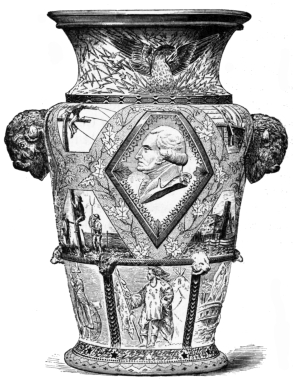
Fig. 444.—Century Vase. Greenpoint Porcelain.
In 1866 he first began to decorate, with one English and one German artist. By availing himself of odd fragments of information, he not only improved his decoration, but discovered some European usages, the prevalence of which he had not suspected. One of these{475} was that Dresden ware was sent in large quantities to England to be decorated, and was afterward returned to Dresden and sold as Meissen ware. On one occasion he bought in Europe a Meissen porcelain cup decorated with blue, red, and gold. On returning home, he broke the cup, and put one of the pieces in his porcelain furnace, to see if the colors would stand the heat to which his own were exposed. When it was withdrawn the red had disappeared, a thin, almost imperceptible line was all that was left of the gilt, and the blue had run into streaks and blotches. This little experiment taught him that he was contending with difficulties, in firing his colors, which European makers had not thought it necessary to meet. That he has succeeded is marked by the extension of his works, which cover about an acre of ground, and give employment to about one hundred and seventy people. All his porcelain is decorated by his own artists. Mr. Karl Müller is the chief designer and modeller, and brings a long experience as a sculptor to bear upon his studies in clay. He is a German, whose art education was mainly acquired in Paris under the tuition of the ablest artists of Europe. His predilection for the potter’s art led him to associate himself with Mr. Smith. Before doing so, in 1874, he modelled three terra-cotta figures of base-ball players, in different attitudes suggestive of athletic activity.
Fig. 445.—“Kéramos” Vase. Greenpoint Porcelain.
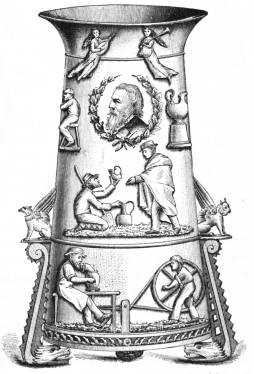
Fig. 446.—Greenpoint Biscuit Porcelain.
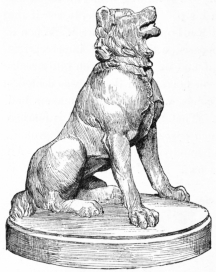
The ingredients of Greenpoint porcelain are the kaolins of Cornwall,{476} Delaware, Pennsylvania, and Georgia; felspar from Maine and Connecticut; and quartz, also from Connecticut. These are compounded according to the purpose for which the paste is to be used. In that for table ware the proportions are: kaolin, 37; felspar, 33; quartz, 30. For the glaze: felspar, 15; lime, 15; kaolin, 12; quartz and broken porcelain, 58. The paste made into hardware trimmings contains a greater proportion of American kaolin than that for table ware. As to the merits of the latter it is thus spoken of by M. Ch. de Bussy, from whose official report we have already quoted: “The porcelain of Greenpoint is second to none in quality of paste and hardness of glaze. Most of the articles are heavy, and may be compared in form with that which in French commerce is known as limonade: we have, however, seen thinner pieces, such as tea and coffee cups, well made, and which would figure honorably among the productions of Europe (bien fabriquées, et qui pourraient figurer honorablement parmi les productions d’Europe).” Mr. Karl Müller’s first work of art was a “Century Vase” (Fig. 444), designed by Mr. Smith for the Centennial Exhibition. Bison heads form the handles; medallions decorate the front and back, and below them is a belt of gold with small bison, walrus, ram, and other animal heads arranged at intervals. The base is surrounded by a series of medallions or panels, representing, in white relief, Indians, a soldier of the Revolutionary era, the Tea Scene in Boston Harbor, and other historical incidents. The body is painted in blue, red, and gold. The artistic character of the vase can be sufficiently studied in the engraving. The decoration, it will be observed, consists in part of paintings on the flat, and in part of the reliefs already mentioned, which give a meaning to the distinctive title, “Century{477} Vase,” chosen for the piece. It illustrates the national progress of a century.
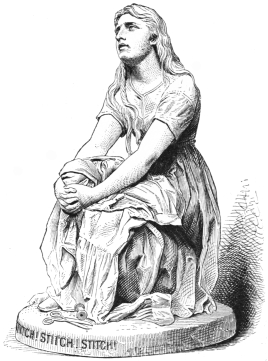
Fig. 447.—“Song of the Shirt.” Greenpoint Biscuit Porcelain.
When Mr. Longfellow wrote his poem “Kéramos,” it is hardly probable that he contemplated the possibility of supplying a subject to the art of which he sang. The poet wrote of the potter, and the potter has illustrated his song. The poem had no sooner appeared than it was made the groundwork of an illustrative vase (Fig. 445). As in the “Century Vase” history is represented by periods and leading events, so in the “Kéramos” vase the history of ceramic art is represented by the leading contributions to its continuous progress. In panels on the base the potters of all ages are seen at work—Egyptian, Greek, and modern. Above these, on the body, are reliefs illustrative of the pottery of Peru, Italy, France, Spain, England, and other countries. As we turn it round, the advance of ceramic art is seen as in a diorama, and amidst the various scenes appears in relief the bust of the poet whose song inspired the work. The form of the vase is singular, simple, and severe, but well suited to the artist’s treatment of his subject. Its rigidity is considerably softened by the quaint, projecting feet and the figures they support, and by the decoration surrounding the flaring top.
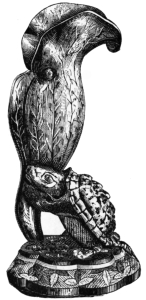
Fig. 448.—Greenpoint Porcelain.
Among the other productions of Greenpoint is a series of statuettes,{478} groups, and animal figures, which were first made in a non-translucent hard clay, of a light but warm brown or buff, and afterward in porcelain biscuit. The material first used is dense and non-vitrifying, more nearly resembling terra-cotta than parian. It is well suited to the production of statuettes and groups, in the modelling of which unmistakable talent and originality are displayed. We can in this department, better perhaps than in any other, appreciate the spirit permeating the designing-room at the Union Works. The rule appears to be to study the antique, but instead of copying or reproducing the works of the ancients, to follow their example in choosing subjects from the every-day life of the artist’s own time. We nowhere see a copy of ancient statuary or feel a breath of borrowed inspiration. Every subject is taken from modern literature, or from life in America in the nineteenth century. One piece (Fig. 447) has under it the words “Stitch! stitch! stitch!” and presents us with a softened illustration of Hood’s poem. We say “softened,” because the artist has preferred—wisely or not we will not now determine—to tone down the unutterable misery of the picture, in which the “woman sat in unwomanly rags, plying her needle and thread.” The unspoken weariness and mingled longing and resignation are here, but the squalor and wretched poverty are rather suggested by the broken box upon which the needle-woman sits, than forced upon our notice. If we accept what was evidently the artist’s working canon, that the literal realization of human wretchedness has no place in art, then we must also accept the work as a fitting counterpart to that of the poet. In any case the conception is praiseworthy, and the execution skilful. Another group was suggested by Poe’s “Raven:”
“And my soul from out that shadow that lies floating on the floor Shall be lifted—nevermore!”
{479}
The bust of Pallas stands, with the raven on its shoulder, upon a pedestal, in front of which lies a veiled figure. The piece is, we have said, suggested by the poem, of which it is in no sense a literal interpretation. A third group consists of a nude boy and dog, and tells its little story truthfully and forcibly. The attitudes and modelling are alike excellent.
Fig. 449.—Greenpoint Porcelain.
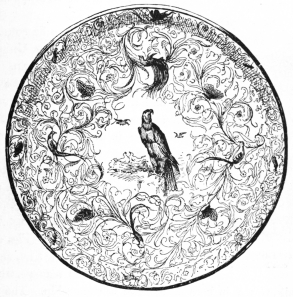
Fig. 450.—Greenpoint Porcelain. (E. Bierstadt Coll.)
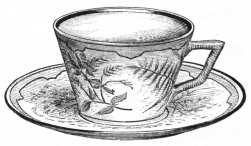
Other pieces, such as a procession of frogs and turtles with shouldered “pitcher-plants,” illustrate the humorous side of the artist’s genius (Fig. 448). The subject appears to be a favorite one, as we find it variously treated in porcelain also. The other statuettes particularly deserving of notice are a stone-mason, two firemen—one of the old regime and one of the new—{480}and a bust of Forrest as William Tell. These specimens will suffice, with what was said above, to indicate the direction in which this branch of art at Greenpoint is being extended.
Fig. 451.—Poets’ Pitcher. Greenpoint Biscuit Porcelain.
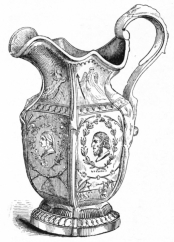
There has yet to be considered the staple product of the Union Works, viz., its household porcelain. The paste is, as we have seen, of good quality, and the manufactured ware is strong and serviceable. One of the great obstacles in the way of the success of other enterprises—the lack of skilled artists—Mr. Smith has overcome, and now employs a number of decorators whose work augurs well for the continued prosperity of the establishment. We have seen one set (Fig. 449), composed of a circular tray, sugar-bowl, milk-pitcher, and teacups, which is entirely praiseworthy in both design and workmanship. The prevailing color is lavender, into which are wrought, in the form of birds and flowers, delicate tints of blue and yellow. The effect of the whole is soft and pleasing, and is heightened by the graceful design of the pieces, and the fine translucent body upon which the decoration is laid.
Fig. 452.—Greenpoint Porcelain.
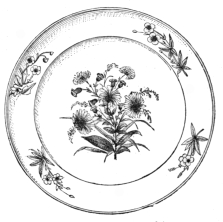
We cannot here point to any style as being particularly distinctive of the workshop. The taste of the decorators is broad and catholic.
White reliefs are occasionally used with fine effect in the ornamentation of pitchers and cups. One of the latter shows white figures in relief upon pale grounds.{481}
The cup is of a very graceful shape, and a miniature Columbia supported by an eagle forms the handle. A pitcher in biscuit (Fig. 451) is surrounded by heads of distinguished poets in relief. In this case also the shape is excellent, and the mouldings, including the subsidiary decoration, are admirably finished.
Fig. 453.—Greenpoint Porcelain. View of Memorial Hall.
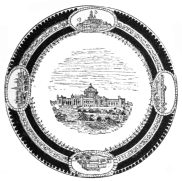
The painting upon some of the plates is deserving of particular notice. They can only be referred to individually, as we have seen that no leading style has been adopted under which they could be treated of collectively. There is no uniformity either in the merit of the designs or decorations. One has for centre-piece a view of Memorial Hall (Fig. 453), and, set in a rim of deep crimson, oval medallions with similar views. The drawing is very careful, and the colors well assorted. On another style a flower or a fern covers the bottom and falls upon the rim, which has no other decoration. Others have views of a windmill (Fig. 455), a cottage embowered in foliage painted in monochrome, or fruit. In some we find delicacy, and in others the work of a brush unaccustomed to search for subtleties of tint or the more refined expression of which color is capable. Fortunately the latter are the exception and the former the rule.
Fig. 454.—Greenpoint Porcelain.
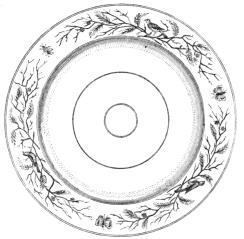
To examine the methods of the artists of Greenpoint, the plate (Fig. 452) may be referred to. The flowers forming its decoration{482} may be found by almost any country roadside. Gathered as they grew, they were taken to the decorating-room, and were there transferred to porcelain. Apart altogether from the artistic result, there is a principle in such a manner of seeking designs deserving of attention. We have seen that in Japan the secret of the infinite variety of art lies in the close sympathy between the artist and nature. He turns to his promptress on all occasions for inspiration and suggestion. It must be so everywhere. The boundless wealth of form and color found in nature confers an equally boundless variety upon the art in which it is reflected. The conventional is limited by human ingenuity: the natural has no limit.
Fig. 455.—Greenpoint Porcelain. Painted by J. M. Falconer.
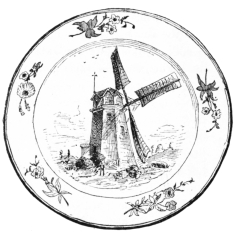
Fig. 456.—English Porcelain. Decorated by Mrs. Hoyt. (D. Collamore.)
As a final example of table ware let us instance a plate (Fig. 454) decorated in gold, blue, red, green, yellow, and pink, so sparingly that only a close examination brings out the real richness of the coloring. In the first place, the decoration lies entirely upon the rim, with the exception of two circles of gold and blue. The design consists of crossed branches painted in blue and gold, with insects and brightly feathered birds. The effect is exceedingly soft, the delicacy of the colors being as pleasing to the eye as it is satisfactory in point of taste. The mark of the Greenpoint porcelain is an eagle’s head with the letter S—the manufacturer’s initial—through the beak.
Besides the manufacturers and the{483} artists employed in their establishments, many persons make a business of decorating earthen-ware and porcelain, and within the past few years many more have been attracted to this branch of art. It is regularly taught by two New York institutions, the Decorative Art Society and the Ladies’ Art Association, and has many devotees both in the East and West. Much of the work executed by these artists is highly creditable; and there is a great deal that never reaches the public eye, which is marked by both delicacy and originality.
One of the regular professional establishments is that of Warrin & Lycett, of New York. The example here given (Fig. 457) is Jersey City earthen-ware, and was painted by Mr. Warrin, who has had an experience of about fifteen years as a decorator. The colors are bright, and are very happily blended. The ground is a shade of light green, and the flowers are painted in their natural colors. At this workshop success was reached some time ago in a very delicate operation, that of transferring photographs to porcelain.
Fig. 457.—Jersey City Earthen-ware. Decorated by Warrin.
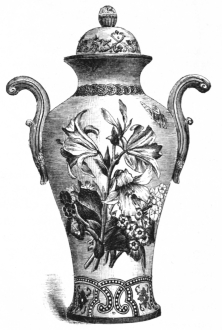
Mr. John Bennett, formerly the Director of the Faience Department of the Doulton factory at Lambeth, has within the past year settled in New York, and is now turning out decorated faience after the styles seen in the English original. He uses imported Lambeth biscuit, and has erected a kiln in connection with his studio for firing the decoration. It is his intention, in course of time, to use American clays, in order to obviate the necessity of importing biscuit, and at the same time to obtain new shapes made after his own designs. Among his best ground colors are pale yellow, pale blue,{484} and a rich brown tinged with red. The latter is very effectively used with leaves and flowers drawn over the piece in shades of green and yellow. All Bennett’s pieces have an even and brilliant glaze. After what has been said of Lambeth faience, no attempt need here be made to characterize the art represented by this ware. It will be, as indeed it deserves to be, admired; and America ought to be congratulated upon the acquisition of so good a representative of the Lambeth school of decorators.
Fig. 458.—Bennett Faience. (D. Collamore.)
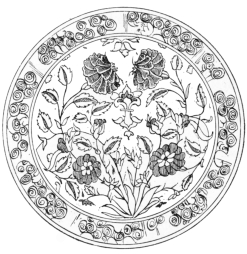
The tile-piece at the opening of the book devoted to America (page 391) was painted by Mr. F. T. Vance, of New York. The drawing is excellent, and the design is original and decidedly meritorious. The arrangement of the figures gives a life to this and other pieces by the same artist entirely lacking in the styles of tile-painting, which consist of a repetition on each tile of the same design, or of varied but independent designs.
Fig. 459.—Bennett Faience. (D. Collamore.)
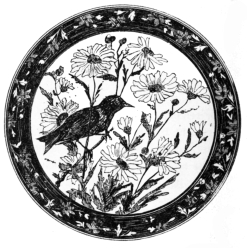
Fig. 460.—Lambeth Faience. Decorated by Bennett.
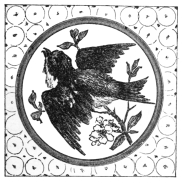
Fig. 461.—Plate Painted by Mr. John M. Falconer.
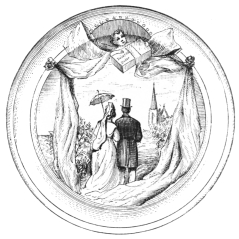
Mr. John M. Falconer, of Brooklyn, is an artist who has devoted himself very successfully to ceramic{485} decoration. Some of his designs on Greenpoint porcelain (see Fig. 455) are very pleasing, and the coloring is chaste and well handled. A more ambitious work is that given below (Fig. 461), an appropriate wedding-gift to an artist’s daughter. The distance toward which the bride and groom are walking is rose-hued, and the church-spire and foliage partake of the effect. Roses are strewn along the path. A heavy knotted white sash forms a curtain and encloses the scene. Above, in a lunette of dark blue bordered with white pearls, is a golden-haired Cupid holding a box of wedding-cake, with the names of the lady and gentleman on the lid. The border of the plate is a deep flat pink, with a narrow outer line of white. The plate is remarkable both as a work of art and for the delicate manner in which, as a gift, it conveys the congratulations and good wishes of the giver. Some of his works, besides the one above alluded to, are in the possession of Mr. T. C. Smith; and others, both in camaïeu and polychrome, are entitled and owned as follows: “Independence Hall,” Rev. Morgan Dix, D.D.; “The Old Clothing Store, Boston,” Mrs. C. F. Blake; “Albert Durer’s House,” and “The Oldest House in St. Louis, Missouri,” Charles Brown, Troy, New York; “Shakspeare’s House,” Edward Green, New York; “A Smoke Fancy,” “Autumn, Montclair,{486} New Jersey,” “Church at West Point,” “Moonlit Lake,” Aaron Vail, Jr., Troy, New York; “Crescent Moon,” John Gale, Esq.; “Killearn Manse, Scotland,” Hon. M. B. Macleay, New York; “The Old Tower, Newport,” Mrs. S. P. Avery; “Across the Water,” F. A. Bridgman, Paris; “At Montreal,” George H. Boughton, London; “At Wilmington, North Carolina,” Mrs. J. P. Whitehead, Newark, New Jersey; “Old Castle, Sunset,” Alfred Jones, Yonkers, New York; “The Philosopher,” Rev. L. L. Noble, Annandale, New York; “Moonlight,” Charles Parsons, Montclair, New Jersey; landscape, and a set of two blue and one yellow vases, Hon. George B. Warren, Jr., Troy, New York. Mr. Falconer has the advantages of a cultivated taste and well-trained skill to help him win such a reputation as might induce him to substitute, even to a greater extent than at present, porcelain or pottery for the more perishable canvas.
Fig. 462.—Limoges Porcelain and Silver. (Reed & Barton, N. Y.)
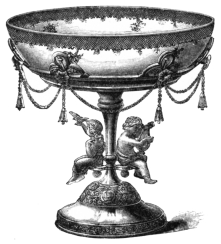
Fig. 463.—Copeland Porcelain and Silver. (Reed & Barton, N. Y.)
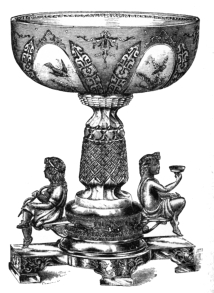
There remains to be noticed an artistic combination in which, although it has long been practised in Europe, American workmen have recently succeeded in producing exceptionally fine effects. Reference is made to the combination of metal and porcelain.{487} We have seen with pleasure slender and exquisitely wrought stands of silver and gold, in which delicately painted French porcelain dishes and basins are converted into card-receivers, flower-stands, and fruit-dishes. A great deal of taste can be displayed in the selection of colors to suit the metal, as well as in the deeper harmony which reproduces in silver or gold the flower stems on the porcelain. Chinese porcelain, in rich colors—green, pink, and blue—is similarly treated. Pieces of the Green family are tastefully set in silver and gold, the mouldings on the bands of metal corresponding with the painted borders of the porcelain.
From such specimens of a double art we turn to others less rich, but scarcely less attractive. Faience vases are mounted in bronze and brightly burnished brass, and derive a new character from the association. Works of this class show that, while it is possible to define the limits of the field peculiar to ceramic art, its place in household decoration cannot be specified with equal precision. Already it has entered into effective alliances with the arts of the silversmith, goldsmith, the workers in the baser metals, of the enameller, the carver, and the cabinet-maker. In these several relations it is not now intended to follow it farther. They would lead to the consideration of many arts essentially distinct, and as foreign to each other as to that whose history has led us from the sun-dried bricks of Egypt to the porcelain of Greenpoint.
Fig. 464.—Worcester Porcelain and Silver. (J. W. Britton Coll.)
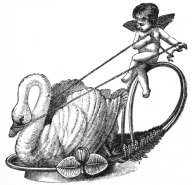
{488}
{489}
INDEX.
A, B, C, D, E, F, G, H, I, J, K, L, M, N, O, P, Q, R, S, T, U, V, W, X, Y, Z
ABAQUESNE, Marreot, 281. Abraham, Copeland’s director, 383. Abubeker, 191. Adam, director at Vincennes, 314. Adobes, 396. Africa, 213, 216, 217, 241. Agapenor, 201. “Agate” ware, 361. Agostino, assistant of Luca della Robbia, 253, 263. Agyllos, 241. Ahriman, 190. Ainos, 163. Akai, 161. Alabastros, 225. Alambra, 203. Albany slip, 457. Alcora, 239. Alençon, 53, 317. Alexander the Great, 190, 200. Algeria, 216. Alhambra, 235, 236, 247. Ali, 191. Alluaud, director at Limoges, 321. Amasis, 200. Amathus, 201, 204. Amazon, tribes on, 417. Ambrosio, son of Andrea della Robbia, 253. America, 391-487 (see South America, Central America, Mound-builders, Indians, United States). American china, 463. American clays, 446, et seq. American Crockery Company, Trenton, 462. American Pottery Company, 455. Ameya, 160. Ammon, 85. Amphora,—æ, 24, 27, 90, 222, 224. Amstel, 343. Andrea della Robbia, 253. Anglo-Roman pottery, 354. Anglo-Saxon pottery, 355. Anspach, faience, 330; porcelain, 341. Antonio, artist at Ferrara and Faenza, 262. Antwerp, majolica, 331. Aphrodite, 201. Apostle mugs, 336. Apries, 200. Apulia, 221, 265, 293, 295. Arabesque, origin of, 213. Arabs, 189, 190, 213, 214, 217, 218, 233, et seq., 273. Araguaya Indians, 438. Archaic Greek vases, 229. Arequipa, 410. Aretine ware, 246. Arita, 161, 172, 176, 179. Arizona, 429, et seq. Arsenal Pottery, Trenton, 462. Artaxerxes, 190. Articulated vase, 153. Artificial porcelain, invented in Europe, 52; classification, 55, 56, and meaning of term 57; analysis, 61; difficulty of its manufacture, 81; Chinese, 122; Persian, 122, 196; Spanish, 238; Italian, 265, et seq.; French, 312, et seq.; English, 376, et seq.; American, 457, 458, 471, 472. Aryballos, 226. Arystichos, 226. Asia Minor, 211, 213, 214, 215. Askos, 224. Assyria, —n, 32, 63-65, 97-102, 198, et seq., 220, 426; porcelain, 100. Astarte, 202, 204. Astbury, English potter, 360; uses calcined flint, 361. Astbury & Maddock, Trenton, 460. Aster decoration, 130. Athieno, 203. Aubry, M., director at St. Clement, 311. Aue, kaolin of, 53, 337. Augustus II., director at Meissen, 338. Augustus III., director at Meissen, 338. Auteuil, Haviland’s workshop at, 287. Avisseau of Tours, 277. Awadji, 171. Awata, 167, 171. Aztecs, 423. Azulejos, 216, 233, 236, 239; Minton’s, 366, 368. BABEL, 22, 101. Babylon, 65, 97.{490} Babylonia, 64, 98. Bacchus, 21, 22. Baden, porcelain of, 340. Bahia, 416. Bagnall, 360. Baireuth, 330; porcelain, 341. Balboa, 418. Balearic Islands, 236, 248 (see Majorca, Minorca, Iviça). Baltimore, Maryland, 455. Banko-yaki, 171. Banks & Turner, 382. Barberini Vase, 363. Barbin of Mennecy, 313. Barbizet of Paris, 277. Barcelona, 234, 237. Barlow, Arthur, 371. Barlow, Hannah B., 371. Barr, Martin, Worcester, 380. Bartlem, potter in South Carolina, 454. Basaltes, Wedgwood’s, 364. Battersea, 380. Battisto Franco, 257. Battus, 216. Beauvais, 273. Becker, workman at Höxter, 341. Belgium, 331; porcelain, 343. Belleek, Ireland, porcelain of, 388, et seq. Benedetto, artist at Siena, 255. Bengrath Oppal, director at Meissen, 338. Bennett, John, New York, 483. Bennington, Vermont, 457; porcelain, 472. Benten, 162. Berlin, 338, 341, 342. Bernardo Buontalenti, inventor of Medicean porcelain, 268. Bernart, Jehan, 279. Beverly, Massachusetts, 468. Beyerlé, Baron de, 310. Biagio, artist at Faenza and Ferrara, 262. Bikos, 223. Billingsley, or Beely, 387. Bingley, Thomas, 376. Binns, R. W., director at Worcester, 380. Birkenhead, 375. Biscuit, meaning of, 53. Bis-ja-mon, 162, 163. Bissen, Danish sculptor, 349, 351. Bleu fouetté, 132. Blois faience, 308. Bloor, Ott & Booth, Trenton, 462. Bloor, Robert, 379. Bloor, Trenton potter, 460. Blue-and-white porcelain of China, 123, et seq.; of Japan, 126, 175. Blue of the sky after rain, 122, 131. Blunger, 67. Boccaro, 119. Boileau, director at Sèvres, 314. Bone, enameller (Plymouth), 377. Bordeaux, 312; porcelain, 320. Böttcher, 52, 336, 337, 452. Bourg-la-Reine, 288, 302, 303, 304. Bow china, 377, 379, 471. Boyle, John, partner of Minton, 366. Bracquemond, M. and Mme., 288, 291, 295, 322. Bradwell stone-ware, 360. Bramelds of Swinton, 386. Bramfield, J. and W., 376. Brazil, 413, 414-417. Breslau, 329. Brewer, J. Hart, Trenton, 462, 465. Brichard, Eloi, director at Vincennes, 314. Bricks, 88, 89, 98, 101, 106, 220, etc. Brick stamp, 88, 101. Bristol pottery, 373; porcelain, 376, 386. Britain, Great, and Ireland, 352-390. Brongniart, director at Sèvres, his classification, 54, 55, 315, 316, 318. Broome, Isaac, Trenton artist, 464, et seq. Brosely pottery, 375. Brown, Westhead, Moore & Company, 388. Brühl, Count, 338, 339. Brussels, 331; porcelain, 343. Buddha, 110, 111. Buddhism, 111, 161. Buen Retiro, 238. Bunsen, 85, 241. Burroughs, G. S., Trenton, 462. Burslem, 360; Wedgwood at, 362. Butler, Frank A., 371. Byzantium, —ine, 241, 248. Cuaballito, Peruvian, 409. Cabuahuil, 421. Cairo, 214. Caistor ware, 354. Caldas, 239. Caldwell & Wood, 364. Callimachus and the Corinthian order, 301. Caltagirone, 247. Camaïeu, 123, 282, 333. Cambrian Pottery, 387. Cambridge, Massachusetts, 468. Cambyses, 29, 200. Camillo, artist at Ferrara, 262. Campania, 241. Campbell, Colin Minton, 360, 368. Capo di Monte, 268, 269, 270. Carolina, clays, 440, 447; works in, 454. Carr, James, New York, 458, 463. Cartalege, Charles, Greenpoint, 472. Casa Pirota, 261. Castel-Durante, 257. Castellani collection, 185, 243, 247, 252, 261, 262, 266. Castelli, 264. Catto, artist at Faenza and Ferrara, 262. Caughley, 387. Céladon, 116, 131, 150, 161, 179, 195, 197. Celts, —ic, 274; Irish, 353. Central America, 418-424. Ceramic art, its origin, 19, et seq.; etymology of “ceramic,” 22, 49; general view of, see Introduction; its struggles in America, 444, et seq.{491} Cesnola, General L. P., 199, 202, et seq. Chaffagiolo, 255. Chaffers, Richard, 374, 471. Chamberlains of Worcester, 380. Chambrette, Jacques, Luneville, 310. Champion, Richard, 376, 386. Chang-ti, 110, 111. Chanon, Commissioner at Sèvres, 315. Cha-no-yu, 160. Chantilly, porcelain of, 313. Chapelle of Sceaux, 311. Chaplet, artist, 288, 302. Chelsea-Derby, 379. Chelsea (England) porcelain, 377, et seq. Chelsea (Massachusetts), 459, 468, et seq. Cheou-lao, 111, 162. Cherokee, clay, 447. Cheroulion, 223. Cherpentier, François, 279. Chertsey, tiles, 355. Chicanneau, 52, 312. Chichimecs, 422, 426. Chili, —ans, 402, 408. Chimu, —s, 399, 400, 408, 409. China, —ese, general history, 109-153; legend, 20, 110; porcelain in Egypt, 25; customs, 28, 292; in Persia, 191, 196, 197; general reference, 37, 107, 163, 164, et passim, to 188, 213, 268, 270, 281, 283, 306, 313, 322, 324, 338, 377, 385, 408. Christ, 22. Christiania, faience of, 347. “Christian” porcelain, 164, 184. Chrysanthemo-Pæonian family, 138, 176, 177. Chulula, 424. Chytrai, 225. Cincinnati, 463. Citium, 201, 202. City Pottery, Trenton, 461. Clark, Shaw & Co., of Montereau, 307. Classification, 54, et seq. Clay, composition of, 61. Clays, American, 446, et seq. Clerissy family at Moustiers, 283. Clignancourt, 320. Cloisonné, enamel, 108, 181, 182; Minton’s, 367. Coast pottery of Peru, 400. Cobalt, blue, 123. Cockscomb, 124. Coke, John, Pinxton, 387. Colebrookdale Pottery, 375, 387. Colhuas, 422. Colinot of Paris, 306. Colombia, 417, 437. Colorado, 429, et seq. Color, its place in Greek art, 36; in Oriental art, 37, et seq.; how obtained, 65, 81. Composition of wares and glazes, 59. Concealed color, porcelain of, 123. Cones, Egyptian, 30, 89. Confucius, 111. Connecticut felspar, 449; stone-ware made in, 454. Conrade Brothers, artists at Nevers, 282. Constantine, 241. Convent of Gratitude, 118. Cookworthy, William, 376, 386, 447. Copan, 423. Copeland parian, 366; sketch of, 382, et seq.; porcelain and silver, 486. Copenhagen faience, 347; porcelain, 351. Cordova, 217. Corea, 154, 155, 159, 161, 163, 313. Corean, 158, 160, 161, 164. Corinth, 241, 242. Cornwall kaolin, preparation of, 61; analyses, 450; used at Greenpoint, 449, 475. Coroados of Brazil, 415. Corrugated ware, from Colombia, 417; from the West, 433, 437, 438, 439. Cortez, 423, 424. Costa Rica, 419. Coxon & Co., Trenton, 462. Coxside porcelain, 376. Cozzi, Geminiano, 269. Crackle, 116, 120, 148, 161, 168. Crauden’s chapel tiles, 356. Cream-colored ware, Wedgwood’s, 363; American, 456, et seq. Creil faience, 306; porcelain, 307. Creussen stone-ware, 336. “Crouch-ware,” 360. Crown-Derby, 379. Crusaders, 214, 247, 356, 357. Cuarto Real, 236. Cup of Tantalus, 152, 153. Cup of the learned, 125. Curium, 201, 204, 206, 207, 208. Custine, Count, 310. Customs illustrated by pottery, 26, et seq. (see also different countries—Egypt, Assyria, Babylonia, etc.). Cutts of Pinxton, 387. Cuzco, 400, 412. Cyfflé, Paul Louis, Luneville and Niederviller, 310. Cyprus, 199, 220. Cypselus, 241. Cyrene, 216. Cyrus, 190. DAIKOKOU, 162. Dali, 202, 206, 208, 209. Damascus, 214, 215. Damousse, artist, 288. Danaus, 21. Darmstadt, porcelain of, 341. Darnet, Mme., 53, 317. Davis, Isaac, Trenton, 460. Deck, faience of, 304; porcelain, 324, 325. Decoration, best styles of, 44, 80, 81. Decorative Art Society, 483. Delaplanche, artist, 288, 292. Delaware, Indian pottery, 438; Kaolin, 449. Delft, 136; French, 311, 331, 333; English, 358, 373, 454.{492} Della Robbia ware, imitation, 265, 268, 366 (see Luca, Andrea). Demaratus, 241, 242. Denmark, 347-351. Dennis, S., Connecticut potter, 454. Derby porcelain, 378, 379. Deruta, 263. Desima, 176, 186. De St. Criq & Company, at Creil, 307; at Montereau, 307. Difficult ware, 168. Dillwyn, Swansea, 387. Dinos, 225. Diogenes, 26, 27, 222. Diskos, 226. District of Columbia, Indian pottery, 438. Doccia, La, 268. Dog of Fo, 113, 157, 163. Dossi Brothers, artists at Ferrara, 262. Doulton ware, 370, et seq.; sketch of John Doulton, 370; artists, 371; terra cotta, 372; imitation, 469. Dragons, Chinese, 112; Japanese, 163. Dresden, 52, 336, et seq.; ware imitated, 381, 475. Dubarry, or Pompadour Rose, 315, 387. Dubois Brothers, 313. Duesbury family, 378, 379. Du Liege, porcelain painter, 324. Dunkirk, 311. Durantino, Francesco, 259. Dutch in Japan, 164. Dynastic colors of China, 115. Dwight, Dr., first English porcelain, 52. Dwight, John, potter at Fulham, 373. EAST BOSTON, 463. East Liverpool, 451, 452, 463. East Trenton Pottery Company, 462. Ebelman, director at Sèvres, 315, 316, 326. Ecouen, château of, 281. Egg pottery, 171. Egg-shell porcelain, 133, 140; French, 322. Egypt, —ian, 20, legend, 21; Chinese porcelain in, 25; customs illustrated by pottery, 29-31, 89, et seq.; porcelain, 48, 62, 92, et seq.; glaze, 63-65, 91, 92; symbols, 85, et seq.; in Cyprus, 198, et seq.; in Etruria, 243; processes, 71, 74; history and general reference, 82-96, 97, 98, 99, 101, 102, 103, 104, 220, 242. Elers Brothers, 360. “El Frate,” artist at Ferrara, 263. El Moro, 431. Ely tiles, 357. Enamel, 63-65. (See Stanniferous.) Encaustic tiles, 366. England, first porcelain made in, 52, 242, 352, et seq.; tiles, 355; lead-glazed pottery, 357; Delft, 358; porcelain, 376; her debt to America, 447. English marks in America, 445. English porcelain, composition, 61; history, 376, et seq. Eraku, 179. Etruria, 241, et seq.; Wedgwood’s, 364. Etruria Pottery Company, Trenton, 462, et seq. Etruscan, 240, et seq.; black, red, and yellow ware, 243. Ettlinger, commissioner at Sèvres, 315. Europe, 198. European art, its fountains, 198. Evagoras, 200. FAENZA, 261, 262, 265, 424. Faience defined, 49; à niellure, 280; à la corne, 282. Falconer, John M., artist, 484, 485. Families of Chinese porcelain, 138. Fauquez family, St. Amand, 311; of Valenciennes, 320. Ferrara, 262. “Fine style,” Greek, 230. Flanders, faience of, 311. (See Grès de Flandre.) Flashed glaze, 133. Flights of Worcester, 380. Florence, porcelain invented at, 52; its majolica, 255; porcelain, 265. “Florid style,” Greek, 230. Florida, Indian pottery, 438; clay, 446. Flushing, Long Island, 463. Fo, 110, 113. Fogen, 159. Fong-hoang, 114, 163. Fontana family, 258. Fontenoy vase, 23. Forli, 262. Fou-hi, 110. Fouque, Joseph, 284. Fournier, 351. Fourniera of Limoges, 320. France, 271-326; ancient, 271-273; porcelain, composition of, 60; history, 312, et seq. Francesco Durantino, 259. Francesco Maria, 255. Francesco Vezzi, 269. Francesco Xanto, 258. Francis I., 266. Frankenthal, 317, 341. Frye, Thomas, artist at Bow, 377. Fulham settled by Dutch, 358; stone-ware, 359, 373. Furnaces, 74, et seq. Fürstenburg, porcelain of, 340, 351. GALLIENUS, 25. Galloway & Graiff, Philadelphia, 455. Garducci, artist at Urbino, 258. Garrett, partner of Copeland, 383. Gaul, 272. Gelanor, 21. Geminiano Cozzi, 269. Genghis Khan, 190. Georgia, Indian pottery, 438; clay, 446; kaolin, 451. Gérault Daraubert, 317.{493} Germany, pottery of, 327-330; stone-ware, 333-336; porcelain, composition of, 60, 336-342. Gien faience, 309. Ginori, Marquis Carlo, 268. Gioanetti, Dr., founds factory at Vineuf, 270. Giorgio Andreoli, imitator of Luca della Robbia, 253; artist at Gubbio, 259, et seq. Giovanni, son of Andrea della Robbia, 253. Girolamo, son of Andrea della Robbia, 253. Giyoki, or Gyoguy, 73, 159, 160. Glasgow Pottery Company, 460, 462. Glaze, porcelain, 60; artificial porcelain, 61; pottery, 63; history of, 64, 80, 81. Glazing, 80, 81. Glot of Sceaux, 311. Göggingen, 330. Golgoi, 203. Goodwin, John, Trenton, 460. Gosai, 176, 177. Goths, 217. Græco-Egyptian, 91. Graffiti, 249; Minton’s, 367. “Grains of rice” work, 152, 197. Granada, 216, 218, 233, 236. Granite-ware, 456, et seq. Gravant, director at Vincennes, 314. Graybeards stone-ware, 335. Greatbatch, D., modeller, at Jersey City, 456. Greece,—eek, legend as to origin of pottery, 21, 22; conquests defined, 24; customs illustrated by pottery, 26-28, 227; painting, 32-34, 36, 37, 221, 222, 228-232; forms, 35, 41, 223, et seq., 264, 326; whence derived, 90, 209-212, 219, et seq.; glaze, 65, 222, 223, 273; moulding and modelling, 68; wheel, 72, 73; furnaces, 74-76; in Cyprus, 199, et seq.; origin of Greek art, 198-212; general history, 219-232; sun-dried pottery, 220; terra-cotta, 220; styles, 228, et seq.; influence in Italy, 240, et seq., 264; in France, 292, 295; in Denmark, 347-350; in Brazil, 414; in United States, 455, et seq. passim, 467, 470; general reference, 20, 49, 84, 95, 110, 190, 191, 192, 198, 240, 273, 299, 392, 404, 477. Green family, China, 130, 139. Greenpoint porcelain, 443; imported kaolin, 449; kilns, 463; history, 472, et seq.; ingredients, 475, 476; biscuit, 478. Greenwood Pottery Company, 462. Grellet Brothers of Limoges, 320. Grès de Flandre, 336; revived by Doulton, 370. Gros-Caillou, 311. Grosso, artist at Ferrara, 263. Guatemala, 420. Gubbio, 259. Gueguetenango, 420, 421. Guettard, chemist at Bagnolet, 317. Guidobaldo II., 257, 259, 261. Guik-mon, 161. HAGUE, the, 343. Haguenau, 286. Haji, 158, 159. Halm Art Pottery Company, New York, 468. Hancock, R., engraver, 381. Handley, A., artist at Worcester, 381. Hanford, Isaac, potter at Hartford, 454. Hangest, Hélène de, 279. Hannong, Charles François, potter at Strasburg, 286; family, 286, 312, 316, 320, 341. Hard porcelain. (See Natural.) Harrison, partner of Wedgwood, 362. Hartford, Connecticut, 454. Harvey & Adamson, Philadelphia, 455. Hattersley, Charles, Trenton, 461. Haviland, Charles Field, 325. Havilands, of New York and Limoges, 287; their faience and process, 287, 288; their artists, 288; examples, 291, et seq.; mark, 304; porcelain, 321, et seq.; faience imitated, 469. Hawthorn pattern, Chinese, 128; black, 129. Helstone china clay, 376. Hemphill, Judge, Philadelphia, 472. Henderson & Co., D., Jersey City, 455, 472. Henri Deux ware, 63, 279; Minton’s, 367. Herbertsville, New Jersey, 455. Herculaneum pottery, 375. Hermann, 24. Hesdin, 273. Hesse-Cassel, porcelain of, 341. Hide-yoshi, 160. Hindoos, 105. Hirschvogel, 329. Hispano-Moresque, 217, 233, et seq., 240. History illustrated by pottery, 23, 139. Hizen, 160, 161, 175, et seq., 179. Hoang-ti, 20, 110, 113, 116. Höchst, faience, 330; porcelain, 340. Holland, faience, 331-333; porcelain, 343. Holmos, 225. Holdship, Josiah, Worcester, 381. Hollins, Michael Daintry, 366, 368. Homer, 75. Ho-nan, 121. Honduras, 423. Honorific marks, 123. Horoldt, director at Meissen, 337, 338. Hotei, 162. Houdayer, John F., Trenton, 460. Höxter, 341. Hudson River Pottery, New York, 457. Hulaku, Khan, 191, 193. Hydria, 224. Hyrche, 223. IBERIAN peninsula, 233-239. Ibis mummy pots, 90. Idalium, 202, 203. Illinois, ancient, 431, 438; kaolin, 449. Imari, 175. Inachus, 21. Incas of Peru, 395. India, 105-108, 138. “Indian” porcelain, 187.{494} Indiana kaolin, 449. Indians, North American, 425, 429-441. Inland pottery of Peru, 400. Ipsen, Mme., 347. Ireland, ancient, 353. Iron-stone china, 458. Irving, 24. Ise, 160, 172. Israelites, 31, 88. Italy: potter’s wheel, 73; furnaces, 76, 217; history, 240-270; general character of its art, 264; porcelain, 265, et seq.; influence in France, 273. Iviça, 236. “Ivory porcelain,” 463. JACQUELINE, Countess, 333. Jacques, manufacturer at Bourg-la-Reine, 304. Jade, 146, et seq., 149, 150. Jade-colored porcelain, 123, 146, 147. Jasper-ware, Wedgwood’s, 364, 365. Jeffords & Co., Philadelphia, 455. Jehan de Voleur, 273. Jehovah, 21. Jerichau, Danish sculptor, 351. Jersey City, New Jersey, 455, 472; decorated earthen-ware, 483. Jewelled porcelain, Sèvres, 315; Copeland’s, 384. Jinmu, 158. Joubert & Cancate, makers of porcelain, Limoges, 321. Jou-yao, 122. Judæa, 103, 104. Jullien, manufacturer at Bourg-la-Reine, 304. Jupiter, 21. KADOS, 224. Kaga, 170, 175, 179, et seq. Kagoshima, 167. Kalpis, 225. Kami,—ism, 20, 161. Kandler, artist at Meissen, 337-339. Kanoun, 226. Kantharos, 226. Kaolin, 51; discovered in Saxony, 52, 337; in France, 53; St. Yrieix, 316; Alençon, 317; etymology, 59; composition, 59; how prepared, 59, et seq.; American, 447, et seq. Karatsu, 172. Kato Shirozayemon, 144, 159, 160. Kato-siro-ouye-mon, ibid. Kean, Michael, partner of Duesbury, 379. Keironan, 216. Kelebe, 225. Keller & Guérin, Luneville, 310. Keramos, 22, 49. Kiel, 347. Kien-long, 134, 135, 138. Kilns, 71, 74, et seq.; in America, 463. King-teh-chin, 112, 122, 123, 126, 133, 135, 137, 142, 150. Kioto, 167, 171, 175, 179. Kiri-mon, 161. Kiusiu, 167, 172. Korzec, porcelain of, 345. Kothon, 225. Kotylos, 226. Kouan-yao, 122, 123, 127. Kouei, 124. Kouen-ou, 20, 116. Koung-tseu, 111. Koutsi fakata, 159. Krater, 225. Kraut, Hans, 330. Krossos, 225. Kuan-in, 111. Kutani, 170. Kyathos, 226. Kylin, 113, 163. Kylix, 27, 209, 226. LA CHINA, 239. Lacquer, 165, 181. Ladies’ Art Association, 483. Lafond, artist, 288, 302. Lagynos, 224. Lake dwellers, 327, 395. Lambeth settled by Dutch, 358; stone-ware, 359; faience, 370; school of art, 371; artists, 371; American, 458, 483. Lambrequin decoration, 124. Lamoninary, Valenciennes, 320. Lancelle, 127. Lang lizen, 125. Land of Great Peace, 163. Lanfranco Brothers, 257. Lanfrey, François, manager at Niederviller, 310. Lao-tseu, 111. Lapis-lazuli blue, 132. Larnaca, 202, 205. Lathrop, Charles, potter at Norwich, 454. Laughlin, Mr., East Liverpool, 451, 452. Lauragais, Count de Brancas, 317. Laurin, artist, 288, 302, 303, 304. Learned, cup of the, 125. Lebœuf and Thebaut, 307. Lebœuf, Milliet & Co., of Creil, 307. Leeds pottery, 374. Leipsic, 329. Lekythos, 225. Lelong, Nicholas, founds Nancy, 311. Lemire, artist at Niederviller, 310. Levigating mills, 452. Licou-li, 118. Lille faience, 311; porcelain, 313, 320. Limoges faience, 286; porcelain, 320; imitated, 469; with metal, 486. Lindeneher, artist, 288. Lindenir, painter at Meissen, 338. Literature enriched by figures, 31. Liverpool delft, 358, 374, 380. Locker & Co., Derby, 379. Longevity, god of, 111; symbols, 114, 124, 163. Longwy faience, 307.{495} Loosdrecht, 343. Lotus as a symbol, 85. Louisiana, ancient, 431, 439. Lowe, Alexander, director at Vienna, 340. Lowestoft pottery, 375; porcelain, 376. Luca della Robbia, 247; sketch of his life, 250, et seq.; his works, 251; the younger Luca, 253; successors and imitators, 253, 263, 329. Lucumon, 242. Ludwigsburg, 341. Luneville, 310. Luson, Herolin, 375. Lyman, Fenton & Co., 457, 472. Lynch, J. and T., Trenton, 461. MACQUOID & Co., W. A., New York, 457. Madrid, 238, 239. Magistrates’ porcelain, 122, 123. Magna Græcia, 241, 244, 245, 246, 265, 295. Maine felspar, 449. Majolica, defined, 49-51; how painted, 80, 193; imported into Italy, 249, 254; earliest Italian, 255; Wedgwood, 365; Minton, 366, 368; Carr, 459. Majorca, 234, 236, 248, 249, 250. Malaga, 234, 235. Malmesbury tiles, 355. Malpass, William, 376. Malvern tiles, 355. Mancos, 433. Mandan Indians, 430. Mandarin vases, 135. Manhattan Pottery, 457. Manises, 234. Manor-house, York, pottery, 376. Manufacture, 66, et seq. Marburg, 330. Marcolini, Count, director at Meissen, 338. Marieberg, faience of, 346, 347. Marreot Abaquesne, 281. Marseilles, founded by Phœnicians, 273; faience, 285; porcelain, 317. Maryland Indians, 440; felspar and quartz, 449. Massie, Sieur, potter at Limoges, 286, 320. Mayer, Joseph, Trenton, 462. Mazarine blue, 132. Mecca, Temple of, 213. Medicean porcelain, 52, 185, 265, et seq. Meissen, 52, 53, 337, et seq., 475. Melchiorre, Fra, 262. Mennecy, porcelain of, 313. Mercer Pottery, Trenton, 462. Mercury, 21. Mesopotamia, 211. Metallic lustre, 50, 65; how applied, 80, 193, 195, 217, 233, et seq., 240, 247, 249, 254. Mexico, 418, 421, et seq. Meyer, commissioner at Sèvres, 315. Mezza-majolica, 50, 249, 254. Mikado, 158, 161, 163. Miles, Thomas, stone-ware maker, 360. Millham Pottery, Trenton, 462. Millington, Mr., Trenton, 460, 461. Ming dynasty, porcelain of, 123, 133, et passim. Mino, 175. Minorca, 236. Minton & Co., Henri Deux ware, 281; pate-sur-pate, 326; sketch of firm, 365, et seq.; porcelain, 382. Minton, Herbert, 366, et seq. Minton, Hollins & Co., 368. Minton, Thomas, 365, 366. Mississippi, 425, 426, 427, 430, 439. Missouri, ancient pottery, 425, 426, 427; Indian, 430; kaolin, 449, 450. Mitla, 423, 424. Moguls in Persia, 191, 195. Mohammed, 190, 191; tomb of, 214, 247. Mohammed-ben-Alhamar, 235. Moore, Joseph H., Trenton, 462. Moncloa, 239. “Monkey,” Brazilian, 416. Montereau faience, 307. Montesinos, Spanish historian, 394. Montezuma, 423. Moorhead & Wilson, Spring Mills, Pennsylvania, 455. Moors,—ish, 216, 218, 233, et seq., 241. Moquis, 436, 438. Moreau, Marie, porcelain-maker, Paris, 313. Moresque, 189, 234. Moringues, 416. Morocco, 216. Moscow, porcelain of, 345. Moses, James, Trenton, 462. Moses, John, & Co., Trenton, 462. Moulding, 68. Mound-builders, 425-428, 438, 439, 440. Moustiers, 283. Muller, Danish minister, 351. Müller, Karl, Greenpoint, 475, 476. Mummy figures, 93. Murviedro, 233. Mylitta, 202. NAGASAKI, 176, 184. Nagoya, 181. Nancy faience, 311. Nankin blue, 123, 175. Nankin, tower of, 118. Nantes, 312. Nantgarrow, 387. Naples, 238; majolica, 264. Natchez Indians, 430. Natural porcelain, its ingredients, 51; invented in Europe, 52; classification, 55, 56; meaning of term, 57; analysis, 60; Egyptian, 62, 92; Assyrian, 99, 100; Indian, 107; Chinese, 121, et seq.; Corean, 154, 155; Japanese, 159-161, 164, 174, et seq.; Persian, 191, 195, et seq.; Spanish, 239; Portuguese, 239; Italian, 270; French, 316, et seq.; German, 336, et seq.; Dutch, 343; Russian, 344, 345; Danish, 351; English, 376, 377; Irish, 388,{496} 389; American, 443, 455, 459, et seq., 471, et seq. Neo-Paphos, 201, 204. Neudeck-Nymphenburg, 341. Neuhaus, 340. Nevers, 282. New England Pottery Co., 463. Newhall china, 386. New Jersey, Indian pottery, 437, 440; clays, 448, et seq.; analyzed, 450, 451. New Mexico, 429, et seq. New York, 457-459. Nicaragua, 419, 421, 424, 438. Nicola da Urbino, 259. Nicoloso Francesco, artist of Robbia school, 253. Niederviller faience, 310; porcelain, 320. Nile, 21, 83, 89, 216. Nishikide, 161, 176, 177. Nisser, Danish, 350. Noel, artist, 288. Nomino-Soukoune, 158. Normans in England, 355. North American Indians. (See Indians, North American.) Northamptonshire, ancient, 354. Northcomb, Huart de, 307. “Northern faience,” 346. Norwalk, Connecticut, 455. Norwich, Connecticut, 454. Nottingham, 375. Nove, Le, porcelain, 268, 269. Num, 21. Numa Pompilius, 244. Nuremberg, 329, 330. Nyon, porcelain of, 343. OANAMUCHI-NO-MIKOTO, 20, 158. Oinochoe, 225. Oiron, faienced, 279. Old Bridge, New Jersey, 455. “Old style,” Greek, 229. Olery, Joseph, artist at Moustiers, 283. Olpe, 226. Omar, 191. Ometepec Island, 419, 420, 421. Onyx-ware, Wedgwood’s, 364. Oosei-tsumi, 20, 158. Opium-pipes, 119. Oporto, 239. Oppal, Bengrath, 338. Oriental art, its leading features, 37; use of color, 37, 38; conventional forms, 38. Orinoco, tribes of the, 438. Orleans faience, 312; porcelain, 317. Ormuzd, 190. Osiris, 21. Osman, 191. Ostrakinon, 227. Ott & Brewer, Trenton, 462, et seq. Ottaviano, assistant of Luca della Robbia, 253. Ouan-lou-hoang, 139. Outang, 124. Owari, 159, 175, 179, 181. Oxides, 65. Oxybaphon, 225. PACHACAMAC, 396. Pa-kwa, 110. Palenque, 423. Palermo, 247. Palestine, 70, 71. Palissy, Bernard, 42, 63, 179; imitation ware, 239; sketch of his life, 273; imitators, 277; works, 277, 329, 346, 366. Pallandre, flower-painter, 324. Pallas Athene, 222. Palmer’s pottery, 360. Pandora, 21. Paphos, 201, 204. Parent, director at Sèvres, 315. Parian, 61; Minton’s, 366; Copeland’s, 385; American, 457, 459, 464, et seq. Paris faience, 311 (see also Deck, Colinot, Parville, Barbizet, Pull, Haviland); porcelain, 313, 320. Parville of Paris, 308. Pasquale, Antonibon, 269. Pate changeante, 326, 367. Pate dure, 51, 55. (See Natural porcelain.) Pate-sur-pate, 326, 381. Pate tendre, 52, 55, 81. (See Artificial porcelain.) Paullownia imperialis, 161. Paulson, Joseph, 365. Pearl, 124. Pectoral tablets, 93. Pelasgi, 241, 242. Pennington, Liverpool potter, 374. Pennsylvania, Indian pottery, 437; kaolin, 449, 451; china works in, 454, 458, 462. Pensacola clay, 447. Perrin, Mme., Marseilles, 286. Perrine & Co., Baltimore, 455. Persia,—n, 38, 106, 107, 130, 189-197; in China, 130; in Spain, 218, 238; influence of, 198, et seq., 241, 247, 249, 254, 257, 283 (fig. 240), 297, 304, 325, 367. Perspective in Chinese art, 150. Perth Amboy clay, 448; analyzed, 450; fire-brick factory, 455. Peru, 393, et seq.; its history, 394; pottery, 395, et seq.; religion, 398; forms, 400; decoration, 407; colors, 408; customs, 409; processes, 413, 418, 428, 430, 438. Perugia, 263. Pesaro, 249, 255, 256, 257. Peterynck of Lille at Tournay, 331. Petuntse, 51; its composition, 59, 60. Phiale, 223, 226. Philadelphia stone-ware, etc., 455; terra-cotta, 467; porcelain, 471, 472. Phœnicia,—ns, 199, et seq., 210, 220, 242, 243; in Gaul, 273. Piccolpasso, 50, 68, 76. Pinax, 226.{497} Pinxton, 387. Pirota, Casa, 261. Pisa, —ns, 218, 234, 248; majolica, 255. Pithakne, 223. Pithos, 27, 222, 223, 228, 243. Pittsburg, Pennsylvania, 463. Pizarro, 395, 418. Place, Francis, 376. Plumbiferous glaze, 64, 65. Plymouth, porcelain of, 376. Poa-en-ssi, 118. Poirel, Nicolas, 281. Poitevin, artist, 324. Poitou, old pottery, 273. Poland, 345. Pompadour, Madame de, 314; Rose, 315, 387. Porcelain, word misapplied, 48; definition and etymology, 51; invented in China, 51, 121; introduction into Europe, 51; invention in Europe, 52; composition, 59, et seq.; Egyptian, 92; Assyrian, 100; Indian, 107; Chinese 121; without embryo, 140; invented in Japan, 160, 174; Persian, 195, etc; porcelain and metal, 486; (see also artificial, natural, and different countries). Porous ware, 459, 469. Portland vase, 363. Portugal, —uese, 164, 239. Poterat, Edme, 281; his son Louis, 281, 312. Potters’ Association, 463. Potter’s wheel, 70, et seq. Pottery, etymology and meaning, 49; composition of different kinds, 62. Pou-tai, 112, 118. Prices, potters in New Jersey, 455. Printing on faience at Creil, 307; at Liverpool, 374; on porcelain at Worcester, 380; at Battersea, 380, 381. Prochoos, 225. Prometheus, 21. Psykter, 225. Ptolemy Claudius, 210. Ptolemy Lagus, or Soter, 200. Pueblo Indians, 430, 431, et seq. Pug-mill, 67. Pull of Paris, 277. QUAMON, 162. Queen’s-ware, Wedgwood’s, 363; made in Connecticut, 454. Quintilius Varus, 24. Quirigua, 423. RAFFAELLE DEL BORGO, 257. Raku, 160. Ramey, R. C., Philadelphia, 455. Rato, 239. Ravenna, 262. Réaumur makes “porcelain,” 313. Reed, Bristol potter, 373. Reflet métallique. (See Metallic lustre.) Regnault, director at Sèvres, 315, 325. Regnier, director at Sèvres, 315. Religion and art, 28, 31, 83, 234, 398 (see under each country). Renard, M., modeller at Sèvres, 294. Reticulated porcelain, Chinese, 152; Copeland’s, 385. Revel, 344. Réverend, Claude, made “counterfeit porcelain,” 312. Rhages, 193. Rhodes, 211, 213, 214, 215. Rhodes, William, potter at Jersey City, 456; at Vermont, 461; at Trenton, 461. Rhodes & Yates, Trenton, 461. Rhyton, 27, 222, 225. Ridgway, Job, potter at Shelton, 388. Rimini, 262. Ringler, workman at Vienna, 340, et seq. Robert, director at Sèvres, 315. Robert, Joseph Gaspard, artist at Marseilles, 286, 317. Robertsons of Chelsea, Massachusetts, 459, 468, et seq. Robinson, Liverpool, artist, 374. Rockingham ware, 376, 386, 458, 459, 462. Rome, 24, 240, et seq. Roman, —s, 233, 240, et seq.; unglazed ware, 245; in Gaul, 272; in Germany, 327, 328; in England, 354. Romulus, 244. Rorstrand faience, 346. Rose-back decoration, 140. Rose family (Chinese and Japanese), 140, 141, 142, 176, 182, et seq. Roses of Colebrookdale, 375, 387. Rouen, 125, 281, 311, 312, 330. Roundabout, New Jersey, 455. Rouse & Turner, Jersey City, 456, 457. Ruminhauy, Peruvian cacique, 405, 414. Russia, 344, 345. Rustiques figulines, 42, 276, 346. SACRED axe, 124. Sacred horse, 114. “Sacred things,” 124. Sadler, John, 374. Saguntum, 233. St. Amand faience, 311. St. Clement faience, 311. St. Cloud, 52; faience, 311; porcelain, 312. St. Denis faience, 311. St. John, Knights of, 215. St. Petersburg, 344, 345. St. Yrieix, 53, 286, 316, 317. Saki or Sake, 170. Salamis, 201, 204. Salmon, commissioner at Sèvres, 315. Salt glaze, 81; discovered in England, 359; used at Lambeth, 370. Samian ware, 104, 233, 245; in England, 354. Sandwich, delft pottery of, 359. Sandy Hill, New York, 468. San Felipe, 233. Sans, Thomas, 359.{498} Santa Cruz del Quiche, 420, 421. Saracens,—ic, 189, 214, 215, et seq., 233, et seq., 240, 241, 247, 248. Sargon, 200. Sarreguemines faience, 309; porcelain, 309. Sassanian dynasty, 190. Satsuma, 161, 167-170. Sauvage, Charles, Niederviller, artist, 310. Savy, Honoré, potter at Marseilles, 285. Saxons, 354. Sayreville, New Jersey, 455. Scandinavians, ancient, 344. Scarabæus, 85; as signet, 92, 93. Sceaux faience, 311. Schaffhausen, 330. Schelestadt, 329. Schiites, 191. Schist, 95. Schnorr, John, 52. Scotland, ancient remains, 353. Seggars, 76. Seidji, 179. Seleucus Nicanor, 190. Semi-china, 458, et seq., 463. Seto, 159, 181. Seville, 236, 237. Sèvres: old paste analyzed, 61; how porcelain is made, 67, 239, 294; faience, 311; Royal factory at, 314, et seq.; copied at Strasburg, 317; value of, 319; pate changeante, pate-sur-pate, 326; imitated in Switzerland, 343; artists in Russia, 345; imitated in Chelsea, 378; Coalport, 387; copied in America, 443. Sforza family, 255, 256. Sgraffiato, 249; Minton’s, 367. Shelton, stone-ware, 360; porcelain, 386, 388. Shintoism, 161. Shiogun, 160. Shiou-ro, 162, 170. Shonsui, 144, 160, 176, 179, 185. Shropshire, 375, 387. Siam, 108. Sicily, 217, 218, 241, 242, 247. Siculo-Moresque, 247. Sidon, 200, 211. Siena, 255. Silicious glaze, 64. Simpson, William, English potter, 358. Skyphos, 226. Smith, T. C., of Greenpoint, 443, 451; sketch of, 473, et seq. Soft porcelain. (See artificial.) Soli, 204. Solon, M., 325, 326, 381. Sometsuki, 161; blue Sometsuki, 175, 179, 186. Sonorous stone, 124. Soufflé, 132, 152. South Amboy, New Jersey, clay, 448, 455. South America, 391. Spain, 216, 217, 218, 233-239, 241, 242, 249. Spaniards in Peru, 395. Sparkes, Mrs., Lambeth artist, 371, 372. Spode, Josiah, 382. Spring Mills, Pennsylvania, 455. Staffordshire, Delft, 358; stone-ware, 359; general history, 359, et seq. Stamnos, 223, 224. Stamps for bricks, 88, 101. Stanniferous enamel, 50, 54, 56, 64, 65, 95, 100, 101, 102, 106, 217, 240, 247, 248, et seq., 253; résumé of history, 254; in France, 273; in Germany, 329. States, Adam, potter at Stonington, 454. Stephenson & Hancock, 379. Stewart & Co., New York, 457. Stoke-upon-Trent, 359, 365, 382. Stone china, Copeland’s, 387; Carr’s, 458. Stonington, Connecticut, early pottery of, 454. Stone-ware, 81, 118; German, 333; English, 358; American, 454, et seq. Strasburg, faience, 286, 311; porcelain, 316. Stratford-le-Bow, 377, 471. Strehla, 329. Sultaneah, mosque of, 39, 195. Suma, 173. Sun as a symbol, 86. Sun-dried clay, 74; Egyptian, 88; Assyrian, 98, 101; Greek, 220; Peruvian, 396; Mound-builders', 427; Pueblo, 431. Sunnites, 191. Surprise hydraulique, 152. Swansea, 387. Sweden, 345, et seq. Swinton, 376, 386. Switzerland, 327, 330, 331; porcelain, 343. TABLET of honor, 124. Tai-thsing, 134, 135, 137, 185. Talhas, 416. Tamerlane, 190. Tao-te-king, 111. Tarquinii, 241. Tarquinius Priscus, 242, 244. Tarsus, 211. Taylor & Speeler, Trenton, 459, 460. Taylor, William & James, potters, Jersey City, 456; at Trenton, 459. Tch’aï, 122, 131. Tchang, 122. Tcheou, 134. Tcheou blue, 122, 123, 131. Tchini, 196, 197. Tchoui, 116. Tea-parties, 160. Technology, 48. Tegua, 436, et seq. Tellwrights of Staffordshire, 359. Tennessee Indians, 440. Terra-cotta, 64; Egyptian, 88; Assyrian and Babylonian, 100-102; Indian, 107; Phœnician, Greek, etc., Book III., Cap. I., passim; Greek, 220, et seq.; Roman, 246; Danish, 347, et seq.; Doulton’s, 372; American, ancient, 426; modern, 455, 457, 467, et seq.{499} Tervueren, 331. Teucer, 201. Teylingen, 334. Thang-kong, 130, 134, 137. Tho-tai-khi, 140. Thoth, 21. Thothmes III., 200, 206. Thorvaldsen, 348, et seq. Throwing, 70. Thuringia, 341. Thursfield, Richard, 375. Tin enamel. (See Stanniferous.) Ting-yao, 122, 134. Tinworth, George, Lambeth artist, 371; plaques by, 373. Tlascalans, 423, 424. Toft, T. and R., English potters, 359. Tokio, 181. Toltecs, 422, 425, 426, 429. Tortoise-shell ware, 361. Tossi-toku, 162, 170. Tournay, faience of, 331. Transmutation, 133. “Treasures of writing,” 124. Trenton, New Jersey, 459-467. Trenton Pottery Works, 460. Tripous, 225. Trou, Henry, of St. Cloud, 312. Truité, 120. Tucker, Thomas, Philadelphia, 472. Tucker, William E., Philadelphia, 471. Tunisia, 216. Tunstall porcelain, 386. Tupinambas, 413. Turner, Thomas, Caughley, 387. Turquoise blue, how made, 123, 131; French, 323, 324; Minton’s, 367. Tuscany, 255. Tycoon, 160, 161, 163. “Tygs,” 359. Tyre, 211. Tyrians, 200. Tyrrheno-Pelasgians, 242, 243. ULYSSE of Blois, 309. Unbaked pottery. (See Sun-dried clay.) United States, 442-487; materials, 446-452; pottery, 453-470; porcelain, etc., 455, 457, 458, 459, 461-463, 471-487. Univalve shell, 124. Urbino, 255, 256, 257, 258. Utah, 432, 437. Utzchneider & Co., 309. VALENCIA, 233, 234, 235, 236, 237, 238. Valenciennes, 311, 320. Vance, F. T., artist, 391, 484. Van Wickle, stone-ware manufacturer, 455. Varus, 24. Venice, 247; majolica, 262; porcelain, 52, 268, 269. Venus, temple of, 203. Vezzi, Francesco, 269. Vienna porcelain, 53, 340. Villingen, 330. Vincennes faience, 311; porcelain, 313, 314, 320. Vineuf, 270. Violet, Chinese, 149. Virginia clay, 447. Vista Allegre, 239. Voleur, Jehan de, 273. Von Lang, workman at Copenhagen, 351. Vulcan, 21. Vulci, 241, 242, 243. WACKENFIELD, potter at Strasburg, 286, 316. Wagenaar, 186. Walker & Beely, 387. Walker, Brown, Aldred & Rickman, 375. Wall, Dr., 380. Wandelein, director at La Doccia, 268. Warrin & Lycett, decorators, 483. Washington, 24, 108, 293; his Sèvres, 319. Water-vessels, Peruvian, 401, et seq. Watson, J. R., 455. Watts, John, partner of Doulton, 370. Wedgwood, imitation jasper-ware of, 309; cameos of, 330; life of, 361, 367, 374, 382; using American clays, 446; his fear of America, 454. Weesp, porcelain factory, 343. Wendrich & Son’s terra-cotta, 348. Wheildon, T., partner of Wedgwood, 362. Whistling jars, Peruvian, 409, 410. White, Chinese, 145, et seq., 147, 148. Willow-ware, 382, 387. Winterthur, 330. Wood, Enoch, 364. Woodbridge, New Jersey, clay, 448. Worcester porcelain, 379; and silver, 487. Wrede, Bristol potter, 373. XANTO, Francesco, 258, 260. Xativa, 233. YANG, 110. Yarmouth, 375. Yebis, 162. Yeddo, 181. Yellow, imperial, 150. Yn, 110. Ynca, 236. Young, William, Nantgarrow, 387. Young, William, & Sons, Trenton, 460, 461. Yu, 147. Yucatan, 423, 424. ZAFFARINO, artist at Ferrara, 263. Zoroaster, 190. Zuni, 431, 436, et seq. Zürich, 330; porcelain, 343.