Book 3 — CHAPTER V. FRANCE.
Reading edition
Prospect on approaching France.—Present and Past.—The Ancient Celts.—Under the Romans.—Middle Ages.—Poitou, Beauvais, and Hesdin.—Italian Influence.—A National Art.—Bernard Palissy, Barbizet, Pull, and Avisseau.—Henri Deux Ware.—Rouen.—Nevers.—Moustiers.—Marseilles.—Strasburg.—Limoges.—Haviland’s New Process.—Examples.—Bourg-la-Reine.—Laurin.—Deck.—Colinot.—Creil.—Montereau.—Longwy.—Parville.—Gien.—Sarreguemines.—Niederviller.—Luneville.—Nancy.—St. Clement.—St. Amand.—Paris.—Sceaux.
TURNING as we leave Italy we seem to look back across a wide, unbroken plain, from the midst of which rises a mountain range, its summits{272} glowing with the rays of the setting sun behind us. It is thus we revert across comparative barrenness to the Renaissance, beyond which, and hidden, lie the earlier glories of Etruria and Græco-Italy. As we turn to France the sun is in front of us, striking full upon a height still cloud-capt and unrevealed, and bathing the intervening undulating landscape in the fulness of its undimmed splendor. With France the present sheds lustre, life, and light upon a long past beginning with pre-Roman Gallia, and extending through Roman domination, the darkness of the Middle Ages, and the Renaissance to the present time.
The early pottery of Gallia has been variously viewed, but there seems no reason for withholding from the ancient Celtic potters the credit of having adopted a high and pure standard of art before the Roman power was established. It has even been questioned, in the light of a full knowledge of the subject, if the Romans did not, by the introduction of new models, retard the growth of native skill and destroy an art superior to their own. Judging from the examples still remaining, it is at least unquestionable that the Celts had, at a very early date, arrived at ideas of simplicity and elegance of form far in advance of those entertained by contemporary nations. These works, moreover, give no indication of foreign influence, and probably represent the last stage of native art, before it was disturbed by the entrance of the invader. The ornamentation is chaste almost to severity, and although in some instances it shows a community of style with the early German pottery, it is generally independent and distinctive. We do not assign an age to these pieces, but it appears probable that they were preceded by a ruder pottery also referable to the ancient Celts. The earlier remains, supposed to belong to the pre-Roman era, have been found in the North, and are of a very primitive character, evidently made entirely by hand, without the assistance of either mould or wheel. The paste is dark-colored and coarse. There is also a class equally rude, in so far as the composition is concerned, but giving in the shapes a suggestion of Roman influence. Red Roman ware has been found in every part of Gaul, and a furnace was discovered in Auvergne. At Bordeaux red, black, white, and yellow Roman pottery has been exhumed, and several localities are indicated at which potteries existed.{273}
As we approach the Middle Ages, and begin to detect evidences in France of a knowledge of processes with which we are already familiar, and to question ourselves as to their special origin, it may be well to keep the following facts in view: firstly, that Marseilles was founded by a Phœnician colony; secondly, that pottery of the South of France, after the Arabs had spread over the States of Barbary, so closely resembled the Arabian as to suggest at once communication with the North of Africa; thirdly, that France was open to the same influences of trade, intercourse, and immigration which had so powerful an effect upon Italy. Let us allude to one point, the probable transmission of lead-glaze from Greece to Rome, and thus to the Gauls, for an illustration of the untraceable route by which knowledge was spread, and for an explanation of the phenomenon so often witnessed of a certain product revealing itself in the most incomprehensible manner at a point far removed from the accepted centre of works of its class.
In the twelfth century Oriental ideas in France begin to supersede those of Gothic inspiration, and Christianity and chivalry together operate a decided change in ceramic ornamentation. Processes gradually improved. At Poitou, in the thirteenth century, green-glazed conical urns were made, and Beauvais had already reached celebrity. More interesting is the fact that, at Hesdin, Jehan de Voleur was, toward the close of the fourteenth century, acquainted with stanniferous enamel. In France, therefore, as in Italy, this secret was known long prior to the supposed discovery by Luca della Robbia. It is, however, to Italy that France is indebted for the access of spirit infused into its ceramic art in the sixteenth century. Italy supplied models to the French potters, who had been busying themselves with ornamentation of Gothic origin and Christian devices and legends. And, further, Italian artists flocked to France between the close of the fifteenth and the latter part of the sixteenth century, and settled at Lyons, Amboise, Nantes, and elsewhere. After a time the Italian taste they represented and their technical skill were turned into a channel more thoroughly French, and to the building up of an art purely national.
Among those who assisted in this great work no name is more eminent than that of Bernard Palissy (Fig. 227). We have already characterized his life as the great romance in the history of ceramics, and{274} certainly it reads more like a romance than sober fact. Let us look at it a little in detail. His father was a humble artisan, and the honor of his birthplace is ascribed to La Chapelle Biron, between the years 1506 and 1510. His education was of the most limited kind, including merely reading and writing; and at an early age he began professional life as a worker in glass, a combination of the glazier and painter. His artistic instincts were thus kindled; and besides acquainting himself with drawing, painting, modelling, and geometry, he studied the Italian masters, copied their works, and devoted part of his time to literature. Thereafter, to add to his stock of knowledge and widen his experience, he began to travel, and visited Germany, Flanders, and the several provinces of his native country. As he travelled, he worked as surveyor and glass-painter, and studied chemistry and natural history. It is with some astonishment that we find this man, unknown to the world at large except as a potter, investigating the subjects upon which the noble science of geology was afterward built, and theorizing upon the elasticity and power of steam.
Fig. 227.—Bernard Palissy. (From a Painting in the Hôtel Cluny, Paris.)

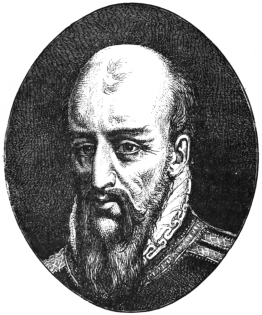
He finished his travels in 1539, settled at Saintes, married, and devoted himself to his original profession and to land-measuring. A few years later he saw the beautiful enamelled earthen cup—whether Oriental, German, or white Ferrarese need not concern us—which turned the entire course of his life. He wished to imitate the enamel{275} without knowing anything of its composition, and embarked upon the long series of experiments which led him, through numberless trials, to eminence and fame. He presents at this period one of the most curious figures possibly in all history, that of a man apparently bent upon shutting out all benefit that might have been derived from the experience of others, literally “groping in the dark,” as he says of himself, and determined to make up for lack of technical knowledge by assiduous experiment. He ground, built furnaces and fired them, tried the potter’s oven of Chapelle-des-pots—all to no purpose. Having accepted a surveying mission he returned with treasury replenished and ardor unabated.
Surely, no man ever knocked with such pertinacity at the door of knowledge. He met his first success by trying a glass-maker’s furnace. One of the pieces came out “white and polished.” This was food to live upon, and he began to build a furnace of his own, doing all the work himself—three masons in one. At length it was finished, and the first attempt ended in failure. He tried again, becoming poorer and poorer, so that he could not buy wood for his furnace. In his strait, he took the tree-props from his garden, his furniture, and house-flooring for fuel. “My shirt had not been dry for more than a month; and also, to console me, they laughed at me, and even those who ought to have helped me went crying about the town that I was burning my floor, and by these means made me lose my credit; and they thought me mad.” He was evidently in a bad way when he dropped into wearing a wet shirt for a month, and thinking that any one ought to have helped him. After a short rest, he turned his attention to the preparation of a new furnace.
To carry out this new plan, he was compelled to mortgage his credit by employing a potter to assist him. His assistant he kept in food by the friendly offices of a tavern-keeper, who seems not to have shared in the madness theory. After six months he felt himself obliged to pay off his help, and did so—in clothes, part of his own scanty wardrobe. Still he was not to be beaten. He finished his furnace single-handed, put in his pieces, and started the fire; but still the gods were inexorable. The pebbles in the mortar used in building the furnace cracked under the heat and flew in splinters, sticking in the glaze of his pieces, and spoiling them. Remorselessly, he broke them{276} all, declining even to give his importunate creditors a single specimen in part payment of his debts. One can imagine the storm such conduct raised, and to make matters worse, “I met with nothing in my house but reproaches, and received maledictions instead of consolation.” The ashes spoiled his next batch, and when he resorted to seggars the unequally distributed heat marred the enamels. He was now, however, too near victory to be altogether discouraged, and finally, after fifteen or sixteen years of unheard-of struggle and misery, this indomitable genius produced the long-sought enamel, and the secret of his well-known rustic pottery was discovered.
Fig. 228.—Palissy Dish. (Rothschild Coll.)
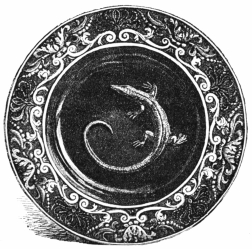
Fame and patronage came with success, but Palissy’s troubles were by no means ended. Having embraced Protestantism, he fell under the edict of 1559, saw his workshop destroyed, and was only saved from death by the intervention of the king. Under the protection of Queen Catherine de Medici, he first went to Rochelle, but was afterward summoned to Paris, and there, in a workshop erected in the garden of the Tuileries, produced some of his best works. Saved by court influence from the massacre of St. Bartholomew, he afterward, in 1588, fell into the hands of the Leaguers, and in the following year, at the age of eighty, died in the Bastille.
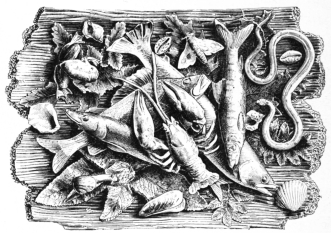
His first success was the production of the white enamel, which appears to have engrossed his entire attention. His second attainment was a jasper glaze, the examples of which show a mixture of brown, white, and blue, and which he deemed only worthy of using as a means of temporary subsistence. His third and most famous achievement was the Rustiques figulines (Fig. 228), with which{277} his name is most intimately associated. These are known by imitations almost everywhere, and consist of variously shaped dishes and vases ornamented with shells, frogs, lizards, snakes, fish of several varieties, and leaves (Fig. 229). He was succeeded by certain members of his family, upon whose death his specialty was lost. At the Centennial Exhibition several imitations were shown in the French, Swedish, and Portuguese departments. Of these the best were those of M. Barbizet (Fig. 230), of Paris, the son of an artist who is said to have rediscovered Palissy’s method, some fifty years ago, and who introduced his father’s discovery into commerce in 1850. Pull, of Paris, and Avisseau, of Tours, are also modern imitators who have been very successful in approaching their model. Pull began to produce his imitations in 1856, and has even deceived connoisseurs. One of his pieces has been sold at as high a figure as £240. Mr. Walters, of Baltimore, has an excellent example by the elder Avisseau. With the exception of the works of Avisseau, Pull, and Barbizet, the imitations of Palissy ware are neither skilful nor in any way attractive; as independent works of art, accomplished on the suggestion supplied by him, they are hardly deserving of serious consideration.
Fig. 229.—Pitcher by Palissy. (Rothschild Coll.)
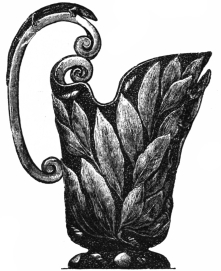
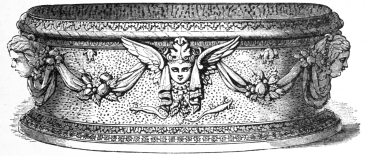
What is to be admired or condemned in Palissy as a man requires no mention; the admirable in him as a potter has been already pointed out (see Introduction, page 42). Passing now from his rustiques figulines, we find him, after his settlement in Paris, carrying his peculiar style into works of a totally different general character. In one piece a figure representing Charity is surrounded by a rustic frame, and a Magdalen kneels in another among shells and plants. In these, as in his rustic pottery, the figures are admirably executed{278} and the coloring vigorous. His palette was limited to a few colors, of which yellow, blue, and gray were the chief, although sometimes we find him introducing violet, green, and brown. Some tiles are attributed to him, but the statuettes formerly ascribed to him are now generally conceded to be the works of other hands. His vases, basins, and dishes are extremely varied, and are decorated with subjects taken from contemporary life and from history. A very remarkable vase now in the Louvre is blue, with yellow ornaments in relief, and not less characteristic are his large oval cisterns, with masques, foliage, fruit, and shells for ornaments. One of these (Fig. 231) is a perfect marvel of soft and harmonious coloring. The heads are white; the drapery white, with yellow fringe, and in its heavier folds blue; the fruit and feathers white, gray, red, yellow, and blue; the ground gray in tone, and composed of blue, maroon, and green. In two specimens of dishes the ground is white, upon which reptiles lie in strong relief. None of his pieces are signed.
Fig. 230.—Barbizet’s “Palissy Ware.” (Tiffany & Co.)
One would imagine the idea to be prevalent that Palissy executed nothing but Rustiques figulines, if we are to judge from the tendency of imitators to produce pieces of that character, and from the prevailing taste of collectors, who appear to demand lizards and fish as essential to the correct imitation of the master. Having given as full{279} a view of his great works as may be necessary to appreciate their variety and beauty, let us revert once more to the fact that Palissy was original in two respects: firstly, in his methods; secondly, in his adoption of natural objects as models. He deliberately shut out all influences which might consciously or unconsciously have affected his aim; and as a consequence, although tin enamel and reliefs were in vogue all over France, he emerged from his obscurity, and lived through the period of his eminence without being affected by either German or Italian ideas or processes. He must be accepted as the exponent of an art emphatically French. His imitators have used his moulds, and his pupils have followed his styles; but even when possessing the secrets and skill, copyists seldom catch the intelligence of their master, and thus we find that on his death his art declined.
Fig. 231.—Palissy Cistern.
While Palissy was still in early manhood, the famous and wonderful Henri Deux ware, or Faience d’Oiron, had been made. There are only sixty-seven pieces in existence; and the mystery which for a long time enveloped its manufacture, its rarity, and its beauty, have both surrounded it with a peculiar interest and rendered specimens almost fabulously valuable. At a sale in 1865, no less a sum than $5500 was given for a biberon. This ware was made about 1530, by a potter named François Cherpentier, and Jehan Bernart, secretary and librarian, both in the service of Hélène de Hangest, widow of Artus Gouffier, Sieur de Boisy. How this lady came to acquire a taste for ceramics, it is not, in view of what heretics call China-mania, hard to imagine. In any case, she built for Cherpentier and Bernart a workshop{280} and furnace near the château of Oiron, and there the admirable Henri Deux ware was made. After the death of Hélène de Hangest, in 1537, Bernart appears to have continued his labors under the superintendence of her son. This faience, therefore, which has created more curiosity—the place of its manufacture was not known until 1862—than any other, and been more lavishly praised, owes its existence to the whim or enthusiasm of a woman.
Fig. 232.—Henri Deux Ewer.
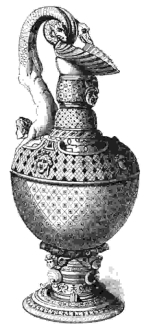
Fig. 233.—Biberon. Henri Deux Ware. (Malcolm Coll.)
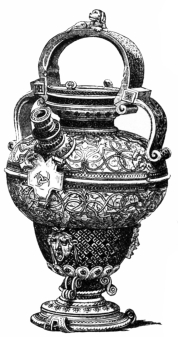
It is an entirely exceptional ware. The paste is a pipe-clay, pure, fine, and white. Upon the first or inner layer, a second layer of a still finer and whiter clay was laid, in which the design was engraved. Colored pastes were then used for filling in the cavities, and the surface was then made level. So closely did the work resemble niello in metal that the name “Faience à Niellure” was given to the ware (Fig. 233). On the earlier works arabesques in zones, initials, and heraldic designs were thus engraved, chiefly in black, brown, and red. The zones are also frequently yellow, and the borders brown. A further ornamentation consists of frogs, shells, lizards, and wreaths in relief. After the death of Hélène de Hangest the decoration assumed an architectural character, and soon afterward the colors lost their beauty, the forms their elegance, and{281} the art, as a whole, degenerated. For a period of about twenty years the faience was made which puzzled ceramists for over three centuries. Copies of this ware, by Minton of England, are in the Boston Museum of Fine Arts, and in the collections of Mr. Walters, of Baltimore, and Mr. W. L. Andrews, New York.
Having referred to the specialties of Saintes and Oiron, we now turn to the other centres of French ceramics, grouping all its porcelain together in a separate section. Beauvais, Poitou, and Hesdin have been already alluded to incidentally. Of the remaining seats of the faience manufactory in France, a few are selected for their importance as producing styles more or less distinctive, such as Rouen, Nevers, Moustiers, and Limoges.
Fig. 234.—Rouen Cup. Lambrequin Decoration.
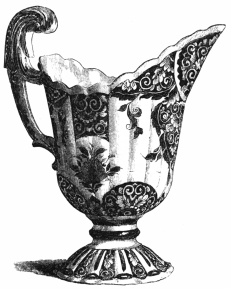
Rouen may be taken as representing independent Norman art. Marreot Abaquesne was engaged there in enamelling from 1535, and two tile pictures from the château of Ecouen, dated 1542, are still in existence, representing, in blue, green, yellow, and white, Mutius Scævola and Marcus Curtius. Abaquesne worked until 1557, and after that date the manufacture of tiles was continued by others. In 1646 Nicolas Poirel, Sieur de Grandval, obtained a privilege or patent for making faience, and immediately transferred it to Edme Poterat, already established in the business in Saint-Sever. To this potter is, in all probability, due the most distinctive styles of decoration practised at Rouen, those resembling lambrequins and lace (Fig. 234.) These are modifications of the Oriental type. In 1673 another patent was granted to Louis Poterat, a son of the former, for the making of “porcelain similar to that of China, and of violet faience painted with white and blue and other colors, in the{282} manner of that of Holland.” After the expiry, about 1700, of Poirel’s patent, manufactories multiplied rapidly, and reached an aggregate of eighteen, from which some estimate may be formed of the number of artists and potters engaged at Rouen.
Fig. 235.—Rouen Faience. Decoration, à la corne. (Trumbull-Prime Coll., N. Y. Metropolitan Museum.)
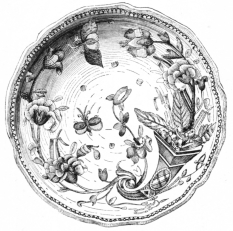
As to the successive styles, there is no doubt that designers drew largely from the works of the gold and silver smith. Flowers in wreaths and bouquets surround landscapes painted on white. Then came the senior Poterat’s adaptation of Oriental designs in the lace and cognate styles already mentioned, at first in blue camaïeu, and afterward mingled with red. Equally well known is the brilliant decoration à la corne (Fig. 235), in which many-hued flowers issue from a cornucopia, and dazzling insects fill in the interstices between the flowers. All these styles have been imitated both throughout France and in other countries. No faience of the eighteenth century was more rich and artistic than that of Rouen. Many of the pieces are of large size and highly ornate in character.
To Nevers it has been usual to accord the honor of being the earliest producer of enamelled pottery in France, but without good reason. The evidence appears to be rather in favor of Rouen. When Louis Gonzaga became Duke of Nevers, he sent for a number of Italian artists, and from that date, about 1565, the production of faience at Nevers took its rise. In 1578 the brothers Conrade came from Albissola, near Genoa, and, settling at Nevers, were patronized by the ducal family. Their works date from 1602, and it was not until thirty years later that a second manufactory was established. The influence of the Conrades upon the art is very doubtful, notwithstanding the monopoly they appear to have enjoyed. One thing may be accepted{283} as certain, that there existed a Nivernais style prior to that introduced by them. Louis Gonzaga, the patron, as we have seen, of ceramic art, died in 1595; and as the Conrades did not establish themselves until 1608, although they had been working for a few years previously, we have a period of forty-three years to account for, dating from the accession of Gonzaga, during thirty of which that prince was alive. The Nivernais styles may, therefore, be divided into the Franco-Urbino prior to the Conrade, the Italo-Chinese which existed under them, the Italo-Nivernais, and the Franco-Nivernais. The Franco-Urbino is marked by a predominance of blue and yellow, by violet tracings, a yellowish flesh tint, a peculiar copper-green, and a scarcity of red. A favorite form of vase handle is the dragon, and the sea is represented in lines of wavy blue. The styles of Persia, Japan, and China began to manifest themselves under the Conrades, and continued down to near the middle of the eighteenth century. We have, after the Persian, blue grounds with white and yellow ornamentation, and white grounds with polychrome and blue decoration. At the same time we find minglings of Italian and Oriental designs. After 1640, however, the traces of Italian influence become less distinct. The Italian school is disappearing, foreign artists are giving place to natives, and down to the end of the eighteenth century there are obvious traces of the styles of Rouen and Moustiers. From that time Nevers declined.
Moustiers has only been known for a few years, but facts have been discovered which prove it to have held a highly important place in ceramic art. Situated in the Lower Alps, its works were long attributed to other places, although its geographical position near Marseilles and Italy would naturally point to it as one of the most favored centres of Provençal art. It is chiefly known by the productions of the Clerissy family and of Joseph Olery. Pierre Clerissy’s works extended from 1686 to 1728, and to this period some of the finest specimens belong. The pieces are generally large oval or round dishes, with hunting or scriptural scenes as central decorations, and borders either of flowers or masks and fabulous monsters and arabesques. The paintings are in blue, upon a very pure white enamel. In the succeeding styles the centre scenes after Tempesta were abandoned. One piece has in the centre a small medallion representing Diana, the huntress, equipped for the chase and accompanied by her dogs. Surrounding{284} it are arabesques, grotesque figures, heads, busts, and amorini, and for an outer border there is a narrow edging of the lace-like pattern of Rouen. Olery (Fig. 236) seems to have abandoned entirely the styles of Clerissy. He enriched his palette with violet, green, brown, and yellow, and revelled in floral decoration. Heavy wreaths of flowers surrounding a series of medallions, with bouquets between, form a deep border for scenes from mythology and the classics.
Fig. 236.—Moustiers Faience Dish. By Olery.
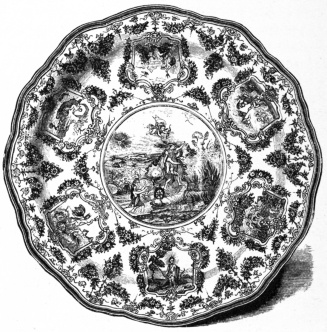
Intercourse afterward obliterated the lines between distinctive styles. Olery went to Spain, and probably acquired there his taste for polychrome decoration (Fig. 237). Spanish artists accompanied him on his return, and worked, no doubt, in the light of their national traditions; and toward the end of the century it is impossible to recognize the styles of either individual artists or schools. Clerissy’s workshop was continued after his death by his partner, Joseph Fouque, whose family retains it to the present day.{285}
Fig. 237.—Moustiers Dish. Polychrome.
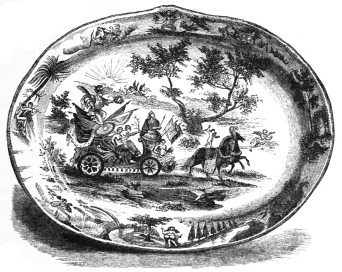
Allied to Moustiers, as representing the art of Southern France, is Marseilles, a city in every way favorably situated for the prosecution of the faience industry. Of its earlier works, dating as far back as the fifteenth century, nothing is known; but toward the end of the seventeenth century a workshop was founded, in which was made an authenticated faience. The distinguishing feature of the decoration is the combination of violet from manganese with cobalt blue. The style bears a general resemblance to that of Moustiers, and it is probable that the works of the two factories are frequently confounded. About 1750 the Marseilles faience was exported in immense quantities; and from that date, when the name of Honoré Savy appears in the list of potters, polychrome decoration became more prevalent. Savy was, in 1777, on the visit of the future Louis XVIII., authorized to call his workshop “Manufacture de Monsieur, Frère du Roi,” and is said to have then adopted the fleur-de-lis as his mark. The mark alone cannot, however, be accepted as indicating with absolute certainty a work of Savy. The same potter is said to have invented a particular green; but it appears to have been common to the other potters of Marseilles, as it is found upon pieces by Joseph Gaspard{286} Robert and Mme. Perrin. Robert ranks next to Savy in faience, and was making porcelain at the time of the royal visit.
In Strasburg we find the origin of a style of faience painting which, although displaying unquestionable excellence of workmanship, was carried to such an extent that the suitableness of the decoration to the earthen-ware body was completely lost sight of. Reference is made to the porcelain style, by which decoration more properly reserved for porcelain was applied to faience. The Strasburg paste is of comparative fineness, the glaze is excellent, and the colors brilliant. The first factory was established by Charles François Hannong in 1709. In 1721 Hannong associated himself with a German potter from Anspach, named Wackenfield, and in 1724 started a second workshop at Haguenau. The latter ultimately fell to Balthasar Hannong, a son of Charles; and the Strasburg establishment was carried on by another son, Paul Antoine. The latter worked industriously, and brought the establishment up to a very high position. On his death, in 1760, it was carried on by his son Pierre Antoine, who transferred it to Joseph Adam, his brother, and in 1780 the production ceased. The best period was that between 1740 and 1760, when Paul Antoine was proprietor.
The places mentioned, Nevers, Rouen, Moustiers, Marseilles, and Strasburg, are the centres from which emanated the leading old styles of decoration. An exact classification is impossible, since, as Marseilles faience often bears a striking resemblance to that of Moustiers, the works of Strasburg, on the other hand, are closely related to those from Marseilles. After them comes a centre, more interesting because very recently arriving at eminence, from which has emanated a style different from that of any of its predecessors.
Limoges is as yet scarcely known in the history of pottery, although there is a probability, almost amounting to a certainty, that it will hereafter be accepted as one of the leading representatives of the ceramic art of France in our day. We find, in 1737, a decree granted in favor of Sieur Massie, empowering him to establish a workshop of faience at Limoges. The discovery of kaolin at St. Yrieix appears to have directed the attention of potters from faience to porcelain. One piece of the Massie period, dated 1741, is now in Limoges. A border, resembling those of Moustiers, surrounds the figure{287} of Justice enthroned and holding the sword and scales. Religion, Truth, and Law attend her, and Crime is crushed under her foot. Other equally remarkable pieces may be in existence, but Limoges nowhere appears in the records as producing any faience of importance or of a very high order of art.
Within the past few years the aspect of affairs has changed, and the Havilands of New York have made for Limoges—in conjunction with Auteuil, near Paris, where much of the moulding and decorating is executed—a place in the history of pottery as lofty as that which it occupies in the history of enamelling. Notwithstanding all that has been said of Saracenic and Italian decoration, we believe that it was reserved for Haviland to show the real decorative capacity of faience, and to demonstrate the possible harmony between decoration and its excipient. For a long time Limoges was known solely as a seat of the porcelain industry. It was in this way that Americans first became familiar with its name. When the time came for Haviland to turn his attention to faience the change above referred to set in. He did more than merely institute a revival of an obscure industry. While Montagnon of Nevers was following closely in the track of his predecessors, and other manufacturers, both French and Italian, were busy with imitations of dead styles, Haviland set a gigantic task before himself, and it is to the credit of Americans that they have been among the readiest to appreciate his works and to encourage his efforts. His faience is remarkable by reason of its combining three very important qualities—novelty of process, originality of decoration, and the strength of drawing and color which are most perfectly in keeping with the material on which they appear.
We have already pointed out the difficulties with which artists on clay have contended. The action of the fire made the result, in so far as the coloring is concerned, always more or less of a problem. Too much or too little heat changed the entire aspect of the piece. Although, therefore, we find in Italy and elsewhere great painters furnishing designs for the decoration of pottery, we seldom find them actually engaged upon the ware itself. Artists naturally prefer the medium which preserves their individuality of touch and finish. This personality the fire destroyed. All that was distinctive of the individual palette and brush vanished under the heat. What the exact nature{288} of the Havilands’ new process and the composition of their palette may be we have not the means of discovering. We know, however, that the painting is laid upon the clay before it is fired, that the piece is then glazed, and is afterward baked for between twenty and thirty hours. Body, glaze, and colors are therefore subjected to the fire together. The glaze is alkaline, and is similar in its general character to that used on pate tendre porcelain. We need not inquire into the preparation of the colors. It is claimed that the possession of the latter brings the result of any operation within such bounds that it can be calculated with a reasonable approach to certainty. Let it be fully understood what this implies. It means that with palette practically unlimited, any artist can apply himself to the decoration of earthen-ware, and find his work emerging from the furnace stamped as clearly with the individuality of his design and execution as if he had applied it to a painting upon a panel or canvas.
Among the artists engaged upon the Haviland faience are M. and Mme. Bracquemond, MM. Lindeneher, Noel, Chaplet, Damousse, Lafond, and Delaplanche. With Messrs. Chaplet, Laurin, and Lafond, the new enamelling process may be said to have accidentally originated at Bourg-la-Reine in 1873, and M. Bracquemond was the first to appreciate its value and to bring it under the notice of the Messrs. Haviland. The latter at once saw its merit, and by farther experiment and the use of the resources at their command, brought it to perfection. The works of their artists have made America as familiar with their faience as it formerly was with their porcelain. The process having been discovered, the second step was the adoption of a style. Here we meet with a peculiarity of the ware. We speak of schools of painting, and our language implies a limitation, a peculiarity of technique. All artists who follow nature closely must needs belong to the same school. Their success in the reproduction of natural effects is a bond of union, which brings them together across the boundaries of special methods of treatment. Each of Havilands’ artists may have his specialty, but we find no broad dividing lines. Their subjects are taken from nature or from imagination, which is only a wider field based upon the natural. The sympathy between them lies in the new sense of the capabilities of their art. The brush is wielded with a stronger hand, and the designs appear bolder, at times
{290}
{291}{289} almost reckless. There is no striving after what might be called “prettiness of style.” Where we have been accustomed to restraint we find largeness and liberty. There are no longer minute divisions of surfaces to be covered in detail with graceful precision, but designs of full artistic completeness and strong simplicity. Color is applied with a commensurate boldness, which carries the conviction that here at last we find a decoration suited to its basis of earthen-ware.
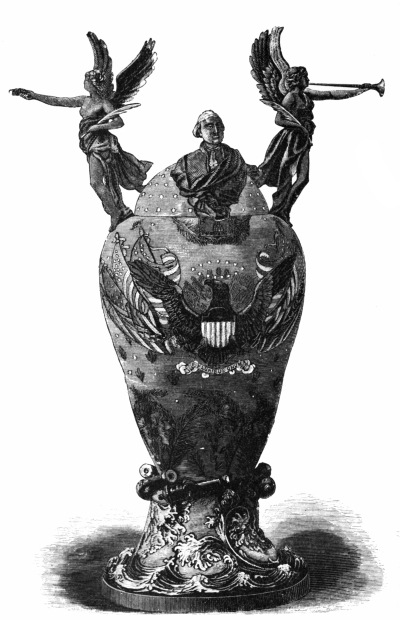
Fig. 238.—Memorial Vase. Haviland Faience. (Smithsonian Institute.)
A recent visitor to the workshop of Haviland & Co., near Paris, where much of their faience is painted, thus describes what he saw: “While in Paris, I studied the way in which the vases are painted, and was surprised to find what an amount of care is expended upon them. They demand more exact treatment than China or English faience. The artist works as if the material were canvas. A bouquet of flowers, for instance, is minutely painted, and the shades of the grounds are all carefully studied. Nothing is left to chance. During the process of firing everything fuses, and it is then that the appearance of boldness is produced. If a vase were painted, as on a cursory examination it appears to be, with a bold brush and careless hand, the result would be a mere daub of no value. The peculiar talent of the artists consists in producing an effect of boldness and carelessness with a great deal of work and a close imitation of nature. Could all the work actually bestowed upon one of these vases, and as it can be seen before firing, be seen after firing, the faience of Limoges would resemble that of England or any other pottery which is painted on the glaze. But the process is different, and after the firing the detail of the work melts away, leaving behind that fascinating harmony of colors which has never before been produced on any pottery. Nothing has as yet been invented to replace work and care; and when anything you may see presents something pleasing, be certain that both have been lavished upon it. No writing or music seems so easy to imitate as that which cannot be imitated; and it is the part of a good author to conceal the method he employs.”
There are now in the Smithsonian Institute at Washington three pieces of Haviland faience which may be taken as exemplifying much of what has been said. These are the Memorial Vases (Fig. 238) and Bracquemond’s tile-piece allegorizing Human Progress. Let us take the vases first. They are the joint productions of MM. Bracquemond,{292} designer, and Delaplanche, sculptor, and are intended to commemorate the Centennial of American Independence. The broad and easily understood conception is intensely American, and was, in fact, due to American inspiration. They fitly stand in the capital, not only as lasting memorials of the hundredth anniversary of America’s entrance into the great commonwealth of nations, but as a congratulatory compliment from the ceramic artists of France.
Viewed in the light of history and of historical usage, they both acquire a fresh interest, and are better understood. They are exceptions, in the idea they represent, to the myriad ornamental vases which load our cabinets and shelves. We have already seen that, from the most ancient days of Egypt downward, vases were employed for the conveyance of religious sentiments. The Chinese followed the same course, and joined with it the custom of using pottery as a reward, or for the purpose of conferring a mark of imperial distinction upon officers deserving well of the state. Vases were also made the media between friends for the conveyance of compliments or congratulations. We might, in this connection, revert once more to the Greeks, who carried the Oriental practice still farther. By that people vases were, as we have seen, used as prizes, as wedding presents, as pledges of love or friendship, the legends they bear enabling us at this distant day to listen to the whisperings of passions which burned and died over two thousand years ago. We also find such commemorative vases as that which bears the legend, “The beautiful horse, twice conqueror at the Pythian games.” On many others are inscribed the names of the great men of antiquity, its kings and its poets. Some of these belong to times posterior to those in which the persons they were intended to honor lived, and may, therefore, be called commemorative in the same manner as statues. Throughout the Middle Ages we find the same usage more widely prevalent. When, therefore, the artists of France decided upon commemorating the American Centennial, they had, as a precedent for making a memorial distinctive of their art, the usage of the potters of all countries back to the most remote times.
In regard to design and decoration, these vases will bear consideration in detail. There is one very large class of Greek vases which represent what we have called the union of pottery and sculpture. In one we have the helmeted head of Pallas Athene surmounted by{293} a figure of Nike, or Victory. On others are Tritons bearing Nereïds, Medusa’s head, pennate figures, and the winged steeds of Aurora. The artist had no thought of utility to hamper him in designing accessories. It is said that M. Bracquemond, while in the Louvre, was attracted by one of the Grecian vases of this class found in Apulia (see Fig. 167). The style is full of grandeur and pomp. The form of the vase would be heavy and clumsy were its outline unrelieved by the decorating figures. On the neck stands a divinity in graceful drapery. Lower down, on the sides, are two statuettes of deities, and on either side of Minerva’s head surmounted by Nike in front are two Tritons, with their horse-feet pawing the air. This vase suggested to M. Bracquemond a design for the Memorial Vases in Washington. All that he thus derived, however, was merely a suggestion.
The details of the design may be gathered from a description of the vases themselves. One is intended to represent the year in which the United States won independence; the other the hundredth anniversary of that event. Between them is a whole century of history. The vase “1776” rises from a base consisting of greenish, foamy waves, lashing angrily against rocks surmounted by a circlet of cannon modelled after the ordnance of Revolutionary times. In this we have the whole story of the struggle for independence, and of the turmoil and confusion of the strife. It is worth noting that this symbolical use of the wave ornamentation is strictly classical. When the potters of Greece sought a symbol of caprice and mutation, they could find none more expressive than the foam-crested waves of the sea. From the cannon the body of the vase swells gracefully outward, and attains its widest girth near the top, where it curves rapidly inward to the upper rim. The orifice is closed by a star-covered dome of blue, from either side of which spring statuettes of Fame and Victory. On a pedestal on the rim in front stands a bust of Washington, modelled by Houdon, after one formerly owned by Lafayette, and now in the Louvre.
The ornamentation on the body is simple and expressive. Green fronds cross each other above the cannon, and smaller branches and stars are sprinkled over the whole surface. On the front is the American eagle with outstretched wings, with the national colors on either side. Above it, and immediately under the bust of Washington,{294} in small gilt letters, are the names of the signers of the Declaration of Independence.
The base of the Centennial vase, “1876,” symbolizes peace and prosperity by means of fruit, cereals, and the implements of husbandry. Above the eagle, in place of the names of the signers of the Declaration, are those of the Presidents, from Washington to Grant, and the surmounting bust represents Columbia. In other respects the two vases are alike. The story they tell is plain, and for every observer to read. Out of the struggle of a hundred years ago have come liberty, peace, and prosperity. The designer was exposed to dangers which he has coped with successfully. He has achieved something grateful to American patriotism without throwing originality aside. The American flag, the eagle, Washington, and the Goddess of Liberty, compose a group which, but for their artistic combination, might have been viewed with the indifference begotten of familiarity. As they stand, it becomes hard to conceive how otherwise, in equally intelligible language, a great historical event could have been commemorated in the everlasting record supplied by clay. They are records, and not mere ornaments. They mirror the first century of America’s life as a nation. They tell all or nearly all that history can tell of the passage from the struggle of 1776 to the prosperity of 1876.
The story of their formation is interesting, that of one applying to both. The body was modelled by M. Renard, chief modeller at Sèvres. He worked incessantly on the inside for thirty-four hours without resting more than a few minutes at a time, in order that his work might be finished before the clay lost any of its plasticity by the evaporation of the moisture. When this operation was completed the body was allowed to dry for fifteen days. A kiln was then built round it, its great size—the vases are twelve feet high, and the largest ever made in Europe—rendering removal impossible. It was fired for eight days at a low temperature, and then for three days at a high degree of heat, and the result of the stupendous work was in every way successful. The furnace required eight days to cool. If anything more is needed to enable us to estimate the immense labor involved in such a work, it may be summed up in this, that these vases demanded thirteen months’ work of some of the ablest artists and potters of France.{295}
It is difficult to criticise them apart from the sentiment they embody, and which invests them with a never-fading interest. It was, however, a touch of genius to get away from immediate usage to a style of ornamentation with which the artists of Magna Græcia and Apulia embellished their vases. It is the style best suited to their enormous size. The enamel is applied only to the ornamentation, the body, busts, and statuettes being all left unglazed and showing the natural color of the clay. Every detail is made expressive, while the strictest simplicity is retained. The size of the work forbade minute ornamentation of a symbolical character, and there is thus a harmony between the entire work and the details. The colors are brilliant, and the general effect, though sombre, is imposing and fine. They will be viewed hereafter with increasing interest, as marking the revival of an old complimentary usage under particularly gratifying conditions; and the grandeur and beauty of the art they represent is not likely to be forgotten in the contemplation of the sentiment they express.
We turn to the tile-piece in which, upon nearly a thousand tiles, M. Bracquemond presents his allegory of Human Progress, with a mingled feeling of dislike and attraction. It also stands in the Smithsonian Institute. The repellent influence is first experienced, and arises, probably, from an apparent absurdity of design and the peculiar coloring. A figure of gigantic size occupies the centre, trampling fire underfoot, and having a greenish bronze statuette in the right hand and a vase in the other. On the left are the chimneys and smoke of a factory, and on the opposite side is a railway train. A flash of lightning strikes in from the right, and above the central figure is the recumbent form of a woman partially enveloped in cloud. The picture, as we have said, is allegorical, and represents the genius of man utilizing the waters of the rebellious stream and storm, the fires of the volcano and lightning, and making them subservient to progress. As it is more closely studied, its true place in art is better understood, and we ultimately accept the piece as an indication of the possibilities of M. Bracquemond’s art. We feel that another stage has been passed on the way toward the perfect union of the potter’s and painter’s skill, and toward the picture “permanent as the Pyramids” of which Ruskin writes.
Many of the other tile-pieces, panels, and plaques (Fig. 239) from{296} Limoges and Auteuil are more absolutely excellent. On a circular plaque appears a draped female head, in which the flesh tint, clear and ruddy, is simply wonderful. The delicacy which it lacks is found on two panels, perfect rural pictures, with single female figures. These pieces illustrate the fineness of landscape effect and the nicety of touch to which the artist in possession of Haviland’s palette can attain. The trees stand out well against the sky, its blue slightly shaded with cloudy gray; and if we turn from these to the figure-drawing, the arrangement of the drapery, even the finish of the embroidery, we feel that we are in presence of an art of the decorative and artistic capacity of which we are only catching the first glimpses.
Fig. 239—Haviland Faience. (H. Havemeyer Coll.)
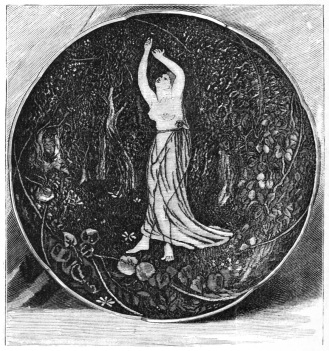
If we pass now to the vases of this ware, we are struck by the originality of their shapes, the freedom of their designs, and the remarkable depth and beauty of their coloring. There is nowhere visible{297} any symptom of the nervous feeling after a doubtful result characteristic of an artist without confidence in himself and his process. Everything indicates strength, assurance, and power; and if there is weakness anywhere, it is evidently the result of a boldness which is over-hasty or too careless of finish and detail. We find no precedent for the decoration. It is as far removed as possible from all that is associated with China or Japan, from the majolica of Italy, Spain, or Berlin, from the stone-ware of England, or the faience of Sweden. The forms of the vases are of boundless variety, and suggest originality by their very multiplicity. One would carry us back to the pottery of ancient Gaul before it had felt the heavy hand of Rome. Another recalls the Anglo-Saxon vases of England. A third would lead us, in searching for a precedent, to the clumsy, rotund urns of ancient Germany. These would all be equally fanciful, no doubt; and in that suspicion one is confirmed by the exquisite forms of a small pichet, a quaint card-receiver, and a vase rising to its slightly out-turned lip as gracefully as the cup of a flower.
Fig. 240.—Haviland Faience. (G. W. Gibson Coll.)
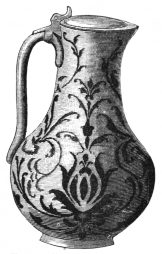
Fig. 241.—Haviland Faience. (Whitelaw Reid Coll.)
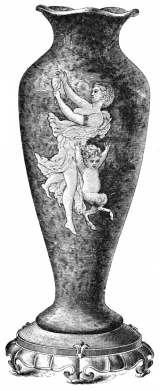
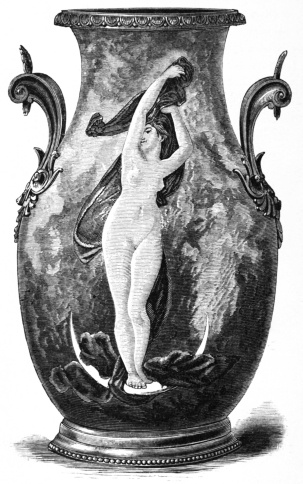
Fig. 242.—Luna Vase. Haviland Faience. (Mrs. William H. Dannat Coll.)
We may take a few examples in order to illustrate the decoration. It consists of painting on the surface, of carved figures in unglazed relief, and of forms glazed and attached to the surface. Of{298} the first of these the choice is wide. On some appear hunting dogs full of life and action and in many attitudes. On another is a Cupid with full-drawn bow, rosy and chubby, and evidently bent upon dealing a fatal wound. On a third is a nymph and satyr (Fig. 241). A fourth shows us a barn-yard pair, a duck and drake, the latter preening himself in the sun, under which his many-hued plumage glitters{299} with a lustre almost iridescent. On a fifth a gayly feathered open-throated songster appears to be warbling his even-song upon a tiny spray. Flowers are painted with all the splendor of nature, and cling round the forms with gracefully sweeping stem. One in particular is made attractive simply by its color, a mottled gray, into the depths of which we look as into the clouds hanging over the couch of the sun in the early mornings of summer. Its beauty is in its suggestiveness, which strikes us again in many of the flower-wreathed vases where there are openings of green, into which one can look as into a forest glade. The mind creates what the eye cannot see, and the glade is peopled with beings whose forms are never caught. This is, no doubt, an example of fancy helping out the artist, but the artist is none the less fortunate and skilful who can thus induce the fancy to take wing. He leaves her room to take flight, and the vase he has decorated with a simple flower becomes a poem suggesting far more than it tells.
Of the vases showing unglazed carvings in bas-relief there is a single pair, sufficient for illustration. On one is represented Phœbus, the golden-haired god of day, and on the other the triform goddess Luna. Phœbus stands with bow drawn full to the shoulder, just as we picture him in Homer. It will be remembered that when Lyrnessus was taken by the Greeks and the spoils divided, Chryseis, the wife of the king of the captured place, and daughter of Chryses, one of the priests of Apollo, fell to the share of Agamemnon. Her father sought her restoration from the “king of men,” and on his request being refused, asked aid from the god he served. We here have Apollo in the attitude of returning an answer to his suppliant priest.
“Bent was his bow, the Grecian hearts to wound, Fierce, as he moved, his silver shafts resound; Breathing revenge, a sudden night he spread, And gloomy darkness rolled around his head. The fleet in view, he twang’d his deadly bow, And, hissing, fly the feather’d fates below. On mules and dogs the infection first began, And last, the vengeful arrows fixed in man.”
On the companion vase (Fig. 242) is the figure of the goddess of night, Luna, Diana, or Hecate, in her character of Luna, with the crescent under her feet, and throwing back a mantle from her graceful{300} form. In both vases the beauty of the conception is skilfully carried out in the execution. The figures are admirably modelled, and, being of a light paste and left unglazed, stand out in bold relief against the ground. The daring of the latter innovation is amply justified by the result.
Fig. 243.—Faience Vase. (Mrs. Colonel T. Scott Coll.)
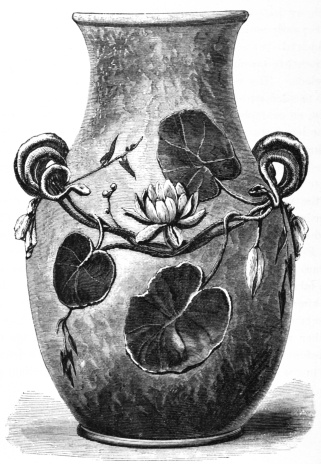
Of the third class of vases with glazed ornaments applied to the body there are many fine specimens. One of the most charming (Fig. 243) is wreathed by flower sprays twined naturally and gracefully{301} round the body. The flower is in full bloom, and its large leaves are spread out above it and below. For handles there are snakes turning in their changeless coil round the flower stem. On another the handles consist of butterflies beautifully moulded and colored, and placed as though they might have been transformed into clay as they alighted on the vase. Another, of small size and quaintly rotund form, has a mass of leaves and flowers in relief clustering round the body. A pitcher with a soft gray ground is lightly overrun with an ivy branch, which twines itself round the neck and handle as naturally as the plant creeps up and winds itself round the stem of a tree.
Can anything be more simple than the suggestions to which these creations are due? Do we need to be reminded of the fable which explains how Callimachus was inspired to produce the Corinthian capital? We are told that he was walking in the country, and as he travelled he came to the grave of a child, upon which, in a basket, some relative—its mother, probably—had placed the customary offering of food. To keep off the birds and small animals, a tile had been laid upon the basket. In course of time an acanthus appeared; and as it grew, its stalk was pressed back by the tile and turned round spirally under its edge. Nothing more was needed. Callimachus found in the little basket on the flower-grown grave a suggestion for the order of architecture which has never been surpassed to this day. We have similarly, in the faience vases of Haviland now under consideration, constant hints of inspiration drawn from the simplest forms of nature. A branch falls upon a vase and becomes its ornament. A butterfly hangs for a moment on fluttering wing and drops from its flight, and it too becomes an ornament. The workman leaves his unfinished work at night, and when he returns at day-break, finds that a lizard or an asp has crept upon the still slimy vase to bask itself in the first rays of the morning sun. It darts out of sight, but it has left an idea which appears in the decoration; and on the spot from which it glided when disturbed a snake displays its spiral convolutions.
Where but in nature shall we see anything suggestive of such decoration? We do not find it in Japan, for the symbolical and semi-imaginative, semi-realistic style of the extreme East has nothing in common with this naturalism. As little do we find it among the{302} brilliant colors and fantastic forms of Persia. If we come nearer home, to Italy, even to the French centres we have already visited, there is nothing in their classical scenes and floral wreaths and bouquets to prepare us to find in Limoges their orderly successor. In a word, the style is original. There is no crowding of tints for the sake of their rich beauty. A single flower lying on a ground of one prevailing tone is sufficient ornamentation for a vase; or a handful of flowers may be scattered upon the surface in tumbled profusion, or woven into a wreath. Haviland has entered upon a hitherto undiscovered path, and let us pray that he may never be tempted to try the porcelain decoration which threatened to ruin faience, nor to give us anything more meretricious than the beauty of a garden flower or of the many other admirably conceived forms which he has endowed with life.
Fig. 244.—Haviland Faience. (Miss Clara Louise Kellogg Coll.)
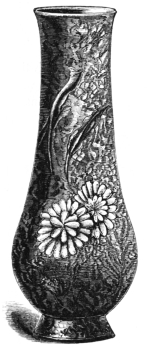
The best pieces have been chosen for commendation and to illustrate the highest results to be expected from the new process. It is unquestionable, however, that there are many pieces of this faience which could be disposed of without seeking words for the expression of enthusiastic praise. This gives those desiring specimens every opportunity for the exercise of a judicious discrimination. In some pieces the simultaneous melting of the color and glaze has resulted in a haziness of outline and confusion of colors by no means characteristic of the better examples. On others with figure decoration the drawing has been completely destroyed, and the figure left in obscurity. These inferior pieces are useful, however, for showing how careful must be the work which produces the bold effects securing our admiration.
When Haviland took up the process discovered by MM. Chaplet, Laurin, and Lafond, at Bourg-la-Reine, he secured the services of two{303} of these artists. The third, M. Laurin, carried out the process at the place of its discovery. Many of this artist’s works come to us bearing his mark and the name of the factory, Bourg-la-Reine, in full. Like that of Haviland, his work is occasionally irregular; but, as a rule, it is entitled to very high commendation. The flower decoration is extremely beautiful, and when laid upon a soft ground, such as the gray, which Laurin produces to perfection, is entitled to nearly all the praise bestowed upon the corresponding works from Haviland’s factory. The Bourg-la-Reine faience is chiefly painted on the flat, and the leading decoration consists of flower and figure painting. We meet with many well-selected subjects and much strong and realistic treatment. On one vase appear an eagle and a serpent on an excellent ground of gray and blue, the former of which is also employed with fine effect in a variety of flower pieces.
Fig. 245.—Bourg-la-Reine Faience. (G. Collamore.)
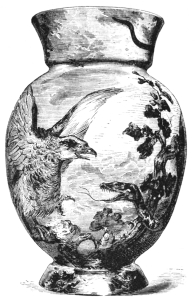
Fig. 246.—Bourg-la-Reine Plaque. (Tiffany & Co.)
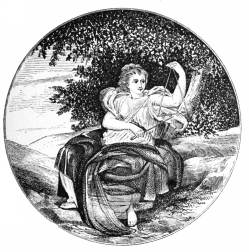
A very common mistake is made regarding this faience. It is often confounded with that of Haviland, although the differences between the two fabrics are obvious. In the first place, the marks can be consulted. That of Limoges{304} is stamped “H. & Co.”—or, Haviland & Co.—with or without the place of manufacture. The artist’s mark also is generally attached. The Bourg-la-Reine is marked either with the name “Laurin” or “B.-la-R.,” or with both. In the second place, the alkaline glaze of the Haviland faience gives the paintings, especially of flowers, a life-like appearance peculiar to itself. It is a mistake to suppose that the processes of decoration are identical in every particular. In one respect only they are alike. In both, the colors are laid upon the unbaked clay. In the mixing of the colors and in the glaze they are distinct. Laurin’s decoration is harder in outline than the Limoges, and never possesses the mingled softness and strength which constitute the great charm of the latter.
Fig. 247.—Deck Faience. (Corcoran Art Gallery.)
Of the early history of Bourg-la-Reine little of general interest is known. It appears that Jullien and Jacques of Mennecy founded a workshop there about the year 1773. Jullien died in 1774, and was succeeded by his son, who resigned his share in the business to Jacques. When Jacques died, in 1799, his son, C. S. Jacques, continued the fabrication. At a later period fine white faience was made. It is upon Laurin alone that, in this country, the reputation of the place depends.
Fig. 248.—Deck Bottle. (Gilman Collamore.)
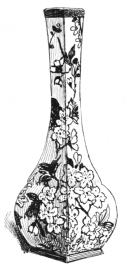
Fig. 249.—Deck Vase. (Gilman Collamore.)
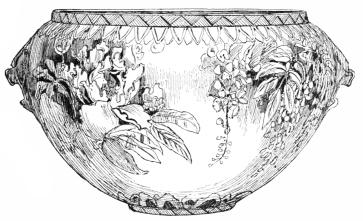
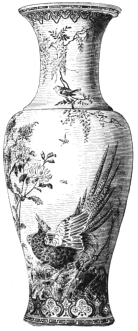
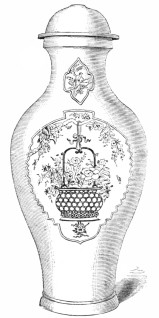
The name of Deck, of Paris, brings before us much that is beautiful in the recent ceramics of France. For a long time, in fact, his name was supposed to represent nearly all that was excellent in the color and decoration of European pottery. Having enriched his palette with a wealth of colors which made him the envy of his cotemporaries, he turned his attention to reviving Oriental styles in hues rivalling those of the East. He was first attracted to Persia, and with marvellous skill applied his rich enamel colors to the reproduction of the faience of that country. In other cases he is manifestly inspired by Japanese{305} art. His technical skill enables him to reach widely varied effects, and since to this are added truthful drawing and a fine taste in the assortment of tints, we can easily understand his eminence in the art. Specimens of his best work are comparatively rare in this country. The faience vase from the Corcoran Art Gallery (Fig. 247) is characteristic, and is an excellent example of M. Deck’s coloring. The ground is a soft yellow or buff, and the plumage of the pheasant is brilliant and rich. The blue tints are especially fine, and the glaze, which is judged to be alkaline, gives the coloring that peculiar softness which is found in the greatest perfection on pate tendre. There is considerable doubt as to the body used by Deck. It varies very much in different pieces, approaching in some cases the hardness and compactness of porcelain. Of this character is the bottle, Fig. 248. The ground color of this specimen is a clear blue, and in it the white blossoms appear in thick clusters. A vase and plaque, with a somewhat similar, but possibly even a finer body, are shown at page 325 (Figs. 280 and 281). That given here (Fig. 249), singular alike in form and color, has a{306} ground of undecided shades of brown and yellow. Deck’s violet is soft and rich, approaching at times the velvety violet of China.
Fig. 250.—Colinot Faience. (Tiffany & Co.)
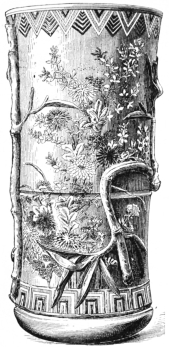
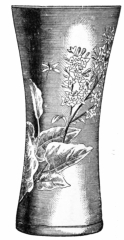
The other names most familiar to Americans are those of Colinot, Parville, Longwy, Creil, Sarreguemines, and Montereau. Their products illustrate the taste for Oriental styles which sprung up a few years ago, and to the gratification of which much of the ingenuity of French makers has been devoted. Colinot, of Paris, has employed with great skill colored enamels in the imitation of Japanese work. On one cylindrical vase (Fig. 250) he has laid in strong relief, upon a dark-buff ground, flowers and leaves exactly after the models supplied by Satsuma and Kioto. On other specimens the decoration is outlined upon a white ground, and filled in with enamel colors. The method is productive of a clear hardness of outline, but the results are seldom unpleasing and often very attractive. Colinot has succeeded in obtaining several excellent colors. The vase (Fig. 251) is a rich purple, on which the flowers are laid in white and green. The treatment is similar to that of Deck, but the ground is less brilliant and clear. Colinot also acquired considerable reputation by his faience with colored stanniferous enamel. We give an example (Fig. 252) of his treatment of large pieces. The ground is a pale blue, and the medallions are admirably painted. The color is subdued throughout.
Fig. 251.—Colinot Vase. (Gilman Collamore.)
{307}The Creil workshop was established some time during the eighteenth century, probably about 1780, by a number of English potters. Its earliest works appear to have consisted chiefly of services of a semi-porcelaneous paste. The Worcester method of transfer-printing and then painting the design in colors was adopted, and successfully handled. The founders transferred the establishment to Le Bœuf, Milliet & Co. and De St. Criq & Co. Porcelain was made until 1860, after which the production was restricted to English faience. The paste cannot, however, be distinctly qualified, as it varies from the original semi-porcelain to cream-colored ware. The latter has a wide reputation, both for its quality and its decoration under the glaze.
Fig. 252.—Colinot Faience. (Tiffany & Co.)
The Montereau establishment was, like that of Creil, founded by Englishmen. Letters patent were granted on March 15th, 1775, to Clark, Shaw & Co., to make English faience and queen’s-ware. The firm started under very favorable auspices, receiving an annual allowance of 1200 francs for ten years, probably for the purpose of naturalizing the industry. Its wares helped to overturn the manufacture of French faience, and were imitated at several places, including Toulouse and Sarreguemines. In 1790 there were two establishments at Montereau. As at Creil, M. De St. Criq, in 1810, acquired the right of protection, and in 1829 assigned it to Lebœuf & Thebaut.
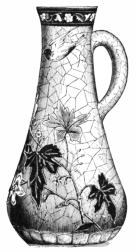
At Longwy the manufacture of faience was begun about forty years ago, when M. Huart de Northcomb was proprietor of a workshop. Its name is now found upon many excellent specimens of faience with colored stanniferous enamel. In the bottle and tray (Fig. 253) a rich effect is produced by the employment of two shades of blue in the scaly ground. The oval medallions and other ornamentation are yellow, with leaves and flowers in green and pink. It is one of the best examples we have seen from this factory, which is one of the largest of its kind in France. The pitcher (Fig.{308} 254) has a ground of undecided very pale yellow, and the leaves, flowers, and birds are variously colored. Our third specimen, an oval plaque (Fig. 255), has, in its design and the brilliancy of its coloring, a decidedly Oriental appearance. In the other examples the ground is broken up by a crackle more or less open and irregular; but in the plaque the white enamel is veined with fine and regular darkly colored cracks, which bring the ground to a soft and pleasing gray. The flowers are red and pink, and the foliage green, turning at times to blue. The bird is brightly plumaged with blue and other colors. In this as in the other pieces, the ground alone is crackled, and the decoration has the appearance of being graved in the enamel and then filled in with the requisite colors.
Fig. 253—Longwy Faience. (Gilman Collamore.)
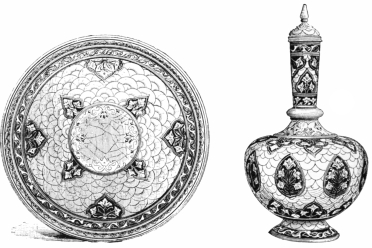
Fig. 254.—Longwy Faience. Crackle. (G. Collamore.)
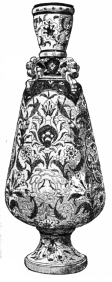
Parville, of Paris, makes enamelled faience of the same general description; and the vase chosen to represent it (Fig. 256) deserves attention both for the peculiarity of its form and for the illustration it gives of{309} a French modification of the Persian style of decorating. The ground is a dull and sombre shade of dark-blue, upon which the ornamentation is laid in light-blue, white, red, and two shades of yellow.
Fig. 255.—Longwy Faience. Crackle. (Tiffany & Co.)
Fig. 256.—Parville Faience. (Tiffany & Co.)
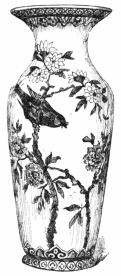
Gien faience, like those of Creil and Montereau, belongs to the class of ware with a colorless plumbiferous glaze, and its decoration is often remarkable both in design and color. In the vase with which we represent this faience (Fig. 257) the design is outlined on the biscuit, and the colors are then applied. The earlier products of Gien are said to be imitations of the styles of Marseilles. A more artistic faience, resembling the Gien, is made by M. Elysse at Blois, in the old Italian styles of the fifteenth and sixteenth centuries.
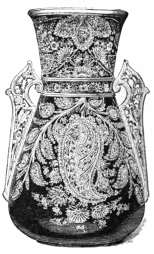
The Sarreguemines factory was founded in 1770, by Paul Utzchneider, and is now carried on under the firm of Utzchneider & Co. It turns out both faience and porcelain. Figures and groups in porcelain biscuit and artificial porcelain are made. The factory is also known by a fine white stone-ware. In the fine faience of Sarreguemines, certain works may be found which are, in many respects, the most extraordinary of the present time. Imitations of jasper, marble, granite, and porphyry, are produced of the most beautiful description, and other pieces resemble the jasper-ware of Wedgwood, with white decoration on a blue ground. The vase (Fig. 258) can hardly be described in words. Among the varied contents of Mr. Collamore’s collection, it is perfectly{310} unique. The ground is a deep and brilliant black, upon which the decoration is laid in white, gold, and blue, dotted with drops of jewel-like enamels. The handles are blue and gold. The design can be distinctly followed in the engraving, but even a colored plate could hardly do justice to the enamels, or give an idea of the general effect.
Fig. 257.—Gien Faience. (Davis Collamore Coll.)
Niederviller has made faience in the Strasburg style since at least the beginning of the eighteenth century, and about 1760 was producing pieces with delicate flower paintings. It was then under the patronage of Baron de Beyerlé, and afterward of Count Custine, under whose proprietorship the porcelain style was farther developed. A curious specimen is given by Jacquemart, in which the ground of the plate is painted to imitate wood, and in the centre is a reservation simulating a sheet of white paper with a landscape in pink. In 1768 the Baron de Beyerlé was making a good quality of porcelain from German material. Under Count Custine, François Lanfrey was engaged as manager. Charles Sauvage, or Lemire, made small figures and groups in biscuit, and Cyfflé also executed some of his works at Niederviller.
Fig. 258—Sarreguemines Faience. (G. Collamore.)
The name of this artist, Paul Louis Cyfflé, is, however, more intimately associated with Luneville. The faience workshop of Luneville was founded about 1729, by Jacques Chambrette. In 1778 it was acquired by Keller & Guérin. The styles of Nevers and Strasburg were both successfully followed. It was here that Cyfflé made his statuettes of fine “terre de Lorraine.”
In the same district are the factories{311} of Nancy and St. Clement. The former produced faience in 1774, and a peculiar kind of biscuit which takes its name from the place. The factory was founded by Nicolas Lelong. Very little is known of the St. Clement works, though they are said to have been in operation in 1750. In 1835 they were under the directorship of M. Aubry. Both Luneville and St. Clement have been more recently known by their stanniferous faience.
St. Amand holds an important position in the history of French art. It is one of the places, including Lille, Dunkirk, Valenciennes, and the other faience-producing towns of Flanders, which enabled France to domesticate, in a measure, the manufacture of ware resembling that of Delft. The paste of these faiences is identical with that used in the great Dutch establishment, with which they very soon came into competition. The history of St. Amand extends from 1740 down to the Revolution. It was founded by Pierre Joseph Fauquez, was continued by his son, Pierre François Joseph, until 1773, and by his grandson, Jean Baptiste Joseph, until the Revolution. The earlier style of decoration is based upon that of Rouen; the second is after that of Strasburg. One of the distinguishing features of this faience is the use of white enamel in relief upon the glaze, which is faintly tinged with blue.
Having already touched upon a few of the leading names of modern Paris, there yet remains to be said something of its previous history. The relics discovered within the city belong to every period, from the Roman downward; and it may therefore be said that the metropolitan potters have been as busy, comparatively speaking, in the past as they are to-day. Faience was made from the beginning of the seventeenth century, and Réverend was, in 1664, making imitations of Delft, “thin, with a white enamel, with clear polychrome colors, often excessively pure.” This is M. Jacquemart’s description. Notwithstanding the privilege accorded to Réverend, many other workshops appear to have made faience throughout the whole of the eighteenth century, and it is generally impossible to tell them from the wares of Rouen and elsewhere, which they imitated.
Artistic faience was made at Sceaux for about forty-five years previous to 1795, by Chapelle and Glot successively. Gros-Caillou, St. Denis, Vincennes, St. Cloud, and Sèvres were all more or less engaged{312} in the manufacture of faience. We find Pierre Antoine Hannong, from Strasburg, at Vincennes in 1767, but he met with little success.
There are many other places at which faience was made, some, like Nantes, Bordeaux, and Orleans, of importance, and others of which little is known besides their names. A list of them would add nothing to our real knowledge of French art, which has been chiefly influenced by the styles of which we have most fully treated. To the accounts of them has been added all that could be learned regarding Limoges, Creil, Sarreguemines, and a few Parisian and other workshops especially interesting to the collectors of the present day.
PORCELAIN.
Efforts to Make Porcelain.—First Artificial Porcelain.—St. Cloud.—Lille.—Paris.—Chantilly,—Mennecy.—Vincennes.—Sèvres.—Natural, or Hard, Porcelain.—Discovery of Kaolin.—Various Factories.—Limoges.—Deck.—Regnault.—Solon.—Pate Changeante.—Pate-sur-Pate.
Fig. 259.—St. Cloud Porcelain Salt-cellar. (Jacquemart Coll.)
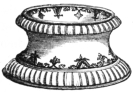
We have already seen that the discovery of artificial porcelain preceded that of natural, or kaolinic, porcelain. In treating of the faience of Rouen, we quoted, from the letters patent granted to Louis Poterat on the 31st of October, 1673, a passage to show that he meditated the production of porcelain similar to the Chinese. A privilege was also granted to Claude Réverend, of Paris, in 1664, which bears that he possessed the secret of making a “counterfeit porcelain, as fine and finer than that which comes from the East Indies.” All that Réverend achieved was a very fine faience; and Poterat, having met with success as a maker of faience, probably renounced the prosecution of the search for porcelain, although he may be said to have arrived at or very near success. The first French artificial, or soft, porcelain known to commerce was that made by the Chicanneau family at St. Cloud in 1695 (Fig. 259). It is first noticed by Martin Lister, a traveller, in 1698. Henry Trou, having married the widow of Pierre Chicanneau, became head of the manufactory of St. Cloud; and a family quarrel having taken place, Marie{313} Moreau, widow of one of the Chicanneaus, established herself in Paris. The earliest marks of St. Cloud porcelain are the sun and the letters S. C. and T., the former dating from 1702 to 1715, the latter from 1715 to 1730. The sun was the device of Louis XIV., and the letters afterward used were the initials of St. Cloud and Trou. The paste was close and white, and the glaze uneven. The decoration soon became varied in character, some pieces, with birds and flowers in relief, resembling the Chinese, and others of French patterns in blue, with arabesques or lace borders.
Fig. 260.—Vincennes Porcelain Cooler. (Duke de Martina Coll.)
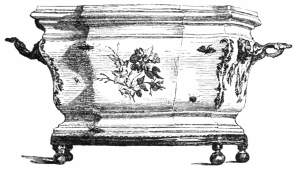
The attempts of Poterat and Réverend, and the more perfect success of Chicanneau, indicate the prevalence of the desire to solve the mystery of Chinese porcelain. Experiments were being conducted almost everywhere, and the success of the potters of St. Cloud gave a new zest to the search. A manufactory was founded at Lille in 1711; at Paris, by the offshoot of the St. Cloud family, in 1722; and at Chantilly in 1725, where the porcelain of Corea was taken as a model. Ten years later Barbin was established at Mennecy, and in 1739 the philosopher Réaumur, led away by the universal search, arrived at a devitrified glass, which went under the name of “Réaumur’s porcelain,” though in no sense deserving such a name. With 1740 we reach the establishment of the royal manufactory at Vincennes (Fig. 260).
Two brothers named Dubois, formerly of St. Cloud, offered to sell their secret to the Intendant of Finance, and were given the necessary means to carry on the production at Vincennes. These men did not{314} fulfil their promise, and were succeeded by one of their workmen, named Gravant. The celebrated Madame de Pompadour used her influence with the king to induce him to favor an enterprise the success of which would make France independent of Saxony. The result was that the manufacture quickly rose to eminence. Chemists, artists, and goldsmiths were engaged in designing and decorating. Flowers were modelled and painted in a style so closely resembling the natural that the king is said, upon one occasion, to have mistaken the artificial for the real. In 1753, the position of manager was given to Eloi Brichard. Louis XV. took a third of the capital upon himself, and the name of “The Royal Porcelain Manufactory of France” was conferred upon the establishment. The workshops at Vincennes became too small, and in 1756 a removal was made to a new building erected specially for the purpose at Sèvres.
Fig. 261.—Old Sèvres Pate Tendre. (August Belmont Coll.)
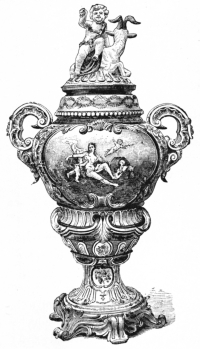
Fig. 262.—Old Jewelled Sèvres Pate Tendre. Cup diameter, 2½ in.; Saucer circumference, 18 in. (Mrs. J. V. L. Pruyn Coll.)
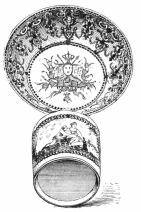
Fig. 263.—Jewelled Sèvres. (H. C. Gibson Coll.)
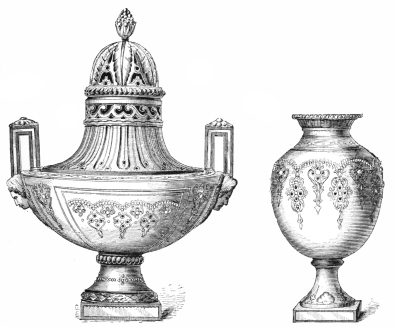
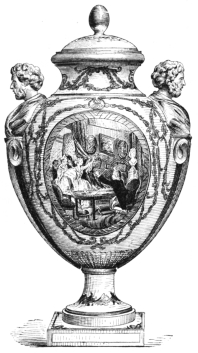
The imitations which had annoyed Adam, the director who preceded Brichard, continued under the administration of the latter. The king then took the entire establishment into his own hands, and appointed M. Boileau director. Such was an eighteenth century toy of royalty. The king, accompanied by the Pompadour, paid regular visits to Sèvres, which was well worthy of being a royal possession. Everything that art could suggest in the form of gardens and groves had been done to embellish it. Even a private chase was provided for the artists, where, in hunting the boar and stag, they relieved the labors of the studio. Never, possibly, were artists so favored by patronage and place, and the productions of Sèvres were worthy of the sunshine in which it{315} basked. Its flowers and vases admit of no classification. Figures were also made in biscuit (see Fig. 226). Chemists vied with each other in the invention of colors, and the bleu de roi, Hellot’s turquoise blue (1752), the Pompadour pink (1757), violet, greens, yellow, and iron-red followed each other in rapid succession, and were employed with dazzling effect. Special mention need only be made of the jewelled porcelain (Figs. 262 and 263) on a bleu de roi ground. The successive directors after Boileau were: Parent, 1773-1779; Regnier, 1779-1793; Commissioners, with Chanou and afterward Salmon, Ettlinger, and Meyer, jointly as inspectors, down to 1800; Brongniart, 1800-1847; and then MM. Ebelman, Regnault, and Robert in succession. The specimen{316} here given (Fig. 264) is one of a pair dated 1772 and 1781 respectively, which formerly belonged to Louis XVI. On his request they were sold by Governor Morris, in order to raise money, and were bought by Dr. Hosack, of New York. The scene in the medallion represents Louis XVI. in his cabinet, and the nurse bringing in the newly born Dauphin.
Fig. 264.—Sèvres Pate Tendre (1772-1781). Bleu de Roi Ground. (Mrs. C. B. Hosack Coll.)
Meantime the paste was still artificial, and the researches for a natural, or hard, porcelain were not relaxed. In 1769 the discovery of kaolin and petuntse at St. Yrieix, near Limoges, led to the introduction of hard paste into Sèvres. In 1804 M. Brongniart decided to abandon the manufacture of artificial porcelain, and soon afterward regretted having taken such a step. In 1847 M. Ebelman, Brongniart’s pupil and successor, decided to revive the pate tendre, and for four years made use of a body which had been prepared by Brongniart forty-five years previously. The clay, instead of being thrown away, as Brongniart thought, had been stored throughout the long period of its neglect, and both saved the new director any trouble in experimenting, and supplied a standard for the future. The production of soft paste has been continued, but the quantity is inconsiderable. Mr. Walters, of Baltimore, has in his collection a valuable pate tendre vase dated 1860.
To give in detail the events which led to the introduction of natural porcelain into the royal factory, we must turn back to the year 1721, when Wackenfeld was attempting to utilize at Strasburg the knowledge he had brought from Germany. Hannong was engaged{317} in the same enterprise; and his son, Paul Antoine, after endeavoring in vain to carry on the production in competition with the artificial porcelain of the royal factory, and engaging in fruitless negotiations with Director Boileau, at last retired to Frankenthal. His son afterward took the Strasburg works in hand, but failed. All this porcelain was made from imported material. That of Paul Antoine resembles in decoration the works of Meissen, and his son followed both the Saxon and Sèvres styles.
Fig. 265.—Charlotte Corday Vase; Sèvres Porcelain, Mounted. Red and Gold. (White House.)
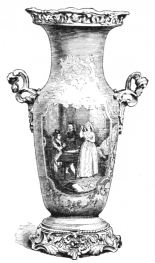
In 1758 an event happened of the first importance to the making of a true French natural porcelain. This was the discovery by the Count de Brancas Lauraguais of an inferior quality of kaolin near Alençon. The specimens of the ware in which it was used show a coarse body, and decoration after the Chinese and Japanese types. Shortly afterward Gérault, or to give his name in full, Charles Claude Gérault Daranbert, the proprietor of a faience establishment at Orleans, engaged in the manufacture of porcelain. A privilege had been granted to the Orleans workshop, in 1755, to make a white faience, and the making of porcelain appears to have begun about 1764, on the acquisition by Gérault of a kaolin mine at St. Yrieix-la-Perche. In 1765 Guettard, chemist in the establishment of the Duke of Orleans at Bagnolet, came upon the kaolin deposit at Alençon originally discovered by the Count Lauraguais. Within a few years, also, Robert was making porcelain at Marseilles.
Fig. 266.—Old Sèvres, Mounted in Metal. Dark-blue Ground. Height, 9½ in. (Mrs. J. V. L. Pruyn Coll.)
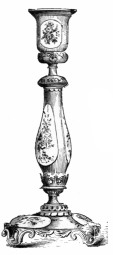
The next events of importance are Madame Darnet’s discovery of kaolin at St. Yrieix, and Macquer’s experiments with it at Sèvres. As at{318} Strasburg, the mistake was made at Sèvres of mixing the kaolin and petuntse in the wrong proportions, and the result of the excess of felspar was a very translucent glassy body. The first pieces and those of artificial paste were so nearly alike that, to distinguish the former, they were marked with the well known double L and crown. They may also be known by the color being laid upon the glaze. In the soft paste the colors appear to be sunk in the glaze. When Brongniart, in 1804, stopped the production of pate tendre, the works of the royal factory began to assume the forms and to be decorated in the styles with which the world has been familiar for the last seventy years. “The largest pieces,” says Jacquemart, “were undertaken, and sculpture and painting united to enrich gigantic vases. Plaques of forty-six by thirty-six inches were given to distinguished artists, who reproduced in unalterable colors the frescoes of Raffaelle, the masterpieces of Vandyke, Titian, and of the modern school.” Of modern Sèvres we give one example (Fig. 268), to which some interest attaches as belonging to a service presented by the French Government to Miss M. F. Curtis, distributor of funds sent from Boston for the relief of sufferers by the war with Germany in 1870-1871.
Fig. 267.—Franklin Vase. Sèvres. Blue and Gold. Inscription on Vase, “Vue de la Maison de Franklin à Passy.” (White House.)
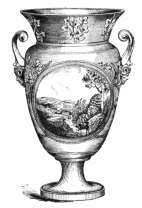
Fig. 268.—Sèvres Porcelain Tea-Set. (Curtis Coll., Boston Museum of Fine Arts.)
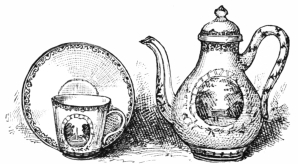
{319}
To give an idea of the value of the Sèvres porcelain, it may be mentioned that Napoleon, following an example set by Louis XV., sent to the King of Etruria a vase worth about sixty thousand dollars. Tea-sets worth $1000, vases at $1500 and $5000, are mentioned as being in the royal collection in England.
Fig. 269.—Washington’s “Cincinnati” Sèvres.
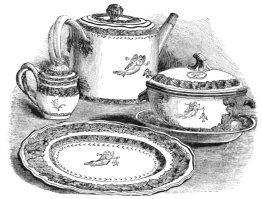
Fig. 270.—Mrs. Washington’s Sèvres Tea-Service.
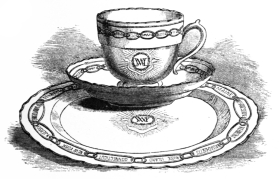
There are several specimens of Sèvres porcelain, formerly preserved at Arlington House, and now in the Patent Office at Washington, to which a historical interest attaches. There are, firstly, some pieces of the “Cincinnati China” (Fig. 269) presented to George Washington by the French officers who fought in the continental army. They are white, with deep-blue bands of leaves and scroll-work, and have on the bottoms or sides the figure of Fame holding in her left hand the Order of the Cincinnati. There are, secondly, several remnants of the set presented at the same time, and by the same gentlemen, to Mrs. Washington (Fig. 270). The rim of each piece is surrounded by a chain of thirteen links, in each of which is the name of one of the original States. In the centre of each plate and saucer, and on the side of each of the other pieces, is the monogram of Martha Washington, surrounded by a green wreath of laurel and olive leaves. A golden{320} aureole surrounds the wreath, beneath which is a ribbon scroll with the motto, Decus et tutamen ab illo. The colors are at once delicate and brilliant, and the painting admirable.
Fig. 271.—Limoges Porcelain. Cup and Saucer. Painted by Pallandre. (S. S. Conant Coll.)
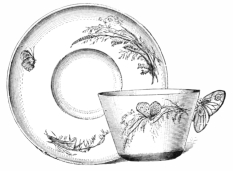
Manufactories rapidly sprung up in other French towns—at Niederviller, where German kaolin was used; at several places in Paris; at Bordeaux, Clignancourt, Lille, Valenciennes, Vincennes, Limoges, and elsewhere. Fauquez made porcelain at Valenciennes in 1785, and the works were taken by Lamoninary in 1787. Hannong was employed at Vincennes in 1786, and marked his pieces with two pipes crossed, with or without the letter H. The industry was afterward protected by the Duke of Chartres, when the monogram L. P. was adopted as the mark.
Fig. 272.—Limoges Porcelain Plate. Painted by Pallandre.
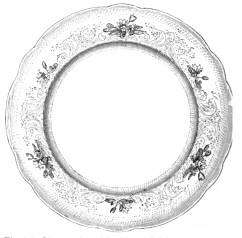
The porcelain of Limoges is probably better known in this country than any other, through the enterprise of the makers, whose works in faience have already arrested our attention. The proximity of Limoges to St. Yrieix would alone lead us to view it as an important centre. After the discovery of kaolin, the brothers Grellet, Massié, and Fourniera established a porcelain workshop in 1773. The mark C. D. occurs on many remarkable works. In 1784 the manufactory was absorbed by Sèvres, Gabriel Grellet acting as director.{321} The paste was then very pure and white, but deteriorated; and Alluaud succeeded Grellet in 1788. Another change was made in 1793, and the works were again carried on as a private enterprise in the hands of MM. Joubert and Cancate. In 1794 the convent at Limoges was converted into a manufactory, and another rose in 1798, in the hands of the elder Alluaud, who was succeeded by his son. Though highly commendable in purity of glaze and compactness and whiteness of paste, his porcelain was inferior in decoration. The next we hear of Limoges is through David Haviland, of New York, who went from this country to Limoges upward of forty years ago. His firm worked steadily in the manufacture of porcelain, chiefly of a domestic character, before they conjoined it with that of faience.
Fig. 273.—Limoges Porcelain. (Mrs. Colonel T. Scott Coll.)
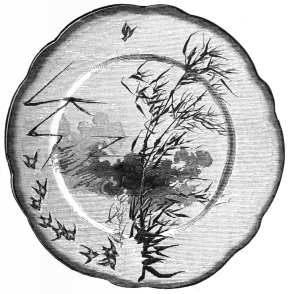
Fig. 274.—Limoges Porcelain. (Gen. A. J. Meyers Coll.)
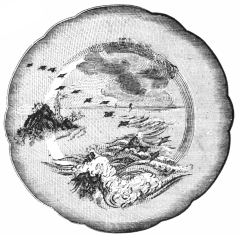
At the present time Haviland & Co. make a domestic ware of exceptional purity and of great{322} beauty of design. One set is modelled after and decorated with the water-lily, and others are of equal simplicity and beauty. The rule in these and in more strictly ornamental pieces is, to follow a chaste and refined style, marked by a limited use of color. The rule we laid down for the decoration of porcelain—that it should never be loaded with colors less beautiful than its own glaze—is here more closely followed than anywhere else occurring to us. Here, for example, is a set of plates painted with different scenes, such as a snow-storm, morning, night, before a shower, during a shower, and other similar subjects. The details are not wrought in with obtrusive precision. Something is left to imagination, and the effect of every view is perfect. They are painted by M. Bracquemond.
Fig. 275.—Limoges Porcelain. (Whitelaw Reid Coll.)
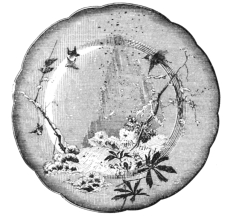
Fig. 276.—Limoges Pate Tendre. (H. J. Jewitt Coll.)
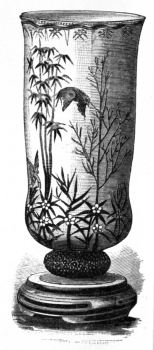
We nowhere find a better successor to the “egg-shell” of China than in the delicate, pure, and fragile specimens of thin porcelain from Limoges. This is an exceptional fabric, but there is elsewhere to be seen enough to substantiate the excellence of French porcelain for domestic use, in point of both beauty and strength. We have seen certain small coffee-cups so finely wrought, exquisitely modelled, and chastely colored, that when not in use they might serve as ornaments. The point to which painting on porcelain has been brought is further illustrated by a series of dessert{323} plates ornamented with different kinds of fruit—grapes, peaches, and other varieties. The supreme delicacy with which the requisite tints are here applied is admirable. On others are different kinds of seaweed and other marine objects, in which the artist has caught the natural hues with wonderful precision. The porcelain vases are, as a rule, small in size. No attempt, so far as we are aware, has been made to follow the gigantic works of Sèvres, Meissen, and Berlin, and we do not regret the fact. The works with which we are presented show great skill in the colors obtained, and the shapes are simple and sometimes severe. The domestic porcelain of Limoges deserves careful study for the sake of the refined taste which it invariably reflects.
Fig. 277.—Dinner-set in Limoges Pate Tendre.
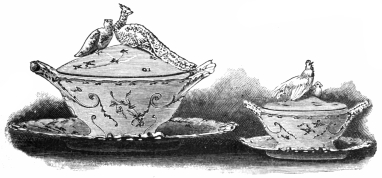
The most highly artistic pieces are in pate tendre, or artificial paste. Considering the difficulty of manipulating the body and its liability to sink in the furnace, many of the old Sèvres pieces must be regarded as marvels of workmanship. We look with a similar interest upon the examples coming to us from Limoges. It has the honor of having produced the only complete dinner-set ever made of this ware (Fig. 277). Its beauty is parallel with its value, which we hardly dare estimate. Beautifully modelled and plumaged birds form the dish handles, and a simple accessory decoration on the body reveals to perfection the peculiar appearance presented by pate tendre of having the colors sunk in the soft and creamy glaze.
Haviland & Co. have attained an exceptional success in colors. A complete toilet-set of pate tendre is turquoise blue of great richness and transparent depth. The modelling corresponds with an{324} achievement in color which has been the despair of ceramic artists for centuries. Deck is the only French maker who, before the Havilands, approached the old turquoise of China. The art has long been lost in the East. Deck’s pieces, however, are apt to craze or crack in irregular breaks, and this was thought to be unavoidable until Haviland made crackle closely resembling in color the rare old Chinese. Of the same material are two recumbent Psyches (Fig. 278), one in blue, the other in pink. In no more poetic form do we remember to have met the winged nymph who turned against Cupid the darts with which he was wont to afflict humanity. A set of three graceful vases (Fig. 279) with reticulated necks, and each supported on a tripod of goats’ feet, is painted in blue, gold, and pink. The forms are graceful and the coloring refined. The paintings of Poitevin and Du Liege on these and other pieces are characterized by the most exquisite delicacy. M. Pallandre, the Parisian flower-painter, has also lent to the porcelain of Haviland & Co. the beauty conferred by his dexterous brush.
Fig. 278.—Psyche, in Blue Pate Tendre.
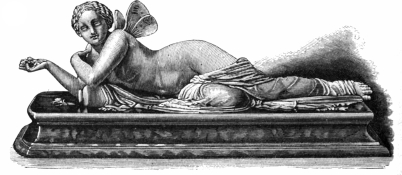
Fig. 279.—Pate-tendre Vase.
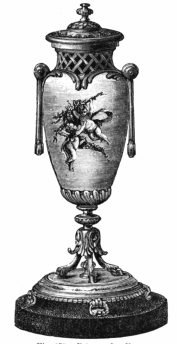
{325}
Fig. 280.—Deck Vase. (G. Collamore.)
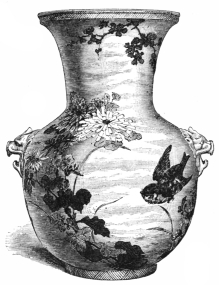
An excellent domestic ware, also made at Limoges, is largely imported by the manufacturers, Charles Field Haviland & Co., of New York. The greater portion of it is undecorated; but lately the makers have been turning their attention to decoration, and artistic work of considerable merit now comes from their establishment.
Fig. 281.—Deck Plaque. (G. Collamore.)
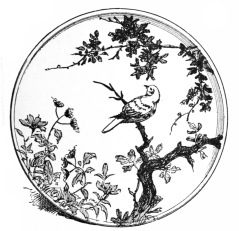
Before leaving France, the names of Deck, Solon, and Regnault may be allowed to stay our progress. The Messrs. Deck, of Paris, have, as we have seen, made a special study of color, and were the first, or among the first, to revive Oriental decoration. Their Persian ware, or imitation of the old art of Persia, is characterized by much of the beauty of the original. Their blue, as we have seen, is especially commendable, and enabled them to compete with the enterprising imitators of England, the Mintons, who have for several years been in possession of a blue very little inferior to the turquoise. It is to be regretted that Deck was not represented at the Centennial Exhibition, where, by the richness of his palette, he would have had an opportunity of extending his reputation in America.
M. Regnault, who succeeded M. Ebelman in the directorate of{326} Sèvres, was the inventor, while at the Sèvres manufactory, of pate changeante. The ware appears, during the day, like gray céladon, and at night, under artificial light, changes to a beautiful pink, whence its name.
Fig. 282.—Minton Porcelain. Pate-sur-pate, by Solon. (Wales Coll., Boston Museum of Fine Arts.)
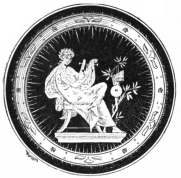
The name of M. Solon recalls at once the peculiar style of decoration called “Pate-sur-pate,” or paste upon paste. The process has been long known in China, and was first attempted in Europe by M. Ebelman at Sèvres about thirty years ago. The experiments were successful, and some very fine works were issued. The process was taken to England from Sèvres by M. Solon, who was engaged a few years ago by the Messrs. Minton (Fig. 282). In Mr. A. B. Daniells’s collection at the Centennial Exhibition, some examples of pate-sur-pate by M. Solon attracted general attention. There were two pairs of vases of a pure Greek shape, with a body of a rich bronze or chocolate color. On this, in white relief, were figures symbolizing Fire and Water, and a group of the Graces accompanied by Cupid in a race. The forms were exquisitely drawn, and were half revealed by the semi-transparent drapery. More usual grounds are a dark green and a grayish tint, either of which has a soft effect. A second specimen is given at Fig. 352.
This method of treatment consists in applying to the surface to be decorated white liquid porcelain as a pigment. The application is repeated until the necessary relief is obtained, when the figures are finished by carving or scraping. Repeated firings are necessary before glazing, and the decoration, which is opaque while wet, becomes more or less transparent, according to the thickness of the pigment. The process is one of the nicest and most difficult in the entire range of ceramic art, as a mistake once made cannot be remedied, and the glaze has a tendency to destroy the fine outlines of the figures.{327}