IN “THE CIRCUIT OF THE SUMMER HILLS”
Reading edition
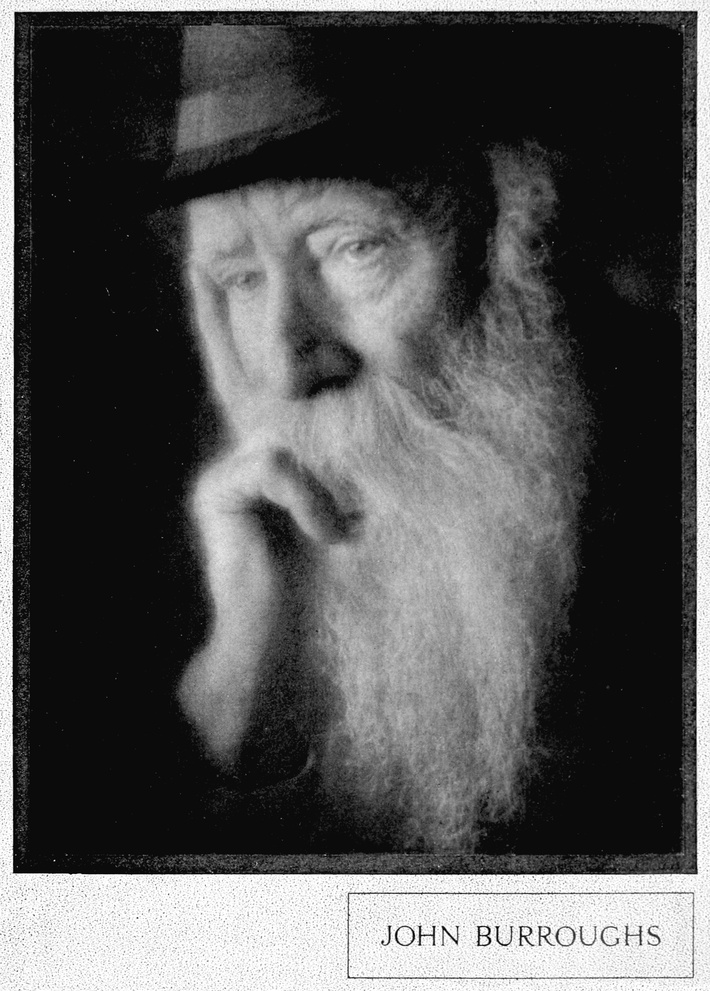
BY JOHN BURROUGHS
Author of “Wake Robin,” “Locusts and Wild Honey,” etc.
WITH A PORTRAIT
I
TO sit on one’s rustic porch, or at the door of one’s tent, and see the bees working on the catnip or motherwort or clover, to see the cattle grazing leisurely in the fields or ruminating under the spreading trees, or the woodchucks creeping about the meadows and pastures, or the squirrels spinning along the fences, or the hawks describing great spirals against the sky; to hear no sound but the voice of birds, the caw of crows, the whistle of marmots, the chirp of crickets; to smell no odors but the odors of grassy fields, or blooming meadows, or falling rain; and amid it all, to lift one’s eyes to the flowing and restful mountain lines—this is to get a taste of the peace and comfort of the summer hills.
This boon is mine when I go to my little gray farm-house on a broad hill-slope on the home farm in the Catskills. Especially is it mine when, to get still nearer nature and beyond the orbit of household sounds and interruptions, I retreat to the big hay-barn, and on an improvised table in front of the big open barn-doors, looking out into the sunlit fields where I hoed corn or made hay as a boy, and write this and other papers.
The peace of the hills is about me and upon me, and the leisure of the summer clouds, whose shadows I see slowly drifting across the face of the landscape. The dissonance and the turbulence and the stenches of cities, how far off they seem; the noise and the dust and the acrimony of politics—how completely the hum of the honey-bees and the twitter of swallows blot them all out!
In the circuit of the hills, the days take form and character as they do not in town, or in a country of low horizons. George Eliot says in one of her letters: “In the country the days have broad open spaces and the very stillness seems to give a delightful roominess to the hours.” This is especially true in a hilly and mountainous country, where the eye has a great depth of perspective opened to it. Take those extra brilliant days that we so often have in the autumn—what a vivid sense one gets of their splendor amid the hills! The deep, cradle-like valleys, and the long flowing mountain lines, make a fit receptacle for the day’s beauty; they hold and accumulate it, as it were. I think of Emerson’s line:
“O, tenderly the haughty day fills his blue urn with fire.”
The valleys are vast blue urns that hold a generous portion of the lucid hours.
To feel to the full the peace of the hills, one must choose his hills, and see to it that they are gentle and restful in character. Abruptness, jagged lines, sharp angles, frowning precipices, while they may add an element of picturesqueness, interfere with the feeling of ease and restfulness that the peace of the hills implies. The eye is disturbed by a confusion of broken and abrupt lines as is the ear by a volume of discordant sounds. Long, undulating mountain lines, broad, cradle-like valleys, easy basking hill-slopes, as well as the absence of loud and discordant sounds, are a factor in the restfulness of any landscape.
My landscape is very old geologically, as old as the order of vertebrate animals, but young historically, having been settled only about one hundred and fifty years. The original forests still cover the tops of the mountains with a dark-green mantle, which comes well down upon their sides, where it is cut and torn and notched into by the upper fields of the valley farms.
I call my place Woodchuck Lodge, as I tell my friends, because we are beleagured by these rodents. There is a cordon of woodchuck-holes all around us. In the orchard, in the meadows, in the pastures, these whistling marmots have their dens. Here one might easily have woodchuck venison for dinner every day, yea, and for supper and breakfast, too, if one could acquire a taste for it. I tried to dine on a woodchuck once when I was a boy, but never have felt inclined to repeat the experiment. If one were born in the woods and lived in the woods, maybe he could relish a woodchuck. Talk about being autocthonous, and savoring of the soil—try a woodchuck! The feeding habits of this animal are as cleanly as those of a sheep or a cow—clover, plantain, peas, beans, cucumbers, cabbages, apples—all sweet and succulent things go to the making of his flabby body; yet he spends so much of his time in pickle in the ground that his flesh is rank with the earth flavor. He is not lean like a rabbit or a squirrel, nor so firm of muscle as a ’coon or a ’possum; he is little more than a skin filled with viscera. He is busy all summer storing up fat in his loose pouch of a body for fuel during his long winter sleep. This sleep appears to begin in late September, or after the first white frost. This year I saw my last specimen on the twenty-eighth of the month as he was running in great haste to his hole. Evidently he does not like the pinch of the cold. He is a fair-weather animal and is the epicure of the meadows and pastures. While the apples are still mellow on the ground, while the red-thorn is still dropping its fruit, and the aftermath is still fresh in the meadows, my woodchucks turn their backs upon the world and retreat to their underground chambers for their six months’ slumber. I know of no other hibernating animal that retires from the light of day so early in the season. His active life stretches from the vernal equinox to the autumnal equinox, and that is about all. Half the year he is under ground, and at least half of each summer day. No wonder his flesh is rank with the earth flavor. He appears to live only to accumulate his winter store of fat. Apparently he comes out of his den in summer only to feed, and maybe occasionally to bask in the sunshine. He is never sportive or discursive like the birds and squirrels. Life is a very serious business with him, and he has reduced it to the lowest terms—eat, breed, and sleep. If woodchucks ever engage in any sort of play, like other wild creatures, I have never seen them, though I once had a tame young ’chuck that would play with the kitten.
The woodchuck probably sleeps more than half the time in summer; he economizes his precious fat. Only once have I seen his tracks on the snow. This was in late December; and following them up, I found the woodchuck wandering about the meadow like one half demented. Something had evidently gone wrong with him. Apparently he had not succeeded in storing up his usual amount of fat. He showed little fight, and we picked him up by the tail, put him into the sleigh, and brought him home. A place under the barn floor was given to him, but he did not long survive. All the glory of the fall, the heyday of the ’coon and the squirrels, the woodchuck misses. No golden October, no Indian summer for him; he has had his day.
Though the woodchuck’s muscles are flabby, his heart is stout. The farm-dog can kill him, but he cannot make him show fear or dismay; he is game to the last. Twice I have seen him from my porch at Woodchuck Lodge put on so bold a front, and become so aggressive, when surprised in the middle of a field by a big shepherd-dog, that the dog did not dare attack him, but circled about, seeking some unfair advantage, only to be met at every point with those threatening, grating teeth. In one case the woodchuck was far from his hole, and he kept charging the dog and driving him nearer and nearer the stone wall, where his own safety lay. An observer inoculated with the idea of animal reason would have said that the tactics of the ’chuck were premeditated; but I am sure he was too much engrossed with the task of defending himself from the jaws of that dog to do any logical thinking or planning. It was only the fortunes of battle that finally brought the hunter and the hunted near the hole of safety, when, seeing his chance, the woodchuck made a sudden, successful dash, too hurried, I fancy, even to whistle his usual note of defiance. In the other case, the dog was of a still more timid nature, and when the surprised woodchuck showed fight, he concluded that he had no business at all with that particular ’chuck, which actually chased him from the meadow. I can still see the woodchuck’s bristling, expanded tail as he drove fiercely after the fleeing dog, which, with a tail anything but threatening, escaped over the wall into the road.
I find that one may be the principal actor in a little comedy, and not see the humor of it at all at the time. I know the humor of a race I had with a ’chuck last summer in my orchard was quite lost upon me till it was over, and the ’chuck was in his hole, and I was back upon my porch recovering my wind. The ’chuck was a hundred yards or more from his den when I leaped over the fence from the road and surprised him. I pressed him so closely that he took refuge in an apple-tree. Instantly seeing his mistake, as the missile I hurled struck the tree, he sprang down and rushed for his hole, a hundred and fifty feet away. But I got there first. The ’chuck paused twenty feet to one side and regarded me intently, defiantly. We stood and glared at each other a few moments, while I recovered my breath. I wanted the scalp of that “varmint.” I knew that he would make himself believe that I had planted my garden for his special benefit, and I wanted to anticipate that conclusion. I was weaponless. Twenty or more feet from me, on the opposite side from the ’chuck, I saw a stone that would answer my purpose. I calculated the chances; so did the woodchuck; I sprang for the stone and the ’chuck sprang for his hole, and was in it as my hand touched the stone. He had won! As I sat on my porch, the recklessness and absurdity of a man more than threescore and ten running down a woodchuck came over me; and I have not yielded to such a temptation since.
II
WHERE cattle and woodchuck thrive, there thrive I. The pastoral is in my veins. Clover and timothy, daisies and buttercups indirectly colored my youthful life; and if the dairy cow did not rock my cradle, her products sustained the hand that did rock it. Hence I love this land of wide, open, grassy fields, of smooth, broad-backed hills, and of long, sweeping mountain lines. The cow fits well into these scenes. It seems as if her broad, smooth muzzle and her potent tongue might have shaped the landscape; it is certainly her cropping that has brought about the hour-glass form of so many of the red-thorn trees, which give a unique feature to the fields. Her fragrant breath is upon the air, her hoof-prints are upon the highway; she may not yet have attained to wisdom, yet surely all her ways are ways of pleasantness and all her paths are paths of peace. Hence, when her ways and her paths coincide with mine, I thrive best. From Woodchuck Lodge I look out upon broad pastures, lands where dairy herds have grazed for a hundred years, never the same herd for many summers, but all of the same habits and dispositions. They all scour the pastures in the same way, scattering, searching out every nook and corner, leaving no yard of ground unvisited, apparently hunting each day for the sweet morsel they missed the day before, disposing themselves in picturesque groups upon the hills; never massed, except under the shade-trees on hot days; slow-moving, making their paths here and there, lingering under the red-thorn trees, where the fruit begins to drop in September; tossing their heads above the orchard wall, where the fragrance of ripening apples is on the air; in the autumn lying upon the cold, damp ground and ruminating contentedly, with no fear of our ills and pains before them; wading in the swamps, converging slowly toward the pasture-bars as milking-time draws nigh, with always some tardy, indifferent ones that the farm-dog has to hurry up; many colored—white, black, red, brown—at times showing rare gentleness and affection toward one another, such as licking one another’s heads or bodies, then spitefully butting or goring one another; occasionally one of them lifting up her head and sending her mellow voice over the hills like a horn, as if to give voice to a vague unrest, or invoking some far-off divinity to release the imprisoned Io—what a series of shifting rural pictures I thus have spread out before me! Such an atmosphere of peace and leisure over it all! The unhurrying and ruminating cattle make the days long; they make the fields friendly, the hills eloquent, the shade-trees idyllic. I wake up to hear the farmer summoning them from the field in the dewy summer dawns, and I listen for his call to them on the tranquil afternoons. One season an especially musical voice did the evening calling—a trained voice from beyond the hills. What a pleasure it was as we swung in our hammocks under apple-trees to hear the free, sonorous summons, and to see the response of the herd in many-colored lines converging down the slope to the bar-way!
When the meadows have gotten a new carpet of tender grass in September, and the cows are free to range in them, a new series of moving pictures greets the eye. The grazing forms have a finer setting now, and contentment and satisfaction are in every movement. How they sweep off the tender herbage, into what artistic groups they naturally fall, what pictures of peace and plenty they present! When they lie down to ruminate, Emerson’s sentence comes to mind: “And the cattle lying on the ground seem to have great and tranquil thoughts.” As a matter of fact, I suppose no more vacant mind could be found in the universe than that of the cow when she is reposing in a field, chewing her cud. But she is the cause of tranquil if not of great thoughts in the lookers-on, and that is enough. Tranquillity attends her wherever she goes; it beams from her eyes, and lingers in her footsteps.
I sympathize with Whitman as he expressed himself in these lines:
“I think I could turn and live with the animals, they are so placid and self-contain’d, I stand and look at them, long and long. “They do not sweat and whine about their condition, They do not lie awake in the dark and weep for their sins, They do not make me sick discussing their duty to God, Not one is dissatisfied, not one is demented with the mania of owning things, Not one kneels to another, nor to his kind that lived thousands of years ago, Not one is respectable or happy over the whole earth.”
III
IF one has a bit of the farmer in him, it is a pleasure in the country to have a real farmer for a neighbor—a man whose heart is in his work, who is not longing for the town or the city, who improves his fields, who makes two spears of grass grow where none grew before, whose whole farm has an atmosphere of thrift and well-being. There are so many reluctant, half-hearted farmers in our eastern States nowadays, so many who do only what they have to do in order to survive; who leave the paternal acres to run to weeds or brush; the paternal fences to fall into ruins; the paternal orchards untrimmed and unplowed; the paternal meadows unfertilized, while the fertilizer wastes in the barn-yard; who get but one spear of grass where their fathers or grandfathers got two or three; and whose plaint always is that farming does not pay. What is the matter with our rural population? Has all the good farming blood gone West, and do only the dregs of it remain?
It is the man who makes the farm, as truly as it is the man who makes any other business; it is the man behind the plow, as truly as it is the man behind the gun, that wins the battle. A half-heart never won a whole sheaf yet. The average farmer has deteriorated. He may know more, but he does less than his father. He is like the second or third steeping of the tea. Did the original settlers and improvers of the farms, and the generations that followed them, leave all their virtue and grip in the soil? It is certainly true that in my section the last two generations have lived off the capital of labor and brains which their ancestors put into the land; only here and there has a man added anything, only here and there is a farmer who does not wish he had some other business. If such men had that other business, they would reap the same poor results. In the long run, you cannot reap where you have not sown, and the only seed you can sow, in any business that yields tenfold, is yourself—your own wit, your own industry. Unless you plant your heart with your corn, it will mostly go to suckers; unless you strike your own roots into the subsoil of your lands, it will not bear fruit in your character, or in your bank-account—all of which is simply saying that thin, leachy land will not bear good crops, and unless a man has the real farming stuff in him, his farm quickly shows it.
My neighbor makes smooth the way of the plow and of the mower. Last summer I saw him take enough stones and rocks from a three-acre field to build quite a fortress; and land whose slumbers had never been disturbed by the plow was soon knee-high with Hungarian grass. How one likes to see a permanent betterment of the land like that!—piles of renegade stone and rock. It is such things that make the country richer. If all New England and New York had had such drastic treatment years ago, the blight of discouraged farming never would have fallen upon them, and the prairie States would not have so far distanced the granite States. A granite soil should grow a better crop of men than the silt of lake or river bottom, though it yields less corn to the acre.
The prairie makes a strong appeal to a man’s indolence and cupidity; it is a place where he can sit at ease and let his team do most of his work. But I much doubt whether the western farms ever will lay the strong hands upon their possessors that our more varied and picturesque eastern farms lay. Every field in these farms has a character of its own, and the farms differ from one another as much as the people do. An eastern farm is the place for a home; the western farm is the place to grow wheat, pork, and beef. Oh, the flat, featureless, monotonous, cornstalk-littered middle West! how can the rural virtues of contentment and domesticity thrive there? There is no spot to make your nest except right out on the rim of the world; no spot for a walk or a picnic except in the featureless open of a thousand miles of black prairie—the roads black, straight lines of mud or dust through the landscape; the streams slow, indolent channels of muddy water; the woods, where there are woods, a dull assemblage of straight-trunked trees; the sky a brazen dome that shuts down upon you; there are no hills or mountains to lift it up. The prairie draws no strong distinct lines against the sky; the horizon is vague and baffling. Ah, my mountains are very old measured by the geologic calendar! Yet how foreign to our experience or ways of thinking it seems to speak of mountains as either old or young, as if birth and death apply to them also. But such is the fact: mountains have their day, which day is the geologist’s day of millions of years. My mountains were being carved out of a great plateau by the elements while the prairies were still under the sea, and while most of the Rocky Mountains and the Alps, and the Himalayas were gestating in the vast earth-womb. In point of age, these mountains beside the Catskills are like infants beside their great-grandfathers. Yet it is a singular contradiction that in their outlines old mountains look young, and young mountains look old. The only youthful feature about young mountains is that they carry their heads very high, and the only old feature about old mountains is that they have a look of repose and calmness and peace. All the gauntness, leanness, angularity, and crumbling decrepitude are with the young mountains; all the smoothness, plumpness, graceful flowing lines of youth are with the old mountains. Not till the rocks are clothed with soil made out of their own decay are outlines softened and life made possible. Youthful mountains like the Alps are battle-marked by the elements, and their proud heads are continually being laid low by frost, wind, and snow; they are scarred and broken by avalanches the season through. Old mountains, such as the Appalachian range, wear an armor of soil and verdure over their rounded forms on which the arrows of time have little effect. The turbulent and noisy and stiff-necked period of youth is far behind them.
Hundreds of dairy-farms nestle in the laps of the Catskills; and their huge, grassy aprons, only a little wrinkled here and there, hold as many grazing herds. Woodchuck Lodge is well upon the knee of one of the ranges, and the fields we look upon are like green drapery lying in graceful curves and broad, smooth masses over huge extended limbs. Patches of maple forest here and there bend over a rounded arm or shoulder, like a fur cape upon a woman. Here and there also huge, weather-worn boulders rest upon the ground, dropped there by the moving ice-sheet tens upon tens of thousands of years ago; and here and there are streaks of land completely covered with smaller rocks wedged and driven into the ground. It used to be told me in my youth that the devil’s apron-string broke as he was carrying a load of these rocks overhead, and let the mass down upon the ground. The farmers seldom attempt to clear away these leavings of the devil.
IV
MY interest in the birds is not as keen as it once was, but they are still an asset in my life. I must live where I can hear the crows caw, the robins sing, and the song-sparrow trill. If I can hear also the partridge drum, and the owl hoot, and the chipmunk cluck in the still days of autumn, so much the better. The crow is such a true countryman, so much at home everywhere, so thoroughly in possession of the land, going his way winter and summer in such noisy contentment and pride of possession, that I cannot leave him out. The bird I missed most in California was the crow. I missed his glistening coat in the fields, his ebony form and hearty call in the sky.
One advantage of sleeping out of doors, as we do at Woodchuck Lodge, is that you hear the day ushered in by the birds. Toward autumn you hear the crows first, making proclamation in all directions that it is time to be up and doing, and that life is a good thing. There is not a bit of doubt or discouragement in their tones. They have enjoyed the night, and they have a stout heart for the day. They proclaim it as they fly over my porch at five o’clock in the morning; they call it from the orchard, they bandy the message back and forth in the neighboring fields; the air is streaked with cheery greetings and raucous salutations. Toward the end of August, or in early September, I witness with pleasure their huge mass-meetings or annual congress on the pasture-hills or in the borders of the woods. Before that time, you see them singly or in loose bands; but on some day in late summer, or in early autumn, you see the clans assemble as if for some rare festival and grand tribal discussion. A multitudinous cawing attracts your attention when you look hillward and see a swarm of dusky forms circling in the air, their voices mingling in one dissonant wave of sound, while loose bands of other dusky forms come from all points of the compass to join them. Presently many hundred crows are assembled, alternately lighted upon the ground and silently walking about as if feeding, or circling in the air, cawing as if they would be heard in the next township. What they are doing or saying or settling, what it all means, whether they meet by appointment in the human fashion, whether it is a jubilee, a parliament, or a convention, I confess I should like to know. But second thought tells me it is more likely the gregarious instinct asserting itself after the scatterings and separations of the summer. The time of the rookery is not far off, when the inclement season will find all the crows from a large section of the country massed at night in lonely tree-tops in some secluded wood.
These early noisy assemblages may be preliminary to the winter union of the tribe. What an engrossing affair it seems to be with the crows, how oblivious they appear to all else in the world! The world was made for crows, and what concerns them is alone important. The meeting adjourns, from time to time, from the fields to the woods, then back again, the babel of voices waxing or waning according as they are on the wing or at rest. Sometimes they meet several days in succession and then disperse, going away in different directions and irregularly, singly or in pairs and bands, as men do on similar occasions. No doubt in these great reunions the crows experience some sort of feeling or emotion, though one would doubtless err in ascribing to them anything like human procedure. It is not a definite purpose, but a tribal instinct, that finds expression in their jubilees.
The crow seems to have a great deal of business besides getting a living. How social, how communicative he is—what picnics he has in the fields and woods, how absolutely at home is he at all times and places! I see them from my window flying by, by twos or threes or more, on happy, holiday wings, sliding down the air, or diving and chasing one another, or walking about the fields, their coats glistening in the sun, the movement of their heads timing the movements of their feet—what an air of independence and respectability and well-being attends them always! The pedestrian crow! no more graceful walker ever trod the turf. How different his bearing from that of a game-bird, and from any of the falcon tribe. He never tries to hide like the former, and he is never morose and sulky like the latter. He is gay and social and in possession of the land; the world is his and he knows it, and life is good.
I suppose that if his flesh were edible, like that of the gallinaceous birds, he would have many more enemies and his whole demeanor would be different. His complacent, self-satisfied air would vanish. He would not advertise his comings and goings so loudly. He would be less conspicuous in the landscape; his huge mass-meetings in September would be more silent and withdrawn. Well, then, he would not be the crow—the happy, devil-may-care creature as we now know him.
His little gaily dressed brother, the jay, does not tempt the sportsman any more than the crow does, but he tempts other creatures—the owl and squirrels, and maybe the hawks. Hence his tribe is much less. His range is also more restricted, and his feeding habits are much less miscellaneous. Only the woods and groves are his; the fields and rivers he knows not.
The crow is a noisy bird. All his tribe are noisy, but the noise probably has little psychic significance. The raven in Alaska appears to soliloquize most of the time. This talkativeness of the crow tribe is probably only a phase of crow life, and signifies no more and no less than other phases—their color, their cunning, the flick of their wings, and the like. The barn-yard fowls are loquacious also, but probably their loquacity is not attended with much psychic activity.
In the mornings of early summer the out-of-door sleeper is more likely to be awakened by the song-birds. In June and early July they strike up about half-past three. “When it is light enough to see that all is well around you, it is light enough to sing,” they carol. “Before the early worm is stirring, we will celebrate the coming of day.” During the summer the song-sparrows have been the first to nudge me in the morning with their songs. One little sparrow especially would perch on the telephone-wire above the roadside and go through his repertoire of five songs with great regularity and joyousness. He will long be associated in my mind with those early, fragrant, summer dawns. One of his five songs fell so easily into words that I had only to call the attention of my friends to it to have them hear the words that I heard: “If, if, if you please, Mr. Durkee,”—the last word a little prolonged, and with a rising inflection. Another was not quite so well expressed by these words: “Please, please, speak to me, sweetheart.” The third one suggested this sentence: “Then, then, Fitzhugh says, yes, sir!” The fourth one was something like this: “If, if, if you seize her, do it quick.” The fifth one baffled me to suggest by words. But in August his musical enthusiasm began to decline. His different songs lost their distinctiveness and emphasis. It was as if they had faded and become blurred with the progress of the season.
The little birds are insignificant and unobtrusive on the great background of nature, yet if one learns to distinguish them and to love them, their songs may become a sort of accompaniment to one’s daily life. In May, while I was much occupied in repairing and making habitable an old farm-house, a solitary, mourning, ground-warbler, which one rarely sees or hears, came and tarried about the place for a week or ten days, singing most of each forenoon in the orchard and garden about the house, and giving to my occupation a touch of something rare and sylvan. He lent to the apple-trees, which I had known as a boy, an interest that the boy knew not. Then he went away, whether on the arrival of his mate or not I do not know.
Photograph, copyright, by Alvin Langdon Coburn. Color-tone made for THE CENTURY by Henry Davidson
⇒ LARGER IMAGE
A butternut-tree stands across the road in front of Woodchuck Lodge. One season the red squirrels stored the butternuts in the wall of one of the upper rooms of the unoccupied house, to which they gained access through a hole in the siding. When we moved in, in the summer, the squirrels soon became uneasy, and one day one of them began removing the butternuts, not to some other granary or place of safety, but to the grass and dry leaves on the ground in the orchard. He was unwittingly planting them by the act of hiding them. The automatic character of much animal behavior, the extent to which their lives flow in fixed channels, was well seen in the behavior of this squirrel. His procedure in transferring the nuts from his den in the house to the ground in the orchard, a distance of probably one hundred feet, was as definite and regular as that of a piece of machinery. He would rush up and over the roof of the house with a nut in his mouth, by those sharp, spasmodic sallies so characteristic of the movements of the red squirrel, down the corner of the house to the ground by the same jerky movements, across some rubbish and open ground in the same manner, alert and cautious, up the corner of a small building ten feet high and eight long, over its roof, with arched tail and spread feet, snickering and jerking, down to the ground on the other side, dashing to the trunk of an apple-tree ten feet away, up it a few feet to make an observation, then down to the ground again, and out into the grass, where he would carefully hide his nut, and cover it with leaves. Then back to the house again by precisely the same route and with precisely the same movements, and bring another nut. Day after day I saw him thus engaged till apparently all the nuts were removed. He probably did not know he was planting butternut-trees for other red squirrels, but that was what he was blindly doing. The crows and jays carry away and plant acorns and chestnuts in the same blind way, thereby often causing a pine forest to be succeeded by these trees.
The red squirrel is only an irregular storer of nuts in the autumn. In this respect he stands half-way between the chipmunk and the gray squirrel, one of which regularly lays up winter stores and the other none at all.
How diverse are the ways of nature in reaching the same end! Both the chipmunk and the woodchuck lay up stores against the needs of winter, the latter in the shape of fat upon his own ribs, and the former in the shape of seeds and nuts in his den in the ground; and I fancy that one of them is no more conscious of what he is doing than the other. Animals do not take conscious thought of the future; it is as if something in their organization took thought for them. One November, seized with the cruel desire to go to the bottom of the question of the chipmunk’s winter stores, I dug out one after he had got his house settled for the season. I found his den three feet below the surface of the ground—just beyond the frostline—and containing nearly four quarts of various seeds, most of them the little black grains of wild buckwheat—two hundred and fifty thousand of them, I estimated—all cleaned of their husks as neatly as if done by some patent machine.
How many perilous journeys along stone walls and through weedy tangles this store of seeds represented! One would say at least a thousand trips, beset by many dangers from hawks and cats and weasels and other enemies of the little rodent.
The chipmunk is provident; he is a wise housekeeper, but one can hardly envy him those three or four months of inaction in the pitchy darkness of his subterranean den. His mate is not with him, and evidently the oblivion of the hibernating sleep, like that of the woodchuck and of certain mice, is not his. The life of the red and gray squirrels, who are more or less active all winter, seems preferable. They lay up no stores and are no doubt often cold and hungry, but the light of day and the freedom of the snow and of the tree-tops are theirs. Abundant stores are a good thing for both man and beast, but action, adventure, struggle are better.