IN LIGHTER VEIN
Reading edition
HOMER AND HUMBUG
BY STEPHEN LEACOCK
Author of “Literary Lapses,” “Nonsense Novels,” etc.
I DO not mind confessing that for a long time past I have been very skeptical about the classics. I was myself trained as a classical scholar. It seemed the only thing to do with me. I acquired such a singular facility in handling Latin and Greek that I could take a page of either of them, distinguish which it was by glancing at it, and, with the help of a dictionary and a compass, whip off a translation of it in less than three hours.
But I never got any pleasure from it. I lied about the pleasure of it. At first, perhaps, I lied through vanity. Any scholar will understand the feeling. Later on I lied through habit; later still because, after all, the classics were all that I had and so I valued them. I have seen a deceived dog thus value a pup with a broken leg, and a pauper child nurse a dead doll with the sawdust out of it. So I nursed my dead Homer and my broken Demosthenes though I knew that there was more sawdust in the stomach of one modern author than in the whole lot of them. Observe, I do not say which it is that has it full of it.
So, I say, I began to lie about the classics. I said to people who knew no Greek that there was a sublimity, a majesty about Homer which they could never hope to grasp. I said it was like the sound of the sea beating against the granite cliffs of the Ionian Esophagus; or words to that effect. As for the truth of it, I might as well have said that it was like the sound of a rum distillery running a night shift on half-time. At any rate this is what I said about Homer, and when I spoke of Pindar,—the dainty grace of his strophes,—and Aristophanes, the delicious sallies of his wit, sally after sally, each sally explained in a note, calling it a sally, I managed to suffuse my face with a coruscation of appreciative animation which made it almost beautiful.
I admitted of course that Vergil, in spite of his genius, had a hardness and a cold glitter which resembled rather the brilliance of a cut diamond than the soft grace of a flower. Certainly I admitted this: the mere admission of it would knock the breath out of any one who was arguing.
From such talks my friends went away saddened. The conclusion was too cruel. It had all the cold logic of a syllogism (like that almost brutal form of argument so much admired in the Paraphernalia of Socrates). For if:—
Vergil and Homer and Pindar had all this grace, and pith, and these sallies, And if I read Vergil and Homer and Pindar, And if they only read Mrs. Wharton and Mrs. Humphry Ward, Then where were they?
So, continued lying brought its own reward in the sense of superiority, and I lied some more.
When I reflect that I have openly expressed regret, as a personal matter, even in the presence of women, for the missing books of Tacitus, and the entire loss of the Abracadabra of Polyphemus of Syracuse, I can find no words in which to beg for pardon. In reality I was just as much worried over the loss of the ichthyosaurus. More, indeed: I’d like to have seen it; but if the books Tacitus did lose were like those he didn’t, I wouldn’t.
I believe all scholars lie like this. An ancient friend of mine, a clergyman, tells me that in Hesiod he finds a peculiar grace that he doesn’t find elsewhere. He’s a liar. That’s all. Another man, in politics and in the legislature, tells me that every night before going to bed he reads over a page or two of Thucydides to keep his mind fresh. Either he never goes to bed or he’s a liar. Doubly so; no one could read Greek at that frantic rate; and, anyway, his mind isn’t fresh. How could it be?—he’s in the legislature. I don’t object to his talking freely of the classics, but he ought to keep it for the voters. My own opinion is that before he goes to bed he takes whisky; why call it Thucydides?
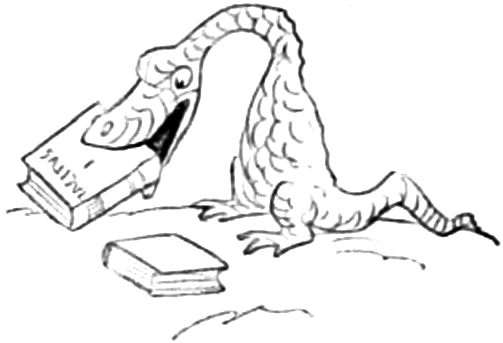
THE ICHTHYOSAURUS DEVOURING TWO OF THE LOST BOOKS OF TACITUS
I know there are solid arguments advanced in favor of the classics. I often hear them from my colleagues. My friend the Professor of Greek tells me that he truly believes the classics have made him what he is. This is a very grave statement, if well founded. Indeed, I have heard the same argument from a great many Latin and Greek scholars. They all claim, with some heat, that Latin and Greek have practically made them what they are. This damaging charge against the classics should not be too readily accepted. In my opinion some of these men would be what they are, no matter what they were.
Be this as it may, I for my part bitterly regret the lies I have told about my appreciation of Latin and Greek literature. I am anxious to do what I can to set things right. I am therefore engaged on, indeed have nearly completed, a work which will enable all readers to judge the matter for themselves. What I have done is a translation of all the great classics, not in the usual literal way but on a design that brings them into harmony with modern life.
The translation is intended to be within reach of everybody. It is so designed that the entire set of volumes can go on a shelf twenty-seven feet long, or even longer. The first edition will be an édition de luxe bound in vellum, or perhaps in buckskin, and sold at five hundred dollars. It will be limited to five hundred copies, and, of course, sold only to the feeble-minded. The next edition will be the Literary Edition, sold to artists, authors, and actors.
My plan is to transpose the classical writers so as to give, not the literal translation word for word, but what is really the modern equivalent. Let me give an odd sample or two to show what I mean. Take the passage in the First Book of Homer that describes Ajax, the Greek, dashing into the battle in front of Troy. Here is the way it runs (as nearly as I remember) in the usual word for word translation of the classroom, as done by the very best professor, his spectacles glittering with the literary rapture of it.
Then he too Ajax on the one hand leaped (or possibly jumped) into the fight wearing on the other hand yes certainly a steel corselet (or possibly a bronze under tunic) and on his head of course yes without doubt he had a helmet with a tossing plume taken from the mane (or perhaps extracted from the tail) of some horse which once fed along the banks of the Scamander (and it sees the herd and raises its head and paws the ground) and in his hand a shield worth a hundred oxen and on his knees two especially in particular greaves made by some cunning artificer (or perhaps blacksmith) and he blows the fire and it is hot.
Thus Ajax leaped (or, better, was propelled from behind) into the fight.
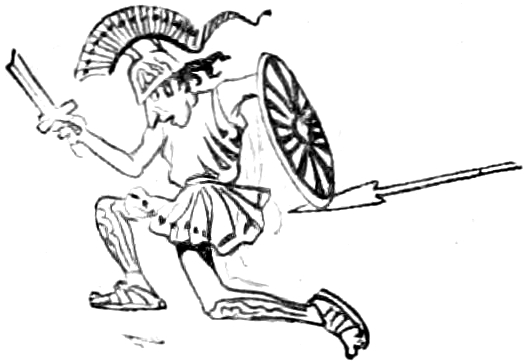
AJAX, “PROPELLED FROM BEHIND”
Now that’s grand stuff. There is no doubt of it. There’s a wonderful movement and force to it. You can almost see it move, it goes so fast. But the modern reader can’t get it. It won’t mean to him what it meant to the early Greek. The setting, the costume, the scene have all got to be changed in order to let the modern reader have a real equivalent so as to judge for himself just how good the Greek verse is. In my translation I alter the original just a little, not much but just enough to give the passage a form that reproduces for us the proper literary value of the verses, without losing anything of their majesty. It describes, I may say, the Directors of the American Industrial Stocks plunging into the Balkan War Cloud:
Then there came rushing to the shock of war Mr. McNicoll of the C. P. R. He wore suspenders and about his throat High rose the collar of a sealskin coat. He had on gaiters and he wore a tie, He had his trousers buttoned good and high; About his waist a woollen undervest Bought from a sad-eyed farmer of the West. (And every time he clips a sheep he sees Some bloated plutocrat who ought to freeze.) Thus in the Stock Exchange he burst to view, Leaped to the post, and shouted, “Ninety-two!”
There! That’s Homer, the real thing! Just exactly as it sounded to the rude crowd of Greek peasants who sat in a ring and guffawed at the rhymes and watched the minstrel stamp it out into “feet” as he recited it!
Let me take another example, this time from the so-called Catalogue of the Ships, which fills up nearly an entire book of Homer. This famous passage names all the ships, one by one, and names the chiefs who sailed on them, and names the particular town, or hill, or valley that each came from. It has been much admired. It has that same majesty of style that has been brought to an even loftier pitch in the New York Business Directory and the City Telephone Book. It runs along, as I recall it, something after this fashion:
And first indeed oh, yes, was the ship of Homistogetes, the Spartan, long and swift, having both its masts covered with cowhide and two banks of oars. And he, Homistogetes, was born of Hermogenes and Ophthalmia, and was at home in Syncope beside the fast-flowing Paresis. And after him came the ship of Preposterus, the Eurasian, son of Oasis and Hysteria,
—and so on, endlessly.
Instead of this I substitute, with the permission of the New York Central Railway, a more modern example, the official catalogue of their locomotives, taken almost word for word from the list compiled by their Chief Superintendent of Rolling Stock and rendered into Homeric verse. I admit that he wrote it in hot weather.
Out in the yard and steaming in the sun Stands locomotive engine number forty-one; Seated beside the windows of its cab Are Pat McGraw and Peter James McNab. Pat comes from Troy and Peter from Cohoes, And when they pull the throttle, off she goes; And as she vanishes there comes to view Steam locomotive engine number forty-two. Observe her mighty wheels, her easy roll, With William J. McArthur in control. They say her engineer some time ago Lived on a farm outside of Buffalo, Whereas her fireman, Henry Edward Foy, Attended school in Springfield, Illinois. Thus does the race of men decay and rot— SOME MEN CAN HOLD THEIR JOBS AND SOME CAN NOT.
Please observe that if Homer had actually written that last line, it would have been quoted for nearly three thousand years as one of the deepest sayings ever said. Orators would still be rounding out their speeches with the majestic phrase (in Greek), “Some men can hold their jobs”; essayists would open their most scholarly dissertations with the words, “It has been finely said by Homer that some men can hold their jobs”; and the clergy in the mid-pathos of a funeral sermon would lift an eve skyward and echo, “and some can not.”
This is what I should like to do: I’d like to take a large stone and write on it—
“The classics are only primitive literature. They belong in the same class as primitive machinery, primitive music, and primitive medicine,”
—and then throw it through the windows of a UNIVERSITY and hide behind a fence to see the professors buzz!
CASUS BELLI
THERE has long been current in New Haven what is sure to be an apocryphal story of college loyalty, told at the expense of Anson Phelps Stokes, the popular secretary of Yale. Secretary Stokes is an ordained clergyman in the Episcopal Church, and, so the story goes, as he was once journeying west on the train in non-clerical garb, a man of the self-appointed missionary type approached, and asked him solemnly:
“I beg your pardon, sir, but are you a Christian man?”
Startled, Dr. Stokes looked up and said:
“Oh, d—— it, no.”
The man turned to go, saying in a deeply offended tone:
“Well, I only asked you if you were a Christian man. I don’t see—”
Impulsively, Dr. Stokes caught him by the arm.
“Oh, I beg your pardon,” he said. “I beg your pardon. I thought you asked me if I was a Princeton man!”
Died
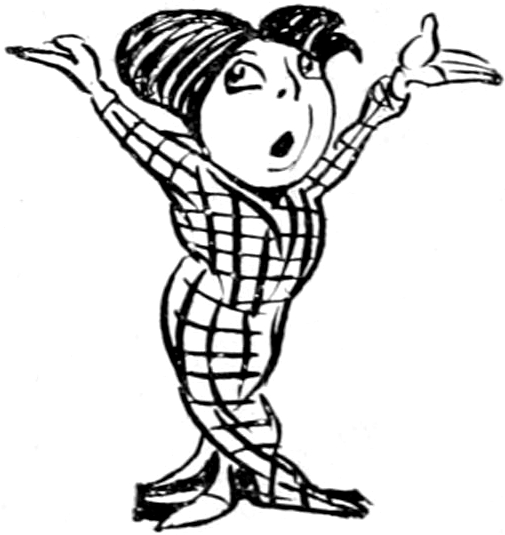
R. R. HIS LAST PORTRAIT
RYMBEL.—Suddenly, of weariness, at his home in Lighter Vein; Rondeau Rymbel, aged two months.
Please omit flowers.
“Blessed are the misunderstood.”
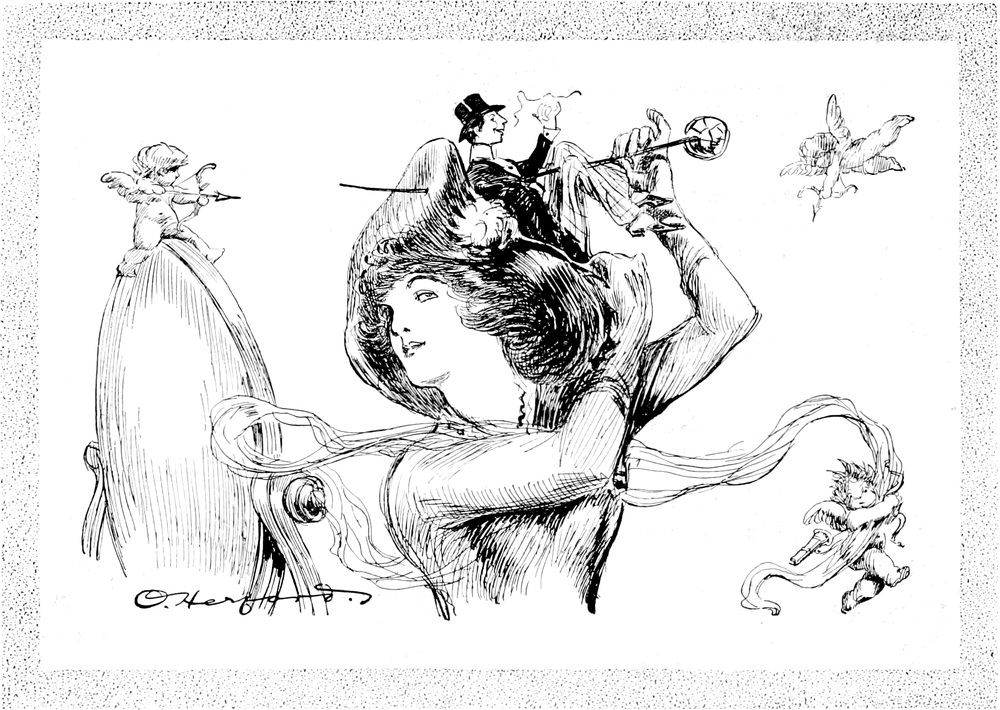
THE HUSBAND SHOP
A FABLE FOR HEIRESSES
BY OLIVER HERFORD
ABOVE the plate-glass window-pane, Inviting every passing gaze, Hung an inscription, large and plain, “THE HUSBAND SHOP.” This, in amaze, Clorinda seeing, stopped wide-eyed, And stared, then turned and stepped inside. A floor-walker whose faultlessness And condescending air proclaimed One of the table d’haute noblesse, Approached Clorinda and exclaimed, With graceful undulating palm: “Something in husbands? Oui, Madame.” “We have the latest thing of all In husbands; kindly step this way. We’re using them on hats this fall, In place of plume or floral spray, The creature being pinned or tied With chiffon bows on either side.” He leads the way, all wreathed in smiles, And wonderful in spotless spats That flitter like twin butterflies Along an avenue of hats, Each one displaying on its brim A husband—fashion’s latest whim. Clorinda tries them each in turn Before the glass; some are too small, And some too cold, and some too stern, And some are slightly soiled, and all, When punctured by the hat-pin’s steel, Betray by squirms how bored they feel. At last Clorinda came to one Marked “Dobbs,” that scarce seemed worth her while; But when she tried it on for fun, It met the hat-pin with a smile, As if to say, “Oh, beauteous miss, Even a stab from you is bliss!” “The very thing! but thrown away Upon a hat!” Clorinda cried. “’T would make a sweet corsage bouquet.” The shoppers stared quite stupefied To see Clorinda Dobbs depart Wearing a husband next her heart.
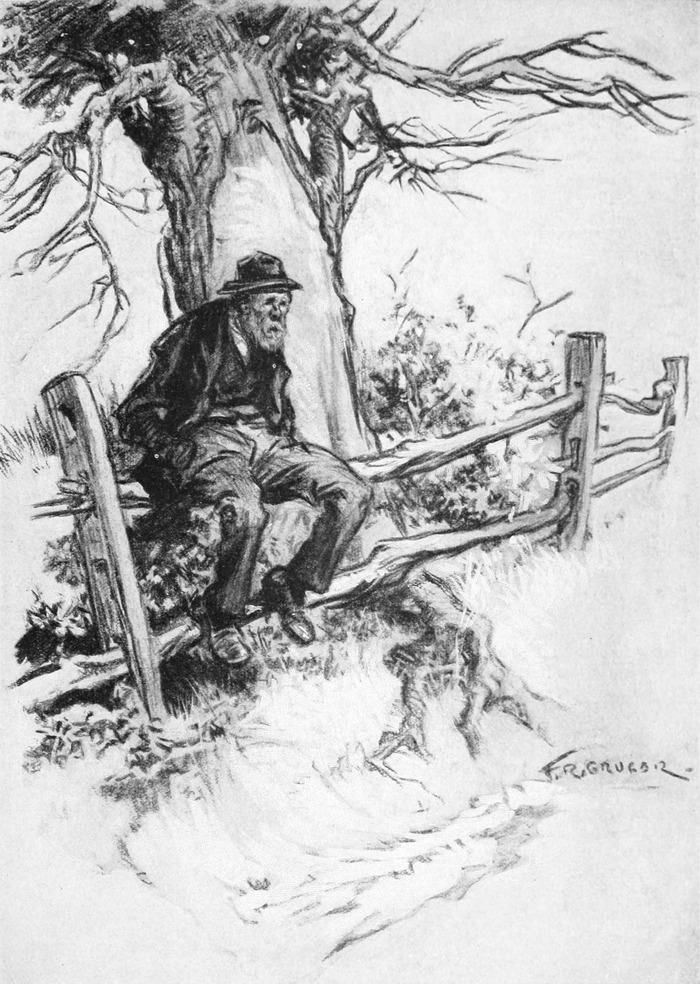
Drawing by F. R. Gruger
A TRIUMPH FOR THE FRESH-AIR FUND
Charity Note. “Owing to the enterprise and generosity of the United Welfare League, a gentleman, widely known in New York as Happy Harry, was recently ‘rescued’ on the Bowery, washed, shaved, shod, and sent to Sunnyside, in Sullivan County, New York.
“We are glad to learn, from recent advices from Sunnyside, that the stranger is wholeheartedly entering into the life and spirit of the place.”
THE SENIOR WRANGLER
SNOBBERY—AMERICA VS. ENGLAND
“HOW the Americans do love a Duke!” is a frequent comment of the British journals, and they then proceed to the sober generalization that “the United States is a nation of flunkies and of snobs.” Whoever will be at the pains to follow British weekly journalism will find this sentiment repeated every little while. Good old British Podsnap! No half-way course for him. He is not the man to shilly-shally with a nation, and he will speak the plain truth to any hemisphere, no matter how it hurts the hemisphere’s feelings. Vulgarity is a matter of geography. It is reckoned from Pall Mall as time is from Greenwich.
But as to snobs. New York’s streets are of course often choked with them. A duke, an elephant, a base-ball pitcher on Fifth Avenue, may at any time be the center of a disproportionate and servile attention from both the American people and the press. Yet the cult of the egregious and the greatly advertised has never the deep devotion of sound snobbery. It is not for an upstart and volatile people to dispute the calm supremacy of British snobbery. Your true snob is not inquisitive at all. He has no sense of any social values not his own. It is among the tightly closed minds of the tight little island that he is seen at his best. What other nation could produce, in journalism, such inimitable snobs as the Lord Alfred Douglases and the Saturday Reviewers?
American snobbery is not a sturdy plant. There is too much social uncertainty at the root of it. What the British take for snobbery over here springs from quite alien qualities—curiosity, a vast social innocence, and a blessed inexperience of rank. To be sure, if King George comes to New York some one may clip his coat-tails for a keepsake; and it is quite probable that Mrs. Van Allendale, of Newport, if asked to meet him, will be all of a tremble whether to address him as “Sire” or “My God.” But what has this in common with the huge assurances of British snobbery—its enormous certainty of the Proper Thing, in clothes, people, religion, sports, manners, and races, and its indomitable determination not to guess again?
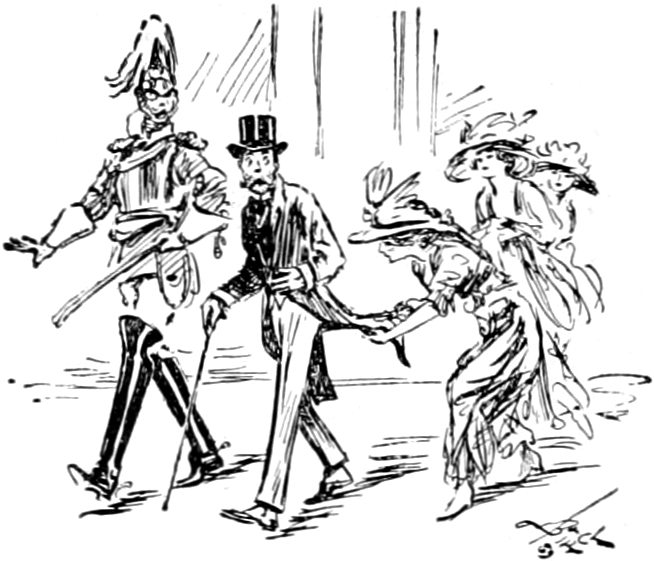
KING GEORGE IN NEW YORK
OUR TENDER LITERARY CELEBRITIES
ONE day, not so very long ago, a well-known American author was laughed at in a morning newspaper. It was apparently not meant for stinging satire. But the author felt it somewhere about him and complained to the editor of the pain. He wrote a letter for publication—long, earnest, very indignant. I am, said he, the victim of a “malignantly humorous attack.” By which process he turned a poor joke on himself into a good one, and incidentally exposed a too tender private temperament to the public gaze.
Sometimes it seems as if the whole body of recent American literature were not worth the damage sustained by character while consuming the fruits of success. There are signs of a bad schooling, of too steady a fare of sweets. For what doth it profit a man to run to a hundred thousand if he turn out a prig? The thing too often happens. His constitution may have been none too robust at the start, but it is awful to think what might become of any of us. Undermined by reciprocal endearments, we, too, might rage at the first word of criticism and swoon at the sound of laughter. Potatoes will sprout in a warm cellar, though some are worse than others. It is the effect of too much shelter in the great author’s life.
I condemn no man. I condemn the influences. Fortified against displeasure, barricaded against even chaff, there comes a time when the soul’s dark cottage needs ventilation. There should be more outside breezes in The Literary Life.

WHEN PA IS SICK
WHEN pa is sick, He’s scared to death, An’ ma an’ us Just holds our breath. He crawls in bed, An’ puffs an’ grunts, An’ does all kinds Of crazy stunts. He wants “Doc” Brown, An’ mighty quick; For when pa’s ill, He’s awful sick. He gasps an’ groans, An’ sort o’ sighs, He talks s’ queer, An’ rolls his eyes. Ma jumps an’ runs, An’ all of us, An’ all the house, Is in a fuss, An’ peace an’ joy Is mighty skeerce.— When pa is sick, It’s somethin’ fierce.
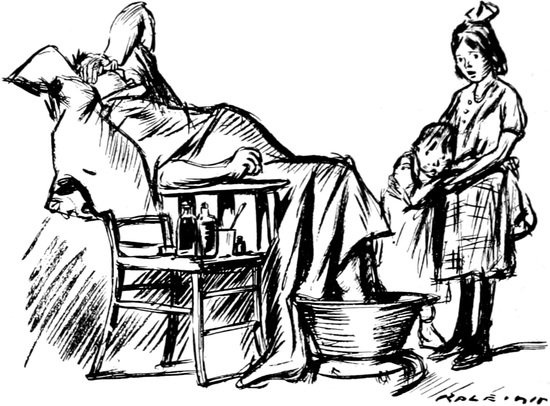
“WHEN PA IS SICK, IT’S SOMETHIN’ FIERCE”
WHEN MA IS SICK
WHEN ma is sick, She pegs away; She’s quiet, though, Not much t’ say. She goes right on A-doin’ things, An’ sometimes laughs, Er even sings. She says she don’t Feel extry well, But then it’s just A kind o’ spell; She’ll be all right To-morrow, sure. A good old sleep Will be the cure. An’ pa he sniffs, An’ makes no kick, Fer women-folks Is always sick. An’ ma she smiles, Lets on she’s glad.— When ma is sick, It ain’t s’ bad.
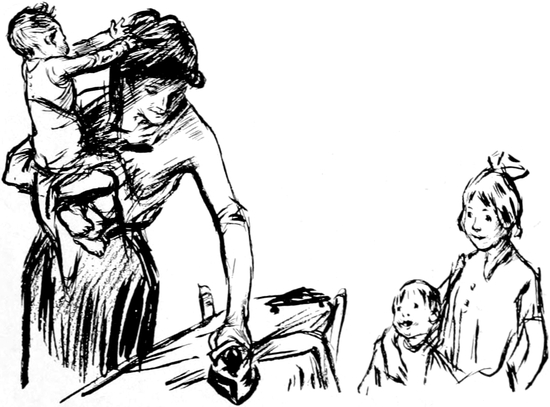
“WHEN MA IS SICK, IT AIN’T S’ BAD”
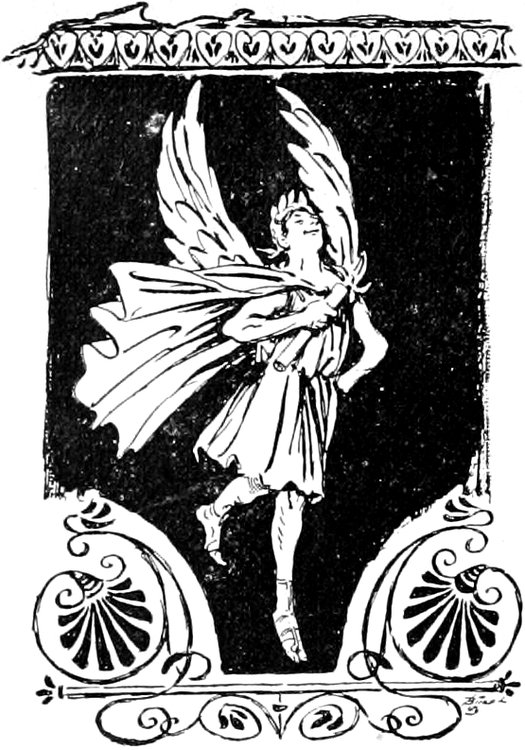
HORACE.—
“I SING OF MYSELF”
(An ode by Horace.—Book II, Ode 20)
BY LOUIS UNTERMEYER
BEFORE I end this glorious batch Of deathless verses, friend Mæcenas, I’ve something still to add, to snatch One laurel more to share between us. (I mention all of this to no man Except perhaps a friend—or Roman.) Now that my time has come to die (Within a score or two of years), I wish to have it known that I Shall gladly leave this “vale of tears,” Because (and how my friends will chortle!) I shall be more than just immortal. Into the clear and boundless air I shall ascend with sounding pinions. Shouting a buoyant “I don’t care,” Laughing at kings and their dominions. And folks will say (how well you know it!), “Q. Flaccus? Ah, he was a poet!” My wings shall sprout,—why, even now I feel all creepy and absurd-like,— My skin is roughening somehow, My legs are positively birdlike. And see, sure as I’m growing older, Feathers and quills on either shoulder! And I shall fly about as long As I’ve the slightest inclination, A veritable Bird of Song Without a local habitation. Like Icarus, I’ll travel surely And (need I say it?) more securely. From where the Dacian hides in shame To where the river Rhone runs muddy, All men will celebrate my name; My works will constitute a study. I shall be loved by people pat in The ways of elementary Latin. Then let there be no dirge for me, No petty grief or lamentation. Why weep for one who’s sure to be A joy and honor to creation? Ah, you’re a lucky man, by Venus! To have a friend like me, Mæcenas.
NEWPORT NOTE
THE LATEST SENSATION IN SMART SOCIETY
“MRS. ALGY FLINT gave an informal turkey-trot last evening at ‘On the Rocks,’ her palace in Newport. Prizes were awarded to the best dancers. The first prize (an Owen Johnson Salamander fire-screen—for stenographers and débutantes) was won by Miss Dolly Marble, for a novel little dance entitled ‘The Tangorilla.’ The second prize (a Pankhurst forcible feeder—for infants and invalids) was awarded to Bertie Stone, her clever and light-footed partner.”
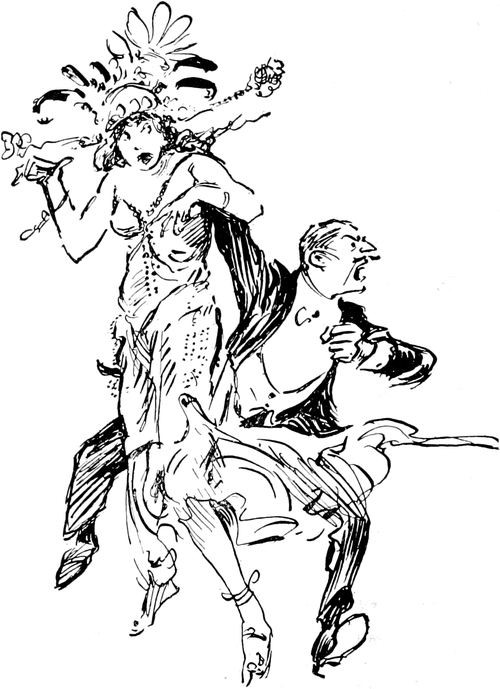
Drawing by Birch
“THE TANGORILLA”
SOCRATIC ARGUMENT
BY JOHN CARVER ALDEN
STRAIGHT, at his ruler’s stern command, The contents of the cup, offhand, Inclusive of its dregs and lees, Was promptly drained by Socrates. More than his foes,—perhaps his wife— Caused his Xanthippe-thy for life.
THE DE VINNE PRESS, NEW YORK