IN LIGHTER VEIN
Reading edition

AFTER-DINNER STORIES
BY SYLVESTER MENLO
BEARDING WHISTLER IN HIS DEN
THE following anecdote of Whistler was told by the painter himself.
One day when Whistler was absorbingly busy in painting the portrait of a prominent American gentleman, a ring was heard at his studio bell, and his man-servant appeared with the cards of a certain rich American lady and her husband, saying they would like very much to see him. He sent word that he was closely occupied with a sitter, and begged them to excuse him. But the servant brought back word that the lady had come from America for the distinct purpose of having him paint her portrait, and that it was necessary for her to have an interview. He immediately sent word down that interviews could be had only by appointment, and he regretted that he could not receive her. But despite this rebuff, the lady and her escort succeeded in passing the guard, and were soon heard mounting the stairs; whereupon Whistler said to his sitter:
“Oh, Jack, for heaven’s sake, do go and send her away!”
At the top of the landing the sitter found the lady and her husband. He expostulated with her on her intrusion, but was unable to make any impression upon her, and so reported to the painter, who finally came out with a handful of wet brushes between his fingers and advanced upon the enemy with a determined manner, and, as he went toward her, pushing his hand in front of him, to the imminent danger of spoiling a very beautiful costume arranged for an effective portrait.
It was very amusing to see Whistler punctuating his remarks with the jerks of his hand in which he had put two or three pencils to illustrate the situation.
“My dear Madam,” he said [forward gesture], “you must know [gesture repeated] that an artist [another gesture] cannot be interrupted in his work [deprecatory gesture], and I must ask you kindly to desist from this intrusion [forward gesture]. It is impossible for me to make arrangements [gesture] except by appointment, and I am obliged to ask you [gesture] to be so good as to excuse me.” As he approached her, the lady was obliged to retire a few inches, until she reached the top of the landing, when Whistler, seeing that she acknowledged her discomfiture, bade her good morning as she took her leave. The painter did not mention the lady’s name.
On the conclusion of the anecdote, one of his auditors said, “You must have a great many such experiences with the nouveaux riches, Mr. Whistler.”
“Ah, yes, ah, yes,” he said; “and it takes them a long time to grow up to the portraits we make of them.”
“RULES ARE MADE TO BE BROKEN”
IN the early days of a certain club of New York, when it was rather harder sledding for the club than it is at the present time, in a meeting of the council the question came up as to the arrears of members’ dues, and the treasurer reported that one man was particularly recreant in this regard. It was in the winter, and the club was then maintaining throughout the day and evening beautifully heated and lighted quarters. At this time the only person in the club who frequented it every day was this delinquent, who, in addition to doing a large portion of his writing there, was accustomed to make considerable inroads upon the stationery of the club for home consumption.
At the meeting of the council referred to, there was protest against this state of affairs, and a determination was manifest to put an end to it, and after discussion the secretary was instructed to notify the member in question that his name had been dropped from the rolls of the club.
The question then arose whether there was anybody else who was in arrears, whereupon the treasurer reported that this was true of another member.
“Who can that be? Let us make an example of them both,” remarked one member, bringing his fist down on the table for emphasis. The reply was that it was Mr. X——, the poet.
“Oh, heavens!” replied another. “We can’t let X—— go. He’s too important to the club.”
Whereupon the resolution was amended to read as follows: “Resolved, that the secretary be instructed to drop the name of Mr. Q—— from the rolls of the club for non-payment of dues, and to retain the name of Mr. X—— for the same reason.”
SERVICEABLE FRENCH
SOME years ago a young American woman, Miss G——, met at a Paris pension a compatriot, a spinster. One evening the conversation turned upon the study of languages. Miss G——, though she had lived some time in Paris, expressed an indifference to acquiring French, and said, with an air of concluding the matter, that on the whole she thought a knowledge of French took away very much from the feeling of strangeness which one had in the country, to which Miss G—— warmly assented.
“But, Miss S——,” she said, “you certainly know some French; otherwise it would be very difficult for you to find your way about the city.”
“Oh, yes,” responded the older lady, “I know some French—quite enough for all practical purposes.”
“For instance,” pursued Miss G——, who herself spoke French very beautifully, “what do you do when you wish a cocher to drive faster?”
“Oh,” was the response, “that’s easy enough. I simply rise, poke him in the back with my parasol, and”—shaking her hands, palms forward, nervously—“I say, ‘Rapidilly, rapidilly!’ Oh, I know French enough for that.”
THE PLAINT OF THE SOREHEAD
BY JAMES D. CORROTHERS
’TWA’N’T ’zackly de ack o’ “de Pahty,” ’Twus slidin’ too quick f’om de fence, Wid an appetite ovahly h’ahty— An’ dis am de quinsequence! Nothin’ “comfo’tin’” visible! Laud! but it’s suttainly tough!— Mis’able, mis’able, mis’able!— Mis’able enough! I worked foh “de Pahty” last ’lection; An’ winked at de Dimocrats, too, Thinkin’ I’d “make a collection” F’om one uv ’em, sho!—wouldn’t you? But heah I sets, sad an’ commis’able— I tell you dey’s treated me rough! Mis’able, mis’able, mis’able!— Mis’able, sho’ ’nough!
APE OWE ’EM
BY DEEMS TAYLOR
WHEN fur stews can this sill leer I’m, Toot rye tomb ache theme e’en ink Lear, Youth inked wood butt bee weigh sting thyme; Use eh, “It’s imp lean on scents, shear!” Gnome attar; Anna lies align! Nation mice lender verse says knot— Fork rip tick poet real Ike mine, How Aaron weal, demesnes allot.
THEN AND NOW
BY CAROLYN WELLS
WHEN my jokes appeal to the editors’ mind, And they send me word they’ve kept ’em; I am so glad if they’re the kind Who pay when they accept ’em. Months later, when in print I find My charming lucubration; I am so glad if they’re the kind Who pay on publication.
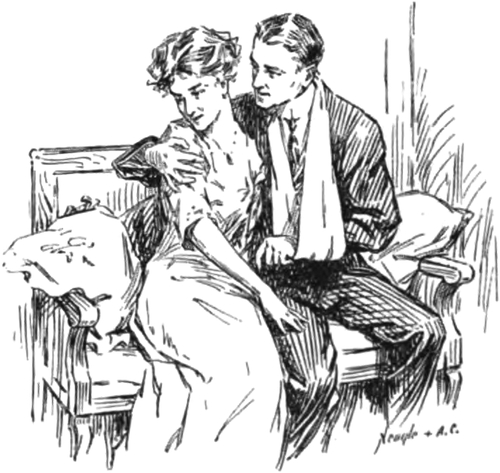
AMBIDEXTROUS
“Oh! Jack, I’m so sorry you’ve hurt your arm.”
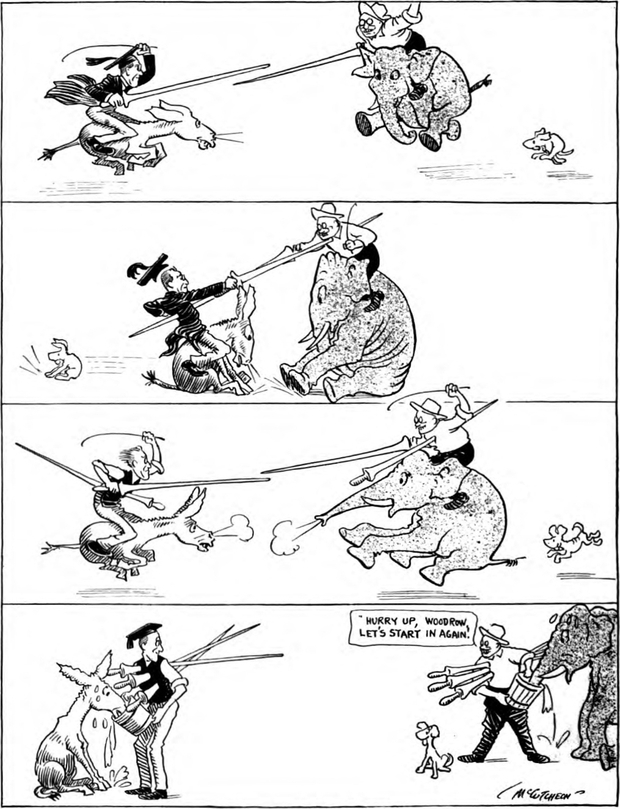
Copyright, 1912, by John T. McCutcheon
“WHEN IMMORTAL MEETS IMMORTAL”
A PROPHETIC CARTOON. BY JOHN T. McCUTCHEON
(Both Mr. Woodrow Wilson and Colonel Theodore Roosevelt are members of the American Academy of Arts and Letters.)
This drawing, made for the Chicago “Tribune,” before the nomination of either candidate, is here reprinted by permission.
LIMERICKS
TEXT AND PICTURES BY OLIVER HERFORD
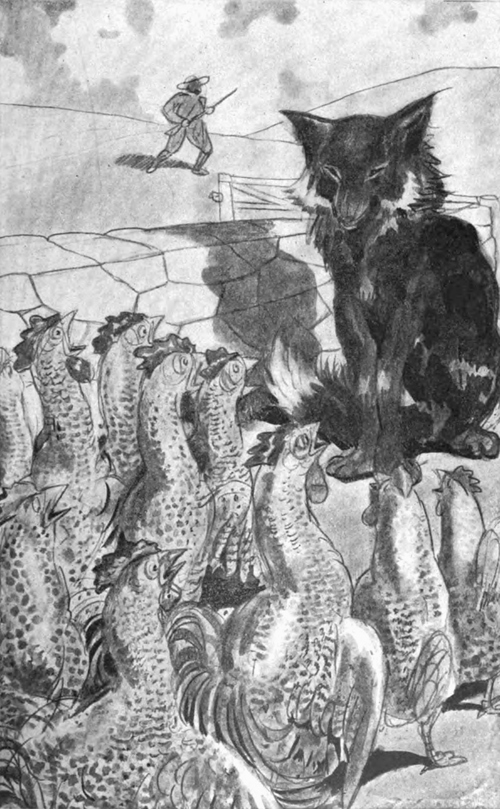
XVII—THE FINANCIER FOX
There once was a plausible fox Who explained that he dabbled in “stocks,” But they found out one day “Live stock” was his “lay,” When he “cornered” ten prize Plymouth Rocks.
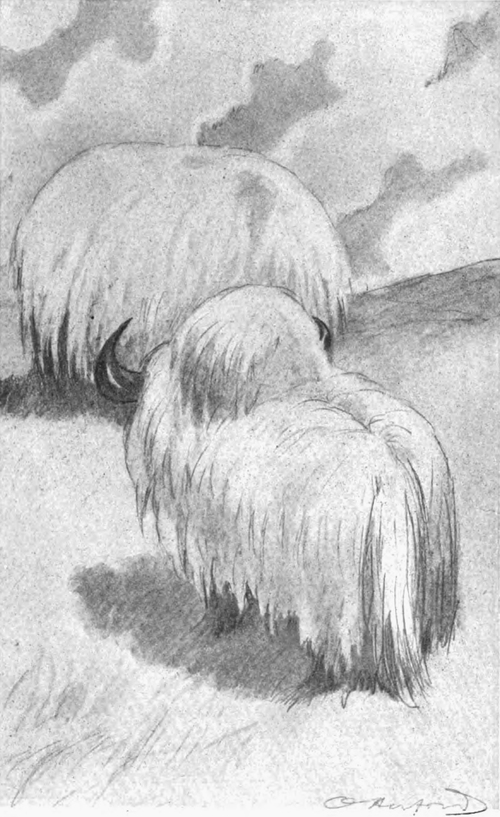
XVIII—THE FASTIDIOUS YAK
There was once a fastidious yak Who refused to eat hay from a stack. “A haystack,” said he, “Looks so very like me!” (The haystack’s the one at the back.)
THE DE VINNE PRESS, NEW YORK
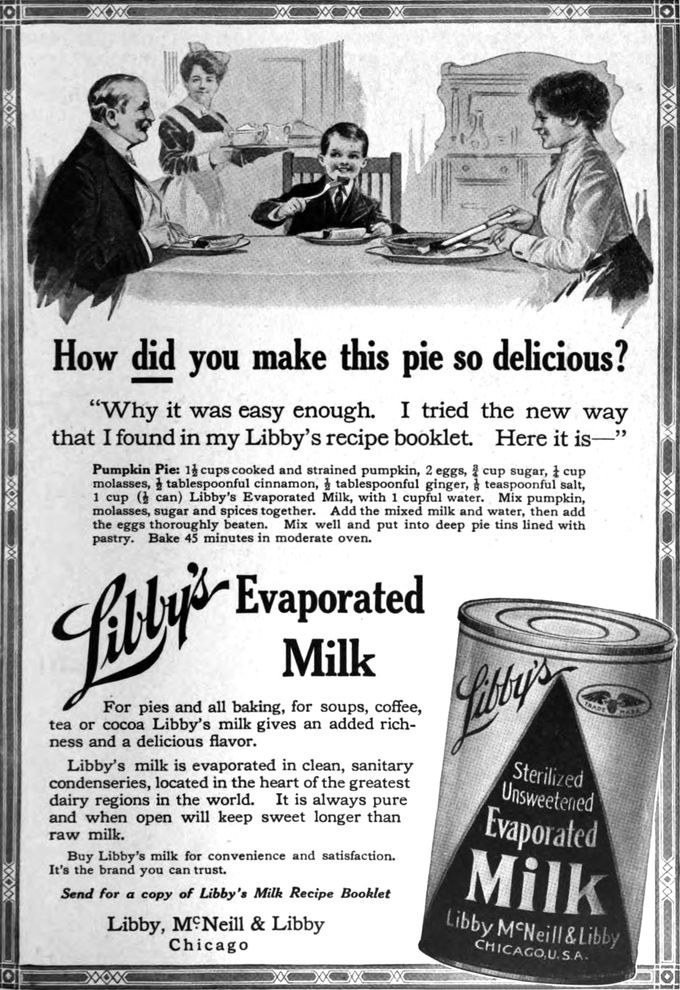
How did you make this pie so delicious?
“Why it was easy enough. I tried the new way that I found in my Libby’s recipe booklet. Here it is—”
Pumpkin Pie: 1½ cups cooked and strained pumpkin, 2 eggs, ¾ cup sugar, ¼ cup molasses, ½ tablespoonful cinnamon, ½ tablespoonful ginger, ¼ teaspoonful salt, 1 cup (½ can) Libby’s Evaporated Milk, with 1 cupful water. Mix pumpkin, molasses, sugar and spices together. Add the mixed milk and water, then add the eggs thoroughly beaten. Mix well and put into deep pie tins lined with pastry. Bake 45 minutes in moderate oven.
Libby’s Evaporated Milk
For pies and all baking, for soups, coffee, tea or cocoa Libby’s milk gives an added richness and a delicious flavor.
Libby’s milk is evaporated in clean, sanitary condenseries, located in the heart of the greatest dairy regions in the world. It is always pure and when open will keep sweet longer than raw milk.
Buy Libby’s milk for convenience and satisfaction. It’s the brand you can trust.
Send for a copy of Libby’s Milk Recipe Booklet
Libby, Mc̣Neill & Libby Chicago
Original Advertisement
⇒ LARGER IMAGE
Have you smoked one lately?
El Principe de Gales
Havana Cigars

Original Advertisement
⇒ LARGER IMAGE