JOHN QUINCY ADAMS IN RUSSIA
Reading edition
EXTRACTS FROM HIS CORRESPONDENCE RELATING TO THE WAR OF 1812, NAPOLEON’S RETREAT FROM MOSCOW, AND CONVERSATIONS WITH MADAME DE STAËL
INTRODUCTION AND NOTES BY CHARLES FRANCIS ADAMS
A CENTURY ago at this time the Napoleonic wars, so-called, or the convulsions which succeeded the French Revolution of 1789, were rapidly drawing to a close. Beginning with the capture of the Bastille, July 14, 1789, the final catastrophe occurred at Waterloo, June 18, 1815. Meanwhile, during the last half of 1812 and the whole of 1813, it is no exaggeration to say that the whole world was at war. Up to June, 1812, the United States had kept out of the actual fray, maintaining, by hook or by crook, a species of so-called neutrality. The affair of the Leopard and the Chesapeake, unspeakably disgraceful to the United States, had occurred off the capes of Virginia in June, 1807. In the following December Jefferson’s embargo had been proclaimed; but, having proved utterly futile as either a remedial or a protective measure, it was removed in March, 1809.
Needless to say, this was for the United States a period of tension and deep humiliation. Threats of disunion were freely made, and the first steps looking to a secession of the New England States from the Union had been taken. On March 4, 1809, James Madison was inaugurated as the fourth President, and war with Great Britain was declared in June, 1812. One of the earliest acts of Madison after taking the oath of office had been to nominate John Quincy Adams to represent the United States at the court of St. Petersburg. Alexander I, then thirty-five years old, was Czar of Russia. Two years before that he had, with Napoleon, effected the treaty of Tilsit, so-called, theatrically signed on a raft moored in the river Niemen. A temporary peace, therefore, existed between the Russian czar and Napoleon, then at the zenith of his career; a truce, rather than a peace, destined to be rudely broken in the summer of 1812. Napoleon’s disastrous Russian campaign, and the War of 1812–15 between the United States and Great Britain, then ensued; the latter was drawing to a close just at the end of 1814 (December 25), six months before the battle of Waterloo.
Mr. Adams’s residence in Russia (1809–1814) covered, therefore, the whole of the period of Napoleon’s Russian experience, as also his campaign during the subsequent year (1813), intervening between the retreat from Moscow and Waterloo. Mr. Adams thus held an official position at the very center of conflict during the four most troubled years of the nineteenth century. He was in the midst of things. During that period also he maintained a constant interchange of familiar, family letters, so far as the facilities for such an interchange then existed, between St. Petersburg and Quincy, his home in Massachusetts. These letters never have seen the light.
On Wednesday, October 16, 1912, the American Antiquarian Society celebrated its centennial anniversary at Worcester, Massachusetts. As president of a sister, but senior, organization—the Massachusetts Historical Society—the writer was invited to take part in this affair, contributing to it. His thoughts, therefore, naturally reverted to the events taking place at the particular time the society, whose birth was thus celebrated, came into existence; and those events were of a very exciting and memorable character.
Napoleon was in Moscow that day, anxiously awaiting the results of certain negotiations he had undertaken, looking to a possible escape from the situation in which he had involved himself. Tidings of the utter failure of the negotiations reached him, and the order to evacuate Moscow, preliminary to the fatal retreat, was given on October 18—just two days subsequent to the occurrence we were to celebrate.
On this side of the Atlantic the memorable action between the Constitution and the Guerrière had occurred on August 19—just two months before; and exactly one week later—October 25—the frigate United States captured the Macedonian. Thus, during the latter half of the year 1812, memorable events followed close on one another’s heels. Of all of these, Mr. Adams, in Russia, and his relatives in Massachusetts, were deeply interested observers; and a recurrence to the letters then interchanged, canvassing these events from the contemporary point of view, could hardly fail to be of interest and even of historical value.
A portion of the material from the yellowing letter-files of that intimate family correspondence is offered in the following extracts. They relate exclusively to the events then occurring in Russia and America, and to characters now become historic. One letter, of the most informal character, describes a long interview with the famous Madame de Staël in St. Petersburg, at the time of Napoleon’s Russian campaign, the conversation taking place on the day preceding that on which the great battle of Borodino was fought (September 7, 1812). It will be remembered that Napoleon, considering Madame de Staël an enemy in no way to be despised, had some years before treated her accordingly, so that in 1812 she was still in exile.
Correspondence between Europe and America in those days was carried on under extreme difficulty. Letters, whether passing through the post, or confided for delivery to private hands, were freely opened by officials in nearly every country. To such a degree was this practised that in a letter written from St. Petersburg to his brother, Thomas Boylston Adams, John Quincy Adams observed: “Almost every letter I write is opened and read either by French or English officers.”
Correspondence, therefore, had to be carried on with great discretion. This is apparent in the letters of Mrs. John Adams to her son. In one of them, dated from Quincy, July 29, 1812, she says:
“The declaration of war by the United States against Great Britain, the necessity for which is deplored, renders the communication between us so hazardous that I despair of hearing from you or conveying intelligence to you.... We have not any letters from you of a later date than the 4th March, and we wait in anxious expectation of hearing. I have written to you by various opportunities, and I could not fill many pages with subjects which ought to come to your knowledge of a political nature, if I did not feel myself restrained by the desire I have, that this letter may reach you, as it contains no subject to gratify the curiosity of any one and can be only interesting to yourself as a testimony of the health of your friends.”
And again, writing under date of November 30 following, she says:
“Your letters gave us the more pleasure, as we had despaired of hearing again from you during the winter. It is almost a forlorn hope to expect any communication between us. The war between France and Russia on the one hand, and America and England on the other, leaves few chances for private correspondence. If while peace existed so little regard was had to letters addrest to a publicke minister that they must be broken open and family and domesticke concerns become the subject of public investigation, there can be but little satisfaction in writing.... Notwithstanding that blundering Irish Lord Castlereagh[1] denies the fact, I cannot expect more respect or civility when the nations are hostile to each other. Should this be destined to similar honor I request Sir William or any of their Lordships to awaken in their own Bosoms some natural affection and kindly forward this letter to the son to whom it is addrest, and whom three years’ absence from his parents and children render it particularly necessary that it should go with safety.”
Curious light on this subject of tampering with correspondence is shown in a letter from J. Q. Adams to his mother, dated St. Petersburg, April 7, 1813:
“I know not whether it was generosity, or any other virtue, or merely a disposition to receive the postage, that induced the transmission of your favour of 30 December to Mr. Williams of London; for by him it was kindly forwarded to me, and on the first day of this month, to my inexpressible joy, came to hand. It was but so short a time before that I had received your letter of 29 July!—and excepting that, not a line from Quincy later than April of the last year. This last letter had apparently been opened, although the impression of your Seal upon the wax was restored—a circumstance which indicates that it was done in England, where they still affect the appearance of not breaking seals at the Post-Office.
“On this Continent they are less scrupulous about forms. When they open letters, they break the seals, and do not take the trouble of restoring them. They send them open to their address. It reminds me of an anecdote I have lately met with of Prince Kaunitz when he was prime Minister of the Empress Maria Theresa. One of his clerks whose business it was to copy the opened letters, coming to foreign Ministers at Vienna, in the hurry of reclosing a despatch to one of the Envoys, sent him his copy instead of the original. The Envoy went to Prince Kaunitz, showed him the copy that he had received, and complained that the original was withheld from him. The Prince immediately sent for the Clerk, severely reprimanded him in the Envoy’s presence for his blunder, and directed him to bring instantaneously the original despatch. The Clerk brought it accordingly, and the Prince gave it to the Envoy, with many apologies for the trouble occasioned him by the Clerk’s mistake, and assurances of his hope that it would never occur again.”
THE SITUATION IN 1812
John Quincy Adams to his mother, Mrs. John Adams
“St. Petersburg, 24 October, 1812.
“ ... There is now scarcely a spot upon the habitable globe but is desolated by the scourge of War. I see my own Country writhing under it, and every hope of better prospects vanishing before me. If I turn my eyes around me, I see the flame still more intensely burning. Fire and the Sword are ravaging the Country where I reside. Moscow, the antient Metropolis, one of the most magnificent and most populous Cities of Europe in the hands of an invader, and probably the greatest part of it buried in ashes.[2] Numerous inferior Cities daily devoted to the same Destruction, and Millions of People trampled under the feet of oppression of fugitives from the ruins of their habitations, perishing by hunger, in woods or deserts....
“We live indeed in an age when it is not lawful for any civilized Nation to be unprepared for or incapable of War. Never, with an aching Heart I say it, never did the warlike Spirit burn with so intense a flame throughout the civilized World as at this moment. Never was the prospect of its continuing to burn and becoming still fiercer, so terrible as now. It would perhaps not be difficult to show that the State of War has become indispensable to the existence both of the French and British Governments. That in Peace they would both find their destruction....”
John Quincy Adams to Thomas Boylston Adams
“St. Petersburg, 24 November, 1812.
“ ... You know how deeply I was disappointed at the breaking out of our War,[3] precisely at the moment when I entertained the most ardent and sanguine hopes that War had become unnecessary. Its Events have hitherto been far from favourable to our Cause, but they have rather contributed to convince me of its necessity, upon principles distinct from the consideration of its Causes.... Our Means of taking the British possessions upon our Continent are so ample and unquestionable that if we do not take them it must be owing to the want of qualities, without which there is no Independent Nation, and which we must acquire at any hazard and any loss.
“The acquisition of Canada, however, was not and could not be the object of this War. I do not suppose it is expected that we should keep it if we were now to take it. Great Britain is yet too powerful and values her remaining possessions too highly to make it possible for us to retain them at the Peace, if we should conquer them by the War. The time is not come. But the power of Great Britain must soon decline. She is now straining it so excessively beyond its natural extent that it must before long sink under the violence of its own exertions. Her paper credit is already rapidly declining, and she is daily becoming more extravagant in the abuse of it. I believe that her Government could not exist three years at Peace without a National Convulsion. And I doubt whether she can carry on three years longer the War in which she is now engaged, without such failure of her finances as she can never recover. It is in the stage of weakness which must inevitably follow that of overplied and exhausted strength that Canada and all her other possessions would have fallen into our hands without the need of any effort on our part, and in a manner more congenial to our principles, and to Justice, than by Conquest.
“The great Events daily occurring in the Country whence I now write you are strong and continual additional warnings to us not to involve ourselves in the inextricable labyrinth of European politicks and Revolutions.”
John Quincy Adams to Mrs. John Adams
“St. Petersburg, 30 January, 1813.
“ ... There are several Americans residing here, who continue to receive frequent letters from their friends at home. Through them and through the English Newspapers we collect the information of the most important events occurring on our side of the Water.
“ ... The English Government and Nation have been told, and have probably believed that Mr. De Witt Clinton would be elected President instead of Mr. Madison, and that he would instantly make peace with England upon English terms. Of the real issue of the Election we are here not yet informed; though accounts from the United States have reached us to late in November, and they lead us to expect Mr. Madison’s re-election.[4]
“I never entertained very sanguine hopes of success to our first military efforts by land. I did not indeed anticipate that within six months from the Commencement of the War they would make us the scorn and laughter of all Europe, and that our National Character would be saved from sinking beneath contempt, only by the exploits of our Navy upon the Ocean. Blessing upon the names of Isaac Hull[5] and Decatur,[6] and their brave Officers and Men! for enabling an American to hold up his head among the Nations!—The capture of two British frigates successively, by American ships but little superior to them in force has not only been most profoundly felt in England, but has excited the attention of all Europe. It has gone far towards wiping away the disgrace of our two Surrenders in Canada. I believe if the English could have had their choice they would rather have lost Canada the first Campaign, than their two frigates as they have lost them. I hope and pray that the effect of these occurrences upon the national mind in our own Country will be as powerful as it has been in England, but with a different operation.
“After the news of the Guerrière’s capture, I saw an Article in the ‘Times,’ a Wellesley Paper, written evidently under the impression of great alarm; and explicitly declaring that ‘a new Enemy to Great Britain has appeared upon the Ocean, which must instantly be crushed, or would become the most formidable Enemy to her naval supremacy with which she ever had to contend.’ We must rely upon it that this will be the prevailing sentiment of the British Nation. That we must instantly be crushed upon the Ocean—and unless our Spirit shall rise and expand in proportion to the pressure which they can and will apply to crush us, our first success will only serve more effectually to seal our ultimate ruin upon the Sea.
“The disproportion of force between us and Britain at Sea is so excessive that the very idea of a contest with her upon that Element has something in it of desperation. To her it is only ridiculous. Upon a late debate in the House of Peers, something having been said of the American Navy, Lord Bathurst, one of the Ministers, told their lordships that the American Navy consisted of five frigates—and the House burst into a fit of laughter. These five frigates, however, have excited a sentiment quite different from laughter in the five hundred frigates of the British Navy, and if the American People will be as true to themselves as their little despised Navy has proved itself true to them, it is not in the gigantic power of Britain herself to crush us; neither instantly nor in any course of time, upon the Ocean.
“Hitherto, Fortune, or rather with a grateful Heart would I humbly say Providence, has favoured us in a signal manner. But we must not expect that our frigates will often have the luck of meeting single ships a little inferior in strength to themselves, or of escaping from ships greatly superior to them. That they have not already all fallen into the Enemy’s hands, is matter of surprise as well as of gratulation....
“The first wish of my heart is for Peace. But the Prospects of Peace, both in Europe and America, are more faint and distant than they have been for many years. War has in the course of the year 1812 consumed in the North of Europe alone, at least half a million of human lives, without producing the slightest indication in any of the parties engaged in it of a disposition to sheathe the sword....”
John Quincy Adams to Thomas Boylston Adams
“St. Petersburg, 31 January, 1813.
“ ... The spirit of 1775 seems to be extinct in New England,[7] but I hope the profligacy of British policy will not be more successful now than it was then.
“The War between us and them is now reduced to one single point—Impressment!—A cause for which we should not have commenced a War, but without an arrangement of which our Government now say they cannot make Peace. If ever there was a just cause for War in the sight of Almighty God, this cause is on our side just. The essence of this Cause is on the British side Oppression, on our side personal liberty. We are fighting for the Sailor’s Cause. The English Cause is the Press-gang. It seems to me that in the very Nature of this Cause we ought to find some resources for maintaining it, by operation upon the minds of our own Seamen, and upon those of the Adversary’s. It is sometimes customary for the Commanders of Ships to address their crews, on going into action; and to inspirit them by motives drawn from the cause they are called to support. In this War, when our Ships go into action, their Commanders have the best possible materials for cheering their men to extraordinary exertions of duty. How the English Admirals and Captains will acquit themselves on such occasions I can easily conjecture. But I fancy to myself a Captain telling them honestly that they are fighting for the Cause of Impressment. That having been most of them impressed themselves, in the face of every principle of Freedom, of which their Country boasted, they must all be sensible how just and how glorious the right of the Press-gang is, and how clear the right of practising it upon American Sailors as well as upon themselves must be. I think they will not very readily recur to such arguments.... The English talk of the Seduction practiced by us upon their Seamen. There is a Seduction in the very Nature of this Cause, which it would be strange indeed if their Seamen were insensible to. I have heard that many of their Seamen taken by us have shown a reluctance at being exchanged, from an unwillingness to be sent back to be impressed again. A more admirable comment upon the character of the War could not be imagined. Prisoners who deem it a hardship to be exchanged! With what heart can they fight for the principle which is to rivet the chains of their own servitude?
“I have been reading a multitude of speculations in the English Newspapers, about the capture of their two Frigates Guerrière and Macedonian. They have settled it that the American forty-fours are line of battle-ships in disguise, and that henceforth all the frigates in the British Navy are to have the privilege of running away from them![8] This of itself is no despicable result of the first half-year of War. Let it be once understood as a matter of course that every single frigate in the British Navy is to shrink from a contest with the large American frigates, and even this will have its effect upon the Spirits of the Tars on both sides. It differs a little from the time when the Guerrière went out with her name painted in Capitals on her fore-topsail, in search of our disguised line of battle-ship President.[9]
“But the English Admiralty have further ordered the immediate construction of seventeen new frigates, to be disguised line of Battle ships too. Their particular destination is to be to fight the Americans. Their numbers will be six to one against us, unless we too taking the hint from one success can build frigate for frigate and meet them on their own terms; in which case if our new ships are commanded and officered, and manned like the Constitution and the United States and Wasp,[10] I am persuaded they will in process of time gain one step more upon the maxims of the British Navy, and settle it as a principle that single English ships are not to fight Americans of equal force. Thus much I believe it will be in their power to do. And further I wish them never to go. I hope they will never catch the indolent affectation of seeking Battle against superior force. An English pretension which has been so well chastised in the fate of their two frigates.
“Our Navy, like all our other Institutions, is formed upon the English model. With regard to the Navy at least the superiority of that model to all others extant is incontestable. But in the British Navy itself there are a multitude of abuses against which we may guard, and there are many improvements of which it is susceptible, and for which the field is open before us. Our three 44 gun ships were originally built not as the English pretend for line of Battle ships, but to be a little more than a match in force to the largest European Frigates, and the experience both of our partial War with France, in 1798 and 1799 as well as of our present War with England has proved the wisdom of the principle upon which they were constructed. It has been a great and momentous question among our Statesmen whether we should have any Navy or not. It will probably still be a great question, but Great Britain appears determined to solve all our doubts and difficulties upon the subject. She blockades our Coast, and is resolved to crush us instantly upon the Ocean. We must sink without a struggle, under her hand, or we must have a Navy....”
NAPOLEON’S RETREAT FROM MOSCOW
John Quincy Adams to Mrs. John Adams
“St. Petersburg, 30 November, 1812.
“ ... It may well be doubted whether in the compass of human history since the Creation of the World, a greater, more sudden and more total reverse of Fortune was ever experienced by man, than is now exhibiting in the person of a man, whom Fortune for a previous course of nearly twenty years had favored with a steadiness and a prodigality equally unexampled in the annals of mankind. He entered Russia at the head of three hundred thousand men, on the 24th of last June. On the 15th of September he took possession of Moscow, the Russian armies having retreated before him almost as fast as he could advance; not however without attempting to stop him by two Battles, one of which [Borodino] was perhaps the most bloody that had been fought for many ages. He appears really to have concluded that all he had to do was to reach Moscow, and the Russian Empire would be prostrate at his feet. Instead of that it was precisely then that his serious difficulties began. Moscow was destroyed; partly by his troops, and partly by the Russians themselves. His Communications in his rear were continually interrupted and harassed by separate small Detachments from the Russian Army. His two flanks, one upon the Dvina, and the other upon the frontier of Austria were both overpowered by superior forces, which were drawing together and closing behind him; and after having passed six weeks in total inaction at Moscow, he found himself with a starving and almost naked army, eight hundred miles from his frontier, exposed to all the rigour of a Russian Winter, with an Army before him superior to his own and a Country behind him already ravaged by himself, and where he had left scarcely a possibility of any other sentiment than that of execration and vengeance upon himself and his followers.
“He began his retreat on the 28th of October, scarcely a month since, and at this moment, if he yet lives, he has scarcely the ruins of an Army remaining with him. He has been pursued with all the eagerness that could be felt by an exasperated and triumphant Enemy. Thousands of his men have perished by famine,—thousands by the extremity of the Season, and in the course of the last ten days we have heard of more than thirty thousand who have laid down their arms almost without resistance. His Cavalry is in a more dreadful condition even than his Infantry. He has lost the greatest part of his Artillery,—has abandoned most of the baggage of his army, and has been even reduced to blow up his own stores of ammunition. The two wings of the Russian Armies have formed their junction and closed the passage to his retreat; and according to every human probability within ten days the whole remnant of his host will be compelled like the rest to lay down their arms and surrender at discretion. If he has a soul capable of surviving such an Event, he will probably be a prisoner himself.
“Should he by some extraordinary accident escape in his own person, he has no longer a force nor the means of assembling one which can in the slightest degree be formidable to Russia. Even before his Career of victory had ceased, commotions against his Government had manifested themselves in his own Capital, on a false rumour of his death which had been circulated. Now, that if he returns at all, it must be as a solitary fugitive, it is scarcely possible that he should be safer at the Thuileries [sic], than he would be in Russia. His allies, almost every one of whom was such upon the bitterest compulsion, and upon whom he has brought the most impending danger of ruin, may not content themselves merely with deserting him. Revolutions in Germany, France, and Italy must be the inevitable consequence of this state of things, and Russia, whose influence in the political affairs of the World he expressly threatened to destroy, will henceforth be the arbitress of Europe.
“It has pleased Heaven for many years to preserve this man, and to make him prosper, as an instrument of divine wrath to scourge mankind. His race is now run, and his own term of punishment has commenced.—‘Fret not thyself because of him who prospereth in his way, because of the man who bringeth wicked devices to pass—for yet a little while, and the wicked shall not be; yea, thou shalt diligently consider his place and it shall not be.’ How often have I thought of this Oracle of divine truth, with an application of the Sentiment to this very man upon whom it is now so signally fulfilling. And how ardently would I pray the supreme disposer of Events that the other and more consolatory part of the same promise may now be also near its accomplishment—‘But the meek shall inherit the Earth, and shall delight themselves in the abundance of Peace.’”
John Quincy Adams to Mrs. John Adams
“St. Petersburg, 31 December, 1812.
“ ... In my last letter I gave you a sketch of the situation at that time of Napoleon the Great. There is no Account yet that he has personally surrendered himself;[11] but he has only saved himself by the swiftness of his flight, which on one occasion at least he was obliged to pursue in disguise. Of the immense host with which six months since he invaded Russia, nine tenths at least are prisoners, or food for worms. They have been surrendering by ten thousands at a time, and at this Moment there are at least one hundred and fifty thousand of them in the power of the Emperor Alexander. From Moscow to Prussia, eight hundred miles of road have been strewed with his Artillery, Baggage-Waggons, Ammunition-Chests, dead and dying men who he has been forced to abandon to their fate. Pursued all the time by three large regular armies of a most embittered and exasperated Enemy, and by an almost numberless militia of peasants, stung by the destruction of their harvests and cottages which he had carried before him, and spurr’d to Revenge at once themselves, their Country and their Religion. To complete his disasters, the Season itself during the greatest part of his Retreat has been unusually rigorous even for this Northern Climate. So that it has become a sort of bye-word among the Common People here that the two Russian Generals who have conquered Napoleon and all his Marshals are General Famine and General Frost. There may be and probably is some exaggeration in the accounts which have been received and officially published here of the late Events; but where the realities are so certain and so momentous the temptation to exaggerate and misrepresent almost vanishes.
“In all human probability the Career of Napoleon’s conquests is at an end. France can no longer give the law to the Continent of Europe. How he will make up his account with Germany, the victim of his former successful rashness, and with France, who rewarded it with an Imperial Crown is now to be seen. The transition from the condition of France in June last to her present State is much greater than would be from the present to her defensive campaign against the Duke of Brunswick in 1792. A new Era is dawning upon Europe. The possibility of a more propitious prospect is discernible; but to the great disposer of Events only is it known whether this new Revolution is to be an opening for some alleviation to human misery or whether it is to be only a variation of Calamities.
“ ... I have already mentioned that the season has been unusually rigorous. In the course of this month of December, we have had seventeen days in succession with Fahrenheit’s thermometer almost invariably below 0. I now write you at that temperature, and notwithstanding the stoves and double windows my fingers can hardly hold the pen. The Sun rises at a quarter past 9 in the morning, and sets a quarter before 3 in the afternoon; so that we must live almost by Candlelight. We are all literally and really sick of the Climate. It is certainly contrary to the course of Nature, for men of the South to invade the Regions of the North. Napoleon should have thought of that....”
John Quincy Adams to Mrs. John Adams
“St. Petersburg, 19 July, 1813.
“ ... The Battle of Lützen[12] was claimed by both parties as a Victory, and was here celebrated as such by a Te Deum. But in its consequences it was the most important Victory ever won by Bonaparte—for it proved to all Europe that France was still able to cope with her Enemies, and even to make head against them. A second Battle[13] three weeks after had a similar and more unequivocal result. Between the first and second Battles Napoleon had proposed that a Congress should be assembled at Prague in Bohemia, to which all the powers at War, including the United States of America, should be invited to send Plenipotentiaries for the purpose of concluding a general Peace; and he offered to stipulate an Armistice, during the Negotiation. After the second Battle, Russia and Prussia, with the concurrence of Austria, accepted the proposition for an Armistice, limited however to the term of six weeks, probably with a view to receive the answer from England, whether she should choose to be represented at the Congress or not. This Armistice is now on the point of expiring, but is said to have been prolonged for six weeks more. In the meantime Napoleon has quartered his army upon the Territory of his Enemy in Silesia, is levying a contribution upon Hamburg of about ten Millions of Dollars, is doubly fortifying all his positions upon the Elbe, and receiving continual reinforcements to be prepared for renewing an offensive campaign. He has made sure of the aid and support of Denmark and Saxony, and strongly confirmed Austria in her propensities to neutrality. If the War should be renewed his prospects, though infinitely below those with which he invaded Russia, last Summer, will be far above those with which he entered upon the present Campaign in April. If the Congress should meet he will not have it in his power to give the law to Europe; but the Peace must be in effect of reciprocal and important concessions.
“There has nothing occurred since the commencement of the French Revolution which has occasioned such astonishment throughout Europe as this state of things. There are many examples in History of the extraordinary defeat and annihilation of immensely powerful armies. But the reappearance of a second overpowering host, within five Months after the dissolution of the first, is I believe without a parallel....”[14]
John Quincy Adams to Mrs. John Adams
“St. Petersburg, 19 November, 1813.
“ ... Since the renewal of the War in Germany the odds of force have been too decisive against the French, and the catastrophe of their Army [at Dresden and Leipsic] has been nearly equal to that of the last year.[15] Napoleon himself has been defeated and overpowered by the four combined armies of Austria, Russia, Prussia and Sweden, and on the 19th of October escaped from Leipsic leaving his ally the king of Saxony a Prisoner, more than twenty of his Generals, and forty thousand men also prisoners, and 400 pieces of Cannon, Ammunition, baggage, etc., in proportion to the conquerors. All his other German Allies have deserted him and taken side against him; the Austrians are advancing in Italy, and Lord Wellington with his English, Spaniards and Portuguese, are invading France from the Pyrenees....”
John Quincy Adams to Thomas Boylston Adams
“St. Petersburg, 24 January, 1814.
“ ... The Events of the last two years have opened a new prospect to all Europe, and have discovered the glassy substance of the Colossal Power of France. Had that power been acquired by Wisdom, it might have been consolidated by Time and the most ordinary portion of Prudence. The Emperor Napoleon says that he was never seduced by Prosperity; but when he comes to be judged impartially by Posterity, that will not be their sentence. His Fortune will be among the wonders of the age in which he has lived. His Military Talent and Genius will place him high in the Rank of Great Captains; but his intemperate Passion, his presumptuous Insolence, and his Spanish and Russian Wars, will reduce him very nearly to the level of ordinary Men. At all Events he will be one of the standing examples of human Vicissitude—ranged, not among the Alexanders, Cæsars and Charlemagnes, but among the Hannibals, Pompeys and Charles the 12ths. I believe his Romance is drawing towards its close; and that he will soon cease even to yield a pretext for the War against France. England alone will be ‘afraid of the Gunpowder Percy, though he should be dead.’”[16]
John Quincy Adams to Mrs. John Adams
“Reval, 12 May, 1814.
“ ... The Coalition of all Europe against France has at length been crowned with complete success. The annals of the World do not I believe furnish an example of such a reverse of Fortune as that Nation has experienced within the last two years.[17] The interposition of Providence to produce this mighty change has been so signal, so peculiar, so distinct from all human co-operation, that in ages less addicted to superstition than the present it might have been considered as miraculous. As a Judgment of Heaven, it will undoubtedly be considered by all pious Minds now and hereafter, and I cannot but indulge the Hope that it opens a Prospect of at least more Tranquility and Security to the civilized part of Mankind than they have enjoyed the last half Century. France for the last twenty-five Years has been the scourge of Europe; in every change of her Government she has manifested the same ambitious, domineering, oppressive and rapacious Spirit to all her Neighbours. She has now fallen a wretched and helpless victim into their hands—dethroning the Sovereign she had chosen, and taking back the family she had expelled, at their command; and ready to be dismembered and parceled out as the Resentment or the Generosity of her Conquerors shall determine. The final Result is now universally, and in a great degree justly imputable to one Man. Had Napoleon Bonaparte, with his extraordinary Genius, and transcendent military talents, possessed an ordinary portion of Judgment or common Sense, France might have been for ages the preponderating Power in Europe, and he might have transmitted to his Posterity the most powerful Empire upon Earth, and a name to stand by the side of Alexander, Cæsar and Charlemagne—A name surrounded by such a blaze of Glory as to blind the eyes of all humankind to the baseness of its origin and even to the blood with which it would still have been polluted. But if the Catastrophe is the work of one Man, it was the Spirit of the Times and of the Nation, which brought forward that Man, and concentrated in his person and character the whole issue of the Revolution. ‘Oh! it is the Sport (says Shakespear) to see the Engineer hoist by his own petard.’ The sufferings of Europe are compensated and avenged in the humiliation of France.... The great danger of the present moment appears to me to be that the policy of crippling France to guard against her future power will be carried too far....”
MADAME DE STAËL
John Q. Adams to Thomas B. Adams
“St. Petersburg, 22d November, 1812.
“ ... Toward the close of the last summer arrived here as a sort of semi official appendage to the British embassy an old acquaintance of yours, Sir Francis D’Ivernois, who as you know has been for many years a distinguished political writer in the French language and in the Interest of the British Government. He came not I believe with, but very soon after, the Embassador Lord Cathcart.[18] just at the same time a lady of celebrated fame, Madame de Staël, the daughter of Mr. Necker, was also here on a transient visit.[19] As I had not the honor of being personally known to Madame de Staël and as we had just received information of the American Declaration of war against Britain, I had no expectation of having any communication or intercourse either with the Embassador or the lady. And I regretted this the less as my whole soul was at that period absorbed in the distressed situation of my family.... Early one morning I received a note from Madame de Staël, requesting me to call on her at her lodgings that same day at noon as she wished to speak to me on a subject respecting America.
“I went accordingly at the hour appointed and upon entering the lady’s salon found there a company of some fifteen or twenty persons, not a soul of whom I had ever seen before. An elderly gentleman in the full uniform of an English General was seated on a sofa and the lady whom I immediately perceived to be Madame de Staël was complimenting him with equal elegance and fluency upon the glories of his nation, his countryman, Lord Wellington, and his own. The Battle of Salamanca and the bombardment of Copenhagen were themes upon which much was to be said and upon which she said much.[20]
“When I went in she intermitted her discourse for a moment to receive me and offer me a seat which I immediately took and for about half an hour had the opportunity to admire the brilliancy of her genius as it sparkled incessantly in her conversation. There was something a little too broad and direct in the substance of the panegyrics which she pronounced to allow them the claim of refinement. There was neither disguise nor veil to cover their naked beauties, but they were expressed with so much variety and vivacity that the hearers had not time to examine the thread of their texture. Lord Cathcart received the compliments pointed at himself with becoming modesty; those to his nation with apparent satisfaction and those to the conquest of Salamanca with silent acquiescence. The lady insisted that the British was the most astonishing nation of antient or modern times, the only preservers of social order, the defenders exclusively of the liberties of mankind, to which his lordship added that their glory was in being a moral nation, a character which he was sure they would always preserve. The glittering sprightliness of the Lady and the stately gravity of the Embassador were as well contrasted as their respective topics of praise, and if my mind had been at cast to relish anything in the nature of an exhibition I should have been much amused at hearing a Frenchwoman’s celebration of the generosity of the English towards other nations and a lecture upon national morality from the commander of the expedition Copenhagen.
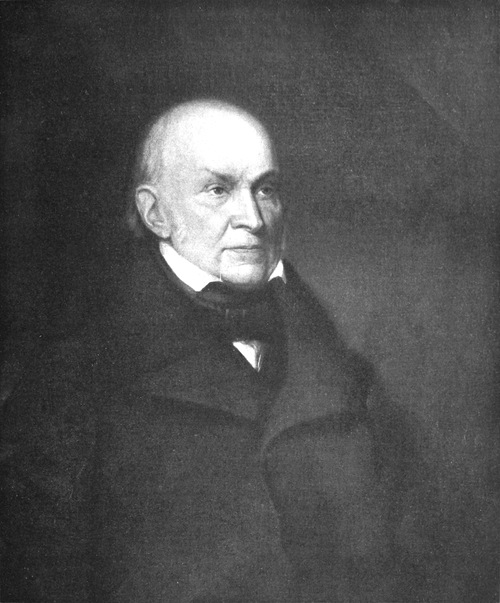
Owned by the Century Association, New York. Half-tone plate engraved by H. Davidson
JOHN QUINCY ADAMS
FROM THE PORTRAIT, PAINTED IN 1835, BY ASHER B. DURAND
“During this sentimental duet between the ambassador and the Embassadress, kept my seat, merely an auditor. The rest of the company were equally silent. Among them was an English Naval Officer, Admiral Bentinck, since deceased. He was then quite the chevalier d’honneur to Madame de Staël but whether the scene did not strike him precisely as it did me or whether his feelings resulting from it were of a more serious nature than mine the moment it was finished he drew a very long breath and sighed it out as if relieved from an offensive burden saying only ‘thank God that’s over.’ He and all the rest of the company immediately after that retired and left me tête-à-tête with Madame de Staël.
“The subject respecting America was to tell me that she had a large sum in the American funds and to enquire whether I knew how she could contrive to receive the interest which she had hitherto received from England. I gave her such information as I possessed. She had also some lands in the State of New York of which she wished to know the value. I answered her as well as I could but her lands and her funds did not appear to occupy much of her thoughts.
“She soon asked me if I was related to the celebrated Mr. Adams who wrote the book upon Government. I said I had the happiness of being his son. She said she had read it and admired it very much, that her father. Mr. Necker, had always expressed a very high opinion of it. She next commenced upon Politics and asked how it was possible that America should have declared war against England. In accounting for this phenomenon I was obliged to recur to a multitude of facts not as strongly stamped with British generosity or British Morality as might be expected from the character which she and the Embassador had just been assigning that nation. The orders in council and the press gang afforded but a sorry commentary upon the Chauvinesque defence of the liberties of mankind and no very instructive lessons of morality. She had nothing to say in their defence but she thought that the knights errant of the Human race were to be allowed special indulgence and in consideration of their cause were not to be held by the ordinary obligations of war and peace.
“There was no probability that any arguments of mine could make any impression upon opinions thus toned. She listened, however, with as much complacency as could be expected to what I said and finally asked me why I had not been to see her before. I answered that her high reputation was calculated to inspire respect no less than curiosity and that however desirous I had been of becoming personally acquainted with her I had thought I could not without indiscretion intrude myself upon her Society. The reason appeared to please her. She said she was to leave this city the next day at noon. She was going to Stockholm to pass the winter and then to England. She wished to have another conversation with me before she went and asked me to call on her the next morning.
“I readily accepted the invitation and we discussed politics again two or three hours. I found her better conversant with Rhetoric than with Logic. She had much to say about social order, much about universal monarchy, much about the preservation of religion in which she gave me to understand she did not herself believe, and much about the ambition and supremacy of Buonaparte upon which she soon discovered there was no difference of sentiment between us. But why did not America join in the holy cause against the tyrant? First because America had no means of making war against him, she could neither attack him by sea or land. 2d because it was a fundamental maxim of American policy never to intermeddle with the political affairs of Europe. Thirdly because it was altogether unnecessary. He had enemies enough upon his hands already. What! Did not I dread his universal monarchy? Not in the least. I saw indeed a very formidable mass of force arrayed under him, but I saw a mass of force at least as formidable arrayed against him. Europe contained about 100 millions of human beings. He was wielding the means of 15 millions and the means of 85 millions were wielding against him. It was an awful spectacle to behold the shock, but I did not believe nor ever had believed that he would ever be able to subjugate even the continent of Europe. If there had ever been any real danger of such an event it was passed.
“She herself saw that there was every prospect of his being very shortly driven out of Spain. And I was equally convinced he would be driven out of Russia. It was the very day of the battle of Borodino. ‘J’en accepte l’augure,’ she said. ‘Everything that you say of him is very just. But I have particular reason for resentment against him. I have been persecuted by him in the most shameful manner. I was neither suffered to live anywhere nor to go where I would have gone, all for no other reason but because I would not eulogize him in my writings.’ As to our war with England I told her that I deeply lamented it and yet cherished the hope that it would not last long. That England had forced it upon us by measures as outrageous upon the rights of an independent nation as tyrannical as oppressive as any that could be charged upon Buonaparte. Her pretences were retaliation and necessity. Retaliation upon America for the wrongs of France and necessity for man Stealing. We asked of England nothing but our indisputable rights, but we allowed no special prerogatives to political Quixotism. We did not consider Britain at all as the defender of the liberties of mankind but as another Tyrant pretending to exclusive dominion upon the ocean. A pretension full as detestable and I trusted in God full as chimerical as the pretension of universal monarchy upon the land.
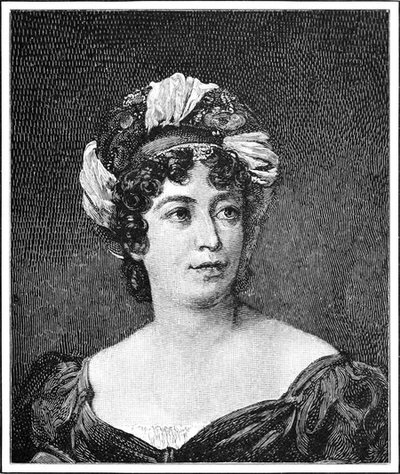
MADAME DE STAËL
“Madame de Staël was of her own opinion still but on the point of empressment she owned that my observations were reasonable. I have not yet found a European of any nation except the English who on having this question in its true state brought to a precise point had a syllable to say for the English side. In conclusion I told her that the pretended retaliation of England had compelled us to resort to real retaliation upon them and that as long as they felt a necessity to fight for the practice of stealing men from American merchant vessels on the high seas we should feel the necessity of fighting against it. I could only hope that God would prosper the righteous cause.
“Madame de Staël charged me if I ever should be again in any place where she should be at the same time not to neglect paying her a visit which I very willingly promised. She left St. Petersburg the same day. I should ask Sir Francis D’Ivernois pardon. I began this letter with him, but whom can one help deserting for Madame de Staël? I will return to Sir Francis by the next opportunity. Dutifully and affectionately yours.”

Half-tone plate engraved by H. Davidson
MY DAUGHTER
FROM THE PAINTING BY FRANK W. BENSON
(THE CENTURY’S AMERICAN ARTISTS SERIES)
❏ LARGER IMAGE