INVULNERABLE
Reading edition
BY WILLIAM ROSE BENÉT
THE armorers met me at the marge of life, The weapon-bearers, calling each his ware, Praising sword or spear or sinuous knife Fashioned for the strife In the forest depths that lay before, To ward off malice or to pierce despair; Shields that could affright All the hissing snakes in Envy’s hair; Or, when Peril’s sudden arrow sped, Crying how bucklers, stern of proof and bright, Glanced the shaft, the rancor overbore; Or iron helms, securely vizarded, Turned the thrusts of mockery and spite. Loudly “Arm you! Arm you!” rose their cry; And I chose a shield, Indifference, And a blade, Sharp Wit, for my defense. Close-meshed mail beneath my gaberdine Glittered all unseen. Proud I strode and whirled my sword on high. Then my friend went by, Passing in his shining joy unarmed, With not even an amulet that charmed; Singing for the innocence confessed In his sparkling eyes, his buoyant breast; Swiftly, gaily thrusting through the trees To his deep and darkling forest doom, As I thought. But still before me goes, Blithe and wonderful, his candid smile Every ambushed shadow to illume, And the quickening sympathy that glows Sudden on his cheek when friends seem foes, And his utter radiance without guile, Merry ignorance where I am—wise? Where they lurk and snarl and close with me, All unscathed of foemen passeth he, Seeing no strife, unarmed eternally, And e’en the Terrors turn away their eyes!

UNDER WHICH FLAG, LADIES, ORDER OR ANARCHY?
THE PENNSYLVANIA ASSOCIATION FOR WOMAN SUFFRAGE DISAVOWS VIOLENCE
IN the April CENTURY, in an editorial article, “The Silent Suffragists of America,” we called upon the official organizations in the United States advocating woman suffrage to abandon their passive and tolerant attitude toward the methods of the English militants, a plea which we had also made in the number for November last.[23] We have received letters of approval of this article from representative women on each side of the suffrage question. It is a matter of sincere gratification to us to publish at the first opportunity the letter which follows from Miss Eleanor Cuyler Patterson of Chestnut Hill (Philadelphia):
I have read with interest the temperate and wise opinion printed in “Topics of the Time” in the April number of THE CENTURY MAGAZINE. It gives me great pleasure to send you the resolution on this subject passed by the executive committee of the Pennsylvania Association for Woman Suffrage on March 7, 1913.
“Although we do not pass judgment on the methods of other organizations, we disclaim all connection with militant organizations, and do not indorse or intend to use militant methods, but shall continue to employ educational methods as in the past.”
Here at last we have from an official suffrage organization in America a sober-minded expression of opinion on this burning subject. It ought to be the beginning of a sincere effort to rescue the whole woman movement from the shallow thinking and super-emotionalism that are likely to wreck it.
That this sort of protest is much needed is shown from the following passage from a letter to “The New York Times” from a leading advocate of the suffrage, Mrs. Eunice Dana Brannan, which is the first public expression of what we must regard as a very unfortunate, not to say shocking, frame of mind on the part of many refined and well-educated American women:
The suffragists in America are agreed in their belief that militant action is not called for. Injustice to women is not so evident nor so general as in England, and the attitude of the majority of American men is certainly fairer and more honestly chivalrous. But, in spite of these amiable differences, it is quite possible that if the Eastern States continue to deny enfranchisement to their women, while the Western States continue to grant it, the women thus discriminated against would find the political anomaly of their position so impossible to bear that even militancy would seem to them justifiable.
The words we have italicized are deplorably significant. They mean, for instance, that the immunity of New York City from similar outrages is to be dependent only upon the granting of the suffrage by the State. “Militant action is not called for”—yet, but will be called for if the voters of the East, however conscientiously, shall deny the suffrage to women!
In striking contrast is this extract from an open letter, printed in “The New York Times” of April 14, from Mrs. Helen Magill White (Mrs. Andrew D. White) of Ithaca, New York, addressed “To the Treasurer of the National American Woman Suffrage Association.” After recording her friendly attitude toward the movement, Mrs. White closes her letter with these downright words:
I never until lately admitted to myself the possibility of our essential inferiority—such that, in matters of government, we could without outrage be classed with children, with idiots and insane, and with criminals.
But now that I see our own kinswomen across the sea sowing the wind to reap the whirlwind—sowing seeds of lawlessness which we may see in our own day, I greatly fear, blossoming in an anarchism more terrible than anything yet known to history—and when I see our own women protesting feebly or not at all, and even, to some extent, encouraging, I have not a cent to contribute nor a word of sympathy for any association of women which does not publicly and earnestly protest against such a line of procedure. It resembles the kicking and biting of spoiled children, the raving and gibbering of insane and idiots—and the unbridled license of the most abandoned criminals. All these classes think solely of what they want, and self-constitute themselves arbiters of what they should have. What it may cost other human beings, innocent though they be, for them to grasp at the objects of their desire by whatever means may come to hand, does not touch their minds; and so it would seem to be with those women of England; and so, also, with those of our own women who condone their offenses—who would condone such action in any cause.
Mrs. White here indicates both the responsibility of sincere, educated, and thoughtful suffragists and an effective method whereby they may hold the official organizations to their duty. Not a dollar should be subscribed to their work until they have pledged themselves that no part of their funds shall go to the support of lawlessness, and have made as definite a disclaimer of sympathy and intention as the Pennsylvania society, the action of which, at this time, is a patriotic public service of the highest order.
We have nothing but respect for the women of America who are earnestly convinced that the extension of the suffrage gives promise of a brighter day for humanity, and we take this opportunity to record our abhorrence not only of violence by women but of such interference with peaceable parades as disgraced the city of Washington on the third of March. In these days of turbulence of action and of thought, there is no securer anchorage to the mind than Chatham’s saying, “Where law ends, tyranny begins.”
NEWSPAPER INVASION OF PRIVACY
IS THE PAUL PRY AND PEEPING TOM TYPE OF REPORTING ON THE INCREASE?
THE newspapers printed the initial paragraph of Mr. Pierpont Morgan’s will, and some of them made it the theme of very respectful and profitable comment. It was as intimate a statement as can well be imagined, a solemn committal of the soul of the maker of the will into the hands of his Saviour, and a charge to his children to maintain and defend “the blessed doctrine of the complete atonement for sin through the blood of Jesus Christ.”
But Mr. Morgan was a public person. All of us, in that sense, became members of his family. We had made our way to his bedside as he lay dying in Rome, and we expected to be given his will to read as soon as his wife and son and daughters had read it. They were obliged to give it to us: what could they do? Mr. Morgan, by reason of his great wealth and his distinguished public service had lost the privilege of privacy.
At the same time, there were those who read the will, and especially the beginning of it, with a certain sense of embarrassment, as if they had been found reading a neighbor’s private letters. The situation is one which arises in connection with some modern biographies and autobiographies, but the newspapers present it to our conscience every day. Now is abundantly fulfilled the prediction of an old book which said, “There is nothing covered, that shall not be revealed; and hid, that shall not be known.” When the book promises further that that which is spoken in the ear in closets shall be proclaimed upon the housetops, we seem to see the reporter in the midst of his characteristic activities. All the closet doors are now wide open; or, if they are shut and locked against us, there are dictagraphs inside.
The other day at a great college a student was found dead in bed. The reporter who put the fact in the paper reported also that the president and the dean, and other persons much older and perhaps wiser than himself, had done their best to keep the matter private. Their endeavors appear to have been entirely for the sake of the student’s family and friends. There was no suspicion of anything wrong except such as the reporter himself conveyed to heighten the interest. These kindly endeavors the reporter, according to his own frank and impudent confession, had frustrated. No purpose seems to have been served by the publication except that the reporter got his money for it.
The other day, in the midst of a suit for divorce, the wife was stricken with a mortal disease, and the husband was sent for. She was unconscious when he arrived, and he knelt by her bedside, praying. Then she opened her eyes and saw him, and told him that she loved him still. Behind the door was a reporter, with his paper in one hand and his pencil in the other, putting down what he saw and heard through the crack, and going out to shout it through a megaphone in the street.
Two lads in a high school fought a duel over the attentions which one was paying to the other’s sister. The local newspapers gave it nearly as much space as they gave to the floods in Ohio. The little girls who looked on were all interviewed, and we were told what the sister said when she went to see her wounded lover in the hospital. Of course the perspective was absurd, but the performance was by no means absurd.
So with the divorce-suits that are tried in the court-rooms, which have no walls, where the busy reporters prepare themselves to tell us a hundred things that we have no right to know. A brutal husband forces his wife to sue him for divorce as her only defense against his cruelty, and the newspapers coöperate with him in exposing to the common gaze all the tender privacies of the woman’s soul.
We read such revelations, at first ashamed, as if we were looking through a keyhole, then somewhat brutalized ourselves by the experience. Thus the line is blurred between the publicity which is for the good of the people and for the terror of offenders, and the publicity which is only gossip and scandal printed for no other purpose than to sell the papers and make money. Whatever the remedy, the fact is plain that our sense of the honest rights of privacy is dulled. If Lady Godiva were to ride through the streets of Coventry to-day, there would be Peeping Toms in groups at every window with cameras and machines for taking moving pictures.
It is not improbable that one of the next important movements in this country will be for a greater sense of responsibility to wholesome public opinion on the part of the press. There is so much that is good and helpful and truly progressive in the better newspapers, and they are so sound on the larger questions of national policy, that it is to be hoped that the reformation of the grosser faults of journalism will be initiated by them. And in saying this we must not forget the offenses against good taste and good morals which are continually being perpetrated by certain periodicals that appear but once a month.
THE CHANGING VIEW OF GOVERNMENT
A GROWING SENSE OF ITS DUTIES TO THE PEOPLE
A MEMBER of Congress summed up the strongest impression from his latest electoral campaign as being that the people in this country are coming to have a much more vivid sense of the Government as “a political entity” which “owes duties.” He obviously means something more than Secretary Hay’s famous phrase about the “administrative entity” of China. This is no mere quibble about Pope’s “forms of government.” It implies a wide departure from the old view that government is a necessary evil, to be kept as limited as possible. However we explain or interpret the new conception, its existence and increasing sway over the minds of men will not be questioned by any one who keeps his eyes open to the facts. He may call the tendency socialistic or simply an extension of the democratic principle, but that it has now become a part of American political thinking he cannot well deny.
Equally undeniable is it that the idea that people have of the nature and function of their Government is more important than any mere question of governmental machinery. We hear much of a movement to “restore the government to the people.” All manner of political devices are commended, or else condemned, to bring about a more direct participation by the citizen in the work of government. Be these proposals wise or foolish, it is plain that the chief question lies behind them. It is what the people wish their Government to be; what they would now have done by those responsible for its conduct; what they themselves would undertake by means of governmental agencies in case those agencies were somehow made more quickly responsive to the popular will. Show a political philosopher what the driving forces of a republic really desire it to be or to become, and he will be able to get much more instruction out of that, much more material on which to base prophecies respecting future development, than he possibly can from endless talk about primaries and conventions, ballot-laws and corrupt-practices acts. Those are only means and machinery; the end aimed at is the main thing.
Looking back at the recent enlargement of governmental activities, and endeavoring to read in them the new sense of duties owed, we are able to detect at least a few general indications and even certain principles. For example, it is clear that the people are demanding, and will more and more demand, that their governments, local and national, do a great deal more than was formerly expected to conserve the physical health of the nation. Here is the origin of pure-food laws, of meat-inspection, of statutes against the adulteration of drugs. In this feeling of the vital relation that ought to exist between the Government and the bodily well-being of its subjects we have also the explanation of official campaigns against disease, of the movement for a national quarantine, and of the great broadening of the work everywhere laid upon health officers.
All this has not come about through a deliberate or reasoned change in the point of view. It is, rather, the result of quiet pressure from the practical side. Large problems of public health have pushed themselves to the front; and in seeking to solve them, the people have merely laid hold of the powers of government as ready and efficient instruments. It is now tacitly assumed that the Government is under a continuing obligation to guard the people against epidemic disease and exposure to impure food and deleterious drugs. This is now distinctly one of the duties owed.
But life is more than meat, liberty and equality of opportunity are more precious than health. And in seeking to preserve these, the work of our Government during the last few years has made of official activity something very different from the conceptions and standards of 1787 or 1850—something which is no doubt open to abuse, but which, we are persuaded, has thus far been largely beneficial in its practical manifestations.
When the Government takes hold of the evil of railway rebating with a strong hand, it is not alone a question of enforcement of the law, but of striking down an insidious and dangerous form of special privilege. The real offense in the old rebate system, now happily so nearly a thing of the past, was not alone its secret favors to a secret few, but its gross discrimination against the unprotected many. It was the denial of the right to compete on equal terms. This is the intolerable thing in a free democracy. It can endure the sight of great wealth, of vast fortunes honestly gained, but it cannot submit to a method of accumulating property which destroys the opportunities of thousands in order to give unfair advantages to one. It is the determination to keep the career open to talent, not to shut it up to favoritism, which has been the animating spirit in the long struggle to prevent the railroads from virtually creating private fortunes at their own sweet will, and bringing whom they please to penury by means of rebates.
A like attitude and animus are seen in the other forms of legislative restriction upon great corporations. All the anti-monopoly laws and anti-trust suits, all the regulating statutes and the public-utilities commissions, have one principle at bottom, and it is to make all men stand equal before the law. On the one hand to strike down oppression, on the other to equalize opportunity, has been the intent of these new activities of government which, whatever else they show, leave no doubt of an altogether changed view of what governments owe.
In all these matters, the greatest peril that lurks in our path is that of being misled by abstractions. If we talk overmuch of “government,” we are in danger of forgetting the human beings who make it up. If we are afflicted by bad rulers, it is no help to us to fall back upon an ideal conception of “the state.” The state is simply men acting. Much amusement was created in Paris by an innocent peasant who passed from one public building to another demanding that he be allowed to see l’état. He had heard of it all his life; he thought it was something at the capital; being there, he wanted to inspect it at close range. He was an unsophisticated rustic, but was he not right in his instinct? We are not, after all, governed by an “entity.” Government is the most concrete of human affairs. It is vested in mortal men. And in all the agitations and the hopes and fears of our day respecting the extension of governmental functions, and the quickening of the whole idea of what the state owes to citizens, it would be fatal to forget that government cannot be made better except by putting better men in charge of it.
THE TWO-BILLION-DOLLAR CONGRESS
A NATIONAL BUDGET THE REMEDY FOR EXTRAVAGANCE IN APPROPRIATIONS
THE time is overripe for a fundamental change in our method of making annual appropriations for the cost of the National Government. A glance at the result of the work done by the various congressional committees charged with the duty of preparing appropriation bills is enough to bring conviction that order and system must be substituted for the present chaotic methods; while, if we could penetrate the secrets of the committee-rooms, the country would stand appalled at the ignoble tricks and devices by which the “pork-barrel” is filled and the money of the taxpayers wantonly and wickedly wasted.
The Democrats in their platform of 1912 “denounce the profligate waste of money wrung from the people by oppressive taxation through the lavish appropriations of recent Republican Congresses,” and they demand “a return to that simplicity and economy which befits a democratic Government.” How did they keep faith with the people under this self-denying ordinance? In the session of Congress immediately following, the second regular session of the Sixty-second Congress, which adjourned on March 4, they passed appropriation bills aggregating $1,098,647,960, and authorized contracts on public works committing the Government to a further expenditure of $76,956,174, making a total demand upon the treasury for the year ending June 30, 1914, of $1,175,604,134, a sum that surpasses all previous congressional achievements in extravagance. Not only that, but the grand total of the appropriations and contracts authorized in the two years of the Sixty-second Congress was $2,238,470,990, which is to be compared with $2,151,610,940 of the Sixty-first Congress. This is democratic economy and simplicity with a vengeance. The Democrats surpassed by more than $86,000,000 the exploits of the previous Republican Congress, which they had denounced as profligate.
But the Republican pot cannot call the Democratic kettle black. The blame falls upon both parties, for both have been profligate. Not only is the method of drawing up the appropriation schedules indefensible, but many of the senators and congressmen of both parties exhibit a degree of greed and rapacity in grabbing for the people’s money that is fairly comparable with the behavior of a drunken army looting a captive city. The river-and-harbor appropriation of $41,000,000, and the public-buildings appropriation amounting to $45,000,000 more, cover multitudes of log-rolling sins, of costly improvements of streams never navigable, of imposing buildings for small towns, veritable “grabs” of money to foster local pride, put district constituents in a good humor, and lay the foundation for safe majorities in the next congressional elections. The sin here is not alone that of profligate wastefulness; it is a pretty direct form of bribery of the voter. The staggering appropriation for pensions belongs in this category. The Service Pension Act added $25,000,000 to this item of expenditure, which in this fiscal year is raised to the great sum of $180,300,000. And we are now observing the fiftieth anniversaries of events of the war!
The national balance-sheet for the year which this “return to that simplicity and economy which befits a democratic Government” presents for the scrutiny of the voter and the taxpayer stands thus: estimated revenue of the Government under existing laws, $991,791,508; direct appropriations, $1,098,647,960; deficit, $106,856,452. But there must be added to the appropriations $76,976,174 of contract commitments authorized, raising the deficit to the colossal total of $183,812,626.
How shall this riot of extravagance be checked? By concentrating the power of control over appropriation bills and by establishing a definite responsibility for them. Two methods have been proposed. President Taft in a special message urged upon Congress the plan of a national budget. The various departments would prepare the estimates as now; these would be diligently studied and coördinated, with constant reference to the estimated revenue of the year; and the Executive would then submit to Congress such a budget statement as in most other countries the legislative body receives from the Government. In the House of Representatives this budget would be considered by a budget committee, or, if the old name were retained, by the Committee on Appropriations. And the report of that committee, of course, would be subject to discussion and amendment by the House. Representative Fitzgerald of the Appropriations Committee and ex-Speaker Cannon agree in advising a return to the practice of intrusting, the preparation of appropriation bills to a single Committee on Appropriations.
Prior to the year 1865, the Committee on Ways and Means had control of appropriation bills. Then the Committee on Appropriations was created, with full control of supply bills. In 1885, because of jealousy of the great power exercised by Samuel J. Randall, the bills making provision for the army, the diplomatic and consular service, the military academy, the navy, Indian affairs, and the post-office, were taken away from the Committee on Appropriations. This change marked the beginning of the era of extravagance. Under the present system, appropriations are made in thirteen annual bills, and “eight different committees, unrelated to one another, without coöperation, are charged with the duty” of preparing these bills. No fairer invitation to extravagance could be issued. Each committee works with regard only to itself, and, as we have seen, all together work without regard to the revenue side of the account. Coordination is impossible, and no balanced and well-apportioned budget could be the result of such a system.
The national-budget plan proposed by Mr. Taft should have the most serious consideration of Congress and of the country. Objection is made that this plan is “wholly inapplicable to our system of government.” It may be admitted at once that it is wholly incongruous with the present “system” of Congress in respect to appropriations. It would smash in both heads of the “pork-barrel,” and apprehension of that catastrophe, rather than any constitutional scruple, we imagine, is the motive of the objections that have been raised. It is true that the House under the Constitution originates revenue bills. But there is no constitutional impediment to the submission of estimates by the Executive, since that has been the practice of the Government since the beginning. A budget based upon the “needs of the Government economically administered,” and scrupulously adjusted to the revenue account, is the most promising remedy for the evils of the present method of preparing bills in eight committees, working with no recognized relation or understanding, under which extravagance has grown into a habit.
ERRATUM
IN the April CENTURY, on page 821, by a misapprehension M. André Tardieu was spoken of as the editor of the “Revue des Deux Mondes,” to which he is a contributor. The editor is M. Francis Charmes of the French Academy.—THE EDITOR.

ON THE LADY AND HER BOOK
A Plea for the Suppression of a Catchword
BY HELEN MINTURN SEYMOUR
My dear George:
The magazine containing “Confessions of a Novel Reader” arrived not two hours ago, and I have just come from its perusal. When a young man cares enough about his spinster aunt to send her his latest literary production on the very day it appears it does seem ungracious to do what I am about to do—make the letter of acknowledgment one continuous complaint. But you touched me on a sensitive spot, George. Your essay proved the proverbial straw, the drop that filled a cup of bitterness to overflowing.
Perhaps you suspect that this tirade comes from an elderly New Englander’s aversion to those very outspoken writers whom you admire. Not a bit of it. Worship at whatever shrine you please. I, too, in my young days, distressed my elders by my attachment to strange gods. It is a waste of time to be shocked, since most of us have gone in for “daring” literature when we were green in judgment. It is a phase of youth, like a boy’s swagger. No, all the trouble came from one little paragraph, which you probably never dreamed would upset me. You said—oh, you said—that no woman enjoys Dumas! That cut me to the heart, George,—and coming from you!
“A woman cannot read—” “A woman does not like—” We have heard those expressions so often! Sometimes the statement is used to illustrate the limitations of feminine sympathy. Sometimes the supposed limitations of feminine sympathy are used to support the statement. I don’t know which is worse, to go softly all one’s days, lest some individual weakness be foisted on the whole unfortunate sex, or to feel that individual tastes avail nothing as examples of female character.
Hark to Mr. Paul Elmer More on Christina Rossetti. He finds her “perfectly passive attitude toward the powers that command her heart and soul” makes her “the purest expression in English of the feminine genius.” Mrs. Browning sinks to a lower level because “her political opinions, her passion for reform, her scholarship ... simply carry her into the sphere of masculine poets, where she suffers by comparison.” But, “even within the range of strictly feminine powers her genius is not simple and typical.” How he comes to his conclusion regarding the typical woman Mr. More neglects to tell us. But you will observe the advantage of this method for the doctrinaire. One has only to accept a certain premise (it matters not what), and by excluding as “not typical” every instance which might contradict it one can prove anything. Thus, a certain book on the Negro proved, some years ago, that the colored race was a hopeless mass of laziness, vice, and stupidity. The writer hastened to forestall criticism by declaring that the well-conducted Negro, wherever and whenever found, was not typical of the race.
Here comes Dr. William Lyon Phelps, all amazement because women have enjoyed the soldier tales of Kipling. To him the preference is as out of place in a woman as her presence in a bar-room amid oaths and tobacco-juice. Well, if there were as much color, adventure, and excellent broad comedy in the bar-room as in the best of these stories a lady might even forgive the profanity and the filthy floor. And you must remember that life, for all the realists may say, is not literature. We take our broad comedy, selected and arranged, from an author. Life is like a variety show; we sit through a deal of vulgar stupidity for the sake of a laugh or two. Furthermore, I believe plenty of men who enjoy Mistress Doll Common when Ben Jonson leads her on the stage would find her sadly dull in real life. Perhaps I have grown more patient with the limitations of sex since the days when I read “Monte Cristo” in the hayloft; but I still fume under that particular form of petticoat tyranny which would extend to books. Sex may pervade all the departments of life, but I hold that it should stop at the library door.
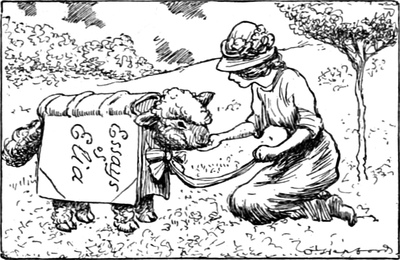
Divest yourself of certain odious catchwords, my dear boy. Toss certain theories into the waste-basket, where they belong. Forget that any one ever called woman “the subjective sex,” and that somebody described her as a “divine totality” (I think it was divine). Any superfluous subjectiveness is wearing away in the freer air which has done so much to destroy woman’s “personal outlook.” Remember that women are no more of a piece than are their fathers or brothers, but a hodge-podge of miscellaneous and often contradictory tastes. “Tell me what you eat and I will tell you what you are,” runs the saying. “Tell me what you read and I will tell you what you are,” says the critic by implication. Now, what is that middle-aged relative of mine who keeps a place in her heart of hearts for “Pride and Prejudice” and “Pan Michael,” for “The Essays of Elia” and “Junius’s Letters”? Verily, we seek our books as we seek the society of many friends, to suit a mood, with no regard for totalities.
By the way, is not this just another instance of that mania for pigeonholing human tastes and playing them off against one another? If you appreciate Sienkiewicz, you must share the opinion of “The Virginian” (and Mr. Wister) regarding Jane Austen; and if you find entertainment in the human comedy as played in English country towns at the end of the eighteenth century, it stands to reason that you are not the person for the Poland of the seventeenth. It avails you little to protest that you find an equal pleasure in routing Lady Catherine with Elizabeth and Tartars with Volodyovski. One of these days I intend to found a society for the suppression of useless comparisons. I can understand how a Trinitarian and a Unitarian, a Democrat and a Republican, a suffragist and an anti-suffragist might drift naturally into discussion. But why, when I speak a good word for the canine race, must my acquaintance, B, launch aggressively into praise of cats, as if my love of dogs were a challenge? Why may I not enjoy Tennyson without calling down on myself the scorn of the Browningite? It annoys me to have my pets or my poets made the excuse for a wrangle. I refuse to commit myself to any type of novel.
But, you may remind me, I went so far as to keep a parrot “once, long ago.” I plead guilty, yet, Mark Twain to the contrary, a parrot is no index to character. John Silver kept one, but nobody ever compared him to a maiden lady.
So, dear George, when you meet some gentle spinster with a flavor of “Cranford” about her, give her the benefit of the doubt. Perhaps she likes nothing better than to swagger in imagination through the streets of old Paris in company with the immortal three, brandishing a sheaf of rapiers taken from the cardinal’s guard.
—And between you and me, George, I never saw a “typical woman.”
Your affectionate aunt,
Anne Coddington.
ON THE USE OF HYPERBOLE IN ADVERTISING
From a Lady who Suffers from Skepticism to a Friend who is Healthily Credulous
BY AGNES REPPLIER
My dear Eleanor:
No, Eleanor, I have not read “The Three Golden Apples.” I have not even read the reviews. But I have read the publishers’ notice, because they were good enough to send it to me. They say the book is the literary masterpiece of our day, that it stands unrivaled in tensity of situation, that it is an epoch-making narrative, and a masterly contribution to the problems that confront the thinking world. Upon which I find myself murmuring with Sancho Panza, “Nothing else, mine honest friend?” Why not say simply and plainly that it is the greatest novel ever written, and that Clarence Coventry (have you ever met him, Eleanor? He is a charming man) is the greatest novelist ever born? Why, when people are soaring in the pure and limitless realms of fancy, should they stop short, as if they were impeded by facts?
Now even if I did not know Clarence—who writes quite as well as his neighbors—I should be chilled into apathy by the publishers’ red-hot enthusiasm. The phrase “epoch-making” is calculated to chill any reader who has encountered it before and who remembers what it usually means. And though I am well aware that epochs are not made or marred by even a readable novel, I don’t like being told pure nonsense, and I don’t like being hounded by advertisements. Why, Eleanor, since I have been running over to New York every few weeks to see Amy and the children, and staring out of the car-windows at ninety weary miles of continuous advertising, I am cured forever of touching pills or pickles.
Yet they tell me (though I don’t believe it) that the success of any business venture depends wholly and entirely on its advertisements; that if people are told often enough to buy a thing they end by buying it; that if they are told imperatively or persuasively they buy it a little sooner; and that they can be startled into buying it at once. I have been given to understand that the artless expedient of printing an advertisement upside-down impels hundreds of men and women to purchase the object or visit the attraction so derided.
But we are not, in other respects, a child-like nation; I find a great deal of incredulity in this world when it comes to things worth believing. Why, then, this touching simplicity in the face of a transparent artifice? Does a young man really believe that if he eats one kind of cereal rather than another he will become a great financier? That is virtually what he is told. But if he will add up the financiers on the one hand, and the cereal-eaters on the other, he will find his figures disheartening.
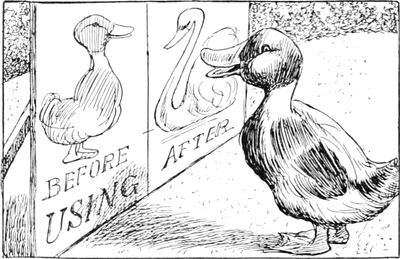
The other day I received a long and exceedingly intimate communication, which began “Why not be Beautiful?”, and which (assuming ungraciously that I was ugly) gave me so many good reasons for altering my estate, that I began to fear I was “resisting grace” by retaining a single feature. A beautiful woman, I was reminded, “has the world at her feet, and can nobly mold the characters of men.” All this for thirty dollars, Eleanor! And I have so many friends whose characters—or at least whose habits—would “thole a mend.” Do you think, if I paid thirty dollars to be beautiful—in an elderly fashion—I could break Archie Hamilton of contradicting every innocent statement made in his presence (he’d say the sea wasn’t salt if he had a chance), and induce Dr. Nett not to tell us any more about the Panama Canal? It would be money well invested; but I fear—I fear—
The amazing thing about the whole business is that it should be worth while. Last winter in a magazine I read a very serious and sanguine paper called “A Revolution in Advertising.” The writer—it is always a woman who believes in the perfectibility of our fallen race—wanted advertisers, one and all, to abandon romance and become educational mediums. She begged them to give us their aid in apportioning our incomes, to tell us “facts about economy and expenditure,” to impart to us the secrets of skill and the principles of science. She sought to make our department stores “museums of vital importance.” As the stores are already concert-halls and picture-galleries, cooking-schools, day nurseries, and vaudeville shows, it seems grasping to ask them to be museums as well; but to expect them to teach us the value of economy is like expecting the steamship companies to teach us the advantages of staying at home. It is not, after all, the money we save, but the money we spend, which benefits the shopkeeper. He may tell us that we economize when we buy a seventy-five-dollar costume for thirty-nine dollars and a half. According to his computation we shall save thirty-five dollars and fifty cents—quite a comfortable sum—by so doing. Who was it that said that figures lie more than anything in the world except facts; and by what system, I often wonder, does the advertiser regulate his choice of numerals? Human greed and human credulity are his only guides. If he said the costume was reduced from seventy-five dollars to sixty dollars, we’d say it wasn’t worth while; and if he said it was reduced from seventy-five to fifteen, we’d say we didn’t believe it; so he has to choose some happy medium which will sound both tempting and trustworthy. He depends on our gullibility, and he does not depend in vain.
What I like best, however, are the ingenious appeals that cast all cramping veracities to the winds. I like being invited (don’t laugh, I can show you the advertisement) to grow potatoes in a closet, or in my spare room. “Method cheap, simple, and sure.” “No digging, no hoeing” (I should think not, in my spare room!). All the potatoes I want to eat, and “immense profits” if I send them to market. No labor involved, and no annoyance, save possibly the loss of an occasional guest, as I could not well have friends sleeping in my potato-patch. I have heard of people raising mushrooms and angleworms in their cellars (I’d as soon eat one as the other); but a truck-garden in the next room would be living in the heart of nature.
And now Massachusetts, in a spasm of integrity, is trying to restrain the exuberance of the advertiser, to clip his wings, and teach him the worth of sobriety. The State proposes to abolish fraudulent advertisements, and to construe the word “fraudulent” so that it will cover any statement that can be proved to be false. A thing must really and truly be just what the advertiser says it is. But oh, Eleanor, what a tangle for the law to smooth out! If, like the three rogues in the Hindoo legend, you sell a dog for a sheep, that, of course, is a transparent lie. But if you say that Clarence Coventry’s book is an “epoch-making narrative,” who shall prove the contrary? We’d have to wait so long to find out the truth that our graves would yawn for us in the interval. And if in 1950 the student of social science were asked, “Who wrote ‘The Three Golden Apples,’ and what influence did it have upon its day?” and he should answer—very naturally—that he never had heard of it, the time for investigation would be over. Clarence, and the publishers, and “The Three Golden Apples” would all be dead together.
Your affectionate friend,
Agatha Reynolds.
P.S. Don’t send me the book for a birthday present.


TEXT AND PICTURES BY OLIVER HERFORD
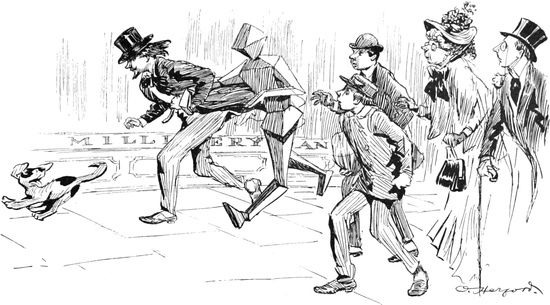
A SCULPTOR once, in search of fame (I can’t recall the sculptor’s name), Turned Cubist, and at once began A statue on the Cubist plan. The statue, I need hardly say, Was something in the Venus way, And as its form grew bit by bit, The sculptor fell in love with it. Then came a wonderful idea: He named his statue Galatea, Which, by the way, reminds me that His own name was Pygmalion Pratt. One day it chanced Pygmalion came To read the legend of his name And hers, and prayed that fiction might Repeat itself for his delight. When, lo! the cubic feet of stone Turned all at once to flesh and bone, And Galatea’s cubic face Met his in angular embrace. Short-lived was Galatea’s bliss; She soon guessed something was amiss, And from the wall, in modish dress, A Gibson girl confirmed her guess. “Pygmalion dear,” she cried, “oh, please Buy me some pretty frills like these!” Then, meeting his astonished stare, Blushed to the cube roots of her hair. Picture the curious crowds they drew As they strolled up Fifth Avenue! Think of the modistes asked to drape Miss Galatea’s cubic shape!
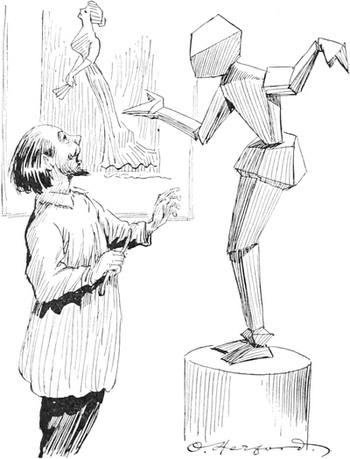
When Galatea came to see The sheer impossibility Of getting clothes, without ado She took to posing for le nu. And now she leads (to end my tale) A model life in Bloomingdale, Painted and sculptured and adored By inmates of the Cubist ward.
AN AFTER-DINNER STORY
BY SILAS HARRISON
AN ANECDOTE OF MCKINLEY
PRESIDENT MCKINLEY’S scrupulous loyalty to his cabinet officers is spoken of as one of his characteristics. It is said that he never went over the heads of his secretaries to consult an assistant, but held each to responsibility for his department.
Of all the events of his administration probably none was a source of more anxiety to him than the decision of the Supreme Court on the status of the colonies. It was a matter of great moment whether the highest judicial body should uphold the view of the Administration that the Constitution sanctioned the possession of colonies which were not granted full representation. There were conflicting rumors and forecasts of the color of the decision, and these added to the tension felt at Washington. Shortly before the announcement of the finding of the court a subordinate officer of one of the Departments appeared at the White House, at an unusual hour, and insisted upon seeing the President on the plea of important business. Having been admitted, he came at once to his errand.
“Mr. President, I have some good news for you. I have just learned authoritatively that the decision of the Supreme Court is to be in your favor.” He fairly glowed with the importance of his welcome message.
“Thank you,” said Mr. McKinley quietly, “that is good news. But have you informed your chief?”
“No, Mr. President; I thought you ought to be the first to know it.”
“Well, Mr.——, I’m sorry for that. Now, will you please do me the favor to go at once to your chief and give him the information, so that he may communicate it to me.”
OLD DADDY DO-FUNNY’S WISDOM JINGLES
BY RUTH MCENERY STUART
THE JACK-O’-LANTERN
SENCE he los’ ’is brains to git ’is smile, Brer Jack-o’-lantern grins lak a ’wilderin’ chile, Widout no secrets out or in; An’ de lighter in de head de broader is ’is grin. An’ he ain’t by ’isself in dat, in dat— No, he ain’t by ’isself in dat.
ANTS
DEM ants is sho got savin’ ways, An’ even de scripture ’lows ’em praise; But dey hoa’ds for deyselves f’om day to day, An’ dey stings any man wha’ gits in de way. An’ dey ain’t no new co’poration in dat— No, dey ain’t by deyselves in dat.
THE CANARY
DAT little yaller cage-bird preems ’is wings, An’ he mounts ’is pyerch an’ sings an’ sings He feels ’is cage, but I ’spec’ he ’low To take what comes an’ sing anyhow. An’ you ain’t by yo’self, little bird, in dat— No, you ain’t by yo’self in dat.
LIMERICK
TEXT AND PICTURE BY OLIVER HERFORD
THE KIND ARMADILLO
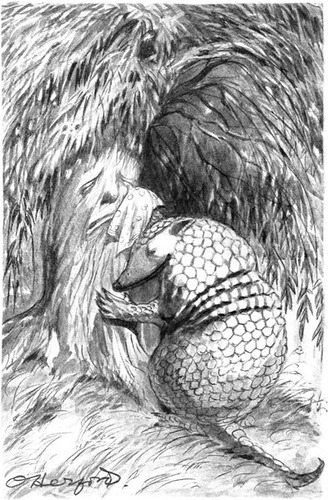
THERE once was a kind armadillo, Who solaced a lone weeping-willow. Said he: “Do not weep! What you need is some sleep; Pray rest on my shell as a pillow.”
THE DE VINNE PRESS, NEW YORK
FOOTNOTES: