THE GUTTER-NICKEL
Reading edition
BY ESTELLE LOOMIS
Author of “Out of Bondage”
WITH A PICTURE BY J. MONTGOMERY FLAGG
I
SUCCESS seldom comes as in a lottery—one big prize, and it’s all over, the winner satisfied.
No; Destiny, like a demonstrator at a pure-food exhibition, stands back of her counter in the world, and to those who happen to pass the booth of success she hands a sample. Sometimes the samples are small, sometimes large; but, whatever the size, let him who receives one never mistake his sample for a complete package of success.
It was strange that Jean Caspian made this blunder. Surely four years of theatrical experience were enough to have proved to her that, for an actor, there is only one real success—a hit in New York. How could she have forgotten that theatrical judgment-seat, where the sheep are separated from the goats?
But here, in Milwaukee, with applause still ringing in her ears, with the local papers full of her praise, her head was fairly turned with her triumph. Guy Norman’s leading lady! As she had won her way up step by step in his company, how she had longed for this final moment to come! Intoxicated with the realization of her ambition, she had already begun to live in a glorious future.
On the morning of the third day in Milwaukee, as Jean sat on her bed, reading a joyous letter from her mother, a high-spirited rap sounded on the door.
“Are you in, old pal?” Clara Coolwood, just from an understudy rehearsal, entered excitedly.
“Jean, what d’ you think! Company’s going to close! Norman’s ill!”
Jean heard the words, but, instead of seeing Clara’s agitated face, a vision loomed before her: she had forgotten New York. Broadway was still unattained.
Clara caught her look of despair, and continued:
“Oh, it may not be for long, Jean. Anyway, you needn’t worry, with the big start you’ve made.”
“A big start! Yes, two nights as leading woman—in Milwaukee!”
“But with Guy Norman,” Clara insisted.
“Guy Norman,” said Jean deliberately, “is under his own management. If he doesn’t play again this year, where shall I be? Have any of the big New York managers ever heard of me—B. B. Littleton, for instance? If he should happen to hear of my brief career as leading lady, has he ever seen me act? No. Therefore Jean Caspian does not exist. Why, you know very well, Clara Coolwood, that until the curtain goes up on you on Broadway, and they see you in the actual flesh, you might just as well have been playing on Mars.”
Jean was mechanically pulling on her coat.
Clara nodded thoughtfully.
“I’m afraid you’re right, Jean. Yes, remember poor Julia Wilcox, drawing crowds every day to that Baltimore stock theater for eight years? And when she opened in New York the critics said, ‘Unknown actress makes a sensation.’ Where are you going, Jean?”
“Why, I’m going to find Davey. Stage-managers usually know the truth, if they’ll only tell.”
Jean put on her hat and set out for the theater. In the stage entrance she met Guy Norman, calm, smiling, the picture of health. As he lifted his hat with his customary air of distinction, Jean inquired timidly for news.
“Why, yes; we’re going to close Saturday night. It’s all so silly, in a way, but my physician and manager were so importunate about my having a rest that I decided to humor them. I thought it might be wise to recuperate for the New York engagement.”
Jean smiled her relief, and was about to leave when he called her back.
“Oh, Miss Caspian, just a minute. I’m going to send a manuscript over to you to-day; it’s a play we’re expecting to put on in New York. And, oh—I may want to do some Shakspere, too. You’d better be up on Juliet.” He looked at her piercingly. “I’m not so sure that you re not the very person I’ve been waiting for.”
Jean flew back delightedly to the hotel, and two days later the still grumbling theatrical party left for New York in Guy Norman’s private cars.
In Mrs. Bunting’s boarding-house, where “the meals made up for the rooms,” Jean Caspian wrote to her chum, “back home” in Wisconsin:
Dear Clara:
Spent my first day in New York traveling the streets, trying to get some of “the road” worn off. You can’t imagine what a hole it made in my salary before I became a real New Yorker again. How I laughed at those hats we bought in Davenport when I caught a glimpse of myself on Broadway!
I dropped in to see Dell yesterday. She’s still haunting the agencies. Poor Dell! Went with her to Smiley’s, and it certainly seemed like old times. I even heard some one ask Smiley, “How’s the baby?” Remember how you used to make those tender inquiries in vain for six months?
Oh, those pathetic whipped-cur faces! Two thousand actors out of work this season, they say! We are lucky, aren’t we?
Yours gleefully, JEAN C.
P.S. Hear we’re to open in Pittsburgh, the fifteenth. Come on soon and take in a few plays. J. C.
P.P.S. Wait till you see my white satin “Countess” costume! You’ll see where four hundred of my good dollars have gone. I’m certainly all ready for my new salary. J. C.
Early Saturday morning Jean Caspian sat in her room darning a long “run” in a silk stocking, to the mental accompaniment of her Juliet cues. Suddenly she dropped her work to listen. Some one was running up-stairs at a breakneck speed. Then, simultaneously with a loud bang, her door opened. Clara Coolwood pale and excited, stood panting before her.
“Oh, Jean, isn’t it terrible! I heard it just as soon as I got off the train! It makes me perfectly sick!”
“What?”
“Why—why, Jean—didn’t you know that Guy Norman is dead?”
Jean Caspian jumped to her feet and stared blankly.
“Why, the papers are full of it; he died in Florida yesterday!”
Jean did not answer; she was trembling violently. Gradually her face grew inexplicably empty, as if her stricken soul were receding into some secret refuge, leaving her body to act mechanically. Suddenly she burst into a paroxysm of laughter, loud and strident, void of mirth.
“Well, it’s back to Grandpa Smiley’s, Clara dear,” she chanted hysterically, and with a flippant gesture she chucked Clara under the chin. “Don’t be blue, little girl! Don’t you know that your old friend Smiley is waiting to hear you ask about the baby? Back to the agencies, darling; back ‘from ten till four!’ Four chairs for eighty: six hours to wait. Six hours? Six weeks, six months, six years!”
Her voice ended in a moan, and she fell headlong upon the bed, where she lay, face down, in crumpled folds of lace and velvet and white satin, unconscious.
Clara Coolwood had been schooled and poised by her theatrical experience; she knew every heartbreaking phase of the cruel competition of her profession; she had seen its inevitable disappointments and failures. So up to this moment she had thought she felt the full force of this day’s shock; but it was not until she had drawn the costly white satin ball-gown from under Jean that she began to lose her self-control.
It was the first time she had seen the wonderful “Countess” costume. She held it up and looked at it sadly, almost with reverence; new and unworn, it was already a relic. Slowly, thoughtfully, caressingly, she smoothed out the creases; then, sobbing, she hung it in the closet.
An hour later, Jean, left alone, still sat staring, still idly tracing with her finger the scrollwork pattern on an exquisite silver slipper. The prolonged ringing of the bell for luncheon aroused her from her lethargy. She rose mechanically, and walked over to the window. How foreign everything looked outside in the sunlight! The passers-by, how queer and busy!
“Dead!” she whispered to herself. Then, drawing a deep breath, she opened the new, unopened chapter of her life. Jean Caspian had awakened to the realization that Destiny had handed her only a sample of success, not a complete package.
II
“OUT,” “Gone to Chicago,” “Busy,” “At rehearsal,” “Won’t be back till next Thursday,” “Got a card?” “Don’t know.” These melancholy refrains, sing-songed by officious, gum-chewing office-boys in the stuffy theatrical agencies, soon became as familiar to Jean Caspian as “Annie Laurie” or “Home, Sweet Home.”
“Mornin’ ’s the best time to catch him,” “He ain’t seein’ any one to-day,” “Ain’t puttin’ on any shows this spring,” “Gone to lunch. No, I couldn’t say.”
Sometimes, in desperation, Jean would approach the sleepy, red-headed type-writer with a brave smile. To all inquiries this remote, supercilious personage always replied, “Cast is filled.”—Click-click-clickety, click, click, click.
During the first week after Norman’s death, Jean gained a momentary interview with B. B. Littleton’s representative. When she mentioned that she had been leading lady for Guy Norman, he smiled incredulously.
“Lord!” he said, “I have a dozen a day in here claiming they were with Norman. It’s a joke, here.”
Jean produced a Milwaukee program bearing her name. The representative, after inspecting it, somewhat reluctantly consented to take her name and address.
“I’ll bear you in mind,” he said. “You might drop in in a month or so.” But never again did Jean succeed in finding him “in.”
Day after day; hot after cold, optimistic mornings and discouraged afternoons; weary, irritable, hungry; now happy, now sad; standing, leaning, gossiping, hoping, always hoping, Jean Caspian, her ambition priming her with bravery to keep up the ordeal, “went the rounds” from managers to agents, from agents to managers. As regularly as the doors opened every morning, she blossomed in a theatrical office, as fresh, lovely, vigorous as a newly opened lily. Yesterday’s weariness was forgotten in to-day’s enthusiasm.
Two months went by. No engagement. Two months more went by. No prospect of an engagement. Another month, then the inevitable—clothes!
How surely her clothes betrayed her! From boarding-house to Broadway they blabbed the tale of her futile peregrinations. Worn-out clothes, shabby-shiny clothes, spots-that-won’t-come-off clothes. Worse than these, stagy-old “stock” clothes; but, worst of all, out-of-date clothes. The time came when Jean, gazing lugubriously at her last three gowns, now dubbed severally “Wreck,” “Goner,” and “Mess,” saw that further wear was impossible. At last she broke down.
But out of despairing tears came inspiration. It was one of the articles of Jean’s esthetic creed that the test of genius is versatility. She should be able to be carpenter, dish-washer, or to model in wax, as necessity dictated. If she were to portray life, all aspects of life, this adaptability alone would justify her calling herself an artist. Now fortune had put her to the test. She must prove herself adequate to the emergency. With a grim smile of determination, Jean jerked the three gowns down from their hooks.
Two days later “Pa” Smiley gave her an encouraging smile. “Pretty dress you got on, little one! Noo, ain’t it? That what they call a ‘pannier’?”
“Oh, no,” said Jean, “this is newer than that. The name of this little frock is the ‘Three-in-one,’ successor to ‘Wreck,’ ‘Goner,’ and ‘Mess.’ Got anything for me to-day, Mr. Smiley?”
It was nearly noon when Della Prance and Clara Coolwood collided with her on the corner of Forty-second Street.
“Oh, I love your hat, Jean! Where? How much?”
Della Prance added:
“Turn round. It’s awfully Frenchy, isn’t it?”
“Yes,” said Jean; “it’s lucky for me the imported creations are always shy on trimming. Just one wonderful bow or something,—” she chucked Clara under the chin,—“if you only know just how to place it.”
The girls took another stare. “You don’t mean to say you made it yourself?”
At a quarter to five a dapper “juvenile” gentleman lifted his hat airily in the offices of B. B. Littleton. “Beg pardon,” he said, “but haven’t you stepped on something?”
Jean crossed her feet hastily, blushing. Through the generous aperture in her left sole she knew he must have read the engraved words, “Mr. and Mrs. U. R. Sweet announce the marriage,” etc. Experience had taught her that, of all cardboards, that used for wedding-invitations is the most durable.
Now, any woman who after dire straits has had her wardrobe unexpectedly replenished, is apt in her delight to consider her new-found costume indestructible. So Jean Caspian relied implicitly on good old “Three-in-one.”
But, alas! three months later what a change had been wrought! Silk and wool could barely hold together any longer. Her mind, like her costume, had also become frayed, worn, and out of date. “Chasing” for an engagement had by this time become a mere habit; and continual contact with weary, discouraged seekers for work had gradually accomplished its demoralizing effect.
As Jean sat one morning in the crowded office of B. B. Littleton, her two-hours’ wait dreamed itself away in the hypnotic fascination of watching person after person, rouged and powdered, with heroically assumed expressions of prosperity and cheerfulness, squeeze into the little room, only to have the dry, suffocating “waiting” atmosphere gradually desiccate them till, benumbed by discouragement, they seemed like mummies, swathed in despairing introspection, the juices of their ambitions long since dried up.
A vivid, fresh young miss entered. Her enthusiastic appearance in that chamber of dead hopes woke the inert groups to laughter. Her face was radiant with “dramatic-school” promises, her confidence obviously reinforced with a “personal” letter.
Blithely she spoke: “Is Mr. Littleton in? His representative! No, I must see Mr. Littleton, himself. Oh, no, I can’t wait; I must see him at once. Oh, dear!”
Jean smiled at her as at a vision of her own first hopeful credulity. Yet, after all, she thought, wasn’t this ingenuous faith as good a passport as any to carry one across the frontier of that door marked “Private”? What did these stage-worn veterans possess that could compete with this splendid, potent ignorance? Nothing. To-day, at least, that girl was a leader. She was still uncontaminated with discouraged, diseased thoughts. How long before some one would tell her, or she would decide for herself simply to follow the crowd? Jean’s thoughts drifted to herself. Oh, the “Personal” letters she, too, had blithely borne to stolid, unsympathetic readers! What was the matter? She was only a follower. That was it: she was wearily tagging along the beaten path. Had any one ever accomplished anything really great in this world by following others along the same old groove? Oh, to get out of it!
The thought disturbed her. She grew restless; and as she pondered, instinct seemed to warn her: “Get out of the rut!” “But how?” she asked herself, with increasing anxiety. An excited hesitancy, shot with fear and doubt, possessed her. It held her like a prisoner who lacks the courage to escape.
Suddenly her thoughts were dissipated by the opening of the private door. “There’s no need of any one waiting; I have nothing to say to any one to-day.” The private door closed.
To have a three-hours’ wait terminated only by a few casual words from Littleton’s representative usually left a drowning expression on every face. A few of the determined-to-survive actors, however, fighting their way through grumblers, swearers, fighters-for-the-elevator, snatched desperately at the one last straw—the stenographer. “When is the best time to catch Mr. Littleton?” “Did you deliver the letter I left yesterday for Mr. Littleton?” “Will you kindly tell Mr. Littleton that Miss Fuller—”
Jean listened to this fusillade of questions being answered with a volley of type-writer clicks that made an occasional interpolated “He’s uncertain,” and “Don’t know,” scarcely audible. She smiled grimly, deciding that she would have to use her full third-balcony voice if she was to impress this cold-blooded, businesslike Annie at the keys. As Jean looked forward to speak, she accidentally caught sight of herself in that young lady’s private mirror. She gave a quick second look, and the sickening revelation held her gaze fixedly. She grew weak, numb.
She did not realize that the clicks had stopped. She was oblivious of the stenographer’s hand pressing her own. “What’s the matter, honey? What you crying about? Blue this morning? Want to leave some message for Mr. Littleton?”
Jean Caspian’s face showed not the faintest knowledge of the stenographer’s sudden interest in her. But, subconsciously, she had reached for a bejeweled hand and pressed it into pain with her gratitude. Her voice came weakly: “I don’t think—thank you so much, but—well—” She shook her head dully. “I don’t think I’ll have any more messages for Mr. Littleton.” With a quick release of her hand, Jean Caspian escaped from the office, moaning to herself: “So I’ve got the look at last! It’s come!”
How jocosely she had once written to Clara Coolwood about those theatrical-agency faces—those “pathetic, whipped-cur” faces! How she had mimicked them! Guy Norman’s voice came back: “Give us another one of those agency faces, Miss Caspian! Do ‘Agony Jane’!” How Guy Norman’s laughter had delighted her! Now it seemed to slap back at her, torturing her horribly. She was only one of the rabble now. She, too, was a mummy. Agony Jane!
The poignancy of the thought sent her wandering on and on till at last she wearily climbed the steps to her boarding-house. Mechanically she took out her key, turned the latch, and entered the dimness of the hallway.
As she started up the stairs, a small boy shot past her. “Mama! mama!” he called excitedly, “come quick! Open the door! Mama, look! See what I found in the gutter—five cents! Mama, it was right down there in the gutter!”
The boy’s outcry caused several doors to open before his mother had time to appear; but as Jean reached the second flight she heard: “That’s very nice, dear; but don’t make such a noise. Come in, and we’ll put it in your bank.”
A chunky, ringleted lady was smiling benevolently upon the scene. “Well, now,” she said, “Owen has been such a nice boy that I’m going to give him something else for his bank. Look, Owen, here’s a nice big quarter for you.”
The little boy was too much absorbed to answer. He was rubbing the nickel energetically on his trousers.
“Can’t you thank the lady?” exclaimed the embarrassed mother.
“Got a pin, anybody? I want to clean these stars and get the dirt out of this face.” He bent over the nickel with delighted concentration.
His mother interposed petulantly: “But look at this nice new quarter, Owen.”
“Don’t bother me with that old quarter!” Instinctively feeling Jean’s sympathy, he looked up at her and smiled. “Say, won’t the fellows be s’prised, though, when they know I found this nickel right down in the gutter?”
Jean, amused, started up the next flight of stairs. At the top she turned and looked back. Then, hardly knowing why, she sat down. Some powerful suggestion was working in her, subconsciously. Her eyes were fixed on the little boy, fascinated.
“That old nickel!” she said to herself. “Why in the world does he prefer that to the quarter, I’d like to know!”
Then something in his absorption threw her into a reverie of her own. A little later she found herself in her room. She was sitting by the window in a far-away mood of exaltation, floating, her intellect freed in some strange fashion from her environment.
If any one had told Jean Caspian that she would end that day in a beatified frame of mind, she would have thought it madness. Had she not given up all hope? But now, suddenly, she found herself asking: “Why am I so happy? Why does everything seem changed?” Strange! In the wretchedest hour of her life a mysterious, inspiring power had risen to support her. It stood beside her now like an invisible husband. What was it? Perhaps it was what people had called the “genius” in her. She was aware only of a swift, potent reaction, which made her body quiver with a new vitality.
“That nickel!” she repeated. Still uncomprehending, she was already sure. Then, wonderfully, the vague radiance within her soul blazed up into an idea, clear, compelling, prophetic. She rose with a serene, confident smile, and pulled down the shade.
“The gutter-nickel!” In her face glowed a secret illumination.
On the next Monday morning, when Clara Coolwood, enthusiastic over a stock company vacancy in Lowell, Massachusetts, rang the doorbell of Mrs. Bunting’s boarding-house, she was answered with the curt statement that Miss Caspian was no longer there. She had gone, and had left no address.
III
“OVER in Dell’s room.” How often every day that little phrase answered, “Where’ve you been?” “Where are you going?” “Where’d you hear that?” “Over in Dell’s room.”
Della Prance’s room was No. 381, third floor, in a little ramshackle hotel on upper Broadway. Della Prance and her elder, divorced, “not-feeling-very-well” sister had grumbled daily at the old peacock-blue and garnet plush furniture, with its nibbled corners and threadbare polka dots; at the dilapidated cretonne-covered divan, with “that caster out again”; and at the dirty, torn, faded old-rose wall-paper, only to have Della conclude, sighing: “Oh, well, what’s the use of tearing up and moving? After all, Sis, the old place has got atmosphere.”
Evidently there were others who shared her opinion. For never was there such a popular rendezvous as “over in Dell’s room.” And never was there a girl so popular as Della Prance.
“Over in Dell’s room” they laughed; “over in Dell’s room” they wept. From the unknown aspirant of Smiley’s to the “featured” celebrity who could not understand why she got those awful notices on her opening night, one and all received genuine sympathy “over in Dell’s room.”
“Over in Dell’s room” they damned, “over in Dell’s room” they praised. “What d’ you think, Dell! Lazette is stranded out in Omaha, and is working her way back to Smiley’s. Playing a real chambermaid now, for a change, in the Grand Hotel! It looks like a good, long engagement, too.” “She got the lead in that play, really? Flora Gordo! That’s bully! She deserves it. Say, I want to get up and yell when a girl wins out honestly in this business. It’s impossible, but it can be done.”
Toward five o’clock the room fairly clattered. Dell was like the leader of an orchestra; she struck high C. And while the sharps and flats of those excited voices ran upward, through arpeggios of laughter, to mingle with the chords and discords of the clamorous piano, where the latest song “hits” were banged and yelled, Dell would feel her liveliest notes of merriment suddenly change to a nervous tremolo. The elevator door had banged! Was this grand concerted movement to culminate in a series of staccato door-whacks by that irate hotel proprietor?
Not this time. To-day, the grand finale was more musical, with the long, persistent tinkling of the telephone-bell.
“Let her ring!” “Tell ’em to come over, Dell.” “The more the merrier—what?”
As Della Prance sent one of her high-spirited, whimsically affected “hello’s!” over the wire, a fresh explosion of laughter rattled along with it. An instant later, something ominous in Dell’s voice wrought a sudden transition in those mirthful faces. While the company wondered, the receiver clicked, and from the pale, bewildered Dell their answer came.
“Say, you all—or I guess the most of you, anyway—have heard of Jean Caspian? Well, that was Clara—Clara Coolwood—on the ’phone. What d’you think? She’s just run into Jean, down and out, in a little cheap-joint place. Oh, girls, think of it! Jean Caspian is manicuring nails down in Fourteenth Street!”
A faint gasp was audible, though no one uttered a word. But their unspoken thoughts seemed to cry out the inevitable reflex of egoism: “Oh, the stage! The life of the stage! I wonder where I’ll end up.”
“Poor Clara!” Dell continued. “It’s been about two months now. Jean just suddenly disappeared out of her life. Clara wrote to Jean’s mother—to every one who knew her, but she never got an answer. And here to-day in Smiley’s office some girl Clara got into conversation with told her about this little place where you get your nails done for twenty cents. Jean Caspian! Think of it!” Dell shook her head incredulously. “I tell you, when a genius like that—”
“Good Lord!” From the corner of the room a raucous voice rattled in. “Genius!” she gibed. “Well, I never saw a so-called genius yet that didn’t end at the bottom of the ladder. These actresses with a future! Say, take it from me, you can usually find them—well, like your wonderful Jean Caspian, in the manicure parlors. But, say, whenever you hear it whispered, ‘Oh, she’ll never act!’ believe me, you can just watch for Somebody’s Favorite to give you the wink in electric lights.”
With a fling, she donned her hat and coat, and moved toward the door. “Say, don’t you mind anything I say, Dell. I’m madder than a wet hen to-day. This hard-luck atmosphere has got on my nerves. Good-by, everybody! See you at Smiley’s in the morning.”
When the other guests had taken their leave, and Dell was at last alone, she slipped into a kimono and rang the call-bell. A few minutes later she heard the sound of footsteps in the hall.
“Ice-water boy!” she muttered thirstily, and flung open the door. “Oh,” she cried, “it’s Clara!”
Clara burst forth without a preface.
“I never should have known her, Dell! Why, she’s so thin, haggard, sort of, but that isn’t it. Jean was so different, somehow. Wait till I get these hat-pins out.”
After she had seated herself she was silent for a moment. Then she seized Dell’s hand.
“Dell, it’s funny, but really it seemed to me as if Jean were—why, she was even greater than she was that wonderful night in Milwaukee with Norman.”
Dell brought her back to realities. “But what did she say?”
“Why, I only had time for a word. I said, ‘Why, Jean!’ She had a little bowl of water, and she said, ‘Oh, Clara, please don’t talk to me now! I’m awfully busy. Come in some other time, won’t you?’ And before I knew it, she was gone.”
For another hour the two girls discussed Jean Caspian and a way to help her. The result of their planning was that the next morning Dell appeared at Clara’s room with a triumphantly extended hand.
“Eighty-eight dollars! Well, they can say what they choose about actors, but when it comes to practical generosity, they’re there, right down to the last little girl in the chorus. Look here! Forty dollars from English Toppling! And we used to call him a tight-wad.”
An hour later Clara and Dell, half hoping, half fearing to find Jean in such a place, walked into a little shop bearing the sign: “Lizzie Lord. Manicuring.” But as Clara was about to reply to the question, “Nails done, lady?” she suddenly stepped back and whispered to Dell:
“I’ll bet Jean’s here under an assumed name. That’s why she asked me not to call her name out.” She turned to the desk again. “Is that—that young lady with the light hair here?”
“Miss Miller, you mean?”
Clara hesitated. Some one, evidently Lizzie Lord, called from behind a screen: “No, that girl ain’t here no more; she quit us last night.”
At this the two girls started reluctantly to leave, when the proprietress, a terrible blonde, emerged to add tartly: “Hold on. We got plenty o’ girls can beat Miss Miller manicuring—she wa’n’t only a beginner, anyways. Set down; you won’t have to wait but a minute.”
Clara timidly explained that she wanted only her friend’s address. But “Maggie Miller” had left no address in the shop. The proprietress didn’t know it. Never had known it. She waddled back behind the screen.
“Maggie Miller!” exclaimed Clara, as the girls left. “Oh, I can’t bear to think what that must mean! It makes me perfectly sick. How in the world are we ever going to find her now?”
Days passed, weeks went by, and still no trace of Jean Caspian. It seemed almost incredible that no one could obtain any news of her even “over in Dell’s room.”
Over in Dell’s room they said, “What a shame that such a talented girl should end so disastrously!” Over in Dell’s room they told interesting anecdotes about her. Ambitious girls, who had hitherto withheld their secret opinions, at last felt that there was no longer danger of her rivalry, and came boldly out of the woods. “Yes, Jean Caspian certainly was a genius.” Time passed, and over in Dell’s room Jean Caspian was now usually referred to in the past tense. Clara Coolwood began to lose hope. She read the papers constantly, fearing each morning to hear of the suicide of Maggie Miller. So the winter drifted by. Newer, more interesting topics were discussed over in Dell’s room.
“They say the marcel is coming back again,” said Dell, one snowy afternoon, as she was entertaining the wife of an actor friend. “Your hair is wonderful, Mrs. Wade. Have you been reckless enough to indulge in the fifty-dollar permanent wave, or is that the transient curl of a day?”
Pretty Mrs. Wade laughed.
“I got it this morning, thank you—only thirty-five cents—at Rosenburg’s, a little place on Thirty-eighth Street. But if you girls ever go there be sure to ask for that pretty blonde girl they have. By the way, do you know, she’s the very image of that leading woman Guy Norman had when I went on to see Harry once. In fact, I told her she ought to go on the stage. Say, that girl’s got the touch all right; she gives a grand shampoo.”
“What’s her name?” Clara asked excitedly. “Miller?”
“Oh, no. Now, let me see—seems to me some one did call her—what was it, now? Hobbs, I think; or was it Cobb?”
Clara Coolwood was already on her feet, and Dell, too. In fifteen minutes they were out of the house. They would lose no time this time. They reached the place breathless; and, not seeing Jean, asked at once for “Miss ’Obb.”
The proprietress gazed at them with a cold professional eye, noting their straying tresses. “Miss Robb, you mean? Why, she left last Thursday. No, I don’t expect to get her back; she said she was sick. But we got other girls just as good; better, in fact. Miss Robb was smart enough; she took hold pretty well, but she lacked experience. Oh, Miss Lipstein! Here, please!”
“Oh,” said Clara, “I don’t wish my hair done to-day, thank you. I wanted to see Miss Casp—Cobb—personally. Could you give me her address?”
The woman immediately lost interest, shook her head, and turned away.
Clara’s and Dell’s hands met and telegraphed a wordless message they could not speak. This second futile effort to solve Jean’s mystery left them too heart-broken for words.
It was late in the spring when Della Prance came upon another clue. This was at Floy Tulliver’s.
“Say, Dell, whatever became of Jean Caspian?” Floy asked. “We all expected so much of her after the hit she made with Norman. Too bad she didn’t strike New York, where some of the big managers like Littleton could have seen her! Oh, that reminds me—funny thing, too. Say, Dell, you remember Betty, that blonde maid I had? Well, I had a picture of Jean on my dresser, right here, and, well—why, Betty used to tell me about a girl that used to work where she worked. Said it was one of those gown places, where they sew on bindings and things,—sort of a sweat-shop, I s’pose,—and Betty always used to say that girl looked so much like Jean’s picture. Yes, really. She was quite positive of it. Only this girl wasn’t so pretty, she said, and was thinner, and—oh, I don’t know. But, anyway, she said the eyes were perfect of her. Yes, it was queer. Oh, I have no idea where the place was, Dell. Why, let’s see—Betty left me about two months ago.”
After thinking all this over seriously, and not without tears, Dell decided not to mention it to Clara Coolwood. It would only break open the wound that was slowly healing in Clara’s heart.
For Clara was full of excitement now over her new stock engagement as leading lady in Lowell. Her talk was all of hats and gowns, salaries and parts and matinées. She smiled now at every one’s jokes and her whole manner was scented with success.
So, as the weeks lapsed into months, over in Dell’s room the name of Jean Caspian gradually faded into a memory.
IV
THE Herrick theater, Buffalo. A profoundly bored stage-hand was hammering away on a back-drop, regardless of the rehearsing of the orchestra.
Prancing along the footlights, up and down, notes in hand, the stage-manager, intoxicated with his own temporary importance, was grimacing and gesticulating his injunctions to play the music, oh, so much softer! Miss Dover’s great love-scene had been ruined by their confounded fiddling at the matinée this afternoon. Now, where was that character-man? “Motzart”—not “Mozart!”—he was profanely cautioned. Two supers were discharged; no use discussing it, gentlemen; they’d walked on the ladies’ trains just once too often. “Be sure to watch those amber lights now, and for Heaven’s sake keep the entrances clear!”
Sarah Dover opened the stage-door, and with her gracious “good evening” stilled the bustle. Through a sudden, flattering silence she passed to her dressing-room.
Here a slight, serious-looking young woman, with light hair braided into a sedate knot, was spreading a silver-and-chiffon gown over a chair. She looked up.
“Well, Vinnie,” Sarah Dover asked anxiously, as she emerged from her sable coat, “what luck did you have with my pet gown?”
The maid modestly displayed her skill on a long mended tear in the lace of the star’s second-act costume.
“Vinnie!” exclaimed Miss Dover, ecstatically. “Why, it’s wonderful! I can scarcely find the place! Where did you ever learn to sew like that?” She smiled gratefully, and sank down before her triple mirrors.
“Why, I could always sew fairly well, Miss Dover,” answered Vinnie. She began deftly to take down her mistress’s hair. “But just before I came to you, I did work a while in a kind of gown shop, and they had all kinds of fine mending to do.”
Sarah Dover mumbled as she plastered her face vigorously with rose-scented cold-cream. “Oh, Vinnie, don’t forget about those two new switches. I want to lengthen my braids. Some friends of mine have a box to-night, and I want to look particularly well.”
Vinnie, after attaching the switches, gave one shrewd look, then carelessly flung a braid round Miss Dover’s head.
“Fine, Vinnie! Leave it that way; it’s just too catchy for anything. Stick in this rose here. Why, Vinnie, I knew you could do nails beautifully, but I had no idea you could dress hair like that. You’re as good as a professional. Lovely!”
Sarah Dover inspected her make-up with smiling satisfaction; then automatically giving the final dusting with her powder-puff, she rose. Vinnie hurried her into her costume gown.
As the star held out her hand for Vinnie to button the glove, a sudden recollection made her say abstractedly:
“I wonder who that was I heard reading those lines last night. Must have been studying some part. Didn’t sound like any voice in the company, though. Here, Vinnie, you’re buttoning that glove all wrong! Don’t be so nervous, my dear; there’s plenty of time. What’s the matter with you to-night?”
Several days later Miss Dover entered the dressing-room with a puzzled smile on her face.
“Funny!” she exclaimed. “Vinnie, I declare if I didn’t hear that strange voice again just now reciting something. It stopped just before I opened the door. Who in the world—no, not those shoes, Vinnie. I’m going to wear the gray ones to-night.” She dropped into her chair with a sigh. “My, but I’m tired! I got so nervous in that cab—oh, that’s nice, Vinnie! Thank you. It is a treat to have some one who knows what to do without being told.”
As Vinnie the maid flitted here and there in the dressing-room, handing Miss Dover this and taking off that, busying herself with hat, gown, kimono, shoes, and and hunting for the inevitably lost nail-file, there was a sparkle in her eyes that never had been there before. She trembled, but evidently not from fear. A pink flush was mounting in her cheeks.
Miss Dover caught her reflection in the glass. “What in the world are you thinking of, Vinnie?” She studied her maid in the glass as she went on rouging her lips.
Pink deepened to red on Vinnie’s face. “Oh, I don’t know that I quite dare to tell you, Miss Dover.”
Miss Dover turned squarely round and looked at her.
“Why, it was only—” Vinnie was apparently much embarrassed. “Oh, you do look so lovely, Miss Dover! I couldn’t help thinking—oh, I’d just love to be an actress!”
Sarah Dover turned back to the rouge-pot to conceal her amusement, but her shoulders were shaking. In another minute she held up an admonitory finger.
“Vinnie,” she said, “I did think that you were the one girl who would never be stage-struck. Oh, dear, nobody’s safe, then!”
“Oh, it is sort of foolish. I know, but—well, sometimes I feel kind of ambitious.”
“Ambitious! Vinnie, for Heaven’s sake, be contented! You’re an admirable maid now. Don’t spoil that with ambition. Why, Vinnie, you’re as much an artist in your line as I am in mine. I give you my word, I’ve envied you more than once!”
Vinnie’s face was the perfection of blank ignorance; her voice was a triumph of stupidity as she exclaimed, “Why, Miss Dover, I always thought actresses had such an awfully good time!”
Miss Dover smiled.
“My poor girl, you have no idea what this theatrical life is. Let me tell you something, Vinnie: you have to pay for your applause on the stage—yes, and a hundred times over. Why, you don’t know when you’re well off. How would you like to stand and wait all day long, month in and month out, for years, in packed, stuffy agencies?” The star shook her head reminiscently. “Wait till you’ve starved and nearly frozen to death in cheap lodging-houses, Miss Vinnie Smith! When I think of the visits to pawnshops! Heavens, I’ve worn clothes like those on a scarecrow! You wouldn’t believe Sarah Dover has patched and borrowed and scrubbed, would you? But, oh, the worst of all was the smiling and smiling, and trying to look prosperous and happy through everything!” She turned and patted Vinnie on the hand. “Just you be thankful, Vinnie Smith, that you’re where you are, and get that stage-struck idea right out of your head.”
Miss Dover leaned forward to the mirror and daintily adjusted a piece of court-plaster. At the sound of sobbing, she turned. Vinnie’s face was hidden in her hands.
“Why, Vinnie!” cried Sarah Dover. “What’s the matter? Vinnie!” She laid her hand tenderly on her maid’s shoulder.
“Oh, I couldn’t bear to think, Miss Dover, that you’d ever had to suffer like that!” Vinnie began to laugh hysterically through her sobs. “It was something in your voice; I kind of forgot where I was, Miss Dover, for a minute, I guess. You made me imagine it all so plain.”
What conversation there was after that dwindled down to cold-cream, cosmetic-sticks, and pins, until Sarah Dover was about to leave her dressing-room. “Strange about that voice I heard,” she muttered thoughtfully. “Vinnie, who has this next room right there? D’you know?”
Vinnie, queerly enough, didn’t know; so there, for a second time, the subject dropped.
During the third week of the popular star’s New York engagement, she arrived at the theater one evening earlier than usual in order to experiment with a new wig. As she stopped to speak to one of the electricians about the spot-light, a voice was heard coming from the direction of her dressing-room. Stealthily, Sarah Dover tiptoed to the door and stopped. For several minutes she leaned against the wall in a spellbound concentration.
When the voice ceased, Miss Dover’s eyes were damp, her hands were cold. She was trembling with puzzled excitement.
Suddenly she flung open the dressing-room door.
Her look searched the room as with a hundred eyes, but no one was there. Only her maid, who, perched on a trunk, smiled as usual and went on flitting the comb through a long-haired golden wig.
“Vinnie!” came the amazed exclamation. “You! Why, that wasn’t you? It couldn’t have—Vinnie!” The excited actress held the maid at arm’s-length and scrutinized her as if she never had seen her before.
Vinnie’s expression was a mask of naïve perplexity. But, as she stared, a nervous, sheepish grin crept into her face. “Oh,” she suddenly recollected, with an artfully timorous voice, “I guess I know what you mean, Miss Dover. You heard me talking to myself just now.” Guiltily, she shied away from the star, and flouncing down on the trunk eyed her skittishly, while the apologetic strain ran on: “Why, I was only fooling, Miss Dover. You know you didn’t come as early as you said you would; so I was just trying to see what it would seem like to be a great actress.”
Sarah Dover did not appear to be listening. As she moved abstractedly about the room for a few minutes in silence, she scowled faintly and frequently bit her lip. Several times she gave Vinnie a quick, sharp glance. Then, turning abruptly, she pressed a lever on the wall and sat down at her escritoire, where she began to write hurriedly.
About fifteen minutes later, while Vinnie was telling her mistress how lovely she looked in the new wig, a series of “beg-pardon” raps came on the door, to the accompaniment of an obsequious voice. “Messenger, Miss Dover,” said the stage-manager. “Did you ring?”
Miss Dover hastened to the door and stepped outside. When she returned to the dressing-room to complete her toilet the atmosphere was subtly changed. The former freedom with which she had glibly called for this and that had diminished. The two were outwardly mistress and maid as much as ever; but the whole relation had subconsciously altered.
It came to a focus when, just before the star left the dressing-room, Vinnie sprang to brush off a splotch of powder from the black velvet gown. As Miss Dover thanked her, Vinnie restrained a smile. Something in the gracious tone seemed different from that which the mistress had heretofore used to the maid.
After the performance that night, as Vinnie was hanging up clothes, awaiting Miss Dover’s unusually delayed return, the assistant stage-manager appeared at the door.
“Miss Dover wants you to come out on the stage right away,” he announced.
The star was seated by the footlights; her eyes were on a short, stout, authoritative stranger who was haranguing the stage director about a door somewhere, damn it! that had banged all through every act. He turned to Miss Dover with a shaking head and smiled wearily.
“Well, where is the little lady?”
Miss Dover rose and drew Vinnie forward. “I imagine you’ve seen my maid before,” she said; “but I suppose you’ve never met.” She laughed at the jest. “Vinnie, this is Mr. Littleton; Mr. B. B. Littleton, one of the biggest managers in this country.” She smiled at the magnate. “And this is Miss Vinnie Smith, Mr. Littleton.”
Littleton’s shrewd, critical eyes swept Vinnie from top to toe.
“Well, Miss Vinnie Smith, what can you do?” His voice was gruffly jocose. “Can you act?”
The two successful personages on the bare stage did not realize that at that very moment they were watching what Vinnie Smith could really do—act. They did not dream that the name of B. B. Littleton had swept through her brain and whirled a past before her—a past that a histrionic instinct stronger than her will itself was forcing back to its old place.
They did not notice that she had stiffened defiantly. All they saw was a singularly good-looking, phlegmatic maid-servant, coolly unafraid, who seemed quite unimpressed with the possibilities of the situation.
“You’d better go over some of those speeches I heard you doing, Vinnie. Mr. Littleton will only want—”
“Yes, anything’ll do,” broke in the manager. “Fire away!” He pulled out his watch impatiently. “By George! it’s quarter-past eleven now, and I’m due uptown at twelve. Got to meet that Madame—what the devil’s her name, now?—you know, Sarah, that big French comedienne, Madame—Madame—” Each “Madame” grew more and more remote as he stalked up and down the stage, fumbling in his pockets, chewing a cigar, flipping out letter after letter, grumbling, jamming them back. “Confound it, if there isn’t that door banging again! Wilson!”
As the feet of Wilson’s assistant pattered obediently up the iron steps, Vinnie was explaining. “Oh, Miss Dover, I only made those scenes up. I was only—”
“Give her some of those lines in the mob scenes,” thundered Littleton. “What are some of them, Wilson?”
Wilson repeated a few of the speeches with characteristic stage-manager delivery, while Littleton’s eyes hurried down the page of a letter. After a short silence, he looked up to demand, “Well, what are you waiting for?”
“I’m not going to say those lines, Mr. Littleton.” Vinnie was standing erect, with a nonchalantly determined smile on her face.
Nonplussed, Littleton glared at her almost as if he were trying to misunderstand her. The star, already on her feet, tactfully intervened.
“Oh, Vinnie, you don’t realize what a wonderful opportunity this is, my dear! Why, Mr.—”
“It’s just because I do realize it, Miss Dover, that I’m not—”
“What’s the matter with those lines?” Littleton barked it out.
Vinnie regarded the manager listlessly. Slowly an ironic smile crept over her face. “Oh, they’re fine,” she finally said, “if all you want is to show intelligence and a good loud voice. But I happen to want to show more. And if this is such a wonderful opportunity, as Miss Dover says, then why should I waste it on such lines as ‘The ropes! Hand me the ropes!’ and ‘Oh, look at the pretty fool!’ I’m sorry, Mr. Littleton, but—” Vinnie stopped abruptly. Her face changed to a delightfully whimsical, far-away expression. “Those lines are too skimpy. There’s not nearly enough room in them for what I’ve got in me to show you, Mr. Littleton.”
Fear, eagerness, and anxiety had vanished in this expression of herself. Littleton! Why, he might have been a scene-shifter, for all she cared, despite the puzzled wonder and growing interest that now lurked behind his cold managerial veil. The amazed, questioning face of Sarah Dover—“Can this be Vinnie?”—caused only a secret smile. Vinnie Smith boldly flung reason to the winds, and, calling up every hidden charm she possessed, intuitively scented her way to success.
A grunt and a few curt words from the manager urged her on.
“That’s very true, Mr. Littleton, but you must remember I did n’t ask you to come and hear me. It was Miss Dover who sent for you, and asked me to come out here on the stage. I’m perfectly satisfied with my position, and I guess I can make good as a maid until—well, some day, somewhere, somebody is going to hear me, Mr. Littleton; but I can tell one thing: I’m not going to ‘fire away’ until I shoot to kill. And when that time comes”—she smiled dreamily—“there won’t be any reading letters or bothering about a banging door somewhere!”
Suddenly Vinnie burst into a victorious laugh. “There!” she cried. “That’s the look I want on your face when I act! See? My own words were better than the ones you gave me. I’ve had time to create the ‘spell’; and that’s what tells whether you can act or not.”
Littleton was staring at her like a child listening to a fairy-tale. But what was the subtle influence that began to threaten to mar his perfect concentration, neutralizing the attractive magnetism between the sexes? The woman’s atmosphere! For the first time, Vinnie felt a pang of anxiety for her success. What should she do? lightened through her brain. An answer flashed back: Sarah Dover’s mind must be charged somehow to an equal concentration with his. The same intensity of attention must be compelled. How? Through anger, jealousy, ridicule? Ah! With a triumphant smile of satisfaction, Vinnie, tingling, ran to the center of the stage.
“I’m going to do the big speech in Miss Dover’s own love-scene!” she exclaimed; and she jumped audaciously into the part.
Shooting a wink at the now intensely interested Sarah, Littleton straddled a chair and, chuckling, rested his arms on the back. The smile gradually faded from his face. He began to scowl, chewing a cigar viciously. He muttered gently under his breath, nervously tapping his foot till the climax came.
Then, jumping up with a dash that sent his chair into the footlights, he caught the glowing Vinnie by both hands, and shook them mercilessly.
“Sarah Dover,” he shouted, shaking his fist crazily, “this is the discovery of my life! You’re right, by Jupiter! The girl’s got it! Think of finding a talent like that in the gutter!”
“That’s right; she certainly surprised me!” So spoke the artist in Sarah Dover. But the woman in her added quickly: “But, Mr. Littleton, you mustn’t forget Madame—that French comedienne, you know. It’s almost twelve o’clock.”
“Right out of the gutter! Think of it!” Littleton was repeating. “By Jove, I believe she’d make a perfect—”
“But, Mr. Littleton,”—Miss Dover’s voice had risen harshly,—“really, you must n’t miss that appointment! Madame—”
“Madame be damned! Let her wait! Why, confound it, Sarah, you don’t realize what this thing means! I’ve been waiting for just something like this. Wait till I tell you something.”
In the excited talk that followed, all Vinnie Smith was really aware of was the iteration of that magic word “gutter.” She stood in a kind of trance, clairvoyante, a delicate smile illuminating her.
Before her was a little boy. He was polishing a nickel on his trousers. How his eyes were dancing with pride in his discovery! Then he vanished. When she turned to Littleton, there was a look of victory on her face.
She left the theater that night, feeling as if, after crawling through a dark, mile-long tunnel, she had miraculously come out into the sunshine, to greet suddenly the half-forgotten figure of—Jean Caspian!
HOW familiar, yet how strange, the office seemed! She felt like a grandmother revisiting the scenes of her youth. Annie, the red-headed typist, had gone, yet the keys of her machine were still playing the same old tune. A new office-boy, but the same old song: “Mr. Littleton’s not seeing any folks to-day.”
How natural it sounded! But Vinnie Smith’s card worked a charm. Two mummies came to life and gaped as she calmly opened the magic door marked “Private.”
“Good afternoon. Just be seated, please,” said Littleton. He went on giving orders right and left. A messenger-boy was hurried off. A dozen letters were glanced at and rubber-stamped. Then he swung round in his chair.
“Can you keep a secret, young lady?”
Vinnie blushed. “That’s what I’ve been doing for the last eight months.”
“Good! I guess that’s the record for a woman. Well, then, see here. I’ve had a ‘lemon’ wished on me in this new production of mine. She’s a great friend of the author; acts like a—well, she’s impossible. The show’s going to the devil. Now, I’ve always said I’d rather have the worst professional than the cleverest amateur in any show of mine. You’ve got to have experience; you simply must know how to handle the stage. But I’m so sick of author’s friends and influence and all those gold bricks I’ve stood for, that for just once I’m going to break all my rules and take a chance on you, young lady!
“Now, see here; Monday morning you take the train for New Bedford, and travel with the company for two weeks. Rehearse, and watch it from the front every night. Then we’ll see what you can do. Now, young lady, you may not know it, but there’s a chance that doesn’t come once in a stage-lifetime. Excuse me for a moment, please.”
As she waited for him to finish a heated telephone conversation, her voyaging eyes stopped suddenly at a large framed photograph on the wall. It was a picture of Guy Norman, and there she herself was, in the very scene she last played with him in Milwaukee! There she was, too, in this very office she had so many months tried in vain to enter! Guy Norman! A choking came in her throat. His cuffs,—the way he jerked them back; that overcoat, flung over a chair at rehearsal; that fresh, folded handkerchief, never opened. “Très bien, Ma’m’selle.” Tears were gathering in her eyes.
Littleton whirled round to her.
“Now, about your name. You know, this ‘Vinnie Smith’ sounds to me like a country dressmaker.” He stopped, stared at a tear trickling down her cheek, and added kindly: “Oh, don’t feel hurt, my dear; they all take stage names, you know. Why, Sarah Dover’s real name is McGillicuddy. Now, I’ve been thinking over some names. I’ll tell you—what was that, now? Sher—”
“My mother’s name was Caspian.”
“Caspian? Bully!”
“Oh, I wish I could take my favorite name. It’s Jean.”
Littleton poked her with his pencil. “Say, you can kiss Vinnie Smith good-by right now. Jean Caspian, I wish you luck!”
IN three weeks Littleton received the following telegram from Springfield:
Where did you catch her? Great! You would n’t know the show. Come on immediately.
GERRISH.
The result of this telegram, and the hurried trip of Littleton’s that followed, was that the production was rushed into New York ahead of the schedule, with the name of Jean Caspian “featured” on the bills.
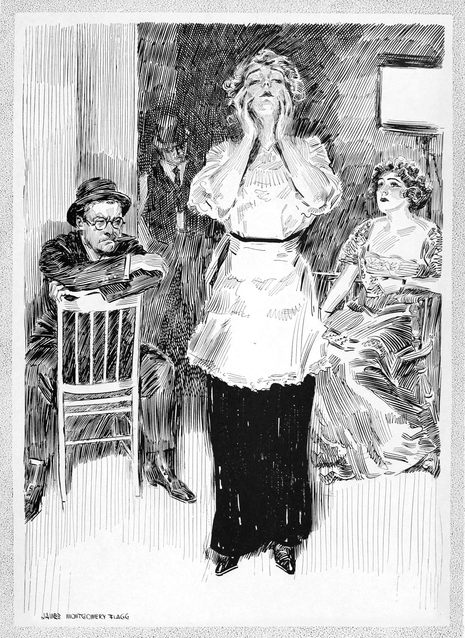
“THE SMILE GRADUALLY FADED FROM HIS FACE”
DRAWN BY JAMES MONTGOMERY FLAGG
❏ LARGER IMAGE
On the opening night, after the second-act drop fell for the last time, Littleton, grinning at the curtain-calls, and with a keen, twinkling eye on the cabal of critics heading for the bar, was suddenly whacked on the back.
“Great girl!” a tall man behind him exclaimed cordially. He was beaming as if his own daughter had won.
“Hello, Davey! It’s a knock-out, isn’t it? Isn’t she a wonder?”
“Well, I guess yes. I came all the way over from Elizabeth to see her.”
“And what d’you think, Davey, I picked that girl almost out of the gutter. Never acted before last month.”
Davey stared. “Say, how many cocktails have you had to-night, old man?”
“Why, that girl was Sarah Dover’s maid!”
“Who? Jean Caspian? Haw-haw-haw!” Davey threw back his head and roared. “Good God! Wasn’t I stage-manager for Guy Norman? I always said she’d go to the top. Say, Littleton, you ought to keep track of these outside winners.”
Littleton was transfixed. His eyes grew small. “How many cocktails have you had, Davey?”
For a moment the two glared at each other in silence. Then Littleton jerked his thumb toward the stage. “Say, come on behind with me.”
Jean opened her dressing-room door in answer to the emphatic knock.
“Well, Miss Caspian,” said Littleton, “you certainly put it over.” He wrung her hand enthusiastically. “But what’s all this about your being with Norman?”
“Oh, yes,” she answered demurely, “I believe I was his leading lady. Oh, how d’you do, Mr. Davey?” She extended her hand, and the two exploded in laughter.
Littleton, baffled, bewildered, watched them, utterly at a loss, pulling his beard savagely.
“Well, I’ll be damned!” he said. Then slowly his face lightened to an indulgent smile. “See here, Miss Caspian, I always thought you were a genius, but now I’m sure of it. Yes, you certainly put it over! Haw-haw-haw!”
SOON after the performance was over that night, Jean and two excited, happy girls hastened from the theater and jumped into a taxicab. Over in Dell’s room they laughed; over in Dell’s room they wept.
“Oh, Jean, it’s awful!” said Clara. “I can’t bear to hear it.”
“Go on! Go on!” said Della Prance. “I want to hear it all.”
“It’s not what she’s telling that affects me. It’s awfully funny, some of it; but it’s something—” Clara slipped down on the floor beside Jean and took her hand. “It’s your voice, Jean—that’s it! It’s something it’s done to it.” She gripped Jean hard. “Jean, you’ve won something more than they ever saw to-night. It’s something that you’ll always have now. It’s been worth the whole game!”
The clock struck three. The parable of the little boy and the gutter-nickel was finished. Silence fell in the room; the girls communed without words. Then Clara rose, yawned, and gave a broken laugh.
“Think of Smiley’s in the morning, Dell!”