IN LIGHTER VEIN
Reading edition

GOING UP
OR, THE PERIL OF EXPOSURE AFTER BATHING
BY FREDERICK LEWIS ALLEN
A PROPHET is not without honor save in his bathing-suit. Bathing-suits harmonize with the ocean, and are worn unblushingly by those who stand with one foot in sea and one on land; but it is possible for a bathing-suit to be out of place, as at a garden party or at the opera. Bathing-suits are specialized goods. If one is inclined to doubt the truth of these propositions, listen to the tale of Professor Jarvis.
The professor spent his summers on the sea-coast of Maine, where he occupied his mornings in working on a history of the diplomatic relations of Uruguay and Paraguay, or perhaps it was Costa Rica and Honduras. His afternoons were spent in golfing and bathing. His house stood about a hundred yards from the end of the sandy bathing-beach, and since he possessed no bath-house, it was his habit, at the end of his chilling swim, to pick his way gingerly home along a sandy, root-ribbed, pine-needled path, to enter his house brazenly by the front door, to flee dripping up the front stairs, and, in the privacy of his bedroom, to transform himself from Proteus to Beau Brummell.
One cool September afternoon as he was returning from his plunge, Professor Jarvis paused among the pines at a little distance from the house. A large black automobile was drawn up before the front steps. The spacious piazza, on which his wife was in the habit of serving afternoon tea—a conveniently situated piazza which gave upon the sea, and not upon Professor Jarvis—was unoccupied. The professor hesitated, his teeth clashing against one another, and the goose-flesh creeping out on his dripping arms. The conclusion was obvious: his wife was receiving guests in the living-room. She had evidently decided that the piazza would be a trifle too breezy for tea.
Now Professor Jarvis, even in a bathing-suit, was not an unbeautiful figure. He had fallen into the vale of fifty years with more grace than the average human being, thanks to golf and to bathing. He did not display to any alarming extent the inevitable tendencies of age. He was, in fact, rather proud of the restraint which his waist-line had exercised. Now he did not hesitate long among the pines, but advanced daintily over some sharp twigs to the front door. The chauffeur, sprawling at ease in the black car and reading “Mutt and Jeff” in the colored comic section of a Sunday supplement, smiled out of the leeward side of his mouth. But the professor regarded him not, haughtily passed him by, and boldly entered the house. His gray hair stood on end in scant wisps, the goose-flesh adorned his limbs, the water dripped from his Roman nose and trickled from his abbreviated trousers, and he left several little wet footprints on the ivy-clad front porch.
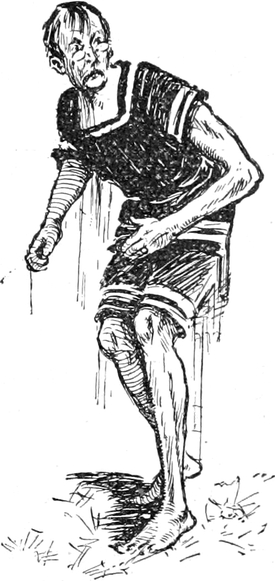
Once inside the house, the professor paused timidly in the hallway. Before him stood two doors. One was the entrance to the dining-room; the other led into the capacious living-room. The stairs were beyond, at the extreme back of the hall. Through the open doors of the living-room issued the sound of voices. Professor Jarvis recognized his wife’s and Mrs. Heath’s and—no, he was not quite sure about the other one. The conversation within continued.
The professor realized that it would be impossible to pass the living-room door without exposing himself to the curious view of the ladies within.
He could, however, reach and enter the dining-room unobserved. He stood a while in thought.
“I find a plain brown stain gives the best wear,” said the doubtful voice in very positive tones. “I find nothing compares with it.”
The professor recognized the voice. It was Mrs. Bannerman’s. He was afraid of Mrs. Bannerman. She was a very positive person, and it was her manner to speak with such evident authority that whenever she held forth the professor began to have his doubts even on Venezuelan questions.
He shivered as he heard her now.
But his wife’s voice reassured him. “I’ve forgotten what our mixture is,” she said. “The farmer always does our shellacking. But you’ll be able to tell if you come out and look at the hall floor. It’s given us splendid wear.”
There was a rustle of dresses. The professor started. It was impossible to get up the distant stairs, with their delightful view of the hall—his own plan. Noiselessly he darted into the dining-room, leaving a tiny pool of water behind him. Mrs. Jarvis, Mrs. Heath, and the formidable Mrs. Bannerman came out into the hall, and discussed varnish, paint, and allied subjects for some minutes.
In the meantime Professor Jarvis considered methods of escape. The dining-room was a large affair. There were windows on one of the sides opposite him, but under them was a sheer drop of twelve feet to a graveled avenue. The sideboard offered no hiding-place. The center-table was not large enough for a professor of diplomacy to curl up under in any fitting way. The “mission” chimney was no place for a man in a bathing-suit. Only one avenue of escape was available, and that was an open door that led invitingly into the pantry or china-closet. Behind this door the professor stationed himself, and prayed that the ladies might depart.
For a moment he had his hopes. There was some mention of good-bys. Somebody went to get her things. The professor drew a long breath. He was very, very chilly, and another little pool was rapidly forming about his white and tender feet.
“Why should I be afraid to face these ladies?” he asked himself. “What have I to be ashamed of? Is there anything wrong in going about my own house in my own bathing-suit? I will go out and say, ‘Oh, I was looking for a towel in the china-closet. I have had such a wonderful swim.’”
Nevertheless, the professor did not move. Nor time nor place did then adhere, while his bathing-suit did. He heard the voice of the terrible Mrs. Bannerman, and remained behind the china-closet door, listening. Suddenly fear smote into his heart.
“Mr. Jarvis planned this house himself,” he heard his wife say proudly. “We had several ideas which we insisted on. For instance, the dining-room here is an arrangement of our own.”
The professor moved on, into a recess of the china-closet. The voices came nearer and uprose in voluble appreciation of the dining-room. Mrs. Jarvis was holding forth with a proud delight on the architectural disposition of doors, windows, etc. What was coming next the professor guessed only too well. He looked about wildly. Cupboards, all too small. Shelves, impossible. They all had glass fronts. He could hardly expose himself under glass, like an exhibit in a museum. There was, to be sure, a dumb-waiter that descended to the kitchen below.
It was a new and wonderful dumb-waiter. Wonderfully balanced, weighted, and contrived. Professor Jarvis headed for it, and, as he heard the voices relentlessly approaching the china-closet, climbed nimbly in and, marveling at the beautiful balance of the thing, cautiously let himself down a few yards into the black abyss that yawned between him and the kitchen.
In absolute and overwhelming darkness he gathered himself about the rope that controlled his wooden cage, and held his breath. Thank heavens, it was a roomy dumb-waiter! As it was, he had to curl up like a kitten or a dog, and a very damp one at that. “I should never have supposed,” he said to himself, “that one could get into a dumb-waiter.” And he pondered on the uses of adversity, and remembered the bird in the gilded cage. Above, the voices were faintly audible; they echoed as if through caverns.
“The dumb-waiter,” his wife explained, “is here.”
There were footsteps. The professor clutched the rope with an iron grasp, and just in time. Some one was attempting to jerk it out of his hands.
“It seems to be stuck,” said a voice above.
“Let me try it,” said Mrs. Bannerman.
“Let us all try it,” said a chorus of voices.
The professor’s blood froze. He curled up tighter about the rope in his damp little puddle. He feared the ladies and particularly he feared the brawny might of the fearful Mrs. Bannerman.
He held fast, but it was of no use.
He was going up!
“As if I were a veal cutlet going up for supper,” he thought.
Blinking, he ascended into the cruel light of day.
“Good afternoon, Mrs. Bannerman,” he said politely.
Drawn by May Wilson Preston
A BOY’S BEST FRIEND
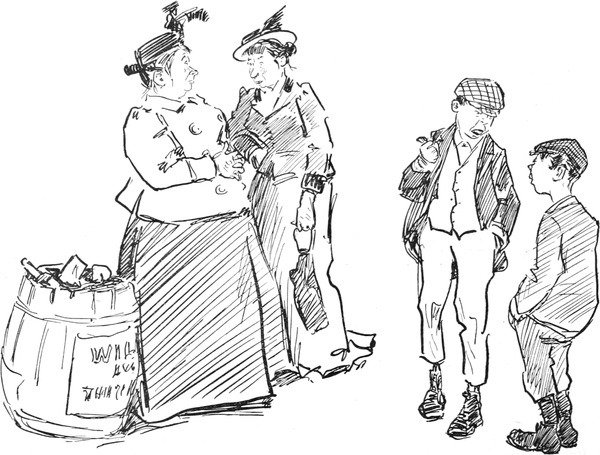
THE SENIOR WRANGLER: “Never you mind what she does, or how she looks. You quit laughin’ at her, and, say, don’t you ever forget what I’m going to tell you—drunk or sober, that lady is me mother!”
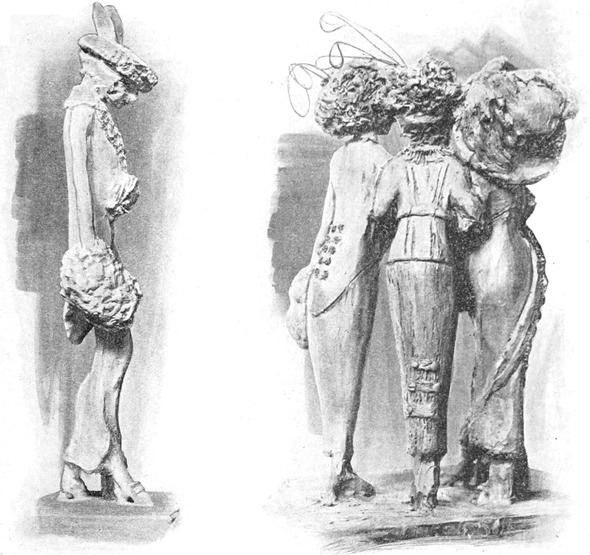
At the recent exhibition in New York of the work of American women sculptors no groups attracted more amused attention than these plasteline groups by Ethel Myers, the wife of Jerome Myers, the painter. The single figure is called “The Fifth Avenue Girl,” and the group is entitled “A Bit of Gossip.”
FRESH LIGHT ON WASHINGTON
The following is a literal transcript of a bona-fide debate by a boy in a public school. As it throws a bright light on two important, and apparently misunderstood, historical characters, it has been thought worthy of a niche in “Lighter Vein.”
Dear teacher, kind schoolmates, honorable judges and chairman, seeing that I am the speaker on the affirmative side I say that Washington was a greater man than Napoleon.
Washington is the man that saved Our Country from the hands of the British. Did Napoleon, of course not, And Washington never deserted his wife and family like Napoleon did. No because Washington was more of a man than to do that.
G. Washington was a man of good sense. He never got a divorce from his wife like Napoleon did. Of course not because Washington knew better than to do that.
When the British made their second attempt to conquer New York, Washington was too sly for them, and by him the English were defeated, and we won the battle. Did Napoleon do that, of course not.
Napoleon entered Berlin in Triumph October 27, 1806 and established himself in the kings palace. He did not like the beutiful Queen Louise, because he felt that she had inspired the soldiers by her presence and urged her husband to make war. He was very unjust to her in his bulletins and Josephine reproached him of speaking ill of women. Did Washington do that of course not he knew better.
Napoleon never liked the festival of a saint, he said it was a day of idleness. Did Washington like it. Of course becaus he used it right and Napoleon didnt.
I both say and think there was never and never will be a man to take the place of Our great American George Washington.
Drawn by Boardman Robinson
THE CHILD DE LUXE
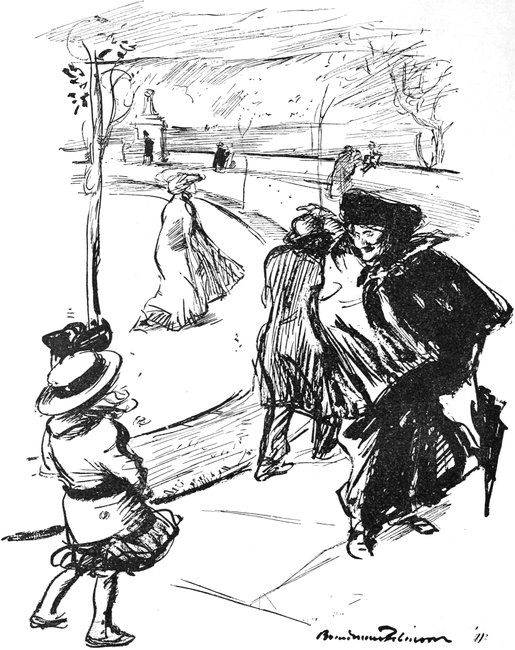
OLD-FASHIONED GRANDMOTHER: “Why! Muriel, where are your dolls this morning? Why don’t you take them out in your doll’s carriage, dear?”
MURIEL (slightly bored): “Oh! I leave all that to their nurse.”
A TRIOLET
BY LEROY TITUS WEEKS
I TOOK just a kiss, But her lips would repeat. What rapture! what bliss! I took just a kiss. You see, it’s like this: “With what measure ye mete—!” I took just a kiss, But her lips would repeat.
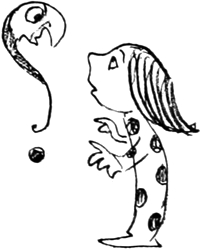
WHAT IS A RYMBEL?
WITH FOUR REMARKABLE EXAMPLES BY OLIVER HERFORD, CHARLES HANSON TOWNE, AND THEODOSIA GARRISON
The Rymbel is an interesting and newly discovered verse family. It consists of either ten, twenty, or thirty lines, and is sometimes spoken of, not as a rymbel, but as a “tent-twent-thirt.” The first noteworthy example of it in our literature is Mr. Herford’s interesting twent which, with its fine flux of cerebral invention, is printed below.
The Rymbel family is descended from many rhyming ancestors. Its father was a Jingle, its mother a Rondel. The result of this marriage was a feeble-minded daughter. Symbol by name, and four “wanting” sons, Ramble (the eldest), Rondeau and Rhyme (the twins), and Jumble, the baby. They only express themselves in verse, and are usually spoken of as “the eccentric Rymbels.” Deafness is a Rymbel family characteristic.
Whenever the father (who is invariably the family pioneer in matters poetical) is seized by an uncontrollable afflatus, he starts out bravely enough, but usually attenuates at the fifth line of the first stanza. Owing to the deafness of his wife and little ones he shouts this last line in a frantic crescendo, at which point his voice and his intellect give up the unequal contest, and his wife, seizing on the last word as her cue, pursues the theme spontaneously—and in her own misguided way.
The poetical relay proceeds in this manner until the tenth, twentieth, or—in very rare cases—the thirtieth line has been reached. In Mr. Herford’s splendid example of rymbelican verse, for instance, the father’s brain ceased to “mote” after the fifth line, but the crescendoed concept “fall” was bravely but disastrously propulsed into the second stanza by Mrs. Rymbel, who, in turn, gave up the struggle and abandoned the entire enterprise to the twins.
R. Otway Prendergast.
Editor of Arch. Vulg. and Obs. Words in Prendergast’s “Rhyming Rumbels” (Oxford Press—out of print), author of “Wild Verses I Have Met” and “The Stanza in a Savage State.” Brentanos; each, $1.65 net.
THE GIRL AND THE RASPBERRY ICE
(THE FIRST RECORDED RYMBEL IN OUR TIME)
BY OLIVER HERFORD
ONE summer day in early spring— How well I can recall The falling snow—no, come to think, It happened at the skating-rink: It must have been the fall. I never shall forget that fall, When, spurning all advice, I buckled on a pair of skates, And, cutting fancy figure-eights, Sat down upon the ice. I think it was a lemon ice Or some such sparkling fruit, She smiled and said she would prefer A raspberry cream—the kind you stir— I quickly followed suit. A simple suit of homespun tweed That ended at the knees! No wonder that my legs are chill. Quick, nurse! another camphor pill! I fear I’m going to sneeze.
MR. CHARLES HANSON TOWNE, who has been spending a week-end with the Rymbels, and who is distantly related to them through the Jumbles (of Spring Street), overheard the following “thirt” and made careful enough notes of it to preserve it for all time.
THE YELLOW VASE
BY CHARLES HANSON TOWNE
I GAVE the man a ten-cent fare When I got on the train. The sun was shining in the sky, A great big drop fell in my eye— It had begun to rain. Oh, yes! It was a glorious reign, The reign of good Queen Bess; The people were quite happy then, The women, children, and the men, Each with a fine address. I tried to find your old address, But no, it was not there; I looked down cellar for it, and I thought I had it in my hand When I came up the stair. Good gracious! how the people stare, When I am off my guard; They watch my feet when I go out, (I always push my feet about) All three feet—in the yard. I told the clerk I’d take a yard; I don’t know what I’ll do, As your clock says it’s now half-past, And mine, although it’s somewhat fast, Says it is half-past, too. I walked a mile and then walked two, Not knowing where to go; Then I came home and ate some fish— Some shad upon a shallow dish— And went out for a roe.
RYMBELS are not all of them necessarily humorous. Jocoseria is, of course, frequently met with in them, but in the following tragical and noteworthy rymbel Theodosia Garrison proves that drama, in its most lean, Greek, intense, and pulsing form, may well find a place in them. The tragedy, terrible as it is, is one that might befall any woman of means.
TRAGEDY
OR, THE MISSES AND THE MASSEUSE
BY THEODOSIA GARRISON
THE dame unto her masseuse spake, With sad and downcast mien, “Woe’s me that I have grown so stout, Both up and down and all about: I would be long and lean.” “Dear Madam, on my guidance lean, ’T were mean to do you wrong; Rely upon my means and taste, And some day you shall have the waist, The waist for which you long.” She murmured “But it takes so long, To get results—I mean.” Oh, what a cruel waste is that That makes a person short and fat Who would be long and lean.
JUST as we were going to press with this page we were fortunate enough to discover another rymbel by Mr. Herford which, though it displays a note almost of inconstancy in his nature, is gladly published below.
“ON REVIENT TOUJOURS À SON PREMIER AMOUR”
BY OLIVER HERFORD
O! SERAPHINE, my Seraphine! When first I saw your face Flash by me in your limousine, Methought there ne’er before was seen Such loveliness, such grace. Dear Grace! her image glows as bright Upon my heart to-day As when, a vision of delight, She first rejoiced my raptured sight, One afternoon in May. ’Twas then I took fair May to be My bride, and I was true, Or nearly so. I fail to see, Considering my constancy, What grounds May had to sue. “And what became of Sue?” you say. Alas! I have not seen Excepting, in a casual way, A sign of Susan since the day I first met Seraphine.
MR. ELLIS PARKER BUTLER recently submitted, in a spirit of adventure, a story to the editors of THE CENTURY. The function of an editor being to criticize and find fault, it was suggested to Mr. Butler, as tactfully and as humanely as the seriousness of his misdemeanors would permit, that some changes in the story might possibly improve it. Breathless, we print his reply—without comment.
E. P. BUTLER LITERATURE FACTORY
242 State St., Flushing, N. Y.
Department of Corrections and Repairs.
April 30, 1913.
The Century Magazine, New York.
Dear Sir—
Regarding your memo. of yesterday in regard to the 1913 model story recently purchased by you from this company, would say we cannot understand why you have found so many repairs necessary.
While we only guarantee our product for one year from date of purchase, all goods are examined before shipment, and should reach you in good condition, and stand any ordinary wear and tear for twelve months. We cannot understand your complaint. Is it not possible you have allowed sand to get in the gear-box of the story?
However, we are shipping you by this same mail material to replace the unsatisfactory parts, Nos. 13 and 14, and trust that, with these in place, the purchase will give you good satisfaction. In case of any further trouble please address this department.
Yours very truly, E. P. Butler Literature Factory, Per E. P. B.
E. P. B./E. P. B.
In answering this communication please refer to Correction No. 987564.
LIMERICKS
TEXT AND PICTURES BY OLIVER HERFORD
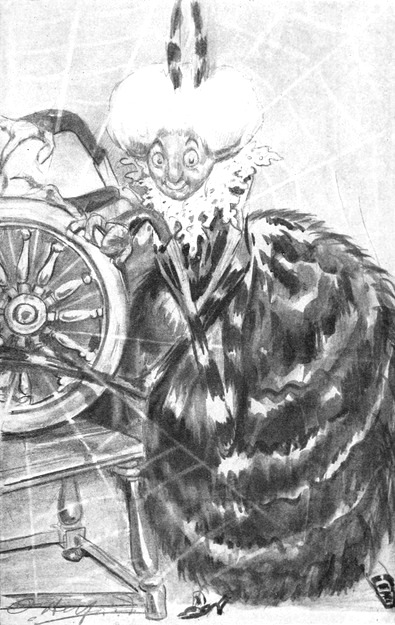
THE ETERNAL FEMININE
SAID the spider, in tones of distress: “As a spinster I’m not a success. Though I toil and I spin And I work myself thin, I never can have a new dress.”
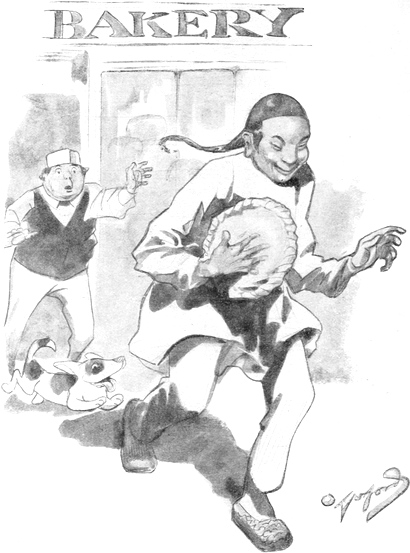
TRA-LA-LARCENY
A HEATHEN named Min, passing by A pie-shop, picked up a mince-pie. If you think Min a thief, Pray dismiss the belief: The mince-pie that Min spied was Min’s pie.
THE DE VINNE PRESS, NEW YORK