THE CAUSE OF THE CHARGE.
Reading edition
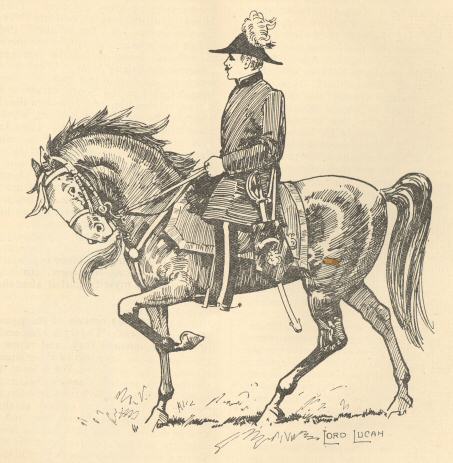
The phrase “Someone had blundered” is familiar to every one, but the condition of affairs which precipitated the blunder are not known and have never been stated in history.
After the Heavy Brigade made their glorious charge, the Light Brigade was placed in the North valley by order of Lord Raglan, Lords Lucan and Cardigan being absent congratulating the Heavy Brigade officers. Both Commanders-in-chief and Staffs had assembled at the top of Sebastopol Heights and were watching the Russian Army. They decided to force a general engagement and recapture the guns and heights the Turks had lost. The Russian General could see the allied armies—the French massing on the heights of Sebastopol and the British Infantry and Artillery marching down both valleys. The Russians, recognising the uselessness of trying to take Balaclava, ordered their army on the Causeway Heights to retreat and abandon the captured guns. Lord Raglan sent General Airey, Quarter-master General, to give Lord Lucan instructions to which he paid no attention. The third order was, “The Cavalry to advance and take advantage of any opportunity to recover the heights; they will be supported by Infantry which has been ordered to advance on two fronts.” Now the trouble commenced. Lord Lucan could see that Lord Raglan intended the whole cavalry to advance in one body, but he could not give the word of command for his two brigades to move together, not knowing the drill in vogue. Again, how could he ask the cavalry to advance with the Artillery without ammunition? How far could he advance against the Russian Artillery? It would be simple slaughter to charge. Lord Lucan had invaded the Crimea without any supply for his cannon. He admits that he did not leave the forts till he had used all his ammunition, and that was before daylight. He was then only one mile from Balaclava Harbour, the only place for supply, and he could have sent his ammunition wagons for it. His artillery being only six-pounders—the smallest in the Crimea—it was impossible to draw or borrow it. So the humbug went on, and instead of him informing Lord Raglan he had no supply of ammunition in the Crimea—which was his first duty to his Queen and country—he prepared the Heavy Brigade to support infantry at the top of the South valley, quite reversing the third order.
The two commanders-in-chief had their infantry ready for the general engagement; the French infantry massed on the top of Sebastopol heights to support the English; and the French Cavalry was ordered to report to General Lord Lucan, the English Cavalry commander. The Duke of Cambridge had his division on top of Sebastopol heights the first and could see the Russian army retreating on the Causeway heights and abandoning the captured cannon. The Duke waited some time for Lord Lucan to get a move upon his command, then marched his troops down the heights of Sebastopol to the South valley, seeing no signs of the cavalry advancing, ordered his infantry and artillery in line of battle and marched them towards the Causeway heights. I am of the opinion—and always have been—that if Lord Lucan had continued his humbug for ten minutes longer, the Duke of Cambridge would have attacked the retreating Russians on the Causeway heights.
The Commander-in-Chief, worn out with Lord Lucan’s delay of nearly 40 minutes, despatched the fourth and last order, viz., “Lord Raglan wishes the cavalry to advance rapidly to the front and try to prevent the enemy carrying away the guns. Troop of Horse Artillery may accompany. French Cavalry on your left. Immediate.” Captain Nolan was selected specially to see this order carried out, being one of the best cavalry officers in the British Army. When the order was given he started and galloped down the steep heights to the South valley to Lord Lucan, saluted him and gave him the order. I suppose he read it, but knowing what took place after, I rather doubt it. Lord Lucan says after he read the order he said to Captain Nolan, “Attack! Sir! Attack what? What guns, sir?” and he states also that Captain Nolan, pointing, said, “There, my Lord, is your enemy, and there are your guns.” Captain Nolan did not tell him to attack and he had no proof to show he did.
Lord Lucan left the largest part of his command in the South valley prepared to support infantry he had never seen. The first thing he did was to inform Lord Cardigan that Lord Raglan had ordered the Light Brigade to charge the guns, telling a lie in the Commander-in-Chief’s name. Lord Lucan then ordered Colonel Douglass to fall back and support the 17th Lancers, and none of the Regimental Commanders or Lord Cardigan were informed of the alteration, although just going into the most deadly charge ever made. Captain Nolan placed himself in front of the 13th Light Dragoons. Seeing one-third of the cavalry going down the valley to be sacrificed, they having to charge one mile and a half, leaving army and supports, and the commander of the Brigade away, Captain Nolan rode in front of the 17th Lancers, the regiment that gave the speed and direction, taking Lord Cardigan’s place. He knew the enemy were on the Causeway Heights retreating and abandoning the captured guns, not more than half a mile from the Light Brigade, and no danger to the Brigade to get where Lord Raglan intended. Captain Nolan knew the guns we were going to charge were sent to that position to cover the Russians’ retreat from the Causeway heights. After Captain Nolan had galloped about forty or fifty yards in the front and centre of the 17th Lancers (he did not know that the 11th Hussars were ordered to fall back) he gave the word of command “Threes right,” waving his sword and turning to his left. At the same moment the Russians opened fire and a piece of shell struck him in the breast near his heart. Had he not have turned he would have been struck in the back or possibly have been missed altogether. When he gave that word of command he intended the whole attacking line to move by it. Though killed his body still remained in the saddle, the horse, seeing the opening on the right, turned sharply in that direction and flung the corpse to the ground.
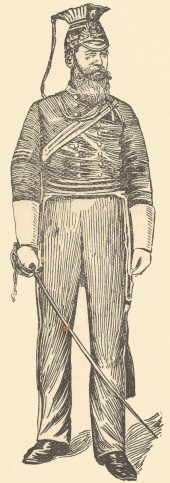
The dress worn in the charge by the 17th Lancers, October 25th, 1854.
The Russians having opened fire, the 13th Light Dragoons did not hear the word of command but advanced. If Sergeant-Major Nunnerley had not given the word of command “Three’s Left” (or front forward), it is a question how far we should have taken ground towards the Causeway heights. The 13th Light Dragoons had their commanding officer, Captain Oldham killed, and all the regiment so scattered that a group of men never held together. The 11th Hussars, through the 17th Lancers taking ground to the right, lost them entirely. The 8th Hussars that were in the 2-line under Lord Paget, with the 4th Light Dragoons, got separated and joined part of the 17th Lancers, after fighting through the guns. Lord Paget, with the 4th Light Dragoons, found the 11th Hussars through the guns, and Colonel Douglas commanding would not obey Lord Paget because Lord Lucan had given him the command of the regiment to support the 17th Lancers, although Lord Paget was the senior officer. Yet they had to join together to fight their way out.
In the meantime, Sir George Cathcart marched his division down the heights of Sebastopol and across the North valley near the 5th redoubt, (without guns) on the top of the Causeway heights. He could see the Light Brigade charging 12 to 20 guns in front and receiving flank fire from 20 other cannon, being the Russian field artillery and the seven ship guns the Turks had lost, together with ammunition in the three redoubts. Sir George could also see the French Cavalry charging a battery of field artillery of six guns on our left. The Russian cannon were all brass polished, 12 and 24 pounds. Their infantry were in square, and the commanding hill covered with the Needle riflemen. Sir George saw all this destruction of life and he could see the Heavy Brigade and Horse Artillery had not even been ordered from the South valley to support or assist the Light Brigade or French Cavalry. Sir George said it would be dangerous to advance further. Lord Lucan brought up two regiment and yet Cathcart would not budge an inch. I believe I saw the whole of the regiments—five in all. (See Lord Raglan’s letter where he states only two regiments).
The Duke of Cambridge is the only General living that commanded a division in the battles of Alma, Balaclava and Inkerman, and he knows what I have written is the living truth in every particular. He saw over 400 horses killed in less than 15 minutes after receiving the order to charge. The combined forces who took part in the Charge numbered 670 all told, of whom only 198 returned mounted.
Lord Lucan only gave one order to the Light Brigade, and that led to its destruction, sooner than inform the Commander-in-Chief that he had no ammunition for his artillery. If Lord Raglan had known, there would not have required any order or A.D.C., and there would not have been any murderous charge by order of Lord Lucan. Had Lord Raglan had known there was no ammunition, he would not have ordered the Horse Artillery to accompany, (see his letter for proof). Lord Lucan allowed the Russian cavalry to advance at a trot through the camp ground of the Heavy Brigade, and none of the commanders knew about it till informed by the Commander-in-Chief. Lord Lucan could not be found, and in consequence it was left to five regiments, under General Scarlett, to engage and defeat the Russians, who numbered seven to one. Lord Cardigan asserts there were only three regiments engaged. And that seven regiments were mere spectators, and yet Lord Lucan asserts he was not taken by surprise. If so, it is an amazing thing that a commander should permit a Russian cavalry force (3500) to make its way, in broad daylight, directly through the camp ground of his own troops.
After the charge Lord Lucan ordered the remnant of the Light Brigade six miles off on the hills near Inkerman to recuperate. In a few days the rain came down and every thing became a mass of mud, impossible to procure either meat, drink, or clothing. All the water we could get to drink was ladled off the ground. The supply consisted of small holes the horses made with their feet and all kinds of filth being on the ground helped to make things worse. We were left to die without having any medicine or even a cup of hot water. Several weeks elapsed before Lord Lucan found it out, for everyone seemed afraid of him and Cardigan, and these two never talked together. Lord Lucan occupied all the houses in Balaclava Harbour, while Lord Cardigan lived on his yacht seven miles from his command, and never visited them, although they were dying of hunger and starvation, and even when we went into action at Balaclava and Inkerman he still lived aboard. It was twelve o’clock when he arrived at Inkerman and his command never went under fire again during his service.
At last a storm came on the 14th of November, 1854, which continued for three days, and not a tent could be made to stand up. Some were blown away and never found again. Think of men dying under such conditions. The horses also were dying of hunger some of them eating all the hair off their bodies. If it had not been for Lord George Paget I do not know what would have become of us. He marched us down to Balaclava but the journey proved too much for our horses, over 100 stuck fast and died in the mud. The Light Brigade received several hundred horses that broke loose on from the Russians on the night of October 25th, 1854, or I would not be counting horses by the hundred. (See Lord George Paget’s Book for proof.)
Lord Cardigan died serenely satisfied because he had destroyed his command in obedience to orders, after stating in the Times, “No one man surpassed another in gallantry.” He is the only officer who had a command that returned back mounted, and that did not give a helping hand. He lost the whole of his command, five regiments and staff, and returned back by himself. He states in Kinglake, “I rode slowly up the hill and met General Scarlett. I said to him, ‘What do you think, General, of the aide de camp after such an order being brought to us which has destroyed the Light Brigade, riding to the rear and screaming like a woman’? Sir J. Scarlett replied, ‘Do not say any more, for I have ridden over his body.’”
Lord Cardigan, in less than six months after, published a letter in the Times newspaper, dated April 6th, 1855, viz.:—“The Light Brigade had not advanced more than 100 yards when they were fired upon, and Captain Nolan, who had placed himself in front of a squadron of the 13th Light Dragoons, was killed.” Lord Cardigan’s statement to Kinglake, published in the appendix 14 years after the charge, viz.:—“After advancing about eighty yards a shell fell within reach of my horse’s feet, and Captain Nolan, who was riding across the front retreating with his arms up through the interval of the brigade.”
I should like to know which statement is true about Captain Nolan. It was impossible for him to be killed in front of the 13th Light Dragoons. It was impossible for him to be retreating with his arms up through the interval in front of Lord Cardigan. The interval was in the rear of him, and he would have to look back. Did Nolan scream in front or rear of Cardigan? How did he get in front of Lord Cardigan without him seeing him go? Lord Cardigan was in front of his command a minute or less before the attacking line commenced the charge, and this is why so many saw him. Captain Nolan would not dare take command if Lord Cardigan had been there. What kind of leading was he doing not to see him; and the 17th Lancers go “threes’ right” and take ground to the right. Many things I should like to explain if I had space.