SWORN STATEMENT FOR VICTORIA CROSS IN SUPREME COURT, UNITED STATES.
Reading edition
To Lord Wolseley, Commander-in-Chief.
909, Steuben Street, N.W., Washington, D.C., U.S.A., November 12th, 1896.
My Lord,
I beg leave to renew my application for the Victoria Cross, basing my claim upon gallantry of conduct during the Charge of the Light Brigade, 25th October, 1854, and the Battle of Inkerman, and will give proofs that corroborate my own statements.
My previous applications for the Cross have been brief. With your Lordship’s permission I will now give a more detailed statement.
First as to the Charge of the 600:—
My squadron was nearly annihilated before we reached the Russian battery, every officer being either killed or wounded. Myself and horse had been knocked down once and my lance shot away. After our passing through and silencing the guns my first thought was to look for directions from an officer, and I rode to Lieut. E. L. Jarvis, still living I believe a retired Major, of the 13th Light Dragoons, as his uniform was so nearly like that of the 17th Lancers, that I first thought he belonged to my regiment. Lieut. Jarvis pointed to a cannon that was being taken off at a gallop towards our right rear, and said, “Let’s capture that gun.” We immediately charged upon it. Jarvis shot one of the horses in the head, bringing it to a stop. I cut down the gunners with my sword. We both dismounted and took out the dead horse, when more stragglers of the Brigade came to our assistance. Private John Smith, C Troop, 17th Lancers, now living in London, mounted one of the horses to the gun carriage and we started off the field with it when a large body of Cossacks charged upon us completely surrounding us. I fought my way through and was pursued down the valley by seven of them into a body of Russian Hussars re-forming. I had no alternative but to charge through their line, which I did, an officer striking my head with the sword, my lance hat saving my head except for a bad bruise. A brigade of Russian Hussars were retreating down the valley pursued by about forty of our men. I rode from the right flank to the left flank of the rear rank calling to the men to fall back. Private Clifford of my troop rode into the column and was cut to pieces before my eyes. The Hussars came about and we were then between two large bodies of cavalry, one marching up the valley, the other down, so that the few of our Brigade who were farthest beyond the Russian guns were now completely hemmed in by a great body of Russians. At this critical moment, when there was no officer to command us and we were apparently lost, I beg leave to introduce the words of a comrade still living describing my conduct.
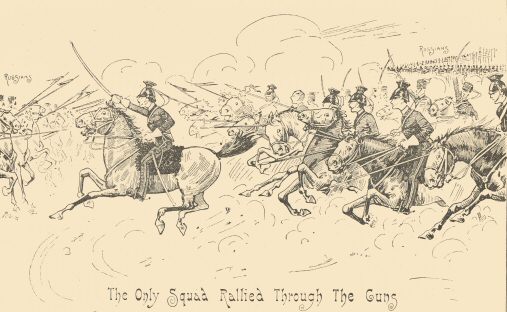
J. W. Wightman, late 17th Lancers, in Nineteenth Century, May, 1892.—“We heard the familiar voice of Corporal Morley, of our regiment, a great, rough, bellowing man from Nottingham. He had lost his lance hat, and his long hair was flying out in the wind as he roared, ‘Coom ’ere! coom ’ere! Fall in, lads, fall in!’ Well, with shouts and oaths he had collected some twenty troopers of various regiments. We fell in with the handful this man of the hour had rallied to him, and there joined us also under his leadership Sergeant-Major Ranson and Private John Penn, of the 17th. Penn, a tough old warrior who had served with the 3rd Light in the Sikh war, had killed a Russian officer, dismounted, and with great deliberation accoutred himself with the belt and sword of the defunct, in which he made a great show. A body of Russians blocked our way. Morley, roaring Nottingham oaths by way of encouragement, led us straight at them, and we went through and out at the other side as if they had been made of tinsel paper. As we rode up the valley, pursued by some Hussars and Cossacks, my horse was wounded by a bullet in the shoulder, and I had hard work to push the poor beast along. Presently we were abreast of the Infantry who had blazed into our right as we went down; and we had to take their fire again, this time on our left. Their firing was very impartial; their own Hussars and Cossacks following close on us suffering from it as well as we. Not many of Corporal Morley’s party got back.”
After Wightman fell I kept a group together through the battery, again in position and then ordered them to separate for safety. Private James Cope died in India, and James McGregor, 4th Light Dragoons, since dead, reported to our regiment with me. We were the last to get back to the regiment.
The names of Cope and McGregor are appended to my first application, 17th October, 1856.
Second as to the battle of Inkerman:—
At the battle of Inkerman, November 5th, Cornet Cleveland was mortally wounded. He fell from his horse in front of me just as the regiment was ordered to retire. After we had retired some distance I rode to the commanding officer of the regiment and asked to be allowed to fall out to go back for Cornet Cleveland. He told me to go to the Sergeant-major and tell him to send two men to assist me. He told his brother James O’Hara and went himself. In the act of carrying Cornet Cleveland off the field, both James O’Hara and myself had our dress hats shot off our heads by a cannon ball. I annex a letter from Lord Tredegar, commanding officer, in support of this statement:—
Terdegar Park, Newport, England, April 6th, 1889
Morley,
I remember quite well that on the field of Inkerman you asked permission to fall out to go and try and bring in Cornet Cleveland, who had been seriously wounded a short time previously. I gave you permission and you went with two other men, and brought Cornet Cleveland into camp. I also know that you displayed great gallantry in the Light Cavalry charge at Balaclava.
Yours sincerely, TREDEGAR, Late Captain 17th Lancers.
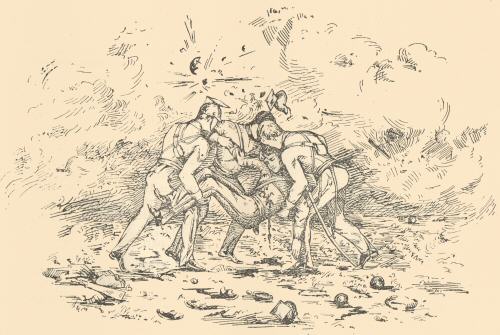
Bringing out of the thickest of the fire, Cornet Cleveland, mortally wounded.
Third as to the Baida Valley:—
In my first application I made a statement as to the occurrence in the Baida Valley, viz.—“Whilst my regiment was stationed in Balaclava I was one of the detachment ordered on duty in the Baida Valley. I was engaged on one particular occasion in the reconnoitreing party in advance of the party that took possession of Prince Chatteloff’s house near the Woronzoff road. Two of the Land Transport Corps were wounded and it was with great difficulty and caution that I was enabled to bring the videttes into the main body upon which we had to retire.” This statement was dismissed by Colonel Benson, who wrote to H.R.H. Duke of Cambridge that he was not aware of any such occurrence taking place. With your Lordship’s permission I will make this occurrence more clear and show that there is ample proof of the truth of the statement.
Major Peel, 11th Hussars, was in charge of the command, consisting of three squadrons viz., 8th Hussars, 11th Hussars, and 17th Lancers. Now General Sir Drury C. Lowe, K.C.B., commanded the 17th Lancers. I was sergeant of the rear guard. The main body were near the house dismounted. The Land Transport Corps were at the gate the only entrance leading into the house. The rear of the 17th Lancers were within 40 yards of the gate just around a bend of the road. The Russian Infantry fired a volley into the Transport Corps I saw them running from their wagons, some of them wounded. I formed a line across the road and charged down to the Russians who had not time to reload. When they saw us they jumped over a stone wall on the left of the gate into the steep woods. We might have captured some of them but their fire had killed a mule in one of the transport wagons, blocking up the gate. The remainder of the wagons were in the road leading to the Woronzoff road which the main body had to retire upon. I at once placed videttes upon the all the roads. Sir Drury Lowe rode up to me and asked “where are the Russians?” as I was watching the place where they had jumped over the wall. I told him and he said “Come further back, they will shoot you. You have done perfectly right.” There can be no exaggeration in this statement as Sir Drury Low is still living. Sergeant-Major J. Nunnerly, late 17th Lancers, was a sergeant with the squadron and aware of the occurrence, as must be every survivor, in spite of Colonel Benson’s discrediting my statement by saying he knew of no such occurrence.
I wish to repeat the statement in my former application that “I embarked at the commencement of the war. I served under Lord Cardigan at Devna and Yenebazaar at the time when disease prevailed to a great extent. During the time I had the honour to be selected as Corporal of a letter party stationed at Varna. The whole of the dispatches of the army were at times conveyed by this party, and I was compelled in consequence of the sickness of the men to ride day and night without any rest to set a good example to the men under my charge and keep out of their minds that too much fatigue would kill them.”
Allow me to add that this was Lord Raglan’s letter party and that I continually reported at his headquarters to receive the dispatches. The party consisted of myself, and Privates Wm. Purvis, P. Murphy, Burkemore, and H. Gallimore. All these went into hospital with cholera and Gallimore died. Wm. Purvis is still living at 105, Rutter Street, Walsall.
In conclusion allow me to say that I served twenty-two years in the 17th Lancers and Yeomanry. I have only one son old enough for army service and he is Sergeant-Instructor in the British Army.
I beg that my claim may be impartially looked into on its merits at this time. When action was taken on it before the claim was thrown out on the statements of Col. Benson, who through carelessness or indifference reported adversely on circumstances of which he had no knowledge. The testimony of Lieut. Wightman and Lord Tredegar, still living, ought to be sufficient as to the Charge of the 600 and the Battle of Inkerman. The occurrence in the Baida Valley is not so important, but is mentioned to show that I was always quick in action and forgetful of any personal danger. If there is any doubt as to the correctness of my account I have no doubt that Sir Drury Lowe will add his statement to mine.
I have my Lord, the honor to be,
Your obedient servant,
THOMAS MORLEY, Late Sergeant 17th Lancers,
Washington, D.C., United States.
Subscribed and sworn to before me, Nov. 12th, 1896.
John R. Young,
Clerk Supreme Court, D.C.
By
S. J. Merrys, Junior Assistant Clerk.
[Blocks not in Sworn Statement.]