Chapter XVI · . (continued 3)
Reading edition
The numerous confessionals, for many different languages, were the resort of wayfarers that day, while the confessors sat quietly at their posts hour after hour listening to the tale of sin and repentance. Almost every Catholic paused to touch and kiss the foot of the bronze statue of St. Peter, worn by centuries of devout kisses. The statue had this day a new attraction; for over it was hung a gorgeous drapery of scarlet and gold. We found that these rich hangings, so graceful and beautiful, were in mosaic from the famous workshop of the Vatican. A fine portrait of the Holy Father crowned the whole, wrought from the same material, and a very satisfactory likeness.
This calls to mind an incident which took place in the Vatican Basilica a short time before the Easter day of which we are writing. We had gone to St. Peter’s for Lenten rest and refreshment, and, having visited the Chapel of the Blessed Sacrament, were directing our steps to the altar of our Blessed Mother, when a sacristan politely requested us to leave the church. We were inclined to rebel for a moment, till we observed the whole assembly, priests as well as people, moving towards the entrance; we followed, of course, and the doors were closed. So surprising a movement in the middle of the day was the cause of much questioning, and it was discovered that his Holiness wished to see the decorations put over the statue of St. Peter by his Viva il Papa! might bring upon innocent friends the indignation of the Italian government, as they had done on a former occasion.
This day we were to see no illuminations of the grand façade and the broad portico; no brilliantly-lighted cupola, visible to the furthest corner of Rome; none of the imposing ceremonies that have been so much sought after and admired by Protestants. These latter go away from the Easter celebrations dissatisfied, sometimes annoyed and angry, that they should be deprived of the fine sights “just for a whim of the Pope.” We heard them utter these words as we passed down the massive steps leading to the piazza. They seemed to forget that holy church puts not forth her beauties solely for the delectation of Protestants who come to Rome at Christmas and Easter “to see sights.” They might know that when her Head is bowed with sorrow, all true children of the church carry the same cross, the whole body suffering with the head. There was joy tempered with much sadness in our hearts as we went from the noble basilica and wandered away to the Coliseum, fit emblem of the church in the Rome of to-day. Ruthless hands—hands of those who would make Rome like any modern city—have shorn this sacred spot of half its beauties; hard hearts have stripped it of its hallowed stations and forbidden the people to pray where the martyrs shed their blood.
THE ETERNAL YEARS.
BY THE AUTHOR OF “THE DIVINE SEQUENCE.”
IV
THE CHARACTERISTICS OF GOD’S GOVERNMENT—LONGANIMITY
As a lavish and yet unwasteful abundance was the first condition and eminent characteristic of the creation, so is longanimity, or patience, the special quality which marks the dealings of God with his creatures, in the gradual and long-enduring developments of his government. It is the quality to which we are most indebted, and yet which, as regards the history of mankind, we value and understand the least. Possibly the fact of our own brevity of life, as compared with the multitude of thoughts, efforts, and emotions which the immortality of our being crowds across the narrow limit of time, leaving an impression of breathlessness and haste, may put it almost out of our power—save as all things are possible by the grace of God—to raise ourselves to any approximate appreciation of God’s long-enduring patience. And this is increased in the minds of those who are zealous for God’s glory. They chafe at the outrages committed against his law; they sicken before the long, dreary aspect of man’s incredulity and hardness of heart; and the rise of a new heresy, the advent of an antipope, or the horrors of a French Revolution lead them hastily to conclude, and impatiently to wish, that the last day may be at hand. Experience is a slow process. At fifty a man only begins to learn the great value of life and to look back St. John wrote to his disciples, “Little children, it is the last hour,” nevertheless the pious of all shades of opinion in all ages have not been afraid to utter random guesses that the end of the world cannot be far off because of the wickedness of men. It is indeed true, as the Holy Ghost spoke by St. John, that it is the “last hour.” But what does that “last hour” mean? Not surely a literal last hour or last day, but a last epoch. The epoch in the history of the cosmos before the coming of the Redeemer—that is, before the hypostatic union in a visible, tangible, and real human body of the second Person of the Triune Godhead—was the first hour, or the first epoch. The period since the Incarnation is the last hour, or the last epoch; because nothing mightier or greater can take place than the fact of God taking flesh in the womb of the Blessed Virgin. It is the consummation; it is the one great end of all creation. This last epoch will have its eras, evolving themselves within the bosom of the Catholic Church, just as the first epoch had its eras in the diverse revelations which God made of himself to man; and which were, if we may use the term without seeming to derogate from their unspeakable importance and their divine origin, of a more desultory nature than those which are, and shall be, accorded to God’s spouse, the infallible church. What is this but to say again what we are endeavoring to express in every page, namely, that “He who sitteth on the white horse went forth conquering, that he might conquer”;[81] and that God’s work ever has been, is now, and ever will be a progressive work. “Gird thy sword upon thy thigh, O Thou most mighty. With thy comeliness and thy beauty set out, proceed prosperously and reign.”[82] When the whole of Scripture is teeming with promises of future more glorious eras of which we now only see the germ, developed here and there in some favored soul, in some special corner of God’s vast vineyard, the church (for the saints have always been men of the future, in advance of their own time), is it not a marvel to hear desponding men talking as though there were nothing better to be hoped for than the end of the world, coming, as they seem to expect it, like a terrific frost which shall nip in the bud all the, as yet, unfulfilled promises, and drown the wicked in a deluge of flame! And this we expect and almost desire, hoping we ourselves may be saved, but without a second thought for God’s beautiful earth, which he has blessed a thousand fold by his own divine footprints on its surface; and where he now makes his tabernacle in ten thousand churches, waiting, nay watching, with that ineffable patience of his, whose cycles of longanimity we are incapable of appreciating!
[83] and that our Lord tells us he “did not come to destroy either the law or the prophets, but to fulfil them.” Bearing this in mind, let our readers take up the Psalms and the Prophets, and study, with a deliberate faith in the inspired words, the promises which concern the future of the world under the tent of the church, the place of which tent shall be enlarged that she may “pass on to the right hand and to the left; and inhabit the [now] desolate cities.”[84]
It is a want of hope—and let us ever remember that hope is a virtue, and not a mere quality or faculty of the mind—which leads us to read the stupendously sublime promises of God to the whole earth in the future of the church, as so much beautiful imagery of which a limited application manifests itself, from time to time, in the partial conversion of some thousands here and there over the vast face of the semi-civilized world, while millions upon millions remain heathens, Hindoos, Jews, and Mussulmans. We read these glorious utterances of the Scriptures with the restrained admiration of one who, while admiring a poem, makes allowances for the “fine frenzy” of the poet. We take it cum grano salis, and forget that it is the trumpet voice of absolute truth; and that whether or no it point to a millennium upon earth—a question left open by the church, and so little discussed as yet by her modern theologians that we will not dwell upon it—it must mean all it says; and, after the fashion of God’s gifts, more than we can conceive. This, then, is what the patience and longanimity of God is leading us to. These glories, which have exhausted the tenderest as well as the most powerful utterance of language to depict, are the future of the church, when the spouse of Christ shall be the mistress of the world. St. Paul in the Epistle to the Hebrews, quoting the eighth Psalm on the high destinies of man, says, “Thou hast subjected all things under his feet,” and adds, “but we see not as yet all things subject to him.” Nevertheless the delay gave no place for doubt that the promise should have an ultimate and complete fulfilment; while he unfolds to us the wherefore of these sublime predictions, the only adequate reason why the human race should be crowned with glory and honor—the one, sole emphatic cause, namely, that all creation is in and for the Incarnation; that the Incarnation is the basement, and the sublime architrave and final coping-stone of the whole edifice; that the creation is for him as entirely as it is by him, and that man is the younger brother of his Redeemer, and shares in his inheritance.
When the three Persons of the ever blessed Trinity said, “Let us make man,” it was with the expressed intention that he should have dominion over the whole earth—“universæ terræ.” That constitution of man as the lord of creation was not annulled when man fell. It is true that it became a dominion he had to contest with the beasts of the forest, who were originally to have been his willing slaves; with the thorns and thistles that ever since bar his passage; and with the convulsions of nature, to the secret harmonies of which he had lost the key; while the angelic guardians of the cosmos could not hold intercourse with him in his degraded state, who, although they be “ministering spirits,” are so in secret only, until the time shall come for their promised mission upon earth. Nevertheless man was a monarch still, though a fallen monarch. Or rather we should say that, as redeemed man, he is God’s viceroy; and in that character is reconquering the material world, that as the ages roll on the church, the spouse of Jesus, may “lengthen her cords and strengthen her stakes.”[85]
Materialism is no necessary consequence of material progress. Scientific discovery, whether as regards the solar system, the dynamic forces, chemical affinities, or the properties of the world’s flora, the habits of its fauna and the uses to which all these may be put, is—next to the development of theological truth, of which in a certain sense, as will one day be proved, it is the correlative—the highest gift of God. It is simply man’s fulfilment of his second and inferior mission upon earth. His first mission, or rather his vocation, is to save his soul from sin, and to live in union with his God. His second is to fill the one spot, be it wide or narrow, which God has assigned him in the creation with all the faculties of his mind and intellect. It may be a very small, a scarcely discernible spot that he occupies; but in his degree
First, it may be assumed that, as the Almighty has not abdicated his providential government of the world in favor of the powers of darkness, therefore no great and wide-spread movement takes place amongst the children of men without its having an ultimate end for good. We do not believe that evil is to win the day. We utterly refuse to give credit to those who look upon the Lord of Hosts as vanquished in the end, and upon the personal Lucifer, and the principle of evil which he embodies and represents, as going off the field with a crowd of prisoners who will far outnumber the armies of the Lord. This desponding about the triumphs of grace is the residuum of Protestantism. It is the melancholy of sectarianism. It is not in accordance with the teaching of the church; she who is forever lifting up her eyes unto the hills from whence cometh her help. The church which is built on the Incarnation, which is fed with the Eucharistic Sacrifice, and which owns as her queen the woman “clothed with the sun,” “terrible as an army with banners,” does not limit her hopes to a few sheep scattered in the wilderness, but knows that the “cattle on a thousand hills” also belong to her Lord and Master.
We have no wish to palliate the evil which dogs the footsteps of modern progress. We see that, like the huge behemoth, it tears down many a sacred barrier, many a hallowed landmark, with its gigantic strides, and we mourn with our mother the church, and with all the body of the faithful, over the souls that perish in the fray. But not even for this is it possible to doubt the ultimate designs of God’s providence in making all work together for good.
Good works through evil, not as its instrument but as its vanquished enemy; and material and scientific progress is so certainly a good in itself that it arises from and forms part of the development of man’s original destination, as being lord over the creation. It is the necessary result of that; consequently it is a fulfilment of God’s will. As to its fatal, or at least deleterious, moral effects on individuals, or even for a time on the multitude, this is but the weaving of the dark woof into the web of man’s existence, which is the result of man’s estrangement from God, but which, neither in this nor in any other form, will be allowed ultimately to defraud the Almighty of his glory, by turning a relative, and much less a positive, good into positive evil. We see the beginning; we do not see the end, save by the eyes of faith, and trust in the goodness of any kind, take possession of mankind without a special beneficial intention of God’s providence, and without a distinct and absolute good being their ultimate result. We bow our heads to the storm of the elements; we accept the flood and the hurricane, and even the pestilence, as coming by the permission of our heavenly Father, and as in some way working for good. And shall we behold the moral and intellectual activity of man scanning the high heavens, searching the deep bosom of the earth, snatching from nature her most hidden secrets; seeking the principles of life, and the occult laws of development and progression; shall we watch wonderingly the strange, new, and pathetic tenderness with which men are beginning to appreciate and investigate the whole world of creation inferior to themselves, but holding perchance in its silent and patient existence secrets important to us—shall we behold all this, while our hearts burn within us, and not intimately and intently believe that God is carrying on his work, while man seems only to be following his own free will in the exercise of his intellect? Let us be larger hearted and more trusting with our God; nor for a moment suppose that the reins of government have fallen from his hands, or that passing evil will not terminate in greater good. The darkest hour is ever the one before the dawn. Doubtless when the eagles of Rome sped victorious over the vast and crowded plains of the Gaul and the Frank there were gentle spirits left at home who, having kept themselves pure by the undiscerned aid of the grace which our heavenly Father never refuses to men of good will, grieved that the corruption of Roman luxury should infiltrate its poison into the simple lives of the semi-barbarous and valorous nations. And yet, but for these victorious eagles what would the world be now?
God brings good out of evil; and though material progress is seldom a real advantage at its first advent, yet when the moral excitement of its early possession has subsided, when the ever living, ever penetrating spirit of God has gradually, through the poor human instruments he condescends to use, claimed all that man can know, do, or acquire, as belonging to himself in the great scheme of creation and redemption, then, by slow degrees perhaps, but by sure ones, the evil gives way to good. It rests with us to hasten the appropriation of all that men call progress, gathering into Peter’s net the large and the small fishes; for it is all ours. As children of the church, to us alone does the world belong in the ultimate and supreme sense. It is our fault if we are not more rapidly converting the raw material which is swept to our feet into increments of God’s glory. It rests with the church in her children to make what the world calls progress become a real progress.
There is no real progress without a fixed principle as its basis and starting point. And that Christianity alone can give; and chiefly Christianity in its only full and perfect form, the Catholic Church. By Christianity we mean the fear and the love of God, with all the pure
Is there any sane man now living who really regrets the invention of printing? We have heard the project of a railroad in China deprecated by a zealous friend to truth. It will carry our merchandise; but will it not also carry our priests? We remember when men said murders would increase because London was to be lit with gas! Do these sincere-hearted men really think that man is working out solely his own will, and that an evil will, in all this heavy tramp of material progress through God’s world? Is not man fulfilling his destiny of conquering the world; and when he has done his part, albeit done too often in blind and arrogant ignorance, will not the rightful owner of the vineyard come and claim the whole?
It is impossible for us to be slack in the exercise of any one virtue without the omission affecting the whole of our inner and spiritual life. If we allow our hopes to sink low it is certain to affect our faith; and if our faith, then also our love. Nor should we forget that it is “according to our faith that it shall be done unto us.” We are not seconding God’s precious intentions towards us so long as we are taking a desponding, narrow, and unaspiring view of what are likely to be his intentions as regards the future of his creation; and all despising of that creation, all holding cheap the law, the order, the beauty, and the uses of the material creation, arises from an inadequate sense of the mystery of the incarnation, of the Verbum caro factum est which is the one sole efficient reason of all we see and of all that exists. Once raise the inferior questions of nature, of science, and of art up to that level, and we shall find that it imparts a certain balance to all our thoughts, and diffuses a peaceful looking forward and a calm endurance of present ills which are morally what the even pulse and the vigorous strength are physically to the man in perfect health. He is as free from the excitability of fever as from the lassitude of debility; he is a sane man.
certain science, admitting of fuller developments as “things new and old” are brought forth from her treasured store, but never making one step too far in advance of another throughout her rhythmical progress. These human elements resided essentially in the Latin mind; and in the Latin tongue, which has ever been the language of the church, and which, the church having consecrated it to her own purposes, became what we popularly call a dead language so far as concerns the shifting scenes and fluid states of man’s mortal life; she laid her hand upon it, and it sublimated beneath her touch, and was consecrated to her use, beyond all changing fashion or wavering sense. The dying Roman Empire involuntarily bequeathed it to her; and the language of the great lawgivers of the world became that of the church, and only on her lips is a living language to this hour. The Latin people were the fountain of law; their code to the present day forms the common law, or the base of the common law, of all Christian nations except where the retrogradations of the Napoleonic code have been flung in the face of humanity and the church as an insult to both. The principle of law, the love of law, lay in them as an hereditary gift. Thus were they as a race specially adapted to become the framers of the church’s canon law, of her discipline, and of her glorious ritual, each phrase of which is the crystallization of a theological truth, a fragment from the Rock of Peter, but perfect in itself and concomitant with all the rest.
Thus also she wrote in letters of red and gold her marvellous ritual, the least part of which embodies a symbolic act relating to the things that are eternal. There is not a touch that is not significative, there is not a line that does not seem caught from the traditions of the
The same genus runs through all the component parts; and that genus belonged to the race to whom was consigned the laying of the church’s foundations, and the raising of the edifice. And thus there exists, besides the divine integrity of the whole, a certain human consistency which, humanly speaking, is the consequence of the work having been put into the hands of the race that was naturally adapted to effect it. Now, as the ways of God are necessarily always consequent—that is, consistent with each other, moving in harmony and working through law—it is not a vain presumption to imagine that as he has constituted different races with different characteristics, so it is his intention to make use of each and all in the fuller developments of his church.
“Other sheep I have that are not of this fold; them also must I bring.” The words were spoken in Jerusalem while the Latin race was lying in the blind pride of paganism, and the Celtic races were only recently being hewn out of the darkness of their far-off life by the swords of the conquering nation. Surely it is one of those words the fulfilment of which is not complete. There are other races waiting to bring into the vineyard the tools that their native genius has put into their hands. As the church through the Latin race has formed her external, congregational, hierarchical, and authoritative condition, and has crowned the whole in the last Vatican Council by the dogma of the infallibility, laying thereby the keystone that locks the perfect arch, so now the Teutonic Saxon races, the people of individuality, of complete inner life, combined with vast exterior activity and resistless energy, will be brought forth in God’s providence to carry out the law of liberty which is the correlative of the law of individuality.
God speaks to the individual soul through his organ the church, through her sacraments, down to her least ceremony, and through her authority. Nor have we any absolute test and security that it is his voice we hear and no delusion of our own, except as we are in harmony with her authority. All may be a mistake save what is in accordance with the one infallible voice. But nevertheless it is to the individual soul that God speaks, and not to the masses as such. God leads each soul separately, and individually apart, and there is no real religion that is not the secret intercourse, the hidden communion, of the solitary soul, alone with God. Every human soul has its secret with God, a secret of love, or a secret of hatred, or of avoidance. God penetrates our souls through the sacraments of the church; but past the sacraments, and as the result of the sacraments, there must grow up the continued, sustained, and ever more and more habitual presence of God in the soul, before we arrive at that state for which the church and the sacraments are but the means to an end—though a divine means. “We will come [86]
Nothing less than this is the promise of God, and should be the object of man. The church in her sacraments and ordinances is the one authorized and infallible way to bring about this blessed union. But unless that be accomplished, all the outward devotions that saints, or confraternities, that individuals or congregations, ever devised and poured into the church’s lap like handfuls of flowers, will be to those who rest in them as fading as flowers, and as sure to be swept away and burned when the fire shall try of what sort the work is. The dying to self—not as man’s restrictions can produce its outward semblance, but as God’s working in the soul joined to our good will can alone effect it—and the consequent union with him whose divine spirit rushes in wherever we make room for him to come, is the one sole object of all that the church gives us and does for us; of all the barriers she erects, of all the gardens she plants, of all her discipline and her ceremonial. It is the only living reality. It was so with the saints of all ages and nations. They valued all in proportion as by its use they killed self and put the living God instead; and they valued it no more. Low down in the soul the deep pulsation of the thought of God, ruling all our actions from the least to the greatest, this is what our dear Lord demands of us in every communion we make; this is what his church intends in all her teaching. This alone will hasten the reign of the Holy Ghost, when God “will pour his spirit on all flesh, and your sons and your daughters shall prophesy, your old men shall dream dreams, and your young men shall see visions.”[87] In other words, the gates of the supernatural world shall be thrown open, not to a rare and scanty few, but to all to whom “it is given to know the mystery of the kingdom of God.”[88]
We seem to have wandered from our subject; but it is not so. We were writing of the future development of the church through the different characteristics of different races, as instruments in God’s hands in the working of his adaptive government; and this has led us to describe the necessity of the inner life of the soul with God, because the Teutonic and Saxon races are the people with whom the tendency to a deep inner life is a natural peculiarity. They are more self-contained, self-reliant, reserved, and recollected than the versatile Latin races; and though none of these characteristics necessarily lead to a spiritual inner life of any form—that being a free grace from God—they are the apt instruments for grace to make use of in producing a certain form. They are, therefore, those to whom we may look for the next important era in the church’s history; when all the vast and complicated edifice of her hierarchy being complete she has now to expand the fuller development and deeper utterance of her inner life in individual souls; and that no longer as an occasional glorious phenomenon of grace, but as spread over a vast area, as influencing whole peoples, and as becoming the sustained life of Christianity. Law and liberty in one; the “freedom wherewith Christ hath made us free.”
We were also speaking of material progress; and these same Teutonic [89] the material sanctified by the spiritual, when all shall be “holy to the Lord.”
The inaccuracy of the popular, as distinguished equally from the Catholic and the rationalistic view of the importance of matter, and of material progress which is the march of man’s conquest over matter, arises chiefly from the imperfect manner in which we realize the universal presence of God. Many among us can look back with a distinct recollection to the time when a mother first announced to us the great truth that God is everywhere. With the unfailing practical sense of children, we probably began to individualize certain familiar objects with the query was he there—in this table, in that flower, in my living hand, in the pen I hold? And the bewilderment of immensity crept over us as we tried to grasp the thought of the great universal presence.
As in later years theological questions opened upon us—the mysteries of our faith, the angelic choirs, the army of saints and martyrs, the Incarnation, and the localization of the eucharistic presence in the Blessed Sacrament—many of us have gradually dropped the more intense sense of God’s omnipresence. It probably was more accurately felt by the Old Testament saints than by any, except saints, under the new law. It is not that we have lost sight of the truth that he sees, hears, and knows each one of us, always and everywhere; but we forget that he fills all space, and that he is in all things. It is a remarkable fact that the very lowest, the least theological and dogmatic, of all heathen beliefs, where all are a jargon of error, is nevertheless the faint reflection of this truth. We allude once more to the animism of the lower savage races, which lends a spiritual presence even to inanimate and inorganic matter. To them God is everywhere and in every thing; so that to them no thing exists disconnected from a spiritual presence as abiding in it, and that not in the pantheistic form of many gods, but as all matter holding an occult spirit, which is the same spirit in each substance. But there it ends; a blind creed, which does not even go the length of acknowledging a personal deity or a divine providence. None the less is it founded on a truth which often slips out of our consciousness, while we are occupied with the more familiar articles of our faith. Let us examine how this great truth, as we hold it in its fulness and
First let us bear in mind that no cause can act where it is not virtually present by its power, even if not actually present by its matter. And this law has its correlative in the spiritual world. I influence you only so far as I touch you. I shall have written in vain unless these pages touch your sight. If I were speaking to you with my living voice I could only reach the hearts of those who heard me. To all the rest I am dead; and they are dead to me. This is the moral side of the question, as between man and man. As regards the material side, let us suppose I push forward a ball. It is force emanating from my touch which sets it in motion; but my force has not ceased with my direct touch. It is still my force propelling it as absolutely, though not so powerfully, as at the moment I touched it; and the ball only stops when my force is expended, or when a counter force arrests it. But whence comes my force? Solely from him in “whom we live, and move, and are.” He is our motive power; every act of ours is formed out of his force, equally whether we are acting according to his will or against it.
We have said that causes can only act where they are actually or virtually present. But it is a great fact in the material world that there is no such thing as material contact. No matter what substance or what fluid we select, the limpid air or the hard iron, in all each infinitesimal molecule dwells solitary and apart, and crush them together as we may there is still a space between.
Now, theology teaches us that God is nearer to us than we are to ourselves. His divine contact with us is closer on our bodies and our souls than the molecules of our bodies are to each other. The only real contact is the presence of God; whether through ourselves or in the vast cosmos around us, the action of forces is God making himself felt. Force is the contact of God, the touch of the divine being on the material world. He is not in us, nor in the worlds around us, as he is in his own essential essence, as he is in himself; but he is there in the effects of his concurrence, and the moment he were to cease to be there (were such a thing possible) in all, or in any one part, the whole or the part would fall away into chaos, quite as certainly as the ball which I have set in motion will cease to roll the instant my force has exhausted itself and ceases to act on the ball. My force diminishes gradually; it is a limited and a borrowed force. The ball goes slower and slower; but so long as it moves, my force is upon it in a stronger or weaker degree. But the force of the divine Being is almighty, is always absolute, is always infinite, is always under his own control; and consequently it never fails, it never waxes less at any one moment, in any one direction.
In every act of our existence we are using God’s force, for him or against him. The whole universe is doing the same. His presence is the sole real contact; the contact Qui Est, of pure absolute being with his own creation.
And all around us we hear a vain clamor about an immutable law that governs nature, while the great primary cause has withdrawn himself from all interference.
We hear of blind forces which spring from nowhere, and hurry us on without any guide save themselves. We repeat it—Law and force are not God; but God is both law and force. There is no motion without a motive power; and there is no motive power at an actual distance from the object set in motion. And thus God, who is law and force, is upon us, within us, around us; and within all, always, and throughout space. There are mutations and diversities in the exhibitions of God’s force, according to his divine will; but there is never anywhere any cessation of it. And there never will be; for if there were, he would contradict himself, and that is impossible.
This, then, is what matter is. It is the exponent of the being of God to the angels and to us. It is not the exponent of himself to himself. That is the eternal generation of the Son in his own bosom; the second person of the Trinity, the divine Logos. And the Incarnation of the eternally-begotten Son in the womb of the ever blessed Virgin Mother is the blending of this double exponent of his being; for it is the Word made flesh; it is God clothing himself in the matter of his own creation, and dwelling amongst men.
Could matter be more beautiful than this? Can we say more in its praise? And could any reflections lead us further from the notions of materialism, or draw us nearer to God?
SACRED EPIGRAPHY AND THE INVOCATION OF THE MARTYRS IN BEHALF OF THE DEAD.
The church is once more in the Catacombs. She has not fled thither from persecution, albeit she is suffering sorely at present; but she has gone down there to live over again the memories of the past. With the lamp of research held aloft, she paces reverently through those dark and tortuous passage-ways where erst she lived in her saints and martyrs. Many a precious relic of her primitive existence is delved out of the accumulated masses of tufa and débris, all more or less showing forth the usages of the early times, and she experiences no small consolation in beholding that what she was then, in all those usages which are founded in dogma, she is now. She has not changed. She is consistent throughout—the beautiful Spouse of Christ, yesterday, to-day, and for ever. Every new discovery in those limitless necropolises is a vindication of the maxim of St. Augustine: Ecclesia orat, ergo credit—The church prays, therefore she believes. The chapels, the altars, the rude frescos, the sarcophagi, the very inscriptions on the tombs, bear evidence to the great truth couched in the words of the inspired Doctor of Hippo. To prove, therefore, that the church prays is identical with proving that she believes; and what she believes must be true, else she is no church, not the spouse of Christ, but an unworthy and intruding handmaid. But we are not going to dogmatize. We would only show on archæological authority, that, as the church, in her liturgy, at this day commends the dead and the dying to the intercessory
Among the many important discoveries made of late in the cemetery of St. Domitilla, outside of the gate of St. Sebastian at Rome, by the illustrious Chevalier de Rossi (to whose Bulletin we are indebted for the inscriptions given below), that of the tomb of Veneranda, a Roman matron, is not the least important, since it constitutes a strong link in the chain of archæological evidence on the antiquity of intercessory prayers for the dead. The tomb lies in a chamber which branches off from one of the subterraneous galleries, entered from the apsis of the old basilica. On the wall over the sarcophagus is a fresco in a good state of preservation and of a style anterior to the Byzantine. It represents a matron in the act of praying in the garden of Paradise, which is symbolized by a flower plant springing up at her feet. She is dressed in a loose dalmatic, and veiled like other Christian matrons who are represented as praying in various cemeterial pictures of the third and fourth centuries. There is none of that stiffness in the style and coloring which indicates the graceless Byzantine school, but such an ease and elegance mark the figure as have induced De Rossi to compare it with that of the “Five Saints” (St. Dionysias and her companions) in the crypt of St. Eusebius in the adjoining catacombs of St. Calixtus. Over the right arm is the inscription, VENERANDA DET. VII. IDVS IANVARIAS. On the left is the figure of a maiden, without any veil, dressed in a long double tunic and pallium. The right hand of the figure is extended as if in the act of welcoming or receiving Veneranda. She points with the left to an open box or casket full of volumes, a symbol of the salutary faith contained in the Holy Scriptures. An open volume is suspended on the wall, and on the pages are the names of the four Evangelists. Beside this figure are the words PETRONELLA MARTyr. Of the title of martyr applied to St. Petronilla we will say a few words presently. On the whole, the style of the fresco, the fashion of the dress, the form of the letters, and the ancient laconism “Petronella Martyr,” without the epithet saint, pronounce the picture to be as ancient as the middle of the fourth century. The purpose of the picture is unmistakable, being in form like many which represent some of the characters in an attitude of prayer, while others are in the act of receiving them into heaven or inviting them to go in as they draw aside the curtains. This picture, however, has the additional worth of declaring explicitly the names of the intercessor and the advocate. The prayers used by the church from time immemorial in behalf of the dying invite the saints and martyrs to come and
PAVLOFILIO MERENTI IN PA cem te svscipian omnivm ispiri ta sanctorvm.
The acclamation reads: Paulo Filio merenti: in pacem te suscipian(t) omnium ispirita sanctorum—To the worthy son Paul: May the spirits of all the saints receive thee in peace. The strange plural form, ispirita or spirita, need not be wondered at. The Catacombs abound in similar inscriptions. Here are a few of the most noteworthy: Leopardum cum spirita sancta [that is, Cum spiritibus sanctis] acceptum—Leopard received with the blessed spirits. Another inscription, bearing the date 291, reads: Refrigera cum spirita sancta—Grant him refreshment with the blessed spirits. From what has been said a clue may be had to the understanding of many more or less laconic acclamations which the visitor meets with in the Roman Catacombs; such as, CVM SANCTIS—INTER SANCTOS. They are to be taken in the sense explained above, because they allude clearly to the soul of the departed, and not to the body, which is buried close to the tomb of the saint appealed to. The prayers and acclamations of the faithful to the saints in behalf of the dead were not simply the outpourings of tender hearts moved by a pious fancy, but the result of a strong belief, confirmed by the authority of the church speaking in her liturgies. In an ancient Sacramentary of Gaul we read, in the Mass of a martyr: Tribue (Domine) tuorum intercessione sanctorum martyrum caris nostris, qui in Christo dormiunt, refrigerium in regione vivorum—Grant, O Lord! through the intercession of thy holy martyrs, to our beloved who sleep in Christ, refreshment in the land of the living; and in the Mass of SS. Cornelius and Cyprian: Beatorum martyrum, Cornili [sic] et Cypriani … nos tibi Domine commendet oratio, ut caris nostris, qui in Christo dormiunt, refrigeria æterna concedas—Let the prayer of thy blessed martyrs, Cornelius and Cyprian, commend us to thee, O Lord! that thou grant eternal refreshment to our beloved who sleep in Christ.[90] In an ancient Mass, discovered by More, express mention is made of the times of persecution—a proof that the invocation of the saints for the repose of the faithful departed was an established usage in the very earliest days of the church. Before the reading of the diptychs the priest prayed in these words: Deus, præsta, si quies adridat te colere, si temptatio ingruat, non negare—God, grant that if peace smile upon us, we may continue to worship thee; if temptation assail us, we may not deny thee. Here there is an evident allusion to the intervals of peace which the early Christians enjoyed between different persecutions. After the recitation of the diptychs the priest continued: Sanctorum tuorum nos gloriosa merita, ne in pœna(m) veniamus, excusent; defunctorum fidelium animæ, quæ beatitudinem [sic] gaudent nobis opitulentur; quæ consolatione indigent ecclesiæ precibus absolvantur—May the glorious merits of thy saints excuse us, that we may not be brought to punishment;
The faith of the early Christians in the efficacy of the prayers of the martyrs especially, was the reason why they had such a strong desire, and regarded it as a great privilege, to be buried near the tombs of the martyrs. St. Gregory Nazianzen, in his funeral epigrams, makes frequent allusions to proximity with the tombs of the martyrs, and takes occasion thence to apostrophize them in behalf of the dead. In an epigram which he wrote on the death of his mother, Nonna, whose body was laid close to the martyrs, he says: “Receive, O martyrs! this great victim, this mortified flesh, joined to your blood.” The words “joined to your blood” have a spiritual signification. By her life of mortification and sacrifice she had assimilated herself to the martyrs; but they have also a literal meaning, and allude to the material contiguity of her tomb with that of the martyrs; for he premises with the words, “Her body we have placed near the martyrs.” The idea that the blood of the martyrs penetrated into the neighboring tombs, and its spiritual signification, that the merits of their sufferings, and their intercession, invoked by the living, would be salutary to the dead, are beautifully shown forth in the epigram of St. Ambrose on the tomb of his brother Satirus, who was buried in Milan, side by side with the martyr St. Victor:
“Hæc meriti merces ut sacri sanguinis humor Finitimas penetrans abluat exuvias.”[91]
This distich was quoted by the Irish monk Dungal, in the eighth century, as a powerful argument in favor of intercessory prayer, against Claudius of Turin, who was opposed to the invocation of the saints in behalf of the dead. The same thought is expressed in the touching verses of Paulinus of Nola, wherein he narrates the sepulture of his little child near the last resting-place of the martyrs. And as the little innocent (he died at the age of eight days) had no short-comings of his own to atone for, the father beseeches him, and his cousin Celsus, who died at the age of eight years, that the intercession of the martyrs, near whose holy remains they slept, might be turned to the benefit of their parents.
“Innocuisque pares meritis, peccata parentum Infantes castis vincite suffragiis.”[92]
This was in the time of St. Augustine. We find him interrogated by the same Paulinus, who had granted permission to a widow to bury her son, Cynesius, near the tomb of St. Felix of Nola: Utrum prosit cuique post mortem quod corpus ejus apud sancti alicujus memoriam sepeliatur—Whether it might benefit one after death to have his body buried near the tomb of some saint. The answer was St. Augustine’s celebrated work entitled De cura pro mortuis. The ultimate conclusion of the book is this: that being buried in proximity to the tomb of the martyrs is beneficial to the dead in this much only: that the remembrance of the place invites the living to commend them to the intercession of the martyrs Fratres, veneremur eos [martyres] in sæculo, quos defensores habere possumus in futuro; et sicut eis ossibus parentum nostrorum jungimur, ita et eis fidei imitatione jungamur; … sociemur illis tam religione quam corpore—Brethren, let us venerate them [the martyrs] in this life, that we may have them as our defenders in the next; and as we are united with them through the bones of our parents, so also let us be joined to them by imitating their faith; let us be associated with them in religion as well as in the body. Nor did the archdeacon Sabinus depart from the spirit of the church and the old fathers when he censured the indiscreet desire and the material devotion of many of the faithful, in wishing to be buried near the tombs of the martyrs. He himself chose the last place, near the door, in the Church of St. Lawrence outside the walls of Rome, and on his tomb is the following inscription, written at his own dictation:
“Nil juvat, immo gravat, tumulis hærere piorum; Sanctorum meritis optima vita prope est. Corpore non opus est, anima tendamus ad illos, Quæ bene salva potest corporis esse salus.”[93]
In the first part of the epitaph he alludes to the difficulty of finding a place vacant near the tombs of the martyrs, and in the end he writes that the efficacy is not in being joined to them in body, but in the soul, which, being saved, will ensure the salvation of the body. Maximus, whose words we cited above, and who was bishop of Turin after the year 412, insinuates the same when he says: Et sic ut eis ossibus parentum nostrorum jungimur. Hence we conclude that the usage of burying the dead near the bodies of the martyrs was regarded as an ancient tradition even in the fifth century. It is not the fact of the material burying-place to which we would invite the reader’s attention, but to the spirit of faith in the efficacy of the martyrs’ intercession. The chamber which contains the tomb of Veneranda is filled with loculi, most of which date back as far as the year 356. A Roman epitaph of the year 382 testifies that even at that date they were very few who obtained the privilege of being buried intra limina sanctorum—within the threshold of the saints. The privilege was only granted to those whose merits during life had been eminent, and who had signalized themselves in the service of God, and especially in their charity towards the poor. Thus we read of a Roman by the name of Verus, qui post mortem meruit in Petri limina sancta jacere—who after his death merited that he should repose within the sacred threshold of Peter. We are far, however, from asserting that the formula sociatus sanctis always alludes to the proximity of a martyr’s tomb. Very often the formula refers to the soul, which is already supposed to be in Paradise. Here is a fragment of a beautiful epitaph found in the cemetery of St. Commodilla:
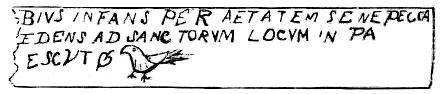
BIVS INFANS PER AETATEM SENE PECCA EDENS AD SANCTORVM LOCVM IN PA ESCVT
The ingenious De Rossi makes of this fragment the following inscription: (Euse)bius infans per ætatem sene (sine) pecca(to) (acc)edens ad sanctorum locum in pa(ce) (qui)escit—The infant Eusebius, going to the place [abode] of the saints without sin, because of his age, rests in peace.
To remove all doubt regarding the spirit which prompted the early Christians to desire burial near the tombs of the martyrs, we will cite a passage from one of the homilies of Maximus, Bishop of Turin: “Therefore the martyrs are to be honored most devoutly; but we must venerate those especially whose relics we possess. With these we have familiarity; … they receive us when we go out from this body.” This special devotion of familiarity with the martyrs, whose relics the faithful possessed, as it inspired the pious trust that the spirits of the martyrs would welcome them into the realms of bliss, so did it induce the faithful living to invoke the intercession of the martyrs for those who were already gone from this life. But we have yet some of the most beautiful epigraphs to cite—those touching, deprecatory appeals to the saint or martyr by name, near whose tomb the remains of the departed are placed: SANCTE LAVRENTI, SVSCEPA(m) (h)ABETO ANIMA(m) (ejus)[94]—St. Lawrence, receive his soul!
In the cemetery of St. Hippolytus Bosius read the following: REFRIGERI TIBI DOMNVS IPOLITVS refriger(et) tibi dom(i)nus Hippolytus—May the lord Hippolytus refresh St. Basilla: SERENVS FLENS DEPRECOR IPSE deum…ET BEATA(m) BASILLA(m) VT VOBIS PRO M(eritis). Another appeal to St. Basilla may be seen in an epigraph now exposed in the Lateran museum. It is that of a bereaved father and mother who commend their departed daughter to the protection of the saint: Domina Basilla, commandamus tibi Crescentinus et Micina Filia(m) nostra(m) Crescen(tiam)—St. Basilla, we, Crescentius and Micina, recommend our daughter Crescentia to thee. Side by side with this is the epitaph of Aurelius Gemelli, a child of four years of age. It was written by his mother, of whose tender affection a more moving expression cannot be found than those four words: Commando Basilla Innocentia(m) Gemelli—Basilla, I recommend [to thee] Innocence Gemelli. She calls him not only innocent, but innocence itself. Since we have mentioned the above as a specimen of the tender affection of the Romans for their dead, and how they gave expression to it in their epitaphs, it may not be out of place to mention another, to be seen to-day in the hypogeum of the Church of St. Praxedes. It is in this form: Sancti Petre, Marcelline, suscipite vostrum alumnum!—Sts. Peter and Marcellinus, receive your pupil. The Chevalier de Rossi is of the opinion that this inscription belongs to the cemetery of St. Helen, on the Labican Way. As a sort of counterpart to it he gives another, of the same tenderness of tone, which he read in Carpentras: MARTER BAVDELI S PER PASSIONIS DIE DNO DVLCEM SVVM COMMENDAT ALMVNVM—Martyr Baudelius per passionis [suæ] die(m) Domino dulcem suum commendat alumnum—The martyr Baudelius, through the day of his passion, commends
Thus far we have appealed almost exclusively to the testimony afforded us by inscriptions discovered in the Roman Catacombs. In conclusion we would transcribe entire two epitaphs which, though not Roman, are of the greatest importance in the matter we have been treating. One is the epitaph on the tomb of Cynesius, in the Church of St. Felix of Nola, the same of whom Paulinus wrote to St. Augustine, asking “whether it were efficacious to bury the dead near the tomb of the martyrs.” The inscription was probably dictated by Paulinus himself. We give it with the restorations:
ilium nuNC FELICIS HABET DOMVS ALMA BEATI atque ita per loNGOS SVSCEPTVM POSSIDET ANNOS patronus plACITO LAETATVR IN HOSPITE FELIX sic protectVS ERIT IVVENIS SVB IVDICE CHRISTO cum tuba terriBILIS SONITV CONCVSSERIT ORBEM excitæque aniMAE RVRSVM IN SVA VASA REDIBVNT Felici merito HIC SOCIABITVR ANTE TRIRVNAL[95]
Here there is a thought expressed rarely to be met with in sacred epigraphy—that the martyr Felix will, on the day of general resurrection, accompany his “guest” before the tribunal of the Great Judge, and that “the youth shall be protected before the judge, Christ.” As a general rule the patronage of the martyrs is invoked for the souls of the faithful departed as they are now. We will give another epigraph in conclusion which confirms the conception we have just been speaking of. It is read upon the tombstone of a priest in Vercelli, by name Sarmata. It is metrical, and the illustrious Father Bruzzi is inclined to attribute its authorship to St. Flavian, the poet, who was bishop of Vercelli about the end of the fifth century. This is the Flavian who was styled by his contemporaries the “Damasus of Liguria.” Sarmata was buried in the loculi between the martyrs Nazarius and Victor. The chronicles speak of this privilege in the following terms: Sedes proxima sanctis martyribus concessa est ad mercedem meritis—The nearest place to the martyrs was given as a reward of his merits. Here is the epitaph:
NAZARIVS NAMQVE PARITER VICTORQVE BEATI LATERIBVS TVTVM REDDVNT MERITISQ CORONANT O FELIX GEMINO MERVIT QVI MARTYRE DVCI AD DOMINVM MELIORE VIA REQVIEMQVE MERERI.[96]
Nazarius and Victor are here spoken of as the ushers of Sarmata into the presence of the Lord—ad Dominum—and to eternal rest. In the same manner St. Petronilla is St. Petronilla, the patroness of the departed, and whose holy ashes reposed not far distant, familiarly (the expression of Maximus of Turin) receives her into heaven, and the painter gave expression to the holy trust of her relatives that St. Petronilla would intercede for her, while the picture itself would invite them to pray more fervently to the saint whose holy “memories” (St. Augustine) were near at hand.
Now that the signification of the picture has been fairly determined, it may not be an unfitting conclusion to our paper to inquire into the accuracy of the title of martyr applied to St. Petronilla in this fresco. In the first place, it is certain that no other saint or martyr is alluded to but the veritable St. Petronilla whose remains reposed in the hypogeum of the basilica of SS. Nereus and Achilleus. Still, it is also certain from the Acts of the two martyrs, in which mention is made of St. Petronilla, that she was not a martyr in any sense whatever. The martyrology of Ado speaks of her thus: “When Flaccus, a knight, desired to be united with her in marriage, she asked for a delay of three days, and, together with her foster-sister, Felicula, giving herself up to continual fasting and prayer, and the divine Mysteries being celebrated on the third day, as soon as she had received the Sacrament of Christ she lay down upon her bed and gave up the ghost.” In other codices of her life the opening chapter is entitled, De obitu Petronillæ et passione Feliculæ—On the death of Petronilla and the martyrdom of Felicula. Hence there is a formal contradiction between her Acts and this fresco. Without entering into a critical examination of the authenticity of the Acts of Nereus and Achilleus—which, by the way, receive new confirmation from every fresh discovery in the cemetery—we will merely say that, were they apocryphal, the supposition would be that they would rather magnify her glory, by giving her the title of martyr, than diminish it. Setting aside the inscription, the appearance of the picture confirms her Acts. She is said to have been a virgin of extraordinary beauty, and that she belonged to a noble family. The picture coincides perfectly with this belief; for she is represented as being beautiful; she wears her hair in plaited tresses, wound into a knot on the top of the head, according to the custom of virgins in those days; while the make of her dress proclaims her as belonging to noble rank. For the rest, there is not a single authentic document which gives her the title of martyr, but all speak of her as Sancta Petronilla, or simply Virgo Petronilla. Hence there is no reason in the world why we should give credence to the inscription of the painter. The title of martyr accorded to her by him does not become an inexplicable mystery to us when we recall to mind the many and obvious examples of the title of martyr being given, especially by private individuals, without due regard for historical facts. For instance, St. Pudentiana, St. Cyriaca, and others have been styled martyrs, when we have positive evidence that they martyr in the Liber Pontificalis, at the life of Leo III. (816), when the history of her life, as given by Ado, was universally accepted. However, if we recall to mind what has already been said on the special confidence of the primitive Christians in the intercession of the martyrs for the dead; if we reflect that they were regarded as the principal citizens in the kingdom of God, to whom the heavens were opened, as St. Stephen said (martyribus patent cœli), and hence that to them was attributed, equally with the angels, the office of introducing departed souls into the divine Presence, it is easy to understand why the artist, in portraying Petronilla as receiving Veneranda into Paradise, either believed her a martyr or deliberately wished to make her equal to one. Pictoribus atque poetis æqua est licentia.
But in this matter we must not observe the material form as it is presented to us, accurately or inaccurately as the case may be. That is merely relative and secondary. It is the spirit of the work which we must contemplate—that great faith in the intercessory prayers of those who had fought the good fight, and whose happiness was complete in the Beatific Vision. Some of the epigraphs may be very inaccurate, even exaggerated; yet they bear, in their way, testimony to a sublime dogma of the church—the communion of saints, not only for the good of the living, but for the happy repose of the dead. In fine, they are the embodiment of the loving counsel: “It is a holy and a wholesome thought to pray for the dead, that they may be loosed from their sins.”
SUNSHINE.
Over the glad earth, with her robe of beauty, Glideth the Spring; Pouring out perfume from a thousand censers The peach-wands swing. Down through the sunny vista of the orchard Tender green glows, Gnarled apple-boughs arrayed in robes of splendor Pearl tint and rose. Out from the dead leaves and the soft green mosses, Like joy from pain, Trailing arbutus, the sweet May evangel, Bloometh again. Who can remember, in this wealth of beauty, How April came? Crowned with a frost wreath on her pallid forehead, And snow-star rain. Yet ‘neath the shadow of the wing of winter Nature’s heart beat, Golden wine surging through each rugged column Like dancing feet. Thus, my belovèd! though upon us shadows Coldly may fall, God worketh slowly with the germs of beauty Given to all. Out from the shadow of our solemn parting Shall sweet hope spring; Faith, to an altar where the fire is hallowed, Her gifts will bring. Grace hath not left thee; it but sleeps, belovèd. Through wintry hours, Waiting the footsteps of the soul’s glad spring-time To wake the flow’rs. What though the sadness of an earthly parting On us be laid? In the bright sunshine of the blest hereafter Shadows shall fade.
NEW PUBLICATIONS.
Alzog’s Universal Church History. Pabisch and Byrne. Vol. II. Cincinnati: Robert Clarke & Co. 1876. (For sale by The Catholic Publication Society.)
The time included in this second volume of the great work edited by Dr. Pabisch and Father Byrne extends from the beginning of the fourth century to the beginning of the sixteenth. We have already said all that is requisite on the excellence of the work in general in our notice of the first volume. At present we have no criticisms to make, except on a very few special points. A condensed summary of this kind is always liable to the fault of ambiguity in some of its general statements from the very fact of its extreme conciseness, and thus may give occasion to false impressions on the mind of an ordinary reader. There is a notable instance of this on page 22, where a short notice is given of the famous Ulfila. He was, as is well known, an Arian. The historian tells us that he “accepted it [viz., Christianity] with simple and earnest faith, just as he found it, putting aside all the idle and speculative questions that distracted the religious mind of the age.” We are inclined to agree with the opinion, which the author evidently intended to express, that Ulfila was not culpably in error respecting the faith, and that to his simple, untutored mind the disputes between Catholics and Arians were unintelligible. Nevertheless, the language we have quoted, taken in connection with a previous sentence in which the Gothic bishop is called a “great apostle and bishop,” and another in which it is curtly stated that the Christianity to which the Goths were converted “meant simply the Arian heresy,” is so extremely awkward and inaccurate that one would naturally understand it to imply that Catholic faith only differed from Arian heresy in respect to idle and speculative questions. A careful and instructed reader would, of course, judge that Dr. Alzog could not have intended such a
On page 972 the author speaks of the “pantheistic language of Tauler.” In this instance he seems to have followed closely the opinion of Dr. Stöckl, an author for whom we have a sincere respect, but whose estimate of Tauler we regard as altogether wrong. We have no fault to find with the censure pronounced upon the Theologia Germanica, and pass over what is said of the writings of Master Eckhart, since, although we incline to the opinion that his subjective sense was orthodox, the objective sense of many of his propositions is pantheistic and deserved the condemnation of the Holy See. In regard to Tauler, however, of whom the author speaks in another place in the highest terms, Dr. Alzog has made, as it seems to us, an inconsiderate statement by a blind following of Stöckl and other authors who condemn all the German mystics without discrimination. We have never observed a single expression in Tauler which has any more semblance of pantheism than the language of St. Bonaventure or any other approved mystical writer. We cannot perceive any difference between the doctrine of Tauler and that of St. John of the Cross, except that the latter states more distinctly the precise theological and philosophical sense of several important propositions.
The learned editor-in-chief of the present translation, Dr. Pabisch, sustains his reputation as a scholar who has a vast knowledge de omnibus rebus et quibusdam aliis, perhaps on a par with that of Dr. Alzog himself. With the exception of occasional infelicities of diction of not much importance, and the frequent use of italics, which gives us the sensation of jouncing on a road with many ruts in it, the style and manner of the translation, which are chiefly due to the diligent care of the Rev. Mr. Byrne, are satisfactory, and the various tables at the end are extremely serviceable to the student. One more volume will complete this exceedingly valuable compendium of the history of the church.
Burning Questions. By William Molitor. London: Burns & Oates. 1876. (For sale by The Catholic Publication Society.)
Burning pretty briskly they have been, these questions, for some time past; the fire seems to be spreading, and not a very speedy prospect of putting it out! Mr. Molitor has a very agreeable and skilful way of handling this kind of fire. A gentleman once went to lecture on nitro-glycerine. Proceeding coolly and with an unembarrassed air to the platform, one of the committee who surrounded him and were pleasantly chatting on the subject of the lecture having casually asked him if he would exhibit any specimens, he replied: “Oh! certainly; my pockets are full of them.” Several gentlemen of the committee retired to the back seats on hearing this announcement, awaiting in fear and trembling the dreaded explosion in the safest place they could find. The application of Catholic principles to politics has long and widely been dreaded as explosive and incendiary. Of late politics have been brought into pretty smart collision with Catholic principles. Of course it makes no particular difference whether you throw nitro-glycerine on a rock or throw a rock on nitro-glycerine. An explosion has certainly resulted in Europe which is likely to be followed by more explosions. If any damage is done, it will not be suffered by the church. The anticipated destruction of Hell Gate by General Newton next July is a figure of what must take place in that quarter after which a certain locality in the East River was facetiously named by our Dutch ancestors. We have said that Mr. Molitor, although in a similar position with the gentleman who lectured on nitro-glycerine, handles his themes very agreeably and pleasantly. He is not only good-tempered and humorous, but he makes his somewhat abstruse topics quite intelligible and interesting. The form adopted by the author, who is a German priest of high rank in the church and of considerable note as a writer, is that of a series of conversational discussions. mise en scène for the talkers and their very intelligent and learned talk. We have not seen the book in its original language, which is German, but the English translation reads well, and the book is a masterpiece in its way, both in respect to its matter and form. The intelligent reader will already have perceived that its subject is the relation of the church to the state. In substance it is a popular exposition of one part of ethics which is treated of scientifically in every Catholic text-book or treatise on morals—such, for instance, as Liberatore’s Philosophical Prelections. We cannot too strongly recommend its careful perusal to all those of our readers who wish to understand what Catholic principles and doctrines really are, in opposition to the popular errors condemned in the Syllabus. We are glad to see that a more extensive and formal treatise on the same topics by Hergenröther has been translated and is advertised in the English papers, although we have not yet received a copy.
Catechism for Confession and First Communion. By a Priest of the Diocese of Springfield. Springfield: Philip J. Ryan. 1876.
We never take up a new catechism without distrust. It is easy to find objections, real or imaginary, to any and every abridgment of the Christian doctrine, and consequently there is little difficulty in coming to the conclusion that a new catechism is needed; but it is rare that even tolerable success rewards the compilers of text-books of this kind. We are of the opinion that it is not so important that we should have the best possible catechism as that one which is good should be adopted throughout the whole country. Many of our wisest and most learned prelates have insisted upon this point, and in the first Plenary Council of Baltimore (1852) a catechism was approved of and recommended to the clergy of the United States; and this is still to-day, we think, the best to be found in this country.
The catechism by a priest of the Diocese of Springfield, which we have carefully examined, has not changed our opinion upon this subject. It is not free from errors and inaccuracies which are of themselves sufficient to deprive it of any value as a text-book of religious instruction. In the “Act of Hope,” p. 4, we come upon the following ungrammatical sentence: “O my God! who has promised every blessing.” “What is God?” is asked at the very outset, and the answer given is: “God is a spirit.” This is no more a definition of God than it is of an angel or a soul. “What was the Garden of Paradise? Answer—A place of pleasure.” This is a poor, not to say false, rendering of the Scriptural phrase. “Who is the devil? Answer—One of the fallen angels.” Is he not the prince of fallen angels? “Who are the angels? Answer—Pure spirits without a body.” Is it, then, possible for pure spirits to have a body? Hell, we are informed, is “a place of eternal torments, where there is all evil and no good.” This is theologically inaccurate. It is impossible that a place where there is no good should exist, since existence itself is a good.
“What are the chief things we must believe? Answer—The chief things we must believe are contained in the Apostles’ Creed.” Question and answer do not agree. The one is what and the other is where.
“Why did he establish but one church? Answer—Because God being one, he could have but one church.” To affirm that God’s nature renders more than one church impossible is, we think, unwarranted.
“Can the church err? Answer—She cannot.” The catechism approved by the First Plenary Council says: “She cannot err in matters of faith.” The priest of the Diocese of Springfield fails to give the four marks of the church; and this is certainly a very grave omission. He, moreover, says not a word about the infallibility of the pope, which is equally inexcusable.
“How many kinds of sin are there? Answer—Two kinds: original sin and actual sin.” We were under the impression that the kinds of sin were very numerous.
“What sins are mortal? Answer—Grievous sins.” And what sins, then, are grievous? Mortal sins, we suppose.
“Is tale bearing a great sin? Answer—Yes;
“What is the Eucharist made from? Answer—From wheaten bread and the wine of the grape.” This, in our eyes, as a matter of taste, if for no other reason, is very objectionable.
We confess that much of what we have found fault with is not of great moment, but in a work of this kind we have the right to demand the strictest care and accuracy. We have no desire to be severe in our criticism, and gladly bear testimony to evidences of talent in the author, who, with greater pains, would have given us, we doubt not, a very excellent catechetical text-book.
Outlines of the Religion and Philosophy of Swedenborg. By Theophilus Parsons. Boston: Roberts Brothers. 1876.
Philosophy of Swedenborg! That is a desideratum which we have looked for in vain some twenty years or more. We have read a considerable number of volumes of the writings of Emanuel Swedenborg and much that has been written on their contents, conversed with not a few of his prominent followers, and yet we have failed to obtain from them all a clear and philosophical statement of the doctrines which he taught. Here, however, is a volume written expressly to give to the world such a statement.
But, alas! we are again doomed to disappointment; for nowhere do we find in it, in precise terms, the nature of this new revelation. The nearest we come to it is in the following passage: “If a new revelation was to be made through him, if it was to be made by his statement of spiritual truths, they should be not merely new, but so entirely distinct from all that was ever before known, so well adapted to send the mind forward on a new path and from a new beginning, so able to supply new motives and incentives to a new moral and affectional as well as intellectual progress, and new instruction to guide this progress, as to justify and authorize this large claim.”
The first pretension made in this paragraph for the new church is “new motives and incentives to a new moral and affectional progress.” Neither Swedenborg in his life nor his followers in theirs have yet made this title good. Nowhere have they shown the signs of a higher spiritual life or of a greater self-sacrifice. When they shall have given us a St. Charles Borromeo, or a St. Vincent de Paul, or the heroism displayed by a Sister of Charity, then, and not till then, will there be reason to investigate their claim of a revelation which is superior to that given by Christ himself.
The next assertion in this paragraph is that this “new revelation” is a source of “new intellectual progress.” Swedenborg revolted at some of the grossest errors of Protestantism, and, in repudiating them, seems to have been entirely ignorant of Catholic theology. The author supposes Swedenborg’s opposition to the errors of Calvinism is the cause of its decline; seemingly, he is unaware of its refutation centuries before Swedenborg lived, and the statements of the truths opposed to it, by the Council of Trent. What is true in Swedenborgianism is not new, and what is new is not true.
As a specimen of “intellectual progress” we take the very first sentence of this book: “A church,” the author says, “may be defined as the collective body of those who agree together in faith and in worship.” This is the same as if he had said: “A man may be defined as the collective body of those members which agree together in physical action.” This is the play of Hamlet with Hamlet left out. Had Mr. Parsons the true conception of the church, this would have started the question of the mission of his master!—a point upon which his evidence would have proven very unsatisfactory.
Again he says “that it is of the very essence of this revelation that it is given to man’s reason” (page 22).
Is the author ignorant of the fact that Christianity from the beginning made, and has always made, appeal to man’s reason? By Christianity we mean the Catholic, the Roman Catholic, Church, outside of which Christianity never had, and has not now, a real, separate existence. Have we to tell Mr. Parsons that the Catholic Church has always upheld the value of human reason and defended its rights? Has he ever looked into any work of Catholic theology? Has he ever opened the Summa of St. Thomas, or his volume Contra Gentiles? Does the author not know that it was Martin Luther who asserted against the church that “a man becomes all the better
The author says “he agrees with Professor Tyndall in saying that to yield to the religious sentiment reasonable satisfaction is the problem of problems at the present hour,” and adds: “We believe also that the system of thought and belief introduced by Swedenborg will lead to the solution of this ‘problem of problems’” (page 30). This is equivalent to saying that the Creator has made man for a destiny which he has carefully concealed from him these six thousand years or more!
The same Creator did not fail to satisfy every appetite with its proper food, except the highest of all—the thirst of the soul to know its true destiny and the means of attaining it. This he allowed to tantalize man up to the date of this new revelation! Pity poor Professor Tyndall could not be made to see it! Happy Professor Theophilus Parsons, who has found it at the feet of Emanuel Swedenborg, whose words, he tells us, “were not God’s words, but his own; full, as we believe, of truth and wisdom, but limited in their scope and liable to error” (page 31).
Swedenborgianism is a product of a mind given to the pursuit of natural sciences, ignorant of theology, and transported into the dream-world—a sublimated materialism. There runs through all the writings of the followers of Swedenborg the assumption of a superior knowledge of spiritual truths, which allies it closely to the old heresy of Gnosticism. In kind, Swedenborgianism does not differ from modern Spiritism, only it assumes an air of greater respectability.
Hymns. By Frederick William Faber, D.D. New York: E. P. Dutton & Co. 1876.
The title “Faber’s Hymns” gleams in golden letters from the back of this handsome little volume, “Hymns by Frederick Wm. Faber, D.D.” (in choice mediæval characters) on either cover. “Faber’s Hymns” consequently they must be. It is impossible to doubt their authenticity, surrounded as they are by all that wealth of adornment in which our ritualistic friends delight. Here are the thorns, and the hammer and nails, and a chaste border of what may be taken at will for the passion flower or forget-me-not, and over the title a gorgeous cross and beneath it I. H. S. One would be shocked not to meet with the softest-toned paper inside—paper full almost of that “dim religious light” that Milton sang. He lingers over these externals, for they are very lovely, and very characteristic; so lovely that a sentimental person would weep to find they are only the adornments of a wilful and systematic mutilation of the hymns of the gentle and saintly man whose name the volume bears.
A complete collection of Father Faber’s Hymns was published in London in 1861 with the approval of the author and under his direct supervision. He wrote a preface to it in which he complained of the liberties that had been taken with his hymns. He added that “he was only too glad that his compositions should be of any service, and he has in no instance refused either to Catholics or Protestants the free use of them: only in the case of Protestants he has made it a title to stipulate, wherever an opportunity has been given him, that, while omissions might be made, no direct alterations should be attempted. Hence he wishes to say that he is not responsible for any of the Hymns in any other form, literary or doctrinal, than that in which they appear in this edition.”
That edition bore and bears the same title as the one now under notice. The difference in size, however, between the two volumes is rather startling. This difference is accounted for by the fact that in the ritualistic version fifty-eight hymns have disappeared. There are one hundred and fifty in the original, there are ninety-two in the new, and what the editor and publishers would doubtless consider improved edition. Nor is the list of omissions complete even with these fifty-eight absent.
But, to do what justice may be done to the ritualistic editor and publishers—we should be delighted to give the editor’s name as well as the publishers’, only that a judicious modesty has concealed it from us—we quote from the preface: “This book of selections from Faber’s Hymns contains all of the Author’s latest revised edition, except the Hymns written for the use of Roman Catholics, such as those for the festivals of the Virgin St. Joseph and the Holy Family, and for the Devotions in honor of them, and the Hymns addressed to the Angels and Saints.”
In other words, it contains “all of the author’s latest revised edition” with the insignificant omission of very nearly one-half. How many hymns “of the author’s latest revised edition” were not “written for the use of Roman Catholics” were an investigation worth making, which the reader may take up at his choice. Leaving those points, however, it is to be supposed that so honest a confession amply atones for everything, especially after Father Faber’s permission to Protestants to use his hymns. But there was a solemn stipulation attached to that permission, and to inquire into how far that stipulation has been observed is the purpose of the present notice.
From the hymn entitled “God,” which is only the fourth in the volume, verses 7 and 9 are left out. Those verses have the name of Mary in them and sing of her beauty. The beauty of the angels and saints, which is sung in the same hymn, is allowed to pass, but for the queen of angels and saints of course there is no room.
In the hymn “My Father,” a few pages on, the same thing is observable. The tender conscience of the editor revolted from and consequently struck out such a verse as this:
“Mary, herself a sea of grace, Hath all been drawn from Thine; And thou couldst fill a thousand more From out those depths divine.”
In the rendering of the Veni Sancte Spiritus the last verse, which prays for the seven gifts of the Holy Ghost, is struck out, the editor probably objecting to those gifts for some reason of his own. In “Christmas Night” the pretty chorus is mutilated for the purpose of throwing out the name of Mary. The original reads:
“All hail, Eternal Child! Dear Mary’s little Flower God hardly born an hour, Sweet Babe of Bethlehem! Hail Mary’s Little One, Hail God’s Eternal Son, Sweet Babe of Bethlehem, Sweet Babe of Bethlehem!”
This the critical editor improves as follows:
“All hail, Eternal Child! Sweet Babe of Bethlehem! Hail God’s Eternal Son, Sweet Babe of Bethlehem!”
The fine hymn “The Three Kings” is shortened by two verses—4 and 12. To be sure those two verses bear rather hardly on Protestants, but in that case, and in many others, why not leave the hymn out altogether? In the hymn immediately following it, “The Purification,” the last verse, which claims “all rightful worship” for the Mother of Christ, is thrown out—of course by Father Faber’s express desire. In “Lent,” on the very next page, verse 3, which celebrates “the feast of penance,” does not appear. Two pages on, in that most touching of plaints, “Jesus Crucified,” such verses as these are found unworthy a place:
“His mother cannot reach His face; She stands in helplessness beside; Her heart is martyred with her Son’s; Jesus, our Love, is crucified! * * * * * “Death came, and Jesus meekly bowed; His failing eyes He strove to guide With mindful love to Mary’s face; Jesus, our Love, is crucified!”
What a starved religion it must be that cannot stomach such lines as those! And what justice to Father Faber! Yet the editor allows the next hymn to open with the lines:
“Hail, Jesus! hail! who for my sake Sweet blood from Mary’s veins didst take.”
It is to be supposed that he could not well deny the physical fact, though he would seem to have strong doubts about it, for presently we find him in “We come to thee, Sweet Saviour,” changing the last line of the chorus,
“O blood of Mary’s son,”
to
“O blood of God’s dear son.”
Just one-half the hymn to “Jesus Risen” is thrown out, from verses 2 to 6 inclusively. These verses treat of the sacred humanity. “The Apparition of Jesus to Our Blessed Lady,” “The Ascension,” and “Pentecost,” which immediately follow, are among those struck out, as are also the first eight verses of “The Descent of the Holy Ghost.” The reason of course is that they eulogize the Mother of God. For the same reason verses 13 and 14 are omitted. Indeed this hymn alone must have caused the pious soul of the editor much trouble; for we find
“One moment—and the Spirit hung O’er them with dread desire”; “O’er her with dread desire”
is the original. Again in his sixth verse, which in the original reads:
“Those tongues still speak within the Church, That Fire is undecayed; Its well-spring was that Upper Room Where Mary sat and prayed.”
Of course Mary cannot be tolerated in such company. Her name is accordingly stricken from the roll and “the disciples” substituted for it, so that the last line reads:
“Where the disciples sat and prayed.”
It is too much to look to this man for respect for the Mother of God; but at least he might have some respect for Father Faber, and at the very least for the laws of rhythm.
It is useless to multiply instances of this kind. They run through the book. A few other gross liberties taken with the text cannot pass unnoticed.
In “The Wages of Sin” the second verse of the author reads:
“We gave away all things for him, And in truth it was much that was given— The love of the angels and saints, And the chance of our getting to heaven.”
The Protestant editor objects to
“The love of the angels and saints,”
for which he substitutes
“We gave away Jesus and God,”
a line that belongs to the third verse. This third verse of course disappears, because it sings of “Mary and grace” and “prayer and confession and Mass.”
Why the last verse of “Conversion” is condemned, even by so tender a conscience as that of our editor, it is impossible to conceive.
“Jesus, Mary, love, and peace”
sang Father Faber in “The Work of Grace”;
“Jesus, mercy, love, and peace”
sings his self-appointed editor.
In “Forgiveness of Injuries,” the very title of which might have caused him to pause, a happy specimen of his peculiar art and animus is given. Father Faber’s first verse read
“Oh! do you hear that voice from heaven— Forgive and you shall be forgiven? No angel hath a voice like this; Not even Mary’s song of bliss From off her throne can waft to earth A promise of such priceless worth.”
In the Protestant version only the first two lines appear; the other four are taken from the second verse; the remainder of which, with the rejected four of the first verse, are thrown away altogether.
Here an examination which might be prolonged indefinitely may as well end. The reader may judge for himself whether the word “mutilation”—a grave word to use—is misapplied in this instance. Selections, of course, may be taken from a man’s works in these days, though we should say not without permission from the author or from those empowered to grant it. But that such permission should be extended to hacking a man right and left, distorting his words, spoiling his verses, studiously making him say just what he does not say, persistently making him dishonor those whom he most honors—strange indeed must be the conscience which can interpret the widest permission thus! We need not refer to the glowing love of Father Faber for the Blessed Virgin. It was no vague aspiration after some ideal being, existing or not existing in a remote state. It was a vital reality to him. The Blessed Virgin was near him always. To her he turned with the love and confidence of a child, as to no imaginary mother, at all times. Her name was ever on his lips, as her love was in his heart. It was natural, then, that all his writings, but above all his hymns, should bubble over with the love that was ever welling upwards from the very depths of his being. Yet this man, pursued apparently by hatred of the Mother of Jesus, and thinking to honor the Son by dishonoring the Mother, follows her up and hunts her from the pages of one so devoted to her, wherever it was possible to do so. Further comment on a man who can commit so dishonest an act, in the name too of religion, is unnecessary. As for the publishers who can lend themselves to such unworthy work, we leave them to their own reflections.
We have no desire to take this as The Following of Christ; the Devout Life, by St. Francis de Sales; the Memorial of a Christian Life, by Father Lewis of Granada; the Spiritual Combat, and all Father Avrillon’s works, have been tampered with in the same manner and by the same set of zealous Christians. Is it too much to detect in this the old spirit that gave us what is known as the King James version of the Bible, and that is content to let centuries of great Christian faith go by, for the purpose of claiming a fancied union with that of the earlier centuries, basing the claim on distorted extracts from the works of a few great writers?
Gertrude Mannering: A Tale of Sacrifice. By Frances Noble. London: Burns & Oates. 1875. (For sale by The Catholic Publication Society.)
One begins to grow shy of “tales of sacrifice” written by Catholic authors. They are so very like one another that the maxim Ex uno disce omnes is nowhere more applicable than to them. Given the characters and their relations one to another, and a very limited amount of experience will enable the reader to sketch out the story faithfully enough for himself without going to the trouble of reading the book. Gertrude Mannering, though bearing a strong family likeness to her sisters, and beginning in the orthodox fashion—in the convent, of course—improves upon acquaintance, and leaves the reader with the impression that the hand which fashioned her is capable of much better work. It is useless to sketch the story, which is a short one and of simple enough construction. Its defects are of the usual order, though in a less degree than ordinarily. There is too much pious “talk,” in season and out of season. When will our Catholic story-writers learn this first lesson of fiction: that a little of such talk goes a very long way? Even inquiring Protestants are not likely to be moved profoundly by the tremendous arguments of a girl of sixteen or seventeen just out of a convent, while Catholics yawn as soon as they appear, and either skip the pages that contain them or close the book. Then, again, Gerty blushes a little too often, even for a convent girl. The color rises in her cheeks more or less deeply at almost every other page. One grows rather tired, too, of the frequent mention of “the pale, proud face” of the “haughty Stanley” and his “splendid intellect.” These, to be sure, are the ordinary attributes of lady novelists’ heroes, but, at least, the last quality might be judiciously omitted, unless excellent grounds are given for it. A “splendid intellect” is no doubt a very good thing to have, as is also a “pale, proud face” in its way; but when the “splendid intellect” only shows itself in rather commonplace observations, such as persons with no pretension at all to so rare a gift would use, the effect is not quite satisfactory.
One more objection we must make, and a serious one. The sacrifice around which the story turns is by no means to be commended and would have been better omitted. Young ladies, even young ladies whose love has been crossed, can easily find something far better to do with their lives than to offer them to God for the soul of some young gentleman whom they are particularly anxious to convert. Martyrdom for the faith is one thing; but the picture of a young lady, who cannot conscientiously marry a young infidel, offering her life to God for his conversion, is quite another thing. One is tempted to ask how much the “pale, proud face” and the “splendid intellect” of the “haughty Stanley” had to do with so tremendous a sacrifice in the present instance. Gerty might have done him, and herself, and her reader much more good by living than by dying for him, as did that practical patriot when the cause of his country seemed lost.
We have noticed this story at some length because the writer, whose name meets us for the first time, seems, as already hinted, to give promise of much better work. Lady Hunter is a well-drawn character. So, apart from the excessive tendency to blush and “talk pious,” is Gerty. The “haughty Stanley” is rather a conventional hero, which, perhaps, is only natural in days when so many young men lay claim to “splendid intellects.” The scene between Gerty and Stanley, where love and duty on the one side, and love and pride on the other, contend for mastery, is drawn with genuine power, while the end is indeed touching.
The School Question: Catholics and Education. 1 vol. 8vo, pp. 200. New York: The Catholic Publication Society.
The republication of the various essays on education which have from time to time appeared in The Catholic World, treating this all-important subject from widely different points of view, presenting a great variety of style and method as well as of authorship, will, we are confident, be welcomed by the reading Catholic public as especially opportune at the present moment, when the questions here discussed enter so largely into all our social, theological, and political controversies.
Though the subject of education is much talked of and written about, it is rarely carefully examined or seriously studied. We have ourselves been made to blush more than once by the ignorance on this point of even intelligent Catholics. Self-respect, one would think, should suffice to make us acquaint ourselves with the arguments upon which our dissent from the theories of education commonly received in this country is based. At the expense of very little time and labor any ordinarily intelligent Catholic might be in a position to defend himself against the attacks of the advocates of a purely secular school system. To those who feel the need of informing themselves more thoroughly on this subject we heartily commend these essays. The questions with which they deal have been discussed, not without ability and sound reason, in pamphlets and lectures; but before the publication of this volume we should have been unable to refer to any one book as giving a fair and satisfactory statement of Catholic principles on the subject of education. This collection supplies a want which many besides ourselves must have felt.