Chapter III · THE INTERIOR. (continued 2)
Reading edition
On the pier at the foot of Sir George Nowers' tomb is fixed the remarkably characteristic monument of Robert Burton, the famous author of "The Anatomy of Melancholy," who died in 1639, having been Student of Christ Church for forty years, and also Vicar of St. Thomas', Oxford. His bust is coloured, and surrounded by an oval frame; it should be a good likeness, and one fancies that the face is drenched in melancholy.
On the frame are two medallions with a sphere, and a curious calculation of his nativity, composed by himself, and placed here by his brother William, the historian of Leicestershire. The inscription, written by himself, is:—
Paucis notus, paucioribus ignotus Hic jacet Democritus Junior Cui vitam dedit et mortem Melancholia.
At the south side of the Montacute tomb there is a stone in the floor with a large cross upon it, and an inscription in Lombardic characters of which these words can be made out:— Johan: de: col ... v. le: gist: id: Dieu ... Merci. Pour: lame: prier: dis: jours: de: pardon: aver: amen.
In the north aisle of the choir a stone commemorates Andreas de Soltre quondam rector Ecclesiae de Kalleyn; and a brass, James Coorthoppe, Canon of Christ Church 1546, and Dean of Peterborough till his death in 1557. On the floor of this aisle there is also a small brass with the figure of a youth, with the Courtenay arms, and this inscription:—Hic jacet Edvardus Courtenay, filius Hugonis Courtenay, filii Comitis Devomæ, cujus animæ propicietur Deus. This Hugh Courtenay, the father of the lad, must have been either Hugh second Earl of Devon, or his son Hugh, surnamed le Fitz, one of the heroes of Crécy.
Glass in the Aisles.—The three lovely east windows of the aisles and Lady Chapel were designed by Sir Edward Burne-Jones and executed by Mr. William Morris. The only possible criticism is that made by Mr. Ruskin, who once said that they were beautiful pictures, but were they windows? They are perhaps open to the objection, but a comparison of them with the Reynolds windows in New College Chapel, which are flagrant offenders in this way, makes one feel that the objection is purely formal, and that these are true windows, adding colour and interest to the old cathedral in a perfectly legitimate way. One is naturally prejudiced against large figures pictorially treated, because of the atrocities of the Munich school, but these were made, not at Munich but at Merton, by the most accomplished craftsman of the century.
The first window, that in the Lady Chapel, was erected in memory of Frederick Vyner, an undergraduate of the House, who was murdered by brigands at Marathon in 1870. The figures represent Samuel the Prophet, David, King of Israel, John the Evangelist, and Timothy the Bishop. In the panels beneath are, Eli instructing the young Samuel, David slaying Goliath, St. John at the last supper, and Timothy as a little boy learning from his mother. The legends are:—(1) Loquere Domine, quia audit servus tuus, and in the panel Prope est Dominus quibus invocantibus eum; (2) Deus, Deus, meus, ad te de luce vigilo, and Tua est Domine victoria; (3) Qui recubit in coena super pectus ejus, and Quis nos separabit a charitate Christi; (4) Dabit tibi Dominus in omnibus intellectum, and Statuit super petram pedes meos.
At the end of the north choir aisle is the St. Cecilia window, presented in honour of the patroness of music by Dr. Corfe, a former organist, in 1873. In the centre light the saint is represented playing her regal or small hand-organ; two angels holding other musical instruments, with palms in their hands, stand by her. The drapery is wrought in white glass, the angels have pale blue wings, and the flesh tints matted over with red tell warm against the drapery. In the lower panels are three scenes from her life: "Here St. Cecilia teaches her husband," "Here an angel of the Lord teaches St. Cecilia," "Here St. Cecilia wins a heavenly crown;" the saint's figure in this last panel is most touchingly drawn. These lower panels are richer in colour than the rest, and a greater variety of tints is introduced; but the colours are so delicate, and so skilfully blended, that they fall in most harmoniously with the main parts of the window. As the neighbouring window just described is full of the robust strength of manhood, so this one, in colour as well as in design, is graceful, delicate, and feminine. Probably it will lead to the north choir aisle being known by the name of St. Cecilia, whose art has certainly many votaries in Oxford. Mr. Malcolm Bell, in his monograph on Burne-Jones, gives the following description of the St. Cecilia window:—
"A still more beautiful instance of the use of simple figures with complicated draperies is found in the lovely St. Cecilia window, executed in 1874-5, a companion to the 'St. Catherine,' executed in 1878, in Christ Church Cathedral at Oxford, in which, moreover, it is enhanced by the soberness of the colouring, which, with the exception of a few touches of stronger hues in the lower panels, is green, and white, and gold, symbolic of the lily of heaven, into which mediæval commentators tortured the meaning of her name. The saint herself stands in the middle, with attendant angels on either side, bearing the palm of martyrdom, who hush their harmony while she plays. Below the left-hand angel, St. Cecilia, seated on her bed, reads to her husband Valirian the lesson of chastity. In the centre the angel brings to them the miraculous proof of the justification of her faith which he demanded from her:
"Valirian goth home, and ſint Cecilie Withinne his chaumbre with an aungel stonde, This aungel had of roses and of lillie Corounes two, the which he bar in honde.
THE 'ST. CECILIA' WINDOW, BY SIR EDWARD BURNE-JONES.
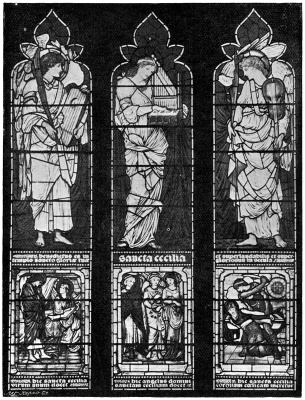
"The lilies, symbolical of virgin purity; the roses, of victory over death. In the third, the executioner holds her by one hand as she kneels on the floor of her bath-room, which is seen in the background, the steam still rising in it after the ineffectual attempt to roast her to death. With his sword raised he is about to strike the first of the three blows which failed to cut off her head.
"And for ther was that tyme an ordinaunce That no man sholde do man such penaunce The ferthe stroke to smyten, softe or sore This tormentour durste do no more."
At the end of the south choir aisle is the third figure window of Burne-Jones. It is dedicated to St. Catherine, and is in memory of Edith Liddell, a daughter of the late Dean, "who, having been scarcely five days betrothed, seized by a sudden attack of illness, rendered her spirit to God, June 26th, 1876." St. Catherine, crowned, is the central figure: she is painted in the likeness of Edith Liddell. On the right is the Angel of Suffering and Submission, with mutilated hands, the wheel of torture and flames beneath; on the left is the Angel of Deliverance, crushing the wheel of torture and scattering the flames. The draperies are white, the wings of the angels are a pale blue, and the curtains hanging at the back of the figures of a rich greenish blue, while the detailed background is cut out of violet-coloured glass, a daring but thoroughly successful arrangement. In the tracery above are angels playing triumphant music. The whole is as beautifully executed as it is finely conceived. In the three lower panels are scenes from the life and death of the saint:—(1) She disputes with philosophers, pleading for her fellow Christians, and demonstrating avec force syllogismes the truth of Christianity, and the falsity of paganism. This little panel has as large an effect as if it were a fresco covering half a wall. (2) Her dream, in which she is led through a wilderness by the blessed Virgin into the presence of our Lord, who is seated amid a concourse of cherubim. The way in which the cherubim are cut out of tones of ruby, full of depth, and without a suspicion of crudeness, should be noticed, and compared with the treatment of ruby glass elsewhere. This is perhaps the most beautifully drawn picture of all; and the figure of St. Mary is something not to be forgotten. (3) St. Catherine is laid in the tomb by angels. The inscriptions are:—Agnus reget illos, et deducet eos ad vitae fontes aquarum, et absterget Deus omnem lachrymam ab oculis eorum. Timor Domini ipsa est sapientia. Beati mundo corde quoniam Deum videbunt. Cum dederit dilectis suis somnum.
The two first windows in the wall of the south choir aisle, in memory of Dr. Jelf, Canon from 1830-1871, are by Hardman. Next is a most interesting glass painting of Bishop King, last abbot of Oseney, and first Bishop of Oxford, which is perhaps from the hand of Van Ling. This window, with some others, was taken down during the Civil War, buried for safety by a member of the family, and put up again at the Restoration. The Bishop is represented standing vested in a jewelled cope of cloth of gold, and mitre, a pastoral staff in his gloved hand. In the background, among the trees, is a picture of Oseney Abbey in its already ruined condition (c. 1630), drawn without much feeling for its architecture, but of great value as almost the only picture of the place we possess. The western tower was the first home of what are now the Christ Church bells. Three coats of arms (being those of the Bishop, impaled with the abbey of Oseney and the see of Oxford) complete the richness of what is a very good example of seventeenth century painted glass, in the strict sense of the word.
It is to be regretted that some of the glass, which formerly was seen by everybody in the cathedral, has been removed to the chapter-house, where it is seen by few: among the glass thus removed the lovely I.H.C. should not be missed.
The Latin Chapel (St. Catherine's, or the Divinity Chapel, St. Catherine being the patroness of students in theology) was built on to the rest in two parts, the walls of the Lady Chapel being cut into arches, and duly fitted with shafts. The first bay from the west is, like that of the Lady Chapel, part of the transept aisle; the second bay was built in the thirteenth century, so as to form a chapel like that of St. Lucy on the south side of the church; the third and fourth were added in the fourteenth century, and make now one large chapel, very secluded and self-contained, a kind of hortus inclusus that has an attraction peculiarly its own, and dwells pleasantly in the memory of every one who sees it. It is that supremely excellent thing, a church within a church, without which no cathedral can be what its builders intended it to be; nor any religious building fulfil that instinctive desire of men for an inner place, where they can find their way to the inner places of their own hearts. In such a home of recollectedness, doubly guarded against the dogging world without, is "rest without languor and recreation without excitement"; in such a place one is "never less alone than when alone"; and the fine sympathy with the needs of workaday humanity, which led mediæval architects to build such sanctuaries as this chapel here, or the Lady Chapel of so many churches, had led men in far earlier ages to find room even within the travelling tabernacle of a wandering tribe for a holy place and a holy of holies. Such being the case, it was like the crude instincts of the "dark ages of architecture" to choose this very chapel as most suitable for a lecture-hall—out of all the lofty rooms in the spacious college. Quite lately this practice has been dropped, and the Latin Chapel restored to something of its ancient sanctity, though a good deal remains to be done in a place where there is not as yet even a chair to proclaim a siste viator.
WINDOW IN THE LATIN CHAPEL.
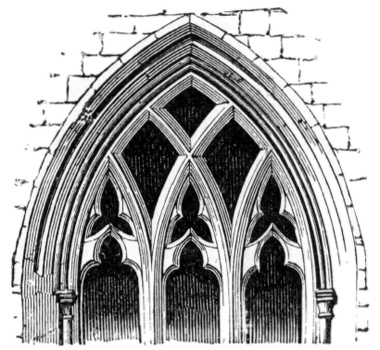
The Decorated vaulting was built when the chapel was enlarged in the fourteenth century. The foliage of its bosses is very beautiful; the water-lilies especially of the third boss, so suggestive of Oxford streams, and the roses a little further east, are a happy combination of naturalistic treatment with decorative restraint. It will be noticed that the vaulting does not run true in the third bay, the Decorated work there having been somewhat awkwardly joined to the Early English of the second bay. That part of the old wall which forms the pier at the juncture has been left in a strangely rough condition; the builder having seemingly given up the problem of fitting the vaults to the unequal spaces of the bays, and left the pier as a simple bit of old wall, without even a moulding to mark its juncture with the vault.
A prominent feature in the Latin Chapel is the old oak stalling, which a second inspection proves to be patchwork. The returned stalls at the west end probably belonged to the choir of the conventual church, and in that case would have been fitted in here when Dean Duppa "adorned" the choir by destroying the old wood-work. Near to these is some of the work prepared for Cardinal Wolsey's new chapel. The poppy-heads are good specimens of wood-carving, and contain a monogram I.H.S., a heart in a crown of thorns, a cardinal's hat, and other devices. The pulpit, with its delicate canopy, an excellent specimen of seventeenth century wood-work, was formerly the Vice-Chancellor's seat in another part of the church, occupied by him during university sermons. It was then used by the Regius Professor of Divinity for his lectures, but since the altar was restored six years ago, the chapel has been no longer used as a lecture room. At the time when it was refitted, a handsome ogival arch was found in the wall near the north end of the altar: the moulding is deeply recessed, and once the arch terminated in what must have been an ornate finial. The top of this finial has been cut down to a level with the window ledge, and the face of the moulding hacked off to make the wall flat for the panelling, which has now been removed. It was probably the "Easter Sepulchre," where the Host was deposited on Good Friday, but it may have been the tomb of the founder of the chapel. The curious break in the masonry at the back has not been yet explained.
The wall behind the altar is pleasantly hung with Morris velvet. The altar itself was the high altar before the restoration of 1870. In 1890 new legs were made for it out of the old organ screen, and it was placed in its present position.
The eastern window (inserted as a memorial to Dr. Bull) is a pathetic instance of the corrupt following of Mr. Ruskin, which also inflicted upon Christ Church the gaunt Meadow Buildings. It is, of course, really as unlike Mr. Ruskin's well-loved Venetian work as anything can possibly be: as heavy as that is light, as clumsy as that is graceful, it is ugly and cold and dead; but it represents a genuine enthusiasm of the fifties, and commands our respect as an honest though mistaken effort, a landmark in the history of the architectural revival. It also illustrates a truth which one is apt sometimes to forget,—that it is easy to appreciate beauty, and very hard to create it.
Fortunately it is nearly lost sight of in the splendid Burne-Jones glass which fills it, and represents another side of the artistic revival not less important than the architectural.
Glass in Latin Chapel.—The beautiful windows at the side are filled with fine fourteenth century glass, which was replaced after a long period of exile by Dean Liddell. In the middle of each light is a figure in canopy work, the rest of the light being covered with "quarries,"—that is, diamond-shaped pieces of glass with leaves and flowers lightly burnt upon them. The spaces in the tracery are ornamented with curious medallions, and the borders with various beasts, as in St. Lucy's Chapel, monkeys among them. The Courtenay Arms—Three Torteaux—suggest that the family may have contributed towards building the chapel. Beginning at the west, the first window contains a St. Catherine in the first light, next a Madonna and holy Child (the blue pattern at the back of these figures should be noticed); next a figure of St. Frideswide, or her mother Saffrida.
The second window contains the figure of an archbishop, holding a cross curiously blended into a crooked pastoral staff; angels are on either side.
The next has St. Frideswide in the centre, with St. Margaret and St. Catherine at her side. The patroness holds the curiously foliated sceptre which has led to the identification of her figure in the choir boss, and Catherine handles her wheel and sword in the same way as her statue over the dean's stall in the choir. The last window on this side is by Clayton and Bell, and a particularly feeble one.
The St. Frideswide window at the east end of the Latin Chapel was designed by Sir E. Burne-Jones and executed by Messrs. Powell of the Whitefriars Glass Works, the firm which is now making the glass for the mosaics at St. Paul's. "Burne-Jones, an Oxford undergraduate, destined for the Church, but gifted with high powers of romantic design, sought out Rossetti towards June 1856, and showed him some drawings. Rossetti told him at once that he ought to be, and must be, an artist, and he became one." In the next year Rossetti drew the attention of the Powells to the young artist, and they had the penetration to recognise his worth and to employ him. But though this is one of the first windows that Burne-Jones ever designed, it is one of his best. Better suited (as many think) to the purpose of a window, at all events in this enclosed chapel, than the freer method of the other glass, it carries on the best traditions of the craft, in its infinite variety of gem-like colour and complexity of detail; while it attains a degree of perfection in pictorial effect and figure-drawing which was impossible during the great era of mediæval glass-painting. The death of the saint, with its lovely effect of light through the latticed window, for instance, and the picture of her in the pig-sty, would be perfect as finished pictures, and yet do not for an instant outstep the convention which is necessary for their function as part of a window. The fact that the subjects are a little crowded is not the artist's fault. Mr. Woodward, the architect to whom the commission was due, made an unlucky mistake about the measurements, being in very ill-health at the time, and indeed on the point of death. Mr. Burne-Jones' cartoon had therefore to undergo a mechanical reduction which has slightly affected the clearness of the designs. The colour is, in spite (or rather because) of its radiant variety, not so immediately attractive to everyone as that of the other Burne-Jones windows; but when one has sat down for five or ten minutes and deciphered the various scenes, its unapproachable beauty becomes apparent, and each succeeding visit deepens the impression of the splendour and poetry of this incomparable work.
The scenes depicted are, by the artist's own account, as follows:—
First Light.
St. Frideswide and her companions brought up by St. Cecilia and St. Catherine.
St. Frideswide founds her first convent.
A messenger from the King of Mercia demands her in marriage.
The King comes to take her by force, and the first convent is broken up.
Second Light.
Flight of St. Frideswide to Abingdon.
The King of Mercia and his soldiers in pursuit,
The Flight continued.
The Pursuit continued.
St. Frideswide takes refuge in a pig-sty.
Third Light.
Flight of St. Frideswide to Binsey.
The King of Mercia in pursuit.
St. Frideswide founds a new convent at Binsey.
Her merciful deeds.
Fourth Light.
Return of St. Frideswide to Oxford.
The Siege of Oxford by the King of Mercia.
The Siege continued.
The King struck blind.
The Death of St. Frideswide.
In the tracery above are the trees of life and of knowledge, and a ship of souls convoyed by angels.
SECTION OF TOWER, WITH A COMPARTMENT OF BAY AND CHOIR, BEFORE THE RESTORATIONS (Britton).
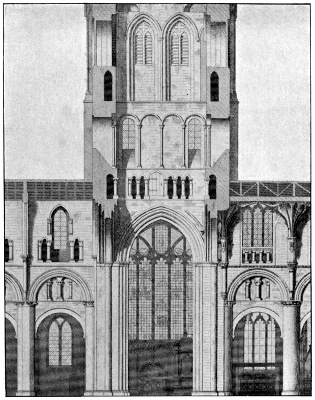
This east window was purchased with money left by Dr. Bull (1853), to whom there is a monument against the western wall. There are also brasses to the eminent Dr. Mozley (Regius Professor of Divinity till 1878), Dr. Ogilvie (1873), Dr. Shirley (1866), Dr Barnes (1859), Archdeacon Clerke (1877).