Chapter III · (continued 2)
Reading edition
the crypt.
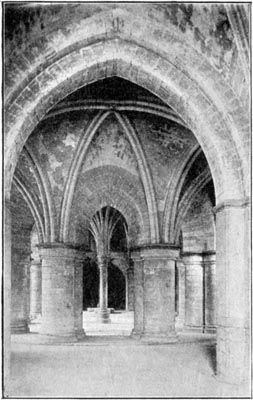
The Main Crypt.—Returning through the passage under the steps that lead up to the choir, we turn to the right into the crypt which originally supported Conrad’s “glorious choir.” On the wall as we enter we may notice some diaper-work ornamentation, interesting from the fact that a similar decoration may be traced on the wall of the chapter house at Rochester for Ernulf who built the westward crypt, was afterwards made Bishop of Rochester. Willis tells us that there are five crypts in England under the eastern parts of cathedrals, namely, at Canterbury, Winchester, Gloucester, Rochester, and Worcester, and that they were all founded before 1085. “After this they were discontinued except as a continuation of former ones, as in Canterbury and Rochester.” This crypt of Ernulf’s replaced the earlier one set up by Lanfranc; Willis thinks it not impossible that the whole of the pier-shafts may have been taken from the earlier crypt. “The capitals of the columns are either plain blocks or sculptured with Norman enrichments. Some of them, however, are in an unfinished state.” He describes minutely one of the capitals on the south-west side. “Of the four sides of the block two are quite plain. One has the ornament roughed out, or “bosted” as the workmen call it, that is, the pattern has been traced upon the block, and the spaces between the figures roughly sunk down with square edges preparatory to the completion. On the fourth side, the pattern is quite finished. This proves that the carving was executed after the stones were set in their places, and probably the whole of these capitals would eventually have been so ornamented had not the fire and its results brought in a new school of carving in the rich foliated capitals, which caused this merely superficial method of decoration to be neglected and abandoned. In the same way some of the shafts are roughly fluted in various fashions. The plain ones would probably have all gradually had the same ornament given to them, had not the same reasons interfered.” The crypt then stands as it was left by Ernulf except that some of the piers were afterwards strengthened and one new pillar was inserted in the aisle by William of Sens, in order to fit in with the new arrangement of the pillars in the choir which he was then rebuilding. It is therefore, of course, the oldest part of the church, and remains a most beautiful and interesting relic of Norman work in spite of the hot water pipe apparatus which now disfigures it, and its general air of unkempt untidiness. There are signs, however, that in this respect there is likely to be some improvement. The floor is being lowered to its original level by the removal of about a foot of accumulated dirt which had been heaping itself up for the last eight hundred years and had at last entirely smothered the bases of the columns, and it is even whispered that the part now cut off and used as the French church, may be opened out and restored to its original position as part of the main crypt.
According to Gervase, the whole of the crypt was dedicated to the Virgin Mary. Here stood the Chapel of Our Lady Undercroft, surrounded by Perpendicular stone-work screens, from which the altar-screen in the choir above was imitated. The shrine of the Virgin was exceedingly rich and was only shown to privileged worshippers: traces of decoration may still be seen in the vault above. It was at the back of this shrine that Becket was laid between the time of his murder and his translation to the resting-place in the Trinity Chapel.
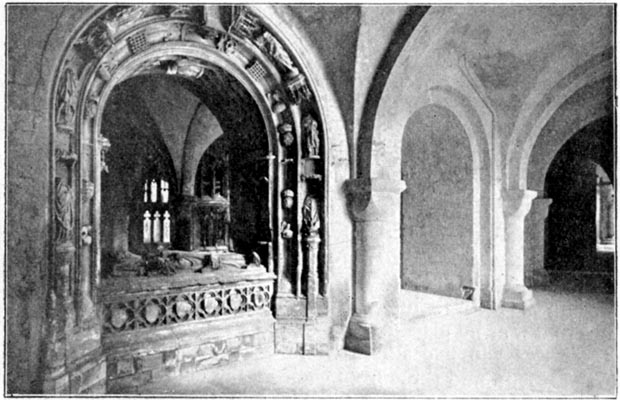
In the main crypt we may notice the monument of Isabel, Countess of Athol, who died in 1292; she was heiress of Chilham Castle, near Canterbury, and grand-daughter of King John. She was twice married, her second husband being Alexander, brother of John Baliol, King of Scotland. The monument of Lady Mohun of Dunster is in the south screen of the Chapel of Our Lady. She was ancestress of the present Earl of Derby, and founded a perpetual chantry. Lastly, here is the tomb of Cardinal Archbishop Morton, the friend of Sir Thomas More, and the faithful servant of the House of Lancaster; it was he who brought about the union of the Red and White Roses by arranging the marriage of Henry of Richmond with Elizabeth of York. As Henry VII.’s Chancellor he made great exactions under the euphonious title of “Benevolences,” and propounded the famous dilemma known as “Morton’s Fork,” by which he argued that those who lived lavishly must obviously have something to spare for the king’s service, while those who fared soberly must be grown rich on their savings, and so were equally fair game to the royal plunderer. He lies in the south-west corner of the crypt, and his monument, which has suffered considerably at the hands of the Puritans, bears the Tudor portcullis and the archbishop’s rebus, a hawk or mort standing on a tun.
st. gabriel’s chapel.
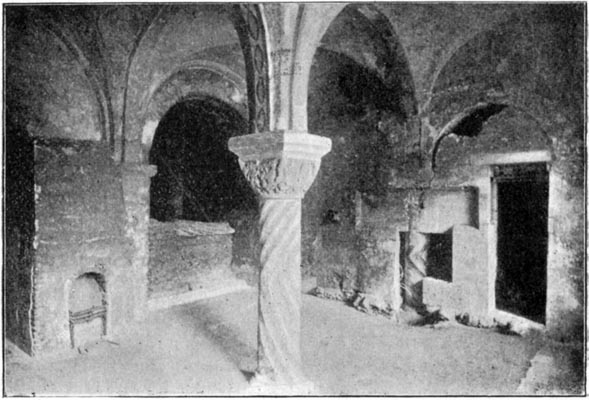
In the south-east corner, under Anselm’s Tower, is a chapel generally known as that of St. John, sometimes as that of St. Gabriel. It has been divided into two compartments by a wall. There are some very interesting paintings[2] on the roof, representing Our Lord in the centre of the angelic host, the Adoration of the Magi, and a figure of St. John; this work is believed to be of the thirteenth century. The central pillar of this chapel, with the curved fluting in the column and the quaintly grotesque devices of the figures carved on the capital, is well worthy of close examination. The grate that we see here was erected by the French Protestants, large numbers of whom fled to England during the persecution which was instituted against their sect in 1561. They were welcomed by Queen Elizabeth, and allowed to settle in Canterbury, where the cathedral crypt was made over to them to use as a weaving factory. It is possible that the ridges in the floor of St. John’s Chapel are marks left by their looms, but more evident trace of their occupation is afforded by the inscriptions in French painted on the pillars and arches of the main crypt, and again by the custom which still survives of holding a French service in the south aisle of the crypt; this part has been walled off especially as a place of worship for the descendants of the French exiles, and here service is still held in the French tongue. Alterations have been lately made by which the French service is held in the Black Prince’s Chantry, and the part of the crypt formerly walled off has been merged with the rest of the crypt, which is thus completely thrown open. Access to the French church is now obtained from the crypt, and not from outside. This chantry was founded by the Black Prince in 1363 to commemorate his marriage with his cousin Joan, the “Fair Maid of Kent.” Here, according to the prince’s ordinance, two priests were to pray for his soul, in his lifetime and after; the situation of the two altars, at which the priests prayed, can still be traced. On the vaulting we see the arms of the prince, and of his father, and what seems to be the face of his wife. In return for the permission to institute this chantry, the prince left to the monastery of Canterbury an estate which still belongs to the Chapter, the manor of Fawkes’ Hall. This was a piece of land in South Lambeth, which had been granted by King John to a baron called Fawkes. His name still survives in the word “Vauxhall.”
in the main crypt, with tomb of cardinal morton (see p. 99).
The Eastern Crypt.—The eastern portion of the crypt, under the Trinity Chapel and the corona, is a good deal more lofty than Ernulf’s building. We noticed the ascent from the choir and presbytery to the Trinity Chapel, and it is, of course, this greater elevation of the cathedral floor at the east end which accounts for the greater height of the eastern crypt. The effect, both above and below, is exceedingly happy. The most striking thing about the interior of the cathedral is the manner in which it rises—“church piled upon church”—from the nave to the corona, and this characteristic enabled William the Englishman to build a crypt below which has none of the cramped squatness which generally mars the effect of such buildings. “The lofty crypt below,” says Willis, “may be considered the unfettered composition of the English architect. Its style and its details are wholly different from those of William of Sens. The work, from its position and office, is of a massive and bold character, but its unusual loftiness prevents it from assuming the nature of a crypt.... There is one detail of this crypt which differs especially from the work above. The abacus of each of the piers, as well as that of each central shaft, is round; but in the whole of the choir the abacuses are either square, or square with the corners cut off.”
It was in the smaller eastern crypt, which formerly occupied the site of William’s building which we are now examining, that Becket was hastily buried after his assassination, when his murderers were still threatening to come and drag his body out, “hang it on a gibbet, tear it with horses, cut it into pieces, or throw it in some pond to be devoured by swine or birds of prey.” And from that time until the translation of the relics in 1220, this was the most sacred spot in the cathedral, and it was known, down to Reformation times, as “Becket’s tomb.” Hither came the earliest pilgrims in the first rush of enthusiasm for the newly-canonized martyr. And here Henry II. performed that penance, which is one of the most striking examples of the Church’s power presented by history. We are told that he placed his head and shoulder in the tomb, and there received five strokes from each bishop and abbot who was present, and three from each of the eighty monks. After this castigation he spent the night in the crypt, fasting and barefooted. His penitence and piety were rewarded by the victory gained at Richmond, on that very day, by his forces over William the Lion of Scotland, who was taken prisoner, and afterwards, recognizing the power of the saint, founded the abbey of Aberbrothwick to Saint Thomas of Canterbury.