SANTIAGO. THE CAPITAL OF CHILI. (continued 2)
Reading edition

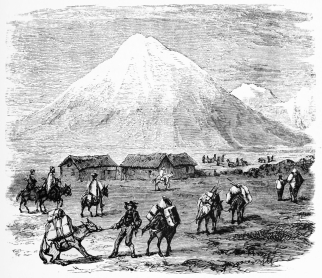
A STATION IN THE MOUNTAINS.
makes the difference exceeding small. Long trains of mules are passing up and down the mountains, and their numbers will constantly increase until the Pacific sea-ports will see nothing that is grown or used in the country which Chili so ruthlessly robbed. One great difficulty, however, lies in the fact that from April to November the mountain passes are blockaded with snow, and it is always dangerous, and often impossible, to make the journey. Native couriers, who use snow-shoes, and find refuge in “casuchas,” or hollows of the rocks, during storms, cross them the year round, carrying the mails. Sometimes, indeed often, they perish from exposure or starvation, or perhaps are buried under avalanches. The passes are about thirteen thousand feet high, and are swept by winds that human endurance cannot survive. During the summer the journey is delightful, and though attended by many discomforts, has its compensations to those who are willing to rough it, and who are fond of mountain scenery. Ladies often venture, and enjoy it. Not long since a party of thirteen school-ma’ams from the United States, who are teaching under contract with the Argentine Government, crossed the mountains to Chili, and had “a lovely time.” Plenty of mules and good guides can be secured at the termini of the railways, but travellers have to carry their own food and bedding. There are no hotels on the way, but only “schacks,” or log houses, which furnish nothing but shelter. Very often people who are not accustomed to high altitudes are attacked with sirroche, from which they sometimes suffer severely.
The road over the mountains is always dangerous, clinging as it does to the edge of mighty precipices and upon the sides of mountain cliffs, and only trained mules can be used on the journey. During the winter season the winds are often so strong as to blow the mules with their burdens over the precipices, and leave them as food for the condors that are always soaring around. These birds know the dangerous passes, and keep guard with the expectation of seeing some traveller or mule go tumbling over the cliffs. Cowhide bridges, the construction of which is not satisfactory to nervous men, stretch across the ravines after the manner of modern suspension-bridges, and a floor or path, made of the branches of trees lashed together with hides, and just wide enough for a mule to pass, is laid. Travellers usually dismount and lead their mules when they cross these fragile structures, for the hide ropes which are intended to keep people from stepping off do not look very secure. The oscillation of these bridges is very great, and a man who is accustomed to giddiness will want to lie down before he gets half-way over. It is remarkable that so few accidents happen, and when they do occur it is usually because a traveller is reckless or a mule is green. The foxes sometimes gnaw the hides, but no accidents have occurred from this cause for many years.
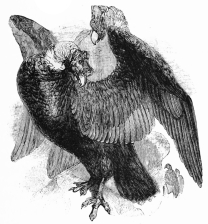
THE CONDOR.
The journey on mule-back usually takes five days of travel, at the rate of twenty or thirty miles a day, but good riders, with relays of mules, often make it in three days. The whole route is historical, as it has been in use for centuries. There is scarcely a mile without some romantic association, not a rock without its incident; and tradition, incident, and romance line the path from end to end. The Incas used the path before the Spaniards conquered the country, and Don Diego de Almagro crossed it in 1535 as he passed southward to Chili after the conquest of Peru.